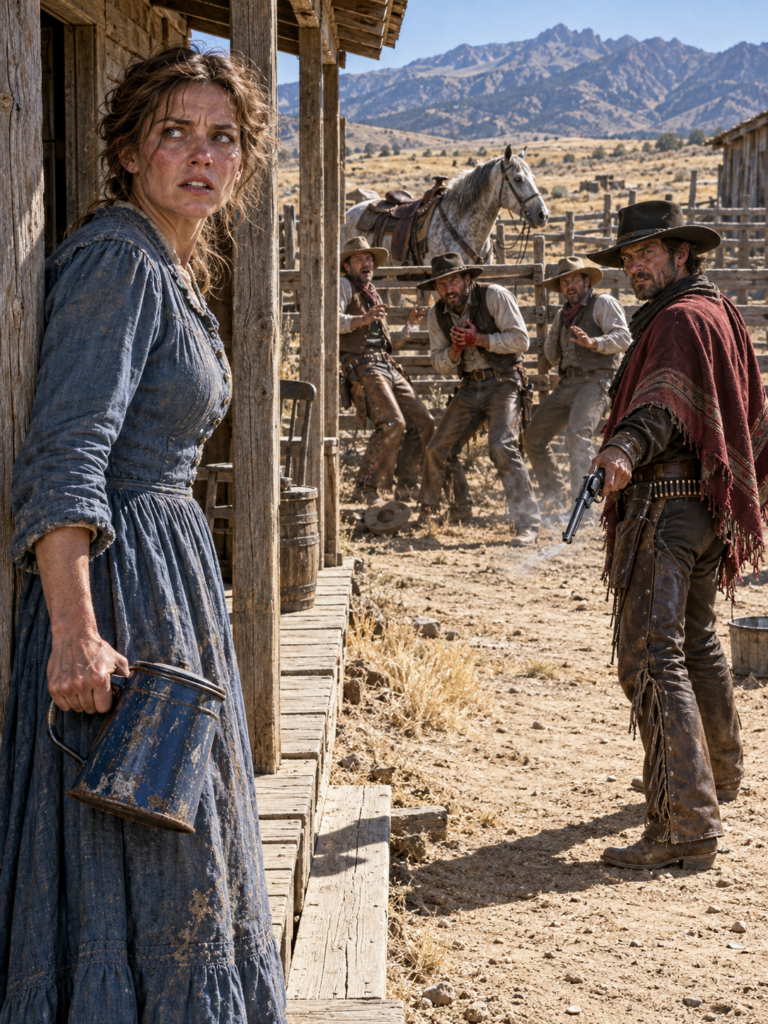
His fingers closed around the rifle’s worn stock, but he did not lift it.
The rider on the ridge remained still.
Ella rose from beside the broken fence, hammer in hand.
“Is he one of Thorne’s men?”
“Yes.”
“Then why hasn’t he come down?”
“He’s looking for something.”
“What?”
The stranger’s jaw tightened.
“Me.”
The black horse shifted sideways. Its rider watched another moment, then disappeared among the aspens.
Only when the trees swallowed him did the stranger release his grip on the rifle.
Ella noticed the small movement.
“You know him.”
“Deacon Mercer.”
The name meant nothing to her, but the way he spoke it made her uneasy.
“What’s he done?”
“Enough.”
“That isn’t an answer.”
“No, ma’am.”
She lowered the hammer.
“I’ve paid you to protect this land, Mister. I’m not asking you to tell me every mile you’ve traveled. But if someone is watching my house because of you, I deserve to know.”
He looked at her then.
And for the first time she saw something beyond his practiced stillness.
Not fear for himself.
Fear that she might pay for whatever had brought him there.
“Mercer worked with men my father knew,” he said. “He’s carried a gun for Major Thorne. If he comes close, don’t try talking him out of anything.”
“Is that all?”
“It’s what I can tell you.”
Ella hated the answer.
She hated more that she believed his warning.
They finished repairing the gate in silence.
He held the rail steady while she drove the final nail. When she tested the hinge, the gate swung cleanly for the first time in weeks.
Henry would have approved.
The thought hurt so sharply that she turned away.
The stranger noticed but did not ask.
By late afternoon, he had inspected the fence line and found two more places where wire had been cut. Ella accompanied him, keeping count of the damaged sections. He never told her to return to the cabin, though he watched the distant trees.
At Willow Spring, the water ran cool and steady from beneath the stones.
Everything else in the valley was drying up.
“Thorne has four thousand head,” Ella said. “He thinks that gives him the right to take the one thing Henry and I worked hardest to keep.”
The stranger crouched beside the spring.
“And what do you think?”
“I think thirsty cattle are innocent. Their owner isn’t.”
He looked up.
Something like respect crossed his face.
At the house, Ella brought him bread and beans. He ate on the porch, declining her offer of Henry’s chair inside.
She sat across from him.
“I won’t have you treating me like a child,” she said. “If there’s danger, tell me what you know. I make my own decisions.”
“Fair enough.”
“And if Saturday comes, I go to that land office whether Thorne likes it or not.”
“Then I’ll see you get there.”
“Unless I send you away.”
He met her gaze.
“Then I’ll go.”
The simple answer unsettled her more than a declaration would have.
After supper, she carried the blue tin outside.
“I counted the money again. It’s still seventy.”
“Keep it someplace safe.”
“That’s your pay.”
“When the job’s finished.”
She studied him in the fading light.
“Why do you care so much about a man who’s already buried?”
He looked toward the cottonwood.
For a long moment, she thought he would finally answer.
Instead, he reached into his pocket and brought out an old silver dollar. He turned it once between his fingers, hiding one face beneath his thumb.
“Some debts take a long time to settle.”
“Did Henry owe you something?”
“No.”
“Then what debt?”
He returned the coin to his pocket.
“Not one he ever asked me to pay.”
Before Ella could question him again, Scout lifted his head sharply toward the south.
The stranger rose.
He had heard something she hadn’t.
He crossed to the porch steps and looked toward the darkening ridge.
Then he turned back to her.
“Mrs. Carver, keep your door barred tonight.”
“Are you leaving?”
“Only as far as the spring.”
He stepped into the yard.
Ella reached for the lantern beside her chair.
“If Mercer comes here, I’ll not be left guessing.”
The stranger halted.
Then, without turning around, he said, “He once knew my father.”
Ella’s hand tightened around the lantern handle.
“And Henry?”
The stranger looked back.
“Your husband knew him too.”
Ella lifted the lantern and stepped off the porch toward him.
The lantern’s flame trembled as Ella crossed the yard.
“Stop walking away from me,” she said.
The stranger halted beside Scout.
For a moment, the only sound was the horse shifting its hooves against the hard earth.
“You said Henry knew Mercer.”
“He did.”
“Was it in Kansas?”
The stranger looked at her carefully.
“Why Kansas?”
“Because Henry was a deputy there before we married. He helped capture the Stroud gang. He never liked speaking of it.”
The stranger’s expression changed.
It was slight, but Ella saw it.
“You’ve heard of them.”
“Yes, ma’am.”
“Then tell me what they have to do with my husband.”
He took Scout’s reins from the fence post.
“There are things I promised not to speak of.”
“Promises to whom?”
He did not answer.
Ella raised the lantern higher.
“You’re standing on my land. You’re eating at my table. And you’ve frightened men who weren’t afraid of the sheriff. If something from Henry’s past has followed you here, I need to know.”
The stranger lowered his eyes.
“You’re right.”
She waited.
“But I can’t give you the answer you’re asking for. Not yet.”
Ella felt the distance between them harden.
“Then don’t expect me to trust you merely because you’re good with a gun.”
“I don’t.”
He led Scout toward the spring.
Ella watched him disappear through the cottonwoods, wondering why his refusal felt so much like a betrayal.
She had known the man barely a day.
Yet somehow, he had already become part of the fragile hope she was carrying toward Saturday.
That troubled her most of all.
***
Wednesday morning brought the smell of dust and another stretch of cloudless sky.
Ella was carrying water to the kitchen when Scout appeared at the gate without his rider.
Her heart lurched.
Then she saw the stranger coming up the lane on foot, leading Olaf Lindquist’s milk cow.
A torn length of rope dangled from the animal’s neck.
The stranger’s poncho had a fresh bullet hole near the hem.
Ella set down the bucket.
“What happened?”
“Trouble at Lindquist’s place.”
“Olaf?”
“Alive. So is Ingrid.”
She approached him, searching his face.
“Did Thorne send men?”
“Two.”
“Did you shoot them?”
“Not where it would kill them.”
His answer failed to comfort her.
He explained that Pike and Brock had been tearing down Olaf’s fence and dragging away his cow while the old farmer stood against them with a pitchfork.
The stranger had cut the rope with one shot and driven the riders away.
One of them had fired while retreating.
Ella touched the torn fabric at his side.
“That came close.”
“Close enough.”
“Your arm?”
“Untouched.”
She looked at the hole again.
“Sit down.”
He appeared ready to argue.
“That’s an instruction, Mister.”
He sat on the porch steps.
She examined the damage, then fetched her sewing basket.
The tear could be repaired.
She knew how to make a stitch hold.
Henry’s coats had taught her that.
As she worked, the stranger sat in his shirtsleeves, carefully keeping his hands away from her sewing.
“Olaf still intends to testify?” she asked.
“He said Ingrid would never let him do otherwise.”
A smile escaped her.
“He’s probably right.”
The stranger watched her hands.
“You’re good at that.”
“I ought to be. I’ve sewn enough quilts to keep half of Red Butte warm.”
“Hasn’t made you rich.”
“No. But it kept me here.”
He seemed to understand the difference.
When she finished, the stitches were small and firm.
He ran one thumb along them.
“My mother used to mend things that way.”
Ella looked up.
“Does she live nearby?”
“No, ma’am.”
He offered nothing further.
For once, Ella let the silence remain.
That evening, they ate beans and bread at the kitchen table.
He spoke of Arizona, of red desert hills and skies so wide a person could feel small beneath them.
Ella found herself laughing when he described Scout refusing to cross a shallow wash because the horse objected to a piece of floating wood.
“He’s particular,” the stranger said.
“So am I.”
“I’ve noticed.”
It was the first time she had heard him tease her.
The sound of her own laughter startled her.
She had scarcely laughed since January.
After supper, she told him about Henry’s silver dollar.
“He called it his lucky coin,” she said. “Carried it through the war. A bullet struck it at Shiloh. Left a dent deep enough to catch your fingernail.”
The stranger’s cup stopped halfway to his mouth.
“Did he?”
“He said the coin saved his life. Then one day he told me he’d spent it on the best thing he ever bought.”
“What was that?”
“He never said.”
The stranger lowered his cup.
Ella saw him turn his face toward the window.
“He liked keeping some things to himself,” she added.
“Maybe he figured some things were better shown than told.”
“That sounds like him.”
“And like a stubborn man.”
She laughed again.
“Yes. Exactly like him.”
But the stranger did not join her.
Later, after she had gone inside, he stood beneath the cottonwood with his hat in his hands.
Ella watched from the kitchen window.
He did not touch Henry’s wooden cross.
He simply stood there.
As though he had come a very long distance to reach that grave and could not yet bring himself to leave it.
***
Near midnight, he took Scout toward Willow Spring.
Deacon Mercer was waiting.
The older gunman sat on a black horse beyond the cottonwoods, where the moonlight reached only in broken patches.
“Seventy dollars,” Mercer said. “That’s what you’re worth now?”
The stranger stopped.
“What do you want?”
“Thorne offers a thousand if you ride out tonight.”
“I’m hired.”
“Your daddy would’ve laughed at that.”
“My father’s dead.”
“I remember.”
Mercer smiled.
“I remember teaching him how to shoot. Remember watching him teach you too.”
The stranger said nothing.
“Seventeen years,” Mercer continued. “I’ve wondered whether that boy from Kansas grew into a man fast enough to beat me.”
“You can keep wondering.”
Mercer’s smile vanished.
“Saturday, then.”
He turned his horse.
“Unless the widow decides you aren’t worth keeping.”
The stranger watched him ride into the darkness.
Then he looked back at Ella’s cabin.
A lamp still burned in her window.
He stood there until it went out.
***
Thursday morning, Ella returned his repaired poncho.
He thanked her with a seriousness that made the small task seem important.
Then they spent the morning setting broken fence rails and hauling loose stones away from the spring channel.
Ella knew every inch of that ground.
She showed him where Henry had diverted runoff during their first dry summer, and why the spring needed to remain free of loose dirt.
He listened.
When she asked him to lift a heavy rail into place, he did.
When he suggested moving another, she explained why it should stay.
He accepted her judgment.
It was a strange pleasure, working beside a man who did not mistake her determination for foolishness.
By sunset, they had restored the lower gate.
They stood looking across the valley.
The drought had browned the hills, but the western sky still carried a broad sweep of gold.
“I haven’t watched a sunset properly since Henry died,” Ella admitted.
The stranger leaned against the fence.
“Then this one’s worth watching.”
She turned toward him.
“What will you do after Saturday?”
“Depends.”
“On what?”
“Whether you’re safe.”
“I asked what you wanted.”
He seemed caught by that distinction.
Before he could answer, hoofbeats sounded behind them.
A tall black horse approached along the valley road.
Deacon Mercer drew up a few paces away.
“Evening, Mrs. Carver.”
Ella recognized him from the ridge.
“You’ve no business here.”
Mercer smiled without warmth.
“Just came to see whether your hired man has told you who he is.”
“He doesn’t owe you an introduction.”
“Oh, but he owes somebody.”
The stranger stepped forward.
“Ride on, Deacon.”
Mercer ignored him.
“Ask him about Ezra Stroud, widow.”
Ella went still.
The name belonged to the Kansas outlaw Henry had helped bring to justice.
Mercer tipped his hat.
“Ezra was his father.”
The words seemed to drain every sound from the valley.
“That boy watched his daddy go to the gallows,” Mercer continued. “And your husband helped put him there.”
Ella stared at the stranger.
“Is that true?”
“Yes.”
Mercer laughed softly.
“There’s your seventy-dollar protector.”
“Leave,” the stranger said.
Mercer turned his horse, satisfied with the wound he had opened.
“Saturday, boy.”
He rode away.
Ella faced the stranger.
“Ezra Stroud was your father?”
“Yes, ma’am.”
“Did you know Henry?”
“Yes.”
“Did you come here because of him?”
“Yes.”
Her throat tightened.
“To punish him for what happened to your father?”
“No.”
“Then why?”
The stranger looked toward the cottonwood.
“I gave Henry my word about something.”
“Tell me.”
“I can’t.”
“Even now?”
“I’m sorry.”
She stepped back.
All the kindness of the past three days suddenly seemed capable of another meaning.
His arrival.
His willingness to work for seventy dollars.
His refusal to speak his name.
His visits to Henry’s grave.
Had she opened her home to a man who had spent seventeen years nursing hatred against her husband?
“You need to leave.”
He did not protest.
“Mrs. Carver—”
“Go.”
He removed his hat.
“I won’t take your money. The job isn’t finished.”
“I don’t want your help.”
His face tightened, but his voice remained calm.
“Then I’ll respect that.”
He mounted Scout and rode toward the southern ridge.
Ella stood at the gate until darkness erased him.
Later, she placed the blue coffee tin on the porch rail.
If he returned for his pay, he could take it.
He never did.
What Ella could not see was the faint outline of a man sitting high among the aspens that night.
The stranger kept no fire.
He merely watched the light in her cabin, with his rifle across his knees.
***
Friday arrived with another hot, dry wind.
Olaf Lindquist came to Ella’s yard before breakfast.
He held his hat in both hands.
“Three riders came to my place at dawn,” he said.
Ella felt cold despite the heat.
“What did they want?”
“They said if I testify tomorrow, Ingrid will be burying me.”
Ella closed her eyes.
The old farmer’s hands shook.
“I’m ashamed, Ella.”
“Don’t be.”
“I gave Henry my word I’d stand up for you.”
“And I won’t have Ingrid made a widow because of me.”
She sent him home.
But she knew the trouble.
The published notice named Olaf as one of her two witnesses.
Martha Doyle was the other.
Without both, her proof could fail.
Ella saddled Biscuit and rode into Red Butte.
The land officer she trusted, Mr. Pell, had not yet returned from Cheyenne.
Pearl Dunn was behind the counter.
His expression was almost apologetic when she explained the threat.
“I’m afraid your situation is worse than that, Mrs. Carver.”
He opened a ledger.
“Your notice of final proof never appeared in the newspaper.”
Ella stared at him.
“That’s impossible.”
“Without the published notice, you cannot prove up tomorrow.”
“I paid the printer myself.”
“Then he failed you.”
She rode to the Clarion office.
Locked.
The printer, Mr. Ames, had supposedly left on Wednesday for a job in Denver.
Even the bundles of old editions were gone from the shelves.
A new publication would take weeks.
Weeks she did not have.
Dunn had already mentioned a sworn statement from Thorne’s foreman claiming she had abandoned the homestead after Henry’s death.
A lie.
But one that could ruin her claim if she failed to appear with the required proof.
Ella made it to Martha’s store before her composure broke.
“I’ve lost it,” she whispered.
Martha pulled her into an embrace.
“No, honey. Not yet.”
“I did everything they asked.”
“I know.”
“I stayed after Henry died. I worked the ground. I kept the spring. And now they’re saying I never even lived there.”
Martha held her until the tears subsided.
Then Ella wiped her cheeks and straightened.
“I won’t sign anything for Thorne.”
“Good.”
“I won’t marry him.”
“Better.”
“And I won’t surrender Henry’s work because Dunn tells me to.”
Martha nodded.
“Go home. I’ll see what I can learn.”
Ella rode back toward Willow Spring.
Not long after she left, the stranger entered the store.
Martha looked up sharply.
“You’ve been hard to find.”
“Mrs. Carver all right?”
“She’s about as far from all right as a woman can be.”
Martha explained the missing notices.
The stranger listened without interruption.
Then he looked at the old newspaper wrapped around a sack of coffee.
“When I bought coffee Monday, you wrapped it in the Clarion.”
“I wrap most everything in it.”
“Where do you keep your old copies?”
Martha pointed beneath the counter.
He knelt and pulled out a stack of folded newspapers.
His eyes moved over the print.
Then he stopped.
There, in a narrow column, was Ella Carver’s notice of final proof.
The proper dates.
The proper witnesses.
The proper land description.
Proof that someone had lied.
The stranger looked up.
“Don’t let anyone destroy these.”
Martha stared.
“Oh, my Lord.”
He gathered the copies carefully.
“Mrs. Carver needs to see them.”
“And you?”
“I’m going to find out why the printer left town.”
Martha watched him go.
For the first time, she understood that the stranger’s silence might have been concealing something other than revenge.
***
That afternoon, Ella sat beside Henry’s wooden cross.
The wind moved through the cottonwood leaves.
She brushed the dust from the grave.
“I don’t know what to do anymore, Henry.”
For months she had imagined the day a proper headstone would stand there.
Now even the land beneath the grave seemed threatened.
She remained until the shadows grew long.
Then she went inside.
Near dusk, Martha arrived carrying a basket.
“Eggs,” she announced.
Ella managed a tired smile.
“That’s kind of you.”
“Look at the paper around them.”
Ella unfolded it.
Her hands began to tremble.
Her notice.
Printed.
Dated.
Exactly as the law office required.
“Where did you find this?”
“Under my counter. Five more copies besides.”
Ella looked up, scarcely daring to breathe.
“How did you know?”
“Someone remembered the wrapping paper.”
“Who?”
Martha hesitated.
“The man you sent away.”
Ella pressed the newspaper against her chest.
“He’s still helping me?”
“He never stopped.”
Martha set the basket down.
“And there’s something else. He came into my store Monday morning asking where to find Henry Carver.”
Ella looked toward the grave.
“When I told him Henry had died,” Martha continued, “he took off his hat. Stood there looking as though I’d struck him.”
Ella could barely speak.
“Why didn’t you tell me?”
“He asked me not to.”
Martha took her hand.
“Whatever his reason, I don’t believe that man came to harm Henry.”
Ella looked down at the rescued newspaper.
She had accused him of coming for revenge.
And he had spent Friday finding the evidence that could save her home.
“Where is he?”
“He said he’d be back on the ridge by dark.”
Ella went to the porch and searched the distant aspens.
The sky was turning copper.
She had to speak to him.
Not because he had helped her.
Because she had judged him without knowing enough.
She returned to the kitchen and placed the newspaper inside her apron.
Then she heard horses.
Three of them.
Coming fast.
Cutter, Pike, and Brock rode through her damaged gate.
Ella rushed for Henry’s shotgun.
She reached the porch just as Cutter dismounted.
“Stay back!”
He kept coming.
She fired both barrels.
The shots passed high, scattering dust beyond the horses.
Before she could reload, Cutter seized the gun.
Brock caught her arms.
Pike dragged Biscuit from the corral.
“Thorne only needs you out of the land office till noon,” Cutter said.
Ella fought hard enough to draw blood from his cheek.
“Let me go!”
They tied her wrists and lifted her onto her own mare.
Through it all, the folded newspaper remained hidden in her apron.
Cutter pulled Biscuit’s reins toward Cottonwood Canyon.
Ella twisted in the saddle, looking desperately toward the ridge.
The aspens stood dark against the evening sky.
No rider appeared.
Then Cutter jerked the mare forward, and the cabin disappeared behind the cottonwoods.
Biscuit stumbled against a stone as Cutter dragged her up the canyon trail.
Ella tightened her knees and steadied the mare.
“Slow down,” she snapped. “You’ll lame her.”
Cutter looked back.
“Still giving orders?”
“She’s carrying me because you put me here. Don’t punish her for it.”
He swore but eased his horse.
The trail narrowed between low, dry slopes. Dust hung in the evening air, and the last sunlight was disappearing from the rocks above.
Ella counted the turns.
She knew this country.
Henry had once taken her through Cottonwood Canyon when they were searching for a stray cow.
At the second bend, she recognized the old line shack, nearly hidden beneath a stand of scrubby trees.
Cutter pulled Biscuit to a stop.
“Off.”
She dismounted carefully, refusing to let him see how badly her bound wrists hurt.
Inside, the shack smelled of dust, old leather, and dry timber.
Pike checked the window while Brock remained outside with the horses.
Cutter shoved a chair toward her.
“Sit.”
Ella remained standing.
“You’ve committed a crime for a man who only wants water.”
Cutter laughed.
“Major Thorne wants that spring. That’s reason enough.”
“And when he’s taken it, what do you suppose he’ll owe you?”
“More than your seventy dollars.”
She watched him closely.
His right hand was swollen where the stranger had wounded him earlier in the week.
He handled his revolver clumsily.
“You ought to have that looked at,” she said.
“I don’t need your concern.”
“It wasn’t concern. I don’t want you blaming me when you lose the use of it.”
Pike gave a short laugh.
Cutter turned on him.
“Keep quiet.”
Ella said nothing further.
But she had learned something.
The men were frightened.
Not of her.
Of the nameless gunman who might follow.
***
The stranger reached Aspen Ridge well after sunset.
He had stayed in town for the evening stage, speaking with the driver who had sold Mr. Ames his ticket.
Someone working for the Crown Tea had paid the printer’s fare to Denver.
The printing job had been a lie.
Now he had one more piece of Thorne’s scheme.
Then he saw Ella’s cabin.
The door stood open.
A shotgun lay in the dirt.
He dismounted before Scout had fully stopped.
Two spent shells lay near the porch.
There were deep hoofprints in the yard, signs of a struggle, and the fresh trail of four horses leading toward the canyon.
One track belonged to Biscuit.
He knew the mare’s gait.
For a moment, he stood utterly still.
Then he checked the cabin.
Ella was gone.
The blue coffee tin remained untouched on the porch rail.
He closed his eyes briefly.
“I gave my word, Henry.”
He mounted Scout.
“And I’m keeping it.”
***
Moonlight had begun to reach the canyon when Scout stopped above the line shack.
The stranger tied him behind a low rise and moved downhill on foot.
Brock was standing watch outside.
The stranger gave one low whistle.
Scout answered with a sharp whinny.
Brock turned toward the sound.
“Who’s there?”
He stepped away from the doorway.
The stranger moved out of the shadows.
A single blow from the heavy revolver brought Brock to the ground.
Inside, Ella heard the thud.
Cutter seized her arm.
“Don’t move.”
The door flew inward.
The stranger stood in the opening.
Pike raised both hands immediately.
“I told you,” he said hoarsely. “I told you who that was.”
Cutter dragged Ella in front of him.
“Put the gun down!”
“Let her go.”
“Not until—”
Cutter tried to raise his revolver.
The stranger fired once.
The shot struck the weapon and Cutter’s injured hand, sending the Colt clattering to the floor.
Cutter cried out.
Pike dropped to his knees.
The stranger crossed the room, keeping his gun trained on them.
“Mrs. Carver?”
“I’m all right.”
“Can you stand?”
“Yes.”
He drew his knife and cut the ropes around her wrists.
The moment her hands were free, she caught his sleeve.
“You came back.”
His face softened.
“I never stopped looking out for you.”
She wanted to tell him everything.
That she had found the newspaper.
That she was ashamed of what she had said.
That she believed him.
But outside, Brock groaned.
There were prisoners to secure, horses to settle, and a Saturday morning appointment that could still save Willow Spring.
Ella took a steadying breath.
“We have to get to Red Butte.”
The stranger nodded.
“Then we’d better be moving.”
***
They remained near the shack until the first light made the trail safer.
Cutter, Pike, and Brock were tied securely, and Brock’s head injury was checked before they were moved.
Ella’s wrists were bruised and swollen, but she could ride.
The stranger offered to lead Biscuit on the difficult turns.
“I know this trail,” she told him.
“Yes, ma’am.”
He handed back her reins.
They traveled down Cottonwood Canyon as daylight spread across the dry hills.
At the Lindquist farm, Olaf appeared beside his gate.
He stared at the three bound men.
Then at Ella.
“What happened?”
“These men tried to keep me away from the land office,” she said. “And I intend to be there by ten.”
Olaf’s face hardened.
He turned toward the house.
“Ingrid!”
His wife emerged onto the porch.
“I’m going,” she announced before he could explain.
Olaf nodded.
“So am I.”
He hitched his wagon.
The small procession continued toward Red Butte.
By the time the buildings appeared, Ella’s heart was beating so hard she could scarcely feel her bruised hands.
The courthouse clock stood near ten.
Too near.
At the jail, Sheriff Whitlock took charge of the prisoners.
Cutter, facing the consequences of the kidnapping, began speaking quickly.
He named Mercer.
He admitted that money from the Crown Tea had paid for the attack.
The stranger told Whitlock about the newspaper copies and the stage ticket.
It was enough to begin uncovering what had happened.
But Ella still needed to reach the land office.
And one man stood between her and its door.
Deacon Mercer.
***
Mercer waited at the foot of the steps, his black coat hanging open around his gun belt.
Major Thorne was already inside.
So was Pearl Dunn.
Mr. Pell had returned from Cheyenne that morning.
Mercer watched the stranger approach.
“Thought you’d come.”
“Move aside.”
“We settle it first.”
Ella stepped forward.
“I have business in that office.”
Mercer barely glanced at her.
“Not until this is done.”
Sheriff Whitlock appeared from the jail, but the stranger raised a hand.
Mercer was already watching every movement he made.
A careless approach could get someone killed.
The stranger understood what Mercer wanted.
Seventeen years of rivalry and resentment had brought the older gunman to this street.
And now Mercer had chosen the hour most likely to hurt Ella.
The courthouse clock showed four minutes before ten.
Ella caught the stranger’s sleeve.
“Don’t do this.”
He turned toward her.
“If I don’t, he keeps you from that door.”
“The sheriff—”
“Mercer won’t let him close enough.”
She looked into his face.
There was no eagerness there.
No pleasure in what was coming.
Only a terrible decision.
“Why?” she whispered. “Why have you done all this for Henry?”
The stranger reached into his pocket.
He brought out a silver dollar and placed it in her palm.
The metal was warm from his hand.
“Keep this for me.”
Ella felt an uneven place along its edge.
“What is it?”
“Something that belongs with your husband.”
He folded her fingers over the coin.
“Don’t look until this is over.”
Her eyes filled.
“Mister—”
He gently released her hand.
“Get through that door, Mrs. Carver.”
Then he stepped into the street.
Mercer smiled.
“You never draw first.”
“No.”
“Then we’ll use the third bell.”
The stranger nodded.
Mercer was smiling because he thought he had arranged the cruelest possible choice.
If the widow waited for the gunfight to finish, she might lose the chance to file before ten.
The stranger glanced toward the clock.
Then toward Ella.
He had brought her this far.
Now she had to be ready to move.
The first bell sounded.
Neither man moved.
The second bell followed.
Mercer’s fingers twitched.
At the third strike, his hand flashed toward his revolver.
The stranger drew.
One gunshot cracked across the street.
Mercer staggered backward, his revolver falling from his hand.
For an instant, he seemed unable to believe what had happened.
He had spent seventeen years wondering whether Ezra Stroud’s son had grown faster than him.
Now he knew.
He fell onto the dusty boards beside the steps.
The stranger remained standing.
His Colt was still.
Then he turned toward Ella.
“Go!”
She ran.
Past the fallen gunman.
Past the people gathering in the street.
Up the steps and through the land office door.
The clock was still striking ten.
***
Pearl Dunn looked up from behind the counter.
“You’re late, Mrs. Carver.”
Ella was breathless.
Her bruised hands rested against the wood.
“No.”
Dunn opened his mouth.
Mr. Pell spoke first.
“She entered before the clock finished striking, Mr. Dunn. She’s on time.”
Ella reached into her apron.
She unfolded the newspaper page and placed it on the counter.
“My notice.”
Martha hurried in behind her and laid down five more copies.
“All properly published,” Martha said.
Pell examined the dates.
Six consecutive weeks.
The notice had run exactly as required.
Dunn’s face changed.
Ella watched him.
“You told me it wasn’t printed.”
“There must have been some confusion.”
“Then explain why the copies disappeared.”
Martha stepped forward.
“I saw you taking old newspapers out of the print shop.”
Dunn looked toward Thorne.
Thorne said nothing.
Then Sheriff Whitlock entered.
“Cutter has made a statement.”
Dunn’s shoulders sagged.
He looked from the sheriff to Pell, then toward Thorne again.
At last, he began talking.
Major Thorne had paid him three hundred dollars to bury the notice, remove the newspaper copies, and help send Mr. Ames to Denver on a printing job that did not exist.
Thorne’s foreman had supplied the false claim that Ella had abandoned the homestead.
The threats against Olaf had been intended to destroy her final witness.
The kidnapping was the last attempt to keep her from arriving on Saturday morning.
Ella listened without interrupting.
Every piece of the cruelty she had endured now had a purpose.
It had never been about whether she could maintain the homestead.
It had been about whether Thorne could make her surrender before her claim became secure.
When Dunn finished, Pell looked at Thorne.
The cattle baron stood beside the wall, his face dark with anger.
“My cattle were dying,” Thorne said.
Ella faced him.
“I know.”
“I offered you a fair price.”
“You offered me a price. Then you tried to take what I refused to sell.”
“Water ought to be used.”
“It is used. Henry and I built a home around it.”
He opened his mouth.
Ella continued.
“And his grave is there.”
Thorne looked away.
“That doesn’t feed cattle.”
“No. But neither does putting innocent people out of their homes.”
Sheriff Whitlock stepped forward.
“Major, you’re coming with me.”
Dunn was taken into custody as well.
Then Mr. Pell called Olaf and Martha to the counter.
The witnesses swore that Ella and Henry had occupied and worked Willow Spring for the required five years.
Ella answered the questions about improvements, residence, and cultivation.
Her voice shook only once.
When Pell signed the papers accepting her final proof, she stood very still.
The patent would follow after the remaining processing.
But the false challenge had failed.
Her claim had survived.
Willow Spring was no longer something Thorne could frighten her into surrendering.
Ella pressed her hands to the counter.
For the first time since Henry’s death, she felt that the ground beneath her feet might truly remain hers.
***
Outside, the stranger sat on the boardwalk.
His hat rested between his hands.
He had no wound.
But there was weariness in his face that Ella had never seen before.
She sat beside him.
For a while, neither spoke.
Then she opened her palm.
The silver dollar lay against her skin.
A deep dent marked one side.
Ella stared at it.
Her breath caught.
“This was Henry’s.”
“Yes.”
She looked at him.
“How did you get it?”
He watched the street.
Then, slowly, he began.
“Summer of 1867. Kansas.”
Ella did not move.
“My father was Ezra Stroud.”
“I know.”
“He rode with a gang that robbed a bank. A cashier was killed. Deacon Mercer rode with them too.”
The stranger’s voice remained quiet.
“When the law came, Mercer ran. My father was caught. I was seventeen, hiding in a barn with a gun I hadn’t fired at anyone.”
Ella’s eyes stayed on his face.
“I thought they’d hang me beside him.”
He drew a breath.
“Then a young deputy found me.”
“Henry.”
He nodded.
“Your husband.”
Ella looked down at the coin.
“He could have taken me in. But he listened when I told him what happened. He decided I hadn’t earned my father’s punishment.”
The stranger swallowed.
“Then he took this dollar from his pocket and gave it to me.”
Ella could almost see it.
Henry as a younger man, standing in a dusty Kansas barn.
A frightened boy before him.
A choice no one else would ever know he had made.
“He told me to buy an honest meal,” the stranger continued. “And then go make myself an honest name.”
Ella felt tears gather.
“I never forgot that.”
He touched the brim of his hat.
“I promised him I wouldn’t tell anyone what he’d done. Maybe he knew helping Ezra Stroud’s boy would raise questions. Maybe he simply didn’t want thanks.”
The stranger looked at her.
“I kept that promise seventeen years.”
“All those years?”
“Yes, ma’am.”
“Why come now?”
“A driver in Arizona mentioned Henry Carver living near Red Butte. I figured it was time I returned his dollar and thanked him.”
His eyes moved toward the distant hills.
“When I got here, Martha told me he was dead.”
Ella closed her fingers around the coin.
“So you came to see me.”
“I came to pay a debt.”
“And you let me believe you wanted revenge.”
“I should have found a way to tell you more. But I couldn’t break the word I gave him.”
She looked at his hands.
Those hands had held Henry’s fence steady.
Carried back Olaf’s cow.
Helped find the missing papers.
Cut the ropes around her wrists.
And placed the old dollar into her palm when he thought he might not live long enough to explain.
“Henry told me he’d spent his lucky dollar on the best thing he ever bought.”
The stranger nodded.
“I reckon he meant a meal and a chance for a foolish boy.”
Ella shook her head.
“No.”
She wiped her eyes.
“He meant your life.”
The stranger looked away.
For a moment, the man who had faced Deacon Mercer without trembling could not find a word to say.
Ella reached for his hand.
“Henry would have been proud of the man you became.”
His fingers closed gently around hers.
“I tried.”
“I know.”
They sat together until the street began to empty.
At last, Ella took a breath.
“I owe you an apology.”
“You were protecting your husband’s memory.”
“I accused you of coming to dishonor it.”
“You had reason to be careful.”
“That doesn’t make me right.”
He looked at her.
She held his gaze.
“I’m sorry.”
He nodded once.
“Thank you.”
Then she glanced toward the road leading home.
“Will you come back to Willow Spring?”
His expression became guarded.
“The job’s finished.”
“I know.”
“You’re safe now.”
“I know that too.”
She looked at their joined hands.
“I’m not asking you to stay because I need a gun.”
His eyes met hers.
“Then why?”
Ella thought of her lonely kitchen.
The mended poncho.
The laughter over supper.
The way he listened when she explained Henry’s work.
And the tenderness with which he had stood beside a grave belonging to a man he had never properly thanked.
“Because I would like to know the man who kept my husband’s kindness alive for seventeen years.”
The stranger’s grip tightened slightly.
“Then I’ll come.”
***
For seven evenings, a lamp burned late in Ella’s barn.
From the cabin, she could hear the patient sound of steel against stone.
Tap.
Tap.
Tap.
Whenever she approached, the stranger met her at the door.
“Not yet,” he said.
Ella raised an eyebrow.
“You’ve taken over my barn?”
“Only borrowed a corner.”
“What are you making?”
“Something I promised.”
On the seventh evening, he led her beneath the cottonwood.
The wooden cross was gone.
In its place stood a carefully worked headstone, its lettering cut deep enough to withstand years of weather.
HENRY CARVER.
Below the name were the dates of Henry’s life.
Ella touched the cool stone.
“You made this?”
“Yes.”
“By yourself?”
“Took me seven nights.”
She traced the letters.
The stone was not grand.
But it was honest, strong, and made with a care money alone could never have purchased.
The stranger stepped back.
“I told you he’d have a proper marker.”
Ella turned toward him, tears in her eyes.
“You kept that promise too.”
He reached for his hat.
“Now the job’s done.”
She went inside and returned with the blue coffee tin.
She opened it.
Seventy dollars.
Every coin still there.
She held it out.
“Your wages.”
He took one silver dollar.
Only one.
Ella stared.
“That’s not our bargain.”
“One’s enough.”
“You earned the rest.”
“Henry paid that seventeen years ago.”
He placed the remaining money back into her hands.
Ella looked down at the seventy dollars that had once represented her husband’s final resting place.
Then she looked at the stone.
She understood.
Some things could be bought.
Others could only be given.
She put the tin aside.
“And what will you do now?”
The stranger looked across the valley.
“Scout and I have traveled a long way.”
“That wasn’t what I asked.”
He smiled faintly.
“No, ma’am.”
Ella stepped closer.
“I know you can go anywhere you please.”
“Yes.”
“And I know I can live here on my own.”
“I’ve never doubted it.”
She glanced toward the cabin.
“But there’s room at the table for another person. If he wants to sit there.”
For a moment, the stranger could only look at her.
Then he answered.
“I’d like that.”
Ella held out her hand.
He took it.
They walked back to the house beneath the fading light.
***
The autumn brought consequences for the men who had tried to take Willow Spring.
Deacon Mercer was buried in Red Butte.
Major Thorne sold the Crown Tea to help pay his legal expenses, but the proceedings against him continued.
Dunn and the men involved in the threats and kidnapping were brought to justice. Ned, the youngest of Thorne’s hired riders, was found still nursing his injured arm.
Mr. Ames returned from Denver to discover that his supposed printing commission had been part of a fraud.
He printed the truth in the Clarion.
Martha bought a hundred copies.
When Ella asked why she needed so many, Martha grinned.
“I’ve got plenty of eggs to wrap.”
For the first time in months, the talk around Willow Spring was not about how soon the widow would lose it.
It was about how she had refused to be driven away.
And about the stranger who had stood beside her without ever claiming the land, the house, or the woman as his own.
***
Winter came.
Snow settled along the valley ridges, and the nights grew cold.
Ella and the stranger worked together to keep the spring channel clear and the house supplied with wood.
She taught him how she kept accounts for butter, quilts, and feed.
He repaired a stubborn hinge and showed her how to handle Scout when the gelding grew nervous.
They shared the work without making it a contest.
Sometimes they disagreed.
Ella wanted to change the arrangement of the storage shed.
He argued that one wall needed shoring up first.
They examined it together.
She conceded the wall.
He conceded the new arrangement.
Both laughed at how seriously they had debated a shed.
There were evenings when Ella spoke about Henry.
The stranger listened.
He never acted as though Henry’s memory stood between them.
And Ella slowly learned that caring for someone new did not diminish what she had once shared with her husband.
One night, sitting beside the stove, she asked him whether he regretted the years he had spent living by his gun.
He took a long time to answer.
“Some of them.”
“Then why not stop?”
He considered the question.
“Maybe I’ve finally found a reason to.”
She looked at him.
“And what reason is that?”
He reached across the table.
“There’s work here that doesn’t need a pistol.”
Ella took his hand.
“There certainly is.”
She had already begun to imagine another spring.
Another crop.
Another chair at the table.
But she was determined that any future they shared should be chosen in daylight, with nothing left hidden between them.
***
When the new owner of the Crown Tea came to ask whether his cattle might water at Willow Spring, Ella listened.
The man offered a fair payment and agreed to terms that protected the homestead’s own needs.
She accepted.
The stranger stood beside her afterward.
“Thought you hated that ranch.”
“I hated what Thorne did.”
“And the cattle?”
“They never did anything wrong.”
He smiled.
“You’ve got a practical way of seeing things.”
“Someone has to.”
When spring returned, the official land patent arrived from Washington bearing Ella Carver’s name.
She read it twice.
Then a third time.
Five years of work.
A winter of grief.
Months of intimidation.
The desperate trip to Red Butte.
All of it had led to this document.
The homestead was hers.
She carried it outside.
The stranger was repairing a harness near the barn.
He put down his tools when he saw her face.
“Good news?”
She held out the paper.
“It’s mine.”
He read her name and smiled.
“Always should have been.”
Ella looked at the land around them.
The spring.
The cabin.
The repaired fences.
Henry’s headstone beneath the cottonwood.
And the man who had arrived intending only to repay a promise.
“I want to ask you something,” she said.
He waited.
“Not because you saved me. Not because you owe Henry anything. And not because I can’t manage this place without you.”
“I know.”
She stepped closer.
“I want you here because I love you.”
His eyes shone.
“I love you too, Ella.”
She smiled through her tears.
“Then perhaps we ought to talk about getting married.”
He laughed softly.
“Are you asking me?”
“Yes.”
He took her hand.
“Then my answer is yes.”
They married in June beneath the cottonwood.
Olaf Lindquist and Martha Doyle stood as witnesses.
The second time they had sworn to something important for Ella.
The ceremony was simple.
No grand promises of riches.
No declaration that the land belonged to the man now standing beside her.
Just two adults freely choosing to share what came next.
Henry’s memory remained part of the place.
And the life ahead belonged to them both.
***
Years later, visitors to Willow Spring sometimes noticed the old silver dollar resting atop Henry Carver’s headstone.
A deep dent crossed its face.
People occasionally asked why a valuable old coin had been left there.
Ella always gave the same answer.
“Because it belongs to a good man.”
No one in Red Butte ever learned the stranger’s real name.
Folks continued calling him Mister, or sometimes the man from Arizona.
Ella knew his name.
He had told her one quiet evening when there was no longer any reason to hide it from her.
She never repeated it without his permission.
And whenever someone pressed her, she merely smiled.
“A name is a thing a man ought to be allowed to keep.”
I was eight years old the Saturday she rode into Red Butte with her wrists bruised and a folded newspaper in her apron.
I saw the gunfight through a shutter.
Years afterward, Ella told me what had happened before and after that day.
She told me about the seventy dollars.
The missing notices.
The terrible secret of the Stroud gang.
And the silver dollar a Kansas deputy had once pressed into the hand of a frightened seventeen-year-old boy.
But she never gave me the stranger’s name.
I think I understand why now.
A name carved into stone tells you who rests beneath it.
It cannot tell you whether that person was merciful when cruelty would have been easier.
It cannot tell you whether a promise was kept after seventeen years.
Or whether a man offered protection without asking for anything in return.
Henry Carver had given a lost boy a chance to become something better than his father’s reputation.
Seventeen years later, that boy returned to protect the woman Henry loved.
And in doing so, he found a home of his own.
The seventy dollars remained with Ella.
The spring remained on her land.
The old silver dollar remained with Henry.
And the man whose name no one knew spent his remaining years answering to something far more important.
Husband.
Partner.
And, to the woman who had once hired him because she had nowhere else to turn, the man she freely chose to love.
Every summer, when the cottonwood leaves rustled above Henry’s grave, Ella would sometimes stand beside the stone and look down at the dented dollar.
Then she would turn toward the cabin.
Two cups would be waiting on the table.
And someone would be there to share the evening with her.