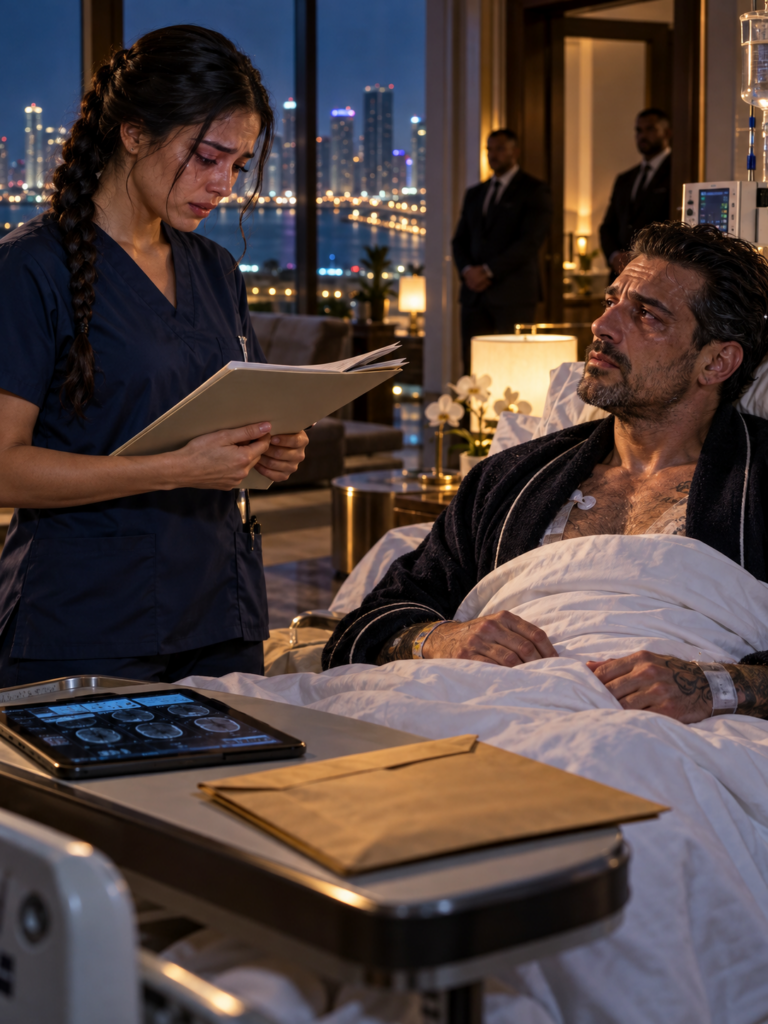
The drawer slid outward beneath Sophia’s hand.
Inside lay a thick manila envelope, its edges softened from years of handling.
Marco watched her.
“That belongs to the investigation,” he said.
“Then I imagine it belongs in this conversation.”
She lifted it carefully.
Her father had died when she was eight. For twenty-two years, she had wanted to know why.
Now the answer might be sitting inches from a man whose life depended partly on her care.
“Open it,” Marco said.
Sophia hesitated.
She had expected him to deny knowing her father.
She had expected a warning, perhaps an order to forget what she’d seen.
She had not expected permission.
She opened the envelope.
The first documents concerned vehicle maintenance.
Her father’s garage.
Records of cars serviced in Overtown.
Dates and payments belonging to a world that had always existed uncomfortably close to her childhood home.
“Your father repaired vehicles for people who worked with me,” Marco explained.
“He was a mechanic.”
“Yes.”
“An honest mechanic.”
Marco’s eyes lowered.
“By every account I received, yes.”
Sophia felt the first sting of tears.
“Then why was he investigated?”
Marco took a slow breath.
“There was a leak inside my organization. People were frightened. Information was being passed to the authorities, and the consequences were serious.”
“And someone blamed my father?”
“His name appeared during the investigation.”
“Was he responsible?”
Marco looked at her.
“No.”
The answer was immediate.
Sophia tightened her grip on the envelope.
“You knew he was innocent?”
“I learned that the accusation against him was wrong.”
“When?”
He did not answer quickly enough.
She understood that the timing mattered.
More than the documents.
More than the identity of the actual informant.
Because her father had not simply been accused.
He had been killed.
“Marco,” she whispered, “when did you learn that?”
He glanced toward the window.
“Too late.”
Sophia went completely still.
The man who normally spoke with absolute precision had chosen two words that concealed more than they revealed.
She placed the envelope on his blanket.
“That’s not an answer.”
“No.”
“Then give me one.”
He looked exhausted.
Not merely from chemotherapy.
From something older.
“I was young,” he began.
Sophia shook her head.
“Don’t.”
He stopped.
“Don’t tell me how young you were. My father was old enough to have a wife and an eight-year-old daughter. He had a family. He had a life.”
Marco accepted the words.
She stepped toward the window, desperate for air.
Miami stretched beneath them.
She could see the distant lights near the highway.
Somewhere beyond those lights was the neighborhood where her father had worked.
Where her mother had cried herself to sleep.
Where Sophia had learned that a person could disappear from the world without anyone powerful being required to explain why.
“I spent my entire childhood thinking someone must have known,” she said.
“Someone did.”
She turned sharply.
“Then why didn’t they tell us?”
Marco looked at the envelope.
“Because the people involved had reasons to keep the truth buried.”
“And you?”
He said nothing.
Sophia felt an almost unbearable mixture of anger and recognition.
During the previous eight weeks, she had watched this man endure illness with astonishing discipline.
She had seen him vulnerable.
She had seen him frightened of losing control.
She had even begun to care about him.
Now she realized that every quiet conversation, every small moment of trust, had taken place while he carried knowledge about her father’s death.
“Did you request me specifically?” she asked.
“Raldi selected you for the assignment.”
“But you recognized me.”
“By the second day.”
“And you said nothing.”
“Yes.”
The honesty hurt more than another lie might have.
Sophia pressed her palms against the edge of the desk.
For one terrible second, she considered leaving.
Removing her name from his assignment.
Walking out of the restricted ward and never returning.
She had every reason.
Then she looked at the infusion pump.
At his exhausted face.
At the folder of treatment records she’d been examining before finding her father’s name.
Something else was wrong.
For days, she’d been troubled by inconsistencies in Dr. Lorenzo Raldi’s notes.
A potentially relevant experimental treatment had been reviewed and dismissed without a clear documented explanation.
The same physician who had chosen her for the assignment.
The physician who had managed Marco’s illness for nine years.
She couldn’t yet say whether the omission was an error, a reasonable clinical judgment inadequately recorded, or something worse.
But she knew it required independent review.
She picked up the medical folder.
Marco watched her carefully.
“What are you doing?”
“My job.”
“After what I’ve told you?”
Sophia looked at him.
“My father’s death doesn’t change the treatment you’ve consented to. But it changes what I need from you.”
“What do you need?”
“The complete truth. And I need you to stop assuming your own judgment is enough.”
She returned the historical envelope to the drawer.
Then she closed it.
The sound was small and final.
“I will finish this shift,” she said. “Afterward, I’m going to decide whether I can continue as your nurse.”
Marco nodded.
“And there’s something in your treatment records that needs another specialist’s attention. I’m going to prepare the clinical findings and raise them through the appropriate channels.”
His expression sharpened.
“Is something wrong with the treatment?”
“I don’t know yet. That’s why it needs reviewing.”
She picked up the medication, checked the order and his identity, and resumed the care he required.
But the man watching her now understood something he had never faced in any boardroom.
Sophia Reyes had information he could not command her to forget.
She could expose it.
She could leave.
And she could insist that the truth about his medical care be examined without allowing him to buy her silence.
After completing the medication administration, she stepped back from the bed.
“Tomorrow,” she said, “you’re going to hear what I found.”
Then she lifted the medical folder from the bedside table and walked toward the door.
Sophia opened the door and stepped into the softly lit corridor.
The guard on duty glanced at the folder beneath her arm.
He said nothing.
She walked past him and stopped at the nursing station, where white peonies stood in a crystal vase.
For eight weeks, she had passed those flowers without thinking about them.
Now their expensive perfection seemed almost insulting.
Her father had worked with grease beneath his fingernails.
Her mother had counted grocery money at the kitchen table.
And Marco Esposito had spent decades surrounded by people who could make terrible decisions and then purchase the silence that followed.
Sophia sat down.
She opened the clinical records.
And she began working.
The medical problem required the same discipline as any other difficult case.
Marco was undergoing treatment for acute myeloid leukemia. His blood counts and treatment tolerance had been closely monitored, yet the response remained concerning.
Dr. Lorenzo Raldi, his longtime physician, had documented a review of an experimental treatment option.
The protocol involved an investigational cellular therapy approach combined with a targeted drug.
It was being studied in patients with particular disease characteristics.
There were risks.
Eligibility would require a full specialist assessment.
And no experimental treatment could promise recovery.
But what disturbed Sophia was not simply that Raldi had declined to recommend it.
It was the absence of a meaningful explanation.
There was no detailed comparison of alternatives.
No documented specialist consultation.
No clear account of the reasoning behind the decision.
For a patient facing a life-threatening illness, that gap mattered.
Sophia reviewed the records again.
Then she prepared a clinical summary for Dr. Vasquez, identifying the missing rationale and requesting an independent hematology consultation.
By morning, she was exhausted.
But her work was organized.
She had separated what the documents actually proved from what she merely suspected.
Raldi might have made a defensible clinical judgment.
He might have overlooked relevant information.
Or the decision might have been influenced by circumstances outside medicine.
Sophia refused to assume which explanation was true.
That was how mistakes became tragedies.
She had learned that lesson long before becoming a nurse.
When Dr. Vasquez arrived, Sophia handed her the summary.
“I believe this needs urgent independent review.”
The older physician read it.
Her expression grew serious.
“Have you discussed this with Mr. Esposito?”
“I told him there was a concern. I wanted the clinical review initiated before presenting conclusions.”
Dr. Vasquez studied the documents again.
“You’re asking us to question his personal physician.”
“I’m asking us to review an undocumented treatment decision.”
“Raldi has been treating him for nine years.”
“Then he should be able to explain the decision.”
Dr. Vasquez looked up.
For a moment, Sophia wondered whether she had gone too far.
Then the physician nodded.
“I’ll arrange the review.”
Sophia exhaled.
The first part was done.
The second was waiting behind Marco’s door.
When she returned to his room, he was awake, sitting against the pillows with his dark eyes fixed on the entrance.
“You didn’t sleep,” he said.
“Neither did you.”
He looked at the papers in her hand.
“What did you find?”
Sophia pulled a chair closer.
She explained the treatment option, the missing documentation, and the need for expert assessment.
Marco listened without interrupting.
When she finished, he looked at the papers.
“Raldi knew about this?”
“He reviewed it. I can’t tell you why he rejected it from the record.”
“Would it have saved me?”
“I don’t know.”
He looked up.
Sophia held his gaze.
“It’s an experimental approach. It may not work. You may not qualify. It may carry serious risks. But you deserve an informed discussion with a specialist.”
For several seconds, the room was silent.
Then Marco asked, “Why are you doing this?”
Sophia felt the question settle between them.
He wasn’t asking why a nurse would advocate for a patient.
He was asking why the daughter of a murdered man would fight for the life of someone implicated in his death.
“Because your medical care isn’t mine to sabotage,” she said.
His expression changed.
“And because my father was a good man. What happened to him was wrong. I won’t honor him by deliberately doing something wrong to someone else.”
Marco looked away.
For the first time, Sophia saw something close to shame on his face.
She stood.
“The specialist review is being arranged. The decision about what treatment to pursue will be yours, once you’ve received the information.”
“Thank you.”
“Don’t thank me yet. Ask difficult questions. And listen to the answers.”
A faint smile crossed his face.
“You’ve become very comfortable giving me orders.”
“I’m giving you medical advice.”
“Is there a difference?”
“An important one.”
He almost laughed.
But the laughter faded.
“Sophia.”
She stopped.
“The other matter. Your father.”
She turned.
“I’m not ready to discuss it.”
He nodded.
For once, he did not press.
Over the following forty-eight hours, the clinical situation changed.
An independent specialist reviewed Marco’s case.
The experimental protocol warranted formal evaluation.
The missing reasoning in Raldi’s notes raised additional questions, and Dr. Vasquez began examining the treatment decisions made over the preceding weeks.
Marco requested a direct explanation from Raldi.
The meeting took place behind closed doors.
Sophia wasn’t present.
When it ended, Raldi left the restricted floor.
He did not return.
Dr. Marcus Webb was brought in to assume responsibility for the oncology assessment and coordinate discussion with the Johns Hopkins trial team.
Sophia continued her nursing duties while the physicians reviewed eligibility, risks, and possible next steps.
Later that evening, Marco called her into his room.
He was sitting at the work desk beside the window, wearing a dark jacket over his hospital clothes.
It was an absurd attempt at appearing healthy.
Sophia noticed immediately.
“Your temperature?”
“Normal.”
“Blood pressure?”
“Acceptable.”
“Did Dr. Webb approve leaving the bed for this long?”
Marco sighed.
“You’re impossible.”
“That’s what the emergency department used to say.”
He gestured to the chair.
She sat.
“I owe you an explanation about Raldi,” he said.
Sophia waited.
“People within my organization knew I was ill. Not everyone, but enough.”
He glanced toward the closed door.
“Some of them have been calculating what happens when I no longer lead.”
“And someone wanted to hurry that along?”
“Not necessarily by killing me quickly.”
His voice hardened.
“A man who declines over months leaves time for other people to divide his authority.”
Sophia felt a chill.
“Raldi was involved?”
“I have evidence that he accepted money from people who wanted my recovery compromised.”
She looked at him.
“Have you given that evidence to the hospital?”
“The relevant information is being reviewed.”
“Marco.”
His eyes met hers.
“Whatever happens inside your organization, a physician deliberately compromising treatment is a matter for medical authorities.”
He studied her for a long moment.
Then he nodded.
“I understand.”
Sophia didn’t know how much of his statement was a promise.
She knew only that his physician had been removed, independent specialists were evaluating the treatment, and the dangerous intersection between his illness and his criminal organization had finally become visible.
There was another subject neither of them had yet resolved.
Her father.
That night, she returned to her apartment instead of remaining on the floor beyond her shift.
She sat at her kitchen table with a photograph of Augusto Reyes.
In it, he was laughing.
She was small enough to sit on his knee.
He had one enormous hand resting against her shoulder.
Sophia tried to imagine him as someone accused of betraying criminals.
It didn’t fit.
He had fixed cars.
Paid his bills.
Loved his wife.
Raised his daughter.
And somebody had decided his life was expendable.
The next morning, Sophia asked Dr. Vasquez for a confidential professional discussion.
She explained that she had discovered a previously unknown personal connection to her patient involving her father’s death.
She did not pretend that the situation was ordinary.
Dr. Vasquez listened.
Then she asked whether Sophia felt able to provide safe care.
“I have,” Sophia answered. “But I need to consider whether continuing is appropriate.”
“You’re entitled to step away.”
“I know.”
“And you don’t owe the patient an explanation beyond what’s necessary for continuity of care.”
Sophia looked down at her hands.
They were steady.
They always became steady when someone needed them.
But steadiness was not the same as peace.
“I want to finish the work I’ve started,” she said. “At least until his new treatment plan is established. After that, I want the arrangement reviewed.”
Dr. Vasquez agreed.
A week later, Marco’s specialists confirmed that he could proceed with the investigational treatment pathway under carefully supervised conditions.
Enrollment would not guarantee success.
But it offered an additional possibility that had previously been withheld from meaningful consideration.
When Marco heard the news, he said very little.
Sophia watched his face.
The man who had spent weeks preparing himself for death was now being asked to imagine surviving.
For someone accustomed to controlling outcomes, hope was a frightening thing.
The new treatment began.
It was demanding.
There were difficult days, severe fatigue, nausea, and periods when his laboratory results produced more questions than reassurance.
Sophia continued helping coordinate his nursing care.
And their conversations changed.
Marco began asking about her life outside the hospital.
She told him about Overtown.
About her mother.
About the small apartment above the tire shop.
He listened without trying to fill the silence.
Sometimes they discussed medicine.
Sometimes books.
Sometimes nothing important at all.
During a late shift, he told her about Palermo.
His grandmother’s house had stood above the harbor.
He remembered looking down at the ships and imagining the places they could take him.
He had left Sicily at nineteen.
He had not returned for more than two decades.
“Why not?” Sophia asked.
“Because I became someone I didn’t know how to bring home.”
She understood more than she wanted to.
He owned a house there now.
He had bought it years earlier but had never spent a night inside.
Sophia found herself imagining him on a balcony overlooking the Mediterranean.
Away from Miami.
Away from the guarded hospital room.
But she refused to confuse the possibility of a different future with absolution for the past.
One evening, Marco asked whether she hated him.
Sophia considered the question.
“I hate what happened to my father.”
“I know.”
“I hate that you knew enough to tell me something and chose silence.”
His face tightened.
“Yes.”
“And I don’t yet know what I feel about the rest.”
He nodded.
She appreciated that he didn’t demand reassurance.
He had no right to it.
The danger surrounding the hospital had not disappeared.
Nico, a man associated with the tensions inside Marco’s organization, had appeared several times near the restricted ward.
Security arrangements were increasingly strained.
Then the violence Marco had spent months keeping outside his room finally reached the hospital.
A confrontation erupted on the thirteenth floor.
Sophia was in the corridor when she realized someone nearby was in danger.
A patient named Daniel was caught in the disturbance.
She moved to protect him and help him reach safety.
The incident happened quickly.
Voices.
Sudden movement.
The terrible recognition that the protected floor was no longer secure.
Sophia was injured while helping Daniel.
Her ribs and shoulder were hurt, though she escaped without a life-threatening wound.
By the time the immediate danger passed, security personnel were rushing through the corridors.
Daniel was safe.
Sophia was shaken.
And Marco was furious.
When he saw her afterward, he looked at the injury to her shoulder.
Then he asked, very quietly, “Why didn’t you get clear?”
“Daniel needed help.”
“You could have been killed.”
“So could he.”
Marco looked away.
She recognized that expression.
He wanted someone to blame.
Someone to punish.
Some way to make his fear disappear by exerting control over the world.
“Don’t turn what happened to me into an excuse to make this worse,” she said.
He looked back.
“Sophia—”
“I’m injured. I’m frightened. And I need you to hear me instead of deciding what I should feel.”
He stopped.
Then he sat beside her.
For a while, neither spoke.
Eventually, he asked, “What do you need?”
“An explanation of how the security failed. Time to recover. And the right to decide whether I stay in this assignment.”
Marco nodded.
“You have it.”
For the first time, Sophia believed he understood the difference between wanting her safe and claiming authority over her.
Dr. Vasquez placed her on light duties while her injuries healed.
She also reminded Sophia that she could leave the assignment without penalty.
Sophia considered it seriously.
She was no longer choosing between her professionalism and a dangerous man.
She was choosing what kind of life she wanted after learning the truth about her own.
Several days later, Marco called her into his room.
He was sitting beside the window.
The afternoon sun illuminated his pale face.
“I’ve made a decision,” he said.
Sophia waited.
“I’m leaving Miami.”
She stared.
“When?”
“As soon as the medical arrangements permit.”
“And your organization?”
“I’m stepping away from its leadership.”
Sophia said nothing.
He looked out at the water.
“I’ve spent twenty-three years building a world that almost killed me. Then it endangered you and an innocent patient inside a hospital.”
He turned.
“I’m not going to spend whatever time I have left defending it.”
It was the most surprising thing he had ever told her.
Not because he was suddenly becoming innocent.
He wasn’t.
But because, for the first time, he was choosing to surrender the position that had defined his adult life.
“Where will you go?” she asked.
“Palermo.”
The word hung between them.
His grandmother’s harbor.
The house he had never slept in.
A medical clinic connected to his treatment program.
A place where he might continue care without remaining at the center of the organization that had threatened him.
Then he looked at her.
“Would you come?”
Sophia’s heartbeat changed.
“To Sicily?”
“Yes.”
“As your nurse?”
He hesitated.
“I can arrange independent medical care. You wouldn’t have to be responsible for me.”
“Then why are you asking?”
Marco’s eyes held hers.
For the first time since she had met him, the feared mafia boss seemed unable to find the words he needed.
“Because I want to know who you and I might be when there’s no hospital bed between us.”
Sophia stood completely still.
Then she looked toward the bedside drawer.
The envelope containing the truth about her father was still inside.
And she knew she could not give Marco an answer until she had opened that part of their history one final time.
She crossed the room, placed her hand on the drawer, and pulled it open.
The drawer opened beneath Sophia’s fingers.
The manila envelope lay exactly where she had left it.
She lifted it and carried it to the chair opposite Marco.
“Before I answer you about Palermo,” she said, “I need everything.”
Marco looked at the envelope.
“You deserve that.”
“Not the version that makes you look better. Not the version your people would approve of. Everything you know about why my father died.”
He nodded.
Sophia sat down.
She opened the file.
And Marco Esposito finally told her what he had concealed for more than twenty years.
In 2005, when he was a young man building power within the organization he would eventually lead, a federal informant had been discovered operating inside their circle.
Information had been leaked.
Criminal operations had been compromised.
Two men had died.
Fear spread through the organization.
And people desperate to identify the informant began searching for someone to blame.
Augusto Reyes worked outside the criminal organization.
He was a mechanic.
His garage serviced vehicles belonging to some of Marco’s associates.
He knew their faces.
He knew their cars.
But there was no evidence he had participated in their crimes.
When suspicion turned toward him, however, that distinction stopped mattering.
“The information against your father was circumstantial,” Marco said.
Sophia held herself still.
“Who believed it?”
“Men I trusted.”
“And you?”
His expression changed.
“I accepted their assessment.”
She looked down at the documents.
Her father’s name appeared beside a date that had divided her entire childhood into before and after.
“Did you order his death?”
Marco was silent.
Sophia looked up.
“Answer me.”
“Yes.”
The word landed between them without protection.
No excuse.
No careful qualification.
No appeal to youth.
He had authorized the killing of an innocent man.
Her father.
The person who had taught her how to ride a bicycle.
Who had repaired broken toys rather than replacing them.
Who had promised to attend every school play even when he had to close his garage early.
Sophia pressed her fingertips against the edge of the envelope.
For a moment, she couldn’t speak.
Then she asked, “When did you discover he wasn’t the informant?”
“After he was dead.”
“How long afterward?”
“Long enough that I had already lost any chance to stop what I’d ordered.”
She stared at him.
“You knew.”
“Yes.”
“All these years?”
“Yes.”
Her throat tightened.
“And you let my mother die without knowing her husband had been innocent.”
Marco lowered his eyes.
“I did.”
Sophia stood.
The chair scraped against the floor.
“My mother spent years wondering what he had done to deserve being killed.”
“I know.”
“No. You don’t.”
Her voice broke.
“You don’t know what it was like when she stopped singing in the kitchen. When she stopped going out. When she looked at me and tried to smile because I was all she had left.”
Marco didn’t interrupt.
“You took away her husband,” Sophia continued. “You took away my father. And you let us spend the rest of our lives wondering whether someone we loved had secretly been a criminal.”
Tears ran down her face.
She made no attempt to hide them.
Marco looked as though every word was deserved.
Because it was.
“I’m not asking you to forgive me,” he said.
“Good.”
“Nothing I say changes what happened.”
“Then why keep the file?”
He reached toward the envelope, then stopped.
“There’s something else inside.”
Sophia looked at him suspiciously.
“What?”
“Records of money I arranged to be sent after your father’s death.”
She turned the pages.
Receipts.
Scholarship records.
Education funds.
Payments continuing through her school years.
She read the dates twice.
Then she recognized them.
Financial assistance her mother had believed came from anonymous donors.
Tuition support.
Help with educational expenses.
Money that had allowed Sophia to remain in school when life became almost impossibly difficult.
Her stomach turned.
“You paid for my education?”
“I arranged financial support.”
“Without telling me?”
“Yes.”
“Why?”
Marco looked directly at her.
“Because I couldn’t repair what I’d done. It was something I could provide without placing another burden on your family.”
Sophia laughed once.
A terrible, disbelieving sound.
“You thought money could make up for my father?”
“No.”
“Then why do it?”
“Because doing nothing would have been another failure.”
She looked at the receipts.
He had helped fund her future.
But she had done the studying.
She had earned the grades.
She had worked through exhaustion and grief to become a nurse.
The money had not made her competent.
And the man who supplied it had no right to claim ownership of the woman she had become.
“Listen carefully,” she said.
Marco lifted his eyes.
“My education belongs to me. My career belongs to me. Whatever financial help you provided does not turn my life into something you created.”
“I understand.”
“And it doesn’t purchase my forgiveness.”
“I know.”
She returned the documents to the envelope.
Then she stood.
“I need time away from you.”
His face tightened.
But he nodded.
“Take whatever time you need.”
She left.
Not dramatically.
Not running.
She simply walked out of his room with the knowledge she had demanded and the right to decide what happened next.
For several days, Sophia kept her distance.
Dr. Vasquez arranged continuity of nursing care while Sophia considered her position.
She visited the old neighborhood in Overtown.
The tire shop had changed hands years earlier.
The buildings looked smaller than she remembered.
She stood across the street and thought of her father coming home with dirty hands and a paper bag containing the sweet bread she loved.
Then she went to the cemetery.
Her parents were buried not far apart.
Sophia knelt beside her father’s grave.
For years, she had carried the belief that the world had failed him.
Now she knew the failure had a name.
Marco Esposito.
She didn’t know whether she would ever forgive him.
Perhaps forgiveness wasn’t a single decision.
Perhaps it wasn’t even necessary for her to reclaim the future.
What mattered was that she finally knew her father had not betrayed anyone.
He had been an innocent man caught in the machinery of a criminal organization that valued suspicion above evidence and obedience above justice.
Sophia placed her hand against the headstone.
“Dad,” she whispered, “you didn’t do anything wrong.”
She stayed until the afternoon shadows lengthened.
When she returned to the hospital, she met Dr. Vasquez before going anywhere near Marco’s room.
“I need my professional assignment to end,” she said.
The older woman nodded.
“Is that what you want?”
“Yes. I’m grateful for the opportunity, but I can’t continue being responsible for his care with everything I now know.”
“Then we’ll arrange a transfer of responsibilities.”
Sophia felt unexpected relief.
She wasn’t abandoning an ill patient.
She was recognizing a boundary that had become necessary.
The medical team would continue treating him.
His survival would not depend on her remaining emotionally entangled in his life.
That distinction mattered enormously.
After the handover, she visited Marco.
He was sitting beside the window.
A book rested unopened in his lap.
“You’ve requested a reassignment,” he said.
“Yes.”
He nodded.
“Dr. Vasquez told me.”
“I need to be someone other than your nurse.”
Marco looked at her.
“And who do you want to be?”
Sophia considered the question.
“For now? Myself. Without having to measure every feeling against your medical condition.”
He closed the book.
“That’s fair.”
“And about Palermo…”
She paused.
His attention became absolute.
“I’m not making that decision as your employee.”
“I don’t want you to.”
“I would need independent work. My own responsibilities. The ability to leave whenever I chose.”
“Of course.”
“And I would need to see that you’re actually leaving the criminal organization behind. Not simply managing it from a prettier house.”
Marco looked toward the window.
For once, he didn’t offer an immediate assurance.
“It’s going to take time,” he said.
“I know.”
“There are responsibilities I can’t erase by announcing I’m finished.”
“I know that, too.”
He turned back.
“But I’ve already begun transferring authority. The evidence concerning the faction that interfered with my treatment has allowed me to remove people I no longer trust. I’m stepping away from active leadership.”
Sophia studied him.
“That doesn’t undo the harm your organization caused.”
“No.”
“And retirement doesn’t absolve you of your past.”
“No.”
She believed that he understood the distinction.
It was the beginning of accountability.
Not its completion.
“I’ll consider Palermo,” she said.
He nodded.
“That’s all I’m asking.”
Weeks passed.
Marco’s treatment continued under specialist supervision.
The experimental protocol remained difficult.
There were days of exhaustion, additional assessments, and the ever-present possibility that the disease would not respond as hoped.
But the clinical signs gradually offered cautious encouragement.
Sophia followed the broad progress of his care through information he voluntarily shared, no longer through privileged access to his records.
She also returned to working in medicine outside his private world.
The difference was important.
She needed to know that her decisions still belonged to her.
In time, she began speaking to Marco more frequently.
Not as nurse and patient.
As two adults trying to understand whether anything honest could grow from a history that contained terrible harm.
Some conversations were gentle.
Others were difficult.
Once, Marco mentioned the scholarship fund.
Sophia immediately interrupted.
“Don’t use that as evidence that you were secretly a good man.”
He looked at her.
“I wasn’t going to.”
“Good.”
“I know it doesn’t cancel what I did.”
“Then remember that.”
He did.
He learned not to ask for absolution.
Not to interpret her kindness as a promise.
Not to confuse her willingness to listen with an obligation to stay.
And Sophia learned something about herself.
She could acknowledge that Marco had committed an unforgivable wrong without allowing that wrong to determine every choice she made for the remainder of her life.
Her feelings were complicated.
They contained anger.
Grief.
Respect for the vulnerability he had finally shown.
And an affection she could no longer honestly deny.
But she refused to hurry.
Eventually, Marco received clearance to continue treatment through the affiliated medical arrangements in Palermo.
His departure from Miami became real.
The restricted floor at Mercy Private Hospital would no longer be his world.
The guards who had surrounded him were reassigned.
The men who had compromised his treatment lost access to his care.
His longtime physician’s conduct had been brought into the process of professional review.
And Marco began the long, imperfect work of disentangling himself from the organization he had led.
On the day before his departure, he called Sophia.
“Everything is arranged,” he said.
“For Sicily?”
“Yes.”
She was quiet.
He didn’t ask again whether she would accompany him.
He had learned that a decision was not more meaningful because he pressed for it.
Finally, Sophia said, “I booked a flight.”
There was a long pause.
“To Palermo?”
“Yes.”
His voice changed.
“Sophia…”
“I made my own arrangements. And I have been looking into professional opportunities there.”
“Of course.”
“I’m not coming because you need a nurse.”
“I understand.”
“And I’m not promising forgiveness.”
“I know.”
She took a breath.
“I’m coming because I want to find out whether there’s a future beyond the worst thing either of us remembers.”
For several seconds, he said nothing.
Then he answered quietly.
“I’d like that.”
They arrived in Palermo under the clear Mediterranean sunlight.
Marco’s house stood on a hillside overlooking the harbor.
He had owned it for fifteen years.
He had never stayed there.
The property was old, beautifully maintained, and filled with the quiet patience of a place waiting for someone to return.
Giuseppe, the longtime caretaker, greeted Marco at the entrance.
He shook his hand warmly.
Then he welcomed Sophia without treating her as an employee or an ornament.
She appreciated that immediately.
The house opened onto a tiled entrance hall.
Tall windows faced the sea.
From the upper balcony, Sophia could see the harbor and the narrow streets winding through Palermo.
Marco joined her there.
For a long moment, they stood side by side.
“You really bought all this and never came home?” she asked.
“Yes.”
“That seems like a terrible waste.”
“It was.”
She looked at him.
“Well, you’re here now.”
He smiled faintly.
“So I am.”
Their months in Palermo were not simple.
Marco still needed medical care.
He attended appointments at a local specialist clinic working in coordination with the treatment team overseeing his experimental protocol.
Dr. Fontana monitored his progress.
The results improved gradually.
There were setbacks and exhausting days, but the overall response became increasingly encouraging.
Sophia maintained her own professional identity.
She did not return to being his personal nurse.
She contributed her skills through independent medical work while supporting him as someone she had chosen to care about.
That boundary allowed their relationship to change.
They walked through the markets.
They ate in small restaurants.
Marco showed her the city of his childhood.
He told her about his grandmother and the hillside view that had remained in his memory for more than two decades.
Sometimes he spoke about mistakes he had made.
Sometimes Sophia asked questions he wished she wouldn’t.
He answered anyway.
She was discovering that the most important change in him was not his willingness to make grand declarations.
It was his willingness to stay present when the truth made him uncomfortable.
One evening, they sat on the terrace after a long day.
The harbor lights shimmered below.
Marco reached toward her hand.
Then stopped.
Sophia noticed.
“You’re allowed to ask,” she said.
He looked at her.
“May I?”
She placed her hand in his.
For a while, neither spoke.
Then he said, “I’ve been afraid you would leave.”
“I know.”
“It’s an unfamiliar feeling.”
“Being afraid?”
“Being unable to solve the problem by controlling it.”
Sophia looked toward the sea.
“You can’t solve another person’s freedom.”
“No.”
“You can respect it.”
He gently tightened his fingers around hers.
“I’m learning.”
She turned to him.
“I care about you, Marco. More than I expected. More than I know how to explain.”
His expression changed.
“But my father will always be part of this.”
“I know.”
“I won’t pretend what happened doesn’t matter simply because I love you.”
He went still.
It was the first time she had said the word.
Love.
Not as a performance.
Not as an apology.
As a fact she had reached through months of doubt, anger, distance, and deliberate choice.
Marco looked at her.
“I don’t deserve that.”
“Perhaps not.”
She let the words stand.
“But whether I love you isn’t something you get to decide for me.”
He gave a small, disbelieving laugh.
“No. I suppose it isn’t.”
“I choose to be here,” Sophia said. “That’s what matters. If I ever choose differently, I need to know you’ll respect that, too.”
“I will.”
She studied him.
Then she leaned forward and kissed him.
It was quiet.
A small, deliberate act.
When she drew back, his eyes were closed.
For a moment, the man who had commanded a criminal empire looked completely overwhelmed by something that required no power at all.
Someone had chosen to stay.
The next morning, he made her coffee.
It was too strong.
Sophia took one sip and winced.
“That’s practically a medical emergency.”
Marco laughed.
A real laugh.
Uncontrolled.
She laughed with him.
Over the following months, their life developed its own rhythm.
Sophia worked.
Marco attended treatment.
They argued occasionally about ordinary things.
Whether he was resting enough.
Whether the kitchen needed more than one coffee maker.
Whether the house should remain exactly as Giuseppe had maintained it or finally begin to reflect the people living there.
The criminal world did not simply disappear because Marco had decided to withdraw.
He still had legal, financial, and personal consequences to face.
But he refused to reclaim the day-to-day authority he had surrendered.
He began looking for ways to ensure that what remained of his life did not continue producing the same harms.
Sophia supported his efforts to change without pretending they erased the past.
She also made clear that neither his wealth nor his past financial assistance entitled him to direct her future.
When he offered to help fund improvements to local healthcare access, she encouraged him to work with independent medical organizations whose decisions would not be controlled by his name.
He listened.
She was proud of that.
Not because he had become harmless.
But because he had finally begun accepting that doing good required allowing other people to exercise judgment.
Then, in August, Dr. Fontana delivered news neither of them had dared to expect.
Marco’s latest results showed remission.
Further evaluation confirmed a complete remission.
The news was extraordinary.
It was not a guarantee that the leukemia would never return.
He would need continued monitoring.
But the immediate struggle that had dominated their lives for months had reached a profoundly different place.
Marco sat in the consultation room without speaking.
Sophia stood beside him.
She remembered the man she had first seen in Miami.
The pale patient who could barely eat.
The criminal boss who believed admitting fear was weakness.
The man who had looked toward death with the same grim discipline he brought to every other problem.
Now he was being told that he had more life ahead of him.
He looked at Sophia.
There was something in his expression she had never seen before.
Not authority.
Not calculation.
Relief so immense that he didn’t know how to contain it.
She reached for his hand.
He held it.
Afterward, they walked slowly through Palermo.
The late summer sun warmed the stone buildings.
Shops were open.
Families moved through the narrow streets.
Cats slept in patches of shade.
The city seemed entirely indifferent to the fact that a man who once believed he was dying had just received a reason to imagine many more years.
They reached the house in the afternoon.
On the terrace, Marco stood at the railing overlooking the harbor.
“I never thought I’d see this,” he said.
Sophia joined him.
“You told me about this view long before you believed you’d come back.”
“I wanted to come back.”
“But you were afraid of what returning would mean.”
He looked at her.
“Yes.”
“And now?”
“Now I don’t want to spend another twenty years living as though there’s nowhere else to go.”
She smiled.
The sea stretched beyond them.
For a long time, they watched the ships moving through the harbor.
Then Marco said, “There’s something I need to tell you.”
Sophia turned.
He looked serious.
“I have done things I cannot reverse.”
“I know.”
“I’m not going to pretend that changing my life makes those things disappear.”
“Good.”
“But I want whatever comes next to be different. I want to stop adding to the harm.”
Sophia considered him.
That was the answer she had been waiting for.
Not an empty apology.
Not a promise that love had made him innocent.
A decision to live differently and accept responsibility for the life he had already lived.
She took his hand.
“Then that’s where you begin.”
Marco looked down at their joined fingers.
“Do you believe there’s a future for us?”
Sophia thought about her father.
The little garage in Overtown.
Her mother’s grief.
The scholarship records.
The hospital room.
The medical file that had exposed a terrible truth.
She thought about all the things that could not be repaired.
Then she looked at the man beside her.
“I believe there’s a future I can choose,” she said. “And right now, I choose one that includes you.”
He drew her closer.
“Thank you.”
She smiled against his shoulder.
“Don’t make me regret it.”
“I’ll do my best.”
They remained on the terrace as the evening settled over Palermo.
For Sophia, the meaning of their life together was not that love had conquered the past.
It hadn’t.
Her father was still gone.
Her mother would never hear the truth from Sophia’s own lips.
Nothing could return those lost years.
But Sophia had reclaimed something the violence had tried to take from her.
The right to build a life governed by her own conscience rather than someone else’s crime.
She had saved Marco’s life because she was a nurse.
She had demanded the truth because she was Augusto Reyes’s daughter.
And she had chosen to love him only after she was free to make that choice.
Marco, meanwhile, had discovered that surviving was not the same as living.
He had spent twenty-three years exercising power over other people’s futures.
Yet the most important decision of his later life was one he could not make for another person.
Whether Sophia would stay.
He had learned to ask.
To listen.
To accept uncertainty.
And to understand that being loved did not mean being absolved.
As darkness settled across the harbor, Sophia rested her head against his shoulder.
“Marco?”
“Yes?”
“Do you remember the first time I told you to stop pretending you weren’t in pain?”
He smiled.
“Very clearly.”
“You were an exceptionally difficult patient.”
“I’ve improved.”
“Debatable.”
He laughed.
Then he kissed the top of her head.
The harbor lights began appearing below them.
Tomorrow there would be appointments, work, difficult conversations, and the ordinary responsibilities of a life neither had expected to share.
There would be consequences from the past.
And choices about the future.
But tonight, there was a man who had survived an illness he had once expected to kill him.
There was a woman who had finally uncovered the truth about her father’s death without surrendering her professional integrity or her independence.
And there was a house above the Sicilian harbor that no longer stood empty.
Sophia took Marco’s hand and led him inside.
For twenty years, he had hidden a truth that could destroy any hope of being loved by her.
In the end, revealing it had not earned him forgiveness.
It had forced him to confront the man he had been.
And given Sophia the freedom to decide whether the man he was trying to become had a place in her life.
She had not saved him because he deserved her love.
She had saved him because a life was worth treating.
And when she eventually chose to stay, it was not because he had power, money, or gratitude to offer.
It was because the decision was finally, completely hers.