Part 1
“Leave the keys on the counter, Sadie. And please don’t make this any harder than it needs to be.”
Logan didn’t even look up from his phone when he said it.
Sadie stood in the middle of the living room holding a cardboard box against her chest. Inside were her mother’s old cookbooks, a framed photograph of her grandmother, and a little ceramic bird she had bought at a roadside market on their first anniversary.
Six years of marriage had come down to fourteen boxes, two garbage bags, and a man who couldn’t be bothered to look her in the eye.
Outside, a cold November rain tapped against the windows of the beautiful two-story house she had once believed she would grow old in.
The house had white siding, dark green shutters, and a wide front porch overlooking a quiet neighborhood. Sadie had painted the shutters herself. She had planted hydrangeas along the walkway, refinished the hardwood floors, and spent countless weekends making the place feel like a home.
Now her husband was taking it from her.
“Logan,” she said quietly, “I paid for half of this house.”
He finally raised his eyes.
“And we’ve been over this. The property belongs to the LLC. I have controlling interest. The attorneys explained everything.”
“You told me that paperwork was for taxes.”
“It was a business decision.”
“You told me we were protecting our future.”
Logan sighed as though she were interrupting an important meeting.
“Sadie, you’re an artist. You don’t understand corporate structures. That’s why I handled the finances.”
Those words hurt almost as much as the betrayal itself.
For years, she had believed he managed their money because he was good at it. He worked for a prestigious private wealth management firm, wore expensive suits, and spoke confidently about investments, deductions, and financial planning.
She had trusted him.
When he suggested transferring their house into a jointly owned company, she signed the documents he placed in front of her.
What she hadn’t understood was that one agreement gave Logan control over fifty-one percent of the entity, along with provisions he now claimed allowed him to force her out.
Only later would Sadie learn how carefully he had arranged everything.
Three days earlier, she had found messages between Logan and another woman.
The woman’s name was Vanessa.
There were photographs of hotel rooms, reservations for expensive restaurants, and discussions about remodeling the house once Sadie was gone.
One message had made her physically sick.
Once she signs the remaining papers, we’ll finally have the place to ourselves.
Sadie had confronted Logan that evening, expecting shame or perhaps a desperate apology.
Instead, he called his attorney.
By the following afternoon, she was staring at legal documents she barely understood and an occupancy agreement she had signed while frightened and exhausted. A lawyer she contacted warned her that the documents were troubling, but investigating them would require money she didn’t have.
Logan had already transferred most of their shared savings into accounts he controlled.
Her remaining balance was seventy-four dollars and twelve cents.
Now, standing in the living room, Sadie looked at the marble kitchen island they had selected together two summers earlier.
She remembered Logan holding her hand in the showroom.
“This is our forever home,” he had promised.
She wondered when he had stopped meaning it.
“Will you at least give me some time?” she asked. “A week. Just until I find somewhere to stay.”
Logan slipped his phone into his pocket.
“You knew today was the deadline.”
“Where am I supposed to go?”
“That isn’t something I can figure out for you.”
He walked past her and opened the front door.
Cold air rushed inside.
Sadie stood still for several seconds.
She could have screamed. She could have begged. She could have thrown the cardboard box against the wall and watched their wedding photographs shatter.
But something inside her had gone painfully quiet.
She carried the box outside.
Her old Subaru station wagon waited in the driveway, its faded blue paint covered with rain and fallen leaves. The back seats were already packed with everything Logan had allowed her to take.
She placed the final box inside and closed the trunk.
Across the street, Mr. Henderson was raking wet leaves beneath his maple tree.
He raised one hand in greeting.
Sadie managed a small wave.
She wondered whether he knew what was happening. Whether anyone did.
Perhaps the neighbors thought she was leaving for a vacation.
Perhaps Logan had already told them some carefully prepared version of the story in which she was unstable, irresponsible, or simply incapable of maintaining their marriage.
He had always been good at making himself sound reasonable.
“Drive safely,” Logan called from the doorway.
Sadie turned.
He stood beneath the porch light wearing the gray cashmere sweater she had given him for his thirty-second birthday.
For one terrible second, she remembered wrapping that sweater in silver Christmas paper, remembered how he had kissed her forehead and said she knew him better than anyone.
Now he looked at her like an inconvenient tenant.
She got into the car.
The engine started with a reluctant cough.
Through the windshield, she watched Logan step back inside and close the door.
Then she drove away.
She made it six miles before pulling into an empty church parking lot.
There, with rain hammering against the roof, she took out her phone and searched for inexpensive motels.
The cheapest room she found was seventy-nine dollars before taxes.
She couldn’t afford even one night.
Her friend Jessica had two small children and a husband recovering from surgery. Her mother lived in a one-bedroom apartment outside Richmond and had been struggling with medical bills.
Sadie couldn’t bring herself to call either of them.
She lowered her forehead onto the steering wheel.
“I don’t know what to do,” she whispered.
Then she remembered something.
In the glove compartment, beneath old insurance cards and a stack of gas receipts, lay a small brass key threaded through a braided leather cord.
Her grandmother’s key.
Grandma Betty had died four years earlier at the age of eighty-two.
She had spent the last two decades of her life in a remote log cabin deep in the Appalachian foothills, nearly thirty miles from the nearest town.
Most of the family had thought she was peculiar.
Her own daughter called the cabin a miserable old shack.
Logan had hated it.
“Sell the place,” he had told Sadie after the funeral. “That land might be worth something. We could take a real vacation.”
But Sadie had refused.
Her grandmother had left the cabin to her personally, and although maintaining even the modest property taxes had been difficult, she had quietly kept paying them.
She couldn’t explain why.
Perhaps because Betty had been the only person who never made her feel foolish for wanting to paint instead of pursue a conventional career.
Perhaps because she remembered summer afternoons watching her grandmother split firewood, bake cornbread, and identify birds by their songs.
Or perhaps some part of her had always known she might need somewhere to go.
Sadie lifted the key into her palm.
The little brass object felt heavier than it should.
She remembered Betty placing it in her hand during one of their last visits.
“Never let anybody convince you that you don’t deserve a place of your own,” her grandmother had said.
Sadie had laughed then.
She wasn’t laughing now.
She started the engine again.
The old Subaru carried her westward through the rain, away from suburban streets and expensive houses, toward the mountains where her grandmother had once lived.
She had no idea whether the cabin was still standing.
She didn’t know if the roof leaked, whether the road was passable, or if there was enough firewood left to survive a November night.
But she had a key.
And somewhere beyond the cold mountains was a door that Logan couldn’t lock against her.
Part 2
By the time Sadie reached the Appalachian foothills, the rain had turned into icy sleet.
Her windshield wipers scraped across the glass with an exhausted squeal. The heater blew lukewarm air against her boots, and the gas gauge hovered dangerously close to empty.
She had been driving for nearly five hours.
Every mile seemed to carry her farther from the life she recognized.
At a lonely gas station outside Pine Ridge, she pulled beneath a rusted metal canopy.
The building looked almost exactly as she remembered it from childhood. Its faded sign advertised diesel fuel, fishing bait, and homemade biscuits.
Inside, an elderly man stood behind the counter reading a newspaper.
He looked up when she entered.
“Rough weather to be traveling these roads.”
“It’s getting worse,” Sadie agreed.
“Where you headed?”
“Up toward Miller’s Hollow.”
The man lowered his newspaper.
“Don’t get many folks going that direction anymore. You visiting somebody?”
“My grandmother used to live there. Betty Whitcomb.”
Recognition softened his expression.
“Well, I’ll be. Betty’s granddaughter?”
Sadie nodded.
“I remember her,” he said. “Stubborn woman. Could fix a broken tractor with a piece of wire and a bad attitude.”
Despite everything, Sadie smiled.
“That sounds like her.”
“Cabin’s been empty a long time.”
“I know.”
He looked at the small cup of coffee in her hand, then at her tired face.
“Road’s washed out in places. Keep to the left after the old logging bridge. And don’t try crossing the creek if the water’s up.”
“Thank you.”
She paid twenty dollars for gasoline and a little more for coffee.
When she climbed back into her car, her bank balance had fallen below fifty dollars.
The road narrowed as the mountains rose around her.
Pavement gave way to gravel, then to a muddy trail bordered by dense stands of oak and pine.
Branches scraped the Subaru’s sides.
Twice she had to stop and move fallen limbs out of her path.
The third time, the car’s tires spun in a muddy rut.
Sadie pressed the accelerator gently.
The wheels whined.
The vehicle lurched forward an inch, then sank again.
“No. Please, no.”
She put the transmission into reverse and tried rocking the car backward.
Nothing.
She sat motionless, staring at the dark forest.
There was no cell signal.
No nearby house.
No one to call.
For the first time since leaving Logan, real fear overtook her grief.
She got out into the freezing rain and examined the rear tires.
Mud had collected around them. She remembered Betty showing her how to free a stuck pickup truck by clearing the ground and placing boards beneath the driving wheels.
Sadie opened the trunk, found a folding shovel among her belongings, and began digging.
Her boots filled with cold water.
Her fingers stiffened.
By the time she collected several flat stones and broken branches, her jeans were soaked to the knees.
But after two more attempts, the Subaru finally climbed free.
She gripped the steering wheel and laughed once, breathlessly.
Then she began to cry.
Not because she was sad.
Because the car was moving.
Because for a few minutes, she had believed she might die on a forgotten mountain road where nobody would find her until spring.
She drove on.
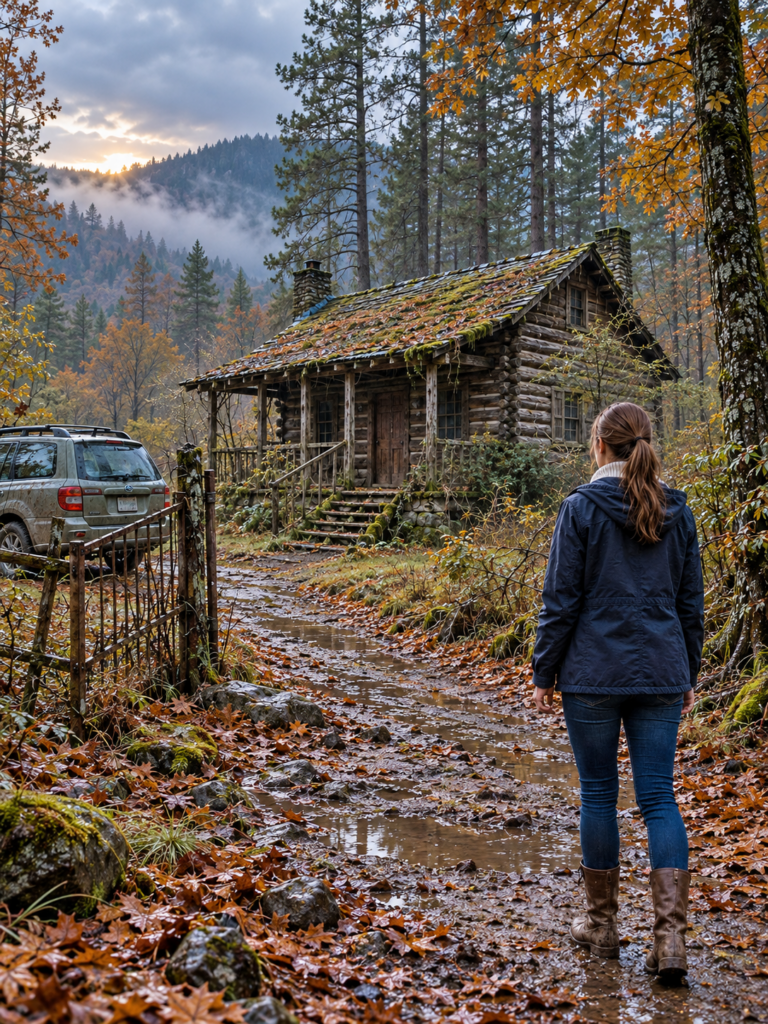
Twenty minutes later, she spotted the old iron gate.
It hung crookedly between two stone pillars, nearly swallowed by blackberry vines.
Beyond it stood the cabin.
Sadie stopped the car.
For a long moment, she could only stare.
The roof was blanketed with wet pine needles. Moss climbed the logs, the porch sagged on one side, and weeds had grown waist-high around the foundation.
The small home looked much older than it had four years earlier.
But it was still standing.
She climbed out, retrieved the brass key, and fought her way through the gate.
The porch boards groaned beneath her weight.
At the front door, she struggled with the lock until her hands ached.
“Come on,” she whispered.
She twisted the key once more.
Something clicked.
The door opened.
Cold, stale air washed over her.
Sadie swept her flashlight across the interior.
The large stone fireplace still dominated the far wall. Her grandmother’s rocking chair sat beside it, covered in dust. A faded patchwork quilt lay across the iron-framed bed.
The little wooden shelves still held chipped mugs, old books, and jars of dried herbs.
A photograph stood crookedly on the mantel.
It showed Betty and her husband, Thomas, standing beside the cabin shortly after they built it.
Sadie remembered asking about that photograph when she was twelve.
“Grandpa looks happy,” she’d said.
Betty had looked at the picture for a long time.
“He was,” she answered. “For a little while.”
Sadie had never understood the sadness in her voice.
Now she stood in that same room, surrounded by everything her grandmother had left behind.
“I’m home, Grandma,” she whispered.
Her voice trembled.
She set her belongings on the dining table and searched for supplies.
The firewood stacked beside the hearth was damp. The old stove pipe needed inspection before she could safely use the fireplace. The kitchen tap produced nothing, and a bucket beneath the sink was filled with rust.
She found two sealed bottles of water in a cupboard, a box of matches, and a dented saucepan.
No working electricity.
No reliable heating.
No telephone.
Outside, the sleet grew heavier.
Sadie dragged her sleeping bag from the car and spread it across the bed.
She put on another sweater, wrapped a scarf around her neck, and ate the crackers she had bought at the gas station.
Dinner consisted of six crackers and lukewarm bottled water.
She sat at the heavy oak table beneath the beam of her flashlight.
In the silence, the memories began to return.
Logan laughing when she showed him her first paid illustration commission.
Logan telling friends she was his “little artist.”
Logan complaining that she spent too much time helping his mother after her hip surgery.
Logan standing at the kitchen island, explaining calmly that the house was no longer hers.
She remembered every sacrifice she had made.
When he worked late, she cooked dinner and waited.
When his father became ill, she drove him to appointments.
When Logan wanted a more expensive home, she used the savings she had accumulated from years of freelance work to help cover the down payment.
She had believed marriage meant building something together.
He had treated it like a business arrangement in which only one person was allowed to read the contract.
Her chest tightened.
She pushed back the chair and walked toward the fireplace.
Beside it stood Betty’s rocking chair.
Sadie touched the worn wooden armrest.
Her grandmother used to sit there every winter evening, darning socks or reading old mysteries while the logs crackled.
On the day Sadie announced her engagement, Betty had listened quietly.
Then she had asked one question.
“Does that boy respect you when nobody else is watching?”
Sadie had been offended.
“Of course he does.”
Betty hadn’t argued.
She had only squeezed her granddaughter’s hand.
“I hope you’re right, sweetheart.”
Now, standing in the cabin, Sadie understood.
Her knees weakened.
She lowered herself onto the dusty floor beside the chair.
And finally, the strength that had carried her through the last three days disappeared.
She cried.
Not prettily.
Not quietly.
She cried until her shoulders shook and her throat burned.
She cried for the house, the marriage, and the years spent loving a man who had apparently planned her disappearance.
She cried because she had nowhere to go except an abandoned cabin.
She cried because Betty was dead and couldn’t put her arms around her anymore.
And beneath all those losses lay a smaller, more humiliating fear.
What if Logan was right?
What if she really was incapable of looking after herself?
The thought broke her all over again.
Eventually, she collapsed sideways against the rocking chair.
Outside, sleet rattled against the windows.
The flashlight began to dim.
Sadie knew she needed to get into her sleeping bag before the temperature dropped further.
She placed one hand against the floor to push herself upright.
Something shifted beneath her palm.
She stopped.
The board moved again when she pressed it.
Not the usual creak of an old wooden floor.
A distinct hollow movement.
Sadie wiped her face.
She knocked lightly against the plank.
Hollow.
She knocked on the one beside it.
Solid.
Her heart began beating faster.
She brought the flashlight closer.
The nails were different.
Unlike the rusty nails holding the surrounding planks, these had smooth heads and sat slightly above the wood.
She remembered Betty warning her never to remove certain boards near the fireplace.
“Old construction,” her grandmother had said. “Some things are better left alone.”
Sadie had never questioned it.
Now she reached for the small screwdriver in her car’s emergency toolkit.
The plank resisted at first.
Then one end lifted.
Cold air drifted from the dark opening beneath it.
Sadie pulled the board aside.
Between two wooden beams was a narrow cavity.
And inside that cavity sat an olive-green metal box.
It was old, heavy, and secured with a rusted padlock.
Sadie stared at it.
She had spent countless childhood evenings playing on this floor.
She had slept beside this fireplace, celebrated birthdays at this table, and listened to her grandmother’s stories while snow accumulated against the windows.
Yet she had never known the box existed.
She reached down and caught its metal handle.
Whatever Grandma Betty had hidden beneath the floor had remained untouched for years.
And somehow, on the worst night of Sadie’s life, she had found it.
Part 3
The box was so heavy that Sadie could barely lift it.
She braced her boots against the floorboards and pulled with both hands.
The metal scraped against the wooden beams before finally coming free.
She dragged it into the center of the room.
For several minutes, she sat beside it, catching her breath.
A small brass padlock secured the lid.
Its surface was heavily corroded.
Sadie found a pair of pliers in her grandmother’s old toolbox and worked the rusted fastening loose until the weakened metal finally gave way.
The lid opened with a sharp creak.
Inside was a thick layer of carefully folded waxed canvas.
Resting on top was a cream-colored envelope.
Sadie recognized the handwriting immediately.
Her grandmother had written one word across the front.
Sadie.
Her fingers trembled as she picked it up.
She carefully opened the envelope and unfolded three sheets of stationery.
The first sentence made her throat tighten.
My sweet girl,
If you are reading this, then I am gone, and life has finally hurt you badly enough to bring you back to this little house.
Sadie swallowed.
She continued reading.
Your grandfather and I learned something the hard way. A person can spend forty years building a life and lose almost everything because he trusted the wrong people.
Before we moved to these mountains, your grandfather owned a successful equipment company. He started with one truck and a rented garage. By the time you were born, he had employees, warehouses, and contracts in three states.
Then his partners betrayed him.
They convinced him to sign agreements he did not fully understand. They shifted assets and debt between companies. When the business collapsed, the men responsible walked away with money while your grandfather was left holding the obligations.
We fought for years.
Lawyers took what savings we had left. Your grandfather never stopped blaming himself.
He died believing he had failed his family.
Sadie looked toward the photograph on the mantel.
She had always known her grandfather died young.
Nobody had ever explained why her grandmother refused to talk about his business.
Her eyes returned to the letter.
After his death, I sold what remained, collected the insurance money, and took what I could recover from the settlements. I refused to gamble it away or hand it to anyone who promised to make me rich.
I bought gold over the years. I saved cash. I kept records of where it all came from because one day somebody would need to know.
I trusted this cabin more than I trusted a banker’s smile.
You will find the money beneath this letter.
Sadie’s hands went still.
She looked into the metal box.
Then she carefully lifted the canvas.
Underneath lay rows of neatly bundled currency.
Old fifty-dollar bills.
Hundred-dollar bills.
Stacks wrapped with aging rubber bands.
Beside them were four thick canvas pouches.
Sadie opened one.
A gold coin rolled into her palm.
It was heavy and warm-looking beneath the pale flashlight beam.
She turned it over.
A South African Krugerrand.
She opened another pouch.
More gold.
Her breath caught.
There were dozens of coins in each bag.
She returned to the letter.
The cash should total approximately four hundred thousand dollars. The gold was worth about six hundred thousand dollars when I last calculated it, although prices may change.
That money came from what remained of your grandfather’s life’s work and from the years I spent saving afterward.
It is not stolen money. It is not a reward for being clever. It is what I kept so that somebody in this family might have a second chance.
I did not tell your mother because I knew she would insist I move back to town and put everything in investments her friends recommended.
And I never told Logan.
Sadie stopped breathing for a moment.
Her grandmother had written his name.
I watched that young man interrupt you at dinner. I watched him laugh when you spoke about your painting. I watched him look at this cabin as though everything old and humble was worthless.
I did not interfere because you loved him.
But I worried.
If he has hurt you, sweetheart, remember that a man who controls your money does not control your worth.
Use what I have left to protect yourself.
Find someone honest to help you. Make certain everything is handled properly. Don’t let fear push you into foolishness.
And whatever happens, don’t turn into the kind of person who hurt you.
You are stronger than you know.
Love always, Grandma Betty.
Sadie pressed the letter against her chest.
For a long time, she didn’t move.
The rain whispered against the roof.
Her grandmother had been gone four years.
Yet somehow the old woman had reached across that silence and placed a hand on Sadie’s shoulder.
The money was almost impossible to comprehend.
One million dollars.
Perhaps more, depending on the current value of the gold.
Yesterday, Sadie had wondered whether she could afford a motel room.
Now she was sitting beside a fortune.
But the first thing she felt wasn’t excitement.
It was grief.
“Oh, Grandma,” she whispered. “Why didn’t you tell me?”
The rocking chair stood silently beside the fireplace.
She read the letter twice more.
Then she noticed something beneath the money.
A small oilcloth packet containing folded documents, old receipts, bank withdrawal records, and invoices from coin dealers.
Betty had kept the records.
Of course she had.
The woman who saved every grocery receipt and labeled every jar in her kitchen would never have hidden a fortune without keeping track of its history.
Sadie carefully returned the documents to the box.
She took one modest bundle of bills and secured the rest beneath the floor.
Then she moved the rocking chair over the concealed opening.
She still had a problem.
Money did not magically make the cabin warm.
It couldn’t dry her clothes or repair the roof.
And out here in the mountains, a careless mistake could still kill her.
That night she climbed into her sleeping bag wearing two sweaters, a coat, thick socks, and a wool hat.
She barely slept.
Every gust of wind made the windows rattle.
She thought about Logan, about the house, and about what she could do now that she had resources he didn’t know existed.
Once, she imagined calling him.
She pictured saying that she had found enough money to buy ten houses just like the one he stole.
She pictured the expression on his face.
But Betty’s words returned.
Don’t let fear push you into foolishness.
Sadie rolled onto her side.
She would not call him.
Not yet.
At dawn, the storm finally passed.
The mountains glittered beneath a thin crust of ice.
Sadie drove carefully into Pine Ridge, carrying enough cash for necessary supplies.
She stopped first at Oak Haven Supply, the large hardware store on Main Street.
An elderly man in a green work vest greeted her.
“Morning. What can I help you find?”
“I need to make an old cabin livable before winter.”
He looked at her boots, the mud splashed across her jeans, and the tired expression on her face.
“How old?”
“Older than me.”
“That narrows it down to most of the county.”
His name was Walter Pritchard, and he had known Betty for more than twenty years.
When Sadie mentioned her grandmother, he smiled.
“Your grandma once fixed my delivery truck with baling wire because I was too stubborn to admit the alternator bracket was broken.”
“That sounds familiar.”
Walter helped her choose a portable heating unit, batteries, lanterns, blankets, waterproof storage containers, and weatherstripping.
When Sadie explained that the cabin had an old fireplace, he advised her to have the chimney inspected before using it. He also recommended a local technician to check the cabin’s wiring and heating arrangements.
He insisted she buy a carbon monoxide detector.
“Cold weather makes people desperate,” he said. “Don’t let it make you careless.”
Sadie promised she wouldn’t.
At the grocery store, she purchased canned food, oatmeal, rice, eggs, coffee, and bottled water.
She hadn’t realized how hungry she was until she stood beside the bakery counter smelling fresh bread.
She bought a loaf and ate two slices sitting in her car.
By afternoon, she was back at the cabin.
For the next several hours, she worked.
She swept the floor, wiped down the tables, cleaned the kitchenette, and washed years of dust from the windows.
She moved damp furniture away from the exterior walls and checked the roof for obvious damage.
A local tradesman agreed to inspect the chimney and roof the next morning.
Until then, she relied on warm clothing, insulated bedding, and heating arrangements appropriate for the enclosed space.
She set a portable generator outside, well away from the doors and windows, sheltered from the weather without enclosing its exhaust.
For the first time since arriving, she had reliable lighting.
She plugged in her phone.
When it finally connected to a weak cellular signal, messages began appearing.
Three from her mother.
Two from Jessica.
And one voicemail from Logan.
Sadie listened.
“Sadie, it’s Logan. My attorney sent the final dissolution documents. We need your signature to complete the property transfer. I assume you’ve had enough time to clear your head. Just tell me where to send the papers.”
His voice was as calm as ever.
Then he added something that made her sit straighter.
“And please don’t start making this a public spectacle. We’re adults. There is no reason to damage anybody’s reputation.”
Sadie listened to the message again.
No reason to damage anybody’s reputation.
She remembered Logan’s job.
He was a junior partner at Valemont Private Wealth, a prestigious firm that managed substantial portfolios for wealthy clients.
His entire professional life depended on people trusting him with their money.
And Sadie knew things about his finances.
Things he had casually mentioned during their marriage.
A Delaware company.
Unusual consulting invoices.
Bonuses routed through accounts whose purpose he never clearly explained.
She remembered helping him organize records during tax season, listening as he boasted about strategies that other people supposedly weren’t clever enough to understand.
At the time, she had dismissed it as ordinary financial jargon.
Now those memories felt different.
She opened her laptop and searched through the documents she had retained.
There were email attachments.
Copies of mortgage statements.
Old household budgets.
Financial spreadsheets Logan had asked her to update.
She didn’t know which details mattered.
But perhaps someone else would.
Sadie looked toward the rocking chair.
Then she searched for attorneys specializing in fraudulent property transfers, asset recovery, and financial misconduct.
After nearly an hour, she found a name.
Calvin Hughes.
Former federal prosecutor.
Known for difficult financial litigation.
His office was three hours away.
She called.
A receptionist answered.
“Law Offices of Calvin Hughes.”
“I need an appointment with Mr. Hughes.”
“May I ask what the matter concerns?”
“My husband used corporate documents to take control of our marital home. I believe there may also be serious irregularities involving his business finances.”
The receptionist asked several questions.
Then she mentioned the firm’s substantial initial retainer.
Sadie looked down at the gold coin lying on the table.
“I understand,” she answered. “I can pay.”
There was a pause.
“Mr. Hughes requires verified funds through the firm’s trust account.”
“I can arrange that.”
“May I ask whether you have documentation of the funds?”
Sadie glanced at Betty’s carefully folded records.
“Yes,” she said. “I believe I do.”
The receptionist placed her on hold.
Several minutes later, a deep male voice came through the receiver.
“This is Calvin Hughes. Tell me why your husband believes he can take your home.”
Sadie looked around the little cabin.
For the first time in days, her hands were steady.
“Mr. Hughes,” she said, “I think my grandmother left me the means to find out.”
Part 4
Three mornings later, Sadie drove into the city carrying a canvas bag filled with documents and a sealed pouch containing gold coins.
She had spent the intervening days arranging an appraisal, verifying several of Betty’s old purchase records, and consulting a licensed precious-metals dealer about converting part of the inheritance into funds she could use openly.
The discovery had given her resources, not immunity from financial rules.
There were questions about taxes, inheritance documentation, and the proper handling of such a large amount of old cash.
Sadie understood that now.
She intended to answer those questions carefully.
Her grandmother had spent a lifetime protecting the money. Sadie would not jeopardize it through impatience.
Calvin Hughes occupied an office on the forty-second floor of a steel-and-glass building.
Sadie arrived wearing black trousers, a simple blazer, and the only clean pair of boots she owned.
The receptionist looked briefly at the boots before showing her into a conference room.
Calvin Hughes stood beside a long mahogany table.
He was a broad-shouldered man in his late fifties, with closely cropped gray hair, a rough beard, and the tired eyes of someone who had heard too many convincing lies.
“You’re Mrs. Mercer?”
“Sadie Mercer.”
He shook her hand.
“Sit down. Let’s start with the house.”
For the next two hours, Sadie told him everything.
She described the purchase, the renovation, the LLC agreement, the emails from Vanessa, and the sudden demand that she leave.
She showed him the documents Logan had persuaded her to sign.
Calvin read them slowly.
Occasionally he made a note on a yellow legal pad.
When he reached the provision giving Logan control of the entity after dissolution, he frowned.
“Did you have independent counsel when you signed this?”
“No.”
“Did he explain that this provision could give him power over the property?”
“He said we were doing it to save money on taxes.”
“Was that explanation in writing?”
Sadie searched through her folder.
Then she found an email.
Calvin read it twice.
His expression changed.
“That is interesting.”
“Why?”
“Because what he told you here is difficult to reconcile with what the agreement actually does.”
Sadie leaned forward.
“Can I get my house back?”
“Possibly. But first we need to establish the full circumstances. And I want you to understand something.”
He laid down his pen.
“The fact that a person signed a document doesn’t automatically mean every provision is enforceable under every circumstance. But it also doesn’t mean a court will rescue someone simply because the agreement turned out badly.”
“So what do we do?”
“We establish the evidence. We examine the formation of the company, the source of the funds, the disclosures, and the circumstances surrounding your consent.”
He opened another folder.
“Now tell me about these financial records you mentioned.”
Sadie explained what she had seen during their marriage.
She showed him copies of business correspondence she had lawfully retained, along with household financial records referencing transactions she didn’t understand.
Calvin studied the names and dates.
“Did Logan ever mention why a private consulting company was receiving payments connected to his employment?”
“He said it was a compensation structure.”
“Did he prepare tax returns using those records?”
“I don’t know. I helped organize household paperwork, but I wasn’t involved in preparing his professional filings.”
“Good. Don’t guess. Tell me only what you actually know.”
For another hour, they reviewed documents.
Calvin occasionally stepped out to speak with an associate.
When he returned, he looked more serious.
“There may be issues here that go beyond the divorce,” he said. “But allegations aren’t proof. We’ll need to authenticate what we can and seek the rest through proper legal channels.”
Sadie looked down.
“Logan always told me I was too stupid to understand money.”
Calvin watched her for a moment.
“People who depend on keeping others uninformed often become uncomfortable when someone starts asking questions.”
He slid a written engagement agreement across the table.
Sadie read every page.
Every clause.
Every fee.
Calvin waited without interrupting.
When she finished, she signed.
The necessary funds would be deposited into the firm’s trust account after her gold transaction cleared and the relevant documentation was completed.
For the first time, she had professional help she could pay for.
As Sadie rose to leave, Calvin asked where she was staying.
“My grandmother’s cabin.”
“Does your husband know about it?”
“He knows it exists. He thinks it’s worthless.”
“Does he know you are staying there?”
“Not yet.”
“Keep your location private where possible. And from this point forward, direct substantive communications through my office.”
She hesitated.
“Do you think he’ll come looking for me?”
“I don’t know. But people sometimes behave unpredictably when they realize they are no longer controlling the situation.”
On the drive home, Sadie kept thinking about those words.
She had spent years allowing Logan to define what was reasonable, what was practical, and what she was allowed to question.
Now she was taking back that responsibility.
But the more she learned, the more frightened she became.
What if the court believed Logan?
What if she had misunderstood the documents?
What if her grandmother’s fortune brought new legal complications?
She had enough money to fight, but there was no guarantee of winning.
And the mountains offered no protection against disappointment.
Back in Pine Ridge, winter was settling over the valley.
The first snow arrived before Thanksgiving.
It began as a fine white powder drifting through the branches and ended with six inches covering the driveway.
Sadie spent an entire morning clearing a path with a shovel.
Her shoulders burned.
Blisters formed beneath her gloves.
She was halfway through the work when a pickup truck stopped beside the gate.
An older woman stepped out wearing a thick red coat.
“Sadie Whitcomb?”
Sadie straightened.
“That’s me.”
The woman smiled.
“June Harlan. I used to visit your grandmother.”
Sadie remembered the name.
Betty had often spoken of June, a widow who lived several miles down the mountain and raised chickens.
June looked toward the cabin.
“Walter told me somebody was staying up here. Figured I’d check that you weren’t frozen solid.”
She lifted a covered baking dish from the truck.
“Chicken casserole. And I brought biscuits.”
Sadie stared at the dish.
For several seconds, she couldn’t speak.
Then she stepped forward and hugged the woman.
June made a surprised little sound before returning the embrace.
“Well, now,” she said softly. “Looks like you’ve had a rough time.”
They ate together beside the newly inspected and repaired fireplace, where a proper fire now crackled behind a sturdy screen.
June listened as Sadie told her part of the story.
Not about the gold.
Not about Calvin’s investigation.
Just about Logan, the house, and how suddenly her marriage had ended.
June shook her head.
“Your grandmother never liked that man.”
Sadie gave a sad smile.
“I know that now.”
“She told me once that he looked at you like you were something he owned.”
Sadie lowered her gaze.
“She should have warned me.”
June set down her coffee.
“Maybe she did, honey. Sometimes people tell us what they see, but we aren’t ready to hear it.”
Sadie looked toward the rocking chair.
She remembered Betty’s question about respect.
June reached across the table.
“Listen to me. You can lose a house and still have a home. Don’t let that man convince you otherwise.”
The words stayed with Sadie long after June left.
Over the following weeks, Sadie began restoring the cabin.
A roofer replaced damaged flashing and repaired leaks.
An electrician made the old wiring safe.
A plumber helped restore the water supply.
Sadie cleaned the kitchen, repaired furniture, and painted the window frames.
She hung her artwork along the walls.
Each evening, she stood on the porch watching mist gather between the mountains.
There were still nights when she cried.
Sometimes she missed the familiar life she had built.
Sometimes she woke from dreams in which Logan was standing at the front door telling her she had no right to be there.
But each morning she got up and continued working.
Meanwhile, Calvin’s team was piecing together a financial picture.
Records suggested that Logan had failed to disclose important information about the property transfer.
Other documents raised questions about the way certain payments had moved through his outside company.
The questions grew more serious when information obtained through lawful legal requests did not match explanations Logan had previously provided.
Calvin prepared a request for emergency relief aimed at preventing the house from being sold or further encumbered while the dispute was litigated.
He also advised Sadie that issues involving her husband’s professional conduct might have to be examined independently by his employer and appropriate authorities.
That evening, Sadie’s phone rang.
It was Logan.
She let it go to voicemail.
A message appeared moments later.
“Sadie, what exactly are you doing? My attorney says you’ve hired Calvin Hughes. Do you have any idea what this is going to cost? Call me. We can work something out.”
The next morning, another message arrived.
“You’re making a huge mistake. Whatever money you’ve borrowed to pay this guy, you’re throwing it away.”
Then a third.
“Just sign the papers and I’ll give you five thousand dollars. That’s more than fair.”
Sadie stared at the screen.
Five thousand dollars.
After six years of marriage.
After everything she had invested.
After he had left her standing in the rain with nowhere to sleep.
A part of her wanted to answer.
She wanted to tell him about the gold.
She wanted to explain that the woman he had dismissed as helpless now had the resources to challenge everything he had done.
But she remembered Calvin’s instructions.
And she remembered Betty.
So she forwarded the messages to her attorney.
Several days later, Calvin called.
“We’ve scheduled the emergency hearing,” he said. “The judge will consider whether the property needs to be preserved while the case proceeds.”
Sadie gripped her phone.
“Do you think it will work?”
“We have a substantial argument. But it’s the court’s decision.”
There was a pause.
“Sadie, I also need you prepared for something. If these financial questions are investigated properly, this could become much bigger than a dispute over one house.”
She looked out at the snow-covered woods.
“How much bigger?”
“Big enough to change several people’s lives.”
After the call ended, Sadie stood beside the fireplace for a long time.
She had wanted Logan to understand how deeply he had hurt her.
Now she was beginning to understand that the truth might accomplish more than any angry words she could speak.
And she would have to decide whether she was strong enough to let that truth come out.
Part 5
Logan Mercer was halfway through his second glass of bourbon when the doorbell rang.
It was late Friday afternoon.
The house was immaculate.
He had replaced Sadie’s lavender candles with expensive cedar diffusers. Her paintings were gone from the walls, and the furniture had been rearranged to suit Vanessa’s taste.
A landscaping company was scheduled to remove the hydrangeas in spring.
Logan had already planned to replace them with decorative stones.
He opened the front door expecting a delivery.
Instead, a middle-aged man in a dark jacket stood on the porch holding an envelope.
“Logan Mercer?”
“Yes?”
The man handed him the documents.
“You’ve been served.”
Logan stared after him.
Then he closed the door and opened the envelope.
The first page bore the name Calvin Hughes.
Logan’s stomach tightened.
He knew the attorney’s reputation.
He had heard senior partners mention Hughes during discussions about complex financial disputes.
The man was relentless.
Logan began reading.
A motion seeking emergency preservation of the house.
Allegations concerning material misrepresentations in the creation and operation of the LLC.
Requests for examination of records relating to the transfer.
Supporting documentation from financial records and correspondence.
Logan turned another page.
There was a copy of the email in which he had reassured Sadie that the LLC arrangement was simply a tax-planning measure.
His own words.
His own signature.
He sank slowly onto a kitchen stool.
“How did she get this?”
He flipped through the remaining pages.
There were references to the Delaware company.
Payment records.
Dates.
Questions about business expenses.
And material concerning certain representations he had made in his personal financial disclosures.
His phone began ringing.
Valemont Private Wealth.
Logan answered quickly.
“Jim. I was just about to call you.”
“Logan, where are you?”
“At home.”
“Have you received legal papers involving Calvin Hughes?”
Logan swallowed.
“Yes, but it’s a personal dispute. My wife is upset about the divorce.”
His managing partner was silent for a moment.
Then he spoke.
“Our compliance department has become aware of allegations that may involve outside business activities you did not fully disclose.”
“Those allegations are false.”
“Then you will have an opportunity to demonstrate that.”
“Jim, you know me.”
“I thought I did.”
The words struck Logan harder than shouting would have.
“You are being placed on administrative leave while we conduct a review. Your access to certain systems has been suspended. Do not contact clients about this matter.”
“Jim, please—”
“We’ll communicate through counsel.”
The call ended.
Logan stared at his phone.
For the first time, he understood that Sadie wasn’t simply trying to negotiate a better divorce settlement.
She had found someone capable of asking questions he did not want answered.
And those questions were already reaching places he couldn’t control.
At the courthouse the following week, Sadie sat beside Calvin Hughes with her hands folded tightly in her lap.
She wore a dark blue dress and a simple wool coat.
Her hair was pinned neatly behind her head.
Calvin had warned her that the emergency hearing was not a trial.
The judge would not decide every disputed fact that morning.
The immediate question was whether there was sufficient reason to restrict further transactions involving the marital property until the legal issues could be examined.
Logan sat across the room beside his attorney.
He looked different.
There were shadows beneath his eyes.
His expensive suit was perfectly pressed, but his expression was strained.
He glanced toward Sadie.
She looked away.
The hearing began.
Calvin presented the documents concerning the creation of the LLC, the disputed transfer provisions, and the correspondence describing the purpose of the arrangement.
He explained why there was a meaningful risk of further disposition of the property before the underlying claims could be resolved.
Logan’s attorney argued that his client had acted within the terms of a valid business agreement.
The judge asked questions.
Why had the property been transferred?
What consideration supported the change in controlling interests?
What had been disclosed to Sadie?
What was the present status of the house?
Logan’s attorney answered carefully.
At one point, the judge examined a letter and looked directly at Logan.
“Mr. Mercer, were you aware that your wife understood this agreement to be primarily a tax-planning arrangement?”
Logan shifted in his chair.
“My wife was aware we were establishing an LLC.”
“That was not my question.”
The courtroom became very quiet.
Sadie kept her eyes on the table.
She remembered the evening Logan handed her the documents.
He had been standing in their kitchen.
There had been music playing.
She was cooking pasta.
“Just sign these, sweetheart,” he had said. “They’re routine.”
She had wiped her hands on a dish towel and signed beside the yellow stickers.
For years, she had blamed herself for not asking more questions.
Now she listened as the judge examined the circumstances under which those signatures had been obtained.
For the first time, someone in authority was asking Logan to explain himself.
After reviewing the submissions and hearing the parties, the judge issued a temporary order restricting the sale, transfer, or additional encumbrance of the disputed property while further proceedings were scheduled.
The judge emphasized that the ruling was provisional and did not determine the ultimate ownership dispute.
But it meant Logan could no longer treat the house as an asset he was free to dispose of without restriction.
Sadie felt Calvin touch her elbow.
“That’s what we came for,” he whispered.
She closed her eyes.
Not because everything was finished.
It wasn’t.
But for the first time since being driven out, a legal decision had interrupted Logan’s control over the house.
The litigation continued.
There were depositions, document requests, and long meetings with attorneys.
Sadie spent hours reconstructing household expenditures from six years of records.
She found receipts for renovations she had paid for, transfers from her freelance business, and correspondence establishing that she had contributed significantly to the property.
Calvin’s forensic accounting team identified inconsistencies that warranted closer examination.
Separately, Valemont’s internal review uncovered problems with Logan’s outside business disclosures.
As the inquiries progressed, the firm terminated his employment.
Certain financial transactions became subjects of formal scrutiny, and additional legal proceedings followed.
Not every allegation was proven.
Some matters required months of investigation.
But the carefully polished professional identity on which Logan had built his life was no longer protected by his confident explanations.
His income disappeared.
His relationship with Vanessa began deteriorating.
She had liked the house, the vacations, and the lifestyle.
She was considerably less interested in sharing his legal bills.
One evening, Logan returned home to find her suitcase beside the door.
“Where are you going?” he demanded.
“I’m staying with my sister.”
“For how long?”
Vanessa looked at him.
“I don’t know.”
“We’re supposed to be together.”
She glanced around the kitchen.
“Logan, you told me this house was yours.”
“It is mine.”
“Then why can’t you sell it? Why are lawyers calling all the time? Why is your company investigating you?”
He said nothing.
Vanessa picked up her suitcase.
“I didn’t sign up for this.”
After she left, Logan stood alone beneath the expensive pendant lights.
The marble island gleamed.
The floors were spotless.
Everything looked exactly as he had wanted it.
Yet the house had never felt more empty.
He walked toward the front window.
Outside, the hydrangea bushes stood dormant beneath the winter frost.
He remembered Sadie kneeling in the dirt to plant them.
He had complained that she was wasting money on flowers.
She had smiled and told him they would be beautiful someday.
For the first time, he wondered whether the problem had ever been the flowers.
Or whether it had been his inability to appreciate anything he couldn’t calculate.
Months passed.
When the property dispute approached resolution, Logan’s position had weakened substantially.
The documents and financial evidence established serious problems with the way he had presented the arrangement to Sadie and with his handling of the shared property.
After extensive negotiations, he agreed to a settlement that restored Sadie’s financial interest and gave her control of the house, subject to the settlement’s remaining obligations.
The agreement required him to move out.
He signed it in a conference room while his attorney watched.
There were no photographers.
No shouting.
No public humiliation ceremony.
Just a pen scratching across paper.
The same ordinary sound that had once helped him take Sadie’s home now marked the end of his control over it.
When Calvin called to tell her the agreement had been executed, Sadie was standing outside Betty’s cabin.
The last patches of winter snow were melting beneath the pines.
She listened carefully as he explained the remaining steps.
Then she asked one question.
“Does that mean I can go back?”
“Yes,” Calvin answered. “Once the agreed conditions are completed, the house will be yours to occupy or sell.”
Sadie sat down on the porch steps.
For several seconds, she couldn’t speak.
She remembered leaving with her belongings packed into the Subaru.
She remembered being unable to afford a motel.
She remembered crying on the dusty cabin floor until her chest hurt.
Now the house was coming back to her.
She should have felt triumph.
Instead, she felt something quieter.
Relief.
“Thank you,” she whispered.
Calvin paused.
“You did the difficult part, Sadie. You came forward with the facts and stayed with the process.”
After the call, she walked inside.
The cabin no longer resembled the abandoned structure she had found in November.
The windows were clean.
The roof was sound.
Fresh curtains hung in the kitchen.
The old table had been sanded and refinished.
Her paintings decorated the walls.
And Grandma Betty’s rocking chair stood beside the fireplace, exactly where it belonged.
Sadie sat down and opened the final page of her grandmother’s letter.
Whatever happens, don’t turn into the kind of person who hurt you.
For months, she had imagined the satisfaction of seeing Logan lose everything.
She had wanted him to know what it felt like to be frightened and powerless.
But now she understood something.
His punishment could not rebuild her life.
Only she could do that.
She folded the letter and set it carefully inside a wooden drawer.
Then she called Calvin again.
“I’ve made a decision about the house.”
“What decision?”
“I want to sell it.”
He was quiet for a moment.
“Are you certain?”
“Yes.”
“You fought very hard to recover it.”
“I know.”
“Then why sell?”
Sadie looked toward the mountains visible through the window.
“Because I don’t think I want to live there anymore.”
The house held too many painful memories.
Too many evenings spent waiting for Logan.
Too many moments when she had doubted herself.
It was beautiful, but it no longer felt like home.
She wanted a fresh beginning.
And she already knew where she belonged.
That spring, she returned to the suburban house one final time.
The rooms were empty.
Logan had removed most of his belongings.
The marble island still stood in the kitchen.
Sunlight fell across the hardwood floors she had once refinished.
Sadie walked slowly from room to room.
She remembered decorating the nursery they had once talked about creating.
She remembered hosting Thanksgiving dinner.
She remembered laughing with friends on the back porch before her marriage began unraveling.
There had been good memories.
She didn’t need to deny them.
But she no longer needed to live inside them.
Outside, she knelt beside the hydrangeas.
New green leaves were beginning to appear.
She brushed away a few dead stems and touched the soil.
“You made it through winter,” she whispered.
Then she stood, walked to the front door, and handed the keys to the real estate agent waiting outside.
She did not look back.
The eventual sale proceeds, together with the inheritance she had properly documented and secured, gave Sadie financial stability beyond anything she had imagined.
But she was careful.
Calvin helped connect her with professionals who could address the estate records, tax obligations, and long-term preservation of Betty’s savings.
Sadie didn’t buy luxury cars.
She didn’t purchase a mansion.
She didn’t travel the world posting photographs intended to make Logan jealous.
Instead, she invested in the small mountain community that had welcomed her when she had nothing.
She paid for improvements to the cabin.
She repaired the neglected stone steps leading down to the creek.
She built a small art studio beside the house, with tall windows overlooking the trees.
Then she began offering inexpensive art lessons to children and older residents in Pine Ridge.
June helped organize the first class.
Walter donated wooden shelves and leftover lumber from his hardware store.
The local school sent a small group of students.
On the first afternoon, twelve people gathered inside the studio.
Some were children.
Others were retired neighbors who said they hadn’t painted since high school.
An elderly man named Frank arrived carrying a battered box of watercolors.
“My wife used to paint,” he explained. “She died three years ago. I thought maybe I’d try it again.”
Sadie helped him set up beside a window.
He painted a small blue house surrounded by trees.
When he finished, his eyes filled with tears.
“That looks like the place we lived when we first got married.”
Sadie touched his shoulder.
“It’s beautiful.”
For a moment, she remembered Betty.
Her grandmother had believed ordinary places could hold extraordinary meaning.
A cabin.
A rocking chair.
A worn dining table.
An old brass key.
Things other people might dismiss as worthless.
Things that could save a life.
At the end of the class, June stayed behind to help wash brushes.
“You look happy,” she told Sadie.
Sadie considered the words.
“I think I am.”
June smiled.
“Your grandma would be proud.”
Sadie looked toward the cabin.
“I wish she could see it.”
“Maybe she knew,” June said. “Maybe that’s why she left it to you.”
That evening, after everyone had gone home, Sadie walked through the quiet house.
She stopped beside Betty’s rocking chair.
On the mantel sat a framed photograph of her grandparents.
Beside it was a new photograph showing Sadie standing with the first group of students from her art studio.
The two pictures seemed to belong together.
One generation had built the home.
Another had protected it.
And now Sadie was making certain it would continue to matter.
She carried a basket of split firewood onto the porch.
The sun was setting behind the mountains, turning the treetops copper and gold.
The air smelled of pine, damp earth, and fresh spring grass.
Her phone vibrated.
It was a short message from Calvin.
The final paperwork from the property settlement had been completed.
The remaining financial matters were being handled through their proper channels.
There was nothing more Sadie needed to do that evening.
She read the message and placed the phone in her pocket.
Then she picked up another log and set it on the chopping block.
Months earlier, standing in front of the cabin during a bitter snowstorm, she had struggled to split even one piece of firewood.
Now she knew how to read the grain, position the wood, and let the weight of the splitting maul do its work.
She raised the tool and brought it down.
The log separated cleanly.
Sadie smiled.
Not because Logan had lost his job.
Not because his carefully constructed life had collapsed.
Not even because she had recovered the house and gained a fortune.
She smiled because the woman who once sat crying on the floor, believing she had nowhere left to go, had found something more valuable than revenge.
She had found her own strength.
As darkness settled over the Appalachian mountains, Sadie carried the firewood inside.
She lit the fireplace and settled into Betty’s old rocking chair.
Outside, the first stars appeared.
Somewhere in the surrounding forest, an owl called.
Sadie closed her eyes and remembered her grandmother’s voice.
Never let anybody convince you that you don’t deserve a place of your own.
She looked around the warm little cabin.
The walls were old.
The floors still creaked.
The furniture didn’t match.
And when the mountain wind blew hard, she could hear it moving through the pines.
But every inch of the place belonged to a life she had chosen for herself.
Logan had taken her house because he believed it was the only thing keeping her secure.
He never understood that security could come from something stronger than money, contracts, or ownership.
It could come from experience.
From people who cared.
From the courage to begin again.
And from the love of a grandmother who had quietly prepared for a day she hoped would never come.
Sadie leaned back in the rocking chair as the fire crackled.
“I’m going to be all right, Grandma,” she whispered.
Then she smiled through the tears gathering in her eyes.
“I finally know I am.”
For the first time in six years, she wasn’t waiting for a husband to come home.
She wasn’t afraid of disappointing anyone.
She wasn’t trying to prove that she deserved to stay.
She was already home.