Part 1
“Five hundred acres, Cecilia. Surely even a woman in your position can appreciate such generosity.”
Duchess Honoria Ashford spoke those words in a drawing room filled with people who knew perfectly well that she was being cruel.
Outside the tall windows of Ashford Manor, October rain fell across the gravel courtyard. Inside, a coal fire burned behind a polished brass screen, and the silver tea service reflected the soft afternoon light.
Cecilia Ashford sat opposite her mother-in-law, dressed in black.
She was twenty-nine years old, and her husband, Edmund, had been dead for eight months.
Their marriage had lasted only three years. They had no children, a fact Honoria had mentioned so frequently since the funeral that Cecilia sometimes wondered whether the duchess believed Edmund’s death had been merely a consequence of her failure to produce an heir.
On the table lay a deed to Thornwick Manor.
Five hundred acres of Yorkshire countryside.
A large stone house.
Several outbuildings.
Pastures, gardens, and woodland.
On paper, it sounded like a magnificent inheritance.
But Cecilia had seen Thornwick once, from a carriage window, during the second year of her marriage.
She remembered the broken gates, the collapsed fences, and the fields swallowed by thistles.
The house had been abandoned for decades.
Its roof was falling in.
Its agricultural tenants had long since departed.
No profitable landowner in Yorkshire wanted responsibility for it.
And now Honoria was giving it to her.
“How considerate,” said Lady Beatrice Wycliffe, one of the duchess’s oldest friends. “A country home must be such a comfort to a young widow.”
Cecilia lifted her eyes.
“Have you visited Thornwick, Lady Beatrice?”
The older woman hesitated.
“Not recently.”
“Neither has anyone else, it seems.”
A slight silence followed.
Honoria placed her teacup on its saucer.
“My dear, you mustn’t let grief make you ungrateful.”
Cecilia turned toward her.
“I am grateful for the property, Your Grace. I merely wish to understand its condition.”
“The estate is perfectly suitable for retirement.”
“At twenty-nine?”
A faint movement passed through the room.
Honoria’s face remained composed.
“Widowhood requires certain adjustments. You are no longer mistress of Edmund’s household, and without children, your place within the family has naturally changed.”
Cecilia folded her hands.
She had endured many humiliations since her husband’s death, but none hurt quite like hearing his mother discuss her future as though she were a servant whose position had become unnecessary.
Edmund had been a gentle man, although often indecisive. He had loved books and music, disliked arguments, and possessed neither his mother’s ambition nor her appetite for control.
Cecilia had loved him.
But she had also learned, during their short marriage, that Edmund’s kindness could not protect her from his family.
When Honoria criticized Cecilia’s country upbringing, Edmund asked her to be patient.
When the duchess questioned her manners, he told her not to take offense.
And when wealthy guests joked about Cecilia’s calloused hands, he squeezed her fingers beneath the dinner table but said nothing.
After his death, even those small comforts disappeared.
Honoria continued speaking.
“The deed will be transferred to you outright. You may live there, lease the land, or dispose of it as you see fit. We shall, of course, be relieved of further obligation.”
There it was.
The true purpose of the gift.
Honoria was not offering Cecilia security.
She was paying her to disappear.
Cecilia looked at the deed.
“Are there outstanding mortgages?”
“No.”
“Unpaid rents?”
“The tenants departed years ago.”
“Tax obligations?”
“The ordinary obligations of a landowner.”
“And the timber rights?”
Honoria frowned.
“I beg your pardon?”
“Do they transfer with the land?”
“Everything transfers. Why on earth would you ask?”
“Because a property is more than its house.”
Lady Beatrice exchanged a glance with another guest.
The duchess smiled thinly.
“You mustn’t imagine that a few childhood summers in the countryside have prepared you to manage an estate.”
Cecilia returned the smile.
“No, Your Grace. I would never confuse a few summers with a proper education.”
She took the deed.
“Thank you for Thornwick.”
Honoria had expected tears.
Perhaps an appeal for more money.
Perhaps some embarrassing display of wounded pride.
Instead, Cecilia stood, gathered her gloves, and asked that her trunks be sent to the estate by the following morning.
“You intend to go there immediately?” Honoria asked.
“Yes.”
“In this weather?”
“The house will not improve while I remain here.”
Cecilia made a polite curtsy and walked toward the door.
Behind her, the duchess spoke once more.
“Do be realistic, Cecilia. Some things are too far gone to restore.”
Cecilia stopped.
For a moment, she remembered her father standing in a muddy field, holding a handful of dark soil.
Land doesn’t lie, little bird. People do.
She turned.
“Then I suppose I must discover whether Thornwick is one of them.”
She left before Honoria could answer.
The following morning, a hired carriage carried Cecilia north through the Yorkshire countryside.
Mist gathered between the low hills.
Stone walls divided fields where sheep grazed beneath a gray sky.
At intervals, villages appeared beside narrow roads, their chimney smoke hanging low in the damp air.
Cecilia watched everything.
The water collecting along the roadsides.
The direction of the slopes.
The fields where grass grew thickly despite the cold.
Her father, Thomas Morse, had spent his life managing other men’s farms.
He had never owned land himself.
But he understood it better than most gentlemen who inherited thousands of acres without ever learning how to hold a spade.
When Cecilia was a child, he taught her to recognize fertile soil by its smell.
He showed her how winter water moved across a hillside.
He explained why some trees flourished in one field and failed in another.
And he taught her to keep records.
Not simply harvest totals, but weather, labor, seed quality, drainage, and the cost of every mistake.
“Anyone can praise a good harvest,” he told her once. “The trick is understanding why the bad one failed.”
Thomas Morse had died five years earlier.
Cecilia had inherited his notebooks, a small collection of tools, and a lifetime of practical knowledge.
The Ashfords had never considered any of those things valuable.
Now, as her carriage climbed the road toward Thornwick, Cecilia rested her gloved hand on the leather satchel containing her father’s journals.
At last, the rusted gates appeared.
The carriage stopped.
The driver looked at the property and then at Cecilia.
“Begging your pardon, ma’am, but are you certain this is the place?”
“Yes.”
“Looks abandoned.”
“It has been.”
He surveyed the overgrown drive.
“Shall I turn around?”
Cecilia stepped down.
“No. I think I’ll walk from here.”
The driver stared.
The road beyond the gate had nearly disappeared beneath weeds.
Cecilia lifted her skirts and made her way forward.
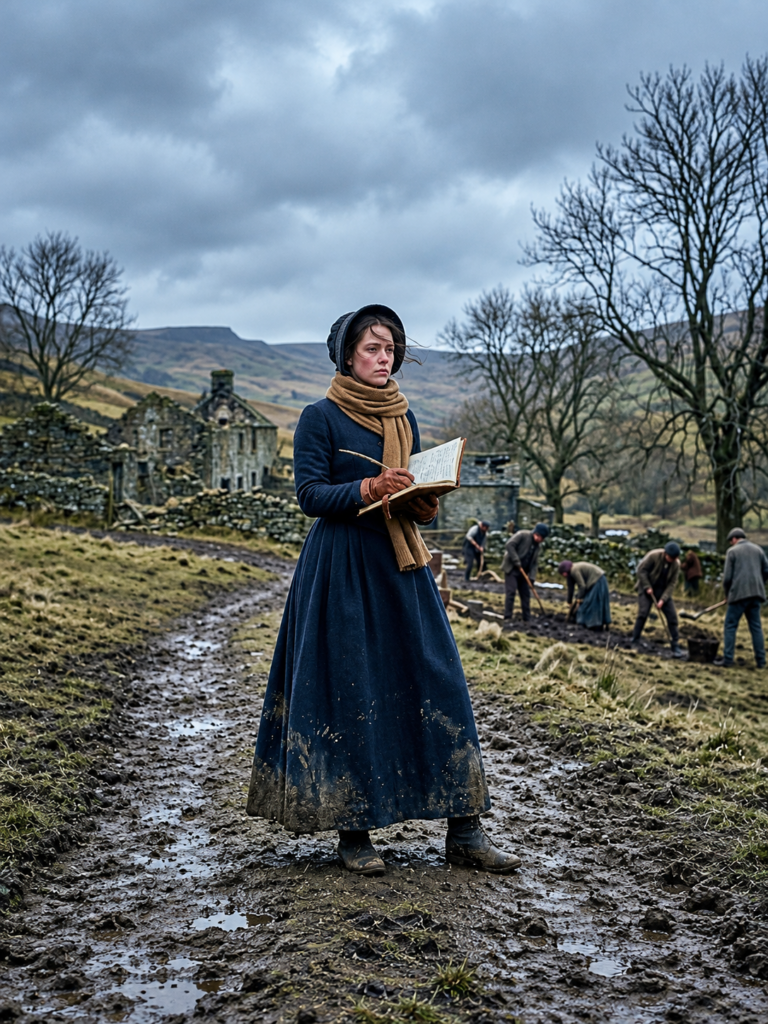
Thornwick Manor stood on a gentle rise.
It was a two-story stone house, broad and once handsome, with tall windows and a deep central entrance.
The roof sagged near the eastern chimney.
Several panes were broken.
Vines covered the south wall.
The front garden had become a wilderness of brambles.
Behind the house stood an old barn, its door hanging crookedly from a broken hinge.
Cecilia examined the buildings without speaking.
Then she walked past them.
The driver watched in confusion as she crossed a fallen fence and entered the nearest field.
She knelt.
Removed her gloves.
And pushed her fingers into the soil.
It was dark and damp.
She crushed a small clump between her fingers.
The earth held together briefly before breaking into loose crumbs.
She smiled.
Under the dead weeds, the land was rich.
She walked farther, studying the slope.
There were signs of an old drainage ditch, nearly filled with silt.
Beyond it stood a row of mature trees that had survived decades without care.
The nearby barn was deteriorating, but its stone foundations remained sound.
Cecilia turned slowly, looking over the property.
Five hundred acres.
Neglected, certainly.
Damaged, unquestionably.
But ruined?
Not entirely.
For the first time in eight months, she felt the heavy ache in her chest loosen.
Her future would be difficult.
She possessed little money, no powerful friends willing to oppose Honoria, and a house that might not survive another winter without repairs.
But she knew this land.
Not its history.
Not yet.
She knew what the soil could become.
The driver approached cautiously.
“Madam?”
“Yes?”
“Should I unload your trunks?”
Cecilia looked toward the ruined house.
Then back toward the fields.
“Yes, please.”
She put on her gloves.
“And would you ask in the village whether there is a carpenter who knows how to mend a roof?”
The driver nodded.
“Anyone in particular?”
“Someone who needs honest work.”
That evening, Cecilia slept in the only bedroom with a dry ceiling.
The furniture was old.
The fireplace smoked.
Rain tapped through a broken window, where she had fastened a piece of oilcloth.
She ate bread, cheese, and an apple beside a small fire.
Then she opened her father’s notebook.
On the first blank page, she wrote:
Thornwick Manor. October 1858.
Beneath it, she listed the property’s most urgent needs.
Roof repairs.
Safe water.
Drainage.
Boundary fences.
Seed.
Labor.
She stopped before writing the final item.
Time.
Then she added another word.
Patience.
Far away, at Ashford Manor, Duchess Honoria informed her guests that Cecilia had accepted the property with touching gratitude.
Everyone understood that the unwanted widow had been sent away.
No one imagined that she had spent her first evening planning how to bring the abandoned estate back to life.
Part 2
The first winter at Thornwick was colder than Cecilia had expected.
Within a week, she discovered that the western chimney was unsafe, the pantry floor had rotted beneath an old cupboard, and two upstairs rooms were so badly damaged by rain that she ordered their doors closed.
She reduced the household to what she could maintain.
One bedroom.
One kitchen.
A small sitting room where the roof still held.
Everything else would wait.
Mrs. Agnes Bell, a widow from the village, arrived seeking employment as a housekeeper.
She was fifty-eight, sharp-eyed, and possessed the practical manner of a woman who had raised four children on a farm laborer’s wages.
After inspecting the kitchen, Agnes folded her arms.
“It’s a dreadful place, my lady.”
“I know.”
“There’s barely enough wood to heat the rooms.”
“I know that too.”
“And the stove door doesn’t close properly.”
Cecilia glanced toward it.
“Can it be repaired?”
“Probably.”
“Then we have something to begin with.”
Agnes studied her.
Most aristocratic women who inherited a house in such condition would have complained endlessly.
This young widow had spent the morning carrying broken tiles into the courtyard herself.
“What wages are you offering?” Agnes asked.
Cecilia named an amount.
It was modest but fair.
Agnes hesitated.
“Would you be able to pay every month?”
“Yes.”
“How can you be certain?”
“Because I shall employ fewer people than I can afford rather than promise wages I cannot pay.”
Agnes nodded.
“Then I’ll come Monday.”
She became the first member of Thornwick’s new household.
A week later, twelve workers stood in the courtyard waiting to meet their employer.
Some were older farmhands dismissed by neighboring estates.
Others were men who had lost work after poor harvests.
Two were skilled stoneworkers.
One, Daniel Harker, had managed drainage systems for thirty years before an injury left him unable to do heavy field labor.
Cecilia walked down the line, asked each man’s name, and inquired what work he knew best.
Daniel seemed surprised.
“Drainage, ma’am. Ditches, culverts, watercourses.”
“Can you still supervise the work?”
“Aye, but I can’t swing a spade all day.”
“I wasn’t asking you to.”
She handed him a rough map.
“Can you tell me where the eastern field floods?”
He studied it.
Then looked up.
“Who drew this?”
“I did.”
“You’ve marked the old brook.”
“I believe so.”
“The brook was diverted forty years ago. The culvert collapsed. That’s why nothing grows properly at the bottom.”
Cecilia leaned closer.
“Could it be reopened?”
Daniel considered.
“With enough men and proper tools.”
“How long?”
“Two weeks, perhaps three.”
“Then that’s where we’ll begin.”
By the end of the first month, the courtyard was filled with activity.
Workers cleared the drainage channels.
The stoneworkers repaired the lower walls.
Carpenters salvaged timber from damaged outbuildings.
Agnes organized meals.
Cecilia kept accounts, inspected work, and spent hours measuring the fields.
She had pawned three pieces of jewelry Edmund had given her, securing a loan against them.
The money would support a limited period of wages and repairs.
After that, Thornwick would have to begin supporting itself.
Every expense mattered.
Every wasted nail.
Every damaged tool.
Every hour of unnecessary work.
Cecilia knew the workers were watching her.
They had seen wealthy landowners arrive full of grand promises, spend money carelessly, and then abandon projects when difficulties appeared.
She did not ask them to trust her.
She gave them reasons.
Wages were paid on time.
Meals were hot.
Accidents were treated seriously.
And when a worker suggested a better method, Cecilia listened.
One afternoon, Daniel found her kneeling beside an old watercourse.
She was measuring the slope with a simple level.
“Begging your pardon, ma’am,” he said, “but you needn’t be doing that yourself.”
“Why not?”
“You’ve got men for it.”
“I also have eyes.”
He chuckled.
“Aye. And a stubborn back, from the look of things.”
Cecilia looked up.
“My father said a farmer who never gets mud on his boots eventually forgets where his money goes.”
Daniel stood silent for a moment.
Then he smiled.
“Your father sounds like a sensible man.”
“He was.”
“Is he living?”
“No.”
Daniel removed his cap.
“I’m sorry.”
Cecilia returned to her measurements.
“So am I.”
The first serious setback came in November.
Heavy rain washed out a newly cleared section of drainage ditch.
Two days of labor disappeared beneath mud and broken stones.
Cecilia found Daniel standing beside the damage, looking miserable.
“It’s my fault,” he said.
“No,” Cecilia answered. “The bank wasn’t reinforced sufficiently.”
“I should have known.”
“We both should have known.”
He shook his head.
“The men will have to dig it again.”
“Yes.”
“More wages.”
“Yes.”
“We’ll lose another week.”
Cecilia looked across the flooded field.
Then she opened her notebook.
“Tell me what would prevent it happening a second time.”
Daniel hesitated.
“A stone lining at the bend.”
“Cost?”
“More than earth.”
“And cheaper than digging it three times?”
He gave a reluctant smile.
“Aye.”
“Then we’ll use stone.”
News of Thornwick’s unusual mistress spread through the villages.
Some said she had gone mad.
Others said grief had driven her into manual labor.
But the men who worked for her spoke differently.
They said she knew their names.
They said she paid them honestly.
They said she understood what she was doing.
And they said Thornwick’s fields, which had stood useless for decades, were beginning to drain.
In early November, an accident brought Cecilia face to face with the owner of the neighboring estate.
Three horses belonging to James Calloway, Earl of Waxford, broke through the eastern boundary.
The animals galloped into a newly prepared field, crushing young plants and pulling down several fence rails.
Cecilia arrived to find two workers trying to drive them back.
“Don’t chase them toward the ditch!” she called.
The men stopped.
“Open the lower gate. Give them somewhere they want to go.”
The horses turned and eventually moved into the adjoining pasture.
By the time James arrived on horseback with two servants, Cecilia was standing beside the broken fence.
Mud covered the hem of her coat.
Her auburn hair had escaped its pins.
She was calculating the damage.
James dismounted.
“Lady Ashford?”
“Yes.”
“James Calloway. I own the adjoining property.”
“I know.”
He looked at the broken rails.
“My horses caused this.”
“They did.”
“I apologize. I’ll compensate you.”
Cecilia nodded.
“Thank you.”
James waited.
He had expected complaints, anger, perhaps tears.
Instead, Cecilia continued examining the fence.
“How much do you require?” he asked.
She looked up.
“Twenty seasoned oak posts.”
He blinked.
“I’m sorry?”
“Twenty oak posts. Properly cut. And two men for a day to help set them.”
James glanced toward the damaged ground.
“Wouldn’t money be simpler?”
“Money would require me to purchase timber and hire additional labor. Your north grove has suitable trees already felled from last winter’s storms.”
James stared at her.
“You know my north grove?”
“I can see it from the ridge.”
After a moment, he smiled.
“Very well. Twenty posts and two men.”
“Thank you.”
Cecilia began walking toward the workers.
James followed.
“May I ask what you’re planting?”
“Not here. This field will carry clover and feed crops. The orchard will be farther uphill.”
“An orchard?”
“Yes.”
He studied the overgrown landscape.
“Fruit trees take years to become profitable.”
“I know.”
“Most owners would begin with quicker returns.”
“Most owners have more working capital than I do.”
That answer surprised him.
She continued.
“The estate needs immediate income, certainly. But it also needs something that will still be valuable long after I’m gone.”
“Such as an orchard.”
“Among other things.”
“How far ahead are you planning?”
Cecilia stopped beside the stone wall.
“Fifty years.”
James looked at her.
She said it without amusement.
Without boasting.
As though fifty years were a perfectly reasonable period in which to measure the value of an apple tree.
He owned nearly fifty thousand acres himself.
Yet he had rarely heard anyone discuss land with such patience.
“Your father taught you to farm?” he asked.
“Yes.”
“And your husband’s family knew?”
“They knew he worked in agriculture.”
“That wasn’t what I asked.”
Cecilia met his eyes.
“No. It wasn’t.”
James said nothing.
At length, she pointed toward the lower fields.
“Would you like to see the drainage work?”
He accepted.
For the next hour, they walked the property.
Cecilia explained the old watercourse, the damaged culvert, and the proposed orchard.
James asked questions.
Not the patronizing questions she had grown accustomed to at Ashford Manor.
Real questions.
He wanted to know why she chose certain fields for grazing and others for crops.
Why she intended to restore the old stone walls rather than replace them entirely.
And why she planned to grow traditional apple varieties instead of the newer commercial trees favored by wealthier estates.
“Because the old varieties have qualities the new ones sometimes lack,” Cecilia said.
“Such as?”
“Hardiness. Storage. Flavor. Suitability to this particular soil.”
“And if the market prefers the newer varieties?”
“Then I shall have to find the right market.”
James smiled.
“You make that sound simple.”
“It won’t be.”
He studied her.
“You don’t seem troubled by that.”
“Being troubled doesn’t improve a harvest.”
James laughed.
It was the first genuine laugh he had enjoyed in weeks.
When he left, he promised the oak posts would arrive within three days.
They arrived the next morning.
So did two experienced workmen.
And with them came a note.
Lady Ashford, I trust these will prove more useful than an apology. James Calloway.
Cecilia folded it carefully.
Agnes, watching from the kitchen doorway, raised an eyebrow.
“That’s a handsome offer of timber.”
“It is compensation.”
“Of course, my lady.”
Cecilia gave her a look.
Agnes returned to her cooking with the faintest smile.
But while Thornwick’s damaged fence was being repaired, news of James’s visit reached Ashford Manor.
Duchess Honoria listened without interrupting.
Then she summoned her secretary.
Before dinner, she had written five letters.
Each suggested, delicately, that Cecilia’s independence concealed a troubling disregard for propriety.
Each implied that Edmund’s death had left questions unanswered.
And each warned that the Earl of Waxford should consider the reputation of any woman with whom he chose to associate.
Honoria sealed the letters with the Ashford crest.
Then she sat back in her chair.
She had intended Thornwick to remove Cecilia from respectable society.
She had no intention of allowing a powerful neighbor to bring her back.
Part 3
By Christmas, Thornwick’s kitchen had become the warmest room in the house.
Agnes kept the stove burning from dawn until nightfall.
A large table stood beneath the window, where Cecilia spread maps, seed lists, invoices, and her father’s notebooks.
The house still looked neglected from the road.
The upper rooms remained closed.
Several windows were boarded over.
But the roof above the occupied rooms was sound, the kitchen pump worked again, and the old barn could shelter tools and two draft horses.
Those were modest improvements.
They had cost nearly everything Cecilia could afford.
Each Friday, she opened the accounts and counted what remained.
Some weeks, the figures frightened her.
She never permitted the workers to see it.
But Agnes noticed.
One evening, she found Cecilia sitting alone with her ledger open.
“You’ve been staring at that page for an hour.”
Cecilia rubbed her forehead.
“I can’t make the money stretch far enough.”
“Can you pay the men?”
“Yes.”
“Can you buy food?”
“Yes.”
“Then what’s troubling you?”
“March.”
Agnes sat opposite her.
“What about March?”
“If the early planting fails, I won’t have enough money for the orchard.”
“Then you must make sure the planting doesn’t fail.”
Cecilia gave a tired laugh.
“I wish it were that easy.”
Agnes poured tea.
“You know, my husband used to say that worrying never mended a fence.”
“Did he?”
“No. He worried constantly. I said it to him.”
Cecilia laughed properly then.
It surprised them both.
Outside, sleet struck the window.
Agnes reached across the table and closed the ledger.
“Eat something. You’ll need your strength tomorrow.”
The following weeks brought frost, rain, and more work than Cecilia could comfortably manage.
She visited the fields each morning.
She helped measure drainage levels, inspected repairs, and studied planting schedules.
Her gloves wore through at the fingertips.
Her boots cracked.
She ordered a stronger pair from the village cobbler and postponed replacing her winter coat.
In the evenings, she reviewed the seed catalogues.
Sometimes she remembered the comfortable rooms at Ashford Manor.
The hot baths.
The servants.
The fires kept burning whether anyone needed them or not.
She missed the warmth.
She did not miss the silence she had been expected to maintain.
James Calloway continued visiting.
At first, he came to inspect the fence.
Then to discuss drainage.
Later, he brought agricultural reports from neighboring counties.
Eventually, he stopped inventing reasons.
He simply arrived.
On clear afternoons, they walked the fields together.
He listened while Cecilia explained her plans.
She listened when he spoke of the difficulties of managing enormous estates through agents who sometimes told him what he wished to hear rather than what he needed to know.
“You could visit your farms more often,” she suggested.
“I do.”
“The profitable ones?”
He looked at her.
She smiled slightly.
“I’m asking because a neglected field seldom appears urgent on a balance sheet until it becomes expensive.”
James considered.
“You sound like my late father.”
“Was he a farmer?”
“He owned land.”
“That isn’t the same thing.”
“No,” James admitted. “It isn’t.”
Their conversations became something Cecilia quietly anticipated.
James never offered to take charge of Thornwick.
He never suggested replacing her plans with his own.
When he thought she was mistaken, he said so.
When she disagreed, he listened.
It was unfamiliar.
She found herself becoming comfortable in his company before she fully understood what was happening.
One afternoon in December, they stood beside the restored northern wall.
Snow lay in thin patches along its shaded side.
James watched workers carrying timber toward the barn.
“You never ask me about myself,” he said.
Cecilia glanced at him.
“Do you wish me to?”
“I wonder why you don’t.”
“You generally come here to discuss farming.”
“That may not be the only reason.”
She stopped walking.
James turned toward her.
For a moment, neither spoke.
Then Cecilia asked, “What would you like me to know?”
He looked toward the distant hills.
“I have a daughter.”
Cecilia waited.
“Eleanor. She’s fifteen.”
“I’ve heard you mention her.”
“Not often enough.”
There was regret in his voice.
“My wife died when Eleanor was young. I told myself that the estate, Parliament, and all my obligations required my attention. I left much of her upbringing to governesses.”
“Did she lack anything?”
“Nothing money could provide.”
Cecilia understood the distinction.
“Does she know you regret it?”
James shook his head.
“I wouldn’t know how to begin.”
“Begin by telling her.”
He looked at Cecilia.
“Is it really that simple?”
“No. But it is that necessary.”
He remained silent for some time.
Then he nodded.
That evening, James returned home and found Eleanor reading beside the library fire.
She looked up in surprise when he sat beside her.
“Are you leaving again, Papa?”
“Not tonight.”
“Oh.”
He watched her turn a page.
“What are you reading?”
“A book about medicinal plants.”
“Would you tell me about it?”
She studied him suspiciously.
“Do you actually want to know?”
“Yes.”
Eleanor closed the book.
For the next hour, she told him about herbs, roots, flowers, and experiments she hoped to conduct in the spring.
James listened.
And when he went to bed, he realized he had learned more about his daughter in one evening than in several previous months.
In January, Eleanor asked to visit Thornwick.
She had heard her father mention Lady Ashford so frequently that curiosity overcame her dislike of formal calls.
She expected a severe widow living among broken furniture.
Instead, she found Cecilia in the greenhouse ruins, studying surviving herbs beneath old glass.
Within twenty minutes, Eleanor was kneeling beside her.
“Is that comfrey?”
“Yes.”
“My governess says it grows like a weed.”
“It can be difficult to control.”
“Is it useful?”
“It has a history of medicinal use, although it must be treated cautiously. Not every traditional remedy is safe.”
Eleanor looked delighted.
Most adults dismissed her questions or answered them with childish simplicity.
Cecilia did neither.
They spent the afternoon examining plants and discussing soil.
When James arrived to collect his daughter, Eleanor announced that she wished to return.
“Lady Ashford knows more about the garden than anyone I’ve ever met.”
Cecilia smiled.
“Your father knows a great deal as well.”
“About accounts,” Eleanor replied.
James laughed.
“She’s not entirely wrong.”
From then on, Eleanor visited whenever the weather permitted.
She helped label seedlings and keep records.
Cecilia gave her small responsibilities, insisting that every measurement be written clearly enough for someone else to understand.
One day, Eleanor asked why Cecilia worked so hard when she could simply sell the land.
Cecilia thought carefully.
“Because selling it would solve only my immediate troubles.”
“And keeping it?”
“Might give a great many people a better future.”
Eleanor considered the answer.
“Even people who haven’t been born yet?”
“Especially them.”
The girl smiled.
“I like that.”
But while warmth slowly returned to Thornwick, rumors began circulating through York.
Honoria’s letters had found willing readers.
At a dinner party, someone suggested Cecilia had been strangely eager to leave Ashford Manor after Edmund’s death.
Another wondered aloud whether grief had genuinely affected her.
A third mentioned the growing friendship between Cecilia and the Earl of Waxford.
The stories reached James through his older brother, Henry.
Henry invited him to breakfast.
After several minutes of ordinary conversation, he put down his cup.
“There’s talk about the Ashford widow.”
James looked up.
“Is there?”
“You’ve been spending a great deal of time at Thornwick.”
“Yes.”
“People are questioning her character.”
“Which people?”
Henry shifted uncomfortably.
“Certain respected families.”
“Names, Henry.”
His brother sighed.
“Lady Wycliffe. The Duchess of Ashford. Others.”
James placed his cup on the table.
“What exactly are they saying?”
“Nothing openly accusatory.”
“Then they should be careful about implying what they refuse to say plainly.”
Henry leaned forward.
“James, you have a reputation to consider.”
“So does Lady Ashford.”
“You know what society is like.”
“Yes,” James said quietly. “I do.”
He rose.
Henry frowned.
“Where are you going?”
“To attend to my estate.”
“And Cecilia?”
James paused.
“I see no reason to discuss her with people who know so little about her.”
Then he left.
He did not tell Cecilia about the conversation.
She already knew.
A village shopkeeper had grown noticeably colder.
Two wealthy women who once offered polite greetings now ignored her.
And Reverend Croft arrived at Thornwick to inquire about her spiritual well-being.
He sat in the repaired sitting room while Cecilia served tea.
“Isolation can lead the mind into dangerous directions,” he observed.
“I find the work keeps me occupied.”
“Nevertheless, a young widow must be mindful of appearances.”
Cecilia set down the teapot.
“Which appearances concern you?”
The reverend cleared his throat.
“Your independence. Your unusual habits. The absence of proper society.”
“Are you concerned for my soul, Reverend, or my reputation?”
He reddened.
“Both, naturally.”
Cecilia looked at him steadily.
“Then I assure you that neither is improved by abandoning honest work to satisfy gossip.”
The reverend left shortly afterward.
Agnes, listening from the kitchen, nearly dropped a plate trying not to laugh.
By February, winter tightened its grip on Yorkshire.
Roads turned to mud beneath thawing snow.
Cold winds swept across the hills.
The greenhouse glass frosted over every night.
Then, during one of Eleanor’s visits, a storm trapped her at Thornwick.
At first, no one worried.
The girl had stayed overnight before.
But shortly after supper, Eleanor complained of chills.
Within an hour, her forehead was hot.
By midnight, she was shivering beneath three blankets.
Cecilia sent a messenger for the doctor.
The man returned exhausted, reporting that the road near the river had flooded.
The physician could not reach Thornwick until conditions improved.
Cecilia kept a vigil beside Eleanor’s bed.
She encouraged small drinks of water, changed damp cloths, and watched the girl’s breathing carefully.
Agnes brought fresh blankets and warm broth.
The night was long.
Eleanor drifted in and out of sleep.
At one point, she grasped Cecilia’s hand.
“Will Papa come?”
“As soon as he can.”
“Will he be angry?”
“About what?”
“Being here.”
Cecilia brushed damp hair away from the girl’s forehead.
“No, sweetheart. Your father loves you.”
“He’s always so busy.”
“I know.”
Eleanor closed her eyes.
“Sometimes I think he doesn’t like being with me.”
Cecilia felt a sharp ache.
She thought of all the things children could mistake for a lack of love.
And of how often adults expected them to understand what had never been explained.
“Your father is learning,” she said softly.
“Learning what?”
“How to show you what he feels.”
Eleanor’s breathing slowed.
Cecilia remained beside her.
At dawn, the fever began to ease.
The storm weakened.
Shortly afterward, hoofbeats sounded in the courtyard.
James arrived soaked to the skin.
He nearly stumbled through the doorway.
“Eleanor?”
Cecilia met him in the hall.
“She’s sleeping. Her fever has come down.”
He stared at her.
“Are you certain?”
“She’s breathing comfortably. The doctor is still expected, but she’s improved.”
James went upstairs.
He stood beside his daughter’s bed for a long time.
Then he sat down and took her hand.
When he finally returned to the kitchen, Cecilia was preparing tea.
He looked exhausted.
“Thank you,” he said.
“She needed care.”
“You stayed with her all night.”
“So did Agnes.”
James stepped closer.
“I’ve spent years thinking I was providing everything Eleanor needed.”
Cecilia waited.
“But last night I wasn’t here.”
“You came as soon as the roads allowed.”
“That doesn’t seem enough.”
“Then make it enough in the days that follow.”
He looked at her.
There was something in her voice that held neither blame nor reassurance.
Only truth.
“Cecilia,” he said quietly.
It was the first time he had addressed her without a title.
She did not correct him.
James reached for her hand.
His fingers were cold from the ride.
For a moment, she allowed herself to hold them.
Then she said, “Your tea is getting cold.”
He smiled faintly.
But neither moved away.
Part 4
Spring should have brought relief.
Instead, it brought a new kind of danger.
The repaired fields were ready for planting, and the drainage system had survived winter better than anyone expected.
But Cecilia’s loan was coming due.
The pledged jewels remained with the lender.
Her available money had dwindled.
And the orchard still existed mostly in carefully drawn plans.
She needed income before autumn.
Working with Daniel, she divided the usable fields into sections.
Some would produce animal feed.
Others would carry vegetables for local markets.
The best-drained slopes would be prepared for apple trees.
A small area near the house would be reserved for medicinal and culinary herbs.
The workers cleared stones and repaired fences.
Agnes organized storage rooms for produce.
Eleanor helped record the first plantings.
James offered advice when asked, but Cecilia refused his suggestion that he lend her money.
“I could arrange favorable terms,” he said.
“I know.”
“Then why refuse?”
“Because Thornwick must learn to stand on its own.”
“You would still be the owner.”
“Ownership is not always the same as independence.”
James considered her answer.
“Very well.”
He did not raise the matter again.
Instead, he introduced her to a reputable agricultural merchant in York who purchased produce from smaller estates.
The first negotiations were difficult.
The merchant, Mr. Pritchard, doubted whether Thornwick could produce reliable quantities.
Cecilia showed him planting schedules, projected yields, and transportation costs.
He studied the figures.
“Who prepared these?”
“I did.”
“Your steward?”
“I have no steward.”
He looked at her again.
“You intend to manage all this yourself?”
“With the assistance of people who know their work.”
Pritchard tapped the ledger.
“Your estimates are conservative.”
“I’d rather promise less and deliver more.”
He nodded.
Eventually, they agreed on a limited trial arrangement.
If Thornwick could supply consistent produce through summer, Pritchard would consider a longer contract.
Cecilia returned home cautiously hopeful.
The next morning, she discovered that several newly planted rows had been damaged by standing water.
An old culvert beneath the southern road had blocked during heavy rain.
Daniel stood beside the flooded ground, furious with himself.
“We should have cleared it.”
“We didn’t know it was still connected to the field,” Cecilia replied.
“We’ll lose half the planting.”
“Perhaps.”
She examined the ditch.
Then she ordered the men to move usable seedlings to higher ground while Daniel organized the repair.
For three days, they worked in cold rain.
Cecilia’s hands blistered.
Her back ached.
She slept poorly and ate standing in the kitchen.
When the culvert finally opened, muddy water rushed down the old channel.
The field slowly drained.
But the damage was done.
At the end of the week, Cecilia sat before her accounts.
The figures did not balance.
Agnes found her there after midnight.
“You must sleep.”
“I may have to dismiss four men.”
Agnes sat down.
“Have you told them?”
“Not yet.”
“They have families.”
“I know.”
“Then tell them tomorrow.”
Cecilia looked at her.
“I hate this.”
“I know.”
She stared into the fire.
“When Honoria gave me this place, I thought she wanted me to fail.”
“Didn’t she?”
“Yes.”
“Then don’t let her succeed merely because the first year is hard.”
Cecilia closed her eyes.
“I can’t pay wages with determination.”
“No,” Agnes said. “But you can find another way.”
The next morning, Cecilia met the workers in the courtyard.
She explained the losses openly.
She showed them which projects would need to be delayed.
She offered a choice: reduced hours for several weeks, or assistance finding temporary employment elsewhere until Thornwick’s finances improved.
No one spoke at first.
Then Daniel removed his cap.
“My brother’s farm needs two men for lambing. They could work there until summer.”
Another worker knew a builder repairing cottages in the next village.
Within an hour, arrangements had begun.
Cecilia watched in astonishment.
They were solving the problem together.
She had expected anger.
Instead, they asked what could be saved.
That afternoon, Daniel approached her privately.
“There’s something you ought to know, ma’am.”
“What is it?”
“The men trust you.”
Cecilia shook her head.
“They may regret that.”
“Not because the crops fail. Crops fail everywhere.”
“Then why?”
“Because you’ve never lied to us about what you can do.”
He looked toward the fields.
“Most of us have worked for men who’d rather lose a harvest than admit they made a mistake.”
Cecilia swallowed.
“Thank you, Daniel.”
He nodded.
“Now, about that southern ditch.”
They returned to work.
By late summer, Thornwick’s fortunes began improving.
The first produce deliveries reached York.
Pritchard ordered more.
The herb garden supplied several local households.
The repaired pasture supported a small flock of sheep leased from a neighboring farmer.
Cecilia used the first profits to repay part of her debt.
She refused to celebrate too soon.
Too much remained uncertain.
Then the orchards suffered another blow.
A late frost damaged several young trees waiting in the nursery ground.
Cecilia and Daniel spent a long morning inspecting them.
Some would recover.
Others would need replacing.
Cecilia knelt beside a blackened branch.
“My father warned me about this.”
Daniel crouched beside her.
“What did he say?”
“That weather doesn’t care about your plans.”
He smiled sadly.
“Sounds right.”
“He also said the answer to a bad season is a better plan for the next one.”
“Then we’d best write it down.”
They marked the damaged areas.
Then they began again.
Throughout these difficult months, Honoria continued working to undermine Cecilia.
Her letters circulated among landowners.
She suggested that Thornwick’s improvements depended on James Calloway’s patronage.
She implied Cecilia’s relationship with him was improper.
And when Cecilia began receiving favorable attention from merchants, Honoria claimed that any success resulted from the Ashford family’s generosity.
The rumors hurt.
Not because Cecilia believed them.
Because she knew how easily they could damage the trust on which Thornwick depended.
One afternoon, Lady Beatrice visited unexpectedly.
She arrived in a carriage with polished fittings and stepped down carefully to avoid the mud.
Cecilia received her in the sitting room.
“What a remarkable change,” Lady Beatrice said, glancing at the repaired walls.
“Thank you.”
“I hear you’ve been very industrious.”
“We’ve had a great deal to do.”
Lady Beatrice settled into a chair.
“Of course, everyone understands that Lord Waxford has been most attentive.”
Cecilia poured tea.
“He has been a considerate neighbor.”
“Some might describe it differently.”
Cecilia looked up.
“Would they?”
Lady Beatrice smiled.
“You’re a young woman, Cecilia. Society has expectations.”
“So I’ve been told.”
“And the duchess is concerned.”
“About the estate?”
“About appearances.”
Cecilia placed the teapot down.
“Lady Beatrice, I have spent nearly a year repairing buildings, draining fields, negotiating contracts, and paying wages. If those activities offend society, I fear society must endure the disappointment.”
The older woman stiffened.
“You misunderstand my concern.”
“Perhaps. But you may assure Honoria that Thornwick is not accepting invitations to disappear.”
Lady Beatrice departed shortly afterward.
Agnes watched from the window as the carriage rolled away.
“That woman looked as though she’d swallowed a thistle.”
Cecilia laughed.
Then the laughter faded.
She leaned against the windowsill.
“I’m tired, Agnes.”
“Of the work?”
“No.”
“Then of what?”
“Being watched by people who hope I fail.”
Agnes touched her shoulder.
“Then look toward the people hoping you succeed.”
Outside, the workers were unloading produce into a wagon.
Daniel was helping Eleanor inspect a row of young trees.
James stood near the gate talking with the farrier.
Cecilia watched them.
And she understood that she had begun building something larger than an estate.
A place where people could be useful without pretending to be more important than one another.
A place where a girl could ask questions without being dismissed.
A place where an older worker’s knowledge mattered more than his physical strength.
But the danger had not passed.
In September, Cecilia learned that Thornwick’s trial contract would be reviewed.
The next month, the county agricultural fair would award its annual prize for productive estate management.
Thornwick had been nominated.
Cecilia was astonished.
Then suspicious.
The nomination required independent inspection.
Representatives would examine yields, soil improvements, livestock management, accounts, and the condition of the property.
There would be no hiding what remained unfinished.
And if Thornwick failed publicly, Honoria would have exactly the humiliation she had been waiting for.
James found Cecilia studying the fair’s requirements.
“Will you enter?”
“I haven’t decided.”
“Why?”
She held up the papers.
“Because one year’s improvement doesn’t make an abandoned estate successful.”
“No,” he agreed.
“And because the duchess will be there.”
James remained quiet.
Cecilia looked toward the orchard slopes.
“I don’t want Thornwick judged as a curiosity.”
“Then let it be judged as a farm.”
She turned toward him.
He continued.
“You’ve kept records. Your workers know what they’ve done. Your accounts are honest. The estate is producing again.”
“Not enough.”
“Enough for what?”
Cecilia did not answer.
James stepped closer.
“You’ve been measuring yourself against Honoria’s expectations since the day you arrived.”
She looked down.
“Perhaps.”
“But she never expected you to accomplish anything.”
“That was rather the point.”
“Then why allow her expectations to determine whether you are proud?”
Cecilia slowly folded the papers.
The next morning, she submitted Thornwick’s entry.
And three days later, a letter arrived from Ashford Manor.
Honoria wished to discuss the future of the estate.
Cecilia read the message twice.
Then placed it beside her ledger.
She had not seen her mother-in-law since the day she accepted the deed.
Whatever Honoria wanted, she doubted it was reconciliation.
Part 5
The Duchess of Ashford arrived at Thornwick on a clear September morning.
Her carriage passed through the repaired gates and followed a gravel drive bordered by trimmed hedges.
She looked out at fields that had been overgrown the previous year.
Workers were harvesting produce.
Stone walls stood repaired.
The old barn had a new roof.
And beyond it, carefully spaced rows of young apple trees followed the curve of the hillside.
Honoria’s expression did not change.
But she looked longer than she intended.
Cecilia met her at the front entrance.
“Your Grace.”
“Cecilia.”
They entered the sitting room.
The walls had been replastered.
The floorboards shone.
Fresh flowers stood on a small table beside the window.
Honoria sat down.
“I see you’ve been busy.”
“Yes.”
“It is quite an improvement.”
“Thank you.”
The duchess glanced around.
“I hear you’ve entered the county agricultural competition.”
“I have.”
“How ambitious.”
Cecilia waited.
Honoria folded her gloves.
“I came because I think it is time we discussed your future.”
“My future is here.”
“Perhaps for the moment.”
Cecilia looked at her steadily.
Honoria continued.
“Thornwick has attracted attention. Naturally, people associate the property with the Ashford name.”
“The deed is in my name.”
“Of course. But we must be sensible. The estate belonged to our family for generations.”
“And you transferred it to me.”
“As an act of generosity.”
“Yes.”
Honoria’s mouth tightened.
“I had hoped you would remember your obligations.”
Cecilia leaned back.
“What obligations?”
“To the family that provided this opportunity.”
For a moment, Cecilia saw the drawing room again.
The smiling guests.
The humiliating gift.
The deliberate expectation that she would disappear.
She spoke quietly.
“You gave me Thornwick because you believed it was worthless.”
“That is an uncharitable interpretation.”
“You wanted me removed from Ashford Manor without public scandal.”
Honoria stiffened.
“Your position had become difficult.”
“Because Edmund died.”
“Because you had no heirs.”
Cecilia felt the old pain.
But this time it did not silence her.
“Edmund’s death was not my failure, Honoria.”
The duchess looked away.
Cecilia continued.
“I loved your son. Whatever you thought of me, I loved him. And I mourned him while you counted what his death would cost the family.”
“That is enough.”
“No. I don’t think it is.”
The room became very quiet.
Cecilia did not raise her voice.
She simply told the truth.
“When I arrived here, the roof leaked. The fields were flooded. The barn was unsafe. There was barely enough money to hire workers.”
Honoria’s expression remained cold.
“And now?”
“Now people have employment. Families are selling produce again. Children are learning things their parents never had the chance to study.”
“The Ashford family made that possible.”
“The land made it possible. The workers made it possible. My father’s teaching made it possible.”
She paused.
“And I made it possible.”
For the first time, Honoria seemed uncertain what to say.
She had spent years mastering the art of making others feel small.
But Cecilia no longer measured herself by the duchess’s approval.
Honoria rose.
“I had hoped this conversation might be productive.”
“So had I.”
She reached for her gloves.
Cecilia stood.
At the door, Honoria turned.
“You should remember who gave you this estate.”
Cecilia met her eyes.
“I remember perfectly.”
The duchess departed.
Cecilia watched the carriage disappear beyond the gates.
Then she returned to the fields.
She had an inspection to prepare for.
The agricultural assessors arrived the following week.
They spent two days examining Thornwick.
They inspected drainage improvements, livestock arrangements, grain stores, planting methods, and detailed accounts.
They questioned Daniel about water management.
They spoke with workers about wages and working conditions.
They examined the vegetable fields and the nursery beds.
One assessor, an older farmer named Mr. Whitfield, studied Cecilia’s orchard plans.
“These trees won’t provide a substantial return for years.”
“I know.”
“Why devote so much land to them?”
“Because the estate must remain useful after I’m gone.”
He looked up.
“You’ve thought carefully about that.”
“My father taught me to.”
Whitfield nodded.
“Most people measure a farm by what it produces this year.”
“And you?”
He smiled.
“I’m beginning to think a better measure might be what it can sustain for the next fifty.”
When the assessors left, Cecilia felt exhausted.
She had answered every question honestly.
She had concealed nothing.
But the outcome remained beyond her control.
The county fair opened in October.
Farmers and landowners arrived from across Yorkshire.
There were livestock exhibitions, machinery demonstrations, produce displays, and crowded tents where merchants negotiated contracts.
Cecilia attended with Agnes, Daniel, Eleanor, and several Thornwick workers.
James joined them before the awards.
Honoria sat in the front section among the county’s wealthiest families.
When Cecilia entered, she could feel people watching.
Some were curious.
Others skeptical.
Several had heard the rumors.
Cecilia kept her posture straight.
She reminded herself that she had not come to be admired.
She had come because Thornwick’s work deserved to be seen.
The awards began after luncheon.
Prizes were announced for livestock breeding, crop quality, and agricultural improvements.
Cecilia listened politely.
Then the chairman stood with the final certificate.
“The judges have considered not merely present production, but the responsible restoration and long-term management of agricultural land.”
Cecilia felt James shift beside her.
“The award for the county’s most outstanding productive estate goes to—”
The chairman paused.
“Thornwick Manor.”
For a moment, Cecilia did not move.
Then Daniel grasped the back of his chair.
Agnes covered her mouth.
Eleanor gave a delighted cry.
James turned toward Cecilia.
“You’ve won.”
She stared at him.
“I—”
He smiled.
“Go.”
Applause filled the hall.
Cecilia walked toward the platform.
She could barely hear the chairman’s words.
All she could think about was the ruined house.
The flooded fields.
The cold winter mornings.
The workers who had trusted her.
The nights she had wondered whether she could pay their wages.
And her father, who had never owned a single acre.
She accepted the certificate.
The chairman invited her to speak.
Cecilia looked out at the audience.
Her eyes found Daniel.
Then Agnes.
Eleanor.
James.
She took a breath.
“A year ago, Thornwick was considered beyond saving.”
The hall grew quiet.
“I was told that the buildings were ruined, the fields exhausted, and the work impossible.”
She looked toward the workers.
“But the people who knew that land told me a different story.”
Daniel lowered his eyes.
“They knew where the water had once flowed. They remembered which fields had produced good crops. They knew how to repair what had been neglected.”
Cecilia paused.
“This award belongs to them.”
Applause broke out.
She waited.
“And I would like to remember my father, Thomas Morse, who spent his life caring for land he never owned.”
Her voice softened.
“He taught me that land does not lie. It tells us what it needs, if we’re willing to listen.”
She looked across the hall.
“Thornwick is not finished. Its orchard has barely begun. The youngest trees may not reach their fullest usefulness for many years.”
A faint smile touched her lips.
“But I believe something worth building is also worth waiting for.”
When she stepped down, the applause followed her.
Honoria remained seated.
She had arrived expecting to offer a gracious word of encouragement to a struggling widow.
Instead, she had watched Cecilia receive the county’s highest agricultural honor.
And the duchess understood, perhaps for the first time, how thoroughly she had misjudged her daughter-in-law.
After the ceremony, Honoria approached.
The surrounding conversation softened.
“Cecilia,” she said.
“Yes?”
“A remarkable achievement.”
“Thank you.”
“I suppose I must take some satisfaction in having provided you with the opportunity.”
Cecilia looked at her for a moment.
Then she smiled.
“You gave me the best gift I have ever received.”
Honoria blinked.
The words were not sarcastic.
They were sincere.
And that sincerity left the duchess with nothing to answer.
Cecilia continued.
“I hope you find something that brings you the same peace.”
She offered a polite nod.
Then she turned toward her companions.
James stood waiting.
He did not congratulate her as though he had accomplished something.
He simply took her hand.
“You were magnificent,” he said.
Cecilia looked at him.
“I was terrified.”
“I know.”
She laughed softly.
“Did it show?”
“Not at all.”
They walked outside together.
The autumn air was cold and bright.
Wagons moved along the fairground roads.
In the distance, horses stamped beside their stalls.
James stopped beneath an old chestnut tree.
“Cecilia, may I ask you something?”
“Of course.”
“Are you happy?”
She considered.
There had been a time when she would have answered automatically.
Now she thought carefully.
“Not every day,” she admitted. “Some days I’m tired. Some days the accounts frighten me. And sometimes I still miss Edmund.”
James nodded.
“I would never ask you to stop missing him.”
She looked at him.
“But yes,” she said. “I am happy.”
He smiled.
“I had hoped you might say that.”
“Why?”
“Because I would like to be part of that happiness, if you’ll permit me.”
Cecilia felt her throat tighten.
James continued carefully.
“I don’t wish to take Thornwick away from you. I don’t wish to manage it for you. And I don’t wish to change the life you’ve built.”
“Then what do you want?”
He took her hands.
“To share it.”
For several moments, she could not speak.
She remembered the first time he arrived, angry horses having broken her fence.
She remembered his astonishment when she requested timber instead of money.
She remembered the long walks, the honest conversations, and the night Eleanor fell ill.
He had seen Cecilia at her most exhausted.
Her most frightened.
Her most stubborn.
And he had never treated her strength as an inconvenience.
“I need Thornwick,” she said quietly.
“I know.”
“I will always need work that is mine.”
“I know that too.”
“And I cannot become a woman who simply waits for her husband to return from his important affairs.”
James smiled sadly.
“Then perhaps you might teach me to remember what is important.”
Cecilia looked into his eyes.
For once, she did not feel that accepting someone’s love meant surrendering herself.
“Yes,” she whispered.
He leaned forward and kissed her forehead.
Then they stood together beneath the chestnut tree while the fair continued around them.
Twelve years passed.
Thornwick changed slowly, as worthwhile things often do.
The orchard matured.
Its rows of traditional apple trees spread across the hillsides, producing fruit prized for its rich flavor and remarkable keeping qualities.
A small cider house was constructed near the old barn.
The estate began selling to merchants in York, Manchester, and Birmingham.
The old house was fully restored.
Its windows shone.
The roof was sound.
The gardens bloomed each spring.
And the land that had once stood neglected provided steady work for families throughout the neighboring villages.
Cecilia and James married after the agricultural fair.
She became Countess of Waxford.
But Thornwick remained hers.
Not merely in law.
In responsibility.
James never attempted to take command.
He supported her work, challenged her ideas when necessary, and celebrated her successes without claiming them.
Eleanor grew into an intelligent young woman with a passionate interest in botany.
She often told her friends that Cecilia had taught her more about courage than any book she had read.
Three years after the fair, Cecilia established the Thomas Morse School.
It offered practical education to the daughters of rural workers.
The students learned reading, arithmetic, bookkeeping, gardening, crop management, and the principles of running a small farm.
Cecilia wanted girls to know what her father had known.
That intelligence was not determined by wealth.
That practical knowledge mattered.
And that a person’s circumstances at birth did not measure the value of the work they might someday accomplish.
The school’s first class consisted of eleven girls.
Within several years, enrollment grew to forty-two.
Daniel Harker, his hair now white, taught the older students about drainage and soil management.
Agnes supervised the school’s kitchen and occasionally insisted that Cecilia eat something before attending another meeting.
James chaired its governing board.
And whenever visitors attempted to praise him for founding the institution, he corrected them.
“My wife built this,” he said. “I’m merely fortunate enough to help.”
Honoria Ashford lived long enough to hear of Thornwick’s continued success.
She never publicly admitted that she had intended the estate as a punishment.
But when Cecilia’s eldest son was born, the duchess sent a silver cup.
There was no apology.
Only a short note wishing the child health.
Cecilia accepted it without bitterness.
She did not pretend their history had changed.
But neither did she allow the past to determine the future of her children.
Honoria died several years later.
Her passing was recorded in the county papers.
The grand rooms of Ashford Manor gradually grew quiet.
Thornwick, meanwhile, was filled with life.
On a golden October afternoon, twelve years after Cecilia first entered the abandoned estate, the family gathered in the orchard.
Robert, seven, ran between the rows carrying a fallen apple.
Five-year-old Clara followed him, demanding that he share.
Their younger brother slept in a blanket beneath a nearby tree.
Eleanor, now grown, sat with a group of visiting students, explaining how to identify the older varieties.
James walked beside Cecilia along the narrow path.
Her auburn hair had begun to show silver at the temples.
She wore a plain wool dress beneath a working coat.
Her hands remained rough from years spent among tools, branches, and soil.
She no longer thought to hide them.
They stopped beneath the oldest apple tree in the orchard.
Its branches were heavy with fruit.
James looked around.
“Do you remember telling me you were planning fifty years ahead?”
Cecilia smiled.
“I remember.”
“You seem to have achieved quite a lot in twelve.”
She shook her head.
“The trees are only beginning.”
James laughed.
“Of course they are.”
Cecilia looked toward the children.
Robert had knelt in the grass and was showing Clara something in the soil.
She smiled.
“He reminds me of my father.”
“In what way?”
“He wants to know how everything works.”
James watched the boy.
“Then let us hope he has someone patient enough to teach him.”
Cecilia slipped her hand into his.
They stood beneath the branches as the October sunlight moved across the fields.
She remembered arriving here at twenty-nine.
A widow with little money.
A woman her husband’s family wanted to forget.
A stranger in a house with a broken roof.
She had been given five hundred acres because nobody believed she could make anything of them.
And now, looking across the orchard, she saw workers bringing in the harvest.
Children learning.
Families earning a living.
A home filled with voices.
And a future that would continue long after she was gone.
James turned toward her.
“What are you thinking?”
Cecilia considered.
“About the day Honoria gave me Thornwick.”
He waited.
“I thought she was giving me a place to disappear.”
“And instead?”
Cecilia looked across the fields.
“She gave me room to become myself again.”
James kissed her hand.
They began walking toward the house.
Ahead of them, Robert called for his mother.
Clara insisted that she had found a bigger apple than her brother.
Eleanor laughed.
And somewhere near the old barn, workers were singing as they loaded the final wagons of the day.
The land was productive.
The orchard was flourishing.
The house was warm.
Cecilia’s father had been right.
Land did not lie.
It simply waited for someone who understood what it needed.
Years earlier, a duchess had handed an unwanted widow the keys to a ruined estate, believing she was giving her the remains of a life that could never be rebuilt.
But the widow had looked beyond broken windows, empty barns, and neglected fields.
She had seen soil worth cultivating.
People worth trusting.
And a future worth the patience required to build it.
By the time the autumn sun lowered behind the hills, Thornwick’s windows were glowing.
Cecilia stood at the gate for one last moment.
She looked at the house she had restored, the land she had protected, and the family waiting inside.
Then she closed the gate and went home.
She no longer needed to prove anything to the duchess.
She no longer needed society to decide whether she belonged.
Everything that mattered stood before her.
And the five hundred acres meant to be her punishment had become the place where her life truly began.
Bạn có thích tính cách này không?