
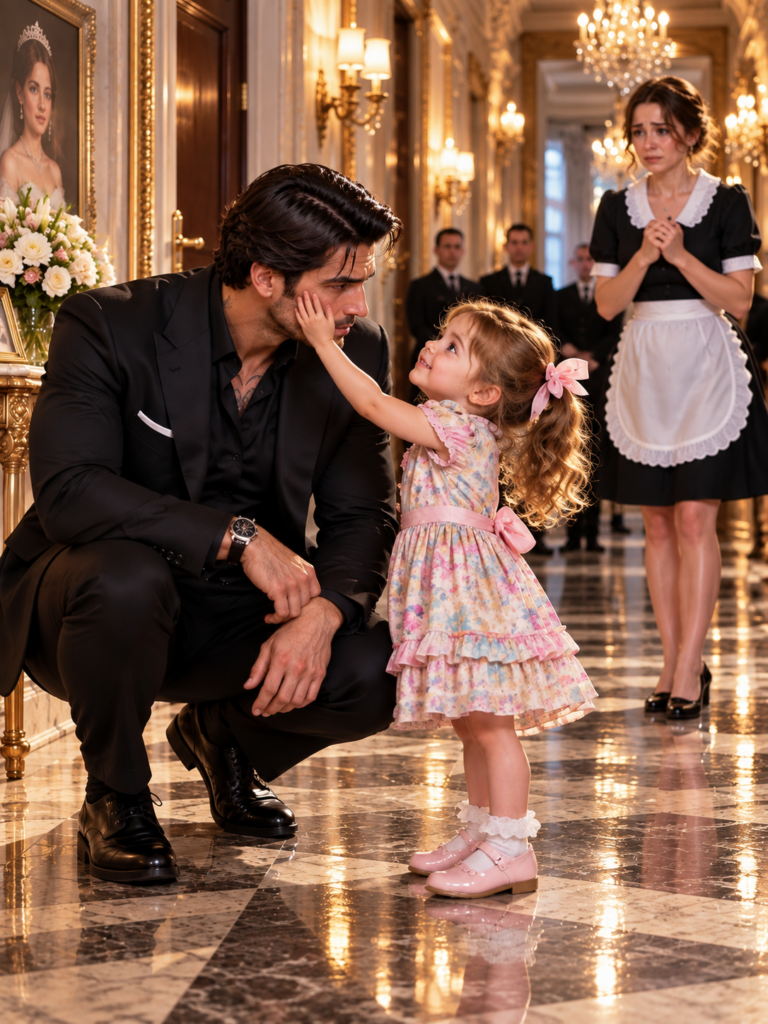
Dante’s expression changed so subtly that anyone who didn’t know him would have missed it. His shoulders remained straight. His hands stayed behind his back.
But something inside him seemed to loosen.
The guard nearest the staircase looked away.
Dante lowered his eyes to Sophia. “Who told you that?”
“Mommy.”
I swallowed. “Sophia, we need to—”
“She told me people who love each other should say it,” Sophia continued. “Even if one person is in heaven.”
Dante’s gaze moved to me.
This time, it was not cold or suspicious.
It was searching.
“What exactly have you been telling her?” he asked.
“Nothing about your wife,” I said quickly. “I promise. She hears things, remembers things, and fills in the rest. Last week, I explained that my grandmother was in heaven. She must have connected it to the portrait in the upstairs hall.”
Dante didn’t answer.
Sophia tugged at his sleeve. “Are you going to tell her?”
He looked down at her hand resting against his dark jacket.
“Not today,” he said.
“Why?”
“Because I’m not ready.”
She considered this with the grave seriousness of a child deciding whether an adult’s excuse was acceptable.
“Then tomorrow.”
A sound escaped the cook behind me—half laugh, half cough.
To my surprise, Dante didn’t reprimand anyone.
He simply looked at Sophia for a long moment. Then he bent until they were eye to eye.
“Tomorrow,” he agreed.
Sophia smiled.
Dante straightened and glanced toward the sitting-room door.
For eighteen months, he had passed it without once touching the handle.
That afternoon, he placed his palm against the wood.
He did not open it.
He only stood there.
Then he said, “Rosa, come to my study after dinner.”
My stomach tightened.
“Yes, sir.”
“And bring your daughter.”
I looked at him sharply.
His expression softened by the smallest degree.
“She has already involved herself in the matter,” he said. “I think she should hear the answer.”
Sophia beamed as if she had been invited to a birthday party.
I was not nearly as enthusiastic.
After Dante walked away, the corridor slowly began to breathe again.
The guards resumed their positions. The cook disappeared toward the kitchen. A maid hurried past carrying fresh towels, pretending not to stare at me.
I took Sophia’s hand.
“What did I tell you about following people?”
“That Mister walks lonely.”
“That wasn’t the question.”
She thought about it. “Don’t follow people who are going somewhere private.”
“Correct.”
“Is Mister going somewhere private?”
“Yes.”
“Can we go too?”
“No.”
She sighed. “Grown-ups have too many rules.”
I could hardly disagree.
That evening, I changed Sophia into her yellow cardigan and brushed the tangles from her hair. She sat on the edge of my narrow bed in the staff quarters, swinging her legs while I tried to make sense of what had happened.
Dante had asked me to bring her to his study.
Why?
Had he been offended? Had he decided that allowing Sophia to continue her daily ritual was irresponsible? Perhaps he intended to tell me that I could no longer bring her to the estate.
That would be fair. The house had rules for a reason.
Still, the idea of leaving frightened me more than I wanted to admit.
The Falcone estate was not an easy place to work, but it paid enough to keep Sophia in preschool three days a week. The hours were steady. Mrs. Bellini, the housekeeper, had quietly arranged for me to use the small room near the laundry when I needed to stay late.
Finding another job would mean losing all of that.
More importantly, I had grown accustomed to the strange rhythm of the house. The silence. The guarded doors. The people who communicated through glances and unfinished sentences.
And, despite myself, I had begun to worry about Dante.
Not because he was frightening.
Because he seemed to be disappearing while still standing in front of everyone.
At seven, I took Sophia upstairs.
Dante’s study was at the far end of the west wing, behind a pair of walnut doors. I had only entered once before, to deliver a stack of invoices. The room had smelled of leather, dust, and the bitter coffee he drank without sugar.
A guard opened the door.
Dante stood near the fireplace, holding a small glass of water. He had changed out of his suit jacket, but his white shirt remained buttoned to the throat.
Sophia walked in as if she owned the place.
“Hello,” she said.
“Hello, Sophia.”
She looked around. “Do you have toys?”
“No.”
“Books?”
“Yes.”
“Are they boring?”
“Most of them.”
She nodded approvingly. “That’s okay.”
I closed the door behind us.
Dante gestured toward the chairs near the fire. “Sit.”
I sat with Sophia beside me. Dante remained standing for a moment before taking the chair across from us.
His eyes settled on my daughter.
“Do you remember what you whispered to me?”
“Yes.”
“Why did you say it?”
“Because you were looking at the door.”
Dante’s fingers tightened around the glass.
Sophia continued, “When people look at doors like that, they want to go inside.”
“And you think I should?”
“Yes.”
“Why?”
“Because maybe the lady wants you to come in.”
The words struck him more deeply than they should have.
I saw it in the slight lowering of his head.
Dante looked toward the windows. Night had gathered against the glass, turning the reflection of the study into a second, darker room.
“When someone dies,” he said slowly, “sometimes the people left behind don’t know how to keep living in the rooms they shared.”
Sophia leaned against my arm. “You can live in another room.”
“I have.”
“But you still walk by this one.”
Dante’s mouth tightened.
She was not being cruel. She was simply stating the truth as she understood it.
“Four o’clock was when she died,” he said.
I had heard the fact from the staff, but never from him.
Sophia’s eyes widened. “So you walk then because you miss her?”
“Yes.”
“Does it make you feel better?”
“No.”
“Then don’t do it.”
I closed my eyes briefly.
“Sophia,” I whispered.
But Dante lifted a hand.
“No,” he said. “She’s right.”
He set the glass down.
“I have been doing the same thing every day because it is the only way I know to reach the moment before it happened.”
My breath caught.
Dante looked at me, and for the first time, I saw the man beneath the careful posture. Not the employer. Not the feared figure whose name made people lower their voices.
Just a husband who had been standing outside a door for a year and a half, hoping grief might eventually open it for him.
“I thought,” he continued, “that if I repeated the walk enough times, I might remember something I had forgotten.”
“About that day?” I asked.
He nodded.
“Do you?”
“No.”
“Then why not open the room?”
His eyes moved toward the fireplace.
“Because Carmela left things there.”
The sentence hung between us.
Dante had not said that before. Not to me. Perhaps not to anyone.
“What kind of things?” I asked.
He gave me a tired smile. “Books. Scarves. A broken music box she refused to throw away. A dozen unfinished projects. Her handwriting on every surface.”
Sophia slipped off the chair and walked toward the bookshelves.
I reached for her, but Dante shook his head.
“She can look.”
Sophia ran one finger over the lower shelf. Dust gathered beneath it.
“Does it smell like her?” she asked.
Dante’s face softened. “It does.”
“Then maybe she’s still there.”
“Maybe.”
“Not really,” Sophia said. “But a little.”
The room became quiet again.
Dante watched her as if her simple logic had given him permission to consider something he had avoided.
Finally, he turned to me.
“Did Carmela ever speak to you?”
I frowned. “Of course. Occasionally.”
“What did she say?”
The question was unexpected.
I searched my memory. Carmela had been kind but private. During my first weeks at the estate, she had shown me where the nursery supplies were kept, though there had been no children living in the house then. She had asked whether Sophia liked picture books. Once, she had given me a bag of outgrown clothes from a niece.
“She asked about Sophia,” I said. “She liked children.”
Dante waited.
“She also told me to take breaks when I worked late. She said no one should be expected to live on coffee and stubbornness.”
A faint smile touched his mouth.
“That sounds like her.”
“She was worried about you,” I said before I could stop myself.
The smile disappeared.
“What do you mean?”
“Not in a dramatic way. She noticed you skipped meals. She said you carried work home even when you were already home.”
Dante leaned back.
“She said that?”
“Once.”
“And you never told me?”
“I didn’t think it was my place.”
His gaze lowered.
There it was again—that strange understanding between us, uncomfortable because it was too honest.
The estate ran on people deciding what was not their place to say.
Dante looked toward the locked door at the far side of the study. It led to a private corridor connecting to Carmela’s sitting room.
“I found a notebook after she died,” he said.
I waited.
“It was in the drawer of her desk. I read some of it, but not all. There were pages about the household, the staff, people she wanted to help. I couldn’t continue.”
“Why tell me now?”
“Because your daughter has spent two weeks imitating me, and today she repeated something Carmela used to say.”
“What?”
Dante’s hand moved to the inside pocket of his shirt.
He pulled out a small folded piece of paper, creased and yellowed with age.
“I found this tucked inside the notebook.”
He placed it on the table between us.
I did not touch it.
“What does it say?”
“It’s addressed to you.”
My heartbeat stumbled.
“To me?”
Dante nodded.
“I thought it was a mistake.”
I unfolded the paper carefully.
The handwriting was small and elegant.
Dear Rosa,
If you ever need anything, please ask. I know you are proud, but pride is not the same as strength, and strength should not have to mean doing everything alone.
There was no signature, only a single initial at the bottom.
C.
I read it twice.
Then a third time.
“I don’t understand,” I whispered.
“Neither do I.”
“When did she write this?”
“Three weeks before she died.”
I looked up. “Did she give it to you?”
“No. It was hidden in the notebook.”
“Maybe she meant another Rosa.”
“There was no other Rosa employed here.”
My fingers trembled slightly as I folded the note.
Dante watched my face.
“Did she ever say anything else to you?”
I thought of the last conversation I had with Carmela.
It had taken place in the kitchen, late in the afternoon. She had been standing by the window, holding a cup of tea she never drank. She asked whether Sophia’s father was involved in her life.
I had said no.
Carmela had looked at me for a long moment and replied, “Then make sure your daughter grows up knowing that someone choosing not to stay is not the same as her being unworthy of love.”
At the time, I had assumed she was speaking from general wisdom.
Now, remembering her expression, I wasn’t sure.
“She asked about Sophia’s father,” I said.
Dante became very still.
“What exactly did she ask?”
I told him.
“Did she say anything about me?” he asked.
“No.”
“About the estate?”
“No.”
“About anyone else?”
I hesitated.
There had been one more thing.
Carmela had asked whether I had ever noticed anyone entering the house through the service gate after midnight.
I had thought it was an odd question, but I had answered honestly. I had seen a dark sedan twice, though I assumed it belonged to one of Dante’s associates.
I had never mentioned it because, at the time, I had not believed it mattered.
Now Dante noticed my hesitation.
“What is it?” he asked.
“I don’t know if it’s important.”
“Tell me.”
I explained about the sedan.
His expression changed—not into anger, but concentration.
“What nights?”
“I don’t remember exactly. Once in early spring. The second time was a few days before…” I stopped.
“Before Carmela died?”
I nodded.
Dante leaned forward.
“Why didn’t you report it?”
“I assumed it was expected. There were always vehicles coming and going.”
“Did Carmela ask you about the service gate?”
“Yes.”
“What did you tell her?”
“That I had seen a car there twice.”
“And?”
“She told me not to mention it to anyone.”
The silence that followed felt different from the others.
Not frightening.
Heavy.
Dante rose and walked toward the fireplace. He stood with his back to us, one hand resting on the mantel.
For a moment, I wondered whether I had made a terrible mistake.
Then he asked, “What did the car look like?”
“Black. Older model. Maybe a sedan.”
“License plate?”
“No. I was too far away.”
“Did you see the driver?”
“Only once. A woman, I think.”
Dante turned.
“A woman?”
“I saw long hair when she got out. That’s all.”
His eyes narrowed—not at me, but at the memory.
“What did Carmela say after you told her?”
I closed my hand around the note.
“She said, ‘If anyone asks, you never saw it.’”
Dante stared at me.
Then, unexpectedly, he laughed once.
It held no amusement.
“Of course she did.”
“What does that mean?”
“It means Carmela had already begun investigating something, and she thought she could protect everyone by keeping it to herself.”
“Investigating what?”
“I don’t know.”
He crossed the room and opened a drawer in the desk. From it, he removed a slim leather notebook.
The cover was worn along the edges.
He placed it beside Carmela’s note.
“This is the notebook I told you about.”
I looked down at it.
“Why show me?”
“Because there is one page I never understood.”
He opened the notebook carefully and turned several pages.
Most were filled with names, dates, reminders, and brief notes in Carmela’s handwriting.
Call Mrs. Bellini about the medication delivery.
Ask Rosa whether Sophia needs winter shoes.
Speak to Dante about the north gate.
Then he stopped.
The page near the back contained only one sentence.
If anything happens, the truth is not in the house. It is with the person who walks beside him.
I read it once.
Then again.
Dante’s voice was barely audible.
“I always thought she meant someone who was physically with me that day.”
He looked at me.
“But now I’m not sure.”
Behind us, Sophia had gone quiet.
She stood beside the bookshelf, holding a small wooden box in both hands.
“Mister,” she said.
Dante turned immediately.
“What is it?”
She carried the box to him.
“This was under the books.”
Dante took it carefully.
The box was no larger than a jewelry case. Its brass latch was tarnished, and a thin layer of dust covered the lid.
He stared at it for several seconds.
Then his face drained of color.
“Where did you find this?”
“Behind the blue books.”
Dante looked at the shelf.
I noticed, for the first time, that one row of books was arranged differently from the others. A narrow gap showed between the last volume and the wood panel behind it.
He opened the box.
Inside lay a silver key, a folded photograph, and a small envelope.
The envelope was addressed in Carmela’s handwriting.
Not to Dante.
Not to Rosa.
To the person who follows him at four o’clock.
Dante lifted his eyes to Sophia.
And for the first time since I had known him, fear—not grief, not anger, but genuine fear—showed plainly on his face.
-END OF PART 2

