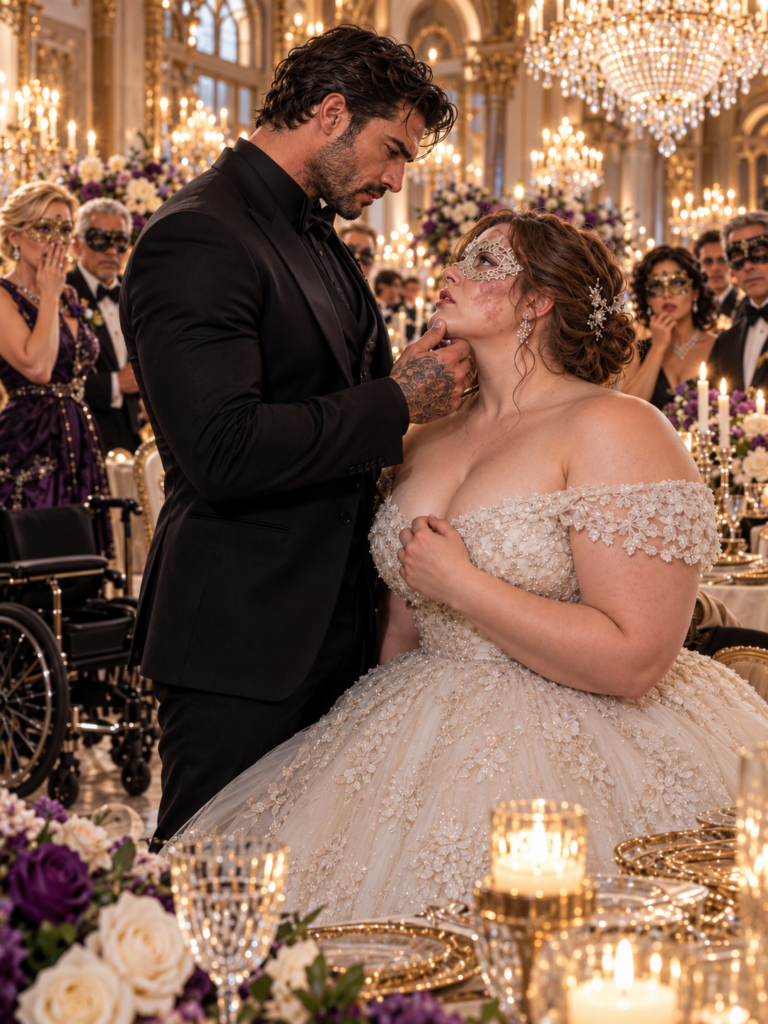
At the Bowmont table, order was absolute.
Casius Ferraro, head of the Ferraro family, was expected to marry a Bowmont daughter. Everyone in New Orleans assumed that daughter would be Camille, the younger, radiant one who had been raised for rooms full of important people and knew precisely how to occupy them.
Instead, Casius was eventually given Delphine.
The sister no one saw.
For 11 years, Delphine Bowmont had been kept largely out of sight whenever the family entertained. People spoke of her without ever seeing her. The story that circulated through New Orleans was that one side of her face had been so badly ruined that even her own mother had never stood beside her for a photograph.
The city expected Casius Ferraro to refuse her.
He did not.
The arrangement began in the Bowmont dining room on a wet April evening.
Sterling Bowmont had prepared the room for negotiation rather than hospitality. He had brought out the good silver inherited from his grandfather and had personally adjusted every chair that afternoon, moving them by inches as though the correct position of furniture might save him from whatever the evening required.
There were 6 people at the table besides the Bowmont family.
Among them was Salvatore Ruggiero, 74 years old, the oldest voice present, a man who ate little and missed almost nothing.
At the far end sat Casius Ferraro.
Before his arrival, Sterling had ordered the chair from that place removed so Casius’s wheelchair could roll directly into the gap.
The gesture was meant to be considerate.
Casius found it insulting.
He had spent 20 months learning what people revealed about themselves through the accommodations they arranged for him. Some made a ceremony of kindness. Some addressed the person standing behind his chair rather than him. Others pretended not to notice the chair at all while constantly reorganizing the room around it.
Casius noticed every version.
He said nothing.
The meal proceeded through shrimp and a second bottle of wine while everyone spoke carefully about continuity, friendship, and the long relationship between the Ferraro and Bowmont families.
Then Sterling put down his fork.
He had been rehearsing what came next since Tuesday.
His daughter Camille, he explained, had been raised to understand what an alliance between families meant.
He looked toward her.
Camille was 23 and beautiful in the polished, expensive way that families like hers cultivated deliberately. She had spent the entire dinner refusing to look directly at Casius.
Now she did look.
Not at his face.
Her eyes moved past his shoulder and down to the wheelchair.
Then, in a voice clear enough to reach every corner of the room, she said she would not marry a corpse that breathed.
No one moved.
Marjo Bowmont’s hand stopped halfway to her water glass.
At the opposite end of the table, Salvatore Ruggiero set his wine down.
He did it gently.
The small sound of crystal meeting walnut carried through the room like the closing of a bolt.
Everyone there understood what Camille apparently did not.
An insult delivered publicly to the head of a family, at a table prepared for alliance and witnessed by other families, was no longer merely an insult.
It had become a debt.
The only remaining question concerned the currency in which it would be paid.
Sterling Bowmont went pale.
He began talking and could not stop. Camille was tired. She was young. She possessed an unfortunate temperament inherited from a relative. She did not understand what she had said. He would speak with her privately. Of course the family honored the arrangement.
No one listened.
Casius said nothing.
He let the silence remain for 4 minutes.
Four minutes without speech is longer than most threats.
By the time it ended, Sterling had exhausted himself and was breathing through his mouth.
Camille’s chin had begun to tremble.
At 23, she had never before spoken into a room that refused to rescue her from her own words.
Casius watched her until she looked away.
Then he asked Sterling a single question.
Did he have another daughter?
Sterling did not answer with words.
His eyes moved upward involuntarily toward the ceiling and the third floor of the house.
He corrected himself almost immediately.
It did not matter.
Everyone at the table had followed his gaze.
Marjo closed her eyes.
Ruggiero pushed back his chair, thanked the Bowmonts for dinner in the tone of a man declining dessert, then walked slowly around the table.
He stopped beside Casius.
Leaning down, with one hand resting briefly on the younger man’s shoulder, he spoke quietly enough that no one else heard.
30 days.
After that, if the debt remained unsettled, the table would choose a head for the Ferraro family itself.
Ruggiero straightened, buttoned his jacket, and left the house.
The dining room remained frozen beneath the chandelier.
Everyone inside it was thinking about a room upstairs that few of them had entered in years.
Marjo finally went to get Delphine.
Sterling could not make himself do it.
Her heels crossed the third-floor landing loudly enough for those below to understand how rarely that part of the house was used.
9 minutes later, Marjo returned.
The woman behind her was not what the room had prepared itself to see.
For 11 years, New Orleans had constructed Delphine Bowmont from rumor.
The result had become something grotesque, fragile, and pitiable.
The real woman was 28 years old.
She wore a gray cardigan and flat shoes. Her dark hair fell loose and forward over the right side of her face, not theatrically but with the unconscious regularity of a habit formed years earlier.
She moved with the efficient quiet of someone accustomed to hospital floors.
She stopped at the edge of the light.
No one offered her a chair.
Sterling explained the situation.
He used the voice he reserved for clients, the one capable of making an ugly arrangement sound prudent.
It took less than 2 minutes.
He spoke about the table, the 30-day deadline, Camille’s insult, and what the Bowmont family now owed.
He used the word obligation 4 times.
He did not say marriage until nearly the end.
He never asked Delphine what she wanted.
Apparently, no one in the room had considered that such a question existed.
Marjo stared at the tablecloth.
Camille wore an expression of solemn sympathy that she seemed almost to enjoy.
Delphine listened.
When Sterling finished, she did not ask about money.
She did not ask where she would live.
She did not ask about the man sitting 10 feet away.
She waited 4 seconds.
Then she said, “All right.”
Casius counted the 4 seconds.
Counting was what he did now.
Seconds underwater in the rehabilitation pool.
Seconds upright between parallel bars.
Seconds a man required to answer when he was lying.
4 seconds was too short for deliberation.
It was also too controlled to be surrender.
Sterling turned completely around in his chair and looked at his oldest daughter.
The awkwardness of the movement made one thing obvious.
He had not truly looked at her for a long time.
Camille gave a small laugh and covered it with her hand.
She apparently believed her sister had accepted because, for once, someone wanted her.
Casius believed something else.
No one agreed that quickly to a proposition like this unless the answer had already been waiting.
Sterling finally introduced them.
Delphine crossed the room.
Everyone approached Casius’s wheelchair differently.
Sterling talked toward a point above his head.
Staff members often addressed Gideon Marsh, Casius’s longtime driver and aide.
Camille had angled her body away from the chair throughout dinner as though proximity might spread his condition.
Delphine did none of those things.
She walked directly toward Casius, held out her hand, and looked at his face.
Not near it.
At it.
Her eyes never dropped toward the chair.
There was no effort in the gesture and no deliberate kindness.
The wheelchair simply did not seem to register as the most important information about him.
For 20 months, everyone around Casius had made some decision about how to react to his body.
Delphine appeared not to have made one at all.
He took her hand.
Her grip was dry and firm.
There was a callus across the base of her fingers that did not belong to a banker’s daughter.
The handshake lasted perhaps 3 seconds.
It changed something inside him that he would not understand for another 6 months.
Outside, warm rain began falling again.
In the van, once they were several blocks away, Gideon finally asked whether Casius believed her.
Casius watched the wet city pass outside.
No.
But he wanted to know what she wanted.
Nobody did anything for free.
They married 9 days later.
City Hall on Perdido Street.
Second floor.
Fluorescent lights.
A water stain on the ceiling shaped vaguely like Louisiana.
There were no guests.
There were no flowers because no one had remembered flowers, and neither of them had raised the subject.
There were no photographs.
That omission mattered more than either admitted.
A photograph would have required someone to stand beside Delphine and smile, and both of them had reasons not to force the test.
Gideon Marsh and a records clerk served as witnesses.
Delphine wore a gray dress she had owned for 6 years, the same dress she wore to funerals when patients from the burn unit failed to leave the hospital.
Casius wore a white shirt without a jacket or tie.
The ceremony lasted 10 minutes.
The officiant had a cold and read the civil language too quickly.
When she reached the end and told Casius he could kiss the bride, he did not even look up from the license.
“The car’s waiting.”
Those were the first words he spoke to his wife.
He did not seem aware of it.
On the way out, the front casters of his wheelchair struck the curled edge of a heavy rubber runner across the corridor.
The chair stopped sharply.
Casius did not curse.
He did not struggle.
He raised one hand.
A security guard came over.
Casius instructed him to remove the runner, not merely from that doorway but along the entire corridor to the elevator, because someone was going to break a neck on it before summer.
A maintenance worker was called.
Delphine stood nearby watching the runner being rolled away.
Something shifted quietly inside her.
Casius had not apologized for needing assistance.
He had not made a joke about the chair.
He had not performed humiliation or bravery.
He had identified an obstruction and ordered its removal.
In doing so, without even intending to, he had cleared the path for everyone who came behind him.
For 11 years, Delphine had been treated as the obstruction no one wanted to discuss.
It had never occurred to her that an obstruction might simply be removed.
On the drive to Casius’s house in the Garden District, Gideon watched her in the mirror.
He had served Casius for 9 years.
He had buried Casius’s younger brother, Emory.
He had carried Casius out of a hospital at 4 in the morning under a bedsheet so photographers could not get an image of him.
Since the explosion, Gideon had studied everyone who came within 10 feet of the wheelchair.
Everyone wanted something.
Most people wanted it badly enough to become pleasant.
Delphine arrived at her husband’s house with no luggage.
Everything important enough for her to bring to her own marriage fit inside a dented tin box about the size of a bread pan.
She kept both hands across the lid during the entire drive.
The house on Prytania Street was one of the old grand houses, with white columns, iron galleries, and a live oak in the side yard older than the state.
Every upstairs window had been dark for 20 months.
Odette Broussard waited in the doorway.
She was 62 and had served the house long enough to understand when not to ask questions.
People had a particular reaction when first seeing Delphine’s face.
A flicker in the eyes.
Then a decision to look elsewhere.
Most people believed the sequence was invisible.
Odette looked directly at the scarred right side of Delphine’s face.
She neither stared nor recoiled.
Then she met Delphine’s eyes.
She told her she would leave the hall light burning all night because Delphine did not know the house yet.
It was only a few words about a light.
Delphine needed a moment before she could answer.
Inside, Casius showed her the ground floor.
The library had become his office.
The old ballroom and morning room had been converted into a bedroom and accessible bathroom.
The alterations were crude and temporary, the work of a man who had wanted the problem hidden quickly rather than solved properly.
In the front hall, Casius explained the arrangement without pretending it was anything else.
Their marriage was a contract.
Ruggiero’s 30 days had been a weapon placed against him.
Delphine had stepped into the middle of it.
He would not insult her by pretending otherwise.
Separate rooms.
Separate floors.
She would appear where protocol required and otherwise be left alone.
No one would touch anyone.
Her door had a lock.
He could not reach the upper floors.
She was safer in his house than anywhere in New Orleans.
Casius meant it as a factual list of advantages.
He seemed unaware that he had described her security as dependent partly on the geography of his own damaged body.
Delphine heard the statement beneath the statement.
She thanked him.
At her own request, Odette had prepared a third-floor room.
Delphine had slept on a third floor for 11 years and no longer knew how to rest anywhere lower.
She unpacked nothing.
The tin box went on the dresser.
That night, after midnight, she heard the wheelchair moving below her.
Across the floor.
Pause.
Back.
Across.
Pause.
Back.
For 3 hours.
She remained on the bed and listened.
She knew what she was hearing.
Neuropathic pain.
The night form.
The kind that burned through legs a man could not consciously move.
There was often nothing to do but keep moving and wait for morning.
Delphine had heard it hundreds of times in the hospital.
She had never heard it from a man who had spent the evening sincerely telling her that she was the safest person in the city.
The wheels finally stopped after 3.
Delphine waited another 40 minutes.
Then she opened the tin box.
It had once held English toffee.
Inside were no jewels.
There were 411 pages of her own medical records.
At 22, Delphine had requested every page from the hospital that treated her after the injury at 17.
She had read all 411 pages in one night.
By sunrise, she understood 2 things.
What happened to her had not been inevitable.
And every crucial decision recorded in those pages had been made by calm adults.
The next morning she transferred to the burn unit at Saint Aurelian.
She had remained there ever since.
Beneath the records lay something that did not belong to her.
A hospital identification band.
Casius A. Ferraro.
August 14.
20 months earlier, at 2:07 in the morning, Delphine herself had cut that band from his swollen wrist in the trauma bay at Saint Aurelian.
She had been the charge nurse.
A vehicle had burned.
There were only 3 people in the hospital who could look at the kind of injuries produced by a burning car without their hands shaking.
Delphine had been one of them.
She held Casius’s head while the cervical collar was placed.
She counted rhythm for the resident.
She stayed through the first 72 hours.
She remembered Emory, too.
There had been nothing left to do for the younger brother.
Casius remembered none of it.
He had been sedated and intubated, then sedated more deeply.
By the time his memory returned, his world consisted of lawyers, cousins, and a physician named Dr. Wendell Price.
Delphine had gone back to the burn floor.
Under the wristband lay a folded piece of scrap paper torn from a supply order.
Her handwriting.
A date.
Initials.
A neurological classification.
And beneath them, 5 words pressed so hard into the paper they had scored it.
Nobody has told him yet.
Those words had remained true for 20 months.
Delphine had entered the Bowmont dining room already knowing something about Casius that he did not know about himself.
She had agreed to the marriage in 4 seconds because she had never truly been deciding whether to marry him.
She had been deciding whether she finally had a way back into his medical record.
She told herself she would stay only long enough to confirm what she suspected, give the evidence to someone able to act on it, and return to her ward.
She locked the tin.
She knew she was lying to herself.
She simply was not ready to name the other reason.
The first clinical proof appeared on a Tuesday morning.
The door to Casius’s bedroom stood slightly open.
Gideon had gone to fetch water.
Delphine happened to look inside.
Casius lay on his side.
Gideon was changing gauze over the left hip.
Delphine stopped.
One glance was enough.
A full-thickness pressure wound.
Undermined edges.
Tissue extending through the fat.
Stage 3.
Not new.
There was nothing ambiguous about it.
And nothing about it should have existed.
Casius had money, a private physician, a full-time attendant, and a large house.
A wound like that required more than bad luck.
It required decisions.
Delphine entered without knocking.
Casius ordered her out.
She ignored him.
In 6 weeks, she told him, the wound would reach bone and he would die of sepsis.
Not because of an enemy.
Because of a cheap seat cushion.
Then she told him to stay still.
No one had spoken to Casius Ferraro that way for years.
For reasons neither of them could later explain, he obeyed.
The cushion beneath him was a 2-inch foam pad retailing for roughly $110, the kind routinely issued to someone expected to walk again in a few weeks.
It offered nothing close to the pressure distribution required by someone sitting 14 hours a day indefinitely.
Gideon explained that Dr. Wendell Price had personally chosen it 20 months earlier and reordered the same type twice.
Delphine asked about repositioning.
Gideon repeated Price’s instructions.
Movement was to be kept down because frequent turning supposedly worsened spasticity.
Delphine went very still.
To a layperson, the instruction sounded medical.
To a nurse with Delphine’s experience, it was indefensible.
No established spinal-cord protocol reduced repositioning to prevent spasticity.
It was precisely the kind of instruction someone would give if he wanted a pressure wound to develop while preserving plausible deniability.
She completed the dressing.
Before leaving, she turned over the cushion and wrote its model number and manufacturing code across her palm.
By Thursday, a graph-paper chart was taped to the refrigerator.
Time.
Position.
Skin check.
Initials.
A $460 air-cell cushion arrived from Baton Rouge.
The foam pad went into the trash.
Casius would now be repositioned every 2 hours, day and night.
Gideon took the 11-to-5 shift without complaint.
His posture had changed.
For 20 months, he had followed Price’s instructions faithfully.
Now he understood that obedience had contributed to hurting the man he had been trying to protect.
Odette quietly began adding her own initials to the chart.
Dr. Wendell Price visited the following Monday.
He was 58, agreeable, neatly dressed, and comfortable with the authority granted to a man accustomed to being the most educated person in the room.
Delphine asked him 3 polite questions.
The current daily drug dose.
How it had been established.
How it had been adjusted over 20 months.
Price spoke at length.
He gave her no number.
She asked whether there had ever been a taper attempt.
He referred vaguely to Casius’s delicate tolerance.
Then Delphine asked a fourth question.
Had Price ever sent a serum level to an independent laboratory during the previous 20 months?
There was a pause.
Only around 1.5 seconds.
His hands stopped on the clasp of his medical bag.
Then he laughed and told Delphine she was a wonderful addition to the household but should focus on nursing matters, dressings, and skin care.
He left within 5 minutes.
Casius had watched from the doorway.
He had spent most of his adult life reading men across tables.
He had just watched the physician he had trusted for 2 years deliberately refuse to answer a simple clinical question.
After Price left, Casius told Delphine she was not afraid of him.
She kept folding a sheet.
She had spent 7 years in a burn unit.
She had held people’s hands while they died.
He sat and scowled.
That was all.
Something at the corner of Casius’s mouth almost became a smile.
Delphine did not see it.
She was too busy understanding that Wendell Price was not merely careless.
Careless physicians gave bad answers.
Price had carefully supplied no answer at all.
They shared dinner for the first time 11 days after the wedding.
Odette simply set 2 places and disappeared into the kitchen.
There was redfish, rice, and an unopened bottle of wine.
Eventually, Casius asked Delphine about her face.
He did not lower his voice.
He did not apologize for asking.
He asked what happened and how old she had been.
Delphine realized that everyone else had treated the subject delicately because they believed the injury too terrible to speak of normally.
Casius treated it as a fact.
She recognized the difference as respect.
She answered plainly.
She had been 17.
There had been an accident in the conservatory of the Bowmont summer house.
Her parents were hosting 400 guests for a fundraiser.
Rather than summon emergency services and risk sirens, photographs, and the collapse of Marjo’s event, they called the family physician to the house.
The decision was made calmly.
In Delphine’s profession, the first critical treatment period was called the golden window.
It closed around hour 6.
She was not transferred to a specialized trauma center until day 2.
She said nothing about pain.
She did not describe the unsuccessful surgeries.
She placed the 2 numbers on the table.
Hour 6.
Day 2.
Casius did the arithmetic.
He did not tell her he was sorry.
Instead, he said her father’s bank carried $4 million with him.
As of the following morning, the rate would be different.
Delphine laughed.
Really laughed.
It startled her.
She had heard pity for 11 years.
Casius had gone directly past pity into consequences.
Someone, somewhere, would pay something.
The laughter turned without warning into tears.
She stood because she refused to cry at the table and only made it as far as the back of her chair.
She cried for approximately 40 seconds.
Then she apologized twice.
Casius waited until she stopped.
“In this house, you don’t apologize for anything.”
Soon afterward, Delphine drew Casius’s blood herself.
2 tubes.
She labeled them under the name of a nonexistent 51-year-old male patient attached to a physician in Metairie who owed her a favor.
She carried them across the river personally to a laboratory with no connection to the Ferraro family.
9 days later, the results arrived.
The level of the primary medication was not merely elevated.
It was many times higher than the dose recorded in his chart should have produced.
There was another drug present as well.
An antispasmodic with heavy sedative effects.
Its concentration appeared nowhere in Wendell Price’s written record.
Delphine sat in the kitchen with the report and understood what she had been afraid of for 20 months.
On August 14, she had been present for Casius’s first neurological assessment.
She had written it down because everyone else seemed preoccupied.
ASIA C.
Incomplete injury.
Motor preservation below the level of damage.
That meant Casius’s spinal cord had not been completely severed.
It meant that at the beginning, there had been a real possibility of recovery.
Not a promise.
Not a miracle.
A possibility.
And for 20 months, nobody had told him.
He had received no genuine rehabilitation.
He had been given a cushion that encouraged tissue breakdown.
A turning schedule that encouraged a pressure injury.
And medication in quantities capable of suppressing whatever motor signals were still surviving.
It was not simply the spinal injury keeping him in the wheelchair.
It was also the treatment.
Delphine understood then that she was no longer looking at medical negligence.
Wendell Price had been assigned to Casius after the explosion by the table itself as a courtesy.
Someone powerful enough to place a doctor inside the Ferraro household had arranged this.
Someone high enough to disguise destruction as care.
Delphine’s first impulse was to tell Casius immediately.
She reached the landing.
Then she stopped.
If Casius learned the truth that night, Price would not survive another day.
Delphine understood the man she had married.
But killing Price would destroy the case.
What did she possess?
A private laboratory result under a false patient’s name.
Blood obtained without Casius’s consent.
Her own word.
Price’s allies could call her manipulative.
Ambrose Corsi, Casius’s ambitious cousin, could stand in front of the table and argue that the head of the Ferraro family had lost his judgment along with the use of his legs.
The Ferraro 30-day deadline would become an afternoon.
She required evidence that could survive arithmetic.
Repeated serum levels.
Same time.
Same procedure.
Matched against written orders.
Matched against doses Delphine herself controlled.
A chain.
At least 4 months.
A notebook.
And absolute silence.
She opened a black composition book purchased at a drugstore on Magazine Street.
She wrote the date.
The values.
One line beneath them.
Then she locked it inside the tin box.
The taper began on the first Monday in June.
Slowly.
A fraction removed from the evening dose.
Hold for 7 days.
Then a fraction from the morning dose.
For 3 weeks, almost nothing happened.
Then, in week 6, Casius’s body began coming out from under 20 months of suppression.
Fever.
Then 103.1.
Tremor so severe he could not hold a glass.
Sweat through the sheets.
On the second night, his speech began breaking apart.
That frightened Delphine more than the fever.
Casius’s voice and mind were the territory no injury had taken from him.
She sat beside his bed from 10 at night until dawn.
Pulse every 15 minutes.
Every result entered into the black book.
Twice, she almost called an ambulance.
Twice, she stopped.
An emergency room meant toxicology under Casius Ferraro’s real name.
Price would know before sunrise.
The chain would be destroyed.
A little before 6, the crisis broke.
The tremor eased.
Casius slept.
Delphine went into the kitchen and shook at the sink before making coffee.
At 9:40, Wendell Price arrived without warning.
For 20 months he had never done that.
He said he happened to be nearby.
Then he asked for the medication administration log.
Not the refrigerator chart.
Every dose.
Every date.
Every initial.
Delphine brought him 14 pages.
They were flawless.
She had written them 3 weeks before beginning the taper.
A false record constructed to resemble a real one.
Not too perfect.
A dose 11 minutes late.
An evening schedule disrupted by a meeting.
The small irregularities that make genuine logs genuine.
Price read all 14 pages.
He found nothing.
Then he asked about the fever.
Delphine answered as a nurse briefing a physician.
Temperature curve.
Negative findings.
Wound clean.
No urinary symptoms.
Spontaneous resolution by 0600.
Likely viral.
She lied directly to his face without a tremor.
Price closed the log.
At the front door, he turned.
He called her Miss Bowmont.
Not Mrs. Ferraro.
Then he told her that people in their line of work sometimes forgot that rich patients tended to die of other people’s kindness.
Delphine understood.
It was not advice.
It was the story he intended to tell if she ended up dead.
The devoted wife.
The overconfident nurse.
A dosing error.
Gideon Marsh had heard the entire exchange from the service passage.
He had also seen Delphine writing the false log weeks before, on a night when nobody was sick.
He said nothing.
Not then.
Not for another 5 months.
In early August, during routine range-of-motion work, Delphine held Casius’s right foot.
As she had done countless times, she told him to push downward against her palm.
She expected nothing.
The great toe moved.
Approximately 3 millimeters.
Almost nothing.
Enough.
Delphine stopped.
Casius raised himself on his elbows and stared at his own foot.
Then at her.
His hand closed around her wrist.
He held on for nearly 1 minute.
Hard enough to leave marks that remained for 4 days.
Neither said a word.
After that came the conservatory.
5 a.m.
Parallel bars bolted into the brick floor.
Ferns gone wild from neglect.
Rehabilitation before dawn where nobody could see.
It was slow.
Ugly.
Repetitive.
Casius fell often.
Sometimes Delphine could not lift him alone and had to call Gideon.
Nobody discussed those moments.
Delphine never told him she was proud.
She never told him he could do it.
He would have heard both as pity.
Instead, she gave him numbers.
12 seconds yesterday.
22 today.
Warmer room.
Different result.
Numbers were a language they both trusted.
By September, Casius asked Delphine to attend a business meeting with him.
She refused.
No explanation.
He did not coax her.
He turned his chair away.
Before leaving, he said something without looking back.
She made him stand every morning, but she was still sitting in her own place.
The sentence followed Delphine upstairs.
That night, she stood before the mirror in the third-floor bedroom.
She pushed her hair away from both sides of her face.
For 11 years, she had congratulated herself for no longer covering mirrors.
But not covering a mirror was not the same as standing before one.
She made herself look directly at the scars.
She counted.
She reached 5 seconds before looking away.
The 91st rehabilitation session came during a storm in November.
The conservatory glass ran with rain.
Casius rose between the bars.
20 seconds.
At 40, his legs failed.
Delphine tried to catch him.
They both went down onto the wet brick.
Nothing broke.
Casius began to laugh.
A cracked, exhausted sound pulled from somewhere beneath 2 years of silence.
Delphine laughed too.
For perhaps 3 seconds.
Then he stopped.
She turned.
He was looking at her.
Casius slowly raised his hand.
Slowly enough to give her time to move away.
She did not.
He took the wet strand of hair covering the right side of her face and placed it behind her ear.
He did not tell her the scars were fine.
He did not say he did not mind.
He did not say she was beautiful anyway.
Delphine had heard that sentence before and considered it one of the cruelest forms of pity because the word anyway contained the entire judgment.
Casius simply looked at her.
Nothing in his face changed.
The scar was not a tragedy.
It was part of her face.
And he was looking at her as a man looked at a woman about whom he had already decided something.
Delphine knew how to dismantle pity.
She had no defense against this.
She stood first.
She folded a towel into perfect quarters and placed it on his lap.
He should dry himself before he got cold.
Then she checked her phone.
40 seconds.
9 more than Tuesday.
She wrote the number in the black notebook.
“Mr. Ferraro. Therapy at 5.”
She left.
Casius remained on the wet conservatory floor for 15 minutes before Gideon found him.
For the next 21 days, no one raised a voice.
No one fought.
Nothing broke.
That was what made it unbearable.
Casius believed he had crossed a boundary.
He had touched the face of a woman who had been delivered to his house by debt and obligation.
Delphine believed something worse.
That he might truly want her.
She began calling him Mr. Ferraro again.
In front of Odette and Gideon, she referred to him as the patient.
Her hair came forward over the right side of her face.
Yet every morning at 5, she arrived.
All 21 mornings.
When the power failed.
On Sundays.
After working a hospital shift on 4 hours of sleep.
Casius counted every one.
The refrigerator chart, which had slowly accumulated handwritten exchanges between them, became clinical again.
Old notes remained in the margins.
Cold front tonight. Wear the wool one.
Beneath it, in Casius’s handwriting:
Wore it. Stop nagging.
One night at 2, he sat alone in front of the refrigerator and read every line.
On day 17, Gideon finally told him what he had seen.
Delphine had altered the medication records.
She had created the log herself.
She had lied to Price without blinking.
Casius understood everything incorrectly.
Inside 21 days of emotional distance, he concluded that Delphine had been managing him from the beginning.
The cushion.
The therapy.
The measurements.
The entire marriage.
An operation with an objective.
Then he had touched her face and received a folded towel.
On day 20, they both reached for a pill bottle that fell in the hall.
Their hands touched.
Both pulled away instantly.
“Delphine?”
“Yes, Mr. Ferraro?”
He looked at her for 3 seconds.
Nothing else.
Casius Ferraro had survived a bomb.
He had buried his brother.
3 weeks of being called Mr. Ferraro in his own house nearly finished what the explosion had started.
Part 2
By early December, the story had escaped the house.
It moved through New Orleans in the ordinary way such things moved: restaurants, christenings, private lunch tables, rooms where no one believed gossip counted if the door was shut.
The Ferraro marriage was supposedly fraudulent.
Casius had taken a Bowmont daughter only to satisfy the table.
They lived on separate floors.
There had been no public wedding.
No photographs.
No social presentation of the bride.
Ambrose Corsi, Casius’s cousin, announced with carefully performed regret that the table had an obligation to determine whether its ruling had actually been honored.
The information came from Sterling Bowmont.
Sterling had been promised a chair and had confirmed that Delphine slept alone upstairs and that he had not seen her since April.
Ambrose demanded a formal reckoning at Mardi Gras.
The Hotel Meringue.
Regional heads.
Every ranking officer in the city.
He framed the request so politely that Salvatore Ruggiero could not refuse it.
That evening, Casius called Delphine to the library.
3 objects lay on the desk.
Her passport, obtained without her knowledge.
An envelope thick with money.
An address in Lisbon’s Alfama district and the name of a man who would meet her at the airport.
Casius explained what Mardi Gras would mean.
What would be asked.
What the room intended to do to her.
A flight left at 11 the following night.
Then, looking down at the desk instead of her, he used the coldest words he could find.
“You don’t owe me anything, Miss Bowmont.”
It was retaliation.
21 days of Mr. Ferraro returned in the same currency.
Delphine looked at the passport.
She did not touch it.
Then she left the library.
Casius heard her walk toward the kitchen.
He sat alone under the lamp and felt something disappear from him.
In the kitchen, Delphine took a marker from the top of the refrigerator.
She found the next morning’s therapy entry.
5:00.
She crossed it out.
Wrote 4:30.
Beneath it:
You are 3 weeks from a cane.
I am not going anywhere.
For the first time in weeks, she wrote you and I.
That was the entire declaration.
Casius came into the kitchen and read it twice.
Then Delphine told him almost everything.
The cushion.
The impossible turning instructions.
The blood samples under a false name.
The laboratory results.
The 131 entries in the black composition book.
The taper.
The withdrawal fever.
The false 14-page administration log.
Price’s threat.
Four months compressed into minutes.
Casius listened without moving.
When she finished, he did not ask why she had manipulated the records.
He asked why she had not told him in June.
Delphine answered plainly.
Because she needed him alive more than she needed him right.
Casius Ferraro had never developed a habit of apologizing.
He did not begin then.
He reached for her wrist and pulled her toward him.
Then he put his arms around her.
Delphine stood stiffly for a moment because she genuinely did not know what to do.
Finally, she placed her hands against his back.
They remained that way beneath the refrigerator chart for a long time.
Meanwhile, Casius had begun following money.
A bomb was expensive.
Not the materials.
The expertise.
Travel.
Silence afterward.
Especially silence.
20 months earlier, someone had paid for all of it.
Money of that size moved through structures.
Casius found 3 shell entities.
A shipping consultancy in Gretna that owned no vessels.
A property company in Jefferson Parish that had purchased nothing for 6 years.
A charitable trust with 1 beneficiary and no meaningful charity.
Three transfers.
Three authorizations.
The same signature on each.
Sterling Bowmont.
Casius sat alone with the pages.
He did not believe Sterling had conceived the operation.
Sterling was a banker.
Banks processed.
Someone else had brought the documents and told a frightened man where to sign.
That was the person Casius needed.
He began applying pressure to Bowmont & Fields quietly.
2 major depositors disappeared.
Then a credit line.
Then a Houston correspondent relationship that had existed for 30 years.
By February, the bank was barely breathing.
Casius stopped before killing it.
Sterling still needed to possess something worth protecting.
He needed to remain alive, present at the table, and capable of saying a name aloud in front of witnesses.
Casius did not tell Delphine.
He knew what knowledge of her father’s signature would do.
She had already spent 11 years knowing her family chose reputation over her body.
In 3 weeks, she would walk into a ballroom before 300 people.
Telling her now that Sterling’s signature also funded the operation that killed Emory and confined Casius to a wheelchair would not strengthen her.
It would dismantle her.
Casius locked the documents away and carried the knowledge himself.
The night before Mardi Gras, he sent everyone away.
Gideon to the garage.
Odette upstairs.
Delphine had gone to bed because she was working the morning shift at Saint Aurelian.
When the house became silent, Casius locked the wheelchair brakes.
He put both hands on the arms.
He stood.
No bars.
No Delphine.
No Gideon.
He walked 11 steps from the bed to the window.
Slow.
Uneven.
Listing hard to the left.
At step 11, he caught the frame.
He remained there, breathing hard, looking down at the wet street.
He did not call anyone.
He did not wake his wife.
He simply stood on his own feet in the dark and kept the moment.
The ballroom at the Hotel Meringue held 300 people.
Every person wore a mask.
Ambrose had chosen Mardi Gras deliberately.
Delphine wore a worked silver Venetian half-mask covering the right side of her face from temple to jaw.
Her gown was deep green velvet.
Her hair was pinned up.
Before coming downstairs, she had stood in front of the mirror for 10 minutes.
Not looking.
Just standing.
Casius wore black.
He arrived in the wheelchair.
That was deliberate too.
He had walked 11 unsupported steps the night before.
He intended no one to know it until the correct moment.
When the Ferraros entered the ballroom, the music did not stop.
It thinned.
300 masked faces turned.
Whispers moved through the room.
Delphine heard people call her veiled.
She heard someone say no one had seen her since the wedding.
Someone else replied that there had never really been a wedding.
Sterling and Marjo stood near the columns.
Both saw their daughter.
Both looked away simultaneously.
Camille stood 6 feet away in gold.
She stared at Delphine for 4 seconds.
Then looked at her telephone.
3 shallow steps led down into the ballroom.
Delphine’s gown caught on the second.
She pitched forward.
Casius’s hand closed around her wrist immediately.
He did not stop moving.
He did not turn and ask whether she was all right.
That would have told the room something had happened.
He simply held her until she recovered her footing, and the 2 of them entered the ballroom as though the step had never existed.
They remained for 2 hours.
Ruggiero was courteous.
A shipping man from Mobile spoke to Casius for 20 minutes and never acknowledged Delphine.
At 3 minutes before midnight, the band stopped.
The master of ceremonies announced the unmasking.
Hands rose throughout the ballroom.
Masks came down.
Applause.
Laughter.
Then Ambrose Corsi entered the open center of the floor.
He held his mask in 1 hand and an untouched drink in the other.
His expression was pleasant.
He spoke loudly enough to reach the far wall.
He apologized for introducing procedure into a happy evening.
The table had recognized an alliance in good faith.
Yet in 10 months, Delphine Ferraro had not been publicly presented.
Since everyone else in the room was already unmasking, surely Casius’s wife could remove her own mask and settle any lingering question of identity.
The request was expertly constructed.
It invoked procedure.
It demanded nothing the other 299 guests were not doing.
Then Ambrose added the second attack.
An alliance existed to continue families.
Therefore, the table had a legitimate interest in knowing whether Casius, after everything that happened to him, remained capable of being a husband and producing an heir.
The room laughed.
Not everyone.
Enough.
A low ugly ripple crossed the ballroom.
Someone added a comment that produced a larger laugh.
Delphine stopped breathing.
The silver mask felt cold against her cheek.
Around her stood 300 people who had spent the evening behind false faces.
Now all of them had been permitted to reveal themselves.
Delphine alone wore the face that had always been real.
They wanted her to put it on display.
Casius ignored Ambrose.
The men along the wall noticed that first.
In that world, a direct public insult required an answer.
When the target did not answer, something else was about to happen.
Casius turned the wheelchair toward Delphine.
He spoke so quietly that only she could hear.
“They eat on our shame. I’m not feeding them anymore. Lend me your arm.”
Delphine stepped closer.
She turned her forearm the way she had learned to do through 91 dawn rehabilitation sessions.
Casius took it.
Gideon started forward.
Casius moved one elbow.
Gideon stopped.
Then Casius Ferraro stood.
It took 18 seconds.
The first 6 were brutal.
At around second 9, his left knee dipped.
Someone near the front made a sound.
He held.
At second 14, his back straightened.
At 16, his chin came level.
At 18, he stood fully upright in the center of the Hotel Meringue ballroom, taller than the man who had just publicly asked whether he was still a man.
Then he released Delphine’s arm.
The ballroom became completely silent.
Ambrose stepped backward half a pace.
Involuntary.
Tiny.
Everyone saw it.
The calculation had changed.
If Casius could stand, then what everyone had been told about his permanent condition was false.
If that was false, somebody had been shaping the story for 20 months.
Casius turned away from Ambrose.
He walked 3 steps.
They were poor steps.
His body listed left.
His right hand reached into empty air before he corrected.
He covered perhaps 5 feet in the time a healthy man would cross the ballroom.
No one helped.
He had not asked.
He stopped in front of Delphine.
His own mask remained on.
That detail would stay in the story afterward.
At an unmasking, Casius Ferraro forgot entirely about revealing his own face.
He placed his left hand on Delphine’s shoulder for balance.
With his right, he reached behind her head.
Found the ribbon.
Pulled.
The silver mask fell.
It struck the parquet with a small flat sound.
Every chandelier was burning.
Every candle.
The scarred right side of Delphine’s face stood uncovered before 300 people.
She kept her chin level.
Her hand did not rise.
Casius placed his palm flat against the scarred side of her face.
Not a passing touch.
He covered the tissue from cheekbone to jaw and left his hand there.
Then he faced the room.
“This is Delphine Ferraro, my wife.”
His voice reached the far wall.
“This is the only real face in this room.”
He asked whether anyone wanted a closer look.
No one moved.
Then Casius turned to the table.
Gideon brought in the folder from the car.
Casius opened it in front of Salvatore Ruggiero.
Page by page.
131 dated entries in Delphine’s handwriting.
4 months of serum levels, collected consistently and logged against the stated prescriptions.
2 independent laboratory reports from a facility outside the influence of anyone in the ballroom.
The original August 14 neurological assessment.
Incomplete injury.
Motor preservation below the level of injury.
A report Casius Ferraro had never been shown.
Wendell Price’s prescriptions.
The cushion model reordered twice.
The turning instruction no competent physician would have issued.
Then the financial records.
3 shell accounts.
3 transfer authorizations.
Sterling Bowmont’s signature.
Casius stated it plainly.
For 20 months, he had never been completely paralyzed.
He had been kept in the chair.
Ruggiero read.
He was 74 and did not hurry.
He returned to the beginning twice.
The ballroom waited.
Then he closed the folder.
He stood.
And he turned his back on Ambrose Corsi.
Slowly.
Every man along the wall understood the gesture.
Ambrose’s authority ended without a shot being fired.
The evidence that broke him had begun with a cheap black composition book purchased on Magazine Street.
Ambrose was stripped of standing and escorted away.
Before the night ended, his authority had been erased.
Sterling Bowmont was taken from the hotel at 1:10 in the morning by 2 men who never raised their voices.
He talked.
What he said kept the table occupied until spring.
By the following afternoon, Wendell Price’s clinic was permanently closed.
Price disappeared from New Orleans.
He understood that being allowed to leave quietly was the last mercy available to him.
Casius and Delphine returned home at 3.
He could not manage the stairs.
He refused the bed.
She took him into the conservatory.
On the same brick floor where he had once fallen beside her, Delphine knelt and worked the damaged muscles of his calves with both thumbs.
8 months earlier, she had done the same work for a stranger.
Neither missed the reversal.
Casius leaned back and watched her.
Then he said the closest thing to a declaration of love he would ever offer.
There was no word love in it.
He told her he had not married her for the table.
He had married her because she had been the only person in that Bowmont dining room who did not look down at the wheelchair.
And during the 3 weeks when she called him Mr. Ferraro, she still came to therapy every morning at 5.
He had counted all 21 days.
That was when he knew.
Delphine continued working.
She did not look up.
If she had, she would not have been able to finish.
Then Casius told her about Sterling.
The accounts.
The signatures.
January.
Everything.
He had known for weeks.
He was still there.
Part 3
Camille came to the house in March.
She stood in the front hall and explained herself in 3 sentences.
The insult in the Bowmont dining room had not originated with her.
Ambrose had given her the line a week before the dinner.
He told her that humiliating Casius publicly would be a kindness.
At 23, she had believed him.
Delphine listened.
Then she made a telephone call.
She found Camille honest employment at a foundation office downtown.
An ordinary job.
An ordinary wage.
She did not give Camille a key to the house.
Forgiveness and access, Delphine had learned, were different things.
In April, Dr. Imogen Radcliffe flew down from Baltimore.
She was considered among the best reconstructive specialists in the country.
She explained what could still be done for Delphine’s face.
Delphine agreed to roughly one third of it.
Release of the contracture that pulled painfully at the corner of her mouth in cold weather.
Reconstruction of the outer ear.
A procedure that restored most hearing on the right side.
She declined the rest.
The scars were evidence that she had survived.
She did not erase evidence.
Casius and Delphine married again that April.
This time the wedding was not an obligation performed beneath fluorescent lights.
It was held on a Saturday in the back garden of the Prytania Street house.
60 guests.
White roses along the brick wall.
A string trio.
Casius walked down the aisle using a single cane.
Slowly.
Still listing slightly to the left.
No one held him up.
Delphine wore her hair pinned high.
The right side of her face remained uncovered in the sunlight.
All 60 guests saw it.
Odette Broussard cried through the ceremony and blamed pollen.
18 months later, on a still bright morning in October, Casius sat on the front steps of the house.
Not in a wheelchair.
On the steps.
A cane leaned against the railing beside him.
A sleeping infant rested in his arms.
The boy’s name was Emory Ferraro.
Delphine came outside carrying 2 cups of coffee and sat beside them.
The baby shifted in his sleep.
One small hand lifted.
It came to rest flat against the scarred right side of his mother’s face.
He left it there.
And slept.
Inside the house behind them, Odette Broussard set a third place at the table.