
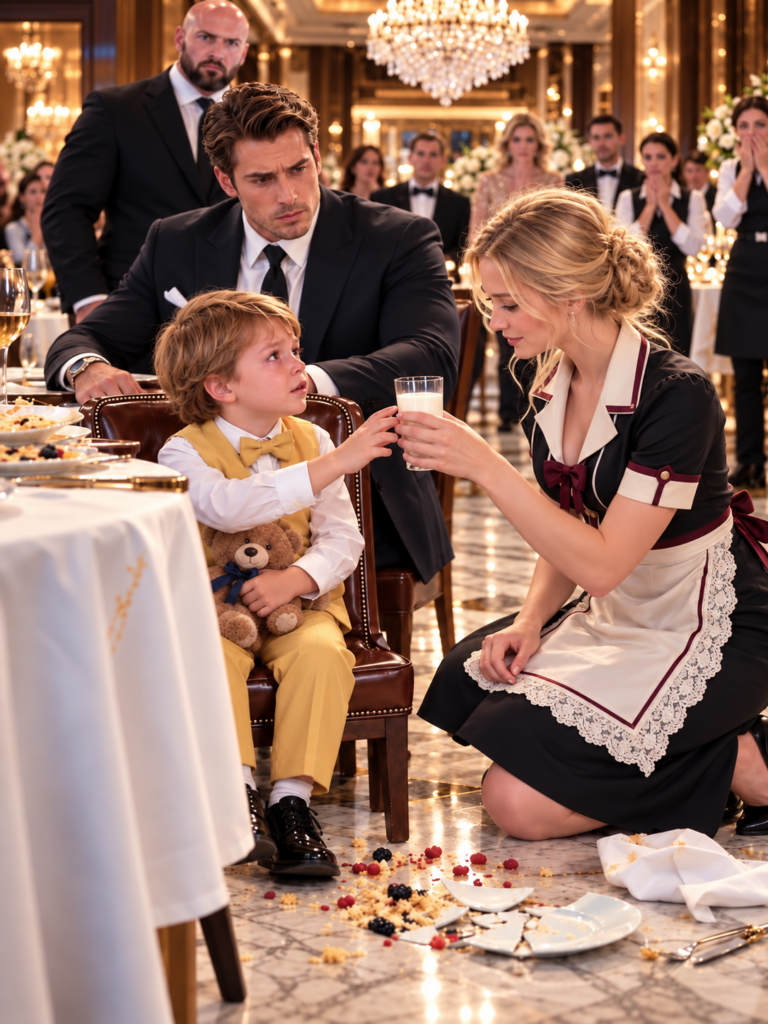
The glass nearly slipped from Clara’s hand.
Rico sat down slowly.
“What did you say?”
Leo’s eyes moved between them.
“Clara.”
The name seemed to pass through the room like a quiet current.
Clara felt every muscle in her body tighten.
She had never met Elena Moretti. At least, she was certain she hadn’t. She had seen photographs of the woman only in newspapers and on the internet after the shooting six months earlier. Elena had been beautiful in the effortless way some people were—dark hair, warm eyes, a smile that made strangers feel included.
But she had never spoken to her.
Never served her.
Never heard her voice.
Rico looked at Clara as if she had suddenly become a question he didn’t know how to ask.
“Why would my wife know your name?”
“I don’t know.”
“You expect me to believe that?”
“I’m not asking you to believe anything.” Clara glanced down at Leo. “I’m telling you the truth.”
The little boy tugged at her hand.
“Mommy said Clara has stars.”
Clara’s breath caught.
Her fingers instinctively moved to the small silver pendant beneath her blouse. It was shaped like a five-pointed star, no larger than her thumbnail. The chain was old and thin, the silver dulled with age.
Her mother had given it to her when Clara was twelve.
“Keep this,” Lydia Vance had said. “It belonged to someone who believed you would need reminding.”
Clara had asked who it belonged to.
Her mother had only smiled sadly and changed the subject.
After Lydia died, Clara had worn it almost every day.
Rico noticed the movement.
“What stars?”
Clara pulled the pendant free and let it rest against her palm.
Leo reached toward it but stopped before touching.
“That,” he whispered.
Rico’s expression shifted.
Not recognition exactly.
Something close to it.
“Where did you get that necklace?”
“My mother.”
“Your mother’s name?”
“Lydia Vance.”
The color drained from Rico’s face.
He looked toward Dante.
“Do you know that name?”
Dante’s brow furrowed. “No.”
Rico didn’t seem to hear him. His gaze remained fixed on the pendant.
“Lydia Vance,” he repeated, almost to himself.
Clara rose slowly, still holding Leo’s hand.
“My mother worked as a seamstress. She died seven years ago. I don’t know what connection she could have had to your wife.”
“Neither do I.”
For the first time since Clara had approached the table, Rico sounded uncertain.
Leo leaned against her leg.
“Mommy had stars,” he said.
“I know,” Rico replied gently. “She did.”
The tenderness in his voice startled Clara. It was the first time she had heard him speak to his son without fear or frustration.
Leo looked up at her.
“Sing.”
Clara blinked.
“What?”
“Sing Mommy song.”
Rico closed his eyes.
“Leo, your mother didn’t—”
But Clara knew the tune before the boy finished explaining.
It was an old lullaby her own mother had sung to her when she was little. Not a popular nursery song, but an obscure melody with only a few simple lines. Lydia used to call it “The Lantern Song.”
Clara had not heard it since the night her mother died.
She swallowed.
“What song?”
Leo hummed three notes.
The same three notes.
Clara felt the restaurant tilt beneath her.
She had no explanation for it. No sensible reason why a child she had never met would know the melody her mother had used to put her to sleep.
Rico opened his eyes.
“Do you know it?”
Clara nodded, though her throat had gone tight.
“My mother sang it to me.”
Leo’s face brightened with a fragile kind of relief.
“Sing it.”
Clara looked around the restaurant. Every table was watching them, but the attention no longer felt intrusive. People had become witnesses to something they didn’t understand.
She lowered herself into the empty chair beside Leo.
“Just a little,” she said.
Her voice shook on the first line.
“Sleep now, little lantern bright…”
Leo leaned against her arm.
Clara continued.
“Night will keep you safe tonight.
When the dark is wide and deep,
Stars will guard you while you sleep…”
By the second line, Leo’s breathing had slowed.
By the end, his head rested against her shoulder.
The room remained silent.
Rico had one hand pressed against his mouth.
Dante turned away, pretending to examine the broken skin on his knuckles.
Clara finished the song in a whisper.
For several seconds, no one moved.
Then Leo fell asleep.
It happened so peacefully that Clara almost didn’t believe it. One moment, he was holding on to her sleeve; the next, his small body had gone limp with exhaustion.
Rico stood.
“I’ll take him.”
Leo stirred immediately, his fingers clamping around Clara’s sleeve.
“No.”
His eyes remained closed.
Rico stopped.
“It’s all right, son.”
“No Clara.”
There was no panic in the child’s voice, only drowsy certainty.
Rico looked at Clara.
She could see the question in his face, as well as the struggle behind it. He wanted to take his son. He also understood that forcing the matter might wake him.
“Let him sleep,” Clara said quietly. “He’s safe.”
Rico studied her for a long moment.
Then he nodded.
“Dante, bring the car around.”
The manager hurried over.
“Mr. Moretti, of course. And Clara, you should—”
“I know,” she said. “I should get back to work.”
The manager’s mouth opened, then closed.
No one seemed willing to tell her what to do anymore.
Clara carefully eased Leo into Rico’s arms. The boy whimpered and reached back for her.
“Just walk beside us,” Clara whispered.
Rico adjusted his son against his chest.
Leo settled again, one tiny fist still gripping the edge of Clara’s apron.
They crossed the restaurant together.
At the entrance, the cold Brooklyn air slipped through the open doors. Traffic moved along the street, headlights glowing across the wet pavement. It had begun to rain sometime during dinner, leaving the sidewalk shining beneath the lamps.
Rico’s black sedan waited at the curb.
Before getting inside, he looked at Clara.
“Come with us.”
Clara almost laughed.
“I’m not getting into a stranger’s car.”
“I’m not a stranger.”
“You are, actually.”
Something almost resembling a smile touched his mouth, but disappeared before it fully formed.
“My name is Ricardo Moretti.”
“I know who you are.”
“Then you know I can make sure you get home safely.”
“I’m sure you can. But that doesn’t mean I want to go.”
His eyes narrowed slightly, though not in anger.
“You helped my son.”
“I gave him milk.”
“You reached him when none of us could.”
“Then let him rest. Tomorrow may be different.”
Rico’s gaze dropped to Leo.
The boy had fallen deeply asleep against his shoulder.
“Will you come back tomorrow?”
Clara glanced through the restaurant window. The manager was standing behind the glass, looking as though he might faint from uncertainty.
“I don’t know if I still have a job.”
“You do.”
“I didn’t ask you to arrange that.”
“No. But you need the job.”
The statement struck too close to home.
Clara’s cheeks warmed.
Rico noticed.
“I’m not trying to insult you.”
“It sounded like you were.”
“I’m trying to say that I understand what it means to need something.”
For a man whose watch probably cost more than Clara’s apartment, he said it without arrogance.
She looked at Leo.
“Does he have a pediatrician?”
“Several.”
“Someone who understands grief in children?”
“Yes.”
“Then call that person tonight. Not because something is wrong with him, but because he needs support. He shouldn’t have to carry this alone.”
Rico’s jaw tightened.
“We’ve tried.”
“Maybe he wasn’t ready before.”
“And now he is?”
“Maybe now he found something familiar.”
Rico glanced at the pendant still resting in her palm.
“What does your mother have to do with my wife?”
“I wish I knew.”
A long silence settled between them.
Rain tapped softly against the car roof.
Finally, Rico reached into his coat and pulled out a small business card. He handed it to Clara.
There was no company name, only a phone number and his first name printed in black letters.
“If you remember anything, call me.”
“I don’t remember anything.”
“Not yet.”
Clara accepted the card because refusing it would have required more energy than she had left.
Rico placed Leo inside the car. The boy stirred.
“Clara,” he mumbled.
“I’m here,” she said.
His eyes remained closed.
“Mommy knows.”
Clara felt a chill move down her spine.
“What does she know?”
But Leo was already asleep again.
Rico looked at her over the roof of the car.
“What did he mean?”
“I don’t know.”
This time, neither of them pretended the answer was simple.
The car pulled away a moment later.
Clara stood beneath the awning until the taillights disappeared into the rainy street.
Only then did she realize that her hands were shaking.
Inside the restaurant, the manager approached carefully.
“Are you all right?”
“No.”
“That’s understandable.”
“What happened to my job?”
He blinked. “Your job?”
“You told me to get back here.”
“I also told you not to approach Mr. Moretti’s table.”
“You did.”
“And then you did anyway.”
“I know.”
He rubbed both hands over his face.
“Clara, I have no idea what just happened. But Mr. Moretti asked me to keep you on the schedule.”
“Asked?”
“He was very clear.”
She looked through the glass doors again.
“I don’t want special treatment.”
“Then don’t call it special treatment. Call it employment.”
“I need the money.”
“I know.”
The manager’s tone softened.
“Go home. I’ll cover the rest of your shift.”
Clara wanted to argue, but exhaustion pressed heavily behind her eyes.
She untied her apron and handed it over.
“Thank you.”
As she stepped into the back hallway to collect her coat, the other waitress, Mia, followed.
“You’re leaving?”
“Yes.”
Mia glanced toward the front windows.
“Did he really ask for you to come back tomorrow?”
“I don’t know.”
“You should.”
Clara pulled on her coat.
“Why?”
“Because people like him don’t ask twice.”
Clara gave her a tired look.
“That’s exactly why I shouldn’t.”
Mia hesitated.
“Clara…”
“What?”
“When Leo said your name, did you recognize it?”
“No.”
“But you knew that song.”
Clara looked down at the silver star hanging against her blouse.
“My mother used to sing it.”
Mia’s expression changed.
“Maybe his mother knew your mother.”
“That’s what I’m afraid of.”
Outside, the rain had strengthened.
Clara walked six blocks to the subway, keeping one hand around the business card in her pocket. The city moved around her in its usual restless rhythm—buses sighing at the curb, people hurrying beneath umbrellas, music leaking from a corner store.
Everything looked ordinary.
Nothing felt ordinary.
By the time she reached her apartment, it was almost midnight.
The building’s elevator was broken again, so she climbed four flights of stairs and unlocked the narrow door to the apartment she had shared with her mother until Lydia’s death.
Clara still hadn’t moved.
The place was too small for two people and too full of memories for one.
Lydia’s sewing machine remained by the window. Spools of thread sat in a chipped ceramic bowl. A stack of unfinished alterations waited on the table, exactly where Clara had left them seven years earlier.
She turned on the lamp.
The light flickered, then steadied.
Clara hung her coat on the back of a chair and placed Rico’s card beside the sink.
She should have gone to sleep.
Instead, she stood in front of the old sewing machine.
The pendant rested against her throat.
“Stars,” Leo had said.
Clara touched it.
She had never asked her mother about it again after that first conversation. By the time she was old enough to insist, Lydia had already become sick. Then there had been hospital rooms, unpaid bills, and the quiet devastation of watching someone disappear piece by piece.
A month before Lydia died, Clara had found her mother sitting by the window, holding the pendant in both hands.
“Who gave this to you?” Clara had asked.
Lydia had looked frightened.
Not sad.
Frightened.
“Some things are better left alone.”
“You always say that when you don’t want to answer me.”
“I’m trying to protect you.”
“From what?”
Lydia had turned away.
That was the last real conversation they ever had.
Clara opened the small wooden box beneath the sewing machine. It contained old buttons, faded photographs, and a handful of letters tied with blue thread.
She had looked through them many times after Lydia’s funeral.
Tonight, she searched them differently.
She found receipts from fabric shops, a postcard from a cousin in Ohio, and a birthday card from someone named Margaret.
Nothing about Elena.
Nothing about the Morettis.
She was about to close the box when a photograph slipped from beneath the letters and landed face down on the floor.
Clara frowned.
She had never seen it before.
The picture was old, perhaps fifteen years old. The edges had yellowed, and one corner had been bent sharply.
She turned it over.
Her mother stood outside a small community clinic, younger by decades, wearing a pale blue dress Clara had never seen. Beside her was a woman with dark hair and familiar warm eyes.
Elena Moretti.
Clara stared at the photograph.
Behind them, a hand-painted sign read: St. Agnes Family Clinic — Community Health Fair, June 2009.
Elena was smiling at Lydia.
Lydia was not.
She looked nervous, one hand pressed protectively over her stomach.
On the back of the photograph, in Lydia’s handwriting, were six words:
She promised she would come back.
Clara’s pulse began to pound.
Beneath the photograph was a folded piece of paper, yellow with age. Her name was written across the front.
Not *Clara Vance*.
Just *Clara*.
She unfolded it with trembling fingers.
The note contained only one sentence.
If Elena ever comes looking for you, listen before you decide who to trust.

