
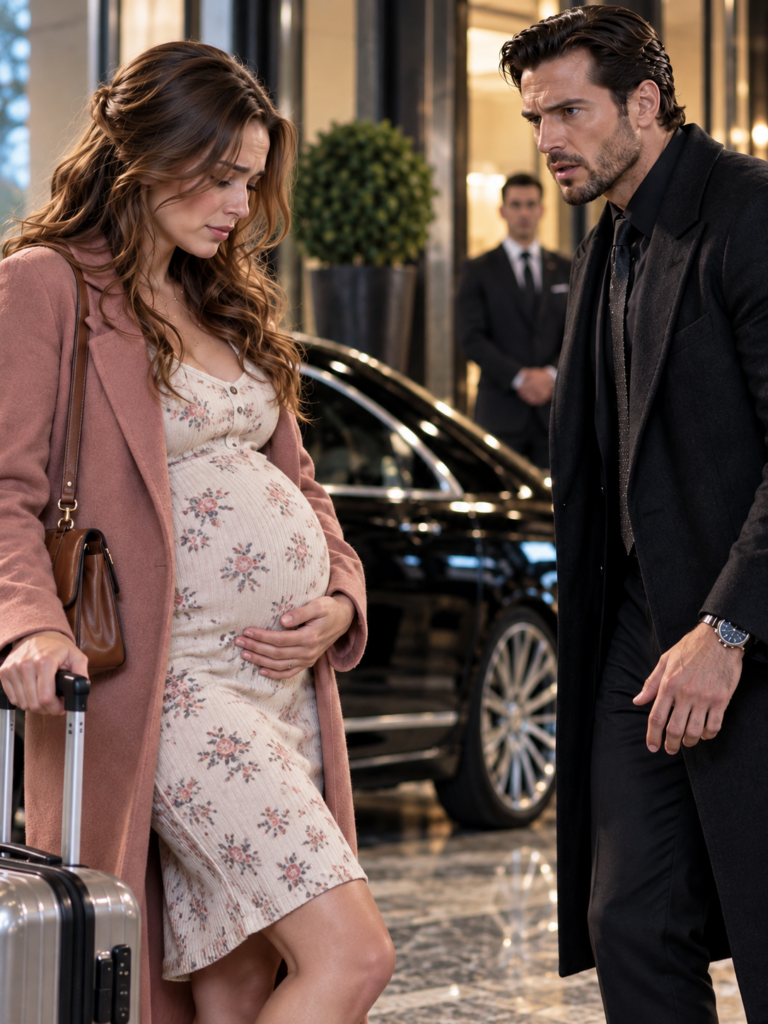
Six months after I escaped my marriage, my former husband stepped from a black SUV and saw the life I had hidden beneath my coat.
He had once promised that no one could take me from him—but his protection had become the reason I ran.
Then his eyes dropped to my pregnant belly, and the most controlled man in New York forgot how to breathe.

PART 1 — THE SECRET HE SAW IN THE RAIN
Rain hammered Fifth Avenue, bouncing from the pavement and soaking through my worn sneakers.
I stood at the crosswalk with one hand gripping a plastic grocery bag and the other pressed against the small curve beneath my oversized coat. The signal counted down from ten, but exhaustion held my feet in place.
Six months.
Six months since I signed the divorce papers and walked out of the marble townhouse that had felt less like a home with every lock Dante added.
Six months since I chose uncertainty over being protected so thoroughly that I could no longer hear my own decisions.
The signal turned red as I stepped from the curb.
A horn exploded beside me.
I froze. My grocery bag tore, and oranges rolled across the wet street.
Then three black SUVs stopped in perfect formation.
The rear door of the middle vehicle opened.
I recognized the shoes first—Italian leather, polished despite the storm. Then the charcoal suit, broad shoulders, and severe face that had lived in every dream I refused to remember.
Dante Moretti.
Traffic noise seemed to recede.
His dark eyes found mine through the rain.
For one second, he looked exactly as he had on the morning I left: powerful, remote, and impossible to surprise.
Then the wind pulled my coat tight across my body.
His gaze dropped.
The change in him was immediate.
His face emptied of color. One hand lifted as if he could reach me from twenty yards away, then closed into a fist.
“No,” I whispered.
Dante shaped my name with his lips.
“Mia.”
Cars began moving between us. I turned and ran.
The subway entrance swallowed me into heat, wet concrete, and the metallic scream of an arriving train. I pushed onto the crowded platform, one arm shielding my stomach.
Behind me, Dante called my name.
I looked back.
He stood at the top of the stairs, soaked, breathing hard, three security men behind him. Fury sharpened his face, but beneath it was something worse.
Pain.
The train doors opened. Commuters carried me inside.
Dante reached the platform as the doors slid shut. His palm struck the glass opposite mine.
His mouth formed four unmistakable words.
You’re carrying my child.
The train pulled away.
My phone began vibrating before we entered the tunnel.
I switched it off.
By the time I reached my studio apartment above a Korean grocery store in Brooklyn, my hands were numb. I locked all three dead bolts, pulled my emergency bag from beneath the bed, and began packing.
I had lived there for three months without photographs on the walls. Everything I owned could fit inside two bags.
That had felt like freedom.
Now it felt like preparation.
A knock sounded.
Not loud.
Controlled.
“Mia.”
Dante’s voice came through the door.
I stopped breathing.
“I know you’re inside.”
“Go away.”
Silence.
Then, quieter, “How far along are you?”
I pressed both hands over my belly.
“That is no longer your concern.”
“You’re carrying my child.”
“We are divorced.”
“The divorce does not erase my responsibilities.”
“You once called responsibility a reason to track every place I went.”
His breath touched the other side of the door.
“I know what I did.”
“No, you know I left.”
“Mia, please open the door. I won’t enter unless you invite me.”
Dante Moretti did not say please.
He did not wait outside doors.
But minutes passed, and he remained in the hallway.
Finally, I slid the chain into place and opened the door two inches.
His gaze went first to my face, then to the curve beneath my coat.
“How far?” he asked.
“Twenty-two weeks.”
He gripped the doorframe.
“Five months?”
“Yes.”
His eyes closed.
When they opened, they were wet.
“I missed half the pregnancy.”
“You missed it because I was afraid you would use the baby to bring me back.”
“Would you have told me before the birth?”
I could not answer.
The baby moved.
Dante saw my hand tighten over the spot.
His face broke.
Then a voice came from the stairwell.
“Mr. Moretti.”
One of his men approached carrying a tablet, his expression urgent.
Dante read the screen.
Every trace of grief vanished behind cold control.
“What is it?” I asked.
He looked at my apartment door, the unlit hallway, and the fire escape visible through the window.
“We weren’t the first people to find you.”
He turned the tablet toward me.
The screen showed photographs taken from across my street—me leaving for work, entering my prenatal clinic, and sleeping beside the window.
The newest image had been taken that morning.
Across it, someone had written:
TELL MORETTI HIS HEIRS WON’T SURVIVE THE WEEK.
PART 2 — THE HOUSE I ESCAPED, THE DANGER I COULDN’T
The hallway tilted around me.
Dante reached toward my arm, then stopped before touching me.
“May I come inside?”
It was such a small question.
Six months earlier, he would have entered first and explained later.
I unhooked the chain.
Dante stepped into my apartment alone. He told his men to remain in the hall and left the door open until I closed it myself.
Rainwater darkened his shoulders. His eyes moved over the narrow room—the sagging ceiling, the portable heater, the three locks, the packed emergency bag on my bed.
He did not criticize any of it.
“Who sent the photographs?” I asked.
“We’re tracing the delivery.”
“Who has a reason to threaten me?”
“Several people.”
“That answer is exactly why I left.”
His jaw tightened.
“I know.”
“No, Dante. You knew I disliked the guards. You knew I hated asking permission to leave the townhouse. You never understood that every unnamed enemy made the walls feel more permanent.”
“I thought knowing would frighten you.”
“Not knowing frightened me more.”
He looked down at the tablet.
“The message was sent to a secure business account forty minutes after I saw you.”
“So someone followed us.”
“Possibly both of us.”
“Call the police.”
“My security team—”
“Call the police.”
His gaze rose to mine.
“This concerns people who may have influence inside law enforcement.”
“Then your attorney can contact the federal task force that already monitors your family’s companies.”
The words landed hard.
I had learned more after leaving than Dante ever told me during our two-year marriage.
Moretti Maritime and Moretti Security were legal businesses. Yet Dante’s grandfather had built the family fortune through smuggling, labor racketeering, and violence. Dante claimed he had dismantled the illegal operations after assuming control.
I believed he had tried.
I also knew powerful men rarely discovered every hidden room in the houses they inherited.
Dante took out his phone.
He called his attorney and instructed her to contact the FBI liaison assigned to threats against his company.
Then he looked at me.
“Satisfied?”
“No. But listening is new.”
A flicker of shame crossed his face.
His security chief, Marco, waited outside while federal agents were contacted. I called my obstetrician and explained enough to obtain medical records for travel.
“Travel?” Dante repeated.
“I’m leaving this apartment.”
Relief appeared before he concealed it.
“My townhouse has layered security, an independent gatehouse, and a medical suite.”
“It also has locks I cannot control.”
“They’ve been changed.”
“I don’t care.”
“Mia—”
“No.”
He became perfectly still.
The old Dante would have turned refusal into a negotiation he intended to win. He would have described danger until my choice felt irresponsible.
Instead, he asked, “Where do you want to go?”
“My attorney arranged an emergency apartment months ago. The building has professional security and no connection to you.”
“Will you permit my team to inspect the exterior?”
“No.”
His mouth tightened.
“The FBI can coordinate with the building.”
He nodded once.
“Then I’ll drive behind you.”
“I’m taking a police vehicle.”
“I’ll follow at a distance.”
“That is still following.”
A breath moved through him.
“All right.”
The concession cost him. I saw it.
I also saw him make it.
An hour later, Special Agent Claire Bennett arrived with a city detective. Bennett wore a dark wool coat, sensible boots, and an expression that had no interest in anyone’s reputation.
She examined the photographs.
“These were taken over at least seven weeks,” she said. “Who knew about the pregnancy?”
“My obstetrician, clinic staff, my attorney, and one friend at work.”
“The father?”
“No.”
Dante flinched but said nothing.
Bennett turned to him. “Any recent threats involving succession, inheritance, or control of your companies?”
“My board is restructuring the family voting trust. If I die without children, several shares pass to extended relatives.”
“And if you have children?”
“They eventually enter a protected trust.”
I looked at him.
“You never told me that.”
“We did not have children.”
“We discussed having them.”
His eyes held mine. “Yes.”
Bennett made a note.
“Who loses financially if these children exist?”
Dante named three cousins and a former executive named Carlo Vitari. Vitari had challenged the restructuring and been removed after auditors discovered shell-company payments.
“Where is he now?” Bennett asked.
“New Jersey, officially.”
“Unofficially?”
“I don’t know.”
“Mr. Moretti, if you substitute reputation for facts, we will waste time.”
He accepted the reprimand.
“I’ll provide every record.”
Bennett looked at me.
“We’ll relocate you tonight. I recommend no independent travel, no work until we understand the threat, and no electronic contact except through a clean device.”
My stomach tightened.
“My patients—”
“Will be cared for by other nurses. Your children cannot be replaced by another shift.”
Children.
Plural.
I stared at her.
Bennett checked her notes. “Your message from the clinic mentioned a twin pregnancy.”
Dante’s head turned slowly toward me.
“Mia?”
I had planned to tell him once I understood whether he could behave like a father without becoming a jailer.
Now the truth stood between us.
“Twin girls,” I said.
Dante sat down as though his legs had stopped working.
The feared head of the Moretti family lowered his face into both hands.
For several seconds, no one spoke.
Then he looked up.
“Are they healthy?”
“They were at my last appointment.”
“When was that?”
“Two weeks ago.”
“May I see the ultrasound?”
I hesitated.
Then I retrieved the image taped behind the bathroom mirror.
Dante accepted it with both hands.
His thumb hovered over two small profiles labeled Baby A and Baby B.
He did not touch the paper.
“Girls,” he whispered.
“Yes.”
“What have you called them?”
“I haven’t chosen names.”
His eyes remained on the image.
“Thank you for telling me.”
Not They need Moretti names.
Not My heirs.
Just thank you.
Agent Bennett transported me to a secure apartment in Manhattan. Dante followed only after she allowed it, in a separate vehicle, and was permitted inside for twenty minutes.
The apartment belonged to a legal-services organization serving witnesses and stalking victims. It had reinforced locks, no public directory, and a staff member on-site.
Dante looked deeply uncomfortable with security he did not command.
That helped me sleep.
Before he left, he stood near the door.
“I need to ask you something.”
“What?”
“Were you ever planning to let me know my daughters?”
The pain in his voice was quiet.
“Yes.”
“When?”
“I don’t know.”
“That is not an answer.”
“It is the honest one.”
He nodded.
“I deserved you leaving. I don’t know whether I deserved this.”
My hand tightened around the ultrasound.
“This was never punishment.”
“What was it?”
“Fear.”
He looked away.
“That may be worse.”
He left without asking to touch me.
At three in the morning, I woke with a headache and a hard, unfamiliar pressure beneath my ribs. The room seemed too bright even with the lamps off.
I called the emergency number my obstetrician had given me.
Within thirty minutes, I was in a hospital triage room with blood-pressure cuffs tightening around my arm and monitors strapped across my belly.
Two heartbeats filled the room.
Fast.
Distinct.
Precious.
The obstetrician on call examined the readings.
“Your blood pressure is dangerously high,” she said. “You’re showing early signs consistent with preeclampsia. We need to admit you for observation.”
Fear dried my mouth.
“Are the babies in danger?”
“Right now, their heart rates are reassuring. Our job is to keep it that way.”
Agent Bennett contacted my attorney.
No one called Dante until I authorized it.
He arrived forty minutes later wearing yesterday’s damp suit and no overcoat. He stopped outside the curtain.
“May I come in?”
“Yes.”
He crossed to the bed but did not touch me.
“What did the doctor say?”
I explained.
His face went gray.
“This happened because of stress?”
“There are many risk factors,” the doctor said firmly. “Do not assign blame. Ms. Russo needs rest, monitoring, medication, and reduced stress.”
Dante looked at me.
“You’ve been working?”
“I’m a nurse.”
“How many hours?”
“Usually ten. Sometimes twelve.”
“While carrying twins?”
“I needed rent and insurance.”
His eyes closed briefly.
I braced for anger.
Instead, he pulled a chair beside the bed.
“What do you need from me?”
The question nearly broke me.
“Do not take over.”
“I won’t.”
“Do not call a private doctor without asking.”
“I won’t.”
“Do not move me.”
“I won’t.”
“Stay until the morning.”
His hand closed around the chair arm.
“Yes.”
The hospital admitted me for two nights. Dante slept sitting upright, his long frame folded badly into a vinyl chair.
He asked permission before attending each medical discussion. When the specialist recommended twice-weekly monitoring, he took notes but did not issue orders.
On the second evening, I woke and found him studying the fetal-monitor paper curling from the machine.
“What are you doing?” I asked.
“Trying to understand which line belongs to which daughter.”
“The upper one is Baby A.”
“Does she always move that much?”
“Yes.”
“And Baby B?”
“Usually calmer.”
A faint smile appeared.
“One has your temper.”
“You don’t know my temper.”
“I was married to it.”
Despite myself, I smiled.
The expression disappeared when he asked, “Why did you leave without telling me you were pregnant?”
“I didn’t know yet.”
“When did you find out?”
“Three weeks after the divorce.”
“And you never considered calling?”
“I considered it every day.”
His jaw tightened.
“Then why didn’t you?”
I looked at the monitor.
“Because the week before I left, you canceled my job interview without telling me.”
He flinched.
The position had been at a nonprofit clinic in Queens. It paid less than my previous corporate role but would have given me work that belonged to me.
Dante called the director and persuaded him that hiring me created a security risk.
“You said you were protecting me,” I continued. “Then you removed my name from our household accounts because someone attempted fraud.”
“I moved the accounts into a trust.”
“Without telling me.”
“Yes.”
“You assigned two guards to follow me inside stores. You reviewed my phone records. You asked the driver to report if I went anywhere not listed on the schedule.”
His face tightened with each sentence.
“I thought someone inside the organization was targeting you.”
“Then you should have told me.”
“I was afraid.”
“So was I. The difference is that you had information and power. I had locked doors.”
He looked at the floor.
“I loved you,” he said.
“You loved me like something that could be stolen.”
“I did not know another way.”
“That does not make it safe.”
“No.”
The answer came without defense.
I turned toward him.
“Why did you sign the divorce papers?”
His expression became unreadable.
“Your attorney said you would seek a public hearing if I contested them.”
“That never stopped you from fighting anything.”
“I saw the security footage from the night you left.”
My stomach tightened.
“You were standing in the foyer with one suitcase. You looked at the camera before walking out.”
“I knew you were watching.”
“You said, ‘If you love me, let me reach one door you don’t lock.’”
I remembered.
“I signed the next morning.”
“Then why investigate the divorce?”
“I didn’t. My first words outside your apartment were anger. I had no right to threaten your freedom.”
I studied him.
“Your lawyer isn’t challenging it?”
“No.”
The relief I felt was mixed with sadness.
He noticed.
“I will never force you to marry me again,” he said.
“Good.”
“If you allow me to be their father, I will follow legal agreements.”
“Even if the agreement gives me primary custody?”
Pain crossed his face.
“Even then.”
That was the first moment I believed change might be possible.
Not forgiveness.
Not reunion.
Possibility.
Agent Bennett returned the next morning with news.
The photographs had been sent through a compromised account once used by Moretti Security. Metadata placed their upload near a warehouse controlled by a Vitari shell company.
There was more.
“Your former personal driver has disappeared,” Bennett told Dante. “Records show he accessed Ms. Russo’s old travel schedules after she left.”
“Adrian?” Dante said.
“You trusted him?”
“For nine years.”
“His bank account received three payments from Vitari.”
Dante’s face hardened.
I recognized the shift—the man who turned hurt into command.
“Give me the address.”
“No,” Bennett said.
“He knows her routines.”
“And now he knows we know. If you pursue him privately, you may contaminate evidence and escalate the threat.”
“He betrayed my family.”
“He committed crimes. Those are not the same sentence.”
Dante stood.
The hospital room seemed smaller around him.
Bennett did not move.
“If you want to prove you’re different from the men whose reputation you inherited,” she said, “sit down and let lawful authority do its work.”
For several seconds, the only sound was the babies’ heartbeats.
Then Dante sat.
His hands shook once before he folded them.
“Tell me what you need.”
Bennett obtained full access to Moretti security records.
Dante’s cooperation revealed years of unexplained payments and unauthorized surveillance conducted by Adrian under Vitari’s direction. Some began before our divorce.
One photograph showed me at the Queens clinic interview.
Another captured me speaking with the director.
Dante had believed his own team discovered a threat.
In reality, Adrian manufactured evidence suggesting I was being watched, knowing Dante would respond by tightening control around me.
My imprisonment had been useful.
The more isolated I became, the more dependent Dante was on the security system Adrian compromised.
The truth did not excuse Dante.
It revealed how his worst instincts had been manipulated.
“When did Adrian begin working for you?” I asked.
“After my mother died. His father served mine.”
“Did he encourage the guards?”
“Yes.”
“The phone monitoring?”
“Yes.”
“Canceling my interview?”
Dante’s face closed.
“That was my decision.”
He refused the easy excuse.
I respected him for it.
A week after my discharge, I moved into a furnished apartment owned by my attorney’s firm. I wore a medical-alert device, stopped working temporarily, and attended appointments under Agent Bennett’s protection.
Dante rented a separate apartment two floors below.
He did not ask to share mine.
Every morning, he texted:
May I bring breakfast?
Sometimes I said yes.
Sometimes no.
When I said no, no tray appeared anyway.
That mattered.
At our first co-parenting meeting, my attorney, Lauren Kim, sat between us with a yellow legal pad. She was forty-five, concise, and unimpressed by wealth.
“We discuss paternity, prenatal medical access, birth attendance, custody after delivery, security, and financial support,” she said. “Not reconciliation.”
Dante nodded.
He agreed to establish paternity through noninvasive testing. He accepted that medical decisions remained mine while I was pregnant. He requested attendance at appointments only with my written permission.
“What about the birth?” he asked.
“We decide later,” I said.
His disappointment showed, but he did not argue.
Financial support presented another problem.
“I can pay every expense,” he said.
“You may pay your lawful share through an account controlled under the agreement,” Lauren replied. “You will not purchase access.”
His eyes moved to me.
“I understand.”
“Do you?” I asked.
“I am trying.”
Lauren tapped her pen.
“Trying is emotional. Compliance is measurable.”
Dante almost smiled.
“You and Mia would get along.”
“We do.”
Over the next three weeks, my blood pressure improved. The girls grew steadily, though doctors warned that twin pregnancy and preeclampsia made early delivery likely.
Dante attended two ultrasounds.
At the first, he stood in the corner as the technician moved the probe over my stomach.
Baby A kicked Baby B in the shoulder.
Baby B turned away.
“They are already fighting,” he whispered.
“They are negotiating space.”
“Like their parents.”
The technician pretended not to hear.
Afterward, Dante handed me an envelope.
“My updated will.”
“I don’t need to see your will.”
“The girls are beneficiaries whether or not we reconcile. An independent trustee will manage the assets. You control medical and educational distributions during their childhood.”
“You planned this without me.”
“I drafted it. Nothing is signed. Your attorney reviews it first.”
A distinction.
I handed it to Lauren.
At the second appointment, the doctor identified a growth concern with Baby B. She recommended additional monitoring and possible steroid injections to support fetal lung development.
Dante’s hand closed around mine before either of us thought about it.
I did not pull away.
That evening, we ate soup in my apartment while snow gathered along the windows.
“Have you chosen names?” he asked.
“I considered Isabella for Baby A.”
“My mother’s name.”
“Yes.”
Emotion passed across his face.
“And Baby B?”
“Lucia. After my grandmother.”
“Isabella and Lucia.”
He said them as though testing the shape of a future.
“They will use Russo as a middle name,” I said.
“Of course.”
“And Moretti only if we agree it does not make them symbols in your family.”
“They are children, not heirs.”
His answer came immediately.
I watched him.
“Six months ago, would you have said that?”
“No.”
The honesty settled between us.
A knock interrupted dinner.
Agent Bennett entered with two officers.
“We found Adrian,” she said.
Dante rose.
“Alive?”
“Yes. He’s cooperating.”
Bennett placed a tablet on the table.
Adrian had admitted following me on Vitari’s orders. He also revealed that Vitari’s threat was partly a bluff designed to force Dante to transfer control of shipping terminals.
But the danger had become real after Dante saw me.
“Vitari now believes the pregnancy can destabilize Moretti Holdings,” Bennett said. “He plans to present evidence at tomorrow’s board meeting claiming Mr. Moretti concealed heirs to manipulate voting trusts.”
“That isn’t a crime,” I said.
“No. But the documents he intends to use include your medical records.”
My skin went cold.
“How did he get them?”
“An employee at your prenatal clinic sold access.”
Dante’s face became lethal.
Bennett raised a hand.
“The employee is in custody.”
“What does Vitari want?” Dante asked.
“Control of two Moretti Maritime terminals and immunity from internal claims. If he doesn’t receive them, he threatens to release your records publicly and expose your location.”
I looked at the snow beyond the window.
“He believes shame will make us cooperate.”
Bennett nodded.
“What is the lawful plan?”
Dante glanced at me.
The question was for both of us.
Agent Bennett proposed a monitored board meeting. Dante would appear to negotiate while federal agents documented Vitari’s extortion attempt. I would remain at a protected location.
“No,” I said.
Everyone looked at me.
“I will not attend the meeting. But I will prepare a statement authorizing the board to know that Dante has children on the way and that the medical records were stolen.”
Dante’s brow furrowed.
“You do not owe the board your pregnancy.”
“I know. That is why I decide what they hear.”
“What will you say?”
“That we are divorced, establishing lawful co-parenting, and that our daughters are not corporate assets. If anyone uses their existence to influence company control, I will cooperate with every criminal and civil investigation available.”
Bennett smiled faintly.
“Direct.”
“Documentation usually is.”
The meeting took place the following afternoon.
I watched through a secure video connection with Lauren and Agent Bennett.
The Moretti boardroom contained twelve directors, polished stone walls, and a long table reflecting winter light. Dante sat at its head in a dark suit.
Vitari entered smiling.
He was older than I expected, with silver hair and the relaxed confidence of a man who believed everyone had a price.
“My condolences,” he said. “Domestic surprises can be disruptive.”
Dante did not react.
Vitari placed a folder on the table.
Inside were copies of my ultrasounds, blood-pressure readings, and clinic notes.
Even through the screen, seeing my body reduced to leverage made nausea rise in me.
“What do you want?” Dante asked.
“Two terminals. Voting rights attached. A mutual release concerning historical accounts.”
“In exchange?”
“Privacy.”
Dante leaned back.
“You misunderstand my former wife.”
Vitari’s smile thinned.
A screen illuminated behind Dante.
My recorded statement played.
“My name is Mia Russo. The medical documents in Mr. Vitari’s possession were stolen. Their disclosure is unauthorized. Dante Moretti and I are legally divorced. We are establishing paternity and custody through independent counsel.”
In the recording, I looked directly into the camera.
“Our daughters are not heirs available for negotiation, weaknesses to exploit, or reasons to transfer corporate assets. Any person who publishes, trades, or threatens to use their medical information will face immediate legal action. This is not a family dispute. This is documentation of extortion.”
Vitari’s face changed.
Federal agents entered the boardroom.
He stood abruptly.
Dante remained seated.
For one terrible second, Vitari reached inside his jacket.
Security moved.
He withdrew not a weapon, but a phone.
Bennett’s agents seized it before he could erase anything.
No shots.
No blood.
Only handcuffs closing around a man who had mistaken fear for permanent authority.
The cliffhanger should have ended there.
Instead, my body chose that moment to begin labor.
A contraction tightened across my back and abdomen so sharply that I dropped the water glass in my hand.
Lauren was beside me immediately.
“Mia?”
Another contraction came three minutes later.
Agent Bennett called medical services.
On the boardroom screen, Dante saw me bend over the table.
His face changed.
He stood.
“Mia.”
The connection had no open microphone, but I read my name on his lips.
Lauren looked at the timer.
“Thirty-three weeks,” she said. “We’re going to the hospital.”
As paramedics wheeled me from the apartment, my phone rang.
Dante.
I answered.
“I’m coming,” he said.
“You’re at a federal operation.”
“It’s finished.”
“Do not drive like a lunatic.”
A breath that might have been a laugh broke through his panic.
“May I be there?”
The question came while sirens rose around me and two daughters pushed impatiently toward the world.
“Yes,” I said. “But only if you remember who makes the medical decisions.”
“You.”
“And who controls the room.”
“You.”
“And if I tell you to leave?”
“I leave.”
The ambulance doors closed.
“Then come.”
PART 3 — THE DOOR HE FINALLY LEARNED TO LEAVE OPEN
The hospital lights passed above me in white rectangles.
A nurse clipped monitors around my stomach while another started an IV. The room smelled of antiseptic, warmed blankets, and the faint plastic scent of oxygen tubing.
Two heartbeats sounded from the monitor.
Baby A’s was strong.
Baby B’s kept dipping.
The maternal-fetal specialist entered in blue scrubs.
“Your contractions are progressing, and Baby B is showing signs of distress,” she said. “Because of their positions and gestational age, I recommend a cesarean delivery.”
Fear compressed the room.
“Will they breathe?”
“Our neonatal team is ready. You received steroid injections last week, which helps. But we should deliver soon.”
“Do it.”
Dante appeared outside the glass door, surrounded by no guards. His hair was disordered, and snow had melted across his coat.
A nurse stopped him.
He looked at me through the glass.
“Let him in,” I said.
He entered wearing hospital coverings. His face was pale.
The nurse explained that he could remain only if the surgical team approved and if I wanted him there.
“I want him.”
Dante came to the bedside.
“May I touch you?”
I held out my hand.
His fingers closed around mine.
“I’m scared,” I said.
“So am I.”
It was the first time I had heard him admit fear without converting it into orders.
The operating room was painfully bright. Machines beeped. Metal instruments clicked softly beyond the blue drape.
Dante sat near my head, holding my hand beneath both of his.
At 7:42 p.m., Isabella was born.
Her cry was thin but furious.
Dante bowed his head against my hand, laughing and crying at once.
At 7:44, Lucia arrived.
She did not cry.
The room changed instantly.
A neonatal team carried her beneath a warmer. I saw only a tiny purple foot before bodies blocked my view.
“What’s happening?” I asked.
No one answered quickly enough.
Dante stood.
A nurse placed one hand on his shoulder.
“Sit down, sir.”
He looked ready to tear the room open.
Then he looked at me.
I shook my head once.
Do not take over.
He sat.
“Tell us what you’re doing,” he said, voice controlled.
The neonatologist responded without turning.
“Lucia needs respiratory support. Her heart rate is improving.”
Seconds became a lifetime.
Then a small cry rose from across the room.
Not strong.
But there.
Dante closed his eyes.
“Thank you,” he whispered to no one and everyone.
Both girls went to the neonatal intensive-care unit.
I saw them two hours later through incubator walls.
Isabella wore a tiny knit cap. Lucia had a breathing tube and a strip of tape across one cheek. Their hands were smaller than my fingertips.
Dante stood behind me.
He did not call them heirs.
He did not promise to purchase the best doctors or destroy anyone who failed them.
He placed one hand against the incubator and said, “Hello, daughters.”
For eleven days, the NICU became our world.
Morning light over plastic bassinets.
Coffee cooling untouched.
Nurses speaking in gentle, precise language.
Dante slept in the family waiting room and attended every round I permitted. He learned oxygen-saturation numbers, feeding volumes, and how to place one finger inside a premature baby’s palm without overwhelming her.
When Lucia’s breathing worsened on the third night, I found him in the hospital chapel.
He was not praying.
He sat in the last row, staring at his hands.
“I don’t know how to ask God for things,” he said.
“Neither do I.”
“I have always negotiated.”
“This isn’t a negotiation.”
“I know.”
I sat beside him.
For several minutes, neither of us spoke.
Then he said, “When my mother was dying, my father sent specialists from three countries. He believed enough money could force a different outcome.”
“Did it?”
“No.”
“What happened afterward?”
“He added more guards. More locks. More control. He taught me loss happened when a man failed to dominate every variable.”
“And you believed him.”
“Until you left.”
The chapel’s air smelled faintly of candle wax and old wood.
“I hated you for leaving,” he admitted. “Then I hated myself because the house became quiet enough for me to hear why.”
I looked at him.
“What did you hear?”
“That I had turned love into surveillance and called your fear ingratitude.”
The words did not repair the past.
They reached it.
Lucia improved the next morning.
Isabella came off respiratory support two days later. By day eleven, both girls could maintain their temperature and take most feedings.
Discharge remained weeks away, but the immediate danger passed.
During that time, the federal case against Vitari expanded. Adrian pleaded guilty to stalking, unlawful surveillance, conspiracy, and participation in the extortion plan. The clinic employee who sold my records faced criminal charges and professional discipline.
Vitari’s public influence collapsed under evidence rather than revenge.
Moretti Holdings also faced consequences.
Auditors discovered that parts of the family security network operated without adequate oversight. Dante removed three executives, turned historical records over to investigators, and agreed to independent monitoring.
The board demanded he resign temporarily.
He did.
I expected rage.
Instead, he came to the NICU wearing a plain black sweater and carrying two small books.
“What happened?” I asked.
“They appointed an interim chief executive.”
“You stepped down?”
“Yes.”
“Are you all right?”
He looked through the incubator at Lucia.
“I thought power was how I protected family. Power made me trust the wrong systems and ignore the cost of control.”
“That isn’t an answer.”
“No. I’m not all right.”
He placed the books beside the bassinets.
“But I will be.”
One was a collection of Italian children’s stories. The other was a blank journal.
“What is that for?” I asked.
“Things I should tell them when they are old enough. The truth about the family name. Their birth. Our divorce. What I did wrong.”
“You plan to write that?”
“Not alone.”
The invitation mattered.
We wrote the first page together.
Your mother left because love without freedom frightened her. Your father learned too late that protecting someone does not mean choosing for her. You were born while we were learning to do better.
We signed both names.
After three weeks, Isabella came home.
Lucia remained hospitalized for six more days.
Leaving one twin behind felt like dividing my body.
I cried in the parking garage, Isabella secured in a car seat beside me.
Dante did not say Lucia would be fine.
He said, “This is terrible.”
The honesty steadied me.
We brought Isabella to my secured apartment, not the townhouse.
Dante stayed downstairs in his separate unit.
At two in the morning, when I could not settle Isabella, I called him.
He appeared five minutes later in sweatpants and a coat thrown over a T-shirt.
“May I take her?”
“Yes.”
He held his daughter against his chest and walked slowly through the living room.
His voice moved through the darkness in low Italian phrases.
Isabella stopped crying.
“You’re smug,” I said.
“Deeply.”
“She is exhausted, not impressed.”
“She recognizes competence.”
“You put the diaper on backward yesterday.”
“A manufacturing problem.”
I laughed.
The sound startled both of us.
Six days later, Lucia came home.
We carried the twins upstairs together.
The apartment filled rapidly with bottles, blankets, laundry, monitor cords, and the exhausted disorder of newborn life. It was not elegant.
Dante loved it.
He attended parenting classes. He accepted that security waited downstairs rather than inside. He learned to text before coming up.
When he forgot and knocked at midnight because Lucia’s monitor transmitted a false alert, I sent him back downstairs and made him text.
He did.
May I come up?
I stared at the message, then laughed despite myself.
Yes.
Change was not dramatic.
It was repetition.
It was the powerful man who once entered every room as if he owned it waiting in the hallway with formula and burp cloths.
The custody agreement was completed two months after the birth.
I received primary residential custody. Dante had extensive parenting time that expanded gradually as the twins became medically stronger.
Security decisions required consultation and, when possible, independent review.
He signed without contest.
Lauren closed the folder.
“Most clients fight over less.”
Dante looked at me.
“I already fought the wrong battle.”
Outside the office, early spring rain polished the sidewalks.
He walked beside me toward the car.
“Mia.”
I stopped.
“Are we ever going to discuss us?”
“We are us. Divorced parents of twins.”
“You know what I mean.”
“Yes.”
He waited.
This, too, was change.
“I don’t know whether trust grows back,” I said.
“Then we don’t assume it does.”
“I still love you.”
The truth hurt both of us.
His face tightened.
“I love you.”
“That was never the only problem.”
“I know.”
“I will not remarry the man I left.”
“Neither would I.”
The answer made me look at him.
“Who are you now?”
“Someone under construction.”
“That sounds inconvenient.”
“It is exhausting.”
I smiled faintly.
“Dinner,” he said. “Public restaurant. No promises.”
“No security at the table.”
“Across the room.”
“Two tables away.”
“Three is irresponsible.”
“Two.”
“Agreed.”
We began dating after our divorce.
It felt absurd.
It was also the first time we had known each other without the force of his world carrying us forward.
Dante asked questions.
What work did I want to return to?
Which neighborhood felt like home?
What did I fear most about raising daughters connected to the Moretti name?
He listened to answers that did not flatter him.
I asked questions too.
What businesses remained tied to old corruption?
What did he intend to do while suspended?
Would he permit his daughters to reject the family empire?
“Yes,” he said.
“Immediately?”
He hesitated.
“Eventually.”
“Wrong answer.”
He laughed.
“Then I have work remaining.”
He sold Moretti Security rather than rebuild it. He kept the shipping and property companies under independent compliance.
He established a victims’ fund with money recovered from the unauthorized surveillance operation.
He did not put my name on it.
When I returned to nursing, I chose three eight-hour shifts each week. Dante offered childcare but did not arrange it before I agreed.
Mrs. Chen, the housekeeper who had cared for him since childhood, watched the twins twice a week. My mother covered Fridays.
Dante took Wednesdays.
The first Wednesday, I returned home to find flour across the kitchen and both babies wearing clean diapers but unmatched socks.
“What happened?” I asked.
“We made bread.”
“They are four months old.”
“They supervised.”
“Why is there flour on Lucia’s ear?”
“She was a demanding supervisor.”
On the refrigerator hung a piece of paper listing feeding times, naps, medication, and every diaper change.
His handwriting was meticulous.
At the bottom he had written:
No emergencies. Isabella dislikes peas. Lucia distrusts the vacuum. Their father requires coffee.
I kept the page.
The criminal cases concluded the following autumn.
Vitari received a federal sentence for extortion, conspiracy, unlawful surveillance, and financial crimes. Adrian received a reduced sentence for cooperation. The clinic employee lost her license and was sentenced under a plea agreement.
Dante testified.
In open court, he admitted that his own culture of secrecy allowed Adrian to operate.
Reporters asked whether he feared the admission would damage his reputation.
“Yes,” he said. “It should.”
The clip spread nationally.
Some called it strategy.
I knew what the answer cost him.
A year after the crosswalk, rain returned to Fifth Avenue.
Dante and I walked beneath one umbrella after a pediatric appointment. Isabella slept against his chest in a carrier; Lucia held my coat in one fist.
At the same intersection where he discovered my pregnancy, the signal counted down from ten.
I stopped.
Dante noticed.
“Do you want to take another street?”
“No.”
The signal changed.
We crossed together.
Halfway over, an orange rolled across the painted line from a street vendor’s display.
Dante caught it with his shoe.
For a moment, memory folded over the present—the torn grocery bag, the black SUVs, his face when the wind revealed my secret.
He picked up the orange and returned it to the vendor.
No convoy stopped traffic.
No men scanned the crowd.
Just rain, babies, and a tired couple crossing when the light allowed.
On the sidewalk, Dante said, “I have something to ask.”
“If it is dramatic, wait until the babies are fed.”
“It can wait.”
“That already sounds suspicious.”
We continued to my apartment.
After dinner, he bathed the twins while I warmed bottles. Their laughter echoed from the bathroom as he attempted to keep water inside the tub.
When both girls were asleep, he joined me in the living room.
The city glowed beyond rain-streaked windows. A lamp cast soft light across the journal we had begun in the NICU.
Dante placed a small box on the coffee table.
I did not touch it.
“What is that?”
“The ring you left.”
My old wedding ring.
The diamond had once seemed like proof that I was cherished. Later it became a symbol of how carefully a cage could be decorated.
“I don’t want it,” I said.
“Neither do I.”
He opened the box.
The diamond was gone.
In its place rested two smaller stones set into simple silver pendants.
“One for each daughter,” he said. “When they are adults, if they want them.”
“And if they don’t?”
“We sell them and donate the money.”
I looked at the pendants.
“What did you want to ask?”
He removed a plain gold band from his pocket.
No diamond.
No family crest.
He did not kneel.
“Mia, I am not asking you to return to the marriage we had. I am asking whether you would consider building a different one.”
My chest tightened.
“With separate legal counsel,” he continued. “A prenuptial agreement. Joint counseling. A home chosen together, with no internal surveillance, no staff reporting your movements, and locks we both control.”
“You prepared terms.”
“I prepared ideas. Nothing moves without you.”
“What about Moretti Holdings?”
“My voting shares remain mine. The twins’ trusts remain independent. You receive no obligation to participate.”
“Security?”
“Risk-based, reviewed with you.”
“And if I need space?”
“You say so. I leave the room, not the marriage.”
Rain whispered against the glass.
“I am still angry,” I said.
“I know.”
“I still check locks because of you.”
“I know.”
“There may be days when I remember the old house and cannot bear your hand on me.”
“Then I do not touch you.”
“You cannot fix everything.”
“No.”
His voice remained steady.
“I am not asking you to declare me repaired. I am asking whether the man I am becoming may keep doing the work beside you.”
I looked toward the hallway where our daughters slept.
The easy answer would have been yes because we had survived.
The honest answer required more.
“Six months,” I said.
Hope flickered across his face.
“Six months?”
“We continue as we are. Counseling, co-parenting, dating. We design the agreement and choose a house. At the end, if the work still feels real, ask again.”
He closed his hand around the ring.
“Agreed.”
“Disappointed?”
“Deeply.”
“Good.”
A smile touched his mouth.
“But hopeful.”
Six months later, he asked again.
Not in a restaurant.
Not during a crisis.
Not after a threat.
We stood in the kitchen of a modest brownstone in Brooklyn that we had chosen together. It had a small garden, wide windows, and a front door with two ordinary locks.
The twins sat on the floor between us, banging wooden spoons against mixing bowls.
Dante wore a blue sweater dusted with flour. I wore old jeans and one of his socks because the washing machine had eaten mine.
He held out the plain band.
“Will you marry me?”
I looked around the room.
No guards inside.
No cameras.
No staff waiting for orders.
The prenuptial agreement had been reviewed. The counseling appointments remained on our calendar. My name appeared equally on the deed.
Most importantly, the front door was unlocked because I had just carried groceries inside.
“Yes,” I said.
Dante’s breath left him.
Isabella struck her bowl in celebration.
Lucia threw her spoon.
We married at city hall on a clear March morning.
Lauren and Agent Bennett served as witnesses. Mrs. Chen watched the twins and complained that she deserved a formal title.
“Guardian of Practical Judgment,” I suggested.
“Too long,” she said. “Grandmother is easier.”
Dante looked at me before answering.
I nodded.
“Grandmother,” he agreed.
There were no photographers.
No family empire.
No vows about possession or eternal protection.
Dante promised truth before strategy.
I promised honesty before flight.
Neither of us promised never to fail.
We promised to name failure while it could still be repaired.
That evening, we returned to the brownstone and ate takeout at the kitchen table. Isabella smeared sauce across her face. Lucia fell asleep in Dante’s arm.
My new wedding band caught the warm light.
Plain gold.
No cage hidden in its brilliance.
Years later, our daughters learned the story of the crosswalk.
Not all of it at once.
At five, they heard that their father discovered them when the wind moved my coat.
At ten, they learned we had been divorced when they were born.
At sixteen, they read the first page of the NICU journal.
Lucia looked at Dante.
“You followed Mom?”
“Yes.”
“You canceled her job interview?”
“Yes.”
“That was awful.”
“Yes.”
“Why are you admitting it so easily?”
“Because shame becomes dangerous when people protect it with lies.”
Isabella turned to me.
“Why did you take him back?”
“I didn’t take him back.”
Both girls frowned.
“I met the person he worked to become,” I said. “And I chose that person slowly.”
“What if he had not changed?”
“I would have loved him from somewhere else.”
Dante lowered his gaze.
The answer still hurt him.
It also remained true.
On the twins’ eighteenth birthday, we gave them the pendants made from my old diamond.
Isabella chose to wear hers.
Lucia sold hers and donated the money to a legal clinic for stalking survivors.
Dante signed the donation card without hesitation.
That night, after the celebration ended, he and I stood at the brownstone door while rain darkened the front steps.
The girls had gone to dinner with friends.
The house felt strangely quiet.
“Do you miss the townhouse?” I asked.
“Never.”
“The marble?”
“Cold.”
“The staff?”
“Mrs. Chen still runs our lives.”
“The security center?”
He looked at the two ordinary locks.
“No.”
I placed my hand on the doorknob.
Once, doors between us had represented power. He controlled who entered, who left, and which risks I was permitted to understand.
Now the door opened with a key we both carried.
Outside, rain silvered the street.
Dante offered his hand.
“Walk?”
“In this weather?”
“You crossed Fifth Avenue in worse.”
“I was younger and carrying groceries.”
“You were carrying our daughters.”
I looked at him.
Gray had begun appearing at his temples. The hard authority remained in his posture, but it no longer entered the room before his humanity did.
I took his hand.
We walked without guards close enough to hear, without a car following at the curb, and without promises that danger could be eliminated.
At the corner, the signal turned green.
Dante paused.
“May I tell you something?”
“You may.”
“The day I saw you in that crosswalk, I thought finding you meant I could finally correct what I had lost.”
“And?”
“I was wrong. Finding you only gave me the chance to face what I had done.”
Rain gathered on his lashes.
“I thought love meant refusing to let go.”
I squeezed his hand.
“And now?”
“Now I know love is holding the door open and trusting that the person beside you still has reasons to stay.”
The signal began counting down.
Ten.
Nine.
Eight.
We crossed before it changed.
Behind us, the brownstone windows glowed through the rain. Ahead, the city stretched beyond the intersection—uncontrolled, imperfect, and open.
Dante did not lead me.
He did not follow.
He walked beside me.
And when the wind lifted my coat, there was nothing left to hide.

