
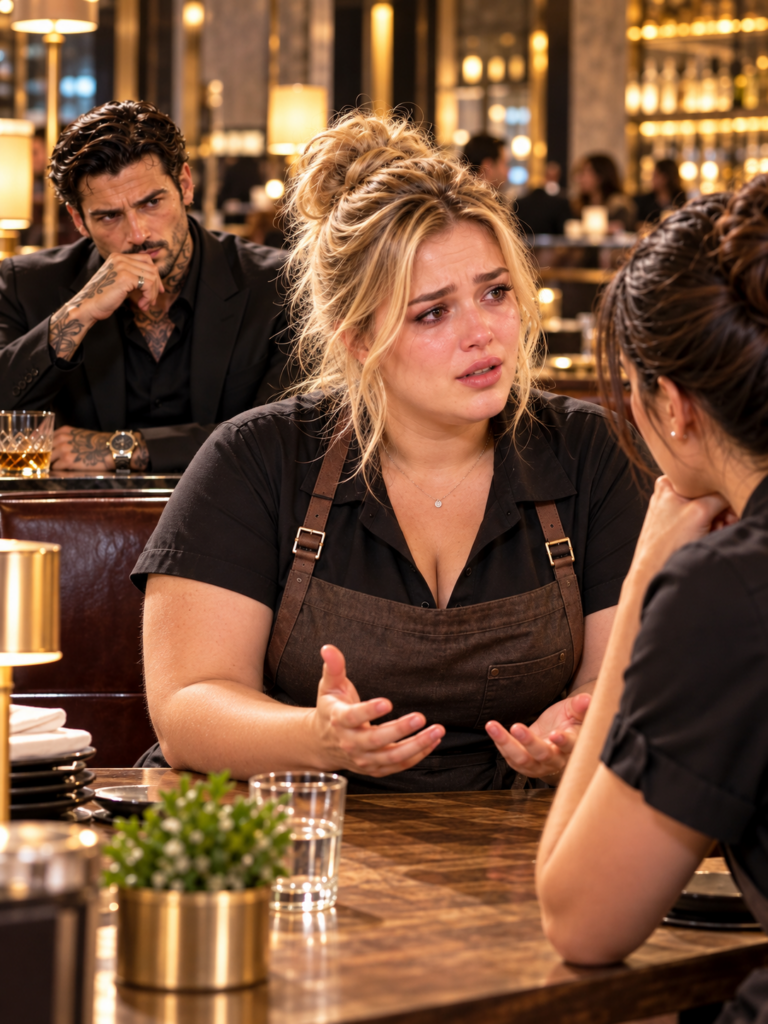
The Curvy Waitress Returned a Mafia Boss’s $500 in the Rain—Then He Discovered the Terrifying Secret Behind Her Family’s Tragedy
Part 1
The first time Marin Doyle told the truth about her life, she had no idea the most dangerous man in Providence was listening.
It was 1:01 in the morning.
The old brass clock above the bar had stopped working three years earlier, but Marin knew the time without looking at her phone. She knew it by the ache in her feet, the silence settling over the empty tables, and the way the neon sign outside Howerin’s Tap began to hum louder after midnight.
“I just need the world to stop taking,” she whispered.
Across the counter, Rosie Vasquez stopped counting her tips.
“What did you say, honey?”
Marin gave a tired smile.
“Nothing. Just being dramatic.”
But Rosie wasn’t fooled.
At twenty-nine, Marin Doyle had learned how to hide exhaustion behind a smile. She had long chestnut-brown hair, warm hazel eyes, and a naturally full, curvy figure that made her impossible to overlook, even though she spent most of her life wishing people would stop looking.
Her soft waist, generous hips, and rounded silhouette had been the subject of too many unsolicited opinions.
Customers sometimes called her beautiful.
Others made cruel little jokes about her weight.
Her former boyfriend had once told her that a woman with her body should be grateful for whatever attention she received.
She had believed him for almost a year.
Then she’d packed his belongings into three garbage bags and left them outside her apartment door.
That had been one of the few decisions in her adult life she’d never regretted.
Now she stood behind a bar in faded black trousers and a burgundy blouse beneath a worn apron, earning enough to survive another month.
Barely.
Rosie watched her with the concern of a woman who had seen too much suffering to mistake endurance for happiness.
“You need a vacation, sweetheart.”
Marin laughed.
“With what money?”
“Somewhere cheap.”
“Rosie, I can’t even afford the good laundry detergent.”
Rosie didn’t laugh.
And somehow, that made everything worse.
Marin set down the glass she’d been polishing.
“My father died at Pier Four eight years ago,” she said quietly. “A shipping container fell from a crane. Seven hundred kilograms. They told me he was standing somewhere he shouldn’t have been.”
Rosie’s expression softened.
“I remember.”
“They made me sign papers. I was twenty-one. A woman wearing a beautiful cream cardigan told me signing would make everything easier.”
Marin looked down at her hands.
“That’s how sixty-one thousand dollars of medical debt ended up in my name.”
“Marin—”
“And then there was Mom. And Micah.”
She swallowed.
Her younger brother had been eighteen when a vehicle struck him outside the car wash where he worked.
Now he lived at Bay View Rehabilitation Center.
Four thousand two hundred dollars every month.
No grace period.
No negotiation.
No second chances.
Marin worked six nights a week, picked up occasional cleaning jobs, and kept track of every payment in a small brown notebook that had once belonged to her father.
She had been doing it for years.
Sometimes she wondered what would happen if she simply stopped.
Stopped answering the phone.
Stopped opening the bills.
Stopped pretending she wasn’t terrified.
“Do you know what the worst part is?” she asked.
Rosie shook her head.
“I don’t even want to be rich.”
Marin’s voice cracked.
“I just want to buy a dress without calculating how many hours I have to work for it. I want to take Micah to the beach again. I want one morning where nobody needs something from me.”
She wiped her eyes angrily.
“And I want to stop feeling ashamed every time I walk into a room full of people who have more than I do.”
Rosie reached for her hand.
“There’s nothing shameful about you.”
Marin tried to smile.
“Tell that to the people who think a curvy waitress with a mountain of debt should be grateful anybody wants her.”
Neither woman noticed the man sitting motionless in booth number nine.
Raphael Baron had returned to the bar twenty minutes earlier.
He’d left his phone behind after a conversation with the owner, Gus Pavitus.
A careless mistake.
Or perhaps a decision his subconscious had made before the rest of him could object.
Raphael was thirty-four years old.
Tall, broad-shouldered, impeccably dressed, with dark hair, striking gray eyes, and the expression of a man who had long ago stopped expecting life to surprise him.
He owned trucking companies, bakeries, warehouses, and enough waterfront property to make city officials nervous.
He also controlled the Baron crime family.
Men twice his age lowered their voices when he entered a room.
Businessmen accepted losses rather than challenge him.
Politicians returned his calls before he finished dialing.
He had inherited his father’s empire five years earlier.
And since then, almost every conversation he’d had ended with someone asking him for something.
Money.
Protection.
Influence.
Mercy.
A favor.
Always something.
But the woman speaking across the bar didn’t even know he existed.
And she wasn’t asking anyone for anything.
Raphael remained in the darkness, listening to her describe a life that had demanded everything from her and given almost nothing back.
Then Marin mentioned Pier Four.
His fingers tightened around his coffee cup.
Pier Four.
A shipping accident eight years earlier.
A dead longshoreman.
The name Doyle.
Raphael remembered something.
Not enough to understand it.
Enough to make his stomach turn.
When Rosie disappeared into the kitchen, he rose quietly, placed five hundred dollars beneath his untouched espresso cup, and left.
He had almost reached the corner when he heard footsteps behind him.
“Sir!”
He turned.
Marin stood beneath the streetlight, rain already darkening her chestnut curls.
She had no coat.
Her blouse clung damply to her shoulders, and her apron fluttered in the wind.
She held the five hundred dollars toward him.
“You forgot this.”
Raphael looked at the money.
“No. I didn’t.”
“Then you made a mistake.”
“I don’t think so.”
“Well, I do.”
He studied her.
Most people would have taken the money without a second thought.
For Marin, it represented groceries, medicine, and another line in that little notebook.
Yet she was standing in the rain returning it.
“It’s a tip,” he said.
“For an espresso?”
“For your time.”
Her expression changed.
“You heard us.”
Raphael didn’t answer.
He didn’t need to.
Marin’s cheeks flushed.
For a moment, shame flickered across her face.
Then something stronger replaced it.
“Listen carefully,” she said. “I don’t know who you are, and I don’t care how much money you’ve got. My life isn’t a charity project.”
“That’s not what I intended.”
“Maybe not. But I don’t take what I can’t pay back.”
She pushed the folded bills against his chest.
He accepted them.
Their fingers brushed.
It was nothing.
A brief touch in the cold Rhode Island rain.
But Raphael felt it long after she stepped away.
“You should get inside,” he said.
She lifted her chin.
“You should find a better place to leave your money.”
Then she turned around and walked back toward the bar.
Raphael watched her go.
He had seen beautiful women dressed in diamonds, silk, and couture gowns.
He had dated actresses and socialites.
He had attended parties where women wore jewelry worth more than Marin’s entire apartment building.
None of them had ever left him standing speechless on a sidewalk.
A broad-shouldered man appeared beside a black SUV.
“Boss?”
Raphael continued staring toward the bar.
“Find out everything about the accident at Pier Four eight years ago.”
His driver hesitated.
“Everything?”
Raphael finally turned.
“Every report. Every signature. Every person involved.”
Then he opened the car door.
“And Bruno?”
“Yes, sir?”
“Find out who’s been collecting money from Marin Doyle.”
The following evening, Marin was carrying a tray of drinks when someone grabbed her wrist.
His name was Darren Cole.
Forty-six years old.
A regular customer.
A man who believed leaving a ten-dollar tip entitled him to make comments about a waitress’s body.
“Come on, sweetheart,” he slurred. “Give us a smile.”
“Let go.”
“Don’t be like that.”
He grinned at his friends.
“Girls built like you ought to be friendlier. You should be happy a man pays attention.”
Marin pulled back.
“Take your hand off me.”
Instead, Darren tightened his grip.
“I’m paying your salary.”
A chair scraped against the floor.
The sound wasn’t loud.
But somehow every conversation in the bar stopped.
Raphael Baron stood beside the table.
He wore a charcoal suit beneath a long black overcoat.
His expression was calm.
Dangerously calm.
“Release her.”
Darren blinked.
“Who the hell are you?”
Raphael looked at the hand gripping Marin’s wrist.
“You have three seconds.”
The bartender behind the counter went pale.
Gus Pavitus emerged from his office.
“Mr. Baron—”
“One.”
Darren released her immediately.
Raphael stepped between them.
“You will apologize.”
Darren gave an embarrassed laugh.
“Hey, we were just playing around.”
Raphael didn’t move.
“Apologize.”
The man swallowed.
“Sorry.”
Raphael glanced at Marin.
“Is that sufficient?”
She stared at him.
Nobody had ever asked her that before.
Not after someone insulted her.
Not after someone touched her without permission.
Not after someone made her feel small.
She straightened.
“No.”
Darren’s face turned red.
“What?”
“You embarrassed me in front of everyone. You told me I should be grateful for your attention.”
Her voice grew steadier.
“So apologize properly.”
For several seconds, nobody moved.
Then Darren lowered his eyes.
“I’m sorry, Marin. I shouldn’t have touched you or spoken to you that way.”
She nodded once.
“Thank you.”
Raphael turned toward Gus.
“This gentleman’s evening is finished.”
Gus agreed so quickly it was almost comical.
Darren left without another word.
When the door closed, Marin looked at Raphael.
“I could have handled that.”
“I know.”
“Then why did you interfere?”
“Because you shouldn’t have had to.”
His answer unsettled her more than Darren’s behavior had.
She folded her arms.
“Are you always this dramatic?”
“Only when necessary.”
“Does that happen often?”
“More than you’d think.”
For the first time, his mouth curved into something resembling a smile.
Marin hated how attractive it made him.
She hated even more that she noticed.
For the next two weeks, Raphael returned almost every night.
Booth number nine.
One espresso.
No alcohol.
He never touched her without permission.
Never commented on her body as though it belonged to him.
Never offered money again.
Sometimes he read a newspaper.
Sometimes he simply watched the rain beyond the window.
Eventually, they began talking.
Marin learned that he hated artificial sweeteners, loved his grandmother’s cooking, and once spent an entire summer repairing fishing boats because his father insisted he learn how ordinary people earned money.
Raphael learned that Marin had once studied nursing.
Three semesters.
Then her mother became ill.
He learned that she liked mystery novels, terrible horror movies, and cinnamon in her coffee.
He learned that she had spent nearly a decade caring for other people without once allowing herself to imagine a different life.
And he learned that her confidence around him was partly an act.
One night, she caught him looking at her.
“What?”
“Nothing.”
“You’re staring.”
“Yes.”
She laughed nervously.
“At what?”
“At you.”
Her cheeks warmed.
“I’m not exactly what men like you usually go for.”
He set down his espresso.
“What does that mean?”
She gestured vaguely toward her figure.
“You know. I’m curvy. Very curvy. I don’t look like the women you probably date.”
Raphael’s expression hardened.
“Who told you that was something to apologize for?”
Marin went quiet.
He leaned forward.
“Marin, I noticed your eyes before I noticed anything else.”
She blinked.
“Your eyes tell people you’re tired even when you’re smiling,” he continued. “Your hands shake when you’re worried about your brother. You give customers extra coffee when you think they’re lonely.”
He paused.
“And when someone insults you, you straighten your back instead of lowering your head.”
Her throat tightened.
“I do?”
“Yes.”
His gray eyes held hers.
“As for your figure, you’re beautiful. But I’m considerably more interested in the woman who returned five hundred dollars to a stranger in the rain.”
Marin looked away.
Nobody had ever spoken about her body without making her feel as though she was being evaluated.
And nobody had ever made her feel so thoroughly seen.
The danger began three nights later.
Marin was closing the bar when a black sedan stopped across the street.
Two men stepped out.
One wore a leather jacket.
The other carried a photograph.
“Marin Doyle?”
She froze.
“Who’s asking?”
The man showed her the picture.
Micah.
Her brother.
Sitting outside Bay View.
Her blood went cold.
“Your brother’s a handsome kid,” the man said. “Would be a shame if something happened to him.”
Marin stumbled backward.
“What do you want?”
“Your father’s notebook.”
Her breath caught.
“How do you know about that?”
The man smiled.
“Bring it tomorrow night. Or your brother gets another accident.”
A black SUV swept around the corner.
Its brakes shrieked.
The back door opened.
Raphael stepped out.
He took one look at Marin’s face.
Then at the photograph.
His expression changed.
Not into anger.
Into something much worse.
Perfect, terrifying stillness.
“Step away from her.”
The men turned.
One recognized him immediately.
“Mr. Baron, we didn’t know—”
“You know now.”
Raphael moved beside Marin, placing himself between her and the strangers.
“Who sent you?”
Neither answered.
Raphael’s driver approached.
The man holding the photograph took a step back.
“It’s not personal.”
Raphael looked directly into his eyes.
“You threatened her brother.”
Silence.
“That makes it personal.”
The men retreated to their vehicle.
Raphael watched until the sedan disappeared.
Only then did he face Marin.
She was trembling.
“Micah,” she whispered. “They know where he is.”
“I’ll make sure he’s safe.”
“You don’t understand. He’s all I have left.”
Raphael removed his coat and draped it around her shoulders.
“Look at me.”
She couldn’t.
He lowered his voice.
“Marin.”
Slowly, she lifted her eyes.
“Your brother will have protection tonight. So will Rosie. So will you.”
“How can you promise that?”
He hesitated.
There were secrets he had wanted to keep.
A world he had hoped she would never have to see.
But the time for comfortable lies had ended.
“My name is Raphael Baron.”
Marin stared at him.
Then she remembered the whispers.
The way Gus went pale whenever Raphael entered.
The black vehicles.
The men who stood outside without ever coming in.
“Oh my God.”
Raphael didn’t deny anything.
“Yes.”
She backed away.
“You’re that Raphael Baron?”
“Yes.”
“The one who controls the waterfront?”
“Yes.”
“The mafia boss?”
He held her gaze.
“Yes.”
Marin’s knees nearly gave way.
The most feared man in Providence had been sitting in her bar for weeks, drinking espresso and asking about her favorite books.
And now someone wanted her father’s notebook badly enough to threaten her disabled brother.
“Why are you helping me?” she whispered.
For once, Raphael Baron didn’t have an easy answer.
Then he stepped closer.
“Because somewhere between your terrible coffee and your stubborn refusal to accept help, you became the first person in years who made me want to be better.”
Her eyes filled with tears.
“Raphael…”
He extended his hand.
“Come with me tonight. I’ll keep you and Micah safe while we find out who is behind this.”
Marin looked at his hand.
The hand of a man who commanded criminals, owned half the harbor, and could change lives with a telephone call.
She was afraid of his world.
But she was more afraid of losing her brother.
“What happens if I say yes?”
Raphael’s answer was immediate.
“You keep your freedom. You keep your money. You make your own decisions.”
“And you?”
“I stand beside you.”
She studied his face.
“Not in front of me?”
His expression softened.
“Only when someone is trying to hurt you.”
For the first time that night, Marin smiled.
Then she placed her hand in his.
And from the darkness across the street, someone photographed them together.
Within minutes, the picture reached Camila Ricci.
The daughter of Raphael’s most trusted adviser.
A woman who had once expected to become his wife.
Camila stared at the photograph.
Then she opened a locked drawer and removed a folder marked:
PIER FOUR — DOYLE INCIDENT.
Inside were two documents.
One concerned Marin’s father.
The other concerned her brother.
And both carried the name of someone Raphael trusted with his life.
Part 2
Marin had imagined a mafia boss’s mansion would look like something from a movie.
She hadn’t expected it to smell like fresh bread.
But that was her first impression of Raphael Baron’s home.
Warm butter.
Espresso.
Rosemary growing in enormous terracotta pots outside the kitchen windows.
The house stood behind wrought-iron gates on Providence’s East Side, with pale stone walls, dark hardwood floors, and windows overlooking a private garden.
Everything was beautiful.
Everything was expensive.
And Marin felt completely out of place.
She stood in the entrance hall holding her battered overnight bag.
Her black trousers had faded at the knees.
Her shoes squeaked faintly against the marble.
She looked down at herself and suddenly felt painfully aware of her generous hips, soft stomach, and the blouse she’d worn for twelve hours.
Raphael noticed her hesitation.
“What’s wrong?”
“Nothing.”
“Marin.”
She exhaled.
“I don’t belong here.”
He took her bag.
“You’re standing in my house.”
“That doesn’t mean I belong in it.”
He studied her.
Then he set the bag down.
“This house has hosted governors, millionaires, and men who would sell their own mothers for a better business deal.”
She raised an eyebrow.
“Comforting.”
“Most of them weren’t worth inviting.”
He moved closer.
“You are.”
She looked away before he could see her smile.
Raphael insisted she have her own bedroom.
Her own bathroom.
A key to every door she might need.
No guards inside her private rooms.
No cameras in her living space.
And no expectation that she spend time with him.
“You’re a guest,” he told her.
“An extremely well-guarded guest.”
“Unfortunately.”
Marin folded her arms.
“And what exactly do I owe you?”
“Nothing.”
“That’s not how the world works.”
“Then perhaps we should change how it works.”
She stared.
“You say things like that very easily.”
His expression darkened.
“Because I’ve spent years making the opposite happen.”
For the first time, she saw the weight beneath his confidence.
Raphael wasn’t simply powerful.
He was tired.
Tired of bargaining, threatening, commanding, and mistrusting everyone around him.
Marin recognized that exhaustion.
She lived with a different version of it every day.
The next morning, she met Teresa Baron.
Raphael’s grandmother was eighty-two years old and approximately five feet tall.
She had silver hair pulled into a tight bun and the commanding presence of a retired general.
She looked Marin up and down.
Marin braced herself.
For a comment about her figure.
Her clothes.
Her job.
Her place in Raphael’s world.
Instead, Teresa handed her an apron.
“Can you make bread?”
Marin blinked.
“Not particularly.”
“Good. Then you can learn.”
For two hours, they kneaded dough together.
Teresa asked about Marin’s parents.
About her brother.
About nursing school.
Eventually, the old woman looked directly at her.
“Are you frightened of my grandson?”
Marin considered the question.
“No.”
Teresa nodded.
“Good.”
“I’m frightened of what his world could do to the people I love.”
Teresa’s hands stopped moving.
Then she smiled.
“Better answer.”
She pressed a little extra flour into Marin’s palm.
“Raphael’s mother died when he was young. His father taught him how to control everything except his own heart.”
Marin looked down.
“I don’t think I can fix him.”
“Good. Don’t try.”
Teresa returned to the dough.
“Love isn’t fixing a man. It’s finding out whether he’s willing to change himself.”
Three days later, Raphael took Marin to visit Micah.
He had arranged transportation to Block Island.
Marin hadn’t been there in eight years.
The island was the last place her family had been happy together.
Her father had taken them to the lighthouse one summer when Micah was twelve.
Their mother had packed sandwiches.
They had spent the afternoon laughing because their father insisted on walking the entire coastal trail in dress shoes.
Marin hadn’t returned after his death.
She couldn’t bear it.
Now, as the ferry crossed the water, she stood beside Raphael at the railing.
Her hair whipped around her face.
The wind pressed her summer dress against her curvy silhouette.
For once, she didn’t tug at the fabric or worry about how she looked.
She closed her eyes.
And breathed.
Raphael watched her.
He had seen her smile before.
This was different.
This was a woman remembering she was alive.
When they reached the beach, Raphael revealed what he’d spent the previous evening building.
A portable wooden ramp.
Uneven.
Heavy.
Not particularly attractive.
But sturdy enough to help Micah’s wheelchair cross the soft sand.
Marin stared at it.
“You made this?”
“Yes.”
“Yourself?”
“Yes.”
She looked at his hands.
There was a small blister near his thumb.
“You could have paid somebody.”
“I know.”
“Why didn’t you?”
Raphael glanced at Micah.
“Because I wanted to.”
Marin turned away.
Her eyes filled.
For eight years, everything she’d needed had been turned into an invoice.
A treatment.
A wheelchair repair.
An appointment.
Transportation.
Every kindness seemed to arrive carrying a bill.
And here was a man worth millions, kneeling in the sand with a poorly made wooden plank because he wanted her brother to see the ocean.
Micah laughed when they finally reached the water.
The sound was quiet and wordless.
Marin covered her mouth.
Raphael pretended not to notice.
Later, Micah folded a paper napkin into a small crane.
He offered it to Raphael.
The mafia boss accepted it with more care than he’d shown some of the priceless objects in his mansion.
“Thank you,” he said.
And placed it inside his jacket.
That evening, Marin found Raphael standing alone on the terrace.
“Can I ask you something?”
“Anything.”
“Why me?”
He turned.
She gave a nervous laugh.
“Seriously. You have women throwing themselves at you. Beautiful women. Wealthy women. Women who know which fork to use at those expensive dinners.”
Raphael remained silent.
“And then there’s me.”
He frowned.
“What about you?”
“I’m a curvy bartender with bills in three different drawers and absolutely no idea how to behave in your world.”
He crossed the terrace slowly.
“You want to know what I see?”
Marin swallowed.
“Yes.”
“I see a woman who has spent eight years carrying more responsibility than most people could survive.”
He stopped in front of her.
“I see someone who can make my grandmother laugh, my brother-like bodyguard smile, and a room full of strangers feel welcome.”
Her eyes shimmered.
“And when you walk into a room,” he continued, “I don’t see the things you’ve been taught to apologize for.”
“Raphael…”
“I see the woman I hope will stay.”
He raised one hand.
Stopped.
Waited.
Marin understood.
He was asking permission.
She stepped closer.
His palm settled gently against her cheek.
Their first kiss was slow.
Careful.
A question rather than a demand.
Marin placed her hands against his chest.
For the first time in years, she didn’t feel that she needed to make herself smaller to be loved.
The trouble began at a charity gala.
Camila Ricci had organized the event at a luxurious downtown hotel.
Officially, it supported waterfront redevelopment.
Unofficially, it was a gathering of the city’s wealthy and powerful.
Raphael asked Marin to accompany him.
She refused twice.
On the third attempt, she agreed.
“I don’t have anything appropriate to wear,” she admitted.
Raphael smiled.
“We can solve that.”
“Don’t you dare buy me something that costs more than my apartment.”
“I wouldn’t dream of it.”
He arranged for a designer to visit.
Marin chose the dress herself.
Deep emerald-green velvet.
Long sleeves.
A modest but elegant neckline.
A fitted waist and graceful draping that celebrated her naturally curvy figure rather than hiding it.
She stood before the mirror in disbelief.
She looked beautiful.
Not thinner.
Not altered.
Not transformed into somebody else.
Beautiful exactly as she was.
When Raphael saw her at the bottom of the stairs, he stopped walking.
Marin laughed nervously.
“Too much?”
He shook his head.
“Not nearly enough words in the English language.”
She blushed.
“That’s a terrible line.”
“I know.”
“Does it usually work?”
“I’ve never tried it before.”
He offered his arm.
And she took it.
The ballroom fell silent when they arrived.
Raphael Baron was expected.
The woman beside him was not.
Marin felt eyes traveling over her dress, her figure, and her face.
She heard whispers.
“Isn’t she a waitress?”
“That’s the girl from the bar.”
“She’s certainly not his usual type.”
Camila approached with a practiced smile.
She was tall, elegant, and dressed in silver silk.
“Raphael.”
“Camila.”
Her gaze shifted to Marin.
“And this must be your little project.”
Marin went still.
Raphael’s expression hardened.
“Be careful.”
Camila gave a delicate laugh.
“Oh, don’t be sensitive. I simply admire charity.”
The insult was unmistakable.
Marin felt the old shame rising.
That familiar heat beneath her skin.
The impulse to lower her head and disappear.
Then she remembered the rain.
Five hundred dollars.
And the man who had accepted her refusal without arguing.
She lifted her chin.
“My name is Marin Doyle.”
Camila smiled.
“I know.”
“Then perhaps you should use it.”
Several nearby guests turned.
Camila’s smile faltered.
“Excuse me?”
Marin spoke calmly.
“I’m not a charity project. I’m a woman Raphael invited to accompany him.”
She glanced at the people watching.
“And if anyone is disappointed that a waitress is attending a gala, they’re welcome to discuss that disappointment with me directly.”
An uncomfortable silence followed.
Then Raphael laughed.
Not loudly.
But with unmistakable admiration.
He took her hand.
“Ladies and gentlemen,” he said, his voice carrying across the nearest tables, “this is Marin Doyle.”
Every nearby conversation stopped.
“The woman beside me tonight is here because I asked her.”
He looked directly at Camila.
“And because I’m fortunate she said yes.”
Marin’s heart pounded.
Raphael brought her hand to his lips.
No performance of ownership.
No implication that she was his property.
Just a public declaration that he was proud to stand beside her.
And for the first time, Marin understood something extraordinary.
She didn’t need to become a different woman to enter his world.
She needed only to remain herself.
But across the ballroom, Camila’s father watched them with increasing alarm.
Salvatore Ricci had served the Baron family for twenty-two years.
He was sixty-eight.
Silver-haired.
Quiet.
Respected.
And responsible for a decision that had killed Marin’s father.
Eight years earlier, a safety inspector had recommended immediate replacement of a damaged crane cable at Pier Four.
The cost was one hundred eighty thousand dollars.
Salvatore had delayed the repair.
The shipping season was behind schedule.
The money could be saved.
The repairs could wait.
Three weeks later, the cable snapped.
Aaron Doyle died beneath a falling container.
The company blamed him.
The safety lines were repainted after the accident.
And the official report declared it an employee positioning error.
Salvatore believed the matter had been buried forever.
Until Raphael Baron fell in love with Aaron Doyle’s daughter.
Camila knew more.
Two years earlier, Micah Doyle had photographed a suspicious vehicle at the car wash where he worked.
The license plate belonged to a truck connected to the waterfront operation.
Micah posted the photograph online.
Nine hours later, it disappeared.
Six days after that, a vehicle struck him.
The driver vanished.
The truck was reported stolen.
And Micah was left with a spinal cord injury.
Camila had seen the internal documents.
She knew the collision had not been an ordinary accident.
She had hidden what she knew to protect her father.
Now she watched Raphael and Marin dance beneath a crystal chandelier.
And she realized the truth might destroy everything.
Her father’s freedom.
The family’s empire.
Her own future.
Something in her hardened.
If Marin Doyle disappeared from Raphael’s life, perhaps the past could remain buried.
Camila decided to make that happen.
Nine days later, Marin received a telephone call.
The woman on the other end identified herself as Camila Ricci.
“We need to talk about your brother.”
Marin’s blood turned cold.
They met at a coffee shop on Wickenden Street.
Camila was already seated.
A thick manila folder lay on the table.
“I don’t like you,” Camila said pleasantly.
Marin sat down.
“The feeling isn’t particularly warm on my side either.”
Camila ignored that.
“But I’m going to give you information you deserve to have.”
She pushed the folder across the table.
Marin opened it.
Page after page.
A photograph of Micah’s social media post.
A vehicle registration.
A police report.
Internal emails.
Names.
Dates.
And evidence suggesting that her brother had been deliberately targeted.
Marin felt the café tilt around her.
Her fingers became numb.
“No.”
Camila said nothing.
“No, that’s not possible.”
“Unfortunately, it is.”
Marin stared at the documents.
Her brother hadn’t simply been unlucky.
Someone had hurt him.
Deliberately.
Because he had photographed something he wasn’t supposed to see.
She looked up.
“Where did you get these?”
“Raphael’s people recovered them.”
“When?”
Camila folded her hands.
“Nine days ago.”
Marin stopped breathing.
“Nine days?”
“Yes.”
“Raphael knows?”
“He read every page.”
Marin’s stomach dropped.
“And he didn’t tell me?”
Camila’s expression softened into something that almost resembled compassion.
“He decided you couldn’t handle the truth.”
That was not precisely what Raphael had said.
But Camila knew exactly where to strike.
Marin had spent her entire adult life fighting to make her own decisions.
And the man she was falling in love with had taken away her right to decide what to do with the worst news of her life.
When Raphael returned home that evening, Marin was waiting in his study.
The folder lay on his desk.
He stopped in the doorway.
For a long moment, neither spoke.
Then Marin asked one question.
“How long?”
Raphael looked at the folder.
“Nine days.”
“Why?”
“Because I didn’t have enough evidence to keep you safe.”
“You knew someone tried to kill my brother.”
“Yes.”
“And you decided I didn’t need to know?”
“I was trying to protect you.”
She laughed once.
It was a devastating sound.
“Protect me?”
“Marin—”
“Do you know what I have done every day for two years?”
He remained silent.
“I have watched Micah struggle to communicate. I have paid thousands of dollars for treatment. I have blamed myself for not picking him up from work that night.”
Tears streamed down her face.
“And you knew.”
Raphael took a step toward her.
She raised her hand.
“Don’t.”
He stopped immediately.
“You don’t understand,” he said. “The people involved are dangerous.”
“Then you should have told me how dangerous.”
“I needed time.”
“You needed control.”
The words struck harder than he expected.
Marin picked up the folder.
“For weeks, you’ve told me you respect me. That I’m strong. That I can stand beside you.”
“I meant every word.”
“Then why did you make the biggest decision of my life without asking me?”
He had no answer that could repair what he’d done.
Her voice softened.
And somehow became more painful.
“I didn’t need a savior, Raphael.”
She looked at him through tears.
“I needed a partner.”
Then she walked past him.
He could have stopped her.
A single word to the guards.
A single locked gate.
A single command.
But he remained still.
Because he finally understood that loving a woman meant allowing her to leave.
Even when watching her go felt like losing the only good thing in his life.
Three nights passed.
Raphael did not call.
Marin returned to work.
She wiped counters.
Poured drinks.
Smiled at customers.
Then went home and cried into a pillow that still smelled faintly of his cologne.
On the fourth afternoon, she visited Micah.
She sat beside his wheelchair and took his hand.
“I need to tell you something.”
He looked at her.
“There was a man.”
Micah’s eyes brightened.
“You remember Raphael?”
A small movement.
Yes.
“I think I loved him.”
She looked down.
“Maybe I still do.”
Her voice broke.
“But he kept something from me. Something about you.”
Micah’s expression changed.
Marin wiped her face.
“It’s just us again, okay? Like always.”
For a long moment, her brother sat completely still.
Then his lips moved.
At first, no sound emerged.
Marin leaned closer.
“Micah?”
His jaw tightened.
A thin, cracked voice came from his throat.
Three letters.
Three numbers.
Marin froze.
“What?”
He repeated them.
Slowly.
Carefully.
A license plate.
The plate he had seen on the truck.
The one he had carried in his memory for two years.
Marin covered her mouth.
“Micah…”
Tears streamed down her cheeks.
He forced out another word.
“Ren.”
Nobody had called her that since before their father died.
She fell to her knees beside his wheelchair.
And held him.
For the first time in two years, she heard her brother’s voice.
And he had used it to give her the truth.
Marin spent that night searching public vehicle records.
The plate led to a stolen truck.
A dissolved leasing company.
A dead registered owner.
Every path ended.
Except one.
At six o’clock the following morning, she picked up her phone.
Her hands shook.
She dialed Raphael.
He answered on the first ring.
“Marin?”
“I have something.”
Silence.
“Micah spoke.”
Raphael closed his eyes.
“Marin…”
“He remembers the plate.”
“Are you safe?”
“Yes.”
“Where are you?”
“My apartment.”
“I’ll come to you.”
“No.”
He stopped.
Marin drew a breath.
“If we do this, we do it differently.”
“Tell me how.”
“No more secrets.”
“Agreed.”
“No more deciding what I can handle.”
“Agreed.”
“And whatever we discover, I get to make my own choices.”
Raphael’s voice was low.
“You should always have had that right.”
She closed her eyes.
For the first time since leaving him, she allowed herself to breathe.
“Then come over.”
Raphael arrived without bodyguards entering the apartment.
He wore a dark sweater instead of a suit.
He looked as though he hadn’t slept.
Marin noticed.
She hated that she noticed.
He stood just inside the doorway.
“I owe you an apology.”
She folded her arms.
“Yes.”
“I withheld information because I was afraid of losing you.”
Her expression changed.
“Not because I thought you were weak,” he continued. “Because I didn’t trust myself to survive what might happen if you confronted the wrong people.”
He swallowed.
“I told myself I was protecting you. But I was protecting myself from the possibility of losing you.”
Marin said nothing.
He looked directly at her.
“I was wrong.”
There were no excuses.
No conditions.
No requests for forgiveness.
Just the truth.
She opened the door wider.
“Come in.”
By evening, Bruno had traced the plate to a former transport contractor named Wade Greer.
Greer worked for a rival waterfront operator.
A man called Victor Kessler.
Kessler had been trying to seize control of the harbor for years.
He had arranged threats, thefts, and violent confrontations to weaken rival businesses.
Micah’s photograph had captured a truck connected to one of his operations.
And the order to silence the boy had passed through people linked to Salvatore Ricci’s office.
Marin listened as Bruno explained.
Then she asked the question nobody else wanted to ask.
“Was my father’s death connected?”
Raphael looked at her.
“Yes.”
He showed her the safety reports.
The delayed repair.
The altered markings.
The signature.
Salvatore Ricci.
Marin stared at the name.
Then remembered something.
“My father’s notebook.”
Raphael nodded.
She ran to her bedroom.
Returned with the worn brown leather book.
Opened the front pages.
Equipment numbers.
Shift assignments.
Weather notes.
Then she found it.
Three days before her father died.
Number three cable. Pier Four. Reported second time. S.R.
She placed the notebook on the table.
“My father reported the problem.”
Raphael read the words.
His face grew cold.
“He knew the cable was dangerous.”
“And someone ignored him.”
“Yes.”
Marin looked at the two men.
“Then we don’t bury this.”
Raphael nodded.
“No.”
“We take it to the authorities.”
Bruno hesitated.
“Marin, Kessler has people everywhere.”
She met his eyes.
“Then we make sure the evidence reaches people he doesn’t control.”
Raphael studied her.
For weeks, he had believed his responsibility was to keep this woman away from danger.
Now he understood his responsibility was to stand beside her while she confronted it.
He reached for her hand.
She let him take it.
Then his phone rang.
Bruno answered the second line.
His expression changed.
“Raphael.”
“What?”
“Bay View just called.”
Marin went pale.
Bruno looked at her.
“Someone tried to enter Micah’s room using a forged medical authorization.”
Raphael rose.
“Where is he?”
“Security stopped them.”
Marin grabbed her coat.
“We’re going.”
Bruno hesitated.
“There’s something else.”
Raphael turned.
“The authorization carried a signature from the Ricci office.”
Silence filled the apartment.
Camila.
And now the threat had reached Micah again.
Part 3
The hospital corridor smelled of disinfectant and freshly brewed coffee.
Marin walked so quickly that Raphael had to lengthen his stride to stay beside her.
She didn’t stop until she reached Micah’s room.
Her brother sat beside the window.
Safe.
A paper crane rested on his blanket.
Marin crossed the room and embraced him.
For several moments, she couldn’t speak.
Then Micah whispered her name.
“Ren.”
She started crying again.
“I’m here.”
Raphael remained near the doorway.
He had spent most of his adult life believing power meant controlling what happened around him.
But watching Marin hold her brother, he understood that there were things power couldn’t create.
Trust.
Courage.
Love.
They had to be earned.
The following morning, Marin requested a meeting.
Not Raphael.
Not Bruno.
Marin.
She wanted Salvatore Ricci in the room.
She wanted Camila present.
And she wanted the attorney who had been reviewing the waterfront records.
Raphael asked only one question.
“Are you sure?”
Marin looked at him.
“Yes.”
He nodded.
“Then I’ll stand beside you.”
The meeting took place in a private conference room above the Baron family’s oldest bakery.
Salvatore arrived first.
He looked older than Marin remembered.
His silver hair was carefully combed.
His suit immaculate.
His hands unsteady.
Camila came next.
She stopped when she saw Marin sitting at the table.
“What is she doing here?”
Marin answered before Raphael could speak.
“I’m asking the questions today.”
Camila looked toward Raphael.
He remained silent.
Marin placed the brown leather notebook on the table.
Salvatore stared at it.
“Do you recognize this?”
He didn’t answer.
“It belonged to my father.”
His face changed.
“He wrote everything down,” Marin continued. “The equipment. The shifts. The problems nobody wanted to hear about.”
She opened the book.
“Three days before he died, he reported a damaged cable for the second time.”
Salvatore closed his eyes.
“Marin—”
“Did you receive that report?”
Silence.
“Did you know the crane was unsafe?”
His shoulders sagged.
“Yes.”
Camila turned sharply.
“Dad.”
Salvatore stared at the notebook.
“We were behind schedule.”
Marin’s breathing grew shallow.
“You were behind schedule?”
“The repairs were expensive.”
“One hundred eighty thousand dollars,” she said.
He looked at her in surprise.
“Yes.”
Marin leaned forward.
“My father had a name.”
Salvatore’s eyes filled.
“He had a wife. Two children. A daughter who wanted to become a nurse. A son who worshiped him.”
Her voice cracked.
“He was not a line on your balance sheet.”
Nobody moved.
“You saved one hundred eighty thousand dollars,” she continued. “And I buried my father.”
Salvatore covered his face.
“I told myself we’d replace the cable the following month.”
“But he died before the following month.”
“Yes.”
Marin’s hands trembled.
For years, she had imagined confronting whoever was responsible.
She’d pictured screaming.
Hitting something.
Making him understand.
But now all she felt was grief.
An enormous, exhausting grief.
She closed the notebook.
“I want your confession on record.”
Salvatore slowly lifted his head.
Raphael looked at the attorney.
The man switched on a recorder with everyone’s consent.
And Salvatore began telling the truth.
Camila sat rigid throughout her father’s statement.
When it ended, Marin turned toward her.
“Now let’s talk about Micah.”
Camila’s face drained of color.
“I already gave you the file.”
“Not the complete file.”
Camila said nothing.
“You had the full internal circulation report.”
“How do you know that?”
“Because the version you showed me was missing the distribution log.”
Camila glanced at Raphael.
He shook his head.
“Don’t look at me. Answer her.”
Marin placed another document on the table.
Bruno had recovered a partial copy from archived records.
It showed that Camila’s office had received Micah’s photograph shortly before the collision.
“You knew someone had targeted my brother.”
Camila’s eyes filled with tears.
“I didn’t order it.”
“I didn’t ask if you ordered it.”
“No.”
“You knew?”
A long silence.
Then Camila whispered, “Yes.”
Marin felt something break inside her.
“Why didn’t you help him?”
Camila pressed her fingers against her forehead.
“Because I was afraid.”
“Of what?”
“Losing everything.”
Marin stared at her.
“My brother lost the ability to walk.”
Camila began crying.
“I know.”
“He spent two years believing he had to stay silent to protect me.”
“I know.”
“And you let it happen.”
Camila couldn’t answer.
Marin looked down at the evidence.
Then back at her.
“You told me the truth about Raphael because you wanted me to leave him.”
Camila swallowed.
“Yes.”
“But you didn’t tell me the truth about yourself.”
“No.”
For a long moment, Marin studied the woman who had humiliated her at the gala.
The polished hair.
The expensive jewelry.
The carefully composed expression now falling apart.
For the first time, Camila seemed neither powerful nor glamorous.
Only frightened.
Marin took a breath.
“You still have a choice.”
Camila looked up.
“You can keep protecting people who hurt innocent families. Or you can tell the truth and accept what comes next.”
Camila looked toward her father.
Then Raphael.
Finally, she reached into her handbag.
And removed a flash drive.
“Everything is on here.”
She pushed it across the table.
“The emails. The payment records. The vehicle arrangements. The people Kessler used.”
Raphael looked at her.
“Camila…”
She shook her head.
“Don’t.”
Tears rolled down her cheeks.
“I’ve spent two years convincing myself that keeping quiet meant protecting my family.”
She looked at Marin.
“But all it really meant was letting your family suffer.”
The evidence went to a federal attorney that afternoon.
It took weeks for the first charges to be filed.
Then months for the investigation to expand.
Victor Kessler was indicted for conspiracy, obstruction, and offenses connected to the attack on Micah.
Wade Greer was arrested after investigators traced the transport records.
Salvatore Ricci faced charges arising from the concealed safety violations and falsified reports.
Camila cooperated with prosecutors and faced consequences for her own role in concealing evidence.
None of it was simple.
None of it repaired Marin’s family overnight.
But for the first time, the truth was no longer trapped in a notebook.
And Micah no longer had to carry six characters alone.
The investigation changed Raphael’s life.
Not because he was surprised to discover corruption in his family’s business.
He had known corruption existed for years.
What changed him was seeing its human cost.
He had inherited an empire built by men who treated suffering as an operational expense.
And somewhere along the way, he had begun using the same language.
Exposure.
Risk.
Assets.
Liabilities.
Marin had forced him to remember that behind every file was a person.
One night, he called Bruno into his study.
“I want out.”
Bruno stared at him.
“Out of what?”
Raphael gave him a tired smile.
“You know exactly what.”
Bruno sat down.
For five years, he had watched Raphael become more powerful and more isolated.
He had feared the man would eventually lose the part of himself that could still feel regret.
Now Raphael stood before him with a small paper crane in his hand.
“It’s going to cost you,” Bruno warned.
“I know.”
“You’ll lose people.”
“I know.”
“Some of them will become enemies.”
“They already are.”
Bruno studied him.
“Is this because of Marin?”
Raphael looked toward the garden.
“She made me see what I was becoming.”
He paused.
“But I’m doing this because I no longer want to be that man.”
Bruno nodded slowly.
“Then we should talk to the lawyers.”
The transition took eighteen months.
Raphael separated his legitimate businesses from the criminal operations.
He cooperated with federal authorities through legal counsel.
The process brought investigations, financial losses, and threats from former associates.
But he refused to turn back.
He retained the bakeries, warehouses, and legitimate trucking operations.
The illegal activities ended or passed out of his control under the supervision of investigators.
He also established a six-million-dollar compensation fund for families harmed by preventable accidents along the waterfront.
He named it the Aaron Doyle Fund.
Not after his own family.
Not after the Baron name.
After the longshoreman whose warnings had been ignored.
When Marin learned about it, she cried.
Not because Raphael had given away money.
But because he had finally understood something she’d been trying to tell him from the beginning.
Money couldn’t erase suffering.
But accountability could prevent someone else from enduring the same pain.
Marin made changes of her own.
She returned to nursing school.
Not because Raphael paid for it.
Because she’d worked out a financial plan, applied for assistance, and decided she was no longer going to postpone her future indefinitely.
Raphael offered support.
She accepted some.
Refused other parts.
They talked about every decision.
Sometimes they argued.
Often.
Marin was stubborn.
Raphael was accustomed to giving orders.
And neither particularly enjoyed losing.
One evening, after a ridiculous disagreement about whether she needed a driver for an afternoon appointment, Marin folded her arms.
“Raphael Baron, I survived twenty-nine years without a security detail.”
He looked at her.
“And I’ve survived thirty-five years without anyone telling me to stop being an idiot.”
She narrowed her eyes.
“Perhaps that’s the problem.”
He laughed.
Actually laughed.
And kissed her forehead.
“Perhaps.”
Micah’s recovery remained slow.
He didn’t miraculously stand up one morning.
He didn’t suddenly regain everything the collision had taken.
He worked through exhausting therapy sessions.
Celebrated small improvements.
Endured setbacks.
Some days were hopeful.
Others were heartbreaking.
But his speech strengthened, and he began participating more fully in his own care.
He told jokes again.
Argued about baseball.
Complained about terrible hospital food.
And one afternoon, with intense concentration, he folded a paper crane using both hands.
When Marin saw it, she burst into tears.
Micah rolled his eyes.
“Ren, seriously?”
She laughed through the tears.
“Sorry.”
“It’s paper.”
“I know.”
“You’re being dramatic.”
She hugged him.
“Runs in the family.”
On a Saturday in September, Raphael took Marin back to Block Island.
The sky was streaked with gold.
The ocean lay calm beyond the dunes.
She wore a flowing blue dress that moved gently around her curvy figure.
Her hair was loose.
She looked healthier than she had the first time they’d met.
Not because her body had changed.
But because her life no longer revolved entirely around fear.
She had finished another semester of nursing school.
She was sleeping more.
Laughing more.
Learning how to exist without guilt.
Raphael stopped beside the lighthouse.
Marin turned toward him.
“What’s wrong?”
“Nothing.”
“You’ve been quiet for twenty minutes.”
“I’m thinking.”
“Dangerous habit.”
He smiled.
Then reached into his coat.
Marin stared.
“Raphael…”
He opened a small velvet box.
Inside was a beautiful diamond ring.
Simple.
Elegant.
Chosen with care.
Marin covered her mouth.
Raphael took her hand.
“The first night we met, you told me you don’t take what you can’t pay back.”
Tears filled her eyes.
“I remember.”
“I spent a long time believing love was something people owed me because of my name or my money.”
He swallowed.
“You taught me it isn’t.”
Marin squeezed his hand.
“You taught me that accepting help doesn’t make me weak.”
He smiled.
“Then maybe we’ve both learned something.”
She laughed through tears.
Raphael lowered himself to one knee.
“I don’t want to rescue you, Marin. You’re not someone who needs to be rescued.”
His voice deepened.
“I want to wake up beside you. I want to argue about coffee and laugh with Micah and listen to my grandmother tell us we’re making bread incorrectly.”
Marin was crying openly now.
“I want to be there when you graduate. When you’re exhausted after your first nursing shift. When you achieve things you’ve spent years believing were impossible.”
He looked into her eyes.
“And on the days when life is cruel again, I want to be the man you can lean on without ever losing yourself.”
He took a breath.
“Will you marry me?”
Marin stared at him.
The powerful mafia boss.
The man who had once commanded a room with a glance.
Now kneeling in the sand, waiting for her answer.
“Raphael Baron,” she whispered, “you are the most infuriating man I’ve ever met.”
He laughed nervously.
“I’m aware.”
“You’re controlling.”
“Working on it.”
“Stubborn.”
“So I’ve been told.”
“And your espresso habit is ridiculous.”
“That’s not going to change.”
She smiled through tears.
“Good.”
His expression softened.
“Good?”
She nodded.
“Yes.”
He stood.
She threw her arms around him.
“Yes, I’ll marry you.”
Their kiss tasted of salt air and happy tears.
And when Raphael finally slipped the ring onto her finger, Marin understood that he wasn’t offering her a new identity.
He was asking to share the one she’d fought so hard to keep.
They married the following June.
The ceremony took place in a small church on Federal Hill.
Marin wore an ivory wedding gown with a beautifully tailored bodice, delicate lace sleeves, and a flowing skirt designed to complement her full, feminine curves.
She hadn’t asked the seamstress to make her look thinner.
She’d asked to look like herself.
And when she appeared at the church entrance, Raphael forgot to breathe.
Micah accompanied his sister down the aisle in his power wheelchair, wearing a handsome gray suit.
Rosie cried so hard her daughter had to give her another packet of tissues.
Teresa Baron declared the wedding flowers unacceptable.
Then cried during the vows.
Bruno stood beside Raphael.
And Gus Pavitus, who had closed Howerin’s Tap for the reception, made a toast in Greek that almost nobody understood.
Everyone applauded anyway.
For their first dance, Raphael held Marin close.
She rested her head against his chest.
“Do you remember the first time I returned your money?”
He smiled.
“Every second.”
“You looked so offended.”
“I was confused.”
“You were a rich man discovering somebody didn’t want his money.”
He laughed.
“That too.”
She lifted her head.
“Would you have kept coming back if I’d accepted it?”
Raphael considered.
“Yes.”
“Really?”
“Yes.”
He brushed a loose curl from her cheek.
“But I might never have learned how extraordinary you are.”
Marin smiled.
“I’m not extraordinary.”
He shook his head.
“You stood in the rain and told a man everyone feared that he couldn’t buy your dignity.”
She looked at him quietly.
“And you listened.”
He kissed her forehead.
“It was the best decision I ever made.”
Two years later, their daughter Josephine was born.
Everyone called her Josie.
She had Marin’s hazel eyes and Raphael’s stubborn expression.
The first time Raphael held her, his hands trembled.
Marin watched from the hospital bed.
“Are you frightened, Mr. Baron?”
He looked at the tiny baby against his chest.
“Terrified.”
She smiled.
“Good.”
He raised an eyebrow.
“Good?”
“Now you know how the rest of us feel.”
He laughed.
Then looked down at his daughter again.
A man who had once controlled an entire criminal empire was suddenly overwhelmed by a seven-pound baby.
And he had never been happier.
Marin eventually opened a small café on Wickenden Street.
She called it Second Pour.
Eleven tables.
Warm lighting.
Good coffee.
Fresh bread from the Baron bakery.
She chose the hours herself.
Seven in the morning until six in the evening.
Daylight.
On purpose.
She still worked as a nurse part-time, and the café became a place where hospital staff, students, elderly neighbors, and exhausted parents felt welcome.
In one corner stood a booth that never accepted reservations.
Booth number nine.
The regular customers eventually learned not to ask.
Every evening, just before closing, Raphael arrived.
Sometimes wearing a suit.
Sometimes carrying grocery bags.
Often with their daughter asleep against his shoulder.
He always ordered espresso.
Marin always complained about it.
And he always smiled.
One evening, as the golden autumn light filled the café, Marin stood behind the counter polishing a glass.
Raphael watched her from the doorway.
She was still beautiful.
Still curvy.
Still stubborn.
Still the woman who refused to surrender her dignity even when life tried to strip everything else away.
Her hair was tied loosely behind her head.
There was flour on her sleeve.
Their daughter was reaching for the paper crane tucked into Raphael’s coat pocket.
Marin looked up.
“What?”
He smiled.
“Nothing.”
“You’re staring again.”
“Yes.”
“At what?”
“At my wife.”
She shook her head, laughing.
“You’ve been doing that for years.”
“I intend to keep doing it.”
She came around the counter.
He opened one arm.
She stepped into it.
And for a few quiet moments, there were no business meetings.
No threats.
No debts.
No secrets.
Only the warmth of the café, their daughter’s sleepy breathing, and the soft sound of evening traffic outside.
Marin glanced toward the old brass clock hanging over the counter.
Unlike the one at Howerin’s Tap, this clock worked perfectly.
“Six o’clock,” she said.
“Time to go home?”
She smiled.
“Yes.”
Raphael reached up and switched off the lamp.
Then he waited beside the door while Marin gathered her things.
He had learned long ago that love wasn’t about being powerful enough to carry someone’s entire world.
It was about respecting them enough to share the weight.
And Marin Doyle Baron had learned something just as important.
She had never needed to become smaller, prettier, wealthier, or easier to love.
She had been worthy all along.
The right man hadn’t changed that.
He had simply been wise enough to recognize it.
Raphael held the door open.
Marin took his hand.
And together, with their daughter nestled safely between them, they walked into the last golden light of the day.

