
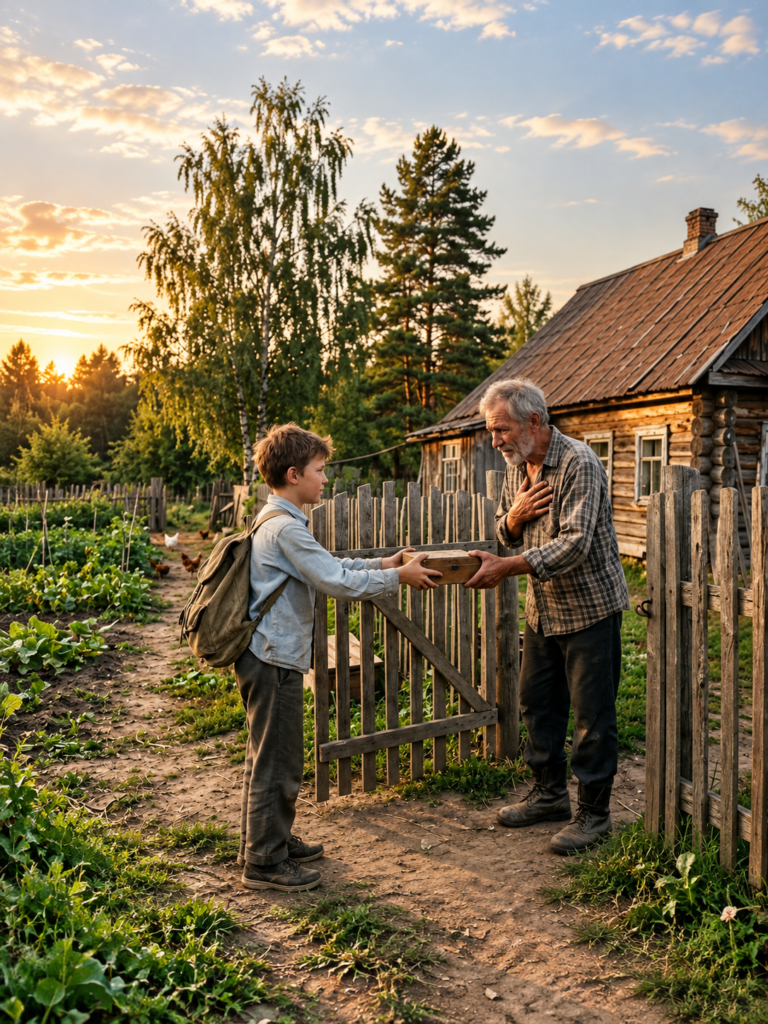
a 13-year-old orphan worked himself to exhaustion to repay his dead father’s debt—when he finally faced the old farmer, the man’s unexpected decision brought him to tears
Part 1
The boy standing at the end of the gravel driveway looked as though a strong wind might knock him over.
His boots were splitting at the toes. His faded flannel shirt hung loosely from narrow shoulders, and his hands were covered with the kind of calluses most grown men didn’t develop until they’d spent years working the land.
He was thirteen years old.
In his right hand, he held a small cloth pouch containing every dollar he had managed to save.
Inside the farmhouse, seventy-year-old Michael Henderson watched the boy through his kitchen window.
He knew who the child was.
Everyone in that part of North Dakota knew.
His name was Ivan Petrov, though nearly everybody called him Vanya.
And he had come to settle a debt that had nearly destroyed him.
But Michael already knew something the boy did not.
Something that would make the money in that little cloth pouch almost meaningless.
And when the truth finally came out, neither of them would leave that porch the same man.
Six months earlier, Ivan’s world had been very different.
His father, Anton Petrov, owned a struggling forty-acre farm outside the small town of Willow Creek, where the prairie stretched farther than the eye could see and the winter winds could turn a familiar road into a dangerous wilderness overnight.
The farmhouse was old, with peeling white paint, a sagging front porch, and a woodstove that smoked whenever the wind blew from the north.
But to Ivan, it was home.
His mother had died when he was six, leaving behind a faded wedding photograph, a blue enamel coffee pot, and memories that had softened with time.
Anton had raised his son alone.
He wasn’t a wealthy man. He wasn’t particularly educated, either. His hands were broad and permanently rough, and he had a habit of rubbing his tired eyes before answering difficult questions.
But his neighbors trusted him.
If Anton said he would repair a fence, he repaired it.
If he borrowed a tool, he returned it cleaner than he’d received it.
And if he gave his word, he treated that promise as something more valuable than anything he owned.
“Money comes and goes, son,” he often told Ivan while they worked together. “But a man’s word follows him everywhere.”
Ivan had heard those words a hundred times.
He never imagined how much they would eventually cost him.
The trouble began during a brutal summer drought.
For weeks, the sky remained an unbroken sheet of pale blue. Grass turned brittle. The corn curled in the fields. The pond behind the barn shrank into a muddy depression where thirsty cattle stood waiting for water that never came.
Anton did everything he could.
He repaired the old irrigation pump himself, sold two cattle, and drove thirty miles to purchase feed on credit.
Nothing was enough.
By September, the farm was barely surviving.
One evening, Ivan found his father sitting at the kitchen table with a collection of bills spread in front of him.
The only light came from a yellow lamp above the stove.
Anton was holding a pencil, but he hadn’t written anything.
“Dad?”
His father looked up.
“Shouldn’t you be in bed?”
“Are we losing the farm?”
Anton didn’t answer immediately.
Then he pushed the papers aside.
“Come here, son.”
Ivan sat opposite him.
“We’re having a hard year,” Anton said. “That happens. But hard years don’t last forever.”
“Mr. Henderson has plenty of land.”
“He does.”
“Could he help us?”
Anton looked toward the dark window.
Michael Henderson owned the largest working farm within twenty miles. He had known Anton for decades, and although the two men were different in nearly every respect, there was mutual respect between them.
Michael was reserved, strict, and not particularly affectionate.
But he was fair.
Two mornings later, Anton drove his battered pickup to Henderson Farm.
He returned just before sunset with enough money to purchase feed, repair the water system, and keep their small operation alive.
Ivan met him beside the truck.
“Did he help?”
Anton nodded.
“He loaned me what we needed.”
“How much?”
“Enough.”
“When do we pay him back?”
“When we’re standing steady again.”
Anton placed one hand on his son’s shoulder.
“And we will pay him back, Vanya. Every penny.”
For a while, things improved.
Autumn brought rain. The cattle recovered. Anton worked long hours preparing the property for winter.
But in November, he developed a persistent cough.
At first, he dismissed it.
“Just the cold air,” he told Ivan.
Then came the fever.
Then the exhaustion.
By December, Anton could barely carry a bucket of water from the pump to the barn.
The doctor at the county clinic urged him to seek further treatment. Tests followed, and the news was worse than either father or son had expected.
Anton was seriously ill.
Treatment would be difficult, expensive, and uncertain.
Ivan remembered the ride home.
The windshield wipers moved back and forth across freezing rain.
His father kept both hands on the steering wheel.
Neither spoke for almost twenty minutes.
Then Anton said quietly, “Whatever happens, you remember something.”
Ivan turned toward him.
“You’re a good boy.”
“Dad—”
“Let me finish.”
His father’s voice shook.
“You’re a good boy, and nothing that happens to me changes that.”
Ivan wanted to ask what he meant.
But he was afraid of the answer.
Over the following weeks, Anton grew weaker.
Neighbors delivered food. The church organized a collection. A retired nurse named Mrs. Whitcomb stopped by every afternoon.
Michael Henderson even sent over hay when Anton could no longer feed the cattle himself.
But illness kept taking more than anyone could replace.
One bitter January night, with wind rattling the windows and snow piling against the porch, Anton called his son into the bedroom.
Ivan found him propped against two pillows.
His face looked thinner than ever.
“Sit with me, Vanya.”
Ivan sat.
His father reached for his hand.
“I’m sorry.”
“For what?”
“For leaving so much unfinished.”
“You’re going to get better.”
Anton smiled sadly.
“I hope you’re right.”
He paused to catch his breath.
“There’s something I haven’t taken care of. The money I borrowed from Michael Henderson.”
Ivan stared at him.
“Dad, don’t worry about that.”
“I gave him my word.”
“I know.”
“I tried to pay what I could. But there’s still a balance.”
His father squeezed his hand.
“Don’t let anyone say I ran from what I owed.”
Ivan’s throat tightened.
“They won’t.”
“Promise me you’ll remember what I taught you.”
Ivan nodded.
“I promise.”
Anton closed his eyes for a moment.
Then he whispered, “And remember to live your life, son.”
But Ivan barely heard that last sentence.
He was too busy holding his father’s hand.
By morning, Anton Petrov was gone.
And in the frightened mind of a thirteen-year-old boy, a dying father’s unfinished obligation had become a responsibility he believed he must carry alone.
Part 2
The funeral took place on a Wednesday afternoon beneath a sky the color of dirty wool.
The little country church was almost full.
Farmers came wearing clean work jackets. Elderly women carried casseroles wrapped in towels. Men who rarely cried stood with their heads bowed as the minister spoke about Anton’s honesty, generosity, and stubborn determination.
Ivan sat in the front pew.
He wore his father’s brown winter coat.
The sleeves were too long.
Every few minutes, he pulled his hands inside them because his fingers would not stop trembling.
When the service ended, people approached him.
“Your father was a good man.”
“If you need anything, you call.”
“We’re praying for you, sweetheart.”
Ivan thanked each person politely.
But their words seemed to come from a great distance.
All he could think about was the empty chair at the kitchen table.
The empty place beside the stove.
The silence waiting for him at home.
For the first several days, neighbors took turns staying with him while Mrs. Whitcomb contacted county family services and helped arrange temporary care.
Ivan’s only nearby relative was an elderly aunt who lived forty miles away and had difficulty traveling. She agreed to become his guardian, but her health and finances meant Ivan would continue spending much of his time at the farm, with local adults checking on him.
He hated needing anyone.
Not because he disliked the people helping him.
Because he had watched his father work so hard to avoid becoming a burden.
And Ivan wanted desperately to be like him.
A week after the funeral, he discovered the envelope.
It lay beneath a stack of receipts in the kitchen drawer.
On the front, written in his father’s careful handwriting, were three words.
Henderson Farm Loan.
Ivan carried the envelope to the table.
Inside was a copy of a handwritten agreement, along with several dated receipts showing payments his father had already made.
The original loan had been for $4,800.
Anton had paid back part of it.
A substantial balance remained.
Ivan stared at the numbers until they blurred.
He had never held that much money.
His savings amounted to forty-three dollars and twenty cents, most of it earned from helping neighbors during the previous summer.
He took the savings jar from his bedroom and placed it beside the loan papers.
Then he began counting.
He counted twice.
The numbers didn’t change.
Afterward, he sat for a long time, listening to the refrigerator hum.
Finally, he folded the agreement and whispered, “I’ll take care of it, Dad.”
The next morning, Ivan approached Mrs. Whitcomb while she was stacking firewood on the porch.
“Can you help me find work?”
She turned.
“What kind of work?”
“Anything.”
“Vanya, you’ve got school.”
“I can work after school. Weekends, too.”
She leaned against the porch railing.
“Why the sudden hurry?”
He hesitated.
Then he told her about the debt.
Her expression changed.
“Oh, honey.”
“I’m going to pay it.”
“That isn’t something you have to carry.”
“My dad promised.”
“Your dad was an adult. You’re a child.”
Ivan looked down.
“I promised him.”
Mrs. Whitcomb wanted to argue, but she saw the stubborn set of his jaw.
Instead, she said, “You can help with little things. Safe things. But your schoolwork comes first, and nobody is putting you on dangerous equipment. Understood?”
Ivan nodded.
It was the beginning.
On Saturday, he helped her gather fallen branches and stack kindling.
She paid him twenty dollars.
On Sunday, he swept out the church fellowship hall.
The following week, he helped a neighbor organize tools in a heated workshop.
Little by little, the money accumulated.
Ivan placed every dollar in a cloth pouch that had once held his father’s tobacco pipe.
He kept it beneath his pillow.
At night, he took it out and counted the bills.
Twenty dollars.
Forty.
Sixty-five.
Ninety.
Each small increase felt like a victory.
But the debt remained enormous.
By early March, the ground had begun to thaw. Brown grass emerged from beneath melting snow, and the roads became muddy trenches between fields.
Ivan began visiting neighboring farms after school, asking whether anyone needed help.
Some refused.
“You’re too young, kid.”
Others offered simple tasks.
He swept barns, cleaned feeding buckets, sorted fence staples, and helped carry lightweight supplies while adults handled the heavier work.
The first real opportunity came from Martha Collins, a widowed farmer who lived three miles away.
She was sixty-eight, with silver hair pulled into a tight bun and a reputation for saying exactly what she thought.
Ivan found her repairing the latch on a chicken coop.
“Mrs. Collins?”
She glanced over her shoulder.
“That you, Petrov boy?”
“Yes, ma’am.”
“What can I do for you?”
“I was wondering if you had some work.”
She looked him up and down.
“Can you follow instructions?”
“Yes, ma’am.”
“Can you tell me when something’s too heavy instead of pretending you’re Superman?”
Ivan hesitated.
She raised one eyebrow.
“That wasn’t a difficult question.”
“Yes, ma’am.”
“Good. Come back Saturday. I’ve got a greenhouse that needs cleaning.”
That Saturday, Ivan worked beside Martha for four hours.
They washed planting trays, organized seed packets, carried empty pots, and cleared dead leaves from the greenhouse floor.
By noon, his back ached.
Martha noticed.
“Sit.”
“I’m almost finished.”
“I didn’t ask whether you were finished.”
She handed him a sandwich and a glass of milk.
“Eat.”
Ivan sat on an overturned bucket.
After a while, Martha asked, “Why are you working so hard, boy?”
He chewed slowly.
“There’s money my dad owed.”
She stopped wiping down a tray.
“Michael Henderson?”
Ivan nodded.
“How do you know?”
“Small town.”
He stared at his sandwich.
“I’m paying it back.”
Martha pulled up a chair.
“Did Michael tell you to?”
“No.”
“Did anybody?”
“No, ma’am.”
“Then why?”
Ivan’s eyes filled.
“Because my dad told me never to run away from a debt.”
For several seconds, Martha said nothing.
Then she set a rough hand over his.
“Your father raised a fine boy.”
Ivan lowered his head.
“Thank you.”
“But there’s something else he would have wanted.”
“What?”
“For that fine boy to have a childhood.”
Ivan didn’t answer.
He didn’t know how to explain that childhood already felt like something that belonged to somebody else.
Martha paid him more than he expected.
When he protested, she told him the extra money was for doing the job carefully.
He thanked her three times.
That evening, he added the money to his pouch.
For the first time since his father died, he smiled.
Then he unfolded the loan papers and saw the remaining balance.
The smile disappeared.
He was making progress.
But at this rate, it would take years.
And Ivan was already afraid that if he couldn’t fulfill his promise quickly enough, he would somehow be letting his father down.
Part 3
Spring arrived with cold rain and long gray mornings.
At school, Ivan began falling asleep during afternoon lessons.
His teacher, Mrs. Dawson, noticed immediately.
One Thursday, she asked him to remain after class.
“Vanya, is everything all right?”
“Yes, ma’am.”
“Your grades have slipped.”
“I’ll do better.”
“You’ve been exhausted for weeks.”
He looked at the floor.
She lowered her voice.
“Mrs. Whitcomb told me you’ve been doing odd jobs.”
Ivan said nothing.
“There’s nothing wrong with helping people. But I want to know whether you’re getting enough rest.”
“I’m fine.”
Mrs. Dawson studied him.
“Your father used to come to every parent conference, didn’t he?”
Ivan looked up.
“He did.”
“He always asked whether you were reading enough.”
A small smile touched Ivan’s mouth.
“He liked books.”
“I remember.”
She paused.
“He was proud of you for being curious. Not for how much money you could earn.”
Ivan swallowed.
“I know.”
But knowing didn’t make the obligation disappear.
That evening, he returned home and found Mrs. Whitcomb waiting with his aunt, Lydia.
Lydia had driven over to discuss the farm, Ivan’s schooling, and how to manage the household while his legal arrangements were being settled.
The adults spoke gently, but Ivan heard enough to understand that the property might have to be leased or sold if expenses became unmanageable.
He went into his bedroom and shut the door.
There was his father’s dresser.
His father’s old boots.
The framed photograph of his parents beside the window.
He sat on the bed and pressed the cloth money pouch against his chest.
He wasn’t merely afraid of the loan.
He was afraid of losing the last place where his father’s presence still seemed real.
The following weekend, he went to help George Miller, a retired mechanic who lived near the county road.
George needed someone to sort old tractor parts in his workshop.
The building smelled of motor oil, sawdust, and wet canvas.
“See those boxes?” George said. “Nuts in one, bolts in another, washers over there.”
Ivan nodded.
“And don’t touch the machinery unless I’m here.”
“Yes, sir.”
They worked side by side.
George talked about farm auctions, bad harvests, and the price of diesel.
Ivan listened, grateful for the company.
Around eleven, George noticed him wincing as he reached for a box.
“What’s wrong with your hand?”
“Nothing.”
“Show me.”
Ivan opened his palm.
The skin had cracked near his thumb, irritated by repeated chores and cold weather.
George frowned.
“That’s not nothing.”
He brought out a first-aid kit and helped clean the sore place.
“You’re pushing too hard.”
“I need the money.”
George sat on a stool.
“How much do you think you owe?”
Ivan told him.
George slowly removed his glasses.
“Son, that’s a lot of money.”
“I know.”
“And you think you can earn it working weekends?”
“I have to try.”
George watched him for a moment.
“Let me tell you something about your father.”
Ivan immediately looked up.
“Years ago, my tractor broke down right before planting. I couldn’t afford a repair shop. Your dad spent two evenings helping me get that machine running.”
“Did you pay him?”
“Tried.”
“What happened?”
“He told me to help somebody else when I got the chance.”
Ivan’s face softened.
“That sounds like Dad.”
“Yes, it does.”
George leaned forward.
“Your father understood something you’re still learning. Helping people isn’t always about keeping score.”
Ivan was quiet.
Then he whispered, “But I promised him.”
George nodded.
“I know you did.”
And because George understood that grief rarely obeyed logic, he did not argue further.
Instead, he gave Ivan a proper pair of work gloves.
They had belonged to George’s grandson, who had outgrown them.
“Take these.”
“I can’t.”
“You can.”
“They’re nice.”
“They’re gloves, son. They’re supposed to protect your hands.”
Ivan slipped them on.
They fit almost perfectly.
He wore them everywhere after that.
Through April and May, Ivan continued working whenever school and the adults responsible for him allowed it.
He helped Martha prepare garden beds.
He washed windows at the church.
He cleaned tools for George.
He sorted supplies at a small feed store.
He also learned to do something his father had often encouraged: keep careful records.
Every evening, he wrote in a notebook.
April 12 — greenhouse cleaning — $35.
April 19 — workshop sorting — $40.
April 26 — church cleanup — $25.
May 3 — yard work — $30.
He recorded what he spent, which was almost nothing.
He recorded what he saved.
And he kept a running total.
But beneath the columns of numbers, he began writing short notes to his father.
I got an A on my history test today.
Mrs. Collins says the tomatoes are growing well.
Mr. Miller gave me gloves.
I miss you.
Those notes became the one place where Ivan could admit how lonely he was.
One night, after a long day helping Martha clean out a storage shed, he sat on the edge of his bed counting money.
He had saved several hundred dollars.
More than he had ever owned.
But the amount seemed painfully small beside the loan agreement.
He counted it again.
Then again.
Finally, he dropped the bills into his lap.
“How am I supposed to do this?” he whispered.
There was no answer.
Rain tapped against the window.
The house creaked as wind moved beneath the eaves.
Ivan bent forward, covering his face.
For the first time in months, he cried without trying to stop himself.
He cried because his father was gone.
Because he was tired.
Because he missed coming home and hearing someone ask about his day.
Because every time he thought he was getting closer, the debt seemed to stretch farther away.
And because he was terrified that love might not be enough to fulfill a promise.
The following morning, Martha found him sitting on her porch steps before their scheduled work.
He looked pale.
“Vanya?”
“Morning, Mrs. Collins.”
“You look terrible.”
“I’m okay.”
“No, you’re not.”
She sat beside him.
He tried to smile.
It didn’t work.
“How much sleep did you get?”
“A few hours.”
She studied his face.
Then she said, “You’re not working today.”
His expression changed instantly.
“But I need—”
“I know what you need. And right now, it’s breakfast and rest.”
“I can’t just sit around.”
“Then you can sit around while helping me plan next month’s garden.”
He almost laughed.
Inside, she served him scrambled eggs, toast, and a bowl of strawberries.
After breakfast, she showed him her late husband’s collection of seed catalogs.
They spent two hours choosing vegetables and discussing where different crops should grow.
Martha explained how she and her husband had started their farm with nearly nothing.
“There were years we didn’t know whether we’d keep the lights on,” she admitted.
“What did you do?”
“We worked. We worried. Sometimes we cried.”
Ivan looked surprised.
“You cried?”
“Good heavens, yes.”
He stared at her.
She smiled gently.
“Being strong doesn’t mean pretending nothing hurts.”
That sentence remained with him long after he left.
A week later, George mentioned that Michael Henderson needed occasional help with basic chores around his farmhouse.
Ivan went still.
“Mr. Henderson?”
“That’s right.”
“The man my dad borrowed from?”
George nodded.
“He’s got a lot to keep up with. His hired men handle the machinery, but there are always smaller jobs.”
Ivan hesitated.
He had avoided Henderson Farm since the funeral.
Part of him feared Michael might ask about the unpaid money.
Another part feared seeing disappointment on the old farmer’s face.
But then he thought about the growing balance in his notebook.
And about the promise.
“I’ll ask him,” Ivan said.
On Saturday morning, he walked four miles along the gravel road to Henderson Farm.
The place was enormous compared with his family’s small property.
There were two red barns, several equipment sheds, long rows of fencing, and cattle grazing beyond the creek.
Michael Henderson stood near the main gate, speaking with a ranch hand.
When he noticed the boy, he stopped.
“Vanya Petrov.”
“Morning, sir.”
“What brings you out here?”
Ivan straightened his shoulders.
“I was wondering if you had any work I could help with.”
Michael looked at him carefully.
The boy’s face was thin.
His boots were worn.
And he had his father’s eyes.
“Does Mrs. Whitcomb know you’re here?”
“Yes, sir. She said I could ask.”
Michael nodded toward the farmhouse.
“Well, there’s a stack of empty feed buckets that needs washing. Nothing dangerous. You think you can manage that?”
“Yes, sir.”
“Then come along.”
Ivan followed him across the yard.
Neither mentioned the loan.
But Michael had already heard from several neighbors why the boy was working so hard.
And watching Anton Petrov’s thirteen-year-old son quietly scrub buckets beneath the spring sunshine, the old farmer began to understand just how deeply that final promise had taken hold.
Part 4
Michael Henderson had never been an easy man to read.
His employees respected him, but few would have described him as warm.
He believed in punctuality, honest work, and paying attention to details.
He disliked excuses.
He disliked waste.
And he disliked people who mistook kindness for weakness.
But he had also spent seventy years learning that the quietest burdens were often the heaviest.
His own wife, Eleanor, had died eight years earlier.
Their farmhouse had grown painfully still afterward.
His daughter lived in Colorado with her husband and children. They visited when they could, but most evenings Michael ate alone at the kitchen table where Eleanor had once insisted they always share supper.
Sometimes, after finishing his meal, he would catch himself looking toward her empty chair.
That was why he recognized something in Ivan.
It wasn’t simply determination.
It was loneliness.
During the first few Saturdays, Michael gave Ivan modest tasks he could complete safely.
He cleaned buckets.
Sorted fencing supplies.
Watered the vegetable garden.
Helped organize the barn office.
Michael paid him fairly and required him to take regular breaks.
The boy never complained.
If Michael asked him to clean ten buckets, he cleaned ten.
If he finished early, he asked what else needed doing.
Once, Michael found him carefully wiping down a workbench that hadn’t been touched in years.
“You don’t have to clean every inch of this place,” the farmer said.
Ivan looked up.
“I know, sir.”
“Then why are you doing it?”
“Because it’s dirty.”
Michael almost smiled.
“Fair enough.”
But as the weeks passed, he noticed other things.
Ivan rarely purchased snacks when the workers stopped at the general store.
He wore the same old jacket even as the weather turned warmer.
He sometimes arrived looking as though he hadn’t slept enough.
And every time Michael handed him his wages, the boy folded the bills carefully and placed them in the same small cloth pouch.
One afternoon, after they had finished organizing a storage room, Michael finally asked about it.
“You saving for something?”
Ivan froze.
“A debt, sir.”
Michael already knew the answer.
But he wanted to hear what the boy believed.
“Whose debt?”
“My father’s.”
Michael set down the clipboard in his hand.
“Anton owed me money.”
“Yes, sir.”
“You know about that?”
Ivan nodded.
“He told me before he died.”
Michael waited.
“I’ve been saving everything I can.”
“Everything?”
“Almost.”
“Why?”
Ivan looked surprised by the question.
“Because he promised to pay you.”
Michael leaned against the workbench.
“And what did you promise?”
Ivan’s voice grew quieter.
“That I wouldn’t let him break his word.”
The old farmer felt something tighten inside his chest.
He remembered Anton coming to his house the previous September, hat in hand, embarrassed to ask for a loan.
He remembered how carefully the younger man explained the drought, the feed shortage, and the repairs he needed.
Anton hadn’t asked for charity.
He had asked for a chance.
And Michael had given it to him without hesitation.
Now that man’s son stood in front of him, treating the loan as though it were a debt against his father’s honor.
Michael cleared his throat.
“How much have you saved?”
Ivan hesitated.
“A little over nine hundred dollars, sir.”
Michael was silent.
It was an astonishing sum for a boy who earned most of it through small chores.
“That’s a lot of work.”
“Yes, sir.”
“How’s school?”
“Good.”
Michael raised an eyebrow.
Ivan corrected himself.
“Better now.”
“That’s important.”
“I know.”
Michael nodded toward the farmhouse.
“Come inside. I’ve got something for you.”
They entered through the kitchen.
The room smelled faintly of coffee and cinnamon.
On the wall near the refrigerator hung a photograph of Michael and Eleanor standing beside their first tractor.
Michael opened a cupboard and took out two glasses.
He poured lemonade.
Ivan accepted his with both hands.
“Thank you, sir.”
Michael sat opposite him.
“Your father was a good man.”
Ivan stared at the table.
“Yes, sir.”
“He worked hard.”
“I know.”
“And he helped a lot of people.”
Ivan nodded.
Michael studied the boy’s expression.
“Do you think he’d want you wearing yourself down like this?”
Ivan looked up sharply.
“I have to pay you.”
“That wasn’t my question.”
The boy’s lower lip trembled.
For several seconds, he tried to find an answer.
“I don’t know,” he finally admitted.
Michael didn’t press him.
Instead, he asked about school, his aunt, the farmhouse, and whether he was eating enough.
Ivan answered politely.
But his mind remained fixed on the unfinished conversation.
When he left that afternoon, Michael watched him walk down the driveway until he disappeared beyond the cottonwood trees.
Then the farmer went into his office.
He unlocked the bottom drawer of an old oak filing cabinet.
Inside were records dating back decades.
He removed a folder marked Petrov, Anton.
For a long time, Michael sat looking at the papers.
The loan agreement was there.
So were the payment receipts.
And tucked behind them was a letter Anton had written shortly after learning that his illness was serious.
Michael unfolded it.
He read it once.
Then he read it again.
By the time he finished, his eyes were wet.
There were things Ivan needed to know.
Things that had nothing to do with the amount still written on the agreement.
But Michael wanted to handle the matter carefully.
He called his daughter that evening.
When she answered, he told her about the boy.
“A thirteen-year-old?” she asked.
“That’s right.”
“And he’s been trying to pay Anton’s loan?”
“Every penny he can earn.”
“Oh, Dad.”
Michael stared out the window.
“He’s a stubborn little thing.”
“Sounds like somebody I know.”
He gave a quiet laugh.
Then his daughter asked, “What are you going to do?”
Michael looked down at the letter.
“Something I should have done a while ago.”
Over the next several days, he made a few phone calls.
He spoke to Mrs. Whitcomb and Lydia.
He consulted a local attorney to make sure Ivan’s financial situation and future were being handled appropriately.
He also asked the school principal about a program that could provide long-term educational support.
He made no promises.
And he told nobody to say anything to Ivan.
Meanwhile, the boy continued saving.
By late June, his pouch contained more than a thousand dollars.
It represented months of careful work, small sacrifices, and relentless determination.
To Ivan, it still wasn’t enough.
One warm Saturday, after helping George organize a shipment of tractor parts, he opened his father’s notebook again.
He reviewed the balance.
He reviewed his savings.
Then he stared at the photograph of Anton standing beside their old pickup.
“Dad,” he whispered, “I’m trying.”
The next morning, Ivan walked to Henderson Farm.
Michael was repairing a loose hinge on the back gate.
“Morning, Vanya.”
“Morning, sir.”
“You here for work?”
Ivan shook his head.
“Not today.”
Michael straightened.
“What is it?”
The boy reached into his jacket pocket and took out the cloth pouch.
“I brought some money.”
Michael said nothing.
“It’s not everything,” Ivan continued quickly. “But it’s what I’ve saved. And I’m going to keep working until I pay the rest.”
He held out the pouch.
Michael looked down at it.
Then at the boy’s hands.
Then at his face.
“Come sit with me, son.”
They walked to the wooden bench beneath the old maple tree.
Ivan sat stiffly, keeping the money in his lap.
Michael removed his hat.
For a while, neither spoke.
Then the old farmer asked a question Ivan had never expected.
“Vanya, who told you that you had to spend your childhood paying me back?”
Ivan blinked.
“My father.”
“Did he?”
“He said a man doesn’t run from his debts.”
Michael nodded slowly.
“That’s true.”
Ivan waited.
“But did he tell you to stop being a boy?”
“No, sir.”
“Did he tell you to wear yourself sick?”
“No.”
“Did he tell you that his debt mattered more than your future?”
Ivan looked down.
“No, sir.”
Michael’s voice softened.
“Then I think there’s something about your father’s last words that you may have misunderstood.”
The boy’s fingers tightened around the pouch.
“What do you mean?”
Michael reached into his coat pocket.
He removed a folded letter.
And for the first time that morning, his own hands were trembling.
Part 5
“Your father wrote this,” Michael said.
Ivan stared at the paper.
“When?”
“Last winter. After the doctors told him how sick he was.”
The boy leaned forward.
Michael unfolded the letter and smoothed it carefully over his knee.
“May I read it to you?”
Ivan nodded.
Michael cleared his throat.
The handwriting was uneven in places, but unmistakably Anton’s.
“Michael,
“I know I still owe you money. I’ve tried to make the payments I could, and if God gives me time, I’ll pay every cent.
“But if something happens to me, I’m asking one thing.
“Please don’t let my boy believe my mistakes are his burden.
“Ivan is a good child. He’s stubborn, and he’ll try to carry things nobody his age should have to carry. He gets that from me.
“I want him to finish school. I want him to laugh again. I want him to have the chances I never had.
“If there is anything left unpaid when I’m gone, I hope you’ll remember that I did my best.
“And if my son ever comes to you about the money, please tell him his father loved him more than any farm, any dollar, or any promise.
“Your friend, Anton.”
Michael stopped reading.
The wind moved gently through the maple leaves.
Somewhere beyond the barn, a cow called to her calf.
Ivan sat perfectly still.
“That’s his writing,” he whispered.
Michael nodded.
“Yes, son.”
Ivan reached for the letter.
Michael handed it to him.
The boy traced the final line with one finger.
His father loved him more than any farm, any dollar, or any promise.
His eyes filled.
“He knew?”
Michael looked at him.
“He knew what kind of boy you were.”
Ivan tried to speak.
Nothing came out.
For months, he had believed that paying the money was the only way to honor his father.
He had measured his love in crumpled bills and coins.
He had treated exhaustion as proof of devotion.
He had been afraid that every day the debt remained unpaid was another day he was disappointing the man he loved most.
And now, in his father’s own handwriting, he was reading the one thing he had needed someone to tell him.
He was allowed to be a child.
Ivan pressed the letter against his chest.
A sob escaped before he could stop it.
“I’m sorry,” he whispered.
Michael shook his head.
“You’ve got nothing to apologize for.”
“I thought—”
His voice broke.
“I thought if I didn’t pay it, people would think Dad was dishonest.”
Michael leaned forward.
“Look at me, Vanya.”
The boy raised his tear-streaked face.
“Your father was one of the most honest men I’ve ever known.”
Ivan wiped his cheek.
“He gave me his word,” Michael continued. “And he did everything a man could reasonably do to keep it. The drought wasn’t his fault. Getting sick wasn’t his fault. And dying certainly wasn’t something he chose.”
Ivan’s breathing shook.
“But the money—”
“The money is my responsibility now.”
He gently touched the boy’s shoulder.
“Not yours.”
Ivan looked confused.
“What do you mean?”
Michael reached into his pocket again.
This time, he took out the original loan agreement.
He placed it on the bench.
Then he removed a pen.
“After your father passed, I should have spoken to your family sooner. I didn’t realize how much you were carrying on your own.”
He drew a firm line through the outstanding balance.
Below it, he wrote:
DEBT FORGIVEN IN FULL.
He signed his name.
Added the date.
Then he handed the paper to Ivan.
The boy stared.
“Mr. Henderson?”
“Yes?”
“I don’t understand.”
“The debt is finished, son.”
Ivan shook his head.
“But I haven’t paid you.”
Michael looked toward the pasture.
“Your father paid me something more valuable than a loan.”
“What?”
“Trust.”
The farmer turned back toward him.
“Do you know what he did for me twenty years ago?”
Ivan slowly shook his head.
Michael smiled faintly.
“My wife was very sick one winter. We’d had a terrible blizzard. The roads were nearly impossible, and I needed to get her to the hospital.”
Ivan listened.
“Your father heard about it on the radio. He came over with his tractor and helped clear enough road for us to reach the highway.”
“Really?”
“Really.”
Michael’s expression changed.
“He spent most of that night helping us. Didn’t ask for money. Didn’t even want me to thank him.”
Ivan looked down at the letter again.
“That sounds like Dad.”
“It does.”
Michael’s voice grew quiet.
“Your father believed that when someone needed help, you helped. You didn’t stand there calculating what they’d owe you afterward.”
He paused.
“I’ve never forgotten that.”
Ivan was crying openly now.
Not with the silent, frightened tears of the past months.
These were the tears of a boy finally letting go of something too heavy for him to carry.
Michael waited until he had steadied himself.
Then he pointed toward the pouch.
“How much is in there?”
Ivan wiped his face with his sleeve.
“One thousand and eighty-seven dollars.”
Michael gave a low whistle.
“That’s an impressive amount of saving.”
“I worked a lot.”
“I know.”
Ivan held it toward him.
“Please take it anyway.”
Michael shook his head.
“No.”
“But—”
“Vanya, listen carefully.”
The old farmer waited until the boy met his eyes.
“That money belongs to you. You earned it. And your father wanted you to have a future.”
Ivan stared at the pouch.
“What am I supposed to do with it?”
“Save it. Buy school supplies. Put some toward your education. Maybe buy yourself a decent pair of boots.”
Ivan glanced at his worn shoes.
Michael smiled.
“And for goodness’ sake, buy yourself an ice cream once in a while.”
A small laugh escaped the boy through his tears.
It was the first real laugh Michael had heard from him.
Then the farmer’s expression grew serious again.
“There’s something else.”
Ivan looked up.
“I’ve spoken with your aunt and Mrs. Whitcomb. With their help, I’ve arranged a savings account for your education. I’m going to contribute to it every year while you’re in school.”
Ivan’s mouth fell open.
“You don’t have to.”
“I know.”
“Why would you do that?”
Michael glanced toward the farmhouse.
“Because I have more than I need. Because your father was my friend. And because a boy who works that hard for the people he loves deserves the chance to become whatever he chooses.”
Ivan couldn’t find the words.
The old man continued.
“And you’re welcome to visit this farm. There will be things you can learn here. Animals to care for, equipment to understand, fields to walk. But you won’t be coming here because you owe me anything.”
Ivan swallowed.
“Then why?”
“Because you’ve got a place here.”
The boy looked at him.
Michael’s own eyes were wet.
“My wife always said a farm needs more than crops and cattle. It needs people who care about it. I’ve been alone in that house a long time.”
He looked toward the maple tree.
“And I think we could both use some company.”
Ivan sat silently for several seconds.
Then he did something that surprised them both.
He stood, stepped forward, and wrapped his arms around the old farmer.
Michael stiffened for an instant.
Then he held the boy tightly.
Ivan buried his face against the man’s work jacket.
“Thank you,” he whispered.
Michael closed his eyes.
“No, son.”
He rested one weathered hand on the back of Ivan’s head.
“Thank your father.”
They stayed that way for a long moment.
Neither spoke.
Neither needed to.
That afternoon, Michael drove Ivan home.
Before leaving, he met with Lydia and Mrs. Whitcomb to explain the documents and confirm that the forgiveness of the debt was properly recorded.
When Ivan went upstairs, he placed the signed agreement in the drawer beside his father’s photograph.
Then he took out the notebook where he had recorded every dollar he’d earned.
He opened it to a fresh page.
For the first time in months, he didn’t write about money.
He wrote:
Dear Dad,
I went to see Mr. Henderson today.
He read me your letter.
I didn’t know you were worried about me.
I thought I had to finish everything you started.
But I think I understand now.
You wanted me to be honest. You wanted me to work hard. But you also wanted me to live.
I’m going to try.
I miss you.
Love, Vanya.
He closed the notebook and sat quietly for a while.
Outside, the sun was setting beyond the fields.
The farmhouse still creaked.
The chair at the kitchen table was still empty.
His father was still gone.
Nothing could change those things.
But something inside Ivan had changed.
The next morning, he slept until eight.
Then he made himself pancakes.
He ate them slowly at the kitchen table, looking out at the bright green fields.
For once, he wasn’t calculating how much he needed to earn that day.
He was thinking about summer.
About fishing at Miller’s Pond.
About helping Martha plant pumpkins.
About a book Mrs. Dawson had recommended.
And about spending some afternoons learning how to care for horses at Henderson Farm.
Life had not suddenly become easy.
There were still difficult conversations about the future of his family’s land. His aunt still needed help arranging his care. There would still be lonely nights, schoolwork, expenses, and grief.
But Ivan no longer had to face all of it as though he were a grown man.
The adults around him had finally understood that helping him meant more than praising his determination.
It meant making sure he didn’t have to sacrifice his childhood to prove his love.
Over the following years, Michael became an important figure in Ivan’s life.
He taught him how to judge the weather by watching the clouds.
How to recognize when a fence needed repair before cattle escaped.
How to keep proper farm records.
How to change the oil in an old truck.
And, perhaps most importantly, how to ask for help without feeling ashamed.
Ivan continued visiting his father’s grave.
Sometimes he brought wildflowers.
Sometimes he simply sat beside the headstone and talked.
He told Anton about school.
About the farm.
About the friends he was making.
And as time passed, the conversations became less about sorrow and more about the life he was slowly building.
When Ivan turned sixteen, Michael helped him find a reliable used pickup.
They spent weekends repairing it together.
At eighteen, Ivan graduated from high school with honors.
Michael sat beside Lydia and Mrs. Whitcomb in the crowded gymnasium, wearing the same dark jacket he’d worn to Anton’s funeral.
When Ivan’s name was announced, the old farmer stood and applauded until his hands hurt.
After the ceremony, Ivan crossed the gymnasium and handed Michael a small envelope.
Inside was a photograph.
It showed Anton standing beside his young son in front of their farmhouse.
On the back, Ivan had written:
Thank you for helping me become the man my father hoped I’d be.
Michael stared at the photograph for a long time.
Then he removed his glasses and wiped his eyes.
Years later, when Ivan returned to Willow Creek after completing his agricultural studies, he brought that same photograph to Henderson Farm.
Michael was older now.
His hair was almost completely white, and his steps had become slower.
But he was waiting on the porch when Ivan arrived.
“Well,” Michael said, looking the young man up and down. “You finally finished all that schooling.”
Ivan smiled.
“Yes, sir.”
“Now what are you planning to do?”
Ivan looked out across the fields.
“I thought I might start by helping you around here.”
Michael raised an eyebrow.
“I’ve already got help.”
“I know.”
“Then why?”
Ivan grinned.
“Because you’ve got a place here.”
Michael laughed.
And once again, he opened his arms.
The boy who had once walked down that driveway carrying a pouch of money was now a grown man with a future, a family of people who cared about him, and the confidence to make his own choices.
He had kept his promise to his father.
Not by sacrificing his life to repay a debt.
But by becoming a man who understood honesty, compassion, and responsibility.
And Michael Henderson had taught him something just as important.
Sometimes the greatest act of kindness isn’t giving someone money.
It’s helping them put down a burden they were never meant to carry.
Because a debt can be measured in dollars.
But a father’s love cannot.
And the finest legacy Anton Petrov left behind wasn’t a farm, a bank account, or even a promise.
It was a son who wanted to do the right thing.
A son who learned that strength includes accepting help.
And a son who finally understood that honoring the dead doesn’t mean forgetting how to live.
Years after Anton’s passing, Ivan kept the old cloth pouch in a wooden box beside his father’s photograph.
He never spent the first twenty-dollar bill he had earned from Martha Collins.
It remained folded inside, a reminder of where his journey had begun.
Beside it lay Michael’s signed agreement and Anton’s final letter.
Three ordinary pieces of paper.
Three reminders of extraordinary love.
One represented the work of a boy trying to protect his father’s honor.
One represented the mercy of an old farmer who chose compassion over money.
And the last represented a father’s deepest wish.
That his son would have the chance to live a good life.
And in the end, that was the promise that mattered most.

