
“Speaking.”
“My name is Frederick Patterson. I’m an attorney representing the estate of your grandmother, Rose Chen.”
Maya straightened.
Her grandmother had been ill for months, although she always insisted she was doing fine.
“I’m afraid I have difficult news,” the attorney continued. “Your grandmother passed away three days ago.”
Maya pressed her free hand against her mouth.
She had known this day was coming.
Knowing did nothing to soften it.
“The funeral was yesterday,” Patterson said gently. “I understand you weren’t able to attend.”
Maya stared at the frosted windshield.
She hadn’t been able to afford the drive to Denver.
She had spent the previous evening wondering whether Rose would forgive her.
But Rose had never needed explanations.
When David left and Maya’s marriage collapsed, her grandmother had been the only family member who called regularly.
When Maya admitted she was living in her car, Rose hadn’t scolded her.
She had simply said, “A hard season doesn’t make you a failure, sweetheart.”
Maya began crying without making a sound.
“The reading of the will is scheduled for Monday at ten,” Patterson continued. “Your grandmother left specific instructions concerning you and your daughter.”
Maya swallowed.
“Instructions?”
“Yes. She wanted you there personally.”
After the call ended, Lily sat upright.
“Was that about Grandma Rose?”
Maya nodded.
Lily’s chin trembled.
“She’s gone?”
“Yes, baby.”
Lily climbed between the seats and wrapped her arms around her mother.
They held each other while the parking lot slowly brightened.
For several minutes, Maya forgot about the cold, the unpaid bills, and the life they had lost.
She remembered Rose’s warm kitchen, the smell of cinnamon bread, and the old woman teaching Lily how to plant beans in a coffee can.
Rose had always said that a seed didn’t care how poor the person planting it was.
It only needed someone willing to help it grow.
Three days later, Maya entered a downtown Denver law office wearing her only black dress.
Lily wore her school uniform.
The conference room had floor-to-ceiling windows, polished furniture, and leather chairs that probably cost more than Maya spent on groceries in six months.
Her brother Marcus arrived first.
Forty-two years old, wealthy, confident, and perpetually annoyed by anyone who interrupted his schedule, Marcus owned a successful technology company.
His tailored suit looked expensive even to someone who knew nothing about clothing.
He glanced at Maya’s worn shoes.
“Still teaching art?”
“Yes.”
He gave a humorless smile.
“Some people never learn.”
Their sister Victoria entered moments later.
A successful corporate attorney, Victoria carried a designer briefcase and wore jewelry Maya recognized from luxury advertisements.
Her eyes moved over Maya and Lily.
“Goodness,” she said. “You both look exhausted.”
“We’re fine,” Maya replied.
Victoria gave a thin smile.
“Of course.”
Frederick Patterson opened a folder.
He explained that Rose had prepared her will carefully and had received independent confirmation that she was mentally capable of making her decisions.
Then he began reading.
Marcus inherited the large family house at Cherry Hills Drive.
A beautiful property worth approximately $1.4 million.
Marcus nodded, unsurprised.
Victoria received Rose’s antique jade collection and vintage jewelry, together valued at more than one million dollars.
She made a note in her leather notebook.
Then Patterson paused.
“To my granddaughter, Maya Chen, I leave five dollars in cash and my original mountain homestead near Copper Ridge, Colorado, including forty acres of surrounding land.”
Silence.
Maya stared at him.
“Five dollars?”
“Yes, Miss Chen.”
“And the cabin?”
“The cabin and its land are yours.”
Marcus burst into laughter.
It wasn’t a brief chuckle.
He leaned back in his expensive chair and laughed until his shoulders shook.
“Five dollars! Grandma actually left you five dollars!”
Victoria lowered her pen.
“That mountain property hasn’t been occupied in decades.”
Marcus wiped his eyes.
“You know what that place is, Maya? A rotting shack in the middle of nowhere.”
He looked at Lily.
“Congratulations, sweetheart. Your mother is officially a mountain landowner.”
Lily lowered her head.
Maya felt anger tighten her chest.
“That’s enough, Marcus.”
He raised both hands.
“I’m just being realistic.”
Victoria leaned forward.
“Honestly, Maya, this makes sense. Marcus created an entire company. I became a partner in a major law firm. You’ve spent your life teaching teenagers how to draw pictures.”
Her voice remained calm.
“Grandmother obviously divided her estate according to what she believed each of us deserved.”
Maya stared at her sister.
Seven months earlier, she had called Victoria asking for help with an apartment deposit.
Victoria had told her that financial difficulties were often the consequences of poor planning.
Marcus had refused the same request.
Now both of them were sitting across the table, celebrating their inheritances while Maya’s daughter slept in a car.
Patterson cleared his throat.
“There’s something else.”
He slid a thick envelope toward Maya.
“Your grandmother left explicit instructions that you must visit the property before deciding what to do with it.”
Victoria sighed.
“That seems unnecessary.”
“The property taxes are paid,” Patterson continued. “There are no outstanding liens against the land.”
Marcus shrugged.
“Forty acres of rocks are still forty acres of rocks.”
He stood.
“Call me when you want to sell. I might know someone willing to take it off your hands.”
Victoria gathered her papers.
“Try not to spend the five dollars all at once.”
They left together.
Maya remained motionless.
Lily squeezed her hand.
“Mom?”
“Yes, sweetheart?”
“Why were they laughing?”
Maya looked at the closed door.
“Because they think money tells you how much a person is worth.”
Lily considered that.
“Grandma didn’t think that.”
“No,” Maya whispered. “She didn’t.”
Patterson moved closer.
“Miss Chen, your grandmother spoke of you frequently.”
Maya looked up.
“She did?”
“Very frequently.”
He touched the envelope.
“She told me that you would understand why she chose this property when the time was right.”
Maya shook her head.
“There’s nothing to understand. My brother’s right. It’s probably worthless.”
Patterson regarded her quietly.
“Your grandmother was many things, Maya. Foolish wasn’t one of them.”
That evening, while Lily slept in the Honda, Maya opened the envelope.
Inside were property documents, an old key, a small jewelry box, and a handwritten letter.
The jewelry box contained Rose’s favorite jade bracelet.
Maya remembered admiring it as a girl.
Inside the bracelet was an inscription.
To Rose, for keeping promises. 1967.
Her hands trembled as she unfolded the letter.
My dearest Maya,
They laughed, didn’t they?
Maya stopped reading.
She stared at those four words.
Somehow, even in death, Rose had understood exactly what would happen.
She continued.
Your brother and sister have measured their lives in money for so long that they no longer recognize anything else.
The mountain homestead is not what it appears to be.
Our ancestor Sarah Black Feather built it in 1867. She was a woman of Chinese and Ute heritage who endured prejudice, loneliness, and hardship. Yet she built a home with her own hands.
She found something in that mountain.
Something I have spent decades protecting.
I could have sold what she left behind. Instead, I kept a promise.
Now I am trusting you to finish what she began.
Maya’s heartbeat quickened.
At the bottom of the second page were four lines.
Northeast corner.
Loose floorboard.
Hidden trapdoor.
Combination: 1867.
Then came the words that made Maya sit upright.
What lies beneath that cabin could change your life forever.
But what you choose to do with it will determine the kind of woman you become.
I love you, Maya. I’ve always been proud of you.
Maya pressed the letter against her chest.
For the first time in seven months, the future no longer looked like an endless repetition of freezing mornings and unpaid bills.
She looked through the windshield at the sleeping city.
Then she whispered into the darkness.
“Grandma, what did you leave me?”
Part 2
The road into Colorado’s mountains grew narrower with every mile.
Maya’s fifteen-year-old Honda struggled against the steep grades.
The heater worked intermittently, producing warm air for several minutes before surrendering to the cold.
Lily sat in the back seat with two coats over her knees.
Outside, pine forests covered the mountainsides. Snow remained in shaded gullies, and gray clouds drifted above the ridges.
They had spent nearly everything Maya could spare on the trip.
Flashlights.
Batteries.
A first-aid kit.
Emergency blankets.
Bread, peanut butter, and bottled water.
Maya had also bought a length of climbing rope, although she wasn’t certain what she expected to find beneath the cabin.
“Mom?”
“Yes?”
“Do you think Grandma left us treasure?”
Maya smiled faintly.
“I don’t know.”
“Maybe gold.”
“Maybe.”
“Or diamonds.”
“That would certainly be convenient.”
Lily grinned.
Then her expression became serious.
“If there’s treasure, can we buy a house?”
Maya tightened her grip on the steering wheel.
She wanted to say yes.
Instead, she answered carefully.
“If there’s something valuable, we’ll make sure we understand what it is before doing anything.”
Lily nodded.
“Grandma always said not to count chickens before they hatch.”
“She did.”
“She also said Uncle Marcus had more dollars than sense.”
Maya laughed for the first time in days.
“She probably shouldn’t have said that in front of you.”
“She said it after he told her to sell her old furniture.”
Maya remembered the argument.
Marcus had wanted Rose to replace her handmade oak dining table with something modern.
Rose had replied that the old table had survived three generations and would probably survive Marcus’s opinions, too.
For a moment, Maya could almost hear her grandmother laughing.
Then the Honda’s check-engine light appeared.
Maya’s smile faded.
“Please,” she whispered.
The engine continued running, but she knew another major repair could destroy what remained of their finances.
Three hours after leaving Denver, they reached a narrow dirt road marked by a weathered sign.
COPPER RIDGE TRAIL.
FOUR-WHEEL DRIVE RECOMMENDED.
Maya studied the road.
Deep ruts crossed its surface. Large stones protruded from the dirt, and fallen branches lay along the shoulders.
The Honda was not built for this.
But turning back meant another night in a parking lot.
Maya shifted into drive.
“Hold on, sweetheart.”
The next fifteen minutes were miserable.
The car bounced over rocks, scraped its undercarriage, and crawled through patches of frozen mud.
Lily gripped her seat belt.
Finally, the trees opened into a clearing.
Maya stopped.
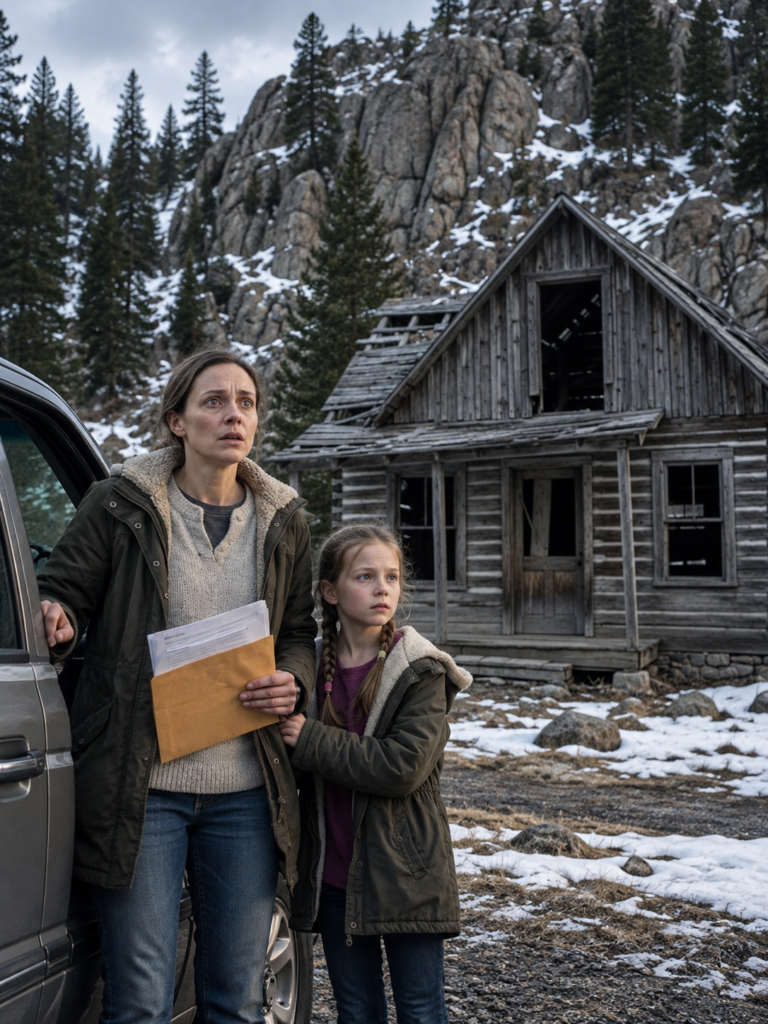
Fifty feet ahead stood a small log cabin.
Its roof sagged. The porch leaned dangerously to one side, and several windows were broken.
The logs had weathered to a dull gray.
Behind the cabin rose a sheer granite cliff, nearly a hundred feet high.
Pine trees surrounded the property so completely that the place seemed separated from the rest of the world.
Lily stared.
“Mom, it looks like a witch’s house.”
Maya almost smiled.
“Not exactly the dream home we imagined.”
“But maybe a good witch lived there.”
Maya looked at the cabin.
“Maybe a very brave woman did.”
They slept in the Honda that night because Maya refused to enter an unfamiliar, deteriorating building after dark.
The temperature dropped below freezing.
Lily curled beneath the coats while Maya remained awake, listening to the wind moving through the trees.
Around midnight, something cracked near the cabin.
Maya sat upright.
The sound could have been a branch falling.
Or old wood breaking.
She shined her flashlight toward the building.
Nothing moved.
Still, she couldn’t shake the feeling that the mountain was watching them.
Morning arrived bright and bitterly cold.
Maya tested the porch boards before allowing Lily to follow.
Several were rotten.
She marked the unsafe spots with pieces of fallen branch and guided her daughter around them.
The front door scraped across the floor when she forced it open.
Inside, the cabin smelled of dust, damp timber, and old ashes.
One room.
A rusted woodstove.
A broken table.
Empty shelves.
A narrow sleeping alcove.
Sunlight entered through holes in the roof, illuminating decades of dust.
Lily wandered carefully through the room.
“Someone really lived here?”
“Yes.”
“Sarah?”
Maya nodded.
“She built it herself.”
Lily touched the rough logs.
“All alone?”
“That’s what Grandma wrote.”
“She must have been strong.”
Maya looked around at the surviving walls.
“Very strong.”
Near the broken table, Maya found initials carved beneath the wood.
SB — 1867.
Her throat tightened.
Sarah Black Feather had stood in this room more than a century and a half earlier.
She had touched these walls.
Endured winters here.
Perhaps cried alone beside that stove.
And now another woman from her family had arrived carrying a child, nearly penniless, searching for somewhere to belong.
“Mom!”
Lily was kneeling beside the sleeping alcove.
“This board moves.”
Maya crossed the room.
One narrow floorboard shifted beneath her hand.
She carefully pulled it loose.
Beneath it sat an old metal box wrapped against moisture.
Inside were photographs and a folded note.
One photograph showed a woman with dark hair standing in front of the cabin.
On the back were the words:
Sarah Black Feather, 1867.
Another showed Sarah decades later.
A third showed a younger Rose standing inside the same room.
Maya smiled through sudden tears.
“There’s Grandma.”
Lily touched the photograph.
“She looks happy.”
“She does.”
The folded note contained a single instruction.
Look beneath where I rested my head. The mountain keeps promises.
Maya turned toward the northeast corner.
There, beneath a layer of dust, was a floorboard slightly different from the others.
She pressed it.
It shifted.
Working slowly, she removed several boards.
Beneath them lay a heavy wooden hatch.
An iron handle protruded from its center.
Beside it was a combination lock.
Maya took out Rose’s letter.
1867.
She entered the numbers.
A sharp click echoed through the cabin.
Lily gripped her arm.
“Mom.”
Maya lifted the hatch.
Cold air rose from below, carrying the unmistakable smell of underground stone.
She shined her flashlight through the opening.
A wooden ladder descended into darkness.
The beam reached several rungs before disappearing.
Lily whispered, “What’s down there?”
Maya looked at the black opening.
“I don’t know.”
“Are we going?”
“Not until we know it’s safe.”
They covered the opening and returned to the Honda.
Maya understood enough about old structures to recognize the danger of descending an ancient ladder into an unknown underground space.
There could be bad air, unstable supports, or water.
She needed someone with experience.
They drove forty minutes to the nearby town of Copperfield.
It had one main street, a diner, a gas station, and a general store that appeared unchanged since the 1950s.
Behind the counter stood an elderly woman with white hair and sharp blue eyes.
“Can I help you?”
“I’m looking for information about an old homestead near Copper Ridge.”
The woman tilted her head.
“Whose property?”
“Rose Chen’s.”
The woman’s expression changed immediately.
“Rose Chen?”
“She was my grandmother.”
The woman came around the counter.
“Well, I’ll be. You’re Maya.”
Maya blinked.
“You knew her?”
“Knew her for forty years. I’m Ruth Campbell.”
Ruth shook her hand warmly.
“Your grandmother came through here every few months.”
“Why?”
Ruth considered the question.
“Usually bought supplies. Lanterns, survey stakes, rock hammers, things like that.”
Maya felt her heartbeat quicken.
“Did she ever tell you what she was doing?”
“No. Rose was a private woman.”
Ruth studied Maya’s exhausted face and Lily’s worn coat.
Then she added, “But I know someone who might help.”
She gave Maya the address of a retired geologist.
Dr. Eleanor Hayes.
Eleanor lived in a blue house surrounded by carefully arranged stones and flowering shrubs.
She was seventy-four years old, tall and thin, with thick glasses and white hair that seemed determined never to remain properly combed.
When Maya introduced herself, Eleanor went perfectly still.
“Rose’s granddaughter?”
“Yes.”
“Come inside.”
The house contained shelves of mineral specimens, geological maps, and boxes of carefully labeled samples.
Eleanor opened a filing cabinet.
From inside she removed a thick folder.
Across its front were two words.
CHEN — CONFIDENTIAL.
“Your grandmother came to me fifteen years ago,” Eleanor said.
“She brought samples from her mountain property. Asked me to examine them privately.”
“What did you find?”
Eleanor placed photographs on the table.
They showed gray rocks threaded with brilliant metallic strands.
“Native silver,” she explained. “An unusually fine wire-silver formation.”
Maya looked confused.
“How valuable?”
Eleanor folded her hands.
“The specimens Rose showed me could be worth several million dollars.”
Maya stopped breathing.
Eleanor continued.
“If the underground deposit is as extensive as her notes suggested, the total potential value could reach twenty or thirty million dollars.”
Maya stared at her.
Thirty million.
For a woman calculating grocery purchases down to the last dollar, the number was almost impossible to understand.
But Eleanor’s face remained serious.
“That isn’t a guaranteed sale price,” she cautioned. “Any estimate depends on the deposit, recovery costs, ownership rights, and what can legally and responsibly be removed.”
Maya nodded slowly.
“Why didn’t Grandma sell it?”
Eleanor looked toward the mountains visible through her window.
“Because she was protecting something more important than silver.”
Before Maya could ask what that meant, her phone rang.
Marcus.
She declined the call.
A moment later, a message appeared.
I know where you are. We need to talk about the property.
Maya felt a chill unrelated to the weather.
Another message followed.
Victoria and I are challenging Grandma’s will.
Then a third.
If you cooperate, we may be able to keep this from getting ugly.
Maya stared at the screen.
Her grandmother’s secret was no longer the only thing waiting for her in Copper Ridge.
Her family was coming to take it.
Part 3
Marcus arrived the following afternoon in a white Tesla.
Victoria followed in her Maserati.
Seeing those expensive vehicles parked beside Maya’s battered Honda was almost comical.
Almost.
Marcus stepped out wearing polished shoes completely unsuited for the muddy mountain road.
Victoria carried a leather folder.
A third man emerged with a camera.
“What’s going on?” Maya demanded.
Marcus glanced toward the cabin.
“We’re documenting the property’s condition.”
“You don’t have permission.”
Victoria gave a cold smile.
“The estate is still being administered, Maya. There are legal questions about this transfer.”
“The attorney said Grandma left it to me.”
“And we believe she may not have been mentally competent when she made that decision.”
Maya stared.
“Grandma knew exactly what she was doing.”
Marcus shrugged.
“Then she made an irrational decision.”
He looked at Lily.
“Living in your car with a child isn’t exactly evidence of excellent judgment either.”
Maya moved closer to her daughter.
“Leave Lily out of this.”
Victoria opened her folder.
“Actually, Lily is precisely why we came.”
She removed several photographs.
Maya recognized them immediately.
Her Honda in the Walmart parking lot.
Lily climbing into the back seat.
Maya carrying laundry into a public facility.
Her stomach turned.
“Where did you get those?”
“An investigator.”
“You’ve been following us?”
Marcus spoke as though explaining an ordinary business decision.
“We needed to understand your circumstances.”
Victoria produced another document.
“David is concerned about Lily’s living conditions.”
Maya’s face went cold.
“You contacted my ex-husband?”
“He has parental rights.”
“He hasn’t helped us in months.”
“That doesn’t change the fact that you’re living in a vehicle.”
Lily stepped behind her mother.
Maya could feel her trembling.
Victoria’s voice softened, although her eyes remained hard.
“We can make this simple.”
She placed a document on the hood of the Honda.
“Transfer the mountain property to us. Marcus will pay you one hundred thousand dollars.”
Maya stared at the paper.
“You want me to sell Grandma’s land?”
“We want to resolve an unnecessary conflict.”
“And if I refuse?”
Marcus stepped forward.
“Then we’ll pursue the will contest. And David may decide to ask the court to reconsider Lily’s living arrangements.”
The mountain wind moved through the trees.
For several seconds Maya couldn’t speak.
They weren’t merely threatening to take the property.
They were using her daughter.
“You would really do that?” she whispered.
Marcus looked away.
Victoria answered.
“We’re giving you an opportunity to make a responsible choice.”
Maya looked at Lily.
The child had gone pale.
Then Maya turned back to her siblings.
“Get off this land.”
Marcus sighed.
“Don’t make this harder than it needs to be.”
“Get off Grandma’s land.”
“It’s yours now,” Victoria corrected.
Maya met her eyes.
“Exactly.”
Eleanor, who had accompanied them from town, stepped forward.
“I’m Dr. Eleanor Hayes. I’ve examined geological material associated with this property.”
Victoria stiffened.
“And your role?”
“I’m advising Maya.”
Marcus studied her.
“Geological material?”
Eleanor’s expression revealed nothing.
“Old Colorado mountains contain many interesting formations.”
Victoria looked toward the cabin.
For the first time, Maya saw genuine curiosity beneath her sister’s professional composure.
But Eleanor offered no further explanation.
Marcus folded his arms.
“Monday morning. Nine o’clock. That’s when the hearing begins.”
He opened his car door.
“I hope you’ve thought about what you’re going to do with Lily when this goes badly.”
The vehicles disappeared down the road.
Maya stood motionless.
Then she turned away and began shaking.
Lily wrapped both arms around her waist.
“Mom, can they take me?”
Maya knelt in the dirt.
“Listen to me, sweetheart. We’re going to get help. We’re going to tell the truth, and we’re going to make sure you stay safe.”
“But Aunt Victoria said—”
“I know what she said.”
Maya held her tightly.
“Being poor doesn’t mean we don’t love each other.”
Eleanor watched quietly.
When Lily finally calmed, she spoke.
“We need an attorney.”
“I can’t afford one.”
“I know someone.”
That evening, Eleanor contacted Samuel Brooks, a local lawyer experienced in property and mineral-rights disputes.
Sam had spent most of his career representing ranchers, families, and small landowners.
He listened to Maya’s account without interrupting.
Then he examined Rose’s will and the messages from Marcus.
“Your siblings can’t simply take the property because they’re unhappy with the inheritance,” he said. “They’ll need evidence that the will is invalid.”
“They say Grandma had dementia.”
“Did she?”
“No.”
“Then we’ll gather the records to prove it.”
He looked at the photographs of Maya’s car.
“And threats concerning your daughter shouldn’t be used as bargaining leverage.”
Maya stared down at her hands.
“I don’t have money to pay you.”
Sam closed the folder.
“We’ll discuss fees later.”
“Why would you help us?”
He glanced at Lily, who had fallen asleep in a chair.
“Because someone should.”
The next morning, Eleanor arranged for an experienced local mine-safety specialist to inspect the hidden entrance.
After checking the air and visible supports, the specialist helped establish a secured descent route. Lily remained aboveground with Ruth while Maya and Eleanor entered the tunnel.
Thirty-five feet below the cabin, Maya’s boots touched solid stone.
She aimed her flashlight ahead.
A narrow passage stretched into darkness.
Timber supports stood at intervals along the walls.
Old tool marks scarred the granite.
Eleanor ran her gloved fingers across one surface.
“This was excavated by hand.”
Maya looked back toward the ladder.
“Sarah did all this?”
“Perhaps not entirely alone. But she certainly knew what she was doing.”
The tunnel opened into a larger chamber.
Three wooden crates stood against one wall.
Maya knelt beside the nearest and carefully lifted its lid.
Inside lay rocks wrapped in aged cloth.
Silver gleamed through their surfaces.
Even Maya could see they were extraordinary.
The second crate contained old mining tools.
The third held a leather journal.
Maya opened it carefully.
The first page read:
Journal of Sarah Black Feather.
March 1867.
She turned the pages.
Sarah described purchasing the property, building the cabin, and enduring ridicule from men who believed a woman had no business claiming land or working stone.
One passage made Maya pause.
They laughed when I carried timber up the mountain.
Let them laugh. When winter comes, I will have a roof, and they will still have their opinions.
Maya smiled through tears.
“She sounds like Grandma.”
Eleanor nodded.
“Or perhaps Grandma sounded like her.”
The journal described Sarah’s discovery of the silver deposit.
At first, she had been exhilarated.
She dreamed of security, food through winter, and freedom from the people who treated her as though she belonged nowhere.
Then, in August 1867, her writing changed.
Sarah described meeting an Ute elder named Running Wolf.
He had shown her sacred chambers deeper in the mountain, places containing ancestral objects and ceremonial materials.
Sarah had been frightened of disturbing them.
Running Wolf had asked her to protect what remained and see that it was eventually returned to his people.
She had promised.
A later entry contained a sentence Maya read aloud.
“Your word is your wealth. Everything else is just metal in the ground.”
The words stayed with her.
Tucked inside the back cover was a hand-drawn map.
Three tunnels extended from the chamber.
East: silver vein.
West: water source.
North: sacred place.
Beneath the drawing was a warning.
Honor the covenant.
Maya stared at it for a long time.
The silver was real.
The fortune was real.
But so was the promise.
When they emerged, Lily rushed into her mother’s arms.
“Did you find treasure?”
Maya looked at the journal.
“Yes.”
“Are we rich?”
Maya hesitated.
She could have said yes.
She could have imagined the houses, the new car, the freedom.
Instead, she answered.
“We found something valuable. But some of it doesn’t belong to us.”
Lily frowned.
“Then we give it back.”
Maya looked down at her daughter.
“What if keeping our promise means we can’t have everything we want?”
Lily was quiet.
Then she said, “Grandma always kept her promises.”
Maya held her close.
That night, they documented the journal, photographs, and mineral samples. Sam secured copies of the relevant evidence, while Eleanor contacted an expert she trusted.
Maya lay awake inside the cold cabin, wrapped in an emergency blanket beside Lily.
The wind pressed against the old walls.
She could still choose one hundred thousand dollars and end the fight.
It would be enough to rent a home and buy Lily a warm bed.
But Marcus and Victoria had made their offer through threats.
And somewhere beneath the floor, Sarah’s journal waited with a promise older than anyone still living.
Maya took Rose’s jade bracelet from her pocket.
She turned it over in her hands.
Then she whispered, “I’m trying, Grandma.”
Outside, snow began falling.
Part 4
By morning, the clearing lay beneath a thin blanket of white.
The mountains had disappeared behind low clouds.
Maya stood on the porch with a cup of instant coffee, looking toward the narrow road.
Every decision now seemed to carry a consequence.
If she surrendered the property, Marcus and Victoria would stop threatening her.
Perhaps.
If she continued fighting, she might lose the little money she had left.
And the hearing was only a day away.
Lily stood inside the cabin, carefully arranging the photographs of Sarah and Rose along the old table.
She had placed her school notebook beside them.
On the first page she had written:
The women in our family.
Maya watched her daughter for a moment.
Then Eleanor arrived with the mine-safety specialist and additional equipment.
They had agreed to investigate the northern passage only after completing another inspection.
The specialist checked the accessible tunnel and marked the sections they could safely traverse.
Maya and Eleanor moved slowly through the underground darkness.
Water dripped from the ceiling.
Their boots disturbed centuries of dust.
After a narrow bend, they reached a stone wall.
At first, it appeared natural.
Then Maya noticed the arrangement of several large rocks.
They had been stacked deliberately.
Beside them, almost concealed by mineral staining, was a carved symbol.
Eleanor raised her flashlight.
“Someone closed this passage intentionally.”
Working under the specialist’s direction, they documented the entrance and removed only loose material that could be moved without damaging the structure.
Beyond it lay a small chamber.
The air was still.
Against the far wall stood several wooden containers, each protected with layers of old cloth.
Nearby were bundles and objects that Maya did not recognize.
She stopped at the threshold.
“These must be what Sarah protected.”
Eleanor nodded.
“Don’t touch anything else.”
They photographed the room from the entrance and withdrew.
There was no need to move objects whose cultural meaning they did not understand.
Back at the surface, Maya opened Sarah’s journal again.
She searched through the final entries until she found several loose pages tucked into the binding.
They described Running Wolf’s trust, Sarah’s fear of outsiders stealing what she had been shown, and her intention to return the materials when a safe arrangement became possible.
One sentence stood out.
I was given a place in this mountain when the world refused me a place among its people.
Maya read it twice.
Sarah had not merely protected valuable objects.
She had been trusted.
And that trust had given meaning to a life shaped by rejection.
Eleanor called Joseph White Eagle, a cultural preservation director working with the Ute Mountain Ute Tribe.
When Joseph heard Rose’s name, he fell silent.
Then he asked Maya to describe what she had found.
She explained the journal, the hidden passage, and the chamber.
Joseph listened carefully.
“Your grandmother contacted us years ago,” he said.
Maya’s breath caught.
“She did?”
“Yes. She was working toward an agreement concerning ancestral materials associated with her property.”
“Why didn’t she finish it?”
“She wanted to make certain the next owner understood the responsibility.”
Maya stared at Rose’s letter.
Joseph continued.
“If the items are what we believe they are, they need to be assessed and cared for by people authorized by the tribe.”
“I understand.”
“We can meet today.”
Maya looked toward Lily.
Then she made her decision.
“We’ll come.”
The journey to tribal headquarters took several hours through mountain roads still covered with patches of snow.
Eleanor accompanied them.
Sam remained in contact, preparing for Monday’s hearing.
Joseph met them in a quiet office decorated with photographs, historical documents, and artwork.
Two elders joined the meeting.
Maya placed photographs and copies of Sarah’s journal on the table.
No one spoke for several minutes.
One elder examined an image carefully.
His hands trembled.
Joseph translated his words.
“His family has preserved stories about a ceremonial place in the mountains. The location was lost generations ago.”
Maya felt tears rising.
“Do you think this is it?”
“We’ll need proper identification and consultation,” Joseph said. “But there are details here that deserve serious attention.”
He examined Sarah’s writing.
“Your ancestor made an extraordinary commitment.”
Maya looked down.
“She said keeping your word matters more than money.”
Joseph smiled faintly.
“That’s something people still need to learn.”
He retrieved a folder.
“Rose and our representatives had discussed a framework. The ancestral materials and sacred area would be placed under tribal stewardship, while ownership of other portions of the land and any permissible mineral interests would be addressed separately.”
Maya studied the documents.
“She never told me.”
“Perhaps she wanted you to understand the reason before signing anything.”
Joseph leaned forward.
“There’s something you should know, Maya. Returning cultural heritage isn’t a business transaction. It isn’t simply a question of paying someone a percentage.”
“I understand.”
“The people connected to this history must have a meaningful say in how it is protected.”
Maya nodded.
“Then that’s what we’ll do.”
She thought of Marcus laughing across the polished conference table.
She thought of Victoria calling the cabin worthless.
Neither had asked why Rose loved the mountain.
Neither had cared who lived there before them.
Maya looked at Joseph.
“I don’t want to take something that was never mine to take.”
For the first time since the funeral, she felt certain of a decision.
Not because she knew it would make her wealthy.
Because she knew she could live with it.
That afternoon, they began organizing the information needed for a formal assessment and preservation agreement.
Joseph agreed to attend the hearing and explain the historical work Rose had undertaken.
The tribal representatives would also seek appropriate measures to protect the cultural materials from disturbance while their status was evaluated.
Sam received the new documentation that evening.
The case had changed.
But the danger had not disappeared.
Marcus and Victoria were represented by an aggressive attorney named Richard Richter.
Their petition claimed Rose had suffered cognitive impairment and that Maya had improperly influenced her.
They also questioned Maya’s capacity to maintain the mountain property.
Sam explained that Rose’s medical records strongly contradicted the first claim.
“Your grandmother underwent competency evaluations,” he said. “And Patterson documented her intentions carefully.”
Maya looked relieved.
“Will that be enough?”
“It gives us a strong defense. But I won’t promise what a judge will decide.”
He hesitated.
“There’s also something Patterson found in his records.”
“What?”
“A video Rose made shortly before her death.”
Maya sat completely still.
“A video?”
“She specifically requested that it be retained if anyone challenged the will.”
Maya could barely speak.
“What does she say?”
Sam closed the folder.
“I think you should hear it in court.”
That night, Maya returned to the mountain with Lily.
They slept in the Honda rather than the damaged cabin.
The wind had intensified, and snow gathered around the tires.
Lily lay under the coats.
“Mom?”
“Yes?”
“Are we going to lose?”
Maya stared through the windshield.
“I don’t know, baby.”
Lily was quiet.
Then she asked, “If we lose the mountain, will Grandma be disappointed?”
Maya turned.
“No. I think she’d be disappointed if we stopped trying to do what’s right.”
Lily thought about that.
“Then we’re doing okay.”
Maya smiled.
“Yes, sweetheart. We are.”
After Lily fell asleep, Maya examined the five-dollar bill Patterson had given her from Rose’s estate.
It was ordinary, worn, and slightly creased.
The smallest inheritance in the family.
Yet it had led her to a woman who built a cabin alone, an old promise, people willing to help, and a secret hidden beneath a mountain.
Maya tucked the bill into Rose’s letter.
She had no idea what would happen the following morning.
She only knew she would walk into that courtroom with her head raised.
Part 5
Monday morning arrived cold and gray.
Maya stood outside the county courthouse wearing the same black dress she had worn to Rose’s will reading.
The hem was slightly frayed.
Her shoes were old.
Her hands were shaking.
But Lily stood beside her, holding the jade bracelet.
Eleanor and Ruth had come.
Joseph White Eagle and two tribal elders had traveled to attend.
Samuel Brooks waited near the courtroom doors with a carefully organized case file.
Marcus arrived wearing another expensive suit.
Victoria followed, carrying her leather briefcase.
When she noticed Joseph and the elders, she frowned.
“Who are they?”
Maya looked at her.
“People who knew Grandma’s wishes better than you did.”
Victoria’s expression hardened.
“We’ll see about that.”
Inside, Judge Morrison called the hearing to order.
Richard Richter presented the siblings’ argument first.
Rose Chen, he claimed, had made an irrational and disproportionate distribution of her estate.
Her decision suggested confusion, diminished judgment, or improper influence.
He pointed to Maya’s homelessness.
He questioned her ability to maintain the property.
He described Marcus and Victoria as established, responsible professionals.
Then Sam Brooks stood.
“Your Honor, the evidence will show that Rose Chen understood her estate, knew precisely what she owned, and made a deliberate decision about who should receive the mountain property.”
He placed a document before the judge.
“The medical evidence also shows no diagnosed cognitive condition preventing her from executing a valid will.”
Victoria testified.
She described her grandmother repeating stories and occasionally forgetting appointments.
Sam approached calmly.
“How often did you visit Rose during her final two years?”
Victoria hesitated.
“Several times.”
“More than ten?”
“No.”
“More than five?”
“Approximately five or six.”
“And did any physician diagnose her with dementia?”
“Not formally.”
Sam allowed the answer to settle.
Then he introduced the medical records.
Rose’s examinations showed that she had been alert, oriented, and capable of understanding her decisions.
Frederick Patterson testified next.
He explained the execution of the will and Rose’s repeated instructions.
She had understood the value of her property.
She had anticipated that her grandchildren might disagree.
And she had been adamant about leaving the mountain homestead to Maya.
Marcus took the stand.
He spoke about Maya’s financial difficulties.
“She was living in her car with a child,” he said. “I didn’t think she was capable of handling a property with substantial responsibilities.”
Sam approached.
“When did you first learn your sister was homeless?”
“Several months ago.”
“What assistance did you offer?”
Marcus shifted.
“I gave her advice.”
“Did you provide temporary housing?”
“No.”
“Financial help?”
“No.”
“Did she ask?”
Marcus looked uncomfortable.
“She asked for money.”
“And you refused?”
“Yes.”
Sam nodded.
“So you knew your sister and niece were living in difficult circumstances, declined to assist them, and now cite those same circumstances as a reason she shouldn’t receive her grandmother’s property?”
Marcus stared at the table.
“I thought she needed to make better decisions.”
Maya closed her eyes.
For months, she had wondered whether she was the failure everyone believed her to be.
Hearing Marcus explain his choices aloud finally made something clear.
He had mistaken hardship for weakness.
Then Eleanor testified.
She described Rose’s geological work, the mineral samples, and the careful planning that had continued for years.
Joseph explained the cultural significance of the discovered chamber and Rose’s longstanding efforts to establish an appropriate stewardship arrangement.
The documentation showed sustained planning, not confusion.
Finally, Sam stood.
“Your Honor, there is one additional piece of evidence.”
A monitor was placed before the courtroom.
The lights dimmed.
Rose Chen appeared on the screen.
Maya covered her mouth.
Her grandmother wore a blue sweater and sat upright at a conference table.
Her white hair was neatly pinned.
Her eyes were bright.
When she spoke, her voice was steady.
“My name is Rose Elizabeth Chen. I’m making this statement because I expect my will may be challenged.”
Maya began crying.
Rose continued.
“I love all three of my grandchildren. Marcus has achieved success in business. Victoria has worked hard to establish her legal career. I’m proud of those accomplishments.”
She paused.
“But money and professional achievement have never been the only measures of character.”
Marcus lowered his eyes.
“Many years ago, I inherited the responsibility to protect something important. It began with our ancestor Sarah Black Feather and a promise she made to people who trusted her.”
Rose leaned toward the camera.
“The mountain property contains a history that must be treated with care. I have spent years preparing for its future.”
Her voice softened.
“I chose Maya because she understands what it means to go without something and still refuse to take what belongs to another.”
Maya’s shoulders shook.
“I know her life has been difficult. I know she has struggled. But I’ve watched her raise her daughter with kindness while facing disappointments that might have made other people bitter.”
Rose smiled.
“That matters to me.”
Then she looked directly into the camera.
“Marcus and Victoria, if you’re watching this, please understand that I didn’t make this decision to punish you.”
Her eyes filled with emotion.
“I made it because Maya is the person I trust to finish the work.”
She paused.
“Maya, sweetheart, you have never disappointed me.”
Maya pressed her hands against her face.
“I know you worry that you haven’t accomplished enough. But I have watched you protect your little girl through circumstances nobody should have to endure.”
Rose smiled again.
“Don’t ever mistake an empty bank account for an empty life.”
Then came her final words.
“Stand firm, Maya. Do what’s right. And remember that you were loved long before anyone knew what that mountain was worth.”
The screen went dark.
The courtroom remained silent.
Judge Morrison reviewed the evidence and the applicable legal arguments.
When she finally spoke, her voice was measured.
“The plaintiffs have not established that Rose Chen lacked testamentary capacity or that the will resulted from undue influence.”
She looked toward Marcus and Victoria.
“The evidence demonstrates a consistent, deliberate estate plan supported by medical assessments, legal documentation, and extensive preparation.”
The judge denied the challenge.
Rose’s will would stand.
Maya remained the beneficiary of the mountain property.
The cultural preservation issues would proceed through the appropriate legal and administrative processes.
For a moment, Maya couldn’t move.
Lily tugged her sleeve.
“Mom?”
Maya looked down.
“We won?”
Maya nodded.
“Yes, baby.”
Lily threw her arms around her.
Maya held her daughter while tears ran down her face.
For seven months, she had tried not to cry in front of Lily.
Now she didn’t care.
They had survived.
Outside the courthouse, Eleanor embraced her.
Ruth kissed Lily’s forehead.
Joseph shook Maya’s hand and thanked her for choosing cooperation rather than secrecy.
Sam reminded her that the court victory was only one part of the work ahead.
The mine still required careful evaluation.
The cultural materials needed professional protection.
And the land carried responsibilities that would not disappear simply because a judge had recognized Rose’s intentions.
Maya understood.
For the first time, those responsibilities didn’t frighten her.
Marcus approached as the others gathered near the steps.
He looked strangely uncertain.
“Maya.”
She turned.
He struggled to find words.
“Grandma knew what we were going to do.”
Maya said nothing.
Marcus stared toward the street.
“She knew we’d challenge the will.”
“Yes.”
He swallowed.
“I thought she was treating me unfairly.”
Maya watched him.
“And now?”
His voice dropped.
“I think she was trying to tell me something I didn’t want to hear.”
Maya felt no triumph.
She had spent too many nights wishing her brother would call, too many afternoons pretending his silence didn’t hurt.
“You could have helped us,” she said quietly.
Marcus looked down.
“I know.”
“Lily needed a bed, Marcus. Not a lecture.”
His face tightened.
“I know.”
Maya waited.
Finally, he whispered, “I’m sorry.”
She studied him for a long moment.
An apology couldn’t erase seven months.
It couldn’t undo the threats concerning Lily.
But it could mark the beginning of something different.
“You can start by showing up,” she said.
Marcus nodded.
“I’d like to try.”
Maya didn’t promise forgiveness.
She simply allowed him the opportunity to prove he meant it.
The weeks that followed brought more changes than Maya could have imagined.
With the legal dispute resolved, Eleanor contacted a reputable mineral specimen dealer named Daniel Wright.
He examined the documented collection of exceptionally preserved wire-silver specimens that could be evaluated separately from the protected cultural area.
His appraisal stunned Maya.
The collection could command approximately $4.5 million.
A purchase agreement followed after further examination, ownership verification, and legal review.
Maya sat at a desk as the financial documents were placed before her.
For years, she had signed papers describing debts she couldn’t pay.
Now she was signing documents that would allow her to build a secure future.
She directed a significant portion of the proceeds toward cultural preservation in coordination with the tribal representatives.
She established a trust for Lily.
She placed much of the remaining money into conservative investments after obtaining professional financial advice.
And then, on a Tuesday afternoon, she did something she had dreamed about for seven months.
She bought a home.
Not a mansion.
Not a luxury estate.
A comfortable three-bedroom house with a small garden, a bright kitchen, and a bedroom facing the morning sun.
Lily walked through the front door carrying a cardboard box of books.
“Mom?”
“Yes?”
“Which room is mine?”
Maya pointed toward the hallway.
“The one with the big window.”
Lily ran ahead.
Seconds later, Maya heard a delighted scream.
“There’s a closet!”
Maya laughed.
“Most bedrooms have closets, sweetheart.”
“And a desk!”
“Yes.”
“And my own bathroom?”
Maya leaned against the doorway.
“Yes, baby.”
Lily turned.
Then her face grew serious.
“Do we have to leave?”
Maya stopped smiling.
“No.”
“Not tomorrow?”
“No.”
“Not next week?”
Maya knelt.
“This is our home, Lily.”
The little girl stared at her.
“Forever?”
Maya pulled her close.
“For as long as we want it to be.”
Lily began crying.
Not loudly.
She simply buried her face against her mother’s shoulder and wept.
Maya held her on the empty bedroom floor while sunlight filled the room.
That evening, they ate pizza out of a cardboard box.
There were no chairs yet.
No curtains.
No pictures on the walls.
But there was warmth.
There was running water.
And there was a front door Maya could lock knowing she had the key.
She slept in a real bed for the first time in months.
The following Monday, she returned to Henderson High School.
Her principal looked surprised.
“I heard you inherited some valuable property.”
Maya nodded.
“You know you don’t have to keep teaching.”
She smiled.
“I know.”
“Then why are you here?”
Maya thought of Sarah Black Feather.
Of Rose.
Of the students who had quietly struggled through difficult lives while learning to draw shadows and light.
“Because some of these kids need someone who believes they can make something beautiful,” she said.
Her principal smiled.
“Welcome back.”
Six months later, the old mountain homestead looked very different.
Its damaged roof had been repaired.
The porch had been rebuilt using carefully matched timber.
The original logs remained, their weathered surfaces protected rather than replaced.
The dangerous mine entrance had been secured.
The culturally significant chamber was placed under an agreed protection and access framework involving the tribe.
Maya chose not to develop the main silver deposit.
It remained underground, beyond the reach of the mining operations that would have disturbed the mountain and its history.
The decision surprised several financial advisers.
But Maya no longer needed another fortune.
She needed to keep her grandmother’s promise.
On a September afternoon, seventy-five people gathered outside the restored cabin.
Golden aspen leaves trembled among the pines.
The sky was clear and blue.
Joseph White Eagle stood beside several tribal representatives and elders.
Eleanor and Ruth had come.
So had Sam Brooks and local historians.
And near the back of the gathering stood Marcus.
He looked uncomfortable in a simple sweater and jeans.
When Lily spotted him, she ran across the clearing.
“Uncle Marcus!”
He bent to hug her.
“Hey, kiddo.”
“You’re supposed to stand with family.”
Marcus looked toward Maya.
She nodded.
He followed Lily toward the front.
A bronze plaque had been mounted beside the cabin.
It honored Sarah Black Feather, who built the homestead and protected a promise; Rose Chen, who preserved that history; and the people working together to safeguard it for future generations.
Joseph spoke about stewardship, trust, and the importance of returning authority over ancestral heritage to the communities connected to it.
Then Maya stepped forward.
Her hands trembled slightly.
She looked at the cabin.
“When I first came here, I had twenty-three dollars in my wallet and a daughter who hadn’t slept in a real bed for seven months.”
The crowd grew silent.
“My brother and sister thought this place was worthless.”
Marcus lowered his head.
“To be fair, I thought so, too.”
A few people smiled.
Maya continued.
“I came here hoping my grandmother had left enough money for an apartment. I didn’t expect to find a story that began more than a century ago.”
She looked toward Sarah’s photograph displayed near the plaque.
“Sarah built this place when the world gave her very little. She found something valuable, but she also accepted a responsibility.”
Maya paused.
“Grandma Rose spent years keeping that responsibility alive. And when she could no longer carry it, she trusted me.”
Her voice caught.
“I used to think my greatest failure was that I couldn’t give my daughter a proper home.”
She glanced at Lily.
“But my grandmother saw something else. She saw that even when we had almost nothing, we still had the ability to choose how we treated other people.”
Maya wiped her eyes.
“That’s what I want my daughter to remember.”
Lily unexpectedly stepped forward.
“Can I say something?”
Maya smiled.
“Of course.”
Lily faced the small gathering.
“My mom used to tell me that being homeless was temporary.”
She looked at Maya.
“Sometimes I didn’t believe her.”
A few people lowered their eyes.
“But she never stopped trying. Even when she was tired and scared, she always made sure I had something to eat and got to school.”
Lily reached for her mother’s hand.
“And Grandma Rose knew she would keep trying.”
Her voice became stronger.
“I want to be like them when I grow up.”
Maya bent to hug her.
The applause began softly and grew.
Later, after the gathering ended, Maya stood on the restored porch with Lily.
The late sun painted the mountains gold.
For a moment, neither spoke.
Then Lily asked, “Mom, is the silver still down there?”
“Most of it.”
“All thirty million dollars?”
“That’s an estimate, sweetheart. But yes, there’s still a very valuable deposit beneath the mountain.”
Lily looked thoughtful.
“Do you ever wish we’d taken it?”
Maya considered the question.
“Sometimes I wonder what we could have done with more money.”
“Like what?”
“Helped more people. Built more things. Made sure nobody we knew ever had to sleep in a car.”
Lily leaned against her.
“But we already helped people.”
Maya nodded.
“Yes.”
“And we have a home.”
“Yes.”
“And you still teach your students.”
“Yes.”
Lily smiled.
“Then I think we have enough.”
Maya looked at her daughter.
Nine years old.
Still learning what the world could be.
Still believing goodness mattered.
She thought of the parking lots and freezing mornings.
Of the embarrassment of washing in public bathrooms.
Of Marcus’s laughter and Victoria’s threats.
Of the moment she had opened the trapdoor and shined a flashlight into darkness.
And of the unexpected people who had stepped forward when her own family turned away.
Ruth.
Eleanor.
Sam.
Joseph.
People who owed her nothing and had helped anyway.
The property had given Maya money, but those people had helped give her something no bank could hold.
A sense that she belonged.
Behind them, the cabin door opened.
Marcus stepped onto the porch.
“I helped Ruth pack everything away,” he said.
Maya smiled faintly.
“Thank you.”
He shifted his weight.
“I’ve been thinking about Lily’s birthday.”
“It’s October fifteenth.”
“I know.”
He hesitated.
“I’d like to come. No expensive presents. Maybe just dinner.”
Maya studied him.
For once, her brother wasn’t trying to negotiate or impress anyone.
He simply looked uncertain.
“She’d like that,” Maya said.
Marcus nodded.
“I’ll be there.”
“Then we’ll save you a chair.”
He looked toward the mountains.
“Grandma really loved this place.”
“She did.”
“I wish I’d listened when she tried to tell me about it.”
Maya touched the old wooden railing.
“You can still listen now.”
Marcus stood quietly beside them for another minute before heading down to his car.
Maya watched him leave.
She didn’t know whether her brother would truly change.
She didn’t know whether Victoria would ever acknowledge the harm she had caused.
But she had learned that rebuilding a family, like rebuilding a cabin, required more than promises.
It required someone to show up and do the work.
The last visitors departed.
The clearing fell silent.
Lily leaned against her mother’s side.
“Tell me about Sarah again.”
Maya smiled.
“You’ve heard that story a hundred times.”
“I know. Tell me anyway.”
Maya pulled her daughter closer.
“Sarah came to this mountain when she had almost nothing. People told her she didn’t belong. They laughed when she bought the land.”
“Like Uncle Marcus?”
“A little.”
“But she stayed?”
“She stayed. She carried timber, built walls, prepared for winter, and made herself a home.”
“And found silver.”
“Yes.”
“And kept her promise.”
Maya kissed Lily’s forehead.
“That’s the most important part.”
The girl rested her head against her shoulder.
“Grandma kept it, too.”
“She did.”
“And now we did.”
Maya looked toward the mountain rising above them.
“Yes, sweetheart. We did.”
From her jacket pocket, she removed the old gold watch Rose had left her.
The inscription remained visible beneath the fading light.
To Sarah, time reveals all truths. 1867.
The watch still ticked.
Maya held it against her palm.
Five generations had passed through hardship, loss, poverty, and change.
The mountain had seen women arrive with little more than courage.
It had watched them build, protect, grieve, and begin again.
And somewhere beneath the old floorboards, millions of dollars in silver remained locked in stone.
Once, Maya would have believed that fortune was the greatest gift her grandmother could possibly leave.
Now she understood.
The fortune had given her security.
The promise had given her direction.
And Lily, standing beside her on the porch of the cabin they had restored, had given her a reason to keep going when she thought she had nothing left.
The little girl yawned.
“Ready to go home, Mom?”
Maya looked one last time at the mountains.
Then she turned toward the waiting car.
“Yes, baby.”
She slipped the watch back into her pocket.
“Let’s go home.”
And for the first time in a very long time, those three simple words brought no fear, no uncertainty, and no need to pretend.
They had a home to return to.
They had people who cared whether they arrived.
And they had kept a promise that money could never have bought.
Sarah Black Feather had written it more than a century and a half earlier.
Your word is your wealth.
Everything else is just metal in the ground.
Maya finally understood.

