
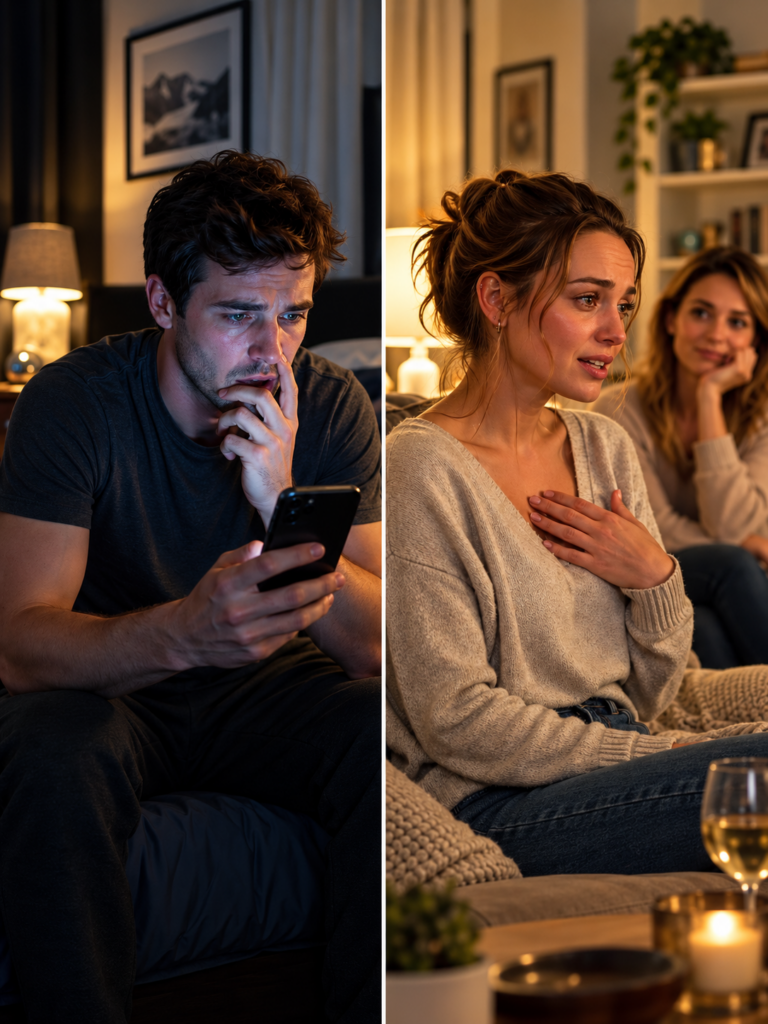
The call should have ended at 11:42.
I know because I looked at the screen later and kept staring at that number like it had personally betrayed me.
11:42 p.m.
That was when Hannah said, “Okay, go sleep. You sound like you’re about to start giving advice to your ceiling again.”
And I said, “My ceiling has made several good points.”
And she laughed.
That should have been the end.
It wasn’t.
My name is Caleb Brooks. I’m thirty-three, and Hannah Miller had been my best friend for almost nine years.
We met at a friend’s birthday dinner when she corrected my pronunciation of gnocchi in front of six people and then stole the last piece of garlic bread like she’d earned it.
I should have found her rude.
Instead, I asked her if public humiliation was one of her hobbies.
She said, “Only when the bread is worth it.”
That was Hannah, bright, sharp, kind in ways she tried to hide under sarcasm, the kind of woman who could make a normal Tuesday feel like something had happened.
She worked as a pediatric speech therapist.
I worked in commercial insurance, which meant she spent years telling people I sold panic with spreadsheets.
She wasn’t wrong.
We became close slowly, then all at once.
Coffee after work, grocery runs, bad movie nights, airport pickups, emergency furniture assembly, the kind of friendship where the person becomes so built into your life that you stop noticing how often your day bends toward them.
Other people noticed for us.
My mother once watched Hannah walk into my kitchen, open my fridge without asking, throw away expired mustard, and say, “You live like a divorced raccoon.”
Then she looked at me and said, “Are we still pretending this is platonic?”
Hannah laughed.
I changed the subject.
That was our specialty.
Laugh, dodge, move on.
And for a long time, that worked.
Mostly because neither of us was brave enough to ask what would happen if it stopped working.
The night of the call started normally.
Hannah had gone to her cousin’s engagement dinner.
I had stayed home because I had a client presentation early the next morning and because her cousin’s fiancé once described himself as a networking-based introvert, which sounded like a legal threat.
At 10:30, she called me from her car.
“I survived,” she said.
“Congratulations. How many people asked when you were getting engaged?”
“Four. One aunt used the phrase ‘still so pretty,’ which I believe qualifies as emotional vandalism.”
I laughed and put her on speaker while I finished folding laundry.
She drove home while giving me the full report.
Bad speeches, excellent cake, one bridesmaid crying in the bathroom because the florist didn’t understand soft coral.
It was all ordinary, familiar, safe.
Then, near the end, her voice changed.
Not much, but I knew her.
“What?” I asked.
“Nothing.”
“Hannah.”
She sighed.
“My cousin’s fiancé asked if I was bringing you to the wedding.”
I froze with a T-shirt half folded in my hands.
“Me?”
“Yes, you. Apparently, everyone already assumes.”
I tried to laugh.
It came out thinner than I wanted.
“Well, everyone has always been dramatic.”
“Yeah,” she said.
Just that.
Yeah, no joke after it.
That should have told me something, but I was tired and careful and very good at not walking through doors I couldn’t close behind me.
So I said, “You can tell them I’m busy being emotionally unavailable in a professional capacity.”
That got a small laugh from her.
Too small.
A few minutes later, she was inside her apartment.
I heard keys hit a bowl, then her roommate Olivia call from somewhere in the background.
“Did you bring cake?”
Hannah said away from the phone, “No, because I love boundaries.”
Then back to me.
“I should go. Olivia’s about to interrogate me.”
“Tell her I said good luck.”
“She doesn’t need luck. She has no shame.”
“Terrifying woman.”
“You adore her.”
“I respect the enemy.”
Hannah laughed again, softer this time.
“Good night, Caleb.”
“Night, Han.”
Then silence.
I thought she hung up.
I set the phone on my nightstand, screen down, and went to brush my teeth.
Except the call hadn’t ended.
The phone must have stayed connected.
Bad signal, frozen screen, whatever tiny modern failure decides to change your life without asking permission.
Because when I walked back into my bedroom, I heard Olivia’s voice coming from the speaker, clear, too clear.
“So?” Olivia asked. “Did you tell him?”
My hand stopped halfway to the phone.
Hannah made a sound I couldn’t read.
“No.”
“Why not?”
“Because he made a joke.”
“That man uses jokes like a panic room.”
I should have picked up the phone then.
I should have ended the call immediately.
I know that.
But hearing your own name from another room in a conversation you were never supposed to be part of does something strange to your body.
It freezes the decent part of you half a second too late.
Hannah said quietly, “I can’t do it if he keeps making it easy to pretend.”
Olivia’s voice softened.
“Hannah.”
“No, I mean it.”
A pause.
Then Hannah laughed once, but it sounded wrong.
“Everyone at dinner kept asking about him, and I just sat there thinking, if they all see it, how does he not?”
My chest tightened.
Olivia asked, “And what do you want him to see?”
The room went completely still around me.
Then Hannah said the sentence I was never supposed to hear.
“I want him to see that every time I imagine my life working out, he’s already in it.”
I forgot how to breathe.
My phone lay face down on the nightstand, still connected, still glowing faintly against the wood.
And for the first time in nine years, the safest person in my life had become the most dangerous truth in the room.
I ended the call.
Not after another sentence.
Not after Olivia answered.
Not after giving curiosity enough room to become something uglier.
I heard the line, felt it land in the center of my chest, and then grabbed the phone like it was burning me.
The call screen was still open.
Forty-three minutes and counting.
My thumb hovered for one second.
Then I hit end.
The silence afterward was worse.
Because now there was no voice coming from the speaker, no accidental window into Hannah’s apartment, no way to pretend I hadn’t crossed a line simply by standing there too long.
I sat on the edge of my bed with the phone in my hand, staring at nothing.
Every time I imagined my life working out, he’s already in it.
There are sentences that don’t just surprise you; they rearrange the furniture inside your head.
For nine years, I had filed Hannah under safe things, necessary things.
The person I could call from a grocery store because I forgot which cough medicine didn’t make me useless.
The person who once showed up with soup when I had the flu and reorganized my medicine cabinet while insulting my life choices.
Best friend.
Simple word, very useful hiding place.
My first instinct was to text her immediately.
My second was to throw my phone into the laundry basket and become unreachable as a man and as a citizen.
Neither seemed mature.
So I opened a message and typed:
“Your call didn’t disconnect. I heard something I don’t think I was supposed to hear. I ended it as soon as I realized. We should talk tomorrow.”
I stared at it for a full minute.
Then I sent it before courage could expire.
The typing dots appeared almost immediately.
Then disappeared.
Then appeared again.
Then nothing.
Ten minutes passed, twenty.
At 12:23, my phone buzzed.
Hannah: How much did you hear?
I answered honestly.
“Enough. Not everything. Just enough that I don’t want to pretend tomorrow is normal.”
This time she didn’t respond.
I didn’t sleep much.
By morning, my client presentation felt like something happening to a different man.
I got through it on muscle memory and caffeine.
I said “risk exposure” six times, apparently in the right places.
My boss told me I looked focused, which was corporate for haunted but useful.
At 11:15, Hannah texted.
“Are you free?”
I was already standing.
“Yes.”
“Park near your office?”
“Ten minutes.”
She was there before me.
That should have told me how little sleep she’d gotten, too.
Hannah sat on a bench under a sycamore tree wearing jeans, a cream sweater, and sunglasses even though the morning was cloudy.
Her hair was pulled back messily, which for Hannah meant either illness, stress, or an emergency involving feelings she had not approved.
I stopped a few feet away.
She looked up.
For one second, neither of us smiled.
That scared me more than the sentence I’d overheard.
Because Hannah and I smiled automatically.
Even in bad moments, especially in bad moments.
Humor was the bridge we threw down before anything could get too serious.
This time neither of us built it.
I sat beside her, leaving a careful amount of space.
She looked straight ahead.
“This is mortifying.”
“I know.”
Her head turned toward me.
“That was not the comforting answer.”
“I’m trying not to lie to you today.”
That made her mouth twitch, but not quite into a smile.
Then she took off the sunglasses.
Her eyes were tired and a little red.
“How much did you really hear?” she asked.
“Olivia asked if you told me. You said no. She said I use jokes like a panic room.”
“She’s not wrong.”
“No.”
Hannah let out a breath, half laugh, half pain.
“And then?” she asked.
I looked down at my hands.
“You said everyone at dinner kept asking about me. That if they all see it, how do I not?”
Her eyes closed.
“And?”
I swallowed once.
“That every time you imagine your life working out, I’m already in it.”
The words sounded different out loud.
More real.
More dangerous.
Hannah pressed one hand to her mouth and looked away.
I didn’t touch her.
Not yet.
The old version of me would have made a joke.
Something about being honored to appear in her hypothetical retirement plan.
Something easy.
Something that would let both of us step backward.
But I heard Olivia’s voice again.
“That man uses jokes like a panic room.”
So I stayed quiet.
Eventually, Hannah said, “I didn’t want you to find out like that.”
“I know.”
“I didn’t even mean to say it that clearly.”
“I know that, too.”
She looked at me then, sharper.
“Do you?”
“Yes.”
“How?”
“Because if you’d meant for me to hear it, you wouldn’t have said it in the one place where I couldn’t interrupt with something stupid.”
That got her a real laugh, tiny and broken.
Then her face softened into something I had almost never seen on her.
Fear.
“Caleb,” she said quietly. “I don’t want to lose you because of one sentence I said when I thought I was safe.”
That hit harder than anything.
Because there it was.
Not just love, risk.
The actual cost of changing the name of something that had kept both of us steady for years.
“You won’t lose me,” I said.
She searched my face like she needed to believe that and didn’t trust herself to.
“You can’t promise that.”
“I can promise I’m not leaving this bench just because the conversation got honest.”
Her eyes brightened.
She looked away fast.
For a while, we sat there with the city moving around us.
People with coffee, a dog pulling someone toward pigeons, traffic.
The normal world being wildly disrespectful to the fact that mine had shifted overnight.
Then Hannah said, “There was another part.”
My pulse kicked.
“I didn’t hear it.”
“I know.”
She looked down at her hands.
“After I said that, Olivia asked what I wanted to do about the wedding.”
“Your cousin’s wedding?”
She nodded.
“And what did you say?”
Her fingers twisted together.
“I said I wanted to ask you to come with me,” she whispered. “Not because people expect it. Not because I need a shield from relatives. Because I wanted one night where I could stop pretending you’re just the person I call afterward.”
The air left my lungs quietly.
Hannah looked up at me.
No sunglasses now, no joke, no escape route.
“So I guess,” she said, voice shaking just enough to matter, “this is me asking.”
I held her gaze, knowing my answer would decide more than one wedding invitation.
Then I asked the question neither of us could dodge anymore.
“As your best friend, Hannah, or as the man already in the life you keep imagining?”
Hannah looked at me for a long second.
Then she said, “That is an unfairly precise question.”
“You started this with life-working-out imagery. I’m just trying to keep up.”
That almost got a smile.
Almost.
Then she looked down at her hands again.
“I wanted to ask you as both.”
There it was.
Simple, terrifying, much harder to hide from than anything I’d overheard.
“As my best friend,” she said, “because I want you there when things matter. And as the man…”
She stopped, swallowed once, then made herself finish.
“As the man I’m tired of pretending I don’t want beside me in every way that counts.”
The park seemed to go quieter around us.
I had spent nine years imagining all the wrong versions of this conversation.
A dramatic confession, a drunken mistake, a jealous moment, some terrible scene where I said too much and she didn’t know how to answer.
I had not imagined a cloudy Tuesday morning on a bench near my office with Hannah looking at me like she was scared and brave at the same time.
“I’ll go,” I said.
Her eyes lifted fast.
“But not as camouflage,” I added. “Not as the guy you bring so your family stops asking questions. Not as a joke we can step back from if it gets too real.”
Her face softened.
“Then how?” she asked.
I looked at her and chose not to hide behind anything clever.
“As me,” I said. “The man who heard something he wasn’t supposed to hear and realized the scariest part wasn’t that you said it.”
Her voice dropped.
“What was the scariest part?”
“That I wanted it to be true.”
Hannah went completely still.
I saw the sentence reach her before she trusted it.
“You did?”
“Yes.”
“For how long?”
That was the harder question.
I leaned back against the bench and let out one quiet breath.
“Long enough that I built a whole personality around not noticing.”
That got her.
A real laugh this time, small and shaky, but real.
“There he is,” she whispered.
“No,” I said gently. “That’s the point. I don’t want to be only that guy anymore.”
The smile faded from her face, but in a good way.
A careful way.
Like something inside her had finally stopped bracing for the joke and started listening for the truth.
“I don’t want us to rush because the call didn’t end,” I said. “That feels like giving a glitch too much power.”
“Fair.”
“But I also don’t want to spend another year pretending that everyone around us is delusional and we’re the only two reasonable people alive.”
“That was one of our weaker lies.”
“One of many.”
She looked down, smiling faintly now.
Then she reached across the space between us and touched my hand.
Not grabbing it.
Not making it dramatic.
Just her fingers resting against mine on the bench.
Asking a question without making me say yes in public.
I turned my hand over.
She laced her fingers through mine.
And just like that, nine years of almost turned into something with weight.
Not a relationship yet.
Not officially.
But not nothing.
Never nothing again.
The wedding was that Saturday.
I picked Hannah up at five.
I had seen her dressed up dozens of times over the years.
But that night did something unfair to my ability to function like a normal adult.
She wore a soft blue dress, simple earrings, and her hair pinned loosely in a way that made her look elegant without trying too hard.
When she opened the door, I forgot my first line.
She noticed immediately.
“Oh, that’s a promising face,” she said.
“I had words prepared.”
“And?”
“They left.”
Her smile turned warm enough to make the hallway feel smaller.
“Good,” she said. “I was hoping to be a little difficult for you tonight.”
“You’re always difficult for me.”
The second I said it, we both heard the difference.
Not banter.
Truth wearing the shape of banter.
Her roommate Olivia appeared behind her with a glass of wine and the expression of a woman watching a long-running show finally reach the episode everyone had been waiting for.
“Please don’t emotionally regress in formal wear,” Olivia said.
Hannah closed her eyes.
“Goodbye, Olivia.”
“I’m serious, both of you. No panic room jokes, no tragic almost-confessions, no pretending the lighting did all the work.”
I looked at her.
“You’re very involved.”
“I’ve earned this.”
Unfortunately, she had.
The wedding was in a restored brick hall downtown, all candles, white flowers, and relatives with opinions.
Within ten minutes, at least four people assumed we were together.
Hannah corrected none of them.
Neither did I.
That should have felt like performance.
It didn’t.
It felt strangely peaceful.
At dinner, her aunt leaned across the table and said, “Caleb, I keep telling Hannah she should bring you to more things.”
Hannah took a sip of wine and said, “I’m starting to agree.”
Under the table, her knee brushed mine.
Accidental, maybe, but she didn’t move it away.
By the time dancing started, the whole night had become dangerous in slow motion.
Not because anything dramatic had happened, because everything ordinary had changed meaning.
Her hand in mine when we walked through the crowd, her shoulder brushing my arm during toasts, the way she looked at me during the first dance, not like she was testing whether I’d run, but like she was quietly daring herself to stay.
Then a slow song came on.
Hannah looked at the dance floor, then at me.
“You’re about to say you don’t dance,” she said.
“I was considering it.”
“Don’t.”
So I didn’t.
I took her hand and led her out.
For a while, we just moved with the music.
Not well, but together.
Her hand rested on my shoulder.
Mine settled carefully at her waist, and the closeness was so familiar and so new that my brain struggled to file it anywhere safe.
Halfway through the song, she looked up at me.
“Caleb?”
“Yeah?”
“I need to ask you something before I lose the nerve.”
My hand tightened slightly at her back.
“Okay.”
Her eyes held mine.
And then, softer than the music, Hannah asked, “Do you ever think about kissing me? Or am I the only one losing that argument?”
The honest answer almost came out too fast.
And that scared me.
Because there are moments where the truth deserves more than instinct.
It deserves care.
Especially when the person asking is the person who has been woven through almost a decade of your life.
So I didn’t joke.
I didn’t look away.
I didn’t say something safe, like sometimes or that depends, or we’re at a wedding, Hannah.
I just kept my hand at her waist, felt her fingers tighten slightly on my shoulder, and said, “Yes.”
Her breath changed.
Just one small catch, but I felt it.
“How often?” she whispered.
I smiled a little, but there was nothing casual in it.
“That is a dangerous follow-up question.”
“I know.”
The music moved around us.
Other couples turned slowly nearby.
Her cousin was laughing with bridesmaids near the bar.
Someone’s uncle had already removed his tie and was making poor decisions near the dessert table.
And somehow none of that reached us.
I lowered my voice.
“More than I should have.”
Hannah’s eyes went bright in the candlelight.
Not tears.
Not quite.
More like something inside her had been waiting a very long time to hear a yes without a punchline attached.
She looked down for a second, then back at me.
“Me, too.”
There it was.
Not overheard.
Not accidental.
Given to me.
The song ended, and neither of us moved.
That was when I knew the whole night had crossed the line for good.
Because before, every charged moment had come with an exit.
A laugh, a room full of people, a reason to pretend.
Now there was only Hannah looking at me like she was tired of safe endings.
“Do you want to get some air?” I asked.
She nodded.
We slipped out through the side doors into a small brick courtyard strung with lights.
The air was cool enough to make her draw in one sharp breath.
And I took off my jacket before thinking.
She gave me a look.
“That was very automatic.”
“I’m trying not to ruin a promising evening with hypothermia.”
She slipped into the jacket and held the lapels closed.
“You are unbearable when you’re thoughtful.”
“I’ve heard worse.”
“I know. I’ve said worse.”
That got us both smiling.
Then the smile faded because the question from the dance floor was still standing between us, waiting.
Hannah looked at the courtyard stones.
“I’m scared.”
“I know.”
“You can’t know. Not all of it.”
“Then tell me.”
She took a breath and wrapped my jacket tighter around herself.
“I’m scared that if we do this and it doesn’t work, I lose the person who knows me best. I lose Sunday grocery calls and emergency furniture opinions and the one person I can text when my day goes sideways.”
She looked up.
“I’m scared that wanting more might cost me the thing I already can’t imagine living without.”
That was the real fear.
Not kissing, not romance.
Loss.
I stepped closer but not all the way.
“I’m scared of that, too.”
Her face softened.
“But I think,” I said, choosing each word carefully, “we’ve been acting like not naming it keeps us safe. And maybe it did for a while, but lately it feels like not naming it has started costing us something, too.”
Hannah’s eyes searched mine.
“What does it cost you?” she asked.
I almost laughed.
Not because it was funny, because there were too many answers.
“Honesty,” I said. “A little peace. The ability to date anyone without comparing them to you by the second drink.”
That one hit.
Her mouth parted slightly.
“You, too?” she whispered.
“Han.”
“Right.”
She let out a shaky laugh.
“Stupid question.”
“No, just late.”
That changed her expression.
Late.
That was exactly what this felt like, not sudden, not reckless.
Late.
I reached for her hand.
She gave it to me immediately, and that simple, familiar contact somehow felt more intimate than anything else had all night.
“Hannah,” I said quietly, “I don’t want to rush you because of a phone call that didn’t end. I don’t want us to wake up tomorrow and wonder if we let one accident make decisions for us.”
“I don’t want that, either.”
“But I also don’t want to stand here pretending I haven’t imagined this.”
Her fingers tightened in mine.
“Imagined what?” she asked.
I looked at her.
She already knew, but she wanted me to say it.
So I did.
“Kissing you.”
The courtyard went completely silent in my head.
Hannah stepped closer first.
Not much.
Enough.
“I’m not drunk,” she whispered.
“I know.”
“I’m not confused.”
“I know.”
“And I’m not asking because of the wedding.”
That one came softer.
“I know,” I said.
Then she looked at my mouth, back at my eyes, and said, “Good. Because I’m done losing that argument.”
I kissed her.
Slowly at first, carefully, like the first touch had to carry all the years we spent almost saying something and all the trust we were trying not to break by wanting more.
Then her hand rose to my chest, fingers curling into my shirt, and the kiss became less careful.
Not reckless.
Certain.
When we pulled apart, she stayed close, forehead almost touching mine, eyes closed like she needed one second before the world came back in.
Then she laughed softly.
“What?” I asked.
“I’m mad.”
“That is not the response I was hoping for.”
“I’m mad that was better than I imagined.”
I smiled.
“That is a very Hannah complaint.”
“I have standards.”
“I know.”
She opened her eyes then, and the look on her face made the whole night feel warmer.
But before either of us could say anything else, the side door opened.
Olivia stepped into the courtyard with two champagne glasses, took one look at us, and stopped dead.
Hannah closed her eyes.
“Of course.”
Olivia’s face slowly transformed into pure delighted horror.
“Oh my God,” she whispered. “I leave you two unsupervised for one slow dance.”
“Olivia,” Hannah warned.
“No, no, I’m not ruining it.”
Olivia set the glasses on a nearby table like she was handling sacred objects.
“I’m just saying, as the unpaid emotional consultant of this entire disaster, I deserve a thank-you card.”
I rubbed a hand over my face.
Hannah looked at me, then at Olivia, then started laughing.
Real laughter.
Bright.
Unhidden.
The kind I had been in love with before I knew what to call it.
And somehow that was the moment that scared me most.
Not the kiss, not the confession, the laughter after.
Because it felt less like a beautiful accident and more like the beginning of a life we were actually going to have to be brave enough to choose.
Olivia was wrong about one thing.
She did ruin it.
Not badly, just enough to keep us from becoming too cinematic about ourselves.
Hannah took one of the champagne glasses from the table, handed it to me, and said, “Apparently, we owe our emotional consultant a toast.”
Olivia lifted her own invisible glass.
“To me, the only adult in a nine-year slow-motion crisis.”
“You are not the only adult,” I said.
“No, but I am the only one with evidence.”
Hannah gave her a warning look.
“Do not mention the call.”
Olivia’s eyebrows shot up.
“I was talking about the way you both looked at each other over grocery store bananas for the last five years, but sure, let’s bring up the call.”
Hannah groaned.
I laughed.
And for the first time since the night before, the whole thing didn’t feel like a mistake or a glitch or an accident we had to explain.
It felt like a door had opened, and the people who loved us were mostly relieved we had stopped pretending it was a wall.
When we went back inside, Hannah didn’t drop my hand.
That was small.
It also felt enormous.
Her aunt noticed first, then her cousin, then half the table, because weddings are basically surveillance operations with flowers.
Nobody said anything directly, but the room changed around us.
Not shocked, more like everyone had been waiting for the obvious answer to finally arrive and was trying not to applaud in a formal setting.
Near the end of the night, Hannah leaned close and whispered, “This is going to be unbearable tomorrow.”
“Your family?”
“My family, Olivia, your mother, possibly the entire produce section at the grocery store.”
“Worth it?”
She looked at me for one quiet second.
“Ask me tomorrow.”
So I did.
The next morning, I showed up at her apartment with coffee, bagels, and absolutely no idea whether we were supposed to act normal or formally acknowledge that I had kissed my best friend in a wedding courtyard and then held her hand through the last dance.
Hannah opened the door in sweatpants, messy hair, and the exact suspicious look she used when she was trying not to smile too fast.
I held up the bag.
“Breakfast.”
She looked inside.
“You got the cinnamon raisin one. You hate cinnamon raisin.”
“I know. I got it for Olivia.”
From somewhere inside the apartment, Olivia shouted, “Bless this emotionally delayed man.”
Hannah rolled her eyes, but she stepped aside and let me in.
That morning was better than the wedding.
Less dramatic, more real.
We sat on her couch with coffee, knees touching under an old blanket, and talked like people who had finally stopped trying to win an argument against the truth.
We talked about fear, about timing, about what changed and what didn’t, about how we were not going to punish ourselves for taking years, but we also weren’t going to waste another one pretending.
Then Hannah looked down at our joined hands and said, “I don’t want to lose my best friend.”
“You won’t.”
“You say that like you control the laws of emotional physics.”
“I’m expanding into new industries.”
That made her smile.
Then I said the part that mattered.
“I don’t want to stop being your best friend. I want to stop using that as the smallest name for what you are.”
Her eyes softened.
“That,” she whispered, “is a very dangerous sentence before noon.”
“Should I save the rest for dinner?”
“You’re asking me to dinner?”
“On purpose.”
She smiled.
“Then yes.”
We went slow after that, but not timid.
There’s a difference.
We still did grocery runs, still watched terrible movies, still called each other after bad days.
Only now when she fell asleep against my shoulder, I didn’t sit there pretending my heart was behaving normally.
I kissed the top of her head and let the life we’d already built finally tell the truth about itself.
Three months later, my mother saw us walk into Sunday dinner holding hands and said, “Finally,” before I even got my coat off.
Hannah pointed at her.
“That is not a greeting.”
“It is when I’ve been patient for nine years.”
Olivia sent a cake that said, “Call ended correctly this time,” which Hannah threatened to throw away and then ate two slices of.
A year later, we moved in together.
Not because it was dramatic, because one night Hannah looked around my apartment, noticed half her books on my shelves, her favorite mug in my cabinet, and her cardigan over my kitchen chair, then said, “This is stupid. I already live here emotionally.”
So we made it official.
Two years later, at a small wedding with no accidental phone calls and one extremely smug maid of honor, Hannah squeezed my hands during the vows and whispered, “Every time I imagined my life working out, you were already in it.”
She cried, then laughed, then told me not to get proud.
Too late.
And every now and then, when one of us says good night on the phone, the other waits an extra second before hanging up.
Not because we’re afraid of what might slip out anymore, because now there’s nothing left to hide.

