
Part 1
The third tractor died at 9:17 on a Wednesday morning.
Tom Brant would remember the exact minute for the rest of his life, because the clock on the dashboard froze when the electrical system went dark.
One moment, the big green machine was pulling a twenty-four-row corn planter across the rich black soil of his family’s Iowa farm. The next, the front wheels dropped, the cab slammed sideways, and a terrible metallic crack rose from somewhere beneath his feet.
Tom grabbed the steering wheel.
The tractor shuddered so violently that his coffee thermos flew off the passenger seat and struck the windshield.
Then everything stopped.
No engine.
No radio.
Just the wind moving through the bare cottonwoods along Miller Creek.
For several seconds, the fifty-four-year-old farmer sat motionless, his hands locked around the steering wheel.
He could see the distant roof of his farmhouse, the old red barn his grandfather had built, and the dark, freshly turned earth stretching toward the creek.
He could also see something else.
A pale strip of ground running diagonally across the field.
And he knew, with a cold certainty that settled deep in his stomach, that he had stopped in exactly the same place as the other two tractors.
“Lord, not again,” he whispered.
He tried the ignition.
Nothing.
He tried once more.
A single dry click came from beneath the dashboard.
Tom lowered his forehead against the steering wheel.
Three tractors.
Ten days.
And now there was no way to finish planting before the rain.
The first tractor had belonged to him.
The second had belonged to his neighbor.
The third belonged to a dealership in town, and the rental agreement lying on his kitchen counter made one thing painfully clear.
Whatever happened to that machine, Tom would be paying for it.
He climbed down from the cab, his boots sinking into the loose spring soil.
The air smelled of freshly turned dirt and approaching rain.
Across the field, a pickup approached slowly along the farm lane.
Tom recognized the faded blue Ford before it came to a stop.
Ray Kowalski stepped out.
At sixty-eight, Ray had been repairing farm machinery longer than most mechanics in the county had been alive. His shoulders were rounded from decades of bending over engines, his hands were permanently stained with grease, and he wore an old gray cap with a broken plastic adjustment strap.
Ray had known Tom’s father, Harold Brant, for nearly forty years.
He had helped Harold rebuild an International Harvester tractor after a fire in 1986.
He had worked through the night when the farm’s combine failed during the harvest of 1997.
And he had stood in the little country cemetery beside Tom when Harold was buried five years earlier.
But today, Ray didn’t approach the disabled tractor.
Instead, he walked past it.
He studied the ground.
Then he crouched beside the rear tire, brushed loose dirt away with two fingers, and stared at the impression beneath the wheel.
Tom watched him.
“Well?” Tom asked.
Ray didn’t answer.
He stood and looked toward the northern end of the field.
“Where’d the first tractor break?”
Tom pointed.
“About thirty yards that way.”
“And Gary’s tractor?”
Tom pointed again.
Ray walked several paces, stopped, and looked back at the rental machine.
Then he asked a question that made no sense.
“Tom, did all three tractors stop along the same line?”
Tom frowned.
“What kind of question is that?”
“Just answer it.”
Tom looked across the field.
For the first time, he noticed that the three breakdown locations were not scattered randomly.
They formed a rough diagonal stretching from the northeast fence toward Miller Creek.
Ray removed his cap and rubbed the back of his head.
“That’s what I was afraid of.”
Tom stepped closer.
“What are you talking about?”
Ray glanced toward the rental tractor.
“Your machines didn’t all break because they were bad machines.”
“Then why?”
The old mechanic looked down at the soil.
“Because something under this field is breaking them.”
Ten days earlier, Tom Brant had still believed he could save the farm through hard work.
That belief had carried him through three difficult years.
First came the drought.
Then the collapse in corn prices.
Then the operating loan that seemed to grow larger no matter how much money he paid toward it.
The farm had been in the Brant family since 1948.
His grandfather, Walter, had purchased the first eighty acres after returning from the war.
Walter had cleared hedgerows, drained marshy ground, and built a modest white farmhouse with his own hands.
Harold expanded the property to four hundred acres.
Tom inherited the land, along with a mortgage, aging machinery, and a responsibility he sometimes felt pressing against his chest like a stone.
His wife, Jenny, understood that pressure better than anyone.
They had married thirty-one years earlier in a small Methodist church outside town.
She had kept the farm accounts, raised their two children, driven grain trucks during harvest, and taken part-time bookkeeping work when the farm couldn’t cover their health insurance.
At fifty-two, Jenny still rose before sunrise.
But lately, Tom had noticed that she sometimes sat awake at the kitchen table long after midnight, staring at figures on her laptop.
She thought he didn’t see.
He did.
He simply didn’t know how to help.
On the morning of the first breakdown, Jenny had handed Tom a thermos of coffee and a paper bag containing two ham sandwiches.
“You planning to come in for supper?” she asked.
“If I get the Creek Forty planted, maybe.”
She smiled faintly.
“You said that yesterday.”
“Yesterday the planter chain broke.”
“And the day before?”
“Hydraulic hose.”
“And tomorrow?”
Tom kissed her forehead.
“Tomorrow we’ll be millionaires.”
Jenny laughed, but it didn’t reach her eyes.
The Creek Forty was the best piece of ground on the entire property.
Forty acres of dark, fertile soil bordered by a narrow creek and an old fence line.
Harold had always treated that field differently.
He wouldn’t let grain trucks park near the lower section.
He never stored equipment along the diagonal strip where the ground stayed damp.
And whenever Tom questioned him, Harold gave the same answer.
“Some ground needs to be respected, son.”
Tom had always assumed his father was being overly cautious.
The old man had grown up in a world of smaller tractors, lighter machinery, and handwritten records.
Times had changed.
Tom had purchased a used twenty-four-row planter the previous winter to cover more acreage while the weather held.
The planter was considerably heavier than his old equipment, especially when its seed hoppers were full.
He needed speed.
Every dry planting day mattered.
His own tractor was nearly twenty years old, but the engine remained strong.
Tom had replaced bearings, repaired the cooling system, and rebuilt much of the hydraulic assembly himself.
It wasn’t pretty.
But it worked.
Until that Tuesday morning.
He was halfway across the Creek Forty when the front end suddenly dipped.
A sharp crack echoed beneath the hood.
The steering wheel jerked.
Tom barely managed to bring the tractor to a stop.
When he climbed down, he found the front axle support had fractured.
The repair bill came to almost seven thousand dollars.
Tom stared at the estimate in Ray’s workshop.
“Seven thousand?”
Ray nodded.
“That’s with me cutting you a break on labor.”
Tom rubbed his face.
“How long?”
“Three days if the parts come in.”
“I don’t have three days.”
Ray studied him carefully.
“Tom, you can’t run equipment that’s broken.”
“I know that.”
“Then don’t act like I have a choice.”
Tom apologized immediately.
Ray waved it off.
He understood.
They had both spent their lives watching weather, machinery, and bank payments decide the future of good people.
By afternoon, Tom had borrowed a newer tractor from Gary Pruitt, whose farm bordered his property.
Gary was sixty-one, broad-shouldered, and perpetually sunburned.
He had known Tom since grade school.
“Bring it back when you’re done,” Gary said, tossing him the keys.
“You sure?”
“If I wasn’t sure, I wouldn’t offer.”
“I’ll cover the fuel.”
“You can buy breakfast sometime.”
For the first time that day, Tom felt a little hope.
He attached the planter and returned to the Creek Forty.
But as he crossed the same diagonal strip, Gary’s tractor struck something hard beneath the soil.
The right rear tire folded.
The sidewall tore open.
The rim bent so badly that the tractor dropped onto its axle housing.
Tom stopped with his heart pounding.
He climbed down and stared at the ruined wheel.
It looked as though the tire had struck the sharp edge of a concrete wall.
Yet the surrounding field was flat.
There was no exposed rock.
No fallen timber.
No visible obstruction.
Gary arrived an hour later.
He examined the damage in silence.
Finally, he said, “Never seen a tire tear quite like that.”
“I’ll pay for it.”
“Tom—”
“I said I’ll pay for it.”
Gary looked at his old friend.
“I know you will.”
That was somehow worse than anger.
By the end of the week, Tom had rented a third tractor from the local dealership.
It was a machine he could never afford to purchase.
The manager insisted he sign additional paperwork because of the damage to Gary’s equipment.
Tom signed.
He didn’t tell Jenny how much liability he had accepted.
And now, standing beside that same machine in the same cursed stretch of farmland, he could no longer pretend he was dealing with ordinary bad luck.
Ray walked toward his truck.
“Come on,” he said.
“Where?”
“Your workshop.”
“The tractor’s still sitting there.”
“It isn’t going anywhere.”
Tom looked across the field.
Dark clouds were gathering on the western horizon.
“Ray, I’ve got four hundred acres to plant.”
The mechanic stopped.
“And how many tractors can you afford to lose?”
Tom said nothing.
Ray opened his truck door.
“Then let’s find out what your father knew about this ground.”
Part 2
The old green filing cabinet stood in the back corner of Tom’s workshop, half hidden behind a stack of worn tires and a broken seed spreader.
It had belonged to Harold.
After his father’s funeral, Tom had carried the cabinet out of the farmhouse because he couldn’t bear to see it beside the kitchen window anymore.
Harold used to sit there on winter evenings, sorting receipts and making notes in a narrow leather-bound notebook.
He recorded rainfall, planting dates, repairs, seed varieties, and the occasional reminder about things nobody else considered important.
Tom had teased him.
“Dad, the computer can do all that now.”
Harold would smile.
“Computers remember what you put in them. Paper remembers what you forgot you knew.”
Tom hadn’t understood.
Not then.
Ray entered the workshop carrying three repair reports.
He placed them on a scarred wooden workbench and spread them beside an old coffee mug.
The first described the fractured axle support.
The second documented the tire damage.
The third was a preliminary assessment from the dealership identifying serious damage to the rental tractor’s drivetrain.
Ray read every page carefully.
Then he drew three rough pictures on a sheet of cardboard.
An axle.
A tire.
A driveline.
“Different parts,” he said.
Tom leaned against the workbench.
“Exactly. Three unrelated failures.”
Ray shook his head.
“Three different results from the same kind of impact.”
“What impact?”
“That’s what we need to find.”
Ray tapped the first sketch.
“An axle support doesn’t crack like that just because the tractor’s old. Something forced the front wheel downward, then slammed it back up.”
He pointed at the second.
“Gary’s tire didn’t get punctured by a nail. The sidewall was pinched against the rim. Hard.”
Then the third.
“And this machine took a sudden shock through the drive wheels.”
Tom folded his arms.
“So what are you saying?”
“I’m saying every machine hit something that wasn’t where it was supposed to be.”
“There’s nothing out there.”
Ray looked at him.
“Nothing you can see.”
The workshop door opened.
Jenny stepped inside holding her phone.
She was wearing an old blue sweatshirt, jeans, and rubber boots.
A loose strand of gray-streaked brown hair had escaped the clip at the back of her head.
“The dealership called,” she said.
Tom stiffened.
“What did they say?”
“They want the machine inspected before they give us a final estimate.”
Ray remained quiet.
Jenny looked at her husband.
“And the bank wants updated numbers by Friday.”
Tom turned away.
“Of course they do.”
“Tom.”
“I’ll handle it.”
“We need to talk about this.”
“Not right now.”
Jenny stepped closer.
“Right now is exactly when we need to talk.”
She placed a folder on the bench.
Inside were invoices, unpaid bills, and the farm’s operating budget.
The three breakdowns had already cost more than nineteen thousand dollars in repairs, tire replacement, and anticipated rental liability.
That didn’t include the original planting delays.
Tom stared at the figures.
For a moment, he couldn’t speak.
Nineteen thousand dollars.
That was more than they had spent on groceries in an entire year.
It was nearly everything they had saved for emergencies.
And they still had seed to put in the ground.
Jenny’s voice softened.
“We can’t absorb another one.”
“There won’t be another one.”
She looked at him sadly.
“You said that after the first two.”
The words struck harder because she wasn’t trying to hurt him.
Tom walked to the open workshop door.
Outside, the farmyard was quiet.
An empty grain wagon sat beside the barn.
The farmhouse paint was peeling beneath the upstairs windows.
Beyond the yard, the fields stretched toward the horizon, black and waiting.
His father had spent his life protecting this land.
And Tom was beginning to wonder whether he would be the generation that lost it.
“I don’t know what else to do,” he admitted.
Jenny stood beside him.
For a moment, she said nothing.
Then she slipped her hand into his.
“We find out what’s wrong.”
Tom shook his head.
“And if we can’t?”
Ray spoke from behind them.
“Then we don’t put another tractor in that field until we can.”
The following morning, Ray arrived before sunrise.
He brought a bundle of wooden stakes, orange surveyor’s tape, a shovel, a long steel probing rod, and a notebook with a cracked black cover.
Tom met him at the gate.
“You look like you’re planning to bury somebody,” Tom said.
Ray gave a faint smile.
“Let’s hope it isn’t your bank account.”
They walked to the site of the first breakdown.
Ray pushed a stake into the ground and tied orange tape around it.
Then they marked the second site.
Finally, they walked to the disabled rental tractor and placed a third marker beside its rear tire.
Tom stepped back.
The sun had risen above the eastern tree line.
Its pale light fell across the freshly worked soil.
And suddenly, the pattern became impossible to ignore.
The three orange flags formed a diagonal.
Not a perfect straight line, but close enough that Tom felt a chill.
Ray stood beside him.
“Which way do you plant your rows?”
“North to south.”
“And the flags?”
Tom swallowed.
“Northeast to southwest.”
“That’s right.”
Ray pointed toward the creek.
“The machines weren’t following each other’s tracks. They crossed this same strip on separate passes.”
Tom stared.
“You’re saying there’s something buried along that line.”
“Maybe.”
“An old foundation?”
“Could be.”
“Big rock?”
“Could be.”
Ray walked to the first marker and pushed the steel rod into the earth.
It slid downward.
And kept sliding.
Ray stopped, surprised.
He pulled it out and tried again two feet away.
The rod sank nearly as far.
Then he walked ten paces outside the diagonal strip.
This time, the rod met firm resistance at a much shallower depth.
Ray tested several more spots.
The result remained consistent.
Soft ground along the diagonal.
Firm ground on either side.
“That’s not right,” Ray muttered.
Tom crouched beside him.
“What does it mean?”
Ray handed him the rod.
“Try it.”
Tom pushed.
The steel slipped down with almost no effort.
He frowned.
“This ground’s always been soft.”
“How soft?”
“Soft enough that Dad never liked equipment parked here.”
Ray looked up sharply.
“Your father told you that?”
“Sure.”
“What else did he say?”
Tom tried to remember.
“He called it the low strip.”
“Anything about drainage?”
Tom shook his head.
“Not that I remember.”
Ray stood slowly.
“Your father wasn’t a man who worried without a reason.”
Tom felt an old, familiar irritation rise inside him.
“Dad worried about everything.”
Ray gave him a long look.
“No, Tom. Your father prepared for everything. There’s a difference.”
Tom looked away.
The wind moved across the field.
Somewhere near the creek, a red-winged blackbird called from the reeds.
He remembered being seventeen, riding beside his father in a narrow tractor cab.
Harold had pointed toward this exact part of the field.
“Stay off that low ground when it’s wet.”
Tom had rolled his eyes.
“Dad, it’s fine.”
“Maybe today.”
Harold had said nothing more.
Now, nearly forty years later, Tom wished desperately that he had asked why.
Ray dug a shallow hole.
The soil below the surface was darker and looser than the surrounding dirt.
It held moisture despite several dry days.
Tom scooped up a handful.
The earth crumbled strangely between his fingers.
“Funny thing,” he said.
Ray glanced over.
“What?”
“The corn always grows greener here.”
“Does it?”
“Almost every year.”
Ray examined the damp soil.
“Extra moisture can do that.”
Tom nodded.
“I thought it was our best ground.”
Ray looked toward the creek.
“Sometimes the thing helping a field grow is the same thing telling you something’s wrong.”
By midmorning, they had measured a soft strip nearly thirty feet wide.
It stretched from an old fence post near the county road toward the creek.
In several places, the tractor tracks had sunk deeper than normal.
Not gradually, as they might in a muddy field.
Abruptly.
As if the ground beneath the wheels had shifted.
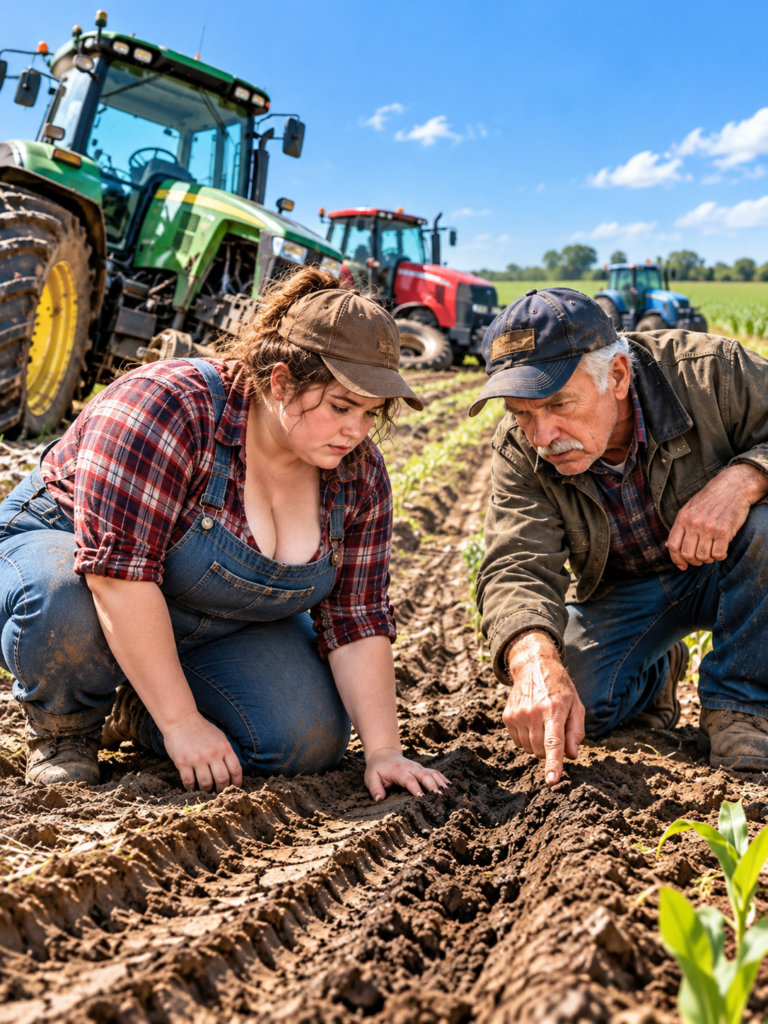
Ray knelt beside one impression.
He traced the edge with his finger.
“See that?”
Tom bent closer.
The soil formed a shallow depression, followed by a raised lip of compressed earth.
“The wheel dropped,” Ray explained. “Then it hit something firm.”
Tom studied the track.
He imagined the tremendous weight of the tractor moving over ground that suddenly gave way.
His stomach tightened.
“How deep?”
“Don’t know.”
“Could there be a hole under there?”
Ray didn’t answer immediately.
Finally, he said, “That’s what I’m afraid of.”
Tom looked toward his father’s old workshop.
And for the first time in five years, he thought about opening the green filing cabinet.
Part 3
The cabinet smelled of motor oil, yellowed paper, and the faint mustiness of a building that had survived too many Iowa winters.
Tom stood in front of it for several minutes before touching the handle.
Ray waited near the workbench.
He understood that the cabinet held more than farm records.
Harold’s handwriting was on every folder.
His fingerprints were probably still on the drawer pulls.
His faded labels remained neatly arranged in an order only he had understood.
After the funeral, Tom had promised himself he would sort through everything.
But each time he tried, he found some ordinary reminder of his father that stopped him.
A grocery receipt.
A handwritten shopping list.
A note reminding him to grease the baler bearings.
The simplest things hurt the most.
Tom opened the top drawer.
Inside were decades of paperwork.
Seed invoices from the 1980s.
Hand-drawn machinery diagrams.
Old soil test reports.
A photograph of Harold standing beside his first combine, grinning beneath a straw hat.
Tom picked up the photograph.
He remembered the day it was taken.
His mother had still been alive.
The farm had been smaller.
The barn roof hadn’t leaked.
And he had believed his father could fix anything.
“Tom?”
Ray’s voice brought him back.
“Look for drainage records.”
Tom replaced the photograph.
He searched the top drawer.
Then the second.
Finally, in the bottom drawer, beneath a stack of equipment manuals, he found a thick manila folder.
Across the front, in Harold’s unmistakable block handwriting, were three words.
CREEK 40 TILE.
Tom’s breath caught.
He carried the folder to the workbench.
Ray moved a coffee mug out of the way.
Inside lay an old map drawn on yellowing graph paper.
The field boundaries were marked in pencil.
Miller Creek curved along the southern edge.
An old fence post was marked near the road.
And cutting diagonally across the property was a long line.
Tom stared.
He knew that line.
He had just spent the morning placing orange flags along it.
Ray leaned closer.
“Well, I’ll be.”
Beside the line, Harold had written:
Old clay main laid by Dad. Outlet end silting up.
Below that, another note appeared in darker pencil.
Soft spot near fence post. Do not drive heavy equipment over until repaired.
And beneath it, almost erased by time:
Repair planned. Never finished.
Tom sat down heavily on an overturned bucket.
He read the words once.
Then again.
And again.
His father’s warning had been sitting in a filing cabinet for years.
Waiting.
Tom rubbed his eyes.
“I never knew.”
Ray studied the map.
“Looks like your grandfather put in a clay drainage main to carry water down toward the creek.”
“Why would that break tractors?”
“Because if the line cracked or collapsed, water could be moving soil where it shouldn’t.”
Tom shook his head.
“Dad would have fixed it.”
Ray looked at the note.
“He meant to.”
“He would have told me.”
“Maybe he tried.”
Tom opened his mouth to argue.
Then stopped.
Because memory had already supplied an answer.
Six years earlier, during Harold’s last autumn on the farm, the old man had asked Tom to walk the Creek Forty with him.
Tom remembered standing by the kitchen door, pulling on his coat.
“Dad, I can’t today. The combine’s down and the weather’s turning.”
Harold had nodded.
“Another time, then.”
Another time never came.
That winter, Harold suffered a stroke.
He never fully recovered.
The following spring, he died.
Tom looked down at the map.
A terrible possibility settled over him.
His father had tried to show him something important.
And he had been too busy to listen.
Ray seemed to understand.
He placed one weathered hand on Tom’s shoulder.
“Son, you can’t go back and have that conversation.”
Tom swallowed.
“I know.”
“But you can pay attention now.”
They carried the map into the field.
The wind threatened to tear it from Ray’s hands as he spread it across the hood of his pickup.
Tom placed a wrench on one corner and a pair of pliers on the other.
Ray lined up the fence post, the creek bend, and the drainage line.
Then he looked toward the orange flags.
The alignment was unmistakable.
“Every breakdown sits right over this line,” he said.
Tom felt his pulse quicken.
“But why now? That pipe’s been there since my grandfather’s time.”
Ray folded the map carefully.
“What was March like?”
“Wettest one I can remember.”
“And that new planter?”
“Heavier than the old one.”
“How much heavier?”
Tom hesitated.
“Several thousand pounds when loaded.”
Ray nodded.
“Old drainage pipe. Wet soil. Heavier equipment.”
He glanced across the field.
“That may be all it took.”
Tom looked down at the ground beneath his boots.
It suddenly felt less trustworthy.
“Are we standing on top of it?”
“Maybe not directly. But we’re close enough.”
Ray walked toward the truck.
“Come on.”
“Where are we going?”
“To call somebody who knows more about underground drainage than I do.”
Tom glanced at the map.
He didn’t want another bill.
But he wanted a fourth broken tractor even less.
That evening, rain began shortly after supper.
At first, it was a gentle spring shower tapping against the kitchen windows.
Then the clouds thickened.
Rain poured from the gutters.
Water ran through the farmyard and pooled near the barn.
Tom sat at the kitchen table with his father’s map spread in front of him.
Jenny placed a bowl of soup beside him.
“You need to eat.”
“I’m not hungry.”
“You haven’t eaten since breakfast.”
Tom looked at the map.
“Dad knew.”
Jenny sat across from him.
“What?”
“He knew there was a problem under that field.”
He pointed to the faded pencil warning.
“He wrote it down years ago.”
Jenny studied the handwriting.
Her expression softened.
“That’s Harold.”
Tom gave a bitter little laugh.
“Always one more thing to worry about.”
“No,” Jenny said. “Always one more thing he was trying to protect.”
Tom looked at her.
She continued gently.
“Your father loved that farm. But you know what he loved more?”
Tom said nothing.
“You.”
The rain struck harder against the windows.
Jenny reached across the table.
“He left those notes because he wanted you to have a better chance than he did.”
Tom’s eyes filled.
He looked away before she could see.
“I’m fifty-four years old,” he said quietly. “And I’m still learning things he knew when he was thirty.”
Jenny squeezed his hand.
“That’s what fathers are for.”
They sat together while the storm moved across the farm.
For the first time in years, Tom allowed himself to remember his father without turning the memory into another task he had failed to complete.
He remembered Harold teaching him to weld.
Harold standing in the rain to pull a newborn calf from the mud.
Harold eating cold sandwiches on the tailgate during harvest.
Harold staying awake all night when Tom was fourteen and running a fever.
The old man had never been wealthy.
He had never owned new machinery.
But he had known his land.
And now, somehow, he was still trying to save it.
At dawn, Ray arrived again.
He and Tom walked toward the diagonal strip.
The rain had stopped, leaving the field soaked and shining beneath a pale sky.
Near the middle orange flag, a small puddle had formed.
As they approached, Tom noticed the water moving.
Not flowing downhill.
Not soaking evenly into the ground.
It was spinning.
Slowly.
In a tightening circle.
Then disappearing into a tiny point in the mud.
Ray stopped so abruptly that Tom nearly collided with him.
“Don’t get closer.”
Tom froze.
“What is it?”
Ray pointed.
“Watch that water.”
They stood silently.
The puddle continued to drain into the same spot.
Ray’s expression hardened.
“That’s not normal infiltration.”
Tom felt the cold morning air against his face.
“Where’s it going?”
Ray looked toward the creek.
“Somewhere underneath us.”
He stepped backward.
“Tom, get away from that strip.”
The urgency in his voice frightened Tom more than the words.
They retreated toward the firmer ground.
Ray took out his phone.
“I’m calling Dana Whitfield.”
“Who’s Dana?”
“Drainage contractor. Best one I know.”
“Ray, how bad do you think this is?”
The old mechanic watched the dark ground for several seconds.
Then he answered.
“Bad enough that I don’t want either one of us standing there when we find out.”
Part 4
Dana Whitfield arrived shortly after noon in a white work truck pulling a trailer loaded with inspection equipment.
She was forty-six, with short brown hair tucked beneath a hard hat and the steady manner of someone accustomed to giving expensive news to people who didn’t want to hear it.
She had spent twenty years repairing agricultural drainage systems throughout central Iowa.
Ray showed her the map.
Tom explained the breakdowns.
Dana listened without interrupting.
Then she walked to the edge of the Creek Forty and studied the ground.
“Three machines?” she asked.
“Three,” Tom answered.
“Different positions?”
“Different passes.”
“But all along this line?”
Ray nodded.
Dana looked toward the creek.
“I want to start at the outlet.”
They walked down the gentle slope toward Miller Creek.
The water was high from the night’s rain, moving brown and fast between the banks.
Near a tangle of willow roots, Dana found the old drainage outlet.
It was almost completely hidden by silt and vegetation.
She crouched and pulled away a handful of debris.
A small trickle of muddy water emerged.
“Your grandfather installed clay tile,” she said.
Tom nodded.
“That’s what the map says.”
“Clay can last a very long time when it’s properly supported. But the joints can shift. Roots get in. Sediment builds up. And if water starts carrying surrounding soil into a damaged section, you can lose material without seeing much happening at the surface.”
Tom glanced uphill.
“You think that’s happening?”
“I think we need to look.”
Her crew cleared the outlet and inserted a small inspection camera.
Tom stood beside the monitor while Dana guided the camera into the old pipe.
The first several feet showed stained clay walls.
There were roots along the joints.
Sediment covered the bottom.
Then the camera entered a section where the pipe had shifted.
One joint opened into a dark gap.
A few feet farther, the picture changed dramatically.
Broken clay.
Collapsed edges.
Loose soil.
And a cavity beyond the pipe that seemed far larger than the pipe itself.
Dana stopped the camera.
She studied the image.
Then she looked at Ray.
“That’s our problem.”
Tom leaned closer.
“What am I looking at?”
“A failed section of your drainage main.”
“Can you fix it?”
“Yes. But first we have to find out how much soil has been lost around it.”
Dana rewound the footage.
She pointed toward the darkness beyond a cracked joint.
“See that empty space?”
Tom nodded.
“That’s where the soil should be.”
He looked from the screen to the field.
“How much is missing?”
Dana’s voice remained calm.
“I can’t tell from the camera alone.”
Then she added something that made his stomach drop.
“But I wouldn’t drive anything over that line.”
The crew began carefully exposing the failed drainage section from firm ground near the field’s edge.
They used a compact excavator, removing soil in small amounts under Dana’s supervision.
As the trench deepened, the extent of the damage became clear.
Beneath a relatively thin layer of root-bound topsoil lay a long hollow where water had gradually washed soil away.
The old clay pipe had partly collapsed.
Some of the surrounding earth had been carried downstream over years of spring rains and freeze-thaw cycles.
The surface had remained intact.
Until the heavier equipment began crossing it.
Dana measured the damaged area.
The main cavity was roughly twelve feet long and reached nearly three feet below the original supporting soil in its deepest section.
There were smaller weakened pockets beyond it.
Tom stood at the edge of the excavation.
He couldn’t stop staring.
For decades, he had planted corn above that hidden space.
He had driven across it.
His father had driven across it.
His grandfather had once worked the same ground behind a much smaller machine.
The field had looked solid.
It had produced good crops.
It had never warned him in a way he understood.
Yet under that ordinary surface was an empty place waiting for enough weight to expose it.
Dana pointed toward the edge of the void.
“Your first tractor likely dropped a front wheel here.”
Tom watched her gesture.
“The axle support took the shock.”
She moved several feet along the trench.
“Gary’s machine probably caught the edge at a slightly different angle. That would explain the tire and rim damage.”
Then she pointed toward the deepest part.
“The rental’s drive wheel may have dropped farther before climbing back onto firmer ground. A hit like that can send an enormous shock through the drivetrain.”
Ray stood with his arms folded.
“Three different failures.”
Dana nodded.
“One underlying problem.”
Tom stared into the hollow.
He imagined the enormous weight of the rental tractor crossing that thin crust of earth.
He imagined the ground opening beneath the cab.
The machine tipping.
The glass breaking.
His body trapped under tons of steel.
He stepped backward.
“I could’ve died.”
Nobody answered immediately.
Then Ray said quietly, “Yes, Tom. You could have.”
The words seemed to drain the warmth from the afternoon.
Tom turned toward the distant farmhouse.
Jenny was inside doing the books.
She expected him home for supper.
Their daughter, Emily, lived in Des Moines with her husband and two children.
Their son, Michael, worked as an electrician in Cedar Rapids.
Tom thought about the grandchildren who called him Grandpa and begged to ride beside him in the tractor.
He thought about the times he’d let them sit in the cab while he drove slowly along the farm lane.
He looked again into the dark hollow.
For the first time since the breakdowns began, he wasn’t thinking about repair bills.
He was thinking about the people he might never have seen again.
Dana approached him.
“Tom, I know this looks bad.”
He gave a humorless laugh.
“Looks bad?”
“It is serious. But we’ve identified the problem before the entire surface failed.”
“Can you make the field safe?”
“Yes. We replace the damaged drainage section, rebuild the outlet, and backfill the cavity in compacted layers. Then we verify the repair before any heavy equipment crosses.”
Tom nodded slowly.
“How much?”
Dana hesitated.
“I need to prepare the full estimate.”
He looked at her.
“Please.”
She met his eyes.
“Somewhere around fourteen thousand dollars, depending on what else we find.”
Tom closed his eyes.
Fourteen thousand.
On top of nineteen thousand in equipment damage.
On top of the operating loan.
On top of a season that was already slipping away.
He felt something inside him sag.
Not anger.
Not even fear.
Just exhaustion.
He had spent his entire adult life fighting to keep the farm running.
And now the land itself seemed to be demanding money he didn’t have.
That evening, Tom sat alone in the old barn.
The building smelled of hay, dust, and sun-warmed wood.
A swallow flew through a broken window and disappeared into the rafters.
Tom rested his elbows on his knees.
He had brought Harold’s map with him.
It lay folded beside his boots.
His father had known about the drainage problem.
He had planned a repair.
But he had never finished it.
At first, Tom felt a sharp, unreasonable anger.
Why hadn’t Harold made the repair?
Why hadn’t he insisted on telling Tom?
Why had he left such an important warning in an old cabinet?
Then Tom remembered the final years of his father’s life.
Harold had been struggling with heart trouble.
The farm had needed a new well pump.
The combine had required a transmission rebuild.
And Tom’s mother had spent months in the hospital before she died.
There had always been something more urgent.
Always another bill.
Another harvest.
Another family crisis.
Harold hadn’t ignored the problem because he didn’t care.
He had simply run out of time.
Tom unfolded the map again.
In the lower corner, written so faintly that he had missed it earlier, was another note.
Ask Tom to walk line after harvest.
Tom stared at the words.
He could hear his father’s voice.
“Come walk the field with me, son.”
And his own impatient answer.
“Not today, Dad.”
The barn blurred before his eyes.
Tom lowered his head.
“I’m sorry,” he whispered.
The words disappeared into the stillness.
He sat there until the evening light turned orange along the barn wall.
When Jenny finally found him, she didn’t ask why he’d been crying.
She simply sat beside him on an overturned feed bucket.
For a long while, neither spoke.
Then Tom said, “I don’t know if I can save it.”
Jenny looked at him.
“The farm?”
He nodded.
She studied the old map in his hands.
“Your father worked this ground for more than forty years.”
“I know.”
“And you’ve worked it for more than thirty.”
Tom stared toward the open barn door.
“That doesn’t mean the bank cares.”
“No,” Jenny said. “But it means we’ve survived things before.”
He shook his head.
“Not like this.”
Jenny waited.
Then she said, “You keep looking at everything we’ve lost.”
Tom turned toward her.
“What else am I supposed to look at?”
She pointed to the map.
“What we found.”
He frowned.
“An expensive hole?”
“A reason.”
She spoke gently but firmly.
“Ten days ago, you had three broken tractors and no explanation. Today, you know what happened. You know how to fix it. And you have people willing to help.”
Tom looked down.
Jenny took his hand.
“That doesn’t make the problem easy. But it makes it possible.”
The next morning, they gathered around the kitchen table.
Ray arrived carrying coffee and a notebook.
Dana joined by phone.
Jenny opened the farm budget.
Tom laid Harold’s map between them.
For the first time, they weren’t guessing.
They were making a plan.
Ray suggested planting the other three hundred sixty acres first.
The damaged strip would remain fenced off.
Dana could complete the drainage repair while Tom worked elsewhere.
Then, after the repair had been checked and the ground was ready, Tom could return to the Creek Forty.
It would mean planting that field nearly a week late.
There might be some lost yield.
But it would keep the remaining equipment out of danger.
Tom studied the numbers.
“We still need a tractor.”
Ray took a sip of coffee.
“Then call Gary.”
“I destroyed his tire.”
“You paid for the tire.”
“That’s not the point.”
Ray looked at him.
“Then tell him the truth. You found the problem. You fixed the reason it happened. Ask him if he’ll help.”
Tom stared out the window.
Pride had carried him through plenty of hard seasons.
But pride wouldn’t put seed in the ground.
He reached for the phone.
Part 5
Gary Pruitt answered on the fourth ring.
“Morning, Tom.”
Tom looked at Jenny across the table.
“Gary, I owe you an explanation.”
A pause.
“About the tire?”
“About all of it.”
Tom told him everything.
The three breakdowns.
The diagonal strip.
The old drainage map.
The collapsed clay pipe.
The hollow beneath the field.
Gary listened without interrupting.
When Tom finished, there was a long silence.
Then Gary let out a low whistle.
“Good Lord.”
“That’s about what I said.”
“You could’ve been killed.”
“Yeah.”
Another silence.
Tom swallowed.
“Gary, I wouldn’t ask if I had another way. But I’ve got three hundred sixty acres ready, and the weather’s turning. Would you consider letting me borrow your tractor again?”
Gary said nothing.
Tom rushed on.
“I’ll stay away from the Creek Forty. I’ll cover insurance. I’ll pay for the fuel and anything else you want. And if you’d rather not, I understand.”
Gary finally spoke.
“Tom.”
“Yeah?”
“Do you remember the summer of ’98?”
Tom frowned.
“The flood?”
“That’s right.”
“Sure.”
“My dad was in the hospital. The south pasture was underwater. I had thirty head of cattle with nowhere to go.”
Tom remembered.
His father had opened a pasture on the Brant property.
For nearly three weeks, Gary’s cattle had grazed there while the floodwaters receded.
“Your dad never charged us a dime,” Gary said.
“He was just helping a neighbor.”
“Exactly.”
Tom closed his eyes.
Gary continued.
“Come get the tractor in the morning.”
Tom couldn’t speak for a moment.
“Gary—”
“And don’t argue about it.”
A small laugh escaped Tom.
“All right.”
“Just one thing.”
“What’s that?”
“Stay the hell away from that hole.”
Tom laughed again, this time through tears.
“I plan to.”
When the call ended, Jenny reached for his hand beneath the table.
Ray gave a small nod.
“One problem down.”
The next call was harder.
Tom phoned the bank.
He asked to speak directly with his loan officer, Margaret Collins.
Margaret had handled the farm’s operating line for six years.
She was professional, careful, and not especially sentimental.
Tom knew she had obligations to the bank.
But he also knew that hiding the truth would only make matters worse.
He explained the equipment failures and the drainage problem.
He sent photographs of the damaged field, Dana’s estimate, Ray’s notes, and Harold’s old map.
He included a planting schedule showing how he intended to finish the remaining acreage.
Then he waited.
Margaret called back that afternoon.
“Tom, I’ve reviewed everything.”
He stood in the workshop, staring at the dusty floor.
“All right.”
“This is a serious setback.”
“I know.”
“Your current position doesn’t leave much room for another unexpected expense.”
“I know that too.”
She paused.
“But I appreciate that you’ve documented the problem and developed a reasonable repair plan.”
Tom gripped the phone.
“Does that mean—”
“It means I’m willing to recommend a modest extension on the operating line, subject to additional documentation and approval.”
Tom leaned against the workbench.
It wasn’t a miracle.
The bank wasn’t forgiving the debt.
The repair still had to be paid for.
The season still carried risk.
But the door wasn’t closed.
And for a man who had spent ten days watching every door slam shut, that mattered.
“Thank you,” he said quietly.
Margaret’s voice softened.
“My father farmed outside Ames. I know what a season like this can do.”
Tom nodded, though she couldn’t see him.
“Then you know why I can’t walk away.”
“I do. Just make sure you don’t risk your life trying to protect the land.”
When he hung up, Tom sat for several minutes.
He hadn’t realized how tightly he had been holding his breath.
The final piece of the financial plan came from Jenny.
That evening, she walked into the workshop carrying an old inventory sheet.
“What about the baler?”
Tom looked up.
“What baler?”
“The one behind the machine shed.”
He glanced through the window.
The old round baler had been sitting beneath a tarp for six years.
It needed repairs, but the frame and major components remained usable.
“What about it?”
“Sell it.”
Tom frowned.
“Nobody wants that old thing.”
“Then let’s find out.”
She had already contacted a small livestock farmer two counties away.
He had offered a modest amount, provided he could inspect the machine.
Tom stared at her.
“You called somebody?”
Jenny smiled.
“While you were worrying about how to pay for the repair.”
He shook his head.
“What would I do without you?”
“Probably lose all your receipts.”
Tom laughed.
Then he crossed the workshop and wrapped his arms around her.
For a long moment, they stood together among the tools and machinery.
Neither pretended things were suddenly easy.
But they had something they hadn’t had ten days earlier.
A way forward.
Dana’s crew began the repair on Thursday morning.
They excavated the failed drainage section, removed the broken clay pipe, and installed modern replacement pipe designed for agricultural drainage.
They rebuilt the outlet near the creek and restored the hollow with carefully placed, compacted backfill.
The work required patience.
Every layer had to be placed correctly.
Every damaged section had to be checked.
The drainage system needed to carry water without allowing surrounding soil to wash into the line.
Tom visited the worksite whenever he could, but most of his time went toward planting the remaining fields.
Gary’s tractor performed beautifully.
Each morning, Tom checked the oil, inspected the tires, and walked around the machine before starting.
He treated it as though it were made of glass.
By Sunday evening, most of the other acreage was planted.
The sky remained clear.
The seed was in the ground.
And the first green shoots from the earliest planted rows were beginning to break through the soil.
Dana finished the repair and completed her inspection.
Ray walked the restored strip with his probing rod, checking the ground along the former weak area.
The soil resisted firmly where it once had swallowed the steel.
He repeated the test several times.
Then he looked at Tom.
“Feels solid.”
Dana nodded.
“The repair checks out. We can start bringing equipment back across once the prepared area is ready.”
Tom looked down the diagonal strip.
The orange flags still marked the ground.
He left them standing until every final inspection was complete.
Only then did he return with a light tractor for a cautious first pass.
Ray and Dana watched from firm ground.
Jenny stood beside the fence.
Tom climbed into the cab.
For a moment, he sat still.
The steering wheel felt familiar beneath his hands.
But something had changed.
Ten days earlier, he had driven into the Creek Forty assuming that every problem could be solved by working harder.
Now he understood that some problems required a different kind of strength.
The strength to stop.
To listen.
To admit that you didn’t know.
And to trust the people who did.
He started the engine.
The tractor moved forward slowly.
Its front wheels reached the restored section.
Tom watched the ground.
The tires rolled across.
Nothing shifted.
Nothing sank.
The tractor continued.
When he reached the far side, he stopped and looked back.
Clean tire tracks stretched across the soil.
Straight.
Shallow.
Ordinary.
He had never been so grateful to see something ordinary.
Ray raised one hand.
Jenny wiped her eyes.
And Tom, sitting alone in the tractor cab, began to cry.
Not loudly.
Not dramatically.
Just the quiet tears of a man who had been carrying too much for too long.
He thought of his father.
Of the map.
Of the warning.
Of the little boy who had once followed Harold through this same field, trying to step in his boot prints.
“Dad,” he whispered, “we found it.”
The Creek Forty was planted six days later than planned.
The delay would likely reduce its yield somewhat.
Tom knew that.
He also knew that one good harvest wouldn’t erase every debt.
The farm remained vulnerable to weather and markets.
He still had payments to make.
But the immediate danger had passed.
The drainage system worked.
The other three hundred sixty acres had been planted on schedule.
The bank had agreed to the extension under its conditions.
And the family farm was still standing.
Summer came slowly.
The heavy spring clouds gave way to long golden evenings.
Corn emerged across the Creek Forty.
The rows grew taller.
Rain fell when it was needed.
The repaired drainage line carried water away as intended.
Tom checked the field often.
Sometimes he walked to the old fence post and stood looking toward Miller Creek.
He could still remember where each tractor had stopped.
But now those places meant something different.
They no longer reminded him only of disaster.
They reminded him of the day he finally listened to the land.
One evening in July, Jenny found him in the workshop.
He was standing before the old green filing cabinet.
Above it hung Harold’s drainage map in a simple wooden frame.
The paper had been protected behind glass.
The pencil marks were still visible.
So were the warnings.
Beside it, Tom had installed a small shelf holding several new binders.
Each was labeled with a field name.
Inside were updated drainage maps, repair records, photographs, machinery notes, and observations about the soil.
Jenny smiled.
“Your father would like that.”
Tom looked at the framed map.
“Think so?”
“He’d probably tell you your handwriting needs work.”
Tom laughed.
“That’s probably true.”
She stepped beside him.
For a while, they studied Harold’s map together.
Then Jenny noticed something.
At the bottom of the frame, Tom had placed a small handwritten card.
It read:
Some warnings are really acts of love.
Jenny looked at her husband.
He shrugged.
“I spent years thinking Dad worried too much.”
She waited.
Tom looked toward the open workshop door.
The sun was setting beyond the cornfields.
“He was just trying to leave me something useful.”
Jenny slipped her arm through his.
“He left you more than a farm.”
Tom nodded.
“I know.”
That autumn, the harvest wasn’t perfect.
The Creek Forty yielded less than Tom had hoped, though most of the crop remained healthy.
The farm’s finances were still tight.
But there were no more mysterious machinery failures.
No more sudden collapses beneath the wheels.
And when Tom parked the combine after the last load of corn, he did something he hadn’t done in years.
He walked to his father’s grave.
The small country cemetery sat on a rise overlooking fields Harold had once worked.
Tom carried no flowers.
Only a folded copy of the new drainage map.
He knelt beside the stone.
“Well, Dad,” he said, “you were right about the low strip.”
A breeze moved through the dry grass.
Tom smiled sadly.
“Wish I’d listened sooner.”
He placed the folded map beneath a small stone at the base of the marker, intending to take it home before he left.
Then he sat quietly for a while.
He told his father about the broken tractors.
About Ray.
About Gary lending him the machine again.
About Dana finding the hollow.
About Jenny selling the old baler.
And about the frightening moment when he realized how close he’d come to never seeing his family again.
Finally, he looked out over the surrounding farmland.
“I used to think keeping this place meant never admitting I needed help.”
He paused.
“Guess you knew better.”
The wind rustled through the trees.
Tom rose slowly, his knees stiff from the cold ground.
He picked up the map.
Before leaving, he rested one hand against the gravestone.
“I’ll take care of it, Dad.”
He meant the farm.
But he also meant something more.
He would take care of the knowledge his father had left.
He would listen when someone older tried to warn him.
He would ask for help before pride turned a manageable problem into a tragedy.
And someday, when his own children inherited the decisions that came with the land, they wouldn’t have to dig through forgotten drawers to understand what lay beneath their feet.
That winter, Emily brought her children to the farm for Christmas.
Her oldest boy, eleven-year-old Noah, wandered into the workshop while Tom was putting away tools.
“Grandpa?”
Tom looked up.
“What’s on your mind?”
Noah pointed toward the framed map.
“Mom says that picture saved the farm.”
Tom set down his wrench.
“Well, it helped.”
“Is it a treasure map?”
Tom smiled.
“In a way.”
Noah stepped closer.
“Where’s the treasure?”
Tom looked at the yellowed paper.
Then at the boy standing beside him.
He remembered himself at eleven, following Harold through the fields.
He remembered asking questions his father always seemed to have time to answer.
And he remembered how easily those precious moments had slipped away.
Tom crouched beside his grandson.
“Come here. I’ll show you something.”
He pointed to the diagonal line.
“Your great-grandpa knew there was an old drainage pipe under this field. He knew part of the ground was getting weak.”
Noah studied the map.
“Did he fix it?”
“He wanted to.”
“Why didn’t he?”
Tom considered the question.
“Sometimes grown-ups run out of time before they finish everything they meant to do.”
Noah was quiet.
Then he asked, “So how did you know?”
Tom smiled.
“He left me a warning.”
The boy looked up.
“Did you listen?”
Tom felt the question settle gently against his heart.
“Not soon enough.”
He placed a hand on Noah’s shoulder.
“But eventually, I did.”
Noah looked back at the map.
“Will you show me where the pipe is?”
Tom stood.
“Sure will.”
“Today?”
“Well, there’s snow on the ground.”
Noah shrugged.
“I’ve got boots.”
Tom laughed.
“All right, then.”
He took his coat from the hook.
Together, grandfather and grandson stepped out into the cold Iowa afternoon.
The fields lay quiet beneath a thin blanket of snow.
The old red barn stood against the pale winter sky.
Smoke rose from the farmhouse chimney.
And beyond the fence, the Creek Forty stretched toward Miller Creek, peaceful and still.
Tom walked slowly so Noah could keep up.
At the old fence post, he stopped.
He pointed across the field.
“See that low strip?”
Noah nodded.
“That’s where the trouble started.”
“Can it happen again?”
“Ground can change. Pipes can wear out. That’s why we check.”
Noah considered that.
“So you have to pay attention.”
Tom looked down at his grandson.
“That’s exactly right.”
The boy slipped his small hand into Tom’s weathered one.
They stood together for a moment, looking across the land.
Three generations had worked this farm before Noah was born.
Three generations had worried over its soil, its weather, and its future.
Some had left buildings.
Some had left machinery.
Some had left debts.
And one old farmer had left a map.
Tom squeezed his grandson’s hand.
“Someday, if you want to, I’ll teach you everything I know about this place.”
Noah smiled.
“Even the secret stuff?”
Tom chuckled.
“Especially the secret stuff.”
They turned toward the farmhouse, where Jenny was waiting with hot chocolate.
Behind them, the Creek Forty lay undisturbed beneath the snow.
The old drainage line was repaired.
The hollow was gone.
And the danger that had nearly destroyed the farm was now part of its history.
But Harold Brant’s greatest gift had never been the warning itself.
It was the lesson hidden inside it.
That land remembers.
That experience matters.
That asking for help is not weakness.
And that sometimes, the people who love us most leave behind the very answers we don’t realize we’ll need.
Tom had nearly lost three tractors, his livelihood, and his life before he understood what his father had been trying to tell him.
Now, as he walked home beside his grandson, he made himself a quiet promise.
The next generation would not have to learn that lesson the hard way.

