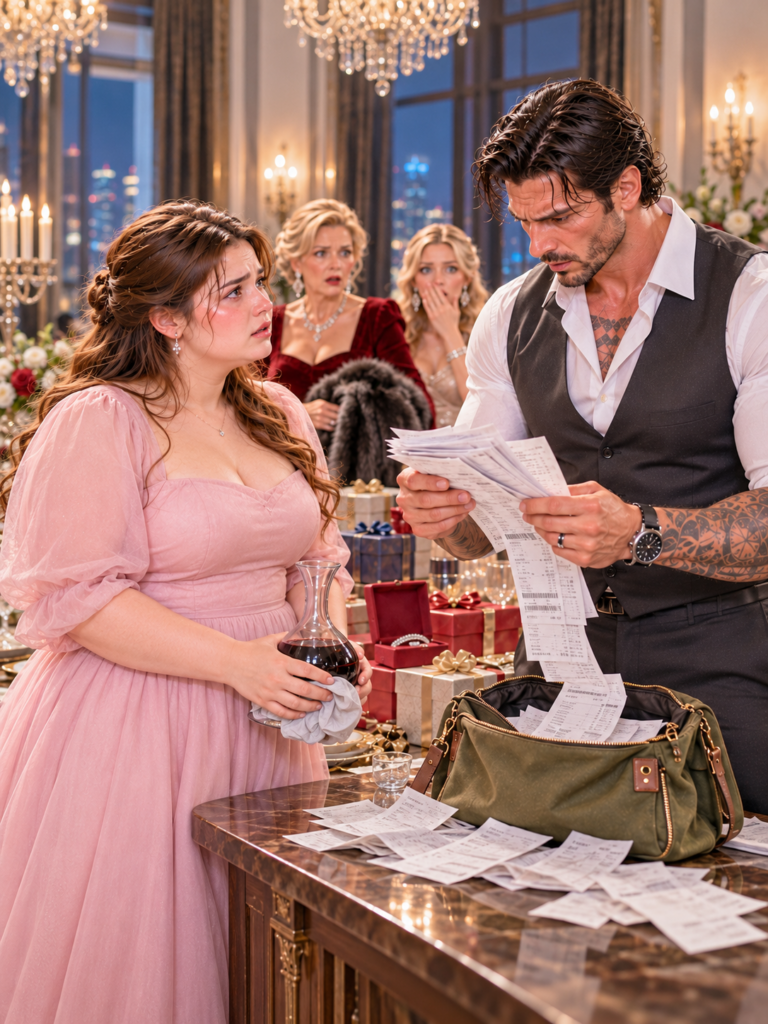
His Family Mocked His Plus-Size Wife and Gave Her Nothing—Until the Ruthless Mafia Boss Opened Her Purse and Discovered Eight Years of Sacrifice
Part 1
Eleven expensive gifts had been placed beneath the Christmas tree in the Callaway mansion.
Not one of them belonged to the woman who had purchased every single one.
June Callaway stood beside the enormous dining table, holding a crystal decanter of red wine. Her feet ached inside her inexpensive black shoes. The waistband of her dark green dress pressed uncomfortably against her soft stomach, and she had spent the evening trying not to draw attention to herself.
At twenty-nine, June was a beautiful plus-size woman with warm brown eyes, a round face, generous curves, and long chestnut hair that she usually wore pinned behind her head. Her figure had always been full, with broad hips, a soft waist, and a natural fullness that expensive gowns could have celebrated if anyone in the Callaway household had ever thought to buy her one.
Instead, she wore a dress she had altered herself.
The fabric was seven years old.
She had let out the seams twice.
And tonight, surrounded by women in designer silk and diamonds, she felt painfully aware of every inch of her body.
“June, sweetheart, you’re blocking the Christmas tree.”
The voice belonged to Dinina Callaway, her husband’s aunt.
June immediately stepped aside.
“Of course. I’m sorry.”
Dinina examined her from head to toe.
“And perhaps next year, you might consider wearing something a little more flattering. Dark colors can only do so much.”
A few women exchanged amused glances.
June lowered her eyes.
Across the table, Colette Callaway, her nineteen-year-old sister-in-law, laughed into her champagne.
“Oh, Aunt Dinina, leave her alone. Some women simply aren’t meant for elegant clothing.”
June tightened her fingers around the decanter.
She had heard worse.
Much worse.
Eight years of marriage into one of Boston’s wealthiest and most feared families had taught her that silence was usually safer than defending herself.
At the head of the table sat her husband.
Rowan Callaway.
Thirty-eight years old.
Six feet four inches of broad shoulders, dark hair, and cold gray eyes.
The man whose name could empty a nightclub, stop a business deal, or make powerful politicians suddenly remember urgent appointments elsewhere.
In Boston’s criminal underworld, Rowan was known as the Wolf of Beacon Hill.
He controlled shipping companies, nightclubs, private security firms, and a network of alliances stretching far beyond Massachusetts.
Men twice his age addressed him with careful respect.
Enemies rarely looked him directly in the eyes.
But his own wife?
His wife was standing beside the dining table, pouring wine like a servant.
And Rowan had allowed it.
He had allowed it for eight years.
“More Barolo,” Perry Callaway demanded, raising his glass.
June hurried toward him.
Perry was Rowan’s cousin and second-in-command, a smooth-talking man whose smile always seemed to arrive half a second before his sincerity.
“Careful,” Perry remarked as June leaned forward. “Don’t knock anything over with those hips.”
Laughter drifted around the table.
June froze for a fraction of a second.
Then she poured the wine.
“Of course.”
Perry smirked.
“Good girl.”
At the head of the table, Rowan’s eyes lifted.
Something about those two words irritated him.
He glanced toward his wife.
June was already moving away, her expression composed.
He had seen her endure countless little cruelties over the years.
Somehow, he had convinced himself that ignoring them was the same as protecting her.
It was a lie he hadn’t yet recognized.
“Now!” Dinina announced brightly. “It’s time for the gifts.”
The room erupted in delighted applause.
Colette received a Cartier rose-gold bracelet.
She squealed when she opened the velvet box.
“Oh, my God! It’s perfect!”
Dinina pressed a manicured hand against her chest.
“From the family, darling. We always take care of our own.”
June smiled faintly.
Four thousand three hundred and eighty dollars.
That bracelet had cost her almost three months of early-morning bakery wages.
She knew the price because she had counted the cash herself at the Cartier boutique.
She also knew that Colette preferred rose gold to yellow gold, that she disliked loose-fitting bracelets, and that she had been admiring this exact design for almost a year.
Nobody else in the family had remembered those details.
Nobody had even asked.
A fur-trimmed designer coat went to Dinina.
Diamond cufflinks went to a cousin’s new husband.
A luxury watch went to Perry.
Six thousand two hundred dollars.
June had purchased it eleven days earlier.
She had spent thirty minutes choosing between two models, remembering that Perry disliked watches with large faces.
When he opened the box, he whistled.
“Now this,” he declared, lifting the watch toward the chandelier, “is what loyalty buys.”
Everyone applauded.
June continued filling glasses.
A cash envelope went to the housekeeper.
A pearl necklace went to a distant aunt.
Gift after gift passed around the table.
Eleven presents.
Eleven expressions of gratitude.
Eleven people smiling at what they believed was proof of the Callaway family’s generosity.
And June received nothing.
Not a card.
Not a ribbon.
Not even a chair.
Her dinner plate waited on the sideboard, the roasted potatoes growing cold beneath a thin layer of congealed butter.
Dinina glanced toward her.
“June, would you take this wrapping paper away? There’s quite a mess.”
“Of course.”
As June bent to collect the discarded paper, the side seam of her dress pulled tightly across her hip.
Colette leaned toward another cousin.
“Honestly, you’d think she’d have learned how to dress for her size after eight years.”
June heard every word.
She straightened slowly.
Her cheeks burned.
For a moment, she wanted to disappear.
But when she looked toward the far end of the table, she saw Rowan watching her.
Their eyes met.
His expression shifted.
Not with disgust.
Not with amusement.
Something more complicated.
Something almost like shame.
June looked away first.
She had stopped expecting him to defend her a long time ago.
Their marriage had never begun as a love story.
Eight years earlier, June’s father had owed the Callaway family two hundred and twelve thousand dollars.
It was a debt he could not repay.
June had been twenty-one, frightened, and desperate to keep her father alive.
Rowan, newly installed as head of the family, had offered a marriage arrangement that settled the debt and placed her under his protection.
June had accepted.
She remembered wearing a white dress that pinched her waist and a borrowed pair of shoes.
She remembered Rowan’s expression at the courthouse.
Cold.
Controlled.
Unreadable.
He had not kissed her when the ceremony ended.
He had simply opened the car door and said, “You’ll be safe in my house.”
And for eight years, June had tried to make herself worthy of that safety.
She had learned to eat less when relatives watched.
To laugh quietly.
To avoid bright colors.
To never request expensive clothing.
To apologize when someone bumped into her.
She had never once asked her husband for money.
She believed she had entered his family as a debt.
And she was determined not to become another expense.
A small metallic sound interrupted the laughter.
At the far end of the table, May Callaway’s fork had fallen onto her plate.
Rowan’s grandmother was eighty-six years old.
Small, fragile, and nearly silent after a devastating stroke four winters earlier.
Her hand trembled against the white tablecloth.
Her lips were turning gray.
Nobody noticed.
Perry was still talking about his watch.
Colette was taking photographs of her bracelet.
Dinina was explaining how difficult it had been to organize the gifts.
But June noticed.
She always noticed May.
“May?”
June set down the decanter.
The old woman’s chest barely moved.
“May!”
June rushed around the table, knocking into a chair.
Her dress caught briefly against the wood, but she pulled free and dropped to her knees.
“Look at me, sweetheart.”
She touched May’s throat.
Her pulse was weak.
The old woman’s breathing was frighteningly shallow.
“Rowan!”
The entire room went silent.
His head snapped toward her.
In eight years of marriage, June had almost never raised her voice in his presence.
“Her emergency spray is in my purse. The green canvas one in the hall closet. Front pocket. Please hurry!”
Rowan was already moving.
He crossed the dining room with long, powerful strides.
Behind him, Perry rose halfway from his chair.
“Shouldn’t we call someone?”
“Call an ambulance!” June ordered.
Rowan ran.
The most feared man in Boston ran down his own hallway searching for his wife’s cheap handbag.
He found it wedged between two designer coats.
Green canvas.
Fraying corners.
A strap repaired with uneven stitching.
He recognized the bag vaguely.
June carried it everywhere.
He had once offered to replace it.
She had smiled and said she didn’t need anything.
Now, holding the worn canvas, he realized he had never wondered why his wife refused even the smallest gifts.
He opened the front pocket.
Lip balm.
A handkerchief.
A rosary.
A small bottle of prescribed emergency medication.
And beneath the medication, an enormous stack of folded receipts bound together with rubber bands.
Rowan hesitated.
There were hundreds of them.
Some yellowed with age.
Others crisp and new.
He grabbed the medication.
Then he hurried back.
June was still on the floor, her full figure bent protectively around May.
“Here!”
She took the spray and administered it according to May’s emergency plan.
“Stay with me, sweetheart.”
Her voice softened.
“That’s it. Breathe slowly. I’m here.”
May’s fingers clutched June’s wrist.
A terrifying minute passed.
Then another.
At last, the old woman drew a deeper breath.
Color slowly returned to her face.
June closed her eyes.
“Thank God.”
The ambulance arrived several minutes later.
The paramedics examined May and prepared to transport her for further evaluation.
Throughout it all, the old woman’s hand refused to release June’s.
Rowan stood nearby.
He watched his wife stroke May’s silver hair.
Watched the gentle way she spoke.
Watched how instinctively she knew what May needed.
He realized he had never once asked how June knew the old woman’s medical routine so well.
When the ambulance doors finally closed, Dinina exhaled dramatically.
“Well, that was an absolutely dreadful interruption.”
June turned toward her.
“What?”
“The dinner, darling. The entire evening is ruined.”
June stared.
Dinina pointed toward the table.
“And look at the wine stain. That linen is antique.”
Colette frowned.
“Seriously, June. Did you have to knock over everything?”
June looked down.
Red wine had spread across the white tablecloth.
“I’ll clean it.”
“Of course you will,” Dinina replied.
Perry picked up his glass again.
“Well, at least Grandma’s fine. Shall we finish dessert?”
June rose slowly.
Her knees hurt.
Her dress was creased.
A small section of her hair had fallen loose against her damp cheek.
Nobody thanked her.
Nobody asked whether she was all right.
She simply went toward the kitchen to find club soda.
And Rowan watched.
For the first time, he saw the room as it truly was.
Not the polished dining room of a powerful family.
Not the elegant Christmas gathering he had funded.
But a table full of people who accepted his wife’s care, money, and sacrifice while treating her like something shameful.
His grip tightened around the green canvas purse.
He looked down.
The receipts were still visible through the open zipper.
One paper slip caught his attention.
Cartier.
Copley Place.
Rose-gold bracelet.
$4,380.
Paid in cash.
Four days earlier.
Rowan slowly removed it.
On the back, in June’s careful handwriting, were five words.
Colette. Christmas. From the family.
His stomach tightened.
He reached deeper into the bag.
A second receipt.
Perry’s watch.
$6,200.
Eleven days earlier.
Perry. Christmas. From the family.
Another.
Dinina’s coat.
Another.
The cufflinks.
The pearl necklace.
The housekeeper’s envelope.
All of them purchased by June.
All paid in cash.
And every single one labeled as a gift from the family.
Rowan turned toward the dining room.
Colette was photographing her bracelet beneath the chandelier.
Perry was admiring his reflection in the polished watch face.
Dinina was complaining about the ruined linen.
His wife had bought every gift.
And they had given her nothing.
He looked through more receipts.
Last Christmas.
The Christmas before.
Birthdays.
Graduations.
Anniversaries.
Get-well flowers.
Hospital visits.
Eight years.
Eight years of generosity concealed inside a nine-dollar handbag.
His jaw grew rigid.
He reached the bottom of the stack.
There lay a yellow pawnshop ticket.
Three weeks old.
One yellow-gold wedding ring.
Nine hundred dollars.
Attached to it was an invoice.
Hearing aids.
Patient: May Callaway.
$880.
Paid in full.
Rowan stopped breathing.
He knew that ring.
June’s mother had worn it until the day she died.
June had carried it into their marriage.
She sometimes twisted it around her finger when she was nervous.
A small gold band.
Nothing extravagant.
But it had belonged to the only person who had ever made June feel completely loved.
And she had sold it.
To buy hearing aids for his grandmother.
Rowan stared at the receipt.
Then he remembered something else.
Every December, he transferred twenty thousand dollars into the household gift account.
Eight years.
One hundred and sixty thousand dollars.
Money supposedly used to purchase the family’s presents.
But June had paid for those gifts herself.
Which meant someone had taken the money.
Someone inside his family.
And the woman he had married to settle a debt had been spending her own earnings to maintain the illusion that the Callaways loved one another.
Rowan folded the receipt.
Very carefully.
Then he walked back into the dining room.
Perry was raising his glass.
“To blood, loyalty, and family!”
“Sit down.”
Rowan’s voice cut through the room.
Perry froze.
“Rowan?”
“I said sit down.”
The entire table fell silent.
Rowan walked toward June’s abandoned plate.
Cold potatoes.
Untouched meat.
A glass of water.
No chair.
No place card.
His eyes moved to his wife.
She stood near the kitchen doorway holding a bottle of club soda.
“June.”
She looked startled.
“Yes?”
“Come here.”
Her shoulders stiffened.
She had learned to recognize that tone.
Something was wrong.
She approached slowly.
Rowan stepped toward Perry.
“Get up.”
Perry blinked.
“What?”
“You’re sitting in my wife’s chair.”
A stunned silence swept the table.
Dinina laughed nervously.
“Oh, Rowan, don’t be ridiculous. June usually—”
“Get up, Perry.”
Perry stood.
Rowan pulled out the chair at his right hand.
Then he turned toward June.
He held out his hand.
She stared at it.
In eight years, her husband had never publicly offered her his hand.
“Rowan, I can stand.”
“I know.”
His voice softened.
“But you shouldn’t have to.”
Her eyes widened.
He stepped closer.
“And you will never stand at this table waiting for scraps again.”
The room seemed to stop breathing.
June glanced at the chair.
It was elegant, narrow, carved from dark mahogany.
She instinctively hesitated.
Rowan understood immediately.
He knew she was wondering whether it could comfortably hold her.
He also knew that someone at this table had taught her to question whether she deserved to sit beside him.
He moved the chair back slightly, giving her plenty of space.
Then he offered his hand again.
“Come, sweetheart.”
The tenderness in that single word nearly broke her.
June placed her trembling fingers in his.
Rowan helped her sit.
Then he moved behind her and placed both hands gently on her shoulders.
“Everyone,” he said quietly, “look at my wife.”
Nineteen faces turned toward June.
She wanted to disappear.
Instead, Rowan laid the thick bundle of receipts in front of her.
“Because apparently,” he continued, his gray eyes turning cold, “none of you has truly seen her for eight years.”
He picked up Colette’s bracelet receipt.
“The bracelet.”
Then Perry’s watch.
“The watch.”
Then Dinina’s coat.
“The coat.”
One by one, he spread the papers across the table.
“Every gift you opened tonight was purchased by June.”
Nobody spoke.
Rowan leaned forward.
“Not with family money.”
He looked at each person.
“With her own.”
Colette’s face drained of color.
Dinina gripped her necklace.
Perry stopped moving.
Rowan placed the pawnshop ticket beside the receipts.
“And three weeks ago, my wife sold her dead mother’s wedding ring so my grandmother could hear us speak.”
June covered her mouth.
“Rowan, please—”
He knelt beside her chair.
A man who had never knelt before an enemy.
A man whose power frightened half the city.
Now on one knee before his plus-size wife, in front of everyone who had mocked her.
He looked directly into her eyes.
“I should have seen this.”
Her lips trembled.
He took her hand.
“I should have seen you.”
Then he rose and faced his family.
His voice became dangerously quiet.
“Starting tonight, the woman you’ve treated like a servant sits beside me as the mistress of this house.”
He lifted the bundle of receipts.
“And before anyone leaves, I want one question answered.”
His eyes settled on Perry.
Then Dinina.
“Where is the one hundred and sixty thousand dollars I gave this family for gifts?”
No one answered.
Perry slowly removed his expensive watch.
And June realized that her husband’s public declaration had just turned eight years of silent suffering into something far more dangerous.
Because whoever had stolen that money now knew Rowan was looking.
And they would do anything to make him stop.
Part 2
The first thing June felt the next morning was fear.
Not relief.
Not gratitude.
Fear.
She sat on the edge of the bed in the enormous master bedroom, her hands folded over the soft curve of her stomach.
Outside the windows, snow drifted across Beacon Hill.
Behind her, the door opened.
Rowan entered carrying a tray.
Two cups of coffee.
Warm toast.
Scrambled eggs.
A small bowl of strawberries.
June stared.
“What are you doing?”
“Bringing you breakfast.”
She blinked.
“Why?”
“Because you haven’t eaten.”
“I could have gone downstairs.”
“I know.”
He placed the tray on the table near the window.
“But today, you don’t have to.”
June looked at the food.
Then at him.
His black shirt was open at the collar, revealing the edge of a scar near his collarbone.
He looked impossibly out of place carrying breakfast.
The sight almost made her smile.
Almost.
“Everyone must be furious,” she whispered.
“Everyone can survive being disappointed.”
“You don’t understand.”
Rowan leaned against the dresser.
“Then explain it.”
June hesitated.
For eight years, she had kept her complaints folded inside herself like letters she never intended to send.
Now he was asking her to open them.
“Your family doesn’t forget humiliation,” she said. “They remember it. They wait. And when you’re somewhere else, they make sure the person responsible pays.”
His expression hardened.
“Has that happened before?”
June looked away.
He waited.
Finally, she answered.
“Last year, Colette told everyone I had broken a crystal vase. I hadn’t. One of the housemaids dropped it, but Colette said I was careless because I couldn’t move around the room without knocking into things.”
Rowan went completely still.
“She blamed your body?”
June gave a small shrug.
“That’s what people usually do.”
“What happened?”
“Dinina made me pay for it.”
“How much?”
“Three thousand dollars.”
Rowan stared.
“Where did you get three thousand dollars?”
June looked down at her hands.
He remembered the flour beneath her nails the previous night.
The rough skin around her knuckles.
The exhaustion she sometimes concealed beneath polite smiles.
“June.”
She exhaled.
“I work.”
His eyes narrowed.
“Where?”
“At Corbett’s Bakery in Savin Hill.”
“Since when?”
“Eight years.”
Silence settled between them.
Rowan slowly straightened.
“You’ve been working for eight years?”
She nodded.
“Tuesday, Thursday, and Saturday mornings. Sometimes more when someone is sick.”
“What hours?”
“Four until eight.”
He stared at her.
“You wake up before three in the morning?”
“Usually.”
“How did you get there?”
“The bus.”
“In winter?”
“Yes.”
He looked toward the window.
Snow tapped softly against the glass.
He thought of his heated Bentley.
His private drivers.
His armored vehicles.
His wife waiting at a bus stop in the Boston winter before dawn.
And nobody in his home had cared enough to notice.
“I told the household I was attending early Mass,” June explained. “Nobody questioned it.”
“Why didn’t you tell me?”
She raised her eyes.
“Would you have listened?”
The question struck harder than any accusation.
Rowan opened his mouth.
Then closed it.
Because he didn’t know.
And June could see that he didn’t know.
“You once told me you didn’t want a wife who interfered with your business,” she continued softly. “Your aunt told me I was fortunate you had married me at all. She said a woman my size, with my family’s debt, should be grateful to have a roof over her head.”
His jaw tightened.
“That woman had no right—”
“But you never stopped her.”
Silence.
June looked back at her hands.
“I decided I would never cost you anything. Not a dress. Not a Christmas present. Not even a new pair of shoes if I could help it.”
Rowan approached her slowly.
“You thought I married you because you were a burden?”
“Didn’t you?”
He stopped.
The truth was ugly.
Their marriage had begun as a financial arrangement.
He had considered it a way to protect an innocent young woman from her father’s dangerous creditors.
But he had never explained that.
Instead, he had remained distant.
Thinking distance would keep his enemies from using her against him.
He had given her luxury without tenderness.
Safety without belonging.
A wedding ring without love.
And his family had filled the silence with cruelty.
“June,” he said, kneeling in front of her, “I never thought you were a burden.”
Her eyes glistened.
“Then why did you make me feel like one?”
Rowan had no answer that would undo eight years.
So he told her the truth.
“Because I was afraid.”
She looked surprised.
“Of what?”
“Of caring about something my enemies could take.”
He rested his hands against his knees.
“My father taught me that loving someone openly was the quickest way to lose them.”
June’s voice barely rose above a whisper.
“So you decided not to love me at all?”
He looked at her.
“No.”
His expression changed.
“I decided not to let anyone see it.”
A tear slipped down her cheek.
“Not even me?”
That question broke something in him.
He reached for her hand.
She let him take it.
“I’m sorry,” he said.
Not a command.
Not a bargain.
An apology.
The first sincere apology he had given her since their wedding.
June wanted to believe him.
But eight years of loneliness could not disappear because a powerful man suddenly noticed her.
“I don’t know what you expect from me now,” she admitted.
“Nothing.”
He stood.
“Eat your breakfast. Go to work if that’s what you want. Visit my grandmother. Tell me when you’re angry.”
He paused.
“And stop apologizing for taking up space in your own home.”
Her throat tightened.
He looked at the old green dress hanging beside the wardrobe.
“And June?”
“Yes?”
“You looked beautiful last night.”
She gave a startled laugh.
“Rowan, everyone saw—”
“I know exactly what everyone saw.”
His gaze remained steady.
“A beautiful woman they were too foolish to appreciate.”
For the first time in years, June blushed for a reason that had nothing to do with shame.
At four forty the following Tuesday morning, a black Bentley stopped outside Corbett’s Bakery.
June stared through the windshield.
“You’re not seriously staying.”
Rowan turned off the engine.
“I thought I’d have coffee.”
“At four forty in the morning?”
“Is that illegal?”
“Not for ordinary people.”
His mouth curved.
“Fortunately, I’m not ordinary.”
June laughed.
The sound surprised them both.
Inside, the bakery smelled of cinnamon, yeast, and warm bread.
Mr. Corbett, a broad-shouldered older man with a flour-covered apron, stopped in the middle of arranging pastries.
His eyes moved from June to Rowan.
“Well, I’ll be damned.”
June smiled.
“Morning, Mr. Corbett.”
The baker glanced at Rowan’s expensive coat.
“You must be the husband.”
Rowan extended his hand.
“Rowan Callaway.”
Mr. Corbett considered it for a moment.
Then shook it.
“I know who you are.”
The two men studied each other.
Finally, Mr. Corbett said, “Your wife works harder than anyone in this place.”
Rowan’s expression softened.
“I’m beginning to understand that.”
June disappeared into the kitchen.
For the next three hours, Rowan sat at a small table with a paper cup of coffee and watched a woman he barely recognized.
Not because her face was unfamiliar.
But because her happiness was.
June moved confidently between ovens.
She laughed with the other bakers.
She carried trays of bread, gave directions to younger employees, and teased Mr. Corbett when he forgot where he’d put his glasses.
Her generous figure moved with practiced efficiency through the small kitchen.
She was strong.
Capable.
Loved.
Nobody mocked her size.
Nobody told her to stand aside.
Nobody treated her presence as an inconvenience.
At one point, a young delivery driver dropped an entire box of pastries.
June crouched beside him.
“Hey, it’s all right. We’ll make another batch.”
“Mr. Corbett’s going to kill me.”
“No, he won’t.”
She glanced toward the office.
“Not unless you drop the next batch too.”
The driver laughed.
Rowan watched her help him clean up.
Something inside his chest ached.
This was the woman he had married.
This bright, funny, generous woman.
And he had spent eight years missing her.
When June finished her shift, Rowan met her at the door.
“Ready?”
She nodded.
They walked toward the car.
Automatically, she opened the rear passenger door.
Rowan gently closed it.
June looked confused.
“What?”
He opened the front door.
“Beside me.”
She hesitated.
“It’s your driver’s seat—”
“I’m driving.”
He held the door.
“And you’re my wife.”
June slowly climbed in.
For the entire ride home, her cheeks remained warm.
Five days later, Rowan took June shopping.
She had protested.
Repeatedly.
He had eventually agreed to one condition.
She would choose whatever she wanted.
He would not interfere.
At a private boutique on Newbury Street, the saleswoman smiled politely when she saw Rowan.
Then her eyes moved to June.
The smile faltered.
“May I help you?”
June glanced at the elegant gowns displayed on slender mannequins.
“I’m looking for a dress.”
The woman examined her figure.
“I’m afraid our selection may be rather limited.”
Rowan’s expression cooled.
June touched his arm.
“Please.”
He remained silent.
The saleswoman gestured toward the back.
“We might have something in our extended sizes, although our designer pieces aren’t generally made for—”
“Women like me?” June asked quietly.
The saleswoman flushed.
“I didn’t mean—”
June straightened.
For once, she refused to look down.
“Then perhaps you should think about what you mean before you say it.”
Rowan watched her.
A flicker of pride moved across his face.
June turned toward him.
“I’d like to leave.”
“Of course.”
Outside, snowflakes caught in her hair.
Rowan offered his arm.
She took it.
“You could have frightened her into bringing out every dress in the store,” June remarked.
“I considered it.”
“I know.”
He looked at her.
“Why did you stop me?”
“Because I wanted to speak for myself.”
He smiled faintly.
“And you did.”
They found another boutique two streets away.
The owner, an older Italian woman named Lucia Bellini, welcomed June warmly.
“Ah, beautiful curves. Finally, someone who will make my gowns look like they were designed for a real celebration.”
June laughed.
Lucia brought out emerald silk.
Deep burgundy velvet.
A midnight-blue dress with a fitted waist and soft flowing skirt.
June disappeared into the fitting room.
When she emerged wearing the emerald gown, Rowan rose from his chair.
The dress draped elegantly over her full hips, defined her waist without squeezing, and complemented the warmth of her skin.
Her hair fell loose around her shoulders.
She looked beautiful.
Not despite her body.
Not because she had hidden it.
But because she finally wore something that allowed her to feel comfortable and confident in it.
June glanced at herself in the mirror.
“I’ve never worn anything like this.”
Rowan approached slowly.
“Do you like it?”
She nodded.
“Then take it.”
She smiled.
“You’re supposed to let me decide.”
His eyes warmed.
“Then I’m hoping you decide yes.”
Lucia pretended to adjust a rack of dresses.
June laughed again.
And Rowan realized he would gladly spend the rest of his life learning how to make that sound happen.
Their first public appearance together came at a charity gala in Back Bay.
Rowan’s arrival usually created a ripple of nervous attention.
That evening, however, every eye turned toward the woman on his arm.
June wore emerald silk.
Her chestnut hair fell in loose waves.
A simple gold necklace rested against her neckline.
She walked with her shoulders back.
Not because she had stopped feeling nervous.
But because Rowan’s hand rested at her waist, steady and reassuring.
Near the entrance, Colette watched with disbelief.
“Is that June?”
Perry’s companion whispered, “She looks different.”
Dinina narrowed her eyes.
“Expensive clothing can improve almost anyone.”
Rowan heard her.
He turned.
“You’re right about one thing.”
Dinina brightened.
“Of course, darling.”
“Money can change a woman’s clothes.”
He drew June closer.
“But it cannot manufacture the grace my wife has shown this family for eight years.”
Dinina’s smile vanished.
Rowan faced the gathering.
“Ladies and gentlemen, my wife, June Callaway.”
Applause followed.
June looked up at him.
The old instinct to hide rose inside her.
Then a photographer asked for a picture.
And Rowan, without hesitation, placed his hand over hers.
The photograph captured June smiling.
For once, she did not turn sideways to make herself appear smaller.
She did not cover her stomach with her handbag.
She stood beside her husband exactly as she was.
Later, on the dance floor, Rowan drew her close.
June glanced down.
“I’m not very good at this.”
“Neither am I.”
“You’re lying.”
“Frequently. But not about dancing.”
She laughed.
His hand settled respectfully against her back.
She placed hers on his shoulder.
They moved slowly beneath the chandelier.
For several minutes, the dangerous world outside seemed very far away.
“You’ve been staring at me all evening,” June whispered.
“Have I?”
“Yes.”
He looked down at her.
“Then perhaps you should know why.”
She waited.
“Because every time I look at you, I realize how much of my life I wasted pretending I didn’t want this.”
June’s heartbeat quickened.
“This?”
He lowered his forehead toward hers.
“To stand beside you. To hear you laugh. To come home and know you’re there.”
Her fingers tightened against his shoulder.
“Rowan—”
“I know I’m late.”
His voice roughened.
“Eight years late.”
For one breathtaking moment, June thought he might kiss her.
She wanted him to.
That frightened her more than she expected.
But before he could move closer, Perry appeared at the edge of the dance floor.
“Rowan. We have a problem.”
His expression was serious.
Rowan reluctantly stepped back.
“What kind?”
“Financial.”
Perry glanced at June.
“Something you need to see.”
The investigation began that night.
Rowan had hired an independent forensic accountant from Providence.
A man named Samuel Mercer, who had worked for the federal government before entering private practice.
Mercer reviewed the household accounts.
The gift fund.
Maintenance contracts.
Charitable donations.
Unusual withdrawals.
And what he discovered was far worse than one hundred and sixty thousand dollars.
Three hundred and forty thousand dollars had disappeared over eight years.
Some through fabricated repair invoices.
Others through transfers to a charitable organization registered under an unfamiliar name.
The Silver Harbor Foundation.
An organization using a Beacon Street post-office box.
And on the financial authorizations were signatures.
June Callaway.
Again.
And again.
And again.
Fourteen bank withdrawal slips.
Eight years of transactions.
Every document bore her name.
Rowan sat behind his desk when Mercer presented the report.
Perry stood near the window.
Dinina sat opposite him, looking almost triumphant.
“I warned you,” Dinina said gently. “Audits can reveal uncomfortable things.”
Rowan ignored her.
He examined the first signature.
June’s name flowed across the paper in graceful loops.
He had seen her handwriting on thousands of little notes.
Shopping lists.
Birthday cards.
Messages left beside his morning coffee.
The signature looked exactly like hers.
Mercer cleared his throat.
“On paper, she’s responsible.”
Rowan’s eyes hardened.
“On paper.”
“There are corresponding bank records, transfer authorizations, and a storage lease.”
Perry approached.
“A storage unit in Saugus. Registered under June’s maiden name.”
Rowan looked up.
“What?”
“Forty thousand dollars in cash. Investigators photographed it this afternoon.”
Dinina pressed a hand to her chest.
“How heartbreaking.”
Rowan’s voice became ice.
“Stop speaking.”
She fell silent.
Perry placed another document on the desk.
“I hate this, cousin. You know I love June.”
Rowan said nothing.
“But you have to consider the possibility that she’s been playing all of us.”
The study door opened.
June stood in the doorway holding May’s supper tray.
She had heard enough.
The tray trembled slightly in her hands.
Rowan rose immediately.
“June.”
She looked at the documents.
Then at Dinina.
Then at Perry.
“What is this?”
Perry’s expression softened with practiced sympathy.
“Sweetheart, there have been some irregularities.”
June approached the desk.
She set down the tray.
Picked up the top withdrawal slip.
Read the name.
Her face went pale.
“That’s my signature.”
Dinina leaned forward.
“So you admit—”
June turned toward her.
“I said it’s my signature.”
Her voice steadied.
“But I never signed it.”
Rowan watched her closely.
“I have never visited this bank,” June continued. “Not once.”
Perry sighed.
“June, the paperwork—”
“I didn’t sign it.”
Rowan moved toward her.
“Look at me.”
She did.
He wanted to believe her.
Every instinct he possessed told him that the woman who had sold her mother’s ring for his grandmother would never steal from him.
But the documents were frighteningly convincing.
And Rowan had spent years surviving by trusting evidence over emotion.
“June,” he asked quietly, “is there anything you haven’t told me?”
Her expression changed.
Something warm and fragile went dark behind her eyes.
“Anything?”
He regretted the question immediately.
She stepped back.
“Eight years.”
Her voice barely trembled.
“For eight years I worked before dawn to buy your family gifts. I paid for their celebrations, their flowers, their birthdays. I sold the last thing my mother left me.”
A tear slid down her cheek.
“And after everything, you still have to ask whether I’m a thief?”
“June, I’m trying to understand—”
“No.”
She shook her head.
“You’re trying to decide whether I’m worth believing.”
Rowan moved closer.
She stepped away.
“Don’t.”
That single word stopped him.
June looked around the study.
At Dinina.
At Perry.
At the papers carrying her name.
Then she faced her husband.
“You said I was your wife.”
“You are.”
“You said I belonged beside you.”
“You do.”
Her voice broke.
“Then why am I standing here alone?”
She turned and walked out.
Rowan remained motionless.
Behind him, Perry lowered his eyes to conceal the smallest hint of satisfaction.
That evening, June stayed with May.
The old woman sat propped against pillows, her new hearing aids tucked carefully behind her ears.
June read aloud from the racing section of the newspaper.
But halfway through an article, her voice faltered.
May reached for her hand.
June tried to smile.
“I’m all right.”
May frowned.
Then reached for her writing pad.
Her trembling hand moved slowly.
He hurt you.
June looked at the words.
She swallowed.
“Yes.”
May wrote again.
He is afraid.
June closed her eyes.
“I’m tired of people being afraid to love me.”
May squeezed her hand.
Then the old woman’s eyes sharpened.
She wrote three more words.
Perry is lying.
June went still.
“What?”
May’s fingers trembled as she reached for another page.
But before she could write, footsteps sounded outside.
Perry entered.
“There you are.”
June immediately covered the notebook.
Perry glanced toward May.
“Grandma, you should be resting.”
The old woman’s expression hardened.
Perry smiled.
Then looked at June.
“Rowan wants a family meeting on Sunday.”
June stood.
“About what?”
“The investigation.”
He paused.
“And your future.”
A cold sensation spread through her chest.
“What does that mean?”
Perry removed a thin envelope from his jacket.
Inside were two documents.
A written confession.
And an annulment agreement.
June stared.
“You can’t be serious.”
“It’s better than involving the authorities.”
“I haven’t done anything.”
Perry smiled sadly.
“Then Sunday should be very interesting.”
He turned toward the door.
Before leaving, he glanced at May.
“And perhaps we should finally discuss moving Grandmother somewhere more suitable. A medical facility where people can properly manage her condition.”
June froze.
May’s hand tightened around the writing pad.
Perry continued.
“After all, we can’t keep relying on a woman who’s under investigation for stealing from the family.”
Then he left.
June looked at May.
The old woman’s face had turned white.
Her pencil moved urgently.
Five words appeared.
He watched me at night.
June leaned closer.
“Who?”
May wrote a name.
Perry.
Then a sound came from the hallway.
A heavy footstep.
June turned toward the door.
Someone was standing outside.
Listening.
The handle moved.
And May grabbed June’s wrist with surprising strength.
Because whatever the old woman had witnessed, Perry was prepared to bury it.
Even if that meant destroying the only woman who had ever cared for her.
Part 3
The dining room was silent when June entered on Sunday morning.
Nineteen members of the Callaway family sat along the enormous mahogany table.
No candles.
No champagne.
No gifts.
Only a thick file of financial documents lying before Rowan.
He sat at the head of the table in a black suit.
His expression was unreadable.
Perry stood at his right.
Dinina occupied the chair opposite him.
Colette sat beside her mother, twisting the rose-gold bracelet nervously around her wrist.
June paused inside the doorway.
She wore the emerald dress Rowan had bought her.
Not because she wanted to impress anyone.
But because she was finished dressing as though her body were something to apologize for.
The silk followed her generous curves elegantly.
Her shoulders were straight.
Her chestnut hair fell loose against her back.
She was frightened.
Terribly frightened.
But she refused to hide it beneath shame.
Perry smiled when he saw her.
“June. Thank you for coming.”
She ignored him.
Her eyes moved to Rowan.
For a moment, neither spoke.
Then Perry lifted two documents.
“Let’s be civilized.”
He placed them on the table.
“A confession and an annulment.”
June stared.
Perry continued.
“Sign both, surrender the money, and leave Boston. Quietly. The family will forget this unfortunate situation.”
Dinina sighed.
“It’s a merciful offer, considering everything.”
June looked at Rowan.
“Is this what you want?”
He said nothing.
The silence hurt more than any insult.
Perry leaned forward.
“He’s trying to protect you.”
June laughed once.
A small, disbelieving sound.
“Protect me?”
Perry’s smile tightened.
“June, we all know the evidence.”
“Then show it.”
Mercer opened his file.
Fourteen withdrawal slips.
Transfer records.
Copies of signatures.
A lease for the Saugus storage unit.
Photographs of cash.
June studied them.
Then she reached into her handbag.
The same worn green canvas purse Rowan had opened on Christmas night.
Dinina rolled her eyes.
“Oh, for heaven’s sake. That ridiculous bag again?”
June lifted her chin.
“Yes.”
Her voice was calm.
“That ridiculous bag again.”
She placed it on the table.
Then looked at Rowan.
“Before I sign anything, I want everyone to hear what I have to say.”
Perry folded his arms.
“Go ahead.”
June removed a thin manila envelope.
Not the receipts.
Not this time.
Inside were fourteen time cards.
Old-fashioned employee punch cards.
Carefully preserved.
Marked with dates, names, and recorded hours.
June placed the first one in front of Mercer.
“March ninth.”
She pointed toward a bank withdrawal slip.
“According to this, I signed a withdrawal authorization at seven twelve in the morning.”
Mercer checked.
“Correct.”
June slid a time card toward him.
“That morning, I clocked into Corbett’s Bakery at three fifty-eight.”
She looked around the table.
“I didn’t leave until eight seventeen.”
Perry scoffed.
“A time card doesn’t prove—”
“I have witnesses.”
She pulled out another document.
“Two bakers. A delivery driver. Mr. Corbett himself. All willing to testify.”
Silence.
June continued.
“June fourteenth. The bank claims I signed at six forty.”
Another time card.
“I clocked in at four oh two.”
Another.
“November second.”
Another.
“January twenty-first.”
One after another, she laid the cards beside the withdrawal slips.
Fourteen transactions.
Fourteen mornings.
Fourteen occasions when someone had walked into a bank using her identity.
And every single time, June had been working in the bakery.
Mercer leaned closer.
He checked the dates.
Then checked them again.
His expression changed.
“These records appear consistent.”
Perry’s jaw tightened.
“She could have altered them.”
June looked directly at him.
“Then contact the payroll company.”
Perry went still.
“The bakery’s attendance records are independently maintained,” she explained. “Mr. Corbett gave me certified copies. The originals are available.”
Dinina stared at the cards.
Colette stopped touching her bracelet.
Rowan leaned forward.
For the first time that morning, something resembling hope appeared in his eyes.
June was not finished.
She took out a pen.
Then a clean sheet of paper.
Slowly, she signed her name.
June Callaway.
The letters flowed elegantly across the page.
She placed it beside the bank documents.
“Look carefully.”
Mercer adjusted his glasses.
June removed several old gift receipts from the bottom of her purse.
“These are from the first two years of my marriage.”
She spread them across the table.
“My handwriting was different then. I was twenty-one. I was frightened. Sometimes my hand shook so badly that I could barely write a shopping list.”
She pointed to the signatures.
“In the first year, the J was narrow. The C leaned to the right. I didn’t form the second l consistently.”
Mercer examined the writing.
She continued.
“Over eight years, my handwriting changed. Slowly.”
Then she lifted the withdrawal slips.
“But these signatures never changed.”
Rowan leaned closer.
They were identical.
Not merely similar.
Identical.
The same angle.
The same spacing.
The same unusual flourish beneath the final letter.
June looked at Perry.
“Every year, the same signature. Exactly the same.”
She paused.
“Real handwriting changes. Especially over eight years.”
Mercer slowly nodded.
“A traced signature could remain consistent.”
June turned toward Rowan.
“Someone copied my name.”
His eyes shifted toward Perry.
Perry raised both hands.
“This is absurd.”
June held his gaze.
“Is it?”
Perry’s voice sharpened.
“You’re trying to distract everyone from three hundred and forty thousand missing dollars.”
“No.”
June straightened.
“I’m trying to show everyone who actually stole it.”
She turned toward the doorway.
“Mr. Corbett?”
The door opened.
An older man entered wearing a gray wool coat.
Mr. Corbett carried a thick folder.
Behind him stood Samuel Mercer’s assistant and a lawyer Rowan recognized from his own legal team.
Perry’s expression changed.
“What’s this?”
Rowan rose slowly.
“People who aren’t afraid to tell the truth.”
June looked at her husband.
He met her eyes.
And she saw something she hadn’t expected.
Trust.
Not uncertainty.
Not calculation.
Trust.
Mr. Corbett approached.
“June’s been working for me since she was twenty-one.”
He placed the folder on the table.
“Every shift recorded. Every paycheck accounted for.”
Mercer examined the documents.
Mr. Corbett continued.
“She never stole a penny from me. She worked through snowstorms, holidays, and mornings when she was so exhausted I told her to go home.”
His voice thickened.
“She told me she needed the money to take care of her family.”
He looked around the table.
“Apparently, that meant all of you.”
Nobody spoke.
June’s eyes filled with tears.
“Thank you,” she whispered.
Mr. Corbett squeezed her shoulder.
“You’re family to us, kid.”
Perry slammed his palm against the table.
“This proves nothing about the storage unit!”
June turned toward him.
“Actually, you’re right.”
Perry blinked.
She took a slow breath.
“That’s why I brought another witness.”
At the doorway, two members of the household staff appeared.
Between them sat May Callaway in her wheelchair.
Her silver hair was neatly brushed.
A soft blue shawl covered her shoulders.
Her new hearing aids were visible behind her ears.
Perry went pale.
“What is she doing here?”
June moved behind the wheelchair.
“Grandmother wanted to attend.”
Perry looked toward Rowan.
“You can’t seriously believe anything she says. She’s had strokes. She’s confused.”
May’s good hand moved toward her writing pad.
June waited.
The room fell silent.
Slowly, carefully, May wrote several words.
Then lifted the page.
Perry copied June’s signature.
A shocked murmur moved around the table.
Perry laughed.
It sounded forced.
“That’s ridiculous.”
May lowered the notebook.
Wrote again.
I saw him.
Perry’s face reddened.
“She’s confused!”
June moved to her side.
“Tell them where, May.”
The old woman gripped the pencil.
Study window.
A pause.
Tracing paper.
Another line.
Four years.
Rowan’s expression hardened.
He looked toward Perry.
May had occupied the third-floor sitting room for years.
Its windows overlooked the courtyard beside Rowan’s private study.
A room Perry used frequently when reviewing household accounts.
Perry took a step backward.
“You cannot possibly expect anyone to—”
May lifted the pad again.
He forgot I can hear.
Silence.
Then she wrote another sentence.
Beacon Street box. Right coat pocket.
Perry’s eyes flickered toward the doorway.
Rowan noticed.
So did June.
His voice turned dangerously calm.
“Perry.”
His cousin swallowed.
“What?”
“Your coat.”
Perry’s expression hardened.
“You’ve lost your mind.”
Rowan moved around the table.
“I asked for your coat.”
Perry took another step back.
Then another.
Two security men appeared in the doorway.
Perry stopped.
Rowan crossed the hall himself.
He returned carrying Perry’s dark overcoat.
Without speaking, he reached into the right pocket.
His fingers closed around something small and metallic.
A brass key.
He held it up.
A post-office box number was stamped along its side.
Mercer rose.
“That number matches the Silver Harbor Foundation’s registered mailing address.”
Perry’s face drained of color.
Dinina gasped.
Colette began crying.
And Rowan slowly placed the key on the table.
The tiny metallic sound seemed louder than a gunshot.
For several seconds, nobody moved.
Then Perry lunged toward the door.
He made it only four steps.
Security intercepted him before he reached the hallway.
He struggled.
Shouted.
Demanded that Rowan remember they were family.
Rowan approached slowly.
His face was terrifyingly calm.
“You stole from me.”
Perry stopped struggling.
“You don’t understand—”
“You stole from this family.”
Rowan continued forward.
“And you used my wife’s name to hide it.”
Perry’s expression twisted.
“She was convenient!”
The words exploded from him before he could stop them.
Everyone froze.
Perry realized his mistake.
But June had already heard enough.
“Convenient?” she repeated.
He stared at her.
She stepped forward.
Her heart hammered.
Her hands trembled.
But she did not stop.
“Because I was the woman nobody respected?”
Perry said nothing.
“Because I was too fat for your idea of a Callaway wife?”
His expression changed.
June moved closer.
“Because you thought nobody would believe a woman like me over a man like you?”
Perry’s mouth tightened.
“You were always easy to overlook.”
The cruelty of the words fell into the silence.
For eight years, June would have lowered her head.
Apologized.
Disappeared.
But she was not that woman anymore.
She straightened her shoulders.
“You were wrong.”
Her voice was clear.
“You thought being overlooked made me weak.”
She looked around the table.
“But while you were watching yourselves, I was watching everything.”
Her gaze returned to Perry.
“I watched how you treated the staff. I watched you pretend to care about May. I watched you praise loyalty while taking from people who trusted you.”
Perry looked away.
June stepped closer.
“And I kept every receipt.”
Rowan stood beside her.
Not in front.
Not shielding her from the moment she had earned.
Beside her.
Perry looked desperately toward Dinina.
“Tell him!”
Dinina remained silent.
“Dinina!”
She lowered her eyes.
Rowan regarded her coldly.
“You knew something was wrong.”
She swallowed.
“I suspected.”
“And did nothing.”
“I didn’t know everything.”
June looked at her.
“That never stopped you from blaming me.”
Dinina’s face reddened.
June continued.
“You told me to be grateful for my place in this family.”
Her voice softened.
“And I spent eight years believing you.”
Dinina looked away.
June took a breath.
“But my worth was never something you had the authority to decide.”
The room remained still.
Then May lifted her hand.
A small, frail gesture.
She reached toward June.
June returned to her side and took it.
May smiled.
And Rowan understood that his wife had just done something more courageous than anything he had ever accomplished through fear.
She had stood before the people who humiliated her.
Told the truth.
And refused to become cruel in return.
Perry’s arrest did not happen that morning.
Rowan wanted the evidence handled properly.
For once, he refused to solve a family problem through intimidation.
The files went to an independent attorney.
The bank records were preserved.
The post-office box was investigated.
The storage-unit lease was examined.
And the financial scheme began to unravel.
Perry had diverted household funds for years.
The missing money had moved through shell charities, fraudulent maintenance invoices, and accounts established under stolen identities.
The signatures had been copied from June’s old gift records.
The storage unit had been arranged to make her appear guilty.
And the one person Perry had underestimated most was the woman whose careful recordkeeping ultimately exposed him.
Eleven days later, authorities arrested Perry at Logan International Airport as he attempted to leave the country.
The charges included fraud and forgery.
Dinina was never criminally charged.
Investigators could not prove that she had participated in the financial scheme.
But Rowan removed her from control of the family accounts and revoked her authority over the household.
She moved to the family’s Palm Beach property.
Before leaving, she approached June in the front hall.
For a long moment, the two women regarded one another.
Then Dinina said, “You’ve caused this family a great deal of embarrassment.”
June looked at her calmly.
“No.”
Dinina stiffened.
“The truth embarrassed this family.”
June opened the front door.
“And I won’t apologize for telling it.”
Dinina left without another word.
A week later, Rowan found June in the kitchen after midnight.
She was standing beside the counter, kneading dough.
Flour covered her hands.
Her hair was tied loosely behind her head.
She wore a soft cotton dress and an old cardigan.
When Rowan entered, she looked up.
“Can’t sleep?”
He shook his head.
“Neither can you.”
She smiled faintly.
“Old habits.”
He approached.
For a moment, he simply watched her work.
Then he rolled up his sleeves.
June raised an eyebrow.
“What are you doing?”
“Helping.”
“You don’t know how.”
“Then teach me.”
She laughed.
And Rowan felt that familiar ache in his chest.
He would never grow tired of hearing it.
June showed him how to fold the dough.
He pressed too hard.
She corrected his hands.
He tried again.
She shook her head.
“You’re treating it like an enemy.”
“That usually works.”
“Not with bread.”
He looked at her.
“Then what works?”
She moved closer.
Her hands covered his.
“Patience.”
Their fingers pressed into the dough together.
For several minutes, the kitchen was filled only with the soft sound of their work.
Then Rowan spoke.
“June.”
She looked up.
“I owe you more than an apology.”
Her smile faded.
He reached into his jacket.
Removed a folder.
Placed it on the counter.
She frowned.
“What is that?”
“Documents.”
She stiffened.
He noticed.
“Nothing dangerous.”
She opened the folder.
Inside were signed papers.
An annulment agreement.
A bank account in her name.
Ownership documents for a car.
And a separate legal document securing financial independence regardless of whether their marriage continued.
June stared.
Her hands went cold.
“Rowan?”
He took a slow breath.
“Eight years ago, I gave you a choice that wasn’t really a choice.”
She looked at him.
“You were frightened. Your father was in danger. You thought marrying me was the only way to keep him alive.”
His voice grew rough.
“I told myself I was saving you.”
He paused.
“But I never asked whether the life I gave you was one you wanted.”
June’s eyes filled.
“Rowan—”
“The door is open now.”
He gestured toward the papers.
“If you want to leave, you can. You won’t owe me a dollar. You won’t need my permission. And you won’t lose your independence.”
Tears slipped down her cheeks.
“You want me to go?”
His face tightened.
“No.”
The word came immediately.
“No, June. That’s the last thing I want.”
He stepped closer.
“But wanting you to stay doesn’t give me the right to make you.”
June looked down at the papers.
For years, she had believed she belonged to Rowan because of a debt.
Now he was giving her the freedom to walk away.
She could leave Boston.
Buy a small house.
Open a bakery.
Live without the Callaway name.
Without the fear.
Without the constant scrutiny.
And for the first time since her wedding, the decision was truly hers.
Rowan stepped back.
“I’ll leave you alone to think.”
He turned toward the door.
“Rowan.”
He stopped.
June placed the folder on the counter.
“Come back.”
He faced her.
She wiped her cheeks.
“Do you remember what you said on our wedding day?”
His expression darkened with regret.
“I told you you’d be safe.”
She nodded.
“And for eight years, I tried to become small enough that nobody would notice me.”
He closed his eyes.
“I know.”
“I thought if I were prettier, thinner, quieter, more elegant, maybe your family would accept me.”
Rowan opened his eyes.
June continued.
“But I was never going to become the woman they wanted.”
“June—”
“And I don’t want to anymore.”
She moved toward him.
“I like baking. I like laughing too loudly. I like dancing badly. I like eating dinner without wondering who’s watching my plate.”
A fragile smile touched her lips.
“And I like the woman I am becoming.”
Rowan looked at her.
“Good.”
She took another step.
“But I need to know something.”
“Anything.”
“Why do you want me to stay?”
His breath caught.
She held his gaze.
“Not because I saved your grandmother. Not because I proved my innocence. Not because your family treated me badly and you feel guilty.”
She swallowed.
“Why me, Rowan?”
He looked at her for a long time.
Then he reached for her hands.
“Because you’re the first person in my life who ever saw a man when everyone else saw a weapon.”
His voice was low.
“Because you made my grandmother laugh when I couldn’t even remember the last time I’d heard her voice.”
He stepped closer.
“Because you learned everyone’s birthdays. Because you cared for people who didn’t deserve you. Because you built a life outside these walls when I failed to give you one inside them.”
June’s eyes overflowed.
“And because when you walk into a room, I feel something I’ve spent my whole life trying to avoid.”
She whispered, “What?”
“Hope.”
A tear slid down her cheek.
Rowan gently wiped it away.
“I love the way your eyes brighten when you laugh. I love your courage. I love your tenderness. I love that you refused to let cruelty turn you cruel.”
His fingers brushed her cheek.
“And yes, I love your beautiful body. Every curve. Every soft place you were taught to hide.”
June’s lips trembled.
He looked directly into her eyes.
“But none of those things are conditions you have to meet.”
He took a breath.
“I love you, June. As you are. Not as someone else thinks you should be.”
She began to cry.
Rowan drew back slightly.
“Have I said something wrong?”
June laughed through her tears.
“No.”
She stepped into his arms.
“Nobody has ever said anything so right.”
He held her carefully.
Then more tightly when she wrapped her arms around him.
For the first time in eight years, she didn’t worry about being too heavy.
Too large.
Too much.
She simply let herself be held.
“Rowan?”
“Yes, sweetheart?”
“I’m staying.”
His breath caught.
She lifted her head.
“But not because I owe you.”
“I know.”
“And not because you can protect me.”
He nodded.
“I’m staying because I want to.”
His eyes glistened.
“And because,” she added, smiling through her tears, “I think I’m falling in love with my husband.”
Rowan closed his eyes.
For a moment, the Wolf of Beacon Hill looked utterly defenseless.
Then he lowered his forehead to hers.
“Then I promise to spend the rest of my life being worthy of that.”
June touched his cheek.
“You don’t have to be perfect.”
He gave a faint smile.
“Fortunately.”
“But you do have to be honest.”
“Always.”
“And you have to let me have the last piece of chocolate cake.”
His laugh was deep and startled.
“That may be difficult.”
She grinned.
“Then this marriage is already in trouble.”
He kissed her.
Slowly.
Tenderly.
Without an audience.
Without a bargain.
Without fear.
And June kissed him back.
Rowan had one more gift.
He retrieved a small box from the hallway.
It was wrapped badly.
The paper sat crooked.
Too much tape held the edges together.
The ribbon looked as though it had survived a fight.
June stared.
“Did you wrap this yourself?”
Rowan glanced at it.
“I may have underestimated the difficulty.”
She laughed.
Then carefully opened the box.
Inside lay a familiar gold ring.
Simple.
Delicate.
A little worn.
Her mother’s wedding band.
June stopped breathing.
She lifted it with trembling fingers.
“Rowan…”
“I found the shop.”
His voice softened.
“The owner still had it.”
June pressed the ring against her heart.
For a long moment, she couldn’t speak.
Then she opened the small card resting beneath it.
Five words were written in Rowan’s careful handwriting.
To my wife. With love.
She began crying again.
Rowan gathered her into his arms.
“My mother wore this,” June whispered against his chest.
“I know.”
“I thought I’d lost it forever.”
He kissed the top of her head.
“Some things deserve to find their way home.”
She held him tighter.
And for the first time, the house felt like home.
Three months later, June opened her own bakery.
She named it May’s Morning.
Not because Rowan had purchased it for her.
He had offered.
Repeatedly.
But June used her savings, a small business loan, and her experience at Corbett’s to build something that belonged entirely to her.
Rowan helped whenever she asked.
Sometimes that meant reviewing lease documents.
Sometimes it meant carrying sacks of flour.
Occasionally, it meant standing in the kitchen while June informed him that his bread-making skills remained questionable.
The bakery became popular almost immediately.
People came for the cinnamon rolls.
They stayed for June.
For her warmth.
Her humor.
Her ability to remember names and make strangers feel welcome.
May visited every Sunday.
She sat near the window with her tea and the racing pages.
Rowan often stopped by after work.
Sometimes he arrived in a black suit with two security men waiting outside.
Sometimes in jeans and a sweater, carrying flowers.
But he always kissed his wife before doing anything else.
He kissed her in front of customers.
In front of employees.
In front of anyone who cared to look.
And when June laughed and told him he was embarrassing her, he would smile and say, “Good. I’m making up for eight years.”
One evening, a customer recognized them.
An older woman approached the counter.
“You’re Rowan Callaway’s wife, aren’t you?”
June smiled.
“Yes.”
The woman glanced toward Rowan, who stood near the window drinking coffee.
Then she looked at June.
“People say you’re a very lucky woman.”
June considered that.
Then smiled a little wider.
“I am.”
She glanced toward her husband.
“But so is he.”
Rowan heard her.
His expression softened.
And when she returned to his table, he reached for her hand.
“You’re right,” he murmured.
June raised an eyebrow.
“About what?”
“I’m the luckiest man in Boston.”
She laughed.
“Don’t let your enemies hear you say that.”
He kissed her knuckles.
“They can hear.”
The following Christmas, nineteen people did not gather around the Callaway table.
There were fewer guests.
Fewer expensive gifts.
Fewer polished speeches about family loyalty.
But the people who came were the ones June wanted there.
Mr. Corbett and his wife.
May.
Several members of the household staff.
A handful of relatives who had apologized sincerely and worked to rebuild their relationships with her.
The long dining table was covered in fresh white linen.
Warm candles glowed beside evergreen branches.
In the center stood a bowl of oranges and cinnamon sticks.
June entered wearing a deep red velvet dress.
Its fitted waist and flowing skirt celebrated her full figure.
She had chosen it herself.
Her hair was loose.
Her cheeks were warm from the kitchen.
And she was laughing.
Rowan stood at the head of the table.
When he saw her, he smiled.
Not the restrained expression he wore in business meetings.
A real smile.
The kind that made the severe lines of his face soften.
He walked toward her.
“Mrs. Callaway.”
She raised an eyebrow.
“Mr. Callaway.”
He offered his arm.
“Dinner is ready.”
She glanced toward the table.
“And who will be pouring the wine?”
“Someone who is paid very well to do it.”
She laughed.
“And cleaning the dishes?”
“Also someone paid very well.”
“And me?”
Rowan looked at her.
“You?”
He kissed her forehead.
“You are going to sit beside me and enjoy your dinner.”
June smiled.
He led her toward the chair at his right hand.
This time, there was a place card.
A small ivory card with gold lettering.
June Callaway.
Rowan pulled out a comfortable, beautifully upholstered chair, chosen with her input.
June sat.
He tucked the chair in gently.
Then took his place beside her.
May raised her glass.
Her voice was still weak after her stroke.
But with her hearing aids and months of therapy, she had regained a few precious words.
“To June.”
The room fell silent.
May smiled.
“Family.”
June’s eyes filled.
Everyone lifted their glasses.
Rowan turned toward his wife.
He took her hand beneath the table.
And as the meal began, June looked around the room.
At the people who respected her.
At the grandmother she loved.
At the husband who had finally learned how to love her openly.
Then she looked down at her plate.
The roasted potatoes were still hot.
The meat had just been served.
Her glass was full.
And nobody was waiting for her to stand up and disappear into the kitchen.
She picked up her fork.
Rowan squeezed her hand.
“Everything all right, sweetheart?”
June looked at him.
At the man everyone feared.
The man who had once believed love was weakness.
The man who had learned to kneel, apologize, listen, and change.
She smiled.
“Everything is exactly where it belongs.”
He leaned closer.
“And where is that?”
June gently touched his cheek.
“Right here.”
Then she kissed him.
And for the first time in eight Christmases, June Callaway ate her dinner while it was still warm.
Not because the family had finally decided she was worthy.
But because she had discovered something far more important.
She had never needed to become thinner, quieter, prettier, richer, or smaller to deserve love.
She had been worthy all along.
And the most feared mafia boss in Boston knew it.
He simply intended to spend the rest of his life making sure she never forgot.