Elena’s boots struck the twentieth-floor landing, and she pushed through the fire door without slowing.
The level below was quieter than the one they had abandoned. Temporary steel shores stood beneath the concrete slab in long rows, holding the structure while the permanent concrete continued gaining strength.
Matteo followed her between them.
Derek came last, his phone buzzing repeatedly.
Elena studied the arrangement against the drawing on her tablet.
Then she stopped.
“These three.”
Matteo looked where she pointed.
Three temporary supports stood slightly away from their specified positions.
“They were moved,” she said.
Derek lowered his phone.
“Repositioned.”
“When?”
“Yesterday.”
“What time?”
“Late afternoon.”
Elena looked at the floor beneath the nearest base plate.
Fresh scraping marked the concrete.
Matteo had seen enough of both legitimate construction and illicit business to recognize the sound of someone choosing his words carefully.
“Derek,” he said, “what happened here?”
“We had a mechanical equipment delivery. The freight path was blocked.”
“So?”
“We shifted the shores to get the equipment through.”
Elena turned.
“Who approved that change?”
“I did.”
“Was the structural engineer consulted?”
“No. We put everything back.”
“Back where?”
“Close to its original position.”
Elena’s expression tightened.
“Close isn’t the same as verified.”
Derek gestured toward the ceiling.
“Nothing collapsed.”
“That isn’t proof the support conditions remained acceptable.”
He looked to Matteo.
“She’s making this sound worse than it is.”
Elena raised the tablet.
“I’m describing what we know. The supports were moved after your inspection, and the next reading showed displacement. Whether one caused the other needs proper engineering review.”
Matteo looked up at the slab.
Suddenly, eight millimeters seemed very different.
“Did you inspect again after moving them?”
Derek said nothing.
Matteo repeated the question.
“No.”
“Did you document the change?”
“Not formally.”
Elena stared at him.
“Then the inspection you kept showing me doesn’t cover the condition that existed after the delivery.”
Derek’s face reddened.
“We were losing time.”
Matteo’s voice dropped.
“And whose decision was it to take that risk?”
“Mine.”
“Why?”
Derek looked at him.
“Because every day this project slips, somebody gets called upstairs and asked how much it costs.”
Matteo didn’t answer.
Derek continued.
“You want the building finished. You want the lenders satisfied. You want every problem solved before it reaches your desk.”
“And that justified changing the support arrangement?”
“No. But don’t pretend the pressure came from nowhere.”
Elena watched Matteo closely.
She expected him to threaten Derek.
The men associated with the Rinaldi name were not famous for welcoming challenges to their authority.
Instead, Matteo asked, “Did I ever tell you to bypass a structural review?”
“No.”
“Then you own that decision.”
Derek looked away.
Matteo continued more quietly.
“And I own the conditions that made you afraid to report a delay.”
Elena hadn’t expected that.
For several seconds, the only sound came from traffic moving along the river below.
Then she stepped between them.
“We still need to establish what the change actually did.”
Matteo turned to her.
“What do you need?”
“Independent structural review. Additional monitoring. No new load on the affected area until the temporary support conditions are assessed.”
“How long?”
“I can’t give you a responsible answer yet.”
His phone vibrated.
The lender.
Matteo looked at the screen but let it ring.
Derek exhaled sharply.
“They’re going to demand a restart date.”
“Then they’ll be disappointed,” Matteo said.
Elena looked toward the neighboring bay.
The support lines connected through the same developing structural system.
A troubling thought had been forming since she saw the relocated shores.
She opened another drawing and traced the load path.
“Matteo.”
He looked up.
“The adjacent bay may need to be isolated too.”
Derek stepped forward.
“Absolutely not. That costs at least three days.”
“I haven’t established where the changed loading effects end.”
“You’re asking him to stop more work without proof.”
“I’m asking him not to assume the influence stops at a line drawn on a schedule.”
Matteo looked from Derek to Elena.
“What’s your recommendation?”
“Close the adjacent work zone until we check it.”
His phone rang again.
Derek watched him.
So did Elena.
She knew he could overrule her.
She knew she could lose her job.
And she knew that if she softened her professional judgment now, she would never trust herself on another construction site.
Matteo answered the call.
“Rinaldi.”
He listened.
“No. We are not restarting tomorrow.”
His gaze settled on Elena.
“We’re extending the hold pending independent engineering review.”
The voice on the other end grew louder.
Matteo ended the call.
Derek stared at him.
“Do you understand what this is going to cost?”
Matteo looked up at the slab.
“I’m beginning to understand what ignoring it might cost.”
Elena lowered her tablet.
The decision had been made, but she had one more condition.
“I want the measurements, the support changes, and the inspection history preserved exactly as they are.”
Matteo nodded.
“No revisions that erase what happened.”
Derek’s expression hardened.
“You think someone’s going to alter the records?”
Elena met his eyes.
“I think the record should tell the truth without depending on anyone’s memory.”
Matteo studied her for a moment.
Then he reached for his radio.
“Clear the adjacent zone. Preserve the site records. Nobody authorizes another pour until the engineers sign off.”
As he released the radio button, Elena turned toward the nearest shore.
There was one more measurement she wanted before anyone disturbed it.
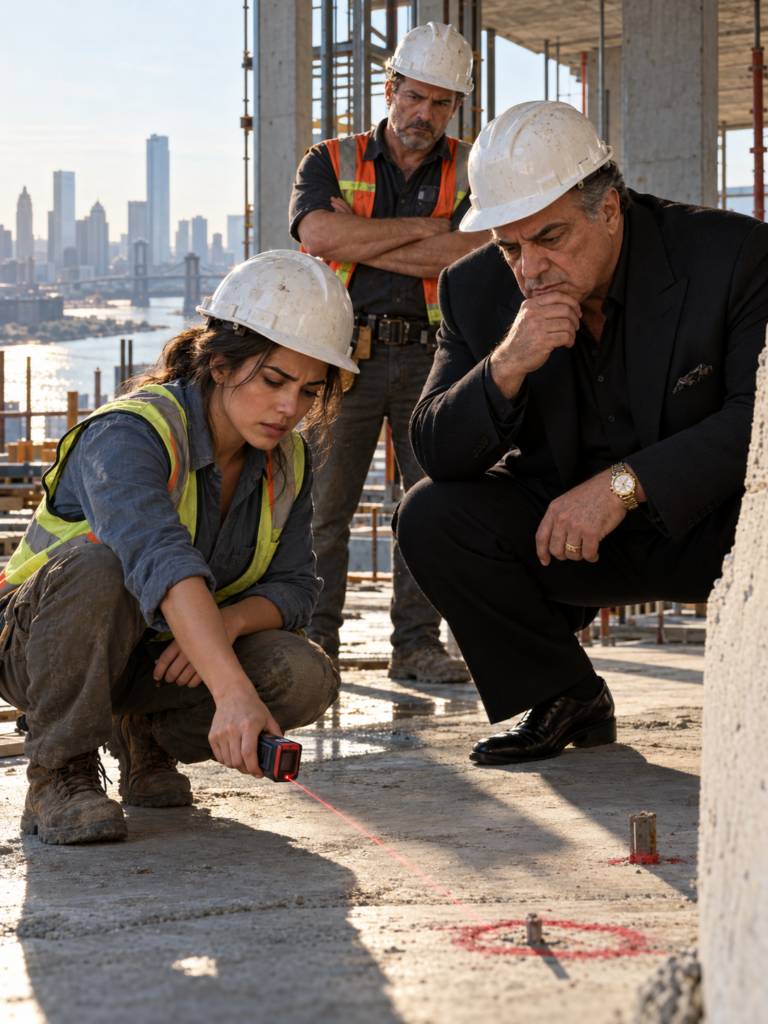
She set her case down, opened the lid, and reached for the instrument.
Elena lifted the instrument from its case and positioned it beside the nearest steel shore.
Matteo watched as she checked the base plate, recorded the reference position, and compared it against the construction drawings.
Derek stood several feet away, arms folded.
“What’s that going to tell you?” he asked.
“Whether the current position agrees with the documented arrangement.”
“You already know we moved them.”
“I know what you told me. I need measurements.”
There was no anger in her voice.
That irritated Derek more than an argument would have.
Matteo noticed.
“Let her work.”
Elena looked over her shoulder.
“I don’t need you to silence him for me.”
Matteo raised an eyebrow.
“No?”
“I need accurate answers. Even when I don’t like the person giving them.”
The reply surprised him.
He was accustomed to people treating his intervention as the end of an argument.
Elena treated it as a possible interruption.
And, disturbingly, he found himself respecting her more for it.
She finished the reading and marked the location.
Then she looked toward Derek.
“When the shores were moved, who supervised the work?”
“I did.”
“Was the slab loading checked before they were reset?”
“No.”
“Was the condition recorded afterward?”
“No.”
“Then that’s what we tell the independent team.”
Derek exhaled.
“You’re going to make sure this follows me.”
Elena closed her case.
“You made a decision that needs review. The consequences depend on what the investigation finds.”
She stood.
“What I’m not going to do is turn an engineering problem into a personal punishment before we understand it.”
Matteo studied her.
Most people who challenged Derek would have welcomed the opportunity to see him humiliated.
Elena seemed entirely uninterested.
Her concern remained fixed on the structure above them.
And that made her more difficult to dismiss.
By late afternoon, the affected levels were empty.
The concrete deliveries had been canceled.
The temporary engineering office had become a war room of drawings, measurements, and unanswered questions.
Outside, the unfinished tower cast a long shadow across the river.
Matteo remained on-site.
He had meetings to attend, financing calls to return, and men within the Rinaldi organization waiting for decisions unrelated to construction.
Yet he kept returning to one thought.
A woman had stopped his most visible development because she was unwilling to pretend she knew something she didn’t.
He had spent much of his adult life demanding the opposite.
Answers.
Certainty.
Results.
And above all, control.
At 5:40 that evening, Elena took another measurement.
She checked the result.
Then checked it again.
Matteo saw her face change.
“What is it?”
She did not answer until the instrument confirmed the second reading.
“The point moved again.”
Derek approached.
“How much?”
“Not much. But the change is continuing.”
“That doesn’t mean the neighboring bay is affected.”
“No,” Elena agreed. “It doesn’t.”
Derek spread his hands.
“Then we should reopen that area.”
Elena turned.
“We also don’t know that it’s unaffected.”
“You’re making every unknown a reason to stop.”
“I’m making unexplained structural behavior a reason to investigate before adding load.”
Matteo stepped toward the drawings.
“Explain what you think is happening.”
Elena took a breath.
“The temporary supports are part of a sequence. They carry and redistribute forces while the concrete develops strength. If three shores were relocated at the wrong stage, the load path could have changed.”
“And putting them back didn’t solve it?”
“Not necessarily. The structure may already have responded to the altered conditions. Resetting equipment doesn’t automatically restore the previous load distribution.”
Matteo stared at the drawings.
“Can it be repaired?”
“I expect there are manageable ways to address it. But I won’t promise a repair until the structural team verifies the cause.”
He nodded.
It was becoming easier to hear her uncertainty without interpreting it as weakness.
That evening, Matteo walked onto the river-facing side of the twenty-first floor.
Elena stood near the temporary railing, her white hard hat tucked beneath one arm.
The city lights had begun appearing across the water.
He stopped beside her.
“You knew I could have fired you.”
“Yes.”
“And you stopped the pour anyway.”
“Yes.”
“You make difficult conversations sound remarkably simple.”
She looked at him.
“You keep asking questions with very short answers.”
He nearly smiled.
“Are you always this direct?”
“When the answer matters.”
“And when it doesn’t?”
“I sometimes pretend to be polite.”
He laughed once, quietly.
It surprised them both.
For a moment, neither spoke.
Then Matteo asked, “Were you afraid?”
Elena looked down at her hands.
“Of course.”
“You didn’t show it.”
“Fear doesn’t always look like panic.”
“What frightened you most? Losing your job?”
“Being wrong.”
That answer made him turn.
She continued.
“If I halt work on a project this large, I need to be prepared to justify every decision. I can’t make the call because I’m nervous. I have to make it because the evidence requires it.”
“But you could have been wrong.”
“Yes.”
“And you’d have lived with that?”
“I would have reviewed the evidence, accepted the result, and learned from it. That’s the job.”
Matteo looked out toward the river.
“People who work for me rarely admit they’re uncertain.”
Elena was quiet.
Then she said, “Maybe they’ve learned that uncertainty is dangerous around you.”
The words landed harder than she intended.
He didn’t deny them.
“My father believed hesitation was an invitation to lose everything,” he said.
Elena glanced at him.
It was the first personal fact he’d offered without being asked.
“He taught you that?”
“He built his business by moving before other people finished thinking.”
“And you inherited the lesson.”
“I inherited quite a few things.”
His tone made clear that not all of them belonged in public conversation.
Elena knew enough about the Rinaldi name to understand the distinction between the development company and the organization behind it.
She didn’t ask.
Instead, she looked back at the tower.
“Fast decisions aren’t automatically bad. But when people are too frightened to tell you a decision is wrong, speed becomes a liability.”
He considered that.
“You’d make an exhausting business partner.”
“I’m an engineer.”
“That wasn’t a denial.”
She smiled faintly.
He noticed.
And for the first time all day, he found himself thinking about something other than concrete.
The independent structural team arrived before sunrise.
By eight, the twentieth and twenty-first floors were occupied by engineers reviewing the support arrangement, inspection records, and measurement history.
Elena worked beside them.
Matteo stayed close enough to understand the conclusions but did not interfere.
Derek answered questions about the delivery and the shore relocation.
The evidence developed into a consistent picture.
The supports had been moved after the previous afternoon’s inspection.
They had been reset without verification of the restored structural condition.
And the load redistribution associated with that change was consistent with the displacement Elena had identified the following morning.
The preliminary review did not claim the tower was about to collapse.
It did not need to.
The uncertainty was material.
Continuing the planned pour might have added stress to an already altered system before the team understood how the loads were being carried.
By late morning, the engineers had proposed a controlled recovery sequence.
Additional temporary support.
Managed load adjustments under engineering supervision.
Verification of the affected positions.
Revised construction sequencing.
Independent approval before work resumed.
Matteo read the report twice.
Then he found Elena standing by the river-facing railing.
He carried two paper cups of coffee.
She noticed them.
“Are you trying to influence the engineering department?”
“Would coffee work?”
“Depends how bad the engineering is.”
He offered her a cup.
“Then I assume I’m safe.”
She took it.
Matteo leaned beside her.
“You were right.”
“The report is still preliminary.”
“You were right to stop the work.”
She looked at him.
That distinction mattered.
He continued.
“We would have added load without understanding the changed support conditions.”
“Yes.”
“How much did you save me?”
“I can’t calculate a disaster that didn’t happen.”
“You’re very determined not to give me a comforting answer.”
“You seem to have plenty of people for that.”
He smiled.
This time, she smiled back.
The moment was brief.
But neither forgot it.
That afternoon, Matteo called Derek into the temporary project office.
The door closed.
Derek remained standing.
“I’ve read the preliminary findings,” Matteo said.
“So have I.”
“You’re being removed from site authority pending the formal review.”
Derek’s jaw tightened.
“I understand.”
“You signed a valid inspection. Then you changed the conditions without obtaining the necessary technical review.”
“I believed it was safe.”
“I believe you believed that.”
Derek looked surprised.
Matteo continued.
“That doesn’t make it acceptable.”
“No.”
“And I’m not going to pretend my demands had nothing to do with how this site operates.”
Derek raised his eyes.
“You set the deadlines.”
“I did.”
“You rewarded people who met them.”
“I did.”
“And when problems appeared, everyone tried to solve them before you heard about them.”
Matteo nodded slowly.
“That changes.”
Derek said nothing.
“But I won’t take responsibility for an engineering decision you made outside your authority. You own that.”
After a long moment, Derek nodded.
Matteo looked toward the unfinished tower beyond the office window.
He had feared betrayal most of his life.
Now he was facing a different problem.
People had been so afraid of disappointing him that they had stopped trusting him with bad news.
For a man whose criminal and legitimate enterprises depended on information arriving at the right moment, the realization was humiliating.
And it was his own making.
Three days later, the movement had stabilized under the approved temporary measures.
Five days later, the recovery plan passed independent review.
The tower remained behind schedule.
But the repair was manageable.
No one had been injured.
And the project could continue once the required checks were completed.
Matteo began changing the way recovery meetings worked.
At the first meeting, a superintendent estimated that one activity would take two days.
Elena watched his expression.
The man hesitated.
Matteo looked up.
“Is that your actual estimate?”
The superintendent shifted.
“Four days, realistically.”
“Then put four on the schedule.”
Several heads turned.
Matteo noticed.
He disliked discovering just how unusual honesty had become in his own meeting room.
Afterward, Elena caught him beside the door.
“That was progress.”
“Is that praise?”
“Don’t get carried away.”
He looked at her.
“Miss Marquez, I have an offer.”
She waited.
“I want you to lead the technical recovery.”
Her smile disappeared.
“No.”
For a man accustomed to negotiating with bankers, contractors, and dangerous associates, Matteo found that single word unexpectedly effective.
“No?”
“Not under the current arrangement.”
“I’m offering you authority over the engineers, the recovery sequence, and the technical decisions.”
“Until the next stop-work order costs you money.”
He folded his arms.
“You think I’d overrule you?”
“I think you make good decisions when the evidence has already reached you. I need to know what happens when it hasn’t.”
“What do you want?”
“Formal stop-work authority.”
“You already exercised it.”
“I exercised my professional judgment. I’m asking whether everyone will have to gamble their job next time.”
He was silent.
Elena stepped closer to the table.
“If I identify a condition that I reasonably believe requires a safety stop, work stops. Then management is notified. The concern is reviewed independently. If the evidence doesn’t support it, we document that and learn from it.”
“And if you are wrong?”
“I need the right to be wrong in good faith.”
Matteo looked at her.
She continued.
“Not negligent. Not careless. Wrong. People need to be able to raise a credible concern before they can prove the worst possible outcome.”
He turned toward the windows.
The tower stood against the afternoon sky.
For years, he had believed authority meant reducing the number of people who could challenge him.
Now one woman was explaining why a building might be safer if more people could.
He faced her.
“You have it.”
Elena blinked.
“Just like that?”
“In writing. With an independent review process and clear responsibilities.”
“Good.”
“And the policy applies beyond you.”
She looked at him more carefully.
“That’s better.”
He stepped nearer.
“You cost me a considerable amount of money.”
“I know.”
He waited until she met his eyes.
“It may be the most valuable interruption this project has ever had.”
For once, Elena had no immediate reply.
And Matteo, who had spent years being obeyed, realized he was beginning to want something far more difficult.
He wanted her to trust him.
But as Elena reached for the written recovery proposal, she stopped on a blank line beneath the heading for authorization.
“There’s one more thing,” she said.
Matteo glanced at the space.
“What?”
“I don’t want a promise that depends on whether you like me tomorrow.”
She handed him the document.
“I want a system that works even when you don’t.”
Matteo accepted the document and studied the empty authorization line.
Elena watched him.
She had already demonstrated that she could halt an eighty-million-dollar operation.
Now she was asking him to build something more difficult than another floor.
A system that would function when his pride was wounded.
A system that would protect workers even when the financial consequences were inconvenient.
A system that did not depend on the personal favor of Matteo Rinaldi.
“You’re asking me to surrender part of my authority,” he said.
“I’m asking you to make sure technical safety decisions can’t be reversed by a financial deadline.”
He looked up.
“There’s a difference?”
“A very important one.”
Matteo considered her words.
The Rinaldi organization had taught him that control was the foundation of survival.
Information moved upward.
Orders moved downward.
Disagreement was managed privately, if it was tolerated at all.
But this tower was not a criminal negotiation.
Concrete did not care who controlled the company.
Gravity did not recognize a family name.
And Elena had made that painfully clear.
“Write the procedure,” he said.
She remained still.
“With the independent review provisions?”
“Yes.”
“Clear technical authority?”
“Yes.”
“Protection against retaliation for good-faith safety stops?”
Matteo looked at her for a long moment.
“Yes.”
“And you sign it.”
“I’ll sign it.”
Elena took back the document.
“Then I’ll lead the technical recovery.”
His expression shifted.
“That was a negotiation.”
“Yes.”
“You knew what you wanted before you walked in.”
“Generally a useful habit.”
He laughed quietly.
“Remind me never to underestimate you again.”
“You can try.”
The policy was formalized the following day.
The engineering team received authority to suspend unsafe work based on documented concerns, followed by prompt independent technical review.
Good-faith reports could not be treated as misconduct merely because the investigation eventually found no hazard.
Management retained responsibility for resources and scheduling.
Engineers retained responsibility for technical judgments.
The distinction was not glamorous.
It did not look impressive in a boardroom.
But Elena knew the next person who saw a problem would have a different choice from the one she had faced.
And for her, that mattered more than being told she was brave.
Over the following two weeks, she led the recovery with the same discipline that had brought the concrete pour to a halt.
She questioned assumptions.
Reviewed measurements.
Worked with subcontractors rather than against them.
Challenged estimates that relied on optimism instead of evidence.
And occasionally challenged Matteo.
Especially Matteo.
During one meeting, a contractor explained why a revised installation sequence required additional time.
Matteo interrupted.
“How quickly can you finish if we add another crew?”
Elena looked across the table.
“That’s not the first question.”
The room became silent.
Matteo turned slowly.
“What did you say?”
She didn’t retreat.
“We need to understand the work sequence before deciding whether more people will help.”
A few executives exchanged glances.
Everyone knew who Matteo was.
Everyone knew what happened when his patience ran out.
But Matteo looked toward the contractor.
Then back at Elena.
Finally, he said, “What does the work require?”
The contractor began explaining.
The room relaxed.
Elena returned to her notes.
And Matteo discovered that being corrected in public did not weaken his authority nearly as much as refusing to learn would have.
Later, he caught her at the construction elevator.
“You enjoyed that.”
“Enjoyed what?”
“Correcting me in front of twelve people.”
She pressed the elevator button.
“Not particularly.”
“No?”
“I enjoyed watching the meeting become useful.”
The doors opened.
She stepped inside.
Matteo followed.
The elevator began its descent.
For several floors, neither spoke.
Then he said, “You have a remarkable ability to make me reconsider things I was certain about.”
“That sounds exhausting.”
“It is.”
“You’re welcome.”
He smiled.
At the lobby, she started toward the exit.
“Elena.”
She turned.
His expression had changed.
No irritation.
No business calculation.
Something quieter.
“Dinner.”
Her eyebrow lifted.
“Was that an invitation or an instruction?”
Matteo paused.
Once, he would have found the distinction unnecessary.
Now it mattered enormously.
“An invitation.”
“Then ask.”
He met her eyes.
“Would you have dinner with me?”
Elena considered him.
She had noticed the way he listened now.
The way he stopped himself before issuing unnecessary orders.
The way he had begun asking for technical advice instead of demanding reassurance.
None of it erased the power he possessed.
His name still opened doors and frightened people.
But he was learning not to use that power in every conversation.
“Yes,” she said.
His relief was almost invisible.
Almost.
“Friday?”
“Friday.”
“And Matteo?”
“Yes?”
“This isn’t a work meeting.”
“I understand.”
“Good. Because I’m not bringing drawings.”
For the first time in days, he laughed without restraint.
Three evenings later, they met at a quiet restaurant overlooking the river.
Matteo arrived alone.
Elena noticed immediately.
“No entourage?”
“Disappointed?”
“Curious.”
“I thought I could manage dinner without turning it into a security operation.”
She looked at him across the table.
“Very ambitious.”
They talked for nearly three hours.
Not about concrete failures or financing schedules.
About childhood.
About responsibility.
About the decisions people inherit before they are old enough to question them.
Elena told him why she had become a structural engineer.
She liked problems that could be understood through evidence.
She liked the responsibility of making decisions that mattered beyond a meeting room.
And she liked knowing that a good design could protect people she would never meet.
Matteo listened.
“What about you?” she asked.
“What about me?”
“Did you always want to run the family businesses?”
He considered the question.
“Wanting wasn’t really part of it.”
She waited.
“My father built his life around the belief that if you weren’t controlling a situation, someone else was controlling you.”
“And you believed him.”
“For a long time.”
“Do you still?”
Matteo looked out at the river.
“I think I’ve spent more time defending that belief than examining it.”
Elena studied him.
She understood that his world contained things he wasn’t prepared to explain over dinner.
And she wasn’t interested in pretending his criminal authority was harmless simply because he was attentive to her.
“You and I don’t live by the same rules,” she said.
“No.”
“I’m not going to pretend otherwise.”
“I wouldn’t ask you to.”
“And I don’t want my work tied to whatever happens between us.”
Matteo met her gaze.
“It won’t be.”
“Even if dinner goes badly?”
“Especially then.”
She smiled.
“That’s reassuring.”
“I was hoping dinner wouldn’t go badly.”
“It hasn’t.”
His expression softened.
Outside the restaurant, the evening air was cool.
The river reflected the lights of nearby buildings.
They stopped beside Elena’s car.
Matteo stood close enough that she could see the uncertainty beneath his composure.
He didn’t reach for her immediately.
He gave her space.
For a man who was accustomed to taking charge of every room he entered, the restraint felt unexpectedly intimate.
“Elena,” he said.
She looked at him.
He waited.
She stepped closer.
And when he kissed her, it was gentle.
Not a claim.
Not a victory.
Not an agreement that she would surrender anything.
Simply two adults choosing the same moment.
When they separated, Elena smiled.
“You look surprised.”
“I am.”
“By what?”
“How much better it feels when I don’t already know the answer.”
She laughed.
And Matteo realized he wanted to hear that laugh on days when nothing had gone wrong.
Two evenings later, he found her in the temporary engineering office after sunset.
The revised construction schedule covered an entire wall.
Red markings showed the days lost during the shutdown.
Matteo entered carrying two coffees.
Elena looked up.
“Should I be worried that this is becoming a routine?”
“Coffee?”
“You appearing with coffee whenever I work late.”
“I was told consistency matters.”
“By whom?”
“A very demanding engineer.”
She took one cup.
“Sounds like an intelligent woman.”
“Unreasonably.”
They worked quietly for a while.
Elena checked the next verification sequence.
Matteo reviewed financing notes.
Eventually, he closed the file.
“What do you think should happen to Derek?”
Elena stopped writing.
“That’s a management decision.”
“I know.”
“Then why ask me?”
“Because you were the person he challenged most directly.”
She leaned back.
“That doesn’t make me the right person to decide his punishment.”
“You aren’t angry?”
“I’m furious.”
“You hide it well.”
“No. I choose what to do with it.”
Matteo remained silent.
Elena continued.
“Derek made a dangerous decision. He changed the support conditions, failed to obtain the necessary review, and relied on an inspection taken before the change.”
“Agreed.”
“He needs to be held accountable.”
“Agreed.”
“But if you convince yourself he was the only problem on this project, you’ll miss the larger lesson.”
Matteo looked toward the red marks on the schedule.
“I created a culture where people feared bringing me delays.”
“Yes.”
“And Derek made an unacceptable technical decision.”
“Yes.”
“Both things can be true.”
“They have to be.”
He took a slow breath.
“The review board recommended removing him permanently from site-director authority.”
Elena listened.
“I approved that. He can remain with the company in a different role if he accepts reassignment and retraining.”
“Has he?”
“He asked for time to decide.”
She nodded.
“That seems reasonable.”
“A month ago, I would have dismissed him immediately.”
“Maybe you’d have felt better.”
“Probably.”
“Would it have made the next project safer?”
Matteo considered the question.
“Not by itself.”
She gave him a small smile.
“You’re learning.”
He looked at her.
“And you make it very difficult to avoid.”
The evening deepened.
Beyond the office window, the tower stood dark against the city.
Matteo moved closer.
“There’s something I need you to know.”
Elena set down her pen.
“What?”
“People around me often confuse loyalty with agreement.”
“I’ve noticed.”
“I used to think that was useful.”
“And now?”
“Now I wonder how many things I failed to see because no one wanted to be the person who told me.”
Elena watched him.
It would have been easy to offer comfort.
But she knew he wasn’t asking for it.
He was finally looking at the cost of his own habits.
“You can’t change what happened,” she said.
“No.”
“But you can change what people expect from you tomorrow.”
He nodded.
For a moment, their eyes held.
He reached toward her, then stopped.
Elena saw the hesitation.
It made her smile.
“Tomorrow,” she said, turning back toward the drawings, “we verify the repaired support line.”
“I know.”
“If there’s movement, we stop again.”
“I know.”
“Even if the lenders complain.”
“Yes.”
“Even if the delay is expensive.”
Matteo leaned against the table.
“Elena.”
“What?”
“I’m beginning to understand that you aren’t going to stop asking difficult questions.”
“No.”
He smiled.
“Good.”
Three weeks after the original shutdown, the twenty-first floor was ready for concrete again.
The repaired support sequence had passed independent review.
The monitored survey points remained stable.
The revised engineering documents were complete.
Every necessary approval had been obtained.
A new concrete truck waited below.
The crew gathered beside the work zone, checking equipment and receiving final instructions.
Elena stood near the same column where everything had begun.
She wore the same white hard hat.
The same dusty blue work shirt.
The same reflective vest.
But something fundamental had changed.
The first time she stood there, she had been one engineer facing an angry construction director and an owner powerful enough to end her career.
Now she had written authority.
Independent review.
A recovery team that trusted her judgment.
And workers who knew they could report a concern without risking punishment simply for being mistaken.
Matteo approached in a white hard hat and navy jacket.
He stopped beside her.
“Morning.”
“Morning.”
“Are we ready?”
Elena looked toward the survey station.
“Final reading first.”
He nodded.
No impatient glance at his watch.
No reminder about financing costs.
No demand for reassurance.
She checked the instrument.
Then checked it again.
The readings remained within the verified limits.
She reviewed the final release conditions.
Everything was in order.
Matteo waited.
At last, Elena turned toward him.
“Ready.”
He smiled.
“Then it’s your call.”
She raised the radio.
“Proceed with the pour.”
Below, the concrete pump came alive.
The hose moved into position.
Workers stepped forward.
Fresh concrete began filling the prepared area.
The building that had stood silent was moving again.
Matteo watched the operation for several minutes.
Then he turned toward Elena.
“The first time I saw you here, I was about to fire you.”
“I remember.”
“You weren’t particularly helpful about making that decision easy.”
“You asked for one reason.”
“You gave me one.”
“Eight millimeters.”
He shook his head.
“Eight millimeters.”
They looked at the column.
It appeared no different from hundreds of others in the tower.
But Elena knew the structure had told them something important.
And this time, someone had listened.
“What if you had been wrong?” Matteo asked.
She glanced at him.
“Then we would have documented the result, reviewed the stop, and improved our process.”
“And the lost time?”
“Would have been the cost of investigating a credible concern.”
Matteo smiled.
“You make that sound simple.”
“The principle is simple. Living by it is harder.”
He looked toward the crew.
“You’re right.”
Elena raised an eyebrow.
“That sounded suspiciously easy.”
“Don’t get used to it.”
She laughed.
The pour continued.
Later, when the operation had settled into its planned rhythm and the final checks remained satisfactory, Elena handed the active monitoring responsibility to the engineer assigned for the next shift.
Matteo waited near the construction elevator.
When she joined him, he pressed the call button.
“You’re quiet,” she said.
“Thinking.”
“About the building?”
“Partly.”
“What else?”
“The fact that I nearly lost the best engineer on this project because I didn’t want to hear an answer I disliked.”
Elena looked at him.
“You didn’t lose me.”
“No.”
“But that doesn’t mean you couldn’t have.”
He nodded.
“I know.”
The elevator doors opened.
They stepped inside.
As the car began descending, Matteo looked toward her hand.
He didn’t take it.
Elena noticed.
Then, with a small smile, she reached for his.
Their fingers intertwined.
The choice was hers.
Months later, the revised safety-reporting process had become a permanent part of the development company’s operations.
Elena continued leading technical work according to her professional judgment, with independent review and documented authority that did not depend on Matteo’s personal approval.
Their relationship remained separate from the engineering decisions she made.
When she challenged him in meetings, he listened.
When they disagreed, they discussed the disagreement instead of treating it as disloyalty.
And when Matteo returned to the harder world of the Rinaldi organization, Elena did not pretend that loving him made every part of that world acceptable.
He never asked her to.
They were not identical people.
They did not possess the same kind of power.
But they had learned to meet each other without demanding surrender.
One evening, standing together beside the river, Matteo looked toward the tower rising above the skyline.
“You know what I remember most about that morning?”
“The concrete trucks?”
“No.”
“Derek’s expression?”
“Memorable, but no.”
She smiled.
“Then what?”
“You weren’t afraid to tell me something I didn’t want to hear.”
Elena shook her head.
“I was afraid.”
He turned toward her.
“I know that now.”
“I just decided the answer mattered more.”
Matteo took her hand.
“That’s what changed the project.”
“And you?”
He looked at the illuminated building.
Then back at her.
“That changed me, too.”
Elena leaned against his shoulder.
Not because she needed his protection to stand.
Not because his name made her important.
Not because an eighty-million-dollar tower belonged to him.
But because the man who once demanded obedience had learned to respect a refusal.
And the woman who had been prepared to lose her job rather than ignore eight millimeters had never needed his permission to be right.
The first day they met, Matteo Rinaldi wanted one reason not to fire Elena Marquez.
By the time his tower began rising again, he no longer measured her value by how much money she saved him.
He measured the change she had made possible by the truth people were finally willing to tell.
And when Elena took his hand, it was not the end of her independence.
It was the beginning of a future they could both choose.