
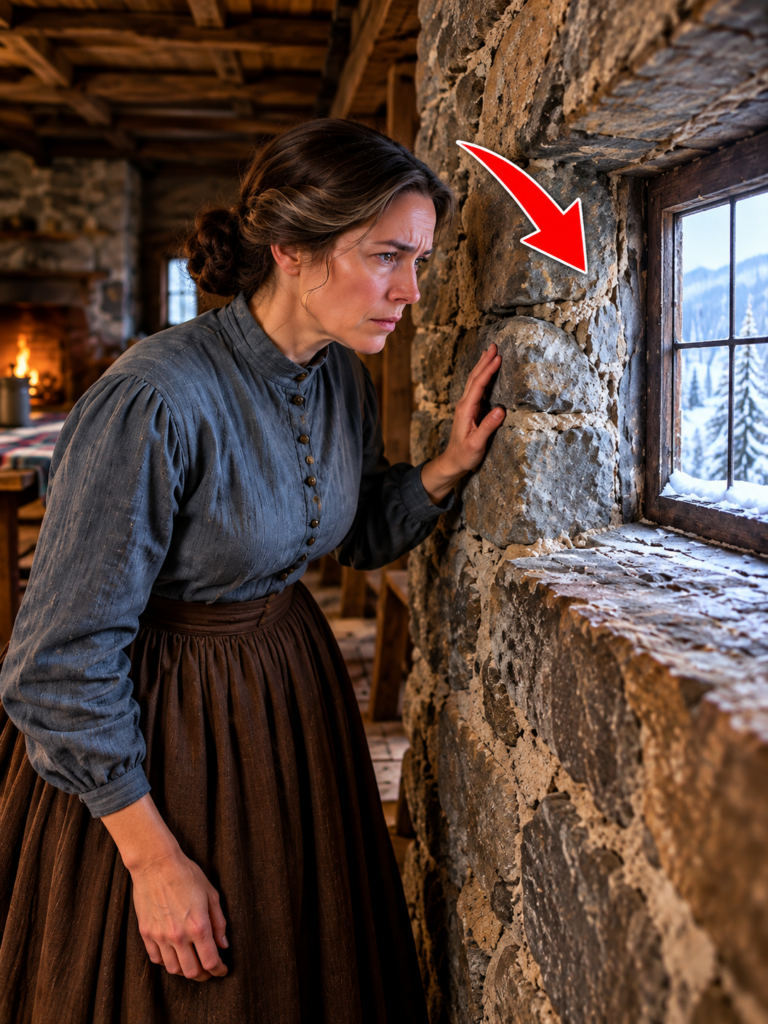
A blizzard was closing on the ridge. Ruth Hale had only a modest stack of properly dry firewood, and the stone cabin her family considered worthless had been cold for years.
A roaring fire could make the little room feel warm for an hour. But if she kept feeding it that way, her wood might disappear before the storm did.
The only thing about the cabin that made no sense was also the one thing she could not change.
Its walls were nearly three feet thick.
They swallowed the window opening so deeply that Ruth could stand an arm inside one and still not reach the outer face of the stone.
The cabin was smaller than the main room of her father’s timber house. Yet someone had carried enough rock up that ridge to build something closer to a fort than a home.
Her brothers had seen waste.
Ruth was beginning to wonder whether the waste was theirs.
Her father had died near the end of summer.
By October, the useful parts of his holding had been divided.
There was nothing dramatic about the division.
No shouting around a table. No lawyer reading an impossible will. Nothing Ruth could point to later and call cruelty.
That almost made it worse.
The pasture went where everyone expected it to go. So did the barn. The timber house stayed with the family member already working the largest share of the land.
Ruth received a narrow ridge parcel and the old stone cabin no one had used in years.
Her brother Caleb had tried to present it as fairness.
The cabin had a roof. It had a hearth. The spring below the ridge still ran. And Ruth, unlike a child, was perfectly capable of deciding what to do with it.
What he did not say was what everyone already understood.
If Ruth found the place impossible, there would always be room for her somewhere else.
Somewhere she would cook. Somewhere she would mend. Somewhere she would keep track of flour, salt, lamp oil, firewood, winter blankets, cracked handles, leaking shutters, and all the other small failures that only became important after everyone else had stopped noticing them.
She would be useful.
She simply would not own much.
Caleb came up the ridge with her on the afternoon she took possession.
The sky was pale and hard above the western mountains, and a line of cloud was building where the wind crossed the higher peaks.
He carried one crate inside while Ruth stood in the doorway.
The cabin smelled of old ash, dry dust, mouse nests, and stone that had not felt a fire in a long time.
The room was compact.
That was the kindest word for it.
One main room, a sleeping platform, a rough table, a stone hearth blackened by fires made years before.
Two small windows set into walls so thick that the daylight reaching the interior seemed to arrive from the ends of tunnels.
Caleb looked around once.
He did not have to say what he thought.
Ruth set her gloves on the table and went straight to the hearth.
She checked the old chimney opening first, then the door, then the windows, then the small stack of seasoned wood Caleb had helped bring up before the weather changed.
It was not enough for carelessness.
That mattered more to her than whether the room looked welcoming.
Caleb told her there was still time to come back down before dark.
Ruth looked toward the west.
The cloud line had thickened.
She had spent too many years preparing other people’s houses for winter to misunderstand what she saw.
The serious weather was not there yet, but it was coming.
She told Caleb she would stay.
He hesitated at the doorway as though waiting for her to change her mind.
She did not.
A few minutes later, Ruth watched him disappear down the ridge trail.
For the first time in her life, there was no one in the room expecting her to keep someone else’s house running.
The thought should have felt freeing.
Instead, the cabin felt colder.
Ruth did not begin with the fire.
That would have been the easiest thing to do.
Instead, she walked the room slowly.
Years of tending winter houses had taught her that cold had more than one way of entering.
Sometimes the walls themselves were cold.
Sometimes the floor held damp.
Sometimes a chimney drew badly.
And sometimes a house could burn through twice the wood it needed because a door that looked closed was still allowing the wind to pass around it.
She put her hand near the bottom of the door.
Cold air moved against her fingers.
At the first window, she felt less.
At the second, more.
The old wooden sash did not sit tightly against the opening, and the air coming through it had a direction that interested her.
The stone beside the window was bitterly cold, but stone did not move.
This did.
She opened her crate and unpacked only what she needed: food, a blanket, a lamp, a small pan, tools, a few strips of worn wool she had saved, because throwing away useful material had never made sense to her.
Only after that did she lay a fire.
At first, she kept it modest.
Then evening settled against the windows.
The cabin seemed to grow colder by the minute.
The stone had spent months giving up whatever warmth summer had ever put into it.
Every surface Ruth touched felt as though it belonged outdoors.
Her patience lasted until full darkness.
Then pride made the decision that experience should have made more carefully.
Ruth added wood and then more.
The fire rose bright and strong.
For the first time that day, heat reached her face without asking permission.
She moved the chair closer.
The air around the hearth warmed.
Her hands stopped aching.
For perhaps twenty minutes, the cabin felt conquered.
Ruth almost laughed.
All that stone, all those warnings, all the looks her brothers had exchanged, and the answer was fire.
Then she looked at the woodpile.
The answer was not fire.
Not like this.
She had burned through far more of the dry pieces than she had meant to use before supper, and the rest of the room was still fighting her.
The air nearest the hearth was warm enough.
Her back was cold.
The floor near the door was colder still.
Every time the wind strengthened outside, she felt another thin movement of air along her boots.
When the flames finally settled, the little comfort she had created began slipping away faster than she expected.
Ruth sat motionless for a moment.
Then she stood.
She did not add another log.
That was the first important decision she made in the cabin.
She carried the lamp to the door.
The flame moved when she brought it near the lower edge.
Not much.
Enough.
At the window, it trembled again.
Ruth ran her fingers around the frame.
The problem was not one large hole.
It was a collection of small failures.
Warped wood, worn edges, old gaps, fittings no longer tight enough to resist a steady mountain wind.
She pressed folded wool into the worst places only as a temporary measure.
The room did not suddenly become warm, but the movement of cold air weakened.
That told her more than another armload of firewood would have.
She turned toward the wall.
Three feet of stone.
For the first time, the thickness irritated her.
A timber cabin would have responded faster to the fire.
This place seemed to demand heat simply to stop feeling like a cellar.
Why would anyone build that much wall around one small room?
Ruth lifted the lamp to the window.
The opening was so deep that its inner edge formed a stone recess large enough for a person to sit in.
There were marks on one side she had ignored earlier.
Two dark scars where iron had once been fixed.
On the opposite side, a worn notch.
She held the lamp closer.
Hinge points and a catch.
There had been something else there once.
Not outside the window, inside it.
Ruth looked at the other opening.
The same marks.
She searched the cabin again.
This time, not for what she needed, but for what was missing.
Behind the sleeping platform were old boards.
Most were useless scraps.
One was not.
It was broad, heavy, and joined across the back by two narrow braces.
One edge still held the remains of a strap hinge.
Ruth carried it to the first window.
The width was almost exact.
An inner shutter.
Someone had once been able to close the entire room side of the window.
She set the panel down and looked at the wall differently.
The window was not deep because someone wanted a dramatic window.
It was deep because the wall was massive, and whoever had lived here had used that depth.
Small glass opening outside.
Deep recess, heavy closure inside.
The first clue had been sitting in front of everyone.
They had simply decided the cabin was foolish before asking why it looked the way it did.
By morning, Ruth’s first fire was almost gone.
The night had not been comfortable.
But she had learned enough to stop thinking of the cabin as one problem.
It was several problems tied together.
The walls were cold.
The openings leaked.
The room had been unused.
The wood supply was limited, and the weather was getting closer.
She ate quickly and began with the window.
The old shutter could not simply be rehung.
One hinge was damaged.
The original catch was gone.
The panel had warped slightly after years without use.
Ruth worked with what she had.
She repaired the hinge enough to carry the load.
She fitted a simple fastening on the opposite side.
It was not pretty.
It did not need to be.
By midday, the first window could close.
The difference was visible before it was measurable in comfort.
The room became darker.
Caleb would have hated that.
Ruth smiled at the thought.
Then she dealt with the largest gaps around the door.
Only after that did she build another fire.
This one was smaller.
She fed it deliberately.
No blaze reaching high into the chimney.
No rush to make the room pleasant.
In ten minutes, she let the heat work.
At first, the result seemed disappointing.
The cabin remained cool.
The stone remained cold to the touch, except near the hearth.
Outside, clouds gathered over the ridge.
Ruth kept going.
An hour passed, then another.
The fire stayed steady.
The woodpile shrank, but not with the frightening speed of the night before.
When the flames settled lower, Ruth waited for the room to turn immediately uncomfortable again.
It did not.
It still cooled.
Of course, it cooled.
The walls had not become insulation simply because they were thick.
Stone could take in heat, and stone could carry heat away.
A heavy wall did not create warmth, and it could not replace a fire, but heavy things changed temperature slowly.
And now that Ruth had reduced some of the moving cold air at the openings, the room itself was changing more slowly, too.
Not warm.
Not effortless.
Slower.
That was enough to change the question.
The cabin had never been meant to behave like the timber house below.
It was a different kind of shelter.
Small openings, a compact room, heavy masonry, closures that could turn the windows from weak places into protected ones, a hearth at the center of everything.
Whoever built it had not been trying to make a room that warmed quickly.
He had been building a room that resisted quick change.
Ruth stood in front of the three-foot wall and understood the cost of that advantage.
At the same moment, she understood the advantage itself.
If the stone was allowed to become deeply cold, she could not wait until the storm arrived and repair the mistake with one enormous fire.
The cabin needed time, and time was exactly what the sky was taking away.
The first snow arrived before sundown.
Not much.
A handful of dry grains skittering across the ground, but the wind behind them had changed.
Ruth went outside and looked west.
The mountains were disappearing.
She had expected another half day.
She no longer believed she had it.
From that moment, every task had to answer one question.
Would this matter after she could no longer safely leave the cabin?
She stopped doing work that merely made the place look inhabited.
She did not sweep the second half of the floor.
She did not unpack the rest of her crate.
She did not repair the loose shelf.
She worked on heat and weather.
The second inner shutter was too damaged to restore completely, but she could reduce its worst gaps and brace it closed.
She checked the door again.
She checked the chimney draw.
She moved more dry wood inside.
Not all of it.
There was too much to justify filling the small room, and some remained protected against the exterior wall under a simple cover.
But she moved enough that she would not have to open the door every hour.
By dark, snow was falling steadily.
Ruth ate beside the hearth.
The fire was smaller than the one she had built the previous night.
The room felt better.
That difference mattered.
Not because the stone had become warm everywhere.
It had not.
Not because the cabin was airtight.
It was not.
The improvement came from dozens of smaller facts working together.
Less wind entering around the openings.
Less exposed glass.
Less reason to open the door.
A fire maintained instead of repeatedly rebuilt from cold.
A compact space gradually moving away from the temperature of the abandoned building Ruth had entered the day before.
It was no miracle.
It was management.
That was a kind of work Ruth understood.
The storm reached the ridge during the night.
Ruth woke to the sound of wind striking the cabin hard enough to make the roof timbers answer.
She sat up.
The fire had burned low.
For one frightening second, she saw the dim coals and wanted to throw three pieces of wood onto them at once.
Instead, she listened.
The door was holding.
The chimney was drawing.
The shutters were closed.
The room was cold, but not like the first night.
She added one piece, then another, only after the first had caught properly.
Outside, the storm had erased the world.
At dawn, there was no true sunrise, only a gray increase in light around the edges of the shutters.
When Ruth opened the door a few inches, wind drove snow against her boots.
She shut it immediately.
The ridge trail was already disappearing.
The decision about leaving had been taken from her.
Now the cabin did not have to prove it was worth keeping.
It had to keep her alive.
By late morning, Ruth began thinking about the wood outside.
She had enough inside for the day if she remained careful.
Beyond that, she would need more.
The covered stack was only a short distance from the door.
In clear weather, it would have meant nothing.
In the storm, that distance had changed.
Every opening of the door replaced part of the room’s air with mountain cold.
Every trip outside meant wet snow on clothing, numb hands, and time spent recovering.
Ruth waited until she could justify one trip instead of three.
She put on every outer layer she had.
She prepared an empty place inside for the wood before opening the door.
Then she went.
The wind hit from the side.
Snow had packed against the lower part of the exterior wall and drifted around the wood cover.
Ruth dug with her hands until she could reach the driest pieces.
She took as much as she could carry safely.
No more.
A fall in that weather would cost more than an extra trip could save.
When she came back inside, she closed the door before setting anything down.
Only then did she stack the wood.
The fire had not gone out.
The cabin had lost heat.
She could feel it, but the room recovered without panic.
That mattered more than comfort.
Ruth looked at the stack she had brought inside.
For the first time, she believed the fuel might be enough.
Then the west shutter knocked once against the stone.
She turned.
It knocked again.
The fastening Ruth had repaired was moving.
Not open.
Not yet.
But each hard gust pulled the warped panel against its catch.
The movement was small.
The consequence would not be.
Ruth crossed the room and put one hand against the shutter.
Cold entered along one edge.
The gap was narrow enough to ignore in calm weather.
The storm was not calm weather.
She held the panel closed and studied the fastening.
The old wood around it was beginning to split.
If she simply drove the catch tighter, she might tear it free completely.
For a few seconds, the cabin placed her back at the beginning.
A problem, a limited resource, no perfect tool.
No one coming to solve it.
Ruth released the shutter carefully.
It shifted.
Wind hissed through the gap.
She used a short piece of sound wood as a brace and changed the load so the damaged catch no longer carried the entire force by itself.
The next gust struck.
The panel flexed.
The brace held.
Another gust.
Still held.
Ruth kept her hand there through three more.
Only then did she step away.
Her fingers were cold.
The room was colder.
And the fire had fallen again while she worked.
This time she did not punish the problem with fuel.
She rebuilt the fire gradually.
The storm had taught her the final piece of the cabin’s logic.
Its strength did not come from one feature.
Three-foot walls could not save a room with an open window.
A shutter could not save a room with no fire.
A fire could not be fed forever if the door and windows gave the warmth away as quickly as she made it.
The value was in the system, and systems failed at their weakest points.
By afternoon, the storm had become worse.
Snow pressed against the lower exterior walls.
The sound in the chimney changed with every gust.
Ruth kept a careful watch on the fire and the west shutter.
The daylight disappeared early.
She counted the dry wood inside again.
There was enough.
Probably.
That word did not comfort her.
There was enough if the wind weakened.
Enough if the repaired brace held.
Enough if she did not waste any.
Enough if the coldest hours were not much colder than the ones already behind her.
Frontier survival was full of words like that.
Probably.
If.
Maybe.
Ruth had spent years turning those words into lists.
What could she control?
The fire, the openings, the amount of time the door stayed closed, her clothing, her food, where she sat, what she did not waste.
What she could not control was the mountain, so she stopped arguing with it.
Near midnight, the cold deepened.
Ruth knew it without a thermometer.
The sound of the snow changed.
The shutter edges whitened where moisture met the coldest surfaces.
The floor near the door seemed to harden beneath her boots.
The fire was still alive, but the stack beside it was small enough now that she could count every remaining piece without moving from her chair.
On the first night, she would have looked at that stack and built the largest fire she could.
Now she understood what that would buy.
A short hour of relief, then less wood.
The cabin itself had been warmed gradually for more than a day.
The interior stone nearest the hearth no longer had the dead cold of an abandoned building.
The worst openings were controlled.
The shutters were holding.
The door stayed closed.
The room was not warm in the way a comfortable house was warm.
Ruth still wore her coat.
Her hands still wanted the fire, but the cold was not racing through the room.
It was advancing slowly.
That was the difference.
And sometimes survival was nothing more glamorous than making danger move slower than time.
Ruth placed one piece of wood on the fire.
She waited.
Outside, the wind continued.
The wall did not defeat winter.
It did not stop heat from leaving, but three feet of stone could absorb a great deal of heat and change temperature slowly.
And the immense wall had also given the builder deeply protected openings that could be closed against the storm.
Combined with a small room, controlled drafts, and a steady fire, that slowness had value.
Not enough to make the cabin modern.
Not enough to make it effortless.
Enough to buy hours.
Ruth only needed the night to run out before the wood did.
Sometime before dawn, she woke in the chair.
The fire was low.
For a moment, she thought the wind had stopped.
Then she realized it had merely changed.
The great pressure against the west wall was gone.
Snow still moved outside, but the long violent gusts had weakened.
Ruth stood stiffly and crossed to the shutter.
The brace remained in place.
She touched the stone beside it.
Cold.
Then she moved closer to the hearth and touched the inner face of the wall there.
Not hot, not even truly warm, but different from the outer edges of the room.
The cabin had not held summer inside its walls.
It had held the result of everything Ruth had done since the first failed fire.
Piece by piece, hour by hour.
She opened the door after full daylight.
The ridge had vanished beneath snow.
The path Caleb had taken two days before no longer existed.
Drifts climbed against the stone.
Branches had come down along the slope.
The air outside made the inside of the cabin seem almost gentle.
Ruth closed the door.
There was no reason to go anywhere.
For the first time, staying was not a challenge she had set herself.
It was simply what she wanted to do.
The weather broke slowly.
By the following afternoon, there were moments when sunlight appeared between fast-moving clouds.
The snow was deep enough that travel remained difficult.
Ruth used the quiet hours to repair what the storm had exposed.
She did not replace the shutter brace.
It worked.
She did not burn a celebratory fire.
She had learned better.
She made food, dried her outer clothes, carried ash from the hearth, and finally unpacked the rest of her crate.
That was when the cabin changed more than it had during the storm.
A folded dress went onto the sleeping platform.
Her sewing things went into the small chest.
A cup stayed on the table instead of returning to the crate.
A loaf of bread went into the deep window recess where the closed inner shutter protected it from the glass.
The same feature that had made the room look absurd when Ruth arrived now had a use she had chosen for herself.
She was arranging a home.
Caleb reached the ridge the next day.
Ruth heard him before she saw him.
His boots dragged through the snow outside, followed by the dull sound of him clearing the doorway.
When she opened it, his face carried the expression of a man who had already prepared himself to be right.
Then he looked past her.
The fire was modest.
There was wood remaining.
The shutters were closed against the bright snow.
A pan sat near the hearth.
Ruth’s coat was hanging to dry instead of wrapped around her body.
Nothing inside looked desperate.
Caleb stepped into the room.
His eyes went first to the fire, then to the wood, then to the repaired west shutter.
Ruth did not explain.
That was the part of the moment she enjoyed most.
For years, she had explained why flour had to be bought before the road turned bad.
Why damp wood had to be separated from dry.
Why a door needed repairing before December instead of after it failed.
Why food had to be moved before the first hard freeze.
Why a hundred small things mattered.
The work had always been easiest to dismiss when it succeeded.
Because when preparation worked, nothing happened.
This time something had happened.
The mountain had supplied the evidence.
Caleb walked to the deep window.
He examined the shutter, then the wall.
He put his palm against the stone near the hearth.
The surface there still carried some of the heat the room had given it.
Not enough to warm the cabin by itself.
Enough to make the point.
He finally asked what Ruth intended to repair next.
Not when she was coming back.
What she intended to repair next.
Ruth looked up at the roof.
There were several things.
There always would be.
That was different from saying the place was worthless.
Caleb stayed long enough to bring in more wood from outside.
Before he left, he paused at the doorway.
The ridge below was brilliant under the new snow.
For a moment, Ruth could see the roofs of the lower buildings through the trees.
The timber house was still there.
The barn was still there.
The pasture would return in spring.
None of those things had become worthless because the stone cabin had survived a storm.
And Ruth did not need them to.
That was not the justice she wanted.
She had spent too many years being measured by what other people possessed to make the same mistake herself.
The cabin did not have to be better than her brother’s property.
It only had to be hers.
After Caleb disappeared down the ridge, Ruth closed the door.
This time, almost no cold air moved around the lower edge.
She had already fixed it.
That evening, she lit no great blaze.
A small fire burned steadily on the hearth.
Outside, the wind moved loose snow from one drift to another.
Inside, Ruth closed the restored shutter.
She placed the loaf back in the deep stone recess.
Then she sat down beside the wall everyone had thought was excessive.
Three feet of stone had not made winter disappear.
It had not produced heat.
It had not rescued her from bad preparation.
What it had done was give a patient person something useful to work with.
Strength against the wind.
Deep protected openings and a massive room that changed slowly once she learned how to manage it.
The cabin had never been worthless.
But neither had it been waiting for winter to reveal some magical secret.
It had been waiting for someone to pay attention.
Ruth had spent most of her life doing exactly that.
And now, for the first time, the house kept running because she understood it, and the house was hers.

