
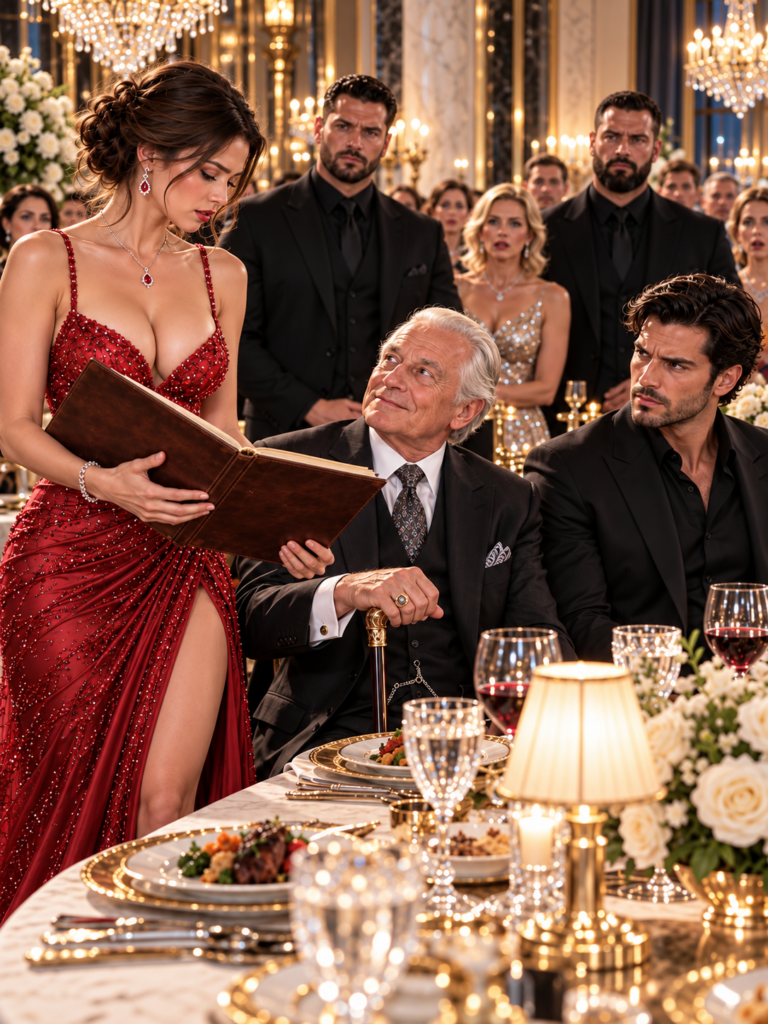
PART 2
For three long seconds, nobody moved.
Then Salvatore Rossi’s mouth twitched.
It wasn’t quite a smile. It looked more like his face had forgotten how to make one and was attempting to remember.
Gabriel recovered first.
“Father,” he said quietly.
Salvatore lifted one thin hand. The gesture silenced him.
His eyes remained on me. They were pale, almost colorless, but they had lost some of their hardness.
“Who taught you to speak like that?” he asked in Sicilian.
“An old man who lived above my apartment.”
“His name?”
“Mr. Cosenza.”
The change in Salvatore was so slight that I might have missed it if I hadn’t been watching closely. His fingers tightened around the head of his cane. Gabriel noticed too. His gaze moved from his father to me.
“What did you say?” he asked in English.
I answered before I could reconsider.
“I said I can bring your father what he asked for.”
Gabriel looked as though he wanted to question me, but the restaurant had become a theater, and every table was watching. A woman near the bar held her wineglass suspended halfway to her lips. At the next table, a man who had spent the last ten minutes speaking loudly about cryptocurrency suddenly found the pattern in his tablecloth fascinating.
Salvatore tapped his cane once.
“Meat,” he said. “Garlic. Oil. And wine that has seen a vineyard.”
“I’ll see what the kitchen can do.”
“Not what the kitchen can do.” His gaze sharpened. “What you can do.”
I glanced toward the swinging doors. Behind them, Chef Laurent was probably already planning my funeral—not a literal one, I hoped, but a professional one. The menu at Ilvento was built around precision. Foams, reductions, edible flowers, sauces that required tweezers. Fire and garlic were tolerated only when introduced by a French name and charged at least forty dollars.
“I’m a server,” I reminded him. “Not the chef.”
“Then ask the chef to let you borrow his kitchen.”
Gabriel leaned forward. “Father, this isn’t necessary.”
Salvatore turned toward him. “You brought me to a place where they serve raw fish on ice and call it dinner.”
“It was the only place with a private table on short notice.”
“That is not a defense.”
“It’s Friday night.”
“That is also not a defense.”
Something in Gabriel’s voice changed. The tension around his mouth softened, and for a moment he sounded less like the feared son of a powerful family and more like an exhausted man trying to keep an aging parent from starting another argument.
I took the opportunity to step away.
In the kitchen, the air was hot with butter, steam, and panic.
Chef Laurent stood beneath the copper pans, his white jacket immaculate except for a streak of sauce near his elbow. Richard was beside him, whispering so rapidly that his words became one long, frightened breath.
“She can’t just— We have reservations— The table has already had the amuse-bouche— This is not a trattoria—”
“I need a steak,” I said.
Both men stared at me.
“For the old man,” I added.
“I know who it’s for,” Chef Laurent said. “The entire kitchen knows who it’s for. Half the dining room knows who it’s for. The other half is pretending not to listen.”
“He wants bone-in, cooked over fire, with garlic and oil.”
Chef Laurent’s expression suggested I had asked him to prepare a grilled shoe.
“We don’t serve that.”
“I know.”
“We have a dry-aged rib eye.”
“Can you cook it over the wood grill?”
“It’s for the tasting menu.”
“Can you?”
He looked at me for a long moment. Chef Laurent had never liked me much. Servers were furniture in his world—necessary, occasionally in the way, and best kept quiet.
But then he glanced through the service window toward Salvatore’s table.
“Yes,” he said. “I can.”
“And garlic?”
“I have garlic.”
“And good olive oil.”
“I’m French, not criminal.”
I almost laughed. The sound surprised me. I hadn’t expected to feel amused with my heart beating that hard.
“Thank you.”
“Wait.” He reached beneath the counter and brought out a small cast-iron pan. “If he complains, tell him the chef is from Lyon and therefore incapable of understanding happiness.”
“I’ll tell him you said that.”
“You absolutely will not.”
I carried the order back to the table.
Salvatore examined me as I poured water into his glass.
“The chef will prepare a rib eye over the wood grill,” I said. “Garlic, oil, and salt. He has no bone-in steak available, but this is close.”
“Close is what people say when they know they have failed.”
“Then you may complain after you taste it.”
Gabriel looked down, and I realized he was hiding a smile.
Salvatore saw it too.
“Something amusing you?”
“No, Father.”
“Your face disagrees.”
Gabriel picked up his water. “I’m enjoying watching someone else speak to you the way you speak to everyone else.”
For the first time, Salvatore looked genuinely offended.
Then he began to laugh.
It was a rusty, uneven sound, as if it had been stored somewhere for years and had to be shaken loose. Gabriel stared at him. I did too.
The laugh lasted only a few seconds, but it changed the table. The bodyguards exchanged glances. One of them, the broader of the two, looked down at his hands as though embarrassed by the sudden warmth in the room.
Salvatore cleared his throat.
“Your mother used to say the same thing,” he told Gabriel.
Gabriel’s smile disappeared.
The old man looked toward the dark window. Outside, rain had begun to blur the lights of Manhattan into golden streaks.
“My mother?” Gabriel asked.
“Your mother,” Salvatore repeated. “She said I argued with waiters because I was afraid they would forget I existed.”
Gabriel’s expression went still.
I should have walked away. A server learns to recognize the borders around private grief. But Salvatore reached for his wineglass and missed it by an inch, and Gabriel quietly moved it closer to him.
The gesture was practiced. Familiar. Tender in a way neither man seemed willing to acknowledge.
“Your mother had a talent for making insults sound like observations,” Salvatore said.
“She had a talent for being right.”
“That too.”
The steak arrived twenty minutes later.
Chef Laurent had done more than I expected. The rib eye came on a thick wooden board, its edges darkened by the grill, the surface shining with olive oil. Roasted garlic sat beside it with a small dish of sea salt and crushed black pepper. The scent rose above the restaurant’s expensive perfume and made me suddenly aware that I hadn’t eaten since noon.
Salvatore leaned toward the plate.
He didn’t touch it immediately.
Instead, he closed his eyes.
“What?” Gabriel asked.
“Nothing.”
“You look—”
“I said nothing.”
But his voice had changed again.
I brought a knife and fork. Salvatore ignored both and asked for a smaller knife. When I gave him one, he cut into the steak carefully, tasted a bite, and sat back.
The restaurant waited.
I pretended to check the water glasses at the next table.
“Well?” Gabriel asked.
Salvatore chewed slowly. He swallowed. Then he tore a piece of roasted garlic with his fingers and spread it across the meat.
“It’s too expensive,” he said.
Gabriel released a breath that sounded almost like a laugh.
“That’s your complaint?”
“It should cost half as much.”
I leaned closer. “That isn’t the same as saying it’s bad.”
“No.” Salvatore took another bite. “It is not bad.”
From Salvatore Rossi, it sounded like a standing ovation.
When I returned with the wine, Gabriel was looking at me differently.
Not with suspicion. Not exactly.
With calculation, perhaps. He had the habit of a man who had spent years studying rooms for exits and people for motives. I had seen that look directed at business associates, at his father’s guards, even at Richard when the manager came too near their table.
Now it was on me.
“You really learned Sicilian from an old neighbor?” he asked.
“Mostly.”
“Mostly?”
“Mr. Cosenza spoke it when he was angry. He was angry often.”
Salvatore cut another piece of meat.
“What did he teach you?”
“How to complain about bad coffee. How to tell the difference between someone who is poor and someone who is simply cheap. How to make pasta with almost nothing in the cupboard.”
“Useful lessons,” Salvatore said.
“He also taught me that people reveal themselves by how they treat those who can’t give them anything.”
The words came out before I could stop them.
Gabriel’s hand paused near his glass.
Salvatore looked at me for a long moment, then nodded once.
“Your old man was wise.”
“He was lonely,” I said. “Sometimes those look similar from a distance.”
That silenced him.
A server from the next section approached with a nervous expression. “Tessa, table fourteen needs—”
“Give me one minute,” I said.
The server nodded and retreated.
Salvatore watched her go. “They call you Tessa.”
“Yes.”
“Not Theresa?”
“Not unless I’m in trouble.”
“Are you in trouble now?”
“Probably.”
His mouth twitched again.
The night continued around us. Plates moved, wine was poured, chairs scraped softly across the floor. Gradually, the other diners began to return to their own conversations. The spell of the table loosened. The bodyguards ate nothing, though I brought them bread. Gabriel finished his wine but refused a second glass.
Salvatore ate half the steak.
For a man who had begun the evening threatening to burn down the restaurant, he became almost peaceful. He asked for more garlic. He requested bread to wipe the oil from the board. When I brought it, he dipped a piece into the remaining juices and said something in Sicilian that sounded like a blessing.
“What did he say?” I asked Gabriel.
Gabriel looked at his father.
“Nothing.”
Salvatore glanced up. “I said the bread was acceptable.”
“That wasn’t what you said.”
“You didn’t ask what I meant.”
The exchange was so ordinary that it hurt.
I had seen fathers and sons in the restaurant before. They arrived carrying briefcases, talking about acquisitions and mergers. They argued over college applications and vacation homes. They ordered for one another without asking.
But there was something fragile between these two, something old and unfinished.
When I returned with the check, Salvatore didn’t look at it.
“How long did you know Cosenza?” he asked.
The question landed softly, but I felt the shift in the air.
“Four years.”
“Where did he live?”
“On West Ninth, above the tailor shop.”
“What floor?”
“Third.”
“Was he alone?”
“Mostly.”
“Mostly?”
“He had a sister in Queens. She visited on Sundays. Sometimes.”
Salvatore’s fingers tightened around his cane.
“What was his first name?”
I hesitated.
“Mr. Cosenza never told me.”
“That is not an answer.”
“It’s the only one I have.”
“You called him Cosenza.”
“That’s what everyone called him.”
“Everyone?”
“The landlord. The mail carrier. The woman who brought his prescriptions. He didn’t like first names.”
Salvatore looked down at the steak board.
Gabriel leaned toward him. “Father, why do you care?”
The old man did not respond.
Gabriel turned to me. “Did he ever mention Palermo?”
“All the time.”
“Did he mention a place called Santa Lucia?”
The name prickled along the back of my neck.
I thought of Mr. Cosenza’s apartment: the faded blue curtains, the brass coffee tin, the framed photograph of a hillside covered in lemon trees. I remembered him speaking of a village near the sea, though I had never been sure whether it was a real place or a memory he had built in his mind.
“He mentioned it once,” I said. “He said it was where the women sang while they worked.”
Salvatore’s face drained of color.
Gabriel noticed. “What is it?”
Salvatore pushed himself back from the table.
“Nothing.”
“You asked her about him.”
“I asked a question.”
“You haven’t said that name in years.”
“Enough.”
The word was quiet, but it carried weight. Gabriel leaned back, jaw tight.
I set the check down between them.
Salvatore ignored it. “When did he die?”
My hand stopped.
“How did you know he died?”
“You said you knew him for four years. You spoke of him in the past tense.”
I looked at Gabriel, then back at Salvatore.
“Three months ago.”
“Three months?”
“He had a stroke.”
Gabriel’s eyes softened, though his father’s did not.
“He was in the hospital for nine days,” I continued. “His sister wouldn’t answer my calls. When I finally found out where he was, he was already gone.”
“Did he leave anything?”
The question was too immediate.
I folded the check beneath the leather folder. “A few things.”
“What things?”
“Books. A radio that only received one station. A kitchen table with one leg shorter than the others.”
“That is not what I asked.”
“No,” I said. “It’s what I chose to answer.”
One of the bodyguards shifted in his chair. Gabriel raised a hand slightly, and the man settled.
Salvatore studied me with an intensity that might once have frightened me. Now I saw something else beneath it. Not anger.
Fear.
Not fear of me, either.
Fear of a door that had been closed for a very long time and might open if he touched it.
“Did he give you a message?” Salvatore asked.
“No.”
“Did he say my name?”
I thought of the final afternoon I had spent in Mr. Cosenza’s apartment. He had been unusually quiet. I had brought him soup, and he had refused it, insisting he wanted coffee. His hands had trembled so badly that I’d held the cup for him.
Before I left, he had called me back.
“Tessa,” he’d said, “if anyone ever asks about the old country, you tell them I died owing nobody anything.”
At the time, I had assumed it was one of his dramatic sayings.
Now I remembered the way he had looked at me.
“No,” I said. “He never said your name.”
Salvatore lowered his eyes.
Gabriel reached for the check, but his father stopped him.
“Take me home.”
“We haven’t finished.”
“I am finished.”
The old man tried to stand. His bodyguards moved instantly, but Gabriel rose first and offered his arm. Salvatore accepted it after a moment’s hesitation.
As he turned, something slipped from the inside pocket of his jacket and fell against the table.
A small envelope.
It landed face up.
My breath caught.
The paper was yellowed at the edges, and across the front, in shaky black handwriting, were two words:
For Tessa.
Salvatore saw it at the same moment I did.
His hand moved toward the envelope, but I was closer. I picked it up.
The room seemed to narrow around us.
Gabriel stared at the writing.
“Father,” he said slowly, “where did you get that?”
Salvatore looked at me, and all the age in his face seemed to fall away, leaving behind a tired young man standing on a road he had once chosen and regretted ever since.
“I found it,” he said.
“Where?” Gabriel asked.
Salvatore didn’t answer him.
His eyes remained fixed on the envelope.
“Your neighbor,” he said to me, “was not named Cosenza.”
I looked down at the handwriting again.
The final line beneath the name was almost too faint to read.
But I could make it out.
Tessa, if Salvatore ever comes looking, give him the key.
PART 3
The envelope was light in my hand, but it seemed to pull the whole table toward it.
“Where did you get this?” Gabriel asked again.
Salvatore’s eyes remained fixed on me.
“Not here,” he said.
Gabriel’s jaw tightened. “Father—”
“Not here.”
There was no threat in his voice. Only exhaustion. The kind that came from carrying the same secret for too many years.
I looked toward the dining room. Conversations had resumed, but quietly. Richard stood near the bar pretending to inspect a vase of lilies. Chef Laurent was watching from the kitchen doorway, still holding the towel he had used to wipe his hands.
I had no idea what to do with an envelope addressed to me by a dead man and claimed by the most feared customer in the restaurant.
So I did the only thing that made sense.
“I’m taking this with me.”
Gabriel looked at me. “You don’t know what’s inside.”
“That’s why I’m taking it with me.”
Salvatore’s hand tightened around his cane. “The key.”
“What key?”
“The one he told you to give me.”
“He didn’t give me a key.”
“You have it.”
“I don’t.”
“You may not know that you have it.”
I stared at him. “That sounds like a very convenient distinction.”
A faint, weary smile crossed his face.
“He was always good at hiding things in plain sight.”
Gabriel turned to his father. “You said you found the letter. Where?”
“In an old ledger.”
“What ledger?”
“It does not concern you.”
“Everything that concerns you eventually concerns me.”
Salvatore looked at him then, and the two of them seemed to occupy a private room inside the public one. Gabriel’s anger was not loud. That made it more serious. He had spent years learning how to restrain every feeling before it became visible, but his father still knew where to look.
I slipped the envelope into the inside pocket of my cardigan.
“Mr. Rossi,” I said, “if you want to know what’s in it, you’ll have to wait until I decide whether I’m opening it.”
Salvatore’s gaze lifted to mine.
“Your mother taught you caution?”
“My medical bills did.”
For a moment, neither of us spoke.
Then Gabriel let out a quiet breath. “She’s right.”
His father looked at him.
“She doesn’t owe us anything,” Gabriel continued. “We can’t walk into her workplace, ask questions about a dead man, and expect her to hand over whatever he left behind.”
Salvatore’s expression hardened, but not at me.
“You have become very noble.”
“No,” Gabriel said. “I’ve become tired of watching people mistake fear for loyalty.”
The old man flinched.
It was almost imperceptible, a small movement around his eyes, but I saw it. So did Gabriel.
The bodyguards approached. One of them reached for Salvatore’s coat. Gabriel helped his father into it instead.
I expected Salvatore to resist. He didn’t.
Before they left, he turned back to me.
“Tomorrow,” he said.
“That wasn’t a question.”
“No.”
“Then my answer is still no.”
“Tomorrow,” he repeated, “you will come to my house. We will speak somewhere you do not have to whisper.”
“I have a shift.”
“Then after your shift.”
“I don’t know you.”
“You know my son.”
I glanced at Gabriel.
“That isn’t the same thing.”
“No,” Salvatore said. “It is not.”
He tapped his cane once and walked toward the door with Gabriel beside him.
At the threshold, Salvatore stopped.
“Your neighbor had a sister in Queens,” he said without turning around. “She was not his sister.”
Then he continued outside.
The rain swallowed them.
For several seconds, I remained beside the table, unable to move. Richard reached me first.
“What,” he said carefully, “was that?”
“I’m not sure.”
“Is this going to become a problem for the restaurant?”
I looked toward the wet glass doors, beyond which the black sedan waited at the curb.
“It already is.”
Richard followed my gaze. “Do you know who that man is?”
“Yes.”
“No, I mean do you know who he is?”
I touched the envelope through my cardigan.
“Apparently not.”
Chef Laurent came out of the kitchen. He had removed his apron and was carrying a small paper bag.
“For you,” he said.
I blinked. “What is it?”
“Food.”
“I can’t take—”
“You can. You look like you are about to faint into the olive oil.”
I accepted the bag. It was warm.
“Thank you.”
He glanced toward the door. “Was the old man satisfied?”
“He said the bread was acceptable.”
Chef Laurent pressed a hand to his chest. “I will treasure that compliment until my death.”
Richard gave him a look.
Chef Laurent ignored it. “Go home, Tessa.”
“I still have tables.”
“Your tables have survived the disappearance of one steak. They will survive you leaving early.”
“I can’t afford to leave early.”
Richard removed a few bills from his wallet and held them out. “I’ll cover your section.”
I stared at him.
“Not a loan,” he said. “And don’t make that face. You’ve worked through two fevers and one sprained ankle this month. I’m beginning to suspect you think employment is a moral punishment.”
“I’m fine.”
“You are standing in a restaurant with an envelope from a man who may or may not have had a different name, and you are arguing about a four-hour shift. Go home.”
I wanted to object. Instead, I took the money.
The subway ride to Queens felt longer than usual.
The envelope remained in my pocket. I didn’t open it on the train. Every time I touched it, I remembered Salvatore’s face when he asked whether Cosenza had said his name.
There had been something beneath the question.
Not fear of being exposed.
Fear of having been forgotten.
My apartment was on the fourth floor of a narrow brick building that always smelled faintly of boiled cabbage, floor cleaner, and someone else’s laundry. When I unlocked the door, I set Chef Laurent’s paper bag on the counter and stood in the dark.
The silence felt different.
I had lived alone for nearly two years, ever since my mother moved to Arizona with her new husband. Usually, I liked coming home to a place where nobody expected conversation from me. That night, the silence seemed to be waiting.
I turned on the lamp.
The room looked exactly as I had left it: a stack of unopened medical bills beside the toaster, a pair of shoes beneath the radiator, and the small wooden cabinet where I kept the few things that had belonged to Mr. Cosenza.
I had promised his sister—or the woman who claimed to be his sister—that I would dispose of the apartment’s contents. She had taken the photographs, clothes, and documents. I had kept the kitchen table because no one wanted it, the radio because I couldn’t bear to throw it away, and three books because their pages smelled like dust and coffee.
The table stood beneath the window.
It still had one leg shorter than the others.
I took out the envelope.
The paper was old but not fragile. On the front, beneath my name, the words were written in a narrow, slanting hand.
If Salvatore ever comes looking, give him the key.
I turned it over.
The flap had already been opened and resealed. Salvatore had read whatever was inside.
That irritated me more than it frightened me.
I found a butter knife in the kitchen and slid it beneath the edge. The paper gave with a soft tear.
Inside was a single sheet folded twice.
Tessa,
If you are reading this, then either I have died, or Salvatore has finally learned to stop running from the past.
I sat down.
The handwriting wavered across the page, growing less steady toward the bottom.
My name is Matteo Bellandi. Cosenza was the name I used when I came to America. It was my mother’s family name, and it was safer than the one I was born with.
I stopped reading.
Bellandi.
The name meant nothing to me. Yet seeing it felt like hearing a familiar song played in the wrong key.
Matteo continued.
I knew your neighbor before he became the man people feared. Before the money, before the restaurants, before men began waiting for his permission to speak. His name was Salvatore Russo then.
He was not a monster. He was not innocent either.
He was young, proud, and angry at a world that gave some people everything and others only reasons to endure. I loved him like a brother. I also knew the day would come when I would have to choose between protecting him and protecting the people he claimed to love.
The letter blurred. I rubbed my eyes.
Mr. Cosenza had never spoken about Salvatore. Not once. He had complained about landlords, doctors, politicians, the price of tomatoes, and American coffee, but never about a man named Russo.
I read on.
There was a woman named Lucia. She was Salvatore’s younger sister.
I looked toward the rain-dark window.
I remembered the photograph in his apartment: a hillside scattered with lemon trees, and a young woman standing at the edge of the frame with one hand raised against the sun.
Lucia.
She had been the one who visited him on Sundays, I realized. Not a sister in Queens, but someone who had loved him enough to keep a distance.
The letter continued.
Lucia wanted to leave Palermo. She had married a man she did not love because she believed love might grow into safety. It did not. Salvatore blamed the man. Matteo blamed the life that had taught them all to confuse possession with protection.
When Lucia decided to leave, Salvatore tried to stop her. Not with violence. With promises. With money. With the certainty that he could fix anything if she would only remain close enough for him to guard.
She left anyway.
I stopped reading again.
There was no dramatic confession in the words. No single act that explained an entire life. Only a series of choices, each made by people who thought they were protecting someone else.
Matteo wrote that he had helped Lucia disappear from Palermo. He had arranged papers, found a room in Naples, and taken a train with her under a different name. Salvatore believed they had betrayed him.
For years, he searched for them.
Not to punish them, Matteo insisted.
To bring them home.
But by then, home had become a word none of them trusted.
I folded the paper against my knee.
Why would Matteo write this to me?
The next paragraph answered partially.
I rented the room above your building because I had become tired of running. Your kindness made it possible for me to remain there. You brought groceries without asking questions. You listened when I complained. You never treated me as a burden or a relic.
That is why I am asking you for one final kindness.
I have kept something that belongs to Salvatore. Something I should have returned many years ago. I could not trust a lawyer, a bank, or anyone who still wanted something from him.
The key is hidden in the place where you and I shared our first meal.
Give it to him only if he comes himself.
Not Gabriel. Not a messenger. Salvatore.
Let him open the box alone.
At the bottom of the page was a final line.
He needs to see what Lucia chose to leave behind.
I read it twice.
Then I went to the kitchen.
Our first meal had been on the wooden table beneath the window. I had found Matteo sitting there on the day he moved in, trying to assemble a small radio with a screwdriver and a butter knife. The apartment had been empty except for the table and two mismatched chairs.
I had brought him soup.
He had said it was too salty.
I had told him to cook for himself.
He had laughed and asked whether I knew how.
We had eaten soup from chipped bowls while rain struck the glass. It was the first time he had spoken about Palermo.
The table had been in his apartment. He had given it to me after his death.
I ran my hands beneath the tabletop, searching along the wood, the joints, the warped edge. Dust gathered beneath my fingernails. Nothing.
I crouched and examined the short leg.
The table had been repaired more than once. A strip of dark metal held the leg to the underside. I fetched a screwdriver from the drawer and loosened the screws.
A narrow compartment had been carved into the wood.
Inside lay a brass key tied with faded green thread.
I sat back on my heels.
The key was small, old-fashioned, and stamped with a number: 317.
Beneath it was a second piece of paper.
This one contained only an address.
A storage facility in Long Island City.
And beneath the address, in Matteo’s handwriting:
Salvatore will believe the box contains money.
It contains the truth.
I was still holding the key when someone knocked on my apartment door.
Three quiet taps.
I froze.
No one visited me without calling first. My mother called too often. My landlord knocked loudly. The woman in 4B never knocked at all; she simply appeared whenever she needed sugar.
Another three taps.
I slipped the key into my palm and crossed the room.
“Who is it?”
“Gabriel.”
I looked through the peephole.
He stood alone in the hallway, his dark hair damp from the rain, his coat open, his expression stripped of the guarded calm he wore at the restaurant.
I opened the door only as far as the chain allowed.
“How did you find me?”
“I asked Richard.”
“Does he give out employees’ addresses to strangers?”
“He knows I’m not a stranger.”
“That remains debatable.”
His eyes moved over my shoulder, taking in the apartment, the table, the paper in my hand.
“Did you open it?”
“Yes.”
“Did it explain everything?”
“No.”
“That would have been unlike Matteo.”
The name caught me.
“You knew him.”
Gabriel looked down the empty hallway before answering.
“My father knew him. I knew of him.”
“Who was Lucia?”
Something shifted in his face.
“My aunt.”
“Your aunt is alive?”
“No.”
The answer was quiet.
“When did she die?”
“Two years ago.”
I stared at him.
“You said she had disappeared.”
“My father believed she had.”
“And you?”
“I found her.”
The hallway seemed to narrow.
Gabriel rested one hand against the doorframe but did not try to come inside.
“She lived in Connecticut,” he said. “She had a small house near the coast. She taught music at a community college. She never married again.”
“Did she know where your father was?”
“She knew exactly where he was.”
“Why didn’t she contact him?”
Gabriel looked past me at the table.
“Because she had spent her whole life trying to become someone outside his shadow. She was afraid that if she returned, he would turn her choice into another obligation.”
“And did she leave something in that storage box?”
“I don’t know.”
“Then why are you here?”
He took a breath.
“Because my father has been waiting for that key for thirty-eight years.”
I closed my fingers around it.
“Waiting for what?”
“For proof that she didn’t hate him.”
The words struck deeper than I expected.
Gabriel’s voice lowered. “After she left, Matteo sent my father one letter. It said Lucia was safe and wanted no contact. My father believed Matteo had written it to punish him. He spent years insisting Lucia had been forced to leave.”
“Was she?”
“No.”
“How do you know?”
“Because she told me.”
His eyes met mine.
“She said my father loved her badly. But she never doubted that he loved her.”
For a moment, the only sound was the rain ticking against the window.
I looked at the brass key in my hand.
“Why did Matteo leave it with me?”
“Because he trusted you.”
“He barely knew me.”
“Sometimes that’s enough. People who have known each other for years can spend most of that time defending themselves.”
The answer sounded too personal to be casual.
I opened the door another inch.
“What happened to Lucia’s things?”
“Most were donated. Some came to my father. He never opened the box.”
“Why not?”
“Because Matteo told him it held the truth. My father was willing to wait for the truth, but not to risk discovering it.”
I studied Gabriel’s face.
“And now?”
“Now he knows you have the key.”
“Did you come to take it?”
“No.”
“Why should I believe you?”
“You shouldn’t believe me yet.”
The honesty unsettled me more than a promise would have.
He reached into his coat and removed a small photograph. He held it through the opening in the door.
It showed a younger Salvatore standing beside a woman with dark hair and bright, serious eyes. Between them was a boy of perhaps six years old, Gabriel. Lucia’s hand rested lightly on the boy’s shoulder.
On the back, someone had written:
For Gabriel, so you remember that love can be complicated without being false.
I looked up.
“Your aunt gave you this?”
“She did.”
“When?”
“Three days before she died.”
He lowered the photograph.
“She asked me to tell my father that she forgave him. But she did not ask me to bring him to her funeral.”
“Why not?”
“She wanted one decision in her life to belong entirely to her.”
I thought of the letter in my apartment, the brass key, and the old man sitting beneath the restaurant’s soft lights, eating steak with his fingers because it reminded him of home.
“What’s in the box?” I asked.
“I don’t know.”
“Will your father come with me?”
“If you ask him.”
“And if I don’t?”
“Then he’ll wait.”
The answer was so simple that I believed it.
Gabriel looked at the paper in my hand. “Tessa, whatever Matteo left there, it may change what my father remembers. That doesn’t mean it will change what happened.”
“I know.”
“People often think the truth is supposed to make everyone feel better.”
“Isn’t it?”
“No.” His gaze moved toward the rain-streaked window. “Sometimes it only gives the pain a proper name.”
I looked down at the key again.
The number 317 glinted beneath the lamp.
“Tell your father I’ll meet him tomorrow.”
Gabriel’s shoulders lowered slightly.
“Where?”
“The storage facility.”
“You’ll go alone?”
“No.”
He nodded.
“Then I’ll be there.”
“With your father.”
“With my father.”
I closed the door, but before the latch caught, he said my name.
“Tessa.”
I looked at him.
“My father has made many mistakes. Some of them were unforgivable. But he has spent the last several years trying to become a man Lucia might have recognized.”
I thought of Salvatore’s hand missing the wineglass. Gabriel moving it closer without hesitation. The two of them laughing over a piece of grilled meat.
“Maybe,” I said, “he should start by telling the truth.”
Gabriel’s expression softened.
“That is why he came to the restaurant.”
After he left, I returned to the table and lifted the loose strip of metal. The compartment was empty now, but beneath it, scratched into the wood where no one would see, were four initials.
S.R.
M.B.
L.R.
And beneath them, a date from thirty-eight years earlier.
The same date as the day Lucia disappeared.
I turned the brass key over in my hand.
On its reverse side, almost hidden beneath the tarnish, was a second engraving.
Not a number.
A name.
Lucia.
PART 4 (THE END)
The name seemed to warm beneath my fingers.
Lucia.
I slept badly, waking several times to the sound of rain and the imagined scrape of a cane against the hallway floor. Each time, I reached beneath my pillow for the key, then felt foolish and put it back on the table.
By morning, the rain had stopped. The city looked rinsed clean, though nothing in my apartment felt settled.
I called Richard first.
“I need the day off,” I said.
There was a pause. “Are you ill?”
“Not exactly.”
“Is this about the Rossi family?”
I looked at the brass key.
“Yes.”
Another pause, longer this time.
“Take the day,” he said. “And Tessa?”
“Yes?”
“If anyone makes you feel unsafe, call me.”
The concern in his voice moved me more than I expected. Richard had spent three months treating me like an employee who could be replaced and one evening treating me like a person whose life mattered.
“I will.”
Then I called Gabriel.
“We’re on our way,” he said.
“You’re coming to my apartment?”
“My father is already downstairs.”
I went still.
“Already?”
“He dislikes waiting.”
“He seems to dislike many things.”
“He has been practicing patience.”
“That must be difficult for everyone around him.”
A breath of laughter came through the phone.
I looked at the envelope on the table. “Did you tell him I opened the letter?”
“Yes.”
“And?”
“He said you had more courage than sense.”
“That sounds almost like a compliment.”
“From him, it is.”
When I stepped outside twenty minutes later, a black sedan waited at the curb. Gabriel stood beside it, holding the rear door open. Salvatore sat inside with his cane across his knees and his hat resting against one thigh.
He looked smaller in the gray morning light.
Not less formidable. Just more human.
“I thought you said we were going to a storage facility,” I said.
“We are,” Gabriel replied.
“I assumed we’d meet there.”
“My father assumed you would come with us.”
Salvatore turned his pale eyes toward me. “You may still refuse.”
It was the first time he had offered me a choice.
I glanced at Gabriel, then at the sedan.
“I’m not getting in unless I know where we’re going.”
“Long Island City,” Gabriel said. “Public storage facility. Box 317.”
“Who else knows?”
“My father, me, and now you.”
“Anyone waiting there?”
“No.”
I opened the door and got in.
The interior smelled faintly of leather and cedar. Salvatore sat on one side, leaving the other open. Gabriel took the front passenger seat. A driver I had never seen before pulled into traffic.
For several blocks, nobody spoke.
Manhattan moved past the window in familiar fragments: coffee carts steaming at the curb, delivery trucks blocking narrow streets, people walking quickly while looking at their phones. The ordinary world continued, unaware that a small brass key might unlock thirty-eight years of regret.
Salvatore broke the silence.
“Did Matteo tell you why he chose you?”
“He said I listened.”
“Matteo trusted listeners more than speakers.”
“You knew him well?”
“I knew the man he was before fear made him careful.”
“And you?”
He looked down at his hands.
“I was careful before fear had a name.”
Gabriel turned slightly in his seat.
“Father.”
“What?” Salvatore said. “She asked.”
“You don’t have to answer everything.”
“I have spent enough of my life deciding what people were allowed to know.”
There was no bitterness in the statement. That made it heavier.
I studied his profile. “Why did you take the name Rossi?”
“Russo belonged to a family that had become too visible. Too many people knew the name. Too many people believed it meant something.” He paused. “Rossi was my mother’s maiden name. It sounded ordinary.”
“But it became known too.”
“Names become what people make of them.”
Gabriel looked out the windshield. “My mother never changed hers.”
“Lucia kept Bellandi?”
“She did.”
Salvatore’s fingers closed around the cane.
“She was always braver than I was.”
Gabriel turned to him. “You never said that before.”
“I have thought it many times.”
“That is not the same thing.”
“No,” Salvatore said. “It is not.”
The facility stood behind a chain-link fence near the river, a long beige building with rows of numbered doors and a small office decorated with plastic plants. The manager, a woman with silver hair and red-framed glasses, greeted us without visible curiosity.
Gabriel had arranged access in advance. She checked an identification card, handed him a ring of keys, and pointed us toward the third corridor.
The storage units were smaller than I expected. Their metal doors stood side by side beneath buzzing fluorescent lights. Every sound seemed amplified—the squeak of shoes, the rattle of keys, the distant hum of an elevator.
Unit 317 was at the end.
Salvatore stopped several feet away.
“Are you coming?” Gabriel asked.
The old man looked at the door.
“I am here.”
“That isn’t what I asked.”
Salvatore’s face tightened. “I need a moment.”
Gabriel did not press him. He stepped back, leaving space between his father and the lock.
I took the key from my pocket.
It fit perfectly.
For a moment, I couldn’t turn it.
The metal felt colder than it should have.
“If this is too much,” Gabriel said quietly, “we can leave.”
I looked at Salvatore.
He was staring at the key, but not with impatience. His expression held something close to dread.
“No,” I said. “We came to open it.”
I turned the key.
The lock clicked.
The door rolled upward with a hollow rattle, revealing a narrow room stacked with labeled boxes, a wooden chair, and a small writing desk. Dust softened everything. There were no grand secrets visible at first glance. No treasure. No evidence of a hidden empire.
Only a life packed carefully into cardboard.
Salvatore took one step forward.
On the desk sat a framed photograph.
Lucia stood beside a young man with a narrow face and a crooked smile. Matteo. Between them was a little boy holding a paper boat.
Gabriel moved closer.
“That’s me,” he said.
“Six years old,” Salvatore murmured.
“You remember?”
“I remember the boat.”
Gabriel touched the edge of the frame but did not pick it up.
“What was his name?” I asked.
“Matteo’s son,” Salvatore said. “Pietro.”
“What happened to him?”
“He died as an infant.”
The words were gentle, without spectacle.
“Lucia never spoke about him,” Gabriel continued. “Not to me.”
“She did not speak about many wounds,” Salvatore said. “She believed some things became smaller when carried quietly.”
“Did they?” Gabriel asked.
“No.”
Salvatore moved toward the desk. His cane tapped once against the floor, then again.
There was a cardboard box beneath the window marked L.R. — PERSONAL. Gabriel lifted it onto the desk. Salvatore remained standing while I opened the lid.
Inside were books, a wool scarf, several envelopes tied with ribbon, and a small blue notebook.
Gabriel picked it up.
“Her handwriting,” he said.
“Read it,” Salvatore told him.
Gabriel opened to the first page. His eyes moved over the writing, then stopped.
“What is it?”
“A list.”
“Of what?”
“Things she wanted to do if she ever had enough money.”
He turned the notebook toward us.
The first page held a simple list.
Learn to drive.
See the northern lights.
Teach music.
Have a garden.
Forgive my brother without pretending he did not hurt me.
Salvatore lowered himself into the wooden chair.
Gabriel continued turning pages. The notebook held years of entries: students’ names, recipes, lines of poetry, reminders to call friends. Lucia had written about a little house near the water, a broken heater, a concert where the violinist had forgotten an entire passage and played through it anyway.
She had written about Gabriel.
He has his father’s eyes but not his father’s fear. He thinks loyalty means carrying every burden himself. I hope he learns that love is not measured by how much pain one can endure in silence.
Gabriel closed the notebook.
He looked away.
Salvatore’s voice was barely audible. “She wrote about me?”
“Not often.”
“Good.”
Gabriel opened another page.
“Here,” he said.
He held the notebook out to his father.
Salvatore read silently.
I watched his face change as he moved through the lines. His mouth tightened. His eyes grew wet, though he did not blink. When he reached the bottom of the page, he rested his hand against the paper.
“What does it say?” I asked.
Gabriel glanced at him.
Salvatore answered.
“She says she did not leave because she stopped loving me. She left because she wanted to learn who she was when no one was guarding her.”
His voice broke on the last word.
He closed his eyes.
For a long time, no one spoke.
Then Gabriel sat beside him on the desk’s edge.
“Did you ever ask her?” he said.
“Ask her what?”
“What she wanted.”
Salvatore stared at the floor. “I thought I knew.”
“That wasn’t the same thing.”
“No.”
The old man folded his hands over the cane.
“I believed if I could keep danger away from her, she would understand that I loved her.”
“You made her feel watched.”
“I know.”
“You sent people to look for her.”
“I know.”
“You told me she had abandoned us.”
Salvatore looked at his son.
“I told myself that because the alternative was admitting she had chosen a life without me.”
Gabriel’s face tightened, but he didn’t look away.
“She forgave you,” he said.
“No.”
“She wrote that she did.”
“Forgiveness is not the same as permission to return.”
“I know.”
Salvatore nodded slowly. “She was always clearer than I was.”
Beneath the notebook lay a larger envelope addressed in Lucia’s handwriting.
For Salvatore, if he ever becomes willing to read without defending himself.
Gabriel lifted it.
“Do you want me to open it?”
Salvatore’s hand rose, then fell back to his knee.
“No.”
Gabriel looked at me.
Salvatore drew a breath. “I will.”
He took the envelope with both hands. The paper shook slightly as he opened it.
He read the letter without speaking.
When he finished, he folded it along its original creases and held it against his chest.
“What did she say?” Gabriel asked.
Salvatore looked toward the open storage unit, toward the thin strip of daylight visible beyond the corridor.
“She said she remembered me as a boy before she remembered me as a man.”
Gabriel waited.
“She said that was why she could forgive me. Not because I deserved it, but because she knew the frightened boy inside the man who had hurt her.”
His voice grew quieter.
“She said forgiveness did not erase the distance between us. It only meant she no longer wanted that distance filled with anger.”
Gabriel lowered his head.
“Did she want you to visit her?”
“No.”
“Did she want you to write?”
“No.”
“Then why leave this?”
Salvatore looked at the letter.
“Because she wanted me to know the truth.”
I found another envelope beneath the box’s false bottom. It contained a bank statement, a copy of Lucia’s will, and a letter addressed to Gabriel.
He read it standing beside the desk.
When he finished, he gave it to me without speaking.
The letter was brief.
Gabriel,
If your father ever learns where I am, do not bring him to my door. I am not punishing him. I am protecting the life I built.
But if he ever finds Matteo’s box, tell him this: I did not become happy because I escaped him. I became happy because I stopped waiting for him to understand why I had to go.
You were never responsible for repairing what existed between us. Be his son if you wish. Do not become his keeper.
Love,
Lucia
Gabriel read the final line again.
Then he folded the letter carefully.
“My whole life,” he said, “I thought keeping him steady was the same as loving him.”
Salvatore looked at him. “You owe me nothing.”
“I know that now.”
The words were not cruel. They were an opening.
Salvatore reached for his son’s hand.
Gabriel hesitated only a moment before taking it.
The old man’s fingers closed around his.
“I am sorry,” Salvatore said.
Gabriel’s eyes filled, but he kept his voice steady. “For what?”
“For making you think my life was yours to carry.”
Gabriel looked down at their joined hands.
“I’m sorry too.”
Salvatore frowned. “For what?”
“For waiting until you were old enough to hear it.”
A sad smile touched the old man’s mouth.
“Your mother would say you are still making insults sound like observations.”
“She was right.”
“Yes.”
They sat that way for a while, father and son, surrounded by the evidence of a woman who had chosen a life on her own terms and left behind enough truth to free them both.
Eventually, Salvatore turned to me.
“Matteo gave you the key because he knew I would need someone who did not belong to my past.”
“I almost didn’t come.”
“You had every right not to.”
“I still do.”
“Yes.”
That answer mattered.
I looked around the storage unit. “What happens to all of this?”
“Lucia’s papers belong to Gabriel,” Salvatore said.
Gabriel shook his head. “Some. Not all.”
He looked at me.
“She wrote about teaching music. There are letters from former students, photographs, lesson plans. I think they should go to the college where she worked.”
Salvatore nodded.
“And her house?” I asked.
“An organization for young musicians,” Gabriel said. “That was her wish.”
He touched the blue notebook.
“She left instructions.”
I smiled faintly. “She seems to have planned for everyone.”
“Except herself,” Salvatore said. “She planned for herself first.”
Outside, the river flashed silver between the buildings.
Salvatore stood with effort, but refused Gabriel’s immediate assistance. He made it to the door on his own, then paused.
“Tessa.”
“Yes?”
“I owe you.”
“You do.”
The answer surprised a laugh from him.
“What would you like?”
I thought of the hospital bills stacked beside my toaster, the warning notices folded beneath them, and the months I had spent measuring every meal against the cost of medicine.
“I’d like you to pay the restaurant’s bill.”
“I paid it.”
“You paid for the steak. I mean the storage fees.”
Salvatore considered this. “Reasonable.”
“And I don’t want money for coming here.”
“Also reasonable.”
“I want a donation made to the medical clinic that treated Mr. Cosenza after his stroke. They helped him when nobody else answered.”
Salvatore’s expression softened.
“You believe he should have had better care?”
“I believe everyone should.”
He nodded once. “It will be done.”
“And one more thing.”
Gabriel glanced at me, almost amused. “You’re negotiating with my father.”
“I’ve had practice.”
Salvatore waited.
“Keep your promises to Lucia. Don’t send people to watch over Gabriel. Don’t decide what he needs without asking.”
The old man’s eyes moved to his son.
“I can do that.”
Gabriel’s eyebrows lifted. “Can you?”
Salvatore sighed. “I can try.”
“That is more believable,” I said.
On the drive back, Gabriel sat beside me in the rear seat while Salvatore watched the city through the opposite window. The silence had changed. It no longer felt like a locked room.
When we reached my building, Salvatore asked the driver to stop.
Gabriel stepped out first and offered me his hand.
I accepted it.
The old man remained inside the car.
“Will you come to dinner?” Gabriel asked.
“At the restaurant?”
“Somewhere less expensive.”
“Your father will complain.”
“He complains when he’s comfortable.”
“That sounds like a family tradition.”
“It is.”
I looked at Salvatore. “What kind of dinner?”
“Something with garlic,” he said.
“And oil,” Gabriel added.
“Good bread,” Salvatore said.
“No foams,” I replied.
Gabriel smiled. “No foams.”
I began to close the door, but Salvatore spoke again.
“Tessa.”
I leaned down.
He held out Lucia’s letter.
Not the original. He had made a copy before leaving the storage unit.
“Keep this,” he said.
I took it carefully.
“Why?”
“Because she wrote that people are not healed by being told to forget. They are healed when someone helps them remember honestly.”
The words settled somewhere inside me.
I tucked the copy into my bag.
That evening, I placed the brass key beside Mr. Cosenza’s old radio. I didn’t know whether I would keep it or return it to Salvatore. For the first time, the decision did not feel urgent.
A week later, a payment arrived at the clinic in Mr. Cosenza’s name. Richard gave me a paid week off, insisting it was “an investment in keeping his best server upright.” Chef Laurent began serving a grilled rib eye with roasted garlic, though he refused to admit it had been inspired by anyone.
The dish appeared on the menu under a simple name:
Lucia’s Steak.
Salvatore came every Thursday.
He still sat with his back against the wall, but he no longer ordered in silence. He argued with Chef Laurent about the amount of salt, asked the bodyguards whether they had eaten, and let Gabriel choose the wine.
Sometimes he brought letters from the storage unit.
Sometimes he brought nothing.
Gabriel began staying after dinner, usually at the bar while I finished my section. We talked about ordinary things—bad subway service, books we had never finished, the strange habits of wealthy people who believed reservations were suggestions.
He never asked me to rescue him from his family.
I never asked him to become someone else.
One night, months later, he placed a small brass key on the table between us.
“Where did you get that?” I asked.
“Duplicate.”
I picked it up.
It was stamped with no number and no name.
“What does it open?”
He smiled.
“A door my aunt kept locked for years.”
“And?”
“She gave me permission to open it.”
“What’s inside?”
“Music. Photographs. A terrible yellow sofa.”
“Sounds dangerous.”
“It is. My father thinks the sofa is beautiful.”
I laughed.
Gabriel looked at me with the same careful attention he had shown from the beginning, but without the calculation. There was still caution between us. There always would be. Trust was not a door that opened once; it was a room people entered repeatedly, choosing not to leave.
He reached across the table.
I placed my hand in his.
Outside, Manhattan glittered against the dark glass, loud and restless and alive.
Inside, the restaurant carried the warm scent of garlic, olive oil, and grilled meat. At the corner table, Salvatore was telling Chef Laurent that the bread needed more character.
Chef Laurent was telling him that character was not a seasoning.
Gabriel squeezed my hand.
For once, nobody was invisible.
And for the first time in a very long while, the truth did not feel like a burden.
It felt like a meal placed before us, still warm, waiting to be shared.

