
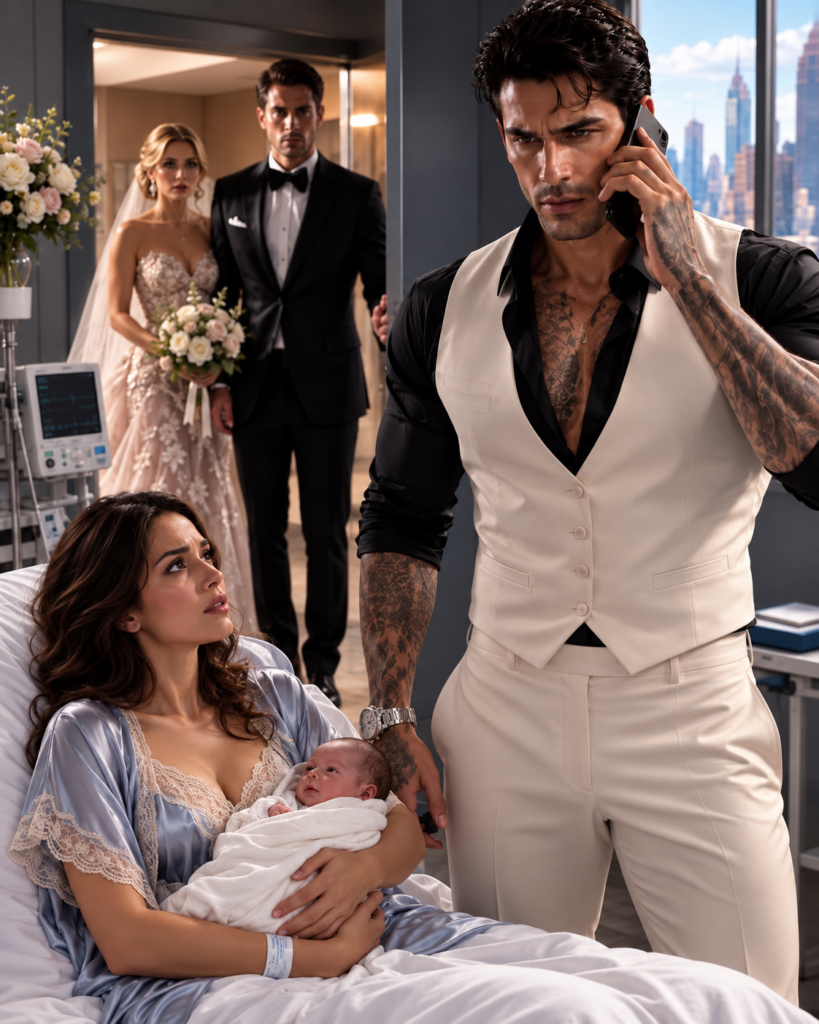
Dominic did not move toward the phone.
He moved toward me.
That distinction mattered.
He crossed the small private hospital room quietly, took the water glass from the table beside my bed, and placed it within reach. Then he adjusted the edge of the cream blanket that had slipped from my daughter’s tiny shoulder.
He did not touch her.
He did not speak.
He simply stayed close enough that I knew I wasn’t alone.
On the phone, Grant finally found his voice.
“Claire.”
The wedding bells were still ringing in the distance behind him.
I closed my eyes.
For years, I had believed there were certain moments a person could rehearse in advance. I had imagined seeing Grant again. Imagined telling him what his words had done to me. Imagined the perfect sentence that would make him understand what it had felt like to watch our marriage become a public story in which I was reduced to one humiliating word.
Barren.
But now there was no perfect sentence.
There was only my daughter breathing against me.
“Her name is Lily,” I said.
Silence.
I heard Grant inhale.
“Her?”
“Yes.”
“You had a baby?”
I looked at Dominic.
His gaze remained steady.
“Yes.”
Grant gave a strange little laugh, but there was no humor in it.
“That’s impossible.”
The words hurt more than I expected.
Not because I believed them.
Because once, I had.
For years, every disappointing appointment, every negative test, every doctor’s careful expression had trained me to hear impossibility as fact.
Lily shifted against my chest.
I rested my palm gently over her back.
“She’s two hours old,” I said.
Another pause.
Then Grant asked the question I had known would come eventually.
“Who is the father?”
The room seemed suddenly too quiet.
Rain traced silver paths down the window behind Dominic.
I had spent six months deciding what I owed Grant.
Then nine months, really, if I counted backward from the moment I had stared at two faint pink lines in the bathroom of a furnished apartment I had rented because I couldn’t bear returning to the townhouse where our marriage had ended.
I had written letters.
Deleted them.
Started emails at midnight.
Closed my laptop before dawn.
I had even driven once to the Kingsley offices, only to sit in the underground garage for twenty minutes before turning around.
Fear had not been the only reason.
Pride had played its part.
So had anger.
But the deepest reason was simpler.
I had wanted one thing in my life that Grant’s opinion could not define.
My daughter had become that thing before she was even born.
I took a slow breath.
“You are.”
Nothing came through the phone.
Not the bells.
Not the guests.
Not even Grant breathing.
Dominic’s eyes lowered for a moment.
He had known.
Of course he had known.
Three weeks after meeting him, I had told him everything over coffee in a nearly empty restaurant on Madison Avenue.
I had expected surprise.
Questions.
Perhaps distance.
Instead Dominic had listened until I was finished and said, “Then you have a decision to make about what kind of relationship you want her to have with her father.”
Not what kind of relationship I wanted.
What kind she might someday deserve.
At the time, I had resented him for saying it.
Now I understood why.
Grant finally whispered, “That isn’t funny.”
“I’m not joking.”
“Claire.”
“She’s yours.”
I heard movement on his end.
A door closing.
The church sounds faded.
He must have stepped somewhere private.
“How?”
Despite everything, a laugh escaped me.
A tired, almost disbelieving laugh.
“Grant, surely I don’t have to explain that part.”
“I mean when?”
“December.”
December.
One word containing an entire marriage.
The last winter we had lived under the same roof.
Before the lawyers.
Before Sienna.
Or before I knew about Sienna.
Before Grant stood in front of reporters outside Kingsley Tower and answered an inappropriate question about our divorce by saying that sometimes two people wanted different futures, and unfortunately “certain biological realities” had made ours impossible.
The newspapers had been less delicate.
KINGSLEY MARRIAGE ENDS AFTER YEARS OF INFERTILITY.
HEIR HOPES DASHED.
Sources had called me barren.
Grant had never corrected them.
I had hated him for that silence almost more than I hated the original words.
Now, on his wedding day, he sounded lost.
“We were barely speaking in December.”
“I remember.”
“We had already discussed separating.”
“I remember that too.”
Another silence.
Then, much quieter, he said, “Christmas Eve.”
I looked toward the rain.
“Yes.”
I had wondered whether he would remember.
Apparently he did.
Christmas Eve had been strange.
Grant had come home after a board dinner.
I had been sitting alone in the library beneath a Christmas tree neither of us had decorated together.
He had poured himself a drink.
I had asked whether we had anything left worth saving.
He had not answered for a long time.
Then he had sat beside me.
For one night, we had stopped being opponents.
We had been two exhausted people remembering why we had once chosen each other.
By New Year’s, the tenderness was gone again.
Three weeks later, Grant moved into the Carlyle.
The divorce petition followed soon after.
“I found out after the settlement was signed,” I said.
“You knew before the divorce was final?”
“No.”
He breathed out.
“When did you know?”
“February twenty-sixth.”
“That was…”
“Eleven days after.”
Another silence.
This time I could almost hear him calculating dates.
“Why didn’t you tell me?”
There it was.
The question I had feared more than any accusation.
I looked down at Lily.
Her tiny hand had slipped free of the blanket.
Five miniature fingers curled against my hospital gown.
“I tried,” I said.
Dominic’s gaze sharpened slightly.
Grant answered immediately.
“No, you didn’t.”
My chest tightened.
“I called.”
“When?”
“Three days after I found out.”
“I never got a call.”
“I left a message.”
“With whom?”
“No one. Your voicemail.”
“I would remember that.”
“It wasn’t your personal phone.”
A beat.
“Which number?”
“The office number you gave me after the separation. The one your lawyers told me to use if anything important came up.”
Grant said nothing.
I remembered the recording perfectly.
You’ve reached the executive office of Grant Kingsley. Please leave your name, number, and the nature of your call.
I had been sitting in my car outside Dr. Patel’s office.
My hands were trembling so badly I had nearly dropped the phone.
Grant, it’s Claire. I need to speak to you about something medical. It’s important. Please call me.
I never said baby.
I never said pregnancy.
At the time, I hadn’t been able to.
“I left two messages that week,” I said. “Then I received the letter from your legal team reminding me that all communication regarding the finalized divorce should go through counsel.”
“I didn’t send that.”
“Your name was at the bottom.”
“That doesn’t mean I personally—”
He stopped.
Perhaps he heard himself.
Perhaps he realized how familiar that excuse sounded.
For most of our marriage, Grant had built an empire by surrounding himself with people empowered to act for him.
Assistants.
Attorneys.
Publicists.
Bankers.
Chiefs of staff.
He signed hundreds of pages every week.
He often knew the broad direction and none of the human details.
It had made him very successful.
It had made being married to him terribly lonely.
“I thought the answer was clear,” I said.
“It wasn’t.”
“It felt clear to me.”
“Claire, you should have come to me.”
“Where?”
He went quiet.
“At your office?” I asked. “Your hotel? One of the restaurants where photographers were following you and Sienna?”
“That isn’t fair.”
“No,” I said quietly. “It isn’t. None of it was.”
Dominic moved back to the chair.
He seemed deliberately intent on giving the conversation space.
That was something I had gradually learned about him.
His stillness wasn’t passivity.
It was restraint.
He believed people revealed themselves more honestly when no one rushed to fill the silence.
Grant spoke again.
“Does my mother know?”
“No.”
“My sister?”
“No.”
“Anyone in my family?”
“No.”
“And Moretti does?”
Dominic looked up.
So Grant had either heard him earlier or somehow guessed.
“Yes.”
“How long?”
“Since shortly after we met.”
A pause.
“Is he there?”
I glanced at Dominic.
“Yes.”
Grant’s breathing changed.
But when he spoke again, his voice was calmer than I expected.
“May I speak to him?”
Dominic lifted one eyebrow.
I hesitated.
Then I held out the phone.
He did not take it.
“Your conversation,” he said softly.
Grant heard him.
“Moretti.”
“Kingsley.”
The two names seemed to change the temperature of the room.
I expected something territorial.
Something ridiculous.
Instead Grant asked, “Did you know the child was mine?”
“Yes.”
“And you never thought I should know?”
Dominic leaned back.
“I thought Claire should decide when she was ready to tell you.”
“That’s convenient.”
“No. It was difficult.”
Grant didn’t respond.
Dominic continued.
“I encouraged her to consider what Lily might one day want. That’s different from telling her what to do.”
My throat tightened.
Grant asked, “You know her name?”
“I helped assemble the crib.”
I looked at him.
Dominic met my eyes.
There was almost humor there.
Grant was silent.
Then came a sound from the other end.
A woman’s voice.
“Grant?”
Sienna.
I stiffened instinctively.
Her voice was muffled.
“We need to know what’s happening. Your mother is asking for you.”
“I’ll be there in a minute.”
“Is everything all right?”
Another pause.
“No,” Grant said. “But it might be something I should have known months ago.”
Sienna said something I couldn’t hear.
Then the door closed again.
Grant came back to us.
“Claire.”
“Yes?”
“I need to ask you something, and I need you to answer without assuming what I mean.”
I almost smiled.
“You always did like complicated introductions.”
“Can I see her?”
My heart stopped.
Dominic did not react.
That helped.
“What about your wedding?”
“I asked if I can see my daughter.”
I looked down at Lily.
The possessive word startled me.
My daughter had lived entirely inside the small world I had created over the past months.
My obstetrician.
Dominic.
My best friend, Hannah.
My father.
The nursery painted pale green because I refused to choose pink before meeting the person who would live there.
Now, suddenly, another family existed around her.
A grandmother.
An aunt.
Cousins.
A history.
The Kingsleys.
“You don’t even know if you want to be her father,” I said.
Grant’s answer came slowly.
“No. I don’t know what this means yet.”
Oddly, that honesty comforted me more than a dramatic declaration would have.
“But I know I don’t want the first decision I make about her to be staying away because today is inconvenient.”
I closed my eyes.
For one dangerous second, I remembered the Grant I had married.
Twenty-nine years old.
Standing barefoot in the kitchen of a borrowed house in Nantucket.
Burning pancakes because he was trying to impress me.
Promising me he would never let his family’s name become more important than his own life.
We had both believed him.
“Not today,” I said.
He exhaled.
“All right.”
“I’m exhausted.”
“Of course.”
“And I don’t want cameras.”
“There won’t be any.”
“I’m not finished.”
“Sorry.”
That word, from Grant Kingsley, was so rare that Dominic glanced up.
“I need time,” I continued. “I need to speak to my attorney about paperwork. Medical records. Paternity. Whatever has to happen.”
“I’ll do a test.”
“I know.”
“And Claire?”
“Yes?”
“I’m not asking you to trust me.”
I stared at the rain.
“Good.”
“But I’m asking you not to decide everything about the father I’ll be based only on the husband I was.”
My eyes burned.
That was the most unfairly reasonable thing he had said in years.
“I’ll think about it.”
“That’s enough.”
Somewhere outside his closed room, the bells rang again.
Grant whispered, “She really has my eyes?”
I looked down.
Lily’s eyes were closed.
“I have no idea. She mostly looks angry.”
A small sound came through the phone.
Almost a laugh.
Then Grant said goodbye.
The call ended.
For several seconds, I simply stared at the dark screen.
Dominic remained seated.
Finally he said, “How do you feel?”
“Tired.”
“That’s not what I asked.”
“I know.”
I swallowed.
“Terrified.”
He nodded.
“And relieved.”
Another nod.
“And guilty.”
His expression changed.
“For what?”
“For telling him.”
“That doesn’t make sense.”
“It does to me.”
I pressed my cheek gently to Lily’s head.
“For months she was mine. Just mine. I didn’t have to wonder who would influence her or what family name she would carry or whether she’d grow up being treated like a succession plan.”
Dominic’s face softened.
“You’re imagining twenty years at once.”
“I’m good at that.”
“I know.”
I looked at him.
“What happens now?”
“You feed her. You sleep.”
“And after that?”
“We find out.”
We.
The word landed quietly between us.
Dominic seemed to realize he had used it.
He looked away first.
Three months was not a long time.
Not really.
We had never called what existed between us a relationship.
He brought soup when nausea made cooking impossible.
He drove me to appointments when my father’s arthritis flared and Hannah was traveling.
He installed a car seat after watching three instructional videos and declaring all car-seat manufacturers enemies of civilization.
He knew which bakery made the almond croissants I liked.
He had kissed me exactly once.
Two weeks earlier.
Then he had stepped back and said, “You have enough changing in your life. I’m not going to make you decide something else before you’re ready.”
I had thought about that kiss every day since.
Now another man had entered the future.
Not romantically.
But permanently.
And permanence changed everything.
“You don’t have to stay,” I told Dominic.
He looked surprised.
“At the hospital?”
“In any of this.”
His brows drew together.
“Claire.”
“I mean it. This just became complicated.”
“It was complicated yesterday.”
“Not like this.”
“No,” he agreed.
He stood and walked to the window.
For a moment, he watched traffic moving below us through the rain.
“When I was twelve,” he said, “my father married a woman named Teresa.”
I waited.
Dominic almost never spoke about his childhood.
“I hated her.”
“That sounds promising.”
He smiled faintly.
“She tried too hard. Packed lunches when I wanted cafeteria food. Asked about school when I didn’t want to talk. Bought me birthday presents I refused to open in front of her.”
“What happened?”
“She kept showing up.”
Something in his voice changed.
“Five years later, my father died of an aneurysm. Teresa could have left. Legally, emotionally, practically—there was nothing requiring her to remain involved with me.”
“But she did.”
“She did.”
“Where is she now?”
“Queens.”
I blinked.
“You never told me.”
“You never asked why I know how to make lasagna.”
I laughed.
Lily stirred.
Dominic turned toward us.
“Family is complicated even when everyone behaves perfectly,” he said. “A child doesn’t need every adult around her to have the same role. She just needs the adults to know what their roles are.”
“And yours?”
His eyes met mine.
“That’s for you and me to figure out.”
The answer was careful.
Not evasive.
Careful.
For the first time since Grant called, I felt something inside me loosen.
Not certainty.
Just room to breathe.
Grant did not get married that afternoon.
I learned that three hours later from Hannah.
She arrived carrying two bags from a pharmacy, three magazines I had not requested, a stuffed rabbit nearly as large as Lily, and the kind of expression people wore when they possessed information they were trying desperately not to announce.
“What?” I asked.
“Nothing.”
“Hannah.”
She put the bags down.
“You need to eat.”
“What happened?”
“Eat first.”
“Hannah.”
She sighed.
“The wedding was postponed.”
Dominic, standing by the coffee machine, turned.
“Postponed?”
“According to every society reporter in Manhattan.”
My stomach dropped.
“Why?”
“No official reason.”
She took out her phone.
“Statement says there was ‘an unexpected private family matter requiring immediate attention.’”
I closed my eyes.
“That will make everyone curious.”
“Yes.”
“People will start digging.”
“Yes.”
“Grant promised no cameras.”
“Grant can control his own photographers. He cannot control the internet.”
Dominic took the phone from Hannah and scanned the story.
“No mention of Claire.”
“Yet,” Hannah said.
I looked at Lily.
“She is not becoming a headline.”
“She doesn’t have to,” Dominic said.
“You don’t know that.”
“No,” he replied. “But you can decide how much of your life is available to strangers.”
Hannah sat beside me.
“There’s something else.”
Of course there was.
“What?”
“Grant’s mother called me.”
I stared at her.
“Eleanor called you?”
“She didn’t have your current number.”
“How does she have yours?”
“I planned your thirtieth birthday party, remember? There are apparently some advantages to keeping the same number for twelve years.”
“What did she want?”
“To know if you were all right.”
My throat tightened unexpectedly.
Eleanor Kingsley had never been cruel to me.
Formal, yes.
Sometimes distant.
But she had also been the person who sat beside me during my first failed fertility treatment and quietly held my hand when Grant was stuck in London negotiating an acquisition.
“Did you tell her?”
“I told her you were safe.”
“And Lily?”
Hannah shook her head.
“That belongs to you.”
I nodded gratefully.
“She asked something strange, though.”
“What?”
“She asked whether you ever received the letter she sent in March.”
I frowned.
“What letter?”
“That’s what I said.”
“And?”
“She sounded confused.”
Dominic placed his coffee down.
“What was in it?”
“Hannah didn’t know.”
“No,” Hannah said. “But Eleanor seemed certain you had received it.”
I searched my memory.
March had been chaos.
I moved apartments twice.
Changed attorneys.
Stopped reading mail that arrived from anything connected to Grant.
“I never got a letter.”
Hannah took my hand.
“She wants to see you.”
I looked at Lily.
“Not today.”
“I told her.”
“What did she say?”
“That she would wait.”
That sounded like Eleanor.
She had always understood waiting.
The next morning, I woke to sunlight.
The storm had passed.
Manhattan looked rinsed clean outside the hospital window, rooftops shining beneath a pale September sky.
For three seconds, I forgot everything.
Then Lily made a tiny squeaking sound from her bassinet.
I smiled before I opened my eyes.
Dominic had gone home sometime after midnight.
Hannah had slept curled in the chair until five before leaving to shower.
For the first time, Lily and I were alone.
I lifted her carefully.
“Good morning,” I whispered.
Her eyes opened.
Dark.
Unfocused.
Serious.
“You caused quite a day yesterday.”
She yawned.
“I know. Not your problem.”
A soft knock came at the door.
My nurse leaned inside.
“Ms. Kingsley?”
I had kept my married name professionally.
“Yes?”
“You have a visitor downstairs asking whether you’re willing to see her.”
“Who?”
“Eleanor Kingsley.”
My heart sank.
Then, strangely, rose again.
“Give me five minutes.”
Eleanor entered carrying no flowers.
No designer gift.
No entourage.
Only a worn leather envelope clutched between both hands.
She looked older than I remembered.
Not dramatically.
Just honestly.
Gray threaded through her dark hair. Lines sat deeper around her eyes.
When she saw me, she stopped.
Then she saw Lily.
Her hand flew to her mouth.
“Oh.”
That single syllable nearly undid me.
I expected questions.
Instead Eleanor whispered, “May I come closer?”
I nodded.
She approached the bed.
Lily slept against my arm.
Eleanor stared at her.
Tears filled her eyes.
“She has Grant’s ears.”
I laughed despite myself.
“That’s what you notice?”
“They were enormous when he was born.”
Her laugh broke halfway through.
She touched her own lips, collecting herself.
“I’m sorry.”
“For what?”
“For crying. This isn’t about me.”
Something about those words opened a door.
“You can sit.”
She did.
For a while, neither of us spoke.
Then she placed the leather envelope on the blanket.
“I came because Hannah told me you never received this.”
“What is it?”
“A letter I sent six months ago.”
“Why?”
Eleanor looked toward the window.
“Because I learned something after the divorce, and I thought you had a right to know.”
My pulse quickened.
“About Grant?”
“About your marriage.”
I stared at the envelope.
“I’m not sure I want to know.”
“That’s fair.”
She pushed it slightly toward me.
“You don’t have to read it.”
“Then why bring it?”
“Because I made the mistake of assuming silence meant you had read it and chosen not to respond.”
Her eyes lowered.
“Yesterday taught me how dangerous assumptions can become.”
I looked at her.
“Did Grant tell you?”
“Yes.”
“How is he?”
Eleanor smiled sadly.
“He’s Grant.”
“That bad?”
“That confused.”
I almost smiled.
“Is Sienna all right?”
The question surprised both of us.
Eleanor nodded.
“She went home with her sister.”
“Was the wedding canceled?”
“Postponed.”
“Whose decision?”
“Sienna’s.”
That startled me.
“Why?”
“She told Grant she did not want their first day of marriage to be a day he spent wondering whether he should be somewhere else.”
I looked down.
That didn’t fit the easy version of Sienna I had carried in my head.
“She knew about me,” I said.
Eleanor did not defend her.
“I know.”
“She knew we were still married.”
“Yes.”
“And she still—”
“Yes.”
I stopped.
Eleanor’s expression held no excuses.
“People can make selfish choices without being incapable of better ones later,” she said.
I looked at Lily.
“That sounds inconveniently reasonable.”
“Age does that to you.”
She stood.
“I’ll leave you with the letter.”
“Eleanor.”
She turned.
“Do you want to hold her?”
Her face changed completely.
Hope made her suddenly look younger.
“If you’re comfortable.”
I handed Lily over carefully.
Eleanor settled her against her chest.
My daughter barely stirred.
For several minutes, Eleanor said nothing.
She just watched her granddaughter sleep.
Then she whispered something so softly I almost missed it.
“Your grandfather would have adored you.”
I thought she meant her own husband, Grant’s late father.
But when I looked at her face, I wasn’t sure.
There was grief there.
Old grief.
Complicated grief.
Before I could ask, she kissed Lily’s forehead and returned her to me.
At the door, Eleanor stopped.
“Claire?”
“Yes?”
“Whatever you decide about Grant, please don’t confuse forgiveness with returning.”
I stared at her.
She gave a small, knowing smile.
“They aren’t the same thing.”
Then she left.
I waited until Lily was asleep before opening the envelope.
Inside was a handwritten letter dated March 14.
Claire,
I have rewritten this three times because every version sounded like an explanation, and I do not believe you need another explanation from the Kingsley family.
You deserve information.
Last week I met Dr. Aaron Feld, the fertility specialist who treated you and Grant during your second year of trying to conceive.
He believed I already knew that he had recommended further testing for both of you before any conclusions were drawn.
I did not.
I had been told, as you had, that your likelihood of natural conception was extremely low.
That was not what his final assessment said.
According to Dr. Feld, the testing was never completed.
Grant missed the follow-up appointment because of the Singapore merger and never rescheduled.
You underwent almost every procedure alone.
He did not.
I had to stop reading.
My vision blurred.
Memories returned with painful clarity.
Waiting rooms.
Needles.
Hormone injections.
Grant promising he would make the next appointment.
Grant sending a driver instead.
Grant saying the doctors seemed certain the problem was mine.
Except they hadn’t.
I continued.
Dr. Feld could not discuss Grant’s private medical information with me, nor should he have. But he was clear on one point: no responsible physician ever told Grant that you were incapable of conceiving.
I do not know how the story changed.
I only know that it did.
And I am deeply sorry that our family allowed you to carry a diagnosis that was never actually given.
There was another page.
My fingers trembled as I unfolded it.
Several years ago, Grant’s father became obsessed with the idea of succession.
You probably sensed this.
What you may not know is that Robert repeatedly asked Grant whether the treatments were “working” and whether the Kingsley family needed to consider “other arrangements.”
Grant hated those conversations.
I believe, over time, he began speaking about fertility as if certainty existed because uncertainty frightened him.
That does not excuse what he said publicly.
But perhaps it explains a small part of how both of you stopped speaking honestly to each other.
There is one final thing.
After Robert died, I found a file among his private papers.
It contained correspondence from Dr. Feld’s clinic.
I did not understand why Robert had copies.
Most were administrative.
One was not.
I have enclosed it because I believe it belongs to you and Grant, not to me.
Eleanor
A photocopied document rested behind the letter.
I lifted it.
It was dated nearly four years earlier.
I recognized the clinic logo immediately.
The document was addressed not to me.
Not to Grant.
To Robert Kingsley.
I scanned the first paragraph.
Then the second.
My heartbeat slowed strangely.
The letter stated that the clinic could not release medical information without patient authorization.
But attached to the correspondence was a handwritten note in Robert’s unmistakable block lettering:
G must complete testing. Stop allowing C to carry this alone.
I stared at those words.
Grant’s father had known.
Or suspected.
The man I had blamed for much of the pressure surrounding our marriage had apparently understood something neither Grant nor I had faced.
I turned the page over.
There was writing on the back.
Different handwriting.
Grant’s.
I knew every slant of it.
Every impatient stroke.
Dad—
Drop this.
Claire has been through enough.
If there is a problem, it is ours, not hers.
I read the sentence again.
And again.
If there is a problem, it is ours, not hers.
I sat frozen in the bright hospital room.
Because Grant had written it years before standing in front of cameras and allowing the world to believe the exact opposite.
The mystery was no longer whether he had once known better.
He had.
The question was what had happened to him between the man who wrote that sentence and the man who eventually let me carry all the blame.
My phone buzzed.
A message from Grant.
No pressure. No lawyers. No press. I only want to know when you’re ready to talk.
I looked at Lily.
Then at the letter.
For the first time since our divorce, I realized that speaking to Grant did not have to mean defending myself.
It might mean asking the questions neither of us had been brave enough to ask while we were married.
And this time, I intended to hear the answers.
Grant came to the hospital the following afternoon.
Alone.
That surprised me.
I had expected an attorney waiting downstairs, or his mother, or perhaps the invisible machinery that seemed to follow wealthy families everywhere they went.
Instead, when the door opened, Grant stood there wearing dark trousers and a pale blue shirt with the sleeves rolled to his elbows.
No jacket.
No tie.
No wedding boutonniere.
He looked tired.
Not disheveled.
Grant Kingsley was probably incapable of looking disheveled.
But there were shadows beneath his eyes I had never seen before.
His gaze found mine first.
Then moved toward the bassinet.
Everything in his face changed.
“Is that…”
“Yes.”
He stepped inside.
Then stopped.
The distance between the door and Lily’s bassinet could not have been more than ten feet.
Grant seemed unable to cross it.
I almost felt sorry for him.
Almost.
“Hello, Grant.”
“Hello, Claire.”
He glanced toward the chair by the window.
“Moretti?”
“Getting coffee.”
A flicker passed through his expression.
Not anger.
Perhaps relief.
Perhaps disappointment that he had lost an excuse to focus on someone else.
I pointed toward the chair.
“Sit.”
He obeyed.
That alone told me the world had changed.
For nearly ten years, Grant had entered rooms as though he owned the air.
Today he sat because I asked him to.
I held Eleanor’s letter on my lap.
Grant noticed.
His face tightened.
“My mother told me.”
“That she came?”
“That she gave you the letter.”
“Did you know she sent it?”
“No.”
I studied him.
“I believe you.”
His eyes lifted.
Something like pain crossed his face.
“I don’t know whether that makes me feel better.”
“It wasn’t meant to.”
“Fair enough.”
Lily stirred.
Grant turned immediately.
“She makes that sound a lot?”
“What sound?”
“That little…”
He gestured helplessly.
I smiled despite myself.
“The squeak?”
“Yes.”
“All the time.”
“Is it normal?”
“Apparently.”
He nodded solemnly, as though receiving a quarterly report.
Then Lily opened her eyes.
Grant froze.
I watched him watch her.
The moment was smaller than I expected.
No orchestra.
No dramatic confession.
Just a man staring at a child and trying to understand how she could have existed yesterday without his knowing.
“She’s tiny,” he whispered.
“She was seven pounds, one ounce.”
“That sounds… normal.”
“It is.”
“Good.”
I almost laughed.
Grant heard it.
“What?”
“You negotiated a twelve-billion-dollar acquisition without notes.”
“Yes.”
“You look terrified of a seven-pound baby.”
“I am.”
“That might be healthy.”
He looked at me.
“I probably deserve that.”
“I wasn’t punishing you.”
“I know.”
He rubbed his palms against his trousers.
“Can I stand closer?”
The question touched something unexpectedly tender in me.
I nodded.
Grant approached Lily slowly.
He stopped beside the bassinet.
For a long moment, he simply looked.
Then he whispered, “Hello.”
Lily yawned.
Grant’s eyes filled instantly.
He turned his face away.
I pretended not to notice.
There were some dignities people deserved even after they had failed you.
Eventually he pulled the chair closer to my bed.
“I read the note,” I said.
“My note to Dad?”
“Yes.”
He looked at the envelope.
“I forgot it existed.”
“You wrote that if there was a problem, it belonged to both of us.”
His jaw tightened.
“I believed that.”
“Then what changed?”
He stared at his hands.
I waited.
Grant had spent years benefiting from my impatience with silence.
I would ask a question.
He would delay.
I would soften it for him.
Explain him to himself.
Offer the easier answer.
I did not do that now.
Finally, he spoke.
“My father got sick.”
“I remember.”
“Everything became succession.”
His eyes remained lowered.
“The company. The board. The estate. My marriage. Children we didn’t have.”
I said nothing.
“I started thinking of every part of life like a problem with a deadline.”
He laughed once, bitterly.
“You used to tell me that.”
“Yes.”
“And I thought you didn’t understand pressure.”
“That’s what you told me.”
“I was wrong.”
Simple words.
No defense.
I felt some rigid part of myself shift.
Not disappear.
Shift.
Grant continued.
“When Dad died, everyone expected me to become him immediately. Investors. Directors. Family.”
“So you did.”
“Yes.”
“And where did that leave me?”
He finally looked up.
“Alone.”
I had expected excuses.
That one word hurt worse.
Because it was true.
“You knew,” I whispered.
“Yes.”
“You knew I was alone.”
“I knew enough that I should have changed something.”
I blinked hard.
“What about the press conference?”
His expression darkened.
“I wish I had a complicated explanation.”
“You don’t?”
“No.”
“What happened?”
“A reporter asked whether infertility caused the divorce.”
I remembered the clip.
Grant outside Kingsley Tower.
Snow beginning to fall.
Microphones pushed toward him.
“And?”
“I was angry.”
“At me?”
“At everything.”
“That sounds convenient.”
“It is convenient. It’s also true.”
He swallowed.
“We had spent years answering questions about children privately. Then the divorce happened and suddenly everyone acted entitled to an explanation.”
“So you gave them one.”
“I tried to shut the question down.”
“By saying biological realities made our future impossible.”
His face tightened.
“Yes.”
“And when they called me barren?”
“I should have corrected it immediately.”
“But you didn’t.”
“No.”
“Why?”
This pause lasted longer.
Then Grant said something I did not expect.
“Because correcting it would have required admitting I didn’t know whose fertility was actually in question.”
I stared at him.
“And you preferred letting strangers assume it was me.”
He closed his eyes.
“Yes.”
The admission settled quietly between us.
There was no satisfaction in hearing it.
Only sadness.
“So your reputation mattered more.”
“At that moment?”
He looked directly at me.
“Yes.”
I appreciated that he did not soften it.
“I’m sorry.”
I looked away.
“I’m not ready to say it’s all right.”
“I’m not asking you to.”
“Good.”
“I don’t think it was all right.”
Lily made her tiny squeaking noise again.
Grant glanced toward her.
Then back at me.
“Claire, I cannot fix what I did to you.”
“No.”
“But I can make sure I don’t repeat the same pattern with her.”
“How?”
“By not assuming money counts as presence.”
My throat tightened.
He knew exactly where he had failed.
“By showing up when things are boring,” he continued. “Not only birthdays. Not only photographs. Pediatrician appointments. School meetings. Saturdays when nothing happens.”
He exhaled.
“I don’t know how to be good at any of that yet.”
“You won’t be good at all of it.”
“I know.”
That answer surprised me.
Old Grant would have promised perfection.
“Have you spoken to Sienna?”
“Yes.”
“And?”
“She moved out.”
My brows rose.
“For good?”
“I don’t know.”
“Because of Lily?”
“Not exactly.”
He looked toward the window.
“She said postponing the wedding made her realize we had been using marriage to prove something.”
“To whom?”
“Everyone.”
That sounded more honest than I expected.
“She asked whether I would have married her yesterday if no photographers were coming, no board members cared, no society pages existed.”
“What did you say?”
“I didn’t know.”
“And she left.”
“She said not knowing was an answer.”
For a second, I felt sympathy for Sienna.
I did not like it.
But there it was.
“What about the affair?”
Grant’s face changed.
“I won’t insult you by minimizing it.”
“Good.”
“It began before I moved out.”
“I know.”
“I told myself our marriage was already finished.”
“And was it?”
“No.”
I held his gaze.
“Thank you.”
“For what?”
“For not rewriting history.”
He nodded.
“I’ve done enough of that.”
A knock sounded.
Dominic entered carrying two coffees and a paper bag.
He stopped when he saw Grant.
Grant stood.
For one terrible second, I imagined male pride transforming the room into something exhausting.
Instead Dominic held up the bag.
“I brought blueberry muffins.”
Grant blinked.
“So I see.”
“Claire refuses hospital oatmeal.”
“It looks like paste.”
“It is paste,” Dominic said.
Grant glanced at me.
“You still hate oatmeal?”
“I never liked it.”
“You ate it every morning for six years.”
“Because your nutritionist said it was good for fertility.”
Grant stared at me.
Then slowly sat down.
“Oh.”
Dominic seemed to realize he had accidentally stepped into something painful.
He put the bag on the table.
“I’ll give you privacy.”
“No,” I said.
Both men looked at me.
“You can stay.”
Dominic hesitated.
“Claire—”
“I don’t want separate worlds.”
The sentence surprised even me.
I looked between them.
“If both of you are going to matter in Lily’s life, I refuse to spend the next twenty years arranging doors so one of you doesn’t walk through while the other is inside.”
Grant’s expression tightened slightly.
Dominic simply nodded.
“That seems reasonable.”
Grant looked at him.
“You always this calm?”
“No.”
“Good.”
Dominic poured my coffee.
“I’m calm because this isn’t about me.”
Grant stared at him for a moment.
Then nodded.
“Fair.”
It was perhaps the least dramatic meeting two powerful men in Manhattan had ever had.
And I was grateful.
The paternity test happened three days later.
Grant insisted.
So did I.
Not because either of us doubted the timeline.
Because certainty would matter legally.
Emotionally.
Someday, perhaps, to Lily herself.
The result arrived four days after that.
99.99%.
Grant was Lily’s father.
I called him myself.
He answered on the first ring.
“Claire?”
“We got the result.”
Silence.
Then, “And?”
“You’re her father.”
Grant exhaled.
I heard something behind him.
A chair moving.
“Okay.”
“That’s all you have?”
“I’m trying not to say something ridiculous.”
“Such as?”
“I don’t know.”
He laughed nervously.
“I spent all week preparing for something I already knew.”
I smiled.
“When do you want to see her?”
His answer was quiet.
“Whenever you’re comfortable.”
That became the beginning.
Not a grand gesture.
A schedule.
Tuesday afternoons.
Saturday mornings.
Grant came to my apartment because Lily was too small for unnecessary travel.
At first he was terrible at everything.
He fastened diapers backward.
He brought a cashmere baby blanket that could only be dry-cleaned.
He once arrived with six kinds of infant formula despite the fact that I was nursing because, he explained, “I didn’t know what emergency milk looked like.”
I laughed so hard I cried.
He looked offended.
Then he started laughing too.
The first time Lily spit up on his shirt, he froze.
“Claire.”
“Yes?”
“She did something.”
I looked over.
“She spit up.”
“On me.”
“Yes.”
“What do I do?”
“Survive.”
He stared at the white stain on a shirt that probably cost more than my first car.
Then he looked down at Lily.
“Are you pleased with yourself?”
She smiled.
It was probably gas.
Grant was convinced otherwise.
“That was deliberate.”
“Absolutely.”
He sat on the sofa holding his daughter, smiling at her like an idiot.
Something inside me softened.
Not toward the husband he had been.
Toward the father he was learning to become.
Those were different relationships.
Eleanor had been right.
Forgiveness and returning were not the same thing.
Neither were fatherhood and marriage.
Dominic adjusted differently.
He stopped coming by without calling first.
At first, I thought he was pulling away.
I hated how much that bothered me.
One evening, after Lily was asleep, I went to his apartment.
Dominic lived in Tribeca in a building so discreet it seemed embarrassed by its own price.
Teresa answered the door.
I recognized her immediately because Dominic had finally shown me photographs.
She was a small woman in her sixties with silver hair and bright brown eyes.
“You’re Claire.”
“You must be Teresa.”
“Oh, thank heavens.”
She pulled me into a hug before I could react.
“I was starting to think Dominic invented you.”
“Teresa.”
His voice came from the kitchen.
She ignored him.
“And where is my baby?”
I laughed.
“With my father.”
“Next time bring her.”
“Teresa.”
“What?”
Dominic appeared.
He wore jeans and a charcoal sweater.
Seeing him outside a suit always startled me.
Teresa pointed toward him.
“He needs people.”
“I’m standing here.”
“I know.”
She kissed his cheek.
“I’m leaving.”
“You said you were staying for dinner.”
“I changed my mind.”
She winked at me.
“I am extremely perceptive.”
After the door closed, Dominic sighed.
“She has no boundaries.”
“She seems wonderful.”
“She’ll enjoy hearing that.”
He went back to the kitchen.
“What are you cooking?”
“Lasagna.”
I smiled.
“Of course.”
We ate at the counter.
For ten minutes, we spoke about ordinary things.
Work.
Lily.
Teresa.
A building Dominic was renovating in Brooklyn.
Then I put down my fork.
“Why are you disappearing?”
He looked at me.
“I’m not.”
“You used to come over almost every day.”
“You have Grant there twice a week.”
“Tuesday and Saturday.”
“And the rest of the week you have a newborn.”
“That isn’t an answer.”
He leaned back.
“I don’t want you to choose me because I was present when he wasn’t.”
My heart tightened.
“I’m not.”
“I know.”
“Do you?”
“Yes.”
He rubbed his thumb along the edge of his water glass.
“But I also don’t want to become a shield.”
“A shield?”
“Between you and Grant.”
I stared at him.
“Dominic, I’m not getting back together with Grant.”
“I didn’t say you were.”
“You’re acting like—”
“I’m acting like a man who cares about you enough not to confuse proximity with entitlement.”
That silenced me.
He continued.
“You just became a mother. You’re learning how to co-parent with someone you once loved and no longer trust. I don’t want every decision you make about me tangled inside that.”
“What if I already made a decision?”
His eyes lifted.
“What decision?”
I stood.
Walked around the counter.
Stopped in front of him.
“I want you.”
Dominic did not move.
“I wanted you before Grant knew about Lily.”
His voice was quiet.
“Claire.”
“I was afraid to admit it because nothing in my life felt stable.”
“That’s reasonable.”
“But stability isn’t the same as certainty.”
“No.”
“I don’t know what happens in five years.”
“Neither do I.”
“I know Grant will always be Lily’s father.”
“Yes.”
“I know you can’t replace him.”
“I don’t want to.”
“And I know I don’t want you to leave simply because Grant finally decided to show up.”
Dominic looked at me for a long time.
Then he reached for my hand.
“You’re sure?”
“No.”
He smiled.
“That’s not usually the answer people give here.”
“I’m sure I want to try.”
His thumb brushed over my knuckles.
“That’s enough.”
He kissed me.
Not urgently.
Not like a man claiming a prize.
Like someone accepting an invitation.
And for the first time in years, I understood that love did not have to begin with certainty to be honest.
Sienna came to see me when Lily was six weeks old.
Her message arrived on a Thursday.
I would understand if you say no. I owe you an apology, and I would prefer to give it without asking for anything in return.
I stared at the screen for ten minutes.
Then I agreed to meet her at a café near Central Park.
She arrived early.
No makeup.
Hair tied back.
A simple navy sweater instead of the polished armor she had worn at Kingsley events.
“Thank you for coming,” she said.
“I almost didn’t.”
“I know.”
We ordered tea.
For a while, neither of us touched it.
Sienna finally said, “I’m sorry.”
I waited.
“I knew Grant was married.”
“Yes.”
“He told me you were separated emotionally.”
“We weren’t.”
“I know that now.”
“You could have asked me.”
“I should have.”
Her eyes dropped.
“I liked being chosen by him.”
The honesty startled me.
“It made me feel important.”
“That sounds familiar.”
She looked up.
I smiled sadly.
“Being chosen by Grant can feel like becoming the center of gravity.”
Sienna’s eyes filled.
“Yes.”
“And then?”
“You discover the center is always somewhere else.”
For the first time, I saw not my replacement.
A woman.
Flawed.
Ambitious.
Lonely in ways I recognized.
“I’m not going to tell you what you did was okay,” I said.
“I don’t want you to.”
“I lost a marriage.”
“I know.”
“You participated in that.”
“Yes.”
“But you weren’t the marriage.”
She swallowed.
“No.”
“And Grant made his own decisions.”
“Yes.”
We sat quietly.
Finally I asked, “Why did you postpone the wedding?”
She looked out the window.
“Because when Grant walked away from the church, I was furious.”
“That sounds reasonable.”
“I thought he was choosing you.”
“He wasn’t.”
“I know.”
She folded her hands.
“Then I realized that was the problem.”
“What?”
“I had spent months trying to win a contest you were no longer participating in.”
The words landed softly.
“I wanted the wedding to prove he chose me.”
“And Lily changed that?”
“Lily made it obvious how childish the whole idea was.”
She gave a small smile.
“Marriage should not be evidence.”
“No.”
“Grant and I are in counseling.”
I blinked.
“Together?”
“Yes.”
“Are you still engaged?”
“No.”
I nodded.
“Do you love him?”
She thought before answering.
“Yes.”
“Does he love you?”
“He’s trying to figure out whether he loved me or whether I represented a life where he didn’t have to examine what happened with you.”
“That sounds painful.”
“It is.”
I reached for my tea.
Sienna looked at me.
“I hope someday you can forgive me.”
I considered the question.
“I think forgiveness is going to be less dramatic than people imagine.”
“What do you mean?”
“I don’t think I’ll wake up one morning and decide everything is erased.”
“No.”
“But maybe eventually I’ll be able to remember you without becoming angry.”
Her eyes glistened.
“That would be more than I deserve.”
“I’m not interested in measuring what people deserve anymore.”
I surprised myself by meaning it.
“I’m interested in what I want to carry.”
Sienna nodded slowly.
“That makes sense.”
We did not become friends.
That would have felt false.
But when we parted, I no longer felt as though I had encountered an enemy.
Only someone who had once made choices that hurt me and was now trying to understand the person who had made them.
It was enough.
By Christmas, Lily could laugh.
A real laugh.
Bright and astonished.
She seemed constantly surprised by how funny the world was.
Grant discovered this when he sneezed.
She shrieked with delight.
He sneezed again deliberately.
Another laugh.
For ten straight minutes, Grant Kingsley—chairman of one of the largest private investment groups in the country—sat on my living-room rug pretending to sneeze because his four-month-old daughter found it hilarious.
My father watched from the sofa.
“I wish I had a camera.”
Grant looked up.
“You have a phone.”
“I mean a real camera. This deserves archival preservation.”
Dominic came in carrying a tray of coffee.
Grant glanced at him.
“Don’t encourage him.”
Dominic handed my father a cup.
“I already filmed it.”
Grant groaned.
My father laughed.
The scene should have felt impossible.
Instead it felt ordinary.
That was its beauty.
There were still awkward moments.
Grant and Dominic did not become friends.
They probably never would.
But they learned respect.
Dominic never inserted himself into parenting decisions that belonged to Grant and me.
Grant never treated Dominic as temporary or irrelevant.
When Lily developed a fever at three months old, both men arrived at the pediatric urgent-care clinic within fifteen minutes of each other.
Grant had driven from Midtown.
Dominic from Queens, where he had been having dinner with Teresa.
Neither argued over who belonged there.
They simply waited.
That night, when Lily’s fever broke and we finally returned home, Grant stood at the door.
“Thank you,” he told Dominic.
Dominic looked puzzled.
“For what?”
“For caring about her.”
Dominic nodded.
“She’s easy to care about.”
Then Grant looked at me.
“Goodnight, Claire.”
“Goodnight.”
No longing.
No hidden message.
Just gratitude.
It occurred to me afterward that perhaps this was forgiveness too.
Not forgetting.
Not returning.
Not pretending.
Simply allowing the past to stop dictating every future room.
One year after Lily’s birth, Eleanor invited us to her house in Connecticut.
All of us.
My father.
Hannah.
Dominic.
Teresa.
Grant.
Even Sienna, though she politely declined.
The occasion was Lily’s first birthday.
I nearly refused.
Then I remembered something Dominic once told me.
Children should not have to shrink their families to make adults comfortable.
So we went.
The Kingsley house had once intimidated me.
Twenty rooms.
Stone terraces.
Portraits of dead men with stern expressions.
That afternoon, someone had tied yellow balloons to the staircase.
Lily toddled unsteadily across the lawn holding one of Eleanor’s fingers.
Grant followed two steps behind like a nervous security detail.
“She’s fine,” I called.
“She’s near a slope.”
“It’s three degrees.”
“She could gain momentum.”
Dominic laughed beside me.
“He’s getting worse.”
“Much worse.”
“You seem pleased.”
“I am.”
My father stood near Teresa arguing cheerfully about the correct way to barbecue corn.
Hannah had somehow convinced Eleanor to wear a paper birthday crown.
For once, no one seemed concerned with appearances.
Grant approached later as the sun began to set.
He handed me an envelope.
I frowned.
“What’s this?”
“Nothing expensive.”
“That sounds exactly like something expensive.”
“It isn’t.”
I opened it.
Inside was a printed statement.
Short.
Signed by Grant.
It corrected the public comments he had made after our divorce.
It stated that speculation about my fertility had been inaccurate and unfair.
That our medical history had been private.
That his own comments had contributed to a false narrative.
And that responsibility for the end of our marriage belonged to two adults and should never have been reduced to whether either of us could have children.
I looked up.
“What is this?”
“Something I should have done a year ago.”
“You don’t have to publish it now.”
“Yes, I do.”
“For me?”
He shook his head.
“For myself.”
I read it again.
“This will restart the story.”
“For a few days.”
“And the company?”
“Will survive.”
“Your board?”
“Will complain.”
I smiled.
“That sounds serious.”
“They enjoy complaining.”
I folded the paper.
“Thank you.”
Grant nodded.
Then he looked toward Lily.
“She should never Google her mother someday and find a lie I was too proud to correct.”
My eyes stung.
“No.”
“She shouldn’t.”
He started to walk away.
“Grant.”
He turned.
“I forgive you.”
His face went still.
I had not planned to say it.
Perhaps that was why the words felt true.
His eyes filled.
“Claire—”
“I’m not saying what happened doesn’t matter.”
“I know.”
“I’m not saying I understand every choice.”
“I know.”
“And I’m not saying we should have stayed married.”
A faint smile appeared.
“I definitely know that.”
I laughed.
“So what does it mean?” he asked.
I thought about Eleanor’s letter.
Sienna’s apology.
Dominic’s patience.
My father holding Lily.
Every unexpected shape family had taken.
“It means I don’t want to keep living inside the worst thing you did.”
Grant looked down.
When he raised his eyes again, they were wet.
“Thank you.”
I nodded.
“That’s all.”
And it was.
That evening, after the cake and gifts and photographs, Dominic found me alone on the back terrace.
The September air had cooled.
Lights glowed through the windows behind us.
Inside, Lily sat on Grant’s lap tearing tissue paper into tiny pieces while Eleanor pretended not to care about the mess.
Dominic leaned beside me.
“You okay?”
“Yes.”
“You sure?”
I smiled.
“You ask that a lot.”
“I like accurate information.”
“Very romantic.”
“I contain multitudes.”
I rested my head against his shoulder.
For a while, we watched the house.
Then Dominic reached into his pocket.
I immediately straightened.
“No.”
He froze.
“What?”
“If that’s a ring, put it away.”
His expression was so offended I started laughing.
“It’s not a ring.”
“Oh.”
He took out a small brass key.
I blinked.
“What is that?”
“My apartment.”
“You already gave me a key.”
“My new apartment.”
“What new apartment?”
“The one three blocks from your place.”
I stared at him.
He shrugged.
“You said you weren’t ready to move.”
“I’m not.”
“So I moved closer.”
My heart tightened.
“Dominic.”
“No pressure.”
“You bought an apartment three blocks away?”
“Rented.”
“That is unexpectedly restrained.”
“I’m growing.”
I took the key.
“What happens when I’m ready?”
“We decide then.”
I curled my fingers around it.
No deadline.
No demand.
No expectation that love had to follow somebody else’s timeline.
I kissed his cheek.
“I love you.”
Dominic became completely still.
I had never said it before.
He turned toward me.
“Say that again.”
“No.”
“Claire.”
“You heard me.”
“I want confirmation.”
I laughed.
“I love you.”
His smile arrived slowly.
Warmly.
“I love you too.”
Behind us, Lily laughed.
Grant had apparently begun sneezing again.
We both turned toward the window.
There he was on the floor.
Eleanor beside him.
My father taking photographs.
Hannah laughing.
Teresa trying to stop Lily from eating wrapping paper.
It was not the family I had imagined when I married Grant.
It was not symmetrical.
It was not simple.
There was divorce in it.
Regret.
Apologies.
New love.
Old affection transformed into something different.
People who had disappointed one another.
People who had stayed.
People who had learned when to step closer and when to step aside.
I once believed family was something you succeeded at or failed at.
A marriage.
A baby.
A name.
A photograph where everyone stood in the correct place.
Lily taught me otherwise.
Family was not the photograph.
It was who remained after everyone stopped posing.
I thought back to the hospital room one year earlier.
Grant calling because he wanted me to hear his wedding bells.
Dominic sitting silently beside the rain-covered window.
My newborn daughter sleeping against my chest.
At the time, I had believed that call would reopen every wound I had spent months trying to close.
Instead, it began something none of us expected.
Not reconciliation.
Something more difficult.
Truth.
Grant learned that fatherhood could not be delegated.
Sienna learned that being chosen was not the same as being loved well.
Dominic learned he did not have to keep his distance simply to prove he was patient.
And I learned that protecting myself did not require closing every door.
Some doors needed boundaries.
Some needed locks.
But some only needed time before I was ready to open them again.
Inside the house, Lily spotted me through the glass.
Her face brightened.
“Mama!”
It was one of the few words she could say clearly.
I opened the door.
She stretched both arms toward me.
Grant stood and handed her over without hesitation.
“There’s your mother.”
Lily wrapped her arms around my neck.
I kissed her hair.
Dominic stepped inside behind me.
Eleanor lifted her camera.
“Everyone together.”
Grant groaned.
“Mother.”
“Do not argue with me on my granddaughter’s birthday.”
My father laughed.
“You’ve been overruled.”
We gathered near the windows.
Not perfectly.
Teresa stood beside my father.
Hannah crouched in front.
Grant stood near Eleanor.
Dominic came beside me.
Lily squirmed in my arms.
“Ready?” Eleanor asked.
“No,” Grant said.
“Yes,” I said.
The camera flashed.
For once, I did not wonder how the picture would look.
I knew what it meant.
A year earlier, I had thought my life had been divided neatly into before Grant and after Grant.
I had been wrong.
Lives did not divide that cleanly.
They expanded.
They made room.
They carried scars without becoming defined by them.
They allowed people to change without pretending change erased what came before.
Later that night, after everyone had gone home, I stood beside Lily’s crib.
She slept on her back, one arm raised above her head.
Dominic waited in the doorway.
“She had a good day,” he whispered.
“She did.”
“You?”
I looked at him.
Then at my daughter.
The child everyone once believed I would never have.
The child whose existence had forced three adults to reconsider the stories they told about themselves.
“Yes,” I said.
“I had a good day too.”
Dominic held out his hand.
I took it.
Before leaving the room, I looked back once.
Not because I was afraid.
Because I wanted to remember.
There would be harder days.
Parenting disagreements.
Missed expectations.
Old resentments that surfaced unexpectedly.
Relationships did not become effortless simply because people finally understood one another.
But I no longer needed effortless.
I wanted honest.
I wanted a life where apologies could be accepted without restoring unhealthy relationships.
Where former spouses could become respectful parents.
Where a child could love many people without feeling divided between them.
Where new love did not have to erase old history.
Where forgiveness meant freedom rather than surrender.
Dominic squeezed my hand.
“Coming?”
“Yes.”
I switched off the nursery light.
In the darkness, Lily sighed softly.
Then settled deeper into sleep.
I closed the door almost all the way, leaving the familiar narrow strip of hallway light shining across the floor.
A small light.
Enough to find the way back if she needed us.
Enough to remind me that sometimes moving forward did not mean closing the door behind you.
Sometimes it meant leaving just enough light for everyone to learn a better way home.

