
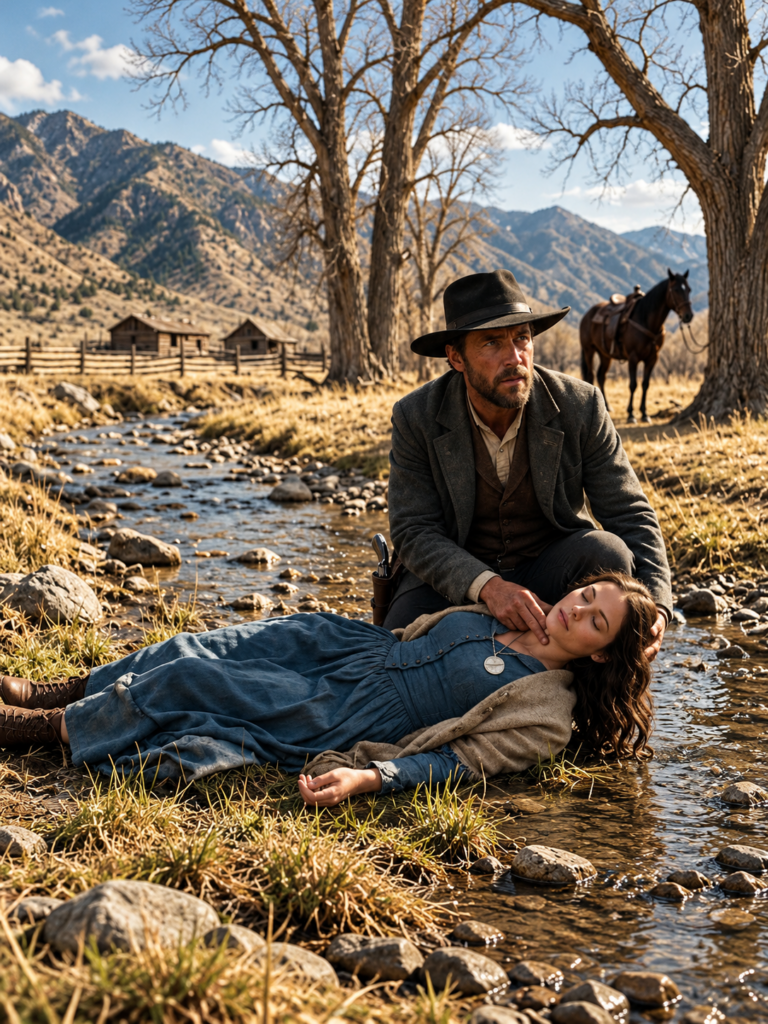
they wanted her dead for knowing the truth about blackwater but the rancher who found her at dead man’s creek came in time to stop them from stealing the land
Part 1
The creek had a name the old men still used when they wanted to warn a stranger off the bottom land. Dead Man’s Creek ran cold and shallow between the cottonwoods, and on a gray afternoon in late March Elias Roark found the woman face-down in the gravel with her skirt torn and one boot gone. He had ridden down to check the lower fence after the last melt and saw the pale of her hand against the dark stones. He swung down, turned her over, and saw that she was breathing.
She was young, maybe twenty-five, with dark hair matted to her cheek and a cut above one eye that had already stopped bleeding. When he lifted her she made a small sound and her eyes opened. They were the color of river water in shade. She looked at him as if he were part of the sky.
“Ma’am. Easy. I’m not going to hurt you.”
She tried to sit. He kept a hand on her shoulder until she stopped fighting it.
“Where am I?”
“Dead Man’s Creek.”
She looked past him at the cottonwoods and the low ridge beyond them. Her mouth moved once before the words came. “Was there a wagon?”
“Not one I could find.”
She touched the front of her dress. There was a thin gold chain around her neck and a small oval locket that had worked itself free of the cloth. He had seen the locket before. His wife had worn one like it until the day she died. The woman’s fingers closed around it and she frowned as if the metal were unfamiliar.
“Where did you get that?” he asked.
“I don’t know.”
He got her onto his horse and walked beside her the two miles back to the ranch. The house sat on a low rise above the home pasture, a single-story frame place with a deep porch and a barn that still smelled of the last hay cutting. He carried her inside and set her on the settee by the stove. She watched the room the way a person watches a place they half remember and do not trust. When he brought her water she drank it in small sips and did not speak again until he asked her name.
“I don’t know that either.”
He left her with a blanket and went out to the barn to unsaddle. While he worked he kept seeing the locket. His wife, Sarah, had worn hers on a longer chain. She had died three years ago of a fever that took her in four days, and he had buried the chain with her because she had asked him to. The woman on the settee looked nothing like Sarah in the face, yet something in the set of her shoulders and the way she held her head made his chest tighten. He told himself it was only the shock of finding a living person where he had expected nothing.
When he came back in she was standing at the window. She had washed her face at the basin and the cut looked cleaner. She turned when she heard him.
“Someone following us?”
“I don’t know.”
He heated soup and set a bowl on the table. She ate standing up, one hand still on the locket. Halfway through the bowl she stopped and looked at him.
“She survived.”
“Who is she?”
“My wife. She died three years ago.”
The woman set the spoon down. “She looks like me.”
He did not answer. Outside the wind had come up and the cottonwoods along the creek were moving. He locked the doors before dark and set a chair under the kitchen window where he could see the lane. She slept on the settee with the blanket pulled to her chin. Once in the night he heard her speak a name he did not catch. When he leaned closer she was quiet again.
In the morning two men rode up the lane and stopped at the gate. Elias met them on the porch with the shotgun resting easy against his leg. The taller one had a narrow face and a gray coat. The other wore a hat pulled low and kept his hands where Elias could see them.
“Looking for a woman,” the tall one said. “Dark hair. Might have come off a wagon somewhere south of here.”
“Haven’t seen one.”
The man in the gray coat looked past him at the house. “Mind if we water the horses?”
“Creek’s that way.”
They did not argue. Elias watched them ride down toward the trees and did not go back inside until they were out of sight. When he turned the woman was in the doorway.
“They were asking about me.”
“They were.”
She touched the locket again. “My family name doesn’t belong on that necklace.”
“Maybe it does.”
She looked at him for a long moment. “Elias. Where did you find her?”
“Dead Man’s Creek. Where did you get this?”
“I woke up wearing it. You know something.”
“Not enough.”
He told her about the two men. She listened without interrupting. When he finished she said, “Two armed men came asking about a woman matching your look. What did they want?”
“You.”
She sat down on the step. The wind moved her hair across the cut on her forehead. “You sure she’s here?”
“I’m sure.”
He did not know what else to say. The men had not given names. They had not said why they wanted her. He only knew that the look on the tall one’s face had not been the look of a man searching for a lost traveler. It had been the look of a man who expected to be paid.
Part 2
By noon the sky had cleared and the wind had dropped. Elias walked the lower pasture and found the place where a wagon had left the track. The ruts were fresh and ended in a tangle of broken brush where someone had turned hard and driven into the trees. He followed the marks for a hundred yards and found a single boot print in the soft ground beside the creek. The print was smaller than a man’s and deeper at the heel, as if the person had been running. He stood there a long time with the sun on his back and tried to remember whether Sarah had ever spoken of a woman who looked like the one now sitting on his porch.
When he came back the woman was in the kitchen with the locket open on the table. Inside was a small curl of dark hair and a folded scrap of paper so thin it had almost worn through. She had not touched the paper. She looked up when he came in.
“Someone was here.”
“The wagon,” he said. “I found where it left the road.”
She closed the locket. “What do you remember?”
“A man wanted something from that wagon. There was a chest.”
“What was inside?”
“I don’t know. Roark. That name was on something.”
He sat down across from her. “Where?”
“The document.”
“What deed?”
“Land. It was about land.”
“This land?”
“Maybe.” She looked at the window as if she expected to see the men again. “I remember this. Someone changed the boundary.”
He did not answer at once. The Roark place had been in his family for three generations. His grandfather had filed the original patent when the valley was still open range. Elias had never heard of anyone changing the lines. The survey posts were still where they had always been, and the creek made a natural boundary on the south side. Yet the way she said it made the skin on his arms tighten.
“The footprints at the creek weren’t random,” she said. “They were looking for the wagon.”
He nodded. “Someone came close to the barn last night. I saw the tracks this morning.”
“Silas?”
“No. The man I remember wasn’t Silas.”
“Then who?”
“I don’t know.”
They sat with the stove ticking between them. Outside a hawk circled once over the pasture and drifted south. Elias thought of the two men at the gate and of the way the one in the gray coat had looked at the house. He thought of Sarah, who had kept every paper the ranch had ever generated in a tin box under the bed, and of the night she had burned with fever and asked him, just once, to make sure no one moved the old fence posts. He had thought she was wandering. Now he was not sure.
In the late afternoon a third man rode in from the county road. He was older than the first two, broad through the shoulders, with a badge pinned inside his coat so it did not catch the light. He stopped at the porch and did not get down.
“Name’s Creed,” he said. “Silas Creed. I’m looking for a woman who may have come through here. There’s a reward.”
“How much?” Elias asked.
“Five hundred dollars. Alive.”
The woman had come to the doorway behind Elias. Creed’s eyes moved to her and stayed there. He did not smile.
“The woman doesn’t belong to you.”
“You’re on private property, Creed.”
“Then I’ll leave. After she comes with me.”
Elias did not move. “You know him.”
The woman shook her head. “I don’t know.”
Creed looked at her a moment longer, then turned his horse. “We’re leaving? For tonight. Tonight she’ll tell him everything. And tomorrow we take her.”
He rode back the way he had come. Elias watched until the dust settled. When he turned the woman was still in the doorway.
“Nobody leaves this house tonight,” he said.
She nodded once. They barred the doors and shuttered the windows. Elias set the shotgun across his knees and sat where he could see both the lane and the back door. The woman sat on the floor with her back against the wall and the locket in her hands. Neither of them slept.
Part 3
At first light they rode east along the creek. The woman sat behind him on the horse with her arms around his waist and her face against his coat. She did not speak until they had crossed the second fence and the house was out of sight.
“Blackwater is here.”
“What about it?”
“There was a document. There was a document.”
“What kind of document?”
“I don’t know, but they were looking for it.”
He reined in under a stand of cottonwoods. The ground here was soft and the tracks of several horses showed clear in the mud. One set was deeper than the others, as if the rider had stopped and dismounted. Elias got down and walked the line of the tracks until he found a place where someone had knelt. The print of a knee and the mark of a hand were still visible. Beside them lay a scrap of blue cloth no bigger than his thumb. The woman slid down and picked it up.
“This is from my dress. I was here.”
He looked at the cloth, then at her. “Then this may be where you lost your memory.”
She turned the scrap over. On the back was a small dark stain that might have been ink or blood. She folded it and put it in her pocket. They rode on. The tracks led them to a low rise where a wagon had been turned and left. The bed was empty. One wheel had sunk into the soft ground and the tongue pointed toward the river. Elias walked around the wagon once and found a chest half buried under a pile of brush. The lock was broken. Inside were folded papers, a man’s coat, and a tin box that had been pried open. The papers were wet and the ink had run, but one sheet still showed a name written in a clear hand: Roark.
The woman knelt beside the chest. “That looks like the chest. That’s the mark. My memory showed me this.”
“Where?”
“On the deed.”
He lifted the papers carefully. Most of them were ruined, but one corner remained dry enough to read. The words were part of a description of land: beginning at the cottonwood marked with three cuts, thence south along the creek to the stone at the bend. He knew the stone. It marked the south line of his own pasture.
“Blackwater is beyond this river,” she said. “They found the trail. Let them cross.”
“Why?”
“Because Blackwater is where they are going.”
They left the wagon and rode north along the river until the ground rose and the trees thinned. Ahead of them the old church sat on a low knoll above the water. The roof had been patched more than once and the door hung open. Elias had not been inside since Sarah’s funeral. The woman stopped at the bottom of the steps and put a hand on the rail.
“This feels familiar. I know this place. I signed something here.”
“Yours?”
“No. Someone else’s.”
They went inside. The light came through the broken panes in long bars. Dust lay on the pews and on the small table at the front. The woman walked straight to the table and knelt. She ran her hands along the underside of the top until her fingers found a seam. When she pressed, a narrow panel slid back. Inside was a flat packet wrapped in oilcloth. She drew it out and opened it on the table.
The paper was old but dry. The writing was clear. It was a deed for the land that began at the three-cut cottonwood and ran south along the creek to the stone at the bend, and from there west to the ridge. The boundaries included the whole of the Roark ranch. At the bottom was a signature Elias recognized as his grandfather’s, and beside it another name he did not know: Jonah Hale. The date was three years earlier.
The woman stared at the signature. “That’s it. The deed. Roark. Your family owned this land. This boundary includes my ranch. Then someone has been trying to take it.”
Elias looked at the paper a long time. He thought of Sarah burning with fever and asking him about the fence posts. He thought of the men at the gate and of Silas Creed and the five hundred dollars. He folded the deed carefully and put it inside his coat.
“Someone is coming,” the woman said.
He heard the horses then, two of them, moving fast along the river road. He took her arm and they went out the back door and into the trees. The riders passed the church without stopping. When the sound of them faded Elias and the woman crossed the open ground to where he had left the horse. They rode hard for the ranch and did not look back until the house was in sight.
Part 4
They reached the porch as the sun cleared the ridge. Elias barred the door and set the deed on the table. The woman stood beside him while he spread the paper flat. The boundaries were plain. Anyone who could read a survey could see that the land described was the land he had always worked. Yet somewhere a second paper existed that moved the line and left the ranch on the wrong side of it. He did not know who had drawn the second paper. He only knew that the woman beside him had carried the knowledge of it in her head until the creek took the rest of her memory.
“We have part of the deed,” she said. “And they know we have it.”
“Then we have to find the rest before they do.”
She looked at the window. “At first light we go to Blackwater.”
“And if the deed is there?”
“Then we finally learn why they wanted you.”
He nodded. They ate what was left of the soup and slept in turns. Elias kept the shotgun across his knees. Once in the night he heard horses on the lane and went to the window. Two riders sat at the gate for a long time, then turned and rode back toward the county road. He did not wake her.
In the morning they left before the sun was up. The woman rode behind him again. She had tied the locket inside her dress so it would not catch the light. They followed the river north until the trees opened and the town of Blackwater showed on the far bank. It was a small place, a dozen buildings and a ferry that ran when the water was low. They crossed on the ferry and left the horse at the livery. Elias walked with the deed inside his coat and the woman at his side. No one looked at them twice until they reached the land office.
The clerk was an older man with ink on his cuffs. He listened while Elias explained that he wanted to compare a deed against the county record. The clerk brought out a large book and turned the pages until he found the entry for the Roark patent. The description matched the paper Elias carried. Then the clerk turned one more page and stopped.
“There’s a later filing,” he said. “Filed two years ago. Moves the south line to the ridge and leaves the bottom land out.”
Elias looked at the page. The signature on the later filing was not his grandfather’s. It was a name he had never seen. The woman leaned closer.
“Jonah,” she said. “He was searching the wagon.”
The clerk closed the book. “If you have the original, you can file a challenge. It will take time.”
They left the office and walked back toward the ferry. Halfway there a man stepped out of an alley and stopped in front of them. He was the one in the gray coat. Two other men stood behind him. One of them was Silas Creed.
“The girl doesn’t know what she carries,” Creed said. “She carries the truth.”
Elias put himself between the woman and the men. “You won’t take her.”
“You already know why I have to.”
The woman spoke from behind him. “Did you love her?”
Creed looked at her. For a moment the hardness left his face. “Every day.”
“I’m sorry.”
“You didn’t do anything.”
One of the men laughed. Elias shifted his weight and felt the deed against his ribs. The street was empty except for the four of them. He thought of the ranch and of the fence posts and of Sarah asking him, in the last clear hour she had, to make sure no one moved them. He thought of the woman who had woken in his house wearing a locket that should have been buried.
“We’re leaving,” he said.
Creed did not move. “Blackwater is here. There was a document.”
“There was,” the woman said. “And we have it.”
The man in the gray coat took a step forward. Elias drew the shotgun from under his coat and held it low. The street stayed quiet. After a moment Creed raised one hand and the others stepped back. Elias and the woman walked past them to the ferry. No one followed.
They crossed the river in silence. On the far bank the woman stopped and looked back at the town.
“Your wife knew about Blackwater,” she said. “She came to me once. Three years ago. Your wife told me someone was changing land records.”
Elias turned. “She never told me this.”
“She wrote your name. That’s my name. How could she have known you?”
“Maybe this belonged to her.” He touched the place where the locket lay under her dress. “Why would she give it to me?”
“That’s when your wife died. She knew about the deed. And someone wanted it hidden.”
They rode the rest of the way without speaking. When they reached the ranch the sun was high and the pasture was empty. Elias unsaddled the horse and led the woman inside. He set the deed on the table again and stood looking at it while she washed her face at the basin. When she came back she sat across from him.
“Elias. They know we found something. Then we have to find the deed before they do.”
“We already have it.”
She shook her head. “The deed wasn’t hidden in the chest. Then where was it?”
“The church. That’s where I remember it. I stood here before. The document was here.”
He looked at her. “We already went to the church.”
“There. Something was hidden underneath.”
He understood then. They had found one paper. There was another. He folded the deed and put it back inside his coat. Outside the light was failing. He barred the door and sat with the shotgun across his knees while she slept on the settee. In the night he heard horses again, closer this time, and the sound of a man speaking low to another man near the barn. He did not wake her. He waited until the voices moved away, then he checked the loads in the shotgun and sat until morning.
Part 5
They left at first light and rode straight to the church. The woman went to the table and knelt again. This time she pressed a different place on the underside of the top. A second panel slid back. Inside was another packet, thinner than the first. She opened it on the table. The paper was the original survey, drawn in her own hand three years earlier, with the boundaries marked in ink that had not faded. At the bottom was her signature and, beside it, the signature of Sarah Roark.
Elias stared at the names. “You signed something here.”
“I did. Your wife found the changes. And you helped her?”
“She trusted me. Your wife gave me this before I left. Why? She said your name would keep me safe. I carried the original. Before they found me. It was Jonah. He was searching the wagon.”
She remembered then. The wagon had been hers. She had been carrying the original survey to the county seat when the men stopped her on the road. Jonah Hale had been one of them. He had worked for the man who wanted the bottom land. They had taken the chest and left her by the creek. The blow to her head had taken the rest.
“She remembered,” Elias said. “Then we stop them before they reach the ranch.”
They rode hard. Halfway home they saw the dust of several horses moving toward the house. Elias cut across the pasture and came in from the back. The men were already at the porch. Silas Creed stood at the bottom of the steps. The man in the gray coat was with him, and two others Elias did not know. One of them held a paper in his hand.
Elias and the woman stopped at the corner of the barn. She looked at him once, then walked out into the open with the original survey in her hands. The men turned. Creed’s face did not change.
“They have the document,” one of the others said.
“Then we follow,” Creed answered.
The woman held the paper up so they could see the signatures. “This proves the original boundary. Your wife was right.”
The man in the gray coat took a step toward her. Elias stepped out from the barn with the shotgun raised. “It’s over. You could leave.”
Creed looked at the paper, then at Elias, then at the woman. For a long moment no one moved. Then Creed raised his hand again and the others lowered theirs. He turned his horse and rode down the lane. The rest followed. Elias watched until they were gone, then he lowered the shotgun and walked to the woman.
She was still holding the survey. Her hands were steady. He took the paper from her and looked at Sarah’s signature one more time. Then he folded it carefully and put it with the other deed inside his coat.
“I don’t think I want to leave,” she said.
“I thought I lost everything here.”
“Maybe you found something instead.”
They went inside. Elias set both papers on the table and weighted them with the locket she had taken from around her neck. Outside the wind moved through the cottonwoods along the creek. The pasture was empty and the fence posts stood where they had always stood. He looked at the woman across the table and saw, for the first time, the small scar at the edge of her hair that matched the one Sarah had carried from a childhood fall. He did not speak of it. He only nodded once, and she nodded back, and they sat together while the light moved across the floor and the house settled around them the way a house settles when the people inside it have decided to stay.

