
Chapter 1
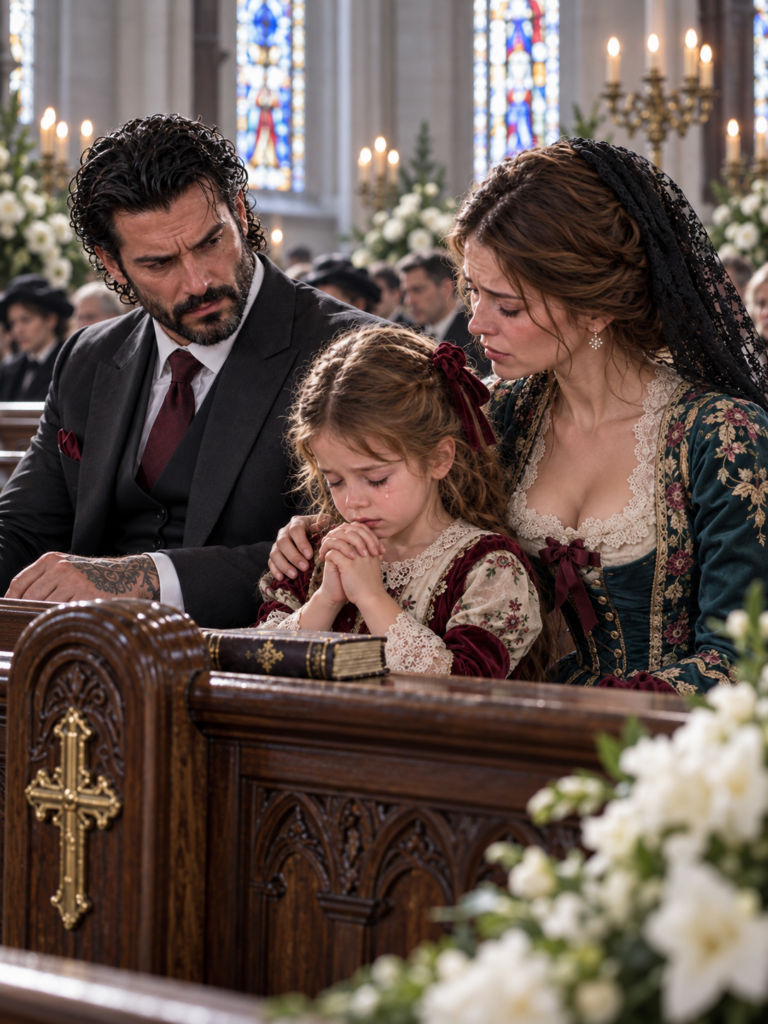
Nora Whitlock heard the prayer the way you hear glass break in another room, after the damage was already done.
“God, please send Mama a good man,” Maisie said, in the clear, carrying voice of a child who believed anything important deserved to be said properly. “Someone who will love us. Someone who won’t ever leave.”
Nora’s eyes snapped open. Beside her, six-year-old Maisie knelt on the church cushion with her hands pressed together so hard the knuckles looked carved from wax. A burgundy ribbon hung from her hair by a thread. One stocking had slid down to her ankle.
“Maisie,” Nora whispered, and her voice cracked on the name. “A little quieter, sweetheart.”
The child lowered her voice. The church had already heard.
In the next pew, Declan Rourke had turned to stone. His tattooed fingers were locked around the polished oak, and they would not open. Behind him, Silas Crane, who had watched Declan walk into rooms full of armed enemies without a change in his breathing, went rigid. A second man glanced up from his hymnal, then at the boss. Neither dared speak.
Someone who won’t ever leave.
Declan had heard those words before, in another voice, in a hospital room that smelled of antiseptic and lilies. Three days before his sister Clara died, her hand had weighed nothing in his. Promise me you won’t let another child pay for what this family has done.
He had promised. That was nine years ago. He had spent every one of them breaking that promise by doing nothing at all.
Nora felt the weight of the stare before she saw it. She glanced sideways. A man in an immaculate charcoal suit, black hair swept back, a dark beard, one hand resting against his jaw. His eyes were fixed on her daughter.
It wasn’t the look of a man irritated by a noisy child. It was the look of a man who had just felt a door swing open inside him and had no idea how to shut it.
Nora drew Maisie against her side and turned away. She didn’t know his name. She only knew that her hand was trembling over her daughter’s, and that in the last three months she had learned to trust that feeling.
Her husband had died in February. The police called it a single-car accident on a dry road, and the file closed within a week. Maisie understood that her father was gone. What she couldn’t understand was how a person could love you and still not come home.
Nora understood something harder. Ethan had not been careless. In his last weeks, he had checked the locks twice every night. He had stopped answering the phone after dark. Once, standing at the kitchen window with his back to her, he had said very quietly, “Some people will do anything to protect a lie.”
She had asked, What lie?
He had only shaken his head.
Then the house was gone, and the savings with it. She had brought Maisie to Harlow Creek with one suitcase, Ethan’s old pocket watch, and enough money to be careful for a few days. Their room at the boarding house was paid through tonight. She had come to church because Maisie asked, and because an hour in a pew cost nothing.
What she needed was work. A kitchen to tend, accounts to put in order, a floor to scrub if that was what someone would pay for. She had not come looking for a man.
When the service ended, Declan waited. His men waited with him. He watched the congregation drain toward the doors, watched Maisie slip her hand into her mother’s and look up to check whether Mama was still sad. He watched Nora stop at the top of the church steps, search for a dry place, and only then kneel to straighten the child’s stocking.
“You haven’t done anything wrong,” she murmured.
Maisie leaned into her. Then they went down the steps together, a thin woman in a mended black veil and a little girl in burgundy velvet, hand in hand.
Declan let them go.
It was Silas who saw the car.
“Boss.” His voice was low and flat. “Black sedan across the street. Engine running.”
Declan didn’t turn his head. He watched the reflection in the glass of the church door instead. The sedan’s rear window was down two inches. Something caught the light there, the cold glint of a long lens. The man behind it photographed Nora. Then Maisie. Then he lowered the camera and thumbed out a message.
Silas’s phone buzzed in his hand. He had been tracking that number for six weeks. He read the screen, and his jaw tightened.
We found Whitlock’s widow. The girl is with her.
Nobody in that church saw what Declan’s face did next. It did not change, and that was the terrifying part. It simply went still, the way a lake goes still before a storm.
“The plates,” he said.
“Registered to Brandt Freight.” Silas swallowed. “One of Julian’s.”
Julian Vane. The man who had stood at Declan’s shoulder for eleven years.
“Put two cars behind them,” Declan said quietly. “They reach that boarding house, and they never see you. They never know why. And the sedan, follow it.” He looked at the street where the woman and her daughter were crossing, small and unknowing under the pale autumn sun. “Find out who it answers to.”
The drive home was long, and he said nothing. He kept hearing the little girl’s voice. He kept seeing her mother checking the steps for a dry place before she knelt. And underneath it all, a name he hadn’t heard in three years, once written across the top of a ruined account.
Whitlock. Ethan Whitlock.
Three years ago, a financial operation had gutted one of Declan’s legitimate businesses. Millions vanished through shell companies, and Ethan Whitlock’s credentials were stamped on every transfer. Declan had believed the man betrayed him. He had never looked closely enough to learn whether it was true. He had been too angry to look.
Then Ethan had died, and the matter went quiet.
So why was his widow here now?
The house at the end of the drive was enormous, with a sound roof, full cupboards, and twelve chairs around the dining table. His supper waited under a silver cover. He used one chair and sat listening to the silence while the food went cold. His hand drifted to the pocket where he kept Clara’s last letter. He didn’t take it out. He only held it through the cloth, the way a man holds a wound.
The phone rang a little after midnight.
“Boss.” Silas never began a call that way. “The sedan went to ground at a warehouse on Dock Street. I couldn’t get close. But there’s something else.”
Declan said nothing.
“I ran the Whitlock name through the archive. Ethan’s case file. The accident report that was sealed three months ago.” A pause. The rustle of paper. “It’s been accessed twice. Using a clearance code that belongs to someone inside our organization.”
Declan’s grip tightened on the phone.
“The first time,” Silas said, and for once he took too long to say it, “was this morning at 9:41. Eleven minutes before the service began. Before that little girl said a single word of her prayer.”
Across the city, in a rented room lit by one lamp, a widow was tucking her daughter into bed. She had no idea someone had been searching for her since dawn.
Declan stood. His chair scraped across the floor of the enormous house, and in the silence it sounded like a warning.
Someone had known exactly where that child would be kneeling before she did.
Chapter 2
Declan did not sleep. By dawn he had made three decisions. Silas would trace the clearance code quietly, with no one else told. Two men would watch the boarding house from the alley. And he would learn exactly what Ethan Whitlock’s widow had been left with.
The answer came before breakfast. Silas laid a single sheet on the desk.
“She has forty-one dollars. The landlady gave her until Thursday morning. She’s tried the laundry, the grocer, and four private houses. Nobody will take her. She’s a stranger, boss, and people in Harlow Creek don’t hire strangers.”
Declan stared at the number. Forty-one dollars. He had spent more on a bottle of wine.
His first thought was an envelope left anonymously at her door. He rejected it before he finished thinking it. A woman who took money from someone she couldn’t question would be in that person’s debt without ever knowing the price. He knew exactly how that felt from the other side of the table. He had built an empire on it.
“Then she needs real work,” he said slowly. “Wages, terms, and a door she can walk out of.”
Silas raised an eyebrow. “At your house?”
“Where I can keep her alive.”
Silas hesitated. “There’s one more thing, boss. The clearance code. It didn’t just open Whitlock’s file. Someone used it to flag the widow’s name in our own system eight months before Ethan died.”
Declan went cold.
Before the accident, someone had already been planning for her.
Chapter 3
Eight months. Declan read the line on Silas’s sheet three times, as though the number might soften.
The flag was small. Just a few characters in a field nobody checked: WHITLOCK, N. Dependents: 1 (female, 3). Leverage. It had been entered in June, the same month Ethan Whitlock had supposedly begun skimming from Declan’s books. Nobody sets aside leverage on a thief’s wife. You set it aside on a man you intend to use.
“Who holds that code?” Declan asked.
Silas didn’t answer at once. Rain had started against the study windows, thin and gray. “Three people, boss. You. Me.” A beat. “And Julian.”
“It wasn’t you.”
“No, sir.”
“And it wasn’t me.” Declan said it flatly, a fact laid on the desk. He did not say the third name. He had said that name a thousand times across eleven years, over a thousand dinners, in a thousand rooms where it had meant safe. Saying it now felt like putting his weight on a stair he’d always trusted.
“Don’t touch Julian,” he said. “Don’t ask him a question. Don’t let him see you looking. Until I know, we are two men reading a file.”
“And the girl?”
“She was three years old in June,” Declan said, mostly to himself. “Someone wrote that down and filed her under leverage.”
He thought of the burgundy ribbon. He thought of a small voice asking God for someone who wouldn’t leave. Then he stood, because standing was easier than sitting with the thing in his chest.
Nora had learned the geography of refusal.
In Harlow Creek, a refusal came in several dialects. The laundry’s was kind, and it came with an apology and a glance at the clock. The grocer’s was brisk. The fourth private house, a white one with a brass knocker, had sent a maid to say that Madam was resting, and Madam went on resting for forty minutes while Nora waited on the porch with Maisie’s hand in hers.
By Wednesday she had forty-one dollars, and the landlady had given her until Thursday morning. She had written her notice for the general store in her neatest hand: Cook. Keeps household accounts and supplies in order. References available. She had spent part of her remaining money on paper and postage and written to a woman who had employed her before her marriage. She had not written the word please anywhere. She had decided on the train that she would ask for work and never for pity, because pity had a way of becoming a sentence you served.
She was outside the store, knotting a small parcel of flour into the corner of a cloth, when a shadow fell across the step.
Maisie was across the street, studying a dog that was studying a fence post. Nora moved sideways until she stood between the shadow and her daughter before she even looked up.
Charcoal suit. A hand rising to remove dark sunglasses.
Her pulse jumped. It was the man from the next pew.
“I owe you an apology,” he said. His voice was lower than she expected, and careful, like a man walking on ice. “For staring on Sunday. It was rude.”
“It was church,” Nora said. “People stare at all sorts of things.”
“Declan Rourke.” He did not offer his hand. She noticed that, and noticed he had noticed her noticing. “I’m a businessman. I have a large property outside town and a household that doesn’t run. My last three cooks left within a month of each other, and I’d rather employ someone capable than keep paying for my own mistakes.”
His mouth moved. It wasn’t quite a smile. It looked like something he’d had to rehearse.
“I don’t take charity, Mr. Rourke.”
“This isn’t charity. It’s a position.”
She studied him. He was tall, and he stood carefully, as if he knew what his size did to other people’s shoulders. A tattoo curled out from beneath one cuff, dark ink against pale skin. He did not look like a man who needed a housekeeper. He looked like a man who had not been told no in years, and was working hard not to be that man today.
“What are the wages?”
He named a figure. It was fair. In fact it was a little more than fair, and she waited for the catch to arrive.
“Hours?”
“Breakfast to the end of supper. Sundays free.”
“Would my daughter be permitted to live with me?”
“There’s a cottage behind the main house. Two rooms, a stove, and a lock that works.”
A lock that works. He had chosen that detail, and she couldn’t have said why it made her chest tighten. Her husband had checked the locks twice every night. She pushed the thought down.
“And if I’m asked to do more than cook and keep the accounts?”
“Then we make a separate arrangement with separate pay. I won’t keep adding work to the same wages.” He paused. “I’ll put every term in writing.”
It was the most reasonable thing anyone had said to her since February. She distrusted it on principle.
Across the street, the dog had lost interest. Maisie was waving at her, a small, hopeful flag of a hand.
“I’ll look at the place,” Nora said slowly, “before I decide.”
“Of course.” He slid the sunglasses back into his pocket. “I’ll send a wagon at ten tomorrow. Bring the little one. She should see where she’d be sleeping.”
He nodded once, turned, and walked away without looking back. A few paces on, a younger man in a dark jacket fell into step beside him from nowhere, as though he had been waiting at the corner for an hour.
Nora stood very still with the knotted flour in her hand.
She had given the landlady her name. She had written N. Whitlock in a dozen different ledgers, on a dozen different doorsteps, all of them closed. She had not given it to this man. She had not given it to anyone on the church steps.
And she had never once heard him say Mrs. Whitlock until the moment he said, “Of course, Mrs. Whitlock,” as he turned away.
Chapter 4
The wagon came at ten, driven by a silent young man who kept his eyes on the road, and carried her four miles out of Harlow Creek behind a wall of dark stone.
Nora saw the cameras before she saw the house. There were three on the gate post alone, turning slowly like the heads of patient birds. The gates were iron, taller than a man, with a keypad set into the pillar. Black vehicles stood in the drive in a neat row. Men in dark jackets stood beside them, each with a small flesh-colored wire curling behind one ear. They looked at her once, quickly, and then not at all.
“Business enemies,” Declan said when he saw her watching. He had met the wagon at the gate on foot. “A man in my position takes precautions.”
It was true. She could hear that it was true. She could also hear that it was not the whole of it, and she folded the thought small and put it away to look at later.
The main house was handsome and neglected. A saucepan sat soaking in the sink with something black welded to its bottom. Three separate orders for flour lay among the receipts on the counter, each for the same week. A good embroidered tablecloth had been stuffed against a draft beneath the pantry window.
Nora pulled it out. “Do you have a rag?”
“I thought that was one.”
“It has embroidered corners.”
“I see that now.”
She tried not to smile. He saw her try, and had the sense to say nothing at all.
The cottage behind the house was small, but the door closed properly. She tested the latch herself, twice, and felt him watching her do it. When she came back outside, Maisie was gone from her side.
Her heart slammed. She found her in the stable, standing on an upturned bucket before an old gray mare, and Declan stood beside her with a half-cut apple in his big hand.
“She’ll take your fingers if you let her,” he was saying. “Palm flat. Like this.”
He took Maisie’s small hand and opened it for her, as gently as one handles something that might break. The mare lipped the apple away with a soft huff, and Maisie shrieked with delight.
For one second, the hard lines of Declan’s face came undone. He looked younger. He looked like a man who had forgotten he was allowed to be.
Nora stood motionless in the doorway. Something in her chest, which had been clenched since February, loosened by a hair.
That evening, at the kitchen table, she laid out her terms.
“This is employment. My daughter and I are not here to be looked after. When the work ends, we discuss what comes next. We don’t simply discover we have nowhere to go.”
“Agreed. In writing.”
“In writing.”
He wrote it himself, in a square, careful hand. He signed first and slid the paper across the table. She read every line twice. There was nothing hidden in it, and that unsettled her more than a trap would have.
They moved in on Thursday morning. Nora paid the landlady the last of her coins. Declan carried the suitcase to the cottage and set it just inside the door, then stepped back while she decided where it belonged. Maisie put her doll on the shelf beside the stove, her ribbon beside it, and the smooth stone her father had found in a stream beside that. Then she took the doll back down and held it as though it might still need to leave.
By afternoon, Nora was in the study with the household ledgers spread across a desk. The old accounts were a disaster. Overpayments, missing receipts, a column of figures that had clearly been added by a man in a hurry and a worse mood. She worked through them line by line, grateful for the arithmetic, because numbers asked nothing of her but accuracy.
Then she stopped.
Polaris Holdings.
She read the name twice. It was printed at the head of a transfer record from three years back, tucked among the estate’s old business papers. She had seen that name before, though never on paper. She had heard it in Ethan’s voice in the last week of his life, when he stood at the kitchen window with his back to her.
Polaris. They’re all connected to Polaris.
Her fingers went cold. She turned the page and found a delivery receipt clipped behind it. The signature was a quick, slanted scroll above a printed company name: Brandt Freight.
Ethan had said that name too. Once, late at night, on the telephone, in a voice she had never heard from him. A frightened voice. She had stood in the dark hallway in her nightdress and thought, My husband is afraid of someone, and had not had the courage to ask who.
She was reaching for the lamp when a knock sounded once at the study door. It opened before she answered.
Silas Crane stood on the threshold, the man from the church, the one who had gone rigid when a child prayed. He kept his eyes on the ledger and not on her.
“Mr. Rourke wants a word.”
“I’m in the middle of something.”
“It won’t wait.” He hesitated, and the hesitation told her more than the words. “A man’s been asking the boarding house owner whether you brought anything with you from your old home. A box. Papers. Anything of your husband’s.”
The room tilted slightly. Nora put her palm flat against the desk.
“What did the landlady say?”
“That you came with a suitcase and a child.” He finally looked at her. His face was blunt and tired, and it did not lie well. “He hasn’t been seen since.”
She did not move for a long moment. The clock in the hall ticked. Outside the study window, a guard crossed the lawn with a hand at his ear, listening to someone she couldn’t hear.
Anything of your husband’s.
Nora closed the ledger over the receipt. She did it slowly, so that neither of them would see her hands.
“Tell Mr. Rourke,” she said, “that I’ll come after supper.”
She did not tell Silas what she had just realized. The man who had come asking after a box could only have known a box existed if someone had already known what her husband had hidden.
Chapter 5
The cottage was dark when she carried Maisie home that night.
She put her to bed and checked the window latch, then the door, then the window again. She sat on the edge of the narrow bed until Maisie’s breathing slowed and the doll slid from her fingers. She had not gone to speak with Declan after supper. A guard had come to say Mr. Rourke had been called away and would see her in the morning. She had been relieved. She hadn’t wanted to be, and she hadn’t liked how much.
Something white lay on the floorboards just inside the door.
A folded note, pushed beneath it. Nora picked it up with two fingers. The paper was cheap. The handwriting was neat and almost polite, the kind taught in schoolrooms to children who would grow up to write bills.
Your husband should have kept his mouth shut. Leave Harlow Creek before your daughter pays for his mistake.
She locked the door. She had already locked it. She locked it again.
Then she gathered Maisie into her arms, warm and heavy and asleep, and held her until her own hands stopped shaking. For three months she had believed that the worst had already happened. She had believed that grief was the end of it, a long flat country you simply had to cross. It was not the end. Somebody had killed her husband for what he knew. Now they wanted to know what he had left behind.
She did not tell anyone about the note.
She folded it small and pressed it into the old sewing tin on the cottage shelf, between a card of buttons and a spool of black thread. Her fingers brushed something cold and thin at the bottom of the tin, and she let it lie. She could not think about that now. She washed her face, braided Maisie’s hair, and walked to the main house at six, because fear was not a reason to let the stove go cold.
By the end of the week, the kitchen ran.
The pantry was sorted. The black saucepan had finally given up its burn. Nora had corrected four supply invoices in a single afternoon, and the grocer’s boy had gone pale when she read the figures back to him.
Declan found the ledger open on the kitchen table that evening, her neat red notes running down the margin.
“Flour,” he read. “Charged three times.”
“Four, if you count the one I caught before it went out.”
“I’ve been paying that man for years.”
“You’ve been paying him for very good flour.” She did not look up from the potatoes. “A little too much of it.”
He laughed.
It startled them both. It was a short, rusty sound, like a gate that hadn’t been opened in a long while. Silas, at the door, studied the floor as though he had witnessed something private.
Maisie found her own way into the house. She brought Declan drawings in small, solemn deliveries: a stable with five horses, though there were only two; a house with an extra chimney because she liked the shape; the old gray mare with very long eyelashes and five legs. Declan propped the first one against the lamp on his desk, where men with guns would see it when they came in to report. Nobody said a word. Two days later there was a second drawing, then a third. Nora found a small wooden box on his desk and understood what it was for. She put the drawings inside it without comment.
One evening she came out onto the back step and found him with Maisie’s shoe in his hands. The sole had begun to separate. He had cut a small patch of leather and was drawing the last stitch tight.
“I was going to take that into town,” she said.
“It still needs a proper cobbler. This will hold until then.”
He trimmed the thread and set the shoe beside its mate. She had expected him to hand it over with some satisfaction, the way powerful men do. Instead he stood and put his tools away.
“Thank you,” she said.
“You’re welcome.”
She stayed on the step a moment after he had gone inside.
The following week a button came loose from his coat as he left for the yard. She caught it before it fell through the porch boards.
“Bring me the coat after supper.”
“I can manage a button.”
“I know. You can also let someone else manage one.”
He looked at her, and she heard her own words a little more clearly than she had meant to. Then he took off the coat and handed it over. That night he stood in the kitchen doorway and said quietly, “Thank you, Nora,” as though it had cost him something to use her name.
It was Maisie who made the biggest change. One evening Declan came in late to find three places laid at the kitchen table.
“She carried the spoons over herself,” Nora said, reaching for the plates. “I’m sorry. She knows we have our own table.”
“Mr. Declan’s supper would be lonely,” Maisie explained, “if ours went away.”
He looked at the third place, then at the empty chairs he usually walked past on his way to dinner alone. “I can count three people and three suppers. It seems a reasonable arrangement.”
He pulled out a chair. Nora sat, because refusing would have made the moment larger than she wanted it to be.
Later, when the dishes were done and the lamps were low, Nora took the sewing tin down from the cottage shelf. She hadn’t touched it since the night of the note. She tipped it carefully into her palm.
The note lay folded on top of the buttons. And beneath it, where her fingers had brushed something cold and thin, the thread had been moved.
Someone had been inside her tin.
Chapter 6
In the sitting room, one shelf was kept clear of dust.
Nora noticed it the day she found the photograph. A young woman sat beside a window with one gloved hand resting in her lap. The frame was clean around its edges. Someone took it down often enough to keep the dust from settling. She put it back exactly where it had been.
“Her name was Rose.”
Nora turned. Declan stood in the doorway with a lamp, not coming in.
“You don’t have to explain.”
“We were going to be married in three weeks.” He said it plainly, a thing he had practiced saying to himself. “I made the cupboard in the pantry taller for her because she hated bending. It’s the only thing in the house I’ve never moved.”
He did not tell her what Rose had died of, and Nora did not ask. He told her instead what came after. He had kept finding reasons to work through supper. People had stopped asking how he was once he looked busy enough.
“Being busy is useful that way,” Nora said, and heard him hear the recognition in her voice.
On the couch in the corner, Maisie had fallen asleep with her doll under her chin.
“When she talks about her father,” Declan said, “you never hurry her through it.”
“I don’t want her to think that mentioning him makes me wish she hadn’t.” Nora kept her voice low. “I can’t bring her father back. But I can make sure she never believes that loving him was a mistake.”
Declan said nothing. He was thinking of a hospital room, and of how he had ordered Clara not to speak of her fear because he could not bear to hear it. He had called that protection. He saw now that it had been a kind of cowardice, and that it had cost him the last honest hours of his sister’s life.
He set the lamp down on the nearest table, very carefully, as if it might spill.
Silas came to the study after midnight with a folder and a face that had stopped pretending.
“Polaris Holdings,” he said, laying out a single page. “Wire transfer, eleven days before Ethan Whitlock’s accident. Two point three million, routed through a shell company in Delaware. I traced the shell for three weeks.” He took a breath. “It belongs to Julian Vane.”
Declan read the page twice.
For three years he had told himself a simple story. Ethan Whitlock was a clerk who got greedy and bled one of Declan’s businesses dry. It had been an easy story to believe. Ethan’s credentials were on every transfer. Ethan was already dead, and the dead cannot object to what is said about them.
But a man who steals two million dollars does not leave his wife with forty-one.
“Ethan never took it,” Declan said slowly. “Someone used his name to bury the theft.”
“And when he found out,” Silas said, “he had an accident. On a dry road.”
Neither of them spoke. Down the hall, the old clock struck one. Somewhere beneath the floorboards of the house, Declan felt eleven years shift and settle into a new shape, one he did not yet have a name for.
Nora remembered the key at breakfast.
She was cracking eggs when it came to her, as sudden as a dropped plate. The cold, thin thing at the bottom of the sewing tin. Ethan’s small brass key. It had hung from his watch chain for as long as she had known him. After the funeral she had pulled it free and dropped it into the tin without a thought, because grief makes you do strange, careful things with objects.
“There was a key,” she said aloud, without meaning to.
Declan, at the table with his coffee, went completely still.
“What kind of key?”
“Brass. Small. Ethan wore it on his watch chain. I never knew what it opened.”
He set the cup down very carefully. His face did not change, but something behind his eyes sharpened into attention, and she saw it.
“Keep it somewhere safe,” he said. “Tell no one else.”
She almost asked why. She did not. She could not have said why she didn’t, except that the way he said it did not sound like a man who wanted something. It sounded like a man who was afraid.
The scream came at two in the morning.
Nora woke already running. The cottage was empty. Maisie’s cot was a tangle of sheets, and the door stood open to the cold.
She found her at the foot of the great staircase in the main house, small and white in her nightdress, sobbing without sound. Declan sat on the step beside her, still in his shirtsleeves. He had not touched her. He had only sat down so that she wouldn’t be alone.
“I dreamed Daddy forgot how to find me,” Maisie whispered. “He kept looking and looking and he couldn’t.”
Nora stopped on the threshold.
Declan did not say it was only a dream. He did not say her father was in heaven. “That sounds frightening,” he said. “Is it true?”
“I don’t know what’s true about dreams.” He turned his head to look at Nora, then back to the child. “But I know I can’t take your father’s place. I wouldn’t try. What I can do is make sure you always find your way back to your mother. That I can promise.”
Maisie considered this with the gravity of a judge. Then she held up her arms.
He lifted her the way a man lifts something he has been afraid of dropping, and carried her across the frosted lawn to the cottage door. Nora took her from him.
“Thank you,” she said.
“Go to bed.”
She watched him walk back across the lawn alone, and something in her chest, long shut, shifted by a single degree.
At dawn Silas was waiting in the study, and he did not sit down.
“Boss. Julian knows where they are.”
Chapter 7
Declan’s head came up.
“The cottage. The child’s name. He’s known since Tuesday.” Silas’s voice was tight. “He asked me this morning, very casually, whether the new housekeeper was settling in.”
“Double the guard,” Declan said. “Four men on the cottage, two on the road. Send the order tonight, and no one outside this room is to see it.”
He wrote it himself. He sent it through the secure channel. He did not know the channel had been compromised for six weeks.
In a dark office across the city, a man in a pressed gray suit read the message twice. He smiled slowly. Four men on the cottage. That meant they mattered. That meant Declan Rourke was in love with a widow and a six-year-old, and had just told his enemy exactly how much.
The car appeared on the road home from town.
Nora noticed it first as a flash of dark paint in the wagon’s side mirror. It stayed three hundred yards back. When she slowed, it slowed. Maisie sat beside her, humming and turning her stone over in her palm.
Nora kept both hands on the reins and her voice steady.
“Maisie, sweetheart. Hold on to the seat.”
She clicked her tongue. The horse broke into a trot. The car did not hurry. It simply followed, patient as a shadow, until the estate gates came into view. Then it turned off onto a farm track and vanished.
When Silas’s men reached the spot a few minutes later, they found tire marks in the dust and nothing else.
“Did you see his face?” Silas asked.
“No.” Her knees would not stop trembling. “Only the car.”
That evening, Declan’s phone lit up on the study desk. There was no message at first, only a photograph. It showed Maisie in her burgundy velvet dress, standing on the church steps. She was holding her mother’s hand, and she was looking straight at the camera, as though someone had called her name.
Beneath it, one line.
A man with your enemies should know better than to keep a child where we can find her.
Declan read it once. Then he set the phone down on the desk very gently, so that nothing in the room would break.
“Everyone,” he said.
By nightfall there were eight armed men on the estate.
Nora saw them from the cottage window. They stood at the gate, along the wall, and under the stable eaves, with shapes beneath their jackets that were not umbrellas. She waited until Maisie was asleep. Then she crossed the lawn and found Declan in the doorway of the main house.
“There are guns on your property.”
“There are men on my property who carry licenses.” He did not look away. “I’ve had a dispute with a business partner. It’s become more serious than I expected. I’m taking precautions.”
“A dispute over money.”
“Over money.”
It was a clean answer. A practiced one. Ethan used to say that the most dangerous lies were the ones with a true thing at the center.
“Mr. Rourke,” she said quietly. “A man followed my daughter today.”
“I know. I’m sorry.”
“What does your dispute have to do with her?”
For a long moment he said nothing. The porch light threw his shadow long across the boards, and she saw his hand open and close at his side, as though reaching for something that wasn’t there.
“Go to bed, Nora,” he said at last. “Lock your door.”
She went. But she did not sleep.
At three in the morning, lying in the dark, she remembered the note’s phrasing. Your husband should have kept his mouth shut. Nobody threatens a widow over a dead man’s debts. They threaten her over something he left behind.
She lit a candle, found the sewing tin, and tipped it into her palm. The key was small and brass, its teeth worn smooth by years of Ethan’s thumb. She turned it toward the light. Stamped into the bow, almost too faint to read, were three letters and a number.
UMB 117.
Union Meridian Bank. Harlow Creek Branch.
Her breath stopped.
Ethan had never mentioned a bank in Harlow Creek. But he had mentioned Harlow Creek once, in his last winter, looking up from his papers with an expression she hadn’t understood. If anything happens, Ellie, go somewhere with a church and a quiet street. Somewhere like Harlow Creek.
She had thought it was only a thing a tired man says.
She sat very still while the candle burned lower, holding the key in a fist so tight it left a mark. Her husband had not sent her here to hide. He had sent her here to find something. And someone in this house, or beyond its walls, had known it before she did.
Chapter 8
At nine the next morning, she walked into Union Meridian with the key in her glove and Maisie’s hand in the other.
The box was a long, narrow rectangle of steel. The clerk left her alone in a small room with a lamp and closed the door without being asked. Inside were three things: a folded letter in Ethan’s looping, hurried hand; a photocopied ledger thick as a prayer book; and a small black flash drive taped to a card.
Nora read the letter standing up, because she could not make her legs bend.
Ellie,
If you are reading this, I did not finish what I started, and I am sorry.
I keep the books for a firm that handles the accounts of several businesses. One of them belongs to a man named Rourke. Six months ago I found that money was moving out through a company called Polaris Holdings into shells and out again. Millions. It was all signed in my name.
Julian Vane did it. He is Rourke’s own man, his lieutenant. He came to my office in October and told me to rewrite the approval records. He said that if I refused, things would happen to you and Maisie.
I copied everything instead. The ledger is the real transactions. The drive holds the matching identifiers and the altered approvals. I mean to give it to an investigator on Friday.
If something happens, do not trust anyone who works for Rourke. Not one of them. Take the girl and go.
I love you both more than anything.
At the bottom of the ledger, one page had been marked in red pencil. A payment of forty thousand dollars, authorized through a company called Brandt Freight, eight days before the accident.
Nora sat down on the floor of the little room.
She understood what she was holding. Not a confession, and not yet proof of murder, but three things that agreed with one another: a dated record of the thefts, a file that matched them transaction for transaction, and Ethan’s own hand naming the man who had ordered it, and the man whose house she was living in. Rourke. Rourke’s own man. Brandt, the name on the receipt in the study, the name Ethan had said into the telephone in the dark.
She had been sleeping in Declan Rourke’s cottage for a week.
She found him in the study at noon with the door open and the afternoon light across his desk. She laid the ledger down in front of him.
“Tell me how you know Julian Vane.”
He looked at the page. He looked at her. She watched something in his face give way, very slowly, like a wall that has been bearing weight for too long.
“Where did you get this?”
“My husband left it in a box. With a key you told me to hide.” Her voice shook, and she let it. “I heard your man say that name at the gate this morning. Vane. He said it the way you say the name of someone you’ve known for years.”
Declan closed his eyes.
“I am not simply a businessman,” he said. The words were very quiet. “I control a criminal organization. Julian Vane has been my lieutenant for eleven years. Three years ago a financial operation destroyed one of my legitimate companies, and your husband’s name was on every transfer. I believed Ethan betrayed me. I never looked far enough to learn he hadn’t.”
The room was perfectly still.
“You knew his name,” Nora whispered. “On the church steps. You knew my husband’s name. You knew he was dead. You gave me a cottage and a lock that works, and you let me believe I was safe.” Her hands had closed into fists without her telling them to. “Without telling me what you were.”
“Yes.”
“My daughter ate at your table.”
“Yes.”
He did not reach for her. He did not say I meant well, or I was protecting you, or any of the things men like him said when they were caught. He only stood there and took it, as though it were a sentence he had been waiting years to hear.
“I’m sorry,” he said. “It isn’t enough. I know that.”
She looked at the hands that had patched her daughter’s shoe. She looked at the ink on his wrist, curling out from beneath his cuff.
“I’m leaving at first light.”
She packed in silence. The suitcase, the wooden doll, the stone from the stream. She woke Maisie before dawn and dressed her in the dark, and the child asked no questions, only watched her mother’s face as though she were reading it.
At the cottage door, Nora looked back once.
Across the lawn, the iron gates stood open. Declan was beside them with his hands at his sides. Silas stood a few paces off, and for the first time since she had known him, he looked ashamed.
Declan could have stopped her. He had the men, the walls, the locks. A word would have closed that gate for good. Instead he had given the word to open it.
She carried her daughter out through the dark, past the black cars, past the silent guards. She did not turn around again.
Behind her, Declan watched the little figures disappear down the road. He had spent twenty years believing that protecting someone meant holding them close enough to keep them safe. He understood now that it was the other way around. The only thing he could give her was the freedom to go.
At the bend, in the gray light, a black sedan idled with its lights off. Nora saw it a heartbeat too late to turn back.
Chapter 9
The sedan did not follow. It only sat there, engine low, as the wagon passed, and Nora understood with cold clarity that it was not hunting her yet. It was waiting to learn where she would go.
The first train out of Harlow Creek did not leave until the next morning. She learned this at the station with Maisie’s hand in hers and the suitcase growing heavier by the minute. The ticket clerk was kind about it. She bought two seats to Marlow anyway, for a small hotel that needed a kitchen kept and a woman who had once been recommended by name. Then she carried her daughter back to the boarding house and paid for one more night with the last of her own coins.
The landlady had already unlocked the room. On the narrow bed lay a thick envelope, and beside it stood Silas Crane with his hat in his hands.
“He told me to leave it and go,” Silas said. “He didn’t tell me to stand around. I’m sorry.”
When he had gone, Nora opened the envelope at the window. Copies of every page from Ethan’s box, made overnight and numbered. A bank draft for exactly the wages owed to her under the written agreement, not a dollar more. A card with a lawyer’s name and number: Gideon Hale, Marlow. And beneath it, in a hand she knew from the signature on her contract, a single line.
He can take this to people who will not answer to me. Whatever you decide, I will not follow you.
No plea. No threat. Not even a please.
Nora sat down slowly on the edge of the bed. She had braced for a bargain, for gates that stayed shut and men who appeared on the road. She had been ready to fight. She had not been ready for a man who simply paid what he owed and let her walk. It frightened her more than any anger would have.
Maisie did not cry. That was the worst of it. She sat on the quilt with her doll in her lap and watched her mother fold the same stocking three times.
“Is Mr. Declan bad?”
Nora set the stocking down. “He did something wrong,” she said carefully. “He knew something about Daddy that he should have told me, and he didn’t. He kept it hidden.”
“Why?”
“I don’t know. I think he was afraid.” She sat down beside her daughter. “When someone hides the truth from us, it doesn’t mean everything else about them was false. But it means we have to be careful. Loving somebody doesn’t mean we ignore what frightens us.”
Maisie looked at the doll for a long time.
“Can a person get better? After they’ve done bad things?”
The question hung in the little room. A cart rattled past in the street below. Nora opened her mouth and nothing came. She had spent three months learning how to answer her daughter honestly, and she had no honest answer to this one.
“I don’t know, sweetheart,” she said at last. “I really don’t.”
At noon, Maisie asked to go to the church.
“Just once,” she said. “Before the train.”
It was a short walk. The pews were empty, and the long light came colored through the windows, falling across the polished wood where only a week ago a man in a charcoal suit had gone still as stone. Nora stopped in the aisle. Maisie went on alone.
She knelt on the same cushion. She pressed her small hands together until the knuckles whitened, and her voice came out so low that Nora heard it only because the church was so quiet.
“Thank you for sending Declan to help us. Please keep him safe, even if he can’t come with us. And help him be a good man.”
Nora put her hand over her mouth.
She did not doubt for a moment that Maisie meant it. A child could not pretend to love like that. But that was exactly what frightened her. Her daughter’s heart had opened without asking permission, and Nora was the one who had to decide whether the door could be allowed to stay open.
Her phone vibrated in her coat pocket. She did not recognize the number. She answered with her back to the altar.
“Mrs. Whitlock.” Silas’s voice was low and fast. “I’m sorry to call. I wasn’t going to. But you need to know.”
“Know what?”
“Someone inside our organization has been pulling records on Maisie. Her school enrollment in Marlow. Your train booking. They accessed it this morning, from inside our own system.” A pause. “Whoever it is, they know where she’s going and when.”
Nora’s blood went cold.
“Declan’s asking to see you,” Silas said. “Not at the estate. Wherever you choose. He’ll come alone.”
He came to the church.
He arrived on foot, without his men, with his hat in one hand and a manila folder under his arm. He stopped at the back of the nave as though he did not think he had the right to come any closer. Nora stood beside Maisie at the front pew, one hand on her shoulder.
“Julian called me at six this morning,” Declan said. He kept his voice level. “He wants Ethan’s originals, and he wants control of everything I still run. If I refuse, he says his people will find the girl.”
Maisie was drawing in the hymnal’s margin with a stub of pencil. She did not look up.
“I could answer him. I know a dozen men who would be on his doorstep tonight. It would be quick, and it would be loud, and Maisie might be in the middle of it before anyone could stop it.” He opened the folder. “I’m not going to do that.”
Inside was a list. Names, dates, the sum of every transaction he could trace, and a letter on a lawyer’s letterhead.
“I spoke to Hale and a federal investigator this morning.”
Nora stared at him.
Chapter 10
“They’ve been looking at Polaris’s accounts for a year,” Declan said, “and nobody has been able to connect them to anyone. Ethan’s records connect them.” He swallowed. “I’ve given them my own ledgers. They’ll have everything by tonight. I told them my name is in it, too.”
“They may arrest you for it.”
“I know that.”
“Why?”
“Because if I buy her safety with another threat, I’m exactly the man you thought I was.” His eyes went to Maisie, bent over her drawing, and then back. “I don’t know all of it. Ethan’s records are a strong lead, not proof. Someone has to verify the accounts, and someone has to prove who killed him. It may take months. It may not work.”
“You’re telling me everything,” Nora said slowly. “Including what you don’t know.”
“I should have done it a week ago.”
The pews creaked in the stillness. Somewhere above them a bell shifted in its frame.
“You have two choices,” Declan said. “You can take the train under protection from federal agents who don’t answer to me. Or you can help deliver Ethan’s evidence in person. They’ll need you. You know the ledger better than anyone alive.” He closed the folder. “It’s yours to decide. I won’t stand in either door.”
Nora looked down at her daughter. Maisie had stopped drawing. She was watching them both with enormous, patient eyes.
“I need to think,” Nora said.
“Of course.”
His phone buzzed. He glanced down as men do when they are expecting something ordinary. Nora saw the color leave his face. He turned the screen toward her without a word.
The little girl leaves town tomorrow. Make sure she never reaches the station.
Beneath it, a single photograph. Maisie in the burgundy dress, kneeling at this very pew. Taken minutes ago. Taken from inside the church.
Nora spun around. The doors stood open. The aisles were empty. Sunlight lay across the floor like a spill of gold.
When she turned back, Declan was looking at her. She had seen him cold, and she had seen him tender. She had seen him still as stone while a child’s prayer went through him. She had never seen what was in his face now. It was fear. Not for his empire or his freedom or his name. It was fear for the six-year-old girl at her side, who was holding up a drawing of a church with five windows and asking in a very small voice whether Mr. Declan was staying for supper.
He did not run. That was what Nora would remember afterward.
He lifted Maisie from the pew without a sound, settled her against his shoulder, and walked her down the side aisle, shielding her with his body. In his other hand, the phone was already at his ear.
“Silas. The church. Bring Agent Marsh’s people, and do it quietly.”
Within ten minutes, an unmarked car idled at the back door. Within twenty, they were speeding down a county road toward a farmhouse that appeared on no map Julian Vane had ever seen. It belonged to the federal government, and the woman who met them at its door wore a plain gray jacket and a badge she did not bother to show.
“Mr. Rourke,” said Agent Helen Marsh. “I’d say it’s a pleasure. It isn’t.”
“No.”
She almost smiled. “But you came.”
They put Maisie in the back bedroom with a sandwich and a coloring book. Nora sat at the kitchen table with Ethan’s photocopied ledger spread before her, and she did not ask permission.
“Mrs. Whitlock, you don’t have to,” Marsh began.
“My husband kept books for eleven years,” Nora said without looking up. “I used to check them for him on Sunday nights. Let me work.”
She read for an hour. Marsh watched. Declan stood by the window with his arms folded, and Silas stood by the door, and neither of them spoke. The pencil in Nora’s hand moved down the columns steadily, the way it had moved through a hundred Sunday evenings at a kitchen table that no longer existed.
Then it stopped.
“There’s a problem with the dates.”
Marsh leaned in. “Three of these transfers are dated on a Sunday.” Nora tapped the page. “Polaris’s bank didn’t process wires on Sundays. Ethan’s drive has the same transactions logged on the following Monday, with different approval stamps. Someone backdated the originals to match his schedule, so they’d look like his.”
She pulled the printout from the flash drive beside it.
“And the transaction identifiers match a second account. Polaris Reserve. Look. It isn’t on the official list.”
Marsh went completely still.
“That’s the account we couldn’t find,” she said softly. “For a year.”
“Then you can verify it,” Nora said, without trusting anyone’s word. “Not mine. Not his.”
She did not look at Declan when she said it. She did not need to.
At four, Silas’s phone rang. He listened for nine seconds, and his face changed.
“Boss. The estate. Gunfire at the east gate. Every man on the roster has been called back.”
Chapter 11
Declan did not move. He was looking at the map on the table, at the little pin marking the farmhouse, and at the distance between it and the estate.
“Eleven miles,” he said.
“Sir, if I pull our men to the estate, there’s no one here but Marsh’s people.”
He looked up slowly. “It’s a diversion. Julian knows I’ve gone to the government. He’s pulling my guards away so he can burn every record before Marsh’s team reaches them.”
“He’s emptied the house,” Silas said, understanding. “The storage units at Dock Street. Every ledger you’ve kept in ten years.”
“Everyone,” Declan said.
The kitchen went quiet. Marsh watched him, and Nora watched him too, and she saw the choice arrive in his face like weather. Those ledgers were his empire. They were the proof of twenty years of favors and fear, of every man who owed him, every door he could open. If Julian burned them, Declan’s name would be clean of nothing but his own power. If they survived, they would hang him.
“Agent Marsh,” he said.
“Mr. Rourke.”
“Dock Street. Units fourteen, twenty-two, and thirty-one. The keys are in my study at the estate, but Silas knows the codes.” He drew a breath. “Everything in those units is yours. Every page.”
“You understand what that means?”
“I understand what it means.” He did not look at Nora. “Take it.”
The storage facility stood behind a chain-link fence at the edge of the docks. Silas drove with Marsh beside him and two cars of agents behind. Smoke was already rising from a metal barrel in the yard.
Julian Vane stood beside it in a pressed gray suit, feeding ledgers into the flames one at a time with the neat patience of a man pruning a garden. Behind him, three of his men watched the road.
Declan had ridden in the second car. He stepped out now into the cold, with Silas a pace behind.
“Declan.” Julian did not look surprised. “I wondered if you’d come yourself.”
“Step away from the fire.”
“You can’t stop me.”
“Nobody here wants to shoot first.”
Julian smiled and fed another page into the barrel. “Listen to yourself. Twenty years we built this on fear. And now you stand in a government car, taking orders from a woman in a gray jacket. For what? A widow and her little girl?” He tilted his head. “You’ve gone soft, Declan. You used to be someone people were afraid of.”
Silas’s hand moved toward his coat. Behind Julian, one of the younger men had a pistol half raised.
“Hold,” Declan said. “Silas. Hold.”
His own gun hung from his hand. He looked at it as though he had forgotten it was there. Then he set it down in the dirt at his feet.
“You’re right,” he said quietly. “I was feared. I built a house on it, and a man who builds on fear will always find another man willing to burn it down.” He lifted his eyes. “I’m not afraid of you, Julian. And I’m not going to hurt you. I’m going to stand here until they arrive.”
Julian’s smile faltered. “You want me to kill you?”
“So the story ends the way you wrote it?” Declan said. “I won’t.”
The sirens arrived before Julian could answer.
Agents came through the gate with weapons drawn. The younger guards dropped their pistols without being asked. Julian stood with a burning ledger in his hand, and for the first time in eleven years, he looked uncertain. Agents wrestled the barrel over and stamped out the fire. They recovered four binders unburned, along with a hidden ledger Julian had kept inside his jacket: a second set of books tracing every payment he had made to Brandt Freight and every wire to Polaris Reserve. His own handwriting was on the last page.
They led him away in handcuffs. He did not look back.
Silas found Declan standing alone by the barrel, staring at the ash.
“Boss. There’s something else.”
“Tell me.”
“Julian’s men have been tracking the farmhouse since noon. Someone found the road.” Silas’s voice was steady, but his eyes weren’t. “Marsh’s teams already moved them. Mrs. Whitlock and the girl are safe. A second site, forty miles north.”
Declan closed his eyes. His shoulders, which had not shaken in twenty years, shook once.
“Take me to them.”
It was nearly midnight when the car stopped at a sheriff’s substation under a single yellow light. The door opened before he reached it. A small figure in a burgundy dress came down the steps in her stocking feet, running.
Maisie stopped three feet away. She had seen his face. She stopped with her hands clenched in the fabric of her skirt and looked up at a man whose hands were black with soot and whose eyes were red.
“Are you going away too?” she asked.
Declan knelt in the gravel so that his eyes were level with hers. In the doorway behind her, Nora had appeared, one hand on the frame.
“I don’t know everything that will happen next,” he said. “I may have to go and answer for things I did. It might take a long time.” He held her gaze. “But I won’t lie to you about it. Not ever again.”
Maisie considered this with her whole small body.
Then she stepped forward and put her arms around his neck, and he held her as though she were made of glass.
From the doorway, Nora watched, and she did not yet know what her face was doing.
Chapter 12
She had seen him promise a hundred small things. She had never before seen him promise nothing, and tell the truth about it.
Agent Marsh found him a little later, outside in the cold.
“Mr. Rourke, what you gave us tonight breaks the case. We have Vane, the books, and the second account.” She paused. “But your name is in those binders, too. Every ledger you handed over is evidence against you. We’ll be looking at all of it. I know cooperation helps. It doesn’t erase anything.”
“I didn’t do it to be erased,” Declan said.
She studied him a moment longer. Then she nodded once and went inside.
Nora came out a minute later. She stood beside him without speaking, arms wrapped around herself, and together they watched the dark road where Julian Vane’s car had once been.
“Thank you,” she said at last. “For Maisie.”
“You don’t owe me thanks.”
“I’m giving it anyway.” She turned to look at him. There was no softness in her face, and no cruelty either. “You did the right thing today, Declan. All of it.”
He waited.
“Now you have to keep doing it,” she said. “When nobody is watching.”
She went back inside. The door closed softly behind her.
The weeks that followed did not arrive all at once. They came the way winter comes, one gray morning after another.
Julian Vane was charged in the first week of November. The charges ran to eleven pages. Agent Marsh’s accountant spent a month inside Polaris Reserve and came out with a single confirmed conclusion: every fraudulent transfer had been forged to carry Ethan Whitlock’s name.
R. Brandt, the man who had signed the delivery receipt Nora found in the study, took a plea agreement rather than face a jury. He told investigators who had hired him, who had paid him, and who had stood beside a dry road on a February night in a gray suit.
The investigation did not hand Nora a tidy story. It handed her pieces, one document at a time, and each piece fit. Ethan had not been careless. He had been silenced. She sat with that for a long time on the steps of her rented rooms above the Harlow Creek Bakery, and found, to her surprise, that she could breathe.
Declan Rourke went to the federal building every Tuesday. He answered every question. He turned over records, names, and routes that no one had asked for, because he had decided there would be no half-truths this time. The warehouses on Dock Street were emptied. The gates of the estate were taken off their hinges. Men who had once crossed the street to avoid his shadow now crossed it to avoid being seen near his name.
He lost most of what he owned. He lost nearly everyone he had known. He did not lose Silas Crane, who resigned his position, testified under oath, and then drove to the estate one evening and asked awkwardly whether there was anything left that needed fixing.
His attorney warned him that cooperation would soften the sentence, not cancel it. Declan nodded. He had stopped hoping for cancellation.
Nora took a position in December. It was the bakery below her rooms. The owner, a widow named Mrs. Petrova, had run the place alone for nineteen years and kept her accounts in a shoebox. Nora spent three evenings with the box and a lamp, and by the new year the books made sense and the oven was running a full hour earlier.
The pay was modest. She kept her own savings in a small blue book and her own key on her own ring. When the lease on the rooms came up, she signed it in her own name.
Maisie went back to school in January. The first week she would not let her mother leave the classroom door. By the second she was running ahead. By February she had stopped checking the windows at night. Nobody explained to her that the men in dark cars were gone. She simply noticed one morning that she had stopped looking for them.
The letters began in the second week of January.
They were short. Declan wrote on plain paper in his square, careful hand, and never more than a page.
I met with the prosecutor today. They will ask for four years. I will not contest it. I sold the estate. The money goes to a fund for the families of men my organization harmed. Silas is managing it. He is better at it than I expected.
I won’t ask you to write back. I want you to know where I am.
She did not write back. But she kept every letter in the wooden box where Maisie had once kept her drawings, and she read them more than once.
In March, on the first Sunday the snow had fully gone, Maisie woke her before dawn and asked, with great seriousness, whether they could go to church.
Nora did not ask why. She already knew.
Chapter 13
In March, Nora walked into the church with Maisie beside her and found a man sitting at the far end of the third pew.
He wore a simple dark suit with no tie pin and no cufflinks. Nobody had walked in behind him. He sat with his hat on his knee and his hands folded, and when he saw them, he did not stand or smile or move to make room. He only waited.
Maisie saw him before Nora could decide what to do. She stopped in the aisle with her hand in her mother’s. She looked at Declan for a long, grave moment. Then she looked up at Nora, and waited too.
It was a strange thing to have been given the choice. Nora had been given very little of it in her life. She stood in the aisle with the colored light moving across the floor and understood that he would remain at the end of that pew all morning, and leave without a word if she asked it.
She sat down one seat away from him.
He bowed his head. He did not say thank you.
After the service, they stood on the church steps in the pale March sun.
“I won’t promise you a life without consequences,” Declan said. He kept his voice low. “I’ll be gone for a few years. I won’t pretend that isn’t true. What I can promise is that I will not lie to you. I won’t take a decision out of your hands. And I will keep leaving what I was behind me, every day. Even when it’s dull.”
Nora said nothing.
“And I know I can’t take Ethan’s place.” His eyes went to Maisie, running ahead down the steps. “I won’t ask her to call me her father. If she ever sees me that way, it has to be because I earned it. Not because she was lonely, and not because I wanted it.”
The wind lifted a strand of Nora’s hair. She looked at him. At the plain suit, at the scar of ink at his wrist, at the face of a man who had spent six weeks answering questions in a federal building and had never once asked her to speak for him.
She had met a dangerous man in a church, and then a man who had hidden the truth. She realized, with some surprise, that she was no longer looking at either of them. She was looking at someone who had been paying a price for a very long time, without asking anyone to notice.
Maisie came running back up the steps. She did not hesitate. She took Declan’s hand as though she had done it a hundred times.
“There’s a school concert in April,” she announced. “I’m singing. Are you coming?”
Declan looked at her hand in his. Then he looked across at Nora. He did not answer. He was asking her.
Nora felt something warm and unfamiliar move through her chest, and she smiled. It was a small smile, and it was entirely her own.
“If you can make it,” she said. “We’d like you there.”
It was a modest invitation. It was nothing like a vow. But Declan let out a breath he seemed to have been holding for months, and he held on to Maisie’s hand a little tighter.
He came to the concert. He sat at the back on a folding chair too small for him and did not stand when the other parents did. He came in May, when Maisie lost her first tooth. He came in June in a borrowed truck to carry the bakery’s flour sacks, because Mrs. Petrova’s back had finally given out. He was not asked to be a father. He was asked to be on time, and he was.
In September, a letter arrived from the court. The sentence was three years.
Declan read it standing in the bakery doorway with flour on his sleeve, and handed it to Nora without a word. She read it, folded it, and put it in her apron pocket.
“I’ll write,” she said.
On a bright morning in October, the three of them sat together in the third pew of the church at Harlow Creek. It was a year, almost to the day, since a child’s whispered prayer had stopped a man like stone.
Maisie knelt. She pressed her small hands together until the knuckles whitened and the light fell across her hair.
“Thank you for hearing me,” she whispered. “Please help us keep being good to each other.”
Declan heard every word. A year ago he had frozen in this pew, caught between guilt and grief, a man holding a promise he had never kept. He did not freeze now. He bowed his head and joined her in silence, and his lips moved around words he had not spoken since he was a boy.
Nora reached out and laid her hand over her daughter’s small fingers. Then, slowly, she rested her other hand on the wood between her and Declan, close enough that their knuckles almost touched.
Maisie’s prayer had not turned a dangerous man into a good one. Prayers do not work that way. What it had done was open a door, and what lay beyond it had been decided by every choice he made in the year afterward. Every hard truth. Every loss he accepted. Every day he came back and did the quiet work of staying.
The final hymn began somewhere behind them. Light moved across the pews.
Declan raised his head, and his little finger came to rest against Nora’s on the polished wood. She did not move her hand away.
THE END

