
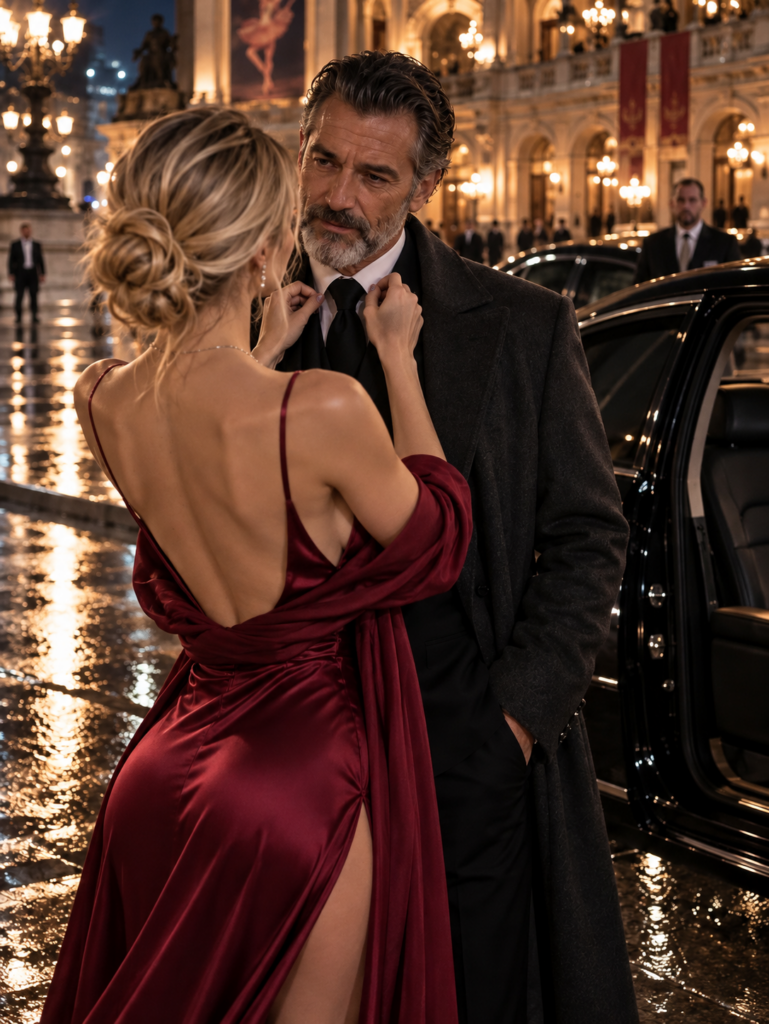
He knew exactly how much money I owed before I ever told him my last name.
By midnight, every dollar of my mother’s medical debt had vanished.
The next morning, I learned the man who paid it was the one man in the city everyone else was afraid to owe.

PART 1 — THE MAN AT TABLE TWELVE
The crystal chandelier above Table Twelve needed cleaning.
I noticed because staring at dust was easier than admitting my feet had gone numb somewhere around hour six of my shift at Giovanni’s. Lemon polish clung to my apron, roasted garlic drifted from the kitchen, and the dining room glowed beneath amber lamps while people ordered bottles of wine that cost more than my rent.
“Lily.”
Marcus shoved through the kitchen doors carrying six dirty plates.
“Seven needs water. Twelve just sat down. VIP.”
I picked up a pitcher.
At twenty-six, I had learned that exhaustion could become a personality if you wore it long enough.
Three jobs. Four hours of sleep on good nights. A mother dying from stage-four cancer and an experimental treatment insurance had politely called “nonessential.”
Current debt: $347,000.
I knew the number better than my own birthday.
Table Twelve sat behind frosted glass.
Four men waited there.
Three looked like security.
The fourth looked like the reason men needed security.
Silver hair swept neatly from a severe face. Black suit. Charcoal shirt. No tie. A pale scar cut through his left eyebrow, and a heavy ring rested on one scarred hand.
He watched me approach.
Not my body.
My face.
That somehow felt more dangerous.
“Good evening. Can I bring you something to drink?”
The others ordered.
He said nothing.
“And for you, sir?”
“What is your name?”
His voice was low, Italian beneath years of American smoothness.
“Lily.”
His gaze dropped briefly.
“You’re favoring your left ankle.”
My stomach tightened.
I had twisted it four hours earlier.
“I’m fine.”
“No, you aren’t.”
“I can bring you—”
“Sit down.”
I blinked.
“I’m working.”
“Your manager won’t object.”
Through the glass, Marco immediately looked away.
The stranger pulled out the chair beside him.
“Sit.”
Against every instinct I possessed, I did.
He studied my hands.
“How much?”
“How much what?”
“Your mother’s medical debt.”
The room seemed to tilt.
I stood so quickly the chair scraped backward.
“I don’t know who you think you are—”
“Three hundred forty-seven thousand dollars.”
My breath stopped.
He continued quietly.
“Stage four. Clinical treatment denied twice by insurance. You’re working here, mornings at a coffee shop, weekends doing private event service.”
Heat flooded my face.
“Did you investigate me?”
“Yes.”
“Why?”
“Because you caught my attention.”
“That is not an answer.”
“It is the only one you’re getting tonight.”
I grabbed the pitcher.
He spoke before I could leave.
“Your mother’s treatment will not cure her.”
I turned on him.
“Don’t.”
“But you’ll bankrupt yourself trying, because walking away would feel like killing her yourself.”
My hand tightened around the glass.
For the first time, something changed in his expression.
Not pity.
Recognition.
“I can clear the debt,” he said.
I laughed once.
It sounded ugly.
“For what?”
“Dinner.”
“What?”
“Tomorrow. Seven.”
“You’re offering me three hundred forty-seven thousand dollars for dinner?”
“No.”
He rose.
Up close, he was taller than I expected.
“I’m paying the debt whether you come or not.”
“Why?”
His gray eyes held mine.
“Because twenty-three years ago, I sat beside a hospital bed and learned money cannot always buy the one thing you want.”
He placed a black card on the table.
SALVATORE CONSTANTINO.
Nothing else.
Then he left.
My phone vibrated thirty seconds later.
UNKNOWN NUMBER.
Check your bank account.
My fingers went cold.
I opened the app.
The balance had changed.
$347,000.
Exactly.
Then another message appeared.
The money is yours. No conditions. But tomorrow at seven, I hope you’ll let me explain why I chose you.
Marcus came rushing toward me.
“Lily, do you know who that was?”
I looked at the black card.
“No.”
His face lost color.
“That was Salvatore Constantino.”
The name finally landed.
Ports.
Construction.
Nightclubs.
Federal investigations.
Three witnesses who had changed their testimony.
Two men who had vanished.
A criminal empire built quietly enough that respectable people could pretend it didn’t exist.
Marcus leaned closer and whispered the sentence that made my blood turn cold.
“People don’t get invited into Salvatore Constantino’s world, Lily.”
He looked toward the door through which the silver-haired man had disappeared.
“They get chosen.”
And standing there with $347,000 in my bank account, I realized the most dangerous man in the city had just chosen me.
PART 2 — THE PRICE OF BEING CHOSEN
I checked the account seventeen times before sunrise.
The money remained.
At 4:12 a.m., I transferred enough to settle the overdue portion of my mother’s hospital account. At 5:03, I paid the pharmacy balance. At 5:41, sitting on my kitchen floor beneath the pale light above the stove, I called the hospice facility whose website I had been secretly studying for months.
Their gardens had roses.
Their rooms had real windows.
Their pain-management specialist had once called me personally after I submitted an inquiry and explained, with devastating kindness, what my mother’s final months could look like if I could afford proper care.
“Ms. Morrison?” the intake coordinator asked.
“Yes.”
My throat tightened.
“I’d like to arrange admission for my mother.”
That afternoon, my mother lay beneath a cream blanket in a private room overlooking winter roses.
No fluorescent hallway.
No rattling radiator.
No neighbor screaming at a television through our apartment wall.
Only lavender, sunlight, and a nurse named Teresa who spoke to my mother instead of over her.
Mama looked around, then at me.
“How?”
I adjusted the blanket.
“It’s handled.”
“Lily.”
“I found help.”
Her thin fingers caught my wrist.
There had been a time when those hands could lift grocery bags, braid my hair, slap pancake batter off my nose. Now her wedding ring hung loose around one knuckle.
“What kind of help?”
“The expensive kind.”
Her eyes narrowed.
Even dying, my mother could detect nonsense faster than most detectives.
“Did you do something stupid?”
“Not yet.”
Her mouth twitched.
“That answer worries me more.”
I kissed her forehead.
“I’m going to dinner tonight.”
“With the expensive help?”
I stared at her.
She smiled faintly.
“I raised you. You make the same face every time you’re hiding a man.”
“There is no man.”
“There is always a man eventually.”
“This one may be a criminal.”
Mama’s smile vanished.
“That is less charming.”
“He paid everything with no conditions.”
“There are always conditions.”
“He says there aren’t.”
“Then he is either lying or lonely.”
I sat beside her.
“Which is worse?”
“Lonely men can be dangerous.”
She squeezed my hand.
“So can lonely women.”
At six forty-five, I stood before the cracked mirror in my apartment wearing a midnight-blue dress borrowed from Rachel.
She worked at a boutique downtown and had answered my emergency call by saying, “If this ends with you murdered, I’m haunting you for ruining my inventory records.”
The dress was simple.
No glitter.
No plunging neckline.
Just dark silk that moved like water when I walked.
For once, I left my hair down.
A message arrived.
Car downstairs.
Of course.
The Mercedes outside my building looked absurd beside the dented Hondas and work vans.
A security man opened the rear door.
“Miss Morrison.”
Inside, Salvatore Constantino sat alone.
Charcoal suit.
Black shirt.
Silver hair.
Storm-gray eyes.
He looked at me for several seconds.
“You came.”
“You paid my mother’s bills.”
“That isn’t why you came.”
“You seem very sure of yourself.”
“I’m rarely unsure.”
“That sounds exhausting.”
One corner of his mouth moved.
“Occasionally.”
The car pulled away.
I clutched my borrowed purse.
“I have questions.”
“I assumed.”
“Were you watching me before last night?”
“No.”
“How did you learn everything so fast?”
“I gave your name to a man who has access to records most people don’t.”
“So you investigated me between ordering Scotch and dessert?”
“I don’t drink Scotch.”
“That is the part you’re correcting?”
His almost-smile returned.
“You’re less frightened tonight.”
“I’m hiding it better.”
“That I believe.”
We left downtown.
Buildings gave way to quiet streets, stone walls, old trees.
“Where are we going?”
“My house.”
My heart jumped.
“I thought dinner was at Giovanni’s.”
“Too public.”
“You understand how terrifying that sounds.”
“Yes.”
“Does that concern you?”
“Yes.”
For the first time, his answer came without amusement.
He turned slightly.
“I will not touch you without permission. You may leave whenever you wish. The driver will take you home the moment you ask.”
“That doesn’t magically make this safe.”
“No.”
“Then why should I trust you?”
“You shouldn’t.”
That answer silenced me.
“You should pay attention,” he continued. “Ask questions. Notice exits. Keep your phone. Trust is earned. Anyone who asks you for blind trust is either a fool or planning to betray you.”
The iron gates opened.
Beyond them stood a house of stone and glass surrounded by cypress trees.
Not flashy.
Worse.
Old money pretending it had nothing to prove.
Inside, photographs lined one hallway.
Not trophies.
Family.
A younger Sal with black hair beside a laughing woman on a beach.
Sal standing behind an elderly couple.
A wedding photograph.
I slowed.
He noticed.
“My wife.”
“She was beautiful.”
“Yes.”
“What was her name?”
“Maria.”
Something in his voice closed the door gently.
We ate beside windows overlooking a garden.
No servants hovered.
Courses appeared quietly and disappeared the same way.
For twenty minutes, he asked about my mother.
Not the illness.
Her.
What music she liked.
Where she grew up.
Why she had kept the broken blue vase visible in our apartment instead of throwing it away.
“How do you know about the vase?”
“You mentioned it to a nurse on a public fundraising page.”
My embarrassment must have shown.
“I read what you wrote,” he said. “Not because I wanted leverage.”
“Then why?”
“To understand you.”
“That sounds like leverage with better manners.”
He accepted the criticism.
“Yes.”
I put down my fork.
“Your turn.”
His eyebrow lifted.
“You know my debt. My address. My work schedule. My mother’s diagnosis. I know you own a criminal empire and apparently dislike Scotch.”
“An unfair imbalance.”
“Exactly.”
He looked out at the garden.
“I am sixty-two.”
“I know.”
“You researched me.”
“I Googled you until four in the morning.”
“What did you find?”
“That half the internet thinks you’re a businessman and the other half thinks you’re Satan in a tailored suit.”
“Internet journalism lacks nuance.”
Despite myself, I laughed.
He watched me.
That look again.
Like laughter was rare currency.
“What happened to your wife?”
The question escaped before I decided whether I should ask it.
He did not answer immediately.
“Cancer.”
My chest tightened.
“Twenty-three years ago.”
“I’m sorry.”
“I had six private specialists. Experimental medication from Switzerland. A surgeon flown from Boston.”
His fingers tightened around the stem of his water glass.
“She died at thirty-eight.”
I understood the money then.
Not all of it.
Enough.
“You saw my mother’s bills.”
“Yes.”
“And you remembered her.”
“Yes.”
“Then why the dinner?”
His gaze returned to mine.
“That part was selfish.”
I waited.
“For twenty-three years, women who approached me wanted something. Protection. Money. Access. Power. Or they were terrified enough to pretend they wanted nothing.”
His voice lowered.
“Last night you came to my table exhausted, limping, worried about whether I needed sparkling water.”
“That’s your standard now?”
“My standards have deteriorated.”
I smiled.
He didn’t.
“You looked directly at me, Lily.”
“I didn’t know who you were.”
“Exactly.”
The word landed softly.
“I wanted one evening where somebody could look at me without seeing the name first.”
The honesty unsettled me more than arrogance would have.
“So I’m an experiment?”
“No.”
“A charity project?”
“No.”
“Then what?”
His eyes held mine.
“I don’t know.”
That was the first uncertain thing Salvatore Constantino ever said to me.
It made me more nervous than everything else.
At the end of dinner, he walked me to the car.
No attempt to kiss me.
No lingering touch.
Just the cool night and his hand briefly at my elbow when I stepped off the stone path.
“Thank you for coming.”
“I still don’t know whether this was the worst decision of my life.”
“You’ll know eventually.”
I stopped beside the car.
“That sounds ominous.”
“It wasn’t intended that way.”
“What do you want now?”
“Another dinner.”
“That’s it?”
“For now.”
“You’re very strange for a crime boss.”
“So I’ve been told.”
The next morning, white roses arrived at hospice.
The card was not addressed to me.
Mrs. Morrison — Lily says these are your favorite. I hope today is gentle. — S.C.
Mama read it twice.
Then she looked at me.
“You are in trouble.”
“He sent flowers.”
“That is how trouble starts when it has money.”
I laughed.
She didn’t.
“Does he frighten you?”
“Yes.”
“Does he hurt you?”
“No.”
“Has he tried?”
“No.”
“Does he listen when you speak?”
I thought about dinner.
“Yes.”
She relaxed slightly.
“Then pay attention to what he does when you say no.”
That advice stayed with me.
Over the next two weeks, Sal asked.
He never ordered.
Dinner?
Would you like to come?
Gallery?
Only if you’re comfortable.
A drive along the coast?
We can turn around whenever you want.
He sent a driver, never appeared unannounced, and never entered my apartment.
That restraint made him harder to dismiss.
At the gallery, people moved away when he approached.
A banker interrupted another conversation to shake his hand.
A city councilman greeted him too warmly.
Two men near the sculpture exhibit lowered their voices when he walked past.
I noticed all of it.
“So this is your world,” I whispered.
“Part of it.”
“Everyone is scared of you.”
“Not everyone.”
His eyes shifted to me.
I looked away first.
Later, I stood before an abstract painting made of violent red slashes crossing a field of white.
“You hate it,” Sal said.
“I’m trying to understand it.”
“You don’t have to understand everything.”
“That sounds convenient coming from you.”
He smiled.
Then his attention moved beyond my shoulder.
The smile disappeared.
A man near the entrance was watching us.
Mid-forties.
Dark beard.
Gray suit.
Nothing remarkable except that everyone else pretended not to notice him.
“Who is that?”
“Nobody.”
“Your face says otherwise.”
Sal placed a hand lightly at my back.
“We’re leaving.”
“Why?”
“Because I said—”
He stopped himself.
His jaw tightened.
“Because I believe it would be safer.”
Mama’s advice.
Pay attention to what he does when you say no.
“I don’t want to leave because some stranger stared at us.”
Sal’s hand dropped.
His expression remained controlled, but I could see the war behind it.
“All right.”
“You’re agreeing?”
“I said you could choose.”
We stayed another twenty minutes.
Sal did not relax once.
The man disappeared.
That night, Sal’s security car followed me home.
I called him.
“Are you having me followed?”
“Escorted.”
“Without asking.”
A pause.
“You’re right.”
That surprised me.
“Tomorrow the car stops.”
“You’re just agreeing again?”
“I dislike it.”
“But?”
“I gave you my word.”
The car disappeared the next day.
Three nights later, someone photographed me entering hospice.
I noticed because the flash reflected in the dark window.
I turned.
A man stepped behind a parked truck.
By the time hospice security reached the street, he was gone.
I called Sal.
He arrived in nine minutes.
Not his driver.
Not security.
Sal himself.
The elevator doors opened and he came out without an overcoat, silver hair disturbed by the wind.
“Where?”
“Outside.”
“Did he speak to you?”
“No.”
“Touch you?”
“No.”
“Are you sure?”
“Yes.”
His hands hovered near my shoulders but did not land.
It was the restraint that made my chest ache.
“May I?”
I nodded.
Then he pulled me into his arms.
Not seductively.
Desperately.
His heartbeat was too fast.
“You were scared.”
“Yes.”
“So were you.”
He released me.
“I’m never scared.”
“You’re lying.”
He looked at me for a long second.
“Yes.”
We sat in the hospice cafeteria after midnight.
The vending machine buzzed.
A nurse laughed somewhere down the hall.
Sal looked absurd under fluorescent lights in a suit that probably cost ten thousand dollars.
“Who was he?” I asked.
“I don’t know.”
“You expect me to believe that?”
“I know who he may work for.”
“Who?”
“Dmitri Volkov.”
The name meant nothing.
My face showed it.
“Russian organization,” Sal explained. “Imports. Weapons. Extortion. Narcotics.”
“And you?”
“I don’t touch narcotics.”
“That wasn’t exactly what I asked.”
“No.”
He folded his hands.
“Our organizations have disputed territory for years.”
“Territory.”
“Ports. Warehouses. Routes.”
“You talk about the city like a board game.”
“Sometimes men with too much power reduce human lives to squares because it is easier than remembering there are people standing on them.”
I stared at him.
“And you?”
His expression turned tired.
“I have done that too.”
The honesty hurt.
“You said the money for Mama had no conditions.”
“It doesn’t.”
“If I walk away now?”
“You keep everything.”
“And protection?”
He looked at me.
“If you walk away because you truly want me gone, I will make sure no one from my world ever bothers you again.”
“You’d leave me alone?”
His jaw tightened.
“Yes.”
“Would that hurt?”
A small, humorless smile.
“Very much.”
I should have left.
Instead, I stayed beside him until sunrise.
The following week, Mama grew weaker.
She slept more.
Ate less.
One afternoon, she woke to find Sal sitting beside her bed reading.
Not aloud.
Just there.
I stopped in the doorway.
He hadn’t noticed me yet.
Mama’s eyes opened.
“You came.”
“You told Lily you liked company when she was working.”
“She talks too much.”
“I’ve noticed.”
Mama smiled faintly.
“What are you reading?”
“Dante.”
“Of course you are.”
“You disapprove?”
“No. I expected something more criminal.”
Sal laughed.
A real laugh.
The sound startled me.
Mama saw me in the doorway.
“Your criminal is entertaining me.”
“He’s not my criminal.”
Sal looked up.
Mama looked at him.
Then at me.
Neither helped.
I crossed my arms.
“You came without telling me.”
Sal stood.
“I came to see her.”
“That is suspiciously sweet.”
“I’m capable of isolated incidents.”
Mama coughed.
The humor vanished.
Sal immediately reached for the water and helped her drink with hands that had probably done terrible things.
He did it gently.
No impatience.
No discomfort.
Watching them together cracked something open inside me.
After Mama slept, I walked Sal to the elevator.
“Thank you.”
“For what?”
“Treating her like a person.”
His face changed.
“My wife hated when doctors spoke around her.”
Maria.
His dead wife.
“You learned from that.”
“I learned too late.”
The elevator arrived.
Before he stepped inside, I touched his hand.
He froze.
It was astonishing.
This man could make rooms go silent, but my fingers around his seemed to steal his breath.
“Sal.”
He looked down at our hands.
Then at me.
“Be careful.”
“With you?”
“With making me forget what I am.”
The elevator doors closed between us.
At two thirteen the next morning, my phone rang.
Sal.
I answered immediately.
“What happened?”
His voice came low and urgent.
“Two men will knock on your door in three minutes.”
I sat upright.
“What?”
“Go with them.”
“Where?”
“Somewhere safe.”
My blood chilled.
“Sal.”
“Someone photographed you at hospice. We found the photographer tonight.”
“What did he say?”
“That Volkov knows your name.”
My hand began shaking.
“Why would he care?”
Silence.
Then Sal said the words that changed everything.
“Because he knows I care.”
Three knocks hit my apartment door.
Exactly three minutes.
I stopped breathing.
“Sal?”
“Listen to me. Take your phone. Nothing else.”
“Are you coming?”
“As soon as I can.”
“Are you in danger?”
A pause.
“Yes.”
The truth terrified me.
The men at my door identified themselves.
I recognized one from the gallery.
I unlocked it.
Two security officers waited in the hall.
“We need to leave now, Miss Morrison.”
I stepped into the hallway wearing pajama pants and sneakers.
As the apartment door closed behind me, Sal spoke again through the phone.
“Lily.”
“Yes?”
“If anyone tells you I sent them but they don’t know the word lavender, you run.”
“Why lavender?”
“Your mother’s room.”
My throat tightened.
He had thought of a code in seconds.
“Sal—”
“I need to go.”
“No.”
Silence.
I hated how desperate my voice sounded.
“Please don’t hang up.”
For two seconds, the most feared man in the city said nothing.
Then, softly:
“I’m sorry I brought this to your door.”
A noise exploded through his end of the call.
Shouting.
Glass breaking.
Then a gunshot.
“Sal!”
The connection died.
The SUV accelerated into the night.
I stared at my phone.
No signal.
No answer.
And for the first time since Salvatore Constantino entered my life, I understood that the danger was no longer standing across from me.
It was coming for both of us.
The safe house sat four hours north of the city.
Steel.
Glass.
Forest.
No neighbors.
No traffic.
No world.
Two armed men stayed downstairs while I paced the upper floor.
At seven in the morning, a message arrived.
I’m alive. Stay there.
That was all.
I called.
No answer.
I texted back.
That is not enough.
Nothing.
At noon:
Please trust me.
I threw the phone onto the couch.
“Trust you?”
The older guard looked up.
I pointed at the phone.
“Your boss sends three words every five hours and expects trust?”
The guard carefully returned his attention to the window.
“Mr. Constantino isn’t known for communication.”
“Apparently murder is easier.”
He coughed suspiciously.
“Are you laughing?”
“No, ma’am.”
“Don’t call me ma’am. I’m twenty-six.”
“Yes, ma’am.”
I almost screamed.
Three days passed.
No Sal.
On the third afternoon, I walked into the security room while one guard was outside.
A wall of screens showed cameras around the property.
The other guard, Marco, stood quickly.
“You shouldn’t be in here.”
“Then lock the door.”
His expression tightened.
“What is happening?”
“Operational matters.”
“That phrase means nothing.”
“It means I’m not authorized.”
“Am I a prisoner?”
“No.”
“Can I leave?”
He didn’t answer.
My stomach dropped.
“Can I leave?”
“Mr. Constantino asked us to keep you here.”
“That was not my question.”
Marco exhaled.
“No.”
The answer hit me harder than expected.
A beautiful cage was still a cage.
“Give me a phone.”
“You have yours.”
“He isn’t answering.”
Marco looked away.
“Is Sal alive?”
“Yes.”
“You hesitated.”
“I was choosing my words.”
“That is what people say when they’re deciding how much to lie.”
The sound of engines cut through the argument.
Three vehicles.
Then four.
Marco’s hand went to his weapon.
“Stay here.”
I pushed past him.
“Absolutely not.”
The front door opened.
Sal walked inside.
His shirt was wrinkled.
A bruise darkened his cheek.
His left hand was bandaged.
He looked ten years older.
Then he saw me.
Everything in his face changed.
“Lily.”
I crossed the room.
And slapped him.
Every guard stopped breathing.
Sal didn’t move.
The sting reddened his cheek beside the bruise.
“You locked me here.”
“Yes.”
“You promised.”
“Yes.”
“You said I could leave whenever I wanted.”
“I did.”
“And then you took that choice away.”
His eyes closed briefly.
“Yes.”
There was no defense.
That somehow made me angrier.
“You don’t get to decide that fear turns me into property.”
“I know.”
“Do you?”
“Yes.”
His voice broke.
“I was wrong.”
I stared.
Salvatore Constantino apologizing was unnerving.
“I saw photographs of you leaving hospice,” he said. “Your apartment. Your coffee shop. Your mother’s window.”
His composure slipped.
“For forty-eight hours, all I could see was Maria.”
His dead wife.
“Sal.”
“They threatened her once too.”
The room went cold.
“You never told me.”
“No.”
“What happened?”
He looked at the guards.
“Out.”
Everyone left.
We stood alone.
“Twenty-three years ago, Maria was kidnapped.”
My anger changed shape.
“What?”
“My enemies believed taking her would force me to surrender several ports.”
His voice became distant.
“I found her after fourteen hours.”
“Was she hurt?”
“Yes.”
The word came quietly.
“They didn’t kill her. Cancer did that six months later.”
I covered my mouth.
“She spent the last half-year looking over her shoulder because of me.”
He looked at me.
“So when I learned Volkov was watching you, I did what fear told me to do.”
“You locked me away.”
“Yes.”
“That isn’t love.”
“No.”
His answer came immediately.
“It is fear wearing love’s clothes.”
The sentence silenced me.
Sal stepped closer but stopped several feet away.
“If you tell me to take you home, I will.”
“Is it safe?”
“No.”
“Then don’t offer choices that aren’t real.”
He absorbed that too.
“What do you want?”
“The truth.”
“About?”
“All of it.”
The afternoon faded while Sal told me about the empire.
Not every crime.
Enough.
His father.
The ports.
The extortion schemes inherited from men who called violence tradition.
Businesses he had forced legitimate over the years.
Businesses he had not.
Enemies.
Bodies.
Compromises.
Things he regretted.
Things he didn’t.
When he finished, darkness covered the windows.
I felt sick.
Not because I had suddenly discovered he was dangerous.
Because now danger had details.
“You killed people.”
“Yes.”
“Personally?”
“Yes.”
“How many?”
“I stopped counting.”
I turned away.
He did not touch me.
“Do you expect me to tell you that doesn’t matter because you’re kind to my mother?”
“No.”
“Good.”
“I expect nothing.”
I faced him.
“Then why tell me?”
“Because you asked.”
A long silence.
“And Volkov?”
“He tried to kill me the night you left.”
“The gunshot.”
“Yes.”
“What happens now?”
“I negotiate.”
I almost laughed.
“You?”
“Occasionally.”
“And if negotiation fails?”
His expression answered.
“No.”
“Lily.”
“You cannot tell me you’re trying to become something better and then solve every fear with a grave.”
“He has killed people.”
“So have you.”
His jaw tightened.
“Exactly.”
I walked closer.
“Maybe that means you understand where the road ends.”
His eyes searched mine.
“You think a conversation can fix this?”
“No.”
“But?”
“I think there has to be something between doing nothing and burning the city down.”
For the first time, Sal looked uncertain.
Good.
Uncertainty meant he was thinking.
That night, he slept in a chair outside my bedroom door.
I knew because I opened it at three in the morning.
He woke immediately.
“Everything okay?”
“You have bedrooms.”
“Yes.”
“Why are you here?”
“Because I wanted to know you were safe.”
My anger softened against my will.
“Come inside.”
His eyes lifted.
“To sleep.”
“Of course.”
“On the sofa.”
His mouth almost curved.
“Cruel woman.”
He slept on the sofa.
At dawn, I woke beneath a blanket I did not remember pulling over myself.
Sal was gone.
A note remained.
You were right. I’m trying your way first.
Negotiations were arranged at an abandoned waterfront terminal.
I was not there.
This time, Sal asked me to remain at the safe house.
I agreed.
Choice changed everything.
Seven hours later, he called.
“I need you to hear this from me.”
My stomach tightened.
“What?”
“Volkov agreed to leave you out of it.”
Relief came too fast.
“But?”
“But he wants something.”
“What?”
“A meeting with you.”
“No.”
The word left Sal like a gunshot.
“Then why tell me?”
“Because you asked for choices.”
He sounded as if the sentence physically hurt.
“Why does he want me?”
“He says he wants to understand what makes you valuable enough that I altered twenty years of strategy.”
“That is unsettling.”
“Yes.”
“Will you be there?”
“Every second.”
“Guards?”
“Enough to invade a small country.”
I almost smiled.
“Then I’ll meet him.”
“No.”
“Sal.”
“I told you because—”
“Because I choose.”
Silence.
I heard his breath.
“Damn you.”
“Very romantic.”
“You’re enjoying this.”
“A little.”
The meeting happened at a neutral restaurant closed for the afternoon.
Volkov arrived with six men.
Sal brought eight.
I brought myself.
Dmitri Volkov was not what I expected.
No scar.
No theatrical menace.
He looked like a university professor in an expensive coat.
“You are Lily Morrison.”
“Yes.”
He sat across from me.
Sal remained beside me, one hand beneath the table, not touching.
Waiting.
Volkov smiled.
“I expected someone different.”
“So did I.”
His smile sharpened.
“Salvatore tells me you convinced him not to kill me.”
“I convinced him to listen.”
“Do you believe men like us change?”
I looked at Sal.
“No.”
Sal’s face tightened.
Then I continued.
“I believe people change when continuing the same way becomes more painful than becoming someone else.”
Volkov studied me.
“And has Salvatore reached that point?”
“That’s his question to answer.”
For ten seconds, nobody spoke.
Then Volkov laughed.
“You really are different.”
He turned to Sal.
“She is going to ruin you.”
Sal’s hand finally found mine.
“Probably.”
The negotiations lasted three hours.
Territory exchanged.
Financial disputes settled.
A nonaggression agreement written by attorneys who would never put the real reasons on paper.
No one died.
When we reached the car, Sal leaned against the door and exhaled.
“What?”
“I have wanted Dmitri Volkov dead since 1998.”
“And?”
“You made me eat lunch with him.”
“Personal growth.”
“You are insufferable.”
“You adore me.”
His face changed.
The humor vanished.
“Yes.”
My breath caught.
He stepped closer.
“I do.”
The parking garage suddenly felt too quiet.
“I tried not to.”
“Very flattering.”
“I’m serious.”
“So am I.”
His hand rose and stopped beside my face.
Permission.
I leaned into it.
His palm touched my cheek.
Warm.
Careful.
“I love you,” Sal said.
No grand speech.
No poetry.
Just four words from a man who had spent half his life training himself not to need anything.
I felt tears sting unexpectedly.
“You terrify me.”
“I know.”
“You frustrate me.”
“I know.”
“You’re sixty-two.”
“I’m aware.”
“And sometimes you’re unbelievably arrogant.”
His mouth twitched.
“That one seems subjective.”
I laughed through tears.
Then kissed him.
His other hand came around my waist.
The kiss deepened, but he pulled back first.
“Lily.”
“What?”
“If we do this, I need you to understand something.”
“What?”
“I don’t know how to love casually.”
“Good.”
His eyes darkened.
“Good?”
“Because neither do I.”
For one brief moment, standing beneath concrete lights in a parking garage surrounded by armed men pretending not to look at us, I thought perhaps danger had finally stepped backward.
I was wrong.
The call came forty-eight hours later.
Not from Sal.
From hospice.
“Ms. Morrison, you should come now.”
Everything inside me stopped.
Mama was awake when I arrived.
Barely.
Sal followed five minutes later but remained outside until I called him in.
My mother looked at him.
“You took your time.”
“I drove illegally.”
“Good.”
He sat beside her.
Mama looked at our joined hands.
“So.”
I cried before she said anything else.
“Oh, baby.”
Her voice was paper-thin.
“No.”
I bent over the bed.
“I’m not ready.”
“I know.”
“No, you don’t.”
“I do.”
She stroked my hair.
“I wasn’t ready when my mother left either.”
Sal turned away.
Mama noticed.
“Salvatore.”
He looked back.
“Come closer.”
He obeyed.
Mama reached for his hand.
“You love her?”
“Yes.”
“How much?”
“Enough to let her walk away if staying with me destroys who she is.”
I looked at him.
Mama’s eyes sharpened.
“Good answer.”
He almost smiled.
“But you listen to me.”
“I am.”
“My daughter is not something you protect by locking it in a safe.”
“I learned that.”
“She will drive you insane.”
“She already does.”
I laughed through tears.
Mama smiled.
“Good.”
Her fingers tightened weakly around his.
“When she is grieving, she will say she wants to be alone.”
“Mama.”
“She will not.”
Sal nodded solemnly.
“When she is angry, she cleans.”
“I do not.”
“You alphabetized the spices after your father died.”
“That was practical.”
“And when she is afraid, she becomes very brave and makes bad decisions.”
Sal glanced at me.
“That I have noticed.”
“Both of you stop.”
Mama closed her eyes for several seconds.
When she opened them, the strength was fading.
“Promise me something.”
Sal leaned closer.
“Anything.”
“Do not save her life so completely that she forgets how to live it.”
His face broke.
Not dramatically.
Just one small collapse around the eyes.
“I promise.”
Mama looked at me.
“And you.”
“I’m here.”
“Do not confuse danger with love just because the dangerous man loves you.”
The truth pierced straight through me.
“Then what do I trust?”
“Watch what he changes when love asks him to.”
Her gaze moved to Sal.
“That is the difference.”
Those were almost her last coherent words.
She died before sunrise.
My hand around hers.
Sal standing behind me.
The room smelled of lavender.
For three weeks after the funeral, grief erased time.
I slept.
Didn’t sleep.
Cried in grocery stores because Mama’s tea was on sale.
Opened my phone to call her and remembered.
Sal never told me to stop crying.
Never said she was “in a better place.”
Never tried to buy my grief into silence.
He just stayed.
Sometimes across the room.
Sometimes holding me.
Always there.
One morning, I woke and found him packing a suitcase.
My stomach dropped.
“Where are you going?”
He turned.
“Home.”
“This is your safe house.”
“My city home.”
“Why?”
“Because you need space.”
“What?”
He closed the suitcase.
“You haven’t chosen anything for yourself in months.”
“That doesn’t answer me.”
“I paid your mother’s debt. I brought danger into your life. I moved you here. I made myself necessary.”
His voice was calm, but his hands were not.
“I need to know that if you stay, you stay because you want me. Not because grief made you afraid to lose another person.”
I stared.
“You’re leaving me?”
“I’m giving you the thing I am worst at giving.”
“What?”
“Freedom from me.”
He walked to the door.
Pain hit with ridiculous force.
“Sal.”
He stopped.
I wanted to ask him to stay.
Mama’s last advice came back.
Watch what he changes when love asks him to.
This was change.
It hurt anyway.
“How long?”
“As long as you need.”
“And if I don’t call?”
His back remained toward me.
“I will keep my promise.”
The door closed.
For the first time since he entered Giovanni’s, Salvatore Constantino disappeared from my life.
No flowers.
No cars outside.
No security I could see.
No messages.
The silence lasted nineteen days.
On day twenty, I enrolled in nursing school.
On day twenty-one, I went back to Giovanni’s and quit.
Marco nearly dropped a tray.
“You’re quitting?”
“Yes.”
“Did Constantino buy the restaurant?”
“No.”
“You sure?”
“Reasonably.”
On day twenty-three, I visited Mama’s grave.
I brought white roses.
I sat on damp grass and told her everything.
About school.
About fear.
About Sal.
About how much I missed both of them in different ways.
“I think I love him,” I whispered.
Wind moved through the cemetery trees.
No answer.
Obviously.
Then I laughed because Mama would have called that observation “late.”
That night, I called Sal.
He answered on the first ring.
But said nothing.
“Hello?”
“Lily.”
One word.
His voice was rough.
“Where are you?”
“At home.”
“Which one?”
A pause.
“The house with the garden.”
Maria’s house.
The one where his wife had once lived.
“I want to see you.”
Another silence.
Then:
“Are you sure?”
“Yes.”
A car did not arrive.
Instead, Sal drove himself.
Thirty-five minutes later, headlights swept across my apartment windows.
I went downstairs.
He stood beside a black sedan in the rain.
No umbrella.
No security visible.
He looked at me like a man waiting for sentencing.
“I enrolled in school.”
His expression changed.
“Nursing?”
“Yes.”
“Good.”
“I quit Giovanni’s.”
“Also good.”
“I planted basil.”
He blinked.
“Congratulations?”
“I killed it.”
“That sounds more like you.”
I laughed.
Then cried.
He crossed the sidewalk but stopped before touching me.
“I missed you.”
“I missed you too.”
“Is that why you called?”
“No.”
He waited.
“I called because I realized something.”
“What?”
“My life was small before you.”
Pain crossed his face.
“That’s what I was afraid of.”
“No. Listen.”
I stepped closer.
“It was small because fear had reduced it. Mama’s illness. Debt. Work. Survival.”
Rain soaked my hair.
“You didn’t give me a life, Sal.”
His eyes searched mine.
“You gave me enough space to remember I wanted one.”
He exhaled.
“And?”
“And I want you in it.”
His control broke.
His forehead dropped against mine.
“I cannot promise you normal.”
“I don’t want a promise you can’t keep.”
“I cannot promise you perfect safety.”
“No one can.”
“I can promise I will never lock you away again.”
“That one I want.”
“I can promise to tell you the truth when it is ugly.”
“I want that too.”
His hands finally touched my face.
“And I can promise that I will love you for as long as I am alive.”
I closed my eyes.
“That sounds dramatic.”
“I’m Italian.”
I laughed.
He kissed me beneath the rain.
And for a while, that was enough.
Until someone fired a bullet through Sal’s dining-room window three months later.
PART 3 — THE THING LOVE COULD NOT PROTECT US FROM
The glass exploded inward.
I was carrying two plates from the kitchen.
Sal was pouring wine.
The first shot hit the wall.
The second shattered the chandelier.
Sal crossed the room before I understood what was happening.
He tackled me behind the stone fireplace as security flooded the house.
“Down.”
His body covered mine.
More gunfire.
Three sharp cracks from outside.
Then silence.
My plate had shattered beneath me.
Tomato sauce streaked the floor like blood.
“Are you hit?”
“No.”
“Lily, look at me.”
“I’m fine.”
His hands checked my shoulders, face, arms.
“Sal.”
“I’m fine.”
A guard shouted from the hall.
“Vehicle heading east!”
Sal started to rise.
I caught his sleeve.
“No.”
His eyes changed.
The old Sal had arrived.
Cold.
Fast.
Deadly.
“Stay here.”
“Where are you going?”
“To end this.”
Mama’s words returned instantly.
Watch what he changes when love asks him to.
I stood.
“No.”
“Lily.”
“You promised.”
“This is different.”
“It always becomes different when you’re afraid.”
“They shot into our home.”
“Yes.”
“They could have killed you.”
“Yes.”
“And you expect me to negotiate?”
“I expect you to think.”
His face hardened.
“I am thinking.”
“No. You’re remembering Maria.”
That stopped him.
His eyes went empty.
I softened my voice.
“You’re back in that room twenty-three years ago.”
His breathing changed.
“And you think if you kill everyone fast enough, history cannot repeat itself.”
A guard appeared.
“Boss.”
Sal raised one hand.
The guard stopped.
“Five minutes.”
He looked at me.
“What are you asking me to do?”
“Find out who did it.”
“And then?”
“Then decide based on what happened, not what you’re terrified might happen.”
His jaw worked.
“You make morality sound very convenient when no bullets are coming through the wall.”
“You think I’m not scared?”
I pointed at the broken glass.
“My hands are shaking.”
They were.
“So are yours.”
Sal looked down.
His fingers trembled.
That terrified him more than the gunfire.
Two hours later, we learned the vehicle belonged to a shell company connected not to Volkov, but to Vittorio Constantino.
Sal’s younger brother.
I had met Vittorio twice.
He was fifty-eight, elegant, charming, and always slightly amused by me.
“Your brother?”
Sal stared at the report.
“No.”
Marco laid photographs on the table.
A driver.
A vehicle.
A property owned by one of Vittorio’s companies.
Sal picked up one photograph.
“Why?”
No one answered.
I thought of the gallery.
The whispers.
The years Sal had ruled.
The sudden peace with Volkov.
“Maybe this isn’t about me.”
Sal looked at me.
“What?”
“You changing.”
Carmine, Sal’s oldest adviser, shifted uncomfortably.
Sal noticed.
“Carmine.”
Silence.
“What aren’t you saying?”
Carmine looked toward me.
Sal’s voice lowered.
“She stays.”
Carmine exhaled.
“Vittorio has been telling captains you’ve gone weak.”
Sal’s face went still.
“He says the Volkov settlement cost us respect.”
“Anything else?”
“He says Lily influences operational decisions.”
“That is false.”
“Is it?”
Sal looked at me.
I raised an eyebrow.
He turned back.
“It is not entirely false.”
Carmine continued.
“He has support.”
“How much?”
“Enough.”
The room felt colder.
This wasn’t an outside enemy.
It was family.
That made everything worse.
Sal stood.
“Bring Vittorio.”
“He won’t come.”
“Then ask him to.”
Carmine looked surprised.
“So he can refuse?”
“Yes.”
Sal glanced at me.
“We do this differently.”
Three hours later, Vittorio called.
Sal put the phone on speaker.
“You embarrass the family,” Vittorio said.
Sal’s expression remained calm.
“You shot at my home.”
“I sent a message.”
“You could have killed Lily.”
“Then perhaps you would remember who you were before her.”
Sal’s fingers curled.
I touched the table beside his hand.
Not him.
Just close enough.
He noticed.
“Meet me,” Sal said.
“Where?”
“The old marina.”
“No guns.”
Vittorio laughed.
“You really have changed.”
“Yes.”
The answer took him by surprise.
“Tomorrow. Noon.”
The marina belonged to the Constantinos before either brother was born.
Their father had stored fishing boats there before he learned smuggling paid better.
Weathered docks reached into gray water.
Wind smelled of salt and diesel.
I stayed home.
My choice.
Sal went with Carmine and two guards.
At twelve thirty, he called me.
His voice sounded wrong.
“What happened?”
“Vittorio wants control.”
“Of the organization?”
“Yes.”
“And?”
“He claims half the captains support him.”
“Do they?”
“Some.”
“What does he want from you?”
“To retire.”
That sounded almost reasonable until Sal added:
“And send you away.”
I closed my eyes.
“There it is.”
“Yes.”
“What will you do?”
His silence frightened me.
“Sal?”
“I don’t know.”
That was progress.
Terrible, painful progress.
“What do you want?”
“To kill him.”
“Thank you for the honesty.”
“And after that?”
I waited.
His voice lowered.
“I would still be leading an empire that puts you in danger.”
There it was.
The real question.
Not Vittorio.
Not Volkov.
Not security.
The empire itself.
“What are you thinking?”
“I have spent forty years building something I no longer want to hand to anyone.”
I sat down.
“Then don’t.”
“You don’t understand.”
“Explain.”
“If I simply walk away, every man beneath me starts fighting for what remains.”
“So restructure it.”
He laughed bitterly.
“You make dismantling organized crime sound like reorganizing a closet.”
“I alphabetized spices after Dad died. I have experience.”
Silence.
Then he laughed.
Softly.
God, I loved that sound.
Over the next month, Sal did something far more dangerous than going to war.
He surrendered pieces of power.
Legitimate businesses were separated from criminal operations.
Accounts were audited.
Ports were sold or converted.
Men unwilling to transition were paid out where possible.
Evidence of violent operations was turned over selectively through attorneys negotiating immunity and cooperation deals.
It was ugly.
Slow.
Risky.
Vittorio called it betrayal.
Others called it weakness.
Sal called it an exit.
Then someone kidnapped me.
It happened outside nursing school.
Two months before graduation.
My security detail was reduced but not gone.
Three guards.
Two vehicles.
A delivery van struck the lead car at an intersection.
Smoke filled the street.
People screamed.
I remembered Sal’s training.
Move toward the secure vehicle.
Do not freeze.
Do not run blindly.
I made it six steps.
Someone grabbed me from behind.
A cloth covered my mouth.
I drove my heel backward.
Connected with a shin.
An arm tightened around my throat.
I bit.
Hard.
A curse.
Then another man shoved a needle into my arm.
The street tilted.
My last coherent thought was absurd.
Sal is going to destroy the city.
I woke in darkness.
Concrete beneath me.
Wrists tied.
Head pounding.
I smelled salt water.
A warehouse.
Of course.
Apparently criminals lacked imagination.
Vittorio sat across from me.
Gray suit.
No tie.
He looked exhausted.
“You’re awake.”
“Unfortunately for you.”
He smiled.
“That mouth.”
“Your brother likes it.”
The smile disappeared.
“Do you know what you did to him?”
“I met him?”
“You made him ashamed of everything that built our family.”
“No.”
I shifted against the chair.
“He was already ashamed.”
“You think you changed him.”
“He changed himself.”
“Because of you.”
“Maybe.”
Vittorio leaned forward.
“My brother commanded this city for thirty years.”
“And was miserable.”
“Miserable men built empires.”
“Congratulations.”
His hand struck the table.
I flinched.
He noticed.
For the first time, I saw what Sal did not have.
Vittorio enjoyed the fear.
Sal used fear.
There was a difference.
“My brother will come,” he said.
“I know.”
“He will give me everything.”
“Probably.”
“And then?”
I looked toward the warehouse door.
“Then you should pray he remembers the man he wants to be.”
Vittorio laughed.
“You still think love made him gentle.”
“No.”
I met his eyes.
“I think love gave him a reason to control the part of himself that isn’t.”
The doors opened.
Sal walked in alone.
No weapon visible.
Silver hair.
Black coat.
Face carved from stone.
My heart broke at the sight of him.
Not because he looked weak.
Because he looked terrified.
His eyes found mine.
“Are you hurt?”
“No.”
A lie.
My head hurt.
My wrists burned.
But I was alive.
Vittorio stood.
“Sign.”
A folder waited on the table.
Transfer documents.
Businesses.
Properties.
Voting rights.
An empire on paper.
Sal did not look at them.
“You release her first.”
“No.”
“Then there is no deal.”
Vittorio raised a gun.
Pointed it at me.
Sal’s expression did not change.
But something died behind his eyes.
“Vittorio.”
“Sign.”
Sal approached the table.
“Fine.”
“Sal, no.”
He looked at me.
A strange calm entered his face.
“It’s all right.”
“No, it isn’t.”
“It is.”
He picked up the pen.
My throat tightened.
Years of power.
Generations of fear.
All of it about to change hands.
For me.
Then Sal asked:
“Do you remember Father’s first rule?”
Vittorio frowned.
“What?”
“Never negotiate for something you already own.”
Vittorio’s eyes narrowed.
Then police lights exploded through the warehouse windows.
Sirens.
Dozens.
Vittorio turned.
The side doors burst open.
Federal agents flooded the building.
For several seconds, nobody moved.
Then Vittorio grabbed me.
Gun against my temple.
Sal froze.
“You brought police?”
“I brought consequences.”
“You traitor.”
“You shot at my home.”
“You handed the family to the government?”
“No.”
Sal’s voice remained calm.
“I handed them you.”
Vittorio’s arm tightened around my neck.
“You think you’re better than me now?”
“No.”
That answer mattered.
Sal took one step forward.
“I think I spent too many years becoming you.”
Vittorio’s gun pressed harder.
“Back up.”
Sal stopped.
“You want to know the difference between us?”
“You became weak.”
“No.”
Sal looked at me.
Then back at his brother.
“I finally found something I loved more than winning.”
Vittorio laughed.
“And you think that saves you?”
“No.”
Sal’s eyes were wet.
“It saves her.”
A shot cracked.
I screamed.
Vittorio collapsed behind me.
An agent on the catwalk had fired.
The gun slid across concrete.
Sal reached me before anyone else.
He dropped to his knees and cut the restraints.
His hands shook violently.
“Look at me.”
“I’m okay.”
“Look at me.”
I did.
For one second, neither of us spoke.
Then I hit his chest.
“You let me think you were giving him everything.”
“I was.”
“What?”
“If the agents couldn’t get a clean shot, I was signing.”
“Sal.”
“Nothing I own is worth your life.”
My anger dissolved.
He pulled me against him.
Around us, agents shouted orders.
Vittorio groaned on the floor.
Alive.
Shot through the shoulder.
Sal looked toward him.
His face became cold.
Vittorio stared back.
“You should have killed me when you had the chance.”
Months earlier, that sentence would have ended differently.
Sal stood.
Walked over.
The agents tensed.
He stopped above his brother.
“No.”
Vittorio sneered.
“Coward.”
Sal looked down at him.
“I have spent my entire life believing death was the worst punishment I could give a man.”
He glanced at the agents.
“I was wrong.”
Vittorio’s smile disappeared.
“You get to live.”
Sal turned away.
“You get to live long enough to watch everything you tried to steal become something you no longer recognize.”
He walked back to me.
And left his brother alive.
That was the moment I knew Mama had been right.
Not when Sal paid $347,000.
Not when he sent flowers.
Not when he said he loved me.
Not when he nearly started wars in my name.
This.
When the man he had once been would have killed without hesitation—and the man he had chosen to become walked away.
Six months later, Salvatore Constantino testified in federal court.
The newspapers called it shocking.
Unprecedented.
A collapse.
A betrayal.
They were partly right.
He provided evidence against violent operations, including his own.
The agreement cost him.
Millions.
Properties.
Influence.
Several legitimate companies remained, carefully separated from everything else.
He received no magical absolution.
No judge declared love had erased his crimes.
It hadn’t.
He paid fines.
Accepted restrictions.
Spent eighteen months under home confinement while investigations continued.
Some men hated him.
Some disappeared.
Some went to prison.
Vittorio received twenty-two years.
Volkov moved his remaining operations out of the region under a federal settlement of his own.
The empire that had once made people whisper Salvatore Constantino’s name slowly became history.
And Sal?
Sal learned to make breakfast.
Badly.
“You burned the eggs.”
“They are browned.”
“They are black.”
“Caramelized.”
“That word does not apply to eggs.”
He stared at the pan.
“I controlled six ports.”
“And yet breakfast defeated you.”
He pointed the spatula at me.
“Watch your tone.”
I kissed his cheek.
“You adore my tone.”
“Yes.”
His surrender came immediately.
Home confinement suited him terribly.
He paced.
Read.
Called lawyers.
Rearranged books that did not need rearranging.
He also helped me study.
At first, I assumed a sixty-two-year-old former crime boss would be useless at anatomy.
Then I discovered Sal had an absurd memory.
“Branches of the external carotid artery.”
“Sal.”
“Answer.”
“I hate you.”
“No, you don’t.”
“Superior thyroid, ascending pharyngeal, lingual—”
“Continue.”
“I genuinely regret falling in love with you.”
His smile appeared.
“Continue.”
The day I graduated, he sat beside an empty chair.
Mama’s chair.
I had placed one white rose across the seat.
When my name was called, Sal stood before anyone else.
Everyone looked.
He didn’t care.
Neither did I.
Afterward, I found him beneath a tree outside the auditorium.
He held flowers in one hand.
A small velvet box in the other.
I stared.
“No.”
His face fell.
“You haven’t even seen it.”
“You are not proposing at my graduation.”
“I had an entire speech.”
“Salvatore.”
“It was good.”
“Put the box away.”
He looked genuinely offended.
“I spent three weeks writing it.”
“Three weeks?”
“I am not emotionally efficient.”
I laughed.
Then I took the box from him.
Opened it.
A sapphire ring.
Deep blue.
Simple.
Beautiful.
My laughter disappeared.
“Sal.”
He became serious.
“I know the timing is poor.”
“It’s terrible.”
“I know.”
“You hijacked my graduation.”
“I waited until afterward.”
“That is not a defense.”
He inhaled.
Then, unexpectedly, closed the box.
“No.”
“What?”
“You’re right.”
He put it back in his pocket.
“We’ll go home.”
I stared.
“Wait.”
“You said no.”
“I said not here.”
Understanding crossed his face.
“Oh.”
“Yes, oh.”
He actually blushed.
Salvatore Constantino blushed.
I started laughing again.
He muttered something in Italian.
That night, we ate takeout on the terrace.
No white linen.
No security men at the table.
No expensive wine.
Chinese noodles from the restaurant three blocks away.
The city glowed beyond the garden.
Sal placed the velvet box beside my carton.
“No speech.”
“Thank God.”
“I shortened it.”
“I’m listening.”
He looked toward the roses I had planted for Mama.
Then back at me.
“When you met me, I thought I knew what power was.”
I stayed quiet.
“I thought power meant people moved when I entered a room. That men feared disappointing me. That money erased inconvenience and violence erased opposition.”
His fingers touched the box.
“Then you told me no.”
I smiled.
“Repeatedly.”
“Constantly.”
“You needed practice.”
“I did.”
His expression softened.
“You taught me that loving someone is not proving I can keep them.”
My eyes burned.
“It is becoming someone they can freely choose.”
He opened the box.
“I am not asking you because I paid your mother’s debt.”
“I know.”
“I’m not asking because I protected you.”
“I know.”
“I’m not asking because you owe me anything.”
“I know.”
His voice roughened.
“I’m asking because every morning I wake beside you and still cannot understand how a life I thought had ended twenty-three years ago became something I look forward to living.”
Tears slipped down my cheeks.
“I’m sixty-three now.”
“Ancient.”
“Cruel woman.”
I smiled.
He continued.
“I do not know how many years we get.”
His eyes flickered.
That was the truth neither of us romanticized.
Thirty-seven years stood between our ages.
Time was not equal.
Love did not magically erase that.
“I cannot promise forever in the way younger men might.”
He reached for my hand.
“But I can promise every year I have.”
My throat closed.
“Lily Morrison, will you marry me?”
I looked at the ring.
Then at the man.
At the scar.
The silver hair.
The lines beside his eyes that had deepened because he laughed more now.
At the hands that once made men afraid and now trembled because he was waiting for my answer.
“Yes.”
He exhaled as though someone had removed a bullet from his chest.
“Yes?”
“Yes.”
“Are you certain?”
“You’re ruining the moment.”
“I need confirmation.”
I kissed him.
“That is your confirmation.”
He slid the sapphire onto my finger.
It fit perfectly.
Of course it did.
One year later, we married in Mama’s garden.
Not the Constantino estate.
Not a cathedral.
Not a hotel filled with politicians and businessmen.
The hospice had created a memorial garden funded by an anonymous donation.
Sal had paid for it.
When I discovered that, I threatened to cancel the wedding.
He insisted anonymous donations did not count as controlling behavior.
I reluctantly agreed.
White roses surrounded the aisle.
Rachel stood beside me.
Marco, the guard who once refused to let me leave the safe house, stood beside Sal and cried more than anyone.
“I have allergies,” he insisted afterward.
“In December?”
“Severe allergies.”
Our wedding was small.
There were no reporters.
No captains.
No men conducting whispered business in corners.
Just people who had stayed.
When it was time for vows, Sal unfolded three pages.
I stared.
“Three pages?”
“I edited.”
Guests laughed.
He ignored them.
Then he looked at me.
The pages lowered.
He never read them.
“Twenty-five years ago,” he said, “I believed losing love once meant I had been excused from ever risking it again.”
The garden became quiet.
“I made loneliness into proof of strength.”
His eyes held mine.
“Then a tired waitress limped toward my table carrying sparkling water.”
I laughed through tears.
“She had cheap shoes, a bad ankle, and absolutely no idea who I was.”
More laughter.
“She looked at me like a customer.”
“I was hoping for a tip.”
“You got one.”
“Eventually.”
His smile faded into tenderness.
“I paid a debt because I remembered helplessness.”
His voice lowered.
“But I asked for dinner because something selfish inside me wanted to feel human for one evening.”
My breath caught.
“You gave me far more than one evening.”
He touched my hand.
“You gave me the terrible gift of being seen clearly.”
His eyes shone.
“You saw the best things in me.”
A pause.
“And the worst.”
Another.
“And you never confused one for the other.”
That mattered.
More than any declaration that I had “saved” him.
I hadn’t.
People save themselves through choices.
Sometimes another person simply gives them a reason to try.
“My vow,” Sal said, “is not that I will protect you from everything.”
He smiled faintly.
“You would object.”
“I would.”
“My vow is that I will stand beside you while you live your own life.”
Tears blurred him.
“And whenever fear tempts me to hold too tightly, I will remember that love is not possession.”
He squeezed my hand.
“It is permission to stay.”
By the time I spoke my vows, I was crying too hard to pretend elegance.
“I used to think love meant someone rescuing me.”
Sal’s face changed.
“I spent three years trying to rescue my mother.”
I looked toward the white roses.
“I thought if I worked enough hours, found enough money, sacrificed enough of myself, I could bargain with death.”
The garden was silent.
“I couldn’t.”
I looked back at Sal.
“Then you arrived with money and power, and for a while I thought maybe this was rescue too.”
I shook my head.
“It wasn’t.”
His eyes remained on mine.
“You could not rescue me from grief.”
My voice trembled.
“You could not erase your past.”
A pause.
“You could not guarantee my safety.”
Another.
“And I could not turn you into a different man simply by loving you.”
I smiled through tears.
“But we learned something better.”
I took both his hands.
“We could tell each other the truth.”
His chin trembled.
“And then decide what to do with it.”
When the officiant pronounced us married, Sal kissed me gently.
No possession.
No claiming.
No whispered “mine.”
Later, while everyone ate beneath strings of warm lights, I found him alone beside the roses.
“What are you doing?”
“Talking to your mother.”
I smiled.
“What did she say?”
“She remains highly critical.”
“That sounds right.”
He slipped an arm around me.
“I told her I kept my promise.”
“Which one?”
“To love you when you’re difficult.”
I slapped his chest.
He laughed.
“And?”
“And to protect you from myself when necessary.”
I leaned against him.
“You did.”
The years that followed were not perfect.
That would have made the story less true.
I worked long hospital shifts.
Sal hated nights when I drove home in storms.
I hated when former associates called at dinner.
We fought over security.
Money.
Privacy.
Whether having four cameras pointed at our driveway qualified as “reasonable.”
It did not.
We compromised at two.
Sal grew older.
That frightened me more than bullets eventually.
At seventy, he needed reading glasses full-time.
At seventy-three, one knee began bothering him.
At seventy-five, he spent three months pretending his cardiologist had recommended “moderate” exercise when the actual word was “daily.”
I found the paperwork.
“You forged your doctor’s instructions?”
“I paraphrased.”
“You deleted half the sentence.”
“Editing.”
“You are impossible.”
“You married me.”
Every anniversary, we returned to Giovanni’s.
Table Twelve.
The chandelier was eventually replaced.
Marcus became manager.
Then owner.
The first year, he gave us dinner free.
Sal tipped enough to cover the restaurant’s electricity for months.
“Show-off,” I told him.
“Former waitress bias.”
At eighty-one, Sal moved more slowly.
I was forty-five.
The age difference society had once treated like scandal had become something quieter.
Time.
One evening, after dinner at Giovanni’s, we sat in the car while rain moved across the windows.
Sal held my hand.
“You regret it?”
“What?”
“Any of it.”
I looked at him.
The silver hair was white now.
The scar remained.
The gray eyes were softer but no less sharp.
“I regret your eggs.”
“Still?”
“They were unforgivable.”
“Lily.”
I smiled.
“No.”
His thumb moved over my wedding ring.
“You had a whole life ahead of you.”
“I still do.”
“You know what I mean.”
“Yes.”
I leaned closer.
“You think love is a calculation where I lost years because you had fewer?”
He looked away.
“Sometimes.”
“Then you learned nothing.”
That brought his eyes back.
“You gave me exactly what you promised at the wedding.”
“What was that?”
“Room to live.”
I smiled.
“I became a nurse.”
Then nurse practitioner.
I had created a fund for families facing catastrophic medical bills.
It was named after Mama.
I traveled.
I had friends.
Work.
A life.
And Sal had been part of it.
Not all of it.
That was why it worked.
“You never swallowed me whole,” I said.
His mouth twitched.
“I considered it.”
“I know.”
I rested my head on his shoulder.
“And I never saved you.”
“No.”
“You saved yourself.”
His voice became quiet.
“Because you made me want to.”
“That is different.”
“Yes.”
We sat listening to rain.
Then Sal laughed.
“What?”
“I was thinking about the first dinner.”
“When you terrified me?”
“You stayed.”
“You had already paid $347,000.”
“You could have kept the money.”
“I know.”
“Why did you come?”
It was strange that after all those years, he had never asked so plainly.
I thought about it.
The cracked mirror.
The borrowed dress.
Mama’s question.
Either lying or lonely.
“You looked lonely.”
Sal went still.
“That’s all?”
“No.”
I squeezed his hand.
“You also had a very nice car.”
He laughed so hard he started coughing.
I panicked.
He waved me away.
“I’m fine.”
“You’re eighty-one. You are not allowed to cough dramatically.”
“I am Italian. Everything is dramatic.”
Some things never changed.
Sal died peacefully two years later.
At home.
Not from a bullet.
Not in a warehouse.
Not because an enemy finally reached him.
His heart simply stopped after eighty-three years of working too hard.
I was beside him.
The garden smelled of lavender and roses.
His hand rested in mine.
Earlier that afternoon, he had complained that the tea was weak.
Then he slept.
Then he was gone.
Grief did not feel different the second time.
That surprised me.
I had thought experience might make loss manageable.
It didn’t.
Grief remained what it had always been.
Love with nowhere physical left to go.
At his funeral, no reporters were allowed.
No spectacle.
Marco stood near the back, older and gray.
Rachel held my hand.
People from Sal’s legitimate companies came.
Former enemies sent flowers.
A federal prosecutor who had once spent five years trying to imprison him quietly attended.
Life rarely organizes people into simple categories.
Neither had Sal.
I placed one white rose on his coffin.
Then I whispered the final thing I had said to Mama years earlier.
“Go gently.”
Weeks later, I opened Sal’s desk.
Inside the bottom drawer was the black business card from Giovanni’s.
The original one.
SALVATORE CONSTANTINO.
On the back, in his handwriting:
$347,000.
Beneath it, something I had never seen.
A sentence added later.
Best money I ever spent, even though she never owed me anything.
I laughed.
Then cried.
Then did both at once.
Beside the card lay an envelope.
Lily.
Inside was one page.
Not three.
He had finally learned editing.
I read it at the desk.
If you are reading this, I have done the one thing I promised to delay as long as possible: left you first.
Do not turn me into a saint. You know better.
Remember me honestly.
Remember the man who frightened you at Table Twelve. Remember the man who locked you in a safe house because fear made him stupid. Remember the man who nearly burned his life down trying to protect what he thought belonged to him.
Then remember that you taught him love was not ownership.
I used to believe power meant making other people stay.
You taught me that love means making it safe for them to leave—and being grateful when they choose to remain.
You remained.
Every year with you was borrowed light.
Now go live the years I cannot.
That is not a request.
You know how I feel about being ignored.
I pressed the letter against my chest.
Even dead, Salvatore Constantino was bossy.
I obeyed him anyway.
I kept working.
Kept traveling.
Kept Mama’s medical fund alive.
Expanded it.
Eventually thousands of families received help before bills could swallow their lives.
Every grant letter carried one sentence:
Help should never be a debt of the heart.
No one outside the foundation knew why.
I did.
Years later, a young nurse working beside me asked how the fund had begun.
We were standing in a hospital corridor at two in the morning.
Fluorescent lights.
Coffee.
Exhaustion.
She had been crying because a patient’s family could not afford a medication.
I told her about Mama.
Not everything about Sal.
Some stories belonged partly to the dead.
But she noticed my sapphire ring.
“You never remarried?”
“No.”
“Why?”
I smiled.
“Because I had a good marriage.”
She looked embarrassed.
“I’m sorry.”
“Don’t be.”
Then she asked:
“How did you meet your husband?”
For a moment, I was twenty-six again.
Cheap flats.
A sore ankle.
Lemon polish in my apron.
Crystal chandelier.
Four men behind frosted glass.
One pair of storm-gray eyes watching me approach.
“He was a customer.”
“That’s it?”
“No.”
I smiled.
“He was a terrible customer.”
She laughed.
I didn’t tell her he had paid $347,000 before our first date.
I didn’t tell her about Volkov.
Vittorio.
The warehouse.
The safe house.
The empire.
Those things mattered.
But they were not the ending.
The ending was a man who believed fear was power learning that restraint required more strength.
A woman who thought love meant sacrifice learning that she was allowed to want a life of her own.
A mother who died knowing her daughter would not face grief alone.
A garden filled with white roses.
A sapphire ring.
A black business card kept in a wooden box.
And the truth Sal and I had spent decades learning.
Love did not redeem everything.
It did not erase blood.
It did not cancel consequences.
It did not make age disappear or grief fair or danger romantic.
Real love did something harder.
It required us to see each other without looking away.
Then decide what needed to change.
Salvatore Constantino had entered my life believing he could buy one evening in which someone looked at him like an ordinary man.
He paid $347,000.
He got his dinner.
What he did not expect was that I would keep looking.
Past the suit.
Past the money.
Past the scar.
Past the name that made rooms fall silent.
I saw the man.
But I also saw the monster he had spent decades feeding.
And I loved him enough not to pretend the monster was beautiful.
That was our real love story.
Not that I accepted everything he was.
Not that he protected me from everything.
But that when I finally asked him to choose between the old life that made him feared and the new life that required him to change—
he changed.
Slowly.
Painfully.
Imperfectly.
For real.
And long after the city stopped whispering Salvatore Constantino’s name with fear, I still remembered the first night he looked across Table Twelve and asked me how much I owed.
He thought he was asking about money.
He wasn’t.
Neither of us understood that yet.
Some debts can be paid with numbers.
Some cannot.
Some people come into your life offering rescue when what you actually need is permission to rescue yourself.
And sometimes the person everyone calls dangerous becomes the person who teaches you the safest kind of love is not the one that builds walls around you.
It is the one that opens the door—
and trusts you to choose whether to stay.

