
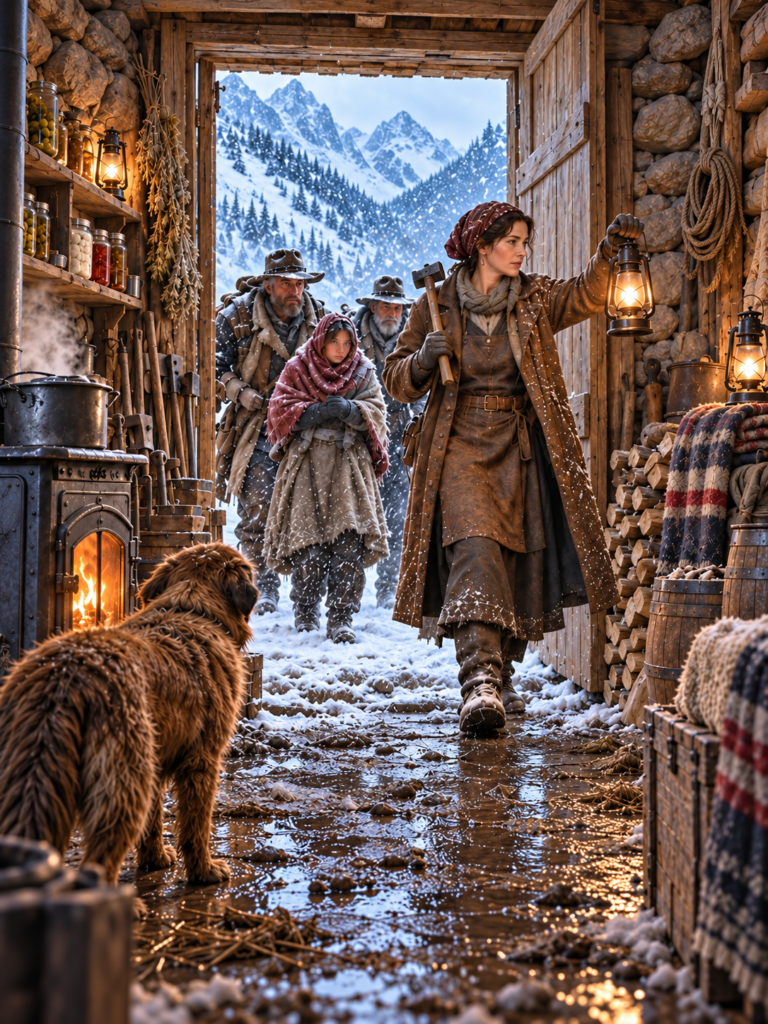
Part 1
By the time Sheriff Elias Mercer nailed the eviction notice to Clara Voss’s forge, snow was already moving sideways across the street. He gave the widowed blacksmith ten minutes to leave. Nine minutes later the road vanished beneath a white wall of wind. Clara stood under the forge awning with a leather tool bag over one shoulder. At thirty-six she had spent half her life beside hot iron. Burn marks freckled her brown work dress and a heavy wool coat covered the shoulders that had swung hammers for years.
“I argued for another week,” Elias said.
“You argued quietly,” Clara replied.
Across the street cattle merchant Gideon Rusk watched through his office window. The lease had carried her late husband Martin’s name. After Martin died beneath a frightened horse in spring, Clara kept the forge alive alone. She repaired wagon rims, stove doors, plows, mining tools, hinges, and anything else Cold Water needed. Gideon waited until the first hard storm to claim the building. Clara could take her personal tools, one blanket, and what little food remained in the back room. The anvil, bellows, coal, and forge stayed behind.
She packed a hand hammer, cold chisel, tongs, file, flint striker, iron punch, three biscuits, salt pork, and a tin cup. Then she lifted Martin’s nine-pound hammer across her other shoulder.
“You cannot carry that through a blizzard,” Elias warned.
“I cannot replace it.”
The forge door closed behind her. Gideon turned the lock from inside. Cold Water saw a homeless widow walking into a storm. Clara saw four miles of mountain between herself and an abandoned charcoal camp near Crow Pass. If frontier skills still meant anything, the mountain was about to decide how much they were worth tonight. She tightened her scarf, faced north, and walked without looking back.
The charcoal camp lay four miles north beyond Crow Pass. Two stone sheds had been standing when Clara last visited the place with Martin years earlier. If the roof survived she might outlast the storm. Snow struck the right side of her face like thrown sand. Clara kept the wind against one cheek. If it shifted behind her she would know she had wandered from the buried trail. Within half a mile Cold Water disappeared. Telegraph poles surfaced one by one through the white, then faded behind her. Ice gathered along her scarf. Each breath scratched her throat. Clara counted her steps in groups of one hundred.
At twenty-three groups she reached the creek crossing. The bridge was gone. One broken rail remained above black water, trembling in the wind. Chunks of ice knocked between the rocks below. Following the creek west would add two miles. Crossing on stones risked a wet boot, and one soaked foot could kill her before Crow Pass. Clara crouched beside the broken railing. Two square spikes remained buried in the timber. She opened her tool bag. Six hammer strikes loosened the first spike. Nine freed the second. Using the spikes she fastened a split section of railing across the narrowest stretch of water. The timber bowed when she stepped onto it. Halfway across one end slipped. Her left knee smashed against the rail. Black water surged inches beneath her boots. Clara swung Martin’s hammer into the frozen bank. The steel head caught between two roots. She hung there, breathing, then dragged herself forward until both hands found solid ground.
She lay flat in the snow. The hammer remained wedged behind her. Clara looked back at the roaring creek, then crawled toward it. She had almost died once. She was not leaving Martin’s hammer there. Clara edged back toward the creek, planted both boots, and pulled until the hammer came free. The effort cost her several minutes and left her gloves wet with snow, but the familiar weight across her shoulders steadied her. She moved north again.
The storm thickened. Telegraph poles disappeared and the road vanished beneath drifts. Clara kept counting steps, but the numbers became slippery in her mind. At forty groups she expected to see a split boulder marking the turn toward Crow Pass. Nothing appeared. She stopped. The wind struck her from behind. Clara’s stomach tightened. Somewhere during the last few hundred steps she had drifted east. Turning blindly could make things worse. She crouched low, shielding her eyes, and searched the snow for anything fixed. A stump, a fence post, exposed stone. Then she noticed a dark shape no wider than her wrist. An iron pipe protruded from the drift. Clara brushed snow away. The pipe angled downward into the mountain, and when she held a finger above its opening she felt something impossible. Dry air, not warm exactly, but warmer than the storm.
Part 2
She dug with her hands, then with the iron punch, widening the hollow around the pipe beneath two feet of packed snow. Her knuckles struck wood. A door. Its hinges had been forged by hand. Clara cleared the frame until she found a recessed ring. The door resisted, frozen tight. She wedged her chisel into the seam, struck it twice, then three more times. The seal broke. A breath of stale, dry air rose from darkness below. Clara stared into a narrow stairway disappearing beneath the mountain. Someone had built this place long ago, then hidden it beneath snow and stone. The abandoned charcoal shed suddenly mattered less. She lit her flint striker. She stepped underground.
The stairway descended into a stone chamber. Dust covered two bunks, shelves, and an iron stove. Along one wall ran a system of pipes feeding vents through the ceiling. Clara struck a match. The stove still held dry kindling. Flame caught. Heat spread through the room. Clara examined the shelves. She found jars of beans, salt, dried apples, lamp oil, and a tin box wrapped in leather. Inside lay folded papers. The first page carried a name. Nathaniel Vale. Clara remembered the name. Nathaniel had been a surveyor and metal worker who vanished years before Cold Water expanded. People assumed he left. The papers said otherwise. Nathaniel had built the chamber as an emergency winter shelter. He mapped air shafts, drainage channels, and a narrow service tunnel running beneath the ridge. Notes in the margins described how warm stove air could be pulled through stone ducts without filling the room with smoke.
Clara followed the pipes with her fingers. This was not an abandoned hole. It was engineered. A second map showed the service tunnel continuing south toward Cold Water. Clara studied the paper. The line ended beneath an old freight building near the edge of town. Outside the storm hammered the mountain. She could stay here. She had food, heat, dry air, and stone walls. No one in Cold Water knew this shelter existed. Then Clara remembered the wind, the vanished road, and the buildings whose chimneys were disappearing under snow. If this storm buried town exits, people would be trapped. Nathaniel had not built the chamber for one person. Clara folded the map, returned it to the tin box, and stood. The mountain had given her shelter. Now it had given her a choice.
Near the stove a rusted shovel and coil of rope suggested someone had once expected travelers to arrive. Clara followed the tunnel south with a lamp in one hand and Martin’s hammer in the other. The passage was narrow enough that her shoulders nearly touched both walls. Every twenty yards Nathaniel Vale had cut small alcoves holding tools, oil, and emergency candles. The workmanship told Clara something important. This tunnel had been maintained. Halfway toward town she found scratches across the stone floor. Boot marks. Someone had used the passage recently. Clara raised the lamp. A draft carried smoke. Not stove smoke. Coal smoke. She hurried. The tunnel ended beneath a wooden hatch. Clara pushed upward, but something heavy blocked it. She struck the underside three times with the hammer. A voice answered. “Who is there?”
“Clara Voss. Move whatever is on this hatch.”
Wood scraped overhead. The hatch opened into darkness and coughing. Sheriff Elias Mercer stared down at her. Behind him fifteen towns people crowded inside the freight building. Snow had sealed the doors and windows. Someone had lit two coal braziers for heat. The room was warm, but several people sat weakly against the walls, faces pale, eyes unfocused. Clara smelled the danger.
“Put those fires out.”
A merchant protested. “We will freeze.”
“You will die if you keep burning them.”
Elias understood. He kicked one brazier over and smothered the coals with snow pulled through a cracked shutter. Clara climbed into the room. Among the trapped were children, two miners, a pregnant woman, a carpenter, and Gideon Rusk’s bookkeeper.
“Where did you come from?” Elias asked.
“Under the mountain.”
Nobody laughed. Clara pointed toward the hatch. “There was a shelter below Crow Pass. Food, heat, dry air.” A woman looked at the storm pressing against the walls. Clara shook her head. “We are not going outside.” She lifted the lamp. “We are going underneath it.”
Part 3
One by one the trapped towns people climbed through the hatch. Clara went first, holding the lamp so everyone could see. Elias stayed behind until the last child disappeared below. The tunnel felt safer than the freight building, but Clara knew safety could change underground. She counted heads twice. Seventeen people, including herself and Elias. They moved north in line. At first the only sounds were boots, coughing, and the groan of wind through the ventilation pipes. Then the floor trembled. Clara stopped. A deep crack rolled through the mountain.
“Move,” she ordered.
Stone exploded behind them. The tunnel filled with dust. People screamed and stumbled forward as part of the ceiling collapsed where they had been walking moments earlier. Elias dragged a boy clear of rock. Clara shielded the lamp beneath her coat until the rumbling stopped. The passage back to town was gone. No one spoke. Clara forced them onward. When they reached Nathaniel’s chamber relief spread through the group. The stove was burning. The room was dry. Shelves held food. Blankets waited on the bunks. Everyone believed the worst was over.
Then Clara noticed the flame. It had changed. Instead of standing bright and steady, it leaned weakly toward the floor. She crossed to the wall vent and held her hand beneath it. No draft. Clara checked the second vent. Nothing. The collapse had blocked both main air channels. Elias saw her face. “What is it?”
“We have heat,” Clara said quietly. “And seventeen people breathing.”
The carpenter understood before anyone else. “How long?”
Clara looked around the chamber. Fear returned faster than the warmth had. “I do not know.” A child began coughing. Clara picked up Nathaniel’s papers. The shelter had saved them from the storm. Now the shelter itself could kill them. Unless they acted.
Clara spread Nathaniel Vale’s maps across the table and forced herself to ignore the voices around her. Panic could fill a room faster than smoke. Two shafts were marked in black ink. Both ran through the collapsed section. Then she noticed a third line, thinner than the others, ending inside rock behind the wall. Beside it Nathaniel had written three words. Secondary draft unfinished. Clara carried the lamp to the wall. She tapped the stone with Martin’s hammer. Solid. She moved six inches and struck again. Another six. The sound changed. Hollow. Elias joined her. “You hear that?”
Clara nodded. “Nathaniel started another passage.”
“How far?”
“That is the part he did not write down.”
The carpenter, Samuel Pike, joined them. He pressed his ear to the stone while Clara tapped farther along the wall. “There,” he said. “Something opens behind.” Clara examined the mortar. The wall was not rock. Someone had sealed a narrow opening with fitted stone. Hope moved through the room, but Clara cut it short. “Do not celebrate yet.” She chose three people strong enough and ordered everyone else to sit low and speak as little as possible. The stove was extinguished to save oxygen. Clara drove her cold chisel between two stones. Hammer. Turn. Hammer again. A crack appeared. They worked in rotation. Elias cleared rubble. Samuel widened the seam. Clara attacked the hardest joints. Air grew heavier. One woman fainted. A child stopped crying because he no longer had the strength. Clara’s arms burned. Then one stone shifted inward. A thin whistle passed through the gap. Cold air touched her cheek. Nobody cheered. They were too tired. Clara smiled anyway.
“Again,” she said.
She raised Martin’s hammer again. This time everyone in the chamber knew exactly why she had carried it through the storm. The first opening was wide enough for two fingers, but the cold thread of air was enough. Clara ordered Elias to hold the lamp while she widened the gap. Samuel used the punch to loosen stones. Others carried rubble away. Each inch brought more air. The chamber revived. The woman stirred. The quiet child began crying. Nobody complained. At last Clara knocked the final stone inward. Behind the wall was an unfinished shaft rising upward. Snow had packed its upper end, but the passage remained open. Clara tied Nathaniel’s rope to her waist.
“You are not climbing that alone,” Elias said.
“I am the smallest person who knows what the shaft is supposed to do.”
Elias stopped arguing. She crawled upward with the hammer on her back and the punch between her teeth. The shaft narrowed until her shoulders scraped. Above her darkness paled. Snow. Clara drove the punch into it. Nothing happened. She struck again. A plug of ice broke loose and buried her face. She choked. Below, Elias pulled the rope. Clara answered with two sharp tugs. Alive. She dug, shoved upward, and her arm broke through into the storm. Wind screamed into the shaft. Fresh air rushed downward. Fresh air poured through the hidden passage, cold enough to make everyone shiver. Clara widened the opening until she saw the white mountain. For once the blizzard felt merciful. She slid back to the chamber. People stood when she returned. Elias gripped her shoulder. “You saved them.”
Clara shook her head and looked at Nathaniel’s maps. “He did.” Then she looked at Martin’s hammer. “And he helped.”
No one laughed. By dawn seventeen people were breathing clean air beneath Crow Pass while Cold Water remained buried under snow. They had survived the night, but Clara was not finished yet.
Part 4
Morning brought silence. The storm weakened, and Clara, Elias, and Samuel climbed from the emergency shaft and crossed the ridge toward Cold Water. Snow covered fences, wagons, roofs, and street signs. Chimneys poked from white drifts like broken fingers. They reached town by noon. People emerged from houses and cellars. News traveled fast. Seventeen people had vanished from the freight building and everyone had assumed they were dead. Then they walked back into town. Questions became shouting. Elias told the story. Clara found the tunnel. Clara recognized the poisoned air. Clara led them underground. Clara found the blocked ventilation. Clara opened Nathaniel Vale’s unfinished shaft.
Gideon Rusk listened from the porch of his office. He said nothing. Over the next week Cold Water changed. Men dug out the freight building and reopened the tunnel entrance. Samuel organized crews to clear the collapsed passage. Elias placed signs at both ends marking the shelter as town emergency property. Nathaniel Vale’s remains were found in a sealed side chamber beyond the collapse. He had not abandoned Cold Water. He had died finishing the system meant to save it. The town buried him on a hill above Crow Pass. Clara stood beside the grave with Martin’s hammer resting against her boot.
Across town Gideon’s business began to fail. Customers stopped bringing him cattle contracts. Wagon owners refused his storage yard. Miners who once bought supplies through his office found other merchants. Gideon had followed the lease. Cold Water followed memory. Two weeks later he came to Clara with an offer. Everyone understood exactly why he had come.
“The forge is yours to rent again,” he said.
Clara looked at the building, then at the man who had locked her outside. “No lease.”
Gideon frowned. “What do you want?”
Clara already knew. “This time I want the deed.”
Gideon Rusk stared at Clara as though he had misheard her. “The deed? The forge, the yard, and permanent public access to the tunnel entrance beneath the freight building? That land is worth more than your debt ever was.”
Clara folded her arms. “So was my husband’s work.”
Gideon looked toward the street. No customer entered his office. No wagon waited beside his warehouse. Cold Water had already made its decision. He signed three days later.
Part 5
Clara returned to the forge before sunrise. She unlocked the door herself. The anvil stood where she had left it. The bellows were dusty. Coal remained stacked against the rear wall. For a long moment she simply listened to the building breathe. Then she lit the fire. By spring the forge had changed. A painted sign beside the door read Voss Forge and Winter Shelter Access. Elias kept emergency blankets underground. Samuel repaired the tunnel supports. Families donated food, lamps, rope, and medicine. Nathaniel Vale’s maps were copied and stored in three locations. Clara refused to let the mountain’s lesson disappear into memory.
Years later, during another hard winter, a freight driver reached Cold Water after dark. Snow covered his coat and ice clung to his beard. He found the forge by following the orange glow from its windows. He climbed the steps and raised one frozen hand to knock. Before his knuckles touched the wood the door opened. Clara stood inside. Older now, silver beginning at her temples. Behind her the forge fire burned bright. The trap door to the shelter was already open.
“Get inside,” she said.
The driver hesitated. Clara smiled. “Storm does not care who owns the road.”
He stepped through the doorway. Once Cold Water had watched a widow pushed into a blizzard. Now that widow was the one holding the door open.

