
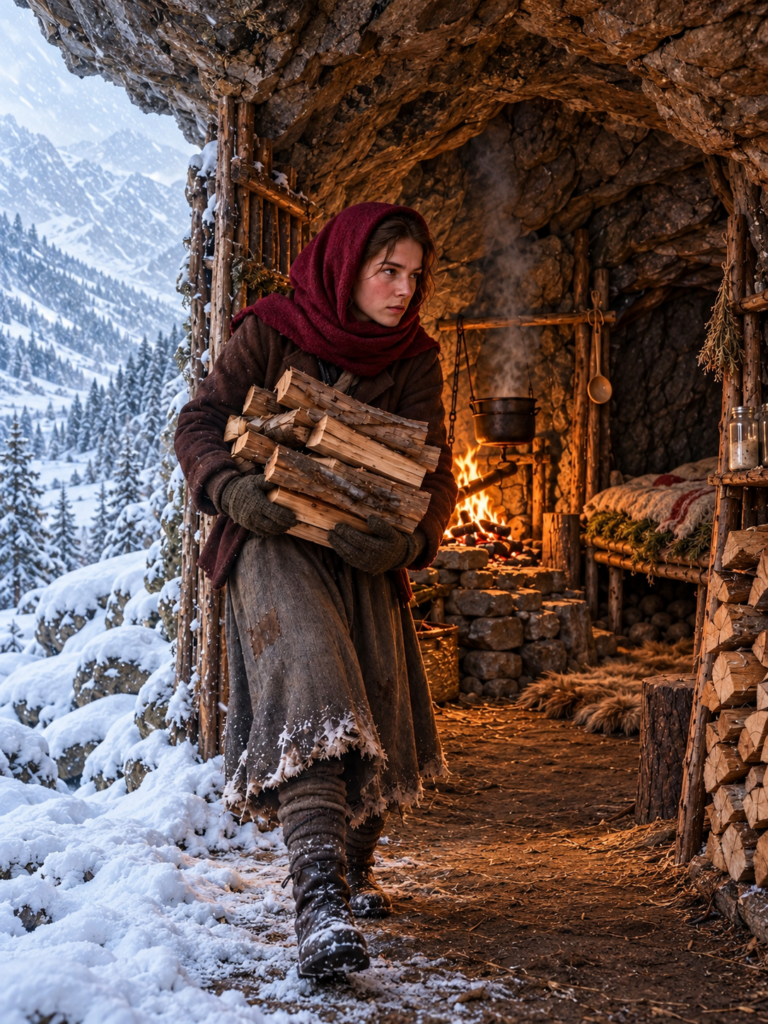
after her husband was buried his brother sold the claim and she climbed into the montana mountains with food for less than a week
Part 1
Alice Morgan stood at the edge of the claim with her husband’s hatchet in one hand and a canvas bag in the other. The ground still showed the tracks of the wagon that had taken Jonah’s brother and everything he could load. August heat had dried the dirt hard. By the time she reached the ridge in late October the first real cold had already come down from the peaks.
Jonah had been dead two months. The mine took him on a Thursday afternoon when a timber gave and the roof came in. His brother rode in from the lower valley three days after the burying and started measuring the claim like it already belonged to him. Alice had signed nothing. She had no paper that would stand against a man’s name on the county books. When she came back from the creek with two buckets she found the cabin empty of tools, the tin of beans gone, the good wool coat Jonah never wore taken from the peg by the door. The brother stood in the yard with two hired men and told her the claim had been sold for what it would bring. He left her the dented pot, the blanket, two boxes of matches, and the hatchet. He said she could keep the hatchet because nobody wanted a woman’s tool.
She walked out that same afternoon. There was no cabin waiting and no road behind her she trusted. Winter was coming early that year. People in the valley were already talking about cattle that would not make it if the grass went under before Christmas. Alice counted her food as she climbed: hard bread, a sack of oats, a smaller sack of beans, a twist of salt. Less than a week if she ate once a day. She had the blanket rolled tight and the hatchet sharp the way Jonah kept it every Sunday. The handle was worn smooth where his hand had rested.
By the last week of October the light was draining from the high country before the sun had cleared the next ridge. Wind found every seam in her coat. She had walked since first light and her legs shook when she stopped. The bag pulled at her shoulder. When she saw the wall of thorn bushes under the dark stone overhang she almost walked past it. From the trail it looked like a crack and nothing more. Behind the branches the hollow opened deeper than she expected. The air inside smelled of wet earth and old smoke. Broken limbs covered the floor. Small bones lay near one wall. Water had stained the rock at the back. It was a poor place, but the wind could not reach her there.
She went in with the hatchet raised and checked every shadow before she set the bag down. The ceiling looked solid where she could see it. One side of the floor was dry. The other was damp from seepage. Near the rear wall she kicked pine needles aside and found a ring of blackened stones. Someone had built a fire here before. Beside the ash lay a rusted nail and a short leather cord. On the wall behind them faint scratches ran in groups, almost like numbers. She wanted to look closer, but the light was already failing. She dragged dead branches across the entrance, wrapped the blanket around her shoulders, and kept the hatchet beside her knee.
Sometime after full dark she heard three slow footsteps outside. They stopped. Then one more. Alice held her breath and watched the dark gap between the branches. Nothing else came. She barely slept. Every gust moved something in her mind. Near dawn she caught herself whispering Jonah’s name the way she used to when he worked the late shift and the lamp burned low. She stopped because no one would answer.
At first light she pushed the branches aside and searched the frozen ground. She found nothing she could name. Fear could wait. The cave could not. She hauled out rotten leaves, loose stones, bones, and branches. Using a flat piece of wood as a shovel she scraped the floor down to firm earth. She did not strike the ceiling. Jonah had told her once that men died in the mines from rock they disturbed themselves. She tested each doubtful patch with a long branch and chose a sleeping place under stone that did not ring hollow.
Cold air poured through the gaps around the entrance. She cut flexible saplings and wedged them between two solid stones. Smaller branches were woven through the frame. She packed moss into the widest spaces, then pressed clay from a sheltered patch near the mouth into the weave. The clay stayed soft until she could dry it near the fire. When the light was strong enough she rebuilt the old stone ring and lit a small flame. Smoke spread under the ceiling within minutes. Her eyes burned. She coughed, grabbed the pot, and went outside. Warmth without a way for the smoke to leave could kill her as surely as the cold.
On the second try she moved the fire toward a natural crack high near the entrance. She cleared loose debris from the crack instead of breaking the rock, then stacked flat stones behind the flames so the heat struck the wall and came back toward her while the smoke found its own way up and out. Most of it escaped. The draft improved. Warmth stayed inside. She left a gap of air low at the foot of whatever she built across the entrance. Smoke she could see. The gas that came with it she could not.
Firelight showed the scratches behind the hearth more clearly. They were not random. They were grouped like someone had been counting days. The marks unsettled her, but daylight was too valuable to spend on questions she could not answer. Sleeping on cold earth would drain the heat from her body faster than any wind. She raised a bed. Four thick branches became the frame. She lashed them with strips cut from an old flannel undershirt, balanced the corners on flat stones, and laid narrower sticks across the top. Pine boughs, dry grass, and the wool blanket formed the surface. It was crude and uneven, but it kept her a hand’s width off the ground. A hand’s width was the difference between shivering and sleep.
A narrow stream ran below the ridge under a skin of ice. Each morning she broke through, filled the pot, and carried it uphill. Two hundred steps left her legs shaking. She boiled every batch. In the debris near the entrance she found two old glass jars, scrubbed them with sand, and began keeping boiled water beside the bed. Food went onto a shelf of forked branches and a cross piece high enough to discourage mice. Bread, oats, beans, and salt. She counted it every night and cut every meal in half. Eight days if she was careful. Then seven.
Part 2
Snow arrived on a still afternoon. Alice spent the hours before it thickened collecting dead standing wood because fallen branches were already wet under the white. On her way back she stopped. Fresh bootprints crossed the ground in front of the cave. They were too large and too regular to belong to an animal. She followed them for twenty yards before common sense stopped her. Whoever made them knew the mountain better than she did. Back inside she tied metal scraps to a cord across the entrance. If someone returned during the night she wanted warning.
The next morning she built a proper door. She chose straight saplings as thick as her wrist, trimmed them to the height of her shoulders, and bound them across two horizontal braces. Over that frame she wove thin branches, packed moss into every gap, and added clay only where the sheltered entrance stayed warm enough for it to dry. Two strips of leather from her bag became hinges, and a flattened piece of tin kept them from tearing. When she pulled it closed for the first time the endless draft dropped to a whisper and the fire stood up straight. The cave changed with it. Without wind stealing the heat she could cook. Two flat stones beside the flames became a griddle. A wooden hook held her pot above the coals. In a crack in the wall she made a shelf for the things she could not afford to lose: matches, cord, the hatchet.
Water grew harder. The stream froze deeper every night, and one morning she spent nearly twenty minutes chopping down to open water. If a storm closed that slope she would have none at all. She began packing clean snow into the pot by the fire. A full pot of snow melted down to barely two fingers of water, and every pot cost wood. She doubled her wood runs and kept three piles by the wall: tinder, kindling, and logs as thick as her arm.
That evening she stepped outside to check the weather. Fresh bootprints crossed the snow again. This time they stopped at her door. Beside the threshold sat a wooden spoon. Someone had placed it there carefully. Alice stared toward the trees, but the forest gave her nothing back. She carried the spoon inside and turned it over in the firelight. It was old, smooth with use, carved by someone patient. Whoever left it could have walked into the cave while she slept and had chosen not to. That frightened her more than a threat would have. It meant someone was watching and deciding.
Still, winter did not care about fear. Then Alice found metal beneath the rear floor. She dug carefully with the edge of her wooden shovel and uncovered a rusted tin box. Inside were three fishing hooks, several nails, a broken compass, and a sheet of paper wrapped in waxed cloth. It was a pencil drawing done with a careful hand. A man stood outside this cave. Beside him stood a boy. On the back, faded handwriting read, “Thomas and Daniel, first winter.” Alice looked from the drawing to the doorway. The drawing showed a wooden door, a smoke vent, and stacked firewood almost exactly where she had built hers.
The following afternoon boots crunched outside. A weathered man, gray already in his beard, appeared at the entrance and stared at the rebuilt cave. Then he looked at Alice.
“You should not be here,” he said.
The man gave his name as Daniel. Alice immediately thought of the drawing. “Were you the boy beside Thomas?”
Daniel’s expression changed for only a moment. He ignored the question and said this cave had belonged to his family for more than twenty years. Alice did not argue about ownership. She told him that deep snow was already closing the lower trail and that leaving now could kill her.
“You came here without permission,” Daniel said.
“I came here because I needed to survive. That does not make this place yours.”
“I never said it did.”
Daniel stepped farther inside and examined the door, the shelf, the bed, and the hearth. His eyes stopped on the drawing. “You opened that box?”
“I found it buried.”
“And now you are rebuilding everything as if nobody was here before you.”
Alice’s exhaustion sharpened into anger. “I cleaned bones off this floor. I carried water up that hill every morning. I fixed the entrance because I was freezing. I am not erasing anyone.” Her voice caught. “I know what it is to have someone erased. My husband’s name is not on a single thing in that gulch anymore.”
Daniel looked toward the rear wall. For several seconds neither spoke. Finally Alice offered a compromise. She would stay only through the worst of winter. She would cut no living trees unless survival required it, disturb nothing she did not need, and leave when the passes opened in spring. Daniel considered her words.
“You can stay for now,” he said, “but do not open the blocked section at the back.”
Part 3
Two days later the weather turned soft for an afternoon and thaw water began seeping from beneath the stones he had pointed to. Alice tried to turn it aside, but the damp spread toward her bedding. She removed only the loose stones needed to reach the leak. Behind them was a narrow chamber. Inside, resting on an old wooden crate, lay a journal. The cover bore one name: Thomas Calder.
Alice knew Daniel would be furious. She did not read the entire journal that night. She opened only enough pages to understand what she had found. The first entry was dated November 1862, a few months after gold was found on Grasshopper Creek. Thomas Calder had wintered here with his son. His notes were practical rather than sentimental. Wind direction, snowfall, the stream, repairs, how much wood each night had eaten. On the coldest, eleven arm loads. Several pages described a storm that had trapped him and young Daniel behind deep snow for two days. The counting marks near the hearth suddenly made sense. They were winter days, one hundred forty of them.
One sketch caught Alice’s attention. Thomas had drawn a second smoke channel hidden behind loose stone along the western wall. He had built it after mountain winds forced smoke back down through the main vent. Alice copied the diagram onto a scrap of paper, then returned the journal to its crate.
Daniel came back the next morning. He saw the shifted stones immediately. “I told you not to open that.”
“Water was coming through.”
“You still had no right.”
Alice handed him the journal. Daniel fell silent. He sat near the entrance, holding the cover with both hands. After a while he told her the rest. Their claim cabin had burned in the first snow of that winter, and his father had carried him up here with a blanket and an axe. Father and son lived in this cave until spring. Years later, after Thomas died, Daniel stayed away because every stone pulled him back toward that season.
“I thought leaving it untouched meant keeping him,” Daniel said.
Alice looked around the repaired shelter and then at Jonah’s hatchet by the door. “Maybe keeping a place alive is another way.”
Daniel did not answer immediately. “That first night,” Alice said, “three steps, a pause, then one more. That was you.”
Daniel nodded. He rode line for a cattle outfit in the valley, and his line camp sat just over the ridge. He had seen her smoke. “I wanted to know who had lit a fire in my father’s cave.”
Alice asked about the spoon. “My father carved it for me here that first winter,” Daniel said. “I wanted to see whether you would burn it or keep it.”
Alice had kept it. Before he left, Daniel showed her the hollow in the rock where Thomas had once kept emergency supplies. It was empty, but dry. The next morning Alice found it filled: candles, a tin lantern, a can of coal oil, and a crock of salt pork sealed in lard. The hooks in the tin box had been Thomas’s too. That week, through a hole in the stream ice, Alice pulled out her first trout and ate it standing by the fire with her fingers. After that, every week or so, a sack of beans or flour appeared by her door, and Daniel never stayed to be thanked.
The argument was not forgotten. But something had changed. Suspicion had become a careful kind of respect, and Alice, for the first time since August, no longer felt alone on the mountain. She did not know it yet, but every shelf, every jar, and every stacked log was about to be tested on a single night.
By the second week of January the transformation was impossible to miss. The cave that had greeted Alice with bones, damp earth, and freezing wind now held warmth around the hearth. The door shut tightly, all but the narrow gap she always left at its foot. Her raised bed stayed dry. Firewood lined the back wall in rows taller than she was. The spoon hung beside her pot. A small lantern threw a warm amber glow across pale stone after sunset. Using Thomas’s notes, Alice reopened part of the second smoke channel. She cleared debris carefully, never striking the rock that held the roof, and fitted a simple cover over the lower opening so cold air would not pour in. Daniel helped once. He arrived with a length of old stove pipe that had belonged to Thomas, and together they fitted it into the main outlet to improve the draft.
“You made this place warmer than he ever did,” Daniel admitted.
Alice smiled. “I had his notes.”
Daniel smiled back. It changed his whole face.
Part 4
Two days later that fragile peace ended. Clouds swallowed the peaks before noon. The temperature fell sharply, and wind began driving fine snow across the ridge. Daniel appeared at the entrance and warned that a storm was coming faster than any he had seen that year.
“Can I reach the valley?”
He looked toward the disappearing trail. “Not safely now.”
So Alice stayed. She moved every usable piece of wood indoors, filled every jar and the pot with water, checked both smoke routes, secured her supplies, and braced the door from inside. By nightfall the storm struck with force. The snow came an inch an hour, and it did not stop. Wind screamed across the mountain. Near midnight smoke suddenly rolled downward from the fireplace. The main vent had stopped drawing. Within seconds the cave changed from refuge to trap. Smoke thickened beneath the ceiling and curled toward Alice’s bed. Her eyes streamed. She pulled a scarf over her nose, dropped low beneath the smoke, and threw her weight against the door, but packed snow held it from outside. Only a narrow gap appeared before the snow forced it shut again.
The fire still burned. Putting it out would take her heat in the worst storm of the winter. Leaving it as it was would fill the cave with smoke. Alice spread the burning logs apart so the fire burned small and bright instead of smoldering, just enough to keep the heat alive. Then she remembered Thomas’s sketch. The second smoke channel. She tore away its lower cover. Nothing happened. Blocked. The storm had shaken loose rock and snow down into the channel. Alice pushed a long branch into the passage until it struck something solid. She twisted, withdrew it, and tried again. On the third attempt packed debris shifted above her. Air rushed through the opening. The smoke lifted slightly. Not enough, but enough to breathe.
Now she needed the main vent. Alice tied a rope around her waist and knotted the other end to the door frame. She dug outward with the metal pot until she could squeeze through the gap. The wind struck her so hard she dropped to one knee. The rope kept her tied to the cave. She crawled upslope toward the vent, using the hatchet only on packed snow and ice. Jonah’s hatchet. A hard crust had sealed the outlet. Alice chopped until a dark opening appeared. Smoke burst upward into the storm. She came back inside, shaking, wet, and too tired to stand, then rebuilt the fire slowly while she watched both vents. The bed was dry. Her water was safe. The door had held. Every small decision from the past eleven weeks had mattered.
The snow fell for sixteen hours. At dawn it stopped. Someone was climbing toward her through drifts as deep as his chest. It was Daniel. He reached the entrance covered in frost and breathing hard. For several seconds he said nothing. He only looked past Alice at the glowing fire, the dry bed, the stacked wood, the water jars, and the thin line of smoke rising cleanly from both vents.
“You kept it going,” he said. “Barely.”
Daniel noticed the opened channel. “My father used that in the storm we survived here.”
“His journal saved me.”
Daniel stepped inside and held his hands to the fire.
Part 5
A week later a chinook came over the mountains. The warm wind melted the top of the snow. Then the cold came back behind it and froze the whole country into a crust of ice. The thermometer at Daniel’s line camp fell toward forty below. Down in the valley cattle stood in the coulees, starving above grass they could not reach. Up on the ridge a woman who had arrived with food for less than a week had wood for a month, water by the bed, and a fire that breathed.
Alice repaired the damaged vent, strengthened the door braces, and dried everything the storm had soaked. Daniel came up with flour and coffee and helped her dig out the trail. He never again told her to leave. One evening he brought the drawing from the tin box. He had pressed it flat and set it in a simple wooden frame.
“This belongs here,” he said.
Alice set it on the shelf beside the spoon. That night she took the journal from its crate and opened it to the first empty page. She wrote the date, then the wind direction, then the snowfall, then how much wood the night had eaten. At the bottom, in smaller letters, she wrote one more line: Jonah Morgan, 1859 to 1886. He kept the hatchet sharp.
Behind the hearth, beside Thomas’s one hundred forty marks, she began cutting her own. Thomas’s knowledge had kept her alive. Now hers would be waiting for whoever came up that ridge next with nothing. Alice had come to the mountain looking for shelter. By winter’s deepest days she had made it a home. The cave kept her only because she had learned to let it breathe, and because a man who had once been a boy in the same hollow had chosen, in the end, to leave the door open.

