
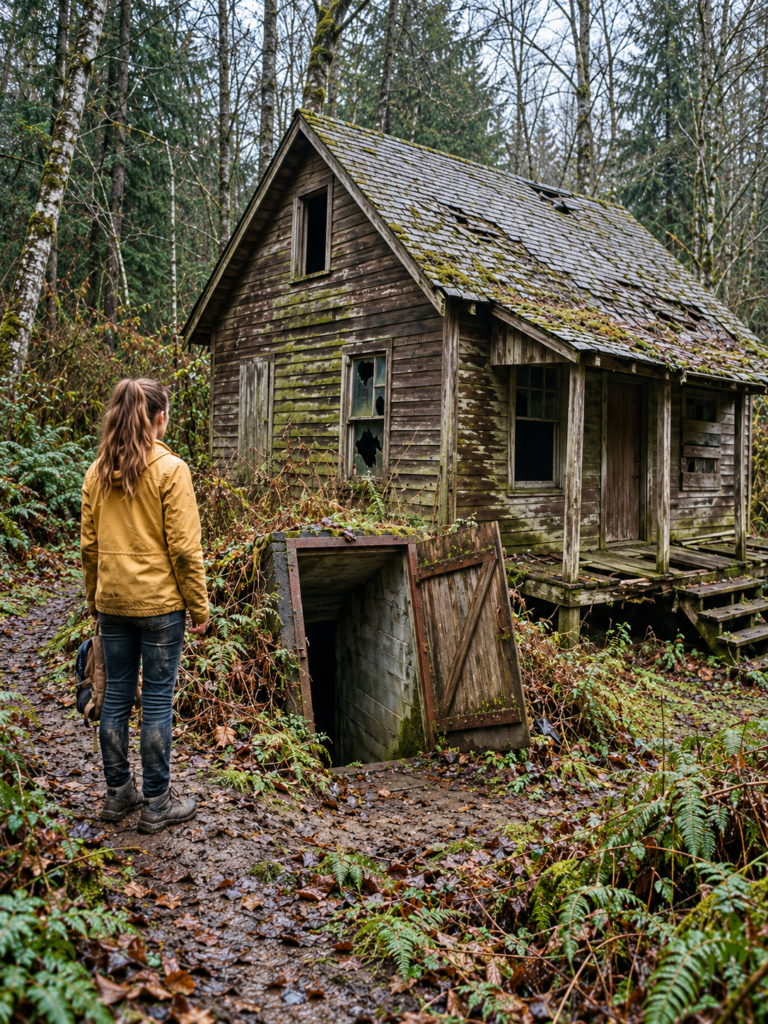
they laughed when she paid one dollar for the rotting cottage on black creek road but the trap door under the kitchen floor held the fortune that let her keep the land they tried to steal
Part 1
The gavel came down and the room laughed. Norah sat in the back row of the Oak Haven municipal building with her damp coat still clinging to her shoulders. Fluorescent lights buzzed overhead and made every face look slightly yellow. Forty people occupied the folding chairs. Most of them already knew why she was there. Small towns could smell failure the way dogs smelled rain, and hers was still fresh.
Two rows ahead her brother Arthur sat in a wool peacoat that cost more than the money left in her account. He had not looked at her since she walked in. He did not need to. The set of his shoulders said everything. Five years earlier Norah had left Oak Haven with a logistics company she believed would carry her. She poured every hour and every dollar into it, and her marriage with it. When her partner emptied the operating account and vanished, the creditors finished what he started. She came home with a rusted sedan, three hundred dollars, and the quiet knowledge that no one in town expected her to stay long.
Mayor Higgins wiped his forehead and called the next lot. Lot 42, the old Harrelson property on Black Creek Road, one-point-two acres and the original structure. A murmur moved through the room. Someone in front snorted. Elias Harrelson had died nearly a decade ago with no heirs. The county had taken the place for taxes and never found a buyer. The land was mostly tidal marsh. The cottage leaned like it was tired of standing. Black mold climbed the walls. The council had talked about burning it for practice rather than pay for demolition.
Higgins opened the bidding at a thousand. Silence. He dropped to five hundred. Arthur leaned toward the man beside him and said something that made both of them laugh. The sound scraped across Norah’s back. She had nothing left that anyone could take except the chance of a roof. Winter was coming. She could not spend another week sleeping in the car.
“Do I hear a hundred?” Higgins asked. “The copper might be worth that if the scavengers left any.”
Norah raised her hand. “One dollar.”
The room went still. Heads turned. Arthur’s smile cracked into something closer to horror. Higgins squinted. “Did you say one dollar?”
“That’s a legal bid,” she said. Her voice stayed level even though her pulse hammered. “The opening was lowered. No reserve. I bid one dollar.”
For a second no one moved. Then a contractor near the aisle barked a laugh and the rest of the room followed. It was not polite. Arthur put his face in his hands. Higgins banged the gavel until the noise thinned. “Sold to Norah for a single dollar.”
The clerk took the crumpled bill and handed her a thick folder and a brass key filmed with green oxidation. Outside, Arthur caught her elbow in the parking lot.
“What is wrong with you?” he said. “You’re trying to humiliate me. That place is a toxic dump.”
“I bought a house,” she answered, pulling free. “I don’t expect you to understand.”
“It’s condemned. The foundation is sinking. There’s mold in the walls. You’re being pathetic.”
“It’s mine,” she said. “It’s the only thing that belongs to me.”
She left him in the rain and drove twenty minutes out of the neat streets into coastal woods. The pavement cracked, then turned to gravel. Weeping willows shadowed a long driveway. The cottage sat at the end of it, gray shingles peeling, porch sagging hard to the left, stairs rotted through. Windows stared out with jagged glass. The whole structure leaned as if it had already decided to fall.
Norah stepped into mud that sucked at her boots. The key would not turn. She put her shoulder to the oak door and shoved. Rusted hinges screamed. Dust and stagnant air rushed out. Water dripped from a ceiling stain into a puddle on the floor. Trash, broken furniture, and fused newspapers filled the rooms. She stood in the middle of it, coat still damp, and felt the weight of a beginning rather than the end she had expected.
Part 2
The first week measured itself in blisters. She spent the last of her cash on trash bags, bleach, a crowbar, and a cheap sleeping bag. By the third day her hands were cracked and taped. Cold lived in the corners and moved into her bones the moment the sun dropped behind the trees. Elias had been a hoarder. Front rooms held waterlogged boxes, rusted parts, and encyclopedias glued together by damp. She hauled bags to the driveway until a small mountain rose there. Soft spots in the floorboards threatened to drop her into the crawl space. She learned the map of them by feel.
The town did not leave her alone. Cars slowed on Black Creek Road. Teenagers tossed beer cans into the tall grass. On Thursday a contractor named Greg pulled his heavy truck into the driveway while she dragged a moldy mattress across the porch. He rolled the window down, toothpick between his teeth.
“Arthur asked me to check on you,” he said. “Make sure the roof hasn’t caved in. Look, you’re wasting time. Joists are rotting. Foundation’s cracked. I’ll bring an excavator next week, haul it off at cost. Once it’s flat you might flip the dirt for a couple grand.”
“It’s not a tear-down,” she said. Her voice was rough from dust. “And I don’t have money to pay you.”
He laughed once, short and hard. “Suit yourself. Don’t come crying when you freeze in December.” He spun the tires on the way out and sprayed mud across the drive.
Norah watched him go, jaw tight enough to ache. She went back inside, took the crowbar, and started on the kitchen. Three layers of linoleum covered the floor. The bottom one was mustard floral from the seventies, glued with something that had turned to concrete. She wedged the bar under a peeling edge and threw her weight back. Plastic tore. She worked for hours on stale water and spite, wanting the house stripped to whatever bones it still had.
By late afternoon the center of the kitchen showed original wide-plank oak, dark and water-stained but sound. She sat back on her heels. Wind rattled loose shingles. A sharp draft pushed against her shins. It did not come from the baseboards. It rose from a seam in the floor. She wiped away grime and adhesive and saw that the seam formed a perfect square, three feet on each side. Someone had cut a trap door into the oak and sealed it under the linoleum.
Her fingers trembled as she cleared the center. The crowbar clinked against metal. A heavy rusted iron ring sat flush in a carved recess. She gripped it with both raw hands and pulled. It did not move. She stood, hooked the crowbar through the ring, and used the solid floor as a fulcrum. For a long moment nothing gave. Then a violent crack echoed through the empty house. A puff of dry air pushed out, metallic, like old coins and paper. She hauled the square upward and let it slam back onto the floor.
Concrete stairs descended into blackness. No crawl-space dirt. The steps were cleanly poured. Cinder-block walls showed no seepage. She sat on the edge of the linoleum and stared down, chest heaving. Her phone battery sat at fourteen percent. She switched on the flashlight and swung her boots over the edge.
Part 3
Fifteen steps brought her to a solid concrete floor. The corridor ran roughly four feet wide and thirty feet long. Rubber-coated wires ran along the ceiling to caged fixtures. Metal shelves lined the walls. The first held airtight drums of vacuum-sealed rice, beans, and old military rations. Farther along, green steel ammunition boxes were stacked five high. She did not touch them. At the end the corridor opened into a square room. A massive antique floor safe stood in the center, four feet of iron with a brass dial. Against the far wall, canvas bank bags had been piled in a hurry. Several had rotted at the seams. Their contents spilled across the concrete in a dull glitter.
Norah dropped to her knees. She picked up a rectangular block the size of a thick paperback. It was heavier than it looked, tarnished charcoal gray. She rubbed her thumb hard across the face. Soft whitish metal showed beneath. Stamped letters read Engelhard, 100 troy ounces, .999 fine silver. She set it down and took another. Identical. Dozens more lay in the spill. The bags were stacked three deep and filled the corner.
Beside the safe sat wooden crates. The top one was unsealed. Inside, plastic tubes held gold coins packed tight. She pulled one tube, popped the cap, and slid a coin into her palm. An American gold eagle, one ounce, dated 1998. The LED light threw warm glare off the face. She whispered the words and the sound of her own voice in the dry air startled her. She dropped the coin back and scrambled backward.
Elias Harrelson had trusted no one. He had let the cottage rot above him so no one would look, and he had buried a fortune in metal that banks and governments could not freeze. The county had sold it to her for a dollar. She sat on the cold floor surrounded by the spill and laughed until her ribs hurt. Tears cut tracks through the dust on her face. She laughed at Arthur’s expression in the municipal building, at Greg’s offer, at the creditors who had called her ruined.
The phone light flickered at five percent. The hysteria snapped off. She was alone in a condemned house in the woods. If anyone in Oak Haven learned what sat under the kitchen, the council would claim error, Arthur would move to control her assets, and lawyers would bleed the place dry. She took one silver bar, shoved it deep into her coat pocket, hauled the trap door shut, and dragged the moldy mattress over the seam. She sat on it through the night with the crowbar across her knees and did not sleep.
At dawn she washed with bottled water, changed into a clean turtleneck and jeans, wrapped the bar in a wool sweater, and drove two and a half hours south into the city. She parked three blocks from a shop called Apex Numismatics. The man behind the reinforced counter wore a vest and kept a jeweler’s loupe on his forehead. She set the bar on the glass. His manner changed at once. He gloved up, examined the stamp, and offered thirty-four hundred cash after a quick test. She took the bills, locked herself in the car, and let out a long breath. The money felt like the first piece of armor she had worn in years.
Her phone buzzed. Arthur. She answered on speaker.
“Where are you?” he said. “Greg told me you turned down the clear-out. Higgins is sending the building inspector Monday. They’ll condemn it. Greg will give you a thousand for the deed today. You make a profit and rent a decent place. Stop this.”
“Tell Greg to go to hell,” she said. “And tell Higgins if he sends an inspector onto my property without a warrant I’ll have them arrested for trespassing.”
“You don’t have the money to fight this.”
“I have renovations to do.” She hung up.
She drove to an industrial supplier and bought four commercial deadbolts, heavy hinges, a battery drill, three trail cameras, and a hundred feet of galvanized chain. She paid in hundreds. Back at the cottage she worked until dark, anchoring the bolts into the soundest studs she could find, strapping cameras to the willows, and chaining the driveway between two oaks. Her hands bled again. She locked herself inside, moved the mattress, and went down with a new tactical light.
She counted bags rather than bars. Sixty bags. One intact bag held five hundred-ounce bars. Three hundred bars at thirty-four hundred each put the silver past a million. Ten wooden crates held gold eagles. At a conservative two thousand an ounce the crates held twenty million. She lay on the concrete and stared at the caged lights until the number stopped spinning. Then she packed three empty bags with tubes of coins, hauled them up one by one, and hid them under the spare tire in the trunk.
Part 4
At seven the next morning the phone chimed. Greg’s truck idled against the chain. He shook the padlock. Norah walked onto the porch with a thermos of cold water and watched until he noticed her.
“What is this?” he shouted.
“A chain,” she called back. “It means private property.”
He climbed over and started up the drive. She met him halfway and stopped ten feet away.
“You are trespassing.”
“I’m a designated contractor for the council. Higgins signed the order. They’re condemning this Monday.”
“You are standing on my land,” she said. She held up her phone. “Three cameras are recording you. One more step and I call the state police, not the local sheriff, and I press charges.”
He spotted the lens on the nearest oak. The set of his shoulders changed. He spat, turned, and drove off. She watched the taillights disappear and felt the small, tight pull of a smile she did not entirely trust.
Monday brought freezing rain that turned the soil to soup. Norah sat in the idling sedan and watched the chain. At nine Higgins’s SUV arrived, followed by a white county car. A thin man with a clipboard stepped out. Then a black Mercedes pulled up. Richard Cole got out in a charcoal suit and trench coat, no umbrella, briefcase in hand. Norah had spent Friday opening safe-deposit boxes across three banks and walking into the most expensive firm in the financial district with a fifty-thousand-dollar cash retainer. Cole handled hostile takeovers and land fights. He did not play golf with the mayor.
Through the windshield she watched Higgins point at the cottage. Cole opened the briefcase and handed over a waterproof sleeve of documents. Higgins’s jaw went slack. The papers included a temporary restraining order, a private engineer’s report stating the foundation was intact and under permitted work, and a cease-and-desist naming Higgins and Greg personally for harassment. The inspector stepped back. Higgins argued, face darkening. Cole checked his watch, smiled once, and pointed down the road. Both vehicles left. Cole unhooked the chain with the key she had given him and drove up.
“The injunction is served,” he said. “They won’t be back. The deed is shielded under the LLC. Back taxes are paid for twenty years. You’re untouchable.”
“What about the other matter?”
His eyes sharpened. “Higgins approved a rezoning for this stretch of Black Creek. It’s slated for a commercial logistics center. The primary investor on the land-acquisition side is your brother.”
Rain struck the Mercedes. Norah stood still. Arthur had not cared that she might freeze in the cottage. He had cared that her single acre sat on the only stable bedrock that could carry the access road his project needed. Without it the rest of the plan sank into tidal mud.
“He’ll know about the injunction this afternoon,” Cole said. “The clerk has to notify adjacent developers. He stands to lose millions.”
“Let him be angry,” she answered. “Drive safe.”
Her phone rang after three. She let it ring five times.
“What did you do?” Arthur’s voice was high. “Who is Richard Cole? How are you paying him?”
“I found spare change in the couch cushions.”
“Do you have any idea what you’re ruining? I have investors. Deadlines. You’re squatting on toxic dirt out of spite. I’ll sue you for everything you have left.”
“I have nothing left,” she said. “You made sure of that when you laughed. You tried to take this land for a thousand dollars so you could build over the house. You didn’t care if I froze.”
Silence. Then the shift into a softer tone. “We can work something out. A hundred thousand. Fair market. You can start over.”
“The land isn’t for sale. I’m going to build a house right here. The biggest one this town has ever seen. Goodbye, Arthur.”
She hung up and looked at the floorboards under her feet. The joke had ended.
Part 5
Spring came with the low roar of diesel. Norah hired no one from the county. Cole brokered a contract with a city architectural firm. White trucks arrived. The crew dismantled the old cottage piece by piece so no heavy debris compromised the foundation. When the rotten framing was gone they built a reinforced cage over the old kitchen footprint and poured a climate-controlled vault that incorporated the bunker into the new structure. Gossip at the diner spun wild stories—secret marriage, blackmail, municipal funds. No one guessed the metal that now sat in blind trusts and city vaults, feeding just enough cash into the LLC to fund the work without drawing an audit.
By late August the framing stood: black steel, floor-to-ceiling glass, dark cedar. It sat on the slight rise and looked over the marsh. Arthur’s logistics center died slowly. Her acre was the keystone. Without the stable ground for the access road the rest of the plan was trapped in sinking mud. Investors demanded progress. When the injunctions held they pulled funding. By September the bank called his commercial loans.
He arrived on a Tuesday afternoon in a rattling economy car. Norah stood on the new wraparound deck in a cashmere sweater with a mug of black coffee. The air already carried the edge of autumn. He looked hollowed. The tailored coats were gone. An off-the-rack jacket hung loose. He had not shaved. He climbed the concrete stairs and stopped.
“The bank seized the house this morning,” he said. His voice was thin. “The firm is in receivership. They took the cars. The accounts. I have nothing.”
She looked at him and felt no sharp triumph, only a heavy tiredness. Five years earlier she had sat in his living room and asked for a bridge loan after her partner emptied the company. He had poured a scotch, laughed, and told her failure was the market weeding out the weak.
“I’m sorry to hear that,” she said.
“I know you have money. I don’t know how. I just need fifty thousand to hire a bankruptcy lawyer. I’m your brother.”
“You weren’t my brother at the auction,” she answered. Her voice stayed even. “You were a shark that smelled blood. You laughed while the room mocked me. You tried to take the land for a thousand dollars. You didn’t care if I froze. I was desperate too. The difference is I bought a shovel and started digging. You tried to bury me.”
He waited. She did not yield.
“Get off my property,” she said. “Before I call the police.”
He turned, walked down the stairs, and drove away. The sound of the cheap car faded. Silence returned to the woods. Norah set the mug down and reached into her pocket. She pulled out a single tarnished gold eagle and rolled it once across her knuckles, feeling the weight. She had lost the company in the city and been laughed out of her own town. The cottage that cost a dollar had given her the land under her feet and the quiet to decide what to build on it. She looked at her reflection in the dark glass of the new house and knew the laughter was finished. The place belonged to her now, and she intended to keep it exactly as it was—solid, private, and no longer anyone else’s joke.

