
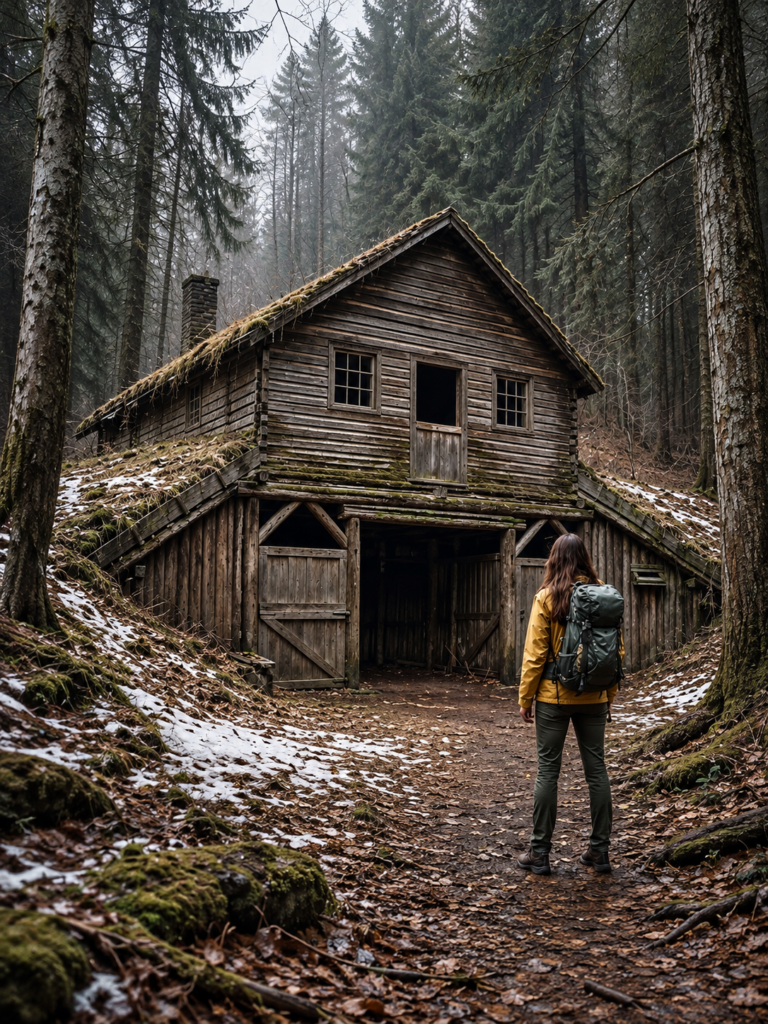
she inherited her grandfather’s half-buried house that the whole family called worthless and what she found under the floor changed everything
Part 1
The letter sat on the kitchen table for most of the afternoon before Anna opened it. It had come in the cheap county envelope, the kind that already looked tired when it left the post office. She had carried it upstairs with the bag of groceries, set it down beside the stack of unpaid bills, and walked past it while she put the milk away and washed the one plate that had been in the sink since breakfast. The apartment was quiet except for the radiator that knocked every few minutes and the low murmur of traffic on the street below. She sat down only when the light outside the window had gone gray and the pressure behind her eyes had returned, the one that came whenever she tried to make the numbers work and they refused.
The wording inside was formal and distant. Friedrich Adler, her mother’s father, had died three weeks earlier. Anna was listed as the sole heir to his property. The description took one line: a residential structure with auxiliary facilities in a rural district, assessed value minimal. She read it twice. The name still sounded foreign in her mouth even though she had heard it all her life. Most of the family simply called him Grandpa Fred, when they called him anything at all.
He had left the city more than twenty years earlier. Sold the small apartment, took what savings he had, and disappeared into the hills west of the interstate. Letters came for a while, then stopped. Someone said he had built a house half into the side of a slope. Someone else said he had finally gone as strange as people always predicted. No one drove out to see him. Anna’s mother had not spoken his name in years except to note that he had chosen his own kind of trouble.
Anna folded the letter and leaned back. The rent was already late. The freelance invoices she had sent two weeks ago had not been paid. The refrigerator hummed like it was working harder than it should. An inheritance, even a modest one, ought to have felt like something useful. Instead it felt like another set of papers that would need to be answered, another decision she did not have the energy to make. She called her mother first. The conversation was short.
“There’s nothing out there worth claiming,” her mother said. “The place is remote. Old. Probably not safe. Selling it would cost more than you’d ever get. Just sign whatever they send and let the county deal with it.”
“The letter mentioned auxiliary facilities.”
Her mother made a small sound. “He always built strange things. Never listened to anyone. If you ask me it’s a burden, not a gift.”
An uncle she rarely spoke to told her the same thing in different words. A cousin left a message saying at least the ground would have one more body eventually. No one asked where the house was or what condition it was in. Their indifference settled over the apartment like the fine dust that gathered on the windowsill no matter how often she wiped it.
That night she lay awake listening to the radiator and the occasional car. The numbers lined up again in her mind with the same precision they always used. Rent. Utilities. The debt she had been carrying since the last slow season. Refusing the inheritance would not make any of those numbers smaller. Curiosity, or something close to it, kept her from turning off the lamp right away. She looked up the coordinates on her phone. The map showed a narrow road leaving a secondary highway and climbing toward low hills. The satellite image was mostly green interrupted by a darker shape pressed against a slope. No nearby towns. No obvious outbuildings.
Two weeks later, after the notary papers had been signed and returned, Anna packed the car with what she could carry. She told herself she would stay long enough to look at the place, decide whether it could be sold for anything at all, and drive back. She left the apartment keys with the neighbor across the hall and did not check the mailbox on her way out.
The pavement ended sooner than she expected. Gravel gave way to packed dirt. The hills rose on both sides, quiet and empty. When she finally saw the house she slowed without meaning to. It did not sit on the slope. It entered it. From the front the structure looked modest, a weathered wooden facade leaning slightly forward. The roof line was low and uneven. Soil pressed against the side walls nearly to the eaves. Grass and low scrub grew where siding should have been. The house was not surrounded by land. It was part of the land.
She parked and stepped out. The air smelled of damp soil and something cleaner than she had expected. There were no fences. No signs of recent work. The front door was solid, the handle worn smooth. Inside, the space felt compressed but steady. Light came through small windows set high in the walls. The floor under her boots was wooden and firm. The air was cool without being cold. She walked slowly through the rooms. A table and two chairs. A narrow bed. Shelves lined with jars, some empty, some still sealed. Nothing decorative. Dust lay thin where it had been allowed to settle. There was no smell of rot.
She set her bag down and stood for a moment in the middle of the main room. The silence was deeper than the silence outside, as if the hill itself absorbed sound. For the first time in weeks her thoughts slowed. The house did not welcome her. It did not resist her either. It simply existed.
She told herself again that this was temporary. She would stay the night, maybe two, then leave. As she moved toward the small kitchen area she noticed something she could not name at first. The temperature had not changed since she entered. The coolness remained even as the light outside faded. She dismissed the thought and began unpacking, unaware that she had already crossed the first line she would not be able to uncross.
Part 2
Anna woke before dawn because the silence had shifted. In the city silence was always layered over other sounds. Here it pressed against her ears until her own breathing felt loud. She lay still for a long time under the jacket she had used as a blanket, staring at the low ceiling, trying to decide whether she had slept or simply closed her eyes and waited. The house was cold enough to remind her where she was, but not cold enough to hurt. That fact settled slowly. She had expected the kind of chill that worked its way into bone. Instead the air felt measured, as if it had been released in exactly the amount the room required.
She stood and moved through the rooms. Outside the sky was pale. The hill rose close against the side of the house. She stepped onto the small porch and breathed in the smell of damp soil. Her first practical thought was water. The map the notary had sent mentioned a well. She found it half hidden by tall grass and a warped wooden cover. Drawing the bucket took effort. The water was clear and cold enough to sting her fingers. She carried it inside carefully.
By the time she set the bucket down the reality of the situation had settled more firmly. Her phone showed no signal. She walked a slow circle around the house holding it high. Nothing. When she tried the car the engine clicked once and fell silent. She tried again, then stopped. There was no sense wasting the battery. She went back inside and closed the door. The sound was absorbed by wood and earth. She leaned her forehead against the frame and let out a breath she had been holding since the night before. This was no longer a visit. It was a pause without a clear end.
She inventoried what she had brought. Rice, oats, canned beans, tea, a loaf of bread already stiffening at the edges. Enough for a few days if she was careful. The shelves in the house offered more. Jars of preserved vegetables lined one wall. Dried herbs hung in small bundles. She checked dates where she could find them and decided the food smelled right and looked right. That was enough for now.
She ate sparingly that morning. Oats cooked in water. Tea made from leaves she could not name. Hunger sharpened the taste. The rest of the day unfolded in small tasks. She swept dust into neat piles and carried it outside. She rearranged what was already arranged. Movement filled time. By afternoon clouds rolled in low and heavy. The light dimmed, but the house did not grow darker the way she expected. It held on to what it had.
By evening the temperature outside had dropped. When she opened the door the difference was clear, a line drawn between the air beyond and the air within. She closed it again and frowned. She lit the stove with small pieces of wood stacked neatly beside it. The fire caught quickly. She heated a pot of potatoes and beans and was careful not to linger by the warmth. Fuel was not something she could afford to waste. She slept that night fully clothed under the blanket she found folded at the foot of the bed. The house settled around her with small sounds of wood and earth. For the first time in months she slept without dreaming.
The next days followed the same restrained rhythm. She rose with the light, fetched water, cooked simply. She measured food. Outside the weather turned. Rain fell steadily, then harder. The road became slick, then impassable. She walked partway down it once, boots sinking into mud, and turned back knowing there was no point. Inside she changed and waited for the cold to settle in. It never did.
That was when she began to notice the house more deliberately. The air did not grow stale even when she kept the door closed. Moisture did not cling to the walls. The floor held the same temperature morning and night. She placed her palm against one wall and felt cool firmness, not chill, not damp. At night, as the rain drummed against the slope, she lay awake listening for the sound of water seeping. Instead there was only the steady rainfall and, beneath it, a deeper silence, as if the hill absorbed impact and returned nothing.
On the fourth day the clouds broke. Sunlight returned pale but determined. That afternoon, while reorganizing a cupboard she had already reorganized twice, she noticed a draft where there should have been none. It was faint, a barely perceptible movement of air along the floor near one corner. She crouched and held her hand low. Steady and cool. She followed it with her eyes and saw a seam in the floorboards she had overlooked. The boards fit tightly, but one section bore marks of use, faint scratches worn smooth. She traced the outline with her fingers. A door disguised not by cleverness but by familiarity.
She sat back on her heels. Her heart beat faster than it had since she arrived. The house, which had seemed complete in its simplicity, now suggested depth. Not metaphorical depth. Literal space beneath her feet. She did not open it that day. She covered it again, stood, and went outside to split wood she might not need, just to feel something solid give under her hands. That night, as she ate her measured portion of bread and beans, she looked at the floor with new eyes. The house was no longer just shelter. It was holding something back. When she lay down to sleep the silence felt different. It was no longer empty. It was waiting.
Part 3
Anna did not open the hidden door immediately. The knowledge of its existence altered the shape of the house without changing a single wall, and she needed time to understand what that meant. She moved carefully that evening, aware of the space beneath her feet. Sleep came in fragments. She dreamed of corridors cut into soil and of air moving where it should not. When she woke before dawn the sense of anticipation was already settled in her body.
She rose, dressed, and boiled water. Only after she ate did she kneel again at the corner where she had felt the draft. She brushed away the dust. The seam revealed itself clearly. The edges of the boards were worn by repeated contact. Whoever had built this door had not bothered to hide it completely. They had simply expected to remember where it was. The latch yielded without protest. The door lifted with a muted groan of old wood and revealed a ladder descending into shadow. Cool air rose immediately, carrying the smell of earth, dry wood, iron, and something faintly mineral. Not rot. Not damp. The smell of a place that had been used and then left alone.
She placed her foot on the first rung. The ladder was solid. Each step down was measured. The light from above followed her for several feet, then thinned, then vanished. She switched on her flashlight. The beam revealed a space larger than she had expected. The ceiling was low enough to feel present but high enough to stand comfortably. Thick wooden posts rose at regular intervals, their surfaces darkened with age but free of cracks. Between them ran heavy beams fitted precisely. The floor was firm, layered stone covered with packed earth that showed signs of careful leveling.
She stepped off the ladder and turned slowly. The space extended farther than the footprint of the house above. Along the walls stood shelves, some empty, others holding objects arranged with a logic she could sense even before she understood it. Wooden crates labeled in faded ink. Glass jars sealed with wax. Tools hung on pegs. She took a few steps forward. The air was cooler than above but not cold. More striking was its stability. It did not shift as she moved. It did not cling to her skin.
She reached out and touched one of the posts. The wood was smooth, polished by years of contact. She followed the wall and discovered that the space was not a single room but a sequence of connected areas. One section held long wooden racks that bore faint impressions, curved and evenly spaced. Stalls, she realized, designed for animals that stayed in place. Further along the shelves grew denser. Boxes stacked carefully, labeled with dates and contents. Potatoes. Carrots. Apples. Honey. Grain. Some labels were decades old. Others were newer.
She opened one crate cautiously. Inside, wrapped in cloth, were tools, their metal surfaces oiled and clean. She noticed the absence of mold before she consciously registered why it mattered. In a space cut into earth, mold should have been unavoidable. Yet the walls were dry. The air was clear. She shone her light upward and saw narrow openings cut into the ceiling, fitted with metal pipes that disappeared into the darkness above. Ventilation, purpose-built.
This was not a hole dug in desperation. The posts were evenly spaced. The beams aligned. Channels cut with care guided water away rather than trapped it. She found a small workbench near the far end. On it lay a notebook, its cover worn soft. The writing inside was neat and economical. Numbers. Measurements. Temperatures recorded across seasons. Observations about airflow. Small diagrams drawn and redrawn. She sat on a low bench and read without fully understanding at first. The deeper meaning emerged gradually. This space had been monitored, adjusted, improved. It had not been abandoned. It had simply been completed.
When she climbed back up the ladder the house greeted her with the same restrained calm. She replaced the door carefully. Standing there she felt as though she had crossed a threshold that could not be recrossed. The house had revealed itself not out of kindness but because she had stayed long enough to notice.
That afternoon she returned below with a broom and a cloth. She cleaned without changing anything. With each small action her understanding grew. The underground space was not an afterthought. It was the foundation, both literally and in intent. As evening fell she lit the stove above and cooked her usual meal. The house warmed slightly, but the change was subtle. She ate thinking of the space below, of the posts carrying weight, of the earth pressing gently on all sides. She realized then that the house did not merely sit on the hill. It depended on it.
In the days that followed she brought the notebook with her and read more carefully. There was a rhythm to the writing, a pattern of observation followed by correction. Notes about temperature fluctuations marked not by surprise but by mild dissatisfaction. Margins filled with calculations. She followed the pipes with her eyes. She knelt to examine the floor and noticed the subtle slope she had missed, the way stones guided water toward channels. Everything had been done just enough.
She found another notebook tucked into a crate. This one was thinner. The entries were less technical and more practical. Records of stored goods. Quantities. Durations. Notes about spoilage rates. Potatoes held well for fourteen months if kept at this depth. Apples required more frequent inspection. Honey remained stable indefinitely. A line underlined twice noted that consistency mattered more than absolute temperature.
She sat back on the bench and closed her eyes. She thought of how she had lived in the city, adjusting constantly to external pressures she could not influence. Here her grandfather had built something that resisted change not through force but through design. He had reduced dependency by narrowing variables until they behaved. The family had called him stubborn, unwilling to adapt. The irony settled heavily. He had adapted completely. He had simply chosen a different reference point.
She began to see how the sections fit together. The former stalls were sources of heat placed where warmth could rise without disrupting storage. The ventilation shafts were positioned strategically. Even the thickness of the earth overhead varied slightly. She returned above ground in the afternoon and stood in the main room with the notebook in hand. The house felt different now, not warmer or brighter, but legible. She could read its decisions in the way light entered, in the placement of the stove, in the absence of unnecessary openings.
That evening she noticed how little fuel she had used all day. The stove had burned briefly. The rest of the time the house had held its temperature. She ate slowly, considering the implications. Her grandfather had lived here alone for years. He had stored food without refrigeration, heated his home with minimal fuel, maintained air quality without electricity. He had not been cutting himself off from the world out of fear. He had been insulating himself from its volatility.
After dinner she returned below with intention. She began cataloging what remained. Some crates were empty. Others held preserved goods that were still viable. She opened a jar of pickled vegetables and tasted one. The flavor was sharp but clean, the texture firm. A memory surfaced then. A visit to her grandfather’s apartment when she was a child, before he left the city. He had offered her something from a jar and explained how it had been made, how long it could last. She had refused, preferring something packaged. He had smiled and eaten it himself.
She understood now that he had been preparing not for a disaster but for a way of life that did not depend on constant replenishment. When she finally climbed back up for the night she did so with a sense of gravity she had not felt before. The house no longer seemed like a burden left by a man who had retreated from life. It felt like a continuation. She lay in bed listening to the faint movement of air through unseen channels. The city felt impossibly distant, not in miles but in mindset. She had stopped asking whether the house was worth keeping and begun asking what it could do.
Part 4
Anna began the morning below the house. She descended the ladder with familiarity now. The air greeted her the same way it had the day before, cool and steady. Nothing here reacted to the world outside. The rain that had soaked the hillside days earlier, the brief return of sunlight, the chill that crept into the evenings. None of it had reached this space.
She carried down a small crate of potatoes she had kept above ground since her arrival. They had already begun to soften. She arranged them on one of the lower shelves with the spacing she had seen in her grandfather’s notes. Days passed. She checked them daily. The absence of further decay was quiet but undeniable. Encouraged, she brought down carrots, then onions. The underground space responded exactly as described. Temperature remained constant. Moisture behaved predictably. The food did not spoil.
Her first experiment in fermentation came next. She prepared a small batch of vegetables, salted carefully, packed tightly into a ceramic vessel she found among her grandfather’s belongings. She placed it in a corner marked in the notes with a small symbol. After several days she opened it. The smell was sharp but clean. The taste surprised her with its depth. It was better than anything she had bought in a store for years. The thought occurred to her then, tentative and almost unwelcome. This space did not merely preserve food. It improved it.
She did not act on the idea immediately. The memory of financial instability was still too fresh. But the thought stayed with her. It was a neighbor who pushed it from possibility into motion. She met him while clearing debris from the edge of the road after a minor slide. He was older, taciturn, his truck battered but functional. They exchanged a few words. He asked who she was. She said she had inherited the Adler place. His eyebrows rose slightly. He mentioned, almost in passing, that he had lost part of his apple harvest the previous year due to poor storage.
That evening she lay awake longer than usual. The question was no longer whether the underground space could be used. It was whether she could justify not using it. Her first offer was small. She spoke to the neighbor again and explained that the house had underground storage with stable conditions. She offered to keep a few crates of apples for him through the coming weeks, no charge, just to see how they fared. He studied her for a moment, then nodded. He returned the next day with two crates, helped her carry them down, and left.
She checked the apples obsessively at first, then less so as the pattern repeated. They held. They retained firmness and flavor beyond what she expected. When she returned the crates weeks later the neighbor inspected them in silence, then asked how much she wanted. She named a number that felt too small even as she said it. He nodded without negotiation and handed her cash. The weight of the bills in her hand felt unfamiliar.
Word spread slowly through the understated channels of necessity. A beekeeper asked about honey storage. A woman who made cheese in small batches asked whether the temperature could be trusted. Anna answered honestly, showing them the space when necessary, explaining what she understood and what she did not. She refused requests she could not accommodate. The restraint built trust faster than enthusiasm would have.
Each new commitment brought fear with it. She worried about spoilage, about liability, about the possibility that the system would fail under use. She reread the notebooks constantly. She adjusted airflow slightly, cleaned drainage channels, repaired a loose board. The work was steady and deeply absorbing. Money came in small amounts, not enough to change her life overnight, but enough to change its texture. She paid for fuel without anxiety. She replenished her supplies. Each transaction carried with it a sense of exchange rather than extraction.
The psychological shift surprised her more than the financial one. For the first time in years she felt capable without feeling exposed. The income was modest but regular. It did not depend on constant negotiation. It depended on maintenance, attention, and respect for limits.
The first sign that the world beyond the hill had begun to notice came not as confrontation but as curiosity. A man she had never met drove up one afternoon and asked whether she was the new owner. He said he was from a neighboring district, that he had heard the place had unusual storage conditions. His eyes moved constantly, tracing the slope of the hill, the way the earth pressed against the walls. Anna answered briefly and watched him leave.
Soon after, the questions became more specific. Someone asked whether she planned to renovate. Someone else asked about the zoning status of the land. A woman mentioned that underground structures could be dangerous if not properly documented. None of the remarks were overtly hostile, but taken together they formed a pattern. The house, once dismissed as an oddity, had begun to register as a factor.
Anna tightened her routines. She reviewed her agreements, reduced the number of clients she accepted, kept more detailed records. The letter arrived in late autumn, delivered by hand. A man in a clean jacket introduced himself as representing a development firm interested in land acquisition in the area. He did not call the property strange or outdated. He called it underutilized. He complimented the location, the natural insulation, the potential for expansion. He suggested that the house, while innovative in its time, was no longer aligned with modern standards. He offered a sum of money that, on paper, exceeded anything Anna had earned in years.
She listened without interrupting. She asked one question about why the firm was interested now. He smiled and said that markets shifted, that smart investments required foresight. When he left he handed her a card and told her to take her time. She stood alone in the room long after the door closed. The offer clarified something she had not articulated before. The house was no longer just a means of survival. It had become a point of leverage, and leverage attracted forces she had not yet faced.
The pressure increased gradually. A complaint was filed with the local office, anonymous but specific, questioning the safety of underground spaces on residential land. An inspector arrived days later. Anna accompanied him through the house, answered his questions plainly, and produced the documents she had found among her grandfather’s papers. Permits, diagrams, registrations filed decades earlier and never revoked. The inspector studied them carefully, then nodded. Everything appeared to be in order. Still, the visits continued. Each one carried a slightly different tone. The strain began to tell. She found herself sleeping less deeply, waking at small sounds. The fear was not of failure but of interference. She understood now that the house worked because it was allowed to.
She returned to her grandfather’s notebooks with new urgency. She found references to similar tensions, brief remarks about officials who questioned his methods, about neighbors who complained and later returned to ask for help. He had recorded outcomes. Persistence, he noted once, often outlasted authority when supported by fact.
The turning point came with a second visit from the developer’s representative. This time his tone was firmer. He suggested that prolonged scrutiny could become unpleasant, that compliance was easier when interests aligned. Anna felt anger rise, sharp and unexpected. She asked him to leave. He did, but not without warning her that opportunities did not remain open indefinitely.
That night she sat alone in the underground space. She thought of the city, of the instability she had escaped, of the systems that demanded constant compromise. She realized that the pressure she faced now was different in form but not in nature. It was another attempt to extract value without understanding function. She made a decision then, not dramatic but absolute. She would not sell. She would not expand recklessly. She would strengthen what existed legally and structurally and trust that clarity would protect it better than secrecy or surrender.
The next weeks were difficult. She consulted an attorney and paid for advice she could barely afford. She registered her activities formally, turning informal agreements into documented services. The process was exhausting and slow. But with each completed form the ground beneath her feet felt more secure. By the time winter approached the visits had slowed. The questions grew less pointed. The house remained unchanged in appearance but reinforced in status. She stood one evening at the edge of the hill and felt a new kind of fatigue settle over her. It was not the exhaustion of fear or scarcity. It was the weight of responsibility, accepted rather than avoided.
Part 5
Winter settled over the hill quietly. The first frost came in the night, thin and cautious. Anna noticed it in the morning when she stepped outside with a bucket and felt the ground resist her boots for the first time. The house was working. That fact was no longer in doubt. The underground space remained stable. Clients continued to come, fewer now but more reliable. The paperwork she had filed held. The developer had not returned. On the surface nothing demanded immediate change. And yet the question persisted. How much was enough?
She felt it most clearly when she stood below, surrounded by shelves that were no longer empty. Apples, honey, sealed crocks of fermented vegetables, wheels of cheese resting on wooden boards. The space was not full, but it was approaching a balance point she could sense intuitively. Each new item added weight, not just to the structure but to her responsibility. The notebooks had warned against overuse, against the temptation to maximize every cubic foot simply because it was available. She reread those passages often. Her grandfather had written sparingly about expansion, and when he had, the tone shifted. He described additional space not as growth but as necessity driven by circumstance. He never wrote about profit. He wrote about sufficiency.
She had lived in a world where growth was assumed to be the goal, where stability was treated as stagnation. Here the logic was different. The system worked because it was contained. The temptation came anyway, dressed in practical terms. A client suggested long-term contracts. Another asked about increasing volume. The attorney mentioned that scaling up could provide additional protection. There were arguments on every side. Anna listened to them all and felt a familiar unease.
She spent more time alone as winter deepened. The road became unreliable again. She cooked slowly, ate carefully, conserved fuel without thinking about it. One evening, after a long day of maintenance below, she sat at the work table where her grandfather had once planned and replanned. She opened a blank notebook and began to write. Not calculations, but reflections. What did she want the house to be? Not in five years, not in some imagined future shaped by external pressure, but now. What kind of work did she want to do? How much risk could she carry without losing the stability she had fought to establish?
The answers surprised her in their simplicity. She did not want to grow until she could no longer manage the system herself. She did not want to hire others who would not understand the logic that made the space function. She did not want to transform the house into something that required constant defense. What she wanted was resilience.
With that clarity came a decision that felt less like refusal and more like alignment. She would improve, not expand. She would strengthen the existing system, reduce points of failure, increase her understanding rather than her reach. The work began quietly. She repaired sections of ventilation that had aged unevenly. She reinforced drainage channels, clearing sediment that had built up slowly over decades. She improved recordkeeping. She adjusted shelf placement to improve circulation. Small changes, deliberate and cumulative.
Above ground she made similar choices. She insulated sections of the house that had relied too heavily on passive protection. She repaired windows rather than replacing them. She improved the stove’s efficiency instead of installing a larger one. Each decision reflected the same principle.
By the time the second spring arrived Anna no longer marked the seasons by dates. She noticed them instead in smaller, more practical ways. The ground softened earlier along the southern edge of the hill. The air in the underground space shifted by fractions of degrees she could feel without checking her notes. The rhythm of her work adjusted itself naturally. Nothing announced the passing of a year, yet everything confirmed it. The decision she had made in winter held. She had not expanded the underground space. She had refined. The improvements were subtle, invisible to anyone who did not know where to look. Ventilation moved more evenly. Moisture drained more cleanly. The shelves held fewer items, but each one sat in precisely the right place. The system breathed as it was meant to without strain.
Her income reflected the same principle. It was not impressive on paper, but it was steady. Each month brought enough to cover necessities, enough to maintain the house, enough to replace tools before they failed. There were no gaps that demanded improvisation. For the first time in her adult life Anna stopped calculating how long she could last. She knew. The quietness of that knowledge surprised her more than its certainty. Stability did not feel like success as she had once imagined it. It felt like the absence of fear. Days unfolded without the background tension that had once shaped every decision. She worked because the work needed doing, rested because rest improved judgment, and slept deeply without the sense of borrowing time from the future.
The house responded in kind. It showed no signs of fatigue. The posts below remained solid. The earth pressed gently against the walls, consistent and reliable. Occasionally visitors still came. Some were curious, others cautious. She answered questions honestly and without defensiveness. The house spoke for itself. Those who understood stayed interested. Those who did not moved on. The developer returned once late in the summer, his approach more tentative than before. He spoke of changing plans, of opportunities that had shifted elsewhere. He asked again whether she had reconsidered. Anna listened, then declined without explanation. There was no anger in the exchange, no satisfaction either. The conversation ended as simply as it had begun. The pressure she had once felt from outside no longer found purchase.
The final test came not as a confrontation but as a request. An official from the local office arrived to review records as part of a broader assessment. The process was thorough and tedious. Anna provided everything requested. When the review concluded the official remarked almost casually that the house was unusual but exemplary, well documented, well maintained, functionally sound. The words mattered less than the tone. There was no implication that anything needed to change.
Afterward Anna descended into the underground space alone. She stood for a long time in the central aisle, listening to the faint movement of air through the shafts, feeling the temperature hold steady around her. She thought of her grandfather then, not as an abstract figure or a source of inheritance, but as a man who had stood in this same place decades earlier, making the same quiet assessments. He had not built for recognition. He had built for continuity. She had once believed he left her a problem. Later she had understood he left her a system. Now she recognized something deeper. He had left her a way of thinking, a method for evaluating needs against resources, for choosing resilience over appearance, for trusting physical reality more than prevailing opinion. The house embodied those choices, but it was not unique in them. It was simply honest.
As summer waned Anna’s routines adjusted again. She prepared for colder months without urgency, stocking what was necessary and no more. She repaired what showed signs of wear and left the rest alone. The house did not require constant improvement. It required respect. On one clear evening she sat outside as the light faded, watching the hill absorb the last warmth of the day. The house behind her was quiet, its presence steady. She thought briefly of the city she had left, of the life she might have returned to if she had chosen differently. The thought held no regret. That life belonged to a system that demanded constant motion. This one asked only for attention.
When darkness settled she went inside and closed the door. The sound was familiar now. Below her feet the underground space waited, unchanged, ready to do what it had always done. The house did not promise safety from every uncertainty. It promised something more practical, that if she worked with it rather than against it, it would continue to hold. Anna moved through the rooms, checking small things out of habit rather than necessity. She paused at the hidden door in the floor, resting her hand briefly on the wood. The house was no longer a mystery to be solved or an asset to be defended. It was a working system integrated into her life so completely that she no longer separated one from the other.
She understood now that what endured was not the structure itself but the principles that shaped it, limits chosen deliberately, growth measured carefully, stability valued for its own sake. These were not relics of the past. They were tools, as relevant now as they had ever been. As she prepared for sleep the hill outside cooled, the earth settling into its nightly equilibrium. The house adjusted without effort. Anna lay down, the quiet wrapping around her, and felt the deep, unremarkable certainty that she would wake to a day that made sense. The house worked, and because of that so did her life.

