
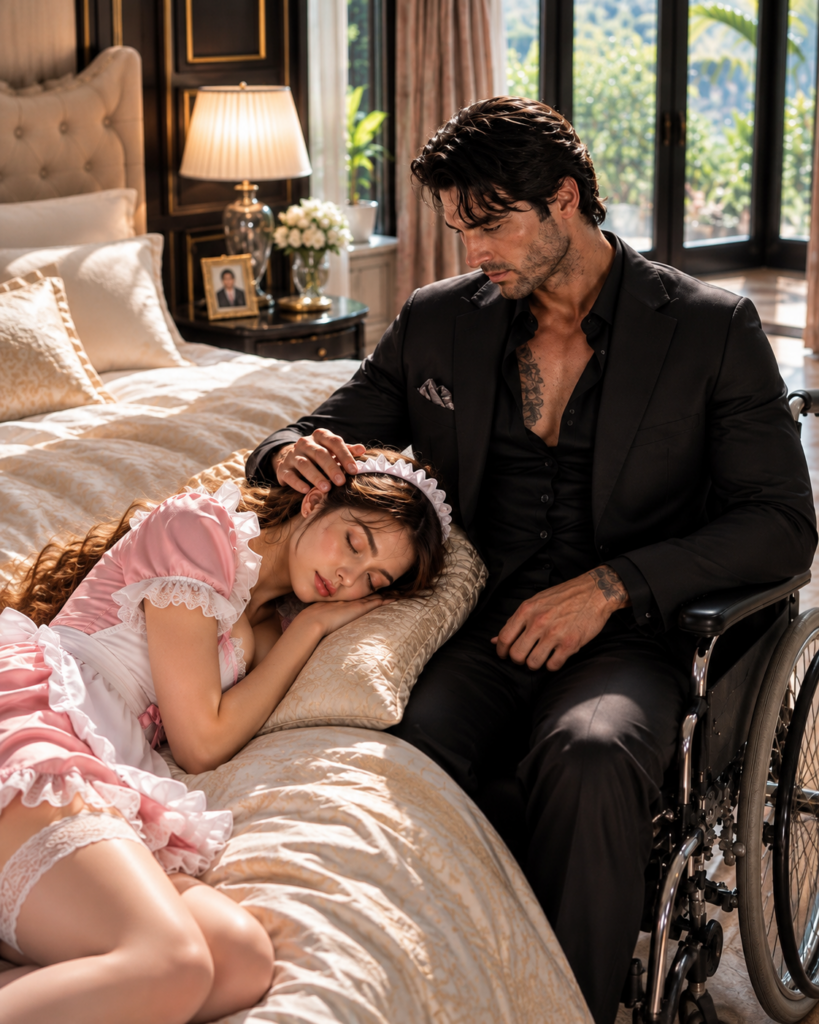
The first thing I saw was Emma’s hair spread across my pillow.
The second was that she was still wearing her cleaning uniform.
Fully dressed. Shoes on. One hand rested above the blanket near my hip, while the other hung loosely over the edge of the mattress.
For half a second, instinct took over.
My fingers closed around the weapon beneath my pillow.
Then I noticed how pale she was.
“Emma.”
Nothing.
I pulled my hand away from the weapon.
“Emma.”
Her eyelids fluttered.
She lifted her head, looked around as though she had no idea where she was, then jerked upright so quickly she nearly slid off the bed.
“Oh.”
“That’s your explanation?”
She stared at me.
“What?”
“You’re in my bed.”
Her eyes widened.
Then embarrassment flooded her face.
“I’m sorry.”
She stood, but the instant her feet touched the floor, she swayed.
I caught her wrist.
It was the first time I had touched her.
Her skin was cold.
“Sit down.”
“I’m fine.”
“You almost fell.”
“I stood too fast.”
“You’re shaking.”
“I’m tired.”
“That’s obvious.”
She gave me a look.
Even half-conscious, Emma Carter could make irritation feel like a professional skill.
Pieces of the night slowly returned to me.
The phantom pain.
The medication.
Emma bringing me water.
I remembered her sitting on the edge of the mattress because I had dropped the glass and she had been cleaning it up.
Then I remembered closing my eyes.
Apparently, sometime afterward, she had done the same.
“How long were you here?”
She checked the clock.
It was 4:17 a.m.
“Oh, no.”
“What?”
“My shift.”
She immediately bent for the cleaning cloth she’d left on the floor.
I stared at her.
“You’ve been unconscious beside me for two hours, and you’re worried about a hallway?”
“I wasn’t unconscious.”
“You didn’t wake when I called your name.”
“I’m a heavy sleeper.”
“You nearly collapsed standing up.”
She straightened.
“I said I’m fine.”
There was something in the way she said it that bothered me.
I knew that tone.
I had used it after the shooting.
Fine meant don’t ask.
Fine meant I cannot afford for the truth to become inconvenient.
“Sit.”
“Danny—”
“Emma.”
She stopped.
I had used the voice that made rooms go quiet.
Normally, I liked what that voice did.
This time I hated seeing her shoulders tense.
So I lowered mine.
“Please.”
That word surprised both of us.
Emma slowly sat.
I reached for the phone beside the bed and called the kitchen.
Rosa answered on the fourth ring, sounding understandably annoyed.
“Mr. Moretti?”
“Bring food.”
“At four in the morning?”
“Yes.”
“For you?”
I looked at Emma.
“For two.”
Emma shook her head immediately.
“I’m not hungry.”
“That wasn’t a question.”
“Then you can eat twice.”
Rosa, who had worked in my house long enough to know when to disappear from a conversation, said, “Twenty minutes,” and hung up.
Emma folded her arms.
“You can’t order me to eat.”
“Apparently I can order food to appear. What you do with it is your business.”
That nearly made her smile.
Nearly.
Then her expression changed.
“I’m sorry I fell asleep.”
“You work at a diner before coming here.”
She looked at me sharply.
“How do you know that?”
“Luke knows everything.”
“That’s comforting.”
“He runs security.”
“That makes it slightly less creepy.”
I ignored that.
“How many hours did you work yesterday?”
“Nine.”
“And then here?”
“Six so far.”
I did the arithmetic.
“Fifteen hours.”
“Congratulations.”
“Emma.”
“What do you want me to say?”
“The truth would be refreshing.”
Her gaze moved toward the windows.
Rain streaked the glass.
For the first time since she had entered my house, she looked defeated.
“My mother’s facility raised its rates.”
“How much?”
“No.”
“I asked a number.”
“And I’m not giving you one.”
“Why?”
“Because then you’ll try to solve it.”
I stared at her.
Most people entered my orbit hoping I would solve their problems.
Emma treated the possibility like a threat.
“You think I solve problems?”
“I think men like you dislike problems they can’t control.”
That landed more accurately than I wanted it to.
Rosa arrived with scrambled eggs, toast, fruit, and coffee.
Emma reluctantly ate half a piece of toast.
Then another.
By the time she finished the eggs, color had returned to her face.
I said nothing.
She noticed.
“Don’t look so pleased with yourself.”
“I’m not pleased.”
“You are.”
“I always look like this.”
“That must be exhausting.”
And against every instinct I had developed over forty years, I laughed.
Not much.
Barely a sound.
But enough that Rosa, who had returned for the dishes, stopped in the doorway and stared at me.
The next evening, Luke found me in the library.
“Rosa says you laughed.”
“Fire her.”
“She also says you ate breakfast.”
“Fire yourself.”
Luke grinned.
That annoyed me more than anything.
Then he placed a folder on the table.
“I found a new physical therapist.”
“No.”
“You haven’t opened the folder.”
“No.”
“This one specializes in spinal cord injuries and neuropathic pain.”
“I said no.”
Luke took the chair opposite me.
Unlike nearly everyone else in my house, he did not retreat when I was unpleasant.
Maybe that was why he had lasted fifteen years.
“Danny, you don’t have to walk again.”
My jaw tightened.
“I know.”
“Then stop acting like every therapist is arriving to prove you failed because you can’t.”
I looked toward the fire.
The room became painfully quiet.
Luke continued.
“The goal can be less pain. Better balance. Easier transfers. More independence.”
“I have independence.”
“You have six employees arranging your independence.”
I looked at him.
He held my gaze.
“Read the folder.”
After he left, I ignored it for twenty minutes.
Then Emma entered with a vacuum cleaner.
She saw the folder.
I saw her see it.
“Don’t.”
“I didn’t say anything.”
“You were about to.”
“No.”
“You have that expression.”
“What expression?”
“The one where you believe you’re right.”
She considered this.
“That’s just my face.”
I almost laughed again.
That irritated me enough that I opened the folder.
Dr. Mira Patel arrived Friday afternoon.
She was in her early forties, calm, compact, and unimpressed by the house.
She did not tell me I could overcome anything.
She did not say determination would make me walk.
She didn’t tell me my limits were imaginary.
Instead, she sat across from me and said, “Tell me what you hate most.”
“That’s your medical assessment?”
“It’s my first question.”
I thought about it.
“The pain.”
“What else?”
“Needing help getting into bed.”
She nodded.
“What else?”
I looked toward the windows.
“People assuming the chair is the tragedy.”
Dr. Patel waited.
“The tragedy,” I said quietly, “is remembering exactly how it felt before.”
She closed her notebook.
“That I understand.”
For the next forty minutes, she did almost nothing physical.
She asked questions.
About sleep.
About pain.
About medication.
About the strange burning sensations in places I could not move.
Then she explained phantom and neuropathic pain without talking to me like a child.
At the door she said, “I’ll come back Monday if you want.”
“And if I don’t?”
“Then I won’t.”
No lecture.
No disappointment.
No manipulation.
I hated how much that mattered.
“Monday,” I said.
Emma was polishing a table in the hallway when Dr. Patel left.
She said nothing.
I rolled past her.
“Go ahead.”
“About what?”
“You clearly have something to say.”
Emma looked at me innocently.
“I was just thinking the weather might improve.”
“You’re terrible at lying.”
“So are you.”
I stopped.
“Meaning?”
“You’re pretending you agreed because you liked the therapist.”
“I did.”
“No. You agreed because she gave you a choice.”
I stared at her.
She shrugged.
“Most people want choices.”
Then she went back to polishing the table.
Monday became Wednesday.
Wednesday became Friday.
I did not improve dramatically.
There was no miracle.
My toes did not suddenly move.
I did not stand.
But Dr. Patel taught me a different way to shift my weight that reduced the pressure across my lower back.
She adjusted how I transferred.
She helped my physician reconsider part of my medication schedule.
Within three weeks, I was sleeping nearly an hour longer at a time.
That felt enormous.
Emma never congratulated me.
I appreciated that more than congratulations.
One night she found me practicing a transfer from my chair to the edge of the bed.
I missed the position and had to start again.
She waited in the doorway.
“Need help?”
“No.”
“Okay.”
She turned away.
“Emma.”
She looked back.
“Stay.”
She leaned against the frame.
I tried again.
It took four attempts.
When I finally managed it, my breathing was embarrassingly heavy.
Emma nodded once.
“Good.”
“That’s all?”
“What do you want, balloons?”
“No.”
“Then good.”
She went back to work.
Somewhere during those weeks, the house changed.
Or perhaps I did.
The cooks stopped leaving rooms when I entered.
Rosa began arguing with me about sodium again.
Luke started drinking coffee in my study without asking permission.
Even the security staff seemed less interested in studying the floor.
I hadn’t realized fear had a sound until I stopped hearing it.
Silence.
That was what fear sounded like.
One Thursday morning, Emma didn’t arrive.
I noticed at 11:10.
Her shift didn’t begin until midnight.
That annoyed me.
At midnight, I waited.
At 12:20, I called Luke.
“Where is she?”
“Who?”
“You know who.”
“I’d like to hear you say it.”
“Luke.”
He laughed.
Then his voice changed.
“Emma called Rosa. Her mother had a difficult day at the facility. She’s staying there tonight.”
I looked at the clock.
“What happened?”
“Nothing dangerous. Her mother was confused and asking for someone who wasn’t there.”
“Who?”
There was a pause.
“I don’t know.”
But Luke’s voice told me he did.
“What?”
“Danny…”
“Say it.”
“Her mother asked for someone named Maria Moretti.”
Everything inside me went still.
Maria Moretti had been my mother.
She had been dead for eighteen years.
The following afternoon, I asked Emma about it.
Her face changed immediately.
“How do you know?”
“Luke.”
“Of course.”
“Did your mother know mine?”
“I don’t know.”
“That’s not true.”
Emma placed the folded sheets in the linen cabinet with unnecessary precision.
“My mother has dementia.”
“I understand.”
“She says names sometimes.”
“My mother’s name?”
Emma closed the cabinet.
“Danny, I really don’t know.”
I heard the honesty beneath the frustration.
That mattered.
“Has she ever mentioned it before?”
Emma hesitated.
“Yes.”
“When?”
“Months ago.”
“And you didn’t tell me?”
“At the time, you were throwing things at medical professionals. We weren’t exactly sharing family histories.”
Fair.
“What did she say?”
Emma stared at me for several seconds.
“She said, ‘Maria’s boy is still angry.’”
I felt something cold move through my chest.
My mother had called me that.
Maria’s boy.
Usually when I had gotten into trouble.
Sometimes affectionately.
Sometimes when she was warning my father not to turn me into a copy of himself.
“Where did your mother work?”
“Lots of places.”
“Before you were born.”
“She was a private caregiver for a while.”
I already knew the answer.
But I asked anyway.
“For whom?”
Emma looked uncomfortable.
“She never told me.”
The next day, Luke found the employment record.
Nora Carter.
Private night caregiver.
Fourteen months.
Maria Moretti.
I read the page twice.
Then a third time.
My mother had been ill during her final year.
Not dramatically.
Not publicly.
My father had protected the family’s privacy obsessively.
I had been twenty-four, angry at the world and rarely home.
At least that was how I remembered it.
Maria had died after a series of complications from an autoimmune condition that none of us had understood well enough.
Afterward, my father had shut down every conversation about her.
Her clothes disappeared.
Her photographs were boxed.
Her bedroom was remodeled.
And my older sister, Sofia, left Chicago six months later.
I had not spoken to Sofia in eighteen years.
I believed she had abandoned us.
She believed something about me.
I had never known what.
“Why wasn’t Nora Carter in the personnel files I reviewed after my father died?” I asked.
Luke looked troubled.
“She was.”
“No.”
“She was under a temporary medical staffing contract. We never searched those archives.”
I looked again at Nora’s photograph.
She had been younger, dark-haired, smiling awkwardly at the camera.
I could see Emma in her face.
“Does Emma know?”
“That her mother worked for your family? She knows now.”
I turned.
Luke nodded toward the doorway.
Emma stood there.
She looked furious.
Not with me.
With the situation.
“I called the facility,” she said. “My mother has a lucid period most afternoons. If you’re going to ask questions, that’s when.”
I waited.
“Are you inviting me?”
“I’m saying she remembers your mother.”
“That’s not the same thing.”
“No.”
Her eyes softened.
“But maybe she remembers something you need.”
The memory-care center sat forty minutes north of the estate.
I had not willingly entered a care facility since rehabilitation.
The smell alone nearly made me turn around.
Clean linen.
Disinfectant.
Coffee.
Plastic trays.
For a second I was back in the hospital, staring at my legs beneath a sheet while a physician carefully explained what might never return.
Emma noticed my hands tighten around the wheels.
“We can leave.”
I looked at her.
She meant it.
There was no challenge in her voice.
No disappointment.
Just choice.
“No,” I said.
We continued.
Nora Carter sat beside a window completing a puzzle with enormous pieces.
She was seventy-one.
Her silver hair had been cut short, and she wore a yellow cardigan Emma had apparently bought her.
When Emma kissed her cheek, Nora smiled.
“There you are.”
“Hi, Mom.”
“You’re late for school.”
Emma’s expression barely changed.
“I know.”
“You always lose your shoes.”
“I know.”
Then Nora looked at me.
The smile vanished.
For a long moment, she simply stared.
“Daniel.”
I stopped breathing.
Emma sat beside her.
“Mom, do you know him?”
Nora ignored her.
“You got old.”
I heard Emma make a small choking noise that might have been laughter.
“Apparently,” I said.
Nora studied my chair.
Sadness moved briefly through her eyes.
Then her attention returned to my face.
“Your mother hated lilies.”
I swallowed.
Everyone sent lilies when she died.
Hundreds of them.
The house smelled like lilies for weeks.
“She did,” I said.
Nora nodded.
“Said they smelled like funerals.”
I almost smiled.
That sounded exactly like her.
“What else do you remember?”
Nora’s fingers returned to the puzzle.
For several minutes, she said nothing.
Emma whispered, “Don’t push.”
I didn’t.
We sat there.
Sunlight moved across the carpet.
Somewhere in the hallway, someone was playing an old Frank Sinatra song.
Then Nora said, “Blue.”
“What?”
“The blue box.”
Emma leaned closer.
“What blue box, Mom?”
Nora became agitated.
“I told her I would keep it.”
“Keep what?”
“For the children.”
My chest tightened.
“What children?”
Nora looked at me.
“You and Sofia.”
I had not heard my sister’s name spoken by someone from that time in years.
“Where is it?”
Nora frowned.
“Blue box.”
“Where, Mom?” Emma asked gently.
Nora’s eyes filled with frustration.
“Home.”
“What home?”
“Not this one.”
Her old house.
Emma and I looked at each other.
Nora’s house had been empty for nearly a year while Emma tried to decide what to do with it.
That evening, we drove there.
It was a small bungalow in Berwyn, narrow and well-kept despite months of vacancy.
Emma unlocked the door.
Dust floated through the beam of the entryway light.
“This may be nothing,” she warned me.
“I know.”
We searched carefully.
Not because I expected treasure.
Because suddenly I was afraid of what memory might contain.
We checked closets.
Cabinets.
The basement.
Emma found old nursing uniforms, photographs, tax returns, Christmas decorations, expired coupons, and approximately forty jars Nora had apparently believed would one day become useful.
No blue box.
At 9:30, Emma sat on the basement steps.
“She may have imagined it.”
I looked around.
Then I noticed the old cedar chest beneath the stairs.
“What’s that?”
“My grandmother’s.”
Inside were blankets.
Baby clothes.
Several photo albums.
At the bottom was a blue metal document box.
Emma stopped breathing.
I couldn’t reach it easily from the chair.
She lifted it onto the workbench.
There was a small brass lock.
Emma searched the key ring she had brought from the facility.
The fourth key fit.
Inside were letters.
Dozens of them.
All tied with faded ribbon.
At the top rested one envelope.
My name was written across it in my mother’s handwriting.
Daniel.
My hands shook.
Emma noticed.
“I can leave.”
“No.”
She stayed.
I opened the envelope carefully.
The paper inside had yellowed slightly.
My mother had written only two pages.
She told me she loved me.
She told me she was afraid my father and I were becoming too much alike.
She wrote that strength without tenderness eventually becomes loneliness.
Then she wrote about Sofia.
Not as the daughter who had abandoned us.
Not as the selfish sister my father had described.
But as someone who had begged my mother to leave Chicago with her.
Someone who had written to me after leaving.
Again.
And again.
And again.
My mother wrote that if I ever believed Sofia had stopped loving me, I should look for Nora.
Because Nora had promised to keep copies of the letters.
I stared at the bundle beneath the ribbon.
Eighteen years of certainty began breaking apart without making a sound.
Emma sat across from me.
“What is it?”
I picked up the first envelope.
It was addressed to me.
Sofia’s handwriting.
I opened it.
Danny,
I don’t know what Dad told you.
I don’t know why you never answer.
But I need you to know I didn’t leave because of you.
I read another.
Then another.
Sofia had invited me to visit.
Sent photographs.
Asked about my birthdays.
Written after our father became ill.
Written after his funeral.
The final letter was twelve years old.
Danny,
I can’t keep sending these into silence.
If you ever decide you want your sister back, you know where to find me.
Except I hadn’t known.
Because I had never received a single one.
At the bottom of the blue box lay an old photograph.
Sofia and me as teenagers.
She had her arm around my shoulders.
I was pretending to be annoyed.
I remembered that day.
I remembered almost everything.
Except how much I had loved her.
Emma said nothing for a long time.
Then she asked the only question that mattered.
“Is the address still good?”
I looked at the final envelope.
Madison, Wisconsin.
“I don’t know.”
Luke checked before midnight.
Sofia Moretti no longer lived at that address.
But she had not disappeared.
She was now Sofia Moretti Bennett.
She taught art history at a small college outside Madison.
And beside her faculty biography was a photograph taken only months earlier.
My sister.
Older.
Smiling.
Alive.
I stared at the screen until the words blurred.
Then Luke quietly placed one more page beside me.
“She has a daughter,” he said.
I looked down.
A young woman stood beside Sofia in the photograph.
Dark hair.
My mother’s eyes.
Her name was Grace Bennett.
Twenty-one years old.
My niece.
A person who had existed for two decades while I sat three hours away believing I had no family left.
Emma stood near the window.
She didn’t tell me what to do.
Luke didn’t either.
For once, nobody did.
The decision belonged entirely to me.
I looked at Sofia’s faculty email address.
My hand hovered over the keyboard.
After eighteen years of silence built on letters I had never seen, what could a brother possibly write as his first word?
I didn’t write that night.
That surprised everyone.
Especially me.
For most of my life, hesitation had felt like weakness.
Decisions were supposed to be made quickly.
Orders delivered clearly.
Problems handled before they grew teeth.
But Sofia was not a problem.
She was my sister.
And eighteen years could not be repaired with the emotional equivalent of kicking down a door.
So I closed the laptop.
Luke raised an eyebrow.
“Tomorrow?”
“I don’t know.”
Emma had remained by the window.
She nodded.
“Good.”
I looked at her.
“Good?”
“You’re thinking before doing something.”
“I think before doing things.”
Luke and Emma exchanged a glance.
I hated that they had apparently formed an alliance.
“You’re both fired.”
Emma picked up her cleaning cloth.
“Okay.”
Luke headed toward the door.
“See you tomorrow.”
Neither of them believed me anymore.
Strangely, that felt like progress.
The next morning, Dr. Patel arrived.
I told her I wasn’t in the mood.
She glanced toward the exercise mat.
“That’s convenient. Neither am I.”
“What does that mean?”
“It means we’re working anyway.”
She had learned from Emma.
Or perhaps stubborn women simply found one another across professions.
We spent forty minutes working on transfers.
I failed repeatedly.
On the final attempt, I managed to move from my chair to the padded bench with minimal assistance.
Dr. Patel noted something on her tablet.
“What?”
“Progress.”
“I don’t need encouragement.”
“It wasn’t encouragement. It was documentation.”
“Fine.”
She gathered her equipment.
At the door, she paused.
“You’re distracted.”
“My sister is alive.”
Dr. Patel turned back.
I hadn’t intended to say it.
But once the sentence existed in the room, I continued.
“I knew she was alive. Technically. I just…”
“You hadn’t been part of her life.”
“No.”
“For how long?”
“Eighteen years.”
Dr. Patel waited.
Then she said, “That’s a long time to practice not speaking.”
The sentence stayed with me all afternoon.
Practice.
That was exactly what silence had become.
At first, Sofia and I had probably been waiting for each other.
Then waiting became habit.
Habit became pride.
Pride became history.
By evening, I opened the laptop again.
I wrote:
Sofia,
It’s Danny.
Then deleted it.
I wrote:
I found your letters.
Deleted that too.
I tried explaining our father.
My anger.
My ignorance.
My life.
Every version sounded like a defense.
Emma entered sometime after midnight carrying fresh towels.
“How many drafts?”
“Six.”
“Any good?”
“No.”
She stacked the towels.
“Then stop writing six.”
“What does that mean?”
“Write one sentence you know is true.”
She turned toward the door.
“That’s it?”
“That’s usually enough to find the second sentence.”
After she left, I stared at the screen.
Then I typed:
Sofia,
I just found the letters you sent me.
I never received them.
I am sorry it took me eighteen years to learn that.
I don’t expect anything from you, but if you’re willing, I would like to hear your voice.
Danny
I read it three times.
Then I pressed send.
No dramatic music.
No revelation.
Just a quiet little electronic sound.
Afterward, I sat in the dark wondering whether I had just opened a door or knocked on one that had been closed too long.
Sofia answered eleven hours later.
Her message contained eight words.
I can talk tonight.
Seven o’clock.
My hands were colder at 6:58 than they had been before business meetings involving millions of dollars.
Luke stood near the fireplace.
“Get out.”
“I haven’t said anything.”
“You’re breathing loudly.”
He smiled.
“I’ll be down the hall.”
At 7:00, my phone rang.
Wisconsin number.
I stared at it through two full rings before answering.
“Hello.”
Silence.
Then a woman’s voice said, “Danny?”
My sister.
Older than the voice in my memory.
Softer.
But still hers.
“Yeah.”
Another silence.
Then Sofia laughed once.
Not because anything was funny.
Because sometimes the body doesn’t know what else to do with eighteen years.
“You sound like Dad,” she said.
I almost ended the call.
Then I heard the smile beneath the words.
“So do you.”
“That’s cruel.”
“I’ve improved with age.”
“You always thought that.”
And just like that, somewhere beneath all the distance, we were sixteen and twenty again.
Not completely.
Not safely.
But enough to recognize each other.
“I found the box,” I said.
“Nora kept it?”
“Yes.”
Sofia became quiet.
“I wondered.”
“You knew?”
“Mom told me before she died that Nora had copies of some things. I didn’t know where.”
“Why didn’t you contact Nora?”
“I tried once. She had moved.”
I looked toward the windows.
“Sofia, why did Dad keep the letters from me?”
She took a long breath.
“You really don’t know?”
“No.”
“He wanted you to stay.”
“Stay where?”
“With him. In Chicago. In the business.”
I said nothing.
Sofia continued carefully.
“I was already arguing with him about everything. Mom was sick. Dad was becoming more controlling. I wanted you out before you became…”
“Like him?”
“Yes.”
That should have angered me.
Instead, I looked around the enormous room where people had once been afraid to breathe too loudly.
“What did he tell you about me?”
“That you chose him.”
“I didn’t.”
“I know that now.”
“What changed?”
“Nothing dramatic.”
Her voice softened.
“I just got older. Eventually you realize most family tragedies aren’t built from one terrible moment. They’re built from people protecting their pride one day at a time.”
I closed my eyes.
She sounded like our mother.
“Why did you stop writing?”
“Because every unanswered letter hurt.”
“I understand.”
“No, Danny. You don’t have to say that.”
“I do.”
Silence again.
Then she asked, “Are you all right?”
The question irritated me automatically.
“I’m fine.”
Sofia laughed.
“Oh, God.”
“What?”
“You still say that.”
“Say what?”
“Fine. You used to say it whenever you were definitely not fine.”
I thought of Emma.
Apparently, my habits had never been subtle.
“I was shot two years ago,” I said.
“I know.”
That surprised me.
“How?”
“Your name appears in newspapers.”
Of course.
“I wanted to call.”
“Why didn’t you?”
Sofia answered without defensiveness.
“I thought you’d made your choice.”
There it was.
Two people standing on opposite sides of the same locked door.
Both believing the other had turned the key.
We spoke for forty-three minutes.
Not about everything.
That would have been impossible.
We talked about small things.
Her work.
Chicago winters.
Our mother’s terrible cooking.
The summer Sofia convinced me that swallowing watermelon seeds would grow vines inside my stomach.
Then she told me about Grace.
“She knows about you.”
“What did you tell her?”
“That I had a younger brother in Chicago.”
“That’s all?”
Sofia hesitated.
“I told her we lost each other.”
Something in my chest tightened.
Not abandoned.
Not betrayed.
Lost.
“Can I meet her?”
“I need to ask her.”
“Of course.”
“And Danny?”
“Yes?”
“I need time.”
My instinct wanted to reject the condition.
Time had always been something I tried to control.
Deadlines.
Schedules.
Meetings.
But this wasn’t mine to command.
“All right.”
Sofia exhaled.
“Thank you.”
After the call ended, I remained still for several minutes.
Luke appeared in the doorway.
“Well?”
“She hates watermelon.”
He stared at me.
“What?”
“So does her daughter.”
Luke nodded gravely.
“Family crisis.”
“Get out.”
He grinned.
The first meeting happened six weeks later.
Not at my estate.
That was Sofia’s request.
I understood why.
The mansion could overwhelm people.
It had been designed to.
Instead, we met at a quiet restaurant near Lake Geneva, halfway between Chicago and Madison.
I arrived early.
That was unusual.
I hated arriving early because it created the possibility of waiting.
But I waited.
At 12:07, Sofia walked through the door.
I recognized her immediately.
Age had altered her, of course.
Silver threaded through her dark hair.
Fine lines gathered beside her eyes.
But she still tilted her head slightly when searching a room.
Our mother had done the same thing.
Behind her came Grace.
Twenty-one.
Tall.
Nervous.
Beautiful in the uncomplicated way of someone who hadn’t realized everyone in the room was looking at her.
Sofia stopped when she saw me.
For one long second, none of us moved.
Then she walked over.
“Hi.”
“Hi.”
Her eyes moved briefly to the wheelchair.
Not pity.
Just acknowledgment.
Then back to me.
I appreciated that.
“This is Grace.”
Grace gave me a cautious smile.
“Hello.”
“I’ve heard you hate watermelon.”
She blinked.
Then looked at her mother.
“Seriously?”
Sofia started laughing.
Grace did too.
The tension broke.
Not completely.
Enough.
Lunch lasted three hours.
Grace studied architecture.
That surprised me.
“Why?”
She shrugged.
“I like buildings.”
“Buildings?”
“Old ones mostly. The way they show what people thought mattered.”
I looked at her.
“That’s an expensive sentence.”
She smiled.
“My professors say worse things.”
Sofia watched us.
I could tell she was studying every exchange.
Protecting her daughter.
Protecting herself.
I respected that too.
At one point, Grace asked what I did.
The table became quiet.
Sofia looked at me.
There were several answers I could have given.
Most would have been technically accurate.
None would have been honest.
“I built businesses,” I said. “Some good. Some I’m less proud of.”
Grace waited.
I continued.
“I spent too many years believing power and respect were the same thing.”
Sofia’s expression changed slightly.
Grace said, “Are they?”
“No.”
“How do you know?”
I thought about nurses leaving my house.
Therapists quitting.
Employees studying the floor.
Emma refusing to stop cleaning because she needed the money.
“Because people who respect you can disagree with you.”
Sofia looked down at her coffee.
After lunch, she walked with me toward the lake while Grace went inside to buy something from the bakery.
“You’ve changed,” Sofia said.
“I’m sitting down more.”
She smiled.
“You know what I mean.”
“I’m trying.”
“Why?”
There were dozens of answers.
The shooting.
The chair.
Pain.
Loneliness.
Emma.
Nora.
The letters.
But one seemed truer than the others.
“I finally got tired of being obeyed.”
Sofia stopped walking.
I turned my chair toward her.
Our eyes met.
“Dad liked being obeyed,” she said.
“I know.”
“You did too.”
“I know.”
“And now?”
“Now I’m learning it’s a very poor substitute for being known.”
Sofia studied me.
Then she reached down and touched my shoulder.
It was not a hug.
Not yet.
But it was something.
When I returned home, Emma was in the kitchen drinking coffee before her shift.
“How was it?”
“Terrible.”
She nodded.
“So good, then?”
“Three hours.”
Emma smiled.
“You stayed three hours?”
“Yes.”
“That sounds terrible.”
I rolled closer.
“Grace studies architecture.”
“Your niece?”
I noticed how naturally the word sounded.
My niece.
“Yes.”
“Do you like her?”
“I barely know her.”
“That wasn’t the question.”
I sighed.
“Yes.”
Emma’s smile deepened.
Then she looked at the clock and stood.
She swayed slightly.
I noticed.
Again.
“You’re still doing too much.”
“Here we go.”
“How many diner shifts this week?”
“Four.”
“And here?”
“Five.”
“Emma.”
“My mother’s care doesn’t become free because you disapprove of my schedule.”
“I know.”
“Then stop looking at me like you’re about to buy the building.”
I had, in fact, briefly considered buying the building.
Apparently my face betrayed me.
“I’m not asking for charity,” she said.
“I wasn’t offering.”
“You were thinking very loudly.”
I considered my words.
“What if there were another job?”
She narrowed her eyes.
“What kind?”
“You notice everything in this house.”
“Hard not to.”
“You know which staff members are unhappy before Luke does. You know when supplies disappear, when schedules don’t work, when someone is covering for someone else.”
“Because people talk to cleaning staff.”
“Exactly.”
She folded her arms.
“Danny, if this is your way of giving me money—”
“It isn’t.”
I rolled toward the desk in the breakfast room.
A folder waited there.
She stared at it suspiciously.
I pushed it toward her.
“Household operations coordinator. Forty hours a week. Benefits. Tuition assistance under the employee program. Same probation period anyone else gets.”
Emma didn’t touch the folder.
“You created a job for me?”
“No.”
That was important.
“Rosa has wanted this position filled for six months. Luke kept hiring people who wore expensive shoes and lasted three weeks.”
“His shoes are expensive.”
“I know.”
“I don’t have a degree.”
“The posting doesn’t require one.”
She finally opened the folder.
I watched her read.
“This pays more than cleaning.”
“Yes.”
“Normal daytime hours.”
“Yes.”
“Health insurance?”
“Yes.”
“Why me?”
“Because Rosa recommended you.”
That surprised her.
“And because,” I added, “you tell me no.”
Emma looked up.
“I don’t think that’s usually considered management experience.”
“In my house it should be mandatory.”
She laughed.
Then her expression became serious.
“What if I say no?”
The old version of me would have pushed.
Explained.
Persuaded.
Made refusal uncomfortable.
Instead, I shrugged.
“Then you keep your current job until you find something you want more.”
She studied me for a long moment.
“You mean that.”
“Yes.”
“I’ll think about it.”
“Fine.”
She accepted three days later.
Not because of me.
Because Rosa spent an hour explaining how badly she needed help.
I liked that distinction.
Emma quit the diner.
She slept more.
The trembling in her hands disappeared.
Her mother’s expenses remained difficult, but Emma met with a benefits counselor through the memory-care center and discovered Nora qualified for assistance they had never applied for.
Emma came into my study afterward and placed the approval letter on my desk.
“I solved it.”
“You did.”
“No mansion acquisition required.”
“I wasn’t going to buy the facility.”
She stared at me.
“Not recently.”
“Danny.”
“Fine.”
She laughed.
Meanwhile, Sofia kept calling.
Once a week became twice.
Grace began sending me photographs of buildings she liked.
I sent back unsolicited opinions about structural integrity.
She usually replied:
You are missing the point.
Which apparently ran in the family.
Three months after our first lunch, Sofia came to Chicago.
She stood outside the estate for nearly a minute before entering.
“This looks exactly like something you’d live in,” she said.
“I’m not sure that’s a compliment.”
“It isn’t.”
Emma showed her around.
Within an hour, they liked each other.
That made me suspicious.
By dinner, Sofia knew about my physical therapy.
By dessert, she knew I had once thrown a paperweight.
I looked at Emma.
“You have violated several confidentiality agreements.”
“You never made me sign one.”
Sofia smiled.
“I like her.”
“Everyone does.”
The words left my mouth before I could stop them.
Emma looked down.
Sofia looked at me.
Then at Emma.
I changed the subject.
Later that evening, Sofia and I opened the blue box together.
We read every letter.
Some made us laugh.
Some hurt.
A few exposed misunderstandings neither of us remembered clearly anymore.
At the bottom, beneath all the correspondence, we discovered one document neither of us had noticed before.
It was our mother’s handwritten list.
Not legal instructions.
Not money.
Just wishes.
Take care of each other.
Do not let your father’s anger become your inheritance.
Travel somewhere neither of you has been.
Keep Sunday dinner when you can.
Forgive slowly if you must, but don’t confuse slow forgiveness with permanent silence.
Sofia read the last line twice.
Then she covered her mouth.
I looked away.
Some grief arrives eighteen years late and still knows exactly where to sit.
Sofia reached for my hand.
This time, I let her.
“I’m sorry,” she said.
“No.”
“You don’t even know what I’m apologizing for.”
“I don’t need to.”
I looked at her.
“We both lost years.”
She nodded.
“We can’t get them back.”
“No.”
“What do we do with that?”
For once, I knew.
“We stop losing more.”
She leaned forward and hugged me.
My sister had not hugged me since I was twenty-four.
I had forgotten that she always held on too long.
I was grateful she hadn’t changed everything.
My life continued changing in smaller ways.
Dr. Patel remained relentlessly unimpressed with me.
Six months after beginning therapy, I could transfer independently on good days.
My pain had not disappeared.
Some nights remained terrible.
My legs still did not move because I demanded it.
There was no miraculous recovery.
What returned was something else.
Participation.
I began leaving the estate.
Regularly.
Restaurants.
Meetings.
Sofia’s home.
Grace’s college exhibition.
Nora’s care center.
The first time I attended Grace’s architecture presentation, she introduced me to a professor as “my uncle Danny.”
Two words.
That was all.
I had negotiated deals worth tens of millions of dollars without feeling what those two words did to me.
Luke noticed too.
“You’re smiling.”
“No, I’m not.”
“You are.”
“Find work.”
“I have work. Mostly because you finally leave the house.”
That part was true.
The more I reentered the world, the less interested I became in the empire I had built.
Too much of it depended on secrecy.
Fear.
Old obligations.
I began separating the legitimate companies from everything else.
It took months.
Lawyers became involved.
Accountants.
Trustees.
I sold interests I no longer wanted.
Closed operations that had no place in the life I was trying to build.
Converted several legal companies into structures that gave longtime employees ownership stakes.
Luke watched the process cautiously.
“One year ago, you’d have called this surrender.”
“One year ago, I was an idiot.”
“I’ve been telling you that for years.”
“You’re still employed because firing you would require paperwork.”
Eventually, I asked what he wanted.
Luke looked confused.
“With what?”
“Your life.”
“I have a life.”
“No. You have my schedule.”
He looked away.
Luke had spent fifteen years keeping my world functioning.
Before the shooting.
After the shooting.
Through my worst months.
I had treated loyalty as though it created an unlimited debt.
“I’m not asking you to leave,” I said. “I’m telling you that you can.”
Luke became very still.
“You want me gone?”
“No.”
“Then why say it?”
“Because staying only matters if it’s a choice.”
The words sounded familiar.
Maybe Emma had changed my vocabulary too.
Luke eventually took three weeks off.
His first real vacation in eleven years.
He went fishing in Montana.
He sent me a photograph of a trout.
I replied that it looked small.
He did not answer for four days.
Emma continued managing the estate.
Efficiently.
Fearlessly.
She eventually enrolled in evening courses in healthcare administration using the tuition benefit available to employees.
Not because I suggested it.
She simply left the enrollment form on my desk one morning.
“What’s this?”
“Nothing you need to sign.”
“Then why is it here?”
“I wanted you to know.”
I looked at her.
She looked different from the woman who had collapsed beside me months earlier.
Still tired sometimes.
Still stubborn.
But there was steadiness in her now.
“What happens when you finish?”
“I might leave.”
I felt an immediate, unreasonable dislike of that answer.
Emma saw it.
“You said choices matter.”
“I regret teaching you things.”
“You didn’t teach me that.”
Fair.
A year after the night she fell asleep beside me, we sat in the same bedroom.
Not on the same bed.
She was in the chair beside the window, reviewing staffing schedules while I adjusted a brace Dr. Patel had recommended for positioning.
Rain tapped against the glass.
Almost identical weather.
“Do you remember your first month here?” I asked.
Emma didn’t look up.
“You yelled constantly.”
“I did not.”
“You made a chef cry over soup.”
“The soup was terrible.”
“You threatened to replace every lamp in the west wing because one bulb flickered.”
“That seems unlikely.”
“I wrote it down.”
“Why?”
“Evidence.”
I smiled.
Then she became quiet.
“My mother remembered something today.”
I looked at her.
“What?”
“She asked about you.”
“That happens sometimes.”
“She said Maria would be happy.”
Neither of us spoke.
Nora’s lucid moments were becoming less frequent.
We had learned not to demand permanence from them.
A good afternoon was enough.
A remembered name was enough.
A smile was enough.
“What did you tell her?” I asked.
“That I thought Maria probably would be.”
Emma closed the folder.
Then she added, “Mom also asked if I was still working for the angry boy.”
I sighed.
“And?”
“I said sometimes.”
I looked at her.
She smiled.
I thought about the strange route that had brought her into my life.
Two buses.
A cleaning job.
Thirty dollars an hour.
A hallway.
A bottle of pills.
A blue box hidden beneath blankets.
None of it felt like destiny.
I didn’t believe in destiny.
It felt more valuable than that.
It felt like choices.
Emma choosing not to be afraid of me.
Dr. Patel choosing not to promise miracles.
Sofia choosing to answer.
Grace choosing to call me her uncle.
Luke choosing to stay after finally being given permission to leave.
Me choosing, slowly and imperfectly, not to turn pain into a weapon against everyone nearby.
“Emma.”
“Yes?”
“When you finish school…”
She looked suspicious immediately.
“I haven’t even started my second semester.”
“I know.”
“What?”
I hesitated.
I had spent a lifetime giving orders.
Simple requests remained strangely difficult.
“Wherever you work afterward, I hope you don’t disappear.”
Her expression softened.
“That depends.”
“On what?”
“Whether you’re still making chefs cry.”
“I haven’t done that in months.”
“Rosa says seven weeks.”
“Rosa exaggerates.”
Emma laughed.
Then she came closer.
She sat on the edge of the bed—not because she had collapsed from exhaustion this time, but because she chose to.
“You’re going to be fine, Danny.”
I almost corrected her.
Fine.
That useless word.
Then I understood she meant something different.
Not healed.
Not walking.
Not free of pain.
Not absolved of every mistake.
Fine simply meant there would be more life after this moment.
More Sundays.
More phone calls with Sofia.
More arguments with Grace about buildings.
More physical therapy sessions I would complain about.
More days when Nora remembered us and more days when she didn’t.
More choices.
I looked toward the chair beside my bed.
Two years earlier, I had believed it represented the end of everything important.
Now it was simply the thing that carried me into whatever came next.
A month later, we held Sunday dinner at my estate.
Sofia arrived early.
Grace brought architectural drawings.
Luke had returned from Montana with an absurd hat.
Rosa complained that everyone was standing in her kitchen.
Emma’s mother joined us from the care center with one of her nurses.
Nora recognized Sofia immediately.
Then she looked at me.
For a moment, I couldn’t tell whether she knew who I was.
She studied my face.
Finally, she smiled.
“Maria’s boy.”
I swallowed.
“Yes.”
She reached across the table and patted my hand.
“Not so angry now.”
The room became quiet.
I glanced at Emma.
Her eyes were bright.
Sofia looked down at her plate.
Luke suddenly became fascinated by the bread basket.
I cleared my throat.
“Dinner’s getting cold.”
Rosa shouted from the kitchen, “It was cold ten minutes ago because nobody listens to me.”
Everyone laughed.
Even Nora.
Especially Nora.
And sitting there among people I had lost, found, hired, annoyed, forgiven, and learned to trust, I finally understood something my mother had tried to tell me eighteen years earlier.
Power could fill a house.
Money could fortify it.
Fear could make everyone inside obey.
But none of those things could make a place a home.
That required something far more difficult.
It required leaving the door unlocked for people who were free to walk away—and giving them reasons to choose to stay.
For the first time since the bullet changed my life, I did not wonder whether I would ever stand again.
I was too busy noticing who had chosen to sit beside me.

