
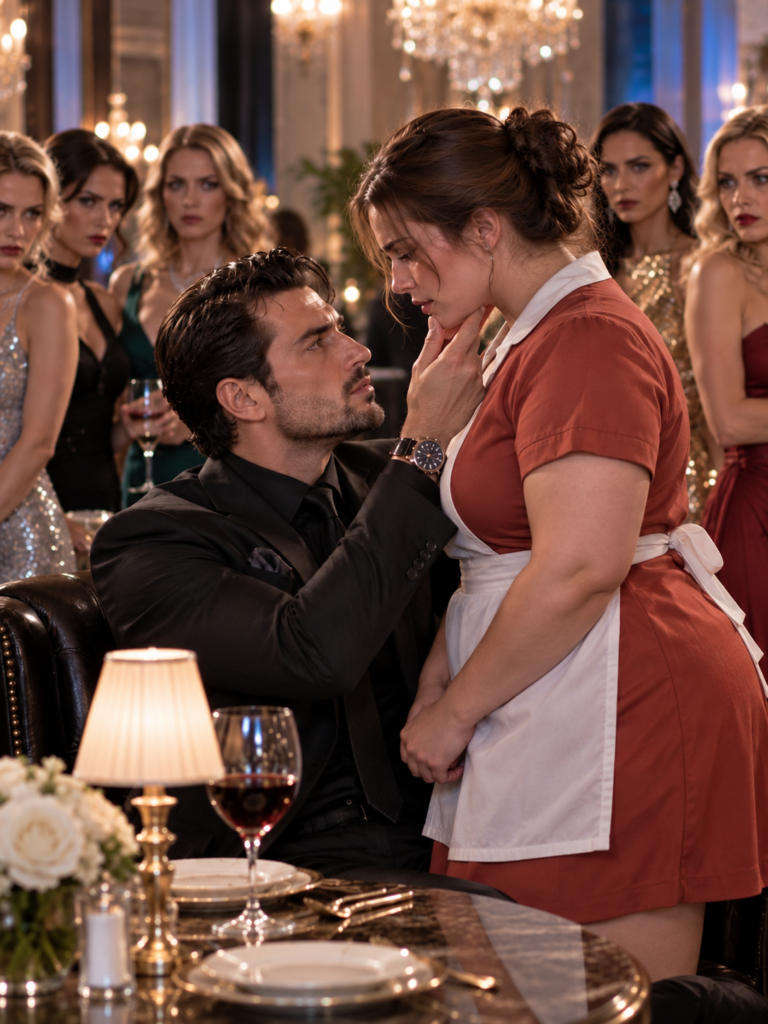
Liya Hart learned her mother had nearly stopped breathing while she was carrying champagne to people wearing more diamonds than her family’s house was worth.
The man who got a private oncology doctor to that house within fifteen minutes was Adrian Moretti—the one guest powerful senators stopped laughing around when he entered the ballroom.
Before dawn, he stood beneath Liya’s porch light and gave her the warning that changed everything: “The moment they saw me care about you, you became something my enemies can use.”

PART 1 — THE MAN WHO NOTICED THE WAITRESS
The Carrington Hotel ballroom glittered with enough crystal to make poverty feel almost fictional. Violins played beneath a painted ceiling, champagne moved on silver trays, and Liya Hart had been on her feet for eleven hours when her phone vibrated inside her apron. She should not have checked it on the floor, but the message came from her mother’s nurse.
Your mother had a reaction at 6:42. We stabilized her. Please call when you can.
For five seconds, the room kept moving while Liya stopped existing inside it. Her mother, Eleanor, had stage-three lymphoma. Liya had left college midsemester, taken three jobs, and learned that words like non-formulary, appeal denied, and coverage limitation could terrify a family more efficiently than shouting ever could.
She slipped into the service hallway, called twice, got no answer, wiped her face, and returned because the catering manager had already warned her that leaving early meant losing the eight hundred dollars she desperately needed. By the time she stepped back into the ballroom, her hands were shaking badly enough that two champagne flutes touched with a bright little chime.
She nearly walked into Adrian Moretti.
Liya knew nothing specific about him yet. She only knew that the room had changed when he entered. Men with titles had shifted aside without appearing to move, and an ambassador’s wife had lowered her glass while pretending to admire the orchids.
“Champagne, sir?” Liya asked automatically.
Adrian did not take one.
“You’ve been crying.”
“I’m fine.”
“No.”
The word was quiet, exact.
Liya swallowed. “My mother had a reaction to her medication. Nobody is answering at home, but I can’t leave.”
Adrian was already taking out his phone.
“Address.”
She blinked.
“What?”
“Your mother’s address.”
Within three minutes he had arranged for Dr. Rice, an oncology physician, to reach Eleanor’s house, a private ambulance to remain nearby, and a replacement nurse with actual oncology experience. Then Adrian looked at Liya and said, “You’re leaving now.”
“I need the shift.”
“Your pay will be covered.”
“I didn’t ask you to—”
“You’re right.”
That stopped her.
Adrian’s expression shifted slightly. “I’ll cover what you would have earned. You don’t owe me anything for it. Now go to your mother.”
Twenty minutes later, Liya sat in the back of his black sedan while rain streaked the windows. Adrian made calls from the opposite seat but did not ask for her hand, did not tell her everything would be fine, and did not turn her panic into a performance about his generosity.
Eleanor was pale but awake when they reached Alexandria.
The generic infusion had triggered a severe hypersensitivity reaction. The assigned nurse had been inadequately trained for oncology monitoring and had stepped outside during the early symptoms. Dr. Rice changed the treatment plan while Liya knelt beside the couch and cried once into her mother’s shoulder.
Adrian went outside.
That was what Liya remembered later.
He knew when to leave the room.
Near midnight, she found him standing beside his car beneath the porch light.
“Why?” she asked.
Adrian looked tired now, stripped of the ballroom’s cold authority.
“I don’t know yet.”
His phone rang.
He listened for less than a minute.
When the call ended, something had changed in his face.
“What happened?”
“My uncle heard where I am.”
“So?”
Adrian looked toward the quiet street.
“The gala was full of people who watch me for weakness.”
Liya’s stomach tightened.
“And?”
“Tonight they saw me leave because a waitress was crying.”
He met her eyes.
“They know your name now.”
Cold moved beneath her skin.
“What does that mean?”
“It means tomorrow I come back and tell you exactly who I am.”
He opened the car door.
“And exactly what being seen beside me could cost you.”
PART 2 — HE COULD BUY DOCTORS, SECURITY, AND SILENCE. LIYA WANTED TO KNOW WHETHER HE COULD RESPECT THE WORD “NO.”
Adrian returned at 9:04 the next morning carrying a cardboard bakery box tied with rough twine.
That irritated Liya immediately.
Men who commanded private doctors at midnight should not arrive carrying almond pastries like apologetic neighbors. It confused categories she preferred separate.
Eleanor was propped on the couch doing a crossword when Adrian entered. Her color had improved slightly, and Catalina—the sixty-two-year-old oncology nurse who had arrived after midnight—was checking medication against a handwritten schedule with the stern attention of a military quartermaster.
“Mr. Moretti,” Eleanor said.
“Mrs. Hart.”
“You brought food.”
“I was told you like almond pastries.”
Eleanor looked toward Liya.
Liya lifted both hands.
“Not me.”
Catalina accepted the box.
“You remember details.”
“Sometimes.”
“You should try it more often.”
For half a second Adrian looked almost startled.
Then he nodded.
“Fair.”
The exchange loosened the room.
Liya hated that too.
She wanted him either clearly dangerous or clearly safe. Contradiction was harder.
They sat at the scratched kitchen table after Eleanor finished breakfast. Pale November light fell across medication bottles, an unpaid utility bill, a stack of college forms Liya had never put away, and Adrian Moretti’s hands.
“I said I would tell you who I am.”
Liya wrapped both palms around coffee.
“I’m listening.”
“My family came through Calabria almost a century ago.”
He did not romanticize it.
He spoke about construction unions, transportation contracts, waste companies, port access, import businesses, political favors, and eventually the kinds of arrangements nobody listed on official websites. His father died when Adrian was twenty-six, leaving him not merely wealth but people who expected orders.
“Have you hurt anyone?”
Adrian did not look away.
“Yes.”
Liya’s fingers tightened.
“With your own hands?”
“Twice.”
“When?”
“A long time ago.”
He paused.
“I’ve made decisions since then that led to violence.”
“So you’re a criminal.”
“Yes.”
No euphemism.
No public-relations language.
Liya stared down at her coffee.
“If I ask you to leave right now?”
“I leave.”
“And Mom’s doctor?”
“Stays.”
“Catalina?”
“Stays.”
“Medication?”
“Handled through an independent medical trust if your mother accepts it.”
“No conditions?”
“None connected to me.”
“Why?”
That question seemed harder for him than admitting violence.
Adrian looked toward the living room, where Eleanor was arguing with a crossword clue.
“I’ve spent years moving pieces of the Moretti businesses toward structures that can survive daylight.”
“Why?”
“Because one day I may have children.”
His mouth tightened.
“And I don’t want a daughter inheriting something she has to lie about to remain safe.”
That reached Liya somewhere charm could not.
Adrian continued.
“Last night I saw you crying and did something before I calculated it.”
“That almost never happens.”
“No.”
“So now you’re curious.”
“Yes.”
“About me?”
“Yes.”
“That is not romantic.”
“I didn’t say it was.”
At least he knew.
Liya leaned back.
“My mother’s treatment cannot become the leash around my neck.”
“It won’t.”
“Security cannot become surveillance I’m not allowed to reject.”
“Tell me when it does.”
“And if I decide tomorrow that I never want to see you again?”
His eyes held hers.
“I’ll respect it.”
Liya believed he meant the sentence.
Whether he could live it was another question.
After Adrian left, Eleanor called Liya into the living room.
Her mother looked smaller than she had in August. Cancer had sharpened her face, thinned her wrists, and turned getting across a room into something that required planning.
“What do I do?” Liya asked.
Eleanor smiled sadly.
“You want me to tell you he’s evil so you can run.”
“Maybe.”
“Or good so you can stay.”
“Maybe.”
“He’s probably neither in any useful sense.”
Liya stared.
Eleanor took her hand.
“That man is dangerous.”
“Yes.”
“He may also be the best thing that ever happened to you.”
“Mom.”
“Both can be true.”
“That’s not helpful.”
“Life rarely is.”
Eleanor squeezed her fingers.
“Do not mistake relief for love.”
Liya became still.
“And do not mistake love for permission.”
The sentence followed her for years.
Liya returned to work three days later.
Adrian objected only with his face.
She noticed the same blue truck near the diner at lunch.
A woman in a tan coat rode two Metro stops behind her.
At night, a sedan parked half a block from her house with lights off.
Invisible security.
Liya called Adrian.
“I said not to make protection into surveillance.”
“They are watching the environment, not you.”
“They know where I go.”
“Yes.”
“That sounds like watching me.”
A pause.
“You’re right.”
The next day, the tan-coated woman disappeared.
The blue truck stayed near Eleanor’s street but no longer followed Liya to work.
That should have relaxed her.
Instead, the fact that Adrian adjusted because she objected made the entire situation more intimate.
One evening she called him after a sixteen-hour day.
“I’m scared of how not scared I feel when your people are nearby.”
He was silent for a moment.
“That is relief.”
“Sounds dangerously close to dependency.”
“Sometimes.”
He did not deny it.
“But somebody sharing weight you’ve carried alone for years is allowed to feel good.”
Liya leaned her forehead against her cold apartment window.
Howard, the orange alley cat she fed scraps on Wednesdays, sat beneath the fire escape.
“What if I get used to it?”
“Then we keep asking whether it expands your choices or shrinks them.”
There it was.
A rule.
One she understood.
Their first dinner happened in a private room above a Georgetown restaurant.
Adrian wore a navy sweater instead of a suit.
He stood when she entered.
No bodyguard inside.
No dramatic flowers.
They talked about ordinary things because ordinary things were suddenly exotic.
Her father had been a history teacher who died at forty-nine.
Adrian’s mother had died when he was six.
He sold a horse at seventeen because his father thought affection for animals made young men sentimental.
“That sounds insane.”
“It was.”
“You miss the horse?”
“More than several relatives.”
Liya laughed.
Real laughter.
Adrian looked startled by how much he liked the sound.
He told her about a house in Virginia his family did not know about.
“Why hide a house?”
“Because I needed one place where nobody entered unless I invited them.”
Liya understood immediately.
“Your secret room.”
“Something like that.”
When dinner ended, Adrian did not touch her.
Not her elbow.
Not her back.
Nothing.
That restraint troubled Liya more than seduction would have.
She lay awake that night thinking, He hasn’t touched me once, and I am in very serious trouble.
Across the river, Adrian stood at his office window thinking something equally unwelcome.
She may actually choose me.
Then his uncle called.
At 2:14 in the morning, Adrian phoned her.
His voice sounded wrong.
Too controlled.
“My cousin Vittorio has requested a senior family meeting Sunday.”
“What kind of meeting?”
“A challenge disguised as governance.”
“Against you?”
“Yes.”
“Because of me?”
“Partly.”
Liya sat up.
Adrian explained.
Five of nine senior voices had begun leaning toward Vittorio, who argued Adrian’s move toward legitimate business had made him politically vulnerable. The gala incident gave him a symbol.
A sick woman’s daughter.
A waitress.
A visible attachment.
“They want me there?”
“No.”
Adrian paused.
“They want you absent.”
“Then why are we discussing it?”
“Because if you don’t attend, Vittorio says I’m hiding you because you can’t withstand scrutiny.”
“And if I attend?”
“He tests you.”
“For what?”
“Fear.”
“Greed.”
“Instability.”
“Anything he can rename weakness.”
Liya’s stomach tightened.
“What happens if I say no?”
“No is real.”
“And your position?”
“I may lose it within months.”
“Would they kill you?”
“Probably not.”
“Adrian.”
“Probably.”
She stood and began pacing.
“You said no is real.”
“It is.”
“Then stop sounding like you need me to say yes.”
Silence.
He breathed out.
“You’re right.”
That mattered.
Liya stopped.
“What happens if Vittorio wins?”
“My daylight transition slows or dies.”
“Old businesses return to old methods.”
“People who are benefiting from reform lose protection.”
“And you?”
“I survive.”
“But?”
Adrian’s voice lowered.
“I become smaller.”
There it was.
Not death.
Something more personal.
Liya stared at the dark ceiling.
“If I stay home because I’m afraid, people like him get exactly what they expect from women like me.”
“Liya.”
“I’m coming.”
“No heroics.”
“Good.”
“Because I’m shaking.”
“That is not disqualifying.”
“I know.”
She heard something change in him.
Relief, probably.
Maybe fear too.
The Chesapeake House sat behind iron gates and winter-bare trees.
Liya wore a navy dress from her cousin’s wedding and Eleanor’s pearl earrings.
Nothing Adrian had purchased.
That was deliberate.
Her mother fastened the pearls that morning.
“Respect yourself in there.”
“I’ll try.”
“No.”
Eleanor looked directly at her.
“Do not try to impress people who need you humiliated before they can feel tall.”
Liya nodded.
“Tell the truth calmly.”
“And remember that dignity is not class-dependent.”
She carried that sentence into the car.
Adrian met her at the bottom of the Chesapeake steps.
“You can still leave.”
“I know.”
“Certain?”
“No.”
A faint smile touched his mouth.
“Good.”
“That’s annoying.”
“Certainty is overrated.”
He lifted one hand toward her back.
Then stopped.
Waited.
Liya nodded.
Only then did his palm settle lightly against the fabric.
Small permission.
Large meaning.
Nine men held formal seats at the table.
Others stood behind them.
Advisers.
Sons.
Lawyers.
Men who had survived long enough to become furniture in rooms where power was inherited and renegotiated.
Vittorio Moretti sat three chairs to Adrian’s right.
Mid-forties.
Perfect dark suit.
Perfect manners.
Eyes polished empty.
Enzo, Adrian’s uncle, looked older and much more tired.
Renata sat near Vittorio.
She inspected Liya with curiosity rather than hostility.
Dinner arrived.
Nobody seemed hungry.
The conversation began with charity foundations, union relationships, port negotiations, and public perception.
Eventually Vittorio turned to Liya.
“Miss Hart.”
She looked up.
“Perhaps you can help us understand whether you appreciate the complexity of the position Mr. Moretti has created.”
A trap disguised as courtesy.
Liya set down her fork.
“I understand my mother nearly died because a medical system assigned her someone who was not qualified to manage her treatment.”
Several men shifted.
“I understand Adrian intervened.”
“I understand people saw it.”
“And I understand that visibility has consequences in your world.”
Vittorio smiled slightly.
“Then you understand our concern.”
“No.”
His smile faded.
“What I don’t understand is why your internal conflict is being placed on a schoolteacher’s daughter from Alexandria as though I engineered it.”
The table quieted.
Adrian did not intervene.
Good.
Vittorio folded his hands.
“No one is blaming you.”
“Aren’t they?”
Liya asked.
“Because you’ve spent twenty minutes discussing my existence as a liability rather than discussing Adrian’s choices as your actual concern.”
Enzo looked toward her more closely.
Vittorio tried another angle.
“This is about suitability.”
“For what?”
“Proximity to the family.”
Liya almost laughed.
“Is having a sick mother unsuitable?”
“No.”
“Being working class?”
“That isn’t what I said.”
“Being afraid?”
Vittorio’s jaw shifted.
Liya continued.
“Those things aren’t moral failures where I come from.”
The sentence landed.
Not because it was clever.
Because it was plain.
She suddenly understood the room.
Most people at that table had been taught to treat vulnerability as a bargaining error.
Liya came from a neighborhood where women brought soup after surgeries without asking how the patient intended to repay them.
Different economy.
Different morality.
Vittorio leaned back.
“Let me be direct.”
“Please.”
“Do you believe you can withstand what comes with proximity to Adrian Moretti?”
“No.”
Absolute stillness.
Adrian turned toward her.
Liya continued.
“No sane person could know that after a few weeks.”
“I know he told me the truth when lying would have been easier.”
“I know my mother’s medical care is not conditional on whether I stay near him.”
“I know he told me I could walk away.”
“And I know many powerful people don’t give less powerful people real choices.”
She looked at Vittorio.
“So I cannot promise what I can withstand.”
“I can tell you I know the difference between coercion and honesty.”
Enzo set down his fork.
“We should be careful not to punish candor because it inconveniences us.”
Vittorio’s eyes hardened.
Renata looked down.
Another older man spoke about the legitimate-business transition.
Then another.
The room was turning.
Not dramatically.
Power rarely does.
It turns through embarrassment.
Suddenly supporting Vittorio’s attack meant publicly agreeing that a sick civilian woman represented the family’s greatest governance problem.
That looked smaller once someone said it aloud.
Vittorio tried one last move.
“And if Miss Hart later decides she resents this attention and speaks carelessly?”
Liya answered before Adrian could.
“Then that would be my moral responsibility.”
She held Vittorio’s gaze.
“Not proof that poor women are inherently unfit for respect.”
That killed it.
Not forever.
For today.
Enzo requested recess.
Thirty minutes later, the formal challenge was tabled.
Everyone understood what tabled meant.
Vittorio had lost the room.
For now.
Outside, Liya started shaking before she reached the car.
Not elegantly.
Her knees nearly gave.
Adrian caught her elbow only after she reached for him first.
“You did not owe me that.”
“I know.”
“Then why?”
She leaned against the cold car.
“Because if I stayed home and let fear make the choice, I would hate myself.”
Adrian looked at her.
“And because I believed you when you said no was real.”
She swallowed.
“So yes had to be real too.”
Something in his face cracked.
“Thank you.”
His voice was rough now.
Not strategic.
The words carried weight.
Marco, Adrian’s driver, opened the rear door.
As they drove away, Liya watched Chesapeake House disappear between bare trees and understood something uncomfortable.
The room had contained no guns.
No shouting.
No overt threats.
Yet she had felt more endangered there than on some streets after midnight.
Civilized people could perform violence with grammar.
Eleanor restarted the correct treatment protocol Monday.
Catalina turned the house into a schedule.
Dr. Rice remained available.
Bills stopped arriving.
That bothered Liya.
She confronted Adrian.
“What did you do?”
“Medical trust.”
“Under whose control?”
“Not mine.”
He introduced her to Miriam Feld, an independent attorney who spent two hours explaining every page.
The trust belonged to Eleanor.
Funding was irrevocable for the treatment period.
Adrian had no right to revoke care because Liya changed her mind about him.
No hidden confidentiality clauses.
No romantic conditions.
No ownership.
“If you’re going to hate me for solving things,” Adrian said afterward, “at least hate me for solving them correctly.”
Liya did not hate him.
That was becoming the problem.
She kept working.
One shift became unnecessary.
Then two.
Eventually she dropped the cleaning job but kept the diner and a few catering weekends.
Adrian sent elaborate fruit once.
Catalina returned it.
A note accompanied the box when it arrived at his office:
DATE LIKE A NORMAL HUMAN BEING.
The next delivery to Liya was a loaf of olive bread.
The text read:
Less humiliating?
She laughed in the diner break room hard enough that her coworker Tasha demanded details.
“A man?”
“Complicated.”
“Rich?”
“Unfortunately.”
“Hot?”
“Tasha.”
“That means yes.”
Liya rolled her eyes.
Tasha pointed a fork at her.
“Keep him if he makes you laugh during cancer paperwork.”
“What if he’s dangerous?”
“Throw him out if he starts giving motivational speeches.”
Reasonable.
Weeks passed.
Adrian showed Liya the Virginia house.
It was smaller than expected.
Wood floors.
A back porch.
Books placed where people actually read them.
No staff.
No black cars visible.
He made terrible espresso.
She found him folding kitchen towels with military precision.
“Why?”
“Stress.”
“You fold towels when anxious?”
“Yes.”
“That’s almost wholesome.”
“Don’t spread it around.”
He learned Liya read medical forms aloud when afraid.
Dense insurance language became less powerful after entering her mouth.
One evening she caught him listening from the doorway.
“What?”
“Nothing.”
“You’re looking at me.”
“You make bureaucracy sound threatening.”
“It is threatening.”
“Fair.”
Their first kiss came six weeks after the gala.
Eleanor had endured a brutal clinic day.
A young boy in another treatment room had cried for forty minutes.
Someone’s father screamed at an exhausted nurse.
Liya returned to the Virginia house because she could not face her apartment.
She stood at Adrian’s kitchen sink trying not to cry.
“Everyone keeps calling me strong.”
Adrian remained several feet away.
“I’m so tired of being assigned that job.”
He nodded.
“Do you want advice?”
“No.”
“Comfort?”
She thought.
“No.”
“Silence?”
“Yes.”
So he stood beside her silently.
One minute.
Two.
No arm around her.
No speech.
No promise.
Liya turned.
Placed one hand on his coat.
Kissed him.
It was brief at first because both of them were surprised.
Then less brief.
When they separated, Liya whispered:
“That was a terrible idea.”
“Probably.”
Adrian’s mouth almost smiled.
“Want to try once more and see if the first improves?”
She did.
Then Adrian stopped.
Not because he lacked desire.
Because stopping mattered.
Liya understood that too.
In January, she asked him a question over coffee at Eleanor’s table.
“Can people like you become good?”
Adrian looked toward the floor.
“Or do you become tired and call it reform?”
He gave a small, humorless laugh.
“Most men like me become sentimental before ethical.”
“What does that mean?”
“We donate.”
“Build hospitals.”
“Talk about legacy.”
“It feels cleaner than changing the machinery that makes money.”
“And you?”
“I’m trying to change the machinery.”
“Does that make you good?”
“No.”
Adrian looked directly at her.
“That judgment does not belong to me.”
That answer mattered.
Liya did not need a dangerous man who believed loving her had purified him.
She needed one who understood affection did not cancel accountability.
Vittorio did not challenge Adrian openly again.
That made Adrian nervous.
Old suppliers delayed agreements.
A port contact slowed approvals.
One subcontractor backed out without explanation.
Friction.
The civilized version of strangulation.
Then Renata contacted Liya.
Alone.
Public tea room.
Afternoon.
Adrian hated the meeting.
Liya went anyway.
Fear could not control every map.
Renata arrived without makeup beyond lipstick and without the icy posture she had worn at Chesapeake House.
“Vittorio is moving money.”
“Where?”
“Old routes.”
“Outside partners.”
“Men Adrian has been cutting away.”
“Why tell me?”
Renata looked into untouched tea.
“Because you were right.”
“About?”
“We moved responsibility downhill.”
“To you.”
She looked ashamed.
“I’m tired of participating.”
Not friendship.
Conscience arriving late.
Still useful.
“What does Vittorio want?”
“To force Adrian into one of two reactions.”
“Soft enough to look weak.”
“Or violent enough to prove the daylight strategy is fiction.”
Liya’s stomach tightened.
“Then he’s not trying to beat Adrian.”
“No.”
“He wants Adrian to beat himself.”
That was the same week the newspaper story ran.
The article never accused Liya of anything directly.
That was why it was effective.
It mentioned Adrian Moretti’s philanthropic foundation.
Then Eleanor’s cancer treatment.
Then the independent trust.
Then “questions” about the relationship between a powerful financier and the daughter of a patient receiving extraordinary private assistance.
The comments were less subtle.
Gold digger.
Groomed.
Paid girlfriend.
Criminal washing his reputation through a cancer patient.
Liya read too many.
Then slammed the laptop shut.
Adrian arrived thirty minutes later wearing a cashmere coat and the expression of someone considering arson.
“Do not burn down a newspaper over me.”
“I wasn’t going to burn it.”
“Good.”
“I was thinking about buying it.”
“That is worse.”
He almost laughed.
Enough to keep himself from doing something stupid.
Liya sat on the floor.
“You sit too.”
“Why?”
“You pace when violent.”
“That’s not scientifically proven.”
“Sit.”
He did.
“This is what Vittorio wants.”
Adrian’s hands tightened.
“You should not pay this price because of me.”
“True.”
He looked up.
“But I’m already paying it.”
“That doesn’t mean I—”
“You do not get to decide my dignity every time your world touches it.”
He went silent.
Liya continued.
“I decide whether this diminishes me.”
“Not you.”
“Not Vittorio.”
“Not strangers online.”
Adrian’s face changed.
Understanding.
Pain.
Something permanent.
Protection, he realized, could become another form of ownership if he decided the meaning of her suffering for her.
He hated that lesson.
He accepted it anyway.
The next morning, Miriam issued a short legal statement confirming Eleanor’s trust structure and independent oversight.
No romantic details.
No defensive essay.
No public performance.
The story began dying.
Then Adrian received a message from Renata.
He read it once.
Then again.
“What?”
Liya asked.
He turned the screen toward her.
He wanted you angry. He wanted you careless. This was only the first test.
Liya looked at Adrian.
“Can you stay calm?”
He stared toward the city.
“I can stay strategic.”
“That is not what I asked.”
A long pause.
Then:
“I’m going to have to learn.”
And that frightened him far more than declaring war ever had.
PART 3 — ADRIAN WON THE POWER STRUGGLE ONLY AFTER HE STOPPED TREATING POWER AS THE POINT
The newspaper scandal faded.
Vittorio did not.
The difference mattered.
A public story had a short life.
A man who believed adaptation meant weakness could wait years.
Adrian accelerated the daylight transition.
Two side businesses whose profits depended on undocumented payments were closed.
An outside compliance company was hired.
Old contracts were rewritten or abandoned.
Real auditors entered rooms where everybody previously understood not to ask certain questions.
Profit fell.
Adrian let it.
Three senior men complained.
One left.
Another adapted.
A third was arrested months later for a private operation Adrian had already separated from the legitimate companies.
Liya watched all of it from enough distance to remain uncomfortable.
“What happens to everybody below the men making decisions?”
she asked.
Adrian looked over a restructuring memo.
“Employees?”
“Yes.”
“The guy driving a truck.”
“The woman doing payroll.”
“Families whose rent doesn’t care whether their employer decided to become ethical.”
Adrian put down the document.
Nobody in his family had ever asked reform questions that way.
“We preserve legal jobs where possible.”
“And where not?”
“Severance.”
“Training.”
“Placement.”
Liya nodded.
“Put that in the plan.”
He almost smiled.
“You are not on my board.”
“Lucky board.”
He added it.
Eleanor’s health improved enough by late summer for Dr. Rice to cautiously use the word remission.
No celebration came immediately.
Liya sat in the oncology parking lot and cried.
Adrian held her.
That night he cried alone in the Virginia kitchen.
He believed nobody saw.
Catalina saw everything.
She handed him a handkerchief.
“Don’t become stupid because God decided to be generous for one afternoon.”
Adrian nodded solemnly.
The sentence became family law.
Eleanor began walking around the block.
Then two blocks.
She reclaimed her porch.
She reorganized her kitchen.
She criticized Adrian’s coffee.
Health returned through ordinary acts.
Not miracles.
Appetite.
Energy.
Irritation.
The ability to become unreasonable about flower pots.
Adrian discovered surviving good news required different muscles from surviving danger.
He was worse at those.
Liya enrolled in one online class.
Then another.
The registrar page remained open on her laptop for three hours before she clicked submit.
Adrian never offered to call anyone.
Never offered to buy anything she had not requested.
He asked one question.
“What textbook do you need?”
“I can pay for the textbook.”
“I asked what textbook.”
She stared.
“Social Policy Analysis.”
He nodded.
“Do you want me to buy it?”
There.
The question.
Not assumption.
“Yes.”
“Okay.”
A book.
Thirty-seven dollars used.
One of the most intimate gifts he ever gave her.
Their relationship remained imperfect.
Adrian disappeared one day for twelve hours after meetings in Baltimore.
No phone call.
No explanation.
He arrived at Eleanor’s house exhausted and tried to kiss Liya as if presence repaired absence.
She stepped backward.
“No.”
He stopped.
Good.
“I will not build my life around disappearing men.”
“I was working.”
“That is a reason.”
“Not communication.”
“You knew I was safe.”
“I didn’t.”
Adrian’s eyes narrowed reflexively.
Then he caught himself.
“Fair.”
“No explanation disguised as an apology.”
He breathed out.
“I’m sorry.”
Nothing else.
Liya nodded.
“That one counts.”
Vittorio’s coalition weakened slowly.
Not because Adrian crushed him.
Because Vittorio became impatient.
He revived old financial channels.
Reopened relationships with men external auditors had already flagged.
Moved cash through a satellite business he believed too small to matter.
It mattered.
Federal scrutiny eventually landed on the company.
Subpoenas followed.
Adrian’s lawyers showed years of formal separation.
The daylight transition that old men had mocked now functioned like a seawall.
Vittorio tried blaming Adrian.
The documentation did not cooperate.
Renata gave evidence through counsel about financial decisions she had warned against.
Enzo refused to protect his nephew.
The old family closed ranks around continuity, not nostalgia.
Vittorio vanished from leadership without a gunshot.
That almost offended him more than defeat through violence would have.
Liya asked Adrian if he felt victorious.
“No.”
“Relieved?”
“Some.”
“Sad?”
Adrian considered.
“Yes.”
“Why?”
“He was my cousin.”
“He was at my tenth birthday.”
“He taught me to drive.”
Liya touched his hand.
“People don’t become strangers just because they become dangerous.”
“No.”
“That’s what makes it hurt.”
Years passed by accumulation.
Eleanor’s scans.
Final exams.
Adrian’s board meetings.
Catalina yelling at everybody.
Howard the alley cat becoming so fat the veterinarian used the phrase “structurally ambitious.”
Liya reduced her work hours.
Finished course after course.
Some semesters she took one class.
Some two.
Once she took none because Eleanor needed surgery again.
Progress did not care about cinematic pacing.
Adrian learned that.
Liya graduated in a borrowed black robe on a humid May afternoon.
Rows of folding chairs sank slightly into the grass.
Eleanor cried from the opening music until the last name.
Marco clapped as though Liya had won a championship.
Catalina informed three strangers that the tassels were on the wrong side.
Adrian stood when Liya crossed the stage.
Not because anyone else did.
Because he could not remain seated.
She saw him.
For a moment, she remembered carrying champagne through the Carrington ballroom.
Invisible.
Exhausted.
No degree.
No plan beyond next month’s bills.
She almost lost her step.
Then kept walking.
Education had not cured cancer.
It had not erased class.
It had not rescued her.
It had given continuity back to a life crisis interrupted.
That mattered more.
Liya became a patient advocate.
Nobody who knew her was surprised.
She helped families file expedited appeals.
Translated insurance letters into ordinary English.
Sat beside mothers holding plastic hospital folders with both hands because paperwork had become physical fear.
She learned which words mattered:
Medically necessary.
Standard of care.
Peer review.
Urgent appeal.
Continuity of treatment.
She did not work for Adrian.
That was deliberate.
His money never directly funded her office.
He supported unrelated programs through independent foundations.
Her profession belonged to her.
One afternoon she called him after winning an appeal for a father whose daughter needed a specialty drug.
“I made an insurance executive say ‘medical necessity’ eleven times.”
Adrian sounded impressed.
“Did he survive?”
“Barely.”
“Should I send security?”
“Absolutely not.”
“Checking.”
Adrian changed too.
Not beautifully.
Not completely.
The old impulse toward control remained.
He simply recognized it faster.
Once, after Liya received a threatening message online, he doubled security without telling her.
She discovered it.
“Undo it.”
“We received a threat.”
“Tell me.”
“I’m telling you now.”
“After deciding.”
Adrian rubbed one hand over his face.
“I hate how inconvenient your principles are.”
“Thank you.”
They compromised.
Temporary increased protection.
Review every forty-eight hours.
Liya could request reduction.
Specific threat information shared with her.
No permanent expansion by stealth.
The system worked because neither pretended love made power harmless.
They married years after the first gala.
Quietly.
Eleanor was well enough to attend.
Catalina wore dark blue and reorganized the flowers because apparently florists required supervision.
Enzo came.
Renata came.
Marco wore a suit that did not fit because tailoring offended him personally.
No photographers.
No foundation sponsors.
No politicians needing favors.
Liya chose a weekday chapel.
“Saturday weddings feel expensive in spirit.”
Adrian laughed.
“You know we can afford Saturday.”
“That is exactly why we aren’t doing it.”
The vows were specific.
Liya went first.
“I promise to tell you when fear is making you controlling.”
A few people laughed.
Adrian did not.
He knew she meant it.
“I promise not to confuse your protection with love when it begins reducing my choices.”
“I promise to stay because I choose staying.”
“Not because your resources make leaving difficult.”
Adrian’s throat tightened.
His vows were shorter.
“I promise to tell the truth before strategy.”
“I promise that help will never become debt between us.”
“I promise that my fear of losing you will never become permission to own you.”
Then he looked at her for a long moment.
“And if I forget, I promise to listen when you remind me.”
That was enough.
A daughter came first.
Then a son.
Their daughter inherited Adrian’s stillness and Eleanor’s ability to use silence as judgment.
Their son inherited Liya’s questions.
Too many questions.
At seven, he asked why security cameras existed around the Virginia house.
Adrian answered:
“Because I spent part of my life doing work that created enemies.”
“What kind of work?”
“Complicated work.”
Liya looked across the table.
Adrian saw.
Corrected himself.
“Some of it was wrong.”
Their son thought about that.
“Do you still do wrong work?”
“I try not to.”
“Do you mess up?”
“Yes.”
“Mom says everyone messes up.”
“Your mother is annoyingly accurate.”
Liya threw a napkin at him.
The children laughed.
Truth entered slowly.
Age appropriately.
No family mythology about Adrian being a misunderstood hero.
No lies pretending his wealth appeared clean.
He wanted the next generation to inherit context instead of silence.
Enzo died when their daughter was eleven.
After the funeral, Adrian sat at the Virginia kitchen table long after everyone left.
Untouched espresso cooled between his hands.
Liya joined him.
“My father used to measure success by control.”
Adrian said.
“Mine too.”
“Then survival.”
“Then containment.”
He looked toward the dark window.
“I think I measure it differently now.”
“How?”
Adrian considered.
“By whether people around me become more free because I exist.”
Liya went very still.
“That might be the best thing you’ve ever said.”
“High praise.”
“I’m serious.”
“So am I.”
She wrote the sentence down later.
Not as romance.
As a metric.
She used it in patient advocacy without attribution.
If people around you are less free because of your love, your protection, your resources, or your certainty, then something in your care has become contaminated.
It helped people.
Adrian never asked for credit.
Another form of progress.
Eleanor grew old enough to become outrageous again.
Remission held.
Not perfectly.
There were scans that frightened everyone.
A suspicious result that turned out benign.
A medication change.
A hospitalization after pneumonia.
Life remained mortal.
But years arrived.
More than they had dared expect.
She taught her grandchildren card games.
Fed them too much sugar.
Corrected Adrian’s manners.
One afternoon their daughter asked Eleanor the difference between pity and kindness.
Eleanor answered without thinking.
“Pity looks down.”
She reached for a card.
“Kindness kneels.”
Adrian, standing by the sink, stopped moving.
Liya looked at him.
Both remembered the gala.
A waitress crying.
A man who could have walked past.
He had not literally knelt.
But for perhaps the first time in his adult life, he had allowed someone else’s emergency to matter more than his own position in a room.
It changed everything.
Not because private power was morally superior to institutions.
Quite the opposite.
That remained the wound beneath the entire story.
The hospital system should have protected Eleanor.
The insurer should have approved appropriate treatment faster.
The staffing agency should have assigned someone properly trained.
Competent care should not have depended on whether a dangerous wealthy man happened to notice a crying waitress at a gala.
Liya never forgot that.
Neither did Adrian.
Years later, winter settled over Virginia.
Their daughter was away at college.
Their son had taken the train into the city to meet friends.
Eleanor was inside the house arguing with Catalina over soup.
Catalina appeared immortal out of spite.
Adrian and Liya stood on the porch in old coats while snow stitched white lines across the yard.
Gray had spread through Adrian’s hair.
Liya had a line between her brows from years of concentration.
He looked toward the road.
“Do you ever think about that night?”
“Which part?”
“The gala.”
“The porch.”
“The terrible pastries.”
She laughed.
“Mostly the pastries.”
“Good.”
“They were excellent.”
They stood quietly.
Then Liya answered the question beneath the question.
“I think about how none of it should have been necessary.”
Adrian turned toward her.
“If the insurance appeal had worked.”
“If Mom had gotten the right medication.”
“If the nurse had been trained.”
“If a patient navigator had been assigned before I dropped out of school.”
She looked at the falling snow.
“I might never have met you.”
Adrian’s expression became difficult to read.
“Do you wish they had?”
Liya looked at him.
“That is not fair.”
“I know.”
She thought anyway.
“No.”
A breath left him.
“But I wish the world had been kinder without requiring you.”
That landed where it should.
Adrian nodded.
“Me too.”
They watched snow gather on the railing.
After a while, Adrian said:
“You know what still bothers me most?”
“What?”
“Not Chesapeake.”
“Not Vittorio.”
“The first nurse.”
Liya looked at him.
“She wasn’t evil.”
“No.”
“She was undertrained.”
“Probably exhausted.”
“Working inside a system that made negligence ordinary.”
Adrian’s jaw tightened.
“Monsters are easy.”
Liya rested her head against his shoulder.
“Rot is harder.”
“Yes.”
Inside, Catalina shouted:
“If you two get pneumonia after all the medical drama I have endured, I will personally bury you in separate cemeteries.”
Liya burst out laughing.
Adrian opened the door.
Warm air rolled over them.
The house smelled like onions, bread, and whatever Eleanor was over-salting.
Home.
They stepped inside.
Later that evening, their daughter called from college.
Her face appeared on the kitchen screen.
“Dad?”
Adrian looked up from drying dishes.
“Yes?”
“I’m doing a paper on family businesses.”
Liya paused.
Their daughter continued.
“And I realized I don’t actually know what the Moretti companies looked like before I was born.”
The kitchen went quiet.
Adrian slowly put down the towel.
For years they had given their children truth in layers.
Enough for safety.
Enough for honesty.
Not yet everything.
Their daughter looked between them.
“Was Grandpa Enzo involved in the bad part too?”
Adrian’s face changed.
Liya walked to him.
No warning was needed.
No strategy meeting.
This was the next open door.
Their daughter deserved the same thing they had spent a lifetime learning to offer one another.
Truth without ownership.
Context without myth.
Adrian pulled out a chair.
“Okay.”
he said.
“Tonight I tell you the whole story.”
Liya sat beside him.
Not in front.
Not behind.
Beside.
And when their daughter leaned closer to the screen, Adrian began at the only honest place he could.
“The first thing you need to know is that nobody in our family gets to call harm tradition just because it happened before you were born.”

