
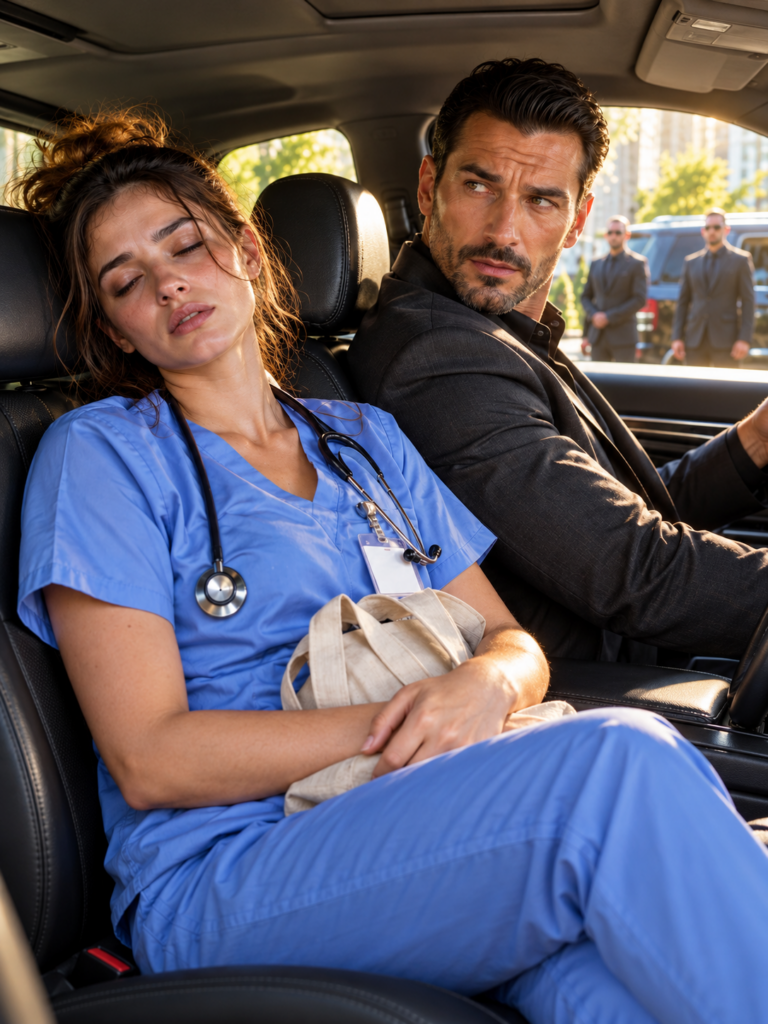
She Entered the Wrong Car on the Worst Night of Her Life and Told New York’s Most Feared Man to Take Her Home
Part 1
Isabella Bennett had not slept in twenty-six hours when she stepped out of Mercy General into the freezing October rain. The bus collision on the Brooklyn Bridge had turned her twelve-hour shift into nineteen. She had held a stranger’s hand while he died, charted the time of death eleven minutes later as if nothing had cracked open inside her, and then she had done it again with the next patient and the one after that. Her scrubs still smelled faintly of antiseptic and copper. Her phone sat at three percent. The rideshare app had given her one instruction before it died: black sedan arriving now.
She saw it at the far end of the ambulance bay, engine running, sleek and quiet where every other car idled in the chaos of headlights and shouted names. Security guards studied their shoes. Paramedics parked on the opposite side of the lot. Even the cab drivers circled the block rather than sit behind that car. Isabella was too tired to notice the pattern. She pulled the passenger door open, dropped into leather that smelled of cedar and rain, shut her eyes, and said the words she had been repeating in her head for the last hour.
“Just take me home, please. I’ve had the longest night of my life.”
Nothing happened. No cheerful greeting. No confirmation of her name. Only silence, the particular kind that makes the hair on the back of a neck stand up even when a person is too exhausted to care. She opened her eyes.
The man behind the wheel stared straight ahead. Dark suit, dark hair, a face carved so carefully it looked as if nothing had ever been allowed to move it. A watch worth more than her mother’s house sat on his wrist. Her tired brain offered its first theory: serious guy. Then the driver’s side window filled with a second man, broad, gray-jacketed, one hand inside his coat. A third stepped around the front of the car. A black SUV she had taken for a hospital van sat idling thirty feet back, its doors opening in unison.
“Sir,” said the man at the window, very quietly. “Do you want her removed, sir?”
Isabella’s gaze moved over the guard’s earpiece, the shape under his jacket, the way every one of them angled toward the man beside her like iron filings toward a magnet. Something in her chest went cold and her exhaustion burned off like fog. Not a rideshare, then. But she was an ER nurse. She had spent six years learning one skill above all others. When everything goes wrong, you do not panic. You assess.
So she assessed him. He had not touched the gun she suspected was under his seat. He had not raised his voice. But his right hand, resting on the steering wheel, was trembling. A fine, steady tremor. His breathing was shallow, controlled in the way people control it when they are trying very hard to appear fine. There was a gray tint beneath the olive of his skin.
“Mr. Romano.” Someone murmured behind the window, a small, careful, frightened way of saying a name.
Romano. She knew that name. Everybody in the five boroughs knew that name.
“Hold,” the man behind the wheel said. He had not looked away from the windshield. “She is not a threat.”
“Sir, she—”
“I said hold.”
The guard stepped back. Isabella swallowed.
“I got into the wrong car. Yes. I am so sorry. I’ll get out.”
“Miss.” His voice was low and unhurried, the voice of a man who had never needed to raise it. “People do not get into this car.”
“Well, I did.” She heard herself say it, blunt and tired. “Your hand’s shaking. When did you last eat?”
He turned his head for the first time. His eyes were a dark, steady gray. For one second they looked at her the way a man looks at a locked door he has just heard something move behind.
“Where do you live?” he said.
“Brooklyn. Fourth Street. Past the bakery.”
“Put on your seatbelt.”
She did. The car pulled out. In the side mirror, Isabella saw the SUV peel from the curb behind them, and at the far end of the bay, under a streetlight, a silver-haired man in a charcoal coat watching their taillights with a patient, thoughtful smile. She meant to stay awake. The city slid past the window, gold and wet and blurred, and the heater hummed, and somewhere on the Manhattan Bridge her head tipped against the glass. She slept like someone who had finally been allowed to.
Alessandro Romano did not wake her. When the car stopped on Fourth Street, the engine ticked in the quiet. The SUV pulled in at the corner and killed its lights. Rain began to fall, soft at first. Dante, his head of security, appeared at the window and opened his mouth. Alessandro lifted two fingers, and Dante closed it. He did not wake her. He did not leave. He simply stayed. For forty minutes the most dangerous man in New York sat in a parked car in the rain with the radio switched off and watched a stranger breathe. He could not have said why. He had not allowed anyone to sit in that seat for seven years.
When Isabella jerked awake, mortified, the dashboard clock said 3:12.
“Oh, no. Oh God, I’m sorry. You should have—”
“You needed it.”
She fumbled her bag open. He held out a folded envelope, thick and plain.
“For your trouble.”
She looked at it the way she would look at a dirty needle. “I don’t take money from strangers,” she said. “Thank you for the ride. Eat something, Mr. Romano.”
She was out and up the steps before he understood that no one had ever refused him anything and then told him to eat.
Three days later, Isabella was floated to the ICU to cover a short shift, and the patient in bed twelve was a man named Marco Ruiz, recovering from two gunshot wounds. At six o’clock visiting hours began. At 6:04 the door opened and Alessandro Romano walked in with Dante a step behind.
“One visitor at a time,” Isabella said without looking up from the IV pump. Dante started to speak. “He can wait,” she added mildly. “Hallway chairs are very comfortable.”
Silence. Then, to everyone’s astonishment, the Romano organization’s head of security stepped backward into the corridor. Alessandro stayed. He watched her work. He watched her adjust the line, check the monitor, speak to Marco in a low, warm voice as if he were a person rather than a problem. The room got quieter.
“You work here,” he said finally.
“I work everywhere. It’s a hospital.”
The ghost of something almost like humor touched his mouth. It was gone before she could be sure. The door opened again. A silver-haired man in a charcoal coat came in with a bouquet of white lilies and a kind, creased smile.
“Alessandro, forgive me. I couldn’t stay away.” He turned to Isabella and bowed his head. “Victor Hale, miss. An old friend of the family. These boys call me Uncle Victor.”
“Isabella.”
“Isabella,” he repeated warmly as though he were tasting it. He crossed to the bed and rested a hand on Marco’s shoulder. “I never left his side that night, you know. I rode in the ambulance and held his hand in the trauma bay until they took him up. I’d do it again.”
Isabella’s hands went still on the IV tubing. A very small thing. A tiny, almost nothing thing. She had been the triage nurse that night. She remembered Marco Ruiz arriving at 1:41 a.m. in the back of a private sedan, dumped at the curb, alone, bleeding through his shirt. There had been no ambulance. No one had held anyone’s hand. The trauma bay had been sealed to visitors until morning. She said nothing. She finished adjusting the line. She smiled at Victor Hale politely, the way you smile at someone whose chart you’ve just decided to read more carefully. But Alessandro, watching her from the foot of the bed, saw her hand stop, and he filed it away.
She found him on the sidewalk outside the hospital the next morning, standing beside the same black sedan, a paper cup in each hand.
“I don’t need a ride.”
“I did not come to drive you.”
“Then why are you here?”
He held out one cup. “I came to ask.”
It took her a moment. “Ask what?”
“If you would have coffee with me.” He said it with the stiffness of a man speaking a language he had studied but never used. “I do not do this.”
“Do what?”
“Ask.”
She took the cup. It was black, no sugar, exactly the way she drank it. She had mentioned it once to Marco in passing, thirty feet from Dante.
“You listen too well,” she said.
“Yes.”
They walked. He asked about her family, and she told him about her father’s heart, and the bills, and the promise. And he did not say I’m sorry, and he did not say I could fix that. He said, after a long block of silence, “That is the first rule anyone has told me that I respected.”
“Which?”
“That you owe nobody.”
“Everyone owes somebody, Mr. Romano.”
“Alessandro.”
She almost said it. Instead she looked at the rain beating on his coat, the cane-handle umbrella he did not need, the slight stillness of a man standing in the exact center of the sidewalk because no one would ever dare walk through it.
“I don’t know who you are,” she said. “I know what the news says. I don’t know you.”
“Neither do I,” he said, and seemed startled to have said it.
The first time she saw the man in the gray hoodie, he was across from her building. The second time, he was in the hospital cafeteria. By the third, Isabella had a small hard knot in her stomach. And when she walked out of her shift to find two of Alessandro’s men standing at the bottom of the hospital steps, the knot turned to anger.
“Who told you to be here?”
“Mr. Romano. For your safety, miss.”
She called him from the sidewalk, still in scrubs. “You put guards on me.”
“Someone has been following you. I needed—”
“You needed. You did not ask.” Her voice shook with something that had very little to do with fear. “I watched what money does to people, Alessandro. It decides things for them. It makes them smaller and calls it kindness. If you want to protect me, you ask me.”
Silence on the line. Long enough that she checked the screen. Then, very quietly, “Will you allow me to keep them there?”
She closed her eyes. “For one week,” she said. “And you tell me why.”
He told her. Not everything, but enough that someone inside his organization had been moving against him, and that her face had been seen beside his. That he had not wanted to frighten her. That he had been wrong to decide for her. It was the first time in seven years that he had apologized to anyone.
The black sedan was parked at the far corner of the staff lot when she came off shift on a Tuesday, and the lights were off. She almost walked past. Something made her stop. Alessandro sat in the passenger seat. Not the driver’s. The seat she had taken that first night. His head was bowed. In his hands, a small silver hair clip turned over and over in his fingers, like a prayer he had stopped believing in.
Isabella stood outside the glass for a full minute. Then she opened the driver’s door, sat down in the seat that should have been his, and said nothing at all.
“Seven years ago tonight,” Alessandro said at last, to the windshield, “my sister Julia sat where I am sitting. She was nineteen. She wanted a ride home from a party. Someone I trusted had arranged the car. The bomb was meant for me.” His voice did not change. That was the terrible part. “She died in this seat. I have driven the same model since that day, and I have never allowed another person to sit here. Not once. Not a guard. Not a woman. Not a friend.”
He turned his head. His eyes were dry, which somehow made it worse. “Until a nurse got in by mistake and told me to take her home.”
Isabella’s throat was tight. She knew that look. She had seen it on the faces of people in family rooms. The look of someone who has stopped feeling because feeling is too expensive. She did not say I’m so sorry. She did not touch his shoulder or tilt her head the way people did when they were performing sympathy. She reached into her bag and pulled out a bottle of water and a granola bar and set both on the console between them.
“You’ve been sitting in the cold for at least two hours,” she said. “Your lips are chapped and your hands are shaking again. Drink this. Eat that. Then, if you want to tell me about Julia, I’ll listen. If you don’t, we’ll sit here and I’ll complain about my shift.”
For a long moment, he only stared at her. Then he took the water.
“You’re the first person who didn’t tell me what I ought to feel,” he said, rough-voiced. “Everyone else looks at me like a grave or a gun. You looked at me like someone who had not eaten.”
“You hadn’t eaten.”
And Alessandro Romano, who had not laughed since the funeral, made a small cracked sound that could have been the beginning of one. They sat there until the rain stopped. She told him about the forty people who walked past her father. He told her what Julia’s laugh sounded like. When the first light came, neither of them had moved. And then, because she was Isabella, and because the thing she knew could not wait, she said, “I need to tell you something about Victor, and you’re going to hate it.”
He did hate it. She laid it out the way she would give a report to a doctor. Marco, 1:41 a.m., alone in the back of a private car. The sealed trauma bay. Victor Hale telling a story about a night that had not happened the way he said.
“You’re mistaken,” Alessandro said. His voice had gone flat. “I was triage. It was chaos. You were tired.”
“I’m tired now, and I still know the difference between an ambulance and a car at the curb. Victor stayed with me when Julia died.” The words came out like stones. “When my father died, when everyone else wanted my seat, he stayed. He is the only person who has stayed.”
Isabella heard what he was really saying. Please do not take this from me.
“Check the visitor log,” she said gently. “The hospital sign-in. Check the garage cameras, please.”
He did not answer. He left without another word. She sat in the empty car, hurt and furious at herself for being hurt.
Part 2
Victor Hale did not waste the opening. Within forty-eight hours, Isabella’s manager called her in. The hospital’s chief administrator, Dr. Raymond Pruitt, a soft-spoken man whose new sailboat everyone had quietly noticed, sat behind a desk with a folder in front of him.
“We have received a complaint,” Pruitt said. “Allegations of improper association with a known criminal figure. Photographs.” He slid them across the desk. Isabella in Alessandro’s sedan. Isabella and Alessandro on the sidewalk. “Until the investigation concludes, you are suspended without pay.”
Without pay. One thousand one hundred and forty dollars a month, and her mother’s name on the loan. She walked out with her badge in her hand, and her face perfectly steady, the way she walked out of every room where somebody died.
That night, a message arrived on Alessandro’s phone from an unknown number. A single photograph, Isabella in scrubs on a street corner speaking earnestly with a man in a gray coat. Your nurse has other friends, the message read. Ask her who he is. It was a detective, a real one. He had been canvassing the hospital about an unrelated overdose, and Isabella had given him directions to the elevator. But the photograph had been cropped and angled and sent at precisely the moment Alessandro’s trust was thinnest. Victor’s whisper reached him an hour later, sweet and sorrowful. I hate to say it, but who do we really know about her? A girl with debts, a girl the police might have found useful.
Alessandro called her at midnight. “Who is the man in the gray coat?”
The silence on the line was a cold thing.
“You asked me to trust you,” Isabella said finally, very evenly. “I told you something that hurt you, and you answered it with a surveillance photo.” She paused. “I’m not your enemy, Alessandro, but I will not be interrogated like one.”
She hung up. He sat in the dark, in the driver’s seat this time, and looked at the empty one beside him for a long time. Then he called Dante. “Pull the hospital’s visitor sign-in for the night Marco was shot and the garage footage. Quietly. Tell no one, not even Victor.”
At dawn, Dante returned with a printout and a face like stone. “Victor Hale signed in at 7:52 a.m., five hours after Marco arrived. And sir, there’s something else. The car that dropped Marco at the curb, it’s registered to one of Victor’s holding companies.”
Alessandro read it three times. The only person who has stayed, the thing he had built the last seven years of his life around. He did not shout. He did not break anything. He put the paper down carefully, like a man setting down a child, and understood two things at once. Victor had betrayed him, and Isabella had been right, and he had cost her her job, her pay, and her trust before he believed her.
But he was not ready to act, not yet. Victor had friends in the rooms that mattered. The families who had sworn loyalty to the Romano name still listened to Victor, because Victor had spent years making sure they would. If Alessandro moved on him privately, it would look like paranoia. It would look like a boss destroying his oldest friend over the word of an outsider. The test was still coming. He knew it, and he was not sure yet that he could pass it.
The Romano Foundation’s annual benefit was held at the Heartwell Hotel in a ballroom of gold and white marble under three crystal chandeliers that cost more than Isabella’s apartment building. Four hundred guests: judges, councilmen, hospital trustees, the heads of five families who had come to see which way the wind was blowing. Isabella came alone. She had refused his driver. She wore a dark green dress she had bought herself two years ago, and her own coat, and she walked in through the front doors with her head up and her hair loose around her shoulders.
Victor was waiting by the champagne tower. “Ms. Bennett,” soft, courteous, “I’m so sorry about your hospital troubles. I’m sure you are. Come, let me introduce you to some people.”
He did not wait for an answer. He took the microphone from a startled MC, tapped it twice, and the whole room turned.
“Friends, forgive the interruption. I have carried a heavy burden for weeks, and I cannot carry it silently any longer.” He gestured toward Isabella with great tragic gentleness. “This young woman has been in our Alessandro’s company for the past month. She has accepted his money, his protection, his trust, and last week she was photographed meeting privately with a member of the New York Police Department.”
A gasp ran through the marble hall like wind through a field. “I do not accuse lightly, but Alessandro is blind to this. I am only his oldest friend, and I could not bear to see him destroyed.”
Four hundred pairs of eyes turned toward Isabella. She had been here before, in a way, in a hallway at four in the morning with a family looking at her for answers. You do not panic. You assess. She stepped forward. The crowd parted.
“I’d like to answer that,” she said clearly, “if I may.”
Victor spread his hands generously. “Of course.”
“The man in the photograph is a detective canvassing my hospital about an overdose. I gave him directions to the elevator. That is the full extent of our relationship.” She did not raise her voice. “I have never taken a dollar from Mr. Romano. You can ask my manager. Ask my landlord. Ask the lender who collects one thousand one hundred and forty dollars from me every month.”
A murmur. Victor smiled sadly.
“And I’d like to ask a question of my own,” she said. “Mr. Hale, on the night Marco Ruiz was shot, you told this family you held his hand in the trauma bay. I was the triage nurse on duty. Marco came in alone at 1:41 in the morning in the back of a private car. You signed in at the hospital at 7:52 a.m.”
The smile on Victor’s face did not fall. It froze. “This is absurd.”
“Is it?” said a voice from the back of the room. Alessandro had not moved from the door. Now he walked forward through the crowd, slowly, the cane tapping marble, and every person in that ballroom who had spent years learning to look away from him found they could not look anywhere else. He stopped at Isabella’s side. “Dante.”
Dante stepped out of the crowd with a tablet, and on the great screen behind the stage the Heartwell’s own display the hospital visitor log appeared. V Hale 0752. Beside it a vehicle registration. Hale Meridian Holdings. And then, because Marco Ruiz had woken up two days earlier and asked for his nurse and had told Dante everything, a video began to play. A hospital bed, a thin shaken man, and the words: “Victor’s driver shot me. Victor told me he’d handle the rest.”
Silence. Not the silence of surprise. The silence of a room understanding which man it should be afraid of.
“Alessandro,” Victor said quite softly. “Thirty years.”
“You would throw away thirty years for a girl who never took an order from me in her life,” Alessandro’s voice carried without effort. He turned to the room, to the five heads of five families, to the judges and the councilmen, to every person whose opinion had once governed his every decision. “I spent seven years believing that if I controlled every room I entered nothing could hurt me. I decided for people. I protected them by making them small. I called it love and it was fear.” He looked at Isabella. “She taught me the difference. She told me the truth when it cost her and she never once asked me to be anything but honest. Tonight I am choosing her in front of every one of you. If that costs me this room then it costs me this room.” He took a breath. “I cannot promise you the world will never lie to me again. I can promise I will keep turning toward the truth with her for as long as she lets me.”
The doors at the far end opened. Men in dark suits moved through the crowd. Not Alessandro’s men, the ones who had been Victor’s. They stopped one by one and stepped to the side. Victor Hale looked around the ballroom. Nobody was looking away from him now.
Later, on the terrace of the Heartwell, high above a city that had gone quiet, Isabella stood at the railing with her coat around her shoulders. Alessandro came out and stopped a respectful distance away.
“I owe you more than an apology,” he said. “You asked me to trust you and then didn’t trust me back. That’s the whole offense.”
“Yes.”
“I won’t be kept, Alessandro.” She turned. “Not protected into a smaller life, not decided for. If this is anything, it has to be a thing where I walk in the front door and walk out the same way.”
“I will not keep you.” He stepped closer, slowly, as one might approach a nervous bird. “I will ask every time, and if the answer is no, I will accept it, and I will still be here.”
She searched his face. No command in it, no fear, just a man holding something steady in both hands.
“You saw me,” he said quietly. “Not the name, not the car. Me.”
“You were shaking,” Isabella said. “Somebody had to notice.”
She did not say what she was thinking, which was this: All her life, she had believed that home was a place you earned by owing nothing to anyone. She had it backwards. Home isn’t where someone takes you. It’s where you stop bracing.
She reached out and took his hand. It was steady.
Part 3
Four months later, on a Thursday evening in February, Isabella’s key turned in the lock of her small Brooklyn apartment, and the first thing she smelled was burning garlic.
“I can explain,” Alessandro called from the kitchen. He stood at her stove in his shirtsleeves, tie gone, a dish towel over his shoulder, glaring at a pan like it had insulted his family. The smoke detector chirped overhead. Dante, on the couch with a book he was pretending not to read, sipped his tea and said nothing with great dignity.
“You asked before you moved my spice rack,” she noted, setting down her bag.
“I asked.”
“I said yes. I noticed.”
The kitchen table was covered in paper cartons. He had given up on the pasta and ordered Thai. Her reinstated hospital badge lay on the counter beside a stack of mail. She paid her own rent. She paid her own loan. Pruitt was gone and the sailboat was somebody else’s problem now. And Victor Hale was somewhere that did not allow lilies.
Outside, the black sedan sat at the curb. The passenger seat held her travel mug, her spare hair ties, and a fraying paperback she had been reading in the red-light stops. It looked like a seat that belonged to someone.
She slid into her chair and rubbed her eyes. “Longest shift of my life.”
“You say that every week.”
“It’s true, every week.”
He set a carton in front of her. Then, after a hesitation she recognized, he said, “Would you like me to take you somewhere after, or would you like to stay?”
Isabella smiled, tired and warm and entirely unafraid. “Stay,” she said. “Just stay.”

