
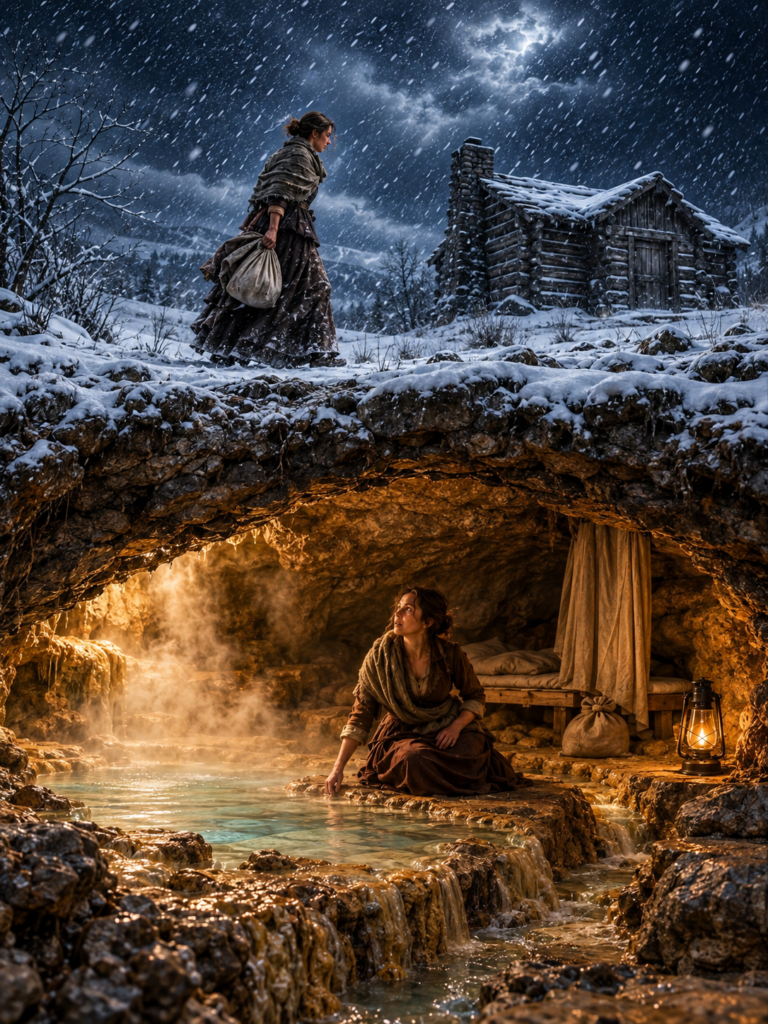
after her landlord threw her into an october storm, the widow found warmth inside a mountain—and the whole town came begging when winter turned deadly
Part 1
October had not even ended when Mara Vance lost her roof.
The morning began with rain needling sideways through Bitterroot Valley, Montana Territory, the kind of cold rain that found the gap between a woman’s collar and neck no matter how tightly she fastened her coat. By noon, a thin crust of white had formed along the shaded wagon ruts. The cottonwoods beside the road stood mostly bare, their remaining yellow leaves trembling against a dark sky.
Mara’s landlord carried her belongings outside one armload at a time.
Two wool blankets.
A dented kettle.
A sack of oats.
Her sewing basket.
A canvas bundle containing two dresses, three shirts, underclothes, a Bible that had belonged to her mother, and Elias’s old work coat.
That was nearly everything.
Hale Mercer set the last bundle beside the road and straightened.
He was not a cruel man.
Mara sometimes wished he had been.
Cruelty would have given her something clean to hate.
Hale was practical instead.
He owned three rental cabins along the edge of Bitterroot and had spent two months allowing Mara to fall behind. He had a wife, two boys, taxes, feed bills, and his own winter supply to protect.
“I gave you September,” he said.
Mara stood with her hands inside her sleeves.
“I know.”
“And October.”
“I know.”
“I can’t carry the rent through winter.”
“I said I know.”
Hale looked uncomfortable.
He disliked being angry when the person in front of him refused to argue.
“I’ve got another family wanting the place.”
Mara glanced toward the cabin.
For eight months after Elias died, she had woken expecting to hear his boots on those floorboards.
For another year, she had stopped expecting it but still found herself listening.
Two winters had passed since the logging accident.
A snapped cable.
A rolling trunk.
Four men unable to lift it soon enough.
The foreman brought Elias home wrapped in a canvas tarp because the coffin from town did not arrive until the following afternoon.
Mara had been thirty-seven then.
She was thirty-nine now and understood that widowhood was not one event.
It was a thousand small removals.
First Elias.
Then his wages.
Then the horse.
Then the better cookware.
Then the silver brooch her mother had given her.
Then the spare quilts.
Now the cabin.
Hale pushed his hands into his coat pockets.
“You have family east?”
“A sister.”
“Then go.”
“Train costs money.”
He looked at the canvas bundle.
“How much do you have?”
Mara did not answer.
That told him enough.
Hale lowered his voice.
“Mara, I’m telling you this because I don’t want to hear in January that somebody found you frozen under a wagon. Nobody gets through a Bitterroot winter without a roof and a woodpile.”
Mara looked past him.
Behind Hale’s shed, neatly stacked beneath a lean-to, stood row after row of split lodgepole pine.
Dry.
Covered.
Ready.
“How much for one cord?”
Hale named the price.
Mara almost laughed.
Instead she reached into her pocket and closed her fingers around the coins there.
Eleven dollars and forty cents.
That was what remained after paying the grocer the previous week.
Enough for food if she was careful.
Enough for winter fuel if she stopped eating.
Not enough for both.
Hale saw her face.
“You’ll be back before November.”
Mara looked at him.
“Maybe.”
He unlocked the cabin door long enough to inspect the empty room, then came out and turned the key.
The click of the lock was quieter than Mara expected.
That hurt more.
She waited until Hale went around the side of the building.
Then she sat on the upturned kettle and stared at her possessions.
Rain dotted the blanket.
She unfolded Elias’s coat and put it on over her own.
It still smelled faintly of pine pitch when damp.
For a moment she could see him standing beside the logging road, grinning beneath a beard full of snow.
You solve the first problem first, Mare.
Elias had said that constantly.
A wagon axle breaks, you don’t worry about reaching town until you’ve got the wheel standing.
A steer goes through a fence, you don’t complain about the fence until the animal is caught.
Winter starts early, you don’t waste daylight wishing it hadn’t.
Mara wiped rain from her cheek.
“All right,” she whispered.
She tied the blankets around the food sack.
Slipped the kettle handle through the rope.
Hooked the sewing basket over one arm.
Then she began walking toward the foothills.
Her first plan was painfully simple.
Find wood.
Make fire.
Stay alive.
She had seen trappers survive in rough shelters.
Elias had slept outdoors during logging drives.
The forest was full of fuel.
Men in town paid for cut wood because they wanted convenience.
Mara did not need convenience.
She needed heat.
By midafternoon she reached the lower timber.
Freezing rain clicked against branches.
She dropped her belongings beneath an overhang of granite and immediately began gathering deadfall.
Branches lay everywhere.
At first, she felt almost encouraged.
She dragged them into a growing pile.
One branch.
Then three.
Then an armful.
She worked until her gloves soaked through.
When the gloves became useless, she removed them.
Wet bark tore her palms.
She ignored it.
She found larger limbs and dragged them downhill.
By dusk she had what looked like enough fuel for a respectable fire.
That was when she finally noticed what she did not have.
Shelter.
The wind had strengthened.
The granite overhang protected only a strip of ground hardly wide enough to sit on.
Rain had turned to sleet.
Her blanket bundle was already damp.
So was the wood.
Mara stared at the pile she had spent the entire afternoon building.
Elias’s voice came back.
The first problem first.
She had solved the wrong problem.
Darkness arrived quickly in the timber.
Mara worked by touch.
She leaned branches against the granite face.
Crossed smaller limbs over them.
Threw one blanket across the crude frame.
The shelter sagged immediately.
She crawled under anyway.
Her fingers were shaking so violently she had trouble opening her matchbox.
She had bought it in town three weeks earlier.
Twenty matches.
She struck the first.
The flame jumped.
She protected it with both hands and touched it to the dry kindling she had carried in her sewing basket.
The kindling caught.
Mara smiled.
Then she fed in a piece of bark.
Smoke rolled beneath the blanket.
The bark hissed.
The flame died.
She struck another match.
Then another.
By the sixth she was whispering.
“Come on.”
The seventh burned her thumb.
The eighth caught a handful of splinters but failed to take the larger wood.
The ninth produced a flame that lasted almost two minutes.
Mara crouched over it, feeding twigs one at a time.
Then melting sleet fell from the edge of the blanket.
A drop struck the heart of the flame.
It flickered.
Smoked.
Went black.
Mara stared.
Nine matches.
Half her dry kindling.
Nothing.
The shelter creaked in the wind.
She crawled beneath the blanket and drew her knees against her chest.
By midnight, water had soaked the hem of her skirt.
By two, she could no longer feel three toes on her left foot.
Before dawn she woke from a shallow sleep and discovered ice inside her kettle.
She stared at it.
That frightened her more than anything had since Elias died.
Not because the ice was surprising.
Because it was proof.
She had believed hard work could solve the cold.
She had worked until her hands bled.
The cold had not cared.
Mara pushed herself upright.
The movement caused pain along her back.
For several minutes she simply sat beneath the sagging blanket.
Then Elias’s voice returned, not as comfort this time, but accusation.
Mountain cold doesn’t kill only fools.
He had told her that once after a young logger died trying to walk twelve miles through a storm.
It kills people who spend their strength on the wrong thing.
Mara looked at her pile of wet branches.
She suddenly understood.
Even if she found enough dry wood today, what about tomorrow?
What if snow buried the deadfall?
What if she sprained an ankle?
What if fever kept her in bed?
What if she became too weak to drag fuel?
Fire was not a solution.
It was a chore she would have to survive long enough to repeat every day until April.
Mara opened the matchbox.
Eleven remained.
She closed it.
Then she packed.
Shelter first.
Fuel second.
Fire last.
That was the new order.
By sunrise Mara was walking again.
She had no destination.
Only a rule.
Find a place that protected her before spending another ounce of strength gathering anything to burn.
It was midmorning when she noticed the ground.
A narrow strip beneath a black outcropping held no frost.
Mara stopped.
Everywhere else, grass glittered white.
Here, the earth looked dark.
Wet.
Soft.
She crouched and pressed her fingers into the soil.
Damp.
Not warm exactly.
But not frozen.
Then she noticed elk tracks.
Several sets.
Fresh.
They crossed the frostless strip and disappeared uphill among boulders.
Mara stood slowly.
A faint mineral smell hung in the air.
She looked toward the black rock.
For the first time since Hale had locked the cabin door, curiosity pushed fear aside.
Something in this hillside was different.
She did not yet understand what.
But she had learned one useful lesson in the freezing dark.
When the mountain told you something, you paid attention.
Part 2
Mara spent two days studying the strange strip of ground.
On the first morning she used a spoon from her sewing basket to dig three inches into the soil.
It remained soft beneath the frozen surface.
Farther north, the spoon struck earth hard as fired clay.
Farther south, the same.
Only the narrow line beneath the dark rock stayed damp.
She walked uphill.
Moss remained green beneath brush.
Not bright summer green.
But alive.
She found another set of elk tracks.
Then rabbit droppings.
Small signs.
The kind a comfortable person ignored.
Mara was no longer comfortable enough to ignore anything.
She followed the tracks toward a shallow ravine and found water moving beneath ice.
She knelt.
Touched it.
Nearly freezing.
That confused her.
If warm water ran beneath the hill, why was the stream cold?
She tasted none of it.
Elias had taught her better than to trust strange mineral water just because animals drank nearby.
She followed the ravine anyway.
By late afternoon, snow began.
Mara had learned from the first night.
She stopped searching while enough daylight remained to work.
Shelter first.
She found a depression protected by two boulders and built a lean-to stronger than the first.
Branches formed the frame.
Brush packed the sides.
One blanket went over the windward wall.
The other remained dry inside.
Only after the shelter stood did she collect fuel.
The fire burned for two hours.
That felt like victory.
Then snow thickened.
Wet branches began smoking.
One wall of the lean-to sagged.
Near dawn it collapsed.
Mara woke with snow across her legs.
Her right hand had swollen from dragging wood.
She sat beside dead coals and almost cried.
Not because she was weak.
Because she was angry at the arithmetic.
Hours of labor.
Two hours of heat.
Then nothing.
She held her swollen hand against her chest.
“If this is the plan,” she said aloud, “I’m dead.”
The mountain gave no answer.
On the third afternoon, she returned to the dark rock.
A rabbit moved through brush uphill.
Mara followed mostly because she had nothing better.
It disappeared behind a choke of willow and deadfall.
She pushed branches aside.
Then stopped.
A crack split the rock.
Barely wide enough for her shoulders.
Mara crouched.
She placed one hand near the opening.
Warm air touched her skin.
She jerked back.
Waited.
Reached again.
There.
Not hot.
Not strong.
But warmer than the air behind her.
The crack seemed to breathe.
A faint draft moved outward.
Stopped.
Then returned.
Mara pushed more brush aside.
Darkness continued beyond the opening.
She felt her pulse quicken.
For three days she had been looking for a warm place above ground.
What if the warmth was inside the hill?
It was too late to investigate safely.
Mara planted three long branches upright beside the opening.
Then she returned to her shelter.
That night she barely slept.
Wind moved through the timber.
The fire weakened.
Snow tapped the blanket.
But Mara thought only about warm air flowing from stone.
At first light she packed a kettle, rope, lamp, and knife.
The three upright branches stood above the new snow.
Mara cleared brush from the crack.
Loose stones came next.
She worked carefully.
The opening widened.
Finally she could crawl through.
Darkness swallowed her.
Mara stopped after several feet.
Behind her, daylight narrowed to a gray slit.
Ahead, the passage widened.
She raised the lamp.
Rock walls appeared.
Steam shimmered faintly.
Mara crawled farther.
Then the passage opened.
She stood.
The chamber was larger than expected, perhaps the size of Hale’s rented cabin, though irregular and low in places.
Water glimmered ahead.
Mara lifted the lamp higher.
A small basin sat beneath a fracture in the stone.
Clear water entered from one side and escaped through a lower channel.
She crouched.
Held her hand above it.
Warm.
Not boiling.
Not enough to cook.
But unquestionably warm.
Steam gathered beneath the rock ceiling.
Mara laughed.
The sound echoed.
She laughed harder.
Then cried.
Not gracefully.
Not quietly.
She sat on a stone and covered her face.
For days she had been fighting winter with wet sticks.
All the while, heat had been moving through the mountain.
She stayed there nearly an hour.
Then she carried in her belongings.
By sunset she believed the problem was solved.
That belief lasted until morning.
Mara spread both blankets near the warmest wall beside the basin.
The cave felt almost luxurious compared with her lean-to.
No wind.
No falling snow.
Warmth beneath the rock.
She removed her boots.
Ate oats.
Slept.
Then woke soaked.
Water dripped from the ceiling.
Her hair was wet.
Her blanket had absorbed condensation until it felt as heavy as canvas.
The floor beneath her was slick.
Mara sat up.
Warmth without dryness.
Another trap.
She moved closer to the entrance the following night.
Too cold.
Wind reached inward.
She tried a higher ledge near the spring.
Too damp.
Condensation still formed.
So she began testing.
Not guessing.
Testing.
She hung strips of cloth in different places.
One near the basin.
One at the entrance.
One on a narrow shelf midway between.
By evening, the first cloth was warm and damp.
The second cold and dry.
The third warm enough to dry.
Mara stared at it.
The cave had zones.
Near the spring: warm, wet.
Near the entrance: dry, cold.
Between: moving warm air.
That changed everything.
Mara raised a sleeping platform above the stone floor.
Flat rocks supported branches laid side by side.
She spread her driest blanket across them.
The bed was hard.
It was also off the wet ground.
At the entrance she stacked loose stones along the bottom, not enough to seal it, only enough to redirect the worst cold draft downward.
She left space above.
Warm damp air needed to escape.
Food became another problem.
At first Mara stored flour on the middle shelf.
One morning she lifted the sack and smelled sourness.
Condensation had dampened the bottom.
She cut away the ruined portion.
Watched flour spill uselessly onto stone.
Her stomach tightened.
Every handful represented money she did not have.
She moved dry goods higher.
Anything needing cold went outside into a shallow pit where the ground remained frozen.
Every mistake became a rule.
Do not sleep beside the water.
Do not store flour low.
Do not block the upper entrance.
Keep bedding raised.
Keep lamp oil dry.
Keep emergency supplies above the floor.
Within a week the cave no longer looked like a hole.
It looked inhabited.
A hook made from bent wire held her kettle.
Cord stretched between two rock projections for drying clothes.
A wooden crate from an abandoned mining camp became a shelf.
Her sewing basket sat inside the driest corner.
Elias’s coat hung where moving air passed.
Mara made a mark on the wall beside the spring.
The water level had risen slightly after heavy rain.
By morning, it dropped.
She scratched another line above the first.
She did not know yet why.
But she had learned not to ignore changes merely because she did not understand them.
Outside, snow deepened.
Her original three branch markers disappeared almost completely.
Mara replaced them with taller poles.
Then added more along the route downhill.
At first the poles existed only for her.
If a storm erased every track, she needed a path home.
Home.
The word surprised her.
A cave could not be home.
Could it?
The first serious storm answered another question.
Snow drove against the hillside throughout the night.
Mara slept on the raised bed.
Near midnight she woke with a pounding headache.
The air felt wrong.
Heavy.
She sat up.
For several seconds she almost closed the entrance tighter.
The instinct was obvious.
Cold outside.
Warm inside.
Seal the gap.
Then she remembered the cloth experiment.
Movement mattered.
She lit the lamp and crawled toward the entrance.
Snow had packed against the upper gap.
Mara used a board to push through it.
Cold air struck her face.
Fresh air flowed inward near the bottom.
Warm damp air moved outward above.
Within minutes the pressure in her head eased.
Mara sat beside the opening.
“Never seal it,” she said.
Another rule.
When the storm passed, she stood outside.
Smoke rose from Bitterroot Valley.
Chimney after chimney.
Every family down there was creating heat.
Cutting it.
Splitting it.
Carrying it.
Burning it.
Mara turned toward the cave.
She had burned nothing.
For the first time, she understood the true value of what she had found.
She was not making heat.
She was living where heat already existed.
November passed.
Mara went to town once.
The trip exhausted her.
She bought salt, lamp oil, flour, needles, and heavy thread.
At the general store, two men recognized her.
“Thought you’d left the valley,” one said.
“No.”
“Where you staying?”
“Foothills.”
“What are you burning?”
“Nothing.”
He laughed.
“Nothing?”
“No firewood.”
The second man grinned.
“Then you won’t be staying long.”
Mara put coins on the counter.
Hale Mercer stood near the flour barrel.
He did not laugh.
His eyes moved from Mara’s boots to her coat.
Dry.
Clean enough.
Her hands steady.
“You still don’t have a stove?” he asked.
“No stove.”
“Then where are you sleeping?”
Mara picked up her bag.
“Somewhere that doesn’t charge rent.”
The storekeeper coughed into his fist to hide a smile.
Hale frowned.
“Mara.”
She turned.
“If you need the cabin for a night—”
“You rented it.”
“Yes.”
“Then somebody needs it.”
She left.
Outside, snow had begun falling.
On the return journey her right boot split along the side seam.
Cold entered immediately.
Mara swore.
Inside the cave, she set to work.
Heavy thread.
Leather from her sewing basket.
Needle pushed through with pliers.
The repair looked ugly.
It held.
Her life became a sequence.
Check vent.
Check waterline.
Check food.
Check bedding.
Check boots.
Check strength.
The last mattered more than anything.
She stopped doing work merely because it seemed useful.
Every chore had a cost.
If hauling something took more energy than it saved, she did not haul it.
If walking to town left her weak for two days, she stayed away.
If a repair could be done before it became urgent, she did it immediately.
Elias had spent years teaching her practical things without realizing she would one day use them alone.
Sometimes that thought hurt.
Sometimes it felt like company.
One evening, she sat beside the warm basin holding his old coat.
“I wish you’d seen this,” she said.
Water moved quietly through stone.
“I would’ve told you I found it.”
She smiled faintly.
“You would’ve told everybody you did.”
For the first time in months, laughing at Elias did not end in tears.
Christmas approached.
Then warm wind came over the mountains after three days of heavy snow.
Mara heard dripping outside.
By evening, the spring reached the second line scratched into the rock.
She stared at it.
Then it passed the line.
Water spread across the cave floor.
At first slowly.
Then faster.
A thin sheet reached the stones supporting her bed.
Mara stood frozen.
The thing that had saved her from cold was now filling her shelter.
The mountain had changed the rules.
Part 3
Mara moved before fear could make the decision for her.
Blankets first.
Then flour.
Lamp oil.
Sewing basket.
Elias’s coat.
Everything went onto the upper shelf.
Water covered her original sleeping place.
Another inch.
Then two.
Mara looked toward the spring outlet.
The natural channel was not clearing water quickly enough.
Snowmelt, rain, and groundwater were feeding the basin faster than it could drain.
She took the small shovel she had traded for in November and began digging.
The first trench ran toward the existing outlet.
Cold mud filled her boots.
She lined the edges with stones.
Water entered.
The side collapsed.
Mara swore and started again.
She widened the trench.
Used larger flat stones.
Another section failed.
She rebuilt it.
Hours passed.
The warm cave became miserable.
Cold air entered through the vent.
Her skirt soaked to the knee.
Her hands cramped.
Several times she had to stop because her back locked.
Near midnight she sat on the upper shelf with her feet in water.
The spring continued rising.
For one terrible minute, Mara imagined losing everything.
The blankets.
The flour.
The lamp.
The dry shelf.
Then what?
Back outside.
Back to wet branches.
Back to the first night.
She covered her face.
“I’m tired, Elias.”
There was no answer.
Of course there was no answer.
The dead did not come because you needed them.
They only left their voices inside you.
Solve the first problem first.
Mara lowered her hands.
Drainage.
Not fear.
She climbed down.
This time she studied the water itself.
Watched where it pressed against the failed channel.
She had been trying to force it straight.
Water wanted the lower route.
She changed the trench.
Curved it along a natural depression.
Lined the weak side with larger stone.
Dug a wider outlet.
When water began moving, she did not celebrate.
She watched.
Ten minutes.
Twenty.
An hour.
The basin stopped climbing.
Near dawn it fell by half an inch.
Mara sat on the upper platform.
Her hands shook.
She looked at the lower floor.
The place where she had once slept lay underwater.
If she had never marked the spring level, she might have ignored the warning.
If she had never built the second platform, she would have been lifting wet blankets through rising water in darkness.
The cave was not a miracle.
That realization settled over her with unusual clarity.
It was not safe because it was warm.
It was useful because she was learning how it behaved.
And behavior could change.
After the flood receded, Mara rebuilt the drainage channel wider.
She moved all emergency stores permanently above the high-water mark.
She constructed a second sleeping platform.
Not because she needed two beds.
Because survival plans that depended on one perfect condition were not plans at all.
Her marker poles outside became taller.
Her food pit deeper.
Her boot repair stronger.
By late December, Mara felt something she had not allowed herself to feel since eviction.
Confidence.
That frightened her.
Confidence made people careless.
She remembered Hale saying nobody survived without a roof and woodpile.
For weeks part of her had imagined returning in spring just to see his face.
That desire began fading.
She had come too close to failure herself.
She had wasted nine matches.
Built the wrong shelter.
Stored flour in the wrong place.
Slept beside condensation.
Nearly blocked her own ventilation.
Almost lost supplies to flooding.
If she survived, it would not be because Hale was foolish.
It would be because she had been fortunate enough to make mistakes early.
Then winter changed again.
The temperature dropped rapidly.
For four nights, timber cracked in the valley.
Trees split with sharp reports that echoed across the frozen hills.
Mara stayed close to the cave.
On the fifth afternoon she heard something unusual.
A voice.
“Hello!”
Mara sat upright.
The sound came again.
“Anybody here?”
She crawled toward the entrance.
A teenage boy stood among her marker poles.
He was breathing hard.
One arm supported a man.
Hale Mercer.
Mara stared.
Hale’s face was gray with pain.
His right leg dragged behind him.
The boy looked terrified.
“Mrs. Vance?”
Mara recognized him as Daniel Cutter, sixteen, whose father kept horses south of town.
“What happened?”
“Sled broke. We were hauling wood. Mr. Mercer got twisted under the runner.”
Hale gritted his teeth.
“Knee.”
Daniel pointed toward the marker poles.
“Saw these. Thought they had to lead somewhere.”
Mara looked downhill.
Wind was already lifting loose snow.
“Inside.”
Hale glanced at the narrow entrance.
“Inside what?”
“Move.”
Daniel helped him through.
Mara followed.
The reaction was almost worth the trouble.
Hale stood inside the chamber staring.
No stove.
No chimney.
No woodpile.
Warm water moved through rock.
Blankets lay dry on an elevated platform.
Clothes hung above the middle shelf.
A drainage channel crossed the lower floor.
Hale turned slowly.
“You’ve been living here?”
“Yes.”
“All winter?”
“So far.”
“How?”
Mara looked around.
“Not one thing.”
She pointed to the entrance.
“That stays open.”
Then the raised bed.
“I sleep there.”
The upper shelf.
“Food stays dry there.”
The drainage trench.
“Spring rises after warm weather.”
The outer direction.
“Cold storage outside.”
Daniel held his hands near the basin.
“Feels like bath water.”
“Warmer than you need. Don’t sleep beside it.”
Hale lowered himself onto the platform.
His expression tightened.
Mara examined the knee.
Swollen.
Possibly sprained.
Probably not broken.
She wrapped it.
Daniel’s gloves were soaked.
Mara hung them high where the warm moving air could dry them.
That night, wind lowered the temperature again.
Hale slept without feeding a stove.
Near morning he woke.
For several minutes he remained still.
Mara sat near the lamp sewing another reinforcement into her boot.
Hale looked toward the dark entrance.
“No fire?”
“No.”
“Not even before bed?”
“No.”
He studied the cave again.
“It’s clever.”
Mara kept sewing.
Hale rubbed his beard.
“But one easy night doesn’t prove much.”
Mara looked up.
The old urge rose.
The temptation to remind him of October.
Of the road.
Of the locked door.
Of his prediction.
She let it pass.
“Then we wait.”
Hale said nothing.
Before leaving the next afternoon, he noticed the matchbox beside Mara’s lamp.
He picked it up.
“Still carrying these?”
“Yes.”
He shook it once.
“Don’t use many.”
“No.”
Daniel helped him outside.
Mara watched them follow the marker poles downhill.
January arrived harder.
Wood shortages spread through Bitterroot.
Families who had calculated carefully found themselves burning reserves too quickly.
The cold lasted longer than expected.
Snow covered deadfall.
Some households began splitting old fence rails.
Others burned green wood that hissed inside stoves and coated chimneys with soot.
Mara heard the news during one brief trip to town.
Nobody laughed when she said she was still in the foothills.
That almost made her more uneasy.
At the store, Ruth Cutter stopped her.
“Daniel told us.”
Mara waited.
“The cave.”
Mara nodded.
“He says it’s warm.”
“Warm enough.”
“Safe?”
Mara considered.
“No.”
Ruth blinked.
Mara continued.
“Useful if you know the rules.”
“What rules?”
“Never seal the vent. Don’t sleep beside spring. Food stays high. Watch water level. Keep drainage clear. Don’t count on anything staying the same.”
Ruth stared at her.
“That sounds like a lot.”
“It is.”
“Still sounds better than chopping wood at thirty below.”
Mara bought salt.
“No place is easy in winter.”
Then came the warning.
Ranchers riding from the north reported a mass of brutal cold moving south.
Older men in Bitterroot remembered winters like it.
Not many.
The storekeeper said twelve years had passed since temperatures fell that hard.
Families prepared.
Stoves were checked.
Wood counted.
Drafts stuffed.
Animals brought closer.
Mara returned to the cave and inspected everything.
Vent.
Drainage.
Shelves.
Marker poles.
Spare bedding.
Food.
Water.
She did not feel heroic.
She felt worried.
The first night of the deep freeze passed.
Then the second.
On the third afternoon, Mara heard voices outside.
Many voices.
She went to the entrance.
Hale Mercer stood among the marker poles.
His knee had improved, though he still walked with a stick.
Behind him came six people.
A man.
Two women.
Two children.
An older woman wrapped in blankets.
Another figure appeared farther down the trail.
Then another.
Mara stared.
Hale removed his hat.
“We need help.”
In October he had stood beside Mara’s belongings and told her she would return.
Now he stood outside her shelter asking to enter.
Mara could have made him say more.
Could have asked whether the cabin rent was paid.
Could have reminded him exactly what he said about roofs and woodpiles.
Instead she looked at the children.
One boy’s lips were blue.
The old woman shook beneath three layers of clothing.
Mara stepped aside.
“Come in.”
Part 4
Nine people crowded into the cave by dark.
Mara had never tested it with nine.
That became the first problem.
Bodies created moisture.
Wet coats created more.
Snow melted from boots and ran across the floor.
Breath fogged the chamber.
The middle shelf that had dried one shirt perfectly now carried gloves, socks, shawls, children’s trousers, and two coats.
The drainage trench began carrying muddy meltwater.
The vent narrowed as blowing snow packed outside.
Mara felt the old panic return.
The same fear she had known beneath the collapsed blanket in October.
For one moment she saw only problems.
Then she forced herself to stop.
One at a time.
The oldest woman was Ruth Cutter’s mother, Ada Bell, sixty-eight and small enough that Hale carried her the final fifty yards.
Their stove had cracked.
Not merely a seam.
The cast-iron body itself had split after weeks of being pushed too hard.
Another family had nearly exhausted its dry wood.
Hale had remembered Mara’s cave.
And her marker poles.
Now the people who had once believed her dead or foolish had followed those poles uphill.
Mara pointed toward the sleeping platform.
“Children and Mrs. Bell there.”
A man named Silas Crowe looked around.
“What about the rest?”
“Floor only where it’s dry.”
“Can we make a fire?”
“No.”
He frowned.
“Nine people and no fire?”
“No heating fire.”
“Mara—”
“No.”
Something in her voice stopped him.
She pointed at the ceiling.
“Too much smoke risk. Air already has to move. You block the vent or foul the chamber, warmth won’t save us.”
Hale nodded.
“Do what she says.”
Silas looked surprised.
Hale met his gaze.
“I’ve been here before.”
Mara organized them.
Wet clothes high.
Food above flood level.
Nothing near the drainage trench.
Two adults assigned to the entrance.
Every hour they checked that snow had not blocked the upper opening.
Nobody slept beside the basin.
Nobody sealed the cave.
Nobody moved the stones Mara had placed along the draft line.
The children asked questions.
“Is that water hot?”
“Can we swim?”
“No.”
“Why?”
“Because you’ll soak everything you own.”
The younger child stared at the spring.
“Could cook an egg.”
“No.”
“Why?”
“Not hot enough.”
“What can it do?”
Mara considered.
“Keep you alive.”
The child became quiet.
Outside, wind screamed across the hillside.
Inside, the stone held steady.
Ada Bell shivered for nearly an hour.
Mara wrapped her in Elias’s old coat.
Hale recognized it.
“That his?”
Mara nodded.
He said nothing.
Later, when Ada finally stopped shaking, Mara sat against the wall.
Her legs trembled from exhaustion.
Hale lowered himself beside her.
“I should’ve helped more.”
Mara knew what he meant.
October.
The cabin.
The road.
“You gave me two extra months.”
“Then put you out before winter.”
“You needed the rent.”
“I needed a lot of things.”
Mara looked toward the sleeping children.
Hale rubbed his hands.
“My wife told me I was wrong.”
“About what?”
“You.”
Mara almost smiled.
“Which part?”
“Most of it.”
He looked toward the spring.
“I thought you’d come back.”
“I almost did.”
Hale turned.
“The first night.”
Mara nodded.
“Could not get a fire going.”
“What did you do?”
“Used nine matches failing.”
Hale glanced toward the little box beside the lamp.
“Nine?”
“Yes.”
“And after?”
“Found this.”
He leaned his head against stone.
“Sometimes luck is a strange thing.”
Mara looked at him.
“Luck found the ground.”
“What?”
“I noticed because frost wasn’t there. Found warm air because animals used the slope. Found the cave because a rabbit went through brush.”
“Sounds lucky.”
“Maybe.”
She pointed toward the drainage trench.
“Luck didn’t dig that.”
Then toward the vent.
“Luck didn’t keep that open.”
Then the high shelves.
“Luck didn’t move food before flood.”
Hale nodded slowly.
“I see.”
“No.”
Mara’s voice softened.
“I didn’t either. Not at first.”
During the night, the cave tested them.
Snow packed against the entrance twice.
Silas cleared it the first time.
Hale the second.
Humidity rose until water formed on the lower ceiling.
Mara moved bedding farther into the middle zone.
A child became sick.
Not seriously.
Fear and bad food.
Mara used warm water from the spring to heat a cloth, then gave him ordinary drinking water from stored containers.
Ada’s breathing steadied.
Wet gloves dried.
Nothing dramatic happened.
That was the miracle, if a person insisted on using the word.
Nothing happened.
Nobody froze.
Nobody suffocated.
Nobody fell ill from smoke.
Nobody had to walk through the storm carrying firewood.
The cave simply held.
At dawn, Hale crawled outside.
The sky had cleared enough to see Bitterroot.
Smoke hung low above the settlement.
Several fence lines had vanished beneath drifts.
The cold bit his nostrils immediately.
Later, the thermometer outside the general store would show the lowest reading in twelve years.
Hale came back inside.
Mara sat near the lamp.
She picked up the matchbox.
Opened it.
Counted.
Hale watched.
“What?”
She turned it so he could see.
Eleven matches remained.
He looked at the box.
Then at her.
“You’ve had that since October?”
“Yes.”
“How many did you start with?”
“Twenty.”
Hale understood.
“Nine.”
“The first night.”
“And none since?”
“Not for heat.”
The cave fell quiet.
Behind them, children began waking.
Ada Bell sat up.
Silas pulled on dry socks.
Warm water continued running from the fracture in the rock.
Hale looked at the matchbox again.
In October he had told Mara nobody survived a Bitterroot winter without a roof and woodpile.
The statement had not been cruel.
It had been based on everything he knew.
But here were nine people alive after the coldest night in twelve years.
No roof built by hands.
No cordwood.
No stove.
Hale removed his hat.
“I was wrong.”
Mara closed the box.
She could have enjoyed the moment.
For months she had imagined being recognized.
Part of her had wanted this exact thing.
Hale humbled.
Mara proven right.
Instead she looked at the people around her and remembered floodwater climbing toward her blankets.
She remembered condensation soaking her hair.
She remembered her first useless woodpile.
She remembered almost sealing the vent.
“I was wrong too.”
Hale frowned.
“About what?”
“Nearly everything before I learned better.”
That answer stayed with him.
The weather remained severe for three days.
Some people returned to town as soon as conditions allowed.
Others stayed.
Mara’s cave became temporary shelter for families with cracked stoves or inadequate fuel.
She did not allow anyone to treat it casually.
Rules were repeated at the entrance.
No open heating fires.
No blocking ventilation.
No waste near the spring.
No sleeping alone.
No children entering without adults.
Every newcomer heard the same warning.
“This place can kill you if you stop paying attention.”
Some laughed nervously.
Mara never did.
The mountain gave warmth.
It also gave floodwater.
Moisture.
Slippery rock.
Bad air if sealed.
Survival came from understanding the entire system, not loving one useful part.
By February, people in Bitterroot talked about Mara differently.
Not as the widow Hale had evicted.
Not as the woman living in a cave.
As the woman who noticed things.
Men visited to inspect the spring.
Women asked where she stored flour.
Ranchers studied the marker poles.
A carpenter offered to build a door over the entrance.
Mara refused.
“A door?”
“Keep wind out.”
“Blocks flow.”
“Could leave cracks.”
“No.”
He stared at her.
“You’ve become particular.”
“I’ve become alive.”
That ended the argument.
One afternoon, Ruth Cutter brought fresh bread.
She sat beside Mara on the middle shelf.
“Are you angry?”
“At who?”
“Hale.”
Mara thought.
“Sometimes.”
“At the town?”
“Sometimes.”
“At Elias?”
That question hurt.
Mara looked toward the spring.
“Sometimes.”
Ruth nodded.
“Me too.”
“At Elias?”
“At my husband.”
Ruth smiled sadly.
“Dead six years. Still makes me angry.”
Mara laughed.
They sat quietly.
Ruth broke bread.
“People think grief makes saints of us.”
“No.”
“Mostly makes us tired.”
Mara tore off a piece.
“Yes.”
Ruth glanced around.
“You staying here after winter?”
Mara did not answer immediately.
For months survival had occupied every thought.
Spring felt almost unreal.
“I don’t know.”
“You could come back to town.”
“I know.”
“Hale says the cabin might be open.”
Mara looked at her.
“He sent you?”
“No.”
“Good.”
Ruth smiled.
“He wanted to.”
“What stopped him?”
“I told him you’d throw the bread at me.”
Mara laughed hard enough that water echoed from the stone.
That evening, after Ruth left, Mara stood at the entrance.
The valley below looked blue beneath winter twilight.
Smoke climbed from chimneys.
She no longer envied it.
For most of her life, home had meant walls built by people.
A stove.
A bed.
A table.
A door you could close.
The cave had taught her something else.
Shelter was not a shape.
It was a relationship between a body and a place.
Wind.
Water.
Heat.
Air.
Distance.
Food.
Strength.
A beautiful house could kill a person if the stove cracked at forty below.
An ugly hole in granite could save nine people if understood.
Mara touched the rock beside the entrance.
She still missed the cabin.
She still missed Elias.
She still wanted a real kitchen.
A real mattress.
A table near a window.
Survival had not erased ordinary desire.
It had simply changed what she considered necessary.
Below her, Bitterroot began lighting lamps.
Mara went back inside.
Winter was not done.
Neither was she.
Part 5
March arrived quietly.
No sudden thaw.
No grand announcement.
Sunlight lingered longer on the southern slopes.
Snow softened by afternoon.
Icicles shrank.
Water began moving beneath creek ice.
One morning Mara stepped outside and heard birds.
She stood completely still.
For months, the valley had belonged to wind.
That small sound felt impossible.
She laughed.
Then cried.
Spring did not arrive as victory.
It arrived as release.
Mara walked into Bitterroot on a clear morning near the end of March.
People noticed.
The blacksmith raised a hand.
The grocer came from behind his counter.
Ruth Cutter crossed the street and hugged her.
Nobody asked whether she had survived.
They could see that.
Questions came instead.
“How warm is the water?”
“Does the cave flood?”
“How’d you dry blankets?”
“How much food can you store?”
“Why leave the entrance open?”
“What happens when snow blocks it?”
Mara answered carefully.
She refused to turn the cave into a legend.
“It’s not safe because it’s warm.”
People listened.
“The spring rises.”
She told them about Christmas flooding.
“Condensation soaks bedding.”
She described moving the bed.
“Close the entrance and air gets bad.”
She explained the headache.
“Children don’t go alone.”
Nobody laughed.
Hale found her outside the general store.
He approached slowly.
His knee remained stiff.
“Can I speak with you?”
Mara waited.
Hale removed his hat.
“The cabin is empty again.”
She looked at him.
“Family left?”
“Went west.”
“I see.”
“You can have it.”
“Rent?”
He hesitated.
“First six months nothing.”
Mara studied his face.
It was not charity exactly.
It was guilt.
Perhaps gratitude.
Perhaps both.
Two years earlier she would have accepted before he finished the offer.
A cabin meant safety.
Respectability.
A door.
A stove.
Now Mara looked toward the foothills.
“No.”
Hale seemed surprised.
“No?”
“I appreciate it.”
“Then why not?”
“Because I don’t want to owe my winter to one stove and one landlord again.”
Hale winced.
Mara did not intend the words cruelly.
She softened them.
“I want something smaller. Mine.”
“You buying land?”
“Not much.”
“With what money?”
“I sew.”
“That’ll take years.”
“Then it takes years.”
Hale looked down the road.
“I have a strip near the lower foothills.”
Mara waited.
“Bad farmland.”
“How bad?”
“Rocky.”
“Water?”
“Creek below.”
“Wind?”
“Sheltered from northwest.”
That interested her.
Hale continued.
“Could sell cheap.”
Mara narrowed her eyes.
“Cheap or guilty?”
He smiled reluctantly.
“Both.”
She considered.
“I’ll look.”
By May, Mara owned a narrow piece of land near the foothills.
Not free.
She refused that.
The price was low enough to manage through sewing work and labor exchanged with neighbors.
Her house rose slowly.
A carpenter framed the walls.
Hale hauled stone.
Silas Crowe dug part of the foundation.
Ruth organized meals.
Mara worked beside everyone.
She chose the site herself.
Not the prettiest location.
The practical one.
Sheltered from prevailing wind.
Higher than spring runoff.
Close enough to the creek without being in the floodplain.
Southern exposure for winter sunlight.
A modest stove went inside.
That surprised people.
“You use wood now?” Silas asked.
Mara looked at him.
“I’m not at war with fire.”
He grinned.
“Could’ve fooled me.”
“Fire is useful.”
She set a stone beside the foundation.
“Depending on one thing is the problem.”
The house was small.
One main room.
A sleeping alcove.
A table beside the window.
Mara cried the first night she sat there.
Not because she missed the cave.
Because she remembered the table in Hale’s cabin.
The chair across from hers where Elias used to sit.
For a long time she had believed moving forward required abandoning him.
Instead she placed his old coat on a peg beside the door.
Not as shrine.
As coat.
On the first cold evening that autumn, Mara lit the stove.
The flame caught quickly.
One match.
She smiled at that.
Then she let the fire burn while she ate supper.
Before bed she reduced it.
She did not fear waking cold.
The house was well-sited.
Insulated better.
Fuel stored dry.
Emergency blankets hung nearby.
And the marked path to the cave began less than half a mile away.
The cave itself remained.
Mara did not claim it as private property.
The marker poles were replaced with permanent posts.
Families learned the route.
Children were forbidden to enter alone.
Hale helped post a simple warning at the trail.
WARM SPRING CAVE.
KEEP UPPER VENT OPEN.
WATCH WATER LEVEL.
NO UNATTENDED CHILDREN.
Mara insisted on another line.
NOT SAFE UNLESS UNDERSTOOD.
Years passed.
People told the story differently depending on who was speaking.
Some said Mara discovered a magic cave.
She hated that version.
Nothing about soaked blankets felt magical.
Nothing about digging a drainage trench knee-deep in water felt magical.
Others claimed she spent the entire winter in luxury beside a hot spring.
Mara laughed at that.
They had never woken to condensation dripping into their hair.
They had never smelled flour turning sour.
Never felt fear while water crossed the cave floor.
Never crawled through snow to clear a vent while their head pounded from stale air.
Children especially liked the part about the matches.
Mara kept the old matchbox for years.
Twenty matches originally.
Nine gone the first night.
Eleven remaining when the deepest freeze arrived.
Eventually the cardboard softened with age.
She placed it inside the sewing basket.
One winter evening, long after the hardest season, Hale came to Mara’s house.
He had gray in his beard now.
Mara poured coffee.
They sat at the table.
Outside, snow moved gently across the field.
The stove ticked.
Hale glanced toward it.
“Still burning wood.”
Mara smiled.
“Sometimes.”
“I’ve heard people tell your story like you never touched another log again.”
“For heat that winter, I didn’t.”
“Sounds better when they say never.”
“Stories like neat endings.”
Hale held the mug.
“Life doesn’t.”
“No.”
They listened to wind.
After a while Hale said, “I still think about that day.”
“What day?”
“October.”
Mara knew.
“You putting my things outside.”
“Yes.”
She traced the rim of her cup.
“I think about it too.”
“I was wrong.”
“You’ve told me.”
“Doesn’t feel like enough.”
Mara looked at him.
Time had changed both of them.
She no longer saw the man turning a widow into the road.
She saw a tired property owner who had made a hard decision and lived long enough to regret how he made it.
That did not erase the harm.
Understanding was not erasure.
But Mara had learned from the cave that two truths could occupy the same place.
Warmth and danger.
Rescue and flooding.
Anger and forgiveness.
“You thought you knew what I needed,” she said.
“A roof and woodpile.”
“You weren’t completely wrong.”
Hale frowned.
Mara smiled.
“A roof and woodpile would’ve been useful.”
He laughed.
“Then why does that make me feel worse?”
“Because they weren’t the only answer.”
Hale looked toward the window.
“I suppose that’s what bothers me.”
“What?”
“I’d lived here thirty years. Walked those foothills. Hunted elk there. Cut timber there. Never noticed warm ground.”
Mara followed his gaze toward the dark mountain.
“I noticed because I had to.”
“You think desperation makes people smarter?”
“No.”
Mara shook her head.
“Makes them look harder. Sometimes.”
Hale nodded.
“And sometimes?”
“Kills them.”
The room quieted.
Mara did not romanticize poverty.
Being thrown out had not been a gift.
She would never call it one.
If the first storm had been stronger, she might have died before finding the cave.
If the spring had flooded faster, she might have lost her supplies.
If she had sealed the entrance completely, warm air could have become dangerous.
Luck mattered.
So did attention.
So did Elias’s lessons.
So did stubbornness.
So did the help of people later.
No single thing saved her.
That was the point people most often missed.
During the years that followed, travelers sometimes came to see the cave.
A newspaper from Helena sent a young reporter.
He asked Mara to stand beside the spring.
“How did you feel when you realized you could survive without fire?”
Mara looked at him.
“I didn’t.”
He blinked.
“What?”
“I never knew I could survive winter until spring.”
The reporter lowered his pencil.
“But you must have felt confident.”
“Sometimes.”
“Fearless?”
“No.”
“Resourceful?”
Mara sighed.
“Young man, most mornings I felt cold, hungry, and busy.”
He laughed uncertainly.
She did not.
“Write that.”
He did not.
The newspaper story called her “The Woman Who Defeated Winter Without Fire.”
Mara read the headline at the general store.
Then she handed the paper back.
“Winter wasn’t defeated.”
Ruth, now older and rounder, smiled.
“You do hate a good story.”
“I hate a foolish one.”
The deeper truth spread anyway.
People in Bitterroot became more attentive to winter planning.
Wood was stored earlier.
Chimneys cleaned more often.
Families kept spare bedding above floor level.
Marker routes were established to several emergency shelters.
Hale began checking on widows and older residents before deep cold.
Arland Jensen, an elderly rancher living alone north of town, received split wood every October after Hale organized a community day.
Mara never asked whether that had anything to do with her.
She knew.
Years later, a young widow named Clara Boone came to Mara’s door.
Her husband had died from fever.
Clara had two children.
Very little money.
“I heard about what you did,” she said.
Mara invited her in.
Clara looked around eagerly.
“Could you show me the cave?”
“Yes.”
“Could my children and I live there?”
Mara paused.
“Maybe.”
Clara seemed relieved.
Mara continued.
“But first we’ll find out whether you need to.”
She helped Clara speak to the church committee.
Hale’s sons, who now managed much of their father’s property, offered temporary rent relief.
Ruth found washing work.
Mara gave Clara sewing.
The cave remained available.
But necessity did not have to become destiny simply because Mara had survived it.
That mattered to her.
One autumn afternoon, Mara walked to the cave alone.
She was older now.
Her knees complained on the slope.
The permanent posts replaced the sticks she had once planted in snow.
The entrance looked smaller than memory.
She crawled inside.
Warm air touched her face.
The spring still flowed.
Her old drainage trench remained visible, though improved with stone over the years.
The upper shelf still bore scratches where she had moved supplies during the Christmas flood.
Near the wall, a faint line showed the old water mark.
Mara touched it.
She could almost see herself there.
Wet.
Thin.
Angry.
Afraid.
Refusing to stop.
She moved to the middle shelf.
The zone where cloth had dried.
Where children had slept.
Where Ada Bell had stopped shaking.
She sat.
“Elias,” she said.
The cave answered with water.
Mara smiled.
“You’d have hated this bed.”
She waited.
“No mattress.”
A drip fell somewhere in the dark.
“And you’d have blocked the vent.”
She laughed.
Maybe he would have.
Maybe not.
Memory had a way of turning the dead into wiser people than they had actually been.
Elias had been stubborn.
Impatient.
Too willing to take dangerous logging work because the pay was good.
He snored.
He forgot anniversaries.
He also taught Mara to inspect a rope before trusting weight to it.
To keep dry socks above flood level.
To solve the problem in front of her.
To respect weather.
Love did not require making him perfect.
Grief became easier when Mara finally allowed him to remain human.
She sat inside the warm mountain until afternoon.
Before leaving, she checked the vent.
Habit.
Then the drainage channel.
Habit.
Then the waterline.
Habit.
Some lessons stayed in the body forever.
Outside, autumn sunlight covered the valley.
Bitterroot looked peaceful.
The kind of peaceful that made newcomers believe winter could not possibly become cruel.
Mara knew better.
She also knew cruelty was not the whole story.
Winter could strip life down until unnecessary things fell away.
It revealed bad plans.
Weak roofs.
Dirty chimneys.
Poor assumptions.
It revealed neighbors.
Character.
Pride.
Fear.
And sometimes, if a person paid close enough attention, it revealed a narrow patch of unfrozen ground beneath black rock.
Mara walked home.
Smoke rose from her chimney.
She smiled at the sight.
Her own stove.
Her own roof.
Her own land.
None of it had come easily.
None of it felt ordinary.
At the door she knocked snow from her boots and entered.
The house smelled of bread.
Her sewing sat beside the window.
Elias’s old coat still hung from the peg, though nobody had worn it in years.
Mara placed another piece of wood in the stove.
One log.
Useful.
Not sacred.
Not salvation.
Just a tool.
That distinction had taken an entire winter to learn.
Years afterward, when people asked how a homeless widow survived the deepest cold in twelve years without burning a single log for heat, they often expected a clever answer.
Mara gave them a simple one.
“I stopped trying to make the mountain obey me.”
Sometimes they understood.
Sometimes they did not.
What she meant was this:
On the first night, she believed survival required fire because fire was the answer everyone knew.
Then the wood got wet.
The shelter collapsed.
The matches disappeared.
The cold ignored her effort.
Only after losing the answer she expected did Mara begin noticing what was actually around her.
Unfrozen earth.
Animal tracks.
Mineral air.
Warm breath through stone.
A cave with different zones.
A spring that rose after thaws.
A vent that must remain open.
A drainage path water already wanted to follow.
Nothing alone was enough.
Together, understood carefully, they became shelter.
The mountain had held that warmth long before Mara arrived.
Elk had found it.
Rabbits had crossed it.
Frost had been revealing it every winter.
Men had hunted nearby.
Loggers had passed below.
Families had burned cords of wood within miles of it.
The heat had always been there.
Mara noticed because eviction had taken away every easier answer.
That was not justice.
It was not destiny.
It was necessity sharpened into attention.
Her real victory came later.
When Hale stood inside the cave speechless, Mara did not humiliate him.
When freezing families followed her poles, she did not turn them away.
When townspeople finally believed her, she did not pretend the cave was perfect.
When she had the chance to return to dependency, she chose instead to build something modest that belonged to her.
And when spring came, she did not become the woman who defeated winter.
She became something quieter.
A woman who trusted what she had learned.
A widow who no longer believed loss meant the useful part of her life had ended.
A woman whose knowledge mattered to other people.
A neighbor whose marker poles became a path others could follow.
That was the part Mara valued most.
Not surviving alone.
Making sure the next frightened person did not have to.
On cold nights, travelers could still see those posts climbing toward the foothills.
Beyond them, hidden inside black rock, warm water moved beneath the mountain.
And in Mara Vance’s little house below, the stove might burn or it might not.
Either way, she slept knowing she had more than one answer.

