
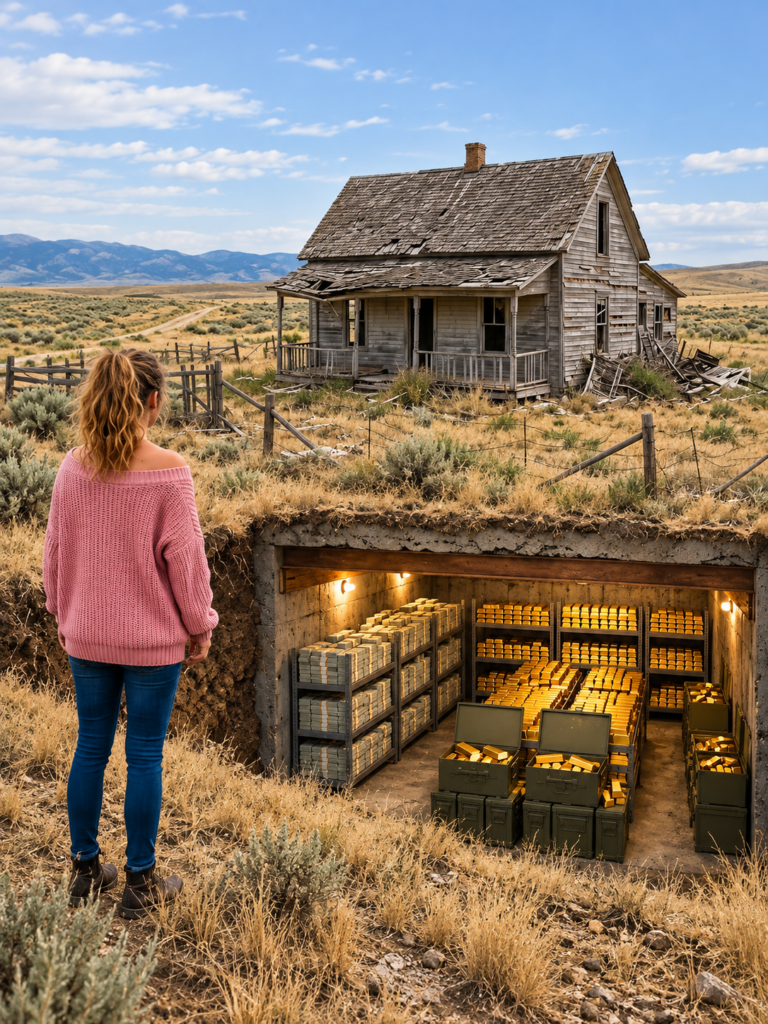
she inherited a ranch everyone called worthless — then one hollow floorboard exposed the secret her grandfather died protecting
Part 1
By the time Sadie Miller reached the old ranch outside Oak Haven, Wyoming, she had twelve dollars in her wallet, three changes of clothes in a canvas duffel bag, and nowhere else in the world she could honestly say she belonged.
The ranch had belonged to her grandfather, Arthur Miller, a man she had not seen since she was nine years old.
Now Arthur was dead.
And somehow, after nearly fifty years of silence, he had left everything to her.
Everything, Sadie thought bitterly as she stopped her rusted sedan beside what remained of the mailbox.
Seventy acres of sun-baked dirt.
A collapsing farmhouse.
A dry well.
Twenty-two thousand dollars in unpaid taxes.
And a warning spray-painted across a piece of warped plywood nailed to the mailbox post.
KEEP OUT.
MEANS YOU.
Sadie switched off the engine.
For several seconds, the only sound was metal ticking beneath the hood as the overheated motor cooled.
Then came the Wyoming wind.
It scraped across the flat ground, carrying dust against the doors of the car in dry little bursts.
Sadie stayed behind the steering wheel.
At fifty-eight, she had learned that sometimes there was a difference between arriving somewhere and being ready to step out of the car.
The farmhouse stood perhaps sixty yards away.
Its roof dipped badly in the middle. White siding had peeled to gray. One shutter hung crooked beside a cracked upstairs window, though Sadie couldn’t remember Arthur’s house even having a second floor.
Tumbleweeds had gathered beneath the porch like animals seeking shelter.
Everything looked abandoned.
Not recently abandoned.
Forgotten.
The bank wanted the property condemned, and everyone who had seen it considered the inheritance more liability than gift.
Sadie rested her forehead against the steering wheel.
“Well,” she whispered, “you always did know how to give a lousy present, Grandpa.”
Her voice sounded strange in the empty car.
The last year had been a long series of losses.
First Daniel.
Her husband of thirty-one years had died after a winter illness that had turned serious before either of them understood how serious.
One week he had been complaining about the furnace and carrying groceries up the stairs.
Three weeks later Sadie had been sitting beside a hospital bed, holding a hand that was getting colder.
After Daniel died, bills appeared that she hadn’t known existed.
Then the printing company where she had worked for twenty-three years closed.
Then the Denver apartment complex changed ownership.
Then the rent went up.
She paid late twice.
The third time, she came home from a temp shift and found a new lock on the door.
Her belongings had been boxed and moved into storage.
The manager had stood beside the office window while explaining it to her, careful not to meet her eyes.
Two days later, Arthur’s estate attorney called.
“Mrs. Miller?”
“Yes.”
“My name is Harold Bennett. I’m calling regarding the estate of Arthur Miller.”
Sadie had actually laughed.
“Arthur Miller doesn’t have an estate.”
There had been silence.
Then Bennett said, “He has land.”
That was how she ended up here.
She opened the car door.
Heat rolled over her.
The air smelled of sagebrush and clay baked hard by months without decent rain.
Sadie pulled out her duffel and started toward the house.
The porch stairs complained beneath her boots.
She remembered standing there as a little girl.
Her mother had held her hand.
Arthur had stood in the doorway with a cup of coffee.
She remembered his beard being dark then.
She remembered wanting him to hug her.
Instead, he had bent slightly, studied her face, and said, “You’re Ruth’s girl.”
As if there had been some question.
Her mother never brought her back.
Sadie tried the front door.
The knob nearly came loose.
“Good start.”
She went around to the kitchen entrance.
That door opened after a hard shove.
The smell inside stopped her.
Dust.
Mouse droppings.
Old cooking grease.
Damp wood.
Something medicinal.
And underneath all of it, the stale smell of a house that hadn’t been opened properly in years.
Sadie covered her mouth.
“Oh, Arthur.”
The kitchen counter had disappeared beneath newspapers, tin cans, mason jars, rusted screws, envelopes, and three coffee cups with dark rings hardened inside them.
A calendar from six years earlier still hung beside the refrigerator.
Sadie walked carefully into the living room.
Arthur had kept everything.
Broken lamps.
Old radios.
Lengths of electrical wire.
Coffee tins filled with bolts.
Bent nails.
A television with no screen.
Stacks of magazines.
A floral sofa sagged beneath blankets and yellowing newspapers.
Sadie picked up a framed photograph from a side table.
She wiped away the dust with her sleeve.
Her mother stood in the picture.
Ruth Miller.
Seventeen, maybe eighteen.
She was laughing beside Arthur, who looked younger than Sadie remembered him.
Behind them stood a red barn.
Sadie’s throat tightened.
She had almost no photographs of her mother before adulthood.
Ruth had died fifteen years earlier without ever making peace with Arthur.
Sadie sat down carefully.
“What happened to you two?”
A knock rattled the front door.
Sadie jumped.
The photograph almost slipped from her hands.
She crossed the living room, stepped around two stacks of newspapers, and opened the door.
A man stood outside in pressed khaki trousers and a matching shirt.
He appeared to be in his late forties.
His sunglasses looked expensive.
His boots looked as though they had never stepped in mud.
“You must be Arthur’s granddaughter.”
Sadie’s fingers tightened around the door.
“Who are you?”
“Tom Granger.”
He smiled and handed her a business card.
GRANGER LAND MANAGEMENT.
“I deal in distressed agricultural properties.”
“I didn’t call you.”
“No.”
His eyes moved past her shoulder.
“Mr. Bennett mentioned you were coming.”
Sadie didn’t like that.
“My lawyer discussed my property with you?”
“Only generally.”
“Generally sounds like too much.”
Granger smiled again, although this one looked more practiced.
“I understand. You’re tired. Long drive from Denver?”
She stared at him.
“How do you know where I came from?”
“Small town.”
“This isn’t a town.”
That earned a short laugh.
“No, ma’am. It certainly isn’t.”
Granger stepped back and looked across the ranch.
“I’ll save you a lot of time, Mrs. Miller. This property hasn’t produced anything meaningful in twenty years.”
“Sadie.”
“Sadie, then. Well’s nearly useless. Soil isn’t worth planting. Fences are gone. Foundation is compromised. Roof needs replacing. County taxes are delinquent.”
“I’ve heard the cheerful version from the lawyer.”
“I’m sure you have.”
Granger removed a folded sheet from his shirt pocket.
“I can make the problem disappear.”
Sadie opened it.
Five thousand dollars.
She looked up.
“That’s an offer?”
“I pay the taxes and legal costs separately. Five thousand to you.”
“For seventy acres?”
“For seventy worthless acres with a condemned structure sitting on them.”
“Then why do you want them?”
Granger shrugged.
“I bundle distressed parcels. Corporate agriculture. Development rights. Sometimes conservation offsets. Sometimes I lose money.”
Sadie looked at the farmhouse.
Five thousand dollars.
Yesterday she would have considered it a miracle.
Enough for a deposit on an apartment.
Enough for groceries.
Enough to repair her car.
Enough to stop feeling like every decision was being made by someone with more money than she had.
Granger seemed to recognize the hesitation.
“I’ll come back tomorrow.”
Sadie glanced at him.
“Why?”
“Give you a night. Walk around. See what you’re dealing with.”
He slid the sunglasses back into place.
“Sometimes a person has to stand inside a bad decision before they’re willing to leave it.”
He started toward his truck.
Sadie called after him.
“Did you know my grandfather?”
Granger stopped.
“Everybody around here knew Arthur.”
“That’s not what I asked.”
He turned.
“No. Not well.”
Then he climbed into his truck and left.
Sadie stood on the porch watching the dust settle behind him.
She looked at the offer again.
Five thousand dollars.
She slowly folded it.
Then she tore it in half.
Not because she had decided to keep the ranch.
Not yet.
But she had spent a year losing things too quickly.
Daniel.
Her job.
Her apartment.
Her dignity every time she had to explain to another stranger why a payment was late.
For once, she wanted twenty-four hours before somebody else decided what happened next.
She slept on the living-room floor that night.
If it could be called sleep.
The wind worked at the old farmhouse for hours.
Joists groaned.
Glass trembled.
Something scratched underneath the kitchen.
At five in the morning Sadie opened her eyes, stiff and cold.
Gray light filled the room.
For a while she stared at the ceiling.
Then she said aloud, “One room.”
If she was going to sell, she would clean out one room first.
Arthur’s bedroom.
She wanted photographs.
Letters.
Anything that explained why her mother had spent half her life refusing to speak his name.
The bedroom was at the end of a narrow hallway.
Its door had swollen inside the frame.
Sadie pushed once.
Nothing.
She pushed again with her shoulder.
The door burst inward.
Arthur’s bedroom surprised her.
Unlike the rest of the house, it was nearly empty.
A metal bed.
A bare mattress.
A battered dresser.
A closet.
An ugly linoleum rug.
Sadie opened the dresser drawers.
Socks.
A broken belt.
Old receipts.
A rusted pocketknife.
Nothing.
The closet contained boots, work shirts, and three empty wire hangers.
“Thirty-one years of marriage,” Sadie muttered, “and Daniel left me six boxes of fishing gear. You couldn’t leave one decent letter?”
She stepped toward the window.
Her boot struck the floor.
Thud.
She stopped.
Sadie shifted her weight.
Then she stepped again.
Thud.
Not the solid knock of pine laid across a joist.
Something deeper.
Hollow.
She looked down.
Three floorboards near the bed had been cut shorter than the others.
The nails were different too.
Newer.
Sadie knelt.
She ran her fingertips over one nailhead.
There were fresh scratches in the metal.
Not fresh as in yesterday.
But fresh compared with everything else in the room.
Those boards had been lifted before.
She sat back on her heels.
“Arthur?”
The wind whispered through a gap beneath the baseboard.
Sadie went outside.
The remains of a tool shed leaned behind the house.
Inside she found a crowbar.
Ten minutes later, sweating and swearing beneath her breath, she pried up the first board.
Then the second.
Then the third.
Black plastic lay beneath them.
Her heart began to pound.
She pulled it aside.
Four olive-green metal crates sat inside a concrete cavity between the floor joists.
Military ammunition boxes.
Each was secured by a brass lock.
Sadie stared.
Everything inside her told her to put the floor back together.
Instead she reached down and tried to lift the nearest crate.
It barely moved.
“Good Lord.”
She repositioned herself and pulled harder.
The box came free with a metallic scrape and dropped onto the floor.
It was unbelievably heavy.
Sadie looked at the lock.
Then at the crowbar.
Five minutes later the damaged lock fell away.
She hesitated.
Her hand rested on the lid.
Daniel’s voice came unexpectedly into her memory.
Whenever they had opened birthday presents, tax notices, or anything else with uncertain contents, he always said the same thing.
No sense being scared of something that’s already here.
Sadie swallowed.
“Fine.”
She opened the crate.
For several seconds she didn’t understand what she was seeing.
Rectangular objects wrapped in yellowed wax paper.
She lifted one.
Her wrist dropped beneath the weight.
The paper broke apart.
Gold appeared beneath it.
Not bright.
Not polished.
A dense, dull yellow bar stamped with numbers.
Sadie sat down hard on the mattress.
“No.”
She turned the bar.
Another stamp.
A purity mark.
She looked inside the crate.
There were more.
Rows of them.
Her mouth went dry.
Sadie counted twenty.
Then she looked toward the open floor.
Three more crates remained below.
She thought about Tom Granger.
Five thousand dollars.
She thought about Arthur living among canned beans and broken radios.
She thought about her mother refusing to discuss him.
She thought about the warning outside.
KEEP OUT.
MEANS YOU.
Sadie’s hands began shaking.
Then gravel crunched outside.
A vehicle was coming up the driveway.
Part 2
Sadie moved before she had time to think.
She shoved the lid closed.
The crate was too heavy to lift cleanly, so she dropped to the floor and pushed it with her legs until the box slid toward the opening.
Her hip screamed.
Her breath came short.
Finally the crate tipped into the cavity.
Sadie pulled the plastic over all four boxes and set the loose boards roughly back into position.
There was no time to nail them.
She dragged the rug over the area.
A knock sounded from the front of the house.
Sadie wiped her palms on her jeans.
Another knock.
Harder.
She forced herself to walk normally.
Tom Granger stood outside.
“It’s not tomorrow,” she said.
“No.”
He held up a manila envelope.
“I reconsidered.”
Sadie didn’t move.
Granger continued.
“Six thousand.”
“You found another thousand dollars since yesterday?”
“I want a quick closing.”
“Thought it was worthless.”
“Mostly is.”
“Then you’re awfully determined to own it.”
His smile disappeared for half a second.
Sadie saw it.
Something impatient.
Maybe angry.
Then the friendly expression returned.
“Sadie, I’ve been doing this twenty-five years. People inherit property and become sentimental. That’s normal. Then they start getting estimates.”
He nodded toward the roof.
“Twenty thousand there.”
Toward the house.
“Foundation could be forty.”
Then toward the fields.
“Well? Maybe fifteen if you’re lucky. Fencing? Another thirty.”
He extended the envelope.
“I’m giving you an exit.”
Sadie remembered the gold pressing into her palm.
“I’m not selling.”
Granger’s hand remained suspended between them.
“What?”
“You heard me.”
“Don’t be foolish.”
“That’s my right.”
“Twenty-two thousand in taxes.”
“I know.”
“County can seize this land.”
“Then I’ll deal with the county.”
Granger studied her.
The friendliness left his face.
“Arthur was stubborn too.”
Sadie felt something cold move through her.
“You said you didn’t know him.”
“I said not well.”
“You know him well enough to know he was stubborn.”
“This is a small county.”
He tucked the envelope back under his arm.
“You should be careful about inheriting another person’s problems, Sadie. Sometimes you don’t understand what they cost until they’re yours.”
He walked away.
Sadie remained in the doorway.
Granger stopped beside his truck.
“Offer goes back to five tomorrow.”
“Don’t come tomorrow.”
He looked over his shoulder.
Then he smiled.
“We’ll see.”
His truck disappeared down the road.
Sadie shut the door.
She turned the lock.
Then she leaned against it.
For the first time since finding the gold, she understood something clearly.
The money was not a miracle.
It was trouble.
Maybe fatal trouble.
She needed information before she touched another bar.
Oak Haven lay ten miles east.
The town had one gas station that no longer sold gas, a diner, a hardware store, a church, and several brick storefronts with plywood covering the windows.
Sadie parked outside the hardware store.
A brass bell rang when she entered.
An older man stood behind the counter.
Late seventies, perhaps.
Thin white hair.
Weathered hands.
A faded cap advertising cattle feed.
Sadie set four heavy padlocks on the counter.
The man looked at them.
Then at her.
“Planning to keep somebody out?”
“That’s generally what locks are for.”
He grunted.
“You Arthur’s granddaughter?”
Sadie stiffened.
“Does everybody know me?”
“Everybody knows a stranger.”
He pointed toward her face.
“And you’ve got Ruth’s eyes.”
Sadie’s defensiveness softened.
“You knew my mother?”
“Knew everybody back then.”
He extended his hand.
“Roy Bennett.”
“Related to Harold Bennett?”
“Cousin. Unfortunately.”
Sadie smiled despite herself.
Roy rang up the locks.
“Arthur used to buy hardware here.”
“Recently?”
“Until he stopped coming into town.”
“When?”
“Couple years before he died.”
Sadie hesitated.
“What happened to him?”
Roy looked at her.
“Besides getting old?”
“I mean why did he live like that?”
Roy’s fingers paused over the register.
“Your mother never told you?”
“She didn’t talk about Arthur.”
“No.”
Roy nodded slowly.
“Ruth wouldn’t.”
He put the locks into a paper sack.
“Arthur wasn’t always strange. Difficult, yes. Mean when he drank. Proud every day of his life. But not strange.”
“What changed?”
“The mine.”
Sadie waited.
Roy sighed.
“State project west of here. Copper exploration. Late eighties. Arthur worked site security and maintenance.”
“What happened?”
“Officially? Nothing. Ore wasn’t worth extracting. Project closed.”
“Unofficially?”
Roy looked toward the windows.
“You grow up in a little place, rumors become entertainment. People said Arthur saw something he shouldn’t have. After the mine shut down he became convinced somebody was following him.”
“Was somebody?”
Roy gave her a sharp look.
“Why are you asking?”
“Because Granger came to the ranch before I’d been there an hour.”
Roy’s expression changed.
“Tom Granger?”
“You know him.”
“Vulture.”
“How long has he wanted Arthur’s land?”
Roy rested both palms on the counter.
“Years.”
Sadie’s stomach tightened.
“How many?”
“At least five.”
“He told me he heard about it from the estate lawyer.”
“That’s nonsense.”
Roy lowered his voice.
“Arthur chased Granger off with a rifle once.”
Sadie said nothing.
Roy studied her.
“Whatever you’re thinking, don’t.”
“I haven’t told you what I’m thinking.”
“You don’t have to.”
He handed her the bag.
“Arthur spent thirty years frightened of something. That should tell you enough.”
Sadie paid.
As she stepped outside, she noticed a black sedan parked beneath the rusted awning of the abandoned gas station.
Tinted windows.
Out-of-state plates.
Someone sat behind the steering wheel.
She couldn’t see a face.
Only the faint glow of a cigarette.
Sadie kept walking.
Her pulse quickened.
She placed the locks in the passenger seat and climbed inside.
When she looked again, the sedan hadn’t moved.
She drove away.
The sedan did not follow.
That frightened her more.
By sunset Sadie had installed steel hasps on every outside door.
She dragged the floral sofa in front of the largest window.
Then she sat at Arthur’s kitchen table with canned soup warming on a camp stove.
Her hands hurt.
Her back hurt.
Her whole body felt used up.
On the table she placed the photograph of Ruth and Arthur.
Her mother’s young face looked impossibly happy.
Sadie touched the glass.
“What did he do to you, Mom?”
No answer came.
Outside, darkness swallowed the ranch.
Sadie remembered Roy’s words.
Arthur spent thirty years frightened of something.
Paranoid people didn’t merely hide things.
They recorded them.
Sadie carried a flashlight to the bedroom.
She checked the dresser.
Nothing.
The mattress.
Nothing.
Bedframe.
Nothing.
Then she looked at Arthur’s old work boots.
She had ignored them earlier.
The left boot contained only dried mud.
The right felt heavier.
Sadie reached inside.
Her fingers touched leather.
She pulled out a small black notebook.
The cover was cracked.
A rubber band around it disintegrated when she removed it.
Sadie sat on the mattress.
The early pages were neat.
Dates.
Equipment numbers.
Shift schedules.
Then she reached October 1989.
Shaft Four opened again last night.
She read faster.
Arthur wrote that he had found pallets underground.
Not copper.
Bullion.
Gold.
Unrecorded.
Moved at night.
Several pages later he wrote about taking crates before the mine was permanently sealed.
Sadie stopped.
She looked down at the floor.
“No, Arthur.”
The entries became increasingly frantic.
Cars following him.
Phone clicks.
Men asking questions.
Offers for the ranch.
Threats.
Then a sentence appeared underlined twice.
Can’t sell.
If they own the ground, they search the house.
Sadie closed the notebook.
Everything fit.
Arthur had not become a recluse merely because he was eccentric.
He had turned his ranch into a fortress.
He had lived poor while millions sat beneath his bedroom.
Not because he didn’t want the money.
Because he was afraid to spend it.
Sadie felt suddenly furious.
“What good was it?”
Her voice cracked.
“What good was any of it?”
She thought about her mother.
Ruth had worked two jobs after Sadie’s father left.
She had skipped dental work.
Driven old cars.
Taken extra shifts at Christmas.
Arthur had possessed enough money to help her.
Enough to buy her a house.
Enough to pay Sadie’s college tuition.
Enough to change their lives.
Yet he had lived alone guarding metal he couldn’t use.
Sadie’s eyes filled.
“You chose this over us.”
Then she turned another page.
A photograph slipped out.
Sadie caught it.
Ruth.
Older than in the framed photograph.
Maybe twenty-five.
Holding a baby.
Sadie.
On the back Arthur had written:
Ruth says I care more about being right than being her father.
Maybe she’s right.
Sadie covered her mouth.
Another note had been folded behind the photograph.
It was addressed to Ruth but apparently never mailed.
I’m sorry.
There were only two words.
Nothing else.
Sadie sat in the old man’s empty bedroom and cried.
Not for Arthur exactly.
Not yet.
She cried for the waste of it.
For mothers and daughters who waited for apologies.
For fathers too proud to say them.
For husbands who died before retirement.
For all the years people believed they had time.
Then bright light swept across the wall.
Sadie’s head snapped toward the window.
Headlights.
A vehicle was coming slowly up the driveway.
The engine stopped.
The headlights vanished.
Sadie switched off her flashlight.
Car doors opened.
Two.
She heard footsteps.
Men.
Coming toward the house.
Part 3
Sadie crouched behind the floral sofa with the crowbar held against her chest.
Boots crossed the porch.
The doorknob moved.
Someone pushed.
The new steel hardware held.
A man’s voice spoke quietly.
“New locks.”
Another voice answered.
“Check the rear.”
Sadie’s breathing became shallow.
She knew the sensible thing.
Hide.
Call the sheriff.
But the ranch had almost no cell signal.
Her phone had shown one weak bar near the mailbox that afternoon.
Inside the house, nothing.
She considered running.
The kitchen door opened toward empty fields, but one man was already moving around the side.
She would never make her car.
A heavy impact shook the back entrance.
Sadie closed her eyes.
Think.
Daniel had always said she was good in emergencies.
Not graceful.
Not fearless.
Useful.
When their basement flooded, Sadie shut off the electricity while Daniel stared at the rising water.
When his truck rolled into a ditch during an ice storm, she crawled through the passenger window and walked two miles for help.
When the hospital doctor had struggled to explain Daniel’s condition, Sadie had been the one who asked the questions nobody else wanted to ask.
Fear did not paralyze her.
It made her practical.
Another crash sounded at the rear door.
She slipped down the hallway.
Arthur had kept an old fuel can in a storage closet.
Sadie pulled it out.
Then she stopped.
She understood what desperate people sometimes forgot.
A threat only worked if the person hearing it believed you were willing to carry it out.
Sadie did not want to die.
She did not want to burn Arthur’s house.
She certainly did not want to destroy evidence that might protect her.
So she did not pour fuel throughout the room.
Instead she carried the can where the men would smell it and understand what she wanted them to understand.
Then came the sound she feared most.
Breaking glass.
The large living-room window shattered.
A flashlight beam moved across the wall.
Someone climbed inside.
Then another.
Sadie stepped into the hallway.
“That’s far enough.”
The flashlight hit her face.
She raised one hand against the glare.
The man holding it wore a dark jacket.
Beside him stood a larger man with broad shoulders.
Neither wore a mask.
That disturbed her.
Men who expected witnesses to survive often hid their faces.
These men apparently didn’t care.
“Mrs. Miller,” the first man said.
“Sadie.”
“All right. Sadie.”
His voice was calm.
“We’re not here to hurt you.”
“You broke my window.”
“We tried knocking.”
“At midnight?”
“We need something that belonged to your grandfather.”
Sadie tightened her grip on the crowbar.
“Then send an estate claim.”
The larger man laughed.
The first didn’t.
“This doesn’t need to become difficult.”
“Already difficult.”
“Arthur removed property from an industrial site many years ago.”
“Property?”
“You know what I’m talking about.”
Sadie did not answer.
The man’s eyes shifted toward the hallway.
“You found it.”
Not a question.
Sadie felt cold.
“I found Arthur’s records too.”
That stopped him.
“What records?”
“The ledger.”
The larger man glanced at his companion.
Sadie saw it.
Concern.
She pressed.
“Dates. Shaft numbers. Vehicle numbers. Names.”
She was bluffing about the names.
Arthur’s notebook contained observations but few identities.
They didn’t know that.
The man in the dark jacket lowered his flashlight slightly.
“What do you want?”
Sadie’s mind raced.
She could demand everything.
All four crates.
Money.
Safe passage.
But greed had trapped Arthur for thirty years.
She would not become him during her first night with his fortune.
“I want to leave.”
“You can.”
“With one crate.”
The larger man stepped forward.
“You’re out of your mind.”
Sadie raised the fuel can enough for them to see it.
“No.”
The first man lifted a hand, stopping his partner.
Sadie continued.
“One box comes with me. You take the others.”
“Why should we agree to that?”
“Because Arthur’s notebook exists.”
“Give it to us.”
“It’s not here.”
A lie.
The notebook was inside her coat.
“I made copies.”
Another lie.
“One goes to an attorney if anything happens to me.”
The dark-jacketed man watched her.
Sadie let him think.
Finally he asked, “And after tonight?”
“You don’t know me.”
“Granger?”
“Never comes near me again.”
The larger man shook his head.
“This is ridiculous.”
His companion ignored him.
“One crate.”
Sadie almost sagged with relief.
Instead she said, “Mine goes in my car first.”
For the next half hour, three frightened, exhausted people did the strangest work Sadie had ever seen.
The men opened the floor.
They hauled out the crates.
Gold that had shaped thirty years of Arthur’s life scraped across dirty boards and passed through a hallway lined with old photographs and peeling wallpaper.
Sadie watched from a distance.
No one spoke unless necessary.
When they loaded her crate into the trunk, the rear suspension dipped under the weight.
The first man turned.
“The notebook.”
“I told you. Safe place.”
His expression hardened.
“You weren’t expecting us tonight.”
Sadie smiled faintly.
“You really want to test whether I’m lying?”
They stared at each other.
Finally he nodded.
“We won’t see you again.”
“Good.”
“But understand something.”
His voice lowered.
“That gold is not clean.”
Sadie looked toward her trunk.
“Neither was the way you came to collect it.”
The men drove away carrying the other three crates.
Their taillights disappeared.
Sadie stood beside her car.
Then her knees failed.
She sat hard in the dirt.
Her whole body shook.
For several minutes she could do nothing but breathe.
When she could stand again, dawn had begun to soften the eastern horizon.
She entered Arthur’s house one final time.
Broken glass glittered across the living room.
The bedroom smelled of dust and old fuel.
The floor gaped open.
The house seemed suddenly exhausted.
Sadie understood it differently now.
It had never been Arthur’s home.
It had been his bunker.
His prison.
And he had spent half his life defending something he could neither enjoy nor surrender.
Sadie packed the photograph of Ruth.
The notebook.
Arthur’s rusted pocketknife.
One old coffee cup.
Nothing else.
At the door she looked back.
“I won’t do what you did.”
Then she drove away.
Three hours later, on a highway heading south, the oil-pressure light came on.
Sadie laughed.
She laughed so hard she had to pull onto the shoulder.
Millions in gold.
Twelve dollars in cash.
And a dying sedan.
Daniel would have thought it was hilarious.
She leaned her forehead against the steering wheel, laughing until laughter became crying.
“I could use you right now,” she whispered.
The passenger seat remained empty.
Eventually Sadie wiped her face and opened Arthur’s notebook again.
Something bothered her.
The gold explained Granger.
It explained the men.
But not everything.
Arthur’s last entries were not about the bullion.
They were about water.
Test results.
Survey markers.
Land descriptions.
An entry dated fourteen years earlier read:
They think the gold is why I won’t sell.
Let them.
Sadie read it twice.
Then she turned the page.
If Granger ever comes back, it’s not the boxes he’s after.
Sadie’s stomach tightened.
She read the following entries slowly.
Arthur had noticed drilling crews near the northern boundary.
Unmarked trucks.
Survey flags removed after dark.
A hydrologist from Cheyenne.
The notebook contained a rough map.
Beneath seventy acres everyone called useless, Arthur believed there was something else.
Water.
Not a shallow ranch well.
A deep aquifer.
Sadie closed the notebook.
Behind her, somewhere beyond the horizon, the old ranch waited.
For the first time since leaving, Sadie wondered whether she had made a mistake.
Part 4
Sadie spent two nights in a roadside motel outside Casper.
The room cost seventy-nine dollars a night.
She paid with a nearly maxed-out credit card and parked the sedan directly outside her window.
The gold stayed in the trunk.
She hardly slept.
Every engine in the parking lot made her sit upright.
Every shadow beneath the curtain became the dark sedan.
On the third morning she drove to the office of Harold Bennett, the lawyer handling Arthur’s estate.
Harold was sixty-three, broad around the middle, and wore suspenders beneath his suit jacket.
When Sadie placed Arthur’s notebook on his desk, his expression changed.
“Where did you get this?”
“His boot.”
Harold looked at her.
“Naturally.”
“You don’t seem surprised.”
“Nothing about Arthur surprises me anymore.”
Sadie sat across from him.
“Did you know about the gold?”
Harold’s head rose sharply.
So sharply that Sadie believed his answer before he gave it.
“What gold?”
She told him enough.
Not everything.
Harold removed his glasses and cleaned them.
When she finished, he said, “You need federal counsel.”
“I need to know whether I own what’s in my trunk.”
“Possession and legal title are two different things.”
“That’s lawyer language for maybe.”
“That’s lawyer language for don’t spend anything.”
“I wasn’t planning to buy a yacht.”
“Good.”
He replaced his glasses.
“Where is it?”
“Safe.”
Harold studied her.
Sadie said, “Don’t ask.”
“I wasn’t going to.”
She opened Arthur’s notebook to the pages about water.
“What is this?”
Harold read.
His eyebrows drew together.
After several minutes he leaned back.
“Arthur refused every offer made on the property.”
“I know.”
“Not only Granger’s company. Other firms.”
“Why?”
“I assumed spite.”
“Arthur wrote that Granger wasn’t after the gold.”
Harold rubbed his chin.
“If there’s groundwater beneath that ranch…”
“What?”
“In this part of the state, reliable water can be more valuable than marginal land.”
“Enough to explain years of pressure?”
“Depends on what’s planned nearby.”
Sadie stared at him.
“What do you know?”
Harold hesitated.
“There’s been talk of an industrial development corridor north of Oak Haven.”
“What kind?”
“Data facilities. Processing. Agricultural projects. Nothing approved publicly.”
“Those need water.”
“A great deal.”
Sadie suddenly saw Granger differently.
The gold had brought one danger to Arthur’s door.
But something else had kept a land company circling for years.
Arthur had hidden one secret beneath the house while unknowingly—or perhaps deliberately—sitting above another.
Sadie asked, “Can we test it?”
“The water?”
“Yes.”
“With money.”
Sadie laughed bitterly.
“I may have some.”
“Money you can’t use until we establish ownership.”
“What about the land?”
Harold considered this.
“I know a retired hydrogeologist.”
“How retired?”
“Retired enough to dislike corporations.”
“Perfect.”
His name was Dr. Walter Hale.
Seventy-two.
Widowed.
Former University of Wyoming faculty.
He drove out to the ranch with Sadie four days later in an old Ford pickup carrying equipment that looked older than she was.
Sadie had dreaded returning.
But daylight changed the property.
The house remained broken.
The fields remained dry.
Yet the fear had less power under a clear blue sky.
Walter spent hours studying Arthur’s map.
He inspected old survey markers.
Walked the northern pasture.
Took readings.
Examined county geological records Harold had obtained.
By late afternoon he stood beside a dry cattle trough and removed his hat.
“Your grandfather wasn’t stupid.”
Sadie smiled slightly.
“I’ve heard other descriptions.”
“Stubborn?”
“Frequently.”
“Paranoid?”
“Apparently with reason.”
Walter pointed across the land.
“There’s a confined aquifer beneath this basin.”
“How much water?”
“I can’t tell you without proper drilling.”
“Enough to matter?”
He looked at her.
“Potentially enough to matter a lot.”
Sadie folded her arms.
“Granger knows?”
“Someone knows. See those markers?”
Walter pointed toward several weathered stakes near the fence.
“Professional survey.”
“Arthur didn’t hire anyone.”
“Exactly.”
A pickup appeared on the county road.
White.
It slowed.
Then turned into the ranch.
Tom Granger climbed out.
Sadie felt anger before fear.
He wore the same khaki shirt.
The same polished boots.
“Mrs. Miller.”
“Sadie.”
His attention moved to Walter.
“Dr. Hale.”
Walter nodded.
“Tom.”
Granger’s jaw tightened.
“Didn’t realize you two knew each other.”
“We didn’t,” Sadie said. “Now we do.”
Granger glanced at the geological equipment.
His expression told Sadie everything.
“You knew,” she said.
“Knew what?”
“About the water.”
Granger exhaled.
“Sadie—”
“How much?”
“You’re making assumptions.”
“How much is the land worth?”
“Land is worth whatever a buyer pays.”
“Then make an offer.”
Granger looked toward Walter.
“This doesn’t concern you.”
Walter put his hat back on.
“She’s paying me seventy-five dollars and lunch. At my age, that’s enough to concern me.”
Sadie nearly smiled.
Granger took her aside.
“I can offer two hundred thousand.”
Sadie stared at him.
Four days earlier he had offered five.
“That’s generous.”
“You have water rights.”
“How generous?”
“Very.”
“Then three hundred.”
“Sadie—”
“Five.”
His face hardened.
“Don’t play games you don’t understand.”
Sadie suddenly remembered Arthur’s note.
They think the gold is why I won’t sell.
Let them.
She stepped closer.
“That’s exactly what you told him, isn’t it?”
Granger froze.
“Arthur.”
Sadie continued.
“You pressured him. For years.”
“I offered him fair value.”
“Five thousand?”
“His structures were worthless.”
“But the land wasn’t.”
“He didn’t have the capital to develop it.”
“So you decided he didn’t deserve to know what he owned.”
Granger’s voice dropped.
“You think this is justice? Fine. Go spend five years permitting wells. Hire engineers. Fight environmental reviews. Pay taxes. Pay legal fees. Watch every dollar disappear.”
“Maybe I will.”
“You’ll lose.”
“Maybe.”
Sadie looked across the empty pasture.
“But it’ll be my decision.”
Granger’s expression changed.
For the first time, he understood that money was no longer the most important thing Sadie had found beneath Arthur’s floor.
Choice was.
After Granger left, Walter stood beside her.
“You planning to keep this place?”
Sadie looked at the farmhouse.
“I don’t know.”
“You don’t have to know today.”
Those words nearly broke her.
For a year everyone had demanded decisions immediately.
Hospitals.
Creditors.
Employers.
Landlords.
Granger.
Take the settlement.
Sign here.
Leave now.
Pay today.
Decide.
For once someone told her she had time.
That evening Sadie sat on the porch.
Walter had gone home.
The sun lowered over the dry fields.
A meadowlark called somewhere near the fence.
Sadie opened Arthur’s notebook.
Near the back she found several pages addressed not to himself but to Ruth.
Ruth,
You were right when you said I turned fear into an excuse.
Sadie stopped breathing.
She read on.
Arthur admitted that when he discovered the illegal gold, he believed he could use it to secure the family’s future.
Then men came asking questions.
He panicked.
He hid the crates.
He withdrew from everyone.
When Ruth begged him to leave the ranch, Arthur refused.
When she told him his paranoia was destroying the family, he accused her of disloyalty.
She left.
Years passed.
Pride hardened.
Arthur wrote:
Every year I thought I would call her next Christmas.
Then one Christmas I heard she was sick.
I still didn’t call.
A man can be ashamed so long that shame starts pretending to be principle.
Sadie wiped tears from the page.
Another entry was dated after Ruth’s death.
My daughter died believing I chose this ranch over her.
Truth is uglier.
I chose my pride over her.
Sadie closed her eyes.
She saw her mother washing dishes after midnight.
Saw Daniel teasing Ruth while carving Thanksgiving turkey.
Saw Ruth sitting beside Sadie after her miscarriage, saying almost nothing because she understood some griefs could not be improved by words.
Arthur had missed all of it.
Not because someone kept him away.
Because he was ashamed of returning.
Sadie turned the page.
One final note had been written shakily.
If Sadie ever comes here, tell her the land was never the inheritance.
Tell her not to waste her life guarding what she’s afraid to lose.
Sadie lowered the notebook.
The wind crossed the porch.
For decades Arthur had possessed gold but lived like a poor man.
Owned land but lived like a prisoner.
Loved his daughter but behaved like a stranger.
Sadie understood then what she needed to do.
She would not keep Arthur’s secrets buried.
But she would not let Granger take the ranch either.
She called Harold.
“Start making calls.”
“To whom?”
“Everybody.”
Part 5
Six months later, the Oak Haven Community Center held more people than it had seen in twenty years.
Farm families.
County officials.
Reporters.
Retired miners.
Attorneys.
People Sadie had never met.
Tom Granger sat near the back beside two men in suits.
Sadie stood at a folding table near the front.
Her hands trembled.
Walter noticed.
“Nervous?”
“Terrified.”
“Good.”
“Good?”
“Means you still have sense.”
She smiled.
Harold approached carrying a folder.
“It’s official.”
He handed it to her.
Sadie read the first page.
Then the second.
She exhaled slowly.
After months of investigation, the origin of the bullion had been documented.
Arthur had indeed stolen it from an illegal off-book storage operation tied to a defunct corporate entity.
Because ownership claims were complicated, the settlement had taken lawyers, federal authorities, and more paperwork than Sadie imagined existed.
She did not receive the full value of the crate.
Nor had she expected to.
A negotiated recovery arrangement, whistleblower evidence contained in Arthur’s records, and legal settlement left Sadie with a substantial but far smaller amount.
Enough.
More than enough.
She used part of it first to pay the ranch taxes.
Then her debts.
Then Daniel’s remaining medical bills.
She bought no mansion.
No sports car.
No diamond jewelry.
She replaced the transmission in her sedan.
Walter laughed for ten minutes when she told him.
The larger surprise came from the land.
Professional drilling confirmed the aquifer.
The ranch sat above one of the strongest accessible groundwater pockets in the area.
Suddenly Granger’s years of pressure made sense.
His company had been quietly assembling parcels for an industrial agricultural development that required long-term water access.
Arthur’s seventy acres were critical.
Sadie could have sold.
Instead, she did something nobody expected.
She negotiated.
Not as a desperate woman with twelve dollars.
As the landowner.
The development company could lease limited water rights under strict conservation terms.
The ranch would remain hers.
Local farms suffering from drought received priority access at regulated rates.
A conservation easement protected part of the acreage from industrial construction.
And a community water reserve was established for Oak Haven.
Granger fought every provision.
Sadie refused to move.
At one negotiation he pushed a contract across the table.
“This is the final offer.”
Sadie didn’t touch it.
“You said that when the offer was five thousand.”
Granger stared at her.
She smiled.
“I’ve learned not to believe you when you use the word final.”
Eventually his company accepted.
Not because they became generous.
Because they needed the water.
That evening at the community center, Roy Bennett stood beside the coffee table telling anyone who would listen that he had known Arthur was sitting on something important.
Walter repeatedly reminded him he had advised Sadie to sell and run.
Roy claimed not to remember.
Sadie walked outside.
The autumn air had turned cool.
Someone had repaired the community center’s porch light years ago with mismatched screws, and the fixture tilted slightly left.
Sadie liked it.
Not everything needed to look new to function.
Footsteps sounded behind her.
She turned.
Tom Granger approached.
He stopped several feet away.
“You won.”
Sadie shook her head.
“This wasn’t a contest.”
“It was to Arthur.”
“That’s why he lost.”
Granger looked out at the dark street.
“You know he could have taken a deal years ago.”
“I know.”
“He could have been comfortable.”
“I know that too.”
Granger studied her.
“You could sell everything tomorrow and never worry again.”
Sadie smiled.
“You’re still trying to buy my ranch?”
“Professional habit.”
“No.”
He nodded.
Then, unexpectedly, he held out his hand.
Sadie looked at it before shaking.
“Take care of the place,” he said.
“I intend to.”
The following spring, construction began.
Not industrial construction.
Sadie rebuilt the ranch house.
Not the way Arthur had left it.
The original structure was too damaged to save entirely, but the stone fireplace remained.
So did one section of the kitchen wall.
She had the carpenter reuse several boards from Arthur’s bedroom floor.
When he asked why, Sadie simply said, “They’ve got history.”
The red barn from her mother’s photograph no longer existed, but its foundation remained beneath weeds near the eastern pasture.
Sadie built a smaller barn on the same footprint.
Walter helped design a rainwater collection system.
Roy donated an old workbench, then charged her for delivery.
Harold claimed a bedroom for himself whenever he visited, though Sadie repeatedly reminded him he had his own house.
Neighbors came.
That surprised her most.
She had spent so long believing independence meant never needing anyone that she had forgotten rural communities often survived by doing the opposite.
A rancher named Ellen brought fence posts.
Two brothers from town repaired the cattle trough.
The church women arrived with casseroles.
A high-school agriculture class planted windbreak trees.
Nobody asked whether Sadie deserved the help.
They simply saw work that needed doing.
One Saturday in May, Sadie opened a cardboard box she had recovered from storage in Denver.
Inside were photographs from her mother’s house.
She took them to the porch.
One showed Ruth at seventeen beside Arthur.
Another showed Ruth holding Sadie as an infant.
Sadie placed both inside new frames.
Then she added Daniel.
Her favorite photograph.
He was fifty-three, standing beside a lake with a fishing pole in one hand and a burnt hot dog in the other.
He was laughing.
Sadie placed the photographs on the mantel.
Three generations of people who had loved imperfectly.
Some had understood it before time ran out.
Some hadn’t.
That night a storm moved across the plains.
Rain struck the roof.
For years, Arthur’s house had argued with weather.
The new house simply held.
Sadie sat at the kitchen table drinking coffee.
Arthur’s old mug rested beside hers.
She had repaired the cracked handle, though she never used it.
The black notebook lay in a drawer.
Not hidden.
Just stored.
She no longer needed it beside her.
There were no dark sedans.
No midnight visitors.
No Granger at the gate.
Federal investigators had dismantled what remained of the old bullion operation.
The men who invaded the farmhouse were never identified to Sadie.
She decided she didn’t need their names.
Some mysteries were worth solving.
Others deserved to stop owning space inside your head.
A truck pulled into the driveway the next afternoon.
Sadie walked outside.
A young woman stepped out.
Early thirties.
Two children climbed from the back seat.
Sadie recognized her after a moment.
“Emily?”
The woman smiled nervously.
“Hi, Aunt Sadie.”
Emily was the daughter of Sadie’s younger brother, Mark, who had died eight years earlier.
They had not spoken since the funeral.
Family had scattered after Daniel’s death.
Everyone dealing with their own lives.
Sadie stepped off the porch.
“What are you doing here?”
Emily looked embarrassed.
“I heard about the ranch.”
Sadie almost laughed.
“Everybody has.”
“I didn’t come for money.”
“I didn’t say you did.”
“I know.”
Emily looked toward her children.
“We were passing through.”
Sadie knew that wasn’t true.
Oak Haven was not on the way to anywhere Emily normally traveled.
But she understood the courage required to invent a weak excuse for showing up after too much time had passed.
Arthur had waited for the perfect moment to call Ruth.
That moment never arrived.
Sadie wasn’t going to repeat him.
“You hungry?”
Emily blinked.
“Actually, yes.”
“I’ve got stew.”
The little boy tugged on his mother’s sleeve.
“Is this the ranch with treasure?”
Emily closed her eyes.
“Oh, God.”
Sadie laughed.
“It is.”
The boy looked thrilled.
“Where’s the treasure?”
Sadie looked across the property.
Green shoots had begun appearing in areas that once seemed permanently dead.
Wind moved through the young trees planted along the fence.
Water shimmered inside the repaired stock tank.
A new barn stood where her mother had once posed beside Arthur.
Walter’s truck was parked near the well.
Roy had left a sack of seed on the porch.
Inside the house were photographs, clean rooms, warm food, and enough chairs for people who might decide to stay awhile.
Sadie looked down at the boy.
“Most of it isn’t underground anymore.”
He frowned, disappointed.
Sadie smiled.
“Come inside.”
Years later, when people in Oak Haven told the story, the details changed depending on who was telling it.
Some said Sadie Miller inherited millions in gold.
Some said she discovered an underground river.
Some said Arthur Miller had stolen from criminals.
Others said he had exposed them.
Roy insisted he knew everything from the beginning.
Nobody believed Roy.
But the version Sadie preferred was quieter.
An older woman arrived at a broken ranch with twelve dollars and nowhere else to go.
She found money.
Yes.
But money was not what saved her.
She found proof that a frightened man could love his family and still fail them.
She found an apology written decades too late.
She found land everyone else had dismissed.
She found neighbors willing to work without asking what they would receive in return.
Most importantly, she discovered that losing almost everything had given her one strange advantage.
She was no longer easily threatened by the possibility of loss.
That made her difficult to manipulate.
It made her brave when she needed to be.
It also taught her something Arthur had understood only at the end of his life.
You could spend decades protecting property and still lose your family.
You could possess a fortune and still live poor.
You could keep every enemy outside the gate and discover that loneliness had been inside with you all along.
So Sadie kept the gate open during daylight.
People came through it.
Neighbors.
Children.
Family.
Friends.
Sometimes strangers.
Every autumn she hosted a harvest dinner in the new barn.
Long tables filled the center aisle.
Older ranchers sat beside young families.
Children ran beneath strings of lights.
Walter complained about his knees.
Roy complained about Walter complaining.
Harold brought pie nobody admitted came from a grocery store.
Emily and her children came every year.
One evening, Sadie’s grandniece asked why a section of old, scratched pine had been mounted on the barn wall.
Sadie looked at the boards.
They had once covered Arthur’s secret.
Now they carried a small brass plaque.
NOT EVERYTHING WORTH SAVING SHOULD BE BURIED.
“Those came from the old house,” Sadie said.
“Why did you save them?”
Sadie considered the question.
Outside, wind moved across the pasture.
Inside, seventy people talked and laughed beneath the barn lights.
She could smell coffee, baked bread, roast beef, sawdust, and the faint sweetness of apple pie.
Daniel would have loved it.
Ruth should have lived to see it.
Arthur should have built something like it instead of barricading himself inside his fear.
Sadie rested her hand on the old boards.
“Because they remind me of something.”
“What?”
She looked around the barn.
“This.”
The girl frowned.
“The party?”
“The people.”
Sadie bent closer.
“Your great-great-grandfather spent a lot of years protecting treasure beneath those boards.”
“Gold?”
“Gold.”
“Wasn’t that smart?”
Sadie smiled sadly.
“He thought it was.”
“What do you think?”
Sadie looked toward the open barn doors.
Beyond them lay the ranch people once called dead.
Pastures had returned slowly.
Not lush.
Not perfect.
Wyoming land did not become gentle because a story required a happy ending.
There were still dry years.
Equipment still failed.
Water allocations still caused arguments.
Snowstorms blocked county roads.
Calves got sick.
Fences broke.
Taxes came every year.
Sadie aged.
Her knees hurt more than they used to.
Some mornings grief returned without invitation.
That was life.
The difference was she no longer confused hardship with failure.
She squeezed the girl’s hand.
“I think treasure is anything you’d regret protecting too late.”
The child clearly didn’t understand.
Sadie didn’t expect her to.
She hoped it would take many years before she did.
Music started near the tables.
Someone called Sadie’s name.
Emily waved.
There was an empty chair beside her.
Sadie looked one final time at the floorboards mounted on the wall.
Then she went to sit with her family.
Outside, darkness settled over the Wyoming plains.
The porch light of the ranch house glowed in the distance.
Not as a warning.
Not as a fortress.
As an invitation.
And beneath the house, where four metal crates had once sat hidden in silence, there was nothing anymore but earth, concrete, and the cool passage of night air.
The gold was gone.
The fear was gone.
The secret was gone.
What remained was the land.
The family.
The truth.
And a woman who had arrived believing she had inherited a ruin, only to discover that the most valuable thing Arthur Miller left behind was not buried beneath the floor at all.
It was the chance to live differently than he had.

