
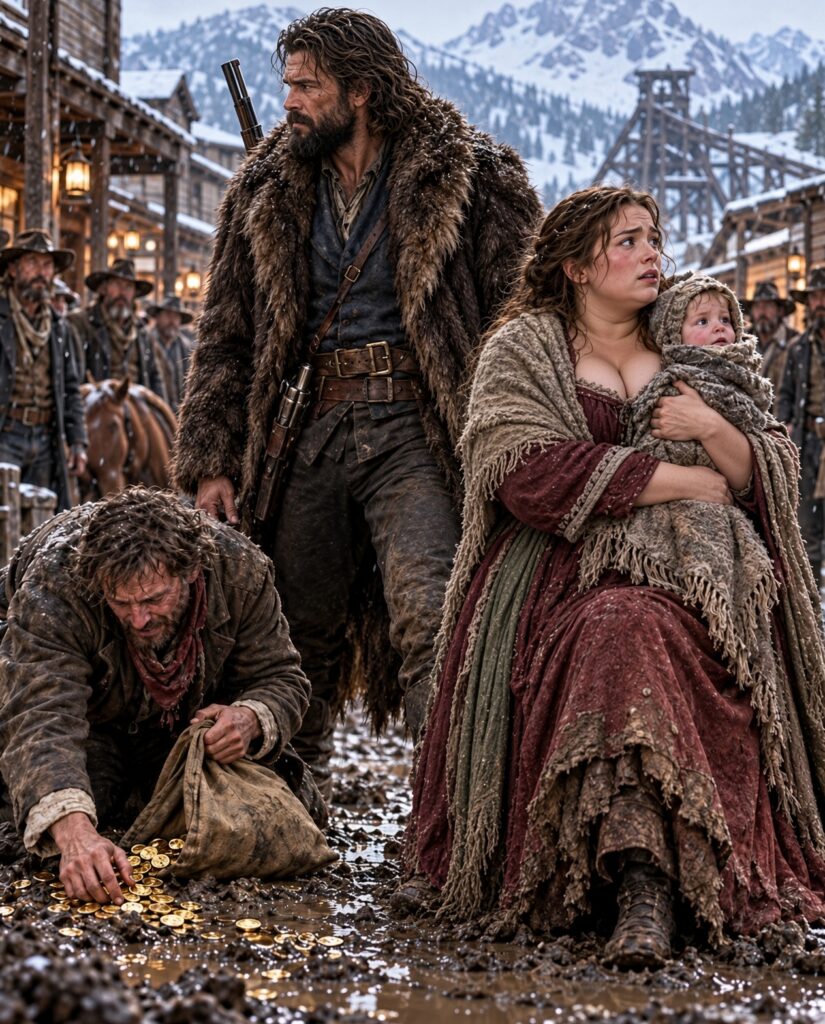
She Was Sold With Her Baby to the Most Feared Man in the Mountains, but His First Demand Was the One Thing Her Husband Had Never Given Her The bidding had reached forty dollars when Mae Walker realized the worst man in Misery Bend was about to own her.
She stood on an overturned whiskey crate in the middle of the mining camp,
clutching her eight-month-old son beneath a threadbare wool shawl while November sleet turned the street to black mud.
“Forty dollars,” Jeb Cutter called again.
Laughter rolled through the crowd.
Jeb was built like a fence post and smelled like blasting powder,
tobacco, and clothes that had not seen soap since spring.
Mae knew what happened to women who disappeared behind the door of his cabin.
Beside the crate, her husband grinned.
Or the man who had been her husband until five minutes ago.
Silas Walker held a bottle of rye in one hand and a
gambling ledger in the other.
“Forty!” he shouted.
“For a woman who cooks, washes, patches clothes, and comes with a healthy boy.
Somebody give me forty-five!”
Mae looked over the heads of the men toward the mountains.
She would not look at Silas.
She had done enough looking at him over the last three years.
She had watched him gamble away their wagon.
Their mule.
Her wedding ring.
The flour money.
Then the money she had hidden beneath a floorboard to
buy medicine when little Samuel came down with fever.
Last night,
Silas had lost money he did not have to men who did not accept apologies.
So this morning,
he had decided to sell something he still believed belonged to him.
Her.
No judge in Colorado would have called the auction legal.
No sheriff in Misery Bend was interested in stopping it.
That was the kind of law the frontier sometimes had.
The law of who had friends.
The law of who had a gun.
The law of who was frightened enough to keep quiet.
Mae tightened her arms around Samuel.
The baby whimpered.
“It’s all right,” she whispered against his hair.
“Mama’s got you.”
She had no idea whether that was true.
Jeb stepped forward.
“Forty-five.”
Silas grinned.
“Sold—” “One hundred dollars.”
The voice did not rise above the wind.
It did not have to.
Every man in the street went silent.
Someone near the saloon muttered, “Lord Almighty.”
The crowd opened.
A man stood at the far end of the street.
Mae had seen him only twice before.
Everybody in Misery Bend knew about Gideon Hale.
The mountain man.
The hermit from Blackstone Ridge.
The man who came into town four times a year for coffee, salt,
cartridges, lamp oil, and nothing else.
Stories followed him whenever he appeared.
They said he had killed a grizzly with a hunting knife.
They said three horse thieves had followed him into the
mountains and only Gideon had come back.
They said he had once buried a man beneath an avalanche
and never bothered telling anyone where.
Most of the stories were probably lies.
But looking at him, Mae understood why people believed them.
He was enormous.
Not merely tall,
but thick through the shoulders and chest,
wrapped in a buffalo coat that made him seem even larger.
A dark beard covered most of his face.
A pale scar disappeared from his left cheek into the beard along his jaw.
A rifle rode across his back.
A skinning knife hung at his thigh.
His eyes were a cold, startling gray.
River ice beneath a winter sky.
Jeb Cutter spat into the mud.
“You crazy, Hale?”
Gideon ignored him.
Silas stared.
“One hundred?”
Gideon walked forward.
He stopped below Mae’s crate.
He did not look at her body.
He looked at Samuel.
Then at her face.
“Does the boy stay with her?”
Silas laughed.
“Hell, yes.
I don’t want him.”
Something changed in Gideon’s eyes.
Only for a heartbeat.
But Mae saw it.
The gray went colder.
“One hundred,” he repeated.
Silas nearly dropped his whiskey bottle trying to reach for the money.
Gideon tossed a canvas pouch into the mud.
Gold coins struck one another with a heavy clink.
Silas fell to his knees.
Actually fell.
He opened the pouch with shaking hands.
Mae stared at Gideon.
A hundred dollars was more money than Silas had possessed in his entire life.
A sane man did not pay a hundred dollars for a woman and
a baby unless he expected something valuable in return.
Gideon looked up at her.
“Come down.”
Mae’s stomach turned to ice.
There it was.
The beginning.
She moved toward the edge of the crate.
Her wet boot slipped.
For one terrifying second, Samuel’s weight pulled her forward.
Then a hand closed around her arm.
Gideon caught her.
He steadied her until her boots found the ground.
Then he released her immediately.
No wandering hand.
No smile.
No whispered promise about what would happen later.
Nothing.
“My wagon’s outside town.”
He turned away.
Silas was still counting the gold.
Mae waited.
Some foolish little piece of her expected him to look up.
Perhaps to feel shame.
Perhaps to say Samuel’s name.
Perhaps to remember that three years earlier he had
stood inside a tiny church in Kansas and promised to
honor her until death.
He never looked up.
Mae pulled the shawl around her baby and followed the mountain man.
By sundown, Misery Bend was four hours behind them.
The mountains swallowed the trail.
Snow began falling harder.
Gideon drove a reinforced buckboard pulled by two broad-backed mules while Mae sat beside him,
shivering so violently she could barely keep her teeth from striking together.
Samuel slept against her chest.
Gideon had not spoken since they left town.
Mae secretly studied him.
His hands were enormous.
Scarred.
Powerful.
Hands made for splitting timber or breaking bones.
She imagined the cabin waiting somewhere beyond those mountains.
One room.
One bed.
No neighbors.
No sheriff.
No place to run.
Her throat tightened.
Silas had been cruel, but predictable.
She knew how much whiskey made him mean.
She knew which floorboards creaked when he crossed the room at night.
She knew when to lower her eyes.
She knew how to curl around Samuel so Silas’s boot
struck her ribs instead of the child.
Gideon was a blank page.
And blank pages frightened Mae more than familiar nightmares.
Without warning, he pulled the reins.
The mules stopped.
Mae’s heart jumped.
So this was it.
Far enough from town.
No witnesses.
Gideon climbed down.
Mae pressed Samuel closer.
Gideon reached beneath the wagon seat.
He pulled out a huge fur blanket.
Then he dropped it across Mae’s shoulders.
Heat trapped around her instantly.
She stared at him.
He uncorked a canteen.
“Drink.”
Mae hesitated.
“Water,” he said.
She took it.
It was water.
Not whiskey.
He looked at the baby.
“Keep him inside that fur.”
Mae drank.
“Thank you.”
Gideon gave a single nod.
“Trail gets too steep for the wagon ahead.
We walk the last mile.”
Mae looked toward the rising white slope.
“My boots—” “I know.”
He took the reins of the lead mule.
“You walk behind me.”
The snow reached Mae’s ankles.
Then her calves….?

The snow reached Mae’s ankles.
Then her calves.
Within twenty minutes, every step became a battle.
The trail climbed sharply between walls of black pine, and the wind came tearing down the mountainside hard enough to steal her breath.
Mae kept one arm around Samuel beneath the buffalo fur and used the other to steady herself against trees whenever her boots slipped.
Gideon walked ahead without seeming to notice the storm.
He led the mule with one hand, breaking a trail through the snow with his enormous boots.
Every few minutes he looked over his shoulder.
Not impatiently.
Checking.
Always checking.
Mae hated that she noticed.
Kindness could be another kind of trap.
Silas had taught her that.
The first time he struck her, he had cried afterward.
He had kissed the bruise on her cheek, promised never to drink again, and brought her wildflowers from beside the creek.
A week later, he broke two of her ribs.
Men could make gentleness into bait.
Mae would not forget that merely because Gideon Hale had given her water and a blanket.
The slope grew steeper.
Her right foot slid.
She caught herself.
Two steps later it happened again.
Then her weakened legs simply gave way.
Mae went down on one knee.
Samuel woke and began crying.
Gideon stopped instantly.
“I’m fine,” Mae said.
He came back toward her.
“I said I’m fine.”
His eyes moved from her face to the trembling leg she was trying to force beneath herself.
“No.”
One word.
No anger.
No judgment.
Just fact.
Before Mae could protest, Gideon took Samuel from her.
Fear exploded through her.
“No!”
She lurched upright.
Gideon froze.
The baby looked ridiculously small against his massive chest.
Mae reached for Samuel.
“Give him back.”
Gideon did.
Immediately.
No argument.
No tightening of his arms.
Mae pulled Samuel against herself so fiercely that the child cried harder.
Gideon stood several feet away.
Snow gathered in his beard.
“I was trying to carry him so you could walk.”
“I carry my own son.”
“All right.”
Mae stared at him suspiciously.
Most men she knew would have taken offense.
Silas certainly would have.
Being questioned was enough to make Silas furious.
Gideon simply turned toward the trail.
They walked another fifty yards.
Mae fell again.
This time she landed on both knees.
Pain shot through her legs.
Samuel screamed.
Gideon waited.
He did not move closer.
Finally Mae closed her eyes.
“Can you carry him?”
“Yes.”
“Only until we reach the cabin.”
“Yes.”
“And if he cries—”
“I give him back.”
“And you don’t—”
“I understand.”
Mae looked at him.
Something painful tightened behind her ribs.
He had allowed her to finish making rules.
No man had done that in years.
She handed him Samuel.
Gideon tucked the baby inside his buffalo coat.
Samuel stared up at the bearded stranger with enormous dark eyes.
For several seconds they studied each other.
Then the baby reached out and grabbed Gideon’s beard.
Mae’s breath caught.
Gideon looked down.
Samuel pulled.
Hard.
The most feared man in the mountains winced.
Mae made a sound before she could stop herself.
It took her a moment to recognize it.
A laugh.
Small.
Broken.
Almost forgotten.
Gideon looked at her.
Something shifted in his expression.
Then he carefully freed his beard from Samuel’s fist.
“Strong boy.”
Mae wiped her mouth with the back of her hand as though she could erase the laugh.
They continued upward.
Twenty minutes later, Gideon stopped at the edge of a clearing.
“There.”
Mae looked up.
The cabin was not what she had imagined.
It was larger.
Much larger.
Built from heavy pine logs beneath a steep roof buried in snow, the house sat against the mountainside surrounded by a barn, smokehouse, woodshed, and fenced pasture.
Warm yellow light glowed behind two windows.
Smoke curled from a stone chimney.
It looked less like the lair of a murderer and more like something Mae had stopped believing existed.
A home.
Her suspicion returned immediately.
Warm walls did not make a safe man.
Silas had once rented them a pretty white farmhouse.
He still beat her in the kitchen.
Gideon opened the door.
Heat rolled over Mae.
She nearly cried.
A stone fireplace occupied one wall.
Shelves held jars of beans, flour, dried apples, coffee, medicine, candles, and folded linens.
A table stood beside the hearth.
Two chairs.
There were three doors.
Gideon pointed to the first.
“My room.”
The second.
“Storage.”
Then the third.
“Yours.”
Mae stared.
“Mine?”
“Yours and the boy’s.”
He opened it.
A narrow bed stood beneath a wool quilt.
There was a small iron stove, washstand, cradle, chest of drawers, and—strangest of all—a lock on the inside of the door.
Mae noticed it immediately.
Gideon noticed her noticing.
“You can lock it.”
She looked at him.
He set Samuel gently on the bed.
Mae moved beside her son.
“What do you want?”
The question left her almost angrily.
Gideon pulled off his gloves.
“Tonight?”
“No.
For the hundred dollars.”
Silence.
“I know what a man expects when he pays for a woman.”
Gideon’s face hardened.
“Do you?”
“I’m not stupid.”
“I didn’t say you were.”
“Then tell me.”
His gray eyes held hers.
Finally he spoke.
“I want you to eat.”
Mae blinked.
“What?”
“You’re half-starved.”
She stared.
“That’s your first demand?”
“My first demand is that you eat enough to stand without falling down.”
Despite herself, Mae almost laughed again.
“I meant after that.”
“After that, you sleep.”
“And tomorrow?”
“Tomorrow you eat again.”
Her anger flared.
“Stop making sport of me.”
Gideon’s jaw tightened.
“I’m not.”
“Then why did you buy me?”
He looked toward Samuel.
For several seconds Mae thought he would not answer.
Then he said quietly, “Because Cutter would have.”
Mae remembered Jeb’s yellow grin.
Cold returned despite the fire.
“That isn’t enough reason to spend a hundred dollars.”
“It was to me.”
He turned toward the kitchen.
Mae followed him.
“No.”
Gideon stopped.
“I want the truth.”
“You’ll get it.”
“When?”
“When I know you and the boy aren’t going to freeze to death tonight.”
He placed a pot near the fire.
Mae did not move.
Gideon sighed.
Then he faced her fully.
“All right.”
His voice lowered.
“You want the truth?
Here’s the part you need now.”
He pointed toward her bedroom.
“That door locks from your side.
Mine doesn’t.”
Mae stared.
“I sleep with a rifle beside my bed.
There’s another rifle above your fireplace.
Loaded.”
Her heart thudded.
“You expect me to believe you would give me a gun?”
“I expect you to check it yourself.”
“Why?”
Gideon stepped back.
“So you understand the rule.”
“What rule?”
His expression became something Mae had never seen on a man speaking to her.
Not pity.
Respect.
“No one touches you in this house without your permission.”
Mae stopped breathing.
Gideon continued.
“Not me.
Not anyone.”
The room blurred.
For three years Silas had treated her body like property.
Before Silas, her father had decided whom she would marry.
Before that, her brothers had eaten first, spoken first, chosen first.
Mae could not remember a time when a man had told her that she belonged to herself.
Gideon reached for the stew pot.
“That includes the boy.
You decide who holds him.
You decide who comes into your room.
If I forget the rule, use the rifle.”
He turned away.
Mae gripped the edge of the table.
Something inside her cracked open so suddenly it hurt.
She hated him for saying those words.
Because some part of her had waited her whole life to hear them.
Mae expected Gideon’s kindness to change after a day.
It did not.
She expected it to change after a week.
It did not.
He gave her no chores.
That frightened her more than work would have.
On the second morning, she found him splitting firewood behind the cabin.
“I can cook.”
He brought the ax down through a log.
“I know.”
“I can mend.”
Another swing.
“I know.”
“I can clean.”
He stopped.
Snow covered his shoulders.
“Mae.”
She stiffened.
“You don’t owe me labor.”
“You paid a hundred dollars.”
“I paid Silas a hundred dollars.”
“For me.”
“No.”
She stared.
Gideon buried the ax blade in the stump.
“I paid him to get him to let go long enough for me to take you away.”
“That sounds the same.”
“It isn’t.”
“To Silas, I was merchandise.”
Gideon’s eyes went cold.
“To Silas, whiskey was breakfast.
I don’t use him to decide what’s true.”
Mae had no answer.
So she cooked anyway.
The stew was better than Gideon’s.
He admitted this by eating three bowls.
Days became weeks.
The first heavy winter storm sealed Blackstone Ridge beneath six feet of snow.
Mae discovered Gideon’s routines.
He rose before dawn.
Fed the mules.
Checked traps.
Chopped wood.
Repaired harness.
Hunted only when they needed meat.
He spoke little, but Samuel adored him.
The baby learned the sound of Gideon’s footsteps before Mae did.
Whenever the front door opened, Samuel would turn his head and wave both hands.
At first Gideon pretended not to notice.
Then one afternoon Mae caught him carving something beside the fire.
“What is that?”
“Nothing.”
The most feared man in the mountains attempted to hide the object behind his leg.
Mae narrowed her eyes.
“Gideon.”
He handed it over.
It was a tiny wooden horse.
Smoothly carved.
Four short legs.
A black yarn tail.
Mae stared.
“Samuel can’t even walk.”
“He will.”
A warmth spread through her that had nothing to do with the fire.
“You carved this?”
“No.
A talented squirrel left it on the porch.”
Mae looked at him.
Gideon’s mouth twitched.
It was the first joke she had ever heard him make.
She laughed.
This time she did not stop herself.
Gideon watched her.
And for the first time, Mae saw what he might have looked like before grief and solitude hardened his face.
Almost young.
Almost happy.
That frightened her too.
The nightmares came in December.
Mae woke screaming.
For one confused instant she was back in Misery Bend with Silas kicking the bedroom door open.
Then she saw moonlight.
The locked door.
Samuel sleeping in the cradle.
Someone stood outside.
“Mae?”
Gideon.
She reached for the rifle before thinking.
“I’m here,” he said from the hallway.
“I heard you scream.”
“I’m fine.”
Silence.
“All right.”
His footsteps moved away.
Mae stared at the door.
He had not tried the handle.
Not once.
The following morning he said nothing about it.
That night the nightmare came again.
This time Samuel woke crying.
Mae tried to soothe him, but her hands shook.
A soft knock came from the door.
“Mae?”
She hesitated.
“Yes?”
“Want me to build up the fire?”
The stove had nearly gone out.
“Yes.”
She unlocked the door.
Gideon entered without looking at her thin nightdress.
He crouched beside the stove.
Samuel reached toward him.
Gideon glanced at Mae.
She understood the question.
“You can take him.”
He lifted Samuel.
The baby immediately pressed his cheek against Gideon’s chest.
Gideon sat in the rocking chair.
Mae watched from the bed.
“You’ve done that before.”
“Done what?”
“Held a baby.”
The chair stopped moving.
Something dark passed across his face.
“A long time ago.”
Mae waited.
He said nothing else.
She did not press.
That was another thing Gideon had taught her.
Silence could be given as a kindness instead of used as a weapon.
Christmas arrived beneath a sky so clear that every mountain peak looked carved from glass.
Mae woke to find three parcels beside the fireplace.
One contained winter boots lined with rabbit fur.
One contained a blue wool dress.
One contained a stuffed bear for Samuel.
Mae carried the dress into the kitchen.
“You bought this before the storm?”
Gideon was making coffee.
“Yes.”
“How did you know my size?”
“I guessed.”
“You guessed well.”
He became extremely interested in the coffee pot.
Mae smiled.
Then she noticed a fourth package on the table.
Small.
Wrapped in brown paper.
“That one is yours,” she said.
Gideon looked suspicious.
“I didn’t ask for anything.”
“Neither did I.”
He opened it.
Inside was a pair of knitted gloves.
Mae had made them secretly from spare wool.
Gideon held them as though they were made of gold.
“They’re not very good,” Mae said.
“They are.”
“The left thumb is crooked.”
“My left thumb is crooked.”
She laughed.
His eyes lifted.
For a moment neither of them spoke.
Something passed between them.
Warm.
Dangerous.
Mae looked away first.
The truth arrived three days after Christmas.
Gideon was in the barn when Mae decided to reorganize the storage room.
She found a wooden box beneath folded blankets.
Inside were papers.
Letters.
A photograph.
Mae almost closed the box.
Then she saw the name written across one envelope.
Mae Carter.
Her maiden name.
Her hands turned cold.
She opened it.
The letter had been written four years earlier.
Dear Mae,
If this reaches you, I pray you will believe that I never forgot you.
Your mother was my sister, and I have spent twelve years searching for where your father took you after Sarah died…
Mae stopped reading.
Her breath came too quickly.
The signature at the bottom was unmistakable.
Gideon Hale.
She tore open another letter.
And another.
All addressed to her.
None had reached her.
Some had been returned.
Some were unopened.
One had a note attached from a Kansas postmaster.
Recipient reportedly married to Silas Walker.
Husband declined delivery.
Mae stood so abruptly the box hit the floor.
Gideon entered moments later.
He stopped when he saw the letters.
Mae held one up.
“You knew me.”
His face went still.
“You knew who I was before Misery Bend.”
“Yes.”
“How long?”
“Years.”
“How?”
“Your mother.”
“My mother died when I was six.”
“She was my sister.”
The world seemed to tilt.
“No.”
“Her name was Sarah Hale before she married Thomas Carter.”
Mae remembered almost nothing of her mother.
A voice singing.
Hands braiding her hair.
A silver locket.
Her father had thrown the locket away after remarrying.
“You’re my uncle?”
Gideon’s expression softened painfully.
“Yes.”
Mae stepped backward.
“Why didn’t you tell me?”
“I was going to.”
“When?
After another month?
A year?”
“When you stopped looking at me like I might murder you in your sleep.”
Anger hit her.
“You bought me!”
“I got you away from Silas.”
“You could have told me!”
“In front of him?”
“After!”
“You were terrified of me.”
“So you lied instead?”
“I never lied.”
“You let me believe—”
“That you were safe here.
Because you were.”
Mae threw the letter at him.
“You knew my mother.”
“Yes.”
“You knew who I was.”
“Yes.”
“And you stood there while that man sold me like an animal!”
Something erupted in Gideon’s face.
“I stood there because if I had put a bullet through Silas Walker’s skull, which was what I wanted to do, you would have had nowhere to go except a jailhouse courtroom to explain why the mountain murderer had killed your husband.”
His voice shook.
“I had already spent three years trying to find you legally.
Every letter vanished.
Every inquiry led nowhere.
Silas moved you from Kansas to Wyoming, then Colorado.
By the time I found Misery Bend, the sheriff was taking bribes from the same men Silas owed money to.”
Mae stared.
Gideon lowered his voice.
“I arrived in town that morning expecting to speak to you.”
He looked away.
“Then I saw you on that crate.”
His fists closed.
“I have regretted many things in my life, Mae.
Paying that money is not one of them.”
She could hear her own heartbeat.
“Why were you looking for me?”
He reached into the box.
Beneath the letters was a legal document.
He handed it to her.
Mae unfolded it.
It was a deed.
Forty acres in Colorado.
A farmhouse.
Mining rights.
And another document.
A bank certificate.
She looked at the amount twice.
Five thousand eight hundred dollars.
Her knees weakened.
“What is this?”
“Your inheritance.”
Mae stared at him.
“From whom?”
“Your mother.”
“She had nothing.”
“She had family land.”
Gideon sat down heavily.
“Our father owned a silver claim east of Leadville.
When he died, half passed to Sarah.
She never knew how valuable it became.
Your father left before the claim started paying.”
Mae could barely understand the words.
“When Sarah died, her share went to you.”
“And you?”
“I received the other half.”
“Why didn’t you keep mine?”
Gideon looked genuinely confused.
“Because it isn’t mine.”
Mae had lived three years with a man who stole coins from beneath floorboards.
Now she stood before a man who had guarded a fortune for someone he had never met.
“Does Silas know?”
Gideon’s eyes hardened.
“I think he learned something.”
Mae felt suddenly sick.
“The letters.”
“Yes.”
“He refused them.”
“Yes.”
“He knew you were searching for me.”
“Probably.”
“Then why sell me?”
Gideon looked toward the window.
“That is the question keeping me awake.”
The answer came two weeks later.
A rifle shot broke the morning silence.
Gideon dropped the bucket he was carrying.
“Inside!”
Mae grabbed Samuel.
Another shot cracked.
Wood exploded from the porch railing.
Gideon pushed Mae toward the cabin.
“Lock the door.”
“Who is it?”
“Now!”
She ran.
Through the window she saw three riders emerge from the trees.
Jeb Cutter.
Sheriff Bram Cole.
And Silas.
Mae’s blood froze.
Silas looked different.
Sober.
Angry.
And armed.
“Well, there she is!” he shouted.
Gideon stepped into the clearing with his rifle.
“Leave.”
Sheriff Cole laughed.
“Not how the law works, Hale.”
“You have never cared how the law works.”
“This time I brought paperwork.”
Silas grinned.
“My wife was abducted.”
Mae’s stomach turned.
Gideon did not move.
“You sold her.”
“Can’t legally sell a wife.”
Sheriff Cole smiled.
“That means the transaction was invalid.”
Jeb chuckled.
“Guess old Hale wasted a hundred dollars.”
Silas shouted toward the cabin.
“Mae!
Come outside!”
She did not move.
Silas’s expression changed.
The familiar darkness entered his eyes.
“Mae.”
Samuel began crying.
Gideon lifted his rifle slightly.
“You heard no.”
Silas stared at him.
“She’s my wife.”
“No.”
“I got a marriage certificate.”
Gideon’s voice became deadly quiet.
“You have five seconds.”
Sheriff Cole reached for his pistol.
“Careful.”
Mae saw what would happen.
Blood.
Death.
Then the law would call Gideon a murderer.
Silas knew it.
That was why he had brought the sheriff.
Mae unlocked the door.
Gideon turned.
“Stay inside.”
“No.”
His eyes flashed.
Mae stepped onto the porch with Samuel in her arms.
Silas smiled.
“That’s my girl.”
Mae felt the old terror rise.
Then something remarkable happened.
It stopped.
She looked behind her.
The door.
Her rifle.
Gideon.
The mountains.
Months without being struck.
Months without having food taken from her plate.
Months of sleeping behind a door no one opened without permission.
Fear had not vanished.
But it no longer owned the entire house inside her.
“You’re not my husband anymore,” Mae said.
Silas laughed.
“Marriage doesn’t end because you decide.”
“Neither does ownership, apparently.”
His smile disappeared.
“Get over here.”
“No.”
Silas stepped forward.
Gideon raised the rifle.
Sheriff Cole drew his revolver.
Everything froze.
Mae looked at the sheriff.
“You want paperwork?”
She handed Samuel to Gideon.
Then she went inside.
When she returned, she carried the letters.
And the inheritance deed.
Silas went pale.
Mae saw it.
There.
The answer.
“You knew.”
Silas said nothing.
“You knew about the inheritance.”
Sheriff Cole looked at him.
“What inheritance?”
Jeb did too.
Mae’s mind raced.
Suddenly she understood.
Silas had not sold her because he believed she was worthless.
He had sold her because he expected Gideon to take her into the mountains.
Somewhere remote.
Somewhere no one would see what happened next.
“You wanted him blamed for my death,” Mae whispered.
Gideon looked at Silas.
Silas’s expression exposed everything.
Mae continued.
“You thought Gideon would kill me.
Or I would freeze.
Or disappear.
Then you would claim my inheritance as my husband.”
Sheriff Cole’s gaze sharpened.
Silas barked, “Shut up.”
“You found Gideon’s letters years ago.”
“Mae.”
“You knew my mother left me land.”
“Get over here!”
“You gambled because you thought money was coming.”
Silas raised his pistol.
Everything happened at once.
Samuel screamed.
Gideon moved in front of Mae.
Silas fired.
The bullet struck Gideon high in the shoulder.
He fell against the porch post.
Mae heard herself scream.
Jeb raised his rifle.
Then another gunshot thundered from the tree line.
Jeb’s weapon flew from his hand.
A voice shouted, “FEDERAL MARSHAL!
DROP YOUR WEAPONS!”
Four riders emerged from the forest.
Silas turned white.
Sheriff Cole immediately lowered his pistol.
Gideon, bleeding heavily, looked almost annoyed.
Mae stared at him.
“You knew they were coming?”
He pressed one hand to his shoulder.
“Hoped.”
The lead rider dismounted.
Marshal Nathaniel Brooks.
Gideon had sent a letter before the winter passes closed.
A letter detailing Mae’s illegal sale.
The corrupt sheriff.
Silas intercepting federal mail regarding an inheritance.
And suspected fraud involving property claims in three territories.
Brooks walked toward Silas.
“Silas Walker?”
Silas began backing away.
“No.”
“That wasn’t a difficult question.”
Silas ran.
He made it seven steps.
Jeb tripped him.
Apparently friendship among criminals ended quickly when federal prison became involved.
Silas hit the snow face-first.
The marshal cuffed him.
Mae barely watched.
She was kneeling beside Gideon.
Blood soaked through his coat.
“You idiot.”
Gideon blinked.
“I’ve been called worse.”
“You got shot.”
“I noticed.”
“You knew men might come after us and didn’t tell me?”
“I didn’t know when.”
“You should have told me!”
“Yes.”
Her hands trembled as she pressed cloth against the wound.
Gideon looked up at her.
“Mae.”
“What?”
“You’re shouting at me.”
“I know!”
A faint smile appeared beneath his beard.
“Good.”
She almost hit him.
Instead she began crying.
Gideon survived.
The bullet passed cleanly through the muscle beneath his collarbone.
Mae spent three weeks changing the bandage.
He complained constantly.
Not about pain.
About being forced to stay in bed.
“You’ll tear the wound.”
“The mule needs—”
“The mule prefers me.”
“He does not.”
“He told me.”
Gideon stared.
Mae raised an eyebrow.
“Talented squirrel speaks mule.”
He laughed so suddenly that he grabbed his shoulder in pain.
“Serves you right,” Mae said.
Samuel, now crawling, slapped both hands against the floor and laughed with him.
The federal case against Silas uncovered far more than Mae expected.
He had forged her signature on loan papers.
Intercepted legal correspondence.
Used her inheritance as collateral with gamblers before he had even gained possession of it.
Sheriff Cole had helped him locate property records in exchange for part of the money.
Jeb Cutter testified against both men.
Not because Jeb discovered morality.
Because the marshal offered him a shorter sentence.
Silas Walker received twelve years in federal prison.
Bram Cole received eight.
Mae sat in the Denver courtroom when the judgment was announced.
Silas turned toward her before the guards led him away.
“I made you,” he hissed.
Mae looked at him.
Once those words would have broken something inside her.
Now she almost pitied the man who believed suffering was creation.
“No,” she said.
“You just made it hard for me to discover who I already was.”
Silas was taken away.
Mae never saw him again.
Spring came late to Blackstone Ridge.
Snow withdrew from the meadows.
Creeks roared with meltwater.
Wildflowers appeared beneath the pines.
And Samuel took his first steps between Mae and Gideon.
Mae knelt beside the porch.
“Come on, sweetheart.”
Gideon crouched six feet away.
Samuel stood uncertainly between them.
His little legs trembled.
He looked toward his mother.
Then toward Gideon.
Then he laughed and charged forward.
Three steps.
Four.
Five.
He fell directly into Gideon’s arms.
Gideon lifted him triumphantly.
“You saw that?”
Mae laughed.
“I saw.”
“He walked.”
“I noticed.”
“Five steps.”
“Six.”
“Five.”
“Six.”
They argued until Samuel grabbed Gideon’s beard.
Some things never changed.
That evening, after Samuel had fallen asleep, Mae found Gideon standing outside.
The sunset turned the western mountains gold.
She stood beside him.
“You’re leaving tomorrow?”
He nodded.
“Denver.”
“To speak with the bank?”
“And the lawyer.”
Mae had decided to sell part of her inherited mining interest while keeping the farmhouse land.
Gideon had helped arrange everything but refused payment.
She had stopped trying to offer.
“Gideon.”
“Hm?”
“What happens afterward?”
He looked at her.
“What do you mean?”
“To us.”
His face became carefully blank.
The expression irritated her.
“You’re very brave when facing bears and armed men.”
Gideon looked toward the mountains.
“Bears are simpler.”
Mae smiled.
“Answer.”
“You own your land now.”
“Yes.”
“You have money.”
“Yes.”
“You don’t need this cabin.”
Her chest tightened.
“That wasn’t the question.”
Gideon remained silent.
Mae stepped in front of him.
“Do you want me to leave?”
His eyes snapped toward hers.
“No.”
The word came too quickly.
She waited.
Gideon exhaled.
“No.”
“Then say what you do want.”
His enormous hands opened and closed at his sides.
Mae had seen those hands skin elk, repair wagon wheels, carry Samuel through snow, and hold a rifle steady beneath gunfire.
Now they seemed helpless.
“I want something I have no right to ask for.”
“You once told me nobody decides what belongs to me except me.”
“Yes.”
“So let me decide.”
Gideon looked at her for a long time.
“I want you here.”
Her throat tightened.
“I want Samuel here.”
He swallowed.
“And if someday you wanted me as something other than your uncle—”
Mae blinked.
Silence.
Then Gideon’s face changed.
He realized what he had said.
Mae stared at him.
“Gideon.”
He froze.
“You are my mother’s brother.”
His expression went from vulnerable to horrified.
“I meant—”
Mae began laughing.
Gideon closed his eyes.
“Wrong sentence.”
“A very wrong sentence.”
“What I meant was—”
“Please stop.”
“I mean family.”
She laughed harder.
Gideon rubbed both hands over his face.
“I’m going into the mountains.”
“You live in the mountains.”
“Farther into them.”
Mae wiped tears from her eyes.
For the first time since Misery Bend, she laughed until her ribs hurt.
Gideon eventually laughed too.
When the laughter faded, Mae leaned her head against his shoulder.
“Family,” she said.
His arm carefully settled around her.
“Family.”
And strangely, that word was enough.
More than enough.
Because Mae had spent years believing rescue had to become romance to matter.
It did not.
Some love arrived without possession.
Some men protected without expecting payment.
Some homes were built not from desire, but from loyalty.
Gideon Hale had not bought a wife.
He had brought his sister’s daughter home.
Two years later, Mae Carter opened the Blackstone Ridge Boarding House on the property her mother had left her.
Travelers heading through the mountain pass stopped there.
Miners.
Widows.
Families.
Runaways.
Women escaping husbands who believed marriage was another word for ownership.
There was always hot stew.
Always a warm bed.
And one unusual rule written beside the front door.
NO PERSON UNDER THIS ROOF BELONGS TO ANOTHER.
Gideon carved the sign himself.
Mae made him redo it because the first version was crooked.
He insisted the wall was crooked.
Samuel, now nearly three, followed Gideon everywhere.
He called him “Uncle Gid.”
Gideon pretended to dislike the name.
Everyone knew better.
One October afternoon, a wagon arrived from Denver.
A woman stepped down.
She was perhaps twenty-five.
Thin.
Bruised.
Holding the hand of a little girl.
Mae knew the look immediately.
Fear mixed with exhaustion.
The certainty that kindness always contained a hidden price.
Mae walked onto the porch.
“You’re Mrs.
Carter?” the woman asked.
“Mae Carter.”
“I heard you sometimes give women work.”
“When they want it.”
“And a place to sleep?”
“When they need it.”
The woman’s eyes filled.
“What do you charge?”
Mae looked past her.
Gideon stood near the barn splitting firewood.
Older now.
More gray in his beard.
Still enormous.
Still terrifying to anyone who did not know him.
Samuel sat on a stump nearby carving something badly with a blunt knife while Gideon supervised.
Mae smiled.
“Tonight?”
The woman nodded.
“Tonight I want you to eat.”
The woman blinked.
Mae remembered another cabin.
Another fire.
Another frightened mother standing inside a doorway, waiting to learn the price of safety.
“And after that?” the woman whispered.
“After that, you sleep.”
The woman began crying.
Mae stepped aside.
The door stood open.
Years earlier, on a frozen street in Misery Bend, Mae had believed the hundred dollars Gideon Hale threw into the mud was the price of her life.
She had been wrong.
The money had never purchased her.
It had purchased one brief moment in which a cruel man loosened his grip.
Gideon had simply used that moment to give Mae something Silas Walker never had.
Not a house.
Not money.
Not even protection.
A choice.
And once Mae understood that her life belonged to her, no man ever owned her again.

