
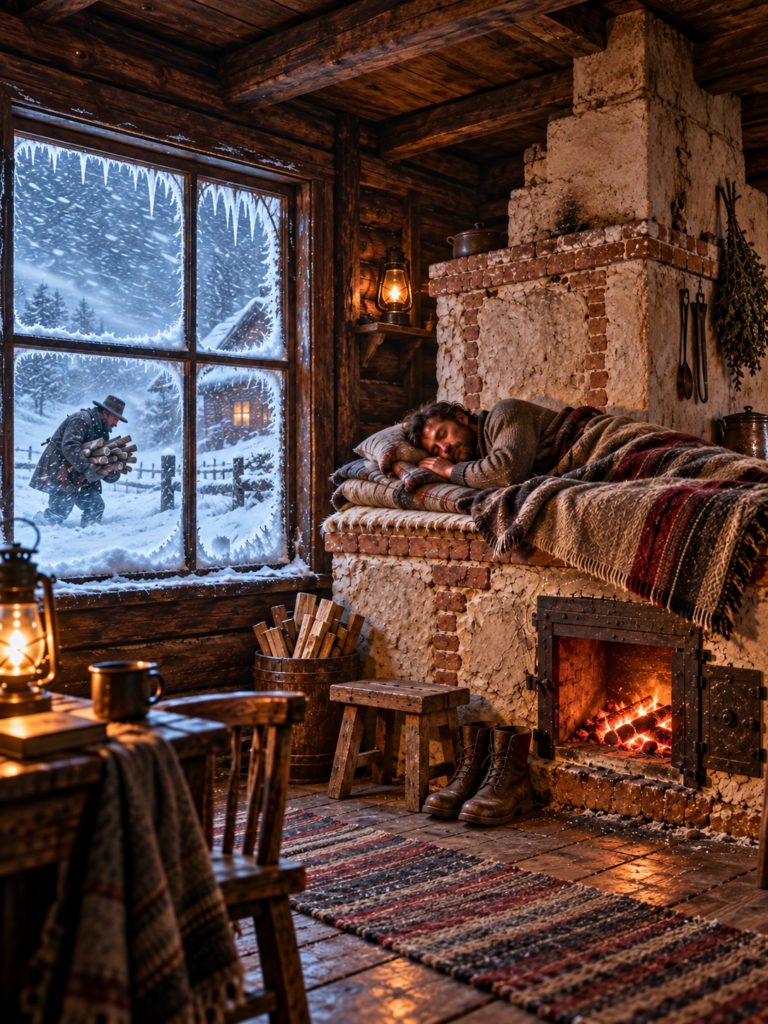
they laughed when the immigrant mason built a brick bed in his cabin—then the blizzard came and every freezing neighbor knocked on his door
Part 1
Late November came hard to Ash Creek Crossing in 1888.
Winter had not yet closed its fist around the Wyoming basin, but everybody who had lived there more than a year could feel the fingers curling.
Old snow lay in white seams along the fences, packed against cedar posts by the first north winds. The creek had narrowed beneath shelves of ice. Wagon ruts froze so solid a man could turn an ankle stepping across them. Each morning the mountains beyond the basin appeared sharper, colder, almost blue beneath a sky stripped clean of softness.
Smoke rose early from the cabins.
That was how people measured security in Ash Creek.
A straight ribbon from a chimney meant wood in the shed, coffee on the stove, blankets drying over chair backs, and another night a family would probably get through.
Warren Hail had his winter heating figured out before Thanksgiving.
Warren was forty-eight, broad through the shoulders, with a rancher’s permanent squint and hands toughened by rope, ax handles, frozen gates, and cattle that rarely cooperated when a man needed them to. He had spent enough Wyoming winters watching temperatures fall past zero that he no longer romanticized cold weather.
Cold was not beautiful when water froze inside the house.
Cold was not peaceful when a cow dropped a calf in a drift.
Cold was not a story to tell until after you survived it.
His new cast-iron box stove had been installed in less than two days.
Emmett Rowe, the settlement blacksmith, had checked the pipe himself.
“Good draw,” Emmett had said after holding a shaving near the open door and watching the flame pull inward. “You’ll cook yourself out of here if you’re not careful.”
Warren grinned.
“That’s the kind of problem I like.”
His wife, Matilda, had already placed a black kettle on the top plate.
By evening, their cabin smelled of coffee, pine smoke, fried salt pork, and hot iron.
Then there was Jonas Varic.
People had stopped understanding what Jonas was doing around the third day.
He was forty-one, lean and dark-haired, though gray had begun appearing above his ears. He had come west after years of masonry work in Moravia and then more years doing whatever labor he could find after arriving in America—railroad grading, foundation work, stone fences, chimney repairs, barn footings.
He did not speak much unless there was something worth saying.
Some men mistook silence for ignorance.
Jonas had long ago learned to let them.
His cabin stood near the center of Ash Creek Crossing, not far from Warren’s place, a plain seventeen-by-twenty-three-foot structure with cottonwood rafters, rough pine walls, two small windows, and a roof that complained loudly during high wind.
It was not large enough to waste space.
Yet one morning Warren stepped through the door and found Jonas apparently doing exactly that.
Jonas stood in the middle of the room with a worn mason’s square in one hand.
A broad rectangle had been marked across the plank floor.
Inside the outline, he was setting fieldstone.
Outside, beneath a canvas sheet, sat stacks of salvaged brick Jonas had hauled from an abandoned kiln nearly twenty miles away.
Warren stared at the stones.
Then at the bricks.
Then at the cold stove pipe hanging overhead.
“Are you heating a house,” he asked, “or building another room inside it?”
Jonas crouched and adjusted a stone.
He checked it against a line.
Then he reached for another.
Warren leaned against the doorframe.
“You know winter isn’t going to wait for you to finish your monument.”
Jonas pressed the stone into place.
“I know.”
“Cast iron stove would’ve been working yesterday.”
“I know.”
“Emmett can get you one.”
Jonas finally looked up.
“I know.”
Warren laughed.
That was one of the things about Jonas. Arguing with him could feel like pushing against a fence post.
Inside the cabin, Jonas’s wife, Elena, stood beside the kitchen table peeling potatoes.
She was not laughing.
She watched the rectangle spreading across the middle of their floor and understood the practical problem better than Warren did.
Every brick Jonas laid took something.
Walking space.
Table space.
Storage space.
The cabin had only one main room and a smaller sleeping partition at the rear. In winter, with wet coats hanging near the door and food sacks stacked against the walls, every square foot mattered.
That evening, after Warren left, Elena put down her knife.
“How large?”
Jonas knew what she meant.
“Five feet four by four feet eight at the base.”
“And how high?”
“A little over seven feet.”
She stared at him.
“Jonas.”
He wiped mortar from his trowel.
“I measured.”
“That’s not what I’m asking.”
He sat back on his heels.
Elena stepped around the growing foundation.
“Where does the table go?”
“Window wall.”
“And the chairs?”
“We move them.”
“And what happens when the masonry cracks?”
“I open the crack and repair it.”
“If the chimney won’t draw?”
“I correct it.”
“If winter comes before the mortar dries?”
“I fire slowly.”
Elena folded her arms.
“You have an answer for everything.”
“No.”
That stopped her.
Jonas rested the trowel across his knee.
“I have answers for things I know. The rest, we find.”
For a moment, only the wind spoke against the cabin wall.
Elena looked at the old square beside him.
Its wooden handle had been worn nearly smooth. Two initials were carved there, so faded a person had to hold it toward the light to read them.
His father’s.
Jonas had carried that square farther than he had carried almost anything else.
Across Moravia.
Across an ocean.
Across train platforms and labor camps and rented rooms.
Across more than half a continent.
As a boy he had watched his father work beside masonry ovens thick enough to stay warm after the fire died.
Jonas remembered winter mornings when frost patterned the windows but the plaster wall surrounding the old heater remained warm beneath his palm.
The flames were gone.
The heat stayed.
Years later, in America, he found himself watching men do the opposite.
They heated iron.
The iron heated air quickly.
Then the fire weakened, the iron cooled, and the warmth left almost as quickly as it came.
Every few hours, another log.
Every night, another waking.
Elena had heard him complain about it during their first Wyoming winter.
“They burn the heat,” he had said.
She had been mending a sock beside a stove glowing dull red.
“What does that mean?”
Jonas had looked at the pipe disappearing through the roof.
“Then they watch it leave.”
She smiled now at the memory, though she tried not to.
“You’re certain about this?”
“No.”
That surprised her again.
Jonas stood.
“I am certain enough to build it carefully.”
Elena looked at the unfinished mass.
Then at the table.
“All right.”
That evening they moved the table against the window.
Jonas took one end.
Elena took the other.
By the following week, nobody entering their cabin could ignore the thing.
The firebox sat low in the structure, lined with refractory brick Jonas had bought cheaply from the abandoned kiln. Around it rose salvaged kiln brick and local fieldstone, all bound with lime-clay mortar.
The weight would eventually reach several thousand pounds.
The heater grew upward.
Then outward.
Jonas extended masonry from one side until it formed a bench about thirty-four inches above the floor.
Warren arrived while Jonas was smoothing the top.
He walked around it.
“At least you remembered somewhere to sit.”
Jonas shook his head.
“Sleep too.”
Warren blinked.
“What?”
“On coldest nights.”
Warren looked at the stone ledge.
Then at Jonas.
“You’re building a bed into your stove.”
“A bench.”
“That you sleep on.”
“Sometimes.”
Warren barked a laugh so loud Elena heard it from the pantry.
By evening, half Ash Creek had heard about Jonas Varic’s brick bed.
At Emmett’s forge, Warren repeated the story while the blacksmith hammered a strap hinge.
“Seven-foot pile of brick right in the middle of the cabin,” Warren said. “And now he’s planning to sleep on it.”
Emmett plunged the iron into water.
Steam jumped from the barrel.
“He always was a strange one.”
“Good mason.”
“Didn’t say he wasn’t.”
“Just strange.”
Emmett smiled.
“Masonry takes forever to heat.”
“Exactly.”
“You come home wet at ten below, an iron stove has you warm before you’ve finished cussing the weather.”
“Exactly.”
Neither man was cruel.
That would have been easier for Jonas, perhaps.
Cruelty can be dismissed.
What troubled him more was that their argument was sensible.
Two nights later Warren invited him over.
“Come see heat that doesn’t require a cathedral.”
Matilda shook her head when she heard that but made coffee anyway.
Warren crouched beside the iron stove, stacked dry lodgepole pine over kindling, struck a match, and opened the draft.
Flame climbed.
Within minutes, the iron began ticking as it expanded.
Twenty minutes later Jonas unbuttoned his coat.
Matilda set the kettle on top.
Steam soon whispered from the spout.
Emmett stood near the stove rubbing his hands together.
“That’s the thing about iron,” he said. “It doesn’t need convincing.”
Warren pointed toward Jonas.
“A man comes home in a wet coat when it’s ten below. He needs heat now, not three hours later.”
Jonas stepped closer.
He held his palm near the iron until the radiant heat forced him to pull back.
“It does that well.”
Warren waited.
Jonas looked toward the pipe.
“Mine answers another question.”
“What question?”
“What happens four hours after flame is gone?”
Warren shrugged.
“You add another log.”
Emmett nodded.
There it was.
A reasonable answer.
A frontier answer.
A proven answer.
Jonas drank his coffee.
He did not argue.
But while the others talked, his eyes kept returning to the stove pipe.
Heat roared from the iron.
Smoke and hot gases climbed through the pipe and disappeared into the night.
Back at his cabin, he worked on the part nobody would see.
Above the firebox, Jonas built a large internal chamber.
Instead of allowing hot gases to hurry directly into the chimney, he forced them to rise into the brick mass first.
There they spread.
Slowed.
Transferred heat into masonry.
As they cooled, they descended through a side passage before reaching the flue.
The principle was ordinary where Jonas had grown up.
The scale looked extraordinary in Wyoming.
Iron warmed fast because there was relatively little material to heat.
It also lost heat fast.
Masonry demanded patience.
But once thousands of pounds of brick and stone absorbed energy, they surrendered it slowly.
Jonas did not want a weak fire burning all night.
He wanted a short, fierce, clean burn.
Then darkness.
Then sleep.
Outside, snow began falling.
Soft at first.
It covered fence rails and filled hoofprints.
It collected on the canvas protecting Jonas’s remaining bricks.
Inside, Jonas fitted the damper.
He worked it forward.
Back.
Forward again.
Nothing caught.
Nothing scraped.
Elena stood near the bench.
“You ever think about what Warren said?”
“Often.”
“About being warm quickly?”
Jonas nodded.
“He is right.”
Elena looked surprised.
“So are you building the wrong thing?”
Jonas brushed dust from the old square.
“No.”
“How can both be right?”
“Different questions.”
That night, long after Elena slept, Jonas sat alone beside the unfinished heater.
His fingertips rested on the square’s wooden handle.
He remembered his father telling him something when he was barely twelve.
A wall does not care how proud you are.
If it is crooked, it is crooked.
If the mortar is weak, it is weak.
Winter, Jonas thought, was much the same.
It would not care that Warren laughed.
It would not care that Jonas believed.
It would judge the work.
And winter was already coming.
Part 2
Jonas did not light the first real fire until the mortar had been given time to harden.
Even then, he began cautiously.
The morning was seventeen degrees.
Cold enough that Elena wore her shawl indoors.
Jonas arranged seasoned lodgepole pine inside the firebox, opened the draft, and struck a match.
The flame caught quickly.
He waited.
An hour passed.
The cabin remained cold.
The inner brick was taking heat, but very little had reached the surface.
Elena sat near the table with her hands around a coffee cup.
“How long?”
Jonas glanced at the heater.
“Longer.”
Another hour passed.
The bench became faintly warm.
That was all.
Warren arrived shortly after noon and stood by the door without removing his coat.
He had the decency not to grin.
That almost made it worse.
Jonas fed more wood into the firebox.
The heater seemed determined to warm itself before helping a single human being.
Warren rubbed his beard.
“My stove would have the windows open by now.”
Jonas knew.
He opened the firebox to adjust a split log.
Smoke curled into the cabin.
He froze.
A gray ribbon first.
Then another.
Elena moved at once, crossing to the wall vent and cracking it open.
Jonas watched the flame.
Instead of leaning strongly inward toward the chamber, it fluttered uncertainly.
Another gust pressed against the cabin.
Smoke rolled out.
Jonas closed the firebox door.
Warren said nothing.
Jonas pulled on his coat and went outside.
Snow squeaked beneath his boots.
A northwest breeze crossed the roof ridge.
Jonas stood below the chimney and watched.
Another gust came over the roof.
The air rolled downward near the short flue.
He watched again.
And again.
His stomach tightened.
The chimney was too low.
He had expected the draft to rise cleanly.
Instead the roof itself was disturbing the airflow, allowing gusts to press downward near the chimney cap.
When Jonas came inside, smoke hung beneath the rafters.
Elena had opened the door.
The cabin was colder than before.
Warren buttoned his coat.
“I’ll leave you to it.”
There was no joke in his voice.
That somehow cut deeper than mockery.
Jonas sat on the masonry bench after Warren left.
It was finally warm.
Warm and useless beneath a room filled with smoke.
Elena shut the door once the air cleared.
“You know what’s wrong?”
“Yes.”
“You can fix it?”
“I think.”
She studied his face.
“What if the next thing is wrong?”
“Then I fix the next thing.”
“And after that?”
“The next.”
Elena looked at him for a long moment.
Then she placed a hand on his shoulder.
At first light Jonas climbed onto the roof.
Frost had formed along the shingles.
He moved carefully, hammer tucked through his belt.
He studied soot around the flue opening.
Then he crouched beside the ridge.
The wind confirmed what he had seen.
The chimney needed height.
Emmett agreed to help.
At the forge, the blacksmith shaped a simple wind hood while Jonas prepared another length of flue.
Hammer blows rang against the morning.
Emmett glanced at him.
“Fixing your pipe doesn’t prove your brick mountain.”
Jonas held a strip of iron steady.
“No.”
Emmett waited for more.
Nothing came.
“You don’t get tired of people telling you that thing won’t work?”
Jonas thought.
“Sometimes.”
“Doesn’t show.”
“Showing does not fix chimney.”
Emmett laughed despite himself.
They raised the flue roughly thirty inches and fitted the new hood.
That evening Jonas fired again.
He opened the door.
The flame leaned inward.
No smoke escaped.
Elena watched from beside the table.
“Better.”
Jonas nodded.
For nearly two hours they allowed the fire to burn.
The upper masonry slowly warmed.
Then Elena sat on the bench.
After less than a minute she stood.
“Jonas.”
He looked over.
“This end is hot.”
He crossed the room.
The section nearest the chamber was too warm to touch comfortably.
Several feet away, the far end was barely lukewarm.
Jonas ran his palm along the masonry.
Hot.
Warm.
Cool.
His jaw tightened.
The gases were surrendering too much heat too early.
The flow was uneven.
By the next morning Warren knew.
Ash Creek was too small for failure to remain private.
He came by carrying a sack of oats and found Jonas marking the bench with chalk.
“Heard you solved the smoke.”
“Yes.”
“And found another problem.”
“Yes.”
Warren looked at the chalk marks.
“I don’t mean this badly, Jonas, but my iron stove needed a pipe and a damper.”
Jonas nodded.
Warren waited for an argument.
Again none came.
Jonas waited until the heater cooled.
Then he removed bricks he had already laid.
Each hammer tap felt personal.
Mortar he had carefully smoothed now had to be broken.
Courses he had checked with his father’s square now came apart.
Elena carried bricks to the table.
Jonas knocked hardened mortar from each one with hammer and chisel.
Chip.
Turn.
Chip.
Brush.
Stack.
Then another.
Late in the afternoon Elena saw blood along one of his knuckles.
“Enough for today.”
“Almost.”
“You said that an hour ago.”
Jonas kept working.
Elena stepped between him and the brick pile.
He looked up.
“Your hands are shaking.”
Only then did he notice.
Not from cold.
From exhaustion.
He lowered the hammer.
That night they ate quietly.
Wind pushed against the walls.
Across the settlement, smoke rose from Warren’s chimney.
Jonas could see it through the window.
Steady.
Simple.
Reliable.
For the first time since beginning the project, he imagined tearing his own heater out.
Not because the idea was wrong.
Because being wrong publicly was tiring.
There is a private shame in building something others have already told you is foolish and then watching it fail exactly where they can see it.
Jonas had known that shame before.
As an immigrant laborer, he had learned how quickly a mistake became proof in another man’s mind.
If he laid one stone poorly, the problem was not one stone.
It became the foreigner’s work.
If he misunderstood one word, the problem was not one word.
It became his intelligence.
He had spent years making himself difficult to dismiss.
Now he had built a seven-foot monument to uncertainty in the middle of his own home.
Elena placed a plate before him.
“You want to remove it.”
Jonas looked at her.
“I saw you looking at Warren’s chimney.”
He said nothing.
“Do you want to?”
Jonas rubbed his hands together.
“I want it to work.”
“That wasn’t my question.”
He stared at the lamp flame.
Finally he said, “No.”
“Then don’t.”
“What if Warren is right?”
“About which part?”
“Maybe simple is better here.”
Elena leaned back.
“Warren has lived here longer. That means you should listen to him about Wyoming winters.”
She paused.
“It doesn’t mean you should forget everything you knew before Wyoming.”
Jonas looked toward the masonry.
She continued.
“Your father carried that square for thirty years.”
Jonas glanced at it.
“He made mistakes.”
“I know.”
“He rebuilt walls.”
“I know.”
“He once tore down half an oven because smoke collected under the arch.”
Elena smiled faintly.
“And after he fixed it?”
Jonas looked at the lamp.
“It worked.”
The next morning he reopened the passage.
He shifted the internal baffle.
He lengthened the path the gases would travel before descending toward the flue.
Then he rebuilt what he had removed.
The third firing took place on a night when the temperature fell to eight degrees.
Jonas loaded seasoned pine.
He lit the fire.
He let it burn hard.
Not smoldering.
Not starved.
For two and a half hours, flames moved through the firebox while the masonry slowly absorbed heat.
At nine o’clock the final flames weakened.
Jonas checked the damper.
Closed it at the time he had calculated.
Then he added nothing.
Elena looked at the dark firebox.
“That’s it?”
“That’s it.”
Outside the temperature continued falling.
Inside the room did not.
The bench was warm from end to end.
Not scorching.
Not cool.
Jonas pressed his palm against the far section.
Heat had traveled evenly.
Elena brought out a wool mattress.
Together they spread it across the bench.
“You first,” she said.
Jonas looked at her.
“You built the thing.”
She lay down before he could argue, pulled the blanket over herself, and shifted against the masonry.
Her eyebrows lifted.
“What?”
“Nothing.”
“Elena.”
She smiled.
“I hate that this is comfortable.”
Jonas laughed.
It was the first time he had laughed about the heater in weeks.
Near two in the morning Elena woke.
The cabin was silent.
At first the silence frightened her.
No crack of wood.
No whisper of flame.
No metallic tick of stove iron.
She pushed one foot beyond the blankets.
Warmth rose from beneath the mattress.
Not fierce.
Not immediate.
Steady.
She reached down and touched the stone.
Still warm.
Jonas slept beside her.
For once he had not risen.
By dawn, the room had cooled.
But not enough to force them from bed in panic.
Elena dressed without pulling on her coat.
Water in the kettle had no skin of ice.
Jonas opened the firebox.
Only ash remained.
He stared at it.
Then touched the heater.
The surface was still giving warmth.
He took a piece of chalk.
On the wall beside the heater he wrote the hour he had closed the damper.
Below it he marked the time useful warmth began to fade.
Elena watched.
“How long?”
Jonas did the calculation.
A small smile appeared.
“Long enough.”
Across the yard, Warren had risen twice during the night to feed his iron stove.
He knew nothing yet about Jonas’s uninterrupted sleep.
For another several weeks, it barely mattered.
Ordinary cold favored the iron stove beautifully.
Warren could wake to a chilly room, lay kindling, strike a match, and feel meaningful heat within minutes.
Matilda could boil water before breakfast.
Wet gloves dried quickly near the iron.
A man coming home from chores could stand beside the stove and feel life return to his fingers.
Jonas’s heater could not compete with that speed.
He stopped trying.
He developed a different routine.
One hard afternoon or evening firing.
Sometimes a smaller morning charge.
Then he let the masonry work.
By Christmas, a new difference began to appear.
Wood.
Warren stood beside his lodgepole stack one morning and frowned.
The pile had retreated several feet farther than he expected.
He calculated again.
Then swore quietly.
Matilda heard him from the doorway.
“Problem?”
“Burning more than I figured.”
“Because it’s been cold.”
“Hasn’t been that cold.”
She looked across toward Jonas’s cabin.
A thin line of smoke rose from the chimney.
“How much is he using?”
Warren followed her gaze.
“Not enough.”
But he did not sound amused.
Other households were noticing too.
Emmett and Ruth Rowe began abandoning the outer corners of their cabin.
The iron stove threw strong heat near its body, but the room’s edges still lost ground.
Ruth moved her sewing chair closer.
A rim of frost remained along one window.
Wet clothes crowded the central area.
Old Arland Pike had a worse problem.
Arland was sixty-three, widowed, and too proud to ask for help until circumstances left him no choice.
His best dry wood ran low shortly after New Year’s.
The remaining cottonwood had been cut late.
It hissed in the stove.
Spat.
Smoked.
Dark residue accumulated inside the pipe.
Still, the most common hardship in Ash Creek was not temperature.
It was sleep.
The iron stoves demanded attention.
Warren would wake when the cabin cooled.
He would leave the blankets.
Cross the cold floor.
Open the stove.
Stir coals.
Add wood.
Wait for the draft.
Return to bed.
Then do it again.
Matilda woke every time the mattress shifted.
One night, after Warren climbed back under the blankets, she said, “You know what annoys me?”
He grunted.
“That Jonas is probably asleep.”
Warren rolled onto his side.
“Go to sleep, Matilda.”
She smiled in the darkness.
“You know he is.”
Warren pulled the blanket to his chin.
Outside, the stars hardened above the basin.
The worst winter had not arrived.
Part 3
By the middle of January, the old hands began watching the northwest horizon.
People who had lived long enough in open country understood that weather often announced itself before it arrived.
The sky flattened.
Clouds lost their shape.
The wind changed direction and held there.
Animals became restless.
Morning came with a temperature near five degrees.
By noon it was lower.
Warren stood beside his splitting block working through lodgepole pine.
He was no longer thinking about whether his woodpile seemed small.
He knew it was small.
Not dangerously so.
Not yet.
But he had burned far more fuel than expected.
He split until his shoulders hurt, then carried several armloads inside so he would not have to cross the yard after dark.
Matilda watched him stack wood near the stove.
“How long do you think it’ll blow?”
“Day, maybe two.”
“You’re sure?”
“No.”
At the forge, Emmett counted coal.
Freight had been delayed.
His supply had to heat both the shop and house.
He closed the coal bin.
“Shop stays colder.”
Ruth nodded.
Nobody argued with arithmetic.
Arland Pike spent the afternoon digging through his woodpile for the driest pieces of cottonwood.
He carried them indoors slowly.
By the third trip he had to rest against the doorframe to catch his breath.
Jonas prepared without hurry.
That made Warren notice him.
While others scrambled, Jonas followed the same careful sequence he had established.
He moved three days of dry lodgepole pine into the lean-to attached to the leeward side of the cabin.
He checked the chimney.
Cleared drifting snow from the vent.
Opened and closed the damper twice.
Elena ran her fingertips across mortar joints.
No widening cracks.
No loose sections.
No smoke marks beyond the old stain from the failed first firing.
“Think it’ll hold?” she asked.
Jonas looked outside.
“Ask me after.”
Before sunset the snow arrived.
Fine grains first.
Then larger flakes.
The wind lifted loose snow from the ground and mixed it with what fell from the sky until it became impossible to tell which direction anything was moving.
Fence posts disappeared.
Then reappeared.
Cabins blurred behind curtains of white.
Warren lit his stove early.
Emmett closed the forge.
Arland brought his last nearby armload indoors.
Jonas began his evening firing.
By darkness, no one could see the cabin across the yard.
The storm struck with full force after nightfall.
Wind hit the buildings in heavy blows.
Snow drove beneath porch roofs and packed against doors.
Paths vanished.
Sheds disappeared behind moving white.
Warren’s stove met the cold with brute force.
He kept a strong fire.
The iron glowed with heat.
Matilda moved her chair back.
Near midnight the flame weakened.
Warren’s eyes opened.
He lay still for several seconds.
The room had begun cooling.
He swore under his breath, left the blankets, and fed the stove.
At two in the morning he did it again.
Near four, again.
Each cycle was the same.
Heat.
Decline.
Wake.
Wood.
Flame.
Sleep.
Then decline again.
Matilda listened to the poker scrape against iron.
At Emmett’s place, Ruth stuffed a rolled blanket beneath the rear door.
They closed off part of the room.
Heat the people, Emmett decided.
Not the whole house.
Arland had the most dangerous problem.
His cottonwood smoked badly.
When a gust pushed against the chimney, gray smoke slipped from the stove door.
He coughed.
Opened the cabin door.
Cold rushed in.
He closed it.
Lowered the fire.
The room cooled.
At Jonas’s cabin, the main firing ended after supper.
The firebox went dark.
Wind shook the walls.
Elena lay on the masonry bench beneath two wool blankets.
Jonas beside her.
No stove door opened.
No poker scraped.
No boots crossed the floor.
The brick beneath them continued releasing heat absorbed hours earlier.
Sometime near midnight Elena woke when a gust struck the cabin hard enough to make a dish rattle on the shelf.
She opened her eyes.
Darkness.
Silence.
Her first thought was that something had failed.
Then she felt the warmth beneath her.
She smiled.
“Jonas.”
He stirred.
“What?”
“Nothing.”
He turned his face toward her.
“Then why wake me?”
“I wanted to know if you were sleeping.”
He made an irritated sound and pulled the blanket higher.
Elena laughed quietly.
By dawn the storm had not weakened.
Jonas rose after hours of uninterrupted sleep.
The firebox contained gray ash and a few red embers.
He pressed his palm to the masonry.
Cooler than midnight.
Still useful.
Still alive with stored warmth.
He added a modest morning charge.
Across Ash Creek, Warren was rebuilding his fire for the fourth time.
His eyes burned.
Matilda handed him coffee.
“You look terrible.”
“Thank you.”
“I mean it kindly.”
“That improves it.”
She glanced toward the window, though nothing could be seen through the blowing snow.
“Think Jonas got through?”
Warren stirred his coffee.
“He got through.”
“How do you know?”
“Man’s too stubborn not to.”
But privately Warren wondered.
The storm continued.
One day became two.
Then three.
The cold itself did not need to worsen.
It simply had to last longer than people’s strength.
Every trip outside became work.
Snow reached thighs in open places and waist height where wind piled drifts.
A woodpile twenty yards from a door might as well have been half a mile away.
Emmett shut the forge completely.
He and Ruth spent their time in the house.
Coal was too valuable to waste on an empty shop.
Arland burned progressively worse wood.
His chimney accumulated more soot.
He knew it.
He also knew climbing onto the roof during a blizzard at sixty-three years old would be stupid.
So he compromised.
Smaller fires.
Less heat.
Coat indoors.
Warren’s existence narrowed to the stove.
His cast-iron heater had not failed him.
That was what frustrated him.
It worked exactly as intended.
The problem was what working required from him.
He slept only until the iron cooled.
Then his body woke before his mind.
Cold cheek.
Cold nose.
Cold room.
Wood.
Fire.
Wait.
Repeat.
On the third morning, Warren sat in his chair waiting for a fresh load of pine to catch.
He held another split log across his knees.
His eyes closed.
The log slid from his hand.
Matilda caught it before it struck the floor.
“Warren.”
He jerked awake.
“What?”
She held the piece of wood.
“Bed.”
“Need to—”
“I’ll watch it.”
“No.”
“Warren.”
He looked at her.
There was something in her face he had not seen before.
Fear.
Not fear of the storm.
Fear of his exhaustion.
He let her take the log.
At Jonas’s place, routine continued.
Hard evening burn.
Small morning charge.
Long hours of stored warmth.
Jonas still went outside.
Still shoveled.
Still cleared snow.
Still hauled fuel.
The masonry did not make winter easy.
It gave him something more valuable.
Time.
And sleep.
The coldest night came after the settlement was already worn down.
The thermometer outside Warren’s cabin fell to thirty-eight below zero.
Wind drove powder across the yard.
Cold pressed through every seam.
Warren kept the iron stove hot, but not dangerously hot.
He understood metal too well now to overfire it.
That meant steady feeding.
Midnight.
Then after two.
Near four.
Warren pulled on his boots again.
He crossed to the stove.
Added wood.
Waited.
Through the frosted window, beyond blowing snow, he could barely distinguish Jonas’s chimney.
He wiped the glass with his sleeve.
No smoke.
He stared.
Nothing.
Jonas’s fire had gone out.
Warren felt an unexpected stab of concern.
Brick or no brick, thirty-eight below could kill a man in his sleep if the room cooled far enough.
He considered crossing the yard.
Then another gust struck the cabin.
The fire in front of him needed tending.
He stayed.
Morning came gray and vicious.
Warren stepped outside to clear snow from his door.
Across the yard, a figure moved.
Jonas.
He was shoveling near the cabin.
Warren stopped.
Jonas looked tired from five days of storm.
But not hollow-eyed.
Not stumbling.
Not like a man who had spent half the night feeding a stove.
Warren crossed slowly through the drift.
Jonas saw him coming.
“Morning.”
Warren ignored the greeting.
“When did you feed it last?”
Jonas rested the shovel against the wall.
“After supper.”
“Nothing overnight?”
“No.”
Warren looked toward the chimney.
“Let me see.”
Jonas opened the door.
The cabin was not hot.
Warren knew that immediately.
It was cooler than his own when his iron stove was roaring.
But the difference was something he could feel only after standing still.
There was no savage heat near one point.
No cold corner demanding attention.
The room possessed a deep, settled warmth.
The firebox was dark.
Jonas opened it.
Ash.
No flame.
He walked to the masonry bench and placed his hand against the surface.
Warren did the same.
Warm.
Not hot.
Warm.
Deep in the brick, heat remained.
Warren left his palm there.
He thought of three nights without proper sleep.
Of Matilda taking wood from his hand.
Of his shrinking pile.
Of that dark chimney he had seen at four in the morning.
Jonas said nothing.
That annoyed Warren more than bragging would have.
“You could at least look pleased with yourself.”
Jonas frowned.
“Why?”
“Because I’m standing here with my hand on your ridiculous brick mountain.”
Jonas considered that.
“Are you warm?”
“Yes.”
“Then good.”
Warren laughed once.
Tiredly.
He looked at the old soot stain above the firebox.
“What’s that?”
“First firing.”
“The smoke problem?”
“Yes.”
“You never cleaned it.”
“Not all.”
“Why?”
Jonas ran his thumb along the stain.
“Useful to remember.”
Warren looked at the bricks.
The heater had not worked perfectly because Jonas was clever.
It worked because when it failed, he had changed it.
Raised the chimney.
Rebuilt the passage.
Corrected what he had misunderstood.
Warren had spent weeks thinking Jonas’s persistence came from pride.
Now he realized it might be the opposite.
A proud man could not tolerate proof he had been wrong.
Jonas kept the proof on the wall.
Outside, the blizzard screamed across the basin.
For the first time, Warren wondered whether being proven wrong might not be the worst thing that could happen to a man.
Part 4
By the fifth day, Ash Creek Crossing was no longer merely uncomfortable.
It was becoming dangerous.
Arland Pike’s firewood had not run out.
That would have been simpler.
His problem was access and quality.
The driest pieces he had carried indoors were nearly gone.
Behind his shed lay more cottonwood, but a drift now blocked the path.
The wood beneath the snow was damp.
His stove pipe had accumulated soot from days of poor burning.
Whenever the wind shifted, the draft weakened.
If he burned a strong fire, smoke threatened to spill inside.
If he lowered the fire, the cabin temperature fell.
There was no good choice.
Warren found him wearing his coat beside a weak stove.
The old man’s hands trembled slightly around a tin cup.
“You eaten?”
Arland nodded.
“When?”
Arland stared at the fire.
“Yesterday.”
Warren looked toward the pantry.
“Why?”
“Not hungry.”
“That’s nonsense.”
“Didn’t ask you.”
Warren crouched beside the stove.
He opened the door a crack.
Smoke leaked outward.
He closed it quickly.
“Chimney’s filthy.”
“I know.”
“Can’t keep burning this.”
“I know.”
Warren looked around.
A photograph of Arland’s late wife sat on the shelf.
Sarah Pike had been dead six years.
After she passed, people stopped dropping by as often.
Not because they disliked Arland.
Because loneliness can become invisible when it belongs to an old man who never complains.
Warren stood.
“You’re coming with me.”
Arland looked at him.
“No.”
“Yes.”
“I’ve weathered colder.”
“Not with that chimney.”
“I leave, pipes freeze.”
“What pipes? Your water bucket’s already frozen.”
Arland frowned.
Warren softened his voice.
“You’re coming to Jonas’s until this wind drops.”
That got the old man’s attention.
“Brick stove?”
Warren nodded.
Arland almost smiled.
“Heard you called it a tomb.”
“I said a brick mountain.”
“Emmett said tomb.”
“Fine. You’re going to the tomb.”
Arland looked at his weak fire.
Pride held him another few seconds.
Then he nodded.
Before leaving, Warren returned home.
Matilda stood by the stove.
“You found him?”
“He’s coming out.”
Warren went to the wood box.
He selected several pieces of his best dry lodgepole pine.
Matilda watched.
“That’s the good stack.”
“I know.”
“You counted every piece yesterday.”
“I know.”
Warren tied the wood into a bundle.
Matilda came closer.
“How much do we have?”
“Enough.”
“For how long?”
Warren hesitated.
Then he tied the knot tighter.
“Enough.”
Matilda understood.
She pulled her shawl around her shoulders.
“I’ll bring bread later.”
Warren and Arland crossed the settlement slowly.
Snow struck their faces.
Arland leaned on Warren twice.
By the time they reached Jonas’s door, both men were breathing hard.
Jonas opened it.
His eyes moved first to Arland.
Then to the bundle of lodgepole pine beneath Warren’s arm.
Behind Jonas, Elena looked toward their own fuel stack.
Winter was not finished.
Nobody had extra.
Warren set his bundle inside before Arland crossed the threshold.
It was a small gesture.
But Jonas understood exactly what it meant.
One man’s best dry wood.
Given without being asked.
Jonas opened the door wider.
“Come in.”
No one mentioned the mockery.
No one mentioned the brick bed.
Arland sat on the masonry bench without removing his coat.
For several minutes, nothing happened.
There was no roaring stove beside him.
No blast of heat.
Warmth simply passed slowly through the brick beneath his weight.
Arland held his gloves together.
After a while he removed them.
Later he unbuttoned his coat.
Elena placed a mug of broth in his hands.
“Slow.”
Arland drank.
His shoulders relaxed.
An hour later, Matilda arrived with bread.
Ruth followed carrying dried meat and a covered pot.
Their mittens were wet.
Elena hung them near the masonry rather than directly over flame.
Ruth touched the heater.
“So this stays warm all night?”
“Usually.”
“Even after the fire is out?”
Elena nodded.
Ruth moved her hand along the bench.
“Where’s hottest?”
Elena showed her.
“Here first. Then farther. Jonas changed the passage.”
“What do you use this ledge for?”
“Kettle. Sometimes dough.”
“Can you keep stew warm?”
“For hours if you know when to set it.”
Ruth studied the wall.
Chalk marks covered a section beside the heater.
Times.
Temperatures.
Fuel amounts.
Notes about wind.
“When did you start writing those?”
“After first test.”
Ruth smiled.
“So this isn’t just Jonas’s stove.”
Elena glanced toward her husband.
“No.”
The room slowly filled.
Warren.
Matilda.
Emmett.
Ruth.
Arland.
Jonas and Elena.
It was not designed to shelter half the settlement.
People sat where they could.
A chair near the table.
A crate.
The masonry bench.
Arland leaned back against the warm structure.
His coat hung open.
Nobody noticed exactly when his eyes closed.
A few minutes later his chin settled against his chest.
He slept.
Jonas watched him.
He remembered his father.
Not the strong man with the trowel.
The older man.
The one who began sitting more often between rows of brick.
The one who pretended his knees did not hurt.
The one who had once fallen asleep beside a masonry wall after working through two cold days.
Jonas had covered him with a blanket.
Years later, after crossing the Atlantic, Jonas learned his father had died.
The letter arrived months late.
A short message.
A date.
A priest’s name.
A few sentences about burial.
Jonas had kept the mason’s square because it was the only object his father had touched every day for most of his working life.
Now an old Wyoming widower slept against a heater built with knowledge carried from the other side of the world.
Jonas looked away before anyone saw his face.
That evening he prepared the main firing.
Warren watched every step.
“How much wood?”
Jonas pointed.
“That.”
“That’s it?”
“Yes.”
“For the night?”
“And part morning.”
Warren crouched beside the firebox.
Jonas lit the load.
Flames rose rapidly.
He opened the draft fully.
“No dampering it down?” Warren asked.
“Not during main burn.”
“I thought slow fire lasted longer.”
“The fire does.”
Jonas pointed to the masonry.
“I do not want fire to last. I want heat here.”
The flames burned hot and clean.
Warren watched the upper structure.
“How long?”
“Two hours. Sometimes more.”
“And after?”
“Close damper when safe. Sleep.”
Emmett arrived carrying his notebook.
He had spent his life around heat.
Forges.
Iron.
Coal.
Red metal.
Temperature was not mysterious to him.
But he had always thought about heat as something produced in the moment.
Jonas was treating it almost like grain in a silo.
Gather it.
Store it.
Use it later.
Emmett looked at the old smoke stain.
“You really had that bad a backdraft?”
Jonas nodded.
“Smoke in whole room.”
“And the hot bench?”
Jonas took a piece of paper and sketched the first passage.
“Gas traveled here. Too much heat here. Not enough there.”
“So you opened it?”
“Yes.”
“After the mortar set?”
“Yes.”
Emmett winced.
“That must’ve hurt.”
Elena answered from the table.
“It did.”
Jonas gave her a look.
She ignored him.
Emmett studied the drawing.
“You lengthened the path.”
“Yes.”
“How high did you raise the chimney?”
“Thirty inches.”
“Wind hood?”
“You made it.”
Emmett laughed.
“Forgot I contributed to the brick mountain.”
“Small contribution.”
Warren grinned.
“There he is. Finally proud.”
“No.”
Jonas pointed at the sketch.
“Still could be better.”
Emmett stared at him.
“You know, that might be the most irritating thing about you.”
The storm weakened the following afternoon.
Not ended.
Weakened.
For the first time in nearly a week, the cabins across Ash Creek remained visible for more than a few seconds at a time.
People dug paths.
Cleared doors.
Checked livestock.
Reopened sheds.
The settlement emerged slowly from the weather.
Damage was mostly manageable.
One collapsed lean-to.
Two missing fence sections.
A frozen water barrel.
Several sick animals.
No deaths.
That last fact mattered most.
Once people recovered enough to think beyond survival, questions began.
Not jokes.
Questions.
Emmett came to Jonas’s cabin carrying a spring scale and notebook.
Warren followed with an armload of dry pine.
“What now?” Elena asked.
Emmett set down the scale.
“Evidence.”
They weighed the wood Warren used during a typical overnight cycle.
Then they weighed Jonas’s main charge.
They recorded hours of useful heat.
Not perfect heat.
Not identical temperature.
Useful heat.
Emmett was careful about that distinction.
Warren’s stove could heat a chilled cabin far faster.
Jonas never disputed it.
Warren’s top plate cooked better.
Jonas agreed.
Iron was easy to install.
Jonas agreed again.
But overnight, the arithmetic changed.
Warren produced heat.
Lost it.
Produced more.
Lost it.
Produced more.
Jonas produced a large amount once, trapped much of it inside masonry, and let the mass surrender it over many hours.
The measurements did not declare iron useless.
They revealed a trade.
Speed for duration.
Convenience for fuel.
Immediate heat for stored heat.
Emmett finished writing.
Then closed his notebook.
He looked at Jonas’s heater.
“How wide did you make the upper chamber?”
Warren smiled.
The argument was over.
Not because Jonas had won.
Because the men had stopped arguing and started measuring.
Still, Jonas did not feel triumphant.
That surprised Elena.
One night after everyone left, she found him sitting beside the dying fire.
“You waited two months for this.”
“For what?”
“For Warren to admit the heater works.”
“He did not admit.”
“He doesn’t have to. He spent an afternoon weighing your firewood.”
Jonas smiled faintly.
Elena sat beside him.
“You should be happier.”
Jonas looked toward the soot stain.
“I almost failed.”
“But you didn’t.”
“Could have.”
“So?”
He rubbed the wooden handle of his father’s square.
“I thought when they stopped laughing, it would feel different.”
Elena understood.
Recognition could not restore the lonely nights before it.
It could not erase the moment he had sat in smoke wondering whether he had built a mistake into the center of their home.
It could not bring his father back to see that old knowledge had survived.
She rested her head against his shoulder.
“What do you feel?”
Jonas thought.
“Quiet.”
Elena smiled.
“Maybe that’s better.”
Outside, the storm clouds were finally breaking apart.
Moonlight appeared across the snow.
Ash Creek looked bruised.
Buried.
Exhausted.
Alive.
Part 5
By March, sunlight began reaching places winter had owned for months.
Snow pulled away from south-facing walls.
Icicles shortened.
The creek spoke again beneath thinning ice.
Roof drips sounded through the warmest part of the afternoon.
Warren Hail made his decision before the ground completely thawed.
He was not getting rid of his cast-iron stove.
That surprised some people.
They expected conversion to require rejection.
It did not.
Warren knew exactly what the iron stove did well.
A rancher coming in with frozen gloves wanted heat immediately.
A kettle belonged on hot iron.
Breakfast was easier when a stove warmed in minutes.
He had no desire to wait hours on a mild October morning.
But he also had no intention of spending another January night rising every two hours.
So he planned something different.
A compact masonry mass behind the iron stove.
Not as large as Jonas’s.
Not designed exactly the same.
The iron would still provide quick heat.
The masonry would capture part of the energy and release it later.
When Warren explained the idea to Emmett, the blacksmith scratched his beard.
“Hybrid.”
“If that’s what you want to call it.”
“I call it you admitting Jonas had a point.”
Warren glared.
“I call it not being an idiot twice.”
Emmett laughed.
At home, Matilda approved immediately.
“If it lets you sleep, build two.”
By late spring Warren had prepared a reinforced base.
Then he walked across the yard to Jonas’s cabin.
Jonas was repairing a fence rail.
Warren stopped beside him.
“Need help.”
Jonas looked up.
“With?”
“The masonry.”
Jonas waited.
Warren shifted his weight.
“You going to make me say more?”
“No.”
“Feels like you are.”
Jonas returned to the rail.
“When?”
“Saturday.”
“Morning?”
“Yes.”
Jonas nodded.
“All right.”
Warren exhaled.
Then Jonas said, “Base level?”
“I checked.”
“Check again.”
Warren stared at him.
“You haven’t even seen it.”
“Check again.”
Saturday morning Jonas arrived carrying the old mason’s square.
No neighbors gathered.
No speeches were made.
No apology came.
Jonas did not need one.
Warren had already carried his best dry wood through a blizzard to another man’s door.
Some apologies are spoken.
Others have bark on them.
They spread mortar across the prepared base.
Warren lowered the first brick.
Jonas handed him the square.
Warren pressed it to the edge.
The brick sat slightly out.
He frowned.
Adjusted it.
Checked again.
Still wrong.
He moved it once more.
Jonas watched without comment.
Finally Warren leaned back.
“Straight.”
Jonas checked.
“Straight.”
Warren turned the square in his hands.
“Your father’s?”
Jonas nodded.
“Carried this from Europe?”
“Yes.”
“Must’ve been worth something.”
“Not money.”
Warren ran his thumb over the faded initials.
“My father left me a saddle.”
Jonas looked at him.
“Good saddle?”
“Terrible saddle.”
Jonas smiled.
Warren laughed.
“Kept it anyway.”
They went back to work.
By summer, Ash Creek had changed in small ways.
Emmett forged damper hardware for two new masonry projects.
Ruth visited Elena to learn which surfaces held enough stored heat to proof dough without scorching it.
Matilda began planning a warming shelf behind Warren’s new brick mass.
Arland Pike did something nobody expected.
He sold part of his back woodlot, not because he needed money desperately, but because he had decided living alone through another deep winter was foolish.
He moved into a smaller cabin closer to the others.
Warren and Emmett rebuilt his chimney before the next freeze.
Jonas helped construct a modest masonry bench.
Not seven feet high.
Not enormous.
Just enough mass to hold warmth overnight.
Arland sat on it before the mortar had fully cured.
Jonas pointed.
“Off.”
“I just wanted to test it.”
“Off.”
“I own the cabin.”
“Not the mortar.”
Arland muttered something rude but stood.
For the first time in years, neighbors regularly crossed his doorway.
Winter had nearly killed him.
It had also made his loneliness visible.
By autumn 1889, Ash Creek Crossing looked much as it had the year before.
Same mountains.
Same creek.
Same rough cabins.
Same wind testing every roof seam.
But chimneys had changed.
Behind several iron stoves stood brick masses.
One family built a heated bench.
Another added a small masonry wall near the sleeping area.
Nobody copied Jonas exactly.
That pleased him.
Blind imitation was no better than blind rejection.
People adjusted ideas to their homes.
Their fuel.
Their needs.
One afternoon in October, a rancher from the eastern side of the basin arrived at Warren’s place.
His wagon held salvaged kiln brick.
He had heard stories about the long blizzard.
About the immigrant mason.
About the stove that stayed warm after the fire died.
Warren showed him the iron stove first.
“This is still what I use when I want the place hot fast.”
Then he showed him the brick mass behind it.
“This is what keeps me from babysitting the other thing all night.”
The rancher took measurements.
“Who designed it?”
Warren glanced toward Jonas’s cabin across the settlement.
“Man over there started me thinking.”
“Can I talk to him?”
“Sure.”
The rancher hesitated.
“You think he minds?”
Warren smiled.
“You’ll have to ask a proper question first.”
The man frowned.
“What does that mean?”
“You’ll see.”
Across the settlement Jonas stood beside his splitting block.
He raised the ax.
A piece of lodgepole pine split cleanly beneath the blade.
Elena came to the doorway.
“Man from east side wants to talk to you.”
Jonas set another piece upright.
“About?”
“What do you think?”
He raised the ax again.
“Tell him after supper.”
Elena remained in the doorway.
“You know, a year ago people laughed.”
Jonas brought the ax down.
The wood separated.
“I remember.”
“Doesn’t bother you now?”
He stacked the two pieces.
“Bothered me then.”
Elena waited.
Jonas looked at the cabin.
Through the doorway he could see part of the giant masonry heater.
It still dominated the room.
The table still sat awkwardly against the window because of it.
The old soot mark remained above the firebox.
The bench had acquired scratches.
One edge had been repaired where mortar opened during spring.
It was not elegant.
It was not perfect.
It was theirs.
“No,” Jonas said. “Doesn’t bother me now.”
That November, the first hard cold returned.
Warren lit his iron stove after morning chores.
Heat spread quickly.
Matilda put coffee on.
By afternoon, Warren fired the stove more strongly and sent heat into the masonry behind it.
At dusk he closed the damper.
That night he went to bed.
Around two in the morning his eyes opened automatically.
Habit.
For years his body had learned the hour.
He lay beneath the blankets waiting for the cold to tell him to rise.
It did not.
Matilda slept beside him.
Warren listened.
No need for wood.
No need for boots.
No need for a match.
He smiled in the darkness.
Then he turned over and went back to sleep.
At the Varic cabin, Jonas slept on the masonry bench.
Elena beside him.
Outside, temperature dropped below zero.
Wind crossed Ash Creek in long, low sweeps.
The firebox had been dark for hours.
Warmth still moved slowly through the stone.
Jonas dreamed of Moravia.
He saw his father’s workshop.
The plaster wall.
The old oven.
Snow against a small window.
His father kneeling beside brickwork, checking a line with the same square Jonas now owned.
In the dream his father did not speak.
He only held out his hand.
Jonas woke before dawn.
For several seconds he did not know where he was.
Then he heard Wyoming wind against the wall.
Elena breathed quietly beside him.
The masonry remained warm beneath his palm.
He sat up.
Across the room, the old square rested on a shelf.
Jonas crossed to it.
He picked it up.
Held it.
Then looked toward the heater.
For years he had thought survival meant carrying pieces of the old life without allowing anyone to take them away.
The square.
The methods.
The memories.
The habits.
But now he understood something else.
A thing survived differently when it became useful to somebody who had never known where it came from.
Warren’s masonry wall.
Arland’s bench.
Emmett’s new dampers.
Ruth drying bread near stored heat.
A rancher carrying kiln brick east.
His father’s knowledge had crossed an ocean without his father.
It had crossed plains.
Mountains.
Language.
Mockery.
Failure.
Smoke.
A Wyoming blizzard.
And now it was moving again.
Jonas set the square back on the shelf.
At breakfast, Elena poured coffee.
“You were up early.”
“Could not sleep.”
“Too cold?”
Jonas looked toward the masonry.
“No.”
She smiled.
Later that morning the rancher from the eastern basin returned with his wagon.
He had more questions.
Jonas answered them.
He explained the chimney.
The chamber.
The mistake with the first baffle.
The smoke.
The uneven bench.
The necessity of dry fuel.
The danger of shutting a damper too early.
He did not hide the failures.
The rancher took notes.
When they finished, he looked at the soot stain.
“You leave that there on purpose?”
“Yes.”
“Why?”
Jonas touched it.
“So people do not think this began perfect.”
The rancher nodded slowly.
He climbed onto his wagon.
The salvaged bricks rattled behind him.
As he turned east, Warren walked over carrying an ax that needed sharpening.
He watched the wagon leave.
“You’re famous now.”
Jonas took the ax.
“No.”
“Men are hauling bricks across Wyoming because of you.”
“One man.”
“That’s how trouble starts.”
Jonas smiled.
Warren glanced toward the giant heater.
“Still ugly.”
“Yes.”
“Takes up half the house.”
“Not half.”
“Feels like half.”
Jonas inspected the ax edge.
Warren shoved his hands into his coat pockets.
After a moment he said, “Saved us that winter.”
Jonas stopped.
Warren looked toward the mountains rather than at him.
“Arland for certain. Maybe the rest of us from doing something stupid while we were exhausted.”
Jonas set the ax on the chopping block.
“It helped.”
Warren nodded.
There were a dozen things he might have said next.
I’m sorry.
You were right.
I should not have laughed.
Instead he kicked lightly at the frozen dirt.
“Matilda wants me to add a sleeping ledge.”
Jonas turned.
Warren held up both hands.
“Small one.”
Jonas stared at him.
Warren began laughing.
After a second, Jonas did too.
The sound carried across the yard.
Inside the Varic cabin, Elena heard them.
She stood beside the masonry heater with one hand resting on the warm brick.
A year earlier, neighbors had come to that doorway to stare at a foolish immigrant giving up half his living space for a mountain of masonry.
Then they had come to watch it fail.
Then to question.
Then to measure.
During the blizzard, they had come because they were cold.
Afterward, they came because they wanted to learn.
That was justice enough.
Not humiliation.
Not revenge.
Not watching another man suffer just because he had once laughed.
Jonas had understood something during the storm that mattered more than being right.
When Warren arrived carrying his best dry pine and an exhausted old man, Jonas could have remembered every joke.
He could have made Warren ask.
He could have said, Go back to your iron stove.
For one brief second, standing in that doorway with the wind behind them, he had felt the temptation.
Nobody would have blamed him for remembering.
But his father had taught him masonry, not bitterness.
A wall built crooked because of anger was still crooked.
So Jonas opened the door.
That choice became part of the story too.
Years later, people in the basin still talked about the great winter at Ash Creek Crossing.
Memory exaggerated some parts.
One man claimed the snow covered whole cabins.
Another insisted the temperature fell fifty below.
Children who had not been born yet repeated stories about people crawling between houses through tunnels.
The numbers changed depending on who was speaking.
But one detail remained remarkably steady.
There had been a strange brick heater in an immigrant mason’s cabin.
People had laughed at it.
Then winter came.
The fire went out.
The brick stayed warm.
And when exhausted neighbors finally knocked, the man inside did not remind them that they had mocked him.
He opened the door.
For Jonas Varic, that became the part worth remembering.
Not that the brick mountain had defeated the iron stove.
It had not.
Iron still had value.
Not that old ways had beaten new ones.
They had not.
Both could learn from each other.
Not even that he had been proven right.
He had been wrong several times before he got it right.
The thing that lasted was simpler.
A man had carried useful knowledge across an ocean.
He had trusted it enough to build.
He had humbled himself enough to correct his mistakes.
He had endured being laughed at without becoming cruel.
And when the cold finally humbled everybody else, he had enough warmth left to share.
Outside Ash Creek, another winter wind crossed the open basin.
Inside, brick released yesterday’s fire slowly into the room.
Jonas sat at the table beneath the window.
Elena poured another cup of coffee.
No flame burned.
No one needed to rise.
And the house stayed warm.

