
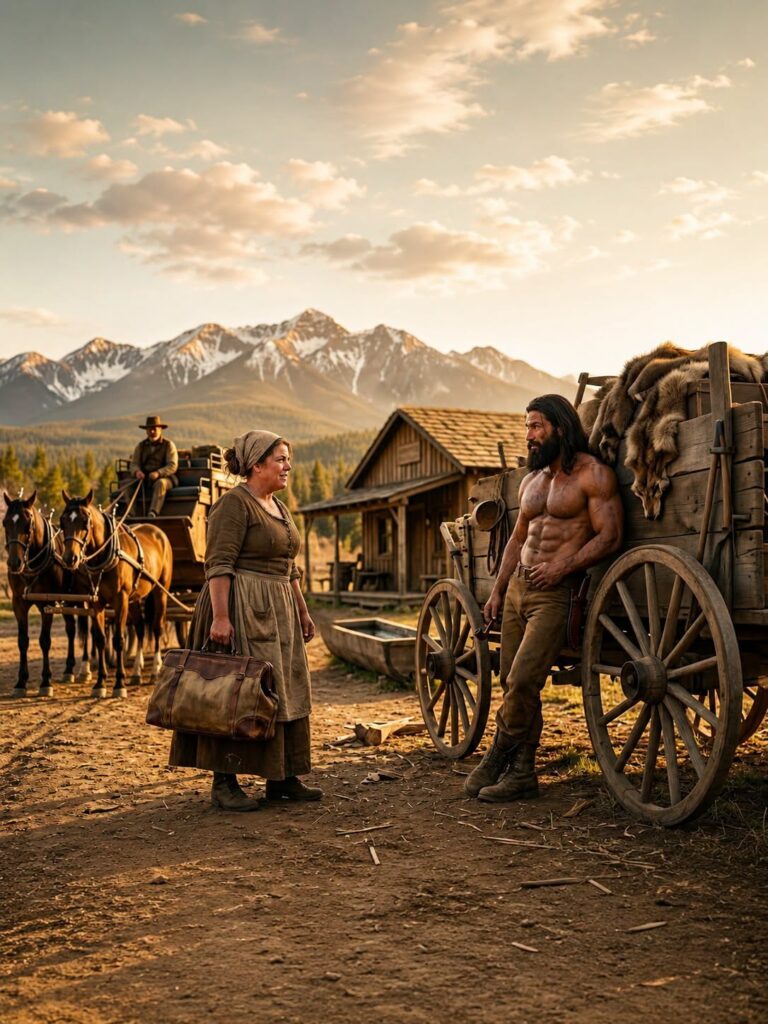
Part 2
Callum swallowed.
Then took another bite.
Ruth folded her arms.
“Well?”
He looked down at the bowl as though it had personally betrayed him.
“What?”
“You have been staring at that stew for nearly a minute.”
“I am eating it.”
“No. You are examining it like there might be gold at the bottom.”
Callum cleared his throat.
“It is good.”
Ruth raised one eyebrow.
“Good?”
He looked up.
She was waiting.
He took another spoonful.
“It might be the best thing I have eaten in ten years.”
“That is better.”
Ruth turned back toward the stove.
Callum watched her ladle stew into her own bowl.
He had known her less than half a day.
Already the cabin felt different.
Not cleaner.
Not yet.
There was too much dirt for that.
But alive.
That was the word.
Alive.
Ruth had opened the shutters without asking.
She had moved a chair closer to the fire.
She had found an old blue cloth at the bottom of a drawer and spread it across the table.
Then she had thrown away three jars Callum insisted were still useful.
“They are growing civilizations,” she told him.
“I was saving them.”
“For what? Scientific study?”
He had not known what to say to that.
So he let her win.
After supper, Ruth washed the dishes while Callum carried in more wood.
When he came back, she was standing in front of the small hallway that led toward the bedrooms.
“There are two rooms,” he said.
“I noticed.”
“You can have the larger one.”
Ruth looked over her shoulder.
“Which one is yours?”
“The larger one.”
“Then I will take the smaller.”
“No.”
She turned fully.
“No?”
“You came a long way.”
“So?”
“So you get the better room.”
Ruth studied him.
Then walked toward the larger doorway.
She looked inside.
The room was plain.
A heavy bed.
A wool blanket.
One dresser.
A window overlooking the valley.
She stood there a moment.
Then she glanced into the smaller room across the hall.
That one had a narrow bed and barely enough space for a chest.
Ruth looked back at Callum.
“You built this cabin?”
“Yes.”
“All of it?”
“Yes.”
“Then why did you build a second bedroom that looks like punishment?”
Callum rubbed the back of his neck.
“I thought there might be children someday.”
The words landed heavily.
Neither of them spoke.
Ruth looked toward the narrow room again.
Then back at him.
“You wanted a family.”
Callum’s jaw tightened.
“Once.”
He turned away.
Ruth did not push.
That surprised him.
Most people did.
Instead she walked into the larger bedroom, set her bag down, then came back out.
“Fine.”
Callum looked at her.
“I will take the bigger room.”
He nodded.
“But tomorrow,” she continued, “we are fixing the smaller one.”
“For what?”
Ruth shrugged.
“For whatever comes.”
Callum did not understand why those words stayed with him long after the fire burned low.
Ruth woke before sunrise.
Callum found her in the kitchen wearing an apron he had forgotten belonged to his mother.
She had already made biscuits.
There was coffee.
Real coffee.
Not the black mud he usually boiled until it surrendered.
He stopped in the doorway.
Ruth glanced over.
“Morning.”
He stared at the table.
“What is all this?”
“Breakfast.”
“I know what breakfast is.”
“Judging from your pantry, I was not certain.”
Callum almost smiled.
Almost.
He sat down.
Ruth put biscuits in front of him.
Eggs.
Fried potatoes.
Apple preserves she had carried from Iowa.
Callum took a bite.
Then another.
Ruth sat across from him.
“You eat like someone is going to take the plate away.”
“No one ever cooked this much.”
“Your mother?”
“She died when I was twenty.”
“Your father?”
“Could burn water.”
Ruth smiled.
“So that runs in the family.”
Callum looked at her.
Then, unexpectedly, laughed.
It was rough from disuse.
Ruth’s smile softened.
“There it is.”
“What?”
“I was wondering if you knew how.”
“How what?”
“Laugh.”
Callum lowered his eyes.
“I laugh.”
“When?”
He thought.
“Last winter, a mule kicked Ezra Hollis into a snowbank.”
“That does sound funny.”
“He cursed for ten minutes.”
“Even better.”
That became the beginning.
Not love.
Neither of them would have called it that.
Not then.
It was simply ease.
Ruth found where Callum kept flour.
Callum learned Ruth hated mice.
Ruth learned he sang quietly when repairing harnesses.
Callum discovered she snored when she was exhausted.
She discovered he talked to horses as though they were old friends.
The days found rhythm.
He chopped wood.
She stacked it.
She cooked.
He cleaned when ordered.
She planted early herbs near the porch.
He built boxes for them.
Sometimes they spoke for hours.
Sometimes not at all.
That was the strange thing.
Ruth had said silence sounded like an improvement.
But with Callum, silence did not feel empty.
It felt companionable.
By the third week, she stopped asking where things belonged.
By the fourth, her shawl hung permanently beside his coat.
By the fifth, Callum realized he had begun listening for her footsteps when he returned from the ridge.
That realization frightened him.
Because women had left before.
Every one of them.
Five.
He knew the pattern.
First came politeness.
Then discomfort.
Then excuses.
Then packed bags.
So when Ruth complained one morning that the road into town was terrible, Callum felt his stomach tighten.
When she mentioned missing Iowa rain, he remembered the first bride.
When she stood staring toward the valley for a long time, he remembered the second.
By June, he began waiting for Ruth to say it.
I cannot do this.
She never did.
Instead she handed him a hammer.
“The porch step is loose.”
Callum looked down.
“It has been loose for eight years.”
“That is not the defense you think it is.”
He fixed it.
The first trouble came from town.
They had gone down for supplies.
Ruth needed flour.
Callum needed nails.
The general store was crowded because the spring cattle auction had brought ranchers in from miles around.
Callum hated crowds.
People stared.
They always had.
But this time they stared at Ruth too.
He noticed immediately.
Ruth seemed not to.
Or pretended not to.
She moved through the store checking sacks of sugar and comparing beans.
Callum stood near the hardware counter.
Then he heard laughter.
Three women were standing beside the fabric shelves.
Callum knew them.
Mrs. Abernathy.
Mrs. Cole.
And Lydia Mercer.
Lydia had been one of the women whose family once tried arranging a match with Callum.
She had refused before even meeting him.
Now she whispered something.
Mrs. Cole covered her mouth.
The three looked directly at Ruth.
Ruth kept shopping.
Callum’s shoulders stiffened.
Then Lydia spoke loud enough to carry.
“Well.”
She examined Ruth.
“I suppose Callum finally found one who would not run.”
Mrs. Abernathy laughed.
Ruth stopped.
The store quieted.
Callum stepped forward.
But Ruth turned first.
Lydia smiled sweetly.
“I meant no offense.”
Ruth looked at her.
“Of course not.”
Lydia’s smile widened.
“I only meant you two seem very suited.”
“Thank you.”
“You are both rather… substantial.”
A few people laughed.
Callum’s expression hardened.
“Enough.”
His voice filled the room.
Lydia flinched.
Ruth turned toward him.
There was no embarrassment in her face.
Only calm.
“Callum.”
He looked at her.
She gave the slightest shake of her head.
Then she faced Lydia again.
“You are right.”
Lydia blinked.
“I am?”
“Entirely.”
Ruth rested both hands on her hips.
“Callum is substantial.”
Several men hid smiles.
“So am I.”
Ruth glanced at Callum.
“I suspect that is why the mountain has not blown either one of us away.”
A laugh moved through the store.
This time not at Ruth.
Lydia’s face tightened.
Ruth continued.
“As for women running from him, I cannot speak for them.”
She looked toward Callum again.
“But I have lived with him six weeks.”
Callum’s chest tightened at the word lived.
“He is clean when reminded.”
More laughter.
“He works harder than any man I have known.”
The room quieted.
“He does not drink.”
Callum shifted awkwardly.
“He does not raise his voice unless someone deserves it.”
Lydia’s smile had disappeared.
“And every morning,” Ruth said, “he leaves the last cup of coffee for me because he knows I like it stronger.”
Callum had not known she noticed that.
Ruth turned back to Lydia.
“So perhaps the question is not why women left.”
Her hazel eyes sharpened.
“Perhaps the question is why nobody bothered learning the man before deciding what he was worth.”
Silence.
Absolute silence.
Callum stared at her.
He had spent half his life being looked at.
Feared.
Mocked.
Judged.
No one had ever defended him like that.
Not because they pitied him.
Because they respected him.
Ruth picked up her flour sack.
“Now, are we finished?”
The shopkeeper coughed into his fist.
“Yes, ma’am.”
Outside, Callum carried the sacks to the wagon without speaking.
Ruth climbed up.
He remained beside the wheel.
“You did not have to do that.”
“Do what?”
“Defend me.”
“I did not defend you.”
Callum frowned.
Ruth looked down at him.
“I told the truth.”
That was somehow worse.
Or better.
He did not know.
On the ride home, Callum barely spoke.
Ruth finally looked at him.
“Are you angry?”
“No.”
“Then what?”
He held the reins tighter.
“No one ever said anything like that about me.”
Ruth’s expression changed.
“What?”
“Not where I could hear.”
She was quiet.
Then:
“That seems unlikely.”
“It is not.”
She looked at the road.
“Well.”
A moment passed.
“I meant every word.”
Callum looked at her.
Ruth did not look away.
Something shifted between them.
Something dangerous.
Quiet.
Warm.
Callum turned back to the road before he could give it a name.
Summer reached the mountain.
Wildflowers exploded across the ridges.
Ruth’s garden grew.
So did everything else.
Callum built her shelves in the pantry.
Ruth sewed curtains.
She repaired an old quilt Callum’s mother had made.
He found a rocking chair at a widow’s sale and carried it six miles because Ruth once mentioned wanting one near the fireplace.
When she saw it, she stood completely still.
“Where did that come from?”
“Town.”
“You bought it?”
“Yes.”
“For me?”
Callum became immediately uncomfortable.
“It is a chair.”
Ruth touched the carved arm.
“You carried this up the mountain.”
“The wagon wheel broke.”
“So you carried it.”
“It was not far.”
“How far?”
Callum did not answer.
Ruth stared.
“How far?”
“Six miles.”
She covered her mouth.
Callum shifted.
“It seemed foolish to leave it beside the road.”
Ruth laughed.
Then to his horror, her eyes filled.
“What is wrong?”
“Nothing.”
“You are crying.”
“I know.”
“Why?”
Ruth wiped her cheek.
“Because nobody has ever carried a chair six miles for me.”
Callum stood there helplessly.
“I can take it back.”
That made her laugh harder.
“No.”
She pressed one hand to the chair.
“You absolutely cannot.”
He smiled.
A real smile.
Ruth looked at him.
The room became suddenly smaller.
Callum felt it.
So did she.
Neither moved.
Then Ruth whispered:
“You should do that more.”
“What?”
“Smile.”
His smile vanished instantly.
Ruth laughed again.
By August, everybody in town knew Ruth had stayed.
Some people had started calling her Mrs. Brek.
Neither Ruth nor Callum corrected them.
But neither discussed it either.
Technically, they were not married.
That had been part of their arrangement.
Ruth came to see if life on the mountain suited her.
Callum insisted she could leave anytime.
No obligation.
No shame.
No promises.
At first that had made things easier.
Now it made them harder.
Because Callum wanted promises.
He wanted the kind that terrified him.
He wanted Ruth’s boots beside the door every winter.
Her laugh in the kitchen.
Her jar of hairpins beside the wash basin.
Her voice complaining about his muddy floors.
But wanting something and asking for it were different matters.
Callum had been rejected enough.
He knew how quickly hope could make a man foolish.
So he said nothing.
And Ruth began wondering whether he ever would.
The storm came in September.
Too early.
Too violent.
The sky darkened before noon.
Callum had gone toward the western ridge to check traps and look for a missing cow.
Ruth saw the clouds gathering.
By two, rain hammered the cabin.
By three, wind tore a branch from the pine beside the porch.
By four, the rain turned to sleet.
Callum had not returned.
Ruth paced.
She told herself he knew the mountain.
He had survived worse.
Then dusk began falling.
And she saw his horse.
Alone.
The animal came limping into the yard, reins dragging.
Ruth’s blood went cold.
“No.”
She ran into the rain.
The saddle was empty.
There was blood on one stirrup.
Not much.
Enough.
Ruth grabbed the horse.
“Where is he?”
The animal snorted.
Ruth had never hated silence more.
She ran back inside.
Pulled on Callum’s heavy coat.
Took a lantern.
A rope.
A blanket.
Then stopped.
Callum had told her repeatedly never to go into the western ravine alone during storms.
The ground shifted.
Trails vanished.
One wrong step could kill.
Ruth stood at the door.
Then looked at Callum’s empty chair.
“No.”
She stepped into the storm.
She found him nearly two hours later.
Not because she knew the mountain well.
Because she knew Callum.
He always checked the north fence before crossing the ridge.
He always tied red cloth to damaged posts.
He always avoided the creek after heavy rain.
She followed his habits.
At last, beneath a fallen pine, Ruth heard a sound.
“Callum!”
Nothing.
She pushed through brush.
“CALLUM!”
A groan.
She nearly collapsed from relief.
He was lying beside a rocky slope.
One leg trapped beneath part of the fallen tree.
His face was pale.
Blood ran from his temple.
When he saw Ruth, anger replaced pain.
“What are you doing here?”
She stared at him.
“You are welcome.”
“You should not be out here.”
“Neither should you.”
“Ruth.”
“Save your strength.”
She dropped the lantern beside him.
He grabbed her wrist.
“You have to go.”
“I just arrived.”
“The creek will rise.”
“Then we should hurry.”
“My leg.”
“I noticed.”
She examined the branch.
Too heavy to lift directly.
She looked around.
Found a broken limb.
Then another.
Callum watched her.
“What are you doing?”
“Being too large.”
“What?”
Ruth jammed the limb beneath the tree.
“You remember?”
She planted her feet.
“Too wide.”
She pulled.
The branch shifted slightly.
“Too much.”
Again.
Callum understood.
“Ruth, stop.”
“Too present.”
She grunted.
The tree lifted another inch.
“Ruth.”
“Too hard to want.”
“Stop!”
She glared at him.
“I did not cross half this mountain so you could tell me what to do.”
She braced herself again.
“On three, pull your leg.”
“Ruth.”
“One.”
“Damn stubborn woman.”
“Two.”
Callum positioned himself.
“Three!”
Ruth heaved against the lever.
Callum dragged himself backward.
His boot came free.
The branch crashed down.
Ruth collapsed beside him.
For several seconds, neither moved.
Then Callum began laughing.
Ruth turned toward him.
“What?”
“You.”
“What about me?”
“You are insane.”
Ruth’s chest heaved.
“You sent five women away and somehow I am the problem?”
That made him laugh harder.
Then he winced.
Ruth touched his face.
“Do not laugh.”
His laughter stopped.
Her hand remained against his cheek.
Callum looked at her.
Rain moved through the branches above them.
Everything else disappeared.
“Why did you come?”
Ruth stared.
“What kind of question is that?”
“You could have waited.”
“And found your body tomorrow?”
“You could have gotten killed.”
“So could you.”
“That is different.”
“No.”
Her voice sharpened.
“It is not.”
Callum looked away.
Ruth grabbed his beard gently and turned his face back.
“It is not different.”
His eyes met hers.
She had never seen him look frightened.
Not of the storm.
Not of his injury.
Of her.
Or rather, of losing her.
Callum whispered:
“I cannot bury another person I love.”
Ruth froze.
The storm seemed to quiet.
“What did you say?”
Callum shut his eyes.
Too late.
Ruth leaned closer.
“Callum.”
He opened them again.
“I said I cannot—”
“No.”
Her heart was pounding.
“The other part.”
He stared at her.
There was nowhere left to hide.
“I love you.”
Ruth said nothing.
Callum’s face hardened immediately.
Like a man preparing to be struck.
“I should not have said that.”
“Why?”
“Because you came here for shelter.”
“I know.”
“You wanted dignity.”
“I know.”
“You did not ask me for anything else.”
“I know.”
“So forget it.”
Ruth stared at him.
Then started laughing.
Callum’s face fell.
“That is cruel.”
“No.”
She shook her head.
“No, you impossible man.”
She bent closer.
“I am laughing because I have spent two months waiting for you to say that.”
Callum stopped breathing.
“What?”
Ruth touched his face again.
“I stayed because I wanted to.”
He stared.
“Not because there was nowhere else to go.”
His expression cracked.
“Not because I was desperate.”
She smiled through tears.
“And certainly not because of your cooking.”
Callum almost laughed.
Ruth leaned her forehead against his.
“I stayed because somewhere between your terrible coffee and carrying a chair six miles, I fell in love with you.”
Callum closed his eyes.
For the first time in years, he looked peaceful.
Then Ruth whispered:
“And if you ever make me cross a mountain in a storm again, I will kill you myself.”
Callum laughed.
This time she joined him.
Part 3
Callum’s leg was not broken.
Badly bruised.
Twisted knee.
Three cracked ribs.
The doctor said he had been lucky.
Ruth disagreed.
“Lucky people do not get trees dropped on them.”
Doctor Pritchard smiled.
“Then stubborn.”
“That I believe.”
Callum was forced to spend two weeks in bed.
They were the longest two weeks of Ruth’s life.
Not because caring for him was difficult.
Because Callum Brek was the worst patient in Montana.
“I can walk.”
“No.”
“I need to check the horses.”
“Ezra checked them.”
“The north fence—”
“Repaired.”
“The woodpile—”
“Full.”
Callum stared suspiciously.
“You did all that?”
Ruth folded her arms.
“With help.”
“Whose help?”
“People.”
“What people?”
“Human ones, mostly.”
Callum frowned.
Then came the knock.
Ruth opened the door.
Ezra Hollis stood outside.
Behind him were seven men from town.
Two women.
Three wagons.
Lumber.
Feed.
Tools.
Callum saw them from the bedroom doorway.
“What is this?”
Ezra removed his hat.
“Heard you were hurt.”
“I am fine.”
“No one asked.”
Callum glared.
Ezra grinned.
“Mrs. Brek said you needed help.”
Ruth turned bright red.
Callum looked at her.
She looked at Ezra.
“I did not say Mrs. Brek.”
Ezra shrugged.
“Everyone calls you that.”
Ruth looked at Callum.
Callum looked down.
Something strange crossed his face.
Not embarrassment.
Hope.
Ruth noticed.
So did Ezra.
The older man smiled to himself.
By sunset, the fence was repaired.
The barn roof patched.
A month’s worth of wood stacked.
Then people gathered around Ruth’s table and ate stew.
The cabin had never held so many people.
Callum sat near the fireplace.
Children no longer hid from him.
One little boy even climbed onto the arm of his chair and asked to see the scar on his hand.
Ruth watched from the kitchen.
She realized something then.
Callum had always believed he was alone because people did not want him.
But part of the truth was that he had stopped letting anyone come close enough to prove otherwise.
Ruth understood that better than most.
She had done the same.
Being unwanted became safer if you decided first that you needed nobody.
Perhaps that was why they had found each other.
Not because their difficulties were compatible.
Because their wounds were.
Three weeks later, Callum could walk without limping.
One morning Ruth found him standing outside before sunrise.
He wore his clean shirt.
His good boots.
His beard had been trimmed.
Ruth stopped in the doorway.
“Who died?”
Callum frowned.
“No one.”
“Then why do you look respectable?”
“I always look respectable.”
She stared.
Callum looked down at himself.
“Mostly.”
Ruth stepped outside.
“What is going on?”
“Come with me.”
“Where?”
“Just come.”
He led her behind the cabin.
Ruth stopped.
A new path had been cleared through the pines.
At the end stood a small structure.
Not finished.
But recognizable.
A room.
Large windows.
A stone chimney.
Wide doors.
Ruth stared.
“What is this?”
Callum stood awkwardly beside her.
“You said once you wanted a proper kitchen.”
“When?”
“June.”
“That was months ago.”
“I remember things.”
Ruth smiled.
“Apparently.”
He walked inside.
There was a massive wooden table.
Shelves.
Hooks for copper pans.
A brick oven half built.
Ruth covered her mouth.
“Callum.”
“You said you might sell preserves.”
Her eyes widened.
“And bread.”
He gestured toward the windows.
“And maybe teach women in town.”
Ruth had mentioned that exactly once.
Late at night.
Almost embarrassed.
She dreamed of making food people would travel to buy.
Callum remembered.
Every word.
“This is too much.”
“No.”
“It is.”
Callum looked at her.
“No.”
His voice softened.
“You spent your life being told you were too much.”
Ruth went still.
“So I built a room big enough.”
Her eyes filled instantly.
“Oh, Callum.”
He reached into his coat.
Ruth’s breath caught.
Callum removed a small velvet box.
Then immediately looked irritated with himself.
“I had a speech.”
Ruth started laughing through tears.
“A speech?”
“Yes.”
“What happened?”
“I forgot it.”
“All of it?”
“Nearly.”
He opened the box.
Inside was a simple gold ring.
Not delicate.
Not ornate.
Strong.
Beautiful.
Like something made to last.
Callum did not kneel.
His ribs still hurt.
Instead he stood in front of her.
“I spent years believing I needed a woman willing to tolerate me.”
Ruth’s smile disappeared.
He swallowed.
“You taught me that was wrong.”
His brown eyes held hers.
“I do not want someone who tolerates me.”
He reached for her hand.
“I want you.”
Ruth’s lips trembled.
“Your laugh.”
He squeezed her fingers.
“Your temper.”
She sniffed.
“My temper?”
“Yes.”
“Careful.”
“Your cooking.”
“Better.”
“Your stubbornness.”
“Callum.”
“Your whole impossible self.”
Ruth was crying openly now.
He continued.
“You wrote that you had difficulty being wanted.”
His voice cracked.
“That is no longer true.”
Ruth covered his hand with hers.
“Because I want you here every morning.”
He breathed in.
“Every winter.”
His eyes shone.
“Every year I get.”
Ruth could barely speak.
Callum opened the box wider.
“Ruth Fairchild.”
He hesitated.
“Will you marry me?”
Ruth stared at him.
Then looked toward the half-built kitchen.
The cabin beyond it.
The mountain.
The place where five women had come and gone.
The place where she had expected only shelter.
And found a life.
She looked back at him.
“No.”
Callum froze.
Every trace of color left his face.
Ruth waited exactly two seconds.
Then smiled.
“I will not marry you as Ruth Fairchild.”
Callum blinked.
She took the ring from the box.
“I will marry you as Ruth Brek.”
Understanding hit him.
“You wicked woman.”
She laughed.
Then Callum pulled her into his arms.
Carefully at first.
Then fully.
Ruth pressed her face into his chest.
For once, neither cared who was too large.
Too scarred.
Too old.
Too unwanted.
They fit.
That was enough.
They married in October.
The entire town came.
Even Lydia Mercer.
She brought a pie.
Ruth accepted it.
Callum inspected it suspiciously.
“She might have poisoned it.”
“She did not poison it.”
“You do not know that.”
Ruth whispered:
“Then you eat the first piece.”
Callum stared at her.
She smiled sweetly.
Their ceremony took place beneath the pines.
Ruth wore cream.
Not white.
She said white made her look like a runaway bedsheet.
Callum wore black.
His beard was trimmed.
His hair behaved for almost twenty minutes.
Ezra stood beside him.
Doctor Pritchard officiated.
When Ruth walked down the path, Callum forgot every person around them.
He simply stared.
The same way he had stared the first time she laughed at the stage station.
Ruth stopped in front of him.
“You look frightened.”
“I am.”
“Good.”
Callum smiled.
The vows were simple.
No poetry.
No grand promises.
Ruth promised to stay honest.
Callum promised never to repair anything “later.”
Everyone laughed.
Then Callum said the one line he had written himself.
“I cannot promise the mountain will be easy.”
Ruth’s eyes softened.
“But I promise you will never face it alone.”
Ruth squeezed his hands.
Then replied:
“I came here because I believed nobody would ever choose me.”
Her voice carried through the trees.
“Now I know I was wrong.”
She looked directly at Callum.
“I only needed one person to choose me completely.”
Callum’s eyes filled.
“And I choose you back.”
They kissed beneath the pines.
The mountain wind moved through the branches.
And this time, no one left.
Years passed.
The kitchen Callum built became famous.
Ruth’s bread traveled as far as Missoula.
Travelers came up the mountain just for her blackberry preserves.
She taught girls from town how to bake.
Widows came to work beside her.
Women who had been told they were too old.
Too poor.
Too loud.
Too heavy.
Too difficult.
Ruth hired them.
Every one.
Callum built another room.
Then another.
Eventually, the little cabin became a large mountain house filled with noise.
Exactly the kind of noise Ruth once thought she did not need.
They never had children of their own.
For a while, that hurt.
Then one December evening, a sheriff brought a twelve-year-old boy named Samuel up the mountain.
His parents had died in a wagon accident.
There was nowhere for him to go.
The boy stood at the doorway terrified.
He looked at Callum and immediately stepped backward.
Ruth saw the old pain flicker in her husband’s eyes.
Then Callum crouched slowly.
At forty-nine, his knees complained.
He held out one enormous hand.
“I look worse than I am.”
Samuel stared.
Ruth laughed from the kitchen.
“That is true.”
Callum looked offended.
The boy smiled.
Just a little.
He stayed one night.
Then a week.
Then forever.
Two years later came Mary.
Then Thomas.
Then a quiet girl named Elsie who had not spoken since losing her mother.
Ruth never planned any of it.
Neither did Callum.
Their home simply became a place where unwanted people stopped being unwanted.
Thirty-one years after Ruth arrived, Callum sat on the porch watching sunset spill gold across the Flathead Valley.
He was seventy-four.
His beard had turned white.
His shoulders had bent.
Ruth was seventy.
Her hair was silver.
She still occupied every chair as though she had personally defeated it.
She brought two cups of coffee outside.
Callum accepted his.
“Took you long enough.”
Ruth stared.
“I can take it back.”
He tightened his grip.
“No.”
She sat beside him.
Below them, grandchildren ran near the barn.
Samuel’s oldest boy was chasing chickens.
Mary’s daughter was helping in Ruth’s kitchen.
There were voices everywhere.
Doors opening.
Pans clattering.
Laughter.
Callum stared at the valley.
“Remember your letter?”
Ruth smiled.
“Which part?”
“The last line.”
Her smile widened.
“Our difficulties are compatible?”
“Yes.”
“I thought that was clever.”
“It was strange.”
“You answered with one word.”
“I was busy.”
“You were emotionally constipated.”
Callum nearly spit out his coffee.
Ruth laughed.
Even at seventy, it was the same laugh.
Deep.
Full.
Enough to fill mountains.
Callum looked at her.
“You know something?”
“What?”
“Five women left.”
Ruth leaned back.
“Yes.”
“I used to think that meant something was wrong with me.”
Ruth said nothing.
“Maybe there was.”
She elbowed him.
Callum smiled.
“But then you came.”
His eyes moved toward the house.
The windows glowed.
The porch sagged slightly under decades of footsteps.
The garden Ruth planted that first summer had expanded across half the hill.
“You stayed.”
Ruth looked toward him.
“I told you I would.”
“No.”
Callum shook his head.
“You never did.”
Ruth thought about it.
He was right.
She had never promised.
Not until the wedding.
Not before.
She had simply stayed one day.
Then another.
Then another.
Until staying became a life.
Ruth reached for his hand.
His fingers were crooked now.
Scarred.
Old.
Still enormous around hers.
“Callum.”
“Yes?”
“I was never the bride nobody wanted.”
He looked at her.
Ruth smiled.
“I was simply the bride the wrong people did not want.”
Callum’s eyes warmed.
“And me?”
“You?”
She squeezed his hand.
“You were never the husband women could not stay with.”
“What was I?”
“The husband who had not met me yet.”
Callum laughed.
The sun dropped behind the mountains.
For a moment, everything turned gold.
The porch.
The fields.
The windows.
Ruth’s silver hair.
Callum looked at the woman who had walked into his cabin carrying one bag and no expectations.
The woman who had turned stew into home.
The woman who crossed a mountain to find him.
The woman who stayed when nobody believed she would.
He lifted her hand and kissed it.
“Forever was longer than I expected.”
Ruth rested her head against his shoulder.
“Still not long enough.”
Inside, someone shouted that supper was ready.
Callum tried to stand.
His knees refused.
Ruth laughed.
“Need help, mountain man?”
“No.”
He tried again.
Nothing.
Ruth stood and offered both hands.
Callum frowned.
“You enjoy this.”
“Immensely.”
He took her hands.
She pulled.
Slowly, painfully, he rose.
Then they walked toward the house together.
Not quickly.
Not gracefully.
But together.
And if anyone had asked how long Ruth Fairchild stayed on Callum Brek’s mountain, nobody in the valley would have answered in days.
Or weeks.
Or years.
They would have said only this:
She stayed until it was no longer his mountain.
It was theirs.

