
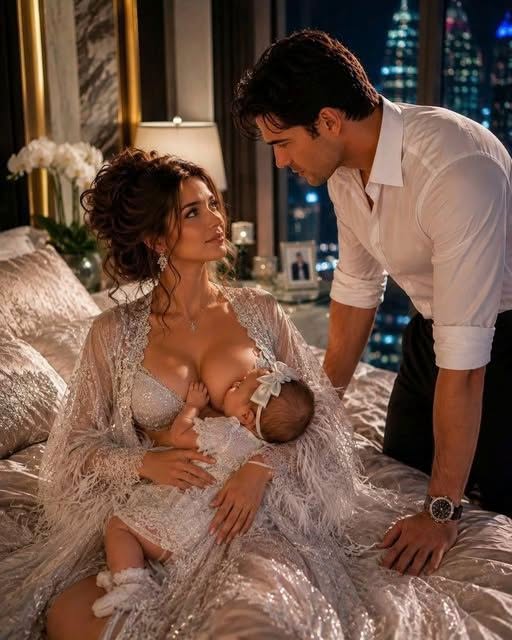
Lorenzo’s question seemed to change the temperature of the room.
“Whose baby did you lose?”
Leo continued nursing against me, unaware that every adult around him had gone silent.
The guards stood just inside the doorway. The night nurse had awakened and was staring at us with one hand pressed to her mouth. Lorenzo remained several feet away, his face unreadable except for something in his eyes I hadn’t expected.
Not anger.
Recognition.
I looked down at the hospital bracelet around my wrist.
I had meant to cut it off weeks ago.
But every time I reached for the scissors, I remembered the moment a nurse had fastened it around me and said, This will identify you as his mother.
His mother.
For three weeks, that narrow strip of faded plastic had been the only thing left that still called me that.
“My son,” I whispered.
Lorenzo’s expression softened almost imperceptibly.
“What was his name?”
The question hurt more than I expected.
“Evan.”
He lowered his gaze.
“How old?”
“He never came home from the hospital.”
No one moved.
Then Leo released me with a tiny sigh.
I quickly adjusted my uniform and settled him against my shoulder. He looked different already—not magically healthy, not suddenly transformed, but peaceful.
Fed.
His cheek rested beneath my chin.
One of his small hands opened against my collar.
The sight of it nearly broke me.
Lorenzo stepped closer but stopped when I instinctively tightened my arms around Leo.
“I’m not going to take him from you,” he said quietly.
I stared at him.
Everything I had heard about Lorenzo Rossi told me I should fear him.
Yet the man standing before me looked less like the powerful figure whispered about in kitchens and hallways and more like a father who had spent two months learning what helplessness felt like.
He turned toward the nurse.
“Call Dr. Bennett.”
She hurried from the room.
Then he looked at the guards.
“Outside.”
Neither hesitated.
The door closed.
For the first time, there were only three of us in the nursery.
Lorenzo.
Leo.
And me.
“Why did you say the Rossi family knew?” I asked.
His brows drew together.
“I didn’t.”
“You knew I had lost a baby.”
“I knew you’d been in St. Catherine’s maternity wing.”
My stomach tightened.
“How?”
He looked toward my bracelet.
“You weren’t hired through the usual agency.”
That was true.
Mrs. Alvarez, the mansion’s head housekeeper, had found me through a church employment bulletin.
“I still don’t understand.”
Lorenzo walked to the window and rested his hand on the back of the chair where the nurse had been sleeping.
“After Sophia died, I reviewed everyone entering this house. Staff, nurses, contractors, delivery drivers. Everyone.”
The statement should have unsettled me.
Instead, his next words did.
“Your employment paperwork listed St. Catherine’s as your previous address for correspondence.”
I blinked.
“That was temporary.”
“I know.”
His voice became quieter.
“The hospital was also where Sophia was taken.”
A cold sensation moved through me.
St. Catherine’s.
Of course.
I had never connected it.
The hospital had been enormous. Different floors. Different wings. Different worlds separated by elevators and pale corridors.
“I was there three weeks before I started here,” I said.
“I know.”
Again.
Those two words.
I looked at him sharply.
“What else do you know?”
Lorenzo met my eyes.
“That you delivered a son.”
My throat closed.
“That his name was Evan Hunter.”
I froze.
My surname was Hunter.
Evan had carried mine.
“And,” Lorenzo continued carefully, “that something in his medical record concerned one of the physicians who treated Sophia.”
The nursery seemed suddenly too quiet.
“What does my baby have to do with Sophia?”
“I don’t know.”
I searched his face.
For the first time, I believed him.
And somehow that frightened me more than if he had possessed an answer.
Dr. Bennett arrived twenty minutes later.
She was a pediatric specialist in her fifties with silver threaded through her dark hair and a manner that made every room calmer when she entered it.
She didn’t react dramatically when she saw me holding Leo.
She simply checked him.
Weight.
Temperature.
Breathing.
Oxygen.
Then she asked how long he had fed.
“About fifteen minutes,” I said.
“Any coughing?”
“No.”
“Arching away?”
“No.”
“Trouble swallowing?”
“No.”
Dr. Bennett listened to Leo’s chest.
Then she looked at the monitor.
“He tolerated it.”
Lorenzo stood beside the crib.
“Is that good?”
“It’s very good.”
Something inside his posture loosened.
“But,” she added, “we proceed carefully. One successful feed is encouraging, not conclusive.”
He nodded.
“What happens now?”
Dr. Bennett turned toward me.
“First, Hunter needs to be examined too.”
“Me?”
“You recently gave birth. You’re lactating. Before we allow continued direct feeding or expressed milk, we need the appropriate screening and medical history.”
Embarrassment warmed my face.
“I understand.”
“And this has to be your choice.”
I glanced at Lorenzo.
Dr. Bennett followed my gaze.
Then she looked directly at him.
“No pressure.”
“None,” Lorenzo said immediately.
She returned her attention to me.
“You are not responsible for saving Leo.”
The words hit somewhere deep.
Perhaps because, for several terrible weeks, I had secretly believed I had failed to save Evan.
I looked down at Leo.
His eyes were closed.
His breathing was soft.
“What happens if I say no?”
“We continue treating him using every available medical option.”
“And if I say yes?”
“We determine whether your milk is medically appropriate for him, establish a safe feeding plan, and monitor both of you.”
I swallowed.
“I’ll do the screening.”
Lorenzo said nothing.
But relief passed across his face.
Not triumph.
Relief.
That mattered.
The testing took most of the night.
By morning, I was exhausted.
Mrs. Alvarez found me in the small sitting room beside the nursery.
She was sixty-two, with silver hair always twisted into a neat knot and the uncanny ability to know what had happened in the mansion before anyone told her.
She placed a cup of tea in front of me.
“I heard.”
I looked at her.
“From who?”
“Nobody had to tell me. Dr. Bennett asked me to bring you breakfast instead of putting you on the morning schedule.”
She sat opposite me.
I wrapped my hands around the cup.
“I broke the rules.”
“Yes.”
“I entered the nursery.”
“Yes.”
“I could be fired.”
“Yes.”
I frowned at her.
“You’re not very comforting.”
Mrs. Alvarez smiled faintly.
“You want comfort or honesty?”
“Both.”
“Then honestly, you entered a restricted room without permission.”
I looked down.
“And,” she continued, “a hungry baby ate.”
My eyes burned.
Mrs. Alvarez reached across the table.
She didn’t touch me immediately.
She simply left her hand there.
An invitation.
After several seconds, I placed mine in it.
“I had a son,” I whispered.
“I know.”
My head snapped up.
She squeezed my fingers.
“You told me you needed work after a medical leave. I saw the way you moved when you first arrived. Carefully. Like every step hurt.”
“Why didn’t you ask?”
“Because grief belongs to the person carrying it.”
I stared at her.
“No one here knew.”
“I didn’t know details.”
Her voice gentled.
“But I knew you had lost something.”
I looked toward the nursery door.
“Lorenzo knew details.”
Mrs. Alvarez’s expression shifted.
“What details?”
“He knew Evan’s name.”
She became very still.
“He said one of Sophia’s doctors had concerns about Evan’s medical record.”
Mrs. Alvarez sat back.
“That doesn’t make sense.”
“No.”
“Did he explain?”
“He says he doesn’t know.”
“And do you believe him?”
I thought about it.
“Yes.”
That surprised me.
Mrs. Alvarez seemed surprised too.
She studied me carefully.
“Then perhaps the question isn’t what Mr. Rossi knows.”
“What is it?”
“It’s what somebody tried to tell him.”
Later that afternoon, my screening results came back clear.
Dr. Bennett established a feeding plan.
No improvising.
No disappearing into Leo’s nursery whenever I heard him cry.
Scheduled feeds, pumping, nutritional support for me, medical supervision for Leo.
A lactation consultant named Nina arrived before dinner.
She treated me with such ordinary kindness that I almost cried when she handed me a glass of water.
“You’ll need more calories,” Nina said.
“I work in housekeeping.”
“You currently have two jobs.”
I glanced at Leo.
Nina smiled.
“Making milk is work.”
The statement was so simple.
So practical.
It made everything feel less strange.
For the next three days, the Rossi mansion changed around Leo’s feeding schedule.
Not visibly.
The guards still stood at the gates.
Phones still rang in Lorenzo’s study.
Men in expensive suits still appeared for meetings and left without lingering.
But upstairs, the center of the household became a small notebook beside Leo’s crib.
7:10 a.m. — fed twelve minutes.
9:30 a.m. — expressed milk, twenty-five milliliters.
12:15 p.m. — fed nine minutes.
Temperature normal.
No reflux.
Rested afterward.
For the first time since I entered the house, I saw Lorenzo Rossi carry a pen everywhere.
He wrote down everything.
“How long?” he would ask.
“Twelve minutes.”
He wrote it.
“Did he cough?”
“Once.”
He wrote it.
“Was that normal?”
“Yes.”
He wrote that too.
One afternoon, I found him staring at the notebook.
“You know Dr. Bennett records all this electronically,” I said.
“I know.”
“Then why are you writing it?”
He glanced at the page.
“Because I can do this.”
I understood immediately.
Everything else about Leo’s illness was beyond his control.
But Lorenzo could count minutes.
Measure bottles.
Record temperatures.
He could do something.
So I stopped teasing him about the notebook.
By the fifth day, Leo had gained three ounces.
Dr. Bennett smiled when she told us.
Lorenzo didn’t.
He simply sat down.
I was holding Leo near the window.
“Three ounces?” he repeated.
“Three,” Dr. Bennett confirmed.
He pressed his fingers against his mouth.
Then he nodded.
“Good.”
She glanced at me.
I looked away to give him privacy.
After she left, Lorenzo walked toward the crib.
“May I?”
I realized he was asking permission to take his own son.
The thought made my chest ache.
“Of course.”
I placed Leo carefully into his arms.
Lorenzo had always seemed slightly awkward holding him, as though the child were something priceless he had been entrusted to transport without instructions.
That afternoon was different.
Leo settled against his father.
Lorenzo looked down.
“You gained three ounces,” he murmured.
I smiled.
“He did.”
“One day you’ll laugh at me for caring about three ounces.”
Leo slept.
Lorenzo’s expression softened.
“But today three ounces is everything.”
I turned toward the window because suddenly I could see Evan.
Not literally.
Only in memory.
The weight I remembered.
The imagined milestones.
The version of my life that had disappeared before it began.
“You okay?” Lorenzo asked.
I nodded automatically.
Then stopped.
“No.”
He waited.
“I thought helping Leo would make me feel useful.”
“And?”
“It does.”
I folded my arms tightly around myself.
“But sometimes when he eats, I wonder why my body can feed someone else’s baby when it couldn’t keep my own.”
Lorenzo’s face changed.
He looked down at his son.
“Sophia used to say grief makes terrible arguments.”
I blinked.
“She said that?”
“After her father died.”
His mouth lifted faintly.
“She told me grief collects unrelated facts and arranges them until they look like evidence.”
I stared at him.
“That sounds like Sophia?”
“Very much.”
He looked at Leo.
“She would have liked you.”
The words startled me.
“You don’t know me.”
“I know enough.”
Something passed between us then.
Not romance.
Not yet.
Something quieter.
Two people standing on opposite sides of losses neither could repair.
That evening, Lorenzo asked me to come to his study after Leo’s final feed.
I almost refused.
The study was the one room employees rarely entered.
Dark shelves lined the walls. A fireplace occupied one end. Framed photographs sat on a table near the window.
One showed Sophia laughing.
She had warm brown eyes and dark curls lifting in the wind.
Another showed Lorenzo beside her on what looked like a beach.
He appeared younger.
Almost careless.
I couldn’t reconcile that man with the one I knew.
“You wanted to see me?” I asked.
Lorenzo gestured toward the chair across from his desk.
On the desk sat a thin brown envelope.
I recognized the St. Catherine’s logo.
My pulse quickened.
“What is that?”
“Something I received two days before you entered Leo’s nursery.”
He pushed it toward me.
I didn’t touch it.
“From the hospital?”
“Yes.”
“About Evan?”
“Yes.”
My breathing changed.
“Why didn’t you tell me?”
“I intended to speak with you after I understood what it meant.”
“And now?”
“Now I think you should see it before I know what it means.”
I sat.
The envelope contained three photocopied pages and a handwritten letter.
Lorenzo handed me the letter.
The name at the bottom was unfamiliar.
Dr. Amelia Park.
“She was a neonatal fellow at St. Catherine’s,” Lorenzo explained. “She assisted with Sophia and Leo the night of the bombing.”
I began reading.
The letter was careful.
Clinical.
Almost painfully so.
Dr. Park explained that while reviewing neonatal records connected with Leo’s treatment, she had discovered a discrepancy involving another infant admitted during the same period.
Evan Hunter.
My son.
The room blurred.
I forced myself to continue.
There had been confusion in the neonatal laboratory database.
Two samples with similar identification numbers had been entered within minutes of one another.
One belonged to Leo Rossi.
One belonged to Evan Hunter.
A later audit suggested that a metabolic screening result might have been attached to the wrong patient record.
I looked up.
“What does that mean?”
Lorenzo shook his head.
“I don’t know.”
I reread the paragraph.
There was more.
Dr. Park had tried to contact me.
The number listed in my chart had been disconnected after I moved out of my apartment.
She had then contacted the Rossi family because the disputed sample involved Leo.
My hands began trembling.
“What screening?”
“I asked Bennett.”
“And?”
“She wants to see the original laboratory report before speculating.”
I looked at the photocopies.
They were mostly codes, numbers and medical abbreviations.
“What happened to Evan wasn’t an accident?”
“I didn’t say that.”
“But this letter—”
“Hunter.”
His voice was quiet.
“No guesses.”
I hated how reasonable he sounded.
“I spent three weeks believing there was nothing anyone could have done.”
“That may still be true.”
“And if it isn’t?”
He didn’t answer immediately.
Then he said, “Then you deserve facts before you decide what those facts mean.”
I pressed the letter against the desk.
“Why did you look at me the way you did that night?”
“What way?”
“Like you recognized me.”
Lorenzo leaned back.
“Because Dr. Park included your employment information.”
I stared at him.
“She knew I worked here?”
“She had asked the hospital’s patient liaison to locate you. Someone discovered your new payroll address.”
“That feels invasive.”
“It probably was.”
He acknowledged it so plainly that some of my anger softened.
“I didn’t ask anyone to investigate you after that,” he continued. “I had enough information to know you had lost a child. I decided the rest belonged to you.”
I thought of Mrs. Alvarez.
Grief belongs to the person carrying it.
Apparently, two people in this mansion understood boundaries better than its reputation suggested.
“What happens now?” I asked.
“Tomorrow, Dr. Bennett is meeting with Dr. Park.”
“I want to be there.”
“I assumed you would.”
“And I want my medical records.”
“They’re yours.”
“And Evan’s.”
Lorenzo nodded.
“I’ll help you request them properly.”
Something about the word properly reassured me.
No favors.
No secret calls.
No pressure.
Just the truth gathered the right way.
The next morning, Dr. Amelia Park came to the mansion.
She looked younger than I expected.
Early thirties, perhaps, with tired eyes behind dark-framed glasses.
The moment she saw me, she stopped.
“Hunter?”
“Yes.”
Her face filled with regret.
“I’m so sorry I couldn’t reach you sooner.”
I didn’t know what to say.
We sat in the sunroom because Lorenzo said the study felt too formal.
Mrs. Alvarez brought coffee.
Dr. Bennett joined us.
Leo slept upstairs with Nina.
For once, Lorenzo didn’t sit at the head of anything.
He chose a chair beside the window.
Dr. Park opened her laptop.
“I want to be clear,” she began. “I do not know whether the discrepancy I found affected Evan’s treatment.”
I nodded.
“What do you know?”
“Both boys had newborn metabolic screenings.”
She turned the screen toward us.
“Leo’s first screening suggested a rare enzyme-processing disorder. His second screening did not.”
Dr. Bennett leaned forward.
“And Evan?”
“Evan’s first screening appeared normal.”
My heart began pounding.
“But?”
“His later bloodwork contained values that didn’t fully match that first screening.”
I swallowed.
“What does that mean?”
“It means there may have been a labeling error.”
I looked toward Lorenzo.
He remained silent.
Dr. Park continued.
“Leo’s doctors were treating him partly based on the assumption that his metabolism was unusually sensitive to certain feeding components. That’s one reason several formulas were changed so aggressively.”
Dr. Bennett’s expression sharpened.
“And if the abnormal screen was actually Evan’s?”
Dr. Park nodded.
“Then Leo may never have had that condition.”
My hands went cold.
“And Evan did?”
“We don’t know.”
There it was again.
Not knowing.
I had spent so many nights wanting certainty that uncertainty had begun to feel like an enemy.
“What was wrong with my baby?” I asked.
Dr. Park closed her laptop.
“Hunter, Evan was born with several complications. He was small. His oxygen levels were unstable initially. He developed difficulty regulating blood sugar.”
“I know.”
“Even if the screening error is confirmed, it does not automatically mean the outcome could have been different.”
I looked down.
“But it could mean something was missed.”
“Yes.”
Her honesty hurt.
Yet I was grateful for it.
Lorenzo spoke for the first time.
“What test confirms whether the samples were swapped?”
Dr. Park looked at him.
“Archived specimens.”
“St. Catherine’s keeps them?”
“In newborn screening cases, often yes, depending on state protocols and timing.”
“Then test them.”
She shook her head gently.
“We need consent and authorization.”
He nodded immediately.
“Of course.”
No command.
No demand.
Just understanding.
Dr. Park turned to me.
“We would need yours for Evan.”
“Yes.”
I answered before she finished.
“Yes.”
That afternoon, I signed the forms.
Then we waited.
Waiting turned out to be harder than feeding Leo.
At least feeding gave my hands something to do.
Waiting gave my mind too much space.
Two days later, I was folding infant blankets in the nursery when Mrs. Alvarez entered.
“You’ve folded that one four times.”
I looked down.
She was right.
“I’m distracted.”
“Obviously.”
She sat beside me.
“Want company?”
“Yes.”
For a while we worked without speaking.
Then I asked, “Did you know Sophia well?”
Mrs. Alvarez smiled.
“Since she was twenty-three.”
“What was she like?”
“Terrible at being told what to do.”
I laughed unexpectedly.
“Lorenzo never mentions that.”
“Lorenzo thought it was charming until they were married.”
“Then?”
“He discovered charming becomes complicated when someone insists the dining room should be painted yellow at midnight.”
I laughed again.
The sound startled me.
It had been a long time since laughter came without guilt afterward.
Mrs. Alvarez watched me.
“You’re allowed.”
I knew what she meant.
“I know.”
But knowing and believing were different things.
She folded another blanket.
“Sophia would want this room to have laughter.”
“You really think so?”
“I know so.”
I looked toward Leo.
He was sleeping peacefully.
“He’s getting stronger.”
“Yes.”
“What happens when he doesn’t need me anymore?”
Mrs. Alvarez paused.
“Is that what you’re afraid of?”
I hadn’t realized it was.
I stared at the tiny socks in my hands.
“I came here because my life had become unbearable at home. Then Leo needed me. Now every day has a reason again.”
“And someday he’ll drink from a cup.”
I looked at her.
“Very comforting.”
She smiled.
“Hunter, being needed can save us for a while. But it can’t be the only reason we live.”
The words stayed with me.
That evening, after Leo had eaten, I found Lorenzo in the kitchen.
Not the formal dining room.
The kitchen.
He was attempting to make coffee.
“You own a house with three coffee machines,” I said.
“I know.”
“And none of them seem to respect me.”
I took the cup from him.
“You forgot to put one under the machine.”
He looked at the counter.
Coffee was dripping directly into the tray.
“I had noticed.”
“No, you hadn’t.”
“No.”
I laughed.
He leaned against the counter.
“I heard you laughing earlier.”
“With Mrs. Alvarez?”
“Yes.”
“Were you spying?”
“I was walking past.”
“Very convenient.”
A small smile appeared.
It disappeared almost immediately.
“Dr. Park called.”
My chest tightened.
“What did she say?”
“The archived samples were located.”
I set the cup down.
“When will they know?”
“Possibly tomorrow.”
I nodded.
He watched me.
“You don’t have to feed Leo tonight.”
“I want to.”
“That’s not what I said.”
I met his eyes.
“You think I’m using him to avoid thinking about Evan.”
“I think I used work to avoid thinking about Sophia.”
The admission silenced me.
“Did it help?”
“For several hours at a time.”
“And afterward?”
“The house was still quiet.”
I looked toward the ceiling.
Leo was upstairs.
“What did you do?”
“Eventually?”
“Yes.”
“I stopped pretending work and grief were competing for the same space.”
I waited.
“They aren’t.”
He picked up the forgotten coffee cup.
“You can miss someone and still build a life.”
It was exactly the kind of thing I would have rejected from almost anyone else.
But Lorenzo wasn’t speaking from theory.
We both knew that.
The results arrived the following afternoon.
Dr. Park called while I was in the nursery.
Lorenzo came upstairs and found me fastening Leo’s sleeper.
“We have an answer.”
My hands stopped.
“Which answer?”
“The samples.”
I stood slowly.
“And?”
He didn’t tell me.
Instead he said, “Dr. Bennett and Dr. Park are downstairs.”
I appreciated that.
This belonged in a room with explanations.
Not a hallway.
We went to the sunroom.
Dr. Park was holding a folder.
Her expression told me the result before she spoke.
“The archived identifiers confirm there was a labeling error.”
I sat.
Lorenzo remained standing behind the empty chair beside me.
Dr. Bennett spoke gently.
“The abnormal newborn screening belonged to Evan.”
I closed my eyes.
For several seconds, I heard nothing but the ticking clock on the mantel.
“What did he have?”
Dr. Park inhaled.
“The screen suggests Evan may have had a rare metabolic disorder affecting how his body processed certain proteins.”
“Would treatment have saved him?”
No one rushed to answer.
That was how I knew the truth was complicated.
Dr. Bennett finally said, “There are treatments. Early identification matters. But Evan had other medical complications. No responsible physician could promise that the outcome would have been different.”
I pressed both hands against my knees.
“So I’ll never know.”
“You may learn more,” Dr. Park said. “But perhaps not that.”
I hated it.
I wanted an answer large enough to hold my grief.
Instead I had something smaller and harder.
A mistake.
A possibility.
An unfinished sentence.
“What about Leo?”
Dr. Bennett looked toward Lorenzo.
“Leo never had the metabolic condition we believed he might have.”
“Then why couldn’t he eat?”
“That is the next question.”
Lorenzo sat now.
Dr. Bennett opened another report.
“Because once we knew the first screen belonged to Evan, I reviewed everything again.”
She looked at me.
“Leo’s feeding difficulty may have been partly physiological from prematurity, but that doesn’t explain the full pattern.”
“What does?”
“We found something in Sophia’s prenatal records.”
Lorenzo’s head lifted.
“What?”
Dr. Bennett slid a photocopy across the table.
“Sophia had arranged private cord-blood and genetic testing shortly before the bombing.”
Lorenzo frowned.
“She never told me.”
“The results were completed after her death.”
His face went still.
“What results?”
Dr. Bennett hesitated.
Not dramatically.
Carefully.
“There was a note from Sophia attached to the authorization.”
She handed him the page.
Lorenzo read it.
Then read it again.
His fingers tightened slightly around the paper.
“What does it say?” I asked.
He looked at me.
For the first time since I had known him, Lorenzo Rossi looked genuinely uncertain about what to do next.
Finally, he passed me the note.
Sophia’s handwriting slanted across the page.
If anything happens before I can explain this to Lorenzo, please contact Elena Moretti. She knows why this testing matters.
I looked up.
“Who is Elena Moretti?”
Lorenzo stared toward the windows.
When he answered, his voice was barely above a whisper.
“My wife’s sister.”
I blinked.
“I didn’t know Sophia had a sister.”
“Almost nobody does.”
“Where is she?”
“That,” Lorenzo said, still staring at the note, “is the problem.”
He looked down at Leo’s medical report.
“Sophia hadn’t spoken to Elena in seven years.”
And suddenly the mystery in front of us was no longer only about two mislabeled samples.
It was about something Sophia had known.
Something important enough to hide inside a medical file.
Something she had trusted an estranged sister to explain if she no longer could.
For several minutes, nobody in the sunroom spoke.
Sophia’s note lay between us.
Please contact Elena Moretti. She knows why this testing matters.
I kept looking at the handwriting.
There was something almost ordinary about it.
A woman writing a practical instruction.
No dramatic farewell.
No prediction of tragedy.
Just a sentence left behind because she had expected to explain everything herself.
Lorenzo finally stood.
“I’ll find her.”
Dr. Bennett closed the medical folder.
“Before anyone assumes the genetic testing relates to Leo’s feeding difficulty, we should remember that we don’t yet know what Sophia was investigating.”
“I understand.”
“Do you?”
Lorenzo looked at her.
She knew him well enough not to be intimidated by silence.
“You’ve spent two months wanting one explanation,” she continued. “But medicine isn’t always one explanation.”
He nodded slowly.
“You’re saying don’t turn Elena into an answer before she becomes a person.”
“Exactly.”
I watched his expression.
“That might also be good advice for you,” he said.
Dr. Bennett smiled.
“Probably.”
After they left, I remained near the table.
Lorenzo picked up Sophia’s note.
“Why didn’t you know about her sister?” I asked.
“I knew about Elena.”
“You said almost nobody did.”
“I meant almost nobody here.”
He returned to his chair.
“Sophia and Elena grew up together in Connecticut. Their parents divorced when they were teenagers. Sophia stayed with their father. Elena moved with their mother.”
“And they stopped speaking?”
“Not then.”
He rubbed one thumb along the edge of the page.
“They were close for years.”
“What happened?”
“I became part of Sophia’s life.”
I studied him.
“That sounds suspiciously like you’re blaming yourself.”
“Perhaps I was part of it.”
He looked toward Sophia’s photograph across the room.
“Elena didn’t like my world.”
I waited.
“She worried Sophia would lose herself in it.”
“Did she?”
His gaze returned to me.
“No.”
The certainty in his answer told me something about their marriage.
Whatever else had existed around them, Lorenzo had never doubted Sophia’s sense of self.
“She and Elena argued before our wedding,” he continued. “Sophia wanted Elena there. Elena refused.”
“Because of you?”
“Because of what she believed marrying me represented.”
“And Sophia?”
“Was furious.”
“That seems consistent with what Mrs. Alvarez told me.”
A faint smile.
“Yes.”
“Did they ever try to reconcile?”
“Several times.”
“And?”
“Pride is remarkably efficient.”
I understood that too well.
“Do you know where Elena lives?”
“Last I heard, Boston.”
“Seven years ago?”
“Five.”
“That’s something.”
Lorenzo looked at me.
“You want to come.”
It wasn’t a question.
“I want to know what Sophia knew.”
“This isn’t your responsibility.”
“I know.”
He seemed mildly surprised by my answer.
“That’s new.”
“Mrs. Alvarez is getting through to me.”
“Dangerous woman.”
“Terrifying.”
His mouth almost smiled.
Then I became serious.
“But Evan’s screening and Leo’s records were mixed together. Whatever Sophia was testing may explain why Leo struggled. If it does, I want to understand.”
Lorenzo nodded.
“Then we find Elena properly.”
That word again.
Properly.
No private investigators appearing at a door.
No people pressured into answering.
The next morning, Mrs. Alvarez located an old Christmas card in Sophia’s belongings.
It contained Elena’s return address.
Whether she still lived there was another question.
Lorenzo wrote a letter.
Not an email.
Not a message sent through someone else.
A letter.
He asked me to read it.
I sat at the kitchen table while he stood beside the window.
Elena,
I found a note Sophia left in Leo’s prenatal testing file asking me to contact you if she could not explain something herself.
Leo has been ill since birth but is improving. His doctors believe whatever Sophia wanted to discuss may be medically relevant.
I know you had reasons for keeping your distance from us, and I will respect them. I am not asking you to return to my life. I am asking whether you are willing to help me understand something Sophia believed you knew.
If you would rather speak to the doctors directly, I will arrange it.
Lorenzo.
I read it twice.
“What?”
He had noticed my expression.
“Nothing.”
“Hunter.”
“It’s good.”
“You sound surprised.”
“I expected more… Lorenzo Rossi.”
“What does that mean?”
“I don’t know. Twelve pages. Commands. A helicopter.”
His mouth twitched.
“I own no helicopter.”
“I find that hard to believe.”
“I have access to helicopters.”
“That is worse.”
For one brief moment, we laughed.
Then I handed the letter back.
“Send it.”
Three days passed.
Leo gained another four ounces.
He had begun waking before feeds instead of needing to be gently roused.
His eyes stayed open longer.
Sometimes he stared at the light moving across the nursery ceiling with such solemn concentration that I imagined him solving great philosophical problems.
Nina taught Lorenzo how to warm expressed milk.
The first time, he checked the thermometer three times.
“You cannot negotiate milk into being the correct temperature,” I told him.
“I’m aware.”
“You look like you’re trying.”
“I prefer reliable systems.”
“Babies are notoriously disrespectful of systems.”
From the rocking chair, Nina laughed.
“Hunter’s correct.”
Lorenzo looked betrayed.
“You’re supposed to be the professional.”
“I am. Professionally, babies ruin schedules.”
Leo chose that moment to hiccup.
I smiled.
Lorenzo stared down at him.
Then something softened in his face.
The mansion had changed around that softness.
The staff no longer lowered their voices every time Lorenzo entered the kitchen.
Mrs. Alvarez occasionally told him he was blocking a drawer.
Nina instructed him to wash bottles.
Even the guards outside the nursery smiled when Leo sneezed.
It wasn’t that Lorenzo had become a different man.
It was that grief had stripped away some of the distance he had once used as armor.
And Leo, without knowing it, kept finding every opening.
Elena replied on the fourth day.
She called.
Mrs. Alvarez found Lorenzo in the nursery and held out his phone.
“Boston number.”
He looked at me.
I stood.
“I can leave.”
“Stay.”
He answered.
“Hello?”
A woman’s voice came through faintly.
“Lorenzo?”
He closed his eyes briefly.
“Elena.”
I moved toward the window, giving him what privacy I could without leaving.
They spoke cautiously.
Like people crossing an old bridge one careful step at a time.
“I received your letter,” Elena said.
“Thank you for calling.”
“I almost didn’t.”
“I understand.”
“No, you probably don’t.”
A pause.
Then Lorenzo said, “Probably not.”
Something about that answer changed the conversation.
Elena exhaled.
“How is Leo?”
“Better.”
“Sophia sent me a picture after he was born.”
Lorenzo stiffened.
“She contacted you?”
“Not directly.”
His expression changed.
“What do you mean?”
“She mailed me things sometimes.”
“How long?”
“Years.”
He sat.
“You said you hadn’t spoken.”
“We hadn’t.”
The distinction seemed to hurt him.
But he didn’t interrupt.
“She sent birthday cards,” Elena continued. “Christmas cards. Sometimes photographs. I never answered.”
“Why?”
Her voice became quieter.
“Because every year made answering harder.”
Lorenzo looked toward Sophia’s picture.
“I know something about that.”
Another pause.
Then Elena asked, “What did she leave?”
He explained the note.
The genetic testing.
Leo’s feeding difficulties.
When he finished, Elena remained silent so long that I wondered whether the call had disconnected.
Finally she said, “She was looking for something our mother had.”
Lorenzo straightened.
“What?”
“A hereditary digestive condition.”
I turned toward him.
Elena continued.
“Our mother was sick as a baby. She couldn’t tolerate ordinary formula. My grandmother breastfed her much longer than was common then because it was one of the only things she tolerated.”
My heart began beating faster.
“What condition?” Lorenzo asked.
“They never had a proper name for it when she was young.”
“Did Sophia have it?”
“No. Neither did I.”
“Then why test Leo?”
“Because boys in our maternal family sometimes had feeding problems.”
Lorenzo put the phone on speaker at Elena’s request so I could hear.
She explained that their mother’s younger brother had struggled during infancy.
A cousin had too.
Different decades.
Different diagnoses.
Nothing definitive.
But when Sophia learned she was having a boy, she had started wondering whether the pattern was hereditary.
“She called me once,” Elena said.
Lorenzo went completely still.
“You just said you hadn’t spoken.”
“She left a voicemail.”
“When?”
“Six weeks before Leo was born.”
“Did you answer?”
“No.”
Pain moved through her voice.
“I wish I had.”
No one spoke.
Then Elena continued.
“She said she didn’t want to fight anymore. She said she was pregnant and had questions about Mom’s medical history.”
Lorenzo looked down at his hands.
“She never told me.”
“She probably wanted certainty first.”
“That sounds like her.”
“Yes.”
For the first time, their shared knowledge of Sophia connected them instead of separating them.
Elena promised to send their mother’s records.
Before ending the call, she hesitated.
“Lorenzo?”
“Yes?”
“I’m sorry about Sophia.”
His face tightened.
“Thank you.”
“And I’m sorry I wasn’t there.”
He closed his eyes.
“So am I.”
I expected the conversation to fracture.
Instead he added, “But I don’t think either of us can change seven years in one phone call.”
Elena’s voice trembled slightly.
“No.”
“Maybe we shouldn’t try.”
“Maybe not.”
A quiet understanding settled between them.
Then Elena said, “Could I see Leo sometime?”
Lorenzo looked at me.
Not because he needed my permission.
Because the question had surprised him.
“Yes,” he said.
“I think Sophia would want that.”
Elena came to Long Island five days later.
She arrived alone in a small blue car.
No dramatic entrance.
No long reunion on the steps.
Mrs. Alvarez opened the door.
A woman in her late thirties stood outside holding a canvas bag and looking as though she might turn around at any moment.
She looked like Sophia.
Not exactly.
But enough that Lorenzo stopped halfway across the foyer.
Elena had the same dark curls.
The same warm brown eyes.
For several seconds, neither of them spoke.
Then Elena said, “You look tired.”
Lorenzo gave a short laugh.
“So do you.”
“That’s encouraging.”
Mrs. Alvarez stepped forward.
“Elena.”
Elena’s face changed.
“Maria?”
Mrs. Alvarez hugged her.
It was the first truly effortless thing that happened that morning.
“I knew you’d come back eventually,” Mrs. Alvarez murmured.
“You always thought everyone would do what you wanted.”
“Usually they do.”
Elena laughed through sudden tears.
Lorenzo looked away.
Later, we gathered in the nursery.
Elena stood beside Leo’s crib.
She didn’t touch him immediately.
Her eyes filled.
“He has Sophia’s mouth.”
Lorenzo nodded.
“Yes.”
“And your serious expression.”
“He’s two months old.”
“Still.”
I remained near the rocking chair.
Elena noticed me.
“You’re Hunter?”
I nodded.
“Thank you.”
The gratitude embarrassed me.
“I’m only helping.”
“That isn’t a small thing.”
She approached slowly.
“I heard about your son.”
My throat tightened.
“Lorenzo told you?”
“Only that there was a hospital error involving both babies.”
I appreciated that he had shared no more than necessary.
“His name was Evan,” I said.
Elena nodded.
“Then I’m sorry about Evan.”
Not your loss.
Not what happened.
Evan.
She used his name.
I realized how much that mattered.
That afternoon, Dr. Bennett reviewed the records Elena had brought.
The hereditary condition turned out not to be the rare disorder Evan’s newborn screen had indicated.
It was something different.
More manageable.
A genetic variation affecting digestive enzyme production and early feeding tolerance.
Not dangerous in the way we had feared.
But meaningful.
Leo carried the variation.
“Then this explains everything?” Lorenzo asked.
Dr. Bennett shook her head.
“It explains part of it.”
She showed us the results.
“Prematurity likely made the symptoms stronger. Stress on his gastrointestinal system may have contributed. Different formulas contain different proteins and carbohydrates, which explains why some seemed worse.”
“And Hunter’s milk?”
“Human milk is generally easier for many premature infants to tolerate. In Leo’s particular case, its composition may have reduced the digestive burden while he matured.”
I looked down at him.
“So he won’t need me forever.”
Dr. Bennett smiled.
“No baby needs one feeding method forever.”
The answer should have relieved me.
Instead it landed exactly on the fear Mrs. Alvarez had already named.
One day Leo would not need my milk.
One day he might not need me.
That evening Elena joined me on the back terrace.
The gardens were turning gold in the late summer light.
“You looked worried earlier,” she said.
“I’m not.”
“You’re bad at that sentence.”
I smiled.
“So I’ve been told.”
She sat beside me.
“You’re afraid of leaving?”
“I don’t know.”
“Or staying?”
That was closer.
I folded my hands.
“When I came here, I planned to work. Save money. Eventually find an apartment somewhere that didn’t remind me of Evan.”
Elena listened.
“Then Leo happened.”
“Yes.”
“And now?”
“Now everything is tangled.”
She looked toward the upstairs windows.
“Grief does that.”
“You sound like Sophia.”
Elena smiled sadly.
“We used to finish each other’s sentences.”
“What happened between you?”
She was quiet for several seconds.
“I confused protecting her with approving her choices.”
I waited.
“When she married Lorenzo, I believed she was stepping into a life I didn’t understand. I wanted her to leave it.”
“Did she ask for your approval?”
“No.”
“And you stopped speaking?”
“She told me she wouldn’t build a marriage around my fear.”
Elena looked at her hands.
“I told her she would regret choosing him over her family.”
“Did she?”
“No.”
“How do you know?”
“Because she kept writing.”
The answer was simple.
“She sent letters you never answered?”
“Birthday cards. Photographs. Notes.”
“Why keep them?”
Elena looked at me as though the answer were obvious.
“Because not answering someone isn’t the same as not loving them.”
That stayed with me.
The next morning, Lorenzo and Elena sat together in the breakfast room.
I wasn’t there.
But later Lorenzo told me what they discussed.
Elena apologized for staying away.
Lorenzo apologized for assuming Sophia’s estrangement from her sister was none of his concern.
They didn’t suddenly become close.
They didn’t erase seven years.
They agreed on one thing.
Leo should grow up knowing his mother’s family.
A week later, Elena rented a small apartment nearby for a month.
“Temporary,” she insisted.
Mrs. Alvarez gave me a look.
We both knew temporary had a way of changing.
Leo continued improving.
Soon he could take some expressed milk by bottle without difficulty.
Then, carefully, Dr. Bennett introduced a specialized formula appropriate for his digestion.
He tolerated it.
The first time he finished a bottle without me, I stood in the hall afterward and cried.
Not because something was wrong.
Because something was right.
And being unnecessary in one small way felt remarkably like losing something again.
Lorenzo found me there.
He didn’t ask why I was crying.
He had become better at understanding silence.
“He finished it,” I said.
“I know.”
“He didn’t need me.”
Lorenzo leaned against the wall opposite me.
“Hunter.”
I wiped my face.
“Don’t say something sensible.”
“I was going to try.”
“Please don’t.”
We stood there quietly.
Then he said, “Leo needing less milk from you isn’t the same as Leo needing less of you.”
I looked at him.
“You weren’t supposed to say something sensible.”
“I failed.”
I laughed through tears.
He smiled.
Then his expression grew thoughtful.
“You should know something.”
“What?”
“I spoke with Mrs. Alvarez.”
“That sentence rarely ends well for me.”
“She said you originally planned to leave after three months.”
My stomach tightened.
I had almost forgotten.
“I did.”
“Do you still?”
I didn’t answer.
He looked toward the nursery.
“I don’t want you to decide because of Leo.”
That surprised me.
“Why not?”
“Because eventually he will sleep through the night. He will eat ordinary food. He’ll go to school. He’ll become a teenager and probably blame me for everything.”
“That seems likely.”
“The point is, if you stay only because he needs you, then his growing up becomes a loss.”
I stared at him.
He had understood precisely.
“So what are you saying?”
“I’m saying you should decide what you want.”
“I don’t know what I want.”
“That’s allowed.”
From Lorenzo Rossi, the man who seemed to require an answer for everything, the words meant more than he probably realized.
Over the next several weeks, I began seeing a grief counselor.
That had been my decision.
No one arranged it for me.
No one insisted.
The first session was terrible.
I barely spoke.
The second was worse because I did.
By the fourth, I could say Evan’s name without feeling as though the entire room disappeared.
I retrieved the box from my old apartment.
His blanket.
The tiny hat the hospital had given him.
His footprints.
The sympathy cards I had never opened.
I brought the box to the mansion.
Not because I wanted to forget him.
Because I was finally ready to remember him somewhere other than the worst day of my life.
Mrs. Alvarez found me placing his photograph on the dresser in my room.
She stood in the doorway.
“He was beautiful.”
“He looked angry.”
“All newborns look mildly offended.”
I laughed.
“He had my nose.”
“Yes.”
I touched the frame.
“For weeks I thought loving Leo meant betraying him.”
“And now?”
“Now I think love may not work that way.”
Mrs. Alvarez smiled.
“No.”
She closed the door gently behind her.
A month later, St. Catherine’s completed its review of Evan’s case.
The hospital met with me.
Dr. Park attended.
So did an independent patient advocate I had requested.
Lorenzo offered to come.
I said no.
He respected that.
The conclusion was difficult but clear.
The mislabeled newborn screen had delayed recognition of Evan’s metabolic condition.
The hospital acknowledged the error.
But Evan’s other complications had been severe enough that no doctor could say whether earlier treatment would have changed the outcome.
For months I had wanted certainty.
Instead I received accountability without certainty.
Strangely, it was enough to begin healing.
Not enough to erase pain.
Enough to stop inventing answers.
Dr. Park apologized.
Not on behalf of every impossible thing that had happened.
For the specific failure she could name.
“We should have caught it,” she said.
I looked at her.
“Yes.”
She nodded.
No excuses.
No request for forgiveness.
I appreciated that most.
I eventually chose to participate in the hospital’s patient-safety review committee.
One meeting became another.
Then a pediatric family-support coordinator asked whether I had ever considered working with parents whose infants were hospitalized.
I almost laughed.
“I’m a maid.”
“You’re also someone who understands what those hallways feel like.”
For days, I thought about it.
Then I enrolled in a patient-support training program.
Mrs. Alvarez helped me fill out the application.
Elena edited my essay.
Lorenzo said nothing until I asked whether he thought it was foolish.
“No.”
“You answered quickly.”
“I’ve been waiting for you to ask.”
“What if I’m terrible at it?”
“Then you’ll learn something else about yourself.”
I studied him.
“You’ve changed.”
“So have you.”
Perhaps that was the truth.
Not that grief changed people into someone new.
It removed assumptions.
It made certain choices impossible to postpone.
By autumn, Leo was thriving.
He had round cheeks now.
Actual round cheeks.
The first time Dr. Bennett called him “chubby,” Lorenzo looked absurdly proud.
Elena came for dinner every Sunday.
Sometimes she and Lorenzo disagreed.
Frequently, actually.
But they had learned that disagreement did not require disappearance.
They spoke about Sophia.
Not only about her death.
About her terrible driving.
Her habit of buying books and never finishing them.
The year she attempted to make pasta from scratch and covered half the kitchen in flour.
Leo would grow up knowing those stories.
One Sunday evening, I was preparing to leave for my training course when Lorenzo stopped me in the foyer.
“Hunter.”
I turned.
He held out something small.
My hospital bracelet.
I stared at it.
“You left it in the nursery weeks ago.”
“I thought I lost it.”
“I kept it safe.”
I took it.
The faded letters were barely readable.
HUNTER.
MATERNITY.
The date Evan was born.
For once, the bracelet didn’t feel like an anchor.
It felt like proof.
He had existed.
I had been his mother.
I still was.
“Thank you.”
Lorenzo nodded.
Then I noticed something in his other hand.
A tiny knitted cap.
Blue.
I recognized it immediately.
“Leo wore that in the hospital.”
“Yes.”
“Why do you have it?”
“Elena suggested something.”
I raised an eyebrow.
“That usually means trouble.”
“She thinks we should make a memory box for Leo.”
I looked at the hat.
“Hospital bracelet. His first bottle. Sophia’s letters.”
“Pictures.”
“And the notebook where you documented every sneeze.”
“I did not document sneezes.”
“You absolutely did.”
He looked offended.
“Only unusual sneezes.”
I laughed.
Then his expression softened.
“I want him to know the truth about how he began.”
“All of it?”
“As much as belongs to him.”
I understood.
Not every secret needed to become a burden.
But truth, offered with care, could become belonging.
I looked at the bracelet in my palm.
“Maybe I’ll make one for Evan.”
Lorenzo nodded.
“I think you should.”
Outside, Elena’s car pulled into the drive.
Mrs. Alvarez called from the kitchen that dinner would be ready in ten minutes.
Somewhere upstairs, Leo began babbling through the baby monitor.
Not crying.
Babbling.
Loudly.
Demanding participation in whatever conversation he believed he was having.
Lorenzo looked toward the stairs.
“He’s supposed to be asleep.”
“He rejects reliable systems.”
“I’m beginning to notice.”
We walked upstairs together.
Leo lay in his crib kicking beneath his blanket.
The moment he saw us, he grinned.
It was still a new expression.
Every time it happened, everyone in the household reacted as though he had performed a miracle.
Lorenzo lifted him.
Leo immediately grabbed his father’s collar.
“Careful,” I said. “He’s strong now.”
“I’ve noticed.”
Leo pulled harder.
Lorenzo sighed.
“You waited two months to become troublesome.”
I touched Leo’s foot.
He kicked my hand.
“Worth the wait.”
Lorenzo looked at me over his son’s head.
“Are you staying?”
The question could have meant that evening.
The mansion.
Leo’s life.
Perhaps something more neither of us was ready to name.
I smiled.
“I’m going to class tonight.”
His eyebrows rose.
“That wasn’t my question.”
“I know.”
I looked around the nursery.
At Sophia’s photograph beside the lamp.
At the notebook full of feeding times.
At the rocking chair where I had first held Leo believing I might be thrown out before sunrise.
Then I looked at Lorenzo.
“I’m keeping my room for now.”
Relief appeared before he could hide it.
“But I’m not staying because Leo needs me.”
He nodded.
“Good.”
“I’m staying because I want to see what my life becomes here.”
Something warm settled in his expression.
“That sounds reasonable.”
“Don’t get used to it.”
“I wouldn’t dare.”
Downstairs, Elena called that dinner was getting cold.
Mrs. Alvarez shouted something back.
Leo laughed at the noise.
And suddenly the house no longer felt like the place I had entered months ago.
Back then, every hallway had seemed guarded.
Every door closed.
Every person careful.
Now the nursery door stood open.
Voices traveled up the stairs.
A baby who had once been too weak to cry loudly was filling the room with sound.
A sister had returned.
A father was learning that protecting a family sometimes meant letting people in.
And I was learning that surviving loss did not require leaving love behind.
I fastened Evan’s bracelet around my wrist one final time.
Not tightly.
Just enough to remember.
Then I removed it and placed it beside Leo’s blue cap.
Two children.
Two beginnings.
Two lives that had crossed for reasons none of us would ever completely understand.
Evan would never become a footnote in Leo’s story.
And Leo would never become a replacement for Evan.
They were separate.
Loved separately.
Remembered separately.
That distinction finally felt peaceful.
Lorenzo adjusted Leo against his shoulder.
“Ready?”
“For dinner?”
“For whatever comes next.”
I looked toward the open nursery door.
For months, I had believed the hardest question in life was why terrible things happened.
Now I suspected there was another question that mattered just as much.
What do we choose after they do?
I slipped Evan’s bracelet into the memory box.
Then I walked downstairs with Lorenzo and Leo toward the voices of the family waiting below.
This time, I wasn’t entering a forbidden room.
I was choosing where I belonged.

