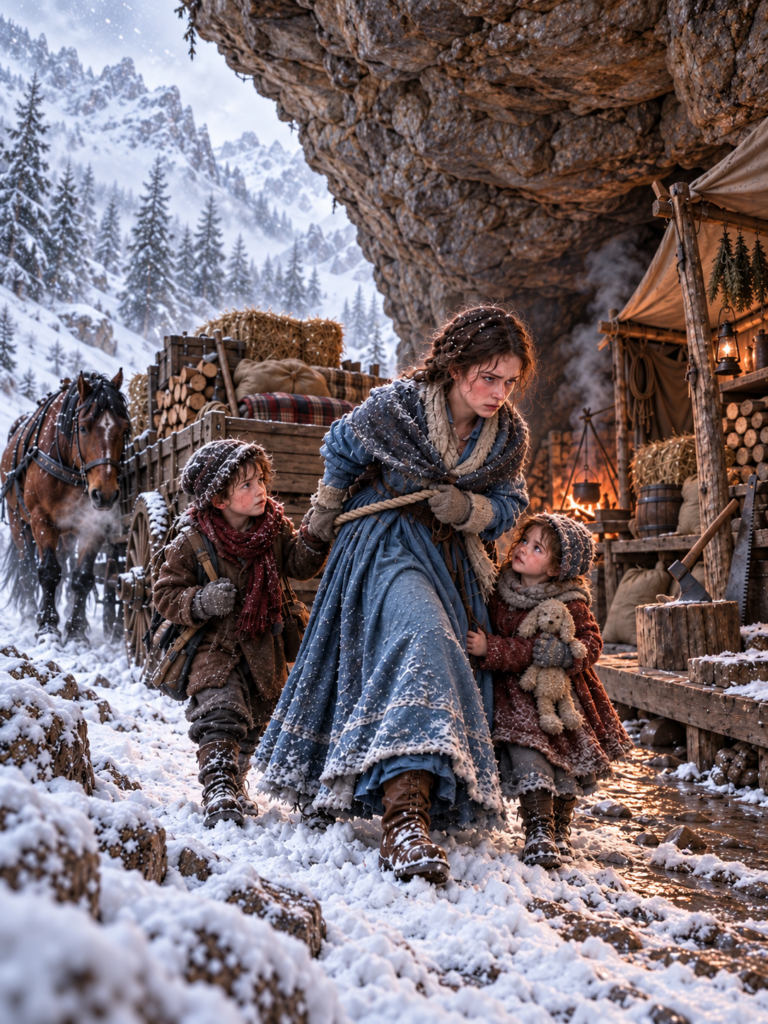
cast out at eighteen with two children and an aging horse she dragged her wagon into a mountain cave then history’s worst freeze struck hard
Part 1
The potatoes had begun to stick to the bottom of the iron skillet before Ruth Cer heard the front door open. She turned the heat lower and scraped them loose with the worn edge of her mother’s spatula, the one with the blackened handle and the dent where her father had once dropped it. Outside the kitchen window the sky over Leadville was the color of old tin. Snow had not yet stuck to the ground, but the air smelled of it. June sat at the table arranging three buttons in a careful row, then rearranging them, the way she had done every evening since their mother stopped waking up. Eli sat nearer the window, working a leather strap with more determination than skill, the needle going in and out at an angle that would have made their father click his tongue.
Amos Cer came in carrying a leather folder under one arm. The folder was clean. Everything else that autumn carried some mark of weather or work: mud on the steps, flour dust on the pantry shelf, pine needles blown against the back door. The folder had none of that. He set it beside their father’s coffee cup as if the table belonged to him.
“You need to hear this from me before somebody else says it worse,” he said.
Ruth did not turn from the stove. “Say what?”
“The note on this place is due.”
That made her look. Their father, Thomas Cer, had been dead since April. A freight wagon had overturned on the road below Tennessee Pass and pinned him beneath the axle. He lived long enough to be brought back to town and long enough to tell Ruth where he had left the harness tools and which doctor still owed him twelve dollars. Their mother lasted five months after that. Pneumonia took her in October. There had been no dramatic final speech and no hidden instructions about how an eighteen-year-old girl was supposed to raise a nine-year-old boy and a six-year-old girl while keeping food on the table. Ruth had turned eighteen three weeks before the funeral. People in town told her that made her lucky. Old enough to manage. Old enough to work. Nobody explained where she was supposed to learn the rest.
Amos tapped the folder. “Your father owed me money.”
Ruth wiped her hands on her apron. “He told Mama he’d paid you.”
“He paid part.”
“How much part?”
Amos paused. The pause lasted only a second, but it was long enough for Eli to stop working the strap. Amos opened the folder and placed a finger beside a number. “Four hundred and twenty remains.”
It might as well have been four thousand. Ruth made less than a dollar on most days she found work. The house was not much—two bedrooms, a narrow kitchen, a small front room, and the shed her father had used as a workshop—but it stood on its own lot close enough to town that a man could walk to the mines or the freight yards. Their father had spent ten years paying for it. At least that was what Ruth had believed.
“I want to see Papa’s books,” she said.
Amos’s jaw moved. “I’ve already gone through them.”
“Then I want to.”
“They’re estate papers now. It’s his desk.”
“It was his desk.”
Ruth walked past him. The roll-top desk under the window was locked. She had not noticed that before. The brass key that normally hung from a nail beside it was gone. Fresh scratches marked the keyhole. When she pulled the top, the desk resisted.
“When did you do this?” she asked.
“Your mother asked me to help settle things.”
“She never told me that.”
“She was sick.”
“She still spoke.”
Eli looked between them. June stopped moving the buttons. Amos lowered his voice. “I’ve got my own family to think about.”
Ruth stared at him. For the first time she understood that this conversation had started long before he entered the kitchen. “What do you want?”
“I take possession of the house and workshop against the debt. I forgive the balance.”
“You forgive it. After taking the house.”
“It’s worth less than you think.”
“It was worth enough for Papa to spend ten years paying for it.”
Amos glanced toward the children. “I didn’t come here to argue.”
“No. You came with the argument finished.”
His face hardened. “You can stay until morning.”
Ruth said nothing. She walked back to the stove and turned the potatoes because they had started to burn. It was such an ordinary thing to do that Amos seemed confused by it. She put three portions onto plates, then set a fourth portion back into the skillet the way she still sometimes did, cooking too much and counting five blankets before she remembered there were only three people left in the house.
“You hear me?” Amos said.
“I heard you. You’ve got until morning.”
“No.”
He frowned. Ruth turned. “Give me an hour.”
“For what?”
“To leave.”
Eli stood so quickly the chair scraped the floor. “Ruth—”
She did not look at him. Amos did. “Where are you going?”
“I’ll figure something out.”
He had used those words before. After the funeral. After the doctor’s bill. After Ruth asked what would happen to the children. You’re capable. You’ll figure something out. She hated them.
Amos nodded toward the yard. “Take whatever personal things fit in the wagon. Papa’s tools—”
“They were his.”
“They’re mine now.”
He started to object, then apparently decided a box of worn tools was not worth the argument. “Fine. The bay horse—”
“Boon. Papa gave him to me.”
“That animal won’t last another winter.”
“Then you won’t miss him.”
Eli looked down to hide a smile. Amos did not. “You have one hour.”
Ruth lifted June’s coat from the peg. Eli said, “Where are we supposed to go?”
Amos looked at the floor. “Your sister will figure something out.”
The words settled in the room like ash. Ruth would remember them later, not because they hurt most, but because of the way he said them—as if the children were already somebody else’s problem.
The next fifty-eight minutes became a kind of inventory. Flour, beans, salt, dried apples, a slab of bacon, two jars of rendered fat, four tightly pressed hay bales, two sacks of oats, three blankets from the beds and two older ones from the cedar chest, candles, a lantern, a kettle, a skillet, a small Dutch oven, rope, an axe, a crosscut saw, a handsaw, hammer, chisels, nails, needles, twine, a whetstone, two wool coats that had belonged to their parents, their mother’s sewing box, their father’s tool chest. Ruth made decisions without letting herself imagine the months beyond them. There was no room for imagining.
Eli loaded wood until she told him to stop. “We can get more wood.”
“Not if there’s snow. Food weighs more.”
“Food doesn’t grow on trees.”
He considered that fair. June appeared carrying the cracked blue cup their mother had used every morning. Ruth almost told her to leave it. Then she saw June’s face. “Wrap it in your red scarf.”
June did. She also brought the stuffed rabbit their mother had sewn from an old flour sack years earlier. One ear was shorter than the other. That went into the wagon too.
Boon stood in the traces, steam rising from his nostrils. He was a broad-backed bay with white hairs spreading around his eyes and muzzle. Thomas Cer had bought him as a five-year-old freight horse. Now Boon was nearly seventeen, too old for mountain hauling, too valuable to leave. The wagon was worse. One rear wheel had been repaired twice. The left sideboard leaned outward. A length of new rope helped hold the cargo together where a proper iron bracket should have been. Ruth climbed beneath the rear axle and checked the grease with her thumb. Not enough. She used a little fat from the workshop. When she crawled out, Amos stood at the shed door.
“You’re taking all the harness tools.”
“Yes.”
“You won’t need half of those.”
“Then I’ll carry half too many.”
His eyes moved over the wagon. “Where are you going this time?”
“West.”
That was all. There was a place in the mountains her father had shown her when she was twelve. Not a cabin. Not even close. A limestone shelf above Half Moon Creek where a shallow cave cut into the rock. Freight men and hunters had added a rough timber lean-to at the entrance years before. Her father once told her a man could wait out a bad storm there if he had sense enough to stay put. Ruth had not been back in six years. She did not know whether the timbers still stood. She did not know whether snow had filled the cave. She did not know whether the road remained passable that late in November. But she knew one other thing. No landlord was waiting there.
With twelve minutes left she went back into the house. Amos was near the desk. The leather folder had disappeared. The desk remained locked. Ruth stood in the doorway.
“You find what you needed?”
Amos looked at her. “What?”
“In Papa’s desk?”
“I told you. Estate papers.”
She noticed his right hand was closed around something. A key, perhaps. He slipped it into his coat pocket. Ruth looked at the scratches around the desk lock again. For a moment she considered demanding that he open it. Then June called from outside. Ruth turned away. The children mattered more than paper. At least that was what she believed. Then she closed the front door behind her without locking it. Amos was already inside.
Part 2
Snow started before they reached the edge of Leadville. Not enough to cover the wagon tracks. Just dry flakes crossing the road at an angle. Eli walked beside Boon, one mitten resting on the horse’s shoulder whenever the grade steepened. June sat under a blanket near the front of the wagon. Ruth held the reins. Nobody spoke for nearly a mile.
Leadville fell behind them. The town sat high enough that winter never needed much encouragement there. The mountains rose hard and white beyond the roofs, and old mine workings marked the slopes with dark cuts, tailings, timber, and abandoned sheds. West of town the road narrowed. Ruth began to wonder whether she had remembered the cave correctly. Her father had described the route in pieces. Follow the road until the creek bends away. Look for the broken spruce. Take the lower wagon track. When the pale rock shows above the trees, don’t climb toward it too early. She repeated the directions to herself.
At the third fork both tracks looked wrong. Eli noticed her hesitation. “Which one?”
“The left.”
“You sure?”
“No.”
He waited. Ruth looked at him. “But we’re taking the left.”
That satisfied him more than false confidence would have. They went left. By midafternoon the damaged wheel had begun squeaking. Ruth stopped twice to check it. The second time she found the leather binding around the repaired section had loosened. Her father’s tools came out before they had even found shelter. She tightened the binding while Eli held the lantern. June stood beside Boon, feeding him one oat at a time from her mitten until Ruth noticed.
“June.”
The little girl froze. “How many?”
June looked at her hand. “Not a lot.”
“Those are for winter.”
“I gave him seven.”
Boon stretched his nose toward her glove and snorted. “Eight.”
Ruth almost smiled. “That’s enough.”
June pressed her forehead to Boon’s muzzle. The old horse closed his eyes. They moved again. The snow thickened. Light disappeared early behind the ridge. Then Eli stopped.
“There.”
Ruth looked through the trees. At first she saw only stone. Then the dark line beneath it appeared. The limestone shelf. Relief lasted perhaps five seconds. The cave was smaller than she remembered. A section of the hunter’s lean-to had fallen inward. Two main roof poles remained, but the smaller branches across them had collapsed under old snow and rot. The floor near the entrance was drifted white. The rear looked dry. Barely.
Eli stared. “This is it.”
Ruth climbed down from the wagon. “This is it.”
June looked from the cave to Ruth. “Are we sleeping here?”
“And tomorrow?”
Ruth pulled her gloves tighter. “Let’s fix tonight first.”
It became another inventory. Dry ground. A little standing timber. Some firewood. Almost none. Protection from the west wind. Better than outside. Ruth backed the wagon beneath the rock shelf as far as Boon could manage. She unloaded food before anything else. The hay went to the driest wall, raised on old boards she found beneath the collapsed lean-to. Flour and beans went higher. The tool chest went near the rear. Blankets stayed rolled until she was certain where the children would sleep. Eli dragged loose branches clear. June collected stones the size Ruth requested and carried them one at a time. Boon stood in the traces, exhausted.
By darkness Ruth had repaired enough of the outer wall to tie him under cover. Then she built the fire. She chose a spot deep enough that sparks could not reach the snow at the entrance. It seemed sensible for about thirty seconds. Smoke rolled along the ceiling and came straight down. June started coughing first. Ruth grabbed her and pulled her toward the entrance. Eli followed with the blankets.
“Why isn’t it going out?”
“Because there’s nowhere for it to go.”
Ruth dragged two burning pieces of wood toward the mouth of the cave. Fresh air caught the flames. A gust sent sparks sideways. One landed on the canvas covering the hay. Ruth slapped it with her glove. Another spark caught in dry grass. Eli stomped it out.
“Back.”
“What?”
“Get back.”
Ruth shoved the fire deeper again. Smoke thickened. Her eyes burned. For one horrible moment she understood the problem. The cave could keep the wind away, or it could let the fire breathe. It did not seem willing to do both. Ruth wrapped a damp cloth over June’s mouth. “We can’t stay in here.”
Eli looked outside. Snow swept past the entrance. “We can’t stay out there.”
Ruth said nothing. That was the whole truth. She took the lantern and studied the ceiling. The flame flickered near the back wall. It bent. Ruth moved it sideways. The flame straightened. She moved it back. Bent again.
“Hold this.”
Eli took the lantern. Ruth climbed onto the tool chest and reached toward the rock. There was a narrow dark seam above her. She put her fingers near it. Air. Not much, but moving. Her father had taught her something about chimneys once. Hot air wanted to rise. The trick was giving it somewhere better to go than into your lungs.
At first light Ruth climbed above the limestone shelf. She tied a rope around her waist and gave the other end to Eli. “If I slip, you wrap it around that tree. Don’t try to pull me yourself.”
He nodded. “Tree first, then pull.”
Ruth climbed. Snow hid most of the rock. She brushed it away with a mitten until she found two slabs meeting at a narrow seam. Black soot stained the stone below it. Somebody had used that opening before. Maybe hunters. Maybe her father. Ruth widened it carefully with a hammer and chisel. Not much. Enough for her forearm. Then she climbed down.
The fire took several tries. Smoke gathered. Hesitated. Then a thin gray ribbon pulled toward the crack. Eli grinned. “It’s going.”
Ruth crouched, watching. “Wait.”
The smoke kept moving upward. June clapped once. Ruth sat on the floor. Her knees had begun shaking. She had not realized how frightened she was until the danger eased.
The victory lasted until noon. That was when Ruth discovered the cave could breathe too well. Cold wind moved across the floor and stole heat almost as fast as the fire made it. So she rebuilt the entrance. Stone at the bottom. Branches woven between old supports. Canvas over the worst gaps. A narrow opening for people. A wider section Boon could use when necessary. She left enough draft for the fire, not enough for comfort. Comfort was no longer the standard.
By evening ice in the kettle melted without Ruth holding it over the flames. That felt like progress. June fell asleep with her rabbit beneath her chin. Eli sat near the fire, trying to mend the strap he had been working on at the house. Ruth watched his fingers.
“You’re crossing the stitch.”
“I know.”
“Then why are you crossing it?”
“Because it keeps doing that.”
“The thread isn’t doing anything.”
He gave her a tired look. Ruth took the strap. She pulled the stitches and showed him again. Through. Back. Tight, not too tight. Their father’s hands had once done the same thing with hers. The memory arrived without warning. For a moment Ruth could not see the strap. She blinked hard and handed it back. Eli pretended not to notice. That was one kindness children learned too early.
The next morning he found the initials. Three letters cut into limestone near the back wall. TC. The marks were old, not ancient. Ruth touched them. Her father’s initials.
“Papa did that,” Eli asked.
“I think so.”
“When?”
“No. I know. You said he only showed you this place once.”
“He did. Maybe he came without you.”
Ruth looked at the letters. Apparently he had. June touched the TC with one finger. “Did he sleep here?”
Ruth thought about the soot on the upper vent. “Probably.”
“Why didn’t he tell us?”
Ruth had no answer. Outside, snow continued falling. By the third day it reached the wagon hubs. The road home disappeared. Ruth counted food. Then she counted it again, not because the second count would change anything. It was simply difficult to believe the first. They had enough for weeks, maybe months if she cut portions carefully. But winter in the high country did not care about calendars. Boon worried her more. Four hay bales sounded like a great deal when stacked in a wagon. It looked smaller when divided into days. The oats had to last. So did the children.
Ruth marked a line inside a tin cup. Boon got oats to that line each morning. No more. Hay came in measured portions. Whenever weather allowed, Ruth gathered dry grass from wind-scoured places and cut willow tips near the creek. She never replaced the hay completely. Her father had taught her that much. A horse could not live on wishful thinking and a handful of twigs.
Part 3
The first mistake that nearly cost Ruth everything happened during clear weather. Storms made people cautious. Blue sky made them stupid. She needed dead wood. The stack beneath the shelf was too small, and green wood smoked badly. So Ruth tied her coat, took the axe, and told Eli she would be gone ten minutes.
“Stay with June.”
“I can come.”
“No.”
“I can carry.”
“No.”
His face tightened. Ruth softened her voice. “I need somebody here.”
That helped. She walked uphill. Ten minutes became fifteen. The deadwood close to the cave had already been collected. Twenty minutes out she found a fallen pine with dry branches beneath the trunk. Good wood. Easy to split. She told herself she would take one bundle. Then she saw another deadfall farther up. Better. Larger. One more. That was the thought. One more.
The wind changed while she was cutting. Ruth heard it before she saw anything. A low rush through spruce. She stood. The ridge had vanished. Snow crossed between the trees in horizontal sheets. She grabbed the bundle and started downhill. After thirty paces she stopped. Nothing looked familiar. She turned slightly left. Walked. The slope steepened. Wrong. She went right. A rock outcrop appeared. She had never seen it. Her tracks were already filling.
Ruth dropped the wood. The bundles suddenly meant nothing. She walked faster, then faster again. Every spruce looked like the last one. Her own breathing grew loud inside her scarf. Somewhere below were two children who had already lost their father, then their mother. Now their sister had walked away in clear weather and disappeared. Ruth nearly ran. She caught herself. Stopped. That was harder than moving. Her father used to say panic could turn a hundred yards into ten miles. She closed her eyes. Listened. Wind. Branches. Snow against her coat. Nothing else.
Then faintly, Boon called. Ruth opened her eyes. She turned toward the sound. Walked twenty steps. Stopped again. Nothing. She waited. Another sound came. Metal. Clang. Clang clang. Eli. She turned left. The sound vanished behind the wind. Ruth waited again. Clang. She followed it. Boon called a second time. The two sounds came from nearly the same direction. Five minutes later Ruth saw the stripped branch Eli had driven into the snow above the entrance. Then the cave appeared. Eli stood outside beating Ruth’s skillet with a short iron bar. He dropped both when he saw her.
“Where were you?”
“Too far.”
“You said ten minutes.”
“I know.”
June ran past him. Ruth knelt before the girl reached her. June hit her hard enough to nearly knock her over. Ruth held both children. She wanted to say something reassuring. Nothing came. Inside, the fire had nearly died. Ruth fed bark into it. Her hands shook too hard to strike the match at first. The abandoned wood stayed uphill. She never went after it.
The next morning Ruth tied fifty feet of rope to an outer support. The other end went around her waist. When she needed to leave the cave in uncertain weather, she followed that line. When she reached its end, she stopped and looked at the sky. Sometimes she went farther. Often she turned back. Eli asked why they needed the rope when the weather was clear.
“Because yesterday was clear.”
That ended the argument. Later that week Ruth returned from gathering branches and found Eli using her small axe. He had set a piece of wood upright on a stone and was swinging down with both hands. The blade glanced, cut through the outer layer of his glove. He dropped the axe. Ruth crossed the cave in three steps.
“What did I tell you?”
“I’m fine.”
“What did I tell you?”
“I was helping.”
“You could have taken your fingers off.”
“I didn’t.”
“That’s not the point.”
His face hardened. “You leave all the time because somebody has to. I can do things too.”
“You’re nine.”
“I’m not a baby.”
“No. You’re a nine-year-old with one pair of hands, and I’d like you to keep them.”
He kicked the split wood aside. Ruth heard herself getting louder. “Don’t you walk away from me.”
That stopped him. Not because of authority. Because their mother used to say the same thing. The words hung between them. Ruth closed her eyes. “I’m sorry.”
Eli looked down. “So am I.”
Ruth took his glove. The cut had not reached skin. She sat beside the fire and repaired it with thread from their mother’s sewing box. For several minutes neither spoke. Then Eli said, “I can hold the wood while you split.”
“Not with your hands near it.”
“I know.”
“I mean it.”
“I know.”
Ruth tied the thread. “All right.”
From then on he carried. He held the lantern. He stacked. He swept snow away from the entrance. He learned how to tell downed wood from dry. Ruth stopped trying to keep him completely outside danger. There was no outside anymore. She taught him where danger stood.
December deepened. Snow climbed the wall. Strangely the cave grew warmer. Packed snow filled cracks between stones and blocked the worst wind. Ruth carved a narrow passage to the entrance and left the rest of the drift untouched. The children stopped sleeping in their coats every night. Not because it was warm. Warm had become another word with a different meaning. Warm meant the water bucket did not freeze solid before morning. Warm meant June could take off her mittens beneath two blankets. Warm meant Ruth woke only three times to feed the fire instead of five.
Winter became arithmetic. Hay. Oats. Flour. Candles. Daylight. Ruth cut notches into a pine board, one notch each morning. June watched.
“How many until spring?”
“I don’t know.”
“How many do we have?”
“Enough for today.”
June considered that. Then she added a small scratch beside Ruth’s notch. “What is that?”
“My day.”
Ruth almost told her not to dull the knife. She did not. Soon two rows marked the board. Ruth’s straight cuts. June’s tiny crooked ones.
One morning meltwater reached the storage corner. Not much. A thin line along the rock. Ruth saw it too late. The bottom of a flour sack had gone dark. She lifted it. The cloth tore. Damp flour sagged into her hands.
“No.”
Eli came over. “Can we dry it?”
“Some.”
They spread the flour on two metal trays near the fire. Part dried. Part had already soured. Ruth smelled it and knew. She sat staring at the ruined portion. Eli waited. “How much?”
“Too much.”
“Could Boon eat it?”
“No.”
“What do we do?”
Ruth gathered the spoiled flour and carried it outside. She threw it into the snow where animals could not easily reach the shelter. Then she returned and dismantled one side of the wagon bed. Eli watched. “What are you doing?”
“Building a shelf. We need that board.”
“We need dry food more.”
They raised every sack above the floor. Beans. Flour. Salt. Oats. Nothing rested directly against rock. Ruth checked the storage corner every morning after that. A wet sack. A loose knot. A cracked jar. A forgotten vent. The dangerous things were not always dramatic. Sometimes winter killed what you needed one spoonful at a time.
While moving the last hay bale, Eli found something. “Ruth.”
She was tightening rope around the shelf. “What?”
“Come here.”
A heavy iron nail protruded from the rear wall. That alone was not unusual. Hunters drove nails wherever rock allowed, but this one sat inside a seam between fitted stones. Ruth brought the lantern closer. She had not noticed the seam before because soot and shadow covered it. The back wall was not entirely natural. A section perhaps three feet wide had been filled with flat stones and old mortar. Ruth touched it.
“What is that?” Eli asked.
“A wall.”
“We know it’s a wall.”
“No.” Ruth moved the lantern. “I mean somebody made it.”
Eli’s face changed. “Why?”
Ruth knocked gently with the hammer. Solid. She moved lower. Knocked again. Different sound. June appeared behind them. “Is something in there?”
“Open it.”
Ruth nearly did. Curiosity had become a luxury they rarely had. She put the chisel against one mortar line, then stopped. The patched section reached close to the roof. If it supported loose rock, opening it could damage the shelter. Eli saw her lower the chisel. “You’re not doing it.”
“Not today.”
“But there’s something there.”
“Probably.”
“Then why not?”
“Because I’d rather wonder what’s behind it than find out while the ceiling falls on us.”
He did not like that. Neither did Ruth. That night June woke Ruth by touching her shoulder. “There’s wind.”
Ruth sat up. “In the wall.”
June pointed. The fire was low. Everything quiet. Ruth crawled behind the hay. She held the lantern near the fitted stones. The flame moved. Barely, but it moved. Air was passing through. The wall did not seal solid rock. Something existed beyond it. Ruth lay awake longer than she should have, not imagining treasure. Her father had worked freight. He hid spare cash beneath a floorboard once, but only because he did not trust banks after a mining company failed to pay him. If he had used this cave—maybe stored supplies, maybe tools, maybe nothing. The initials TC no longer felt accidental. She left the wall untouched for now.
Part 4
The storm arrived two days before Christmas. It lasted four days. Wind shook the canvas until the sound filled the cave like a loose sail. Ruth stopped long trips for wood. Boon stayed under the lean-to. On the second evening he refused oats. That frightened Ruth more than the wind. She offered them by hand. He turned away. She checked his mouth, his legs, his belly. Then she saw the bedding wet. Meltwater had slipped under the outer wall and pooled beneath him. Ruth moved Boon closer to the rock, stripped out the wet spruce tips, and dug a drainage channel toward the entrance. Eli carried bedding. June held the lantern. Nobody complained. Near dawn Boon ate from Ruth’s palm. Seven oats first, then more. Ruth laughed softly. June woke at the sound.
“He’s eating.”
“He’s eating.”
The girl smiled and went back to sleep. Hours later the storm took something else. A gust tore loose part of the outer covering. Snow poured across the storage platform. Ruth ran toward it. A timber shifted. One board struck the lower shelf. The oats sack fell. It hit the floor, split. Grain spilled into wet snow, mud, and dirty bedding. For a second Ruth could not move. Then she dropped to her knees. Eli grabbed a pan. Anything clean. They scooped oats by hand. June brought the kettle. Ruth picked grain from snow. Some could be dried. Much of it could not. Boon watched from three feet away. He smelled the oats, pulled at his rope. Ruth turned him away. By the time the storm eased, nearly half his concentrated feed was gone.
Ruth sat beside the remaining hay. The numbers no longer worked. Not comfortably. Maybe not at all. Whenever weather allowed she would have to gather more grass. Boon could lose weight and survive a little. Too much and he would not pull the wagon home. If the wagon could not move, June could not walk the distance. If Boon failed before spring, they might all leave the mountain on foot. Or not leave.
Eli was still cleaning the spill when his hand caught something behind the damaged platform. “There’s another nail.”
Ruth looked over. “No.”
He pulled. A board shifted. Behind it, set into the old masonry, was a small iron ring, not a nail. A handle. Eli stared at her. Ruth stared back.
“Now can we open it?”
Ruth brought the lantern. The iron ring belonged to a thin wooden panel buried behind the stonework. Most of its edges had been mortared over. Someone had wanted it hidden or protected. She touched the wall above. No loose stone. Then the sides. The patched section was not carrying the ceiling, at least not most of it. She waited until morning anyway. The storm weakened. Light entered the cave. Ruth moved Boon and the children back. She removed mortar slowly, one line, then another. The first flat stone came free. Behind it was darkness.
Eli leaned. “Can you see?”
“Back up.”
She removed a second stone. Air touched her face. Dry air. Colder than the cave. She widened the opening enough to fit one arm. Her glove brushed wood. Ruth pulled. Nothing. She reached farther. Metal. An edge. She worked the stones until a small cavity opened. Inside sat a tin dispatch box wrapped in dark oilcloth. No gold. No shining coins. Just a box the length of Ruth’s forearm with rust around the hinges.
Eli’s voice dropped. “Was that Papa’s?”
Ruth carried it to the fire. A short piece of wire held the latch. She untwisted it. The lid stuck. She worked a knife around the edge. When it opened, the smell was paper and old oil. Inside lay a narrow freight ledger, several folded receipts, two contracts, a survey map, a small brass key, and an envelope. The envelope had her mother’s name on it. Margaret. Ruth stopped breathing for a moment. She knew her father’s handwriting. Eli knew it too.
“That’s his.”
“Open it.”
Ruth did not. Not immediately. June sat beside her. “Is that Mama’s letter?”
“Looks like it.”
“Did she read it?”
“I don’t know.”
The envelope was not sealed. Ruth unfolded the pages. Thomas Cer had not written a farewell. That would have been easier to understand. The letter was practical. Half a page about freight routes. A line about roof repairs. A complaint about Amos insisting on being paid twice for the same lumber. Then a paragraph Ruth read three times. He had settled the remaining amount owed to Amos for Amos’s original share in the Leadville property. Payment had been made in stages. Thomas believed the final transfer paperwork would be filed during his next trip into town because company records had once been destroyed in a warehouse fire. He had begun keeping copies of important papers in two places. One set, he wrote, was with his freight things. The other was in the shop box.
Ruth lowered the letter. Eli was watching her. “What?”
She did not answer. She opened the ledger. Most entries meant little at first. Hay. Shoes. Repairs. Freight charges. Lumber. Then she saw Amos’s name. A payment. Another. Another. The last one carried the figure Ruth remembered from the kitchen. Not four hundred and twenty owed. A payment toward the original property interest. Beside it was a notation. Balance settled.
Ruth read it again. No dramatic certainty came. Paper could be wrong. Books could be incomplete. The final transfer might never have happened. But Amos’s story had depended on Thomas owing him a large unpaid balance. The ledger suggested something very different.
Eli leaned closer. “Does that mean he lied?”
Ruth folded the letter. “It means Papa wrote something different.”
“That’s lying.”
“It might be.”
“He threw us out.”
“I know.”
“We can go back.”
Ruth looked toward the entrance. Snow covered the wagon. Wind moved fine powder along the outer wall. “We can’t go anywhere.”
Eli’s excitement faded. The papers changed the story. They did not change the weather. Ruth wrapped everything again. The brass key remained in her palm. Small. Cold. One tooth slightly bent. “The shop box,” she said.
“What?”
“Papa said the other papers were in the shop box.”
Eli frowned. “What box?”
“I don’t know.”
They had taken the large tool chest from the shed. The key did not fit it. Ruth tried. Too small. She remembered a narrow iron-strapped chest under the workbench. Amos had told her it contained old machine parts and was too heavy to bother with. She had believed him. The chest was still in the workshop. At the house Amos now controlled. The discovery gave Ruth something she had lacked since November. A reason to return beyond survival. It also gave her one more thing to protect. She wrapped the papers in fresh cloth, placed them back in the tin box, then moved the box into the hidden cavity. Eli looked surprised.
“You’re putting it back.”
“Nobody knows it’s here. We know exactly.”
She replaced the loose stones but left the inner panel accessible. The brass key stayed on a cord around her neck.
That afternoon Ruth noticed the air had changed. Not warmer. Sharper. The wind had fallen. The sky turned a hard pale blue. Boon stood with his head low. Sound carried differently. Axe striking wood seemed to travel across the whole slope. A week passed, then another. January became February. There were signs before the worst cold arrived. A freight worker named Walter Pike reached the lower road with two mules and stopped near the creek when he saw Ruth gathering willow. He recognized her from Leadville. For several seconds he simply stared.
“Calder.”
Ruth rested the axe against her leg. “Pike.”
“I heard you’d gone south.”
“We didn’t.”
“I can see that.”
His eyes traveled toward the cave. “The young ones with you?”
“Both.”
He removed one glove and rubbed his beard. “Town’s been wondering.”
“Town knows where Amos lives.”
Pike gave a small uncomfortable nod. Then his expression changed. “You got enough wood?”
“Why?”
“Cold’s dropping down.”
“It is February.”
“No.” He looked north. “Different kind.”
Ruth waited. “They’re talking about it along the rail line. Cold air coming out of Canada. Wyoming’s already getting ugly.”
“How ugly?”
“Ugly enough. I’m turning back today.”
Ruth looked at his mules. “You’ve got another ten miles.”
“Not anymore.”
Pike reached into his wagon and gave her a folded newspaper two days old. Most of it meant little for the mountain. Reports from places she had never seen. Temperatures falling across the northern plains. Rail crews struggling. Stock losses expected if the cold deepened. Pike looked toward Boon. “Keep that old boy fed.”
“I’m trying.”
“Try harder for the next week.”
He started away, then turned. “You need anything sent to town?”
Ruth thought about Amos. The key beneath her dress. The tin box behind stone. “Tell people we’re alive.”
Pike nodded. “That all?”
“For now.”
He left. Ruth watched until the mules disappeared. The next morning Boon’s water had frozen deeper than usual. By noon it barely softened. The following night the cave walls gathered a skin of frost near the entrance. Ruth added wood. Wind found cracks she had never noticed. Eli woke with his scarf stiff against his face.
“How cold is it?”
Ruth had no thermometer. “Cold.”
“That’s helpful.”
She looked at him. He smiled faintly. That reassured her more than she expected. On the fourth morning Ruth swung the axe into a piece of pine and the wood split with a sharp sound, almost like breaking stone. Her gloves creaked. Metal burned through cloth faster than before. Boon’s breath froze along his whiskers. Ruth increased his hay. The ration plan she had guarded for months changed in one morning. A horse needed fuel to stay warm. So did children. There was no clever way around that. Ruth gave June more oatmeal. Then Eli. She ate what remained in the pot.
That night June began coughing. Not badly. Not yet. Ruth lay beside her and listened. Every parent learned certain sounds. Ruth had become a parent without becoming anyone’s mother. She knew June’s frightened cough. June’s dry cough. June’s cough after running. This was different. Lower. Ruth warmed a cloth. June opened her eyes.
“I’m okay.”
“I know.”
“Then why are you staring?”
“Because you’re interesting.”
June considered that. “No, I’m not.”
“Go back to sleep.”
The cold strengthened. What newspapers later called one of the great Arctic outbreaks of 1899 had spread over an enormous part of the country. Ruth knew none of the maps. She knew only the evidence. Inside one cave in Colorado, water placed six feet from the fire glazed with ice. The smoke vent narrowed with frost. Leather stiffened. Boon stamped his feet constantly. The children stopped wanting to leave their bedding. Ruth burned wood faster than she had planned. Too fast.
On the second night of the worst cold, Eli counted the pieces beside the fire. He had learned Ruth’s habits. “That’s all.”
“There’s more outside.”
“Frozen under snow.”
“I know where it is.”
“How long will this last?”
Ruth adjusted June’s blanket. “Don’t know.”
“Don’t know. You say that a lot.”
“Winter asks questions I don’t have answers for.”
Eli looked at the wagon. Its sideboard was still partly disassembled from the food shelf. “We can burn that.”
“No.”
“Why?”
“We need the wagon.”
“We need fire.”
“The cold will break.”
“What if it doesn’t tonight?”
Ruth did not answer. Eli pointed toward June. “We can fix a wagon.”
Ruth looked at him. Nine years old. Thin face. Hair too long because she had cut it badly in December and refused to try again. He was right. That irritated her. Not because she wanted to be right herself. Because the right answer cost something. Ruth went outside. The cold struck the inside of her nose. She stopped beneath the shelf. Boon turned toward her. Snow squeaked under her boots. She put both hands on the wagon’s sideboard. Her father had built part of it. Not the whole wagon, but he had replaced this board after a freight load shifted three years earlier. Ruth remembered holding the nails. Wood was wood. Memory did not make it burn differently. She removed the board. Inside, Eli said nothing. Ruth laid it across two stones. Sawed. Split. Fed the first piece to the fire. June slept through the sound. That night part of their road home became heat. Ruth decided it was a fair trade.
By morning the fire still lived. So did they. The roof began to fail the following night. Ruth heard the first groan just after midnight. Low wood under pressure. She sat up. Boon moved outside. Then came a crack. Snow dust fell through the outer covering. Eli woke.
“What was that?”
“Stay here.”
Ruth took the lantern. The main limestone shelf remained solid. The danger was the timber extension beneath it. One old support bowed inward. Snow packed above the brush roof had become too heavy. Boon stood directly beneath one end. Ruth tied her boots. “Eli, move June to the back.”
“I’m helping.”
“Move June first.”
He did. Ruth went to Boon. The horse pulled against his lead. “Easy.”
Another groan. She untied him. Branch snapped overhead. Boon lurched. Ruth pressed against his shoulder, guiding him beneath the stone shelf. The inner space was tight. Too tight for all of them comfortably. But comfort no longer mattered. A support shifted. Part of the feed rack fell. Hay disappeared under snow and branches. Eli grabbed the lantern.
“Ruth—”
“I see it.”
The cracked support had been worrying her for weeks. She had prepared another post. A straight piece of pine leaned against the wall, already cut close to length. That small act of preparation became the difference between fear and possibility. Ruth dragged it over. The failing post still carried weight. Removing it would bring the roof down, so she needed to wedge the new support beside it. She shaved one end. Set the base on stone. Raised it. Too long.
“Hold it.”
Eli pressed against the post while Ruth cut again. His boots slipped. “Don’t get under it.”
“I’m not.”
“You’re close enough.”
She cut. Raised it. The top caught. Ruth drove a wedge beneath the base. The wedge slid out. “Damn it.”
Eli looked at her. Ruth almost apologized for the word. Another crack made the apology unimportant. She cut a second wedge. Struck it with the hammer. The frozen wood split. For a second Ruth wanted to throw the hammer across the cave. Instead she set it down. Her hands had gone numb. She could not feel the chisel properly. That frightened her more than anger. Ruth crouched beside the fire. Thirty seconds. Maybe forty. She warmed her gloves. Eli stood behind her.
“We’ve got time.”
She looked at him. He did not know that. Neither did she. Still the words helped. Ruth cut a thicker wedge. Returned. The roof groaned. Snow shifted overhead. She drove the wedge once, twice, three times. The new post caught. Ruth added two flat stones beneath the base. Wrapped rope around old and new supports. Tightened it. The failing timber moved half an inch, then stopped. Nothing fell. Ruth did not trust silence. She took the long pole they used for clearing snow from the roof. The entrance was nearly buried. Going outside would be dangerous, so she opened just enough canvas to reach upward. The pole knocked loose a section of packed snow. It fell away from the entrance. More weight shifted. The support held.
Then June screamed. Not loudly. One sharp, frightened sound. Ruth turned. The rear wall had moved. A small stone dropped from the section they had opened weeks earlier. Behind it the wooden panel had shifted inward. Cold air poured through the hidden cavity. Eli ran toward June. Ruth stopped him. “Stay clear.”
The fire bent almost flat under the sudden draft. Smoke moved sideways. Ruth grabbed the loose panel. It resisted. She pulled harder. The old iron ring tore free in her hand. The panel opened another inch. Air rushed through. Behind it was not a room. Not exactly. The cavity continued deeper than Ruth had known. A narrow natural recess rose into darkness. She lifted the lantern. The space was perhaps six feet deep, but higher at the back. Old boards formed a shelf. A roll of wool lay beneath it, and against the far wall sat a stack of wood. Dry wood. Very old. Not much. Maybe enough for one night.
Eli whispered. “Papa.”
Ruth saw another carving in the rock. TC. Below it a date. 1887. Her father had not merely visited this cave. He had worked on it. The stack contained split pine, pitch wood, and three pieces of heavier timber. There were also rusted tins, all empty or spoiled beyond use. No miracle food. No hidden fortune. Nothing that would carry them to spring. But the dry wood was real. Ruth took one piece. It snapped clean. The sound nearly made her cry. She carried it to the fire. Eli brought another. June hugged her rabbit and watched.
The hidden recess changed something else. At the rear a natural crack rose toward the surface. The air coming through was cold, but it gave Ruth another vent path. She could partially seal the lower opening and still allow smoke to draw upward. Her father had understood the cave better than she did. Perhaps that was why he had kept the recess. Perhaps the wall had been meant to stop drafts while leaving emergency access. Ruth found an old canvas tarp. Mice had damaged one corner. The rest was usable. She hung it across the inner opening. Draft weakened. Heat gathered again. Outside the damaged roof remained braced. Inside the fire burned wood her father had cut more than a decade earlier. Nobody said much. The moment did not need help. June fell asleep first. Eli sat beside Ruth.
“Do you think he knew we’d come here?”
“No.”
“Then why’d he leave stuff?”
“For himself. Probably. Or anybody who needed it.”
Eli stared into the fire. “He always did that.”
“Did what?”
“Left things where people needed them.”
Ruth thought about the nails her father kept sorted near the workshop door because neighbors borrowed them. The water barrel by the shed. Extra leather strips. A shovel leaning outside after snowstorms. She had not thought of those things as character. They had simply been there. “Yeah,” she said. “He did.”
Near dawn Ruth checked the hidden dispatch box. The cold change had pulled moisture into one corner of the cavity. The oilcloth protected most of it. Not all. One receipt had dampened along the edge. Ink blurred. Ruth moved everything closer to the warmer interior and opened the papers carefully. Eli woke.
“Are they ruined?”
“No.”
“All right. That isn’t the same as useful.”
He sat beside her. “Why wouldn’t they be useful?”
Ruth showed him the contracts. “This says Papa paid Amos. The ledger says he paid Amos. The letter says he paid Amos.”
“So?”
“So the deed might still say something else.”
Eli stared. “That’s stupid.”
Ruth almost smiled. “Sometimes paper is.”
“Then people know Amos lied.”
“People know what they can prove.”
“We can prove it.”
“Maybe.”
He hated that word. Ruth hated it too. “Does Amos have to give us the house back?”
“I don’t know.”
Eli stood. “You always say that when you don’t want to tell me.”
“No. I say it when I don’t know.”
“What’s the difference?”
“The difference is I’m not lying to you.”
He looked at her. That landed. Ruth touched the brass key at her neck. “The letter says there’s another set in the shop box. At our house.”
“At Amos’s house now.”
“Maybe.”
“Stop saying maybe.”
Ruth folded the papers. “I’d rather give you a maybe that’s true than a promise I can’t keep.”
Eli looked away. After a moment he nodded. Not agreement. Acceptance. Sometimes that was enough.
The cold did not end because they had found something important. That would have made a kinder story. The following morning Boon stumbled when Ruth led him outside. His front leg buckled. He recovered. Ruth froze. She checked the hoof. Ice. No visible injury, but his ribs showed more than they had in December. Ruth increased his hay again. There went another calculation. For two days she and Eli dug through drifted snow to recover feed buried beneath the damaged rack. Much had stayed dry because the hay itself. Some had not. Every handful mattered.
June’s cough worsened at night. No fever that Ruth could feel. Still she watched. There was no doctor. No medicine beyond what their mother had kept in a small bottle. And Ruth did not trust the remains of that enough to use it blindly. So she did what she understood. Warm water. Rest. Food. Dry bedding. Keep the smoke moving. Keep June warm without making her sweat. She checked the little girl’s breathing until June grew irritated.
“I’m breathing.”
“I noticed.”
“Then stop.”
Ruth sat back. June pulled the blanket over her nose. Eli grinned. “She told you.”
“I heard her.”
The cold began to ease several days later. Not warm. Never that. But the kettle stopped freezing beside the fire. Boon drank more. Ruth noticed water dripping from a sunlit icicle at noon. Three drops. Then nothing. The next day five. Winter was not leaving, but something had shifted. Weeks passed. February moved toward March. The great cold that had gripped so much of the country receded elsewhere before the mountain surrendered its snow. At the cave survival returned to smaller problems. A loose harness buckle. A blocked vent. Damp socks. A cracked jar. The ordinary failures. Ruth preferred them. She could fix ordinary.
Eli began repairing harness under supervision. His stitches remained uneven, but they held. June’s cough faded. Her crooked day marks reached the bottom of the pine board, so she started a second row. Boon still looked thin, but when Ruth led him toward exposed grass near the creek he pulled hard enough to complain. She liked the complaint. One afternoon Ruth heard water running beneath snow. She stood still. Listened. There. Below the crust. She followed the sound to a narrow opening near Half Moon Creek. Dark water moved beneath ice. Ruth filled the kettle without melting snow for the first time in months. Boon lowered his head toward exposed grass. June stood beside Ruth.
“Is this spring?”
“Not yet.”
June sighed. “You always ruin it.”
Ruth laughed. She had not expected to. The sound came out rusty. June stared, then laughed too. Eli, farther uphill, shouted. “What?”
“Nothing.”
“Then why are you laughing?”
June shouted back. “Because spring isn’t here.”
Eli shook his head as if they had both gone foolish. The wagon took three days to uncover. Ruth dug around the wheels first. The damaged rear wheel had suffered through months of cold and weight. One leather binding had cracked. The rim remained sound. She greased the hub with the last useful fat she could spare. Replaced the leather. Tightened the spokes. Eli spun it. The wheel turned.
“Good.”
“Maybe.”
He stared. Ruth smiled. “Good enough.”
The missing sideboard was another matter. The board had become fire in February. There was no getting it back. Ruth used narrower timber from the damaged lean-to, lashed it with rope, and built a rough replacement. It looked poor. It held. That mattered. Before leaving, Ruth repaired the shelter. Eli complained. “Why?”
“Because we broke half of it.”
“The storm broke it.”
“We’re still using it.”
“We’re leaving.”
“Somebody else may not be.”
They replaced the damaged support with a stronger post. Ruth cleared both smoke paths. She deepened the drainage trench. They stacked dry wood under the limestone shelf. Not much. Enough to start a fire. Ruth left a small tin cup, a bundle of kindling, several nails in a jar, a short length of rope. June left one thing without asking. A blue button. Ruth found it on the hidden shelf.
“What’s that for?”
“So somebody knows a kid was here.”
Ruth left it. Eli carved three new initials beside their father’s. RC. EC. JC. He stepped back. Ruth looked at the letters. Her father’s initials sat above them. Not a message. Not prophecy. Just proof that years apart, four members of one family had stood in the same place needing shelter. Ruth replaced the dispatch box in the tool chest for travel. The documents stayed wrapped. The brass key stayed around her neck. When the road finally showed a muddy line through the snow, they loaded the wagon. Boon leaned into the traces. The repaired wheel turned slowly. No crack. No wobble. They started downhill. June looked back. The cave vanished quickly behind trees.
“Will we come again?”
Ruth held the reins. “Maybe in summer.”
Eli looked at her. She laughed. “That’s an acceptable maybe.”
Part 5
They reached the outskirts of Leadville late the following day. The town looked smaller. Ruth did not know why. Perhaps every place looked smaller after living beneath a mountain all winter. Chimney smoke rose over roofs. Wagons cut through brown spring mud. Mine whistles carried across the cold air. At the first cluster of houses a woman dropped a bucket. Ruth recognized her as Mrs. Bell from three streets over. The woman stared.
“Ruth.”
Ruth pulled Boon to a stop. “Morning.”
Mrs. Bell looked at Eli. Then June. Then Boon. Her face changed. “Good Lord.”
June whispered. “Are we dead?”
Ruth almost choked. “No.”
Mrs. Bell came closer. “We heard you’d left the county.”
Ruth glanced at Eli. “Apparently.”
“Some said Colorado Springs.”
“People have imagination.”
Mrs. Bell touched June’s shoulder. “Where have you been?”
Ruth looked west. “In the mountains.”
The story moved faster than the wagon. By the time they reached their old street, two men had followed on foot and several people stood outside shops. Amos came out of the house before Ruth stopped Boon. He looked older. Not much. Enough. His wife appeared behind him. Two children Ruth barely knew watched from the doorway. Amos stared at the wagon. At Eli. At June. At Ruth.
“You’re alive.”
Ruth climbed down. “So I’ve been told.”
He stepped toward her. “Where were you?”
“You know where Papa used to freight. West of town.”
Amos’s eyes changed very slightly. Ruth saw it. “Why do you know the cave?”
He looked toward the people gathering behind the wagon. “I know a dozen places your father stopped.”
Ruth touched the key beneath her coat. Amos saw the movement. His face lost color. Not all at once. Enough. Ruth did not pull out the papers. Not yet. “Where’s Papa’s small iron shop box?”
Amos went still. “What box?”
“The one under the workbench.”
“Probably scrap.”
“Where is it?”
“Ruth. This isn’t the place.”
“It’s the exact place.”
Mrs. Bell stood twenty feet away. So did Walter Pike. He had apparently heard before anybody else. Amos lowered his voice. “We should talk inside.”
Ruth looked at the front door. The door he had closed behind her in November. “No.”
“Don’t make a public scene.”
“I’m asking for a box. It’s part of the estate.”
“So am I.”
That sentence quieted even Amos. Ruth removed the tin dispatch box from the wagon. She set it on the tailgate. Opened it. Placed her father’s ledger on top, then the letter. She did not wave the papers. Did not accuse Amos of theft. Did not tell the neighbors what to think. She simply opened the ledger to the page carrying his name. Amos read it from where he stood. His jaw tightened.
“That isn’t a deed.”
“I know.”
“This proves nothing by itself.”
“I know that too.”
He looked at her. That answer worried him. Ruth pulled the brass key from beneath her coat. For the first time Amos said nothing. Eli stood beside Boon. June held the stuffed rabbit beneath one arm. Ruth raised the key. “Where’s the shop box?”
Amos looked toward the workshop. Nobody moved. Then his wife spoke behind him. “Amos.”
He did not turn. “What?”
“If it’s there, bring it out.”
“This is family business.”
She looked at Ruth and the children. “Yes.”
Something passed across his face. Not guilt exactly. Cornered calculation. Ruth recognized it. She had spent a winter calculating food. Hay. Distance. Daylight. She knew what a man looked like when the numbers had stopped favoring him. Amos turned and walked toward the workshop. Walter Pike followed.
“So nobody later says it wasn’t there,” Pike said.
Amos gave him a hard look. Pike shrugged. “I like boring stories.”
The iron chest came out covered in sawdust. Ruth recognized it immediately. Her father had used it years before. A narrow black box with rust at the corners. Amos set it on a bench outside. “Key.”
Ruth did not hand it to him. She inserted it herself. The bent tooth caught. For one terrible second the key would not turn. Eli held his breath. Ruth pulled it back slightly. Turned again. Click. The lid opened. Inside were machine parts. Old bolts. A broken gauge. Two leather templates. Amos exhaled. Ruth stared. Nothing else. Eli whispered. “No.”
Ruth moved the parts. Bottom layer. Metal. Grease rag. Nothing. Her chest tightened. Had they misunderstood the letter? Had Amos removed the papers? Had her father meant another box? Ruth lifted the last rag. The bottom felt too shallow. She knocked on it. Hollow. A false panel. Her father, of course. She used the small screwdriver from his tool roll. Two screws came out. The inner tray lifted. Beneath it lay a packet of paper wrapped in waxed cloth. Nobody spoke. Ruth opened it. The first page was a receipt. The second a copy of a property agreement. The third carried names she recognized. Thomas Cer. Amos Cer. Witnessed. Dated months before Thomas died. Ruth read slowly. Not every legal phrase. Enough. Thomas had completed the final payment for Amos’s former share. A formal transfer had been prepared. Whether every filing had been completed was another matter, but the claim that Thomas still owed the same balance no longer stood alone. There were records against it. Two sets kept in two different places, exactly as his letter said.
Ruth folded the paper. Amos stared at the ground. Eli looked at him. “You knew.”
Ruth put one hand on Eli’s shoulder. “Don’t.”
“But he knew.”
“Let him answer.”
Amos looked at Ruth. “The transfer was never recorded.”
“Did Papa pay you?”
Silence. Ruth waited. “Did he?”
Amos rubbed his mouth. “Most of it.”
Ruth opened the agreement again. “This says final payment.”
“There were expenses afterward.”
“Four hundred and twenty. He didn’t answer. That was what you told me.”
“Your father owed other money.”
“To you?”
“No.”
There it was. Not everything. Enough. It did not feel what she had expected. No burst of victory. No pleasure. Mostly fatigue. Months of it. The house stood ten yards away. She could see the upstairs window of the room she once shared with June. Nothing about it looked different. Amos had changed the curtains. That bothered her more than it should have. Walter Pike cleared his throat. “You’ll want somebody at the county office to look at those.”
Ruth nodded. “I know.”
Amos spoke. “You think this means you just walk in and take the place?”
Ruth looked at him. “No.”
That seemed to surprise him. “I think it means you don’t get to decide by yourself anymore.”
The legal part took time. Real life usually does. The papers did not magically place Ruth in the house that afternoon. Questions remained about the estate, Thomas’s debts to other people, responsibility for the two younger children, and the fact that some property documents had not been filed when they should have been. But the duplicate agreement mattered. So did the receipts. So did the freight ledger. Amos’s claim was challenged. The supposed unpaid balance shrank under examination, then disappeared. By early summer a settlement recognized Thomas Cer’s completed purchase interest and returned a substantial part of the property value to his children. Amos did not go to prison. There was no dramatic courtroom confession. No sheriff dragged him away. For Ruth that almost made the ending more believable. Men like Amos often did not think of themselves as thieves. He had a family, debts, a business that had done poorly. He told himself Thomas’s paperwork was incomplete. He told himself Ruth was too young to manage the property. He told himself the children needed somebody practical to make hard decisions. With enough telling, almost any selfish choice can begin sounding reasonable. Ruth never accepted that explanation. She also stopped needing an apology. Amos tried once. Not well. They met outside the county office in June. He stood beside her for several seconds.
“I didn’t think you’d make it through winter.”
Ruth looked at him. “I know.”
“That isn’t what I meant.”
“I know that too.”
He stared toward the street. “I thought you’d go south.”
“With what money?”
He had no answer. Then he said, “I could have handled things better.”
Ruth almost laughed. Instead she nodded. “Yes.”
That was all. No reconciliation. No speech. Some doors do not need reopening simply because you survived on the other side of them.
Ruth did not move back into the old house. That surprised nearly everyone. She rented a smaller place with a shed behind it and enough ground for Boon. Eli protested. “It’s ours.”
“Part of it.”
“Then why let somebody else have it?”
Ruth looked around the little rented kitchen. One window. Crooked floor. Stove that smoked when the wind came from the north. “I spent all winter trying to get somewhere because I thought home was a building.”
Eli waited. Ruth set their mother’s blue cup on the table. “I’m not sure anymore.”
The old property eventually sold. Ruth’s share gave her enough to settle debts, keep the children together, and buy tools she could never have afforded before. Not many. The useful ones. She still preferred their father’s. She sharpened saws, repaired wagon boards, patched harness, reset loose axe heads, fixed buckles, replaced broken handles. At first people brought work because they had heard the story. Later they came because Ruth was good. Those were different things. She preferred the second.
Eli spent afternoons in the shed. Ruth taught him how to use an axe properly. Two hands. Clear ground. Nobody within swing distance. Never hurry the downward stroke. He learned. June started school. The first morning she refused to leave the stuffed rabbit at home. Ruth argued. June argued better. The rabbit went to school inside her coat. Boon lived behind the shed. Keeping him made no financial sense. He was old. Ate more than he earned. Could no longer pull heavy freight. Ruth kept him anyway. Some decisions did not need to make financial sense after a winter spent measuring survival in tin cups.
In July they returned to the cave. This time the wagon carried lumber, roofing canvas, nails, food, and sealed tins. More rope. Eli rode beside Ruth. June sat in back with the rabbit. Boon walked slowly but willingly. The mountains looked entirely different without snow. Wildflowers near the creek. Running water. Dry roads. Birds where winter had held only wind. When the limestone shelf appeared between the trees, nobody spoke for a moment. The cave looked smaller again. Ruth wondered if difficult places always did once you no longer needed them.
They spent three days repairing it. Not turning it into a cabin. Ruth did not want that. The cave had survived because it remained simple. She replaced two supports, raised the storage shelf, improved the drainage channel, stacked dry wood farther from the entrance. They left a tin containing matches wrapped against dampness, a metal cup, nails, a length of leather. Small things. The sort that mattered when the world became narrow. Eli opened the hidden recess. Everything remained where they had left it, except the papers. Those stayed in town. June checked for her blue button. Still there. She nodded, satisfied. Ruth stood near her father’s initials. TC 1887. Below them were the three sets Eli had carved before spring. RC. EC. JC. She ran one finger across the stone. For years she had wondered why her father never told them more about this place. Now she thought she understood. There had been nothing mysterious to tell. To him the cave was probably just another useful place. Somewhere to leave dry wood. Somewhere to store papers. Somewhere a traveler could get out of the wind. His life had been full of practical kindnesses so ordinary nobody thought to write them down. A nail when someone needed one. A rope left dry. A horse watered before dark. A second copy of a paper because the first might disappear.
Ruth had spent months believing she survived because she learned to become harder. She had a little. But hardness was not what kept the children alive. Preparation did. Patience did. Eli banging a skillet through a snowstorm did. Boon calling from below the ridge did. June noticing air moving through a wall did. An old man cutting firewood twelve years before anyone knew they would need it did. People survived through one another more often than they admitted, even across years.
That afternoon Eli found the exact place where Ruth had burned the wagon sideboard. He ran his hand along the mismatched replacement. “We should put a proper board on.”
“We should.”
“You said that in March.”
“I was busy.”
“You’ve been busy since birth.”
Ruth looked at him. “You’re getting bold.”
“I survived winter with supervision.”
June called from the cave. “I survived too.”
Ruth shouted back. “Barely. You gave away Boon’s oats.”
“Eight.”
Eli laughed. Ruth did too. They replaced the board. The new one never matched the old wagon. Different grain. Lighter color. Straighter edge. Ruth left it that way. Years later people who knew the story sometimes asked why she had not painted it. She usually gave a practical answer. Paint cost money. The truth was quieter. She liked seeing where something had been lost and where something else had taken its place.
The winter of 1898 and 1899 became part of the Cer family’s private language. When Eli pushed too far into bad weather, Ruth only had to say “ten minutes.” He knew. When June wasted flour while learning to bake, Ruth sometimes stared at the floor until June said, “I know, I know. Flour doesn’t grow on trees.” That was not technically the lesson. Nobody corrected her. When Boon called from the pasture, all three children of Thomas and Margaret Cer heard more than an old horse.
Boon lived another four years. He died in late summer beneath a cottonwood outside the small house Ruth eventually bought. Eli found him first. Ruth sat beside the horse for a long time. No storm. No crisis. No need to calculate. She put one hand on his neck. “Good boy.” Those were the only words she managed. They buried him above the pasture. June placed the old blue button from the cave beneath a flat stone on the grave, then cried because she had immediately decided she wanted it back. Ruth dug it up. Human beings were inconsistent. That was all right.
Years passed. Eli became better with wood than Ruth ever was. June became a schoolteacher. Ruth kept repairing things. Not because she could not do anything else. Because she understood broken things. There was usually a point where damage stopped. A place where good material remained. Find that place. Work from there. The cave stayed above Half Moon Creek. Hunters used it. Freight men used it less as roads improved. Once a family caught in an early storm found the dry wood stack and later left more than they had burned. Nobody knew who started that custom. Ruth never claimed it. That would have embarrassed her.
She had seen stories like this reduced to one lesson. Be strong. Never give up. Hard times make strong people. That sounded clean. Life rarely was. Ruth made mistakes. She walked too far from shelter. She lost food to water. She failed to protect the oats. She yelled at Eli because she was scared. She nearly opened the hidden wall before knowing whether it was safe. She burned part of the wagon she needed to get home. Some choices worked because she planned well. Others worked because she was lucky enough to recognize a mistake before it became final. That may have been the more useful truth. Survival was not always knowing what to do. Sometimes it was noticing soon enough that what you were doing was not working.
Amos had given Ruth an hour to leave because he assumed she had nowhere to go. He was almost right. She had no house. No money worth mentioning. No legal papers she knew about. No adult standing behind her. She had two frightened children, an aging horse, a failing wagon, her father’s tools, and a memory of a limestone shelf in the mountains. For a while that was everything. Then the road disappeared. The food shrank. The cold arrived. The roof started to come down. And behind a wall nobody had opened in years, Ruth found evidence that the story she had been told about losing her home was not the whole story at all. But the papers alone did not save her. That mattered. The key did not keep June warm. The ledger did not feed Boon. The contract did not brace the roof. Justice could wait until spring. Cold could not. Ruth had to survive long enough for the truth to matter. Maybe that was why the old wagon meant more to her than the house ever did. A house had been taken in an afternoon. The wagon carried what remained. Then part of it went into the fire. The rest brought them home.
Amos once told two frightened children that their sister would figure something out. He meant it as an excuse to close a door. Ruth spent that winter giving the words another meaning. A house could be taken. Food could spoil. Records could disappear. A road could vanish beneath snow. A roof could bend until one more inch meant collapse. And sometimes the thing you believed was a solid wall turned out to have a way through it. Ruth Cer never conquered the mountain. She would have laughed at anyone who said she had. She learned where the wind entered, where the water traveled, how much hay one old horse needed, when to turn back, when to burn something valuable because a child mattered more, when paper was worth protecting, and when paper had to wait because somebody needed fire. By the time spring opened the road again, Ruth had returned with less food, less wagon, and fewer illusions than she had carried into the mountains. But she came back with both children. She came back with Boon. She came back with her father’s tools. And in an old tin box wrapped against the damp, she carried enough of the past to stop someone else from deciding her future.