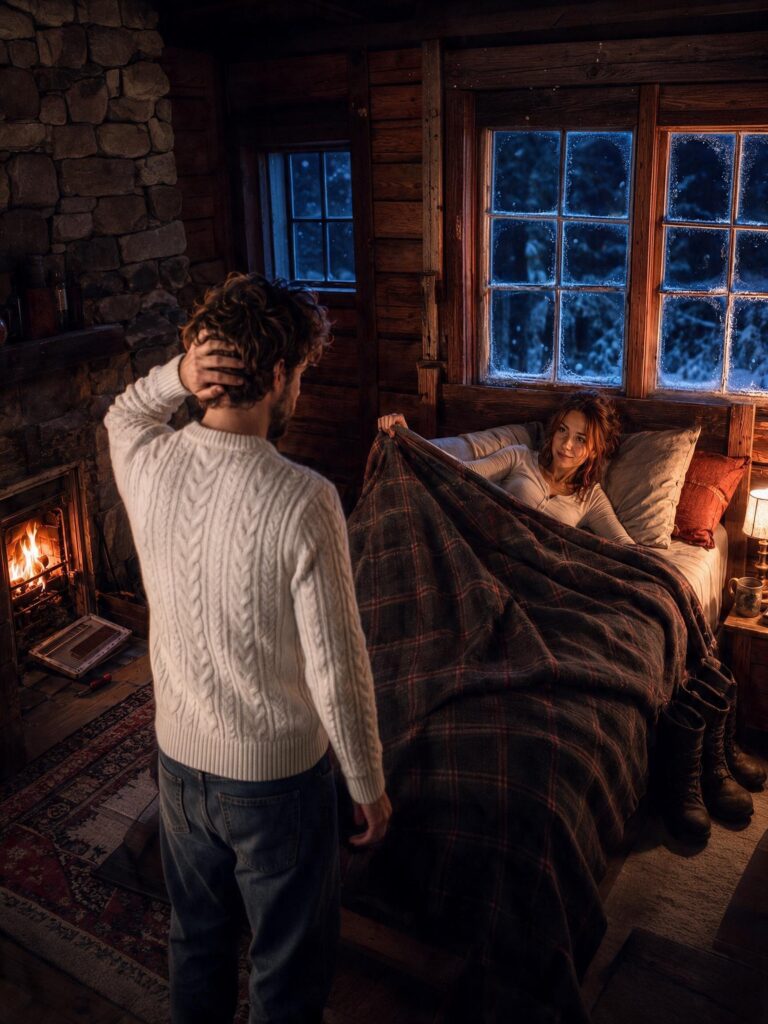
The frost crept up the inside of the cabin window like white spider webs, sealing us in as the wind tore through the dark pine trees outside and rattled the heavy wooden door on its hinges.
I stood near the center of the small room, staring at a dead thermostat that offered zero comfort, feeling the sharp drop in temperature seep through the soles of my boots.
My name is Clay.
I was standing 10 feet away from a woman I had known for a large part of my life, listening to the howling storm outside and trying very hard to pretend that my hands weren’t shaking in my pockets.
To understand how we ended up in that freezing room, you have to drift back. You have to leave the bitter cold and the quiet tension of that night and return to the beginning.
You have to go back to the warm, loud, and completely normal background noise of my everyday life.
My best friend was a guy named David. We grew up in the same neighborhood, rode the same bus, and eventually navigated the messy years of high school and early adulthood together.
David’s house was the absolute anchor of our friend group.
Even as we got older, got jobs, and moved into our own cheap apartments, his childhood home remained the place we naturally drifted toward on weekends. It was a modest two-story house with a wraparound porch that always needed painting and a driveway permanently stained with motor oil from our various broken-down trucks.
And the heart of that house was his mom, Sarah.
For years, Sarah was just a fixture in the background of my life. She was the one who left the porch light on when we were teenagers sneaking in late. She was the one who made sure there was always a pot of coffee brewing on Saturday mornings when we woke up on the living room floor, nursing hangovers and regretting our life choices.
She had a quiet sort of grace about her, a steady presence that made you feel completely grounded just by walking through her front door. She wasn’t loud. She never hovered or pried into our business. She just created a space where we all felt safe.
It was a Tuesday evening at the end of summer when the baseline of our reality first started to come into focus for me.
The air was still thick and humid, smelling of fresh-cut grass and distant rain. I had stopped by David’s house after a long shift at the lumberyard where I worked. I was covered in sawdust, exhausted, and just looking for a cold drink before heading back to my empty apartment.
David was out in the garage wrestling with a faulty lawnmower engine, shouting colorful words at a stubborn spark plug.
I walked through the side door and stepped straight into the kitchen.
Sarah was standing at the counter. She was wearing faded blue jeans and an oversized gray sweater pushed up to her elbows. She was holding a wooden spoon, stirring a large ceramic bowl of potato salad.
The late evening sun was cutting through the blinds, casting warm golden stripes across the worn linoleum floor.
I stopped in the doorway, taking off my dirty boots so I wouldn’t track sawdust into her clean kitchen.
“Clay, are you going to stand there all evening, or are you going to get a plate?” she said.
She didn’t look up right away. Her voice was perfectly steady, carrying that familiar warm tone that I had heard a thousand times before.
“I don’t want to intrude,” I said, leaning my boots against the wall. “I just came to borrow a socket wrench from Dave.”
She finally turned around. She tapped the wooden spoon against the edge of the bowl and gave me a soft, easy smile.
“You are never intruding, Clay. You know that. Wash your hands. The pulled pork is in the slow cooker, and there are fresh buns in the pantry.”
“Thank you, Sarah,” I said, moving past her toward the sink.
It was completely innocent.
It was a surface-level exchange between a guy and his best friend’s mother.
We ate dinner on the back porch, the three of us talking about the weather, the price of lumber, and David’s hopeless lawnmower.
It was comfortable.
It was exactly the way it had always been, an effortless dynamic built on years of shared history and mutual respect.
That should have been the end of it.
But time has a funny way of shifting the ground beneath your feet so slowly that you don’t even realize you are standing at an entirely different angle until you look down.
A few weeks later, the long, lazy days of summer finally broke, giving way to the crisp, sharp air of autumn.
The leaves in David’s front yard turned a burnt orange, and the evenings started getting darker much earlier.
Our friend group had planned a weekend camping trip up at a state park about 3 hours north, but as usual, the planning fell apart at the last minute. Half the guys bailed for work, and David ended up getting called into an emergency shift at the warehouse.
I had already requested the time off, and I found myself with a free Saturday and absolutely nothing to do.
Out of sheer habit, I ended up driving my truck over to David’s house. I knew he wasn’t there, but I had promised him a week prior that I would take a look at the jammed kitchen cabinet that kept driving his mother crazy.
When I knocked on the screen door, Sarah answered.
She looked a little surprised to see me, holding a mug of tea in both hands, her hair pulled back into a loose, messy bun.
“David’s at work, Clay,” she said, pulling the door open a few inches.
“I know,” I replied, holding up my small red toolbox. “I told him last week I’d fix that cabinet door by the sink, the one with the busted hinge. Figured since I had the day off, I might as well get it out of the way for you.”
She blinked, and then a very genuine, bright smile spread across her face.
“You really didn’t have to spend your day off doing chores around my house.”
“It’s not a chore,” I said, stepping inside as she made room for me. “Besides, if I don’t fix it, Dave is going to try to use duct tape again, and we both know how that ends.”
She laughed at that.
It was a nice sound. Quiet, light, and easy.
I set to work in the kitchen.
It was peaceful.
The house was completely quiet except for the steady ticking of the clock on the wall and the occasional clink of my screwdriver against the metal hinges.
Sarah didn’t leave the room. She sat at the small kitchen island, flipping through a magazine and occasionally taking a sip of her tea.
This was the first genuine moment of ease we had shared, just the two of us, without the buffer of David or the rest of the guys.
There was no tension.
There was no awkwardness.
Just a very comfortable silence shared between two people who were used to occupying the same space.
“You always were the reliable one,” she said suddenly, breaking the quiet.
I paused, looking over my shoulder at her. She was still looking down at her magazine, turning a page slowly.
“I don’t know about that,” I said, turning back to the cabinet. “I’m just a guy with a toolbox.”
“No,” she said softly. “You pay attention to things, Clay. Most guys your age, most of David’s friends, they walk through a room and they don’t see what’s broken. They just step over it.”
She paused.
“You actually stop and fix it.”
I focused very hard on tightening a small silver screw.
I told myself it was just a mother complimenting a younger man’s work ethic. I told myself she was just being polite, just expressing gratitude for the free handyman work.
I shifted my weight, adjusted my grip on the screwdriver, and redirected my attention to aligning the wooden door perfectly with the frame.
But I couldn’t stop thinking about the way she had said my name.
It wasn’t the brisk, maternal way she usually called us in for dinner.
It was slower.
More deliberate.
“Well,” I said, keeping my voice light and steady. “Someone has to make sure the doors stay on the hinges around here.”
I finished the job, testing the cabinet door a few times.
It opened and closed smoothly, no longer catching on the bottom lip of the counter.
I wiped my hands on an old rag and started packing up my tools.
Sarah stood up from the island and walked over to inspect my work.
She was standing a little closer than she normally would.
I could smell her perfume.
Something soft, like vanilla and old paper.
“It’s perfect,” she said, looking up at me.
“Good as new,” I replied.
We stood there for just a second too long.
The comfortable silence suddenly felt a little heavier.
A little denser.
I grabbed my toolbox, took a step back, and gave her a casual nod.
“I should get going,” I said. “Let Dave know the tape won’t be necessary.”
She smiled, following me to the front door.
“I will. Thank you, Clay. Drive safe.”
I walked out to my truck, tossed the toolbox into the passenger seat, and started the engine.
As I pulled out of the driveway, I glanced in the rearview mirror.
She was still standing on the porch, watching my truck disappear down the street.
I shook my head, turned on the radio to drown out my own thoughts, and drove home.
It was nothing.
Just a quiet Saturday afternoon.
Just fixing a cabinet.
But that was the first time I realized that the background noise of my life was starting to sound like a completely different song.
The transition from summer to autumn brought a new rhythm to our weekends.
By late October, the heat had been entirely replaced by a biting chill that made your breath bloom in the air, and our gatherings shifted from the back porch to the rusted iron fire pit out in David’s sprawling backyard.
It was a Friday night, the kind that felt bruised and dark by 6:00, and the entire core group had managed to actually show up for once.
There were five of us huddled around the flames in thick jackets, nursing cheap beers and arguing loudly about a football game none of us had actually watched closely.
I was sitting on a cracked plastic lawn chair, listening to David and our friend Mark shout over each other, feeling that familiar, comfortable exhaustion settle into my bones after a 50-hour work week.
I was laughing, but I wasn’t really participating.
I was just letting the noise wash over me.
When the cooler beside me finally rattled empty, I volunteered to make the trek inside for the second round.
I grabbed the handles, hauled the plastic cooler up against my hip, and walked away from the glow of the fire toward the glowing yellow windows of the house.
The warmth of the kitchen hit me like a physical wave the second I pushed through the back door.
The air smelled like cinnamon and roasted chicken, a sharp contrast to the harsh smoke and damp earth outside.
Sarah was standing at the counter, sorting through a stack of mail under the soft light of the overhead pendant lamp.
She was wearing a dark green cardigan that looked incredibly soft, her glasses pushed up onto the top of her head.
“Sorry,” I said, hoisting the cooler slightly. “Just coming in to raid the fridge. The boys are drinking fast tonight to stay warm.”
She looked up, dropping a heavy envelope onto the counter.
“Help yourself, Clay. Though if they drink too much more, they’re going to end up sleeping on the lawn, and I am not dragging them inside.”
“I’ll make sure they stay upright,” I said, walking over to the refrigerator.
I started pulling cans from the cardboard box on the bottom shelf, tossing them into the cooler one by one.
The house was quiet.
The muffled shouts from the backyard barely penetrated the thick glass of the kitchen window.
I finished loading the ice, shut the fridge door, and turned around to find that Sarah had moved.
She was standing on the other side of the kitchen island now, leaning her elbows against the marble, watching me.
“You don’t always have to be the one who takes care of them, you know,” she said.
I stopped wiping the condensation off my hands.
“What do you mean?”
“I watched from the window,” she said, her voice dropping into a register that felt a little too quiet for the bright kitchen. “You’re always the one fetching the drinks, feeding the fire, making sure David doesn’t do something entirely stupid.”
She tilted her head slightly.
“You know exactly how to step away from the noise when it gets to be too much. You don’t have to keep pretending to be loud just to fit in with them, Clay.”
It was a perfectly reasonable observation from a woman who had known me since I was 15.
But it was the way she delivered it.
It was the slight tilt of her head.
It was the fact that she was looking right through the casual, easygoing front I put up for the guys, peeling it back with a single sentence.
I set the towel down.
I looked at her, trying to read the lines around her eyes, trying to figure out if we were having a conversation about my social habits or something else entirely.
“I don’t mind it,” I said carefully. “Somebody has to keep the ship from sinking.”
She smiled.
A slow, quiet curving of her lips that didn’t show any teeth.
“Just make sure you aren’t the one drowning while you’re busy bailing their water.”
Before I could even process the weight of that sentence, the back door flew open with a violent slam.
“Clay! What are you doing, brewing the beer from scratch?” David yelled, stomping his muddy boots on the welcome mat, completely shattering the quiet atmosphere of the kitchen. “Mark is about to start eating the firewood.”
The sudden intrusion felt like a bucket of ice water down my spine.
I physically jolted, instantly putting three extra feet of distance between myself and the island where Sarah was standing.
I felt an immediate, crushing wave of embarrassment.
I was an idiot.
I was projecting my own weird, tired loneliness onto a perfectly innocent conversation with my best friend’s mother.
I had entirely misread the situation.
“I’m coming,” I said quickly to David, grabbing the cooler by the handle. “Just had to find a towel to wipe down the cans.”
I didn’t look at Sarah.
I kept my eyes locked on the floor, deeply ashamed of whatever brief, insane fantasy my brain had just tried to construct out of thin air.
I hurried past David, eager to get back out into the freezing cold where things made sense.
But as I stepped through the doorway, I glanced back over my shoulder just for a fraction of a second.
David was already rummaging loudly through the pantry for chips.
Sarah wasn’t looking at him.
She was looking squarely at me.
She held my gaze, offered a very small, almost imperceptible roll of her eyes toward her son’s chaotic noise, and gave me a soft smile that completely reanchored me.
It was a signal.
It was a lifeline thrown across a crowded room, telling me that I hadn’t made it up.
I told myself she was just sharing a quiet joke between the two mature adults in the room.
I told myself it was just a mother apologizing for her son’s complete lack of situational awareness.
I pushed out into the freezing night air, dropped the cooler by the fire, and handed out the beers to the shouting guys.
But I couldn’t stop feeling the distinct weight of her eyes on my back, pulling me away from the fire and back toward the glowing kitchen window.
Two weeks later, the slow burn caught oxygen.
It was mid-November, a dreary, rain-soaked Saturday that kept most of the town trapped indoors.
David had gone up to the city to visit a girl he was casually seeing, leaving the house empty.
Or so I thought.
I had agreed earlier in the week to swing by and help move an old solid-oak bookshelf from the downstairs den up to the spare bedroom on the second floor.
It was a two-person job, heavily dependent on leverage and not breaking your back on the narrow staircase.
I parked my truck in the driveway, pulled my collar up against the heavy, relentless drizzle, and jogged up to the front porch.
I knocked, wiped my boots on the mat, and let myself in.
“Dave?” I called out, shaking the rain from my jacket.
“He’s not here, Clay,” Sarah’s voice called back from the top of the stairs.
I walked into the foyer and looked up.
She was standing at the top landing wearing worn-out denim overalls and a white T-shirt.
Her hair was tied back with a faded bandana, and she had a smudge of dust across her left cheek.
She looked incredibly real.
Completely unpolished.
And absolutely beautiful.
“He went to the city,” she explained, starting down the carpeted stairs. “I completely forgot he promised you’d help with the bookshelf today. I’m so sorry you drove all the way out here in the rain for nothing.”
“It’s not for nothing,” I said, unzipping my wet jacket and hanging it on the brass hook by the door. “I’m already here. I’ve got a strong back. We can move it ourselves.”
She stopped on the bottom step, looking at me with a mix of hesitation and amusement.
“Clay, that thing weighs 200 pounds. It’s solid oak.”
“I move lumber for a living, Sarah. You just have to guide the top half so I don’t punch a hole in the drywall.”
She laughed, stepping down onto the hardwood floor.
“All right. But if we break the banister, I’m blaming you.”
We walked into the dimly lit den.
The bookshelf was a hulking, imposing piece of furniture that smelled like old varnish and dust.
I tipped it backward, letting the heavy weight settle against my chest, and instructed Sarah to take the lighter top end.
We moved slowly, shuffling out of the den and into the main hallway.
It was an awkward dance of shifting weight, tight corners, and heavy breathing.
By the time we reached the bottom of the staircase, the physical exertion had forced us into a rhythm, communicating entirely through short, breathless instructions.
“Okay, tilt it back,” I grunted, taking the first step up backward. “Watch your hands on the doorframe.”
“I’ve got it,” she said, her voice tight with effort.
We made it up the stairs, taking it one agonizing step at a time.
The real problem arose when we reached the second-floor landing.
The hallway leading to the spare bedroom was incredibly narrow, a tight squeeze that barely allowed the bookshelf to pass through, let alone two people carrying it.
“Set it down,” I said, my arms burning.
We lowered the heavy oak to the carpet with a dull thud.
We were standing in the narrowest part of the hallway, wedged between the wall and the bookshelf.
The overhead light in this section of the hall was burned out, leaving us bathed in the dim gray light filtering through a small window at the far end.
I was breathing hard, wiping a bead of sweat from my forehead.
I looked up.
Because of the tight space, Sarah had backed up against the wall to get out of the way.
I was standing directly in front of her, separated by maybe 6 inches of air.
The physical proximity was sudden and unavoidable.
The smell of her vanilla perfume mixed with the damp scent of rain lingering on my clothes.
“We need to pivot it,” I said.
My voice sounded rougher than I intended.
“Okay,” she whispered.
She didn’t move.
I didn’t either.
The air between us stopped.
I reached out to grab the edge of the bookshelf, and as I did, my forearm brushed against hers.
It wasn’t a bump.
It was a slow, sliding friction of bare skin against bare skin.
A sudden rush of heat flared precisely where we touched.
I froze, my hand hovering over the wood.
I looked at her.
Her chest was rising and falling slightly faster than normal from the heavy lifting.
Her eyes were wide in the dim light, locked onto mine.
The quiet of the empty house pressed in around us, thick and heavy.
Three seconds passed.
Three long, agonizingly deliberate seconds where neither of us stepped back.
Neither of us apologized for the touch.
Neither of us looked away.
The tension was a physical thing wrapping around my chest, pulling tighter with every breath I took.
I could see the pulse beating faintly at the base of her throat.
I wanted, with a sudden, violent intensity, to close the remaining 6 inches between us.
Then the floorboard creaked loudly beneath my work boot, shattering the fragile stillness.
I swallowed hard, ripping my eyes away from hers and gripping the heavy oak wood until my knuckles turned white.
I cleared my throat, staring very intently at a scratch on the side of the shelf.
“Ready?” I asked, my voice entirely hollow.
“Ready,” she breathed out, her voice slightly unsteady.
We pivoted the shelf, slid it into the spare room, and pushed it against the far wall.
The moment was over.
Boxed up and buried beneath the mundane reality of moving furniture.
We spent the next 10 minutes discussing shelf heights and dusting off the bottom panels, keeping our conversation strictly anchored to the wood and the dust.
I told myself it was just a cramped hallway.
I told myself it was just the adrenaline from lifting heavy furniture making my heart hammer against my ribs.
I practically ran down the stairs, grabbed my damp jacket, and made a clumsy excuse about needing to get home before the rain picked up again.
But I couldn’t stop feeling the exact spot on my forearm where her skin had dragged against mine, burning like a brand all the way home.
The final tipping point arrived the weekend after Thanksgiving, carried in on the back of a storm that the local meteorologist had vastly underestimated.
Sarah’s family owned a small rustic cabin about 3 hours north, buried deep in a dense patch of state forest.
It had belonged to her father, and every year before the heavy snow set in, someone had to drive up to drain the pipes, secure the storm shutters, and properly winterize the place so the freezing temperatures wouldn’t destroy the foundation.
Naturally, that responsibility had fallen to David.
And naturally, David had called me on a Thursday night in an absolute panic, explaining that he had just been scheduled for mandatory overtime at the warehouse and couldn’t make the drive.
He asked if I would go up with his mother to do the heavy lifting.
I didn’t even hesitate.
I told myself it was just a favor for a friend.
I packed a duffel bag, threw my heavy winter gear into the back of my truck, and picked Sarah up at 8:00 on Saturday morning.
The drive north was easy at first, filled with the comfortable, flowing conversation of two people who had entirely ignored the electric tension of a few weeks prior.
We talked about the holidays, the changing landscape outside the truck windows, and the mechanical quirks of my aging transmission.
But as we crossed the county line and headed higher into the wooded elevations, the sky bruised into a heavy dark purple, and the scattered flurries quickly shifted into a blinding horizontal whiteout.
By the time we finally navigated the unplowed dirt road leading to the property, the snow was already halfway up my truck’s tires.
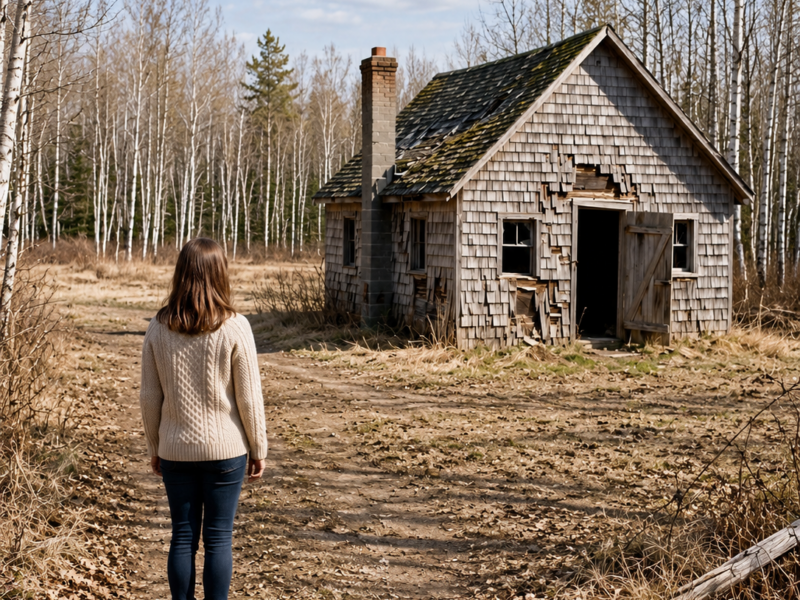
The cabin was a small, single-story A-frame made of dark, weathered logs, sitting entirely isolated against a backdrop of towering pine trees groaning under the weight of the wind.
We rushed inside, stomping the heavy snow from our boots onto the braided rug in the entryway.
The air inside the cabin was completely stagnant and bitterly cold, holding the deep, damp chill of a space that hadn’t seen a fire or a warm body in over a year.
I immediately went to work in the small kitchen area, locating the main water valve to shut off the supply, while Sarah started unpacking the small box of groceries we had brought for the afternoon.
I was lying on my back under the sink, wrestling with a stiff, rusted copper pipe, when she walked over and leaned against the counter above me.
“How does it look down there?” she asked, her voice echoing slightly in the empty wooden room.
“A little rusted,” I grunted, finally getting the wrench to bite into the metal fitting. “The joint is stiff. If we had left this out in the cold for another week, it probably would have cracked under the pressure.”
She was quiet for a long moment.
I could only see her boots and the frayed hem of her jeans from my vantage point on the floor.
“Some things just break if you leave them out in the cold too long,” she said quietly. “They look perfectly fine on the outside, but the structure just quietly gives up.”
I stopped pulling on the wrench.
I stared at the dusty underside of the sink cabinet.
“Are we talking about the copper pipes, Sarah?” I asked, keeping my voice entirely flat, entirely casual.
“I’m talking about whatever you’re trying to fix today, Clay,” she said.
I told myself it was just a metaphor for the aging cabin.
I told myself she was just making an innocent, tired observation after a stressful drive through a blizzard.
I shifted my weight, adjusted my grip on the heavy steel wrench, and forced the rusted valve shut with a loud metallic squeak.
But I couldn’t stop thinking about the sudden, devastating vulnerability in her voice and the undeniable double meaning hanging in the freezing air above me.
I slid out from under the sink and stood up, dusting off my jeans.
Before I could formulate a response, the lights above us flickered violently.
The old refrigerator hummed loudly for a fraction of a second, and then, with a heavy, final-sounding click, the power in the entire cabin died.
The silence that followed was absolute, save for the violent howling of the wind tearing at the roof shingles outside.
“Okay,” I said, pulling my flashlight from my heavy coat pocket and clicking it on, sweeping the bright white beam across the room. “That’s not ideal.”
I spent the next 40 minutes trudging outside through waist-high snowdrifts, trying to wrestle with the ancient breaker box on the side of the house.
It was completely useless.
The power line leading from the main road had been torn down by a falling pine branch.
The electric baseboard heaters, our only modern source of warmth, were entirely dead.
I walked back inside, brushing a thick layer of snow from my shoulders.
The temperature in the living room had already dropped significantly, the cold beginning to seep through the floorboards and radiate off the windows.
“The line is down,” I said, watching my own breath turn to vapor in the dim gray light filtering through the frozen windows. “And with this snow, nobody is getting a plow up that access road until tomorrow morning at the earliest. We’re stuck here, Sarah.”
She didn’t panic.
She didn’t complain.
She just nodded, her face illuminated by the weak light of the afternoon storm outside.
“Then we need to conserve whatever heat we have,” she said practically.
That was the external event that stripped away the remaining polite distance between us.
For the next hour, we moved through the cabin with a focused, silent efficiency, bound by the immediate practical necessity of staying warm.
We closed the heavy wooden doors to the two small bedrooms, sealing off the empty spaces to trap whatever ambient heat we could in the main living area.
We dragged the thick, heavy quilts and wool blankets off the beds and piled them onto the large leather sofa in the center of the room.
I managed to get a fire going in the old stone hearth, though the damp wood hissed and popped, fighting me every step of the way before finally catching and offering a meager, flickering orange glow.
The panic and the electric tension from the hallway weeks ago had vanished, replaced by a dense, comfortable domesticity.
We were just two people working together in the quiet dark.
It felt remarkably natural moving around each other in the small space, handing off blankets, sharing the beam of a single flashlight.
The silence between us was heavy but no longer charged with unspoken anxiety.
By early evening, the storm outside had reached a deafening pitch.
The cabin was completely dark, save for the weak, wavering light of the fireplace.
The cold had finally won, creeping through our heavy jackets and settling deep into our joints.
We were sitting on the thick rug in front of the hearth, wrapped in separate heavy wool blankets, staring into the low flames.
“I used to want to be a structural architect,” Sarah said suddenly.
Her voice was soft, barely rising above the crackle of the damp firewood.
It was the kind of confession that only happens in the dark, when the rest of the world has been entirely stripped away.
I looked over at her.
She had her knees pulled up to her chest, her chin resting on the thick wool of her blanket.
The orange firelight caught the soft lines of her face, illuminating a profound, quiet sadness that I had never seen in her before.
“You never told me that,” I said.
“I never told David either,” she replied, keeping her eyes fixed on the burning logs. “I was accepted into a program in Chicago when I was 22. I had the drafting tables, the late nights, the arrogant belief that I was going to build something that would outlast me.”
She paused.
“And then I got pregnant. And his father decided that he wasn’t ready to be tied down to a family, so he left.”
She took a slow, shaky breath, adjusting the blanket around her shoulders as a bitter draft swept across the floorboards.
“I didn’t give it up because I had to,” she continued, her voice remarkably steady. “I gave it up because architecture requires risk. It requires you to bet everything on a foundation you haven’t even poured yet.”
“And I couldn’t take risks anymore. I had to provide certainty. I had to be the solid ground for my son because he didn’t have anyone else to anchor him.”
“So I took a job at the bank, I bought that house, and I spent 20 years making sure the walls never fell down around him.”
I listened to her, feeling a deep, quiet ache bloom in my chest.
I didn’t offer her empty platitudes.
I didn’t try to give her advice.
I just recognized the massive, silent weight she had been carrying her entire adult life.
“You built something that lasted, Sarah,” I said gently. “You built a life. You built David. You built a place where a bunch of lost, chaotic kids could always come to find their footing.”
I looked at her.
“That’s not a compromise. That’s a foundation.”
She finally looked away from the fire, turning her head to meet my eyes in the dim, flickering light.
There was a raw, unfiltered gratitude in her expression that made my breath catch in my throat.
“What about you, Clay?” she asked softly. “What did you give up to be the guy who always fixes everyone else’s broken things?”
I looked down at my hands, rough and calloused from years of hauling lumber and repairing engines.
I had never talked about this with anyone in the group.
Not even David.
“I wanted to restore classic cars,” I admitted, the truth feeling foreign and heavy on my tongue. “I wanted my own garage. I had the down payment saved up 3 years ago to buy the old Sinclair shop on Route 9, but then my dad got sick.”
I swallowed.
“The medical bills piled up, and my mom was drowning trying to keep the house. So the down payment went to the hospital, and I took the steady paycheck at the lumberyard.”
“I’m so sorry, Clay,” she whispered.
“It’s fine,” I said, shaking my head, trying to brush off the vulnerability before it fully settled. “You do what you have to do for the people you love. You don’t get to complain about the cost.”
“Yes, you do.”
Her voice was suddenly fierce.
“You are allowed to mourn the things you had to leave behind. You don’t have to be perfectly strong all the time.”
I looked at her, entirely disarmed by the fierce, protective intensity in her eyes.
The space between us felt incredibly small.
The air thick and warm despite the freezing temperature of the room.
I was so caught off guard by the depth of the moment, by the sudden realization of how deeply she actually saw me, that I panicked.
I felt the overwhelming need to retreat to safer ground, to rebuild the walls that had just come crashing down.
“Well,” I said, offering a forced, hollow laugh that sounded terrible even to my own ears. “I guess we’re just a couple of tragic, unfulfilled martyrs sitting in the dark, aren’t we?”
The fierce warmth in her eyes vanished instantly.
She went perfectly still, the muscles in her jaw tightening as she slowly turned her face back toward the weak fire.
The comfortable, intimate space we had just created shattered into a million sharp, jagged pieces.
I had broken it.
I had taken something fragile and true, and I had crushed it with a cheap, cowardly joke because I was too terrified to stand in the emotional open with her.
The silence in the cabin suddenly felt suffocating.
I sat there in the dark, hating myself, desperately searching for a way to rewind the last 10 seconds, absolutely certain that I had just ruined the most profound connection I had ever experienced.
I stared at the side of her face, waiting for her to stand up and walk away into the freezing dark of the bedroom.
Instead, she slowly reached out from beneath the heavy folds of her wool blanket.
She didn’t look at me.
She just shifted her weight slightly on the rug, leaned to her right, and gently bumped her shoulder against mine.
It was a tiny, deliberate point of contact.
A quiet, physical reassurance.
It was a signal.
It was her telling me that she knew I was terrified, she knew I was running away, and she wasn’t going to let me go that easily.
The panic in my chest slowly dissolved, replaced by a profound, overwhelming sense of relief.
I let out a long, slow breath, resting my head back against the base of the leather sofa, closing my eyes, and leaning my shoulder firmly back against hers.
We sat there in the fading firelight, anchored against each other as the bitter cold finally overtook the room.
The fire slowly starved in the cramped stone hearth, the damp logs putting up a valiant but ultimately futile fight against the crushing, oppressive cold.
I watched the wood turn from a vibrant, glowing orange to a deep, charred black, eventually crumbling into a pile of fragile gray ash that offered absolutely no heat.
The temperature in the cabin plummeted rapidly, the bitter chill seeping up through the floorboards and radiating off the glass panes of the windows with vicious intensity.
I could see every single breath we took looming like thin white smoke in the dim, fading light, a constant visual reminder of how entirely vulnerable we were to the storm raging outside.
The cabin groaned under the relentless weight of the wind, the heavy timber beams shifting and settling with loud, sharp cracks that echoed through the empty space.
The cold was no longer just an inconvenience you could ignore by wrapping a jacket a little tighter.
It was a physical, biting presence in the room, threatening to push straight through the heavy wool of our blankets and settle directly into our bones.
I knew with absolute certainty that we could not stay sitting on the braided rug.
The only place left to retreat, the only possible source of sustainable warmth, was the makeshift bed we had constructed hours earlier on the large leather sofa, a massive, chaotic nest of down comforters and thick quilts that we had piled together out of sheer survival instinct.
But neither of us made a move toward it.
We just sat there, anchored against each other, our shoulders pressed firmly together in the dark, actively delaying the inevitable reality of the situation.
Because acknowledging the necessity of that single shared bed meant acknowledging the massive, terrifying shift in gravity that had just occurred between us during our conversation.
And neither of us was quite ready to look that reality directly in the eye.
The silence that stretched between us was no longer the comfortable, domestic quiet of two people working together, nor was it the panicked, electric tension of the hallway weeks ago.
It was something entirely new.
Something heavy and profound, filled with the unspoken weight of confessed regrets and a sudden, striking vulnerability that I had never expected to share with her.
We were suspended in that fragile space between the life we had always known and completely unknown territory.
Moving to the sofa felt like stepping over an invisible threshold that we would never be able to cross back over.
So I just sat perfectly still, letting her warmth seep through the shoulder of my jacket, watching the last ember die in the fireplace, waiting for the cold to finally force our hands.
The wind battered the heavy wooden door, rattling the iron latch with a violent rhythm.
The last piece of damp firewood split down the middle with a sharp, echoing crack, sending a shower of orange sparks up the dark brick chimney.
A thin layer of white frost crept up the inside of the living room window panes, catching the weak moonlight that occasionally broke through the storm clouds outside.
The air in the room was entirely still, smelling of wood smoke, old leather, and the sharp metallic scent of freezing rain.
She pulled the edge of the heavy wool blanket tighter around her neck, her fingers pale and trembling slightly in the dim light.
The floorboards creaked as she shifted her weight.
She let the blanket fall from her shoulders, the thick fabric pooling on the braided rug with a soft, muffled thud.
She stood up slowly, the silhouette of her frame dark against the dying embers.
She walked the four steps to the leather sofa.
She lifted the edge of the thickest down comforter.
She slid beneath the heavy layers, pulling them up to her chin.
The rusted springs of the old sofa groaned faintly.
The fire popped one final time.
She looked at me and said, “Just get in. I’m freezing.”
Like she’d been carrying it a long time.
Like she’d finally decided to put it down.
I didn’t move.
Not right away.
My lungs entirely locked up.
Cold air in my throat.
Just a sharp, hollow ache.
I stared at the ashes.
The wind howled outside.
My hands were completely numb.
Everything felt entirely unmoored.
The room was completely dark.
I could hear her breathing.
A slow, trembling, quiet rhythm.
I closed my eyes.
The hesitation finally shattered.
The last wall came down.
I stood up.
My boots were heavy.
The floorboards were freezing.
I walked to the edge.
I looked down at her.
Then I said, “I’m coming in.”
I stepped out of my heavy, damp work boots, leaving them near the dead hearth, and carefully lifted the edge of the massive pile of blankets on the sofa.
I slid underneath the heavy layers, the sudden, stark contrast between the freezing air of the cabin and the trapped, concentrated warmth beneath the comforter sending a violent shiver down my spine.
The leather cushion of the sofa was narrow, forcing us into immediate, undeniable proximity, our heavy clothes creating a clumsy, awkward friction as I tried to settle my broad shoulders into the confined space without crowding her entirely against the backrest.
For a long minute, we simply lay there, entirely stiff, staring up at the dark wooden beams of the ceiling while the wind screamed violently against the roof above us.
The physical reality of the situation was overwhelming.
I could feel the steady, rhythmic rise and fall of her chest against my arm, the soft heat of her body bleeding through the layers of our sweaters, and the faint, familiar scent of vanilla perfume now entirely mixed with the smell of wood smoke and winter cold.
My heart was hammering a frantic, desperate rhythm against my ribs, loud enough that I was certain she could hear it in the quiet dark.
Every muscle in my body pulled taut with the sheer, overwhelming effort of keeping myself perfectly still.
Slowly, the biting chill that had seeped into my bones began to recede, replaced by a deep, resonant warmth that had absolutely nothing to do with the heavy blankets piled on top of us.
I turned my head slightly, my face inches from hers in the heavy shadows, the weak moonlight from the frosted window illuminating the soft, quiet contour of her cheek and the profound, beautiful darkness of her eyes looking back at me.
She wasn’t pulling away.
She wasn’t rebuilding the walls of polite distance.
She was just lying there, watching me with a steady, quiet courage that entirely dismantled the last remaining traces of my own fear.
“Can I kiss you?” I whispered, my voice completely stripped of the casual, easy confidence I usually wore, leaving only a raw, terrified honesty in the tiny space between us.
She didn’t say a word.
She simply reached out from beneath the heavy wool, her fingers sliding gently against the rough, cold skin of my jaw, and she nodded.
A slow, deliberate movement that felt like the earth shifting entirely off its axis.
I leaned in, moving incredibly slowly, giving her every possible opportunity to change her mind, until my lips finally brushed against hers in a soft, impossibly gentle kiss that felt like taking a full breath of air after drowning for months.
It was careful.
It was terrifyingly fragile.
A quiet question asked in the freezing dark.
And the moment she exhaled softly against my mouth, leaning into the touch and entirely surrendering to the pull, the lingering tension in my chest completely dissolved.
The soft, tentative pressure seamlessly deepened into something incredibly grounded and profoundly real, a slow, hard kiss that carried the weight of every unspoken glance, every deliberately ignored touch, and every agonizingly careful boundary we had built over the last decade.
My hand found its way to the back of her neck, my fingers tangling in the messy, loose strands of her hair, pulling her closer against my chest as the freezing reality of the cabin faded entirely into the background of my consciousness.
There was no explosive, chaotic climax.
No desperate rush of adrenaline.
Instead, there was just a profound, overwhelming sense of arriving somewhere I hadn’t even realized I was navigating toward.
The kiss slowed, gentled, and finally broke, leaving us resting our foreheads together in the dark, sharing the same quiet, heavy air as the storm continued to rage completely unnoticed outside the walls.
We settled into the narrow space, the awkwardness of the heavy layers completely forgotten, our bodies naturally finding a comfortable, familiar alignment beneath the weight of the down comforters.
She rested her head against the curve of my shoulder, her hand resting warmly against my chest, and the overwhelming electric tension that had haunted every interaction for the past 3 months quietly, peacefully dissolved into the freezing night.
Twelve days passed.
The transition back to the loud, chaotic reality of our normal lives happened with a strange, seamless ease that I completely failed to anticipate.
I had expected the return to David’s house to be fraught with a heavy, unmanageable awkwardness, filled with stolen glances and the terrifying paranoia of being discovered by the very people who anchored my everyday existence.
I had braced myself for a massive structural shift in the way our entire friend group operated, convinced that the profound, undeniable truth of what had happened in that freezing cabin would somehow be permanently written across my face for anyone to read.
But the reality was entirely different.
The reality was a quiet, unshakable grounding.
A secret foundation poured beneath the surface of my life that actually made everything else feel infinitely more stable.
It was a Wednesday evening, just a few days before Christmas, and the familiar, comforting noise of David’s house was in full swing.
David and Mark were in the living room, fiercely debating the mechanics of a video game while an old action movie played, entirely ignored, on the television in the background.
The air in the house was incredibly warm, smelling of pine needles from the tree in the corner and the rich, dark scent of coffee brewing in the kitchen.
I was standing at the kitchen counter, wearing a faded gray T-shirt and my heavy work jeans, mindlessly tracing the rim of a ceramic mug while I waited for the coffee pot to finish its slow, sputtering cycle.
I wasn’t hovering near the door like I used to.
I wasn’t keeping a careful, polite distance from the center of the room.
I was just standing there, occupying the space with an effortless, undeniable sense of belonging.
Sarah walked into the kitchen from the hallway, carrying a stack of folded laundry.
She was wearing a thick, oversized maroon sweater and a pair of worn-out denim jeans, her hair pulled back into a loose clip that allowed a few stray strands to frame her face.
She didn’t pause when she saw me.
She didn’t offer the polite, motherly smile that had defined our interactions for the better part of a decade.
Instead, she set the laundry basket down on the edge of the kitchen island, walked directly into my personal space, and stopped.
I didn’t step back.
I didn’t panic.
The terrifying electric tension that used to flood my veins whenever the physical distance between us closed had been entirely replaced by a deep, resonant calm.
I simply took a half step forward, closing the remaining few inches between us, and reached out to gently tuck one of those loose strands of hair behind her ear.
She leaned into the touch, a slow, natural inclination of her head, resting her cheek against the rough calluses of my palm for a long, quiet second.
The comfortable silence of the room wrapped around us, completely undisturbed by the loud, chaotic shouting of her son in the very next room.
What used to require agonizing calculation, what used to demand a constant, exhausting vigilance to prevent myself from crossing an invisible boundary, was now just a simple, effortless reality.
“They’re going to break that television if they keep throwing the controllers,” she murmured, her voice pitched perfectly so that only I could hear it over the noise of the coffee maker.
“I’ll go in there and threaten to unplug the console in a minute,” I replied softly, my thumb brushing lightly against the soft skin of her jaw. “Just let me finish this cup of coffee first.”
She smiled.
A small, entirely unguarded curve of her lips that reached all the way to her eyes.
It was a look completely devoid of the fierce, protective armor she had worn for 20 years.
It was just her looking at me, entirely present and entirely open.
She reached out, resting her hand lightly against my chest, her fingers curling easily into the soft fabric of my shirt.
“You look tired, Clay,” she said gently, her thumb tracing a slow, rhythmic circle against my collarbone.
“Just a long day at the yard,” I said, leaning down slightly to press a soft, quick kiss to her forehead. “I’m fine now.”
She lingered there for another moment, sharing the quiet warmth of the kitchen, before giving my chest a gentle pat and pulling away to pick up her laundry basket.
The separation wasn’t a retreat.
It was just a natural, easy breath in the middle of a continuous sentence.
I turned around, grabbed the glass pot, and poured my coffee, feeling a profound, quiet contentment settle deep into my chest.
I leaned back against the counter, taking a slow sip from the mug, and looked toward the back of the house.
The frost crept up the outside of the kitchen window like white spider webs, sealing the warmth in as the winter wind tore through the dark, bare branches of the oak trees in the backyard.
It was the exact same bitter cold that had trapped us in the cabin.
The same relentless winter pressing against the glass.
But this time, the freezing dark was safely, entirely on the other side of the pane.
She paused in the doorway leading toward the stairs, the laundry basket balanced easily on her hip.
She turned around, looking back at me as I stood comfortably in the center of her kitchen, entirely anchored to the space.
“You never have to stand by the door anymore, Clay,” she said.
I thought about what she said every day since.
I think I always will.