“Say Fat One More Time” — the Plus-Size Pie Maker Warned the Elegant Woman in Silver, and Then the Banana Cream Flew Across the Ballroom of Milwaukee’s Most Feared Man
Part 1
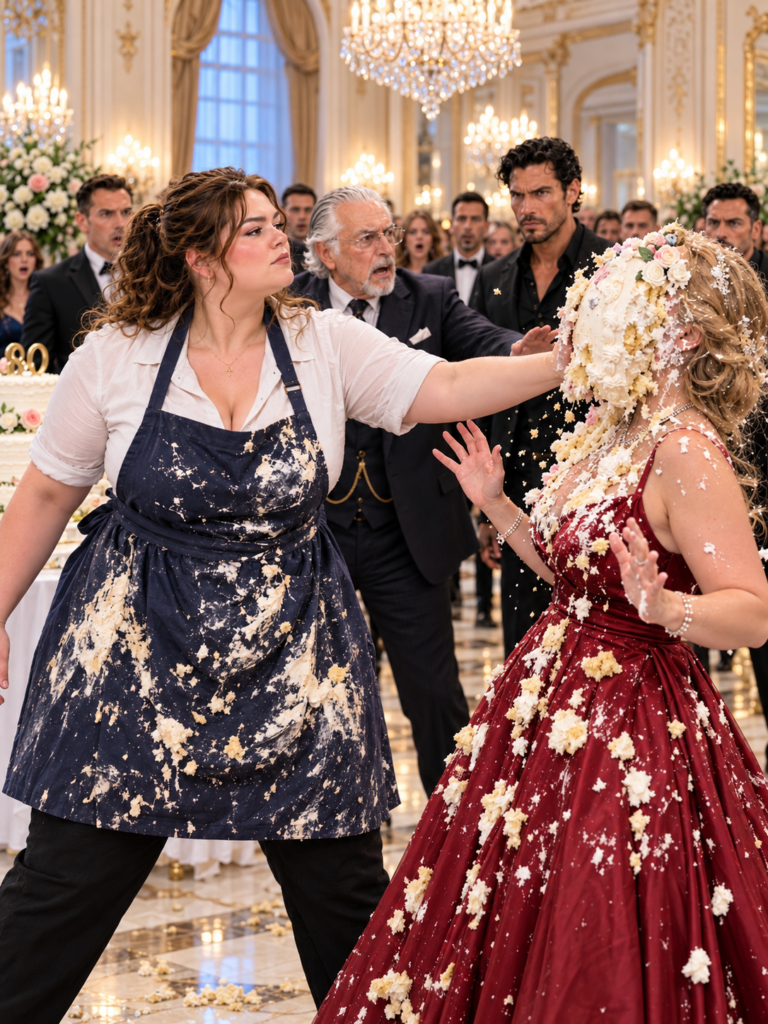
The pie tin hit the parquet and spun once before it settled. For three full seconds nobody in the Fister Ballroom breathed.
Serena Vance stood perfectly still. Banana cream slid down her cheeks and dripped off her chin onto a silver silk dress that had probably cost more than Rose Kowalic’s delivery van. A piece of whipped topping slid off her eyelashes and landed on her shoe. Then she screamed. It was not a word at first. Just sound. Then it became Roz’s name. Then it became the word assault. Then it became a demand that someone call the police right now.
Roz wiped her hands on her apron. They were shaking. She had spent thirty-five years swallowing the things people said about her body. She had always imagined that if she ever finally stopped swallowing, it would feel like freedom. Instead it felt like standing at the edge of a cliff after she had already jumped.
Two men in dark suits came off the wall behind the dessert table. Big men. Fast. One of them was already reaching for her arm. Luca Benedetti turned his head. That was all. He did not say a word. He did not lift a hand. He simply looked at them, and both men stopped so abruptly that one nearly collided with the other.
Serena shoved cream out of her eyes and pointed a shaking finger at Roz. “She attacked me in front of your entire family. I want her arrested. I want her little bakery shut down by Monday.”
A small voice cut through the room, clear and sharp. Carmela Benedetti, eighty-two years old and barely five feet tall, walked straight between the two women and planted herself in front of Roz like a wall.
“The pie maker was defending me,” she announced to the ballroom.
Roz stared down at the top of the old woman’s silver head. Something hot and complicated rose in her chest. “You started all of this.”
Carmela did not turn around. “That is true.”
Luca looked at his grandmother, then at Roz, then at Serena dripping onto the floor, then back at his grandmother. When he spoke, his voice was very calm and very tired. “Would anyone like to explain why the scholarship gala named after my late grandfather has just turned into a food fight?”
Nobody answered him.
Five weeks earlier, Rose Kowalic had been elbow-deep in cinnamon-apple filling at five forty-five in the morning when the bell over the door of Crust and Crumble rang. She yelled from the back that they did not open until seven. The bell rang again. Somebody was not leaving. She came out wiping her hands and found a tall, dark-haired man in a black overcoat standing at her counter. He had set a white bakery box in front of the register and was looking at it the way someone looks at a document with an error in it.
“There is a problem with my order,” he said.
Roz said good morning. He did not smile. He opened the lid. It was one of her lemon meringue pies, the special-order kind with piped lettering across the top. The pie itself was perfect. The lettering said Happy Birthday, Carmen. Roz checked the ticket taped to the side of the box. It said Carmela in her own handwriting. She closed her eyes for a second.
“That was my mistake.”
“It was.”
“Who is Carmela?”
“My grandmother. She is turning eighty-two tomorrow. Somebody at her church called her Carmen in 1964 and she has not forgiven that woman for sixty years.”
Roz nodded seriously. “I respect that kind of commitment.”
The corner of his mouth moved about one millimeter. “I need it fixed before noon.”
“Fixing things is generally what happens after I make a mistake.” She took the box, set it on the counter, and pulled a piping bag from the drawer behind her. Her assistant Dana came in the back door, saw who was standing at the counter, and dropped her car keys. She grabbed Roz by the sleeve and pulled her two steps toward the ovens.
“Do you have any idea who that is?” Dana whispered.
“No.”
“Luca Benedetti.”
Roz stopped piping. She knew the name. Everybody in Milwaukee knew the name. The Benedetti family owned half the parking garages downtown, a string of restaurants along the lake, and a trucking company that nobody ever talked about in detail. People said the name quietly, the way you mentioned weather that had knocked down power lines. She looked back over her shoulder. He was checking his phone, completely unbothered, standing in her tiny bakery at a quarter to six in the morning as if he waited in lines every day.
She turned back to the pie. “Fifteen minutes.”
He looked up. “Fifteen minutes.”
“The meringue has to set. If you want your grandmother’s name written correctly, it will take exactly as long as it takes anyone else.”
Dana made a small noise like a teakettle. Luca Benedetti looked at Roz for a long moment. He looked like a man who had not been told to wait for fifteen minutes by anyone in a very long time. Then he sat down on one of the two wobbly stools by the window and waited.
At six-oh-two she handed him the box. The lettering said Happy Birthday, Carmela in perfect cursive. She had not charged him for the remake. She had tucked a second small tart in the corner of the box for free. He looked at the tart.
“What is that?”
“An apology tart. Cherry.”
“My grandmother is not supposed to have sugar.”
“Then you can eat the tart and not tell her.”
He paid anyway, left a twenty in the tip jar that Dana stared at for five minutes, and walked out. Roz told herself she would never see him again. She was right for exactly two days.
On Thursday at seven-fifteen a very small, very elegant old woman in a camel coat and pearl earrings walked into Crust and Crumble, stood in front of the pie case for three minutes like a general studying a battlefield, and pointed. “I would like three slices of the bourbon pecan.”
Roz reached for a box and then noticed the round white sensor stuck to the back of the woman’s upper arm, peeking out from under her coat sleeve. A glucose monitor. Roz’s own father had worn one for eleven years. She stopped.
“How many slices would your doctor say you can have?”
The woman looked deeply offended. “My doctor does not work in this bakery.”
“That is not what I asked.”
The woman narrowed her eyes. “One.”
Roz cut one small slice of bourbon pecan, put it on a plate, poured a cup of coffee, and set both in front of her. “The coffee is on the house. It is black because I am not going to be responsible for anyone’s A1C.”
The old woman stared at the single slice. “At my age I can eat whatever I like.”
“At your age you can apparently also lie to your endocrinologist.”
The woman burst out laughing so loudly that a man waiting for a croissant jumped. She came back the next morning and the morning after that. By the second week Roz knew that she took her coffee black with one ice cube because she hated burning her tongue. She knew she thought the blueberry crumble was underseasoned and the apple was the best in the state. She knew she had buried a husband, two brothers, and most of her friends, and that she believed eighty-two was entirely too young to be managed by anyone. She never gave Roz her last name. Roz never asked. She simply introduced herself as Carmela.
On the ninth morning Carmela asked why Roz never talked about a husband. Roz said because there was not one. Carmela asked whether there had been one almost. Roz spent a second too long refilling the napkin dispenser. Then she said there had been a man named Derek. Four years. He had been an insurance lawyer. He had loved her pie and he had loved her apartment and he had loved her company on a Sunday. He had also left a printed diet plan on her kitchen counter for her birthday with a note that said it was because he wanted her to feel confident when he took her to meet the partners. He had taken her to meet the partners exactly never.
Carmela put down her fork. “That man was a coward.”
“I know that now.”
“Good.” She reached across the counter and patted Roz’s hand with her small, surprisingly strong fingers. Roz had to go into the back for a minute and pretend to check the ovens.
That was the morning the door flew open so hard the bell nearly came off its hook. Luca Benedetti walked in. He was not calm this time. His coat was open, his tie was loose, and he looked like a man who had just spent forty minutes driving in circles. Carmela, sitting at the window with her single slice of apple pie and her black coffee, immediately looked guilty. Luca saw the pie.
“Nona.”
“Do not use that tone with me.”
“You walked out of the house at six-thirty without telling anyone.”
“I went for a walk.”
“You walked eleven blocks.”
“My cardiologist will be thrilled.”
“You turned your phone off.”
“It kept ringing.”
Roz stood behind the counter with a dish towel in her hands and slowly put the pieces together. Her stomach dropped. The birthday pie. The name on the ticket. Carmela. Luca turned to her. His voice was very controlled.
“Have you been serving my grandmother pie every morning for two weeks?”
Roz folded her arms. “I have been serving your grandmother one slice every morning for two weeks, plus black coffee, which is exactly two fewer slices than your grandmother tried to order on the first day.”
“My grandmother has type 2 diabetes.”
“I am aware. Because I have eyes, and your grandmother wears a monitor on her arm, and I asked her about her doctor on day one, which I am guessing is more than anyone at your house has done without yelling.”
His eyes flashed. Roz kept going. “If you are worried about your grandmother, you should sit down at a table and talk to her like a grown woman. You should not send people chasing her down Kinnickinnic Avenue like she is an escaped prisoner.”
Luca went completely still. Across the room, Carmela picked up her coffee cup and said with enormous satisfaction that she had told him Roz would win.
“This is not a competition.”
“It is now.”
Roz looked from one of them to the other. Then her face slowly changed. She pointed at Luca. “Wait. You are the lemon meringue man.”
Luca closed his eyes.
“You are Mr. Happy Birthday Carmen.”
“Please never call me that.”
Carmela’s whole face lit up like a Christmas tree. Roz smiled slowly. “Oh, I am absolutely going to call you that.”
Luca Benedetti should have been angry. Men in this city had lost business deals for speaking to him that way. Instead, standing in a bakery that smelled like cinnamon, listening to his grandmother cackle into her coffee, he found himself fighting a reaction that was far more inconvenient than anger. He wanted to laugh. He did not. He told his grandmother it was time to go home. Carmela told him she had not finished her pie. He sat down across from her and waited while she finished it, one very slow bite at a time, and he did not check his phone once.
When they left, Carmela stopped at the counter and squeezed Roz’s hand. “I will see you tomorrow.” Luca looked at Roz over his grandmother’s head. For one second something in his face softened.
“Thank you,” he said quietly, like it cost him something.
“I will put you down for a lemon meringue next year. Spelled correctly.”
He almost smiled. Almost.
The next morning Carmela did not come in. She did not come in the morning after that either. Roz told Dana she was not worried. She said the old woman had probably finally been grounded by her grandson. She said it three times before noon, which was two more times than a person says something they believe. On the third morning at seven-forty the bell over the door rang and Roz looked up so fast she knocked over a cup of pie weights. It was Carmela, walking slowly, holding on to the door frame. Roz came around the counter before she had decided to.
“Are you all right?”
“I am perfectly fine. I simply had a small adventure with my insulin and spent two nights in Froedtert Hospital being poked by children in white coats.” She sat down at her table by the window. Roz watched her hands tremble as she took off her gloves. Roz brought her a cup of black coffee. No pie. Carmela did not ask for one.
“I want to talk to you about something important.”
Roz sat down across from her, which she had never done before. Carmela said that lying in a hospital bed for two nights had made her think. She was eighty-two and her grandson was forty and he spent every hour of his life taking care of everybody except himself. He had not laughed in two years. Not since the woman he was going to marry walked out on him six weeks before the wedding and took the ring with her.
“That is a lot of personal information to give the woman who sells you pie.”
Carmela ignored her. She said she had heard Luca laugh in the car on the way home from the bakery. She had thought she was asleep. Then she reached into her coat pocket, took out a folded sheet of heavy cream-colored paper, and slid it across the table. It was a signed catering contract. The Salvatore Benedetti Scholarship Gala. Three hundred mini pies for the dessert table. Caterer: Crust and Crumble. Beside the words deposit paid in full, a check number and a signature in elegant old-fashioned handwriting. Carmela Benedetti.
Roz read it twice. “I never agreed to this.”
“That is why I signed it for you. The deposit alone will pay your rent for three months. Dana mentioned the rent was late.”
“Dana is fired.”
From behind the register Dana said she was not. Roz looked back down at the contract, trying to decide whether she wanted to hug this woman or throw her out of the bakery. Then she saw the line at the bottom of the page printed under event committee. Chair: Serena Vance.
Carmela watched her read it, and for the first time since the morning they met, Roz saw something in the old woman’s smile that was not sweet at all. It was the smile of a woman who had already planned the next three moves.
Part 2
Roz read Serena Vance’s name three times, then set the contract down on the table like it might bite her. “Who is Serena Vance?”
Carmela took a slow sip of black coffee. “She is the chair of the gala committee.”
“I can read that part. Who is she?”
Carmela put the cup down. “She is the woman who was six weeks away from marrying my grandson.”
Dana dropped a tray of muffin tins in the back. Roz pushed the contract across the table. “Absolutely not. I am not going to bake three hundred pies for a party run by my customer’s grandson’s ex-fiancée because that sounds less like a catering job and more like the first ten minutes of a divorce trial.”
Carmela pushed the contract back. “Serena had nothing to do with choosing the caterer. The scholarship is named after my late husband and the family has always chosen the dessert. Serena just runs the seating chart and the silent auction and likes having her name printed at the top of things.”
“Does Luca know about this?”
“Luca will find out at the appropriate time.”
“That is not a yes.”
Carmela smiled. “It is not a no either.”
Roz looked at the deposit line again. Four thousand two hundred dollars. The rent on Crust and Crumble was sixteen hundred a month and she was two months behind. She had been lying awake at three in the morning doing math on the back of an electric bill. “I will do it on one condition. There will be no surprises.”
“Of course not.”
Roz would remember that promise for a very long time.
For the next nine days nobody at Crust and Crumble went home before midnight. Three hundred mini pies meant nine hundred feet of rolled crust, forty pounds of apples, twenty pounds of pecans, and more banana cream than Roz had made in a year. Dana developed a blister on her thumb from crimping. Tessa, the eighteen-year-old high school senior who washed dishes on weekends, came in every afternoon after class without being asked and learned how to flute a crust by the second night. On the fourth night, while Roz was pulling a tray of pecan tartlets, Tessa asked her why she was working this hard for rich people who probably would not even notice the pies.
“Because the pies are not for the rich people,” Roz said. “The scholarship is for kids like you. I looked it up. Every penny from that auction goes to first-generation college students from the south side.”
Tessa went very quiet. Then she said her guidance counselor had told her to apply for that scholarship. Roz said then they had better make these the best pies anybody in Milwaukee had ever eaten.
On Saturday afternoon, with the gala starting at six, three hundred pies were boxed, labeled, and stacked by the back door. At four-ten the delivery van refused to start. Dana turned the key. The engine made a sound like a sick cow and then made no sound at all. Roz said please. Dana turned the key again. Nothing. Roz said please in a much higher voice. Dana got out, popped the hood, stared at the engine for a while as if she knew what she was looking at, and closed it again. She said she thought the van had died.
Roz stood in the alley and did the math. The gala was at the Fister Ballroom downtown, twenty minutes away. The dessert table had to be set by five-thirty. Three hundred cream pies were sitting in a kitchen that was already eighty degrees. Every ride-share car in the city would fit maybe forty boxes. She called two rental companies. The first was closed. The second had a cargo van available on Tuesday.
At four-twenty-two a black SUV pulled into the alley behind the bakery. Luca Benedetti got out of the back seat. He had come to pick up his grandmother, who had spent the entire afternoon sitting on a stool in Roz’s kitchen giving unsolicited opinions about meringue. He looked at the dead van. He looked at the tower of boxes. He looked at Roz, whose hair had come loose and who had flour in her eyebrows.
“What happened?”
“Transportation betrayed me.”
He glanced at the van again. “I have vehicles.”
“No.”
“You have not heard what I am offering.”
“I know exactly what you are offering. I have seen your vehicles. I am not going to deliver three hundred pies to a children’s scholarship gala in a motorcade of black SUVs with tinted windows like I am smuggling something across a border.”
Luca stared at her. “Would you rather three hundred cream pies melted on principle?”
Roz looked at the boxes. She looked at him. She looked at her watch. It said four-twenty-six. “Fine.”
Luca nodded toward the two men standing beside the SUV. “They will load the boxes.”
“No.”
He raised an eyebrow.
“You offered, so you can carry boxes.”
One of the two men suddenly became deeply interested in a gutter. Luca looked at her for a long moment. “Are you seriously asking me to carry pie boxes?”
“Unless the Benedetti family has some kind of religious exemption from lifting things.”
From the back doorway Carmela, who had heard every word, said this was the best day she had had since the Packers won the Super Bowl. Luca took off his overcoat, handed it to one of his men, and rolled up his sleeves. Forty minutes later the most feared man in Milwaukee was carrying pie boxes through the service entrance of the Fister Hotel while a plus-sized baker in a flour-covered apron supervised him like a mildly disappointed foreman.
“Keep them level,” Roz told him.
“I know how to carry a box.”
Roz opened the box he had just set down. Six banana cream tarts had slid into one corner and were now leaning against each other like drunk men at a wedding. She looked up at him. “Your empire has serious logistical concerns.”
Luca looked inside. “That happened in the car.”
“Accountability is a great leadership quality.”
He gave her a long, flat look. She handed him another box.
What surprised Roz was that he kept going. He did not hand the job off to his men once the cameras were not around. He did not disappear to make a phone call. When a seventeen-year-old catering intern from the hotel knocked over a stack of empty tiered stands and went white with panic, Luca bent down and started picking them up before anyone could yell at the kid. He told the boy it was fine. He told him the stands had been badly stacked in the first place. Roz noticed that.
Luca noticed things too. He noticed that Roz never raised her voice at Dana or Tessa, even when they were an hour behind. When Tessa mislabeled two boxes of pecan as apple, Roz simply fixed the labels and showed Tessa how to check the color of the crust. When a hotel server apologized for moving too slowly, Roz told her she would rather be five minutes late than put three hundred ugly pies on a table. People listened to her, not because they were afraid of her, because they trusted her. Luca had spent his entire adult life surrounded by people who listened to him because they were afraid. He found that he could not stop watching a woman who got better results without it.
At five-twenty-eight the dessert table was finished. Three hundred mini pies in rows of red, golden, cream, with little handwritten flags for each flavor. Roz stepped back, put her hands on her hips, and said, “It was not terrible, Mr. Happy Birthday Carmen.”
“You are still using that.”
“It is growing on me.”
“It is not growing on me.”
“Give it time.”
Across the ballroom Carmela sat at the head table, watching them both with an expression of enormous satisfaction. Luca caught her looking. “No.”
Carmela blinked innocently. “I have not said a word.”
“You are thinking very loudly.”
Roz laughed and Luca looked at her. Flour on her sleeve. A smudge of banana cream on her jaw. Exhausted and proud. He realized he had not been this aware of another human being in years. Across the table Roz caught him looking. For a second neither of them looked away. Then Luca’s phone buzzed. He glanced at the screen and every bit of warmth left his face so fast it was like a light switching off.
“I have to step out,” he told Roz. He told his men to take his grandmother home at nine. He walked out of the ballroom without another word.
Roz asked Carmela what that was. Carmela’s smile had disappeared too. She said very quietly that it was a text from Serena.
The pie delivery was a success. The gala was a success. The auction raised two hundred eighty thousand dollars. And Serena Vance never came downstairs because she was in a private suite upstairs having what one hotel server described to Dana as a meltdown over the seating chart. Roz did not see Luca again that night. She told herself that was fine.
The problem started three days later at a Benedetti family lunch Roz did not know existed. Luca found out about it at the same time as everyone else because his aunt Rosa put down her wine glass, smiled across the table, and asked him when the family was finally going to meet her. Luca looked up from his plate.
“Meet who?”
Aunt Rosa said the woman he was bringing to the anniversary dinner on Saturday, the one he was serious about. Luca slowly turned his head and looked at the end of the table. His grandmother was concentrating very hard on her minestrone. After lunch he cornered her in the hallway.
“What exactly did you tell them?”
“I told them you were bringing a woman to the anniversary dinner.”
“You told them I was bringing a woman I was serious about.”
Carmela shrugged. “You are serious about everything.”
“I am not bringing Roz Kowalic to my grandfather’s memorial anniversary dinner.”
“I never said Roz.”
“You implied it.”
“At eighty-two people are always misunderstanding me.”
“You take advantage of that constantly.”
Carmela patted his cheek. “Yes, I do.”
Rose found out nothing about any of this until the next morning when Carmela walked into Crust and Crumble, sat down at her table, and said she needed Roz at a dinner on Saturday. Roz said no. Carmela said she had not explained why. Roz said she had learned. Carmela explained that the dinner was the annual memorial for her late husband. Eighty guests, family and old friends and scholarship donors. She said Crust and Crumble was providing dessert again and the family wanted Roz personally to oversee service because the auction pies had been such a hit.
Roz narrowed her eyes. “Is this a real catering job?”
“Mostly.”
“That word is doing a lot of dangerous work.”
Carmela had the anniversary committee call the bakery directly. The order was real. The payment was real. So on Saturday night Roz put on a clean black chef’s jacket, pinned her name tag on, and loaded forty-eight apple tarts into a rented cargo van. She understood something was wrong within fifteen minutes. A woman with teased gray hair and a lot of gold jewelry swept over to the dessert station, took both of Roz’s hands, and said, “So you are Roz.”
“Yes.”
“I have heard so much about you. I am Aunt Rosa and I am just so happy Luca has finally found someone who makes him laugh again.”
Roz stood very still. Then she slowly turned her head. Across the room Luca Benedetti was standing beside a marble column with a glass of water, and he looked as uncomfortable as a man in his position could possibly look without visibly expressing emotion. Roz told Aunt Rosa very clearly and very quickly that she was not Luca’s girlfriend. She said she was the pie lady. Aunt Rosa laughed and said of course she was, dear, and squeezed her hands again and walked away looking completely unconvinced.
Across the room Luca should have been relieved at how fast Roz said it. He was irritated instead, and he did not want to examine why. Carmela materialized at Roz’s elbow holding a club soda. Roz turned and pointed at her. “You did something.”
“I simply invited a caterer to a dinner.”
“You weaponized a sentence somewhere. I can feel it.”
Luca, walking up behind them, almost smiled. Then the room changed. Roz felt it before she understood it. Conversations dipped. A few heads turned toward the entrance. Someone said a name softly. A tall woman in a silver silk dress walked in as though she had been expected to arrive last. She was beautiful in the effortless, expensive way that takes a great deal of effort and expense. She moved through the room kissing cheeks. She hugged Aunt Rosa. She kissed Carmela on both cheeks and Carmela let her do it with the expression of a cat being petted by someone it planned to bite later. Then she reached Luca. She put a hand on his arm very lightly, like it belonged there, and said his name.
“Serena.”
Serena Vance smiled at him. Then her eyes slid down to the dessert station, found Roz’s name tag, and read it. “Crust and Crumble. How charming.” Then she turned away and completely forgot Roz existed.
Roz did not care. She had been furniture to rich women before. It was practically a job requirement. What she did care about happened twenty minutes later. Tessa, who had begged to come and help serve so she could meet the scholarship committee, was carrying a tray of dessert plates across the room. She was nervous. She was trying too hard. Her foot caught the edge of a rug. Two plates slid off the tray and shattered on the floor six inches from Serena’s shoes. A spoonful of caramel landed on the hem of the silver dress. Serena stepped back like she had been burned.
“Seriously,” she said, loud enough for the three nearest tables.
Tessa’s face went crimson. “I am so sorry. I will pay for the cleaning.”
Serena looked her up and down. “This dress cost more than your family probably makes in a month, and I do not think a bus girl is going to be paying for anything.”
Tessa’s eyes filled. Roz was across the room before she had decided to move. She told Tessa to go get a new tray from the kitchen and take five minutes. She said she would handle it. Tessa fled. Serena turned to Roz.
“Perhaps the bakery should hire staff who know how to walk.”
“Tessa knows how to walk. Tessa tripped.”
“Apparently the difference is lost on you.”
Roz kept her voice perfectly pleasant. “Tessa apologized and offered to pay for a stain she cannot afford. And unless you want the girl to reverse gravity, we are done.”
Serena looked at her for the first time. Really looked. The way people look at a problem they have just realized is not going away on its own. Luca had seen every second of it from across the room. So had Carmela. And Roz, turning around with the dustpan, caught the expression on the old woman’s face. Not amusement. Something sharper. Something calculating. Roz walked straight over and told her in a low voice not to.
“I have not done anything.”
“That has never once made me feel better.”
Then Aunt Rosa’s voice carried across the room, bright and happy and a little tipsy, telling a table of donors that she was so glad Luca had brought his new girlfriend, the baker, to Salvatore’s dinner, because Carmela had said the two of them were practically inseparable. Serena Vance turned her head slowly toward the dessert station. Her eyes went from Roz to Luca to Carmela, and Roz watched the old woman beside her, the woman who had promised her no surprises, lift her club soda to her lips and smile.
Serena Vance did not come for Roz right away. That was what made it worse. Roz spent the next forty minutes plating apple tarts and waiting for the explosion, and it never came. Serena simply drifted from table to table, laughing, touching elbows, kissing cheeks, and every few minutes her eyes slid back to the dessert station like a hand checking a hot stove. Roz told Dana under her breath that she wanted to leave. Dana said they had forty-eight tarts left to serve and a check that cleared the rent. Roz said she knew. She kept plating.
Luca found her during the toasts. He stood beside the dessert station with his hands in his pockets and said very quietly that he was sorry about his aunt. Roz said his aunt was not the problem. He said he knew. She asked whether he had known about any of this. He said he had found out at a family lunch on Wednesday that he was apparently bringing someone he was serious about. He said he had told his grandmother clearly and repeatedly that it was not happening.
“Then why am I standing in a room full of your relatives who all think I am your girlfriend?”
Luca looked across the room at the small silver head at the family table. “Because my grandmother has never once in eighty-two years taken no as a final answer from anyone, including God.”
Roz almost laughed. She was too angry to. “I need you to understand something. I have been the woman that people talk about at parties before. The one standing next to a man everyone assumes is doing her a favor. I am not going to be that woman in your family’s ballroom.”
Luca turned and looked at her. Really looked. “You are not.”
“Tell that to everyone in this room.”
Before he could answer, Aunt Rosa tapped her glass and called his name for a photograph and he had to walk away. Roz watched him go and hated how much she wanted him to turn around. He did, halfway across the floor, just for a second. She looked down at her tarts.
At nine-ten Carmela signaled the dessert station to bring a slice of apple to the family table. Roz carried it over herself. She had decided on the way that she was going to set down the plate, lean close, and tell Carmela in a very calm voice that they would be having a conversation on Monday. She got within six feet of the table and stopped. Serena Vance was sitting in the chair beside Carmela. She was not smiling now. She was speaking low and fast. And Carmela was looking straight ahead with her hands folded, the way Roz’s own grandmother used to sit through sermons she disagreed with.
Roz heard Serena tell Carmela that she had been busy. Carmela said that at her age every day was a gift. Serena said she meant the baker. Carmela picked up her water glass. “What about her?”
Serena said Carmela knew perfectly well what she meant. Carmela was encouraging something embarrassing and the whole family was whispering about it. Carmela said she seemed awfully interested in Luca’s personal life for a woman who had handed back his ring six weeks before the wedding. Serena’s face went tight. She said she simply thought Luca deserved someone who understood his world. Carmela’s voice turned to ice. She said Luca could decide what Luca deserved. Serena said apparently his grandmother had decided to do that for him.
Roz set the plate down harder than she meant to. Both women turned. Roz told Serena to leave Carmela out of it. Serena looked up at her with polite surprise as though a chair had started talking. She said she had not been speaking to Roz. Roz said no. She had been speaking about her while standing six feet away. And in Roz’s experience, that was what cowards did when they wanted to insult someone without the inconvenience of looking at them. At a nearby table a scholarship donor coughed into his napkin to hide a laugh. Serena’s eyes narrowed. She said Roz certainly had gotten comfortable here. Roz said she was working. Serena said of course she was. There was something in the way she said it. Roz knew that tone. She had heard it for four years from Derek. Every time he introduced her to someone as his friend who baked.
Serena turned back to Carmela, but she spoke loud enough for Roz to hear every word. She said she understood why lonely old women enjoyed being fussed over by the help. She said it must feel like having a granddaughter. Carmela said Serena’s name like a warning. Roz felt her face go hot. She said Carmela came into her bakery and bought one slice of pie a day and argued with her about crust. She said nobody was fussing over anybody and nobody was being taken advantage of. Serena laughed. She said please. She said Carmela liked Roz because Roz made her laugh and apparently that had been enough to convince the pie lady she belonged at this table. Roz kept her voice level. She asked whether they were still talking about Carmela or whether Serena was just working her way around to insulting Roz more efficiently.
Serena smiled a thin bright smile. “At least Luca’s taste used to run to women who could fit into his world.”
Several people at the family table went silent. Aunt Rosa put her fork down. Roz understood exactly what had been said. So did everyone within twenty feet. She could have walked away. She knew that. She had walked away from that sentence a hundred times in her life, from waiters and doctors and Derek’s mother and a boy in seventh grade and a woman at a bridal shop who had asked whether she was shopping for her sister. She had always walked away and she had always carried it home.
She reached over to the dessert cart beside her and picked up a whole banana cream pie. She told Serena very quietly that she would give her one chance. She said if Serena called her fat one more time, that pie was not staying on the cart. Serena looked at the pie. She looked at Roz and she laughed, a genuine delighted laugh, because she did not believe for one second that a woman in a chef’s jacket would ever do anything to someone like her.
She said the word.
The pie hit her square in the face.
Part 3
It was not a gentle pie. It was a nine-inch banana cream pie with three inches of whipped topping, and Roz put her whole shoulder into it. For one second the room was completely silent. Then eighty people gasped at once. Serena staggered back with cream sliding down her face, into her hair, down the front of the silver dress. Two of Luca’s men came off the wall. One of them was already reaching for Roz’s arm. Luca turned his head and both men stopped cold.
Serena clawed cream out of her eyes and screamed. She screamed that she had been assaulted. She screamed for someone to call the police. She screamed that she would own Roz’s little bakery by the end of the week. And Carmela Benedetti, eighty-two years old, stood up from the family table and walked straight between them. She told the room that the pie maker had been defending her.
Roz stared down at the old woman’s silver head. “You started this.”
Carmela did not turn around. “That is true.”
Luca looked at his grandmother, then at Roz, then at Serena dripping onto the parquet, then back at his grandmother. He asked whether anyone would like to explain why his grandfather’s memorial dinner had just become a food fight. Everyone started talking at once. Serena. Aunt Rosa. Two of Serena’s friends. A donor who wanted to know whether the auction was still happening. Luca raised one hand. The room went quiet. He did not turn to Serena. He did not turn to his grandmother. He turned to Roz and he asked her what happened.
Roz opened her mouth and a shaking voice came from behind the dessert cart first. Tessa stepped forward. Her hands were twisted in her apron and her chin was trembling, but she did not look at the floor. She said Ms. Vance had been insulting Roz for five minutes. She said earlier when Tessa dropped the plates, Ms. Vance told her that her family was too poor to pay for a stain. Serena spun on her. She said that was ridiculous. Luca said quietly that he had seen that. Serena stopped talking.
Then Carmela let out a long sigh and she said the words that turned Roz’s blood cold. She said she may have encouraged things. Roz slowly turned to face her. “What does that mean?”
Carmela’s confidence finally cracked. She said she had known Serena would lose her temper if she believed Luca cared about Roz. She said she had told Rosa that Luca was bringing a girlfriend so it would spread through the room. She said she had asked the committee to put Serena at the family table tonight, right beside the dessert station. She said she had wanted everyone in this family to finally see who Serena really was.
Luca’s face went very hard. “You provoked Serena on purpose.”
“I wanted Serena to stop treating people like Roz as if they were beneath her.”
Roz stared at the old woman. The anger drained out of her voice and what replaced it was worse. “You used me.”
“No. I—”
“You like me. And so you decided that gave you permission to rearrange my life like pieces on a board. To put me in a room I did not choose, in front of a woman I did not know, with a story I never agreed to, just to teach somebody else a lesson.”
Carmela’s mouth closed. Roz said that was not friendship. Luca heard it and he felt it land somewhere he had not let anything land in years, because his grandmother had been doing the exact same thing to him. The lunches. The whispers. The seating charts. Deciding what two grown adults should want and then pushing until everyone around them believed it.
Roz untied her apron. She folded it and set it on the dessert cart. She told Dana to finish the service. She told Tessa she had been brave and that she was proud of her. She said she was going home. Carmela took a step forward and said Roz’s name. Roz said not tonight. Luca could have stopped her. One word from him and the whole room would have made space for whatever he wanted. He did not say it. Roz walked out the service door without looking back. And for once in her very long life, Carmela Benedetti had absolutely nothing clever to say.
Roz did not cry in the van. She did not cry in her apartment. She sat at her kitchen table in her chef’s jacket with banana cream still dried on her wrist and she felt stupid. Stupid for thinking a lonely old woman had just liked her. Stupid for letting herself look at Luca Benedetti across a ballroom like something might be possible. At eleven-forty her phone buzzed. It was a text from Luca. He said he was sorry. He said he would never have let his grandmother do that if he had known. He said he was not going to call unless she wanted him to. Roz read it three times and did not answer.
At six-fifteen the next morning her phone buzzed forty-one times in a row. Dana was calling, then Tessa, then Dana again. Roz picked up on the fourth ring and Dana said only one thing. She said check Instagram. Serena Vance had posted a video at one-twelve in the morning. It was eleven seconds long. It started with Roz picking up the banana cream pie. It ended with the pie hitting Serena’s face and Serena stumbling backwards, screaming. There was no sound of what Serena had said. There was no Tessa. There was no warning. There was only a large woman in a chef’s jacket, face twisted in fury, smashing a pie into a slender woman in a silver dress. The caption said that Serena had been physically attacked at a family memorial dinner by a catering employee who had become obsessed with her ex-fiancé. It said Serena was shaken and filing a police report. It tagged Crust and Crumble. Four hundred thousand people had watched it by breakfast.
By nine the bakery’s Google page had three hundred twelve one-star reviews from people who had never set foot in Milwaukee. Somebody posted the bakery’s address. Somebody else posted a photo of Roz from her high school yearbook. The comments under the video were exactly the words Roz had spent her whole life walking away from, typed by thousands of strangers in all capital letters. At ten-twenty the Hilton downtown cancelled a standing order of sixty pies a week. At eleven-oh-five a law office emailed a cease and desist letter demanding that Crust and Crumble preserve all records related to the event in anticipation of civil action for assault and emotional distress. At eleven-thirty the Scholarship Foundation’s board chair called to say, very politely, that the foundation was suspending all partnerships with Crust and Crumble pending review and that they were also placing any related scholarship applications on hold.
Roz asked what that meant. The woman hesitated. Then she said it meant Tessa Morales’s finalist interview had been postponed indefinitely since Tessa had been working the event. Roz had to sit down on the floor of her own bakery. At noon her landlord came in person. Mr. Horvath had been renting Roz the storefront for six years. He had eaten her cherry pie at his wife’s retirement party. He stood in the doorway holding his cap and would not look her in the eye. He said his insurance company had called about the video. He said he was sorry, but he could not renew her lease in September. Roz watched him go. Then she walked into the kitchen where Tessa was sitting on an upside-down bucket, crying so hard she could not breathe.
Tessa said this was her fault. She said if she had not dropped those plates none of it would have happened. Roz crouched down in front of her and took both her hands. She said Tessa had tripped on a rug. She said a grown woman had chosen to humiliate her and Roz had chosen to throw a pie. She said none of that belonged to Tessa. Tessa wiped her face. Then she said something that made Roz go perfectly still. She said Serena’s video did not make sense. She said it started too early. It started before Roz picked up the pie, and the angle was from the table behind Serena’s chair at eye level, perfectly steady. Tessa said that meant someone had been sitting there already recording before anything happened.
Roz asked who had been at that table. Tessa said two of Serena’s friends. She said one of them had her phone propped against a wine glass the whole dinner. Tessa had noticed because she had had to move it to set down a plate. Roz felt the floor shift under her. Carmela had set a trap to make Serena show who she was, but Serena had come to that dinner with a camera already running.
Roz’s phone buzzed on the counter. An email. A second letter from the law office, this one addressed to her personally. A formal notice of intent to sue. She scrolled to the signature at the bottom and stopped breathing. Derek Linkfist, attorney at law, counsel for Miss Serena Vance.
Roz read the name at the bottom of the email four times. Derek Linkfist. The man who had left a printed diet plan on her kitchen counter for her thirty-first birthday. The man who had introduced her at his cousin’s wedding as his friend who baked. The man who had told her the night she finally ended it that she would never find anybody who was as patient with her as he had been. Now he was going to sue her on behalf of the woman who had called her fat in front of eighty people. Dana read the email over her shoulder and said a word that made Tessa gasp. Roz did not say anything. She put the phone face down on the counter, walked into the walk-in cooler, closed the door, and stood there in the cold among the butter and the heavy cream until her breathing slowed down. She had spent four years with Derek learning how to make herself smaller so nobody would be embarrassed by her. She had spent the three years since learning to stop, and one pie had put her right back where she started.
When she came out, Tessa was still on the bucket holding Roz’s phone. Her eyes were wide. Tessa said somebody was standing at the front door. It was Carmela. She was alone. No driver at the curb. No grandson. No security men. She stood on the sidewalk outside Crust and Crumble in her camel coat holding her pocketbook in both hands and she did not knock. She just waited like a woman who knew she had no right to walk in. Roz unlocked the door but did not open it all the way. Carmela did not ask to come in. She did not make a joke. She said she had seen the video. She said she had seen the reviews and heard about the Hilton and the foundation and Mr. Horvath because in Milwaukee bad news traveled faster than any Benedetti truck.
Roz said she was sure it did. Carmela said she had come to tell Roz something and she wanted Roz to let her say all of it before she closed the door. Roz folded her arms and waited. Carmela said that when she was twenty-two years old her own mother-in-law had decided who she was allowed to be friends with, what she was allowed to wear, and which rooms in the house she was allowed to sit in. She said she had spent fifty years promising herself she would never do that to another woman. Her voice shook. She said that she had loved Roz from the first morning Roz refused to sell her three slices of pecan pie. She said she had loved her so much that she decided loving her gave her the right to arrange Roz’s life. To seat her at a dinner she did not choose. To tell a story about her that was not true. To put her in front of Serena like a match next to gasoline. Because Carmela wanted to watch Serena burn. She said that was not love. She said it was the same thing her mother-in-law had done, dressed up nicer. Then she said she was sorry. No excuse followed it. No clever line.
Roz looked at her for a long time. The old woman looked exactly her age for the first time since Roz had known her. “Thank you.”
Carmela asked whether they were all right. Roz said no. She said they were not all right yet, but they could be getting there. Carmela nodded like that was more than she had expected. Then she turned to go, stopped, and said one more thing over her shoulder. She said Luca had spent last night sitting in his car outside her house for three hours. And when she finally came out to ask what he was doing, he told her that if she ever did anything like that to Roz again, he would move her into a retirement community in Arizona himself. Roz almost smiled. Carmela said she had never been so proud of him.
Luca came to the bakery at four. He did not come in the front. He knocked on the kitchen door in the alley the way Tessa and Dana did. And when Roz opened it, he stayed on the step outside. He said he was not there to fix anything. He said he knew exactly how much he could fix with three phone calls and he was not going to make any of them unless she asked. Roz said she knew he could make the video disappear. He said he could. She said she knew he could make Serena’s lawyer disappear too. His face did not change. He said he meant from the case. Roz said she did not want that. She said if a Benedetti made this go away, everyone in Milwaukee would say the pie lady got her boyfriend’s family to bury it and they would be half right. She said she needed to walk into a room and say the truth with her own mouth or it would follow her for the rest of her life. Luca said then that was what they would do. Roz said they. He said he meant her. He said he was only asking whether she wanted help carrying boxes. She laughed a short surprised sound and it hurt her chest.
Then Luca said one more thing and it was the only time his calm slipped. He asked very carefully whether when this was over she would let him buy her a cup of coffee, not because of his grandmother, not because of a dinner or a seating chart, just because he wanted to. Roz looked at him on her back step. She thought about Derek’s signature, about eleven seconds of video, about four hundred thousand strangers. She said no. He nodded. He did not argue. He did not push. He said all right. And he meant it. Roz said not right now. Anyway she said she could not think about coffee while her bakery was on fire. Luca said he understood. Then he turned around and walked back to his car, and Roz stood in the doorway and was surprised by how much she hated watching him go.
The break came from somewhere nobody expected. At eight-forty that night a message landed in the bakery’s inbox, buried under two hundred hate emails. The subject line said I was holding the phone. The sender was a woman named Brooke Aldana, Serena’s friend, the one who had propped her phone against a wine glass at the table behind Serena’s chair. Brooke wrote that she had not slept since Serena posted the video. She wrote that Serena had asked her at the start of dinner to film the dessert station because Serena thought the baker might embarrass herself. She wrote that Brooke had never meant for any of it to happen. She wrote that Serena took the phone from her at midnight, cut the video down to eleven seconds, and posted it herself. And then Brooke wrote that her phone backed up automatically to the cloud. The original file was four minutes and fifty-two seconds long. She attached it.
Roz opened it at her kitchen table with Dana on one side and Tessa on the other. It had everything. It had Tessa tripping and Serena telling a crying eighteen-year-old that her family was too poor to pay for a stain. It had Serena sitting down beside Carmela and calling her a lonely old woman fussed over by the help. It had Roz asking her to stop. It had the word fat twice before Roz ever touched the pie. It had Roz’s warning clear as a bell. And at the very beginning, before any of it, the phone had picked up Serena’s voice, leaning back toward Brooke’s chair. It was quiet, but it was there. Serena telling Brooke to keep it running because the fat one was going to snap, and Serena wanted it on camera when she did.
Tessa put both hands over her mouth. Dana said slowly that Serena had planned it. Roz watched the last thirty seconds three more times. Then she closed the laptop. Her hands were perfectly steady. She called the scholarship foundation’s board chair at nine-fifteen at night and asked for a hearing.
The foundation’s board met the following Thursday. Nine board members around a long table. Serena Vance in a cream blazer at one end. Derek Linkfist beside her with a leather folder and the same thin smile Roz remembered from every dinner he had never taken her to. He did not look surprised to see her. He looked pleased. Roz sat at the other end with Tessa beside her. Tessa had insisted. Carmela sat in the back row with her pocketbook on her knees and did not say one word. Luca sat beside the door. Roz had asked him to be there and not to speak unless the board asked him a direct question.
Derek went first. He was good at it. He always had been. He told the board that his client had been violently assaulted at a memorial dinner by a vendor who had developed an inappropriate fixation on a member of the Benedetti family. He said his client had video. He said the foundation could not in good conscience keep partnering with a business whose owner had assaulted a board member in front of eighty witnesses. Then he glanced down the table at Roz with something that looked almost like pity. He said he had personal knowledge that Miss Kowalic had struggled with emotional volatility for years. The room went very quiet.
Roz stood up. She did not start by defending the pie. She told the board that throwing it had been wrong. She said she had lost her temper and she would pay for Ms. Vance’s dress and she would apologize to her in writing if the board asked. She said she was not there to pretend she was perfect. Then she said she was there because the board had been shown eleven seconds of a five-minute video and she thought the children who applied to this scholarship deserved a board that watched the whole thing. She handed a flash drive to the board chair. Derek stood and objected. He said the footage was obtained improperly. Roz said it had been sent to her voluntarily by the woman who recorded it, who was Ms. Vance’s friend, and who was sitting in the hallway if the board wanted to ask her. Serena turned white. The board chair plugged in the drive. For four minutes and fifty-two seconds nobody in the room moved. The board heard Serena humiliate a crying teenager. They heard her insult an eighty-two-year-old widow at her own husband’s memorial. They heard the word fat twice. They heard Roz’s warning. And at the very beginning they heard Serena ask her friend to keep the camera running.
When it ended, a board member at the far end of the table slowly took off her reading glasses and looked at Serena. She asked Ms. Vance whether that was her voice. Serena opened her mouth. Nothing came out. Derek said that the edited context did not change the fact of physical contact and Roz turned to face him for the first time. She told the board there was one more thing they should know before they took any advice from Mr. Linkfist about her personal history. She said that Mr. Linkfist had been in a relationship with her for four years. She said he had not disclosed that to this board or to his client before calling her emotionally volatile in a legal proceeding. She said she did not know the rules for lawyers in Wisconsin, but she suspected the state bar would find it interesting.
Serena turned in her chair and stared at Derek. Her voice came out high and thin. She asked whether that was true. Derek’s smile was gone. He said it was not relevant. Serena said he had told her he had never met the baker. Nobody in the room said anything for a very long time. Then Tessa stood up. Her voice shook the entire time, but she did not sit down until she was finished. She told the board how it felt to be told her family was worth less than a stain on a dress. She said she had applied for this scholarship because her mother cleaned offices downtown at night and nobody in her family had ever gone to college. She said the only adult in that ballroom who stood up for her was the woman they were being asked to punish.
The board chair asked Luca Benedetti whether he had anything to add. Luca stood. He did not threaten anyone. He did not raise his voice. He simply gave the board facts. He said Miss Kowalic had attended the dinner as a paid dessert vendor. He said his grandmother had pursued the friendship with her, not the other way around. He said his grandmother had told the family Roz was his girlfriend without either of their knowledge. Then he paused. He said that after the dinner he had asked Ms. Kowalic to have coffee with him. Several board members looked up. Luca finished calmly. He said she had turned him down. The room went completely silent. Serena looked like she had been slapped a second time. Because there was no version of the story left. The obsessed baker who threw herself at the Benedetti heir had in fact told the Benedetti heir no.
The board voted in eleven minutes. The suspension of Crust and Crumble was lifted. The foundation issued a public apology to Tessa Morales and rescheduled her finalist interview for the following Monday. The board asked Serena Vance to resign as chair of the gala committee, effective immediately. Serena took down the video by three that afternoon. By five Brooke Aldana had posted the full five-minute version with a two-line apology, and by nine that night it had been watched more times than the original. Derek Linkfist withdrew from the case the next morning. The notice of intent to sue went with him.
On Saturday people started showing up at Crust and Crumble, not strangers from the internet, neighbors from Bay View, the old men from the Polish social hall, nurses from Froedtert coming off the night shift. A line went out the door and down the block, and by noon they had sold every pie in the building. Someone taped a handwritten sign to the front window that said Say Fat One More Time with a drawing of a pie. Mr. Horvath came in at two with his cap in his hands and a new lease. He said his wife had watched the long video and told him that if he did not renew it, he could find his own dinner for the next twelve years.
Outside the foundation office after the vote, Roz caught up with Luca on the sidewalk. She said he had really told a room full of donors that she turned him down. He said it was accurate. She asked whether it hurt. Luca said it was catastrophic. Roz laughed before she could stop herself. Luca smiled, a real one, and then his face turned serious. He said he could have handled Serena his own way. He said he knew exactly how. Roz said she knew he could have. And standing there she understood what he had actually done. He had protected her name without claiming her, without threatening anyone, without turning her into a woman who needed the most powerful man in Milwaukee to speak for her. He had simply told the truth, even when the truth cost him something to say out loud.
Roz let Luca stand on that sidewalk for a long time. Not because she was angry anymore. Not because she needed convincing. She let him wait because she suspected that a man like Luca Benedetti had not spent nearly enough of his life waiting for someone else’s answer. And she wanted to see what he did with the silence. He did not fill it. He did not push. He put his hands in his coat pockets and waited like a man at a bus stop who had nowhere else he needed to be. Finally Roz asked him whether he still wanted to buy her that cup of coffee. He said yes. She said there would be conditions. He said he assumed there would be. She said no relatives, no committees, no seating charts, no scholarship dinners, and no eighty-two-year-old women hiding behind a pie case listening to every word. Luca turned his head and looked through the front window of the foundation office across the street where a small silver head immediately ducked behind a potted plant. Roz burst out laughing. Luca sighed and said he could guarantee everything on that list except the last item. Roz said that was fair. He asked whether that meant yes. She said it meant Tuesday, seven in the morning. Her bakery. She said he could pay for his coffee like everyone else.
His whole face changed. It was not a big smile. It was smaller and more dangerous than that. The face of a man who had just been handed something he had not expected to get. For the first time since Carmela had walked into Crust and Crumble and pointed at the bourbon pecan, what happened next belonged only to Roz and Luca. Nobody had arranged it. Nobody had whispered it into a room. They had chosen it themselves.
On Tuesday at six-fifty-eight Luca Benedetti stood in line behind two nurses and a man with a golden retriever, ordered a black coffee and a slice of apple pie, and paid with a twenty. Dana behind the register handed him his change with the expression of a woman watching a bear use a debit card. He sat at the table by the window. Roz brought his pie herself and sat down across from him. They talked for forty minutes. Not about Serena. Not about the video or the board or his grandmother. He asked how she learned to bake and she told him about her grandfather’s kitchen on the south side, where she had rolled her first crust at seven on a stool, and how he used to tell her that a pie was just a promise you kept to the people you fed. She asked what he did on a day off and Luca was quiet so long that she thought he had not heard her. Then he admitted he could not remember the last one. Roz said that was the saddest thing she had heard all week and she had read three hundred one-star reviews. He laughed and two customers turned around and Dana dropped a spoon.
When he left he stopped at the counter and asked whether he could come back Thursday. Roz said the bakery was open to the public. He said that was not what he was asking. She looked at him for a long moment. She said Thursday.
The first real test came three weeks later. A regular named Owen Pritchard came into Crust and Crumble every Friday for a cherry hand pie and twenty minutes of conversation. Owen taught history at the high school where Tessa was a senior. He was funny and kind and he always found a reason to lean on the counter a little longer than he needed to. That Friday Luca happened to be sitting at the window table. He watched all twenty minutes. When Owen left, Luca brought his empty cup to the counter and asked very casually whether that man came in often. Roz asked who. He said the man who had just left. Roz said that was Owen. Luca’s face stayed perfectly neutral. He said so she knew his name. Roz put down her rolling pin. She asked whether he was really about to interrogate her customers. He said no. From the kitchen doorway Tessa announced helpfully that Mr. Benedetti had asked her ten minutes ago what subject Mr. Pritchard taught. Luca closed his eyes. Roz laughed so hard she had to hold on to the counter. Then she came around it and put her hand on his arm and her voice went quiet. She told him that jealousy was not ownership. The amusement left his face. He said he knew. She said she meant it. She said she had spent four years with a man who treated every waiter who smiled at her like a threat and she was never going to live like that again. Luca looked at the door Owen had left through. Then he said something that surprised both of them. He said he was capable of not liking a man without doing a single thing about it. Roz said that was excellent. She said it was real personal growth. He said he was being forced to grow at an alarming rate.
That Monday Tessa sat for her rescheduled finalist interview with the Scholarship Foundation. Roz drove her downtown. Tessa threw up once in the bakery bathroom beforehand and once in the parking garage. Roz held her hair both times and told her that half the greatest bakers in the world had thrown up before their first competition, which was a statistic she made up on the spot. The interview lasted forty minutes. Tessa came out white as flour and said she thought she had talked too much about pie crust. Nine days later at three-twenty on a Wednesday afternoon Tessa’s mother called the bakery phone because Tessa could not stop crying long enough to dial. Tessa had won full tuition. Four years. The first person in her family ever to go to college. Roz sat down on a sack of flour and cried with her.
It should have been the end of the hard part. Two days after that Serena Vance walked into Crust and Crumble. She came alone at ten in the morning in jeans and a gray sweater with no makeup. For a moment Roz almost did not recognize her. The whole bakery went silent. Dana put herself between Serena and the register without a word. Tessa, rolling out crust in the back, stopped moving. Serena did not come to the counter. She stood just inside the door the way Carmela had once stood outside it. She asked Roz whether she could have five minutes. Roz said she could have three. Serena nodded like that was fair. She said that her lawyer was gone, her committee seat was gone, her friends had stopped calling, and her mother had told her she had embarrassed the family in front of every donor in Milwaukee. She said she was not there to complain about any of that. She said she deserved all of it. Roz waited. Serena’s hands were shaking. She said she had watched Brooke’s full video eleven times. She said she kept stopping it at the moment she said the word, and every single time it was not her own voice she heard, it was her mother’s. The room got very quiet. Serena said that the week before her wedding to Luca her mother had taken her for a final dress fitting, and when the dress was a little tight across the back her mother had told the seamstress that it did not matter how pretty Serena was. A man like Luca Benedetti would never stay with a bride who let herself go. Serena said she had stopped eating for six days. She said she had stood in her apartment the night before her rehearsal dinner and realized that she was about to marry into a family where she would be measured every day for the rest of her life. And she had panicked and she had handed back the ring. She said she had spent two years telling everyone that she left because Luca was too cold. She said the truth was she left because she was terrified of being looked at. And then she had walked into a ballroom, seen a woman who looked completely unafraid of being looked at, standing near the man Serena gave up. And every ugly thing her mother had ever said to her came out of her own mouth.
Roz did not move. Serena said she was not telling her this so Roz would feel sorry for her. She said she knew it did not excuse anything. She said she had been cruel to Roz and cruel to Tessa and she had tried to destroy a business to make herself feel less small. She said she was sorry. Then she looked past Roz toward the kitchen. She asked whether Tessa was there. Tessa came to the doorway slowly, flour up to her elbows. Serena told Tessa she was sorry for what she said about her family. She said that Tessa had apologized for an accident with more grace than Serena had shown for something she did on purpose. She said she had read that Tessa won the scholarship. She said Tessa deserved it more than anybody in that ballroom. Tessa did not say anything. Then she nodded once. Serena turned to leave. Roz said her name. Serena stopped. Roz told her that she accepted the apology. She said she was not going to pretend that it erased what happened. And she said one more thing very quietly. She said that the voice Serena heard was not Serena’s, but Serena was the one who got to decide whether she kept repeating it. Serena’s face crumpled. She walked out without another word. Dana let out a breath she had been holding for four minutes. She said she did not see that coming. Roz said neither did she. She did not tell Luca about Serena’s mother. It was not hers to tell. She only told him that Serena had come to apologize and Luca listened. And when she was done he said that he had spent two years believing Serena left because something was wrong with him. Then he was quiet for a while. He said maybe nothing had been wrong with either of them. Maybe they had just both been listening to the wrong people.
Seven months later Crust and Crumble catered Carmela Benedetti’s eighty-third birthday. It was a small party this time. Thirty people in the back room of an Italian restaurant on Brady Street. No committees. No seating chart. No donors. Roz carried in a lemon meringue pie with piped lettering across the top. Luca lifted the lid off the box. He read it and then he put his hand over his mouth. In perfect cursive the pie said Happy 83rd Birthday, Carmen. Carmela looked at it and gasped like she had been stabbed. She said absolutely not. Roz said it was a gesture of personal growth. Carmela said it was a betrayal. Luca laughed harder than Roz had ever heard him laugh. So hard that Aunt Rosa asked whether he was choking. Carmela pointed a finger at her grandson and said he was encouraging this. Luca said he had learned never to interfere in the decisions of the women in his life. Carmela called him a coward. Roz cut the pie. Carmela ate exactly one small slice. She had been seeing her endocrinologist every month for half a year now and her numbers were the best they had been in a decade. She no longer needed anyone following her down Kinnickinnic Avenue because she had stopped running away from the people who loved her. Tessa was there too, home from her first semester at Marquette with a B+ in chemistry and a part-time job in the campus bakery. Dana had brought her new girlfriend. Mr. Horvath and his wife came with a card.
When it was time for the toast Carmela stood up and tapped her glass. Everyone expected her to thank her grandson. That was what she did every year. Instead Carmela thanked the bakery. She thanked Dana by name and Tessa by name. And then she thanked her late husband Salvatore, whose scholarship had sent a girl who scrubbed pie tins after school to college. Then she turned to Roz. She told the whole room that for most of her life people had spoken to her age or her name or her family. She said that Roz Kowalic was the first person in twenty years who had simply spoken to her and who had loved her enough to tell her no. Roz’s eyes filled. She tried very hard not to let them spill over. She failed. Luca did not reach for her. He did not interrupt. He simply stood beside her and let her have it.
Later, when the room had emptied out and the waiters were stacking chairs, he found her in the hallway by the coat rack, wiping her eyes with a cocktail napkin. He asked her whether she was all right. Roz said his grandmother had made her cry in public. Luca said he was considering throwing a pie at her. Roz said she would hold Carmela down for him. He said that was the most romantic thing anybody had ever said to him. Roz laughed. Then she looked up at him and he was looking at her the way he had been looking at her for seven months now. Not carefully. Not privately. With a pride he did not bother to hide from anyone in the room.
Four years ago a man who said he loved Roz had wanted her thinner, quieter, and easier to introduce. He had left diet plans on her counter and kept her out of every room that mattered to him. Luca Benedetti had never once asked Roz to edit herself to fit into his world. He had simply made his world bigger so there was room for her in it exactly as she was.
Out in the dining room one of Carmela’s old friends, a little tipsy on limoncello, called across the room and asked whether the baker had finally become Luca’s girlfriend. Carmela’s face lit up like Christmas morning. She opened her mouth. Roz walked straight back into the dining room, pointed at her, and told her to choose her next sentence very carefully. Carmen. Carmela closed her mouth. She looked at Roz. She looked at her grandson laughing in the doorway. And for the first time in eighty-three years Carmela Benedetti chose to let someone else tell their own story.
Roz Kowalic had spent her whole life being told to shrink, to stay quiet, to walk away from the word that followed her through every room. And the night she finally refused, she lost almost everything. But she spoke the truth with her own voice and won it all back because a woman’s worth was never measured by her size, and nobody else would ever again decide where Roz Kowalic belonged.