PART 2:
She scrubbed the table with snow until the old pine showed pale beneath years of grease.
Isach watched her once from where he sat repairing a leather binding on his snowshoe.
“You’ll take the grain out,” he said.
Iris kept scrubbing.
“Then it will be clean.”
“It was clean enough.”
“For a trapper, maybe.”
His mouth moved.
Not quite a smile.
It was the first change she had seen in his face since Leadville.
By noon, the storm had buried the lower half of the window.
The cabin seemed to shrink around them.
Wind pressed at the walls in long, low blows, then retreated and came again. Fine snow hissed through cracks around the door and collected in narrow white lines on the floorboards.
Isach checked the weather every hour.
He never opened the door more than a few inches.
Each time, the mountain answered the same way.
White.
Nothing but white.
On the second day, Iris learned the cabin belonged to the stage company, though Isach had repaired half of it himself. He had replaced the roof the previous autumn, cut the stove pipe, stacked the wood against the north wall, and left tins of beans, flour, salt pork, and coffee for anyone caught between Leadville and Fairplay.
“You knew we might be trapped,” she said.
“I knew the mountain might trap somebody.”
“You came anyway.”
“I always come.”
She looked at him.
“Why?”
He shrugged.
“Mail has to cross.”
That seemed to be enough of an answer for him.
Iris stopped asking.
He spoke rarely, but when he did, he did not waste words.
He told her which wood burned hottest.
How to listen for the difference between wind and shifting snow.
Why a roof could collapse even when the drift on top of it looked light.
How to warm frozen fingers without putting them directly against the stove.
“You lose skin that way,” he said.
“You’ve done it?”
“I’ve seen it done.”
There was always that distance in his answers.
He knew things because he had seen them.
He had scars because things had happened.
He never volunteered the story between the two.
By the third morning, the fear Iris had carried into the cabin had changed shape.
It had not vanished.
A woman did not survive long by pretending danger could not wear a quiet face.
But fear had become something more complicated than the simple terror she had felt when he said the bed was his.
She had learned that Isach never came closer than he needed to.
When he passed behind her, he warned her first.
When he handed her something, he held it out at arm’s length.
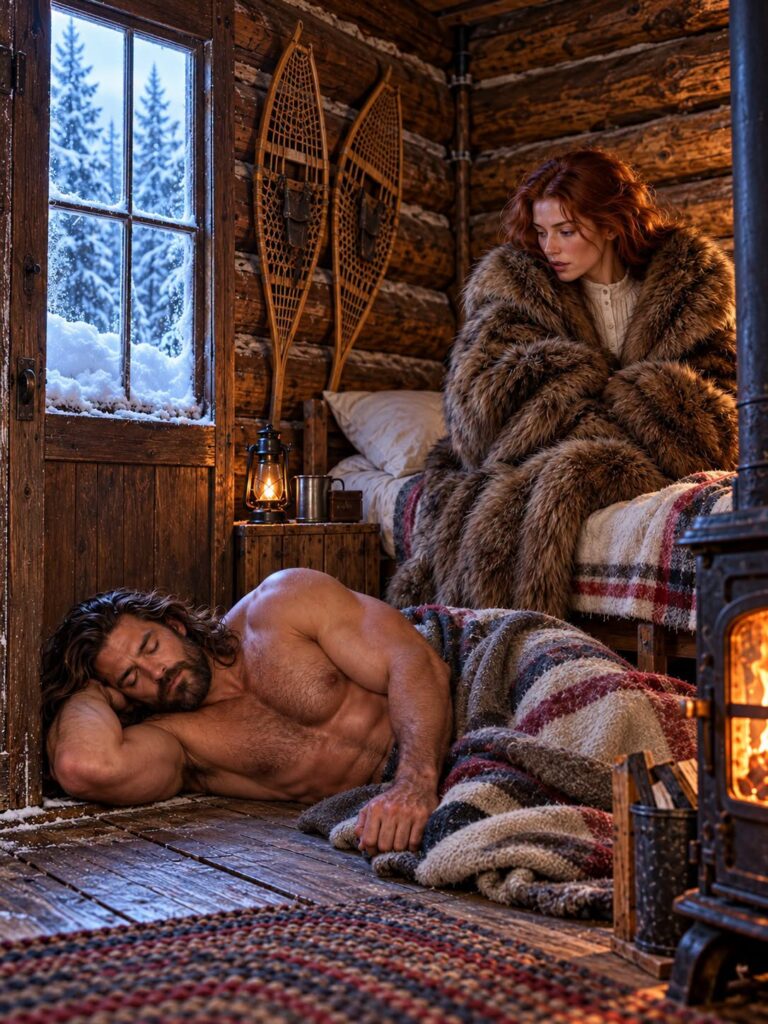
At night, he still slept across the door.
The first night, she had thought he was keeping her in.
By the third, she understood.
He was keeping everything else out.
She also began to notice the cost.
The floor was cruel on his body.
Each morning he rose more slowly than the day before. His shoulder had stiffened from the cold draft beneath the door. Once, while lifting the kettle, he paused and pressed his hand to the small of his back.
“You should take the bunk tonight,” Iris said.
“No.”
“You can barely straighten.”
“I can straighten.”
“You do it like an eighty-year-old.”
He gave her a long look.
“Twenty-six years old and already bossing strangers.”
“You stopped being a stranger when you put your coat over me.”
Something closed in his expression.
He turned back to the stove.
“That was a coat.”
“It was kindness.”
“It was cold.”
“Exactly.”
He said nothing.
Iris folded her arms.
“You can have the bunk tonight.”
“No.”
“Then I’ll sleep on the floor.”
“No.”
“You do understand I can keep saying this.”
“I do.”
“For how long?”
“Storm might last another three days.”
Against her will, she laughed.
It startled both of them.
The sound seemed too alive for that little cabin.
Isach looked at her as if he had forgotten people could make such a sound.
Then he lowered his head and went back to cutting kindling.
That afternoon, Iris found a sewing kit inside the stage company chest.
One of Isach’s gloves had split between the thumb and palm. She took it without asking and began repairing it.
He noticed.
“Don’t.”
“Why?”
“Needle’s poor.”
“So am I.”
“That makes no sense.”
“It makes enough.”
He stared at her fingers moving the needle through thick leather.
“You sew?”
“I worked at Mrs. Harrow’s dress shop for eleven months.”
“In Leadville?”
“Yes.”
“Before the boarding house?”
“During.”
He nodded.
Then, after a while, “Your man take your wages too?”
The needle stopped.
Iris lifted her eyes.
Isach was looking at the stove.
Not at her.
“His name was Lyman.”
“I know.”
That surprised her.
“How?”
“Town talks.”
She returned to the glove.
“He didn’t take my wages.”
Isach waited.
Iris hated that he could wait better than anyone she had ever known.
Silence did not seem to bother him. He did not rush to fill it or rescue anyone from it.
Eventually, she said, “He asked me to save for our start.”
“How much?”
“Fifty dollars.”
Isach’s jaw shifted.
To a man like Lyman, $50 might not have been much.
To Iris, it had been nearly a year of pinching coins from wages that were already small.
It had been fabric she did not buy.
Meals she skipped.
Shoes she repaired instead of replacing.
It had been faith converted into money.
“He said we’d need it in Denver,” she continued. “Then he took it with him.”
“With the other woman.”
“Yes.”
Isach’s knife stopped against the wood.
“He steal from you?”
“He would say I gave it.”
“What would you say?”
Iris pulled the thread tight.
“I would say he knew what he was doing.”
Isach nodded once.
“So he stole it.”
There was something strange in the certainty of it.
No lecture.
No pity.
No suggestion that she should have known better.
He simply placed the blame where it belonged.
Her vision blurred for a second.
She bent closer over the glove until it cleared.
That night, the storm worsened.
The cabin groaned under the weight of snow.
Once, shortly after midnight, a deep crack sounded outside.
Iris came awake instantly.
Isach was already standing.
He crossed to the window and scraped frost away with his thumbnail.
“What was it?”
“Pine.”
“Fell?”
“Yes.”
“Near us?”
“Near enough.”
He went to the door and listened.
Iris sat upright in the bunk, his coat still over her.
“Isach.”
He glanced back.
It was the first time she had used his name.
Something passed over his face.
Then another sound came from outside.
Not a crack.
A low sliding roar.
Isach moved so quickly that Iris barely saw him cross the room.
He seized her wrist and pulled her out of the bunk.
“Against the stove wall.”
“What is it?”
“Move.”
She moved.
The mountain answered before she reached the wall.
The sound became enormous.
The entire cabin shook.
Tin cups jumped from their nails.
Snow struck the outside wall like gravel thrown by a thousand hands.
Iris covered her head.
The window went dark.
For several seconds, there was nothing but noise.
Then silence.
Not ordinary silence.
Buried silence.
Isach released her wrist.
“Slide came down the north cut.”
“Are we buried?”
“Partly.”
“Can we get out?”
He did not answer.
That frightened her more than the avalanche had.
He took the shovel from beside the stove and forced the door inward.
It moved less than an inch.
Snow packed the other side.
He tried again.
Nothing.
Iris watched his shoulders tighten beneath his shirt.
“How much air do we have?”
“Enough.”
“For what?”
“Enough.”
She understood then that he did not know.
By morning, the chimney draft had weakened.
Smoke curled back into the room.
Isach climbed onto the table and struck the stove pipe with the shovel handle.
Snow had covered the upper vent.
“If it blocks completely?” Iris asked.
“We put the fire out.”
“And then?”
“We freeze slower than we choke.”
He said it without drama.
A fact.
Nothing more.
He tied a scarf around his face and began digging at the door from inside, using the shovel to pull snow into the cabin and throwing it toward the back wall.
Iris took the tin washbasin.
“What are you doing?”
“Helping.”
“No.”
“Why?”
“Could shift.”
“And kill you?”
“Yes.”
“Then it can kill me too.”
His eyes hardened.
“That isn’t an argument.”
“It is to me.”
She crouched beside him and began scooping snow into the basin.
For 2 hours, they dug.
Their breath fogged the cabin.
Meltwater soaked the floor.
Isach worked until blood appeared through the leather of his repaired glove.
Iris said nothing.
She kept digging.
At last, a blade of white daylight opened above the door.
Then a hole.
Then enough space for Isach to force his shoulders through.
He disappeared into the snow.
Iris stood alone for several minutes, staring at the opening.
He could leave.
The thought came uninvited.
He could go down the mountain and save himself.
Then his arm appeared through the hole.
“Give me the shovel.”
She almost laughed from relief.
Instead, she handed it up.
By noon, they had cleared the door and part of the roof.
The pass itself remained impossible.
Isach returned from inspecting the trail with ice in his beard and a grim set to his mouth.
“Another slide took the west shelf.”
“What does that mean?”
“We stay.”
“How long?”
“Could be a week.”
Iris sat down.
A week.
She had imagined reaching Fairplay the next day.
Her sister May lived there with her husband and 2 children. Iris had pictured walking into May’s kitchen exhausted but safe, explaining everything beside a warm stove.
Now the mountain had erased time.
Isach removed his gloves.
The hand beneath the repaired one was bleeding.
Iris stood.
“Give me that.”
“It’s nothing.”
“You men have a powerful affection for that word.”
She took his hand before she could reconsider.
He went completely still.
His palm was enormous.
Callused.
Warm despite the cold.
A cut ran across the base of his thumb.
Iris poured a little boiled water into the basin, cleaned the wound, and wrapped it with a strip torn from the lining of her old petticoat.
Isach watched her hands.
“You don’t have to do that.”
“I know.”
He looked at her.
The same answer he had given on the Ravenel Bridge did not exist in their world, but the meaning was there all the same.
You did not have to come.
I know.
Sometimes an answer could be complete because it did not try to defend itself.
Iris tied the cloth.
“There.”
He did not take his hand away immediately.
Neither did she.
The cabin had become very quiet.
Outside, snow moved against the eaves.
Finally, Isach said, “Town says things about me.”
“I know.”
“You believed them.”
“Yes.”
“Still do?”
Iris looked at his hand in hers.
“I believe some of them.”
A faint line appeared between his brows.
“That honest?”
“You want me to lie?”
“No.”
“They say you killed a man in Wyoming.”
“I did.”
Her fingers stopped.
He did not look away.
“Why?”
“He was beating a boy with a trace chain.”
“Your boy?”
“No.”
“Did he die because you meant to kill him?”
“Yes.”
Iris slowly released his hand.
Isach flexed his fingers once.
“Now you know.”
He stood and moved toward the door.
Iris watched him.
“Was the boy alive afterward?”
Isach stopped.
“Yes.”
“What happened to him?”
“Grew up.”
“How do you know?”
“He writes me every Christmas.”
Isach opened the door.
Cold flooded the cabin.
He stepped outside before Iris could answer.
That evening, she understood something that frightened her in an entirely new way.
The stories about Isach Thorvald were not all lies.
He could be violent.
He had killed.
But Leadville had told the story backward.
It had remembered the dead man and forgotten the boy with the chain around his shoulders.
It had remembered Isach’s size and silence and beard.
It had forgotten why violence had found him.
When he came back inside after dark, Iris was seated at the table.
She had divided the remaining flour and beans into careful portions.
“We have 6 days if we’re sensible,” she said.
Isach looked at the neat piles.
“Five.”
“Why?”
“You eat too little.”
“I’ve eaten enough.”
“No.”
“You don’t know how much I eat.”
“I watched you.”
She looked up.
He seemed almost uncomfortable admitting it.
“You watch me?”
“To make sure you don’t fall over.”
“That almost sounded concerned.”
“Don’t get ambitious.”
She smiled.
This time, he did too.
Only slightly.
But she saw it.
And for the first time since the stage office platform, Iris felt something inside herself begin to move toward life again.
Not because a man wanted her.
Not because she needed another man to replace the one who had humiliated her.
Because for the first time in days, perhaps months, she was somewhere no one expected her to perform shame.
The mountain did not care that Lyman had left her.
Isach did not seem impressed by it either.
She was cold.
She was tired.
She was useful.
That was enough.
On the fifth night, Isach developed a fever.
It began with a cough.
Then another.
By supper, his face had gone pale beneath the beard.
“You’re sick.”
“No.”
“There’s that word again.”
“I’m tired.”
He tried to stand and nearly fell against the table.
Iris caught his arm.
The weight of him almost took her down.
“Bunk.”
“No.”
“Isach.”
“I sleep by the door.”
“You sleep where I tell you tonight.”
His eyes focused on her with visible effort.
“That so?”
“That is so.”
Some part of him seemed to find the situation funny.
He let her guide him to the bunk.
By midnight, the fever had climbed.
He shook beneath both blankets.
Iris put his coat over him.
He tried to push it away.
“No.”
“It’s yours,” she said.
“Exactly.”
“And I say who sleeps in it.”
His eyes opened.
For a second, despite the fever, they were clear.
Then he gave a low sound that might have been a laugh.
Iris sat beside him until morning.
She changed the cloth on his forehead.
Fed the stove.
Boiled water.
When he became restless, he muttered words she could not understand.
Norwegian, perhaps.
Once he said a woman’s name.
“Astrid.”
Iris pretended not to hear it.
Near dawn, Isach woke fully.
He found her sitting on the floor beside the bunk, her head against the wall.
“You stayed.”
“Yes.”
“You should sleep.”
“So should you.”
His gaze moved to the coat covering him.
“You stole my coat.”
“I learned from you.”
He was quiet.
Then his large hand emerged from beneath the fur and rested palm-up on the blanket between them.
He did not reach for her.
He simply left it there.
An offering without demand.
Iris looked at it.
Then placed her hand in his.
His fingers closed carefully around hers.
Outside, for the first time in 6 days, the wind began to fall.