
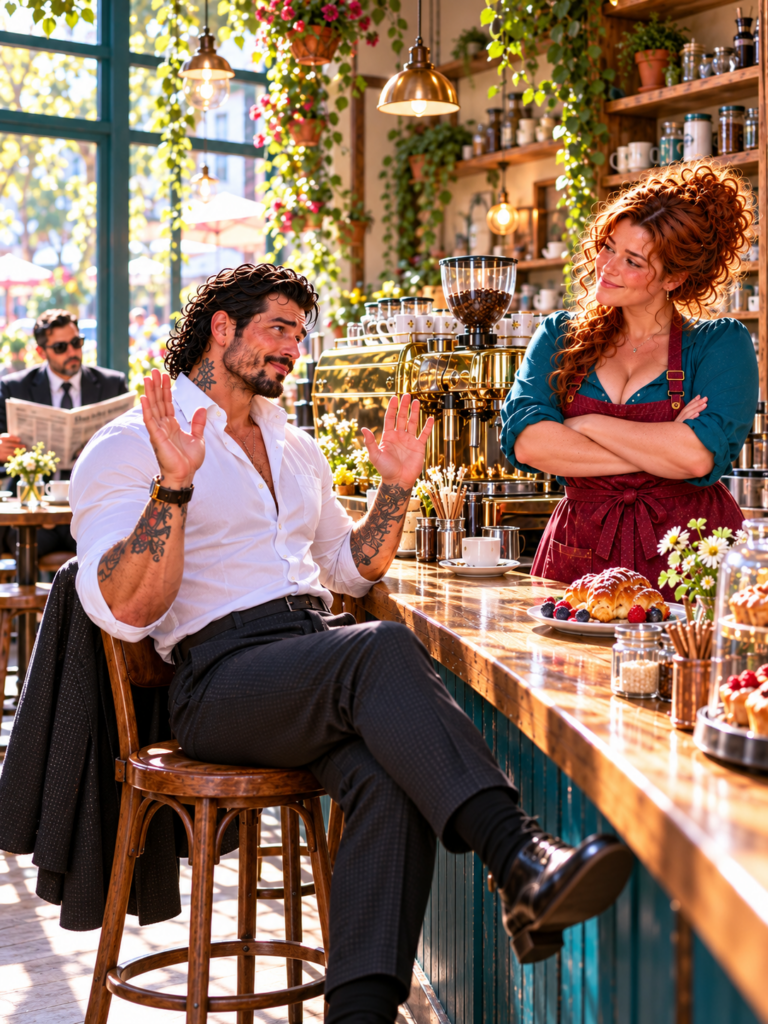
The Curvy Café Owner Cut Off the City’s Most Feared Mafia Boss—Then He Claimed Her When His Enemies Turned Her Safe Haven Into a Target
Part 1
“That is your sixth espresso.”
Raphael Conte looked at the tiny white cup between his fingers.
Then he looked at the woman across the counter.
Ruby Shaw planted both palms on the worn walnut surface of the Copper Kettle Café and gave him the same expression she had used ten minutes earlier on a college student trying to order a fourth energy drink.
“It is six forty-seven in the morning,” she continued. “Your left eye is twitching.”
“It does that.”
“No, it does not.”
“You’ve known me for five weeks.”
“Which has been long enough to learn three things. You don’t sleep, you lie when people ask if you’ve eaten, and you think espresso is a food group.”
Raphael’s three bodyguards stood near the entrance.
None of them moved.
Aldo, his twenty-six-year-old driver, stared at Ruby with the expression of a man watching someone pet a tiger against the fur.
Raphael lifted the cup.
Ruby reached across the counter.
And took it from his hand.
Aldo stopped breathing.
Lenny, the oldest guard, slowly lowered the newspaper he had been pretending to read.
No one took anything out of Raphael Conte’s hand.
Not a weapon.
Not a contract.
Not a glass.
Not if they wanted continued use of their own fingers.
Ruby dumped the espresso into the sink.
“You’re cut off.”
Raphael stared at her.
She rinsed the cup.
“You’re vibrating.”
“I am not vibrating.”
“You absolutely are.”
“I am sitting still.”
“Internally.”
A muscle flexed in his jaw.
Ruby pointed to a stool.
“Sit.”
The café went quiet.
Old Mr. Pike looked over his crossword.
Dolores, a night-shift nurse still wearing navy scrubs, paused with a piece of toast halfway to her mouth.
Jonah, the engineering student, whispered, “Oh, my God.”
Ruby heard him.
“Language.”
Jonah immediately looked ashamed.
Raphael looked at Ruby.
She was five foot five on a generous day and softly, gloriously curved in ways expensive designers would have called difficult and Raphael privately considered impossible not to notice.
Chestnut hair had escaped its knot around her face. Flour dusted one side of her black apron. Her cheeks were pink from steam, and her dark green sweater hugged a body that seemed designed in direct opposition to every hard, austere thing in Raphael’s life.
She was not afraid of him.
That was what disturbed him.
Almost everyone feared Raphael Conte.
Men twice Ruby’s size lowered their voices when he entered a room.
Judges returned calls.
Politicians remembered birthdays.
Rivals learned caution.
His father had built fear into the Conte name.
Raphael had perfected it.
But Ruby Shaw had apparently looked at all forty-four years of his reputation and concluded that what the man really needed was oatmeal.
She set a bowl in front of him.
“Eat.”
“I didn’t order this.”
“It’s not a democracy.”
“This is my breakfast.”
“No. Six espressos was your attempt at breakfast. I intervened.”
“Ruby.”
“Raphael.”
His guards looked at one another.
It was the first time any of them had heard a civilian use his first name without invitation.
Ruby picked up the cinnamon.
“Brown sugar?”
“No.”
She sprinkled some anyway.
Raphael stared at the oatmeal.
Then at her.
“You understand I could buy this building.”
“Sure.”
“And replace the café.”
“With what?”
He had not expected the question.
“A bank.”
“There are three banks on this block. Nobody wants another.”
“A restaurant.”
“Then you’d have to find someone willing to feed you at six in the morning.”
She pushed a spoon toward him.
“Eat.”
For fifteen long seconds, the most feared man in Bellariva did nothing.
Then Raphael Conte picked up the spoon.
Jonah made a strangled noise.
Ruby pointed at him.
“Study.”
Jonah looked back down at his textbook.
Raphael ate.
Ruby returned to the espresso machine as if she had not just publicly overruled a man half the city called the Black Prince.
The oatmeal was good.
Of course it was.
Everything Ruby made was good.
That was becoming a problem.
So was the café.
Five weeks earlier, Raphael had discovered the Copper Kettle by accident.
He had not slept that night.
That was not unusual.
Raphael rarely slept properly.
He slept in fragments.
Thirty minutes.
An hour.
Two, if exhaustion won a temporary battle.
But one part of his mind always remained awake.
Counting exits.
Remembering faces.
Replaying old mistakes.
His father had called it vigilance.
Raphael privately thought of it as the guard.
The guard never sat down.
At five in the morning, after a night spent dealing with a crisis he refused to remember before daylight, he had told Aldo to drive.
“Where?”
“Anywhere.”
Aldo, wisely, had not asked again.
They crossed the east side while rain silvered the windshield.
Then Raphael saw one lit window on a street still mostly dark.
A copper kettle hung from a little painted sign.
Inside, a woman was turning chairs down from tables.
“Stop.”
Aldo glanced back.
“Boss?”
“Here.”
The car stopped.
Raphael entered alone.
A bell chimed above the door.
Ruby looked up.
“We’re not open.”
He almost turned around.
Then she studied his face.
“You’ve been awake all night.”
He said nothing.
She checked the clock.
“Five minutes.”
“What?”
“We open in five minutes.”
“I can come back.”
“No.”
She pointed toward the counter.
“Sit down. You look terrible.”
Raphael had stood motionless.
Ruby frowned.
“Do frightening-looking men not understand chairs?”
He sat.
She made coffee.
No recognition.
No fear.
Nothing.
She poured it into a thick ceramic mug with a chip near the handle.
“Milk?”
“No.”
“Sugar?”
“No.”
“Food?”
“No.”
Her eyes narrowed.
“When did you last eat?”
“That is not your concern.”
“Now I know it was too long ago.”
She disappeared into the kitchen.
Raphael looked around.
The café was small.
Warm.
Uneven.
Nothing matched.
Tables had scratches and carved initials.
A shelf held mismatched mugs.
Framed photographs showed neighborhood children, retired teachers, Little League teams, wedding announcements.
A chalkboard listed coffee, soup and sandwiches in slightly crooked handwriting.
There was no marble.
No brass.
No discreet security.
No one had designed the room to impress anyone.
That alone made it different from every place Raphael usually inhabited.
Ruby returned with eggs and toast.
“I didn’t order these.”
“I know.”
“I’m not paying for them.”
“Then I’ll eat them.”
He looked at her.
She shrugged.
“But you look hungrier.”
That first morning, Raphael ate everything.
He returned the next day.
He told himself it was the coffee.
By day five, he knew it was not.
Ruby’s café had rules.
No threats.
No business disputes.
No harassing staff.
No bothering other customers.
And most importantly:
“In here, nobody’s scary.”
Raphael had looked up from his coffee the first time she said it.
“Excuse me?”
“You heard me.”
“You don’t know what I am.”
Ruby wiped the counter.
“I know exactly who you are.”
That surprised him.
“You recognized me.”
“Day one.”
“You showed no indication.”
“Should I have screamed?”
“Most people behave differently.”
“I own a café. Everybody who comes through that door is hungry, tired, lonely, avoiding work, meeting someone, leaving someone, or desperate for caffeine. Whatever else you do with your day is not my department.”
She leaned against the counter.
“I grew up six blocks from here, Mr. Conte. I know your name.”
“Then you know enough to be careful.”
“I am careful.”
Her gaze did not move.
“My careful just looks different from yours.”
Raphael said nothing.
Ruby pointed toward the window.
“Out there, you can be whatever makes grown men cross the street.”
Then she pointed at the floor.
“In here, you’re a customer.”
“And if I object?”
“There are nineteen other cafés within a mile. Every one of them will be scared enough to serve you twelve espressos and let you have heart failure in a booth.”
Her mouth curved.
“I’m the one that won’t.”
Raphael had stayed.
By week two, the regulars stopped fearing him.
Mr. Pike went first.
Eighty years old, widowed, suspicious of smartphones, addicted to crossword puzzles.
He slid the newspaper toward Raphael one morning.
“Seven letters. Ruthless authority.”
Raphael glanced down.
“Tyranny.”
Mr. Pike counted the boxes.
“Well, look at that.”
He wrote it in.
“What do you do for a living?”
The café quieted.
Raphael sipped his coffee.
“Logistics.”
Mr. Pike snorted.
“Sure.”
Then he turned the paper.
“Six letters. Finally at peace.”
Raphael stared at the clue longer than necessary.
“Rested.”
Mr. Pike wrote it in.
“You don’t look it.”
“No.”
“Ruby will fix that.”
Raphael glanced toward the counter.
Ruby was arguing with Jonah about breakfast.
He did not know why Mr. Pike’s statement felt dangerous.
By week three, Dolores began leaving him half of whatever Ruby overfed her.
“You need protein.”
Raphael looked at the egg sandwich.
“So Ruby tells me.”
“She’s right.”
“You have both become very comfortable.”
Dolores smiled.
“You’re less scary before seven.”
Jonah cornered Raphael with a résumé.
“I know you do logistics.”
Aldo, outside the window, nearly choked when he saw the exchange.
Raphael read the résumé.
Then read it again.
“You apologize too much.”
Jonah frowned.
“What?”
“First paragraph. ‘I may not have much experience.’ Remove it.”
“But I don’t.”
“You’re applying for an internship. They know.”
Raphael took Jonah’s pen.
“Third paragraph is useless. Delete it. Put your robotics project here.”
Jonah stared.
“That’s kind of brutal.”
“It’s clear.”
Jonah made the changes.
He got the internship.
A week later, he brought Raphael a muffin.
“To say thanks.”
Raphael looked at it.
“No one has ever given me a muffin for professional advice.”
Jonah shrugged.
“First time for everything.”
Raphael ate half.
Ruby wrapped the other half for him because apparently she had decided he needed snacks in his car.
His men did not understand.
Aldo watched through the window one morning as Ruby removed Raphael’s third espresso.
“She just took it.”
Lenny looked up from his phone.
“Who?”
“The boss’s coffee.”
“Again?”
“Again!”
Aldo pressed both hands to the steering wheel.
“He let her.”
“Seems so.”
“She told him to drink water.”
“Good advice.”
“Lenny.”
“What?”
“That man made a union president cry last Tuesday.”
“And?”
“And now he’s eating banana bread because a woman in an apron told him to.”
Lenny watched Raphael through the window.
The boss sat with his shoulders slightly lowered.
No phone in his hand.
No one whispering in his ear.
No papers.
Just coffee.
Bread.
Ruby.
“He looks better,” Lenny said.
Aldo followed his gaze.
Raphael was listening while Mr. Pike complained about modern baseball.
He looked almost normal.
“That makes it weirder.”
“No.”
Lenny settled deeper into the passenger seat.
“It makes it sadder.”
Aldo looked over.
Lenny nodded toward the café.
“Everywhere else, everybody wants something from him.”
Inside, Ruby swatted Raphael’s hand away from the espresso machine when he tried to serve himself.
Lenny smiled.
“She doesn’t.”
That was not entirely true.
Ruby wanted something from Raphael.
She wanted him to sleep.
She became increasingly irritated by his exhaustion.
One rainy morning, he entered looking worse than usual.
Ruby immediately stopped steaming milk.
“You’re gray.”
“Good morning to you too.”
“No jokes.”
“I wasn’t joking.”
She abandoned an order halfway through.
“Sit.”
“I have a meeting.”
“You have a face that looks like a medical emergency.”
“I’m fine.”
“Raphael.”
Something about her voice made him stop.
There was worry in it.
Not fear.
Worry.
For him.
The distinction went through his chest like a blade.
He sat.
Ruby made one coffee.
Then a warm roll with butter.
She placed both in front of him.
He stared at the bread.
“I didn’t order this.”
“Yes, I know. We’ve established our relationship to ordering.”
The café was almost empty.
Rain whispered against the windows.
Raphael looked at Ruby.
“Do you ever stop?”
“Stop what?”
“Taking care of everyone.”
She shrugged.
“Someone has to.”
“Pike.”
“His daughter lives in Arizona.”
“Dolores.”
“Single mom.”
“Jonah.”
“Twenty-one and technically feral.”
“Me.”
Ruby paused.
Raphael turned the chipped mug in his hands.
“Who takes care of you?”
For one second, Ruby’s face changed.
The cheerful command disappeared.
He saw exhaustion.
Loneliness.
Then it was gone.
“I hold the coffee pot.”
“That is not an answer.”
“It’s the answer you’re getting.”
She turned away.
Raphael watched her wipe a spotless section of counter.
“You live upstairs.”
“Yes.”
“Alone?”
“That is definitely none of your business.”
“Family?”
“Also none.”
He leaned back.
“You know everything about me.”
“I know you take coffee black, pretend not to like cinnamon, read financial news backward from the last page, and need someone to physically remove caffeine from your reach.”
Ruby glanced over.
“I don’t know anything real.”
Raphael looked at the rain.
He did not know why the next words came.
Perhaps exhaustion loosened them.
Perhaps safety did.
“I don’t sleep.”
Ruby’s hand stopped.
Raphael continued staring through the window.
“Not properly.”
“How long?”
“Years.”
She came closer.
He spoke quietly.
“I close my eyes and part of my mind stays awake. Always.”
Ruby said nothing.
“The guard.”
“What guard?”
“The one in my head.”
A bitter smile touched his mouth.
“He watches the door. Counts footsteps. Replays conversations. Remembers men I should have noticed sooner.”
Ruby slowly sat on the stool beside him.
Raphael continued.
“I’ve tried medication.”
“Didn’t work?”
“I hated not being alert.”
“Therapy?”
He looked at her.
“What?”
She lifted both hands.
“Worth asking.”
“No.”
“Shocking.”
Despite himself, he almost smiled.
His hand tightened around the coffee cup.
“The guard never sits down.”
Ruby studied him.
“Except here.”
Raphael looked at her.
Her smile disappeared.
“What?”
“Here.”
He glanced around.
The tables.
The humming refrigerator.
Mr. Pike’s abandoned newspaper.
Rain.
Warm bread.
“You asked why I keep coming.”
Ruby’s breath caught.
“It’s not the coffee.”
“I knew that. My coffee is good, not cult-worthy.”
“The guard stops here.”
Silence.
“I don’t know why.”
His voice roughened.
“I walk through that door and for twenty minutes, sometimes thirty, I stop calculating.”
Ruby’s eyes softened.
“That sounds exhausting.”
“It is.”
The answer came before pride could prevent it.
“It is.”
Ruby looked toward the front door.
Then at the clock.
Then at him.
“Put your head down.”
Raphael stared.
“What?”
“On your arms.”
“No.”
“Yes.”
“Ruby.”
“You said the guard sits down here.”
“That was figurative.”
“I’m testing the theory.”
“Absolutely not.”
She folded her arms.
“You slept zero hours last night.”
He did not answer.
“Raphael.”
Silence.
“How many?”
“None.”
“How many the night before?”
“Two.”
She looked furious.
“Put your head down.”
“I am not sleeping in public.”
“There are no customers.”
“There are three people outside who work for me.”
“Then they can protect you while I protect you from yourself.”
His jaw hardened.
She leaned closer.
“Twenty minutes.”
“No.”
“I’ll lock the door.”
“No.”
“I’ll sit here.”
“No.”
“I won’t let anyone in.”
Raphael’s eyes met hers.
Ruby lowered her voice.
“You trust this room.”
He did.
That was the problem.
“Trust me too.”
Those three words frightened him more than threats ever had.
Ruby drew the little sign from beneath the counter.
BACK IN A BIT.
She turned the lock.
Then sat beside him.
“Twenty minutes.”
Raphael looked at her.
“If anything—”
“Nothing is happening.”
“You cannot know that.”
“I can for twenty minutes.”
He almost laughed.
“You are five foot five.”
“Five six in boots.”
“You’re not wearing boots.”
“Details.”
He looked toward the door.
Ruby touched his sleeve.
“Let me stand guard.”
His eyes returned to her.
Nobody had said that to him.
Not since childhood.
Not since his mother died.
Not since before his father taught him that sleep was carelessness and carelessness got men buried.
Ruby’s voice softened.
“I’ve got you.”
Raphael slowly folded his arms on the counter.
“This is ridiculous.”
“Completely.”
“If Aldo takes a photograph, I’m firing him.”
“I’ll break his phone.”
“You?”
“I own a hammer.”
Raphael almost smiled.
Then he lowered his head.
The position was absurd.
Undignified.
Vulnerable.
He expected the guard to scream.
Instead he smelled coffee.
Bread.
Ruby’s soap.
He heard rain.
Her breathing.
The faint scrape of her stool.
Nothing happened.
For the first time in years, the guard sat down.
Raphael slept.
He did not doze.
He did not drift.
He disappeared.
Forty-three minutes later, he woke in confusion.
His body jerked.
Ruby put a hand on his shoulder.
“Easy.”
Raphael froze.
The café came back into focus.
Ruby beside him.
Door locked.
Rain lighter.
He looked at the clock.
“Forty-three minutes.”
“You snored.”
He sat upright.
“I do not snore.”
“You absolutely do.”
“No.”
“Like an exhausted bear.”
He stared at her.
Ruby’s teasing faded.
“You slept.”
Raphael swallowed.
His eyes burned unexpectedly.
Ruby pretended not to notice.
That kindness almost undid him more than noticing would have.
“You let me sleep.”
“You needed it.”
She stood.
Retied her apron.
“Don’t turn this into a dramatic thing.”
“It already is.”
“Then make it less dramatic by eating.”
She unlocked the door.
Raphael stayed seated.
Something had changed.
Ruby knew it too.
After that, he remained longer.
Sometimes he dried cups.
Badly.
He learned where she kept the chipped mugs.
“Family shelf,” Ruby explained.
“Why give family damaged cups?”
“Because strangers get the pretty ones. Family knows you don’t have to impress them.”
On Thursday, Ruby gave Raphael a chipped blue mug.
He held it for a long time.
“Don’t make that face.”
“What face?”
“The one where you’re accidentally having an emotion.”
“I am not.”
“Coffee?”
“Yes.”
“Two cups.”
“Three.”
“Two.”
He accepted two.
Later, during the quiet hour, Ruby asked, “Tell me something true.”
Raphael looked up from the cup he was drying.
“That sounds dangerous.”
“Not business.”
She pointed at him.
“I never want to know business. That is the wall.”
“Good.”
“Something else.”
“Why?”
“Because everybody here knows something real about everyone else.”
She nodded toward the empty room.
“Mr. Pike played trumpet in a jazz band. Dolores wanted to be a veterinarian. Jonah secretly likes musical theater even though he thinks engineers aren’t supposed to.”
Raphael leaned against the counter.
“And you?”
Ruby stiffened.
“I asked first.”
“Avoidance.”
“True thing, Raphael.”
He looked at the towel in his hands.
Then said, “I wanted to be an architect.”
Ruby stilled.
“What?”
“When I was a boy.”
His eyes went somewhere far away.
“I drew buildings. Houses. Libraries. City squares.”
“That’s unexpectedly wholesome.”
“My father disagreed.”
Ruby waited.
“He burned the notebooks.”
Her expression changed.
Raphael’s mouth became hard.
“He said Contes did not build things.”
“What did they do?”
“Take them.”
Ruby’s chest tightened.
“How old were you?”
“Fourteen.”
“And you stopped drawing.”
“Yes.”
She took the towel from his hand.
“You know what I think?”
“I suspect you’ll tell me.”
“I think he burned paper.”
Raphael frowned.
“Not the part of you that wanted to build.”
“That part is irrelevant.”
“No.”
Her voice sharpened.
“He didn’t get to kill it just because he scared you enough to hide it.”
Raphael stared at her.
Ruby nodded toward the mug.
“You just spent ten minutes drying cups because you like making things orderly.”
“I was helping.”
“You fixed the broken hinge on my storeroom yesterday.”
“It annoyed me.”
“You moved a table because Pike complained about the draft.”
“He is eighty.”
“You designed a better shelf for my flour bins on a napkin.”
Raphael opened his mouth.
Ruby smiled.
“Architect.”
His gaze dropped.
Something inside him hurt.
Not badly.
Almost sweetly.
Which was worse.
He looked at her.
“Tell me something true about you.”
Ruby’s smile vanished.
For once, she did not dodge.
“My mother left when I was twelve.”
Raphael went still.
“My father stayed physically and checked out emotionally. I started cooking because someone had to.”
She shrugged.
“Then the woman who owned this café gave me a job at sixteen.”
“The previous owner.”
“Mrs. Bell.”
“You bought it from her.”
“She gave me a ridiculous deal when she retired.”
Ruby stared toward the tables.
“She taught me that feeding people can be a way of saying stay.”
Raphael heard the wound under it.
“And does anyone stay?”
She looked at him.
“Not usually.”
Their eyes held.
The room seemed smaller.
Raphael took one step closer.
Ruby did not move.
He could have touched her.
He wanted to.
Her mouth softened.
His gaze dropped to it.
Then the bell above the door rang.
Both stepped apart.
Aldo entered.
His eyes widened.
He immediately turned around.
“Nope.”
Raphael frowned.
“Aldo.”
“I forgot what I came in for.”
“You came to tell me we’re late.”
“We are.”
Aldo looked determinedly at the ceiling.
“Very late.”
Raphael set down the cup.
Ruby cleared her throat.
“Go do logistics.”
His gaze returned to her.
“Tomorrow?”
Ruby tried to sound casual.
“You’ll come whether I invite you or not.”
“Yes.”
“Then tomorrow.”
He came back.
Every morning.
And somewhere south of the river, another man began paying attention.
Cosmo Lazaro had wanted Raphael Conte’s territory for twelve years.
He was clever enough not to attack Raphael directly.
Men who attacked Raphael directly tended to disappear from strategic conversations.
Cosmo preferred erosion.
Rumor.
Fear.
He noticed patterns.
Raphael going to the same café every morning was a pattern.
A fixed hour.
A fixed place.
No visible business.
Often fewer guards.
A woman no one knew.
Cosmo smiled when one of his men reported it.
“What do they talk about?”
“No idea.”
“Who comes in?”
“Regular neighborhood people.”
“Federal?”
“Could be.”
That was enough.
Cosmo began whispering.
Raphael was meeting someone.
A handler.
A prosecutor.
An FBI contact.
Why else would the most careful man in Bellariva visit one uncontrolled location at the same time every morning?
The story reached the Commission.
Then it reached federal ears because Cosmo anonymously made sure it did.
Cars began appearing across from the Copper Kettle.
Ruby noticed on the second day.
Mr. Pike noticed on the third.
By the fourth, Dolores stopped coming.
Ruby called.
Dolores sounded ashamed.
“I have my daughter.”
“You don’t have to explain.”
“I’m sorry.”
“Don’t be.”
Jonah texted that his mother had heard something and begged him to stay away.
Ruby told him to listen to his mother.
Then she cried for three minutes in the pantry.
The café emptied.
The room that had held the neighborhood’s mornings began to feel hollow.
Ruby kept smiling.
Until two men entered on Friday.
They ordered one coffee.
Did not drink it.
One sat at the counter.
“You’re Ruby.”
“That depends who’s asking.”
He smiled.
“Nice place.”
“Thanks.”
“Raphael Conte likes it.”
Her stomach tightened.
“He’s a customer.”
“A good one?”
“They all are.”
The man leaned closer.
“What does he tell you?”
Ruby’s hand stopped.
“About?”
“Whatever he talks about when he comes here every morning.”
“He orders coffee.”
“Who does he meet?”
“No one.”
“Government?”
Ruby’s fear became real.
The man’s smile stayed pleasant.
“Come on, Ruby. A man like Conte doesn’t cross half the city every morning for eggs.”
He looked around.
“You ever notice anyone who doesn’t fit?”
Ruby thought of the cars.
The empty tables.
Dolores apologizing.
Jonah staying home.
Her safe room had been breached.
“Leave.”
The man blinked.
“Excuse me?”
“We’re closed.”
“It’s seven thirty.”
“Special occasion.”
He smiled again.
This time nothing friendly remained.
“You should be careful, Ruby.”
Her pulse thundered.
“You don’t know who you’ve let sit at your counter.”
She forced herself to meet his eyes.
“And you don’t know how many cast-iron pans I own.”
He left.
Ruby locked the door.
Then she leaned against it and shook.
The next morning Raphael arrived at five fifty-eight.
The lights were on.
Door unlocked.
No coffee waiting.
Ruby stood behind the counter with her arms folded.
Raphael saw immediately that something was wrong.
“What happened?”
“No.”
He stopped.
“No what?”
“No coffee.”
“Ruby.”
“Sit.”
He did.
She looked at him.
“My regulars are gone.”
His face changed.
“There’s a car across the street every day.”
Raphael’s eyes cut toward the window.
“A man came in yesterday asking what you tell me. He asked if you meet federal agents here.”
Raphael went still.
Ruby’s voice shook.
“He looked at me like I was already something he might have to clean up.”
Rage entered Raphael’s face.
She held up a hand.
“No.”
“Ruby—”
“You don’t get to become frightening and avoid the question.”
He forced himself still.
She swallowed.
“This café was safe before you.”
“I know.”
“It was mine.”
“I know.”
“It was the one place in this neighborhood where nobody had to watch the door.”
Her eyes filled.
“Now everybody watches the door.”
Raphael looked around at the empty tables.
Something inside him broke.
Ruby whispered, “What did you bring here?”
He could have lied.
He could have told her it was temporary.
He could have made soothing promises.
Instead he gave her what she had demanded from him since the first morning.
The truth.
“A rival started a rumor.”
“What rumor?”
“That I’m informing.”
Her face paled.
“To whom?”
“The Commission.”
“And the men outside?”
“Some may be Commission surveillance.”
“Some?”
“Federal agents may also be watching because the rumor was probably sent to them.”
Ruby looked sick.
“And the man who questioned me?”
“Cosmo’s.”
“You know that?”
“I know the type.”
She pressed both hands against the counter.
“What do they think happens here?”
“That I meet a handler.”
Ruby stared.
Then laughed.
It came out broken.
“A handler.”
Raphael’s jaw tightened.
“They think you’re part of it now.”
Her laughter died.
“I’m what?”
“They may think you’re the intermediary.”
The color drained from her face.
Raphael stood.
“I’ll fix this.”
“How?”
“I’ll make the café irrelevant.”
“What does that mean?”
“It means I stop coming.”
Ruby stared at him.
“No.”
“It’s the safest option.”
“No.”
“Ruby.”
“You do not get to decide that.”
“I brought this to your door.”
“Yes.”
“So I remove myself.”
“That is not fixing it.”
“It is exactly fixing it.”
She came around the counter.
“No. That is you punishing both of us because you’re scared.”
His eyes hardened.
“This is not fear.”
“Of course it is.”
“You don’t understand the danger.”
“Then make me understand!”
Her voice cracked.
“You do not get to walk into my life every morning for five weeks, tell me things you’ve never told anyone, fall asleep on my counter with your head next to my hand, make me care whether you live on caffeine, and then disappear because you decided it’s noble.”
Raphael stopped breathing.
Ruby’s eyes widened.
She had revealed too much.
Too late.
“You care,” he said quietly.
She looked away.
“Obviously I care. I cut Pike off too.”
“Not the same.”
“Don’t.”
He stepped closer.
“Ruby.”
“Don’t make me say something while I’m angry.”
His voice softened.
“I’m trying to keep you alive.”
“And I’m trying to tell you something you don’t understand.”
She looked up.
“I have spent my whole life watching people leave.”
Raphael went silent.
“My mother left. My father was technically present and emotionally gone. Mrs. Bell died three years after selling me this place. Every relationship I ever tried ended because the café came first or because I took care of everybody until there was nothing left for me.”
She wiped angrily at a tear.
“You don’t get to matter and then make yourself another empty chair because you think pain becomes noble when you choose it first.”
Raphael stared at her.
“What do you want me to do?”
It was the first time he had asked.
Ruby took a shaky breath.
“Fix the actual lie.”
“How?”
“Tell the truth.”
He nearly laughed.
“To the Commission?”
“Yes.”
“Ruby, those men—”
“Think you’re a traitor because something about your mornings looks secret.”
She spread her hands.
“So stop making it secret.”
“You want me to tell the heads of five families that I come here to sleep?”
“Yes.”
His expression was almost offended.
“That is humiliating.”
“Good.”
“What?”
“You could use some.”
Despite everything, his mouth twitched.
Ruby pointed at him.
“Tell them you drink too much coffee.”
“I do not.”
“Six espressos.”
“That was one time.”
“It was this week.”
He exhaled.
“Tell them I cut you off.”
“No.”
“Tell them you do crossword puzzles with Pike.”
“Absolutely not.”
“Tell them everything.”
Raphael stared.
Ruby’s voice softened.
“The truth cannot look like a secret if you drag it into the light.”
He looked around.
Empty chairs.
Coffee cooling in the pot.
Her safe room damaged because of him.
Then he looked at Ruby.
“What if it fails?”
“Then we deal with what happens.”
“We?”
“Yes.”
His eyes sharpened.
“You are not part of my world.”
“No.”
Her hand closed around his.
“But apparently you’re part of mine.”
Raphael looked down at their joined hands.
Ruby’s pulse fluttered.
“Come back tomorrow.”
“Ruby—”
“Come back.”
His thumb moved once over her knuckles.
Then he said the most dangerous word he knew.
“Okay.”
Part 2
Aldo almost drove onto the sidewalk.
“You want to tell the Commission you nap in a café.”
Raphael stared out the window.
“Yes.”
“Boss.”
“Yes.”
“Respectfully.”
“Dangerous beginning.”
“This is insane.”
Raphael glanced at him.
Aldo tightened his hands on the steering wheel.
“I’m saying this because I care about continuing to exist.”
“Continue.”
“They think you’re a rat.”
“Yes.”
“You want to answer that by telling them a woman confiscates your coffee and tucks you in at a counter.”
“She does not tuck me in.”
“Good. Important distinction.”
“Aldo.”
“Sorry.”
Lenny, in the passenger seat, hid a smile.
Aldo continued.
“We could deny everything.”
“They already know I go.”
“Then deny the reason.”
“That creates a secret.”
“We could remove Cosmo.”
“That confirms I’m afraid of the accusation.”
Aldo stared through the windshield.
“Ruby told you this?”
“She suggested honesty.”
“Of course she did.”
Raphael’s eyes narrowed.
“What does that mean?”
“She has completely rearranged your brain.”
“No.”
“Yes.”
Lenny finally spoke.
“She’s right.”
Raphael looked at him.
Lenny shrugged.
“Whispers survive because everybody is afraid to look stupid asking the obvious question.”
“And the obvious question is?”
“What if the terrifying man just likes breakfast?”
Aldo exhaled.
“I hate that that makes sense.”
The Commission met above an old social club that had no public sign.
Raphael entered alone.
Five men waited.
Don Ettore Valenti sat at the center.
Seventy-nine.
Sharp-eyed.
Old enough to remember Raphael’s grandfather.
“Conte.”
“Ettore.”
“You requested this.”
“I did.”
“Interesting decision for a man supposedly talking to federal agents.”
Raphael removed his coat.
“If I were, I would be halfway to Switzerland.”
One man chuckled.
Ettore did not.
“Cosmo Lazaro says you meet someone every morning.”
“I do not.”
“You go somewhere every morning.”
“Yes.”
“Same location.”
“Yes.”
“Same time.”
“Yes.”
Raphael pulled out a chair.
“May I?”
Ettore gestured.
Raphael sat.
Then did something none of them expected.
He told them everything.
“I have insomnia.”
Silence.
One of the men frowned.
Raphael continued.
“I’ve had it for years.”
Ettore leaned back.
“Go on.”
“There is a café on Mercer Street.”
“I know.”
“Of course you do.”
Raphael clasped his hands.
“The owner is Ruby Shaw.”
“Your handler?”
“No.”
“My men say she takes things from your hand.”
Raphael closed his eyes briefly.
“Yes.”
Ettore’s mouth twitched.
“Coffee.”
“Yes.”
“How many cups?”
“That seems irrelevant.”
“How many?”
Raphael hated Ruby.
“Six once.”
One of the old men laughed.
Raphael gave him a look.
The laughter died.
Ettore smiled.
“Continue.”
“She makes breakfast.”
“How sinister.”
Raphael’s jaw tightened.
“I sleep there.”
The room fell silent.
“What?”
Raphael forced the words out.
“I sleep.”
“At the café.”
“Yes.”
“In front of people.”
“Once.”
“You nap at a counter?”
Raphael looked murderous.
“Ruby locks the door.”
Ettore stared.
Then began laughing.
Not politely.
Not quietly.
He laughed until he coughed.
Raphael waited.
Finally Ettore wiped his eyes.
“I had two men watching that café for eight days.”
Raphael’s expression hardened.
“I know.”
“Do you know what they reported?”
“No.”
“One said you were receiving coded signals through pastry selection.”
Someone else started laughing.
Raphael looked at the ceiling.
“The croissant,” Ettore continued, “was supposedly important.”
“It was almond.”
“I know.”
“My man photographed it.”
Raphael pinched the bridge of his nose.
“He also reported that the café owner refused you coffee at seven fourteen.”
“I had already had enough.”
Ettore’s laughter returned.
“She told you?”
“Yes.”
“And you listened?”
“Yes.”
“Raphael Conte.”
“Yes.”
Ettore shook his head.
“My surveillance found no meetings. No dead drops. No government contacts.”
He became serious.
“Federal surveillance also found nothing.”
Raphael looked up.
“You know about that.”
“I know everything that matters.”
Ettore leaned forward.
“The rumor is false.”
“Yes.”
“And Lazaro knew it.”
“Yes.”
“How do you know?”
“Because Cosmo does not believe I’m stupid enough to conduct treason at the same counter every day in public.”
Ettore nodded slowly.
“So his goal was fear.”
“Correct.”
Around the table, expressions changed.
The lie had worked only while it was mysterious.
Now it looked ridiculous.
A crime boss.
Eggs.
A woman with an apron.
Sleep.
The old men had been manipulated into spying on breakfast.
That insulted them more than the rumor itself.
Ettore’s mouth hardened.
“I dislike being made a fool.”
“So do I.”
“You were made less of one than I was.”
Raphael almost smiled.
Ettore tapped one finger against the table.
“Go drink your coffee.”
“Two cups.”
The old man laughed again.
“Whatever she allows.”
Raphael left alive.
Cosmo’s collapse began the same day.
No bullets.
No bodies.
Something more devastating in their world.
Calls stopped being returned.
Men who had encouraged his whispers suddenly could not remember them.
Invitations disappeared.
A shipment was delayed because no one felt urgency.
A council seat was reassigned.
Within weeks, Cosmo became socially radioactive.
He had made powerful men afraid of a fiction.
Worse, he had made them look gullible.
He fled Bellariva before winter.
Raphael did not touch him.
Ruby was relieved.
Then furious.
Because Raphael did not return to the café.
Not Monday.
Not Tuesday.
Not Wednesday.
The surveillance disappeared.
Regulars returned.
Dolores came first.
She hugged Ruby over the counter.
“I’m sorry.”
“You had a kid to think about.”
Jonah returned next and attempted to order four espressos as an apology.
Ruby gave him two.
Mr. Pike had never really left.
By the end of the second week, the Copper Kettle was itself again.
Safe.
Warm.
Alive.
Ruby hated every minute.
The stool at the end of the counter stayed empty.
She cleaned it too often.
Mr. Pike noticed.
Of course he did.
“Your logistics fellow hasn’t been in.”
“He’s busy.”
“Two weeks?”
“Logistics are complicated.”
“Hmm.”
Ruby scrubbed the espresso machine.
Mr. Pike studied his crossword.
“Six letters. Love that got away because two people are idiots.”
“That isn’t a clue.”
“I invented it.”
“Drink your coffee.”
“Regret.”
Ruby looked over.
“Six letters.”
He filled imaginary boxes.
“Fits.”
“Mr. Pike.”
“I chased my wife onto a train once.”
Ruby stopped.
“She was leaving for Chicago.”
“What did you do?”
“Made an ass of myself.”
His smile went soft.
“Best decision I ever made.”
Ruby wiped the same section of counter again.
Mr. Pike watched.
“He had a family cup.”
She froze.
“I saw the shelf.”
“That doesn’t mean anything.”
“He told Jonah to stop apologizing for taking up space.”
“That is unrelated.”
“He fixed my draft.”
“He likes fixing things.”
“He slept here.”
Ruby’s throat tightened.
Mr. Pike’s voice gentled.
“People don’t sleep where they don’t feel safe.”
She looked toward the empty stool.
“What if I’m not safe with him?”
“Were you?”
She thought.
“No.”
Mr. Pike blinked.
Ruby gave a broken laugh.
“I was safer before him.”
“That wasn’t my question.”
She swallowed.
“Emotionally?”
“Yes.”
Ruby looked down.
“No.”
Mr. Pike nodded.
“Those are different things.”
He returned to his puzzle.
“You’ve spent years taking care of everyone who comes through that door.”
Ruby said nothing.
“Maybe you liked having one person who looked at you like you were the safe place.”
Her eyes burned.
“And maybe,” he added, “you liked knowing he needed you.”
“That sounds selfish.”
“No.”
Mr. Pike shook his head.
“Being needed isn’t selfish when you need them too.”
That sentence followed Ruby upstairs that night.
Into bed.
Into sleep.
Into the gray dawn when she woke at four thirty and realized she knew exactly what she was going to do.
She found Aldo’s number on an old receipt.
Raphael had once overpaid for coffee, and Aldo had called Ruby to ask if she could return his boss’s credit card.
At five twelve, she called him.
He answered on the first ring.
“Hello?”
“Aldo?”
Pause.
“Ruby?”
“I need Raphael’s address.”
Longer pause.
Then:
“Thank God.”
“What?”
“Nothing.”
“Aldo.”
“He looks terrible.”
Her chest tightened.
“How terrible?”
“Six-espresso terrible.”
“Oh, for God’s sake.”
“I’ll text you the address.”
“Don’t tell him.”
“Wouldn’t dream of it.”
Aldo sent the address in eight seconds.
Raphael lived behind iron gates on a hill overlooking the city.
Ruby arrived at five fifty.
A guard at the gate recognized her.
That was unsettling.
The gate opened without explanation.
She drove up a winding lane to a mansion so large it made the Copper Kettle look like a dollhouse.
Ruby parked.
Walked to the front door.
Raised her hand.
The door opened before she knocked.
Raphael stood there barefoot.
Ruby forgot everything she intended to say.
He looked awful.
Unshaven.
White shirt open at the collar.
Dark circles under his eyes.
Hair disordered.
“You came.”
His voice was rough.
Ruby crossed her arms.
“You didn’t.”
His expression changed.
“The café is safe.”
“I know.”
“Surveillance is gone.”
“I know.”
“Regulars returned.”
“I know.”
“Then why are you here?”
“Because you’re an idiot.”
Raphael stared.
Ruby pushed past him.
He stepped aside automatically.
The foyer could have swallowed her café.
Everything was beautiful.
Nothing was warm.
“No wonder you can’t sleep.”
Raphael closed the door.
“What?”
“This house looks like a museum for rich ghosts.”
“That is extremely insulting.”
“Good.”
She turned.
“You promised to come back.”
“I promised to fix it.”
“You said okay when I told you to return.”
“I misunderstood the scope.”
“Liar.”
His jaw flexed.
Ruby walked closer.
“Why?”
“Because the safest way to restore your café was to make everyone believe I had no connection to it.”
“And now they do.”
“Yes.”
“So come back.”
“No.”
Her heart hurt.
“Why?”
Raphael looked at her.
“Because it worked.”
“What?”
“You’re safe.”
“And miserable.”
“You’re alive.”
“So are you. Barely.”
She pointed toward him.
“You look worse than the morning I made you sleep.”
“That isn’t your concern anymore.”
Ruby went still.
Raphael immediately regretted it.
Her face closed.
“I see.”
“Ruby—”
“No.”
She turned toward the door.
He caught her wrist.
Then released it instantly.
“Don’t go.”
She looked back.
His face was raw.
“You just said I’m not your concern.”
“I lied.”
“Poorly.”
“Yes.”
Ruby waited.
Raphael looked toward the floor.
“The café was the only place I rested.”
“I know.”
“If I return and something happens—”
“We deal with it.”
“If someone hurts you—”
“We deal with it.”
“If my enemies decide—”
“We deal with it.”
His eyes lifted.
“You make that sound easy.”
“No.”
Ruby’s voice softened.
“I make it sound shared.”
Silence.
She stepped closer.
“You think leaving is the only proof you care.”
Raphael said nothing.
“My mother left because she wanted another life. My father disappeared into his grief while sitting five feet away. Every man I’ve dated eventually decided my café took too much of me and left.”
She touched his chest.
“You are not going to become one more person who walks out and calls it love.”
His breathing changed.
“I don’t know how to do this.”
“Neither do I.”
“You look like you do.”
“I own aprons. It creates an illusion of competence.”
Raphael laughed.
A quiet, startled sound.
Ruby smiled despite herself.
Then she grew serious.
“I missed you.”
The laughter disappeared.
She forced herself to continue.
“I hated the empty stool.”
Raphael’s throat worked.
“I kept making too much coffee because some part of me expected you to come through the door.”
“Ruby.”
“I missed telling you no.”
His mouth softened.
“I missed you bossing me.”
“That may be the saddest confession anyone has ever made.”
“It gets worse.”
She waited.
“I missed your hands.”
Ruby’s heartbeat stumbled.
Raphael looked at them.
“Always moving.”
His voice lowered.
“Pouring coffee. Fixing plates. Touching everyone’s shoulder when they look tired.”
He looked back at her.
“I missed wondering what they would feel like on me.”
Heat rose through her.
“Raphael.”
“I’m trying honesty.”
“You’re getting ambitious.”
He stepped closer.
“You told me to.”
She could feel his breath.
“Yes.”
“Tell me to stop.”
Ruby looked at his mouth.
“No.”
That was all he needed.
Raphael kissed her.
For a man whose reputation rested partly on control, the first kiss was startlingly careful.
His hand cupped her jaw.
His mouth brushed hers.
Once.
Then again.
Asking.
Ruby answered by gripping his shirt and pulling him closer.
Something in Raphael broke open.
He kissed her deeper.
Not rough.
Hungry.
Years of restraint condensed into the way his hand trembled against her cheek.
Ruby pressed closer.
His other arm wrapped around her waist.
Her softness fit against his hard body so perfectly she almost laughed from the unfairness of it.
Instead she sighed into his mouth.
Raphael stopped.
“Too much?”
Her eyes opened.
“That is the most ridiculous thing you’ve ever said.”
“You’ve heard me say very few ridiculous things.”
“You told me espresso hydrates you.”
“It contains water.”
She kissed him again just to stop the argument.
When they separated, Raphael rested his forehead against hers.
“Come back tomorrow.”
Ruby smiled.
“To the café.”
“Yes.”
“At six.”
“Five fifty-eight.”
“One coffee.”
“Two.”
“Fine.”
“Three.”
She narrowed her eyes.
“Do not ruin this.”
He smiled.
“Two.”
The next morning Raphael returned.
The bell chimed.
Mr. Pike looked up.
“There you are.”
Raphael stopped.
“Nine letters,” Pike continued. “Finally came to his senses.”
“That is more than nine.”
“I wasn’t counting.”
Dolores smiled.
Jonah gave him a thumbs-up.
Ruby set his chipped blue mug on the counter.
Raphael took his stool.
She poured.
“One.”
He looked at her.
“Good morning.”
“Good morning.”
Under the counter, where no one could see, Raphael reached for her hand.
Ruby let him.
For several weeks, their mornings became something neither had known how to ask for.
Raphael still conducted business.
Still frightened men.
Still carried danger around him like expensive cologne.
But every morning he entered the Copper Kettle and left the Black Prince outside.
Ruby kissed him once in the pantry.
Twice behind the espresso machine.
Once in his car, which caused Aldo to abandon the driver’s seat and walk halfway down the block muttering, “Boundaries.”
Raphael began drawing again.
The first notebook appeared in late November.
Ruby caught him closing it too quickly.
“What’s that?”
“Nothing.”
“Suspicious.”
“Private.”
Her eyebrows rose.
“Private?”
He hesitated.
Then opened it.
A building.
Not polished.
Not professional.
But beautiful.
A courtyard.
Trees.
Benches.
A café at one corner.
Ruby stared.
“You drew this.”
“Yes.”
“You’re drawing again.”
“Badly.”
“Who cares?”
She touched the page.
“What is it?”
Raphael looked embarrassed.
“A community center.”
Her eyes widened.
“For what?”
“Kids.”
“Which kids?”
“The ones who need somewhere to be after school.”
Ruby looked at him.
He shrugged.
“You said places can be built to be kind.”
Her eyes filled.
“Raphael.”
“Don’t cry.”
“I’m not.”
“You are.”
“Shut up.”
He smiled.
Then Ruby saw writing in the corner.
The Shaw Center.
She froze.
“No.”
Raphael closed the notebook.
“It was a placeholder.”
“Absolutely not.”
“Why?”
“You do not get to name buildings after me because we kissed in a pantry.”
“We kissed in several locations.”
“Raphael.”
“Fine.”
He changed the subject.
But Ruby carried the image all day.
Unfortunately, peace made them visible again.
Not to Cosmo.
Cosmo was finished.
This time the threat came from within Raphael’s world.
And from his past.
Vittoria Bellandi arrived at the Copper Kettle on a Wednesday morning wearing cream cashmere, dark glasses and the kind of diamond earrings Ruby could have sold to pay off her mortgage twice.
Ruby recognized her immediately.
Everybody did.
Vittoria was the daughter of one of the most powerful men in Bellariva.
Beautiful.
Elegant.
Thirty-eight.
And according to old society pages Ruby had read at the dentist years ago, once expected to marry Raphael Conte.
Vittoria removed her glasses.
“You must be Ruby.”
Ruby’s stomach tightened.
“And you must want coffee.”
“I don’t drink it.”
“Tea?”
“No.”
Ruby nodded.
“Then we’ve reached the limits of my professional usefulness.”
Vittoria smiled.
It did not reach her eyes.
“I understand why he likes you.”
Ruby continued wiping the counter.
“Do you?”
“You’re uncomplicated.”
Ruby looked up.
There it was.
The first cut.
Delivered gently.
“Am I?”
“You run a café.”
“Yes.”
“You don’t know his world.”
“No.”
“You don’t understand the expectations around him.”
“Probably not.”
Vittoria leaned closer.
“So you can pretend he is simply a tired man who needs breakfast.”
Ruby’s jaw tightened.
“He is a tired man who needs breakfast.”
“He is Raphael Conte.”
“I’ve noticed.”
Vittoria’s smile faded.
“My father and his father planned our marriage when we were young.”
Ruby knew.
Hearing it from her still hurt.
“Raphael refused.”
“Good for Raphael.”
“He regretted it later.”
Ruby’s hand stopped.
Vittoria noticed.
“He told you otherwise?”
“He and I don’t discuss former relationships over muffins.”
“You should.”
The bell above the door rang.
Raphael entered.
He saw Vittoria.
Stopped.
The temperature in the room changed.
“Why are you here?”
Vittoria turned.
“Good morning to you too.”
“Vittoria.”
Ruby saw something old pass between them.
Not love.
History.
Which could be worse.
Vittoria picked up her gloves.
“Your uncle wants to see you.”
“Then he can call.”
“He has.”
Raphael’s jaw hardened.
Vittoria looked at Ruby.
“A pleasure.”
“Tea offer expires at noon.”
Vittoria smiled.
Then left.
Raphael approached the counter.
Ruby reached for his cup.
He caught her wrist.
“What did she say?”
“Nothing.”
“Ruby.”
“You don’t get to interrogate me.”
“She hurts people with precision.”
“So do you.”
He released her.
“That is exactly why I know the signs.”
Ruby poured coffee.
“She said you were supposed to marry.”
Raphael went still.
“She said you regretted refusing.”
His expression hardened.
“I did not.”
“Did you love her?”
“No.”
“Did she love you?”
He hesitated.
Ruby laughed softly.
“There.”
“It was complicated.”
“Everything in your life is complicated.”
“Ruby.”
“I’m not angry.”
“You are.”
“I’m irritated.”
“Different?”
“Very.”
Raphael leaned closer.
“I never loved Vittoria.”
“But?”
“She understood my world.”
Ruby looked away.
He saw the wound.
“That was why I once considered marriage.”
Her gaze snapped back.
“You considered it.”
“Yes.”
“When?”
“Twelve years ago.”
“After refusing the arrangement?”
“Yes.”
“Why?”
“Because I believed marriage should be practical.”
Ruby laughed without humor.
“Of course.”
“I don’t believe that now.”
“That’s convenient.”
“Because of you.”
“More convenient.”
He reached across the counter.
Ruby stepped back.
Raphael froze.
She regretted the movement instantly.
But jealousy had found the oldest bruise in her.
People eventually chose easier things.
Women who fit.
Lives that required less care.
Raphael saw too much.
“She is not easier.”
Ruby folded her arms.
“I didn’t say that.”
“You thought it.”
“You read minds now?”
“Yours.”
She looked away.
He lowered his voice.
“You think because she wears couture and knows which fork to use at Commission dinners that she belongs beside me more than you do.”
Ruby said nothing.
Raphael came around the counter.
“No.”
“Customers are not allowed back here.”
“Fire me.”
“You don’t work here.”
“Then it appears you lack leverage.”
Despite herself, she nearly smiled.
He took her hand.
“Look at me.”
She did.
“I do not want a woman who fits my world.”
His thumb brushed her knuckles.
“I want the woman who made me realize I could build another one.”
Ruby’s breath caught.
Raphael stepped closer.
“You.”
She swallowed.
“Even when I cut you off?”
“Especially then.”
He kissed her forehead.
Then said, “Come with me Friday.”
“Where?”
“Commission charity dinner.”
Her eyes widened.
“No.”
“Yes.”
“Absolutely not.”
“I want you there.”
“To prove something to Vittoria?”
“No.”
“To prove something to everyone else?”
“No.”
“Then why?”
His answer came immediately.
“Because when I walk into rooms like that, I become someone I don’t particularly like.”
Ruby’s heart softened.
“And?”
“I want to know you’re there when I walk back out.”
That defeated her.
Friday night, Ruby wore black.
Not because it made her look smaller.
She had spent half her life hearing women were supposed to use clothing to hide generous hips, soft arms and a stomach that did not disappear when she exhaled.
She was done hiding.
The dress hugged her.
Deep neckline.
Long sleeves.
A skirt that moved when she walked.
Raphael saw her at the bottom of the stairs in his house and forgot how language worked.
Ruby smiled.
“That good?”
He crossed the foyer.
“You cannot wear that.”
Her face fell.
Then his eyes darkened.
“Because I am expected to conduct a coherent conversation.”
Ruby laughed.
“Recover.”
“I’m trying.”
He offered his hand.
At the dinner, everyone stared.
The café owner.
The curvy woman from the east side.
The woman who cut Raphael Conte off from coffee.
Whispers followed them.
Ruby heard enough.
“She’s older than I expected.”
“Not his usual type.”
“Does she understand what she’s involved with?”
“Temporary.”
Raphael heard too.
His body hardened.
Ruby squeezed his hand.
“Do not kill anyone over my thighs.”
“I was considering it over the word temporary.”
“That too.”
Across the ballroom, Vittoria watched.
Then an older woman approached.
Vittoria’s mother.
“Well,” she said, looking Ruby over. “You are certainly not what anyone expected.”
Ruby smiled.
“I get that a lot.”
“You own the little café.”
“Yes.”
“How quaint.”
Raphael’s expression went cold.
Ruby touched his wrist.
No.
She answered herself.
“It pays its bills, employs six people, and fed half the neighborhood during the blackout last year.”
The older woman blinked.
Ruby smiled.
“I’m proud of quaint.”
Vittoria’s mother recovered.
“Raphael could give you something larger.”
Ruby’s smile sharpened.
“He knows better than to try.”
Raphael looked at her with unmistakable pride.
That was when Ruby realized every person nearby had seen it.
The whispers changed.
Not mistress.
Not distraction.
Important.
Raphael placed his hand at the small of her back.
Not to own her.
To stand with her.
Then Vittoria’s father, Don Bellandi, approached.
“Raphael.”
“Antonio.”
Bellandi looked at Ruby.
“You embarrassed several important men recently.”
Raphael’s eyes chilled.
“I corrected a lie.”
“And weakened a rival.”
“He weakened himself.”
Bellandi nodded.
Then glanced at Ruby.
“Because of a café.”
“Because of truth.”
The old man’s gaze sharpened.
“And if the truth one day becomes inconvenient?”
Raphael looked at Ruby.
His answer carried through the small circle around them.
“Then I will be inconvenienced.”
Ruby’s chest tightened.
Bellandi smiled faintly.
“Your father would hate that answer.”
“Yes.”
Raphael smiled too.
“That is one reason I like it.”
The public reversal was complete.
The woman people expected him to hide stood openly at his side.
Vittoria saw it.
So did everyone else.
Then Raphael kissed Ruby’s temple in full view of the room.
Not dramatic.
Not performative.
Natural.
Possessive only in the sense that he was unafraid to let the world know where his heart had gone.
Ruby smiled.
For one shining hour, she believed they had outrun danger.
Then Aldo appeared at Raphael’s shoulder.
His face was wrong.
“Boss.”
Raphael turned.
“What?”
“Outside.”
Raphael saw the urgency.
Ruby saw it too.
They reached a private corridor.
Aldo handed Raphael a phone.
On the screen was a photograph.
Ruby’s café.
Taken from across the street.
Then another.
Ruby locking up.
Another.
Ruby entering her upstairs apartment.
And one more.
A note photographed on the café door.
THE NEUTRAL GROUND ENDS WHEN THE KING PUTS HIS WOMAN ON IT.
Ruby went cold.
Raphael’s entire body changed.
“Who sent this?”
Aldo shook his head.
“Unknown.”
Ruby looked at the last photograph.
There was a reflection in the café window.
A man.
Familiar.
She zoomed in.
Her stomach dropped.
“I know him.”
Raphael looked at her.
“Who?”
“The man who came asking questions during the Cosmo rumor.”
Aldo swore.
Raphael’s voice went terrifyingly calm.
“Cosmo left the city.”
Ruby shook her head.
“Maybe this isn’t Cosmo.”
Raphael stared at the screen.
Ruby suddenly understood.
The rumor had not been the whole plot.
It had only shown someone exactly where Raphael was vulnerable.
And now that someone knew she mattered.
Part 3
Raphael wanted Ruby moved to his house immediately.
Ruby refused immediately.
“No.”
“You were threatened.”
“My café was threatened.”
“Which is where you live.”
“Yes.”
“You are coming home with me.”
Ruby folded her arms.
They stood in a private room at the charity hotel while security spread through the building.
“Listen to yourself.”
“I am.”
“You said home.”
Raphael paused.
Ruby did too.
The accidental word hung between them.
His expression softened for one dangerous second.
Then fear hardened it again.
“Yes.”
She nearly lost the argument right there.
Instead she shook her head.
“I’m still not hiding.”
“This is not the time for independence as a philosophical exercise.”
“This is not philosophy.”
She stepped closer.
“That café is my life.”
“It is a building.”
Raphael knew the mistake the instant he said it.
Ruby’s face changed.
“Do not.”
“I meant—”
“No.”
She pointed at him.
“You do not get to tell me a place is just a building after I spent weeks teaching you that places can be built to be kind.”
He went silent.
“The Copper Kettle is where Pike goes because his house is empty since his wife died. It’s where Dolores sits for fifteen minutes after night shifts so she doesn’t bring hospital grief home to her daughter. It’s where Jonah learned people would notice if he stopped showing up.”
Her voice shook.
“It is where you learned to sleep.”
Raphael closed his eyes.
Ruby continued.
“It is not just a building.”
“No.”
His voice was quieter.
“You’re right.”
Aldo wisely stared at the wall.
Raphael looked at Ruby.
“But you cannot stay there tonight.”
She considered.
“Fine.”
His shoulders lowered.
“Hotel?”
“No.”
“My house.”
Ruby hesitated.
“Fine.”
Raphael exhaled.
“But tomorrow we go back.”
“Ruby—”
“We.”
He stopped.
She touched his hand.
“Not you protecting me while I stay behind a wall.”
Raphael looked at their joined hands.
“We.”
The next morning they returned to the Copper Kettle before dawn.
Security swept the block.
No devices.
No intruders.
No obvious threat.
Ruby unlocked the door.
She switched on the lights.
Raphael stood in the center of the room.
His eyes tracked exits automatically.
Ruby watched the guard in his head rise again.
She touched his back.
“Coffee?”
“One.”
Her eyebrows rose.
“I’m traumatized, not stupid.”
She smiled.
Aldo coughed to hide a laugh.
Then Mr. Pike arrived.
Raphael frowned.
“You shouldn’t be here.”
Pike stared.
“Why?”
“Security issue.”
“I survived Normandy.”
Ruby blinked.
“You never told me that.”
“You never asked.”
Raphael looked at him.
“Mr. Pike.”
“You telling me someone threatened the café?”
Raphael went still.
Pike snorted.
“Whole neighborhood knows.”
Ruby groaned.
“Of course it does.”
Pike took his usual seat.
“I’m not letting some fool steal my crossword table.”
Dolores arrived ten minutes later.
Then Jonah.
Then three construction workers.
Then the kindergarten teacher from down the street.
Ruby stared as the café filled.
“They heard,” she whispered.
Raphael looked around.
No one was leaving.
The Copper Kettle’s safety had never come only from Ruby.
It came from the people who believed in the rule.
Nothing from out there came in.
This time, when something tried, the neighborhood pushed back.
Raphael’s phone rang.
Aldo answered.
Listened.
Then looked up.
“We traced the photographs.”
Raphael’s face hardened.
“Who?”
“Matteo Serrano.”
Raphael’s eyes narrowed.
Ruby recognized the name from nowhere.
“Who is he?”
Raphael did not answer immediately.
Aldo did.
“Former Conte security.”
Raphael looked at him.
Aldo winced.
“She asked.”
Ruby crossed her arms.
“Good man.”
Raphael sighed.
“Matteo worked for my father.”
“Why would he threaten me?”
“He left after I took control.”
“Voluntarily?”
“No.”
There was history in that word.
Ruby looked between them.
“What happened?”
Raphael’s jaw tightened.
“He believed my father’s methods were the only way to preserve the family.”
“And you?”
“I disagreed.”
Aldo coughed.
Ruby looked at him.
“That is the polite version.”
“I assumed.”
Raphael’s gaze went distant.
“Matteo wanted fear everywhere. Businesses. Neighborhoods. Partners.”
His mouth hardened.
“I wanted rules.”
“What kind?”
“No drugs near schools. No collection from family-run shops that paid legitimate rent. No recruiting teenagers.”
Ruby studied him.
“Your father allowed that?”
“Yes.”
“And you stopped it.”
“Yes.”
Understanding came.
“You built something.”
Raphael looked at her.
Even now, she could find the boy with the burned notebooks.
“Yes.”
His voice softened.
“I suppose I did.”
Aldo’s phone rang again.
He answered.
His face changed.
“Boss.”
“What?”
“Matteo has someone inside the Commission.”
Raphael’s expression became ice.
“Who?”
“Bellandi.”
Ruby thought of Vittoria’s father.
“No.”
Aldo shook his head.
“Not Antonio.”
Raphael understood first.
“Vittoria.”
Ruby went still.
Aldo nodded.
“She’s been communicating with Serrano for months.”
Pain flashed through Raphael’s face.
Not romantic pain.
Betrayal.
“She warned Cosmo where I went.”
Aldo nodded.
“She fed the fixed-pattern rumor to someone close to him. Cosmo thought it was his idea.”
Ruby’s stomach turned.
“So Cosmo was used.”
“Yes.”
Raphael looked toward the window.
“And now?”
Aldo swallowed.
“Vittoria believes you’ve humiliated her family by publicly choosing Ruby.”
Ruby flinched.
Raphael saw.
His voice lowered.
“This is not your fault.”
“I know.”
But the old wound whispered anyway.
Women like Vittoria belonged in ballrooms.
Women like Ruby caused trouble.
Raphael seemed to read the thought.
He stepped closer.
“Do not.”
She looked at him.
“You are not the embarrassment.”
His gaze was fierce.
“You are the choice.”
Her breath caught.
Raphael turned to Aldo.
“Where is Vittoria?”
“Unknown.”
“Find her.”
Ruby grabbed his sleeve.
He stopped.
“What?”
“Find her how?”
“Ruby.”
“You promised.”
His jaw tightened.
Enough truth to choose.
He exhaled.
“We trace her communications and bring her to a meeting.”
“Alive?”
He looked offended.
“Yes.”
“Good.”
“And if she resists?”
“I don’t want details.”
“That is wise.”
Ruby thought.
Then glanced around the café.
At Pike.
Dolores.
Jonah.
People pretending not to listen.
An idea formed.
“No.”
Raphael frowned.
“No what?”
“Don’t bring her anywhere.”
“Ruby.”
“Make her come here.”
Everyone looked at her.
Raphael’s face darkened.
“Absolutely not.”
“This is what she wants to destroy.”
“That is precisely why not.”
“She thinks this place makes you weak.”
“Yes.”
“Then let her see what it actually is.”
Aldo looked intrigued.
Raphael did not.
“No.”
Ruby stepped closer.
“She expects you to respond like your father.”
His face went still.
“Threat. Remove. Silence.”
She lowered her voice.
“That’s the trap.”
Raphael said nothing.
“You beat Cosmo by telling the truth.”
“Yes.”
“Do it again.”
“How?”
“Publicly.”
Ruby looked toward Mr. Pike.
The old man was openly listening now.
“Your world thinks I’m a weakness because you hide here.”
Raphael understood.
“No.”
“Yes.”
“No.”
“Raphael.”
“I will not use you as bait.”
Her chin lifted.
“I’m not bait if it’s my idea.”
“That distinction will comfort me while people shoot through my windows.”
“We’re not inviting guns.”
“You do not schedule them.”
Ruby almost smiled.
Then became serious.
“She is counting on me being frightened away.”
Raphael’s silence confirmed it.
Ruby’s eyes hardened.
“I spent too many years being the person other people left behind.”
Her voice strengthened.
“I will not become someone who leaves herself behind.”
Something changed in Raphael’s face.
Pride.
Fear.
Love.
All tangled together.
“What are you proposing?”
Ruby looked around her café.
“A breakfast.”
Aldo blinked.
“A what?”
“Invite the Commission.”
Raphael stared at her.
“To breakfast.”
“You want five mafia bosses in your café?”
“Six, including you.”
Mr. Pike raised his hand.
“Do I still get my table?”
Ruby looked over.
“Yes.”
“Then fine.”
Raphael rubbed both hands over his face.
“This is insanity.”
Ruby smiled.
“You like me.”
“Against all reason.”
“Invite them.”
The breakfast took place Sunday.
Ruby opened late to the public.
At seven, six black cars lined Mercer Street.
Old men entered one by one.
Security filled the sidewalks.
Neighbors watched through curtains.
Don Ettore arrived last.
He looked around.
“So this is the famous café.”
Ruby pointed at the sign.
“It has always had a name.”
Ettore smiled.
“I see why he likes you.”
“So does everyone, apparently.”
Raphael stood beside her.
Not in front.
Beside.
That mattered.
Vittoria arrived at seven fifteen.
She wore black.
Beautiful.
Composed.
Her father followed.
Antonio Bellandi looked furious.
Not at Raphael.
At his daughter.
Vittoria stopped when she saw Ruby.
“You invited me to a café.”
Ruby nodded.
“Tea?”
“No.”
“I remembered.”
Raphael’s hand brushed Ruby’s back.
Vittoria saw.
Her expression tightened.
Ettore sat.
“Let us finish this.”
Aldo distributed printed records.
Messages.
Transfers.
Phone logs.
Photographs linking Vittoria to Matteo Serrano.
Vittoria glanced through them.
Then smiled.
“You have nothing proving I ordered violence.”
“No,” Raphael said.
“You have nothing proving I threatened her.”
“No.”
“You have communications between two people.”
“Yes.”
Vittoria looked at Ruby.
“And you built this spectacle because your little café owner felt unsafe.”
Raphael’s face hardened.
Ruby touched his arm.
Her turn.
She stepped forward.
“I built it because I was tired of people talking around me.”
Vittoria blinked.
Ruby continued.
“You came into my café and told me I did not understand Raphael’s world.”
“You don’t.”
“You were right.”
Vittoria’s mouth curved.
Ruby nodded.
“And you do.”
“Yes.”
“That’s why what you did is worse.”
The smile disappeared.
“You knew exactly what rumor would put him in danger.”
Silence.
“You knew exactly where he came every morning.”
Vittoria said nothing.
“You knew that if people watched this place long enough, customers would leave.”
Ruby’s throat tightened, but she continued.
“You did not attack him.”
She looked around.
“You attacked the room where he rested.”
Raphael’s eyes stayed on her.
“You tried to prove I was a weakness.”
Vittoria leaned back.
“You are.”
Ruby almost smiled.
“There it is.”
She looked at Raphael.
“Can I tell her?”
His brows drew together.
“What?”
“The thing you showed me.”
Understanding dawned.
The notebook.
Raphael’s vulnerability.
For a second, fear flashed in his eyes.
Then he nodded.
Ruby walked behind the counter.
Pulled out a notebook Raphael had accidentally left there two days earlier.
She placed it on the table.
Vittoria frowned.
“What is that?”
Ruby opened it.
Plans.
Buildings.
Community spaces.
Youth centers.
Apartments above small storefronts.
Courtyards.
A new public square.
Ettore leaned closer.
Antonio Bellandi’s expression changed.
Ruby looked at Vittoria.
“When he was fourteen, his father burned his drawings because he believed Contes were supposed to take things.”
Raphael inhaled quietly.
Ruby’s voice softened.
“He came here and remembered he wanted to build.”
Vittoria stared at the pages.
Ruby continued.
“You call that weakness because you wanted him frozen in the shape his father made.”
Raphael’s throat tightened.
“You wanted him powerful enough to be useful to you and empty enough that nobody else mattered.”
Vittoria’s composure cracked.
“You know nothing about what I wanted.”
“Then tell us.”
The challenge landed.
Vittoria’s eyes flashed.
“You think I wanted him?”
Ruby said nothing.
Vittoria laughed.
“He rejected me at twenty-six.”
Antonio Bellandi closed his eyes.
“Vittoria.”
“No.”
She turned toward her father.
“You want truth? Fine.”
Then to Raphael.
“You humiliated me.”
Raphael went still.
“I was raised my whole life knowing I would marry you.”
“I told you before the announcement that I would not.”
“And everyone knew why.”
His expression changed.
“Because?”
“Because you said you would rather have no wife than one chosen by men discussing territory.”
Ruby’s heart hurt for the younger version of both of them.
Vittoria laughed bitterly.
“You walked away looking principled.”
Her voice cracked.
“I stayed behind looking rejected.”
Antonio whispered, “Daughter—”
“You gave me no choice either.”
She looked at him.
“All of you decided my life.”
Ruby saw it then.
The wound.
Not excuse.
Wound.
Vittoria had been humiliated by the same world that damaged Raphael.
She had simply chosen to become like it.
Vittoria looked at Ruby.
“Then you appeared.”
Her gaze moved over Ruby’s body.
“A café owner.”
Ruby held her chin high.
“Curvy, ordinary, no family name, no alliance, no training.”
Raphael stepped forward.
Ruby held him back with one hand.
She would answer.
Vittoria’s voice sharpened.
“And suddenly the man who told me marriage could not be arranged walks into a ballroom holding your hand like love is some great moral revelation.”
Ruby absorbed the hit.
Then answered quietly.
“You deserved better than what happened to you.”
Vittoria froze.
The room went still.
Ruby continued.
“But so did he.”
Vittoria stared.
“And so do I.”
Ruby’s eyes hardened.
“You being hurt did not entitle you to turn my home into a target.”
No one moved.
“You wanted him to choose you because everyone told you he was supposed to.”
Ruby stepped closer.
“I want him to choose freely.”
She looked at Raphael.
“And I choose freely too.”
His face changed.
Love became visible.
Vittoria saw it.
That was the final defeat.
Not Ruby’s dress.
Not status.
Not beauty.
Choice.
The thing Vittoria had been denied and then tried to deny someone else.
Ettore closed the notebook.
“Enough.”
Vittoria’s shoulders stiffened.
The old man looked at her.
“You endangered the peace over a personal grievance.”
“I exposed a weakness.”
“No.”
Ettore glanced toward Ruby.
“You created one.”
He turned to Antonio.
“Handle your daughter.”
Vittoria laughed bitterly.
“There it is again.”
Ruby stepped forward.
“No.”
Everyone looked at her.
Vittoria too.
Ruby held her gaze.
“Not ‘handle her.’”
Ettore frowned.
Ruby’s voice remained calm.
“Let her leave.”
Raphael looked at her.
Vittoria blinked.
Ruby continued.
“No arranged marriage. No revenge. No father deciding what happens next.”
She looked at Antonio.
“No man deciding.”
Then back at Vittoria.
“She loses access to Raphael’s world because she betrayed him.”
Ruby swallowed.
“But what she does with the rest of her life should be hers.”
Vittoria stared at her.
“You’re defending me?”
“No.”
Ruby shook her head.
“I’m refusing to become you.”
The words landed harder than cruelty would have.
Vittoria’s eyes shone.
She looked away.
Ettore glanced at Raphael.
“Your woman has opinions.”
Raphael’s expression softened.
“She does.”
“And you permit this?”
Ruby almost laughed.
Raphael did.
“No.”
Ettore raised an eyebrow.
Raphael took Ruby’s hand.
“I respect it.”
The old man leaned back.
“Your father truly would hate you.”
Raphael smiled.
“I’m sleeping better.”
That ended it.
Matteo Serrano was arrested weeks later on unrelated charges after financial evidence surfaced connecting him to extortion schemes.
Raphael neither arranged nor prevented it.
Vittoria left Bellariva.
Not exiled.
Not hidden.
She moved to Boston and eventually began working with an arts foundation.
Ruby heard that from Antonio months later.
She hoped it was true.
The café stayed open.
Nothing from the outside came in.
Or rather, Ruby learned the better version of the rule.
The outside world always came in eventually.
Grief.
Fear.
Danger.
Loneliness.
Love.
The goal was not to build walls strong enough to keep life out.
It was to build a room warm enough that people could face life together.
Raphael understood that too.
He still arrived before six.
He still drank too much coffee.
Ruby still confiscated it.
But now there was a second stool beside his.
Some mornings, after the rush, Ruby sat there.
Raphael would close the café sign for twenty minutes.
And she would put her head down too.
The first time she did it, she lasted four minutes before sitting back up.
“I can’t.”
Raphael looked at her.
“Why?”
“There are dishes.”
“They can wait.”
“The supplier calls at nine.”
“It’s eight twenty.”
“I should prep soup.”
“Ruby.”
She looked at him.
He touched the back of her neck.
“You told me the guard could sit down.”
“That was your guard.”
“Yours too.”
“I don’t have one.”
Raphael gave her a look.
Ruby sighed.
“Fine.”
She folded her arms again.
Put her head down.
Raphael sat beside her.
“I’ve got you.”
Her eyes filled.
“That’s my line.”
“I stole it.”
“You steal everything.”
“My father did say Contes take.”
She laughed softly.
Then closed her eyes.
Raphael sat guard.
Twenty-three minutes later Ruby woke.
She lifted her head.
The café still existed.
Nobody had fallen apart.
Raphael was sketching beside her.
“You let me sleep.”
“You needed it.”
She smiled.
“Don’t make it weird.”
“Impossible.”
Winter became spring.
Raphael’s community center project became real.
He did not name it after Ruby.
She threatened him with a cast-iron skillet until he agreed.
Instead he called it Bellariva House.
The plans included tutoring rooms, a library, a clinic office, classrooms, an indoor basketball court and a courtyard café.
Ruby reviewed the kitchen.
“You need more outlets.”
Raphael stared at the blueprints.
“There are twelve.”
“Need fourteen.”
“Why?”
“Blenders.”
“For children?”
“Smoothies.”
He made the changes.
The groundbreaking drew cameras.
People expected Raphael to stand at the podium alone.
He did not.
Ruby stood beside him.
Not behind.
Beside.
A reporter called out, “Mr. Conte, who is Ms. Shaw to this project?”
Raphael looked at Ruby.
She lifted one eyebrow.
Careful.
He almost smiled.
“She’s the reason I remembered buildings can be made to help people.”
The reporter blinked.
Ruby’s heart stuttered.
“And personally?”
Raphael looked at her.
He had not asked.
They had not discussed public labels.
Ruby saw the hesitation and loved him for it.
She stepped toward the microphone.
“Personally, he’s the man whose coffee I keep taking away.”
Laughter.
Raphael leaned down.
“Inadequate description.”
“You’re cut off.”
“From the interview?”
“Yes.”
“You cannot—”
Ruby took his microphone.
The crowd laughed harder.
Pictures of the moment spread across the city.
The feared Raphael Conte being silenced by a smiling café owner.
Ruby expected to hate the attention.
Instead, she liked the photograph.
She framed one.
Months later, after closing, Raphael came into the café carrying a small velvet box.
Ruby saw it immediately.
“No.”
He stopped.
“What?”
“You are not proposing while I’m wearing an apron covered in tomato soup.”
Raphael looked offended.
“I was not.”
“You’re carrying a ring box.”
“It could contain anything.”
“It is square and velvet.”
“Jewelry is not necessarily a proposal.”
“Raphael.”
He sighed.
“I had a plan.”
“Clearly not a very good one if you walked into my workplace with the evidence in your hand.”
“I am less strategic around you.”
“That is concerning.”
He put the box in his pocket.
“Forget it.”
Ruby smiled.
“No.”
“No what?”
“No forgetting.”
She untied her apron.
Hung it up.
Then walked around the counter.
“Try again.”
Raphael stared.
“Now?”
“Unless you need a committee.”
His mouth twitched.
“I have access to several.”
“Do not make this less romantic.”
Raphael took a breath.
Then reached into his pocket.
Ruby’s humor disappeared when she saw his hands shake.
“Raphael.”
“I’m nervous.”
Her chest cracked open.
“You?”
“Yes.”
“The Black Prince?”
“Ruby.”
“The man who stared down the Commission?”
“I will leave.”
“No, you won’t.”
She took his free hand.
“Stay.”
That steadied him.
Raphael lowered himself to one knee.
Ruby’s eyes immediately filled.
“I spent most of my life believing safety meant having nothing someone could take from me.”
He looked up.
“Then you took my coffee.”
Ruby laughed through tears.
“It was excessive.”
“It was six.”
“I know.”
“You took my coffee. Then my mornings. Then my sleep.”
“Technically I gave you sleep.”
“Do not interrupt.”
“Sorry.”
“You took the part of me that believed tenderness was dangerous and proved it was simply expensive.”
Ruby frowned.
“Expensive?”
“It costs control.”
Understanding softened her.
“It costs letting someone matter.”
His voice roughened.
“It costs admitting there is a person whose absence could hurt you.”
A tear fell down Ruby’s cheek.
“And somehow, instead of making me weaker, loving you made me want to build.”
Her hand tightened around his.
“A life.”
His eyes shone.
“A home.”
Ruby covered her mouth.
“A thousand mornings.”
She was crying openly now.
Raphael opened the box.
The ring was elegant.
An oval emerald.
Warm gold.
Not enormous.
Ruby had once said giant diamonds looked like security deposits.
He remembered.
“Ruby Shaw.”
His voice cracked.
“I have been feared by men I didn’t respect, used by people who called it loyalty, and obeyed by people who never knew me.”
He swallowed.
“You knew me tired.”
Ruby sobbed softly.
“You knew me undignified.”
She laughed.
“You knew me asleep.”
“Yes.”
“You knew what I was capable of and still demanded that I become better.”
His thumb moved against her hand.
“You are the first person who made care feel like freedom instead of debt.”
Ruby knelt in front of him.
His eyes widened.
“No.”
“What?”
“You’re not staying down there alone.”
He laughed wetly.
Ruby cupped his face.
“Finish.”
Raphael stared at her.
“Marry me.”
Ruby kissed him.
He made a startled sound against her mouth.
She pulled back.
“Yes.”
His whole body went still.
“Yes?”
“Yes.”
He closed his eyes.
Relief crossed his face so intensely Ruby started crying harder.
Raphael slid the ring onto her finger.
Then pulled her into his arms.
They remained kneeling on the café floor, laughing and crying like fools.
The bell above the door chimed.
Both froze.
Mr. Pike stood there.
“I forgot my newspaper.”
Ruby stared.
Raphael closed his eyes.
Mr. Pike looked at the ring.
“Well.”
He smiled.
“Nine letters.”
Ruby started laughing.
Raphael looked resigned.
“What?”
“About time.”
“That is nine including the space.”
Pike shrugged.
“I was never good at counting.”
He retrieved his newspaper.
At the door, he paused.
“Eleanor would’ve liked this.”
Ruby’s smile softened.
“Good night, Mr. Pike.”
“Good night, Mrs. Logistics.”
He left.
Raphael looked offended.
“He is not calling you that.”
Ruby held up her new ring.
“He can call me whatever he wants.”
They married at the Copper Kettle.
Not in a cathedral.
Not in a ballroom.
Not at a country estate secured by men with earpieces.
At six in the evening after closing.
Mr. Pike sat in the front row.
Dolores cried.
Jonah played music from a speaker because no one trusted him with live instrumentation.
Aldo was best man and gave a speech so humiliating Raphael threatened to revoke his parking privileges.
Lenny toasted “the woman who finally made the shark stop swimming.”
Ruby wore ivory.
Not white because anyone told her she should.
Ivory because she liked it against her skin.
The dress celebrated every curve she had spent years being encouraged to disguise.
Raphael saw her and cried.
One tear.
He denied it.
Every photograph proved otherwise.
At the altar, Ruby took his hands.
No fear.
No arrangement.
No alliance.
No territory.
No debt.
Choice.
Raphael spoke first.
“I promise never to call leaving you protection.”
Ruby’s eyes filled.
“I promise never to decide what danger you are allowed to face.”
Aldo looked impressed.
“I promise to tell you enough truth to let you choose.”
Ruby squeezed his hands.
“And I promise,” Raphael finished, “to remember that love is not the place where I stop being strong.”
His voice softened.
“It is the place where I stop pretending I never need rest.”
Ruby whispered her vows.
“I promise to let you take care of me even when I could do it myself.”
Raphael’s expression changed.
He knew what that cost her.
“I promise to sit down sometimes.”
Soft laughter.
“I promise not to confuse being needed with having to carry everything.”
Her voice trembled.
“And I promise that when the world becomes too loud, I will keep making room for the part of you that once wanted to build.”
Raphael pressed her hand to his heart.
“You already did.”
A year later, the Copper Kettle looked almost exactly the same.
That mattered.
Ruby had refused every suggestion that marriage to Raphael should transform her café into something expensive and unrecognizable.
The chairs still mismatched.
The counter still showed scratches.
The copper kettle still swung above the door.
Mr. Pike still occupied his corner.
Dolores still got undercharged.
Jonah had graduated and now worked two neighborhoods away but appeared every Saturday and still tried to negotiate extra espresso.
The difference was the stool beside Raphael’s.
It belonged to Ruby.
Everybody knew.
At six fourteen on an ordinary Tuesday, Raphael sat at the counter drawing.
Ruby set down his coffee.
“Second.”
“I’m aware.”
“Last.”
He looked up.
“It’s six fourteen.”
“Yes.”
“That is tyranny.”
Mr. Pike called from his booth.
“Seven letters!”
Raphael looked over.
“Tyranny has seven.”
“I know.”
Ruby laughed.
Raphael drank slowly.
His notebook lay open.
He had become good.
Not professionally trained.
Not perfect.
But good.
The page showed a new public library planned for the west side.
Ruby touched the drawing.
“Too much glass.”
“Why?”
“Glare.”
He made a note.
“Anything else?”
“Children’s room needs a bathroom closer.”
Another note.
“And the café needs more outlets.”
Raphael looked up.
“There are eighteen.”
“Twenty.”
“No.”
“You’re cut off.”
“From architecture?”
“Yes.”
“You cannot cut me off from architecture.”
“I brought you back to it. I can take you out.”
He caught her wrist.
Gentle.
Smiling.
Then kissed her palm.
Ruby’s breath caught even after all this time.
“Unfair.”
“I have learned leverage.”
“Bad man.”
“So I’m told.”
The morning rush faded.
At eight thirty, Ruby flipped the door sign.
BACK IN A BIT.
She sat beside her husband.
Raphael looked at her.
“Tired?”
“Yes.”
“Head down.”
“Bossy.”
“I learned from the best.”
They folded their arms.
Ruby rested her head.
Raphael did the same.
Outside, Aldo sat in the car reviewing messages.
He glanced through the café window.
There they were.
The most feared man in Bellariva.
The woman who had once confiscated his sixth espresso.
Sleeping side by side in a patch of morning sun.
Aldo smiled.
He silenced his phone.
Leaned back.
Closed his eyes too.
Inside, nothing terrible happened.
The coffee cooled.
The dishes waited.
Mr. Pike quietly finished his crossword without waking them.
For twenty minutes, no one needed Raphael Conte to be dangerous.
No one needed Ruby Shaw to hold the whole world together.
The guard in his head sat down.
The woman who had spent her life taking care of everyone finally let herself be cared for.
And the little café with the copper kettle on the sign held them both.
Not because nothing dangerous existed beyond its windows.
Danger would always exist.
Loss would exist.
Power.
Enemies.
Fear.
Time.
But Ruby had learned that safety was not a life untouched by those things.
It was knowing where you could bring them.
Raphael had learned that protection was not pushing away everyone he loved until nobody could be used against him.
It was standing beside someone strong enough to choose the risk for herself.
Together, they had learned that the safest room was not the room with the strongest locks.
It was the one where neither person had to stay awake alone.
Twenty minutes later, Ruby woke first.
She lifted her head.
Raphael remained asleep.
His face looked younger like that.
The hard lines eased.
The frightening man disappeared.
She remembered the first dawn he had walked through her door.
The expensive coat.
The exhausted eyes.
The way he had expected her to fear him.
She had thought he needed breakfast.
She had been right.
She simply had not known he also needed a place where being human would not cost him his power.
Ruby reached over.
Brushed one dark strand of hair from his forehead.
His eyes opened.
“Were you watching me sleep?”
“Yes.”
“Disturbing.”
“You drool.”
“I do not.”
“After all this time, still lying.”
He sat up.
His gaze went to the clock.
“Twenty-two minutes.”
“You needed it.”
“So did you.”
Ruby smiled.
“Yes.”
It had taken her longer than him to learn to say that.
Yes, I need something.
Yes, I’m tired.
Yes, stay.
Yes, take care of me too.
Raphael lifted her left hand.
Kissed the wedding ring.
“Coffee?”
Ruby narrowed her eyes.
“You’ve had two.”
“I was hoping marriage came with benefits.”
“It does.”
“Such as?”
She leaned in.
Kissed him slowly.
Raphael’s hand slid to her waist.
When she pulled back, his eyes had darkened.
Ruby smiled.
“Still no coffee.”
He sighed.
“Cruel woman.”
“You married me voluntarily.”
“I was vulnerable.”
“You proposed.”
“Coerced by caffeine deprivation.”
Mr. Pike called from across the room.
“Eight letters. Man who knows better but keeps arguing.”
Ruby looked over.
“Stubborn?”
“Eight.”
Raphael frowned.
“That could apply to her.”
Mr. Pike shook his head.
“I meant husband.”
Ruby laughed.
Raphael stared at both of them.
Then he laughed too.
Warm.
Uncontrolled.
Nothing like the man whose name once emptied rooms.
And in the little café where nobody was scary, nobody stopped to be surprised anymore.
The most feared man in Bellariva still ran an empire.
He still wore dark suits.
He still made powerful men nervous.
He still entered some rooms and changed the temperature.
But every morning, he came through a bell-chimed door beneath a copper kettle sign.
A curvy woman with flour on her apron told him when he had consumed enough caffeine.
He obeyed more often than not.
Sometimes he drew buildings.
Sometimes he helped Mr. Pike with crosswords.
Sometimes Ruby put her head on his shoulder.
Sometimes he slept.
And when the world outside demanded that he become hard again, he knew something now that the boy with the burned notebooks had never been taught.
A man did not become powerful by needing no one.
A man became whole when he found someone before whom power was unnecessary.
Ruby had spent her life holding the door for everyone else.
Raphael had spent his life standing guard.
Love did not ask either of them to stop being who they were.
It simply taught them to trade places sometimes.
He held the door.
She slept.
She stood guard.
He rested.
He built.
She stayed.
And every morning, whether the city feared Raphael Conte or not, Ruby Shaw-Conté poured him exactly two coffees.
Never six.
Because some things marriage changed.
And some rules were sacred.

