
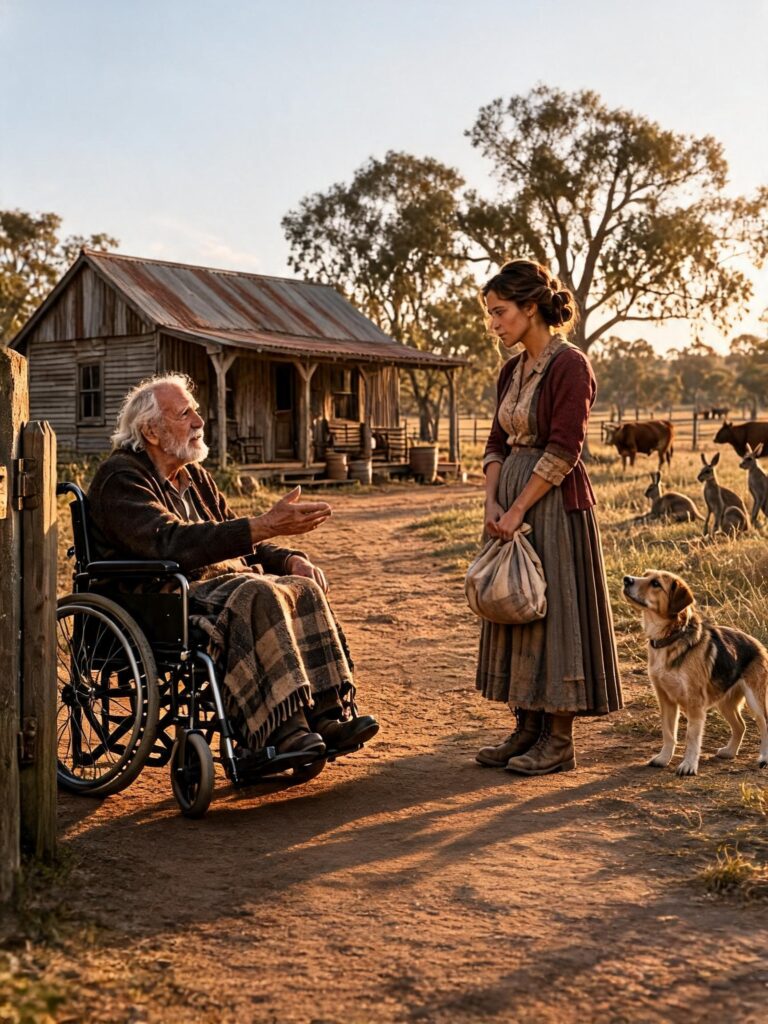
i can’t walk anymore and nobody comes to see me. you need work and i need company, said the old rancher from his wheelchair
Part 1
The sun was dropping behind the ridge when Clara reached the cattle guard, and the red dust of the county road looked poured with gold. She had been walking three days. Her boots were split at the seams. The cotton dress she had run in was stiff with sweat and alkali. A bundle of clothes was tied against her chest with a piece of baling twine, and a scruffy tan dog, half shepherd and half whatever had survived the breaks, had been trailing her since the second morning without ever being called.
She stopped because an old man was sitting alone at the gate in a wheelchair, a wool tartan blanket over legs that did not move, both hands held open toward her like a man offering the only thing he had left.
“I can’t walk anymore,” he said. His voice broke on it. “And no one comes to see me. You need work, and I need company.”
The place was called Cedar Creek. From a mile off it had looked like a ranch where happy people lived: a white frame house, a deep porch crowded with tin pots and clay planters, two weathered rocking chairs, a barn, a post-and-rail fence, a stock horse and a milk cow grazing in the late light. Up close, the man in the chair undid the picture. His hair was wild and silver. White stubble covered his chin. His eyes carried a sorrow so plain it frightened her to look into them.
“Forgive me,” she said, pulling the bundle tighter. “I didn’t mean to startle you. I came up the road hoping you might need a hand. I can scrub, cook, wash, mend fence, handle stock. I’m not asking for much. A corner to lay my bedroll and a hot meal.”
He studied her a long time. The dog sat beside her boots and tilted his head.
“What’s your name?”
“Clara.”
“Clara,” he repeated, slow, as if it had been years since he had said anyone’s name out loud. “I’m Hamish Campbell. I’ll give it to you straight, because at my age I don’t know how to spin yarns and I haven’t got enough daylight left to learn.” A faint whistle came from his chest. “I haven’t got much to pay you with. This was a proud run in its day. Now I’m a useless old man strapped to this chair, can’t even wheel myself down to latch the front gate. What I can give you is a dry roof and decent food. Honest work for honest tuck. But I’ll be asking for something more, and that’s why I’m looking you in the eye. I’m asking for company. It’s been three years since a living soul set foot through that gate. Some mornings I open my eyes and haven’t the faintest idea why I bothered.”
The dog gave one quiet sound, almost to break the stillness.
Clara felt her eyes sting and shut them. She had learned years ago never to weep in front of another person. The old rancher, without knowing it, had just named the ache she carried: not knowing why she opened her eyes at dawn.
“Mr. Campbell,” she said, “it’s been a long time since I knew what I was waking up for, either. Maybe the good Lord put us both on this road for a reason.”
Something moved across his weather-beaten face. Not quite a smile. The soil where a smile might take root if somebody watered it, the way those pots along the porch had been watered.
“Well, then come on in,” he said. He shoved one wheel with an effort that seemed to empty him. “Take the handles and push. I’m no good at even rolling this thing anymore. The house is a dog’s breakfast inside. Nobody’s touched it in years. There’s a back room off the breezeway with a decent iron bed. It’s yours from tonight.”
She set the bundle on the dirt, stepped behind the chair, and laid her palms on the rubber grips. They were young hands, calloused since girlhood. She pushed him up the track toward the white house, the tan dog trotting alongside, the sun dropping behind them. Neither of them knew that this was the second their lives began to turn. She did not yet know why a gentle man had been left so utterly alone. He did not know the terror she was running from.
Inside, the house was another country. On the porch, life was bursting: red and pink geraniums, creepers on the posts, pots overflowing as if a loving hand still tended them. Across the threshold, gray dust lay on every surface. Unwashed enamel plates were stacked in grease. Cobwebs hung in the corners. The air smelled of closed windows and stagnant loneliness. Heavy curtains were drawn. Daylight still glowed outside. Inside it felt like night.
“Told you it was a shambles,” Hamish muttered, hanging his head. “A woman drives out from town every couple of weeks, drops off tins and flour, and clears out. She hasn’t the time to clean, and I haven’t the cheek to ask. The rest fell to pieces. Same as me.”
Clara let go of the handles, walked to the nearest window, and dragged the drapes wide. The last gold of the Montana evening cut through the floating dust until the parlor glittered.
“Light comes first, Mr. Campbell,” she said, and hoisted the sash. “A house starved of sun and wind withers. The people inside wither with it.”
He squinted like a man who had lived so long in a cellar he had forgotten what sunlight felt like on his skin. His shoulders drew back a fraction, as if his bones remembered an older posture.
That first night she never sat down to nurse her blistered feet. She found the woodstove, boiled a kettle, and scoured the crust off every plate. In the pantry she found flour, dried beans, a tin of coffee, and a carton of eggs the town woman had left. She made stewed beans, hot biscuits, and a pot of scalding tea. When she set the plate in front of him, he stared at it as if he had forgotten what a hot supper looked like.
“Eat up,” she said. “It’ll go cold.”
“I can’t recall the last time someone set a proper table for me,” he whispered. “I chew whatever cold bread is left near the bed, when I remember. Half the time I don’t bother.”
“From tonight on you’ll bother. You’ll eat hot food as long as I draw breath on this place. Under this roof, meals are served hot, and they’re served on the hour.”
He lifted the spoon with trembling fingers, brought the first mouthful to his lips, and chewed with his eyes shut. She looked toward the doorway out of respect, but she saw the tear slip into his silver beard. It was not about the biscuits. It was about a set table and a living voice across from him, somebody who remembered he was still a man who needed feeding.
They ate in quiet. Out on the porch the tan dog had already decided the place was his. Farther back in the hall, from a threadbare blanket, a second dog watched: an old golden mix with a gray muzzle, who lifted his chin, sighed, and settled again.
“That was her dog,” Hamish said. “Belonged to my late wife. Won’t leave my side. Doesn’t wag his tail much either. Just waiting out his days. Same as me.”
She did not push. The way he spoke of his wife told her where the hollow had come from. She had lived through enough of her own to know certain wounds only let you touch them when they are ready.
Getting him from the chair to the mattress was a trial. He was tall and solid. She had farm strength and a gentle touch, and it shook him that anybody would handle him with kindness instead of hurried obligation.
“Good on you, girl,” he whispered from the pillow. “Don’t know what wind blew you up to my gate. Thank you.”
“Rest easy, Mr. Campbell.”
In the back room she sat on the edge of the bed in the dark and, with no eyes on her, pressed both hands over her mouth and wept without sound. She had perfected those quiet tears through eight brutal years in another house, beside a man who was now, thank God, miles behind her. She had not only come looking for work. She was running for her life. She prayed two things: that this decent old man would never find out what she had crawled out of, and that the man she had escaped would never track her down.
She did not know, and mercifully so, that he had already saddled a horse to hunt her.
Part 2
She woke before the magpies, if this country had magpies. It was an old reflex. Oversleeping had once meant a shout, a fist, or worse. This morning, for the first time in an age, her pulse was not hammering against her ribs. The tan dog was curled at her feet. He had slipped in during the night. Through the window came cold air scented with damp sage and wet dirt. No coarse yelling. No boot heels in the hall. Just a meadowlark somewhere and the dog breathing.
She splashed her face from the tin basin, pinned her hair, and stepped onto the porch into a frosty dawn. That was when she truly saw the garden.
What had looked like tin drums from the road was a marvel kept with fierce tenderness. Scarlet geraniums, purple petunias, wallflowers, carnations, morning glory wound tight around the posts. Every pot was weeded and damp. Not a dead leaf in sight. In the middle of a ranch falling into decay, the porch garden shone like an altar. It was the only living thing kept whole.
She knelt and touched the soil. It was moist. Someone had watered it recently.
“I water them.”
She spun. Hamish sat in the doorway in his chair, wrapped in the tartan blanket. He had transferred himself out of bed, an effort she knew must have been agonizing, and rolled out just to watch her see the flowers.
“You water all these?”
“Wheel myself along the boards,” he said, without shame. “Edge over, hoist the can onto my knees, hit every tin one by one. Takes me half the morning. Tumble out of the seat sometimes. But I water them every single day. Haven’t missed one.”
“But the house is drowning in grime. The plates are piled high. The rooms are neglected. And these flowers—”
He was quiet a long time. When he spoke again it was hushed, like a man in an empty church.
“My Maggie planted this lot. Stem by stem, with her own hands. She’d spend every afternoon out here, talking to them like they were neighbors over for coffee. Said a homestead without flowers was a place without a soul.” He swallowed. “Forty-one years we were married. Forty-one. And in forty-one years there wasn’t a week this porch went without color, because Maggie wouldn’t allow it.”
The old golden dog limped through the screen and collapsed across the footplates. Hamish lowered a knobby hand to the graying crown.
“When she took ill, I nursed her. Two years, day and night. Bathed her, brushed her hair, fed her with a teaspoon when she lost the strength in her arms. Right up to her last sunset, all she ever asked was to be wheeled out here to look at her blooms. ‘Take me out for a minute, Hamish. Let me look at my garden.’ And I wheeled her out.” His voice cracked cleanly. “The day she passed, she was sitting right there in that rocking chair, looking at the petals. Drifted off looking at them, and just never woke up.”
One chair had a flattened, sun-bleached cushion. The other sat empty, its cushion untouched. Nobody had dared sit in Maggie’s chair for three years.
“That’s why you break your back to water them.”
He nodded. “Because the day this garden dries up and blows into the dirt, she dies a second time. And I can’t bear that second death. The house can rot around my ears. I can turn to dust in this chair. But Maggie’s garden stays green. As long as I draw breath, it lives.”
Clara dropped to her knees beside the chair and took his rough hands between her own. It was the first time she had touched him out of affection rather than duty.
“Mr. Campbell. Your Maggie’s garden is never going to die. From this sunrise on, you and I are watering it together. But I’m going to tell you something straight, and forgive my cheek. Your Maggie wouldn’t want to see this house looking like an abandoned ruin. A woman who loved flowers that much wouldn’t want her husband rotting in filth and dirty crockery, waiting around for the grave. That isn’t honoring her. That’s punishing yourself. And you have no cause to whip yourself for loving her so deeply.”
He stared as if she had clipped him across the jaw. His eyes went glassy. He turned his face toward the rail so she would not see him break.
“Give me a fair go,” she said, rising. “Not just to keep you alive, but to help you live again. There’s a world of difference. Give me one month. If within a month I haven’t put the spark back in you, I’ll pack my bundle and you’ll never see my face again.”
She did not wait for an answer. She rolled her sleeves, grabbed the rusted watering can, and marched down to the pump.
That day she worked as she had never worked, and this time it was not out of terror of a fist. She worked because she wanted to. She swept the floorboards end to end, hauled furniture into the yard to beat the dust from it, scrubbed curtains in a tub, mopped until the grain shone. She opened every window and let the clean wind move through the rooms like a river flushing old sorrow. Under the grit on the mantel she found framed photographs: a young Hamish with a dark mustache, standing proud beside a smiling girl with dark plaits. Maggie. Clara wiped the glass and set them square.
From his chair he watched, at first with the squint of a recluse whose grief was being disturbed. As the rooms filled with light and the smell of soap, something frozen in him began to thaw. By mid-afternoon, without a word from her, he picked up a rag and polished what he could reach: table legs, chair rungs, the low skirting.
“You don’t have to lift a finger.”
“Shut your trap and let me be,” he growled, though a small smile was fighting through his whiskers. “This is still my station.”
Behind his back, she smiled too. It was the first time he had spoken with a man’s pride.
That evening, after another hot meal under a lamp she had polished clean, she did something unscripted. She walked to the second rocking chair, Maggie’s empty chair, dragged it alongside his, and sat down to watch the stars prick through the indigo sky.
He stiffened like iron. For a second she thought he would order her off the boards. He said nothing. He leaned back, staring into the sky, while both chairs began to creak in a shared rhythm against the decking.
After a long while his voice broke the quiet. “She used to sit right where you are.” A pause. “Doesn’t sound half bad. The two chairs creaking together. I’d near forgotten the sound.”
No words were needed. They rocked on, two battered souls under the northern sky, dogs asleep at their boots, Maggie’s garden breathing the night air around them.
The next morning she had to walk into the town of Oak Haven for supplies, and in a town like Oak Haven, tongues were already working.
Hamish pulled a handful of crumpled bills and silver from an old tobacco tin under his mattress and looked her dead in the eye. “I trust you with this, girl.” It had been years since he had trusted anyone with a penny. She felt the weight of that faith like something she could not dare drop.
The walk was miles, but she took it in high spirits, the tan dog trotting ahead. For the first time in eight years she walked without constantly glancing over her shoulder. That ease vanished the second her boots hit the gravel of Main Street. Two ranch wives leaning on a pickup stopped their chatter and watched her pass. A grocer sweeping the boardwalk paused mid-stroke. When she pushed through the screen door of Mrs. Henderson’s general store, an icy hush fell over the room.
“Morning,” Clara said. “I have a list to fill.”
Mrs. Henderson, stout, with sharp eyes, looked her up and down. “So you’re the one shacked up at old Hamish Campbell’s place.”
“I’m working the ranch for him.”
“Is that a fact?” The shopkeeper dragged tins off the shelf at a crawl, gaze locked on her. “Funny thing. For three years that bitter old coot wouldn’t let a soul near his gate. Chased the Presbyterian minister off with an axe handle when he came to offer a prayer. Chased the church ladies when they brought casseroles. Even cursed out old Jock McAllister, his closest mate from the stock routes, and told him never to show his face again. Then out of thin air a strange young woman turns up, and he invites her right in.” She let a nasty pause hang. “People talk, love. Don’t take it personal. But people talk.”
Clara felt the blood surge into her cheeks. “People can talk till they’re blue in the face. I scrub his floors, cook his meals, and look after him because he can’t get out of that chair. And if the town thinks ill of that, shame on the town. You left a sick, grieving old man to rot in his own dirt for three years, and now you’ve got plenty of lip for the only person who offered him a hand.”
The shop went dead quiet. From the back, a lanky stockman pretending to test fencing wire drawled loud enough for everyone. “She’s after the deed. Clear as day. Old Hamish has no kids. Somebody’s getting that run when he kicks the bucket. And we all know who’s playing her cards right.”
Clara turned, eyes blazing. “I don’t want a scrap of any man’s dirt. I arrived with a bundle of rags and a stray dog, and that’s exactly what I’ll leave with. I don’t want his acres. I don’t want his will. I don’t want a single thing I haven’t earned with these two hands.” She held up her cracked palms. “If you lot can’t understand that, it’s because you’ve forgotten what honest work looks like.”
She slapped the money on the counter, shoved the tins into her basket, and walked out with her chin high. Under her ribs her heart hammered. Gossip in a small county spreads faster than grassfire, and the last thing she could afford was her name bandied from the cafe to the bar, traveling the stock routes until it reached the man she was hiding from.
She had told Hamish she was alone, that she had no kin, that she needed work. Every word of that was true. She had left out the dark part. She had not breathed a word about Wayne.
Wayne, her husband. The man her people had pressured her into marrying at seventeen because he was an established grazer with sheep and land of his own. Decent enough the first fortnight, until the ring was on her finger and he showed his colors. Wayne who hit the bottle. Wayne who turned unrecognizable the moment liquor touched his tongue. Rages over burnt toast, over a quiet room, over the way she looked at him, over the sound of her breath. The man who had sobbed like a child the first time he struck her, swearing on the Bible it would never happen again, only to break that oath the next time a bottle was opened.
Eight years. She had endured eight years because she had nowhere to run. Her folks were in the churchyard. The parish priest told her marriage was a sacred cross she had to carry. And because when a woman gets used to being beaten, even the violence starts to feel like everyday life. Until the final night. Blind drunk, he had wrapped both hands around her throat until her vision went black. In that dark she understood that if she did not get out that night, she would leave that house in a wooden box. The next time he would finish it, and nobody in their district would care enough to stop him.
So at midnight, the second his snores shook the iron roof, she grabbed a few clothes, a heel of bread from her own kitchen, and slipped out barefoot so as not to rattle the floorboards. No plan except to run as far into the open country as her legs would carry her. She walked through the night, through the heat of the next day and the next, sleeping rough in the scrub, until at the end of a dirt road she saw a white house with a porch full of flowers.
That was the terror she carried back toward Cedar Creek. If the old man discovered she was a runaway wife, he might cast her out for bringing trouble to his door. And in three days the creek had become the closest thing to a sanctuary she had ever known.
He was waiting on the boards, restless. “Thought you’d pulled pin and left.”
“Why on earth would I leave?”
He looked toward the paddocks. “Because that’s what folks do. They pack up and leave. My Maggie left. My good legs left. The whole district cleared out. I’ve gotten used to everyone I give a damn about vanishing down that track.” He lifted his tired eyes. “And you. Even though it’s only been three days. God knows why. But I was hoping you weren’t one of them.”
In thirty-two years on this earth, nobody had ever looked at her and said they wanted her to stay.
“I’m not going anywhere,” she said, her voice catching. “I give you my word.”
She meant it. But promises made by runaways are rarely theirs alone to keep. Leagues away, in the district she had fled, a hard-eyed man was leaning on a timber bar, shoving a faded photograph into the faces of shearers and teamsters.
“You seen this woman? Running on her own. She’s my missus, and I’m dragging her back home. Dead or alive.”
Part 3
The weeks that followed felt to Hamish like waking from a long suffocating sleep. Clara worked in a way that was more than labor. It was like watching life breathed back into dead earth.
After the house, she tackled the kitchen garden out back, which had turned into burrs and wild scrub. She cleared it with a mattock and hoe, turned the soil, and sowed whatever seed packets she had coaxed out of town: tomatoes, chard, pumpkins, beans, sweet corn.
“Saves us blowing money on tins,” she told him. They both knew it ran deeper. It was the quiet joy of watching green shoots pierce dry earth.
Then the stock. The chicken shed had been abandoned. She traded for a dozen laying hens and a proud rooster, and within weeks fresh eggs sat in the wire basket every morning. She milked the solitary Jersey Hamish had kept out of stubbornness and started churning butter. With the nails from town she patched the barn door, secured loose boards on the porch, and plugged the leak in the kitchen roof.
Whatever she did not know, she asked him. And right there, without either of them naming it, lay his salvation. She did not ask to be polite. She asked because she genuinely did not know, and he genuinely did.
“Mr. Campbell, do I stake these tomato vines or let them crawl?”
“Stake them, girl. Drive a good timber stake beside the roots and tie them off loose with a strip of rag. Bind them too tight and you’ll strangle the life out of them. That’s how my old man taught me.”
“And the cow. Why is she kicking the pail every time I sit down?”
“Because you’re grabbing her teats with freezing cold hands. Rub your palms together first. Warm them up and talk to the beast. Cattle need to hear your voice.”
Question by question, the old stockman who had given up on living began to feel of use again. The sun coming up mattered. He woke wondering what Clara was going to ask him, what job needed seeing to, whether the heifer had calved, if the morning glory had climbed higher. He had a tomorrow again, even if it was only twenty-four hours wide. For a man who had spent years without a single future sunrise to care about, it was nothing short of a miracle.
Every afternoon she wheeled him onto the porch and they tended Maggie’s garden together. She passed him the planters he could not reach, and he recounted the pedigree of every bloom. This cutting Maggie had brought from her mother’s place down south. That one was a gift from an old shearer’s wife. That wild vine had blown in on a westerly and taken hold on its own. The porch, which had stood as a memorial to a dead woman, slowly became a place for the living.
One afternoon, without asking permission, Clara planted sunflower seeds in a freshly painted kerosene tin.
“What are those?”
“Sunflowers. I fancy them because they always turn to find the sun. No matter how dark the shadow, they’ll twist their necks around until they catch the light.” She cut him a glance. “Just like folks ought to do.”
He said nothing. That night he lay awake staring at the ceiling, thinking about sunflowers.
The first time she heard him laugh, she nearly dropped a bowl of peas. The tan dog, who now ruled the yard like an overseer, had tried to pinch an egg from the coop and been chased across the dirt by a furious red hen pecking at his tail. Hamish let out a roaring belly laugh that shook his frame until he coughed. She stared, then burst out laughing too. They howled on the porch until tears streamed down their cheeks. Good tears this time.
Catching his breath, he wiped his whiskers. “Three years. Three bloody years since I had a laugh. Thought I’d clean forgotten the trick of it.”
“You never forget,” she said. “You just shove it into a dark drawer for a spell. It stays there, waiting.”
Oak Haven was slowly changing its mind, the way small places do when the dust settles. The town woman who used to drop the tins stopped making the run because it was no longer needed, and told everyone at the post office what she had seen: the house scrubbed, the old man shaved, hair combed, tucking into hot meals, cracking jokes. “He’s a changed man. That girl pulled him straight out of the grave.” The butcher noted that Hamish Campbell was ordering beef again, something he had not done since Maggie passed. The church ladies began whispering that perhaps they had judged too harshly, that perhaps help arrives in the form of a woman with a bedroll.
Not everyone came around. Mrs. Henderson still pulled a sour face. The lazy stockman still muttered into his beer that the runaway was playing the long game for the deed. Yet the tide had turned, because the truth has a way of showing through. And one dry afternoon that truth arrived in the shape of an old bushman in a battered hat, riding a swaybacked mare up to the gate.
Clara saw him from the pumpkin patch and walked up, wiping her hands on her apron. “Good day. Looking for someone?”
He swung down with a groan. His skin was tanned like worn leather. His eyes were kind. He turned his hat in his hands. “Looking for Hamish. I’m Jock McAllister. His old mate. Or I used to be.” He looked at his boots. “Last time I rode up here, eighteen months back, he roared at me like a scrub bull. Cursed me up and down. Told me he didn’t want to see a soul. Said leave him be to rot. Hurt me to the bone, so I stayed away. But yesterday at the sale yards a fellow told me Hamish was up and about, eating proper, even having a yarn. I couldn’t help myself. Had to see it with my own eyes, even if he sets the dogs on me again.”
She took the measure of the man and understood. Hamish, in his agony, had not only locked himself away. He had pushed away every soul who cared for him. His loneliness was not because the world had abandoned him. It was because he had barred the gate from the inside.
“Hold on right here, Mr. Jock. Don’t go anywhere.”
Inside, Hamish was shelling dried corn by the parlor window. She had set it out to keep his hands moving.
“You’ve got a visitor at the gate.”
“A visitor? Who the hell would come out here to see me?”
“Mr. Jock McAllister. Your old mate.”
His face set like dried concrete. He threw the cob down. “Not him. Tell him to clear off. I won’t see him.”
“And why is that?”
“Because when my Maggie passed, he had the gall to tell me to let her go. Told me life goes on. Told me not to bury myself in the ground with her. I can’t forgive that. How could a mate say that to me? Let her go, like she was an old saddle. Forty-one years, and he wanted me to brush it off in a month.”
Clara knelt before the chair, the way she did when she needed him to truly listen.
“That man has spent a year and a half carrying the hurt of losing you. He climbed onto an old horse and rode all the way out here through the heat, knowing full well you might curse him off the dirt again, and he came anyway. Do you have any idea how few men care enough about a mate to swallow their pride and risk a hiding just to check on him? Very few.” She laid her hand over his. “He wasn’t telling you to forget Maggie. He was begging you not to let go of life. Maybe he said it rough. Maybe he picked the wrong time. But he said it because he loved you like a brother, and you ran him off, just like you ran off the parson, the neighbors, everyone. The district didn’t turn its back on you. You locked yourself in. There’s a world of difference between being forgotten and locking your own door.”
He sat motionless, chin trembling. Through the glass, by the fence, old Jock waited in the sun, hat in hand, refusing to budge.
“He’s looking terrible,” Hamish rasped at last. “Can barely throw his leg over the saddle.”
“He’s just as old as you are.” She smiled.
Then he did something that made her heart lift. He straightened his back, smoothed the front of his flannel with shaking fingers, and cleared his throat. “Wheel me down to the gate. And put the kettle on. Jock’ll be parched after that ride.”
The two old men stared at each other across the rails. Decades of mateship, grief, and unbroken silence hung between them. Jock’s voice broke before he could spit out a greeting.
“Hey, mate.”
“Right, that’ll do,” Hamish cut in, gruff, the way men talk when they are fighting tears. “Don’t you go turning soft on me, McAllister. We’re too old for waterworks. Come on up the porch. The kettle’s boiling, and this girl makes a biscuit that would give my late Maggie a run for her money. God rest her.”
They clamped hands over the rail in the late light. Clara slipped into the kitchen to stoke the stove, wiping a tear from her cheek, overjoyed to have restored not just a house and a garden, but an old friend.
That evening three voices echoed across the porch of Cedar Creek. Hamish, Jock, and Clara, swapping yarns, recalling old drives, laughing at antics from decades gone. Watching his mate laugh and his girl pour the tea, Hamish thought that life, stubborn battered life, somehow always finds a way to start over just when a man thinks he has drawn his final card.
What none of the three knew was that at that same hour, along the mail road toward Oak Haven, the shadow Clara had fled was edging closer, asking questions at every homestead along the way.
Part 4
Summer heat settled over Cedar Creek, and with it the new life she had cultivated came ripe. The vegetable patch yielded its first heavy harvest. Hamish put on good weight. A healthy color returned to his cheeks. His legs remained dead weight, but the man himself was transformed. Jock started riding over two or three times a week, sometimes bringing other old-timers. Soon the porch hosted cards and long yarns past dark. The dead ranch had quietly turned into the place where folks wanted to drop by.
Between Hamish and Clara a bond had formed that had no simple name. It was beyond a boss and a hired hand. It was the devotion that binds two people who have pulled each other out of an abyss.
One afternoon, stripping corn on the porch, he spoke plain, the way he always spoke of things that mattered.
“Clara. I never had children.”
She looked up from the cob.
“Maggie and I tried. Every blessed year of our marriage. The good Lord never saw fit to send us one. It was the only deep sorrow we ever shared before the sickness took her. She’d cry into her pillow at night, thinking I was asleep. I’d pretend I was out cold so she wouldn’t feel the shame of it.” He took a long breath. “My whole life I wondered what it would be like to have a daughter. A girl who’d come asking how to tie up a tomato vine. Someone to teach the things my father passed down to me. Someone to look after me in my twilight years, not for wages, but out of genuine love.” He lifted his damp eyes. “And look at the irony of it. At seventy-eight, when I’d made up my mind to die alone like a scrub bull, a girl with a bedroll turns up at my gate and gives me every single thing I begged the Lord for. Everything I thought was dead and gone.” His voice broke. “I don’t rightly know what you are to me. You’re not my flesh and blood. But if the Almighty had ever given me the choice, I’d have picked you. Plain and simple.”
She dropped the cob, stood, and threw her arms around his shoulders. He wrapped his thick trembling arms around her. They held each other on the porch, the father who never had a child and the daughter who never had a father, while the sun dipped behind the cottonwoods and Maggie’s flowers watched.
“You’re the dad I never had,” she sobbed into his shoulder. “Mine died when I was barely walking. After that, nobody ever looked out for me. Nobody. Until you.”
In that moment the secret tearing at her ribs became unbearable. A man who had just offered her the place of a daughter deserved the truth, no matter how much it terrified her.
She pulled back, sat in Maggie’s chair, hands shaking in her lap. “There’s something I have to tell you. All I ask is that you let me finish before you tell me to pack my things, if that’s what you decide.”
“Nobody’s throwing you out. This is your home. Speak your mind.”
She told him everything. Wayne. The arranged match. The drunken rages. The blows. The eight years. The night he nearly choked the life out of her. The midnight escape barefoot with a bundle of rags. The three days walking until she saw the white house. She laid it bare without drama or self-pity, eyes on her trembling fingers, and when she finished she hunched her shoulders, bracing the way she used to brace for Wayne’s fists.
Hamish was silent a terrifyingly long time. She thought: this is it. He will say a married woman has no right running off. That it is a disgrace. That she has to leave.
When he finally spoke, there was no judgment in it. There was fury, and none of it directed at her.
“That coward laid his hands on you.” His voice trembled with wrath. “A grown man used his fists against a woman.”
“Yes, sir.”
He squeezed his hands into fists against the tartan rug until his knuckles went white. “Damn him. God damn him to hell.” Then, softening, tears in his aged eyes: “And you bore that for eight years alone, with nobody in your corner? Sweet Lord, girl.” He took her hand. “And here I was pitying myself, thinking my grief was the heaviest cross in the country. I lost my Maggie. But she loved me for forty-one beautiful years. You got handed a monster for eight.” He squeezed her fingers. “You didn’t run out on a marriage. You saved your own life. I don’t know where you found the grit to do it. But I swear on the memory of my Maggie, as long as I draw breath under this roof, that man will never cross this threshold. If he tries, he’ll have to roll right over my dead body.”
She wept then, not from shame, but from relief so large she could hardly hold it. For the first time in her life, someone was standing between her and the dark.
“I don’t want any harm coming to you on my account. If he comes, I’ll run. I’ll head further north. I can’t bring my misery down on you.”
“You’re not running anywhere.” His voice was iron. “Life took my wife, took my legs, took my will to live. And when I was down to nothing, it sent you along to hand it all back. You think I’m going to let some drunken bully steal the last good thing I’ve got left? Not on your life. We stand together. Whatever comes down that track, we face it as one.”
That night she slept without the knot in her stomach. He knew the worst of her, and instead of casting her out, he had pulled her closer. Blood is an accident, she thought, the tan dog warm at her feet. True family is the one that chooses you.
While she slept, at an old wayside shack on the edge of Oak Haven, a hard-faced man reeking of cheap spirits slid out of his saddle, walked up to the publican, and showed a faded photograph.
“Looking for a woman named Clara. She’s my wife. Took off a few months back. Head’s not right, poor thing. You heard tell of a stray woman turning up alone around these parts?”
The publican scratched his chin, unaware of the poison he was dealing. “Only one stray woman’s come through lately. Working up at old Hamish Campbell’s place. Cedar Creek. Folks reckon she pulled the old fellow right back from the edge. Don’t know if she’s yours.”
Wayne’s eyes narrowed. A crooked grin spread across his jaw. “Cedar Creek.” He pocketed the picture, swung into the saddle, and dug his spurs in.
He hit the gate late the following afternoon. Clara saw him from the pumpkin patch, and the blood turned to ice. She recognized the horse, the grease-stained hat, the arrogant slouch, the swagger of a man who believed he owned every creature in his path. Most of all she recognized the face that had haunted her sleep for eight years. The hoe slipped from her fingers. Her knees went. For a heartbeat she was seventeen again, waiting for the blow.
“Well, well,” he drawled, dismounting with mocking slowness. “Look how far you made me ride, you little wretch. Do you have any idea the humiliation you caused me back home? Every shearer in the district knowing my own missus bolted like a thief in the night.” He strode toward her. “The game’s up. Grab your things. We’re going home.”
“No.” Her voice was thin. “I’m never going anywhere with you. Never again.”
He laughed, a harsh bark. “The hell you aren’t. You’re my wife before God and the law, and a wife stays where her husband puts her. Don’t make me drag you. You know what happens when I lose my temper. Get on the horse.”
He lunged for her forearm. She squeezed her eyes shut, waiting for the fist. It never landed. Between her and Wayne the tan dog lunged, hackles stiff, fangs bared, a murderous snarl tearing from his throat.
Wayne jumped back. “Get that mongrel out of my way or I’ll put a bullet through it.” His hand dropped to the knife at his belt.
“Banjo. Heel.” A thunderous voice roared from the porch.
Hamish had wheeled himself to the edge of the deck. Trapped in the chair, legs dead under the blanket, seventy-eight years old facing a younger man, there was such authority in his glare that Wayne stopped dead.
“And who the bloody hell are you, old man? This is private business between a man and his wife. Stay out of it.”
“I am the owner of this ranch you are trespassing on,” Hamish boomed, “and this woman is in my employ and under my protection. What happens on Cedar Creek is my business. Get off my land.”
Wayne threw his head back and laughed. “Or what, Granddad? You going to run me down in your little cart? Mind your own business before an old invalid gets hurt.”
“Try me. Put one boot on that step and see what happens.”
Then something Wayne had not bargained for. Down the track, drawn by the barking or by that uncanny country instinct that tells a township when trouble is brewing, men were arriving. First Jock on his mare. Then two of the old card players in a farm truck. Right behind them the town butcher, a towering man with forearms thick as fence posts. They fanned out across the dust between Wayne and the porch steps, a wall of weathered men.
“Everything all right here, Hamish?” Jock asked, looking Wayne up and down with cold contempt. The butcher cracked his knuckles.
Wayne took stock. He was a bully who took pleasure in cornering a lone woman in a locked room. Out here in daylight, faced with men who did not fear him, a dog showing teeth, and an old man who would not flinch, his bravado withered. He spat into the dust.
“This isn’t finished. She’s my legal wife. The law will hand her back to me. I’ll bring the district court down on this place, and then we’ll see who’s laughing.” He swung into the saddle, cast a look of pure hatred at Clara, the cold promise she knew too well, and kicked his horse into a gallop.
The moment the hoofbeats faded, her knees buckled. She collapsed in the pumpkin patch, shaking. Jock and the others stepped over. Hamish wheeled furiously to the edge of the deck, agonized that he could not climb down to reach her.
“Clara. Are you hurt? Did that mongrel touch you?”
“No.” Through the tears came a voice they had not heard before. “He didn’t touch me. He didn’t lay a finger on me, because this time I wasn’t alone.”
In eight years, the violence had never been the worst part. The worst part had been the isolation, the certainty that nobody would ever stand up for her. Now, for the first time, she had an army.
That evening Wayne’s parting threat hung over the porch like weather. In those days the law weighed heavily on the side of the husband.
“He’ll be back,” Jock said, blowing steam off his enamel mug. “Men of his stripe don’t take a beating lying down. He’ll return with a warrant, or worse.”
“Then we meet him with the law on our side,” Hamish said. “We take this to the courts properly.”
“What law?” Clara asked bitterly. “The statutes say I’m his property. No country magistrate is going to take my word over his.”
“Don’t be so certain.” An educated voice spoke from the bottom of the steps. Arthur Morrison, the district schoolmaster, a lean silver-haired man who had ridden up with the others, took off his hat and climbed up. “Pardon the intrusion. Having read a fair bit of case law, I might offer some counsel.” He sat on the railing. “A marriage is a legal bond. But no judge with an ounce of integrity will compel a woman to return to a man who brutally assaults her, provided the cruelty can be proven. The challenge lies in the evidence.”
“And how does one prove what happens behind closed doors? It was always at night. No witnesses.”
“There must be witnesses in the district you fled. In eight years, somebody saw something. The local doctor who set a bone. A neighbor who heard the screaming. A rider who saw the bruising. We send word, find those willing to testify, gather affidavits. And this must not be heard by some petty local justice who might drink with the man, but brought before the circuit judge, where your husband’s local influence counts for nothing.” He turned to Hamish. “Such proceedings demand resources. Time, travel, and a respected citizen to stand surety.”
“I’ll stand surety,” Hamish said without hesitation. “And I’ll put up every penny of the costs. Cedar Creek can still back an honest fight.”
“I’ll turn up the witnesses,” Jock said. “I know stockmen from here to the border. If there’s an honest soul who saw what he did, I’ll find them and drag them to the courthouse myself.”
Clara looked around at them, rugged men stepping into her fight without asking for a thing. A feeling swept over her she had no name for. Her life, which she had considered worthless rubbish for eight miserable years, actually mattered to someone. It mattered to a great many people.
“I don’t know how I’ll ever repay you.”
“Repay us by staying alive and keeping your freedom,” Hamish said. “That squares the ledger.”
The days that followed were consumed with preparation. Jock took to the roads. Morrison drafted a formal petition in his copperplate hand. Clara sat with the teacher and dictated every detail of what Wayne had inflicted, every beating, every broken promise, every scar. She wept through the telling, but she omitted nothing. The silence that had imprisoned her for eight years had been Wayne’s greatest weapon. Speaking the truth was how she would tear it from his grip.
One afternoon, watering Maggie’s garden, Hamish looked over. “When you first turned up, I thought you’d come to save your own skin and was doing this old codger a favor by keeping him company.” He clipped a dry leaf from a geranium. “Took me a while to see it was the other way around. You came to save my life, and now it’s my turn to help save yours. That’s how family works, even if I’d forgotten the way of it. You take turns lifting each other up. The world never falls to pieces for both of you on the same day.”
Wayne was far from idle. Having failed with force, he turned to poison. He lingered in the Oak Haven hotel, buying rounds, feeding his version: that Clara was unhinged, that she had deserted him without reason, that she was an unfaithful woman who had bamboozled a dying rancher to get her claws into his land. The slander found ears among the bitter few. The lazy stockman took up with him like a fly to meat.
In the dead of night Clara was jolted awake by the stench of smoke. She rushed to the window. An orange glow was licking the timber walls of the barn. Dry hay had been shoved against the boards and set alight.
“Mr. Campbell! Fire! The barn’s burning!”
The flames were still low, but the dry wind was whipping them toward the stored fleece and the rafters. If the fire caught the interior, the whole structure would be gone, and sparks would rain on the house.
“Water! Fetch the buckets!” The pump was too slow for one pair of hands. Hamish, strapped in his chair on the porch, felt the agony of his paralysis burn hotter than any fire. Trapped on the deck, he did the only thing left to him. He hollered. He filled his lungs and bellowed into the night with all the ferocity of a man in a stampede.
Out in the country, neighbors hear. The dog’s frantic barking mingled with his shouts. A mile off, a dog answered, then another, and lanterns began flickering along the ridge. The first to tear up the track was a neighboring rancher with two galvanized buckets, followed by Jock, half-dressed and bareback. Then folks from the edge of town, the very people who had once whispered, arriving in nightshirts with tubs, wet blankets, milk pails. A bucket line formed from the tank to the barn wall. Hands passing metal. Water sloshing. Men and women shouting.
In the thick of it stood Clara, her nightdress singed, her face smeared with charcoal, hauling buckets without feeling the heat or the blisters. When at last the blaze was smothered, leaving smoldering timber and the stink of ash, the crowd collapsed on the dirt, panting. Someone let out a breathless laugh of relief, and it rippled through the soot-stained group.
Hamish sat in his chair on the porch, weeping openly. He wept from the frustration of having no legs to carry a bucket, and he wept with gratitude for the people who had rallied. Clara climbed the steps, trembling and coated in soot, and dropped to her knees beside him. He pulled her into a fierce embrace, uncaring of the ash on his shirt.
“It’s all right. Nothing vital was lost. The house is safe. You’re safe.”
“You could have been trapped in that blaze. God in heaven. That monster stops at nothing.”
There was not a soul present who doubted who had lit the match. And that night Wayne’s malice, instead of breaking her, united the township behind her. She was no longer an outsider. She was a decent woman a coward had tried to burn out. The district, rough though it was, drew the line at arson.
At first light the butcher, checking the boundary fence, spotted a wide-brimmed felt hat snagged on the barbed wire. An expensive hat, not the sort local hands wore. Jock inspected the plaited band and nodded grimly.
“I know this hat. Belongs to that bastard Wayne. He was wearing it in the pub. And that no-account stockman was with him when they were drinking.” He turned to the crowd. “We’ve got him. This isn’t just a dispute between a man and his wife. This is arson and attempted murder, and half the district is witness to the blaze.”
Morrison, who had spent the night hauling water, stepped forward. “This changes the field. A man who sets fire to an occupied homestead is no husband asserting a claim. He is a violent criminal. Pack what you need. Tomorrow morning we ride to the district court at the railhead with the petition, the charred evidence, and every witness willing to take the stand.”
Clara looked around: the blackened wall, the soot-covered neighbors refusing to leave, Hamish steady as an ironwood in his chair. For eight years Wayne had seemed an invincible force. In the clear light of dawn she saw him for what he was. A miserable coward who set fires in the dark and lost his hat running away through the scrub. Just a man. A man who could be beaten.
“We go tomorrow,” she said, her voice steady. “And I’ll tell the judge everything. I’m done keeping quiet.”
Part 5
The district court lay half a day’s travel away. They made the journey in Jock’s spring wagon: Clara, Morrison with his brief, the scorched hat wrapped in hessian, the butcher, and two neighboring farmers who had fought the fire. Hamish could not manage the rough ride. The bone-jarring wagon was too much for his spine, and the inability to go ate at his heart. Before they pulled out, he took both her hands.
“I can’t ride with you to the court. But I’ll be sitting right here on the porch, having a word with my Maggie all day long, to put the right words on your tongue and steel in your spine. Go without fear. Speak the truth. Truth is the one weapon that coward can’t face, because he’s never used it in his life.”
She went carrying her fear, but refusing to let it steer. At the courthouse they were ushered before the presiding judge, an austere gray-haired man who had spent decades on the bench and had little patience for scoundrels. He first heard Wayne, turned up in a clean shirt and oiled boots, spinning a smooth sorrowful yarn about an errant wife and an aggrieved husband only wishing to take his poor confused woman home. The judge listened in stony silence.
Then he called Clara. Her voice wavered at first, then gained strength with every sentence. Truth, uncaged after years in the dark, possesses a resonance that cannot be faked. She spoke of the eight years, the drunken rages, the beatings, the midnight she was throttled nearly to death. She rolled up her sleeve and showed the jagged white scar where a heavy spar had broken her forearm, and the faint line above her brow. She spoke without hysteria, without malice, laying out the stark facts. The courtroom fell so quiet you could hear the flies against the windowpane.
Then the witnesses. Morrison read the petition. The butcher testified to the fire and presented the charred hat. Jock swore to the hat’s owner. Then came the turn that took her by surprise. Through his inquiries Morrison had brought two people from her old district: an elderly midwife who had treated Clara for cracked ribs years prior, whom Wayne had told she had been thrown from a horse, and a boundary rider from the adjoining lease who admitted he had often heard her cries through the timber walls and kept silent out of fear and shame, now bowing his head to ask her pardon and state what he knew.
The judge heard it all. When Wayne, realizing the ground was falling out from under him, leapt up shouting that it was all lies and conspiracy, that a man had rights over his wedded wife, the judge slammed his gavel onto the bench with a crack like a rifle shot.
“Sir. You dare speak of rights in this court? A man possesses no right over the life or body of another human being. A marriage certificate is not an indenture of slavery, nor a title deed to property. What is proven here today is that you brutalized this woman for years, brought her to within an inch of her life, and capped your depravity by setting fire to a neighbor’s ranch, endangering the life of an elderly invalid and this lady.” He paused, gaze boring in. “That is not a private domestic quarrel. That is felony arson and grievous assault.”
The verdict was swift. Wayne was placed under immediate arrest to face formal charges for arson and assault. Regarding the marriage, the judge entered into the record that Clara was placed under the court’s protection, permanently released from any obligation of cohabitation, with proceedings initiated to dissolve the union on the established grounds of extreme cruelty.
She walked out into the bright afternoon and had to catch herself against the stone pillar, knees trembling, not from fear but from a sensation so vast her body could scarcely contain it. Freedom. For the first time in fifteen years, since she was married off at seventeen, she was a free woman. Nobody owned her. Nobody was waiting in the dark with clenched fists.
Jock stepped up beside her, a grin under his gray mustache. “Come on, then. Let’s get the wagon rolling home. There’s an old fellow up on the porch who won’t shut his eyes until he knows you’re safe.”
The journey back under the stars was made in reverent silence. She watched the constellations turn, feeling the broken pieces inside her quietly settling. When the wagon crested the final ridge, there in the distance shone the white house of Cedar Creek, a single kerosene lamp burning on the porch. Old Hamish was sitting in his chair beside Maggie’s empty rocker, waiting, as he had promised.
Tears slipped down her cheeks, the last tears of sorrow she would shed for a long time. She was returning home. And for the first time in her life, that word meant what it was supposed to mean: a place where somebody keeps a lamp lit to welcome you back.
The wagon pulled up well past midnight. He was wide awake, the tartan rug over his knees, eyes fixed on the track. The moment he saw her step down, walking tall, shoulders back, the invisible weight gone from her stride, he knew the battle was won.
“Well?”
“It’s done,” she said, bounding up the steps. “He’s locked up, and I’m free. The law broke the chains.”
He covered his face with his weathered hands and wept tears of pure joy, whispering over and over, “Thank the Lord. Thank God Almighty.” Then he opened his arms and she stepped into them. They held each other a long while on that dark porch, laughing and crying all at once, while the two dogs danced around their feet, catching the scent of a relief they could not understand but could feel in the air.
What followed were the finest years either of them had ever known. With Wayne’s shadow lifted, Clara blossomed. The habit of ducking her head, of speaking in timid whispers, of constantly watching the doorways, fell away. She began to laugh loud and clear, singing old ballads over the washtub, standing with her hands on her hips, arguing with Hamish over stock and crops. He relished every argument, like a man hearing music after years in a deaf world.
Cedar Creek came fully alive. With the funds he now gladly unlocked, having found someone to build a future for, they restocked the pastures, rebuilt the burnt barn stronger than before, and hired a young town lad to handle the heavy fencing she could not manage alone. The kitchen garden became the talk of Oak Haven. The ranch, once shunned as the haunt of a bitter hermit, became the favorite stop for anyone passing through, just for the pleasure of passing the time with old Hamish and his girl. That was how the district spoke of them now. Not the hired hand. Not the stray woman. His girl, the way a man speaks of his own daughter.
One afternoon the bond was made plain, even before the papers were drawn. They were on the porch, Clara mending a bridle, Hamish shelling peas.
“I’ve been turning something over in my mind, and I don’t want you barking no before you’ve heard me out.”
“Go on.”
“I’m an old man. Don’t know how much sand is left in the glass. A year, five years, whatever the Lord grants.” He put down the tin bowl. “When I’m gone, this ranch has no heir. I haven’t got a soul in the world. No cousins, no nephews, nobody who gives a damn about me, nor me about them.” He looked up, eyes steady. “I’m leaving Cedar Creek to you. The whole run. The land, the house, the stock, every stick of it.”
She dropped the bridle. “No. Absolutely not. I didn’t come here for that. The whole town said from day one I was after the dirt, and I swear to God I wasn’t, and I won’t.”
“That’s precisely why,” he said gently. “That’s the very reason I’m giving it to you. Because you’re the only soul on this earth who never wanted a scrap of it. To the person who asks for nothing, you give everything. To the ones who demand, you give not a brass farthing.” He smiled. “Besides, it’s not wages. I pay your wages fair and square. This is what a father leaves to his daughter. And you are my daughter. The one God owed me. Paid back at the end of my days, with interest.”
Her eyes brimmed, but she shook her head. “We’ll talk about this years from now. You’re going to outlive me yet.”
“God forbid,” he chuckled. “Be that as it may, let’s get the paperwork sorted now, so you’re safe no matter what the future holds.”
He had already sent for Morrison to draft a proper deed and will, signed and witnessed, so that no distant claimant, nor Wayne if he ever walked free, could contest what she had built with her bare hands. It was settled not out of greed, but out of the devotion of an old man ensuring that the one person who had truly loved him, and not his land, would be protected.
That night she stepped onto the porch to look at the garden under the moon. The sunflowers she had sown had grown tall, their heads bowing, waiting for dawn to pivot back toward the light. She realized she had been just like those sunflowers, trapped in cold shadow, head bowed, until at the gate of a heartbroken rancher she had finally found the light to turn toward.
The months rolled by, peaceful and productive. The formal decree came through from the capital without contest. Wayne, broken by the criminal charges and facing a hard sentence, had neither the means nor the standing to fight it. The day Morrison rode up with the final paper bearing the court’s seal, she read it three times, scarcely believing the words. Free. Completely free in the eyes of the law.
“So what are you going to do with all that freedom?” Hamish asked that evening, a wry grin.
She looked out across the cottonwoods and pastures. “Live. Just live. That’s the one thing nobody ever let me do.”
And she lived fully at Cedar Creek. They rose at first light. She milked the cow and gathered the eggs, carried his morning tea to the porch, and they breakfasted as the sun crested the ridge. Then the day’s work, each tending their tasks, always within calling distance. In the cool of the afternoon they watered Maggie’s garden, which was now their garden. When night fell they took their places in the two rocking chairs, watching the stars, sharing stories, or sitting in the comfortable silence that only devoted souls can share.
Jock dropped by almost daily. On Sundays half the township rode out. Hamish, who had once chased the world from his gate, now kept the most hospitable house in the district. Occasionally, amid the chatter of guests and children chasing the dogs, he would sit quietly for a moment. Clara knew that in those spells he was speaking to Maggie, saying, You see, old girl. You see how it all came right. I didn’t curl up and die like you feared. I’m still here, and I’m not alone.
His legs never recovered. The stroke had taken them for good. Yet in every other way the man gained ten years of life. He ate heartily, slept peacefully, and laughed every day. The local doctor who had written him off years ago shook his head. “No medicine in my bag did that. That man was cured by a reason to live, and you can’t write a prescription for that. That only comes from someone who loves you.”
One warm twilight, while she trimmed his silver beard on the porch, he murmured, “You know what the best part of all this is?”
“What’s that?”
“I’m not terrified of the dark anymore.” He closed his eyes as the razor worked gently across his cheek. “Before you turned up, nightfall was pure torture. I’d lie there in the black, praying the sun wouldn’t rise, hoping the Lord would take me in my sleep just to end the misery.” He opened his eyes. “Now I lay down wondering what we’re tackling tomorrow. Whether the black heifer has dropped her calf. What you’re baking for supper. Who’s riding out on Sunday. I fall asleep making plans. At my age. Making plans.” He smiled. “That’s what you gave me back. Tomorrow. My tomorrows were clean gone, and you brought them to my gate wrapped in an old bedroll.”
She finished the beard, wiped his cheeks with a warm damp cloth, and kissed his forehead the way a daughter kisses her father.
“And you gave me something even greater. You took away my fear. I arrived here shaking like a leaf. I spent my whole life shaking. Under this roof, the trembling finally stopped.” She straightened his collar. “Folks say I saved you. But you saved me just the same. Only nobody saw it, because my deepest wounds weren’t the ones you could see.”
They sat in silence, her hand on his shoulder, both gazing at the garden where the sunflowers, tall and bright gold, turned their faces to the dying sun. Anyone riding down the track who caught sight of them, the white-haired rancher and the woman who tended him, the dogs curled at their boots, the white house blooming behind them, would have sworn they were looking at a father and daughter who had shared a lifetime. And they would have been right. Family is not merely the blood you are born into. Family is the people who stand by you when everyone else has walked away. The ones who leave the porch light burning to guide you home.
The years passed over Cedar Creek like gentle winter rains over parched earth, slowly, quietly, leaving green life wherever they touched. Hamish, defying every prediction, did not pass in a year, nor in two, nor in five. The man who had once begged for death clung to life the moment he found a reason, and live he did. He lived to see the kitchen garden flourish through many seasons, to watch healthy calves born in the pastures, to bury Maggie’s old golden dog under the great cottonwood by the yard on a crisp winter morning, and to comfort Clara as she wept for the loyal animal as if he were kin, which he truly was. He lived to see her grow into a respected woman of the district, someone the ranch wives sought for counsel, for whom the men tipped their hats when she rode into town. She learned to read and write under Morrison’s patient tutoring. The afternoon she read her first complete book aloud on the porch, Hamish clapped from his rocking chair, tears in his eyes, as proud as any father watching his child finish school.
And he lived to witness something neither of them had planned. One scorching afternoon another lost soul came walking up the track. A lad this time, an orphan boy of fifteen, wandering from ranch to ranch, looking for work in exchange for food. Gaunt, dressed in rags, with the hollow eyes of someone who had slept too many nights rough. He stopped at the cattle guard, asking for a job, just as Clara had done years before, bearing the same hunger and the same terror.
She saw him from the porch. She saw the bundle, the blistered feet, the desperate look, and a lump rose in her throat, for it was like looking into a mirror of her own past. She glanced at Hamish. He was very frail by then, stooped in his chair, his voice a faint whisper, but his mind sharp as ever. He met her gaze and whispered, with a knowing smile, “You know what to do. Open the gate. Under this roof, the door has never been shut against the lonely, and it never will be.”
She walked down the steps, strode to the gate, and opened it wide for the boy, just as an old man in a wheelchair had opened it for her. She gave him a hot meal, a clean bed, honest work, and above all what had been given to her: a safe place where he no longer had to fear the night.
That evening, while the lad slept under a dry roof for the first time in months, she and Hamish sat rocking beneath the stars.
“Do you see it?” she murmured. “It’s the great wheel turning. You lifted me up. I lift this lad. And someday he’ll reach down to lift another. It never ends.”
“That’s how the Lord mends this broken world,” the old man said softly. “He doesn’t send down angels with wings. He sends broken people to knock on the doors of other broken people, so they can piece each other back together.” He rocked on. “The day you turned up at my gate, I thought my life was over. Turns out it was only just beginning. Look at how it all turned out.”
She reached out in the dark and clasped his rough, spotted hand, the hand that had faithfully watered a dead woman’s flowers, and which now rested warm between hers.
“Thank you for not shutting the gate on me that day. You could have let me walk on by. You were so deep in your grief, you could have looked right through me.”
“No, lass,” he replied, and she could hear the gentle smile in the dark. “I didn’t open that gate. My Maggie opened it from heaven, so I wouldn’t die alone in the dark. You were the last gift she ever sent me, and the greatest.”
They rocked on in companionable silence under the timeless sky, the father and the daughter that blood had denied them, but whom life, after so much sorrow, had granted as a blessing.
Hamish Campbell passed away many years later, at a great age, on a warm spring morning in his own bed, with the scent of the blooming porch drifting through the open window, his hand resting peacefully in Clara’s. He did not die alone, as he had once feared. He died surrounded by love. Clara at his side. The lad, now a strapping capable young stockman, at the foot of the bed. Jock whispering prayers. Outside on the porch, half the township of Oak Haven waiting in reverent silence, hats in hand, to bid farewell to the old rancher they had all come to cherish.
He slipped away in peace, without fear of the dark, having learned that the night holds no terror when you know someone will be there waiting for you at the dawn. His final words, spoken in a faint gravelly whisper, were for her.
“Don’t weep, my girl. I go content. I was given what I asked of the Lord. For every soul to die knowing I was truly loved.” He gave her hand a gentle squeeze. “Look after the garden, Clara. And keep the gate unlatched. Never let it close.”
He drifted off looking toward his flowers, just as Maggie had done so many years before, the way good people pass who have lived in peace in their own home, surrounded by those who care.
They laid him to rest beneath the great cottonwood beside Maggie, as he had requested, so they could rest together within sight of the garden they had both loved. And Cedar Creek, by the old man’s firm decree recorded long ago, remained in Clara’s hands, not to be sold or hoarded, but to remain what he had always intended: a sanctuary with an open gate for anyone who arrives alone.
And so it remained. Clara lived out the rest of her long days at Cedar Creek, and not once did she ever latch that front gate. Through the years many passed through it. Orphans, widows, cast-off old wanderers, lost youths, and women who arrived clutching a bundle to their chest, trembling, just as she had once done. She welcomed every one of them, fed them hot meals, gave them a room, honest work, and a refuge where they could lose their fear of the dark. And to each, on their first night, she told the tale of a heartbroken old man in a wheelchair who opened his gate to a stranger at dusk, and how, without planning it, they saved each other’s lives.
Maggie’s garden never withered. The sunflowers opened their golden faces to the morning light each spring. And on the porch, until the end of her days, the two timber rocking chairs stood side by side, rocking gently in the breeze, as if two old friends were still sitting there at peace, watching the twilight settle over the ranch they had brought back to life.
For in the end, that is all we truly carry with us, and the only legacy we leave behind. Not the acreage. Not the money. Not the timber walls. But the gates we opened when we could have kept them barred. The fallen we helped back to their feet. And the terror we lifted from a weary heart in the dark. That never dies. It ripples from gate to gate, heart to heart, as long as the world keeps turning.

