
Chapter 1
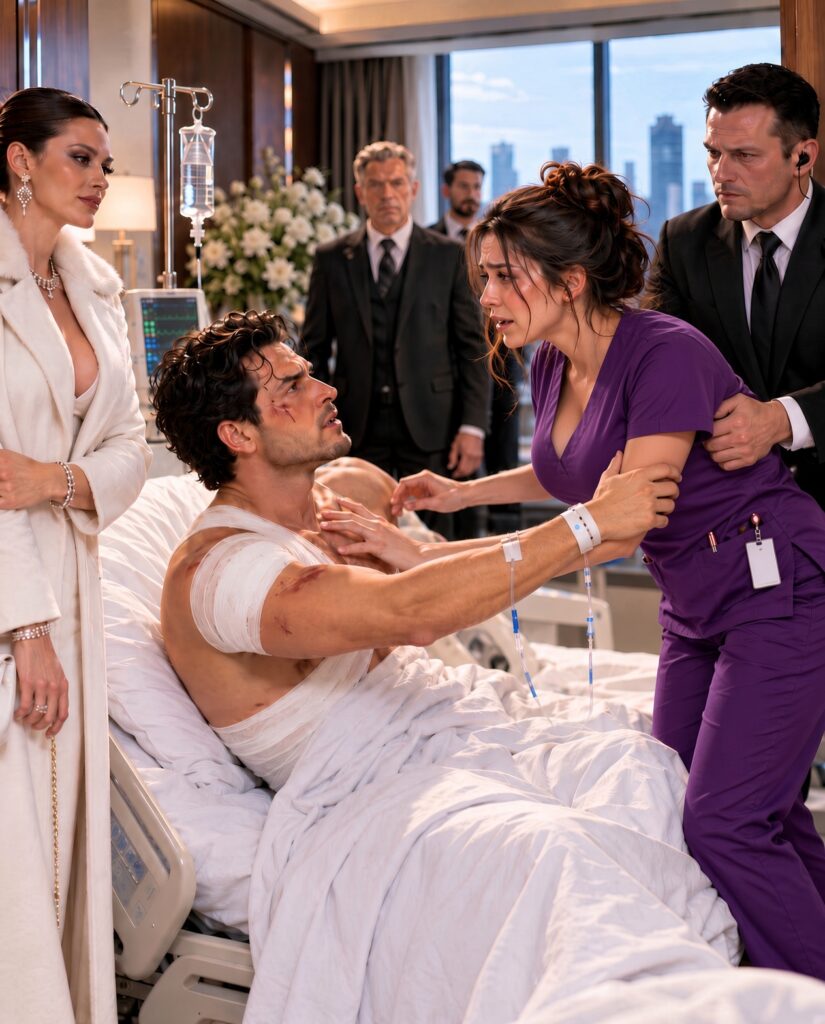
They were dragging me out of the room when the machines began to change their rhythm.
One guard’s fingers were still locked around my arm, hard enough to leave a bruise I would find later, a purple bloom on my wrist. My hair had fallen out of its bun. My eyes burned from forty hours without sleep. And in front of a room full of armed men, powerful families and white roses that smelled like a funeral, Vivienne Castellano leaned close enough for me to feel her breath and whispered, “You were just his nurse. When this is over, no one will remember you were ever here.”
I did not fight. I could not. If I made a scene, someone would start asking questions, and questions were the one thing I could not afford.
Then a voice cracked through the silence.
“Mara.”
Every head turned. The man in the bed, the man the doctors had whispered would not survive the night, had opened his eyes. Dante Moretti, the most feared name on the East Coast, lifted one trembling hand toward the woman being thrown out.
Not toward his fiancée.
Toward me.
His fingers were shaking, but the whole room obeyed him. The guard let go. And as Dante’s dark eyes locked on mine, I saw something no one else in that room was supposed to see. It wasn’t rage or power. It was fear, and it wasn’t for himself.
“Come here,” he said.
Behind me, Vivienne’s smile finally died.
She had no idea that two floors below us, in a room that officially did not exist, a five-year-old boy was sleeping under a name that wasn’t his, clutching a broken silver chain with a black cross.
And I was the only person alive who knew he had survived the fire.
Vivienne recovered first. She always did.
“Dante,” she breathed, rushing to the bed, her voice syrupy with relief. “Thank God. You’re confused. You’ve been through hell. She is just your nurse.”
He didn’t look at her. He looked at me.
His face was gray beneath the bruises. A bandage cut across his ribs. Machines breathed softly around him. He should not have had the strength to lift a finger, yet his hand stayed suspended in the air between us, steady as an oath.
“Then why,” he said, low and rough, “are you all so afraid of her?”
No one answered.
Aldo Moretti, his uncle, shifted in the corner with two of his men. Vivienne’s father stood by the window, watching me the way you watch a lit match near gasoline.
Every instinct I had spent thirty-one years trusting told me to walk out. Go home to my tiny apartment in Queens. My double shifts, my cold coffee, my mother’s recipe cards taped inside a cabinet door. A life where danger came through the ambulance doors and left when the hospital lights stopped flickering.
But his hand was still reaching.
And I knew something none of them did.
Forty-eight hours earlier.
It was 2:17 a.m., and I was eating a vending machine granola bar when the emergency doors exploded open.
Rain blew into the ambulance bay. Sirens screamed. Two stretchers came through at once. The first carried a man covered in glass, smoke and blood-dark rainwater.
The second carried a child.
He was maybe five, small enough to disappear inside the paramedic’s jacket wrapped around him. His curls were damp against his forehead. One tiny hand clutched a broken silver chain with a black cross pendant, and would not let go.
I dropped the granola bar.
“Trauma team, now!” Dr. Harris shouted. “Male, mid-thirties, vehicle explosion, possible gunshot wound. Child, unknown relation, respiratory distress!”
I was moving before anyone told me to.
I don’t look like someone who belongs in rooms full of power. Soft brown hair. Gray eyes. Navy scrubs, comfortable shoes, a watch with a cracked face. People’s eyes slide right past me.
Until someone is dying.
“Two large-bore IVs,” I said, already gloving up. “Crossmatch blood. Watch his airway.”
The man turned his head. Even bleeding, he radiated command. A tattoo vanished beneath his torn collar. Another curled around his wrist, dark ink on olive skin. Then I saw the ring on his right hand: a black onyx crest.
Every nurse in New York knew that crest.
“That’s Dante Moretti,” someone whispered behind me.
The room changed. Not visibly. The work went on. But I felt it, that invisible shift when fear walks in. Voices dropped. Security multiplied. An administrator appeared where no administrator should be at two in the morning. A surgeon who had ignored three pages suddenly arrived in person.
I hated it. A dying man is a dying man. A child is a child. Power means nothing beneath broken ribs.
I leaned over him and checked his pupils. His eyes opened halfway, dark and violent with pain.
“The boy,” he rasped.
I glanced toward the second bay, where the child had started coughing weakly. “He’s alive.”
His bloody hand clamped around my wrist. Not hard enough to hurt. Just hard enough to make me understand.
“No one knows,” he whispered. “No one.”
Then his eyes rolled back.
I stood frozen for half a second, staring at the unconscious mafia boss. His first thought had not been his life. Not his empire. Not his enemies.
It had been a child no one was supposed to know about.
That was the first secret.
The second arrived seven minutes later, wearing white heels.
Vivienne Castellano swept into the emergency wing like she owned it. Tall. Blonde. Wrapped in a cream coat worth more than my monthly rent. Two men in black suits followed her, and behind them, an older man with silver hair and dead eyes.
“Where is my fiancé?”
“Miss Castellano,” the administrator stammered. “He’s being stabilized.”
Her gaze drifted toward pediatric imaging, where the little boy was being wheeled away.
For one heartbeat, her face changed.
It wasn’t worry. It was recognition. Then calculation.
I had spent ten years watching families receive the worst news of their lives. Real fear softens a face. Real love makes people forget themselves. Vivienne’s eyes only narrowed.
“Who is that child?”
“We’re still confirming,” the administrator said.
“John Doe minor,” I heard myself say. “Unrelated accident victim.”
She turned and looked at me like I was a smudge on glass.
“And you are?”
“Mara Ellison. Nurse.”
“How touching.” Her smile was delicate and cold. “Do try not to confuse your role with importance, Nurse Ellison.”
“I don’t usually confuse anything.”
Something sharp passed between us. Then Dr. Harris called my name, and the night swallowed me whole.
Dante survived surgery. Barely.
The boy survived too.
At dawn, I was checking his vitals in the pediatric observation room when he woke up screaming.
“Papa! Papa!”
I pulled the curtain shut and gathered him in my arms while his small body thrashed beneath the blanket.
“Hey, sweetheart. You’re safe. You’re in the hospital.”
“No!” He sobbed so hard his chest hitched. “The car was burning. Papa was bleeding. The bad lady—”
I went still. “What bad lady?”
His mouth snapped shut. His eyes, huge and wet, darted toward the curtain.
Outside, someone’s shoes were clicking down the hallway.
Slow. Deliberate.
White heels.
My blood went cold. I grabbed the boy’s chart off the wall and turned just as Vivienne appeared in the doorway.
For a woman whose fiancé was clinging to life upstairs, she looked untouched. Perfect lipstick. Smooth hair. Only her eyes were restless.
“I was told there was a child from the crash.”
I stepped in front of the bed. “He’s sedated.”
“He doesn’t look sedated.”
“He’s frightened.”
“Children often are.” Her smile returned. Behind me, a small hand caught the back of my scrub top and held on. Vivienne saw it. Her gaze sharpened.
“What is his name?”
“Hospital policy doesn’t allow me to disclose that.”
“Do you know who I am?”
“Yes.”
“Then you know I’m not asking.”
My heart hammered. My voice stayed level. “And you know I’m still not answering.”
For the first time since I’d met her, Vivienne stopped smiling.
And that was when I understood: she wasn’t asking because she didn’t know his name.
She was asking to see whether I did.
Chapter 2
Dr. Harris appeared in the doorway with two security guards, and Vivienne’s mask slid back into place like it had never left.
“Your fiancé is being moved to the private ICU, Miss Castellano. The family is waiting.”
She never looked at him. She looked at me.
“You have no idea what you’re standing in the middle of.”
“No,” I said, holding the boy’s hand. “But I know who I’m standing in front of.”
She walked away, heels echoing like a countdown.
That was the moment I should have told someone everything.
Instead, I made the most dangerous decision of my life. I changed his chart. Not enough to erase him, since hospitals have cameras and logs. Just enough to move him under an alias, two floors below Dante’s suite, into the care of Mrs. Alvarez, a retired nurse who owed me three favors.
When we were alone, the boy whispered his name.
“Matteo.”
“Matteo what?”
His eyes filled. “Moretti.”
I closed mine. A secret son. A hidden heir.
Two nights later, I found a white rose arrangement Vivienne had sent to Dante’s suite. Tucked between the petals was a lens no bigger than a pinhead, aimed directly at his bed.
Someone had been watching him breathe.
And whoever it was had just watched me change Matteo’s chart.
Chapter 3
The lens looked back at me like a single black eye.
I didn’t touch it. I stood over the vase in Dante Moretti’s private suite, machines ticking behind me, and made myself think the way I think during a code. One step. Then the next.
The camera was aimed at the bed. But when I shifted half a step to the left, I saw what else it could see: the bedside terminal, where hours earlier I had opened a certain pediatric file just to confirm the alias had held. A nurse’s habit. Double-check everything.
Habit had just become evidence.
How much had the lens caught? A name on a screen? A floor number? My own face, gray with exhaustion, hovering over both?
Someone had been watching a dying man breathe. Now someone knew exactly where I had been looking.
I carried the vase into the private bathroom and turned the shower to scalding. I held the roses under the water until steam swallowed the mirror and petals slid down the drain like ruined silk. Something inside the arrangement gave a small, wet pop. The smell of hot plastic rose with the steam.
I fished out the dead little eye, wrapped it in a paper towel and pushed it deep into my pocket. It weighed nothing. It felt like a stone.
My hands were shaking. I pressed them flat against the cold tile until they stopped, because a nurse who shakes in front of the wrong people is a nurse who gets asked why.
When I stepped back into the suite, my sleeves soaked to the elbow, Vivienne Castellano was waiting.
The room had become a silent theater. Aldo Moretti sat in the corner with two of his men, thumbs resting on the head of a cane he did not need. Lorenzo Castellano stood at the window with his back to the city. The doctors hovered near the door, eager to be anywhere else.
Vivienne looked at the empty place where her flowers had been.
“What happened to my roses?”
“They were contaminated.”
“By what?”
“Something that didn’t belong near my patient.”
A hush fell. She took one slow step closer, and her voice softened, which made it far more dangerous.
“Your patient?”
“My unconscious patient.”
“Listen carefully, Nurse Ellison. You are not family. You are not blood. You are paid to check machines and empty bags.” Her gaze slid down to my shoes and back to my face. “Do not stand there in those cheap shoes with that tired face and pretend Dante Moretti would know your name if he were awake.”
I had been insulted before, by rich patients, drunk relatives, surgeons who mistook kindness for weakness. This was different. The whole room listened, and the whole room allowed it. Nobody looked at me. Nobody looked at her. They studied the floor the way people do when a wrong thing is happening in a place where wrong things are normal.
“Remove her,” she said.
“Miss Castellano,” Dr. Harris began, “Nurse Ellison is assigned to—”
“Then unassign her.”
A guard’s fingers closed around my arm. I did not fight. Not because I was afraid of being hurt, though I was, but because two floors down a five-year-old lay sleeping under a borrowed name, and a scene would bring questions, and questions would find him.
You know how the next minute went. The bruise. The whisper. The voice that said my name and made a room full of killers go quiet.
What you don’t know is what happened after I walked back.
I put my hand in his, and his fingers closed around mine, warm, unsteady, alive. Up close, his eyes were not black, as I had thought, but the darkest brown, ringed with exhaustion and something else: the look of a man who has held a door shut with his whole body and has just seen another hand on the handle. He studied my face with unsettling focus, as if he were memorizing it.
Then he spoke so low that only I could hear.
“Matteo.”
My throat closed. “Safe,” I breathed.
His eyes shut for half a second. Relief crossed his face like a shadow no one else was meant to see. When they opened again, the boss had returned.
He turned his head toward his fiancée. “No one removes her from this room.”
“Dante.” Vivienne’s voice was honey poured over a blade. “You’re badly injured. This woman has been overstepping since the moment you arrived—”
His thumb moved once across my knuckles. A small touch. A dangerous claim.
“I said no one touches her.” Each word was quiet enough to chill the air.
Aldo leaned forward. “Dante. We need to speak privately.”
“Then leave.”
His uncle stared. So did everyone else.
“All of you,” Dante said, breathing hard, voice perfectly calm.
Vivienne laughed, soft and disbelieving. “You can’t mean me.”
He looked at the diamond on her hand. “Especially you.”
The stone flashed under the hospital lights. Her face went white. For one second I watched the bride vanish and the enemy beneath her rise.
Then she smiled. “Of course. You need rest.”
She left on her father’s arm. Aldo followed more slowly, studying me with open suspicion, and the doors sighed shut, and the machines filled the silence.
I tried to pull my hand away.
He did not let me.
“You lied for my son,” he said.
Chapter 4
“You’re not well enough for this conversation,” I said, because it was the only sentence left in my mouth.
“You hid him from Vivienne.”
“I hid him from everyone.”
“Why?”
I could have softened it. I didn’t. “Because the first person who asked about him looked disappointed he was alive.”
Dante went utterly still.
I have seen anger before. Loud anger, careless anger, men throwing chairs because they have no other way to hold what they feel. This was not that. His anger made no sound. It was a city going dark block by block before the explosion, and the only proof of it was a muscle ticking in his jaw and the way his eyes drifted to the ceiling and stayed there, as if a verdict had been written in the tiles.
“Tell me everything,” he said.
So I did. Not all at once. His body would not allow it. Twice his pressure climbed so sharply that I had to stop and make him breathe, my palm flat on his sternum, counting aloud while he stared upward and absorbed the shape of a betrayal he was only beginning to see.
I told him about the boy in the trauma bay, the broken chain in his fist. The scream at dawn. The bad lady. The white heels in the hallway, and the way she’d asked a name she already knew. The alias, the quiet room two floors down, Mrs. Alvarez, who asked me nothing. The roses.
Then I took the lens from my pocket, still wrapped in its paper towel, and set it on the blanket beside his hand.
He looked at it for a long time. Then he closed his fingers around it, and I learned that a man can hold a piece of plastic the way other men hold a gun.
In return, he gave me the crash. Not as a story. As a report, flat and precise, the way people speak when feeling would cost too much.
“A truck cut across the avenue near the East River. Two motorcycles boxed in my detail. Someone fired through the windshield before the engine caught. The car hit the barrier already burning.”
“And Matteo was in it.”
“I was moving him that night.”
“Moving him where?”
His gaze slid toward the dark window. “Away.”
The answer was too small for the weight behind it. Away from the city. Away from Vivienne and his uncle and every hand that wanted something from a five-year-old. Away from the whole world he had built and could not keep his son inside.
I should have been afraid of him. I was. But fear did not stop me from seeing what lay in front of me. The man the papers called ruthless, the man federal agents called untouchable, had nearly died trying to carry his child out of his own life.
“Does anyone else know he exists?”
“Three men.”
“Three?”
“Two are dead.” His face hardened. “The third is missing.”
Cold slid down my spine, slow as water.
“You need to leave this hospital,” he said.
“I have a shift.”
“You have a target on your back.”
“I have patients.”
“You have my son’s life in your hands.”
That silenced me. He watched the argument cross my face, and something like fascination flickered in his eyes.
“You’re afraid,” he said.
“I’m not stupid.”
“Good.”
“But I’m not yours to order around.”
The corner of his mouth moved. Not a smile. Something more dangerous, because it wanted to become one and refused.
“No,” he said. “You’re not.”
I let out a breath. Then he added, quieter, “That is why you’re still alive.”
For a while neither of us spoke. Rain ticked against the glass.
“Why did you do it?” he asked at last. His thumb had stopped moving against my hand, as though he needed all his attention for the answer. “A stranger. Your career. A name on a chart.”
“He was five,” I said. “He was calling for you in his sleep, and every adult in that building was looking at him like a problem. Somebody had to look at him like a child.”
Dante’s eyes closed. When they opened, something in them had come loose from its moorings.
“Most people who look at Matteo see my name,” he said. “You saw a boy.”
“It’s the job.”
“No.”
“It’s not the job,” I admitted.
Around four, his medication pulled him under, and his grip finally loosened. I changed his dressing. He slept with his hand open on the sheet, palm up, as if he had forgotten how to close it around anything but a gun and had not yet decided what else it was for. I stayed until the monitors settled into a rhythm I trusted. Outside the door, two of his men stood like statues, and I understood they were not there to protect me. They were there to remember which nurse he had asked for.
At five-forty, gray light bled through the blinds. My phone lit in my pocket with a text from Mrs. Alvarez, four words I read three times: He ate. Asked for you. I pressed the screen against my chest and let myself feel, for one second, something soft.
Then the phone buzzed again.
Jenna. Six messages, stacking so fast they overlapped.
Mara are you seeing this
Please tell me it isn’t you
Don’t go to the locker room
Under them, a link. I tapped it.
Ten seconds of video. A hospital bed. A gray-faced man. My hand in his. Vivienne beside us, white with shock. The counter beneath it read 2.4 million views, and it was still climbing while I watched.
I played it again. Then a third time, and on the third my stomach dropped, because I finally saw what was wrong with it.
No hospital camera hangs at chest height.
Someone had been standing inside that room, close enough to hear every word, holding a phone, waiting.
Chapter 5
By sunrise, the internet had decided who I was.
The clip was only ten seconds long. That was the terrible part. It didn’t need more. The breakroom TV cycled it beneath a red banner: MAFIA BOSS WAKES FROM COMA, REJECTS FIANCÉE FOR NURSE.
By noon my phone showed forty-seven missed calls. A cousin I hadn’t heard from in years. Reporters. A man from a magazine who offered to help me “tell my side.” One unknown number I answered once and regretted, because all it gave me was breathing.
By one, Saint Raphael suspended me pending review. A polite man from Human Resources slid a folder across the table and studied his own hands while he called it “protection.”
By two, Vivienne appeared on television dressed in black, eyes glistening, dignified in her grief. She spoke of her beloved fiancé’s fragile condition, and of an exhausted nurse who had taken advantage of a critically injured man during a vulnerable medical episode. She did not cry. She let her voice tremble instead, which was smarter.
I made the mistake of reading exactly one comment section. It called me a gold digger, a home-wrecker, a woman who had seduced a dying man for his money. A stranger called me ugly in a paragraph about my character.
I stopped reading.
By three, I was cleaning out my locker with hands that would not hold still.
Jenna stood beside me, furious enough to vibrate. “They can’t do this.”
“They already did.”
“You saved his life.”
I folded my spare scrubs and set them in my bag. “I saved the wrong man,” I said. “Apparently.”
She lowered her voice. “Mara. What happened in that room?”
I looked down the corridor. Two men in dark suits stood near the vending machines, pretending very hard not to watch me.
“I don’t know anymore,” I said.
It was the truth and it was a lie, and Jenna, who had known me since nursing school, heard both. She hugged me hard enough to hurt, and I let her, and neither of us said what we were thinking, which was that the suits by the vending machines were not hospital security.
That night I rode the subway to Queens with my forehead against the cold window, watching my own tired reflection slide past the tunnel lights. I thought about my mother, who used to say that the world was made of ordinary days and that you should protect them like glass.
My apartment looked smaller than I remembered. Softer. I had left a lamp burning in the window, and from under my building’s awning I could see it glowing, warm and yellow, my plants leaning toward the glass like they were waiting for news. My mother’s old kettle sat on the stove where it had sat for eleven years. For a few minutes I stood there in the rain and let myself believe I could still choose ordinary.
Then I saw the black SUV parked across the street.
My bag hit the wet pavement.
The rear window slid down. Dante Moretti sat in the backseat, bandaged beneath a black coat, his face half shadowed by rain sliding over tinted glass. He should have been in a hospital bed. Instead he was outside my home like a warning carved out of the dark.
I crossed the street without an umbrella. The driver stepped out, but Dante lifted one hand and stopped him. I yanked the door open.
“Are you insane?”
He looked up at me, calm. “Often.”
“You left the ICU.”
“I discharged myself.”
“You had internal bleeding two days ago.”
“I still have enemies today.”
“You need monitoring.”
“I have you.”
My breath caught. His eyes moved over my wet hair, the thin cardigan clinging to my shoulders, the anger under which fear had been hiding.
“Get in,” he said.
“No.”
“Mara.”
“No. You don’t get to show up outside my home like some nightmare in a tailored coat and order me into your car.”
His gaze sharpened. Not offended. Interested. “A nightmare. Yes. I’ve been called worse.”
“I’m sure you have.”
“By people who knew me better.”
Rain hammered the pavement around us. For a second, neither of us moved. Then he leaned forward, and I saw pain flicker beneath his control.
“I’m not here because I enjoy being disobeyed in the rain. Vivienne leaked that video to make you visible. By morning, every enemy I have will know your face.”
“She already ruined my job.”
“She’s trying to ruin your life.”
“Why?”
“Because you know my son survived.”
Across the street, my window glowed, the lamp burning warm and yellow behind the curtain like an ordinary evening.
Then the glass exploded.
A bullet tore through the lamp.
Dante moved faster than any injured man should have been able to. He caught me around the waist and hauled me into the SUV as a second shot cracked through the rain. I landed against him, breathless, his arm locked around me, his body rigid with pain.
“Drive,” he ordered.
The SUV lurched away. Through the rear window I watched my building shrink behind rain and gunfire, my lamp gone dark.
His hand was still at my waist. Protective. Possessive. Too intimate. I pushed away, and he let me go, but his eyes stayed on me.
“I warned you,” he said.
I laughed once, shakily. “That’s your idea of comfort?”
He looked out at the wet city. “That was my apology.”
I did not ask where we were going. I was afraid he would answer, and more afraid of how little I would mind.
Chapter 6
We did not speak for the first twenty minutes.
He pressed one hand to his ribs and stared at the wet streets sliding by, and I watched a dark stain spread through the wool of his coat, slow as ink. I opened my mouth to say something practical. He shook his head once. Not now. So I took off my cardigan, folded it into a pad, and pressed it against him without asking. He went rigid under my hands. Then, after a second, he let me.
The house stood on the Long Island coast, and calling it a house was generous. It was a fortress wearing a house’s clothes. Glass walls. Limestone. Iron gates that opened like a mouth. Black SUVs lined the curved drive, men with guns watched from the balconies, and cameras hid in the garden lights. Beyond it, the Atlantic beat at the cliffs like something trying to get in.
Inside, everything smelled of cedar, leather, rain and money old enough to forget where it came from.
Matteo was waiting.
The moment I stepped through the door he ran across the marble and threw himself into my arms. “Miss Mara!” I dropped to my knees and held him, breathing in soap and small boy, my eyes stinging.
Dante stopped in the doorway. For one heartbeat the terrifying man disappeared, and in his place stood a father looking at the only two people who had come out of the fire with him.
Matteo pulled back. “Papa.”
Dante lowered himself to one knee, carefully, despite everything tearing inside him, and Matteo ran to him. Dante closed his eyes as his son’s arms circled his neck. Nobody in that room said a word. Not the bodyguards. Not the doctor waiting with a medical kit. Not me, though my throat had tightened until it hurt. He held that boy like he could rebuild the world by refusing to let go.
Then blood soaked through his shirt.
I was across the room before I could think. “You are impossible.” I eased Matteo aside. “Sit down before you undo every stitch I fought for.”
Dante looked up at me. Something warm and dangerous moved through his eyes. “You fought for me.”
I froze. “That was not romantic. That was medical.”
“Of course.”
“Stop looking pleased.”
“I’m injured,” he said. “Let me have this.”
I should not have smiled. I almost did.
That night the war began in earnest, the small kind, fought over gauze. Dante refused the doctor’s sedative. I refused to treat him unless he followed medical orders. He called me stubborn. I called him medically reckless and emotionally allergic to common sense, and he stared at me so long that a guard found something fascinating on the ceiling.
“You speak to me differently than other people do,” he said while I cleaned the edge of his wound.
“They’re afraid you’ll kill them.”
“And you’re not?”
My hands slowed. “I am. But fear doesn’t make you right.”
Silence stretched. His skin was warm under my fingers. Tattoos crossed his ribs and shoulder, black ink shifting with every controlled breath. One lamp burned. Rain tapped the glass. Somewhere down the hall, Matteo slept under guard. And Dante watched me work, not the way men watch women they want to charm, but the way a starving man watches a fire from a distance, knowing it could save him or destroy him.
“You should have taken the money,” he said.
“What money?”
“The settlement the hospital will offer you tomorrow to keep quiet.”
“I don’t want hush money. I want my job back.”
“You need to survive.”
I pressed the bandage harder than necessary. He inhaled. “Sorry,” I said, not sounding sorry.
The almost-smile again. It tightened my stomach, which annoyed me more than his arrogance. “Do you flirt with every nurse who keeps you alive?”
“No.”
“Good.”
“I usually threaten them.”
I looked at him. His face was unreadable. Then I realized he was teasing me. Barely. Like a man speaking a language he had never been allowed to use. I turned away to hide the strange ache in my chest.
The days blurred. Dante healed slowly and hated every second of weakness. Men came and went at impossible hours, and names passed through their conversations like knives: Castellano, Barone, burned cars, missing shipments. Piece by piece I learned the world I’d been dragged into. Vivienne was the daughter of Lorenzo Castellano, whose alliance had stopped a war five years ago; their engagement was a contract dressed as romance. Then a lawyer delivered a sealed letter from Lucia, the woman who had once loved Dante and vanished rather than live in his world. She had died in a car accident that now looked less like one. You have a son. Keep him away from them. He had found Matteo three months ago and hidden him under a false name. Someone found out.
“She tried to kill a child,” I said one night in his study, while the ocean struck the cliffs.
“Yes.”
“How are you so calm?”
“I’m not.”
“You look calm.”
“That is different.”
“What happens now?”
“Now I find the man who sold my son’s location. Then Vivienne.” Firelight carved his face into shadow and restraint. “She thinks I won’t kill the woman I almost married.”
“Will you?”
He stood. He did not come close enough to touch, only close enough for my body to become aware of him in a way that felt dangerous and unwanted.
“I told you I’m not a good man. You know what the papers say. You do not know what I am capable of when someone threatens what belongs to me.”
“What belongs to you?”
His eyes dropped to my mouth for one forbidden second, then rose again. “My son.”
The answer should have relieved me. It didn’t. Because the silence after it said he had stopped speaking only because the truth had come too close.
The first time Dante almost touched me, it was Matteo’s scream that stopped him.
Chapter 7
I reached Matteo before the guards could reach Dante.
He was sitting bolt upright in the middle of the bed, sheets twisted around his legs, sobbing for his mother in a voice too big for his body. I gathered him against my shoulder and felt his heart racing against my collarbone like a trapped bird.
“I saw the fire,” he cried. “I saw the bad lady. She said Papa picked the wrong family.”
My blood went cold. “Sweetheart, was it Vivienne?”
He shook his head against my neck. Not a no. Just a child refusing to say the name out loud.
The door opened.
Dante stood there, pale and motionless. Matteo saw him and burst into fresh tears, and Dante crossed the room, then stopped halfway, as if afraid his own darkness might make the nightmare worse.
“Sit with him,” I said.
“I don’t know how.”
The admission was so quiet it broke something in me. I held out one hand. “Then learn.”
He looked at my hand for a long moment, exactly as he had in the hospital bed: a man reaching for something he did not believe he deserved. Then he sat beside us. Together we held Matteo until the sobs thinned into hiccups, then into breathing. Dante’s hand rested on the blanket beside mine. Not touching. Almost.
“I built an empire,” he whispered, looking down at his son. “I can make judges lie. Politicians bow. Enemies disappear. And I don’t know how to comfort a five-year-old.”
“You start by staying.”
“You make that sound simple.”
“It isn’t.”
“Then why do you say it like you believe I can?”
“Because he does.”
His fingers shifted. For one suspended second they brushed mine, and neither of us moved away.
Then a guard knocked softly. “Boss. We found something.”
The moment shattered. Dante rose with the cold snapping back over him like armor. I pulled my hand into my lap and hated how empty it felt.
The betrayal came from inside the family. Aldo Moretti, Dante’s own uncle, had sold Matteo’s location to Vivienne in exchange for control of a shipping route, and a promise that once Dante married her, the boy would vanish from the succession records forever.
Dante let me listen. He claimed it was because I was already involved, not because he trusted me. When his men dragged Aldo down into the wine cellar, I followed, and stopped at the top of the stairs.
The scene below looked like a painting of judgment. Aldo on his knees on the concrete, bruised and still proud. Dante standing over him in a black shirt, one hand braced against his wounded side, a gun hanging loose in the other.
“You brought them to my son,” Dante said.
Aldo spat blood onto the floor. “A child makes you vulnerable. You brought that weakness into this family.”
Dante’s expression did not change. My heart pounded. Aldo’s eyes slid past him and found me on the stairs, and he smiled. “And now a nurse.”
The gun began to lift.
I moved before I could stop myself. “Dante.”
His hand froze. Every man in the cellar looked at me as if I’d stepped in front of a train. I came down slowly. “This is not justice.”
Aldo laughed. “Listen to her. She thinks you can be saved.”
“Leave, Mara.”
“No.”
“I said leave.”
“And I said no.”
The cellar went silent. I stopped beside him, close enough to feel the violence trembling under his control. “If you do this because he betrayed you, that’s your world. But if you do it because he called your son weakness, then he wins. He turns Matteo into the reason his father becomes a monster.”
Dante’s breathing changed.
“She owns you already,” Aldo sneered.
That was the wrong thing to say. Dante struck him so fast I barely saw it. Not a bullet, not an execution. One brutal blow that dropped Aldo sideways onto the concrete. Then Dante handed the gun to his captain.
“Lock him where he can still breathe. For now.”
He walked past me without a glance. I followed him up the stairs, through the kitchen, into the dark hall.
“Dante.”
He stopped, his back to me. “You should not have come down there.”
“You were going to kill him.”
“Yes.”
“Because he hurt you.”
“No.” He turned, and his eyes were terrifying. “Because he looked at you.”
I forgot how to breathe. The confession stood between us like a loaded weapon. He stepped closer, then stopped himself, hands curling at his sides. “I told you I’m not good.”
“Good men don’t always make people feel safe.”
“And do I?”
I wanted to lie. “Sometimes you scare me.”
Pain flickered across his face before he buried it. “And sometimes?”
“Sometimes you make me feel like the whole world could burn and I’d still have somewhere to stand.”
His eyes closed. For a second, his control nearly broke.
Then his phone rang.
He looked at the screen. Vivienne. He answered on speaker.
“My love,” she said sweetly, “I hear your nurse is still alive.”
Ice moved through my veins. Dante’s eyes opened. “Enjoy that sentence. It’s the last mistake you’ll make with her name in your mouth.”
Vivienne laughed softly. “Meet me tomorrow night at the Meridian Club. Public place. No guns at the table. And bring the nurse.”
“No.”
“Then I release the second video.”
Dante’s eyes met mine. “What second video?”
I could hear her smile through the phone.
“The one where your little secret calls you Papa.”
Chapter 8
The Meridian Club sat above Manhattan like a jewel sharpened into a blade.
Glass elevators rose seventy stories into velvet shadow and gold light, where politicians drank with art dealers and billionaires whispered with men whose fortunes had no legal origin. Every table looked expensive enough to hide a sin.
I entered on Dante’s arm in a black dress chosen by his household staff, with a coat he had settled over my shoulders without asking. I hated that it fit. I hated more that when he saw me in it, he went completely still.
“You look angry.”
“I am. At the dress. At the situation.”
“The dress is innocent.”
“The dress cost three months of my rent.”
“I’ll apologize to the dress.”
I glared. A faint warmth touched his eyes. Then the cameras flashed, because Vivienne had made sure the press knew.
The room turned as Dante Moretti walked in with the nurse from the scandal. Whispers moved like sparks and crawled across my skin. Gold digger. Mistress. The nurse who seduced a mafia boss.
His hand settled at the small of my back. Not pushing. Grounding.
“Look at me,” he said under his breath.
I did. The room blurred.
“You are not here for them. You are here because the woman at that table threatened my son, and I need her to believe she still has power.”
“And what am I supposed to do?”
His gaze lowered to my mouth and returned with a restraint so visible it felt like touch. “Stand beside me. That’s it. In my world, that is not nothing.”
Vivienne waited at the center table in red. Not bridal white this time. Blood red. War red. Her smile widened as we approached.
“How beautiful. You dressed the nurse?”
I sat before Dante could answer. “I dressed myself.”
“I’m surprised you came. Public humiliation can be hard on ordinary women.”
I folded my hands. “I work in hospitals. Your opinion is not the worst thing I’ve survived this week.”
Dante looked at me. For one brief second, pride warmed his cold face. Vivienne saw it, and jealousy flashed across hers, bright and ugly.
“You think he cares for you?” She leaned closer. “He cares because you’re useful. You know where the boy is. Men like Dante don’t love women like you. They possess. They protect. Then they bury whatever becomes inconvenient.”
Dante’s hand tightened around his glass. The words landed. But I refused to bleed where she could watch.
“Is that what happened to Matteo’s mother?” I asked quietly.
Vivienne’s smile vanished. Dante went still. The whole table seemed to stop breathing.
“You should have stayed in your hospital,” she said, her eyes turning vicious.
“And you should have stayed away from a child.”
She stood so fast her chair scraped the floor. Cameras flashed again.
Then the windows exploded.
Gunfire tore through the club. Screams shattered the room. Dante moved instantly, throwing me beneath him, shielding me with his body as glass rained across his back. His wound split open against my side, and I felt the heat of his blood through his shirt.
“Stay down.”
His men returned fire. Guests crawled beneath tables. Vivienne vanished behind a wall of Castellano guards. I pressed my hand to his side. “You’re bleeding.”
“I know.”
“You need pressure.”
“I need you alive.”
A bullet cracked into the marble beside us. He pulled me closer, his body a wall between me and everything else, his mouth at my ear. “Do you trust me?”
I looked up at him through falling dust and chandelier light. I was terrified. I trusted him anyway.
“Yes.”
Something changed in his face. Not softness. Devotion, taking root in a place where softness could not survive.
He lifted me in one arm despite the pain and moved through the chaos, firing once, twice, not wildly but with calm precision. His men closed around us, black coats, black guns, black fury. Outside, SUVs screamed to the curb and rain poured over Manhattan. He carried me through the storm while cameras caught every second.
By morning, the world had a new headline: MAFIA BOSS SHIELDS NURSE DURING ASSASSINATION ATTEMPT.
This time I did not read the comments.
I woke in his house with a bandaged hand and a cut on my temple. Dante sat beside my bed. Not standing like a boss. Sitting like a man who had waited all night for one breath to become steady. His shirt was clean. His face was not. He looked wrecked in a way no wound could explain.
“You should be resting,” I whispered.
“So should you.”
“I got hit by glass.”
“I got hit by you refusing to stay behind me.”
“You were bleeding.”
“You were supposed to run.”
“I’m a nurse.”
“I noticed.”
His voice was quiet, but the anger under it trembled. “What are you really mad about?” I asked.
He looked at me, and the answer was naked in his eyes before he could hide it. “I thought I lost you.”
He stood and walked to the window. “I have known you less than a week,” he said, more to himself than to me. “That should make this impossible.”
I slipped from the bed, unsteady. He turned at once, crossing the room before I could take two steps, and his hands caught my arms, so gentle it hurt. “You don’t get to disappear on me.”
“I’m standing right here.”
“For now.” His voice roughened. “For now is all anyone has.”
His gaze fell to my mouth. This time he did not look away. His hand rose, his thumb stopping a breath from my cheek, close enough for my skin to feel the warmth.
Then Matteo’s small voice came from the doorway. “Miss Mara? I had another dream.”
Dante stepped back as if struck. I opened my arms, and the boy ran into them. Then, without deciding to, I held out my other hand. Dante took it.
The three of us sat on the floor beside my bed while dawn rose gray over the ocean, and for one impossible hour the mafia world did not exist.
It was a borrowed hour. Two nights later, hunting for gauze, I opened the wrong door.
Chapter 9
Behind the door lay a dark room lined with monitors.
My apartment building. My hospital locker. The street outside Jenna’s home. Photographs of me entering Saint Raphael, leaving Saint Raphael, standing in the rain beside Dante’s SUV. My stomach dropped through the floor.
Dante found me there minutes later. I turned on him, pale with fury.
“You had me watched.”
His face hardened. “For protection.”
“You photographed my home.”
“After someone shot into it.”
“My friend’s building.”
“In case they went after her too.”
“You don’t get to decide that without telling me.”
“I kept you alive.”
“You controlled me.”
His jaw tightened. “That is not the same thing.”
“To men like you, it always is.”
The words hit him. I moved for the door, and he stepped into my path.
“Move.”
“No.”
“I am not Vivienne. I am not your family. I am not one of your soldiers. You do not get to lock me in a beautiful house and call it safety.”
His face went cold, but his eyes betrayed him. Fear again. Always hidden under command. “If you leave, they will take you.”
“Then ask me to stay. Don’t tell me. Ask.”
The room went still. He stared at me as if I had asked him to open his own chest.
“I don’t know how,” he said.
My anger faltered. He looked away. “I know how to threaten. How to buy loyalty. How to punish betrayal. I know how to put men outside your building and cameras on every door. I know how to make the world afraid to touch you.” His voice lowered. “I do not know how to ask.”
The monitors glowed around us like cold moons. Finally he turned back.
“Stay.” The word came out rough, unpracticed, almost painful. “Not because I command it. Not because you owe me. Stay because my son sleeps when you are near. Stay because my enemies know your face. Stay because when you walk out of a room, I count the seconds until I hear your voice again.”
My heart trembled. “Dante, I’m not asking you to love a monster—”
“Mara.” The word love struck us both, and he looked as though he regretted it at once. “I’m asking you to survive one.”
Before I could answer, the alarm screamed.
Red light washed over the monitors. A guard’s voice crackled through the comms: Breach at the east gate. Multiple vehicles. Dante shoved me behind him. The war had come to our door.
The Castellanos arrived with police lights and forged warrants. Vivienne had played the perfect victim: she claimed Dante had kidnapped her fiancé’s nurse, hidden an illegitimate child, and murdered his own uncle. She came to the gates with federal agents, private security, and enough cameras to turn a raid into theater.
But Dante had planned for betrayal longer than she had planned for victory. He handed me a coat. “Put this on.”
“What are you doing?”
“Ending the engagement.” A pause. “Publicly.”
Floodlights cut through the rain. Reporters shouted at the iron gates. Vivienne stood beneath an umbrella, beautiful and tragic for the cameras. Matteo was not there. He was hidden below the house with Mrs. Alvarez and two trusted guards, exactly as I had insisted. Vivienne’s eyes locked on my coat. Dante walked down the steps with me beside him, and every camera followed.
“Dante,” she called. “Tell them you’re unwell. Tell them this woman manipulated you.”
“I am perfectly aware of what Nurse Ellison has done.”
Her smile widened. “She hid your child from your legal fiancée.”
“She hid my son from the woman who tried to kill him.”
The shouting stopped. Even the rain seemed to pause.
Dante lifted a small black drive. “This contains security footage from my vehicle before the crash. A recording from inside the SUV. Bank transfers from your father to the Barone shooters. And the video you took inside my hospital room with a camera hidden in white roses.”
Vivienne’s smile died. Lorenzo pushed forward. “You’re making a mistake.”
“I made the mistake five years ago,” Dante said, “when I called your family allies.”
One federal agent reached for the drive. Dante did not hand it over. He looked at me first, as if giving me the chance to stop him, as if my conscience had become the last courtroom he feared. I nodded once. He gave it up.
Vivienne lunged, not at him but at me, a small blade flashing from beneath her coat. Dante caught her wrist inches from my throat. The speed of it stunned everyone.
“She is nothing!” Vivienne hissed, every ounce of beauty burned away. “A nurse. A nobody. You would destroy an empire for her.”
He leaned close. “No,” he said softly. “I’d destroy two.”
The engagement ended in rain, handcuffs, and Vivienne screaming my name like a curse.
Three nights later, a message arrived from Jenna’s phone. I’m sorry. They made me call you. Attached was a photograph: Matteo’s black cross pendant lying on the floor of an abandoned church. A second message followed one second later.
Come alone, Nurse Ellison. Or the boy learns what his mother learned.
I did not think. That was my mistake. Or maybe it was love, arriving before I had a name for it.
I took a spare car from the garage while the house slept under storm clouds, left my phone on the bed, and drove toward St. Bartholomew’s. When I pushed open the church doors, candles burned along the aisle. And at the altar, dressed in white, stood a woman who was supposed to be in a federal cell.
Chapter 10
It was not a wedding gown. It was worse: the ghost of one. Vivienne’s hair hung loose, and bruises ringed her wrists from restraints she had somehow slipped. Two armed men waited in the shadows. Jenna knelt beside the front pew, bound and crying. Matteo was nowhere.
“Where is he?”
“Safe.” Vivienne smiled. “For now.”
“You ruined my life,” she said, descending the altar steps.
“You did that when you tried to murder a child.”
“That child ruined everything.” Her voice cracked, elegance splitting. “Dante was mine by contract. The empire was mine by marriage. Then Lucia’s brat appeared with his little cross, and suddenly Dante wanted out.”
“You killed Lucia.”
“Accidents happen.”
I felt sick.
“You think he loves you? Dante doesn’t love. He fixates. He protects whatever soothes his guilt. Today it’s you. Tomorrow you’re another locked room.”
My hands shook. My voice did not. “You’re wrong.”
“Am I?” Her gaze slid toward the door.
I turned.
Dante stood at the entrance with rain pouring behind him. Alone. No guards, only a soaked black shirt and a gun at his side. His eyes found me first, and relief, fury, fear and devotion all burned there.
Vivienne’s gun rose toward me. Dante stopped. In that held breath I understood the nightmare he had spent his life preventing: not death, not betrayal, but being forced to watch someone he loved become leverage.
“There it is,” Vivienne whispered. “The great Dante Moretti, on his knees for a nurse.”
He lowered himself onto one knee on the wet marble. My heart broke.
“Look at me,” he said. “Are you hurt? Even now?”
“No.”
“Good.”
Glass exploded from the bell tower. His men had not come through the door; they had come from above. Shots cracked. Candles flew. I lunged for Jenna and sawed through her ropes with a shard of glass while Dante moved through the violence like a storm with a human shape.
Vivienne seized me from behind. Cold metal pressed beneath my jaw. One of her men fired, and Dante jerked as the bullet tore open the wound that had never healed. He dropped to his knees.
“Now watch him die for you,” she panted.
But I was done being only afraid. I stamped my heel down on her foot, twisted from the blade and drove my elbow back, the way the instructor taught nurses after too many parking-garage attacks. Dante fired once. The gun flew from her hand.
He collapsed. I ran to him and pressed both palms into the wound. “You do not get to do this again.”
“You came alone,” he rasped.
“I’m allowed to be stupid.”
“Don’t you dare joke.”
His trembling hand covered mine while his men dragged Vivienne screaming from the church.
“Stay with me, Mr. Moretti,” I whispered, the way I had the first night.
He smiled, small and devastating. “Still medical?”
Tears slid down my face. “No. This part is not medical.”
“Good.”
Then his eyes closed.
I fought him back from death a second time, on the floor of an abandoned church while rain fell through broken glass and the saints watched like witnesses. When the ambulance came, I climbed in beside him. Nobody tried to stop me.
Weeks later, Saint Raphael reopened its east wing as the Lucia Moretti Pediatric Trauma Center. An anonymous donor, the papers said. Everyone knew better.
I stood in the lobby in navy scrubs again. My suspension had been revoked, and I skipped the board’s press conference. Jenna healed. Matteo began seeing a child therapist and no longer woke screaming. Vivienne vanished into federal custody for decades, and Lorenzo Castellano’s empire fractured before winter. Aldo lived, barely, because Dante remembered what I once told him about becoming a monster in his son’s name. He never admitted it. I saw it in the choices he made when he thought no one was watching.
I found him outside the pediatric wing beside Matteo, who was pinning a drawing to the dedication wall: a tall man in black, a small boy with a cross necklace, a woman in blue scrubs holding both their hands.
“You’re holding Papa’s hand because he gets lost,” Matteo told me solemnly.
Dante’s eyebrow rose. “I get lost?”
“Emotionally.”
I pressed my lips together. Dante looked at me. “You taught him that word.”
“It might be medical.”
Matteo giggled and ran off toward Mrs. Alvarez. We were alone in the golden light.
“You came back,” Dante said.
“I work here.”
“You know what I mean.”
I did. After the church he had not asked me to move into his house. He had not trapped me behind gates and called it love. He had sent one message: When you are ready, I will ask properly. It took me three weeks to answer, because loving a man like Dante meant accepting guards at every door. But it also meant Matteo’s small hand in mine, and a man in a hospital chair at midnight, saying nothing, simply staying.
“Ask,” I said.
He reached into his coat and took out a ring. Not Vivienne’s diamond. Not a contract. An old sapphire set in gold, beautiful in a quiet way.
“My mother’s,” he said. “I have signed treaties. Ended wars with handshakes and lies. I know how to take. You taught me how to ask.” He held out his hand, just as he had in the hospital, only now he was standing, alive, choosing. “Mara Ellison. Will you take my hand? Not because I’m dying. Not because you’re trapped. Because you want to.”
“You make it sound simple,” I said. “It isn’t.”
“No.”
“Then why do you say it like you believe we can?”
His eyes softened. “Because you do.”
I looked at his hand. I remembered Vivienne’s voice: You were just his nurse. I remembered being dragged from a room by men who thought power decided worth. I understood then that the truth was not that a mafia boss had chosen an ordinary nurse. It was that an ordinary nurse had stood in front of death, betrayal, money and fear, and chosen herself first.
Only then could I choose him.
I placed my hand in his palm. His fingers closed around mine.
“Papa!” Matteo shouted from across the lobby. “Don’t mess it up!”
Dante closed his eyes. I laughed, a real laugh, and he drew me gently closer, not enough to claim me before the world, just enough to let me cross the final inch myself. His forehead rested against mine.
“I love you,” he said, like the words had cost him every wall he’d built.
“I know.” I touched his face. A flicker of panic crossed his eyes. I smiled. “And I love you, too.”
Outside, black SUVs waited in the evening rain. Inside, children laughed in the new wing, and on the dedication wall three crayon figures held hands beneath the light.
And I stayed. Not because I was just his nurse. Because I had become his home.
THE END
Chapter 1
They were dragging me out of the room when the machines began to change their rhythm.
One guard’s fingers were still locked around my arm, hard enough to leave a bruise I would find later, a purple bloom on my wrist. My hair had fallen out of its bun. My eyes burned from forty hours without sleep. And in front of a room full of armed men, powerful families and white roses that smelled like a funeral, Vivienne Castellano leaned close enough for me to feel her breath and whispered, “You were just his nurse. When this is over, no one will remember you were ever here.”
I did not fight. I could not. If I made a scene, someone would start asking questions, and questions were the one thing I could not afford.
Then a voice cracked through the silence.
“Mara.”
Every head turned. The man in the bed, the man the doctors had whispered would not survive the night, had opened his eyes. Dante Moretti, the most feared name on the East Coast, lifted one trembling hand toward the woman being thrown out.
Not toward his fiancée.
Toward me.
His fingers were shaking, but the whole room obeyed him. The guard let go. And as Dante’s dark eyes locked on mine, I saw something no one else in that room was supposed to see. It wasn’t rage or power. It was fear, and it wasn’t for himself.
“Come here,” he said.
Behind me, Vivienne’s smile finally died.
She had no idea that two floors below us, in a room that officially did not exist, a five-year-old boy was sleeping under a name that wasn’t his, clutching a broken silver chain with a black cross.
And I was the only person alive who knew he had survived the fire.
Vivienne recovered first. She always did.
“Dante,” she breathed, rushing to the bed, her voice syrupy with relief. “Thank God. You’re confused. You’ve been through hell. She is just your nurse.”
He didn’t look at her. He looked at me.
His face was gray beneath the bruises. A bandage cut across his ribs. Machines breathed softly around him. He should not have had the strength to lift a finger, yet his hand stayed suspended in the air between us, steady as an oath.
“Then why,” he said, low and rough, “are you all so afraid of her?”
No one answered.
Aldo Moretti, his uncle, shifted in the corner with two of his men. Vivienne’s father stood by the window, watching me the way you watch a lit match near gasoline.
Every instinct I had spent thirty-one years trusting told me to walk out. Go home to my tiny apartment in Queens. My double shifts, my cold coffee, my mother’s recipe cards taped inside a cabinet door. A life where danger came through the ambulance doors and left when the hospital lights stopped flickering.
But his hand was still reaching.
And I knew something none of them did.
Forty-eight hours earlier.
It was 2:17 a.m., and I was eating a vending machine granola bar when the emergency doors exploded open.
Rain blew into the ambulance bay. Sirens screamed. Two stretchers came through at once. The first carried a man covered in glass, smoke and blood-dark rainwater.
The second carried a child.
He was maybe five, small enough to disappear inside the paramedic’s jacket wrapped around him. His curls were damp against his forehead. One tiny hand clutched a broken silver chain with a black cross pendant, and would not let go.
I dropped the granola bar.
“Trauma team, now!” Dr. Harris shouted. “Male, mid-thirties, vehicle explosion, possible gunshot wound. Child, unknown relation, respiratory distress!”
I was moving before anyone told me to.
I don’t look like someone who belongs in rooms full of power. Soft brown hair. Gray eyes. Navy scrubs, comfortable shoes, a watch with a cracked face. People’s eyes slide right past me.
Until someone is dying.
“Two large-bore IVs,” I said, already gloving up. “Crossmatch blood. Watch his airway.”
The man turned his head. Even bleeding, he radiated command. A tattoo vanished beneath his torn collar. Another curled around his wrist, dark ink on olive skin. Then I saw the ring on his right hand: a black onyx crest.
Every nurse in New York knew that crest.
“That’s Dante Moretti,” someone whispered behind me.
The room changed. Not visibly. The work went on. But I felt it, that invisible shift when fear walks in. Voices dropped. Security multiplied. An administrator appeared where no administrator should be at two in the morning. A surgeon who had ignored three pages suddenly arrived in person.
I hated it. A dying man is a dying man. A child is a child. Power means nothing beneath broken ribs.
I leaned over him and checked his pupils. His eyes opened halfway, dark and violent with pain.
“The boy,” he rasped.
I glanced toward the second bay, where the child had started coughing weakly. “He’s alive.”
His bloody hand clamped around my wrist. Not hard enough to hurt. Just hard enough to make me understand.
“No one knows,” he whispered. “No one.”
Then his eyes rolled back.
I stood frozen for half a second, staring at the unconscious mafia boss. His first thought had not been his life. Not his empire. Not his enemies.
It had been a child no one was supposed to know about.
That was the first secret.
The second arrived seven minutes later, wearing white heels.
Vivienne Castellano swept into the emergency wing like she owned it. Tall. Blonde. Wrapped in a cream coat worth more than my monthly rent. Two men in black suits followed her, and behind them, an older man with silver hair and dead eyes.
“Where is my fiancé?”
“Miss Castellano,” the administrator stammered. “He’s being stabilized.”
Her gaze drifted toward pediatric imaging, where the little boy was being wheeled away.
For one heartbeat, her face changed.
It wasn’t worry. It was recognition. Then calculation.
I had spent ten years watching families receive the worst news of their lives. Real fear softens a face. Real love makes people forget themselves. Vivienne’s eyes only narrowed.
“Who is that child?”
“We’re still confirming,” the administrator said.
“John Doe minor,” I heard myself say. “Unrelated accident victim.”
She turned and looked at me like I was a smudge on glass.
“And you are?”
“Mara Ellison. Nurse.”
“How touching.” Her smile was delicate and cold. “Do try not to confuse your role with importance, Nurse Ellison.”
“I don’t usually confuse anything.”
Something sharp passed between us. Then Dr. Harris called my name, and the night swallowed me whole.
Dante survived surgery. Barely.
The boy survived too.
At dawn, I was checking his vitals in the pediatric observation room when he woke up screaming.
“Papa! Papa!”
I pulled the curtain shut and gathered him in my arms while his small body thrashed beneath the blanket.
“Hey, sweetheart. You’re safe. You’re in the hospital.”
“No!” He sobbed so hard his chest hitched. “The car was burning. Papa was bleeding. The bad lady—”
I went still. “What bad lady?”
His mouth snapped shut. His eyes, huge and wet, darted toward the curtain.
Outside, someone’s shoes were clicking down the hallway.
Slow. Deliberate.
White heels.
My blood went cold. I grabbed the boy’s chart off the wall and turned just as Vivienne appeared in the doorway.
For a woman whose fiancé was clinging to life upstairs, she looked untouched. Perfect lipstick. Smooth hair. Only her eyes were restless.
“I was told there was a child from the crash.”
I stepped in front of the bed. “He’s sedated.”
“He doesn’t look sedated.”
“He’s frightened.”
“Children often are.” Her smile returned. Behind me, a small hand caught the back of my scrub top and held on. Vivienne saw it. Her gaze sharpened.
“What is his name?”
“Hospital policy doesn’t allow me to disclose that.”
“Do you know who I am?”
“Yes.”
“Then you know I’m not asking.”
My heart hammered. My voice stayed level. “And you know I’m still not answering.”
For the first time since I’d met her, Vivienne stopped smiling.
And that was when I understood: she wasn’t asking because she didn’t know his name.
She was asking to see whether I did.
Chapter 2
Dr. Harris appeared in the doorway with two security guards, and Vivienne’s mask slid back into place like it had never left.
“Your fiancé is being moved to the private ICU, Miss Castellano. The family is waiting.”
She never looked at him. She looked at me.
“You have no idea what you’re standing in the middle of.”
“No,” I said, holding the boy’s hand. “But I know who I’m standing in front of.”
She walked away, heels echoing like a countdown.
That was the moment I should have told someone everything.
Instead, I made the most dangerous decision of my life. I changed his chart. Not enough to erase him, since hospitals have cameras and logs. Just enough to move him under an alias, two floors below Dante’s suite, into the care of Mrs. Alvarez, a retired nurse who owed me three favors.
When we were alone, the boy whispered his name.
“Matteo.”
“Matteo what?”
His eyes filled. “Moretti.”
I closed mine. A secret son. A hidden heir.
Two nights later, I found a white rose arrangement Vivienne had sent to Dante’s suite. Tucked between the petals was a lens no bigger than a pinhead, aimed directly at his bed.
Someone had been watching him breathe.
And whoever it was had just watched me change Matteo’s chart.
Chapter 3
The lens looked back at me like a single black eye.
I didn’t touch it. I stood over the vase in Dante Moretti’s private suite, machines ticking behind me, and made myself think the way I think during a code. One step. Then the next.
The camera was aimed at the bed. But when I shifted half a step to the left, I saw what else it could see: the bedside terminal, where hours earlier I had opened a certain pediatric file just to confirm the alias had held. A nurse’s habit. Double-check everything.
Habit had just become evidence.
How much had the lens caught? A name on a screen? A floor number? My own face, gray with exhaustion, hovering over both?
Someone had been watching a dying man breathe. Now someone knew exactly where I had been looking.
I carried the vase into the private bathroom and turned the shower to scalding. I held the roses under the water until steam swallowed the mirror and petals slid down the drain like ruined silk. Something inside the arrangement gave a small, wet pop. The smell of hot plastic rose with the steam.
I fished out the dead little eye, wrapped it in a paper towel and pushed it deep into my pocket. It weighed nothing. It felt like a stone.
My hands were shaking. I pressed them flat against the cold tile until they stopped, because a nurse who shakes in front of the wrong people is a nurse who gets asked why.
When I stepped back into the suite, my sleeves soaked to the elbow, Vivienne Castellano was waiting.
The room had become a silent theater. Aldo Moretti sat in the corner with two of his men, thumbs resting on the head of a cane he did not need. Lorenzo Castellano stood at the window with his back to the city. The doctors hovered near the door, eager to be anywhere else.
Vivienne looked at the empty place where her flowers had been.
“What happened to my roses?”
“They were contaminated.”
“By what?”
“Something that didn’t belong near my patient.”
A hush fell. She took one slow step closer, and her voice softened, which made it far more dangerous.
“Your patient?”
“My unconscious patient.”
“Listen carefully, Nurse Ellison. You are not family. You are not blood. You are paid to check machines and empty bags.” Her gaze slid down to my shoes and back to my face. “Do not stand there in those cheap shoes with that tired face and pretend Dante Moretti would know your name if he were awake.”
I had been insulted before, by rich patients, drunk relatives, surgeons who mistook kindness for weakness. This was different. The whole room listened, and the whole room allowed it. Nobody looked at me. Nobody looked at her. They studied the floor the way people do when a wrong thing is happening in a place where wrong things are normal.
“Remove her,” she said.
“Miss Castellano,” Dr. Harris began, “Nurse Ellison is assigned to—”
“Then unassign her.”
A guard’s fingers closed around my arm. I did not fight. Not because I was afraid of being hurt, though I was, but because two floors down a five-year-old lay sleeping under a borrowed name, and a scene would bring questions, and questions would find him.
You know how the next minute went. The bruise. The whisper. The voice that said my name and made a room full of killers go quiet.
What you don’t know is what happened after I walked back.
I put my hand in his, and his fingers closed around mine, warm, unsteady, alive. Up close, his eyes were not black, as I had thought, but the darkest brown, ringed with exhaustion and something else: the look of a man who has held a door shut with his whole body and has just seen another hand on the handle. He studied my face with unsettling focus, as if he were memorizing it.
Then he spoke so low that only I could hear.
“Matteo.”
My throat closed. “Safe,” I breathed.
His eyes shut for half a second. Relief crossed his face like a shadow no one else was meant to see. When they opened again, the boss had returned.
He turned his head toward his fiancée. “No one removes her from this room.”
“Dante.” Vivienne’s voice was honey poured over a blade. “You’re badly injured. This woman has been overstepping since the moment you arrived—”
His thumb moved once across my knuckles. A small touch. A dangerous claim.
“I said no one touches her.” Each word was quiet enough to chill the air.
Aldo leaned forward. “Dante. We need to speak privately.”
“Then leave.”
His uncle stared. So did everyone else.
“All of you,” Dante said, breathing hard, voice perfectly calm.
Vivienne laughed, soft and disbelieving. “You can’t mean me.”
He looked at the diamond on her hand. “Especially you.”
The stone flashed under the hospital lights. Her face went white. For one second I watched the bride vanish and the enemy beneath her rise.
Then she smiled. “Of course. You need rest.”
She left on her father’s arm. Aldo followed more slowly, studying me with open suspicion, and the doors sighed shut, and the machines filled the silence.
I tried to pull my hand away.
He did not let me.
“You lied for my son,” he said.
Chapter 4
“You’re not well enough for this conversation,” I said, because it was the only sentence left in my mouth.
“You hid him from Vivienne.”
“I hid him from everyone.”
“Why?”
I could have softened it. I didn’t. “Because the first person who asked about him looked disappointed he was alive.”
Dante went utterly still.
I have seen anger before. Loud anger, careless anger, men throwing chairs because they have no other way to hold what they feel. This was not that. His anger made no sound. It was a city going dark block by block before the explosion, and the only proof of it was a muscle ticking in his jaw and the way his eyes drifted to the ceiling and stayed there, as if a verdict had been written in the tiles.
“Tell me everything,” he said.
So I did. Not all at once. His body would not allow it. Twice his pressure climbed so sharply that I had to stop and make him breathe, my palm flat on his sternum, counting aloud while he stared upward and absorbed the shape of a betrayal he was only beginning to see.
I told him about the boy in the trauma bay, the broken chain in his fist. The scream at dawn. The bad lady. The white heels in the hallway, and the way she’d asked a name she already knew. The alias, the quiet room two floors down, Mrs. Alvarez, who asked me nothing. The roses.
Then I took the lens from my pocket, still wrapped in its paper towel, and set it on the blanket beside his hand.
He looked at it for a long time. Then he closed his fingers around it, and I learned that a man can hold a piece of plastic the way other men hold a gun.
In return, he gave me the crash. Not as a story. As a report, flat and precise, the way people speak when feeling would cost too much.
“A truck cut across the avenue near the East River. Two motorcycles boxed in my detail. Someone fired through the windshield before the engine caught. The car hit the barrier already burning.”
“And Matteo was in it.”
“I was moving him that night.”
“Moving him where?”
His gaze slid toward the dark window. “Away.”
The answer was too small for the weight behind it. Away from the city. Away from Vivienne and his uncle and every hand that wanted something from a five-year-old. Away from the whole world he had built and could not keep his son inside.
I should have been afraid of him. I was. But fear did not stop me from seeing what lay in front of me. The man the papers called ruthless, the man federal agents called untouchable, had nearly died trying to carry his child out of his own life.
“Does anyone else know he exists?”
“Three men.”
“Three?”
“Two are dead.” His face hardened. “The third is missing.”
Cold slid down my spine, slow as water.
“You need to leave this hospital,” he said.
“I have a shift.”
“You have a target on your back.”
“I have patients.”
“You have my son’s life in your hands.”
That silenced me. He watched the argument cross my face, and something like fascination flickered in his eyes.
“You’re afraid,” he said.
“I’m not stupid.”
“Good.”
“But I’m not yours to order around.”
The corner of his mouth moved. Not a smile. Something more dangerous, because it wanted to become one and refused.
“No,” he said. “You’re not.”
I let out a breath. Then he added, quieter, “That is why you’re still alive.”
For a while neither of us spoke. Rain ticked against the glass.
“Why did you do it?” he asked at last. His thumb had stopped moving against my hand, as though he needed all his attention for the answer. “A stranger. Your career. A name on a chart.”
“He was five,” I said. “He was calling for you in his sleep, and every adult in that building was looking at him like a problem. Somebody had to look at him like a child.”
Dante’s eyes closed. When they opened, something in them had come loose from its moorings.
“Most people who look at Matteo see my name,” he said. “You saw a boy.”
“It’s the job.”
“No.”
“It’s not the job,” I admitted.
Around four, his medication pulled him under, and his grip finally loosened. I changed his dressing. He slept with his hand open on the sheet, palm up, as if he had forgotten how to close it around anything but a gun and had not yet decided what else it was for. I stayed until the monitors settled into a rhythm I trusted. Outside the door, two of his men stood like statues, and I understood they were not there to protect me. They were there to remember which nurse he had asked for.
At five-forty, gray light bled through the blinds. My phone lit in my pocket with a text from Mrs. Alvarez, four words I read three times: He ate. Asked for you. I pressed the screen against my chest and let myself feel, for one second, something soft.
Then the phone buzzed again.
Jenna. Six messages, stacking so fast they overlapped.
Mara are you seeing this
Please tell me it isn’t you
Don’t go to the locker room
Under them, a link. I tapped it.
Ten seconds of video. A hospital bed. A gray-faced man. My hand in his. Vivienne beside us, white with shock. The counter beneath it read 2.4 million views, and it was still climbing while I watched.
I played it again. Then a third time, and on the third my stomach dropped, because I finally saw what was wrong with it.
No hospital camera hangs at chest height.
Someone had been standing inside that room, close enough to hear every word, holding a phone, waiting.
Chapter 5
By sunrise, the internet had decided who I was.
The clip was only ten seconds long. That was the terrible part. It didn’t need more. The breakroom TV cycled it beneath a red banner: MAFIA BOSS WAKES FROM COMA, REJECTS FIANCÉE FOR NURSE.
By noon my phone showed forty-seven missed calls. A cousin I hadn’t heard from in years. Reporters. A man from a magazine who offered to help me “tell my side.” One unknown number I answered once and regretted, because all it gave me was breathing.
By one, Saint Raphael suspended me pending review. A polite man from Human Resources slid a folder across the table and studied his own hands while he called it “protection.”
By two, Vivienne appeared on television dressed in black, eyes glistening, dignified in her grief. She spoke of her beloved fiancé’s fragile condition, and of an exhausted nurse who had taken advantage of a critically injured man during a vulnerable medical episode. She did not cry. She let her voice tremble instead, which was smarter.
I made the mistake of reading exactly one comment section. It called me a gold digger, a home-wrecker, a woman who had seduced a dying man for his money. A stranger called me ugly in a paragraph about my character.
I stopped reading.
By three, I was cleaning out my locker with hands that would not hold still.
Jenna stood beside me, furious enough to vibrate. “They can’t do this.”
“They already did.”
“You saved his life.”
I folded my spare scrubs and set them in my bag. “I saved the wrong man,” I said. “Apparently.”
She lowered her voice. “Mara. What happened in that room?”
I looked down the corridor. Two men in dark suits stood near the vending machines, pretending very hard not to watch me.
“I don’t know anymore,” I said.
It was the truth and it was a lie, and Jenna, who had known me since nursing school, heard both. She hugged me hard enough to hurt, and I let her, and neither of us said what we were thinking, which was that the suits by the vending machines were not hospital security.
That night I rode the subway to Queens with my forehead against the cold window, watching my own tired reflection slide past the tunnel lights. I thought about my mother, who used to say that the world was made of ordinary days and that you should protect them like glass.
My apartment looked smaller than I remembered. Softer. I had left a lamp burning in the window, and from under my building’s awning I could see it glowing, warm and yellow, my plants leaning toward the glass like they were waiting for news. My mother’s old kettle sat on the stove where it had sat for eleven years. For a few minutes I stood there in the rain and let myself believe I could still choose ordinary.
Then I saw the black SUV parked across the street.
My bag hit the wet pavement.
The rear window slid down. Dante Moretti sat in the backseat, bandaged beneath a black coat, his face half shadowed by rain sliding over tinted glass. He should have been in a hospital bed. Instead he was outside my home like a warning carved out of the dark.
I crossed the street without an umbrella. The driver stepped out, but Dante lifted one hand and stopped him. I yanked the door open.
“Are you insane?”
He looked up at me, calm. “Often.”
“You left the ICU.”
“I discharged myself.”
“You had internal bleeding two days ago.”
“I still have enemies today.”
“You need monitoring.”
“I have you.”
My breath caught. His eyes moved over my wet hair, the thin cardigan clinging to my shoulders, the anger under which fear had been hiding.
“Get in,” he said.
“No.”
“Mara.”
“No. You don’t get to show up outside my home like some nightmare in a tailored coat and order me into your car.”
His gaze sharpened. Not offended. Interested. “A nightmare. Yes. I’ve been called worse.”
“I’m sure you have.”
“By people who knew me better.”
Rain hammered the pavement around us. For a second, neither of us moved. Then he leaned forward, and I saw pain flicker beneath his control.
“I’m not here because I enjoy being disobeyed in the rain. Vivienne leaked that video to make you visible. By morning, every enemy I have will know your face.”
“She already ruined my job.”
“She’s trying to ruin your life.”
“Why?”
“Because you know my son survived.”
Across the street, my window glowed, the lamp burning warm and yellow behind the curtain like an ordinary evening.
Then the glass exploded.
A bullet tore through the lamp.
Dante moved faster than any injured man should have been able to. He caught me around the waist and hauled me into the SUV as a second shot cracked through the rain. I landed against him, breathless, his arm locked around me, his body rigid with pain.
“Drive,” he ordered.
The SUV lurched away. Through the rear window I watched my building shrink behind rain and gunfire, my lamp gone dark.
His hand was still at my waist. Protective. Possessive. Too intimate. I pushed away, and he let me go, but his eyes stayed on me.
“I warned you,” he said.
I laughed once, shakily. “That’s your idea of comfort?”
He looked out at the wet city. “That was my apology.”
I did not ask where we were going. I was afraid he would answer, and more afraid of how little I would mind.
Chapter 6
We did not speak for the first twenty minutes.
He pressed one hand to his ribs and stared at the wet streets sliding by, and I watched a dark stain spread through the wool of his coat, slow as ink. I opened my mouth to say something practical. He shook his head once. Not now. So I took off my cardigan, folded it into a pad, and pressed it against him without asking. He went rigid under my hands. Then, after a second, he let me.
The house stood on the Long Island coast, and calling it a house was generous. It was a fortress wearing a house’s clothes. Glass walls. Limestone. Iron gates that opened like a mouth. Black SUVs lined the curved drive, men with guns watched from the balconies, and cameras hid in the garden lights. Beyond it, the Atlantic beat at the cliffs like something trying to get in.
Inside, everything smelled of cedar, leather, rain and money old enough to forget where it came from.
Matteo was waiting.
The moment I stepped through the door he ran across the marble and threw himself into my arms. “Miss Mara!” I dropped to my knees and held him, breathing in soap and small boy, my eyes stinging.
Dante stopped in the doorway. For one heartbeat the terrifying man disappeared, and in his place stood a father looking at the only two people who had come out of the fire with him.
Matteo pulled back. “Papa.”
Dante lowered himself to one knee, carefully, despite everything tearing inside him, and Matteo ran to him. Dante closed his eyes as his son’s arms circled his neck. Nobody in that room said a word. Not the bodyguards. Not the doctor waiting with a medical kit. Not me, though my throat had tightened until it hurt. He held that boy like he could rebuild the world by refusing to let go.
Then blood soaked through his shirt.
I was across the room before I could think. “You are impossible.” I eased Matteo aside. “Sit down before you undo every stitch I fought for.”
Dante looked up at me. Something warm and dangerous moved through his eyes. “You fought for me.”
I froze. “That was not romantic. That was medical.”
“Of course.”
“Stop looking pleased.”
“I’m injured,” he said. “Let me have this.”
I should not have smiled. I almost did.
That night the war began in earnest, the small kind, fought over gauze. Dante refused the doctor’s sedative. I refused to treat him unless he followed medical orders. He called me stubborn. I called him medically reckless and emotionally allergic to common sense, and he stared at me so long that a guard found something fascinating on the ceiling.
“You speak to me differently than other people do,” he said while I cleaned the edge of his wound.
“They’re afraid you’ll kill them.”
“And you’re not?”
My hands slowed. “I am. But fear doesn’t make you right.”
Silence stretched. His skin was warm under my fingers. Tattoos crossed his ribs and shoulder, black ink shifting with every controlled breath. One lamp burned. Rain tapped the glass. Somewhere down the hall, Matteo slept under guard. And Dante watched me work, not the way men watch women they want to charm, but the way a starving man watches a fire from a distance, knowing it could save him or destroy him.
“You should have taken the money,” he said.
“What money?”
“The settlement the hospital will offer you tomorrow to keep quiet.”
“I don’t want hush money. I want my job back.”
“You need to survive.”
I pressed the bandage harder than necessary. He inhaled. “Sorry,” I said, not sounding sorry.
The almost-smile again. It tightened my stomach, which annoyed me more than his arrogance. “Do you flirt with every nurse who keeps you alive?”
“No.”
“Good.”
“I usually threaten them.”
I looked at him. His face was unreadable. Then I realized he was teasing me. Barely. Like a man speaking a language he had never been allowed to use. I turned away to hide the strange ache in my chest.
The days blurred. Dante healed slowly and hated every second of weakness. Men came and went at impossible hours, and names passed through their conversations like knives: Castellano, Barone, burned cars, missing shipments. Piece by piece I learned the world I’d been dragged into. Vivienne was the daughter of Lorenzo Castellano, whose alliance had stopped a war five years ago; their engagement was a contract dressed as romance. Then a lawyer delivered a sealed letter from Lucia, the woman who had once loved Dante and vanished rather than live in his world. She had died in a car accident that now looked less like one. You have a son. Keep him away from them. He had found Matteo three months ago and hidden him under a false name. Someone found out.
“She tried to kill a child,” I said one night in his study, while the ocean struck the cliffs.
“Yes.”
“How are you so calm?”
“I’m not.”
“You look calm.”
“That is different.”
“What happens now?”
“Now I find the man who sold my son’s location. Then Vivienne.” Firelight carved his face into shadow and restraint. “She thinks I won’t kill the woman I almost married.”
“Will you?”
He stood. He did not come close enough to touch, only close enough for my body to become aware of him in a way that felt dangerous and unwanted.
“I told you I’m not a good man. You know what the papers say. You do not know what I am capable of when someone threatens what belongs to me.”
“What belongs to you?”
His eyes dropped to my mouth for one forbidden second, then rose again. “My son.”
The answer should have relieved me. It didn’t. Because the silence after it said he had stopped speaking only because the truth had come too close.
The first time Dante almost touched me, it was Matteo’s scream that stopped him.
Chapter 7
I reached Matteo before the guards could reach Dante.
He was sitting bolt upright in the middle of the bed, sheets twisted around his legs, sobbing for his mother in a voice too big for his body. I gathered him against my shoulder and felt his heart racing against my collarbone like a trapped bird.
“I saw the fire,” he cried. “I saw the bad lady. She said Papa picked the wrong family.”
My blood went cold. “Sweetheart, was it Vivienne?”
He shook his head against my neck. Not a no. Just a child refusing to say the name out loud.
The door opened.
Dante stood there, pale and motionless. Matteo saw him and burst into fresh tears, and Dante crossed the room, then stopped halfway, as if afraid his own darkness might make the nightmare worse.
“Sit with him,” I said.
“I don’t know how.”
The admission was so quiet it broke something in me. I held out one hand. “Then learn.”
He looked at my hand for a long moment, exactly as he had in the hospital bed: a man reaching for something he did not believe he deserved. Then he sat beside us. Together we held Matteo until the sobs thinned into hiccups, then into breathing. Dante’s hand rested on the blanket beside mine. Not touching. Almost.
“I built an empire,” he whispered, looking down at his son. “I can make judges lie. Politicians bow. Enemies disappear. And I don’t know how to comfort a five-year-old.”
“You start by staying.”
“You make that sound simple.”
“It isn’t.”
“Then why do you say it like you believe I can?”
“Because he does.”
His fingers shifted. For one suspended second they brushed mine, and neither of us moved away.
Then a guard knocked softly. “Boss. We found something.”
The moment shattered. Dante rose with the cold snapping back over him like armor. I pulled my hand into my lap and hated how empty it felt.
The betrayal came from inside the family. Aldo Moretti, Dante’s own uncle, had sold Matteo’s location to Vivienne in exchange for control of a shipping route, and a promise that once Dante married her, the boy would vanish from the succession records forever.
Dante let me listen. He claimed it was because I was already involved, not because he trusted me. When his men dragged Aldo down into the wine cellar, I followed, and stopped at the top of the stairs.
The scene below looked like a painting of judgment. Aldo on his knees on the concrete, bruised and still proud. Dante standing over him in a black shirt, one hand braced against his wounded side, a gun hanging loose in the other.
“You brought them to my son,” Dante said.
Aldo spat blood onto the floor. “A child makes you vulnerable. You brought that weakness into this family.”
Dante’s expression did not change. My heart pounded. Aldo’s eyes slid past him and found me on the stairs, and he smiled. “And now a nurse.”
The gun began to lift.
I moved before I could stop myself. “Dante.”
His hand froze. Every man in the cellar looked at me as if I’d stepped in front of a train. I came down slowly. “This is not justice.”
Aldo laughed. “Listen to her. She thinks you can be saved.”
“Leave, Mara.”
“No.”
“I said leave.”
“And I said no.”
The cellar went silent. I stopped beside him, close enough to feel the violence trembling under his control. “If you do this because he betrayed you, that’s your world. But if you do it because he called your son weakness, then he wins. He turns Matteo into the reason his father becomes a monster.”
Dante’s breathing changed.
“She owns you already,” Aldo sneered.
That was the wrong thing to say. Dante struck him so fast I barely saw it. Not a bullet, not an execution. One brutal blow that dropped Aldo sideways onto the concrete. Then Dante handed the gun to his captain.
“Lock him where he can still breathe. For now.”
He walked past me without a glance. I followed him up the stairs, through the kitchen, into the dark hall.
“Dante.”
He stopped, his back to me. “You should not have come down there.”
“You were going to kill him.”
“Yes.”
“Because he hurt you.”
“No.” He turned, and his eyes were terrifying. “Because he looked at you.”
I forgot how to breathe. The confession stood between us like a loaded weapon. He stepped closer, then stopped himself, hands curling at his sides. “I told you I’m not good.”
“Good men don’t always make people feel safe.”
“And do I?”
I wanted to lie. “Sometimes you scare me.”
Pain flickered across his face before he buried it. “And sometimes?”
“Sometimes you make me feel like the whole world could burn and I’d still have somewhere to stand.”
His eyes closed. For a second, his control nearly broke.
Then his phone rang.
He looked at the screen. Vivienne. He answered on speaker.
“My love,” she said sweetly, “I hear your nurse is still alive.”
Ice moved through my veins. Dante’s eyes opened. “Enjoy that sentence. It’s the last mistake you’ll make with her name in your mouth.”
Vivienne laughed softly. “Meet me tomorrow night at the Meridian Club. Public place. No guns at the table. And bring the nurse.”
“No.”
“Then I release the second video.”
Dante’s eyes met mine. “What second video?”
I could hear her smile through the phone.
“The one where your little secret calls you Papa.”
Chapter 8
The Meridian Club sat above Manhattan like a jewel sharpened into a blade.
Glass elevators rose seventy stories into velvet shadow and gold light, where politicians drank with art dealers and billionaires whispered with men whose fortunes had no legal origin. Every table looked expensive enough to hide a sin.
I entered on Dante’s arm in a black dress chosen by his household staff, with a coat he had settled over my shoulders without asking. I hated that it fit. I hated more that when he saw me in it, he went completely still.
“You look angry.”
“I am. At the dress. At the situation.”
“The dress is innocent.”
“The dress cost three months of my rent.”
“I’ll apologize to the dress.”
I glared. A faint warmth touched his eyes. Then the cameras flashed, because Vivienne had made sure the press knew.
The room turned as Dante Moretti walked in with the nurse from the scandal. Whispers moved like sparks and crawled across my skin. Gold digger. Mistress. The nurse who seduced a mafia boss.
His hand settled at the small of my back. Not pushing. Grounding.
“Look at me,” he said under his breath.
I did. The room blurred.
“You are not here for them. You are here because the woman at that table threatened my son, and I need her to believe she still has power.”
“And what am I supposed to do?”
His gaze lowered to my mouth and returned with a restraint so visible it felt like touch. “Stand beside me. That’s it. In my world, that is not nothing.”
Vivienne waited at the center table in red. Not bridal white this time. Blood red. War red. Her smile widened as we approached.
“How beautiful. You dressed the nurse?”
I sat before Dante could answer. “I dressed myself.”
“I’m surprised you came. Public humiliation can be hard on ordinary women.”
I folded my hands. “I work in hospitals. Your opinion is not the worst thing I’ve survived this week.”
Dante looked at me. For one brief second, pride warmed his cold face. Vivienne saw it, and jealousy flashed across hers, bright and ugly.
“You think he cares for you?” She leaned closer. “He cares because you’re useful. You know where the boy is. Men like Dante don’t love women like you. They possess. They protect. Then they bury whatever becomes inconvenient.”
Dante’s hand tightened around his glass. The words landed. But I refused to bleed where she could watch.
“Is that what happened to Matteo’s mother?” I asked quietly.
Vivienne’s smile vanished. Dante went still. The whole table seemed to stop breathing.
“You should have stayed in your hospital,” she said, her eyes turning vicious.
“And you should have stayed away from a child.”
She stood so fast her chair scraped the floor. Cameras flashed again.
Then the windows exploded.
Gunfire tore through the club. Screams shattered the room. Dante moved instantly, throwing me beneath him, shielding me with his body as glass rained across his back. His wound split open against my side, and I felt the heat of his blood through his shirt.
“Stay down.”
His men returned fire. Guests crawled beneath tables. Vivienne vanished behind a wall of Castellano guards. I pressed my hand to his side. “You’re bleeding.”
“I know.”
“You need pressure.”
“I need you alive.”
A bullet cracked into the marble beside us. He pulled me closer, his body a wall between me and everything else, his mouth at my ear. “Do you trust me?”
I looked up at him through falling dust and chandelier light. I was terrified. I trusted him anyway.
“Yes.”
Something changed in his face. Not softness. Devotion, taking root in a place where softness could not survive.
He lifted me in one arm despite the pain and moved through the chaos, firing once, twice, not wildly but with calm precision. His men closed around us, black coats, black guns, black fury. Outside, SUVs screamed to the curb and rain poured over Manhattan. He carried me through the storm while cameras caught every second.
By morning, the world had a new headline: MAFIA BOSS SHIELDS NURSE DURING ASSASSINATION ATTEMPT.
This time I did not read the comments.
I woke in his house with a bandaged hand and a cut on my temple. Dante sat beside my bed. Not standing like a boss. Sitting like a man who had waited all night for one breath to become steady. His shirt was clean. His face was not. He looked wrecked in a way no wound could explain.
“You should be resting,” I whispered.
“So should you.”
“I got hit by glass.”
“I got hit by you refusing to stay behind me.”
“You were bleeding.”
“You were supposed to run.”
“I’m a nurse.”
“I noticed.”
His voice was quiet, but the anger under it trembled. “What are you really mad about?” I asked.
He looked at me, and the answer was naked in his eyes before he could hide it. “I thought I lost you.”
He stood and walked to the window. “I have known you less than a week,” he said, more to himself than to me. “That should make this impossible.”
I slipped from the bed, unsteady. He turned at once, crossing the room before I could take two steps, and his hands caught my arms, so gentle it hurt. “You don’t get to disappear on me.”
“I’m standing right here.”
“For now.” His voice roughened. “For now is all anyone has.”
His gaze fell to my mouth. This time he did not look away. His hand rose, his thumb stopping a breath from my cheek, close enough for my skin to feel the warmth.
Then Matteo’s small voice came from the doorway. “Miss Mara? I had another dream.”
Dante stepped back as if struck. I opened my arms, and the boy ran into them. Then, without deciding to, I held out my other hand. Dante took it.
The three of us sat on the floor beside my bed while dawn rose gray over the ocean, and for one impossible hour the mafia world did not exist.
It was a borrowed hour. Two nights later, hunting for gauze, I opened the wrong door.
Chapter 9
Behind the door lay a dark room lined with monitors.
My apartment building. My hospital locker. The street outside Jenna’s home. Photographs of me entering Saint Raphael, leaving Saint Raphael, standing in the rain beside Dante’s SUV. My stomach dropped through the floor.
Dante found me there minutes later. I turned on him, pale with fury.
“You had me watched.”
His face hardened. “For protection.”
“You photographed my home.”
“After someone shot into it.”
“My friend’s building.”
“In case they went after her too.”
“You don’t get to decide that without telling me.”
“I kept you alive.”
“You controlled me.”
His jaw tightened. “That is not the same thing.”
“To men like you, it always is.”
The words hit him. I moved for the door, and he stepped into my path.
“Move.”
“No.”
“I am not Vivienne. I am not your family. I am not one of your soldiers. You do not get to lock me in a beautiful house and call it safety.”
His face went cold, but his eyes betrayed him. Fear again. Always hidden under command. “If you leave, they will take you.”
“Then ask me to stay. Don’t tell me. Ask.”
The room went still. He stared at me as if I had asked him to open his own chest.
“I don’t know how,” he said.
My anger faltered. He looked away. “I know how to threaten. How to buy loyalty. How to punish betrayal. I know how to put men outside your building and cameras on every door. I know how to make the world afraid to touch you.” His voice lowered. “I do not know how to ask.”
The monitors glowed around us like cold moons. Finally he turned back.
“Stay.” The word came out rough, unpracticed, almost painful. “Not because I command it. Not because you owe me. Stay because my son sleeps when you are near. Stay because my enemies know your face. Stay because when you walk out of a room, I count the seconds until I hear your voice again.”
My heart trembled. “Dante, I’m not asking you to love a monster—”
“Mara.” The word love struck us both, and he looked as though he regretted it at once. “I’m asking you to survive one.”
Before I could answer, the alarm screamed.
Red light washed over the monitors. A guard’s voice crackled through the comms: Breach at the east gate. Multiple vehicles. Dante shoved me behind him. The war had come to our door.
The Castellanos arrived with police lights and forged warrants. Vivienne had played the perfect victim: she claimed Dante had kidnapped her fiancé’s nurse, hidden an illegitimate child, and murdered his own uncle. She came to the gates with federal agents, private security, and enough cameras to turn a raid into theater.
But Dante had planned for betrayal longer than she had planned for victory. He handed me a coat. “Put this on.”
“What are you doing?”
“Ending the engagement.” A pause. “Publicly.”
Floodlights cut through the rain. Reporters shouted at the iron gates. Vivienne stood beneath an umbrella, beautiful and tragic for the cameras. Matteo was not there. He was hidden below the house with Mrs. Alvarez and two trusted guards, exactly as I had insisted. Vivienne’s eyes locked on my coat. Dante walked down the steps with me beside him, and every camera followed.
“Dante,” she called. “Tell them you’re unwell. Tell them this woman manipulated you.”
“I am perfectly aware of what Nurse Ellison has done.”
Her smile widened. “She hid your child from your legal fiancée.”
“She hid my son from the woman who tried to kill him.”
The shouting stopped. Even the rain seemed to pause.
Dante lifted a small black drive. “This contains security footage from my vehicle before the crash. A recording from inside the SUV. Bank transfers from your father to the Barone shooters. And the video you took inside my hospital room with a camera hidden in white roses.”
Vivienne’s smile died. Lorenzo pushed forward. “You’re making a mistake.”
“I made the mistake five years ago,” Dante said, “when I called your family allies.”
One federal agent reached for the drive. Dante did not hand it over. He looked at me first, as if giving me the chance to stop him, as if my conscience had become the last courtroom he feared. I nodded once. He gave it up.
Vivienne lunged, not at him but at me, a small blade flashing from beneath her coat. Dante caught her wrist inches from my throat. The speed of it stunned everyone.
“She is nothing!” Vivienne hissed, every ounce of beauty burned away. “A nurse. A nobody. You would destroy an empire for her.”
He leaned close. “No,” he said softly. “I’d destroy two.”
The engagement ended in rain, handcuffs, and Vivienne screaming my name like a curse.
Three nights later, a message arrived from Jenna’s phone. I’m sorry. They made me call you. Attached was a photograph: Matteo’s black cross pendant lying on the floor of an abandoned church. A second message followed one second later.
Come alone, Nurse Ellison. Or the boy learns what his mother learned.
I did not think. That was my mistake. Or maybe it was love, arriving before I had a name for it.
I took a spare car from the garage while the house slept under storm clouds, left my phone on the bed, and drove toward St. Bartholomew’s. When I pushed open the church doors, candles burned along the aisle. And at the altar, dressed in white, stood a woman who was supposed to be in a federal cell.
Chapter 10
It was not a wedding gown. It was worse: the ghost of one. Vivienne’s hair hung loose, and bruises ringed her wrists from restraints she had somehow slipped. Two armed men waited in the shadows. Jenna knelt beside the front pew, bound and crying. Matteo was nowhere.
“Where is he?”
“Safe.” Vivienne smiled. “For now.”
“You ruined my life,” she said, descending the altar steps.
“You did that when you tried to murder a child.”
“That child ruined everything.” Her voice cracked, elegance splitting. “Dante was mine by contract. The empire was mine by marriage. Then Lucia’s brat appeared with his little cross, and suddenly Dante wanted out.”
“You killed Lucia.”
“Accidents happen.”
I felt sick.
“You think he loves you? Dante doesn’t love. He fixates. He protects whatever soothes his guilt. Today it’s you. Tomorrow you’re another locked room.”
My hands shook. My voice did not. “You’re wrong.”
“Am I?” Her gaze slid toward the door.
I turned.
Dante stood at the entrance with rain pouring behind him. Alone. No guards, only a soaked black shirt and a gun at his side. His eyes found me first, and relief, fury, fear and devotion all burned there.
Vivienne’s gun rose toward me. Dante stopped. In that held breath I understood the nightmare he had spent his life preventing: not death, not betrayal, but being forced to watch someone he loved become leverage.
“There it is,” Vivienne whispered. “The great Dante Moretti, on his knees for a nurse.”
He lowered himself onto one knee on the wet marble. My heart broke.
“Look at me,” he said. “Are you hurt? Even now?”
“No.”
“Good.”
Glass exploded from the bell tower. His men had not come through the door; they had come from above. Shots cracked. Candles flew. I lunged for Jenna and sawed through her ropes with a shard of glass while Dante moved through the violence like a storm with a human shape.
Vivienne seized me from behind. Cold metal pressed beneath my jaw. One of her men fired, and Dante jerked as the bullet tore open the wound that had never healed. He dropped to his knees.
“Now watch him die for you,” she panted.
But I was done being only afraid. I stamped my heel down on her foot, twisted from the blade and drove my elbow back, the way the instructor taught nurses after too many parking-garage attacks. Dante fired once. The gun flew from her hand.
He collapsed. I ran to him and pressed both palms into the wound. “You do not get to do this again.”
“You came alone,” he rasped.
“I’m allowed to be stupid.”
“Don’t you dare joke.”
His trembling hand covered mine while his men dragged Vivienne screaming from the church.
“Stay with me, Mr. Moretti,” I whispered, the way I had the first night.
He smiled, small and devastating. “Still medical?”
Tears slid down my face. “No. This part is not medical.”
“Good.”
Then his eyes closed.
I fought him back from death a second time, on the floor of an abandoned church while rain fell through broken glass and the saints watched like witnesses. When the ambulance came, I climbed in beside him. Nobody tried to stop me.
Weeks later, Saint Raphael reopened its east wing as the Lucia Moretti Pediatric Trauma Center. An anonymous donor, the papers said. Everyone knew better.
I stood in the lobby in navy scrubs again. My suspension had been revoked, and I skipped the board’s press conference. Jenna healed. Matteo began seeing a child therapist and no longer woke screaming. Vivienne vanished into federal custody for decades, and Lorenzo Castellano’s empire fractured before winter. Aldo lived, barely, because Dante remembered what I once told him about becoming a monster in his son’s name. He never admitted it. I saw it in the choices he made when he thought no one was watching.
I found him outside the pediatric wing beside Matteo, who was pinning a drawing to the dedication wall: a tall man in black, a small boy with a cross necklace, a woman in blue scrubs holding both their hands.
“You’re holding Papa’s hand because he gets lost,” Matteo told me solemnly.
Dante’s eyebrow rose. “I get lost?”
“Emotionally.”
I pressed my lips together. Dante looked at me. “You taught him that word.”
“It might be medical.”
Matteo giggled and ran off toward Mrs. Alvarez. We were alone in the golden light.
“You came back,” Dante said.
“I work here.”
“You know what I mean.”
I did. After the church he had not asked me to move into his house. He had not trapped me behind gates and called it love. He had sent one message: When you are ready, I will ask properly. It took me three weeks to answer, because loving a man like Dante meant accepting guards at every door. But it also meant Matteo’s small hand in mine, and a man in a hospital chair at midnight, saying nothing, simply staying.
“Ask,” I said.
He reached into his coat and took out a ring. Not Vivienne’s diamond. Not a contract. An old sapphire set in gold, beautiful in a quiet way.
“My mother’s,” he said. “I have signed treaties. Ended wars with handshakes and lies. I know how to take. You taught me how to ask.” He held out his hand, just as he had in the hospital, only now he was standing, alive, choosing. “Mara Ellison. Will you take my hand? Not because I’m dying. Not because you’re trapped. Because you want to.”
“You make it sound simple,” I said. “It isn’t.”
“No.”
“Then why do you say it like you believe we can?”
His eyes softened. “Because you do.”
I looked at his hand. I remembered Vivienne’s voice: You were just his nurse. I remembered being dragged from a room by men who thought power decided worth. I understood then that the truth was not that a mafia boss had chosen an ordinary nurse. It was that an ordinary nurse had stood in front of death, betrayal, money and fear, and chosen herself first.
Only then could I choose him.
I placed my hand in his palm. His fingers closed around mine.
“Papa!” Matteo shouted from across the lobby. “Don’t mess it up!”
Dante closed his eyes. I laughed, a real laugh, and he drew me gently closer, not enough to claim me before the world, just enough to let me cross the final inch myself. His forehead rested against mine.
“I love you,” he said, like the words had cost him every wall he’d built.
“I know.” I touched his face. A flicker of panic crossed his eyes. I smiled. “And I love you, too.”
Outside, black SUVs waited in the evening rain. Inside, children laughed in the new wing, and on the dedication wall three crayon figures held hands beneath the light.
And I stayed. Not because I was just his nurse. Because I had become his home.
THE END

