
The Widow Thought Her Shoes Were Killing Her—Until a Mountain Man Cut Them Open and Found What Her Husband Died to Hide
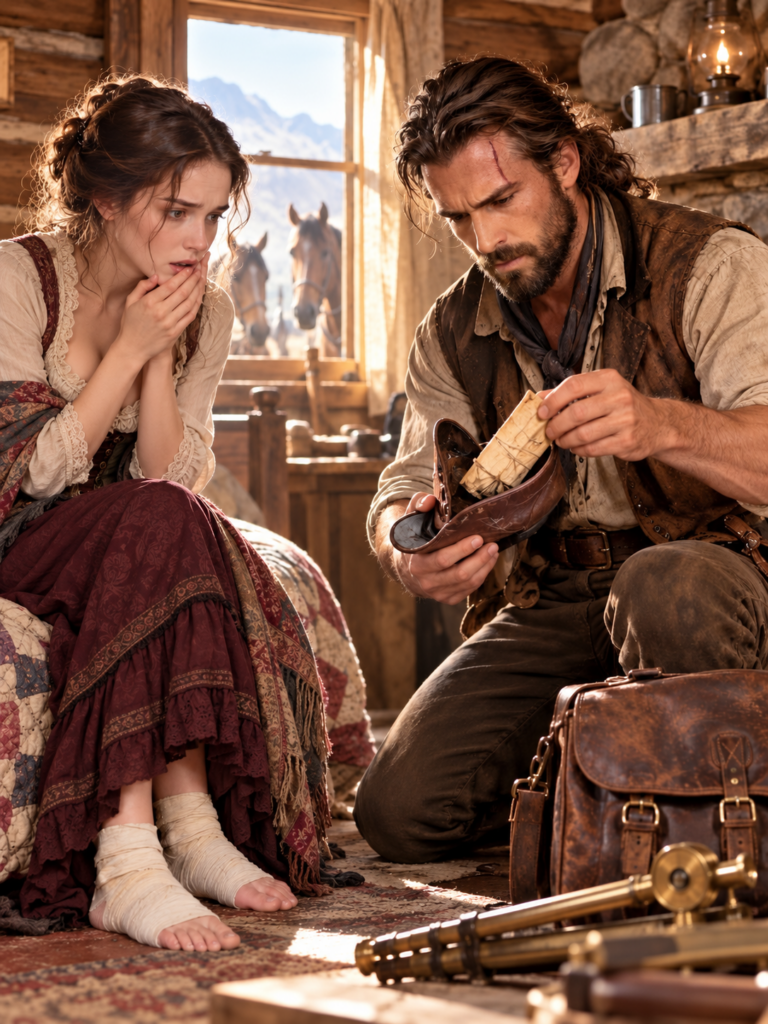
The mountain man held Clara Whitcomb’s blood-soaked shoe beside the fire, turned it once in his enormous hands, and suddenly went still.
“Mrs.
Whitcomb,” he said quietly, reaching for his knife, “someone put something inside this shoe.”
Three days after burying her husband in the Arizona wilderness, Clara realized Thomas’s final warning might not have been about the railroad at all—it might have been about what he had hidden beneath her feet.
Hours earlier, Clara had staggered into Mercy Creek after walking nearly forty miles.
A yellow stray dog was the first creature to notice the blood dripping through the seams of her new shoes.
Thomas had bought them in Santa Fe shortly before his death.
Clara had blamed their stiff leather for every blister and burning step, but she kept walking because Thomas’s last words still haunted her.
“Do not trust the railroad.”
Then, staring strangely toward her shoes, he had whispered, “Keep walking.”
Clara believed a rattlesnake had killed him.
She had buried her thirty-one-year-old husband beneath a mesquite tree herself, packed his surveying instruments into his leather satchel, and continued toward Mercy Creek alone.
At Morrison’s Trading Post, she asked for work instead of charity.
That was when Leland Kray appeared.
His gray suit was too expensive and his boots too clean for a frontier settlement.
“Mrs.
Whitcomb,” he said.
“Mercy Creek has been waiting for you.”
Clara had never seen him before.
Kray introduced himself as a regional agent for Maricopa Rail and Survey and claimed Thomas had left company property among his belongings.
“There are no papers,” Clara told him.
Kray’s eyes moved immediately toward Thomas’s satchel.
Then toward Clara’s bleeding shoes.
For one brief second, his expression changed.
Recognition.
Clara saw it.
Before she could understand why, pain tore through her feet and she collapsed.
A large stranger rose from the shadowed corner.
“Touch her,” he warned Kray, “and you lose the hand.”
When Clara awakened, she was inside a small mountain cabin.
The stranger sat beside her bed, broad-shouldered and sun-browned, with dark hair tied behind his neck and a pale scar crossing his left eyebrow.
When Clara tried to sit up, he reached toward her—then stopped without touching her.
Only after she nodded did he help steady her.
“Where am I?”
“My cabin.
Outside Mercy Creek.”
“My satchel?”
“Beside the hearth.
Nobody opened it.”
Relief crossed her face.
The man introduced himself as Elias Boone.
Then his expression hardened.
“Your feet need tending.”
“They’re only blisters.”
“No.”
He lifted one of her shoes from beside the bed.
The leather was dark with blood.
“These are new?”
“My husband bought them in Santa Fe.”
Elias pressed his thumb along the sole.
His eyes narrowed.
“What?”
Instead of answering, he took a hunting knife from his belt.
Clara stiffened.
Elias noticed immediately.
“I’m cutting the shoe, not you.”
He slid the blade carefully beneath the inner leather lining.
The stitching resisted.
Then it snapped.
Elias peeled back the layer.
Something crackled inside.
Not leather.
Paper.
Clara stopped breathing.
Elias slowly pulled out a narrow folded sheet wrapped in waxed cloth.
Numbers covered one side.
Survey coordinates covered the other.
And across the top was the unmistakable handwriting of Thomas Whitcomb.
Clara stared at it.
“He put that in my shoe.”
“Looks that way.”
Her mind raced back to Thomas dying beneath the mesquite tree.
Do not trust the railroad.
Keep walking.
“He knew,” she whispered.
Elias looked toward the cabin window.
A horse had just stopped outside.
Then another.
Clara heard men dismount.
Elias folded the paper once and placed it in her hand.
“Mrs.
Whitcomb?”
“Yes?”
“Your husband wasn’t telling you to escape.”
Heavy boots crossed the porch.
Elias drew his revolver.
“He was making sure the evidence reached Mercy Creek.”
Someone struck the cabin door.
“Boone!”
Leland Kray shouted from outside.
“Send the widow out, and nobody gets hurt.”
Clara looked down at Thomas’s hidden survey.
For the first time since burying him, she understood one terrible truth.
The rattlesnake might never have killed her husband at all.

The pounding came again.
“Boone!”
Elias stood beside the door, revolver lowered but ready.
“Send the widow out.”
Leland Kray’s voice carried through the thin wooden walls.
“She’s injured.
You don’t want this trouble.”
Elias looked at Clara.
She was still holding Thomas’s paper.
“What does it say?” he whispered.
“I don’t know all of it.”
“Then read it.”
Clara unfolded the sheet.
The paper was narrow, no wider than two fingers, and covered in tiny handwriting.
Survey coordinates.
Parcel numbers.
Measurements.
At the bottom was a sentence.
THE RAILROAD WILL NOT BE BUILT WHERE THEY SAY.
Clara’s fingers trembled.
Another line appeared beneath it.
THEY ARE MOVING THE SURVEY EAST.
She looked up.
“Elias.”
“What?”
“This isn’t about the railroad taking land.”
He waited.
“It’s about them taking land that doesn’t belong to them.”
The cabin door shook under another blow.
Kray shouted, “Last warning!”
Elias’s eyes hardened.
“How many men?”
“I heard at least four horses.”
“Five.”
“You can hear them?”
“I can hear men trying not to breathe.”
Clara almost smiled despite herself.
Then something struck the window.
A bullet shattered the glass.
She ducked.
Elias grabbed her and pulled her behind the stone hearth.
The sound of gunfire filled the cabin.
Elias fired once.
A man outside cursed.
“Stay down.”
Clara pressed herself against the wall.
“Where’s the back door?”
“Behind the bed.”
“Then we’re leaving.”
“No.”
“Elias.”
His eyes met hers.
“They came for me.”
“No,” Clara said.
She held up Thomas’s paper.
“They came for this.”
That changed everything.
Elias looked toward the window.
Then toward the rear of the cabin.
“Can you walk?”
“I walked forty miles.”
“Your feet are bleeding.”
“They’ll survive.”
He studied her face.
“Then keep up.”
The back door opened into a narrow ravine.
Elias led Clara through the darkness.
They moved between pine and juniper while bullets cracked behind them.
Clara stumbled once.
Elias caught her arm.
She immediately pulled away.
“I can walk.”
“I know.”
He released her.
That simple act affected her more than she expected.
Most men she’d known would have dragged her where they thought she belonged.
Elias simply walked beside her.
They reached a rocky shelf above the creek.
Below them, Mercy Creek glimmered beneath the moon.
Elias crouched.
“Wait here.”
“Where are you going?”
“To make sure we’re not followed.”
“You can’t go alone.”
He looked back.
“You’re worried about me?”
“No.”
His mouth almost curved.
“Good.”
He disappeared into the trees.
Clara waited.
Five minutes.
Ten.
Then she heard footsteps.
Not Elias.
Men.
She pressed herself against the rock.
Two figures moved below.
“Boone went this way.”
“He won’t get far.”
“What about the widow?”
“Dead or alive, Kray wants the paper.”
Clara’s blood chilled.
She waited until the men passed.
Then she heard Elias behind her.
“You heard them.”
“Yes.”
“What did they say?”
“They want the paper.”
“I know.”
“No.”
She looked at him.
“They said Kray wants it.”
Elias nodded.
“That means Kray isn’t the man in charge.”
Clara unfolded Thomas’s survey.
“Who is?”
Elias stared at the numbers.
“I don’t know yet.”
“Then we find out.”
They spent the night in a dry cave.
Clara sat beside the fire while Elias examined her feet.
“You’re going to need these bandaged.”
“I can do it.”
“I know.”
He handed her cloth.
She wrapped one foot.
Then the other.
Elias watched without comment.
Finally he said, “Your husband was a surveyor.”
“Yes.”
“What did he do for Maricopa Rail?”
“He surveyed routes.”
“Only routes?”
Clara hesitated.
“I don’t know.”
“You married him.”
“For six years.”
“You never discussed his work?”
“Not the dangerous parts.”
“Why?”
“He said knowing less would keep me safer.”
Elias stared into the fire.
“Men always say that.”
“What does that mean?”
“They tell women ignorance is protection.”
He looked at her.
“Usually it only means they’re carrying danger home without telling anyone.”
Clara looked down.
Thomas had done exactly that.
For six years, she had believed his silence was love.
Now she wondered if it had also been fear.
“Did you know him?” she asked.
Elias was silent for a long time.
“Once.”
Clara looked up.
“When?”
“Two years ago.”
“Where?”
“Up near Black Mesa.”
“What happened?”
“He found me surveying a mountain trail.”
“Thomas was surveying?”
“Yes.”
“Why?”
Elias poked the fire.
“Because someone was building a road where no road should have existed.”
Clara frowned.
“What kind of road?”
“A private supply road.”
“For the railroad?”
“No.”
Elias looked at her.
“For guns.”
At dawn they returned to the cabin.
The men were gone.
But the horses remained.
Kray had left two behind.
Elias examined the tracks.
“They’re heading west.”
“Why?”
“To make us think they’re searching for us.”
Clara frowned.
“Where are they really going?”
Elias pointed toward Mercy Creek.
“Town.”
They reached Mercy Creek by noon.
The settlement looked different now.
People watched Clara.
Some whispered.
Others stepped aside.
At Morrison’s Trading Post, the yellow dog from the day before came running.
It sniffed her bandaged feet and wagged its tail.
Clara knelt.
“Hello again.”
The dog licked her hand.
Elias looked at Morrison.
“Where’s Kray?”
Morrison wiped a glass.
“Gone.”
“When?”
“An hour ago.”
“With how many men?”
“Four.”
“Where?”
Morrison glanced toward Clara.
“North.”
Clara stepped forward.
“What did he ask you?”
Morrison hesitated.
“About your husband.”
“What did you tell him?”
“That Thomas had no papers.”
“Did he believe you?”
“No.”
Clara looked at Elias.
“What else?”
Morrison lowered his voice.
“He asked about the old courthouse.”
“Why?”
“Because Thomas registered a survey there.”
Clara froze.
“A survey?”
Morrison nodded.
“Three weeks before he died.”
Elias looked at her.
“We’re going to the courthouse.”
The courthouse stood at the edge of town.
It was a low adobe building with cracked walls and a rusted bell.
The clerk recognized Thomas’s name immediately.
“Whitcomb?”
“Yes.”
“He filed something.”
“What?”
The clerk frowned.
“Can’t tell you.”
Clara placed Thomas’s wedding ring on the counter.
The clerk stared.
“This was his.”
“Yes.”
“He died three days ago.”
“I know.”
The clerk looked uncomfortable.
“He told me that if anyone came asking about the survey, I was to give them this.”
He reached beneath the desk.
Then stopped.
His hand trembled.
“What’s wrong?”
He looked toward the window.
“Kray.”
Elias turned.
Three men stood outside.
Clara’s heart raced.
The clerk whispered:
“There’s a back room.”
Elias grabbed the survey.
“Show us.”
They hurried through a narrow corridor.
The clerk opened a cabinet.
Inside was a metal box.
“Thomas left this?”
“Yes.”
Clara opened it.
Inside were letters.
Maps.
Receipts.
And a small black notebook.
She recognized Thomas’s handwriting.
She opened the first page.
If Clara ever reads this, I failed to protect her.
Her vision blurred.
She turned the page.
The railroad company is purchasing land through false surveys.
They are moving the proposed line east because the original route crosses copper deposits belonging to independent settlers.
Another page.
The company plans to seize forty-three thousand acres before construction begins.
Clara stopped breathing.
Forty-three thousand acres.
Not one ranch.
Not one widow.
An entire valley.
Then she found a name.
Leland Kray.
Below it was another.
Nathaniel Voss.
Elias’s expression changed.
“Voss?”
“You know him?”
“Yes.”
“Who is he?”
“The man who owns the surveying company.”
Clara looked down.
At the bottom of the page Thomas had written:
Kray takes orders from Voss.
Voss takes orders from someone higher.
Then another sentence.
The railroad itself may not know what is being done in its name.
Clara closed the notebook.
“We need to get this to the railroad.”
Elias shook his head.
“No.”
“Why?”
“Because that’s exactly where they’ll expect us to go.”
He pointed at the map.
“Look.”
Clara spread it across the desk.
The proposed railroad route ran west of Mercy Creek.
But the altered survey moved it east.
Toward the ranches.
Toward the copper deposits.
Toward the valley.
“They’re not building a railroad.”
Elias nodded.
“They’re using the railroad as an excuse to clear the land.”
A shot shattered the courthouse window.
The clerk screamed.
Elias dragged Clara down.
Men stormed the front door.
“Find the widow!”
Elias looked at her.
“Can you run?”
Clara smiled.
“I’ve had practice.”
They escaped through the cellar.
By nightfall they were twenty miles from Mercy Creek.
Elias had stolen no horse.
Instead, they traveled through the mountains.
Clara’s feet screamed with every step.
But she refused to stop.
Eventually Elias said:
“We rest.”
“No.”
“You’re bleeding again.”
“I can keep walking.”
“That’s not strength.”
She stopped.
“What is?”
“Knowing when to stop.”
Clara stared at him.
“You don’t know me.”
“No.”
“But?”
“I know what grief looks like.”
She looked away.
Elias continued quietly.
“I buried my wife seven years ago.”
Clara turned.
“You were married?”
“Yes.”
“What happened?”
“Apache raiders.”
Her breath caught.
“I didn’t know.”
“Few people do.”
“Children?”
“One.”
“What happened?”
He looked toward the mountains.
“My daughter was three.”
Clara didn’t ask further.
She understood.
Some wounds didn’t need questions.
After a while, she said:
“Thomas was my whole world.”
Elias looked at her.
“I know.”
“No, you don’t.”
“I know what it means to wake up and reach for someone who’s no longer there.”
Her eyes filled.
“I thought his last words were instructions to survive.”
“They were.”
“No.”
She held up the notebook.
“He was trying to finish something.”
Elias nodded.
“Both can be true.”
That night, they slept beside the fire.
Not touching.
But closer than before.
The next morning, they discovered someone had followed them.
Fresh hoofprints surrounded the camp.
Elias studied them.
“Six men.”
Clara’s heart sank.
“How long?”
“An hour.”
“We need to move.”
“Yes.”
They gathered their things.
Then Elias stopped.
“What?”
He pointed toward the trees.
A small silver object hung from a branch.
Clara approached.
It was Thomas’s compass.
She picked it up.
Her hands trembled.
“He had this when he died.”
Elias examined it.
“Someone left it here.”
“Why?”
“To tell us they’re close.”
A voice came from behind them.
“Exactly.”
Kray stepped from the trees.
Six men surrounded them.
Elias drew his revolver.
Kray smiled.
“Boone.”
“Walk away.”
“You know I can’t.”
Kray looked at Clara.
“Mrs.
Whitcomb, your husband made a very unfortunate mistake.”
“He discovered yours.”
Kray’s smile disappeared.
“Give me the notebook.”
“No.”
“Then you’ll die here too.”
Clara stepped forward.
“You killed Thomas.”
Kray didn’t answer.
“You poisoned him.”
His eyes flickered.
Clara saw it.
“You used a rattlesnake.”
Kray laughed.
“That is a ridiculous accusation.”
“But true.”
Elias stared at Kray.
“Thomas wasn’t bitten.”
Kray’s face changed.
Elias continued.
“The puncture wounds were too clean.”
Clara’s breath stopped.
“You examined his body?”
“I did.”
“Why didn’t you tell me?”
“Because I didn’t know who to trust.”
Kray raised his gun.
“You should have trusted me.”
“No,” Clara said.
“You should have trusted your husband.”
Kray smiled.
“He trusted you enough to hide the evidence in your shoes.”
That sentence confirmed everything.
Clara looked at Elias.
He nodded.
They had their proof.
Now they needed to survive.
The first shot came from the ridge.
Not from Kray.
One of his own men dropped.
Everyone turned.
Elias fired.
Clara ran.
The mountain exploded into gunfire.
She dropped behind a boulder.
Elias moved like a shadow between the trees.
One man fell.
Another fled.
Kray shouted orders.
Clara saw him reaching for the notebook.
She pulled it from her dress.
“Looking for this?”
Kray turned.
She threw it into the fire.
“No!”
He lunged.
Clara kicked the burning pages into the wind.
Kray screamed with rage.
But the pages didn’t burn completely.
Several scattered across the ground.
One landed at Clara’s feet.
She grabbed it.
A name was written there.
Nathaniel Voss.
And beneath it:
Paid $10,000 for Whitcomb’s death.
Clara stared.
Kray saw it.
He fired.
The bullet struck the rock beside her.
Elias tackled her.
They rolled down the slope.
Kray disappeared behind the trees.
When the shooting stopped, the mountain was silent.
Three men were dead.
Two had fled.
Kray was gone.
Elias looked at Clara.
“Are you hurt?”
“No.”
He touched her face.
Stopped.
Then withdrew his hand.
“Good.”
Clara caught his wrist.
“You can touch me.”
His eyes met hers.
He gently brushed dirt from her cheek.
Neither spoke.
Then Clara kissed him.
It was not a kiss born from romance.
Not entirely.
It was fear.
Relief.
Grief.
And the sudden understanding that after losing everything, she had found someone who knew how to stand beside her without trying to replace what she had lost.
When they separated, Elias rested his forehead against hers.
“Clara.”
“Yes?”
“If you kiss me again, I’m going to forget we’re being hunted.”
She almost smiled.
“Then don’t forget.”
They reached Mercy Creek two days later.
The railroad representatives had arrived.
So had federal marshals.
Thomas’s notebook, the surviving pages, and the watermarked survey were enough to trigger an investigation.
But there was still one problem.
Nathaniel Voss had vanished.
Kray had vanished.
And without them, the railroad could claim ignorance.
Clara refused to let that happen.
She stood before the railroad inspector.
“My husband died because he discovered your company was being used.”
The inspector looked uncomfortable.
“We have no evidence that the railroad authorized—”
“I know.”
She placed the survey on the table.
“But someone inside your organization did.”
She pointed to the signature.
“This is Kray.”
Then another.
“Voss.”
Then the payment record.
“And this is proof money changed hands.”
The inspector studied the documents.
“Where did you get this?”
“My husband.”
“He’s dead.”
“Yes.”
She looked directly at him.
“That’s why I’m here.”
The room went silent.
“I spent six years believing my husband kept secrets because he wanted to protect me.”
She swallowed.
“I was wrong.”
Her voice steadied.
“He kept secrets because he was afraid.
But he trusted me enough to hide the truth where no one would think to look.”
She placed her blood-stained shoe on the table.
The inspector stared.
“This was inside.”
Nobody spoke.
Then the inspector slowly stood.
“Mrs.
Whitcomb.”
“Yes?”
“I believe you.”
The investigation lasted four months.
The railroad suspended construction.
Voss was arrested in Tucson.
Kray was captured near the border.
The altered surveys were exposed.
The land claims were restored.
And the forty-three thousand acres were protected from fraudulent acquisition.
But Clara never cared about the number.
She cared about one name.
Thomas.
She returned to the mesquite tree where she had buried him.
The desert was quiet.
She placed a small stone beside the grave.
“I found it,” she whispered.
The wind moved through the branches.
“You were right.”
She cried for a long time.
Then she stood.
For the first time since his death, she did not feel as though she were leaving him behind.
She was carrying him with her.
Elias waited at the edge of the cemetery.
“You ready?”
Clara nodded.
“Where are we going?”
He hesitated.
“I have a cabin.”
“I know.”
“It’s not much.”
“I know.”
“I don’t have money.”
“I don’t either.”
“I don’t know how to live in town.”
“I don’t want to live in town.”
He looked at her.
“Then what do you want?”
Clara smiled.
“To keep walking.”
“Where?”
“Somewhere nobody knows my name.”
Elias looked toward the mountains.
“I know a place.”
“Does it have a roof?”
“Yes.”
“Food?”
“Sometimes.”
“Beds?”
“One.”
Clara raised an eyebrow.
“One?”
“I can sleep outside.”
She laughed.
“You’re terrible at courting.”
“I wasn’t aware I was courting.”
“You are now.”
He smiled.
Then he took her hand.
“Come home with me.”
Clara looked at the mountains.
Then at him.
“Home?”
Elias nodded.
“Home.”
One year later, the cabin had changed.
A second room had been added.
A garden grew behind it.
A yellow dog slept on the porch.
Clara had named him Mercy.
Elias complained that the dog was spoiled.
The dog ignored him.
On the wall above the fireplace hung Thomas’s compass.
Beside it was a framed copy of the original survey.
Clara never hid the past.
She simply stopped allowing it to dictate the future.
Sometimes travelers stopped at the cabin.
Sometimes they asked about the woman who had walked forty miles across the desert with blood in her shoes.
Clara always told them the same thing.
“My husband died protecting the truth.”
They would ask about the mountain man.
She would smile.
“My husband lives down the trail.”
And then Elias would appear carrying firewood, pretending he hadn’t heard.
One evening, Clara sat on the porch watching the sunset.
Elias came behind her.
“You’re thinking again.”
“I do that.”
“Dangerous habit.”
She smiled.
“I was thinking about my shoes.”
He laughed.
“I should’ve burned those things.”
“You cut them open.”
“They were trying to kill you.”
“They weren’t.”
“No.”
He sat beside her.
“They were trying to carry a secret.”
Clara leaned against his shoulder.
“Thomas told me to keep walking.”
Elias looked at her.
“And you did.”
“I thought he meant away from danger.”
“What did he mean?”
She looked toward the distant mountains.
“Toward the truth.”
Elias kissed her temple.
“And did you find it?”
Clara smiled.
“Yes.”
She took his hand.
“And I found something else.”
“What?”
“A reason to stop.”
He looked at her.
“You’re not going anywhere?”
“No.”
“Good.”
He kissed her.
The desert wind moved softly through the trees.
Behind them, Mercy barked at a rabbit.
The fire crackled.
And on the wall inside the cabin, Thomas Whitcomb’s old compass pointed steadily north.
Clara had once believed survival meant keeping her feet moving.
Now she understood.
Sometimes survival meant knowing where to stop.
Sometimes it meant trusting the person who reached for your hand without trying to own it.
And sometimes, the greatest secret a dead man could leave behind was not hidden in a letter, a survey, or a pair of shoes.
It was the knowledge that even after everything was taken from you—
you could still choose where the road ended.
Clara had buried one life beneath a mesquite tree.
But she had not buried herself with it.
She kept walking.
And eventually, she found home.

