
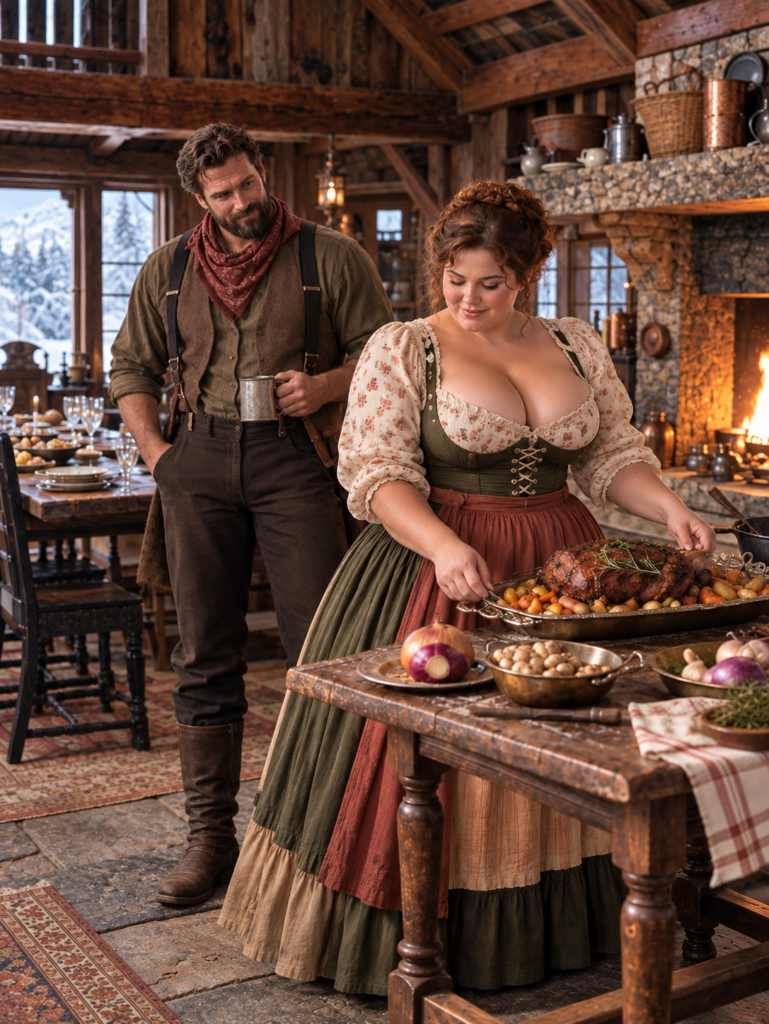
The Rich Mountain Man Only Wanted a Cook for One Night Before His Important Guests Arrived—But the Woman He Hired Changed His Entire Mansion in a Few Hours, and When Morning Came, He Found Himself Desperate to Learn Why She Was Planning to Leave
When a reclusive Colorado millionaire desperately hired a local outcast for a single evening, he expected a hot meal.
He didn’t expect the heavy-set, fiercely resilient cook to thaw his frozen heart, uncover a deadly betrayal, and turn his haunted timber mansion into the home he never knew he needed.
The year was 1888, and the biting winds of the Colorado Rockies showed mercy to no one.
High above the bustling dirt street town of Oakhaven stood The Ridge View Estate, a sprawling fortress of dark timber and gray stone.
It belonged to Caleb Whitmore, a man whose wealth was as vast as the silver veins he had struck a decade prior, and whose reputation was just as cold and impenetrable.
Caleb was a mountain man turned tycoon.
He was rugged, bearded, and entirely unforgiving.
He had built his massive home to overlook the valley, isolating himself from the society he despised.
But isolation had a price.
On the eve of the most crucial business meeting of his life, a dinner that would secure a railroad spur directly to his mines, his entire household staff walked out.
His temper had finally driven them away, leaving Caleb alone in a freezing mansion with 50 pounds of raw provisions and absolutely no idea how to prepare a feast fit for East Coast investors.
Desperation drove Caleb down the mountain on horseback, his breath pluming in the freezing November air.
He needed a cook, and he needed one immediately.
The local tavern owner pointed him toward a small, dilapidated cabin on the edge of town.
“”””You want Beatatrice Gallagher?””””
the barkeep had muttered, wiping down the counter.
“”””Folks around here talk behind her back because of her size, but she’s got hands blessed by the Almighty when it comes to a skillet.
Just don’t cross her.”””” Caleb didn’t care about town gossip.
He rode to the cabin and hammered on the wooden door.
When it swung open, he was met by a woman who filled the doorframe.
Beatrice B, to the few who treated her with respect, was a woman of undeniable, substantial size.
She carried her heavy weight, not with shame, but with the grounded, formidable stance of a pine tree that had weathered countless storms.
Her apron was dusted with flour, her dark hair pinned back haphazardly, and her warm brown eyes narrowed as she looked the towering millionaire up and down.
“”””I’m closed for baking,”””” she said, her voice a rich, smoky alto.
“”””I don’t want baked goods,”””” Caleb replied, his voice gruff, unaccustomed to asking for help.
“”””I have three railroad executives arriving at my estate at sundown.
My staff abandoned me.
I will pay you $50 for one night of cooking.
You make the dinner, you serve it, you leave.””””
$50 was a staggering sum—more than Bee made in six months selling bread to the miners.
She knew of Caleb Whitmore.
Everyone knew of the beast of Ridge View.
She knew his house was said to be as cold as a tomb, but she also knew she was one harsh winter away from losing her cabin.
Bee crossed her thick arms over her chest, the fabric of her worn dress pulling tight.
“”””$75,”””” she counted smoothly, “”””and I need a wagon to carry my own cast iron and spices.
I don’t cook with whatever neglected rust you have in your kitchen.””””
Caleb’s jaw clenched, but a flicker of respect flashed in his icy blue eyes.
“”””Done.
Be ready in 10 minutes.””””
The journey up the mountain was treacherous.
The sky above was bruising into a deep, violent purple, heavy with the promise of snow.
When Bee stepped into the sprawling kitchen of the Whitmore estate, she shuddered.
It wasn’t just the physical cold, though the hearths were barely lit.
It was the sheer emptiness of the place.
High vaulted ceilings, dark mahogany panels, and not a single rug or woven tapestry to soften the echo of their footsteps.
“”””They arrive in three hours,”””” Caleb barked, pacing the stone floor.
“”””I need a miracle, Miss Gallagher.”””” Bee didn’t panic.
She calmly unpacked her crates.
Out came fragrant bundles of dried rosemary, jars of preserved summer peaches, heavy sacks of flour, and cuts of prime venison she had insisted they grab from the butcher.
“”””Mr.
Whitmore,”””” Bee said, not looking up as she began to expertly chop an onion, her large hands moving with startling grace and speed.
“”””What?”””” he snapped.
“”””If you want a miracle, stay out of my kitchen and, for heaven’s sake, light a fire in the dining room.
Men don’t sign contracts when their teeth are chattering.”””” Caleb stared at her.
No one had spoken to him like that in years.
Instead of exploding, he found himself turning on his heel and walking to the woodpile.
For the first time in a decade, the Ridge View mansion was about to wake up.
By the time the carriage bearing Josiah Abernathy and Arthur Pendleton crested the mountain pass, the Whitmore estate smelled entirely different.
The scent of roasting meats, bubbling butter, and sharp, earthy pine had permeated the drafty hallways.
Abernathy and Pendleton were men of extreme wealth from Boston, wearing tailored suits and expressions of permanent distaste.
They looked around the austere dining room, clearly unimpressed by Caleb’s lack of ostentatious decor.
Though the roaring fire Bee had demanded did offer some comfort, Caleb sat at the head of the long oak table, feeling a knot of anxiety in his chest.
His silver empire depended on these men agreeing to fund the railway extension.
If they refused, his ore would rot in the mountains, and his company would bleed to death.
The dining room doors swung open, and Bee entered.
She carried a massive silver platter holding a perfectly seared venison roast, surrounded by caramelized root vegetables and bathed in a rich, dark blackberry reduction.
Pendleton adjusted his monocle, his eyes sweeping over Bee’s large, rounded figure with poorly concealed disdain.
“”””My word, Whitmore, I see you feed your staff entirely too well in the wilderness,”””” he sneered under his breath to his companion.
Caleb’s knuckles turned white.
He was a ruthless businessman, but he had survived the mines alongside hardworking people.
He detested East Coast snobbery.
Before he could speak, Bee gracefully lowered the heavy platter onto the table without a single rattle of silver.
“”””In the mountains, Mr.
Pendleton,”””” Bee said, her voice smooth as cream, “”””we believe a sturdy foundation is required to survive the winter.
I highly recommend the venison.
It requires a strong jaw.
I hope yours is up to the task.””””
Abernathy let out a sudden, booming laugh, slapping the table.
Pendleton turned red, sputtering.
Caleb felt a sudden, strange jolt of admiration.
He watched Bee turn, her skirt swishing powerfully around her heavy frame, and disappear back into the kitchen.
The meal that followed was nothing short of a revelation.
Bee served fluffy, steaming mounds of garlic whipped potatoes, warm, crusty bread that cracked perfectly, and a savory tart of wild mushrooms that made even the snobbish Pendleton close his eyes in delight.
As the wine flowed and the food warmed their bellies, the tension in the room evaporated.
But the drama of the night was only beginning.
As Bee returned to pour coffee, she moved silently behind Pendleton.
She noticed a leather folder open on his lap, concealed beneath the tablecloth.
Pendleton was quietly swapping the final page of the contract Caleb was about to sign.
Bee’s sharp eyes, trained by years of reading complex merchant ledgers to survive, caught the handwritten alteration on the bottom clause: “”””Transfer of 51% mineral rights upon completion of the rail line.””””
It was a hostile takeover disguised as a partnership.
Bee didn’t gasp.
She didn’t shout.
She calmly picked up a pitcher of iced water from the sideboard.

She calmly picked up a pitcher of iced water from the sideboard.
Pendleton glanced up.
“Coffee, Miss Gallagher.”
“In a moment.”
Bee smiled.
Then she deliberately tipped the pitcher.
The water crashed directly onto Pendleton’s lap.
He shot to his feet.
“What the devil!”
The leather folder slipped from his hands.
Bee moved faster than anyone expected.
She caught it before it hit the floor.
“Oh dear,” she said sweetly.
Pendleton’s face turned crimson.
“You clumsy woman!”
Bee ignored him.
Instead, she looked at Caleb.
For one second, their eyes met.
Something in her expression told him this was not an accident.
Caleb stood.
“Miss Gallagher.”
“Yes, Mr.
Whitmore?”
“Would you bring me the contract?”
Bee held up the folder.
“This one?”
Pendleton lunged.
“Give that to me.”
Caleb’s voice became dangerously quiet.
“Don’t.”
Pendleton stopped.
Caleb held out his hand.
Bee walked toward him.
She placed the folder in his palm.
Then she leaned close enough that only he could hear.
“Read the final page.”
Caleb’s eyes narrowed.
He opened the folder.
He read.
Then read it again.
The room became silent.
“Fifty-one percent.”
Abernathy frowned.
“What?”
Caleb lifted the page.
“This clause.”
Pendleton’s expression changed.
“That is a standard security provision.”
“No.”
Caleb looked at him.
“It isn’t.”
His voice had gone cold.
“You told me this agreement granted the railroad access to my eastern mines.”
“It does.”
“It also transfers majority mineral rights.”
Pendleton smiled.
“Temporarily.”
“That’s not what it says.”
Abernathy reached for the document.
Caleb handed it to him.
The older investor read the clause.
His face hardened.
“I didn’t approve this.”
Pendleton turned toward him.
“Josiah—”
“You told me the final agreement contained no change in ownership.”
“I—”
Abernathy stood.
“I will not sign this.”
Pendleton’s face darkened.
“Don’t be foolish.”
“No.”
Abernathy closed the folder.
“I believe I have been foolish enough already.”
Caleb stared at Bee.
She stood beside the fireplace, wiping her hands on her apron.
He couldn’t understand how the woman who had been hired to cook dinner had just saved his company.
Pendleton pointed at her.
“She tampered with the document.”
Bee raised an eyebrow.
“Did I?”
“You deliberately spilled water.”
“I have been known to spill things.”
“You stole the contract.”
“I handed it to Mr.
Whitmore.”
“You were spying on us.”
Bee smiled.
“No.”
She looked at Caleb.
“I was serving coffee.”
Then she turned toward the kitchen.
“Would anyone like pie?”
Abernathy burst out laughing.
Caleb almost smiled.
Pendleton looked ready to explode.
The meeting ended before midnight.
Abernathy refused to sign.
He also refused to leave until Caleb understood exactly what had happened.
The men moved into the study.
Bee returned to the kitchen.
She began cleaning as though she hadn’t just prevented a financial disaster.
Caleb watched her from the doorway.
“You knew.”
Bee kept scrubbing a plate.
“I suspected.”
“How?”
“People who intend to cheat you rarely leave the important page lying open where everyone can see it.”
“That wasn’t the important page.”
“Exactly.”
Caleb stared at her.
“Who taught you to read contracts?”
Bee shrugged.
“My father.”
“What did he do?”
“He ran a trading post.”
“And your mother?”
“Kept the books.”
Caleb looked at the ledgers stacked on the shelf.
“You’ve read those?”
“Some.”
“All?”
Bee glanced at him.
“Most.”
He frowned.
“Why?”
“Because numbers tell the truth more often than people do.”
Something about the sentence struck him.
“You saved me.”
Bee shook her head.
“I saved you from signing something stupid.”
“Same thing.”
“Not quite.”
She lifted another plate.
“I was paid seventy-five dollars to cook.”
“I’ll pay you five hundred.”
She stopped.
“For what?”
“For tonight.”
Bee shook her head.
“That isn’t necessary.”
“It is.”
“No.”
Caleb stared.
“No?”
“I agreed to seventy-five.”
“You just saved me hundreds of thousands of dollars.”
“Then perhaps you should pay your lawyers more attention.”
He almost laughed.
“You’re impossible.”
Bee smiled.
“So I’ve been told.”
The next morning, Caleb woke before dawn.
He hadn’t slept.
He kept thinking about Bee.
Not just her sharp eyes.
Not just her courage.
Everything.
The way she had walked into his kitchen and immediately commanded him to light a fire.
The way she had spoken to Pendleton without fear.
The way she had noticed the contract.
But most of all, the way she had transformed the house.
He walked downstairs.
The mansion felt different.
Warm.
Alive.
Bread sat cooling on the counter.
A pot of coffee steamed beside the stove.
The dining room smelled faintly of pine and cinnamon.
Caleb stopped.
He had spent years building Ridge View into a fortress.
Yet one woman had made it feel like a home in a single evening.
He found Bee in the pantry.
She was counting flour sacks.
“You haven’t left.”
She looked over her shoulder.
“I was finishing breakfast.”
“You said you’d leave after dinner.”
“I changed my mind.”
“Why?”
“Because you have no idea how to run a kitchen.”
Caleb frowned.
“I’ve survived forty-two years.”
“Surviving isn’t the same as living.”
He stared at her.
She smiled.
“Breakfast?”
He nodded.
“Yes.”
She put a plate in front of him.
Eggs.
Potatoes.
Fresh bread.
He sat.
After the first bite, he looked at her.
“This is excellent.”
“Thank you.”
“Did you sleep?”
“Some.”
“Why?”
Bee looked toward the window.
“Snow is coming.”
Caleb frowned.
“How do you know?”
“The clouds.”
He looked outside.
The sky was gray.
“Storm?”
“Heavy.”
Caleb stood.
“Then I’ll take you home.”
Bee shook her head.
“I don’t have a home.”
The words were simple.
But something inside Caleb tightened.
“What happened?”
She hesitated.
“Mine was lost to the bank.”
“Debt?”
“Medical bills.”
“For whom?”
“My husband.”
Caleb waited.
“He died two winters ago.”
“I didn’t know.”
“Most people don’t ask.”
He sat back down.
“I’m sorry.”
Bee nodded.
“So am I.”
“Do you have family?”
“No.”
“Children?”
She looked down.
“No.”
Caleb didn’t know what to say.
So he said the only thing that came to him.
“You can stay here.”
Bee looked up.
“Excuse me?”
“Until the storm passes.”
“I’ll pay you.”
“That’s not what I mean.”
She studied him.
“Then what do you mean?”
Caleb struggled.
He was a man who negotiated mine leases worth millions.
Yet one woman’s eyes left him speechless.
“I mean you don’t have to leave.”
Bee’s expression softened.
“Mr.
Whitmore…”
“Caleb.”
She blinked.
“What?”
“My name is Caleb.”
She smiled faintly.
“All right.”
“Bee.”
She laughed.
“You’ve been calling me Miss Gallagher all night.”
“I know.”
“And now?”
“Now I know better.”
The storm arrived that afternoon.
Snow buried the mountain road.
The telegraph line went down.
No wagon could safely descend.
Bee stayed.
At first, she insisted on sleeping in the servants’ quarters.
Caleb objected.
“They’re freezing.”
“I’ll manage.”
“No.”
She crossed her arms.
“You’ve become bossy.”
“It’s my house.”
“And I’m your cook.”
“You saved my company.”
“I cooked dinner.”
“You also prevented a theft.”
Bee sighed.
“Fine.”
He led her to one of the guest rooms.
The fire was already burning.
She looked around.
“Why is this room never used?”
“Because no one comes here.”
“Why?”
Caleb shrugged.
“I don’t invite people.”
“Why?”
“I prefer quiet.”
Bee smiled.
“And yet you hired me.”
“Desperation.”
“Of course.”
She closed the door.
Caleb stood outside for a moment.
Then he walked away.
He couldn’t explain why his mansion suddenly seemed too large when he couldn’t hear her moving inside it.
Three days passed.
The storm trapped them together.
During those three days, Bee changed everything.
She opened curtains.
She moved furniture closer to the fireplaces.
She placed rugs in the hallways.
She brought flowers from dried winter arrangements into the dining room.
She filled empty shelves with books.
She turned the kitchen into a place where someone actually wanted to sit.
Caleb watched.
“You’re rearranging my entire house.”
Bee nodded.
“Yes.”
“Why?”
“Because your house looks like it was built by a man who expected to die alone.”
He stared at her.
She continued arranging candles.
“Am I wrong?”
Caleb said nothing.
“No.”
She looked at him.
“You aren’t.”
He walked toward the window.
“My wife died.”
Bee knew.
“Three years ago.”
“I heard.”
“My daughter died with her.”
Bee’s expression softened.
“I’m sorry.”
“I built this house afterward.”
“Why?”
“Because I needed something to control.”
She nodded.
“And did it work?”
“No.”
The silence between them deepened.
Bee walked closer.
“Control is a poor substitute for peace.”
Caleb looked at her.
“How do you know?”
“Because I spent years trying to control things too.”
“What happened?”
“I learned storms don’t care.”
He almost smiled.
“You have an answer for everything.”
“No.”
She touched the edge of a table.
“Just some things.”
On the fourth morning, the storm cleared.
Caleb expected Bee to pack immediately.
Instead, she stood in the kitchen staring at the mountains.
“You should go,” he said.
“I know.”
She didn’t move.
He waited.
“Why haven’t you?”
Bee turned.
“Because I’m afraid.”
“Of what?”
She looked at him.
“That if I leave, I’ll go back to being invisible.”
Caleb stepped closer.
“You aren’t invisible.”
She laughed softly.
“To you, perhaps.”
“To me?”
“You’re different.”
“How?”
“You look at me.”
Caleb frowned.
“I don’t understand.”
“Most men look at my size first.”
He said nothing.
“They decide what kind of woman I am before I speak.”
Caleb looked at her.
“I noticed your size.”
She stiffened.
“But?”
“I noticed your strength more.”
Bee’s eyes softened.
“You shouldn’t say things like that.”
“Why?”
“Because a woman can start believing them.”
He stepped closer.
“Then believe me.”
She looked away.
“Caleb…”
He stopped.
“I don’t know what this is.”
“Neither do I.”
“But I know I don’t want you to leave.”
Her eyes filled.
“Why?”
“Because this house was silent before you came.”
She swallowed.
“And now?”
“Now I hear it breathing.”
The peace didn’t last.
On the fifth day, a rider arrived.
He carried a telegram.
Caleb read it.
His face hardened.
Bee noticed.
“What happened?”
“Pendleton is back.”
“Why?”
“He’s brought a lawyer.”
“About the contract?”
“Yes.”
Caleb folded the telegram.
“He claims the altered page was inserted after the meeting.”
Bee’s expression changed.
“But it wasn’t.”
“I know.”
“Then why is he saying that?”
“Because someone has told him I won’t fight.”
Bee looked at him.
“Will you?”
Caleb’s eyes turned cold.
“I’ve spent my entire life fighting.”
She stepped closer.
“Then don’t fight alone.”
He looked at her.
For the first time, he understood that she wasn’t merely offering advice.
She was offering herself.
The lawyer arrived that evening.
His name was Horace Bell.
He was polished.
Smiling.
Dangerous.
He brought documents claiming that Caleb had agreed to transfer majority rights.
Caleb refused.
Bell smiled.
“You’ll lose in court.”
“Perhaps.”
“And your railroad deal.”
“Perhaps.”
“And your company.”
Caleb stepped closer.
“Perhaps.”
Bell looked at Bee.
“Unless, of course, you can prove who altered the document.”
Bee stepped forward.
“I can.”
Bell laughed.
“You?”
Bee held up a small notebook.
“I copied the handwriting.”
Bell stopped laughing.
“The alteration was written with blue-black ink.”
She opened the notebook.
“The original contract was written entirely in black ink.”
Bell’s face changed.
“That proves nothing.”
“It proves someone added the clause later.”
Bell shook his head.
“Not enough.”
Bee smiled.
“Then perhaps this will help.”
She removed a folded receipt.
“The ink came from Pendleton’s private secretary.”
Caleb stared.
“How do you know?”
“I found the bottle in the study.”
Bell stepped backward.
“Where?”
“On the desk.”
Caleb understood.
Bee had been cleaning.
She had noticed everything.
Bell’s confidence disappeared.
But Bee wasn’t finished.
“There’s one more thing.”
She opened her notebook.
“The signature on the altered page was written with a different pen.”
Caleb took the paper.
He compared it.
“You’re right.”
Bee looked at Bell.
“And I know who used that pen.”
The truth came out within forty-eight hours.
Pendleton’s secretary had been paid to alter the document.
The railroad deal was designed to seize control of Caleb’s mining rights.
Worse, Pendleton had been working with one of Caleb’s own managers.
The betrayal ran deep.
But Bee’s evidence prevented the takeover.
Pendleton lost the railroad contract.
The manager was arrested.
Caleb retained control of the mines.
And Abernathy, disgusted by the deception, offered Caleb a different partnership.
A fair one.
No hidden clauses.
No transfer of ownership.
No tricks.
When the agreement was signed, Caleb looked across the table at Bee.
She smiled.
“You’re staring.”
“I’m grateful.”
“For what?”
“Everything.”
She shrugged.
“You paid me seventy-five dollars.”
“I’ll pay you more.”
She shook her head.
“I don’t want money.”
“What do you want?”
She hesitated.
Then whispered:
“To know what happens next.”
Spring arrived.
Bee stayed at Ridge View.
At first, she called herself the cook.
Then household manager.
Then, eventually, she stopped explaining.
Caleb began spending his evenings in the kitchen.
Sometimes they talked.
Sometimes they argued.
Sometimes they sat in silence.
But it was no longer the lonely silence he had known before.
One evening, Caleb found Bee standing on the porch.
The valley below was green.
“You never told me why you called yourself closed for baking.”
She laughed.
“Because I didn’t want to work for a rich man.”
“Yet here you are.”
“I changed my mind.”
“Why?”
She looked at him.
“Because you weren’t what I expected.”
He smiled.
“And you?”
“What about me?”
“You were exactly what I expected.”
She raised an eyebrow.
“What did you expect?”
“A woman who would argue with me.”
She laughed.
“Then you’ve been thoroughly disappointed.”
“No.”
He stepped closer.
“Not once.”
He reached for her hand.
She let him.
“I have spent years believing I needed a larger house.”
She looked around.
“And now?”
“I think I needed someone to fill it.”
Bee’s eyes filled.
“Caleb.”
He gently touched her cheek.
“I don’t want you here because you’re my cook.”
“I know.”
“I want you here because when you’re gone, this place feels empty.”
She whispered:
“And when I’m here?”
He smiled.
“It feels like home.”
She leaned into him.
For a long moment, neither moved.
Then Bee laughed softly.
“You know something?”
“What?”
“You hired me for one night.”
“I know.”
“You offered me seventy-five dollars.”
“I remember.”
“And somehow I ended up reorganizing your entire house.”
“You did.”
“Saving your company.”
“Yes.”
“Arguing with your investors.”
“Several times.”
“Changing your life.”
Caleb smiled.
“That too.”
She looked at him.
“You’re not angry?”
“No.”
“Why?”
He squeezed her hand.
“Because I spent years believing wealth meant having everything.”
He looked at the warm windows of Ridge View.
“Then you walked through my door and taught me that having everything means nothing if there’s no one to share it with.”
Bee smiled.
“And what are you going to do about that?”
Caleb looked at her.
“I was hoping you’d stay.”
“Stay as your cook?”
“No.”
He reached into his coat.
Bee’s eyes widened when she saw the small velvet box.
“Caleb…”
He opened it.
Inside was a simple gold ring.
Not extravagant.
Not designed to impress anyone.
Just beautiful.
“I don’t need another employee.”
She laughed through her tears.
“What do you need?”
He took her hand.
“A wife.”
Bee stared at him.
“Are you certain?”
“I’ve never been more certain of anything.”
“What about your house?”
He smiled.
“It’s ours.”
“The mines?”
“Ours.”
“The kitchen?”
He laughed.
“Especially yours.”
She wiped her eyes.
“You really are impossible.”
“So I’ve been told.”
She looked at the ring.
Then at him.
“Yes.”
Caleb blinked.
“Yes?”
“Yes.”
He slipped the ring onto her finger.
Then he kissed her.
Behind them, Ridge View stood against the mountains.
The mansion that had once been cold and empty now glowed with light from every window.
There were rugs in the halls.
Flowers on the tables.
Books beside the fireplaces.
And, most importantly, laughter.
A year later, the railroad finally reached the valley.
Caleb’s mines flourished.
The honest partnership with Abernathy made him richer than ever.
But the people of Oakhaven noticed something else.
The man who had once terrified everyone rarely shouted anymore.
He smiled.
He visited the town.
He donated coal to families during winter.
He paid fair wages.
And the mansion on the mountain was no longer called the fortress.
People began calling it Ridge View Home.
Bee hated the name at first.
Then she secretly loved it.
One snowy evening, she stood in the kitchen stirring a pot of stew.
Caleb walked in.
“You’ve been cooking all day.”
She looked over.
“Someone has to feed you.”
He kissed her forehead.
“You know you don’t have to work.”
“I know.”
“Then why do you?”
She smiled.
“Because I like feeding people.”
He looked around.
There were six places set at the table.
“Who’s coming?”
“Some miners.”
“How many?”
“Twelve.”
Caleb stared.
“Twelve?”
Bee nodded.
“And two children.”
He laughed.
“You planned all this?”
“Of course.”
He looked at her.
“You changed everything.”
Bee shook her head.
“No.”
She placed another loaf of bread on the table.
“We changed everything.”
Caleb wrapped his arms around her.
Outside, snow fell across the mountains.
Inside, the fire burned brightly.
And the woman who had once been hired for a single evening had become the heart of Ridge View.
Caleb sometimes thought about that first night.
He had believed he needed a cook.
What he actually needed was someone brave enough to walk into a mansion full of shadows and open the curtains.
Someone who would tell him when he was wrong.
Someone who could see betrayal hidden beneath polished words.
Someone who understood that a home wasn’t built from stone, silver, or money.
It was built from warmth.
Trust.
Courage.
And people who chose to stay.
Years later, whenever someone asked Caleb how he had survived the darkest period of his life, he never mentioned the silver mines.
He never mentioned the railroad.
He never mentioned the millions he had made.
He simply looked toward the kitchen.
And if Bee was there, he smiled.
Then he would tell them:
“I hired a cook for one night.”
And Bee, hearing him from across the room, would call out:
“You hired a stubborn woman who refused to leave.”
Caleb would laugh.
“No.”
He would look at her with the same admiration he had felt the first night she walked through his door.
“I hired the woman who taught me how to come home.”
And every time he said it, Bee would smile.
Because she knew the truth.
She had gone to Ridge View for seventy-five dollars.
She had stayed for love.
And somewhere between the first fire she lit and the final curtain she opened, the coldest mansion in the Colorado Rockies had become something neither of them had expected.
A home.

