
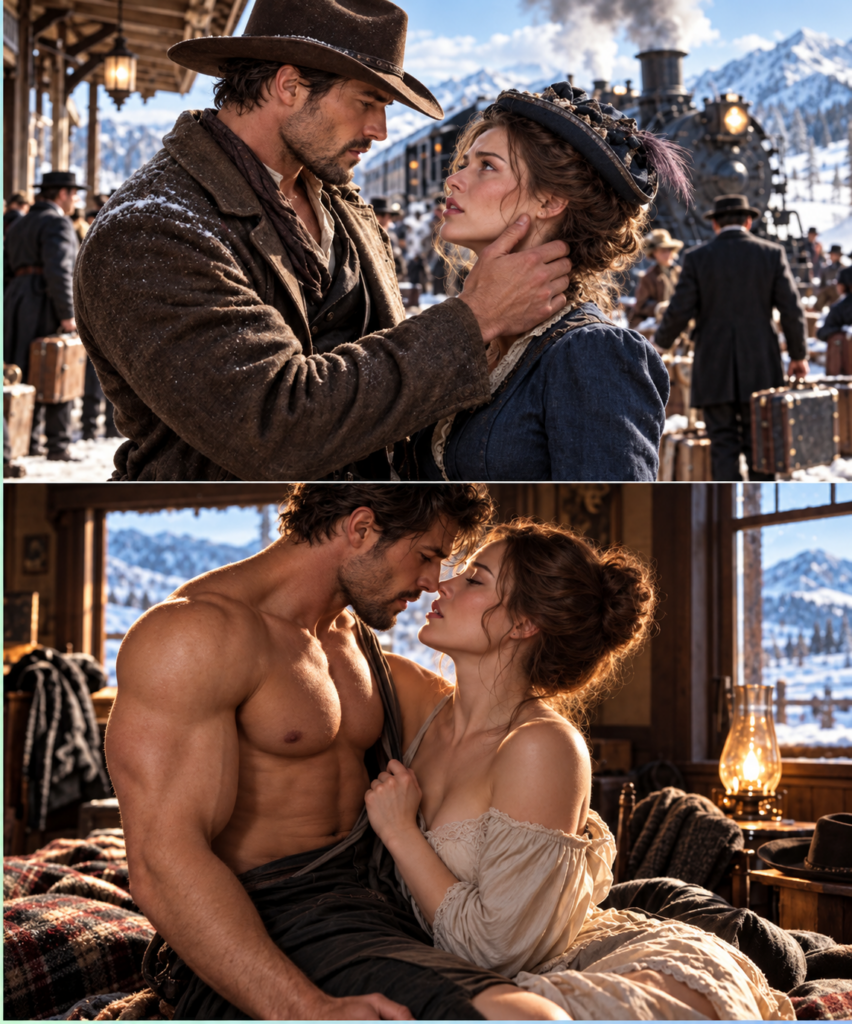
“Was it real?”
Her brow furrowed.
“What?”
“What we had.”
She looked at him for a long moment.
Nathan forced himself not to fill the silence.
Finally, Anna said, “I grieved losing you longer than I grieved almost anything else in my life.”
He swallowed.
“That wasn’t exactly my question.”
“It was real.”
Something he had carried for twelve years loosened inside his chest.
“Good night, Anna.”
“Good night, Nathan.”
He drove home beneath a sky crowded with stars.
Ben Harris was on the porch repairing a cinch strap when Nathan arrived.
Ben had worked beside him eight years and had perfected the rare skill of being nosy without appearing to ask questions.
He looked at the empty wagon.
“No fencing wire.”
“No fencing wire.”
Ben went back to stitching leather.
“Interesting trip?”
Nathan sat on the steps.
“Anna Whitmore came off the westbound.”
The stitching stopped.
Ben slowly raised his head.
“The Anna Whitmore?”
Nathan gave him a warning look.
“There is only one Anna Whitmore.”
“Apparently so.”
Nathan told him about the letters.
When he finished, Ben remained quiet.
Then he said, “You going back tomorrow?”
“I still need wire.”
“Sure.”
Nathan glanced at him.
Ben studied his cinch strap.
“I’ll tell Margaret to make extra biscuits.”
“Don’t.”
“I’m talking about biscuits.”
“You’re never just talking about biscuits.”
Ben smiled into his work.
The following morning, Nathan found Anna sitting outside Eliza’s boarding house with a cup of coffee.
“You busy?” he asked.
“I have a train tomorrow.”
“That wasn’t my question.”
She studied him.
“No. I’m not busy.”
“Come help me buy fencing wire.”
To his surprise, she did.
Inside the hardware store, Anna watched him select a coil and said, “That’s too light.”
Nathan turned.
“What?”
“That gauge will loosen when the posts freeze.”
“You sell fencing wire now?”
“My husband kept horses.”
The word husband struck him harder than it should have.
He put the wire back.
“You were married.”
“For five years.”
Nathan carefully selected the heavier gauge.
“Were you happy?”
Anna looked at him.
“That seems like a conversation for somewhere other than a hardware aisle.”
“Fair.”
They carried the supplies outside.
Her train came at four fifteen.
Nathan waited on Eliza’s porch across from the station.
At four fourteen, the whistle sounded.
At four fifteen, the eastbound passed through Cottonwood Crossing without stopping.
Nathan looked toward the flagpole.
The signal flag had never been raised.
Behind him, the boarding house door opened.
Anna stepped onto the porch.
“I didn’t raise it,” she said.
Nathan kept his voice steady.
“I noticed.”
“This is not me choosing anything.”
“I understand.”
“I need time.”
“I understand that too.”
“Do you?”
Nathan turned to face her.
“I’m not twenty-two anymore, Anna. I know the difference between a woman asking for time and a woman promising to stay.”
The tension in her shoulders eased.
“There’s another train in two days.”
“Yes.”
Nathan went home.
The next morning, he returned.
Anna was helping Eliza bake bread.
“Margaret’s hands are bad this winter,” Nathan said from the kitchen doorway.
Anna kept kneading.
“Arthritis?”
“Yes.”
“I remember.”
“She could use help.”
Anna stopped.
Nathan continued.
“Cole Ridge needs a cook through winter. Fair wages. Private room. You’d be my employee. Nothing else. If you want Nebraska in spring, I’ll personally take you to the station.”
Anna turned.
“Why are you offering?”
“Because Margaret needs help.”
“That isn’t all.”
“No.”
He held her gaze.
“But I spent twelve years believing someone had made a decision about me. I’m not going to make one about you now.”
Anna stared at him for a long time.
“I’ll think about it.”
She arrived at Cole Ridge the next morning with one suitcase.
The ranch received Anna quietly.
Margaret Cole, who had practically raised Nathan after his parents died, walked onto the porch and took Anna’s hands.
“You used to ruin your mother’s preserves.”
Anna blinked.
“I was fifteen.”
“You still used too much sugar.”
Anna laughed.
Nathan had not heard that laugh in twelve years.
It went through him like sunlight through a shuttered room.
The first weeks were careful.
Anna worked.
Nathan worked.
They did not pretend the past had disappeared simply because they had learned part of the truth.
Anna transformed the ranch kitchen without making a performance of transforming it. Breakfast improved. The hands began showing up early. Even Ben started eating vegetables.
“These are less terrible,” he informed Nathan one evening.
“That might be the highest compliment you’ve ever given food.”
“Don’t repeat it.”
Margaret’s swollen hands finally got rest.
Anna sat with her every afternoon.
Nathan noticed everything while pretending not to.
The way Anna remembered each ranch hand’s coffee.
The way she repaired a broken window latch herself.
The way she stood on the porch after supper watching the last light disappear over the ridge.
The way the house seemed fuller merely because a second voice sometimes answered Margaret from the kitchen.
One night, Nathan found Anna in his study holding a small wooden box.
She immediately lowered it.
“I’m sorry. It was on the desk.”
“It’s all right.”
“I didn’t open it.”
Nathan walked closer.
He had carved the box from cottonwood when he was twenty-one and given it to Anna for Christmas. When her father announced they were leaving, she had returned it because she wanted him to keep something she had touched.
“Open it,” he said.
“Nathan—”
“Go ahead.”
Inside was a dried prairie flower flattened between two pieces of paper.
Anna stared at it.
“You kept this?”
“You gave it to me down by Miller Creek.”
“I remember.”
“It was already half dead.”
She almost smiled.
“You said it looked determined.”
“It did.”
“So you kept a dead flower for twelve years?”
“When you say it like that, it sounds unhealthy.”
She laughed softly.
Then her expression turned serious.
“Nathan, this doesn’t give us back what happened.”
“I know.”
“We’re not those people anymore.”
“I know.”
“I had a husband.”
He nodded.
Anna closed the box.
“He was a good man,” she said.
Nathan waited.
“Good can be a thin word,” she continued. “Samuel wasn’t cruel. He worked hard. He never drank too much, never gambled away money, never frightened me. He provided a decent home.”
“But?”
“He never asked me what I wanted.”
Nathan said nothing.
“He wasn’t trying to control me. It simply never occurred to him that my answer might matter. He decided where we lived, what we saved, when we traveled. And I let him because by then I had learned not to expect anyone to ask.”
“What happened to him?”
“Chest illness. Two winters ago.”
“I’m sorry.”
“I grieved him.”
Nathan heard the careful distinction.
“But you weren’t destroyed.”
Anna looked at him sharply.
Then nodded.
“And I hated myself for that.”
“You shouldn’t.”
“I know now.”
She touched the wooden box.
“The grief for you was different.”
Nathan’s breath caught.
Anna’s voice trembled despite her effort to steady it.
“I tried to stop loving you. I truly did. I decided your letter was real. I told myself I had been foolish. I married a decent man. I built a decent life.”
She looked directly at Nathan.
“Then I stepped off that train and saw you.”
He did not move.
“And?”
“And I realized I hadn’t stopped. I had only put it somewhere I refused to look.”
Nathan lowered his eyes.
He wanted to cross the room.
He wanted to take her in his arms.
Instead he said, “Thank you for telling me.”
Anna’s eyes filled unexpectedly.
“Why aren’t you making this harder?”
“Because enough people have made things hard for you in the name of knowing what was best.”
That broke something open in her.
Not dramatically.
One tear slipped free.
She wiped it away impatiently.
“I still might leave in spring.”
Nathan nodded.
“I know.”
Three weeks later, Thomas Whitmore rode through the gate.
Anna saw him from the kitchen window.
Nathan was coming out of the barn when he heard her say her brother’s name.
Thomas dismounted.
He had aged well—expensive coat, good horse, confident posture—but his face lost color when he saw Nathan standing beside Anna.
That was what gave him away.
Not anger.
Not surprise.
Recognition.
Nathan felt the truth before anyone spoke.
Anna must have seen it too.
“Thomas,” she said quietly. “What do you know about the letters?”
Thomas froze.
“Anna—”
“What do you know?”
“I did what I thought was right.”
Nathan’s hands curled.
Anna went frighteningly still.
“What did you do?”
Thomas looked between them.
“You were seventeen.”
“That is not an answer.”
“Nathan had nothing.”
Nathan took one step forward.
Anna lifted a hand without looking at him.
He stopped.
She faced her brother.
“Say it.”
Thomas swallowed.
“Anna.”
“Look at me and say it.”
The winter yard seemed to hold its breath.
Finally Thomas said, “I wrote the letters.”
Anna stared.
“Both?”
“Yes.”
“The one supposedly from Nathan?”
“Yes.”
“The one supposedly from me?”
“Yes.”
Nathan heard blood pounding in his ears.
“And our real letters?” he asked.
Thomas looked at him.
Nathan’s voice lowered.
“What happened to them?”
“I intercepted them.”
“How many?”
Thomas looked away.
“All of yours.”
Nathan felt something cold move through him.
“For how long?”
“Eight months.”
Eight months.
Fourteen letters.
Nathan remembered each one. Some had been awkward. Some hopeful. One had contained nearly all the money he possessed because he thought Anna might need fare west.
She had never seen any of them.
Anna whispered, “And mine?”
“Eleven. Maybe twelve.”
Her hand flew to her mouth.
Thomas stepped toward her.
“Anna, Father was convinced you would ruin your life. You were seventeen. Cole had no land. No money. No future anybody could see.”
“So you invented one for me?”
“I was trying to protect you.”
“From what?”
Thomas gestured toward Nathan.
“From spending your life poor.”
Anna looked around at Cole Ridge—the barns, cattle, fences, smoke curling from the chimney of a house Nathan had built board by board.
Thomas noticed.
His jaw tightened.
“I know how that looks now.”
“This isn’t about how it looks now!” Anna shouted.
It was the first time Nathan had heard her raise her voice.
“It was my life!”
Thomas flinched.
Anna’s eyes filled with tears.
“You let me believe he abandoned me.”
“I thought you would recover.”
“I married someone else!”
“I know.”
“You let him believe I thought he was worthless.”
Thomas looked at Nathan.
“I was wrong.”
Nathan’s voice came out dangerously calm.
“You were not wrong. Wrong is buying the wrong horse. Wrong is taking the north road when the bridge is washed out.”
He stepped closer.
“You made her choices for her because you believed being her brother made you wiser than she was.”
Thomas said nothing.
Nathan continued.
“And you made mine because you thought a poor man’s word wasn’t worth much.”
For one frightening second, Nathan wanted to hit him.
Twelve years of grief narrowed into the distance between his fist and Thomas Whitmore’s face.
Then Anna spoke.
“Nathan.”
Only his name.
He looked at her.
She shook her head.
Nathan unclenched his hand.
Thomas saw it.
That somehow shamed him more than a punch would have.
“I’m sorry,” Thomas said.
Anna’s face hardened.
“Leave.”
“Anna—”
“Leave.”
Thomas mounted.
Before he rode away, he looked at Nathan.
“I was wrong about you.”
Nathan answered, “You were wrong about her.”
Thomas lowered his eyes.
Then he rode out.
Anna stood in the yard until he disappeared beyond the ridge.
Nathan remained beside her.
After several minutes, she said, “I need to go.”
His stomach tightened.
“Inside?”
“No.”
She turned toward the house.
“I need my suitcase.”
Nathan felt the old terror instantly.
“Anna.”
“I can’t breathe here right now.”
He understood, and understanding did nothing to make the fear smaller.
“Where will you go?”
“Eliza’s.”
Nathan nodded.
“I’ll take you.”
“No.”
“Anna—”
“I need to make one decision alone today.”
He forced himself to step back.
“All right.”
She packed.
Ben drove her to Cottonwood Crossing because Nathan knew following her against her wishes would turn love into exactly the thing Thomas had mistaken it for.
Control.
Nathan spent the rest of the afternoon repairing a gate that did not need repairing.
By three thirty, he had replaced two perfectly good hinges.
At three forty, Ben rode back alone.
Nathan looked toward the wagon.
“Where is she?”
“Station.”
“What?”
“She bought a ticket east.”
Nathan’s hammer fell.
Ben leaned against the wagon.
“She told me not to tell you.”
“Then why are you telling me?”
“Because she told me that at two forty-five. It is now three forty.”
Nathan stared at him.
Ben shrugged.
“I gave her nearly an hour of privacy.”
Nathan was on his horse before Ben finished speaking.
Snow began falling halfway to town.
The wind drove it sideways.
Nathan rode harder.
He had once spent twelve years believing Anna had chosen to leave him.
He would not spend another twelve wondering whether he should have said one more thing.
The station appeared through the snow at 4:07.
The eastbound was already there.
Nathan jumped from the saddle and ran onto the platform.
“Anna!”
She stood beside the passenger car steps.
Her suitcase had already been loaded.
She turned.
Nathan stopped several feet away, breathing hard.
People watched.
He did not care.
Anna’s face tightened.
“I asked for space.”
“I know.”
“Then why are you here?”
“To say one thing.”
“Nathan—”
“One thing. After that, if you get on that train, I will let you go.”
The conductor called for boarding.
Anna folded her arms.
Nathan stepped closer.
“I won’t lose you twice.”
Pain crossed her face.
“That is exactly what I was afraid you’d say.”
“Listen to the rest.”
She hesitated.
Nathan’s voice lowered.
“I won’t lose you twice because somebody else decided our lives for us. But if you leave today because you want Nebraska, or Pennsylvania, or California, or the other side of the world, then I will put your suitcase on that train myself.”
Anna’s eyes filled.
“I mean it.”
The conductor called again.
Nathan continued.
“I love you. I never stopped. That is my truth. But it is not a rope around your waist.”
Anna looked toward the train.
“You could ask me to stay.”
“I am asking.”
She turned back.
“But I will not decide for you.”
Nathan’s throat tightened.
“Twelve years ago, Thomas stole your choice. If I stand here now and use your love for me to trap you, then all I’m doing is stealing it again with kinder words.”
Anna’s tears spilled.
Nathan’s voice nearly broke.
“So stay because you want the life at Cole Ridge. Stay because you want Margaret’s kitchen and Ben complaining about onions and the chickens getting into everything. Stay because you want me.”
He swallowed.
“But don’t stay because I chased you here.”
The conductor stepped onto the platform.
“Ma’am, are you boarding?”
Anna looked at the open train door.
Then at Nathan.
Then down the track disappearing into blowing snow.
Nathan thought his heart might split in half.
Anna whispered, “Do you know why I came to the station?”
“No.”
“Because Thomas’s confession made everything feel stolen again. My youth. My marriage. You. Twelve years.”
Nathan nodded.
“And I thought if I left first this time, at least the leaving would belong to me.”
Nathan’s eyes burned.
“That makes sense.”
Anna gave a broken laugh.
“That is an infuriating answer.”
“It’s the truth.”
“I wanted you to stop me.”
Nathan stared at her.
She wiped her face.
“And then I hated myself for wanting you to stop me because I have spent half my life being told what I should do.”
The whistle screamed.
Nathan stepped closer.
“So choose.”
Anna looked at him.
“Choose what?”
“Anything.”
He spread his hands.
“Choose the train. Choose the ranch. Choose six months. Choose tomorrow morning. Choose not to know yet.”
The conductor called, “Last boarding!”
Anna turned toward the train.
Nathan’s heart stopped.
She took one step.
Then another.
She reached the passenger car.
The conductor held out his hand.
Anna looked at it.
Then she laughed softly through her tears.
“No.”
The conductor frowned.
“Ma’am?”
“I said no.”
She turned around.
Nathan did not move.
Anna walked back toward him.
“I’m not choosing forever today.”
He nodded.
“Good.”
“I’m not promising marriage.”
“Wasn’t going to ask.”
“I may still leave in spring.”
“I know.”
“And if you become unbearable, I reserve the right to go to Nebraska just to prove a point.”
“That seems excessive.”
“It might be worth it.”
The train began moving.
Nathan watched the last car disappear.
Then he looked at Anna.
“You missed your train.”
“I noticed.”
“Want a ride home?”
She studied him.
“Home?”
Nathan immediately regretted the word.
But Anna’s expression softened.
“For tonight,” she said.
“For tonight.”
She took his arm.
They walked away from the station together.
Winter settled hard over Cole Ridge.
What grew between them did not return as the love they had known when she was seventeen.
That love had been impatient, certain, full of promises made by people who did not yet understand how much life could cost.
This one grew slowly.
Anna stayed because each morning she chose to.
Nathan loved her enough not to count those mornings as debts.
By January, Anna stopped talking about Nebraska.
One afternoon, Nathan took her on horseback to the ridge overlooking the ranch.
Snow covered the fields.
The barns stood dark against the white.
Smoke lifted from the chimney.
And there, on the east side of the house, the kitchen window caught the winter sun.
Anna studied it.
“Margaret told me something.”
Nathan frowned.
“That is generally dangerous.”
“She said you designed the house yourself.”
“Mostly.”
“She said everyone told you the kitchen window should face south.”
Nathan looked away.
Anna smiled.
“You insisted east.”
“Morning light.”
“She said that was your excuse.”
“It’s a good excuse.”
“Nathan.”
He sighed.
“When we were young, you told me you wanted a kitchen with an east-facing window.”
Anna’s eyes filled.
“You remembered?”
“I remembered everything.”
“You built it for me.”
“I built it because I couldn’t stop.”
He looked down at the ranch.
“Even when I thought you had chosen someone else, some foolish part of me kept building as if one day you might walk through the door.”
Anna was silent.
“If I hadn’t come back,” she asked, “what would you have done?”
“Kept ranching.”
“Alone?”
“Probably.”
“That may be the saddest thing I have ever heard.”
Nathan reached into his coat.
“It has a better ending.”
Anna saw the ring.
Her mouth opened.
“Nathan Cole.”
“It’s not fancy.”
The gold band held a small dark red stone.
“I know I said I wasn’t going to ask at the station.”
“You didn’t.”
“I also said I’d wait until you chose.”
“I did.”
Nathan froze.
Anna smiled.
“Ask me.”
“You’re sure?”
“Nathan.”
“All right.”
He took her cold hand inside his warmer one.
“I cannot give you back twelve years.”
“I don’t want them back.”
He blinked.
Anna squeezed his fingers.
“They made us who we are.”
Nathan nodded slowly.
“I can’t undo Thomas’s letters. I can’t undo your marriage or my mistakes or all the nights we spent believing something that wasn’t true.”
“I know.”
“But I can promise this. I will ask what you want. Even when I’m afraid of the answer.”
Anna’s lips trembled.
“I will tell you the truth even when the truth gives you the power to leave.”
He held up the ring.
“And if you still want an east-facing kitchen and a stubborn rancher who occasionally buys the wrong fencing wire, Anna Whitmore, will you marry me?”
She laughed through her tears.
“Yes.”
Nathan stared at her.
“Yes?”
“Yes.”
“You might want to sound more certain.”
She took his face between her hands.
“Nathan Cole, I crossed half the country, missed two trains, discovered my brother committed the most elaborate romantic sabotage in Wyoming, survived Ben Harris’s opinions about vegetables, and spent three months watching you pretend not to come into the kitchen just to see me.”
Nathan blinked.
“I was getting coffee.”
“You do not drink six cups of coffee before noon.”
He smiled.
“So that’s a yes?”
She kissed him.
It was not the kiss of two young people trying to outrun the future.
It was slow, certain, and chosen.
“Yes.”
They married the following October in the little Cottonwood Crossing church.
Anna made her own dark blue dress.
She carried no flowers.
When Margaret asked why, Anna said, “I’ve spent enough of my life carrying things somebody else expected me to carry.”
So she walked down the aisle with empty hands.
Nathan stood at the front.
When he saw her, his eyes filled.
Anna reached him and whispered, “Don’t you dare.”
“It’s dust.”
“In a church?”
“Wyoming dust is determined.”
She laughed and took his hand.
Thomas attended.
He sat near the back.
Anna had not forgiven him completely.
She refused to pretend she had.
But months earlier, when Thomas had asked whether there was any door left between them, she had answered honestly.
“There is a door. It is not open yet.”
That was enough.
At the reception, Thomas approached Nathan.
“I was wrong about you,” he said.
“You told me that already.”
“I’m saying it where other people can hear.”
Nathan looked across the room.
Anna was laughing with Margaret and Eliza.
Happy.
Thomas followed his gaze.
“Take care of her.”
Nathan turned back.
“No.”
Thomas frowned.
Nathan continued.
“She doesn’t need one man handing responsibility for her to another.”
Thomas’s face changed.
“That was your mistake twelve years ago.”
Thomas lowered his eyes.
“Yes.”
“I’ll stand beside her,” Nathan said. “I’ll love her. I’ll be there when she asks and sometimes when she doesn’t know how to ask. But Anna takes care of Anna.”
Thomas nodded.
“I understand.”
“Good.”
Nathan handed him a glass.
“And if you want any chance of your sister forgiving you, never again confuse love with permission to choose for her.”
Thomas looked toward Anna.
“I won’t.”
One year later, on their anniversary, Nathan and Anna returned to Cottonwood Crossing station to collect a cast-iron range she had ordered for the ranch kitchen.
The westbound rolled in while they waited.
Steam drifted across the same boards where Nathan had dropped his pocket watch two years earlier.
Anna noticed him staring.
“What?”
“Nothing.”
“That face is not nothing.”
Nathan smiled.
“This is where I found you.”
Anna slipped her arm through his.
“No.”
He looked at her.
She watched passengers stepping onto the platform.
A young widow with a frightened little boy struggled with two bags. Anna immediately crossed over and helped her.
Within five minutes, Anna had learned the woman had arrived from Indiana, had been abandoned by her husband three months earlier, had twenty-seven dollars left, and needed work.
Nathan shook his head.
“You got all of that while helping with one suitcase?”
“People tell me things.”
“Why?”
Anna looked toward the town.
“Maybe because I actually want to know.”
Nathan smiled.
The young widow disappeared toward Eliza’s boarding house with directions, a promise of temporary kitchen work, and enough money for two nights that Anna had slipped discreetly into her hand.
Then Anna returned to Nathan.
“You said this is where you found me.”
“Yes.”
She shook her head.
“This is where we found out we had never actually lost each other.”
Nathan looked at her.
Anna glanced toward the ranch road.
“I used to think what mattered most was getting those twelve years back somehow.”
“And now?”
“Now I think the important part is that we stopped letting stolen years decide the ones we still had.”
The freight crew rolled their new range toward them.
Nathan took her hand.
“I still hate that we lost them.”
“So do I.”
“I suppose I always will.”
“You can hate what happened without living inside it.”
Nathan nodded.
They loaded the range onto the wagon and started home.
Twelve miles later, Cole Ridge appeared beyond the cottonwoods.
The barns.
The cattle.
Margaret’s flowers along the porch.
Ben waving irritably because Nathan had apparently positioned the wagon in exactly the wrong place for unloading.
And the east-facing kitchen window.
Anna sat beside Nathan with her shoulder touching his.
Ordinary.
That was what surprised Nathan most.
After everything—the false letters, the years, the grief, the station platform, the train she almost boarded—the thing they had fought their way back to was not some grand romance suspended above real life.
It was real life.
Coffee before sunrise.
Arguments about fence posts.
Cold boots beside the stove.
Margaret complaining when anyone tried to help her.
Ben pretending onions were an enemy.
Anna humming while she kneaded bread.
Nathan coming inside at dusk and seeing light in the east-facing window.
The specific, ordinary life that somebody had once decided they were too young, too poor, too foolish to choose.
Nathan pulled the wagon into the yard.
Anna jumped down before he could help her.
“I’m going to clear space for the range.”
“I’ll get Ben.”
She started toward the house.
At the door, she stopped and turned.
“Nathan?”
“Yeah?”
“I love the life we have.”
Nathan looked at the woman he had first loved when he had thirty-eight dollars and nothing else to offer but his word.
He looked at the house he had built while pretending he was building it for no one.
He looked at the woman who had returned not because fate had repaired everything, but because when life finally gave them a choice, they had chosen honestly.
“So do I.”
Anna smiled and went inside.
A moment later, her voice drifted through the open kitchen door, warm and impatient, telling Margaret not to lift anything heavy.
Nathan stood in the yard listening.
Twelve years earlier, someone had convinced him that losing Anna meant he had not been enough.
He knew better now.
Some losses were not proof that love had failed.
Sometimes love was interrupted by fear, pride, bad decisions, and people who believed they had the right to choose another person’s future.
And sometimes life, impossibly, brought two people back to the same platform and asked a different question.
Not whether they still loved each other.
Whether they had finally learned how to love without owning.
Nathan looked at the east-facing window.
Then he went inside.
THE END

