
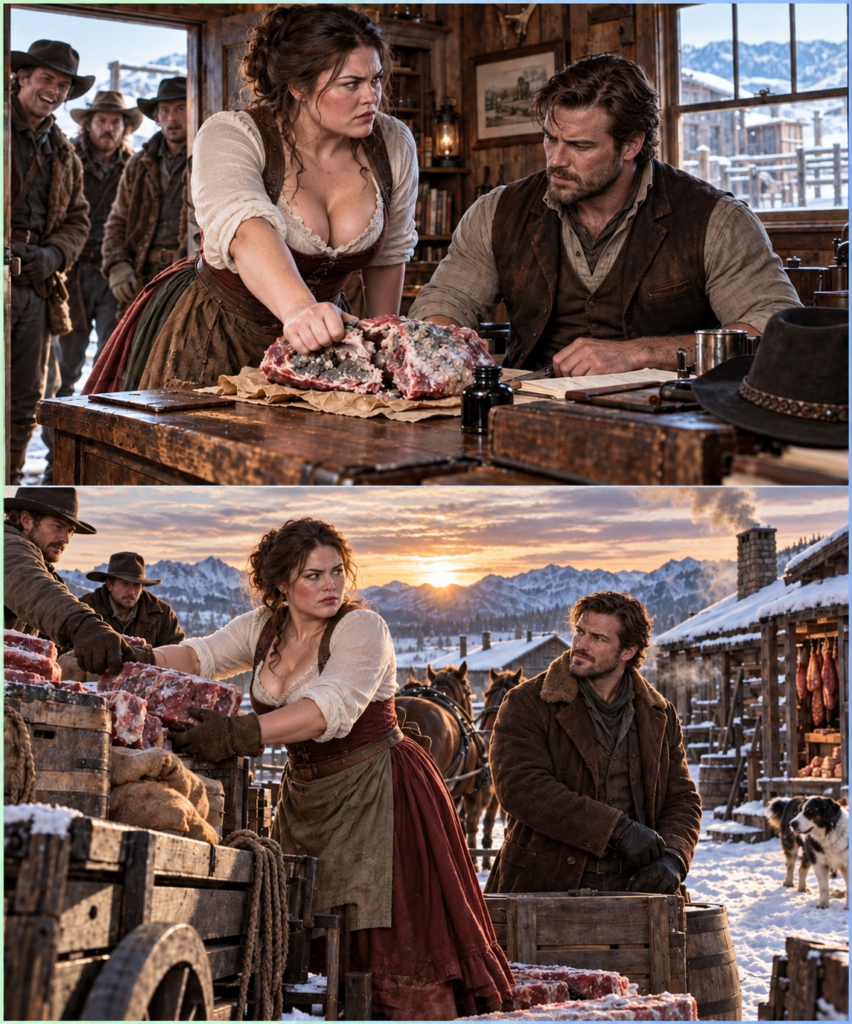
She never hurried what should not be hurried.
The ranch hands stopped laughing by the fourth day.
By the sixth, two of them were appearing outside the smokehouse each morning asking whether she needed wood.
Dell took longest.
“Seems like a lot of fuss,” he told her one afternoon, watching Clara separate carefully dried apple branches.
“Good work usually looks like too much fuss to people who’ve never done it.”
“My granddaddy smoked pork with whatever wood he could find.”
“Then your granddaddy probably ruined pork he never told you about.”
Dell stared.
Clara finally glanced at him.
“Every man who does something badly insists his grandfather did it the same way.”
One of the older ranch hands laughed so hard he nearly dropped an axe.
Dell walked away red-faced.
The next morning, however, Clara found the applewood stacked exactly as she had instructed.
Ethan began visiting the smokehouse too.
At first he invented reasons.
The fire.
The roof.
The salt inventory.
After several evenings, he gave up pretending.
He would stand in the doorway with his hat in his hands and watch her work.
One night Clara asked, “Do you ever sit down?”
“Do you?”
“I’m working.”
“So am I.”
“You’re watching me work.”
“That’s management.”
She gave him a look.
He smiled.
It was the first genuine smile she had seen on him.
It changed his whole face.
That frightened her more than it should have.
The moment passed, and Clara turned a ham hanging over the slow smoke.
“My father used to say a person ought to know one useful thing so well nobody could argue with them about it.”
“This was his useful thing?”
“This and surviving men who thought they knew better.”
Ethan leaned against the doorway.
“You miss him.”
“Every day.”
“What happened?”
“Pneumonia. Four winters ago.”
“I’m sorry.”
“So am I.”
She used his exact answer deliberately.
He noticed.
Clara inspected another cut.
“My father worked other men’s ranches his whole life. Half the best smokehouses in northern Wyoming ran on something Thomas Whitmore taught somebody, but those same men would pass him in town like he was hired furniture.” Her hands paused. “I decided when I was twelve that I’d get so good nobody could pretend not to see me.”
“Did it work?”
“No.”
Her answer was so immediate that Ethan laughed.
Clara smiled sadly.
“Turns out people can ignore almost anything when they’re committed to it. So I changed my goal.”
“To what?”
“To being good whether they notice or not.”
Ethan’s laughter faded.
She looked around the smokehouse.
“When I’m standing in here and the temperature’s right and the smoke runs clean and I know every piece hanging above me is going to feed somebody when snow is six feet deep, I’m rich. Doesn’t matter what’s in my pocket.”
Ethan stared into the fire.
“I remember feeling that way about this ranch.”
“You will again.”
“You don’t know that.”
“Yes, I do.”
“How?”
She looked straight at him.
“Because this place has good bones.”
Something in his expression changed.
It was the same thing she had said to herself about the dead smokehouse.
She had not realized until then that she meant him too.
The quiet between them grew almost intimate.
Then Ethan put his hat on.
Whenever a feeling got too close, Clara had noticed, he reached for his hat.
“Good night, Miss Whitmore.”
“Good night, Mr. Caldwell.”
Neither slept particularly well.
Three days later, Harold Pierce arrived.
He stepped from a polished black buggy wearing a wool coat too fine for ranch work and a smile too pleased for an ordinary visit.
Clara was carrying oak across the yard.
Pierce looked at her from boots to face with a slowness intended to humiliate.
“So the stories are true.”
Clara kept walking.
“Caldwell hired himself a smokehouse woman.”
She stopped.
“Mr. Pierce, I assume.”
His smile widened.
“And you must be the miracle worker.”
“No, sir. Miracles are free. I charge wages.”
A ranch hand choked on a laugh behind the barn.
Pierce’s eyes hardened.
“I’m told you mean to save this ranch with smoked pork.”
“I mean to preserve pork.”
“Same thing, from what Ethan’s become.”
Clara set down the wood.
“I also found the batch your store supplied salt for.”
Pierce’s smile thinned.
“That so?”
“Cheap salt. Poor grade. Sold to a man you knew was short of cash.”
“I sell what people can afford.”
“And then hold their notes when what they can afford fails.”
Pierce stepped closer.
“You’ve got a sharp mouth for hired help.”
“And you’ve got soft hands for a man who makes his living off ranchers.”
The yard went completely still.
Pierce’s face changed.
“I’ve seen Caldwell’s books,” he said quietly. “He has one winter left. Maybe less. I hold paper on the north forty and his water rights. This ranch is dying, Miss Whitmore. You can smoke every hog from here to Nebraska and you won’t change arithmetic.”
Clara picked up her oak.
“I’ve been bad arithmetic my entire life.”
“What?”
“People keep calculating me and getting the answer wrong.”
She stepped closer until Pierce had to look directly at her.
“So here’s another calculation for you. I have a fire. Ethan has cattle left. These men still work. Winter hasn’t won yet. You came all the way out here to laugh.”
She nodded toward his buggy.
“I’d save your energy for spring.”
Pierce’s mouth tightened.
“We’ll see.”
“Yes,” Clara said. “We will.”
As the buggy rolled away, she noticed Ethan standing on the porch.
He had heard everything.
“You shouldn’t have had to do that,” he said when he joined her.
“I didn’t have to. I wanted to.”
“He was telling the truth about the note.”
“I know.”
Ethan stopped.
“You know?”
“I figured it out four days ago.”
“How?”
“You look at the north pasture like a man watching somebody measure his coffin.”
Despite himself, Ethan laughed once.
Then he became serious.
“If this ranch goes, Pierce gets the water. Once he has that, he controls half the valley.”
“So we don’t let it go.”
“You really think pork can stop him?”
“No.”
Clara looked toward the smokehouse.
“But pork can become money. Money can become time. Time can become choices.”
She met Ethan’s eyes.
“And a person with choices isn’t beaten yet.”
That evening, the weather changed.
Clara smelled it before she saw it.
Cold sharpened the air. Clouds flattened over the mountains. Wind curled downward from the north.
She stood in the yard at dawn staring at the ridge.
Dell joined her.
“You keep looking at that sky like it insulted your mother.”
“It’s early.”
“What is?”
“The freeze.”
Dell followed her gaze.
“How early?”
“The big batch needs eleven more days.”
“And?”
“We have maybe five.”
Dell’s face lost its humor.
“Can you speed it?”
“Not safely.”
“Then what?”
Clara looked at the smokehouse.
“Then I do it unsafely, carefully.”
That sounded impossible.
It was.
For four days she barely slept.
The ranch hands worked in shifts hauling wood. Dell became her loudest defender, scolding anyone who left the door open too long.
On the second night Ethan rolled up his sleeves.
“What do you need?”
“You don’t know what you’re doing.”
“Teach me.”
So she did.
They worked side by side through darkness.
She showed him how clean smoke smelled almost sweet and bad smoke caught harshly in the throat. She guided his fingers over the surface of curing meat.
Once, when his hand was in the wrong place, she closed her own over his wrist.
Neither moved.
The fire cracked softly between them.
Ethan looked at her.
Clara released him.
“You press there.”
“I understood.”
“I was making sure.”
“Of course.”
They worked another hour in silence.
Near two in the morning, Ethan said, “I’m afraid.”
Clara turned.
It was such an unguarded confession that she almost pretended not to hear.
“Of the storm?”
“Of wanting this place again.”
She understood immediately.
“If you don’t want it, losing it can’t hurt you.”
“That’s the theory.”
“Does it work?”
“No.”
“Never does.”
He looked at her across the red glow.
“And you? What are you afraid of?”
Clara considered lying.
Instead she said, “Believing I have a place here.”
His face softened.
“You do.”
“For a season.”
“No.”
She looked away.
“Careful, Ethan.”
It was the first time she had used his first name.
He went very still.
She continued quietly. “Men say warm things at two in the morning when the fire’s low and nobody can see them. Daylight is where words get expensive.”
He understood.
She had been mocked too often to accept tenderness that needed darkness.
“All right,” he said.
He did not reach for her.
“Daylight, then.”
Before either could say more, the wind hit the wall.
By dawn, snow was coming sideways.
The smokehouse door would not seal.
Clara shoved cloth into the gaps, but one space along the bottom remained open.
“Ethan!”
He ran from the woodpile.
“Door’s leaking. If that wind gets under it, the temperature drops. We lose the batch.”
He looked around.
There was no lumber cut to size.
No time.
Then Ethan stripped off his heavy winter coat, dropped to his knees and forced it into the gap.
Clara stared.
“That’s your only good coat.”
“I have a house.”
He drove the fabric deeper with both hands.
“The meat doesn’t.”
The first wall of snow swallowed the yard.
Ethan stood.
“Stay with the fire.”
“What about you?”
“I’ll get the men inside.”
He caught her gaze.
“Clara.”
“Yes?”
“Daylight.”
Then he disappeared into white.
Within two hours, the storm became too violent for anyone to cross the yard.
Ethan ordered the men to stay inside the bunkhouse.
Clara was alone.
One woman.
One fire.
A winter’s food hanging above her.
The first night, she talked aloud to remain awake.
“My father once held a fire through two days of blizzard,” she told the flames. “He said storms aren’t patient. Sleep is.”
By the second day, exhaustion became pain.
By the second night, pain became something stranger. Her thoughts wandered. She heard her father’s voice. She imagined Dell complaining about applewood. Once she opened her eyes and realized she had been asleep standing up.
She slapped her own cheeks.
“No.”
The fire glowed low.
“You don’t get me now.”
She fed it oak.
Across the yard Ethan stood at the kitchen window staring toward a smokehouse he could no longer see.
Dell came beside him.
“She knows what she’s doing.”
“I know.”
“You trust her.”
“With the ranch.”
Dell was silent.
Then he said, “That isn’t what I meant.”
Ethan’s jaw tightened.
Dell looked toward the white window.
“You love her.”
Ethan did not answer.
There was no need.
The storm broke on the third morning.
When the snow finally stopped, the ranch emerged buried to the fence rails.
Above the drifts, a thin column of smoke rose from the smokehouse chimney.
Ethan was outside before anyone else had his boots fully fastened.
He fought through waist-deep snow, tore his frozen coat from beneath the door and pulled it open.
Heat washed over him.
The fire still lived.
Above it hung row after row of dark, beautifully cured meat.
And beside the salt chest sat Clara.
Her eyes were closed.
A piece of oak rested loosely in her hand.
For one horrifying instant, Ethan thought she was dead.
“Clara.”
He dropped beside her.
“Clara!”
Her eyes opened.
They struggled to focus.
Then she looked past him toward the meat.
A weak smile touched her face.
“Told you,” she whispered, “your men would eat.”
Ethan made a sound somewhere between a laugh and a sob.
Behind him Dell whooped.
Nine men began cheering.
Clara Whitmore, who had spent thirty years standing at the edge of rooms pretending she did not care whether anyone noticed her, closed her eyes again and listened to every voice.
For once, she let herself be celebrated.
Five days later, Harold Pierce returned with a folded paper.
He was no longer smiling.
“The seasonal interest payment was missed during the storm,” he told Ethan. “Thirty dollars.”
Ethan stared.
“You know why.”
“I know what your contract says.”
Pierce unfolded the note.
“Default on seasonal interest permits the holder to call the principal due. Four hundred dollars. Friday.”
The men gathered behind Ethan.
Pierce continued.
“Fail to pay and the north forty and water rights transfer to me.”
“You planned this.”
“I read contracts.”
“You waited until the storm.”
“I waited until the contract permitted action.”
His eyes moved toward Clara.
“Turns out pork doesn’t change arithmetic after all.”
He left.
Ethan stood in the yard for a long time.
Then he said, “It’s over.”
Clara turned toward him.
“No.”
“I have sixty dollars. Spring buyers won’t arrive for months.”
“How much surplus meat?”
“What?”
“The cellar. How much beyond what nine men absolutely require?”
Dell answered.
“Maybe two hundred pounds.”
Clara’s mind had already begun moving.
“Where are the nearest mining camps?”
Every man looked at her.
Ethan’s expression sharpened.
“No.”
She ignored him.
“Dell?”
“Across Falls Ford. Biggest camp’s maybe twenty-five miles if you take the southern draw.”
“Road?”
“Bad.”
“Passable?”
Dell hesitated.
“With a good team.”
Clara nodded.
“Miners have money?”
“Some.”
“They have fresh meat?”
Dell’s face changed as he understood.
“Almost none.”
Ethan stepped forward.
“No.”
Clara looked at him.
“Two hundred pounds at a dollar a pound.”
“That’s two hundred dollars, not four.”
“There’s more meat.”
“Our winter meat.”
“Yes.”
“You nearly died making it.”
“And I’d rather be hungry on your ranch than full on Pierce’s.”
“No.”
Her voice hardened.
“Ethan, hunger ends in spring. Losing the water doesn’t.”
He stared at her.
“You’d gamble the men’s winter.”
“I’d ask them.”
One by one, the ranch hands looked at Ethan.
Dell spoke first.
“I’ll eat beans.”
Another hand nodded.
“Me too.”
Within a minute every man had agreed.
Ethan looked around at the crew he had expected to abandon him.
Nobody did.
Before dawn the next morning, Clara, Dell and an older hand named Amos loaded the wagon quietly.
They were nearly finished when Ethan appeared in the barn doorway carrying a lantern.
“Where are you taking my winter?”
Clara froze.
His voice was not angry.
It was frightened.
“I’m selling it.”
“Behind my back?”
“Because you’d stop me.”
“You’re right.”
“Then stop me.”
He stared.
Clara stepped closer.
“You handed me a key to a dead building when nobody else would hand me anything. You judged my work when everybody else judged my body. You gave me a room with a lock because you understood dignity before I had to ask for it.”
Her voice trembled now, but she did not lower it.
“I love this ranch too much to watch your pride lose it.”
Ethan’s face changed.
She had said love this ranch.
Neither of them pretended they had not heard the larger meaning.
Clara continued.
“You can make us unload the wagon. Pierce takes your water Friday. Or you can climb up and help me do the impossible thing.”
For several seconds Ethan did not move.
Then he set down the lantern.
He climbed onto the wagon.
“Not without me.”
The crossing at Falls Ford nearly killed them.
Ice covered the stones beneath rushing water. Halfway across, the lead horse lost its footing.
The wagon slid sideways.
Dell shouted.
Ethan hauled the reins.
The current pushed harder.
Clara jumped into the freezing water.
“Clara!”
She threw her full body against the horse’s downstream shoulder, giving the terrified animal a counterweight.
“Get your feet under you,” she murmured against its ear. “Come on. We didn’t get this far to drown before breakfast.”
The horse found one hoof.
Then another.
The wagon stopped sliding.
Slowly, impossibly, they crossed.
On the opposite bank Ethan jumped down and seized Clara by the shoulders.
“You could have died.”
“But I didn’t.”
“You went under that wheel and—”
“I didn’t.”
“Clara.”
She looked up at him, drenched, shaking and laughing from the wild relief of survival.
“The sun’s coming up,” she said.
“What?”
“Daylight.”
He understood.
There, beside a frozen river with Amos politely studying the horses and Dell trying badly to hide a grin, Ethan kissed her.
It was not elegant.
It was cold, frightened and overdue.
When he pulled away, Clara touched his cheek.
“You meant it?”
“God help me,” he said, “I’ve never meant anything more.”
Then she smiled.
“Good. Now get back on the wagon. Love doesn’t pay Pierce four hundred dollars.”
The mining camp smelled the pork before Clara could announce it.
Four hundred hungry men had survived for weeks on beans, salt fish and whatever game hunters could find.
Clara stood on the wagon seat.
“Gentlemen, I brought you a memory of home.”
Heads turned.
“Hickory-and-apple smoked pork. Cured right. One dollar a pound.”
A miner shouted, “One dollar?”
“You’re welcome to keep eating beans.”
Laughter rolled through the camp.
Clara lifted a freshly cut slice.
“Or you can buy something that tastes like a Sunday table.”
The first man paid.
Then twenty came forward.
Then fifty.
Word traveled to a second camp.
By the following afternoon, the strongbox held five hundred twelve dollars.
They returned to Caldwell Ranch Wednesday evening, a full day before Pierce’s deadline.
A rider waited in the yard.
He handed Ethan another paper.
“Emergency hearing tomorrow. County seat. Noon.”
Ethan read it.
His face went pale.
Pierce had told the county judge Ethan was liquidating ranch assets in order to flee his debt. The judge had temporarily advanced the hearing.
Pierce no longer wanted merely to be paid.
He wanted the water rights.
Clara read the filing twice.
“He took the truth,” she said quietly, “and bent it until it looked like a lie.”
Ethan sat heavily on the porch.
“He wins.”
“No.”
“Clara, we can’t outwork a court order.”
“No. But we can tell the truth.”
“Pierce will have papers.”
“We have witnesses.”
“Ranch hands in my employ.”
“Then we find somebody who isn’t.”
She looked at Dell.
“The miners.”
Dell understood instantly.
Before midnight he was riding back toward Falls Ford.
The next morning Clara and Ethan entered the county courthouse with the strongbox between them.
Half of Red Creek seemed to be there.
Harold Pierce sat at the front beside a local attorney named Nathan Ashford.
He looked confident.
The judge listened first to Pierce.
Pierce’s story was clever because nearly every fact in it was technically true.
Ethan had missed a payment.
He had loaded much of his winter food onto a wagon.
He had crossed the mountains.
He had converted ranch stores into cash.
Pierce simply changed the motive.
Not survival.
Flight.
When Ethan testified, he told the story plainly.
His wife.
The drought.
The dying ranch.
Clara’s arrival.
The storm.
The meat.
The debt.
The miners.
“I wasn’t running from what I owed,” he said. “I crossed a mountain to pay it.”
Pierce’s attorney rose.
“With employees whose livelihoods depend on your keeping the ranch?”
“Yes.”
“So every witness you have benefits if this court believes you.”
Ethan had no answer that could change the fact.
The judge looked toward the clock.
Eleven twenty.
Clara stood.
“Your Honor, may we have until noon?”
Pierce objected.
Clara turned toward him.
“You demanded noon in your own filing.”
The room murmured.
The judge almost smiled.
“She has you there, Mr. Pierce.”
He looked at the clock.
“Forty minutes.”
They waited.
Twenty passed.
Then thirty.
At eleven fifty-six Pierce checked his pocket watch and smiled.
At eleven fifty-eight Clara’s hope began to collapse.
At eleven fifty-nine footsteps thundered in the hallway.
The door opened.
Dell Rooney stumbled inside, mud to his knees and bloodless from cold.
Behind him stood a coal miner named Cole Maddox.
Cole removed his hat.
“I was told somebody needs to know why a rancher brought pork up our mountain.”
The courtroom changed.
Cole had never met Ethan before the trip.
He owed him nothing.
He testified that Clara had announced publicly they were selling food to save Caldwell Ranch from foreclosure.
He described the prices, the buyers and the strongbox.
He described Ethan refusing extra money from miners who offered charity.
Then Cole told the court about the ford.
“That woman went waist-deep into water cold enough to stop a heart and held a horse upright because their wagon had the food they meant to sell to pay their creditor.”
He pointed at Clara.
“You’re asking whether those people were running from a debt?”
He shook his head.
“I watched them nearly die running toward it.”
Pierce’s certainty finally disappeared.
The judge leaned back.
“Mr. Caldwell, do you have the full amount?”
Ethan opened the strongbox.
“Yes, Your Honor.”
“Then pay it.”
Ethan stared.
“Sir?”
“Count four hundred dollars onto that table. Mr. Pierce will mark the note satisfied.”
Pierce rose.
“Your Honor—”
“Sit down.”
The judge’s voice hardened.
“You brought me an emergency petition claiming this man was preparing to abscond. Instead I find he drove through a winter mountain crossing to produce the money you demanded early. That isn’t a debtor fleeing obligation.”
His eyes narrowed.
“It’s a creditor using my courtroom to reach collateral he wanted more than repayment.”
Nobody moved.
“You’ll accept payment.”
Pierce sat.
Ethan counted the money coin by coin.
When Pierce signed the satisfaction, his hand shook.
Outside the courthouse, the entire town seemed to exhale.
Then someone clapped.
Clara turned.
It was an older woman from the bakery.
Another person joined.
Then Dell.
Then Amos.
Within seconds the street filled with applause.
Clara stood motionless.
She had spent a lifetime watching rooms close before she reached the door.
Now an entire town was standing in one, making space.
She looked at Ethan.
He came toward her.
“Don’t,” she whispered.
“Don’t what?”
“Say something because they’re watching.”
His face softened.
“Still worried about daylight?”
She nodded.
He placed his hands gently against her cheeks.
“Clara Whitmore, there has never been enough daylight in this world for what I mean.”
Then he kissed her in front of everybody.
Dell whooped louder than anyone.
Three weeks later, Clara and Ethan married in the little church outside Red Creek.
But before the wedding, Ethan did something she did not expect.
He placed a deed on the kitchen table.
Clara read it.
Then read it again.
Her name was beside his.
Half ownership of Caldwell Ranch.
She looked up sharply.
“No.”
“Yes.”
“I’m marrying you. I don’t need payment.”
“This isn’t payment.”
“Then what is it?”
Ethan sat opposite her.
“You saved the smokehouse.”
“That was my job.”
“You saved the winter.”
“I was stubborn.”
“You saved the water rights.”
“So did you.”
“You brought my men back together. You brought me back.”
His voice grew quieter.
“But none of that is why your name belongs there.”
“Then why?”
“Because I heard what you told me about your father.”
Clara went still.
“He spent his whole life making other men’s places better and died owning none of them.”
Ethan pushed the deed toward her.
“I will not love his daughter and ask her to spend her life doing the same.”
Her eyes filled.
She looked down, embarrassed by the tears.
Ethan reached across the table.
“No.”
“What?”
“Don’t hide those from me.”
“I look foolish when I cry.”
“You look like Clara.”
That was the answer.
She signed.
Winter remained hard.
They ate more beans than anybody cared to remember.
The ranch hands complained theatrically whenever Clara served them, then cleaned every bowl.
Dell became her most devoted assistant in the smokehouse, although he insisted he was only learning enough to make sure she did not “get too proud.”
By spring, buyers arrived.
The Caldwell pork had acquired a reputation from the mining camps.
Orders came.
Money went first to seed, then livestock, then repairs.
Ethan finally replaced the warped smokehouse door.
When he removed the ruined winter coat that had remained folded on a shelf, Clara stopped him.
“Don’t throw that away.”
“It’s destroyed.”
“I know.”
“What are you planning to do with it?”
She smiled.
“Preserve it.”
He laughed.
Two years later, the ranch was profitable again.
Three years later, ranchers who had once laughed at Clara began riding miles to ask her advice about smokehouses.
Some apologized.
Most did not.
Clara helped them anyway.
One bitter January, she learned that a family six miles down the valley had lost its livestock to sickness.
Without telling Ethan, she loaded a wagon with flour, potatoes and smoked meat.
When she returned with an empty wagon, he stood waiting.
“How much did you give them?”
“Enough.”
“Clara.”
She folded her arms.
“I spent thirty years being the family nobody loaded a wagon for. If I have a full cellar now, I refuse to become the person who forgets what an empty one feels like.”
Ethan stared at her.
Then smiled.
“I’m not angry.”
“You’re doing arithmetic.”
“I stopped doing arithmetic on you the day I married you.”
He took the horse’s bridle.
“I already know the answer.”
“And what’s that?”
“That I married a woman who’ll keep making my cellar smaller and my life bigger.”
Years passed.
Caldwell Ranch became known for cattle, hay and smoked pork, but more quietly for something else.
If a family was hungry, a wagon sometimes appeared.
If a widow needed wood, ranch hands mysteriously found themselves driving past her house with extra oak.
If a young woman needed work and somebody in town had already decided what she could not do, Clara usually found something she could.
The smokehouse became a classroom.
Young ranchers came to learn.
So did women.
So did old men who waited until nobody else was around before admitting they had been curing meat incorrectly for forty years.
Clara never humiliated them.
Well, almost never.
Dell Rooney eventually bought a small place of his own.
Before leaving, he stood in the smokehouse doorway shifting awkwardly from one boot to the other.
“I owe you an apology.”
Clara continued turning a ham.
“For what?”
“You know.”
“I’d like to hear you say it.”
Dell groaned.
“You’re going to make this painful.”
“I waited years.”
He sighed.
“I laughed when you came here.”
“Yes.”
“I thought you’d last a week.”
“Yes.”
“I said things about your size.”
“Yes.”
“I was an idiot.”
Clara finally turned.
“That part wasn’t strictly necessary, but I appreciate the completeness.”
Dell smiled.
Then his eyes turned serious.
“You changed my life.”
“No.”
“You did.”
“I cured pork. You changed your own mind.”
“That was harder.”
“It usually is.”
He hugged her before she could object.
When he left, Clara stood alone in the smokehouse and cried for several minutes.
She denied this whenever Ethan mentioned it.
A decade after the winter that nearly ended Caldwell Ranch, Clara stood outside the same smokehouse at sunset.
The building was bigger now.
The hinges were straight.
The roof was new.
A second curing room had been added.
Ethan came across the yard carrying two mugs of coffee.
His beard had gone silver at the edges.
He handed her one.
“Had three ranchers here today.”
“Four.”
“Who was the fourth?”
“Pierce’s nephew.”
Ethan nearly dropped his coffee.
“You helped him?”
“He asked politely.”
“You’re a better person than I am.”
“Yes.”
He laughed.
They stood quietly.
Smoke climbed straight into the cold evening.
“You know what I remember most?” Ethan asked.
“The storm?”
“No.”
“The court?”
“No.”
“The ford?”
“No.”
She looked at him.
“What?”
“That first piece of rotten pork hitting my desk.”
Clara smiled.
“I remember Dell laughing.”
“I remember thinking you were the most terrifying woman I’d ever met.”
“I was trying to get hired.”
“You threatened my competence, my smokehouse and nearly every decision I’d made for two years.”
“Efficient interview.”
Ethan slipped an arm around her.
“I thought I was hiring somebody to save some pork.”
Clara leaned against him.
“You were.”
“No.”
He looked toward the ranch, the rebuilt barns, the returning cattle, the lamps coming on in the bunkhouse, the land that had almost belonged to Harold Pierce.
Then he looked at the woman beside him.
“You saved my men. You saved my ground. You saved this ranch.”
Clara’s smile softened.
Ethan shook his head.
“And somehow, while I was busy thinking everything I loved had already died, you saved the part of me that could love something again.”
For once Clara had no clever answer.
She watched smoke rise from a building everyone had believed was useless.
Her father had taught her that rot often began where nobody could see it.
He had also taught her that preservation was never magic.
It was attention.
Patience.
Heat applied carefully.
Enough salt.
Enough time.
And refusing to abandon something simply because neglect had made it look beyond saving.
Clara squeezed Ethan’s hand.
“No,” she said at last. “I didn’t save you.”
He raised an eyebrow.
“You had good bones.”
Ethan laughed.
Across the yard, one of the younger hands called that supper was ready.
They started toward the house together.
Halfway there Clara looked back once at the old smokehouse.
The door fit tightly now.
Ethan’s winter coat no longer had to hold the cold outside.
Inside, the fire burned steady.
And Clara Whitmore Caldwell understood something she wished her father had lived long enough to see.
He had been wrong about one thing.
A person did not have to become twice as good merely because the world expected half as much.
Clara had always been enough.
The work had always been good.
Her hands had always been capable.
Her heart had always deserved a home.
The world had simply taken a long time to catch up.
She turned toward Ethan, toward the warm house and the people waiting at the table.
This time, nobody was asking Clara to stand at the edge of the room.
They were waiting for her at the center.
And she walked in.
THE END

