
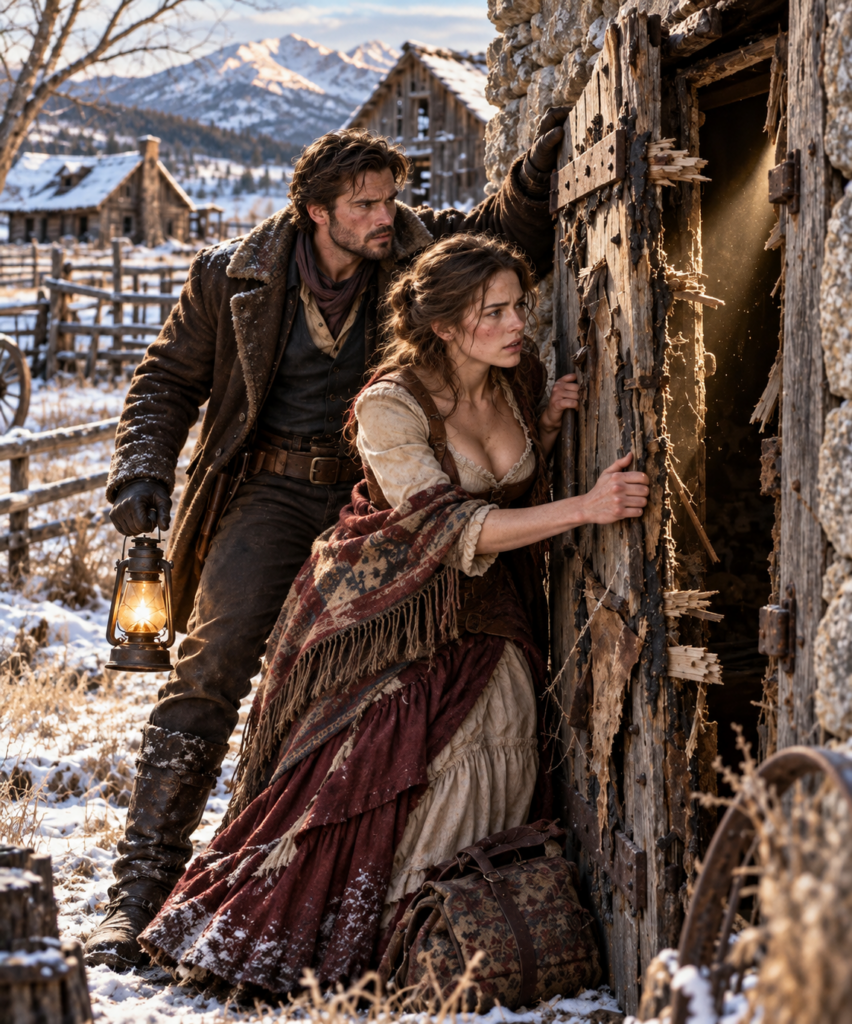
That was when she saw the smokehouse.
It stood behind the larger building, low and square, made of carefully fitted stone.
The oak door looked almost black.
Dozens of square-headed nails had been driven around its edges. Hard strips of ancient leather covered every seam. Thick tar had been pressed over those strips until air itself seemed unwelcome.
Thirty years of winter had cracked the tar.
The seal remained.
Lenora stood before it until darkness erased the details.
She felt no ghostly presence.
No warning.
What she felt was stranger.
Recognition.
Nobody had sealed that door in panic.
The nails were evenly spaced. The leather overlapped deliberately. Whoever had done this had taken time.
They had wanted something inside to remain untouched.
That first night Lenora slept on the cabin floor with her coat buttoned to her throat and her folding knife beside her hand. Wind slipped through gaps in the roof. Something scratched once beneath the porch.
She dreamed of Harriet.
In the dream, the old woman was trimming apple branches.
You’re cutting too much, Lenora complained.
Harriet smiled.
Then grow something worth saving.
Lenora woke before sunrise.
The smokehouse was the first thing she looked at.
She found an old hatchet inside the barn.
It took nearly two hours to open the door.
The nails fought her. The leather cracked in her hands. Tar clung stubbornly inside the seams. Her fingers became numb and then painful, and twice she nearly stopped.
Finally she wedged the hatchet beneath the door edge and pulled.
The oak groaned.
The frame shifted.
For one impossible second, Lenora had the childish thought that whoever sealed it might somehow still be holding the other side.
Then the door opened.
Cold stale air rolled over her.
The smell was not death.
It was smoke.
Salt.
Old wood.
Dried herbs.
Time.
Hooks hung from the ceiling. Stoneware crocks lined shelves. Ancient cured meat had hardened into useless black shapes. Dried beans lay scattered from a collapsed wooden chest.
Nothing supernatural waited inside.
Lenora almost laughed at herself.
Then she noticed the box.
It had been pushed behind the lowest shelf.
Black metal.
Bread-loaf sized.
No lock.
She carried it into the cabin.
Inside was a cloth pouch.
Coins spilled into her palm.
Silver.
Several gold pieces.
Folded banknotes wrapped carefully against moisture.
Lenora counted them.
Then counted them again.
Four hundred eighty-two dollars.
She sat motionless.
Four hundred eighty-two dollars could put glass in the windows.
Repair the roof.
Buy hens.
Buy seed.
Buy rope.
Buy enough time for work to become a livelihood.
Beside the money lay a worn pewter thimble and a folded letter protected inside waxed linen.
Lenora opened it.
The handwriting belonged to someone who had written carefully rather than easily.
To whoever finds this,
If you are reading these words, then you were not frightened away by what other people called lost.
My name is Beatrice Holloway.
My husband Samuel and I built this place when there was more grass than road in this country. We buried our son James beneath the cottonwoods on the east slope when fever took him at seven. Samuel died years afterward in the south field.
I remained here eleven years alone.
Some would call that stubbornness. They would not be entirely wrong.
When my hands became too painful to continue, I knew I would have to leave. I had no family who wanted this ground. I had no child left to give it to.
So I decided to leave something for the person who wanted it without already knowing what it could give them.
The money in this box is what I saved during those eleven years.
I sealed the smokehouse because I did not want a traveler to find it. I wanted it found by someone who had already decided to stay.
If you opened this door after choosing this place, then the money belongs to you.
Use it to begin.
The apple trees will need pruning.
The well was sound when I left.
The north fence was always troublesome.
Be good to the ground and perhaps it will be good to you.
Beatrice Holloway
Lenora read the letter twice.
Then a third time.
At the fourth reading, the words blurred.
She touched her face and discovered tears there.
Not because of the money.
Because thirty years earlier, a woman who had lost a husband, a child, and eventually the strength in her own hands had still been able to imagine a stranger arriving cold and alone.
A stranger who might need a beginning.
Lenora pressed Beatrice Holloway’s letter against her chest.
All her life, when something was taken from her, someone had eventually explained why the taking was legal.
Fever had taken her mother.
Grief had taken her father.
Poverty had taken childhood.
Inheritance law had taken Harriet’s farm.
But this was different.
A dead woman who owed Lenora nothing had reached across thirty years and said, in effect, I do not know you, but I prepared for you anyway.
Lenora cried until there was nothing dramatic about crying anymore.
Then she wiped her face.
She put the money back in the box.
She stepped outside.
And she began fixing the porch.
The following two months nearly killed her confidence before they built it.
Four hundred eighty-two dollars sounded like wealth when a person possessed eleven. It became considerably smaller when measured against lumber, nails, glass, rope, grain, food, roofing material, tools, livestock, and winter.
Lenora made rules.
She would not spend Beatrice’s money on comfort that did not create stability.
She repaired before replacing.
Salvaged before purchasing.
Worked before hiring.
And never confused suffering unnecessarily with virtue.
That last lesson came from Harriet too.
“A fool freezes beside a pile of money,” the old woman had once said, “then calls herself thrifty.”
Lenora spent what needed spending.
She replaced two broken windows, repaired the roof, restored the well, rebuilt the chicken house, and rehung the barn doors.
On her third trip into Red Willow, she entered Nell Harrow’s general store carrying a list.
“I need cut nails, six panes of glass, salt, lamp oil, and another coil of rope.”
Nell, a broad-shouldered woman in her fifties, studied her.
“You’re the Holloway woman.”
“I’m Lenora Vance.”
“I mean you’re the woman living at Holloway.”
“That would be me.”
Nell’s mouth twitched.
“You opened the smokehouse?”
News traveled quickly where entertainment traveled slowly.
“Yes.”
“And?”
“Old crocks. Ruined stores. Useful building.”
Nell waited.
Lenora waited longer.
At last Nell laughed once through her nose.
“You’ll do fine here.”
While she wrapped the glass, the bell over the door rang.
An older rancher entered.
“Gideon Pike,” he introduced himself after hearing where Lenora lived. “Rafter K, four miles south of you.”
“I know the fence line.”
“Then you know you have a bad northern stretch.”
“I know.”
“I can send my son with wire.”
Lenora’s shoulders stiffened.
“I pay my debts.”
“I didn’t mention a debt.”
“People usually do later.”
Gideon considered that.
“You’ve had practice with the wrong sort of people.”
“I’ve had practice with people.”
The older man nodded slowly.
“Fair enough. You send word when you need help. That way it’s your decision.”
That answer surprised her enough that she remembered it.
Two weeks later, after fighting frozen ground for three days while replacing fence posts, she sent word.
Gideon did not come.
His son did.
Wade Pike rode up carrying wire, two fence posts, and a shovel.
He was thirty, broad through the shoulders, weathered without looking old, quiet without seeming shy.
Lenora met him beside the north fence.
“I asked your father for wire.”
“He sent wire.”
“I can see that.”
“He sent me to carry it.”
“I can carry wire.”
Wade looked at the half-mile she had already repaired.
“I believe you.”
Something about that irritated her less than an argument would have.
They worked.
For an hour, they barely spoke.
When they reached a section where an old post hole had been dug too close to stone, Wade said, “Move three feet east.”
“The line will bend.”
“Better than hitting rock.”
“Or we dig wider and brace.”
“That’ll take twice as long.”
“It’ll last twice as long.”
Wade crouched, inspected the ground, and nodded.
“Then we brace.”
No wounded pride.
No lecture.
No insistence that he knew better because he was a man and she was not.
Lenora found that more unsettling than arrogance.
At dusk she made coffee.
They sat on the repaired porch.
Wade looked toward the orchard.
“My father says Beatrice Holloway grew the best apples north of Red Willow.”
“They’re not dead.”
“They look dead.”
“They’re neglected.”
“That different?”
Lenora glanced at him.
“Yes.”
He looked at the tangled branches again.
After a moment he said, “I suppose it is.”
Something moved inside her.
She did not yet have a name for it.
By January, Wade had become a familiar figure at the ranch, though Lenora never let his visits become necessary.
He came when she asked.
Sometimes when Gideon had business nearby.
Never to inspect her progress.
Never with gifts she had not requested.
When he disagreed, he said so. When she ignored his advice, he did not punish her with injured silence. When she was right, he admitted it.
Those qualities were so unfamiliar to Lenora that trust developed almost against her will.
The orchard became their first argument that lasted longer than an afternoon.
“You’re cutting too much,” Wade said as she stood on a ladder with pruning shears.
“I’m cutting dead and crossing growth.”
“That tree will look naked.”
“It’s an apple tree, Wade, not a church bride.”
His laugh startled a crow from the fence.
Lenora stared at him.
“What?”
“Nothing.”
“You laughed.”
“I did.”
“At me.”
“With considerable respect.”
“That sentence means nothing.”
“It means keep cutting your naked tree.”
She tried not to smile.
Failed.
Spring arrived violently.
Three days of warm rain struck mountain snow that had not yet melted. Blackpine Creek rose before dawn and continued rising.
Lenora woke to the sound of water where water did not belong.
She ran outside.
The lower pasture was disappearing.
Brown floodwater spread toward the barn.
Her two young hogs screamed from their pen. Chickens battered themselves against their coop.
Lenora opened the chicken house first, driving the flock toward higher ground. Then she fought through knee-deep water to the hog pen.
One animal bolted uphill.
The second froze.
“Move!”
Water surged against Lenora’s thighs.
The frightened hog squealed and backed toward the fence.
A hand caught Lenora’s coat.
She spun.
Wade.
“What are you doing here?”
“My father saw the creek.”
“Take the hog!”
“You take yourself!”
“I’m standing!”
“Barely!”
Together they forced the animal out.
Water reached the barn wall.
Wade surveyed the pasture.
“You need a diversion channel.”
“I know.”
“Where?”
Lenora pointed east.
“There’s a natural fall beyond the orchard.”
“That’s two hundred feet.”
“It’s enough.”
“It’ll take hours.”
“The barn doesn’t have hours.”
“Then why are we talking?”
They dug.
Rain soaked them until their clothes weighed twice what they should. Mud filled their boots. Water rose faster than the trench deepened.
Gideon arrived with two ranch hands and more shovels.
Lenora did not waste time pretending she could do alone what five people could accomplish faster.
“From here to that low ground!” she shouted.
For three hours they cut the channel.
When Lenora finally broke the inlet, floodwater hesitated.
Then turned.
A brown stream entered the trench.
“Come on,” Wade whispered.
More water followed.
The advancing sheet around the barn slowed.
Gideon slapped Wade’s shoulder.
Lenora did not celebrate.
“Wait.”
Twenty minutes later debris clogged the bend.
Water began spilling over.
Lenora was first into the trench.
“Vance!” Wade shouted.
She dragged branches free.
Something struck her shin underwater.
She fell.
The current rolled her.
For a terrifying second, brown water filled her mouth and nose.
Then Wade hauled her upright.
“Are you trying to die?”
“No!”
“You have a strange method of proving it!”
“The channel—”
“I have the channel!”
“You missed the second blockage!”
Wade looked.
There was, in fact, another blockage.
Even half-drowned, Lenora felt vindicated.
“That is the most irritating face I have ever seen,” Wade said.
“Clear it!”
He cleared it.
By midnight, the barn remained standing.
They gathered in Lenora’s cabin afterward, soaked, muddy, exhausted.
Five people in the small room made it feel smaller than it had any right to feel.
Nell arrived from town with dry bread, blankets, and a pot of stew somebody had sent.
Lenora looked around the crowded cabin.
“I didn’t ask for all this.”
Nell removed her wet coat.
“No.”
“I could have managed.”
“Probably.”
Lenora stared at her.
Nell handed her a bowl.
“That doesn’t mean you’re supposed to.”
The words hit a place inside Lenora more tender than any bruise.
She looked toward Wade.
He was standing near the stove, water dripping from his hair.
When he caught her eye, he said nothing.
That helped.
The flood changed more than the pasture.
Afterward, people in Red Willow stopped referring to Lenora as “the woman at the Holloway place.”
They called her Lenora.
It was a small distinction.
It meant everything.
By summer, eggs from her hens were selling in town.
The restored orchard produced its first modest crop.
Lenora saved the applewood pruned from the trees, then used it to smoke her first serious cured ham inside Beatrice’s stone smokehouse.
When the meat was ready, she carried it to Ada Bell, who supplied meals to workers and travelers.
Ada cut one slice.
Chewed.
Cut another.
Lenora’s stomach tightened.
Finally Ada said, “How much?”
Lenora named a price.
Ada cut a third piece.
“I’ll buy everything you can cure through October at that price.”
Lenora did not move.
Ada frowned.
“Was that too low?”
“No.”
“Then why are you staring at me?”
“I’m trying not to behave foolishly.”
Ada smiled.
“Do it outside.”
Lenora made it to the street before laughing.
Not smiling.
Laughing.
She stood on the Red Willow boardwalk with people walking around her and laughed until tears came.
Gideon happened to be approaching from the land office.
He stopped.
“Good news?”
Lenora nodded.
“Very.”
That evening, back at the ranch, she took Beatrice’s letter from the black box.
She read it again.
I wanted it found by someone who had already decided to stay.
For months Lenora had wondered whether she had truly chosen the Holloway ranch or merely accepted it because she had nowhere else to go.
Now she understood that beginnings did not become less meaningful because desperation led you to them.
Sometimes desperation brought you to a door.
What mattered was what you did after opening it.
By September the ranch was supporting itself.
Lenora entered Aldis Fry’s office.
He looked up.
“Trouble?”
“No.”
“Then you’re unusual.”
“I want the property name changed in the county record.”
Aldis slowly removed his spectacles.
“To what?”
“Vance Ranch.”
He studied her.
“That took you longer than Nell predicted.”
“What?”
“There was a pool.”
“A pool?”
“On when you’d name it.”
Lenora stared.
“You gambled on me?”
“Technically we gambled on a date.”
“That distinction will comfort you when I throw your ledger out the window.”
Aldis smiled for perhaps the first time since she had known him.
He pushed a form across the desk.
“Sign here, Miss Vance.”
Lenora did.
This time, when she wrote her name on a piece of paper connected to land, she knew exactly what she was signing.
Wade came in late October.
The trees were bare again. The cured meat hung in the smokehouse. Firewood was stacked against the cabin wall. The south fence needed two posts replaced before snow.
They worked until sundown.
Afterward Lenora made coffee.
They sat on the porch in their coats.
She looked toward the orchard.
“I’ve been thinking about something you said during the flood.”
Wade blew across his coffee.
“I said several things. Some of them loudly.”
“You said coming here was a choice.”
“It was.”
“I didn’t think it was.”
He waited.
“That bothered me,” Lenora continued. “Because if you have nowhere else to go, can you really claim you chose where you ended up?”
Wade looked toward the hills.
“Did you stay after you had money?”
“Yes.”
“After you had customers?”
“Yes.”
“After you had people here who would’ve helped you find something easier?”
Lenora said nothing.
He finally looked at her.
“Then maybe the first day doesn’t get to define all the days after it.”
She lowered her eyes.
“I’m not good at needing people.”
“I know.”
“That wasn’t an apology.”
“I know that too.”
“I’m serious.”
“So am I.”
She looked at him sharply.
Wade’s expression had changed.
There was no teasing in it.
“I don’t want to rescue you, Lenora.”
Her chest tightened.
“Good.”
“I don’t think you need rescuing.”
“Better.”
“I would like to stand beside you while you do things that are clearly going to happen whether I’m here or not.”
Lenora looked down at her cup.
“That may be the least romantic thing anyone has ever said.”
“I can try again.”
“Please don’t.”
The corner of his mouth lifted.
She felt herself smile.
Wade reached across the space between their chairs, slowly enough that she could move away.
She did not.
His hand covered hers.
Lenora sat very still.
Not because she was frightened.
Because stillness had once been how she survived difficult moments.
Now, for the first time she could remember, stillness allowed her to remain inside a good one.
The following December, Lenora counted Beatrice Holloway’s remaining money.
Two hundred eleven dollars.
She had spent two hundred seventy-one.
Glass.
Nails.
Rope.
Seeds.
Hens.
Piglets.
Salt.
Tools.
Roofing.
Grain.
Everything that now existed around her in another form.
She spread the remaining money across the table.
For several minutes she wondered whether she should preserve it untouched.
Then she understood that would violate the entire point.
Beatrice had not saved money so money could survive.
She had saved it so somebody could.
Lenora took out a sheet of paper.
Her handwriting was plain.
My name is Lenora Vance.
I came here with eleven dollars and forty cents and nowhere else to go.
I found your letter, Beatrice.
I used what you left the way you asked me to.
The orchard lives.
The well is still sound.
You were right about the north fence.
The smokehouse works again. It earns money now.
The ranch has my name, though I hope you would not think that means I have forgotten yours.
I once believed inheritance was what the law allowed one person to take after another person died.
You taught me that inheritance can also be what someone chooses to prepare for a stranger.
I do not know who comes after me.
But I do not want to be the person who breaks the chain.
Lenora stopped writing.
She read the words.
Then she opened the drawer beside her bed.
Inside lay her mother’s tortoiseshell comb.
It was the oldest thing she owned.
She had carried it from childhood to Harriet Gould’s house, from Harriet’s house to Red Willow, from Red Willow up nine frozen miles to a ranch nobody wanted.
For years, touching it had felt like touching her mother’s hand.
Lenora lifted it.
Her first instinct was immediate.
No.
Some things could not be surrendered.
Then she looked at Beatrice’s worn thimble.
The thimble was not valuable.
That was why it mattered.
Beatrice had left proof that before she became a name on a letter, she had been a woman with fingers that sewed.
Lenora understood.
Slowly.
Painfully.
Completely.
Holding on and remembering were not the same act.
She pressed the comb to her lips.
“Thank you, Mama.”
Then she placed it beside Beatrice’s thimble.
She added her letter.
She closed the black box.
But she did not return it to the hidden corner where Beatrice had left it.
She carried it into the smokehouse and placed it on a low shelf in plain view.
Wade, who had been repairing a hinge outside, appeared in the doorway.
“What’s that?”
“Something that belongs to whoever comes next.”
He looked at the box.
“You’re planning on leaving?”
“No.”
“Good.”
She gave him a look.
He raised both hands.
“Continue.”
Lenora touched the lid.
“Beatrice sealed this building because she needed thirty years to separate the person who wanted easy money from the person willing to choose the land first.”
Wade nodded.
“But I don’t want the next person to have to break through nails and tar.”
“Why?”
“Because I want to leave them something different.”
“What?”
“An open door.”
Wade leaned against the stone frame.
Lenora looked around the smokehouse.
Thirty years earlier it had been closed around grief, savings, and a dead woman’s hope.
Now hams hung from the rafters.
Applewood smoke darkened the stones.
Outside, chickens scratched beside the barn. The well pulley creaked in the winter air. Horses moved behind repaired fences. Twenty apple trees stood pruned and strong against the snow.
A place once described as abandoned had become noisy with usefulness.
The door remained open behind them.
The real twist in Beatrice Holloway’s inheritance, Lenora finally understood, had never been the $482.
Money had repaired buildings.
But Beatrice’s faith in an unknown person had repaired something money could not reach.
Lenora had spent most of her life believing she was temporary everywhere.
A burden at her aunt’s house.
A hired girl at Harriet’s.
An inconvenience to Clifton Marsh.
A woman who could work on land but never belong to it.
Beatrice had left a different idea waiting inside a sealed room.
You came.
You stayed.
You can build from here.
The following spring, Lenora and Wade drove home from Red Willow in a wagon loaded with a new dairy cow, orchard tools, and enough fencing material to enlarge the eastern pasture.
They argued most of the way.
“You do not need twelve more apple trees,” Wade said.
“I need fifteen.”
“You have twenty.”
“I have twenty old trees.”
“They produced last year.”
“They’ll produce better with younger trees cross-planted among them.”
“You made that explanation up.”
“I did not.”
“It sounded suspiciously prepared.”
“Because I knew you’d complain.”
“I’m not complaining. I’m protecting the pasture.”
“From apples?”
“From you putting an orchard on every piece of ground you can see.”
Lenora looked at him.
“You understand this wagon belongs to me.”
“So does the ranch.”
“And the orchard.”
“Yes.”
“So why are you arguing?”
“Because apparently standing beside you includes occasional attempts to slow you down.”
“You’re failing.”
“I’ve noticed.”
The wagon reached the final ridge.
Vance Ranch appeared below.
Lenora pulled the reins gently.
The cow complained from behind them.
Wade looked at her.
“What is it?”
She stared down at the land.
The first time she had stood on this ridge, darkness had been coming. Snow had been falling. The cabin roof leaked, the barn door hung loose, the orchard resembled a collection of dead hands, and she possessed eleven dollars and forty cents.
Now sunlight lay across repaired shingles.
Smoke rose from the chimney.
The corral stood straight.
The orchard showed pale spring blossoms.
Near the barn, the smokehouse door stood wide open.
Lenora thought of Harriet teaching a frightened fourteen-year-old girl how to keep a fire alive.
She thought of her mother’s comb resting beside Beatrice’s thimble.
She thought of a woman she had never met, working alone for eleven years and saving coins for somebody whose name she could not know.
She thought of Clifton Marsh telling her she had three weeks before everything she loved belonged to someone else.
For years, Lenora had believed losing Harriet’s farm was the cruelest thing that could have happened to her.
Perhaps it had been cruel.
But cruelty and endings were not always the same thing.
Sometimes a door closed behind you because another door existed nine miles into the mountains, nailed shut beneath thirty years of tar, waiting for the precise version of you who had finally learned how to open it.
Wade followed her gaze.
“You’re going to do this for a long time, aren’t you?”
“Do what?”
“Build things people gave up on.”
Lenora considered the ranch.
Then she considered him.
“Yes,” she said.
Wade nodded toward the orchard.
“Fifteen trees?”
“Fifteen.”
“Twelve.”
“Fourteen.”
“Thirteen.”
Lenora smiled.
“Fifteen.”
He sighed.
“I walked into that.”
“You rode.”
“That somehow makes it worse.”
She laughed and released the brake.
The wagon rolled down toward home.
Years later, people in Red Willow would tell stories about Vance Ranch.
They would talk about the orchard.
The smoked hams.
The terrible flood.
The woman who arrived with almost nothing and became one of the most reliable employers in the Blackpine country.
But the story Lenora told mattered less than the one she quietly prepared.
The black box remained on the smokehouse shelf.
Over time, more letters joined the first two.
Beatrice Holloway’s thimble remained inside.
So did the tortoiseshell comb.
And beneath them, Lenora eventually placed money of her own.
Not because she expected to fail.
Not because she planned to leave.
But because somebody, someday, might arrive at Vance Ranch believing what Lenora had once believed.
That being broke meant being worthless.
That being alone meant being unwanted.
That losing one home meant you had missed your only chance to belong anywhere.
For that person, Lenora left the smokehouse unlocked.
She left instructions for the orchard.
Advice about the well.
A warning about the north fence.
And one sentence at the end of her final letter.
If you came here because the world ran out of places for you, stay long enough to discover that perhaps this place was waiting for you instead.
THE END

