
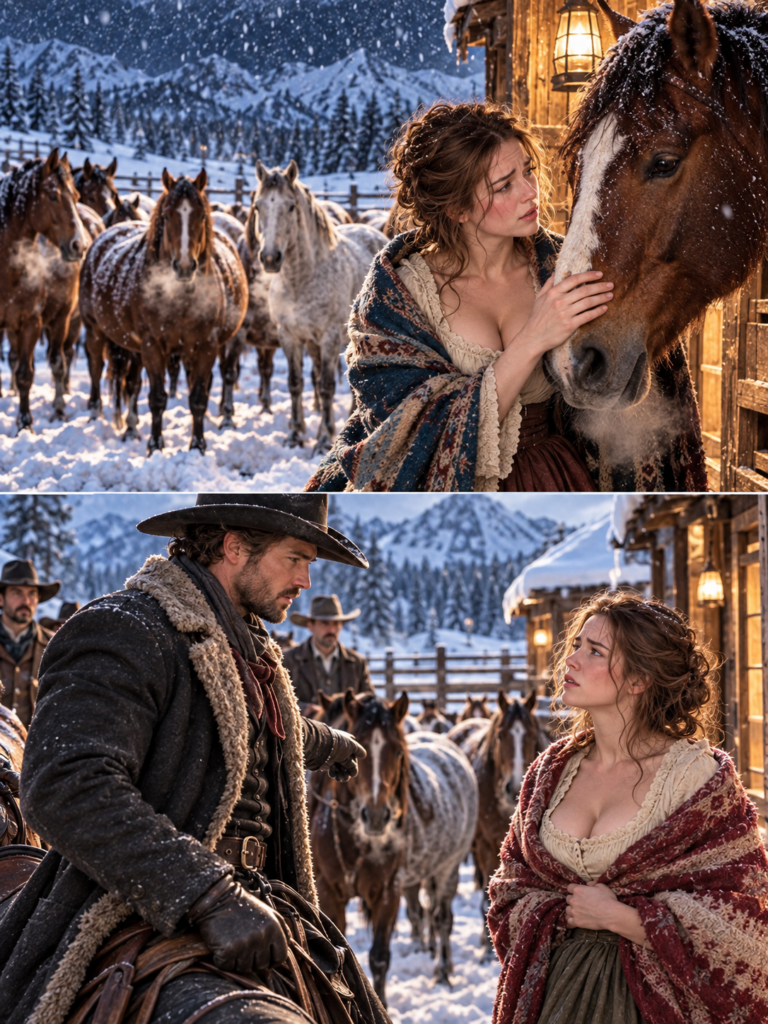
“Can you fix it?”
“Not like this. She’s weak. We need her circulation better, get some warmth into her, get her eating. Sometimes the foal shifts as the mare improves.”
“Sometimes?”
Ethan looked at her.
She appreciated him enough to hate that look.
“What aren’t you saying?”
“I’m saying she has a chance.”
“That isn’t what I asked.”
“No.”
Clara folded her arms.
Ethan sighed.
“She might lose the foal. She might die trying to deliver it.”
Clara looked at Grace.
“No.”
“Clara—”
“No.”
“That wasn’t a decision.”
“It is now.”
Ethan studied her, then nodded toward the house.
“Anything sweet?”
She remembered a jar in the pantry.
“Molasses. Daniel bought it when he was keeping bees.”
“How much?”
“Maybe half a jar.”
“Use it.”
“All of it?”
“What are you saving it for?”
The question entered her more deeply than Ethan intended.
What was she saving anything for?
The blanket in the chest.
The seventeen dollars and forty cents.
Daniel’s boots she could not wear.
His chipped coffee mug she never used.
The part of herself she had packed away because loving anything again seemed like giving winter another target.
Clara brought the molasses.
By noon Ethan’s young ranch hand, Pete Nolan, arrived dragging grain and two additional hay bales behind a sled.
His expression was strange.
“What?” Clara asked.
Pete removed his hat.
“Ma’am, I asked around about the horses.”
Ethan stopped working.
“And?” he said.
“They aren’t strays.”
Clara looked at Hope.
“Whose?”
Pete swallowed.
“William Carter’s.”
The name changed the air.
Carter owned the largest ranch in the valley, nearly three thousand acres spread along the best water. He was not loved, but money had made affection unnecessary.
Clara had met him twice.
He spoke to people the way a merchant inspected cattle.
“Were they stolen?” she asked.
“No, ma’am.”
“Then how did eight of his pregnant mares end up sixteen miles away?”
Pete hesitated.
“He turned them out.”
Ethan became very still.
“Explain.”
“Carter said they weren’t worth wintering. Said the bloodline hadn’t produced what he expected and hay would cost more than the foals would bring. He opened a north pasture gate three days ago.”
“Three days ago?” Clara repeated.
“Yes, ma’am.”
“Before the storm?”
Pete looked ashamed on behalf of another man.
“Yes.”
Clara turned slowly toward the mares.
Three days.
They had walked pregnant through the mountains for three days.
Past Hartley’s place.
Past Morrison’s barns.
Past Ethan’s eastern pasture.
Places with more hay.
Larger shelters.
More money.
They had continued until reaching Clara’s collapsing lean-to.
“Why?” she whispered.
“Why what?” Pete asked.
“Why here?”
Ethan looked at Hope.
The bay mare was watching Clara.
“Horses remember things people don’t notice,” he said.
“You think she knew me?”
“No.”
“Then that makes no sense.”
“Maybe not everything important does.”
That afternoon Clara named the remaining mares River, Faith, Joy, Constance and Mercy.
She did not tell Ethan.
He noticed anyway.
Around sunset, a woman named Mabel Hurst appeared with bread and dried apples.
“I heard you had a situation.”
“I’m fine,” Clara replied automatically.
Mabel stared at her chapped hands.
“Didn’t ask.”
Twenty minutes later Tom Brackett left two hay bales against the wall.
By dark Frank Dawson brought oats.
The next morning another family arrived with firewood.
Nobody announced that the valley had chosen Clara’s side.
They simply kept coming.
That nearly undid her.
For fourteen months, Clara had believed people saw her as a problem waiting to become somebody else’s responsibility.
Now she realized some of them had merely been uncertain how to cross the distance grief built around her.
The horses had crossed it first.
People followed.
William Carter came on the second afternoon.
Clara heard his horse before she saw him.
Fast.
Hard.
Entitled.
She stepped outside.
Carter reined in twenty feet away. He was broad-shouldered, gray at the temples and dressed in a heavy coat worth more than Clara’s winter supplies.
His eyes went to the lean-to.
“Mrs. Whitmore.”
“Mr. Carter.”
“Those are my mares.”
Clara said nothing.
“I’ll be taking them.”
Ethan emerged behind her.
“Taking them where?”
Carter’s jaw tightened.
“My property is not your concern.”
“They became our concern when they arrived half-dead.”
“I turned out livestock I no longer wished to winter. That does not transfer ownership.”
Clara tilted her head.
“You turned them out?”
“Yes.”
“Knowing the storm was coming?”
His eyes hardened.
“You should be careful how you frame things you don’t understand.”
“I understand eight pregnant mares walked sixteen miles through a blizzard because you decided hay cost more than their lives.”
“They are animals.”
“Yes.”
“They are property.”
Clara looked toward Grace.
Daniel’s blanket remained across her back.
“No,” she said softly. “That’s where you and I disagree.”
Carter dismounted.
“You don’t have the money to fight me.”
Ethan shifted forward, but Clara raised one hand.
She wanted to answer this herself.
Carter continued.
“You are a widow keeping a failing property alive month to month. You have no legal training, no influence and no resources. If you make this difficult, you’ll lose more than the horses.”
The old Clara might have heard a threat.
The Clara who had kept Grace walking circles through the night heard arithmetic.
Carter was assigning value.
His land.
His money.
Her poverty.
His certainty.
Her fear.
He expected the largest number to win.
Clara looked him directly in the eyes.
“I have kept eight of your horses alive for two days.”
“You had no authority—”
“One of them may die because you starved her before abandoning her.”
“I did not starve—”
“She had almost nothing left when she reached me.”
Carter’s voice sharpened.
“Be very careful.”
“No.”
He stopped.
Clara surprised herself with the calmness of that single word.
“I have been careful for fourteen months, Mr. Carter. Careful with food. Careful with money. Careful with firewood. Careful about asking neighbors for help because I did not want anybody thinking I couldn’t manage. Careful about grief because people become uncomfortable when widows grieve longer than expected.”
Ethan said nothing.
Carter said nothing.
Clara continued.
“I am tired of being careful with the wrong things.”
Carter’s nostrils flared.
“These mares belong to me.”
“Then send your claim through Silas Holt.”
That landed.
Carter knew the older attorney.
“You hired Holt?”
“He volunteered.”
It was not entirely true yet, but Clara had learned that confidence sometimes had to arrive before certainty.
Carter looked around.
For the first time he seemed to notice the extra hay.
The sled tracks.
The footsteps of neighbors.
Evidence that Clara Whitmore was no longer one isolated widow.
“You’re making a mistake.”
“Possibly.”
“You’ll regret this.”
“Possibly.”
“I’ll return Thursday.”
Clara nodded.
“I’ll still be here.”
After he rode away, her knees nearly gave out.
Ethan caught her elbow.
“You all right?”
“No.”
“Good.”
She looked at him.
“What?”
“Means you’re sane.”
Despite everything, she laughed.
It was the first real laugh she had produced since Daniel died.
That night Hope went into labor.
Clara noticed the change shortly after midnight.
The bay mare began pacing, circling, looking at her flank.
“Ethan.”
He was asleep sitting against the wall.
His eyes opened immediately.
“What?”
“I think Hope’s starting.”
They moved quickly.
Hope’s labor progressed normally, but nothing felt normal to Clara.
Each contraction tightened something inside her.
She knelt in straw, speaking softly.
“You brought everybody here,” she whispered to Hope. “You don’t get to quit before you see what all this trouble was for.”
Ethan almost smiled.
Then Hope lay down.
The delivery came fast.
For one terrible second the foal lay motionless.
Clara stopped breathing.
Then a small dark head moved.
The foal coughed.
Hope turned and touched the newborn with her nose.
Clara covered her mouth.
“Oh, thank God.”
“A filly,” Ethan said.
The tiny horse struggled almost immediately to rise.
She fell.
Tried again.
Fell again.
“Stubborn,” Ethan observed.
“Good.”
The filly planted trembling legs beneath herself.
Clara was crying before she realized it.
“What are you calling her?”
Clara watched Hope clean her newborn.
“Miracle.”
Ethan nodded.
“Appropriate.”
By sunrise half the valley seemed to know.
People appeared throughout the day.
Not to celebrate exactly.
Mountain people were suspicious of excessive celebration when more trouble remained.
They came with food.
Hay.
Coffee.
Advice.
Hands.
Clara noticed Grace watching Hope and Miracle from the adjoining stall.
Grace’s belly shifted violently.
Ethan noticed too.
His expression changed.
“No.”
Clara followed his gaze.
“What?”
“She’s closer than I thought.”
“How close?”
Grace pawed once at the floor.
Ethan swore under his breath.
“Close.”
The veterinarian could not reach them until morning.
Snow had blocked the southern trail.
By nine that night, Grace was in labor.
By ten, Ethan knew the foal had not turned enough.
“This is bad,” he said.
Clara’s skin went cold.
“What do we do?”
“We try.”
Grace strained.
Nothing happened.
Ethan checked again.
The mare trembled from exhaustion.
“We may have to choose.”
Clara stared at him.
“Choose what?”
“If the foal stays lodged, we lose both.”
“No.”
“Clara.”
“You said that before.”
“I was hoping the position would correct.”
“So correct it.”
“This isn’t a fence post.”
“Then tell me what you need.”
Ethan stared at her.
“A clear head.”
“You have one.”
“I mean yours.”
She understood.
He was asking her to accept the possibility that hope was not control.
Clara moved to Grace’s head.
The mare was soaked with sweat despite the cold.
“Hey.”
Grace rolled a frightened eye toward her.
Clara put both hands on the animal’s face.
Fourteen months earlier, she had knelt beside Daniel’s bed holding his hand while his fever climbed.
She had begged him to stay.
Daniel had looked at her and whispered, “Clara, loving me is not the same as being able to keep me.”
She had hated him for saying it.
For months afterward, she had hated herself because love had not been enough.
Now Grace strained beneath her hands, and Clara understood something Daniel had been trying to give her.
Love was not power over an ending.
Love was staying when the ending frightened you.
“I’m here,” she whispered.
Ethan worked.
Minutes became an hour.
Grace weakened.
“Again,” Ethan said.
The mare tried.
“Come on, Grace.”
Another contraction.
Ethan changed position.
“I’ve got something.”
“What?”
“A leg.”
“One?”
“Yes.”
“That’s bad?”
“It’s better than none.”
He worked carefully.
Then stopped.
“What?”
“Clara, I need you to keep her down.”
She dropped beside Grace.
The mare’s breathing was ragged.
Clara pressed her forehead against the gray face.
“You walked sixteen miles.”
Grace’s ear moved.
“You walked past three warm barns because somehow you decided my broken little cabin was where you wanted to stop.”
Grace breathed against her.
“So you listen to me. You did not drag yourself through a Wyoming blizzard to die in my lean-to.”
Another contraction seized her.
Ethan shouted, “Now!”
Grace pushed.
Clara heard herself crying.
Ethan pulled.
Something shifted.
“Again!”
Grace gathered whatever remained.
One final violent effort.
The foal came free.
For one second nobody moved.
Then Ethan dropped to his knees.
The foal was still.
“No,” Clara whispered.
Ethan cleared its airway.
Rubbed hard.
Nothing.
“Ethan.”
“I’m working.”
Grace attempted to lift her head.
“Come on,” Clara pleaded. “Come on, baby.”
Ethan rubbed harder.
The foal jerked.
A tiny breath.
Then another.
Clara made a sound that did not resemble laughter or crying but contained both.
“He’s breathing.”
“He?”
“Colt.”
Grace lifted her head.
Ethan moved the newborn closer.
The mare touched him with her nose.
The exhausted gray horse who had nearly died four nights earlier made a low sound Clara felt in her chest.
The colt answered.
That was when Clara finally broke.
She sat in the straw and sobbed.
Not quietly.
Not politely.
Not the contained grief she allowed herself when neighbors might hear.
Fourteen months came out of her.
Daniel’s fever.
The grave.
The empty bed.
The seventeen dollars and forty cents.
The neighbors’ pity.
The cold.
The fear.
Every morning she had risen because there had been chores and not because she had wanted another day.
Ethan sat beside her without speaking.
After several minutes he asked, “What do we name him?”
Clara wiped her face.
She looked at Grace and the tiny colt.
“Redemption.”
“That’s a lot of name for something that weighs less than a sack of feed.”
“He’ll grow.”
Ethan nodded.
“Suppose he will.”
Clara leaned against the wall.
Across the lean-to, Hope stood over Miracle.
Grace rested beside Redemption.
Two mothers.
Two newborns.
Both alive.
And the strangest thought entered Clara’s mind.
Maybe the miracle was not that the foals survived.
Maybe it was that she had cared whether they did.
Silas Holt arrived the next morning.
He listened to the story at Clara’s kitchen table while drinking coffee strong enough to frighten most civilized people.
When she finished, he asked, “How many people heard Carter admit he intentionally released the mares?”
“Pete. Several men in town, apparently.”
“And Ethan heard him say it here?”
“Yes.”
Holt made notes.
“How much have you spent?”
“I haven’t calculated it.”
He looked up.
“I understand you’re having a difficult relationship with arithmetic.”
Clara almost smiled.
“Something like that.”
“Well, unfortunately the law remains fond of arithmetic. Hay, grain, medicine, labor.”
“I don’t want his money.”
“This is not about wanting it. It establishes responsibility.”
Clara looked toward the wall separating the kitchen from the lean-to.
“What are my chances?”
“Of keeping them?”
“Yes.”
Holt removed his glasses.
“If Carter had simply lost horses and you found them, poor.”
“But he didn’t.”
“No. He intentionally released pregnant livestock before a known storm and publicly stated they were not worth the cost of wintering.”
“So?”
“So I intend to make a very simple argument.”
“Which is?”
“A man should not be allowed to abandon responsibility when it is expensive and reclaim ownership once someone else makes it valuable again.”
Clara sat back.
“That sounds almost fair.”
“Don’t become sentimental. Courts are unpredictable.”
Carter filed his claim that afternoon.
The hearing took place the following week in a crowded room behind the county clerk’s office.
Clara had never seen so many neighbors in town at the same time without a funeral.
Mabel Hurst sat behind her.
Pete stood near the wall.
Tom Brackett brought both sons.
Ethan sat at Clara’s right side.
Carter entered with an attorney named Arthur Reed and looked genuinely irritated by the crowd.
The hearing officer listened first to Carter.
Carter was polished.
He claimed the mares had been temporarily released into a winter pasture because feed supplies needed to be reorganized.
Pete whispered behind Clara, “That’s a lie.”
Holt murmured, “Good. Let him finish it.”
Carter claimed Clara had knowingly retained branded property.
Then Holt called Pete.
“Did Mr. Carter tell you he intended to recover the mares?”
“No, sir.”
“What did he say?”
Pete looked toward Carter.
Then toward Clara.
“He said they weren’t worth feeding.”
A murmur spread through the room.
“Anything else?”
“He said if nature wanted them, nature could have them.”
Silence.
Carter’s face hardened.
Holt called Ethan.
Then two ranch hands.
Then Mabel, who had heard Carter repeat essentially the same statement in town.
Finally Holt called Clara.
She sat with her hands folded.
He asked about the night the mares arrived.
She told the truth.
Four hay bales.
Seventeen dollars and forty cents.
Eight animals shaking outside her door.
Grace refusing food.
Daniel’s blanket.
Hope giving birth to Miracle.
Grace nearly dying while delivering Redemption.
When Holt finished, Reed approached her.
“You have no veterinary training, correct?”
“No.”
“No legal training?”
“No.”
“So when you say Mr. Carter abandoned these horses, that is your personal interpretation.”
Clara considered him.
“No.”
Reed blinked.
“No?”
“It’s what happened.”
“You are not qualified to make a legal determination.”
“I didn’t make one.”
“You just did.”
“No. I made an ordinary one.”
Someone in the room coughed to hide a laugh.
Reed’s expression tightened.
“Mrs. Whitmore, you admit you knew at least three mares carried Mr. Carter’s brand.”
“Yes.”
“And you nevertheless refused to return them.”
“Yes.”
“Because you became emotionally attached.”
Clara looked at him.
“No.”
“You named them.”
“I did.”
“You slept beside them.”
“Yes.”
“You gave one your deceased husband’s blanket.”
“Yes.”
“And yet you deny emotional attachment?”
“I didn’t say I wasn’t attached.”
“Then what are you saying?”
Clara glanced toward Carter.
“I am saying attachment did not make him abandon them.”
The room went still.
“He did that himself.”
Reed paused.
Clara continued before he could stop her.
“If I had closed my door that night, those mares might have died, and Mr. Carter would have lost nothing he had not already decided was disposable. But I opened my door. Neighbors brought hay. Ethan stayed up nights. Pete hauled grain. Two foals were born alive. Suddenly Mr. Carter’s unwanted animals became property again.”
Carter shifted.
Clara looked directly at him.
“That is the part I object to.”
Reed said, “Mrs. Whitmore—”
“No. You asked why I kept them. That is why. Responsibility does not disappear when something stops making money.”
Nobody moved.
The hearing officer looked down at his notes.
Then he said they would reconvene after reviewing testimony.
Three days passed.
During those three days another mare delivered a healthy foal.
Then another.
By the time the decision came, Clara’s lean-to had become hopelessly inadequate.
Ethan walked the fence line beside her.
“My southern pasture touches your north boundary.”
“I know.”
“Seven and a half acres.”
She looked at him.
“What?”
“I’d sell them to you.”
“With what money?”
“Pay me over time.”
“I won’t take charity.”
“Didn’t offer it.”
“Ethan.”
“Clara.”
She stopped walking.
Snow glittered beneath the afternoon sun.
“Why?”
Ethan took off his hat.
He stared at it for so long Clara almost laughed.
Finally he said, “Daniel asked me before he died to keep an eye on you.”
Clara’s throat tightened.
“What?”
“He knew.”
“Knew what?”
“That he was sicker than he told you.”
She stared at Ethan.
“No.”
“He made me promise not to interfere unless you asked.”
Anger arrived first.
“He had no right.”
“I told him that.”
“He planned my life after his death?”
“No. He tried to make sure you had somebody nearby.”
Clara turned away.
Tears burned her eyes.
“All this time?”
“All this time.”
“And you stayed away.”
“You didn’t ask.”
“That was the promise?”
“Yes.”
She laughed bitterly.
“Two stubborn men deciding the respectful thing was to leave a grieving woman alone.”
“Sounds worse when you phrase it accurately.”
Despite herself, she smiled.
Ethan continued.
“I’m telling you now because the land offer isn’t Daniel’s. It’s mine.”
Clara turned back.
“Why?”
“Because seven and a half acres do me less good than they’ll do you.”
“That’s arithmetic.”
“Yes.”
“And you know how I feel about arithmetic.”
“I’m learning.”
She studied him.
“How much?”
He gave her a number far below market value but high enough to preserve her pride.
“Seven and a half acres?”
“Yes.”
“Payments after spring?”
“Yes.”
“And you don’t get to forgive the balance later.”
“No.”
“Put that in writing.”
A corner of Ethan’s mouth moved.
“Yes, ma’am.”
The final ruling came in March.
By then seven foals had been born alive.
Hope’s Miracle.
Grace’s Redemption.
And five more sturdy little creatures who seemed determined to turn Clara’s exhausted property into chaos.
The hearing officer rejected Carter’s claim.
His decision was simple.
There was no credible evidence that Carter had intended a temporary release.
Multiple witnesses proved he had deliberately relinquished the mares because he considered them economically worthless.
Clara’s emergency care had preserved lives Carter had knowingly exposed to fatal conditions.
The mares remained with Clara.
So did the foals.
Carter was ordered to reimburse documented emergency feed and medical costs.
He sat completely still while the ruling was read.
Then he stood.
Clara expected anger.
A threat.
Something.
Instead Carter looked at her across the room.
For the first time since she had met him, he did not look powerful.
He looked old.
Not defeated exactly.
Confronted.
“You really believe those horses chose you?” he asked quietly.
Clara considered the question.
“I believe they kept walking until they found an open door.”
Something in Carter’s face shifted.
He nodded once.
Then he left.
There was no grand punishment.
His ranch did not collapse.
He did not become poor.
Clara did not need him to.
Sometimes justice did not require destroying the person who had done wrong.
Sometimes it required preventing him from deciding the ending.
Outside the building, neighbors surrounded Clara.
Pete shook Ethan’s hand.
Mabel hugged Clara and immediately pretended she had not.
Tom Brackett announced that the new pasture fence would need at least twenty posts and somehow, by the following Saturday, twenty-six appeared.
Clara stood in the middle of them feeling overwhelmed.
Fourteen months earlier she had believed grief had reduced her life to a cabin and a grave.
Now people were arguing over who would bring lumber.
Ethan came to stand beside her.
“Fifteen horses,” he said.
Clara looked at him.
“Fifteen horses.”
“Seven and a half new acres.”
“Pending paperwork.”
“Of course.”
They started home late that afternoon.
March snow remained deep, but the light had changed.
Winter no longer looked permanent.
That mattered.
When Clara reached the cabin, Hope was the first to greet her.
The bay mare crossed the enclosure and pressed her face against Clara’s shoulder exactly as she had after the storm.
Clara wrapped both arms around her neck.
“We won.”
Hope breathed against her hair.
Miracle came trotting behind her on absurdly long legs.
Across the pasture, Grace stood beside Redemption.
The gray mare had gained weight. Her ribs no longer showed. Daniel’s blanket had been washed, folded and placed back in Clara’s chest—not because she could not bear to see it anymore, but because she finally could.
Ethan stopped near the fence.
Clara looked around.
The barn neighbors had helped build.
The mares that should have died.
The foals that should never have drawn breath.
The land she was going to work.
The cabin chimney trailing smoke against the pale sky.
Daniel’s grave still stood on the hill.
Nothing had erased what she lost.
That was the part people misunderstood about healing.
It did not negotiate with the past.
It did not give back the dead.
It did not turn suffering into something that had secretly been good for you all along.
Daniel should have lived.
Grace should never have been abandoned.
Those mares should never have needed to walk sixteen miles through a blizzard.
There was nothing beautiful about those facts.
The beauty was in what happened afterward.
Someone opened a door.
Someone else brought hay.
Another brought bread.
A tired old horseman put on his coat without asking whether helping was sensible.
A young ranch hand told the truth when a rich man expected silence.
A valley that had watched a widow disappear into grief began knocking on her door until she understood she was still part of it.
And eight exhausted animals who had nothing left kept walking anyway.
Clara felt Ethan beside her.
She reached back without looking.
Her hand found his.
He held it.
No promise.
No declaration.
No attempt to replace Daniel.
Just warmth.
Just presence.
Just somebody standing there.
Clara watched Redemption race after Miracle until his legs tangled and he nearly fell.
She laughed.
Ethan looked at her.
“What?”
“Nothing.”
“That was clearly something.”
She wiped at her eyes.
“I spent fourteen months wondering why I survived when Daniel didn’t.”
Ethan’s face softened.
“And?”
Clara looked at Hope.
“I think I was asking the wrong question.”
“What’s the right one?”
She watched the horses moving across the snow.
“What am I going to do because I did?”
Ethan said nothing.
He did not need to.
A week later Clara climbed the hill to Daniel’s grave.
Spring had begun eating holes through the snow. Dark soil showed beneath the pines.
She brought no flowers.
Daniel had always said flowers belonged alive in the ground.
She sat beside the marker.
“You would’ve liked Hope.”
The wind moved gently through the grass.
“She’s bossy.”
Clara smiled.
“You’d have claimed she learned it from me.”
She told him about Miracle.
About Redemption.
About the hearing.
About Carter.
About Ethan’s seven and a half acres.
Then she was quiet.
“I gave Grace your blanket.”
Her voice trembled.
“I thought you should know.”
The mountain remained silent.
Clara pressed one hand against the cold stone.
“I kept thinking holding on to your things was the same as holding on to you.”
Her eyes filled.
“It isn’t.”
She swallowed.
“I know that now.”
For a long time she simply sat there.
Then she stood.
“I’m going home.”
The words stopped her.
Home.
Not the cabin.
Not the place Daniel left behind.
Home.
Below the hill, fifteen horses moved inside the new fence.
A hammer rang where Pete and the Brackett boys were extending the shelter.
Mabel Hurst was walking toward Clara’s porch carrying something in a covered basket and undoubtedly planning to deny that it was an act of kindness.
Ethan stood near the pasture gate.
Hope lifted her head.
Even from that distance, Clara could see the white blaze on her face.
The mare called once.
Clara laughed.
“I’m coming.”
She touched Daniel’s stone one final time.
Then she walked down the hill.
Years later, people in that valley would tell the story differently depending on who was speaking.
Some would say it was about eight pregnant mares surviving a blizzard.
Some would say it was about a widow standing up to the richest rancher in the county.
Others would remember the winter when neighbors began leaving hay outside Clara Whitmore’s door.
Children would prefer the part where Miracle learned to open a gate latch and led three foals directly into Clara’s kitchen garden.
Ethan would always insist the real story began when Clara walked through waist-deep snow to ask for help.
Clara disagreed.
She knew exactly when it began.
Midnight.
December 3.
A knock that was not a knock.
Eight freezing animals outside a door.
A woman inside who believed she had almost nothing left.
Four hay bales.
Seventeen dollars and forty cents.
Two blankets.
One broken heart.
Clara had believed that was not enough to save anything.
The mares had believed otherwise.
Perhaps that was why they passed three wealthy ranches.
Perhaps animals understood a truth people complicated with pride, property and fear.
Shelter was not always the biggest barn.
Safety was not always where the most food was stored.
Sometimes home was simply the place where suffering was seen and the door still opened.
Clara had saved eight mares that December night.
That was how the valley told it.
But whenever she heard the story, she would look toward Hope grazing in the pasture and smile.
Because Clara knew the part everyone else had backward.
Those horses had not come to her cabin because she was the only person who could save them.
They had come because, somewhere beneath fourteen months of grief, Clara Whitmore was the one who needed to remember she was still capable of opening a door.
And once she did, life came through it.
THE END

