
PART 3
He glanced toward her.
“And I knew what she needed.”
Mike searched for the simplest version of what had been on his mind all week.
“Every neighborhood becomes the result of thousands of small decisions. We see something and act, or we see something and pretend we didn’t.”
He looked around the room.
“Those decisions add up. They become the street our kids walk down. They become whether an elderly neighbor feels safe getting groceries after dark. They become whether a woman believes somebody will help if she asks.”
Emma was beaming again.
“I’m not telling anybody to start fights.”
Officer Brooks, standing near the wall, nodded appreciatively.
“But I am saying that regular people have to decide that they care enough to do something. Sometimes doing something means speaking up. Sometimes it means calling police. Sometimes it means walking someone home.”
Mike shrugged.
“That’s all.”
It wasn’t all.
The meeting created committees.
Committees created plans.
Within two months, the city replaced six broken streetlights after residents submitted coordinated requests instead of individual complaints.
Businesses installed brighter exterior lighting.
Volunteers organized evening walking groups.
Residents created a phone tree.
The community center began hosting monthly dinners so neighbors could actually meet one another before emergencies forced them together.
Elena became one of the organizers.
At first, she claimed she was only helping.
Soon everyone knew she was the person who made things happen.
She coordinated volunteers while balancing Mateo on her hip.
She contacted the councilman’s office.
She found grant applications.
She convinced local businesses to donate food and supplies.
Mike remained Mike.
He worked.
He raised Emma.
He attended meetings when Emma made him.
He fixed things when people asked.
But he also noticed something changing in himself.
For years after Sarah died, he had treated survival like a private responsibility.
Now people were appearing in his life again.
Three months after the night outside Callahan’s, Mike was repairing the steps of his front porch when Elena stopped by with Mateo.
The baby was crawling then and had developed a habit of grabbing anything within reach.
“We’re having a picnic Sunday,” Elena said.
“Who’s we?”
“Basically half the neighborhood.”
“That’s terrifying.”
“You’ll survive.”
Mike smiled.
“You and Emma should come.”
“We’d like that.”
As Elena left, Emma emerged from the house.
“Was that Elena?”
“Yes.”
“Is Mateo walking?”
“Not yet.”
Emma sat beside him on the unfinished step.
She watched Mike drive a screw into a replacement board.
Then she asked, “Do you think Mom would be proud of you?”
Mike stopped working.
Sarah had been gone eight years.
Most days, grief no longer arrived like an explosion.
It had become weather.
Usually somewhere in the background.
But there were questions that brought the storm close again.
“I think she’d be proud of what’s happening now.”
“Meaning?”
“Everybody helping.”
He set his drill aside.
“Doing something once is easy compared to doing it every week. The harder part is showing up after everyone stops paying attention.”
Emma nodded thoughtfully.
“I’m going to be like that.”
Mike smiled and ruffled her hair.
“You already are.”
Sunday picnics became regular.
So did dinners.
Mateo became obsessed with Emma, who could make him laugh by simply putting a paper cup on her head.
Mike started helping Elena assemble furniture.
Once, when she had a job interview and her babysitter cancelled, Mike watched Mateo for two hours.
Emma considered this evidence supporting a theory she had apparently been developing privately.
One evening, while walking home from Elena’s apartment, she announced it.
“Mateo needs a dad like you.”
Mike nearly stumbled.
“What?”
“I’m just saying.”
“Please stop saying.”
“And I wouldn’t mind a little brother.”
“Emma.”
“Or Elena could have another baby someday. Maybe a girl.”
Mike stopped walking.
“That isn’t remotely how this works.”
“Why?”
“Because life is not a dollhouse.”
Emma looked unimpressed.
“You like Elena.”
Mike resumed walking.
“Elena is my friend.”
“She likes you.”
“Also friendship.”
“I can tell the difference.”
Mike sighed.
“You’re twelve.”
“Exactly. I’m not distracted by adult excuses.”
That sounded disturbingly like Sarah.
The truth was that Mike had noticed Elena.
He noticed her laugh.
He noticed the way she became more confident every month.
He admired how she’d taken one frightening experience and turned it outward instead of allowing it to shrink her life.
But dating had not been part of Mike’s vocabulary for years.
After Sarah died, the very idea felt disloyal.
Later it simply felt impossible.
Dating someone new seemed too close to admitting that the future was allowed to contain things Sarah would never see.
“It’s complicated,” he finally told Emma.
“Adults always say that when they’re scared.”
Mike looked at her.
She kept walking as though she hadn’t just dismantled several years of emotional defenses in eight words.
The next weekend, Maplewood’s neighborhood watch held a park cleanup.
Mike and Emma arrived early.
Elena was already directing volunteers with Mateo strapped to her chest.
She wore jeans, sneakers, and a faded green T-shirt, her hair pulled into a loose ponytail.
“You’re good at this,” Mike told her while unloading trash bags and gloves.
“At carrying garbage bags?”
“Getting people together.”
Elena adjusted Mateo’s hat.
“I never thought I was.”
“What changed?”
She looked across the park.
“Before that night, I was trying to survive. Work. Rent. Mateo. Groceries. Sleep.”
She smiled faintly.
“Mostly not sleep.”
Mike understood.
“I thought community problems belonged to people who had extra time.”
“And now?”
“Now I think that’s backward.”
She gestured toward the volunteers.
“This is how things get better. People decide the problem belongs to them too.”
Mike was quiet.
“Sarah used to say things like that.”
Elena looked at him.
It was the first time Mike had voluntarily mentioned his wife to her.
“My wife,” he clarified unnecessarily. “She was always organizing something. School fundraisers. Food drives. Holiday collections.”
His voice softened.
“After she died, I stopped doing all of it.”
“I’m sorry.”
“It was eight years ago.”
“That doesn’t mean you’re done missing her.”
Mike looked at Elena.
She hadn’t said it with pity.
That mattered.
“No,” he admitted. “I’m not.”
Elena glanced toward Emma, who was organizing younger children into cleanup teams.
“You’ve raised an incredible daughter.”
Mike felt the familiar swell of pride.
“She makes me look better than I am.”
For the rest of the afternoon, Mike and Elena worked side by side.
They talked about movies.
Jobs.
Parenting.
Bad landlords.
Cleveland winters.
Their children.
Elena told him Mateo’s father had disappeared during her pregnancy. She didn’t speak bitterly. She simply said she’d stopped waiting for someone who clearly had no intention of becoming dependable.
Mike didn’t press for details.
By the time volunteers sat down for lunch, he realized he had not felt that comfortable around a new person in years.
On the walk home, Emma gave him a look.
“What?”
“Ask her out.”
Mike laughed.
“You’ve become very invested in this.”
“Because somebody needs to.”
“I’ll think about it.”
He thought about it for an entire week.
He considered every reason not to.
Elena was his friend.
Their children were attached.
Their neighborhood lives overlapped.
If dating failed, it could complicate everything.
Mostly, though, Mike was afraid.
Not of Elena.
Of hope.
Hope created something that could be lost.
He had spent eight years organizing his life around reducing that risk.
At the next neighborhood watch meeting, Mike walked Elena to her car.
Mateo was already asleep in his carrier.
Mike stood beside the passenger door, suddenly feeling like a sixteen-year-old who had forgotten how conversation worked.
“I was wondering…”
Elena waited.
Mike nearly retreated.
Then he remembered something Emma had said.
Adults always say complicated when they’re scared.
He forced himself forward.
“Would you and Mateo want to have dinner with Emma and me sometime?”
“We have dinner all the time.”
“No.”
Elena’s expression shifted slightly.
“I mean not a neighborhood dinner.”
Mike rubbed the back of his neck.
“Not furniture assembly. Not watching Mateo. Just… dinner.”
Elena looked at him for several long seconds.
Mike’s courage, which had somehow been sufficient for three drunk men, rapidly failed him in a parking lot with one woman holding a diaper bag.
Then Elena smiled.
It was different from her community-meeting smile.
Softer.
“I’d like that.”
Mike breathed again.
“We’d both like that very much.”
Their first dinner was deliberately ordinary.
Pizza.
Emma talked too much.
Mateo threw a spoon.
Nobody called it a date until afterward.
Then there was another dinner.
And another.
Mike discovered that moving forward didn’t feel like replacing Sarah.
That had been his greatest fear.
Instead, it felt like allowing the life Sarah had loved him enough to share to continue growing after her absence.
Emma never stopped talking about her mother.
Neither did Mike.
Elena never asked them to.
That may have been the reason it worked.
Over the following year, Maplewood continued changing.
Not magically.
There were still problems.
Streetlights still failed.
Teenagers still broke park equipment occasionally.
People still argued at meetings.
But residents knew one another.
When Mrs. Guzman became sick, meals appeared outside her apartment.
When Mr. Patel’s hardware store flooded after a pipe burst, twenty neighbors spent Saturday helping him clean.
When a teenager named Jordan stopped showing up at basketball practice because his mother couldn’t afford new shoes, somebody quietly solved the problem without turning it into charity theater.
Elena became a formal community liaison for a nonprofit focused on neighborhood safety.
Mike remained a construction foreman.
He eventually joined the community center board only because everyone nominated him while he was absent.
Emma found this hilarious.
One evening, almost two years after the incident outside Callahan’s, Mike stood near the same convenience store.
The owner had installed brighter lighting.
A new camera faced the sidewalk.
Across the street, two teenagers in volunteer vests walked an elderly resident home from the pharmacy.
Elena stood beside Mike holding Mateo’s hand.
The boy was nearly three now and fascinated by trucks.
Emma, fourteen, was inside buying ice cream.
Their Friday ritual had expanded.
Mike looked toward the brick wall where Elena had once stood trapped.
“You ever think about it?”
She followed his gaze.
“That night?”
“Yeah.”
“Sometimes.”
“Does it still scare you?”
Elena considered.
“Not in the same way.”
She squeezed Mateo’s hand.
“For a while, I hated this block.”
Mike understood.
“Then I realized the worst thing that happened to me here isn’t the only thing that happened here.”
Emma came outside carrying four cones.
“Nobody move. I have limited structural integrity.”
Mike took two.
Elena laughed.
They started walking home.
Mike thought about the strange mathematics of consequences.
If he had looked away that night, Elena probably would have eventually escaped those men.
Police still might have caught them.
Maybe somebody else would have intervened.
Or maybe not.
He would never know.
But he knew what followed because he hadn’t looked away.
A meeting.
A neighborhood watch.
Streetlights.
Picnics.
Friendships.
Emma learning that courage mattered more when it was inconvenient.
Elena discovering leadership.
Mike discovering that protecting his heart and closing it were not the same thing.
One choice had not magically created all those things.
It had simply interrupted the silence.
Other people did the rest.
That distinction mattered to Mike.
He never wanted Emma believing one heroic person saved communities.
Communities saved themselves when enough ordinary people decided they belonged to one another.
Years later, when Emma was preparing to leave for college, she found the old video online.
Mike had nearly forgotten it existed.
She came into the kitchen holding her laptop.
“Dad.”
He saw the frozen image.
“Oh, no.”
“You look so young.”
“I was forty-two.”
“Exactly.”
“You’re cruel.”
Emma sat down.
The video played.
There he was in his faded cap.
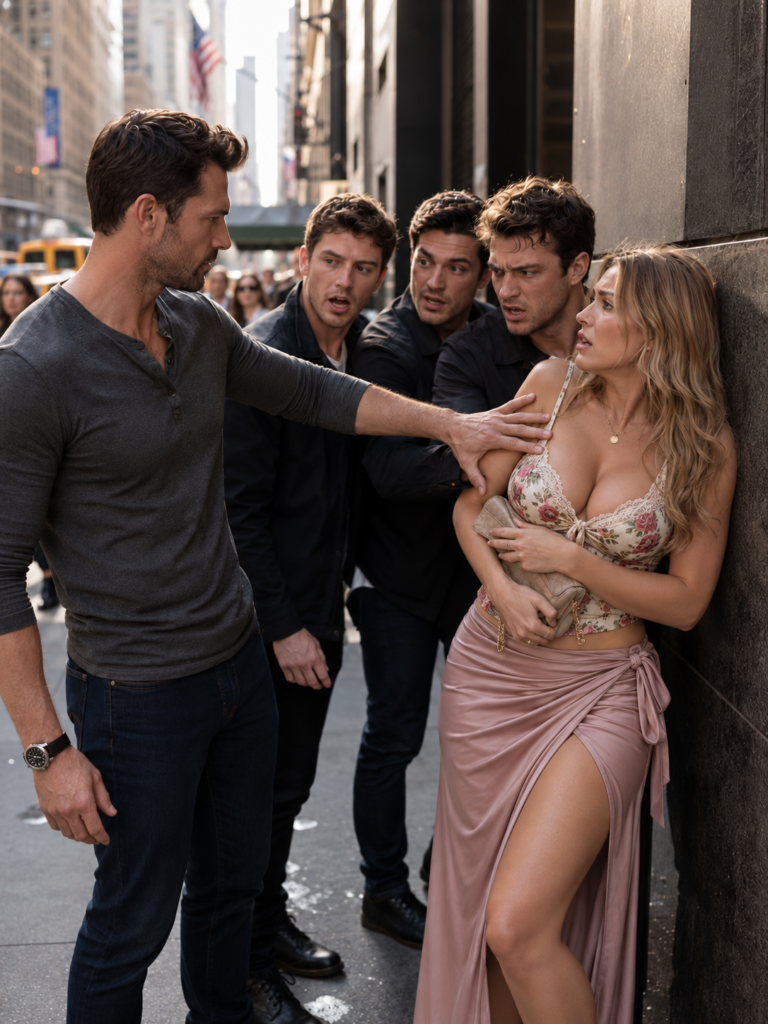
Elena against the wall.
Three young men.
The shove.
The screech of brakes.
Doors opening.
Mike noticed something he hadn’t paid attention to before.
The video didn’t end with him.
It ended with other people stepping outside.
One person.
Then three.
Then eight.
By the final seconds, the sidewalk was full.
Emma paused it.
“That’s the important part, isn’t it?”
Mike looked at her.
“What?”
“Everybody coming out.”
He smiled.
“Yeah.”
Emma closed the laptop.
“I used to think the important part was you.”
“Your mother would’ve raised you smarter than that.”
Emma smiled.
“She did.”
Mike’s throat tightened.
There were moments when he could hear Sarah in the person Emma had become.
Not like a ghost.
Like an inheritance.
That night, after Emma went upstairs, Elena came into the kitchen.
By then she and Mike had been married almost three years.
Mateo was asleep down the hall.
Elena found Mike staring out the window.
“What are you thinking about?”
“That night.”
She leaned beside him.
“You think about it more than you admit.”
“So do you.”
“Probably.”
Mike looked toward the neighborhood.
Maplewood wasn’t perfect.
No place was.
But lights glowed on streets that had once been dark.
Neighbors waved.
Children rode bicycles between houses.
People knew who lived alone.
They knew who had babies.
They knew who needed help.
Mike understood now that safety was never only about police or cameras or streetlights.
Those things mattered.
But there was another kind of safety that came from being known.
From believing that if you called out, someone would answer.
Elena rested her head against his shoulder.
“You know what I remember most?”
Mike expected her to mention the men.
Instead she said, “The eggs.”
“The eggs?”
“They didn’t break.”
Mike laughed.
“That’s what stayed with you?”
“Everything was chaos. Bottle shattered. Groceries everywhere. Police sirens. Three men screaming.”
She smiled.
“And somehow the eggs were fine.”
Mike nodded.
“I remember holding them up.”
“You made a joke.”
“It was a good joke.”
“It was terrible.”
“You laughed.”
“I was emotionally compromised.”
They stood quietly.
Then Elena said, “You know, you didn’t save me.”
Mike glanced down.
“I know.”
“I mean that as a compliment.”
“I know.”
She continued.
“You helped me get through one terrible minute. Then a lot of people helped each other afterward.”
“That’s better.”
“Much better.”
Mike thought of Sarah.
He thought of twelve-year-old Emma asking why he’d taken the risk.
He thought of the crowded community center.
He thought of people who had spent years living one wall apart finally learning one another’s names.
He thought of Elena changing from someone afraid to walk home alone into the woman other residents called whenever they needed something organized.
And he thought about himself.
A widower who once believed keeping his daughter safe meant making their world smaller.
He had been wrong.
Sometimes safety came from making the world larger.
More people.
More connections.
More reasons to care.
Mike had spent years believing courage was something dramatic.
He no longer did.
The sixty seconds outside Callahan’s had mattered.
But the years afterward mattered more.
Courage was attending the next meeting.
Answering the next call.
Fixing the next porch.
Checking on a neighbor.
Inviting somebody to dinner.
Letting another person into a life carefully constructed around loss.
Teaching children that communities were not things they lived inside.
They were things they built.
Emma left for college the following fall.
On moving day, half the neighborhood showed up.
Mrs. Guzman brought food despite repeated instructions not to.
Officer Brooks, long since promoted to sergeant, stopped by.
Mr. Patel brought a tiny toolbox “for emergencies.”
Elena cried.
Mike pretended not to.
Mateo, now old enough to understand that his sister was leaving, cried openly enough for everyone.
Before Emma got into the car, she hugged Mike.
“You okay?”
“I’m the parent. I’m supposed to ask you.”
“I’m asking first.”
Mike looked around.
People carried boxes.
Elena argued with Mrs. Guzman over how many containers of food could fit in the trunk.
Mateo sat on the curb holding Emma’s college sweatshirt.
“I’m okay.”
Emma studied him.
Then she smiled.
“You know why?”
“Why?”
“Because you’re not alone anymore.”
Mike couldn’t answer immediately.
Eight years earlier, he might have denied needing anyone.
Now there was no point.
Emma kissed his cheek.
“See you at Thanksgiving.”
“You’ll call.”
“Dad.”
“Regularly.”
“I know.”
She climbed into the car.
Mike watched her leave.
It hurt.
Of course it did.
Love didn’t eliminate fear.
Community didn’t eliminate loss.
Nothing did.
Sarah had taught him that.
But Elena, Emma, Mateo, and Maplewood had taught him something equally important.
The possibility of losing people was not a reason to refuse the life they offered while they were there.
The following Friday, Mike drove to Callahan’s Market.
He bought two cones.
Then he stared at them and realized Emma wasn’t home.
“Old habits?” the cashier asked.
Mike laughed.
“Something like that.”
He carried both outside.
Elena was waiting beside the truck.
He handed her one.
“What flavor?”
“Chocolate.”
“Emma’s.”
“I know.”
Elena took it.
They leaned against the truck.
A young woman crossed the street pushing a stroller.
Two teenagers left the pizza shop.
Mrs. Guzman waved from an upstairs window.
Nothing dramatic happened.
No glass broke.
Nobody screamed.
No sirens came.
It was an ordinary Friday evening in a neighborhood that had learned not to wait for emergencies before caring about one another.
Mike decided that was the best possible ending.
Because the real measure of a community isn’t what people do during sixty seconds of crisis.
It’s what they choose to do during all the ordinary minutes afterward.
Sometimes change begins with laws, money, or institutions.
Sometimes it begins with a forty-two-year-old single father standing beside a pickup truck, thinking about his daughter, deciding he can’t pretend he doesn’t see a frightened stranger.
Then somebody else sees him step forward.
A door opens.
Then another.
And eventually an entire neighborhood remembers something it should never have forgotten:
No one person has to be fearless.
People only have to stop leaving one another alone.
The End.

