
PART 3
I knew enough not to call it nothing.
But I also knew cornering frightened people rarely produced truth.
So I nodded.
That night, I woke around midnight and heard voices downstairs.
Sophie.
“He might find us.”
Then Meera.
“Not here.”
“What if he does?”
“He won’t come this far.”
“You don’t know that.”
Silence.
Then Meera whispered, “I won’t let him hurt you again.”
I went back upstairs.
Did not sleep.
The next morning, I found Meera near the barn.
“You running from somebody?”
Her body stiffened.
“Please, Mr. Hale.”
“Jack.”
“We don’t want trouble.”
“I didn’t ask whether you wanted trouble.”
She looked away.
“We just need time.”
Fear is difficult to fake.
I had seen it in Ellen’s face when doctors stopped using words like treatment and began using words like comfort.
Different circumstances.
Same desperate attempt to hold onto something stable.
“You can stay.”
Meera looked at me.
“As long as you need.”
“We can’t pay rent.”
“I didn’t ask for rent.”
“We don’t want charity.”
“Good.”
I pointed toward the fence.
“I hate fixing fences.”
She almost smiled.
“You work. You eat. You sleep somewhere dry.”
“What do you get?”
The question stopped me.
I could have said labor.
Instead, I told the truth.
“A house that doesn’t sound dead.”
Her face changed.
Sophie came running from the chicken coop.
“What happened?”
Meera said nothing.
I told Sophie, “You can stay.”
She hugged me.
No warning.
Just threw both arms around me.
I stood there stiff as a fence post.
It had been years since anyone had hugged me like that.
Eventually, I put one hand gently against her back.
“Okay.”
My voice cracked.
“Okay.”
Something opened inside me.
Not healed.
Opened.
Over the following weeks, we repaired the farm together.
We painted the downstairs hallway.
Cleared the path to the barn.
Planted late-season vegetables.
Repaired the chicken run.
Sophie named three hens after famous singers despite my objections.
Meera laughed more.
Not often.
But enough.
I learned she could draw.
Really draw.
One rainy afternoon, I saw her sketchbook open on the kitchen table.
Farmhouse.
Barn.
Sophie sitting on the porch.
My hands holding a coffee mug.
“You’re good.”
She slammed it shut.
“Sorry.”
“No.”
She looked embarrassed.
“I used to paint.”
“Why’d you stop?”
A shrug.
“Life.”
I understood that answer.
Ellen’s old garden shed stood behind the barn.
I had not opened it in almost two years.
She used to keep flower pots there.
Seed packets.
Tools.
A ridiculous yellow watering can shaped like a duck.
One afternoon, I handed Meera the key.
“What’s this?”
“Garden shed.”
“Why?”
“Go look.”
She did.
An hour later she returned.
“You’re giving me that space?”
“Borrowing.”
Her eyes filled.
“Jack…”
“Needs paint.”
That became her project.
She scrubbed the walls.
Repaired a window latch.
Painted the interior warm white.
I built a worktable from leftover lumber.
Sophie painted one cabinet blue.
The duck watering can remained because I was not ready to move it.
Meera never asked.
That mattered.
For the first time since Ellen died, I was not just maintaining the farm.
I was participating in it.
Then the black SUV appeared.
Late afternoon.
Clear weather.
No reason for anybody to be on my road.
I heard the engine before I saw it.
Meera was standing by the kitchen window.
The second the SUV turned into the driveway, her face emptied of color.
A paintbrush fell from her hand.
“It’s him.”
Sophie froze.
“He found us.”
I did not ask who.
I walked outside.
A tall man stepped from the SUV.
Forties.
Broad shoulders.
Dark coat despite the warm afternoon.
He looked at the house, barn, truck, fields.
Not like a visitor.
Like someone inventorying territory.
“Can I help you?”
He smiled.
“Looking for two girls.”
“What girls?”
“Older one’s named Meera. Younger one Sophie.”
His smile disappeared.
“They took something that belongs to me.”
Every instinct I had sharpened.
“There’s nobody here who belongs to you.”
His eyes narrowed.
“That’s not what I said.”
“Sounded close enough.”
He walked toward the porch.
“Mind if I look around?”
“Yes.”
He stopped.
“You don’t know what you’re involved in, old man.”
I was fifty-eight.
I objected internally to old man.
Outwardly, I said nothing.
Behind me, the screen door opened.
Meera stepped onto the porch.
Her hands shook.
Her voice did too.
But she stood upright.
“You don’t get to touch her again.”
The man’s face changed.
There it was.
Ownership.
Anger.
Recognition.
“Get in the car.”
“No.”
“I said—”
“She said no.”
I moved between them.
He looked at me.
“You her father?”
“No.”
“Then stay out of family business.”
Meera flinched.
I saw it.
Whatever this man called family had taught her to fear the word.
“This is my property.”
My voice stayed low.
“You’ve been told to leave.”
He took another step.
I did not.
Maybe he expected me to threaten him.
I didn’t.
I had already called the county sheriff from inside.
The patrol car was probably ten minutes away.
“I think you should go before this becomes a legal conversation.”
His eyes moved toward my pocket.
Perhaps he guessed.
Perhaps he simply decided two frightened young women were easier to control without witnesses.
He pointed toward Meera.
“This isn’t finished.”
I stepped forward half a pace.
“It is for today.”
For several seconds, neither of us moved.
Then he spat into the gravel.
Turned.
Got into the SUV.
The tires kicked dust across my driveway as he left.
I memorized the license plate.
Meera collapsed onto the porch steps.
Sophie ran to her.
They held each other.
I stood nearby while adrenaline burned through my arms.
Ten minutes later, Deputy Karen Mills arrived.
That changed everything.
Because fear could no longer remain a private arrangement.
Meera finally told the truth.
The man’s name was Raymond Cole.
He had been their mother’s boyfriend.
Meera was twenty-one.
Sophie was fifteen.
Their mother had died unexpectedly the previous year after complications from a stroke.
Meera had already been working as a waitress in Pittsburgh while attending community college part-time.
After their mother died, Raymond stayed in the apartment.
At first, he claimed he was helping.
Then came control.
He took Meera’s money.
Checked her phone.
Decided where she could work.
Became increasingly threatening.
The bruise on her arm had come from him.
When he turned his anger toward Sophie, Meera stopped waiting for things to improve.
She took her sister.
A backpack.
Some cash.
Documents.
And left.
They had spent nights in shelters.
A bus station.
Once behind a twenty-four-hour laundromat.
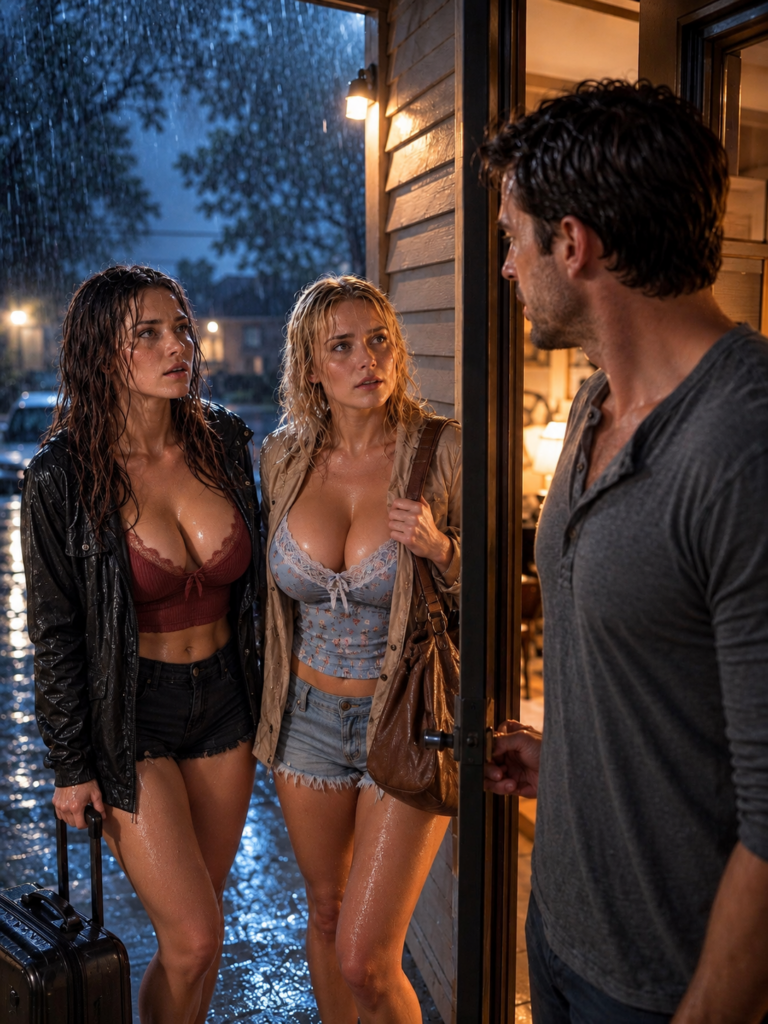
Then a storm caught them walking along the county road.
My porch light had been visible through the rain.
“We didn’t know who lived here,” Sophie whispered.
“We just saw the light.”
That sentence stayed with me for years.
Deputy Mills documented everything.
She connected them with a victim advocate in town and helped Meera begin the process of obtaining a protective order.
For the first time, we had something more useful than my front porch standing between them and Raymond.
A record.
People who knew.
A plan.
I realized then that standing up for someone did not mean pretending you could single-handedly protect them forever.
Sometimes the best protection was helping them build a world in which they did not need one man standing at the door.
That night, the three of us sat by the woodstove.
Nobody said much.
Before going upstairs, Meera stopped.
“No one ever stood up for us before.”
I looked at her.
“You stood up for Sophie.”
She blinked.
“You got her out.”
Her face crumpled slightly.
“You did that before you ever knew me.”
That mattered because I did not want her leaving the farm believing safety was something I had given her.
She had carried the first piece herself.
After Raymond’s visit, life became more complicated but also more honest.
Meera stopped checking the road every five minutes.
Not immediately.
Gradually.
Sophie enrolled temporarily in the local school district with help from the advocate.
I drove her the first morning.
She was terrified.
“You’ll pick me up?”
“At three.”
“Exactly?”
“Exactly.”
At 2:40, I was already in the parking lot.
When she saw my truck, her whole face relaxed.
I understood then that reliability can be a form of medicine.
Meera returned to painting.
The shed became an actual studio.
She painted the farmhouse in different seasons.
The barn at sunrise.
Sophie reading on the porch.
One portrait of Ellen from an old photograph.
That one nearly destroyed me.
She left it covered for a week before showing me.
“I can get rid of it if you don’t like it.”
I stared at my wife’s face.
Not perfectly reproduced.
Something better.
Remembered through another person’s eyes.
“You made her look happy.”
“She was.”

“Yes.”
I swallowed.
“She was.”
We hung it in the hallway.
That was the first time I moved one of Ellen’s photographs to make room for something new.
I felt guilty.
Then relieved.
Grief had convinced me that allowing anything new into the house meant removing Ellen.
Meera’s painting taught me otherwise.
Memory did not need an empty room.
Summer arrived.
The fields greened.
Sophie got better at gardening.
Not good.
Better.
Meera found part-time work at a café in Millbrook and opened a bank account Raymond could not touch.
The victim advocate helped her apply for housing programs.
She hated doing it.
“I don’t want to live off programs.”
“You’re not.”
“It feels like it.”
“You pay taxes?”
“When I worked.”
“Then congratulations. Society owes you approximately one functioning safety net.”
She rolled her eyes.
I considered that progress.
We became a strange family.
Sophie called me Mr. H at first.
Then Jack.
Once, by accident, she called me Dad.
The room went silent.
She turned bright red.
“Sorry.”
I shook my head.
“You don’t apologize for words that come out by accident.”
She looked relieved.
We never mentioned it again.
Meera and I developed our own rhythm.
She cooked badly.
I cooked slightly less badly.
We argued about music.
She claimed my record collection was “historically significant,” which was a polite way of calling me ancient.
I told her modern music sounded like appliances falling down stairs.
Sophie informed us both that we were embarrassing.
For the first time in three years, I started thinking about next season instead of just surviving the current one.
Then autumn arrived.
One morning, Meera found me repairing the gate.
She had an envelope.
Her eyes were already wet.
“We got accepted.”
I put down the wrench.
“Housing?”
She nodded.
A transitional housing program in Harrisburg had an apartment available.
Safe building.
Affordable rent.
Counseling support.
School assistance for Sophie.
Job placement.
Everything they had been working toward.
“That’s good.”
“I know.”
She cried anyway.
“I don’t want to leave.”
I looked toward the farmhouse.
Sophie’s bicycle leaned against the porch.
Meera’s paintings filled walls that had once been bare.
The shed windows were open.
Chickens scratched near the garden.
I did not want them to leave either.
That was exactly why they had to.
“You remember what you told me the first night?”
She shook her head.
“One night.”
A laugh escaped through her tears.
“That was a terrible estimate.”
“Your planning skills were weak.”
She wiped her face.
“What if Sophie hates the city?”
“She might.”
“What if I can’t find enough work?”
“Then you solve that problem.”
“What if Raymond—”
“You call the police. Your advocate. Me. Whoever you need.”
I stepped closer.
“But you don’t build your future around what Raymond might do.”
She looked at me.
“That’s still hard.”
“I know.”
“What if we fail?”
I smiled.
“Then you call.”
“And?”
“We figure out what comes next.”
She hugged me.
I held her.
Not like a rescuer.
Not like someone being abandoned.
Like family.
The week before they moved was miserable.
Nobody admitted it.
Sophie packed and unpacked the same box three times.
Meera cleaned things that were already clean.
I repaired an outdoor faucet that had worked perfectly for years.
On their final evening, we ate dinner on the porch.
Meera cooked spaghetti.
It was overcooked.
I ate two servings.
Sophie knew I was lying when I called it excellent.
“You hate it.”
“I respect it.”
“That means you hate it.”
“I respect it deeply.”
She laughed.
After dinner, Meera disappeared into the studio.
She returned carrying a painting wrapped in brown paper.
“For you.”
I opened it.
The farmhouse.
Not the lonely version.
Sunlight across the porch.
Garden in bloom.
Three figures near the barn.
One older man.
Two younger women.
Not posed.
Working.
Living.
I could not speak.
“Turn it over,” she said.
On the back, she had written:
We were only going to stay one night.
Thank you for giving us somewhere long enough to remember who we were.
I pressed my thumb against the edge.
“You’re taking this back.”
“No.”
“It’s too good.”
“That’s why you’re keeping it.”
The next morning, a caseworker arrived to drive them to Harrisburg.
Their boxes filled the back of a small SUV.
Sophie hugged every chicken.
Even the mean one.
Then she hugged me.
Hard.
“You saved us.”
I shook my head.
“No.”
She pulled back.
“You did.”
“No, kid.”
My voice broke.
“You two saved me.”
She started crying.
So did I.
I stopped pretending otherwise.
Meera hugged me next.
Longer.
“Porch light,” she whispered.
“What?”
“If we ever need to come back.”
I looked at the house.
“It’ll be on.”
They got into the SUV.
I stood in the driveway.
Watched until the vehicle disappeared beyond the bend.
Then silence returned.
The farmhouse was quiet.
But it was not the same silence.
That surprised me.
Before Meera and Sophie, quiet had felt like evidence that everything good was finished.
Now it felt temporary.
The rooms contained traces of them.
A blue paint mark on a cabinet.
Sophie’s crooked garden row.
A repaired fence.
Ellen’s portrait.
Life had passed through the house.
And somehow, instead of taking something with it, it had left more behind.
The first letter arrived three weeks later.
Sophie liked school.
Meera had found work at a bookstore café.
Their apartment was small.
The radiator made terrible noises.
They were safe.
Inside the envelope was a tiny watercolor of my farmhouse.
On the back:
The porch light was the first thing we saw that night.
Please keep it on for somebody else.
I did.
That winter, I contacted a local nonprofit that supported young adults transitioning out of shelters and unsafe homes.
At first, I volunteered to repair furniture.
Then a fence.
Then a broken porch railing.
Eventually, I started offering temporary farm work through the program.
Nothing informal.
Nothing secret.
Everything coordinated through people who understood safeguarding, housing, counseling, and legal support better than I did.
I had learned something important.
Kindness mattered.
But kindness worked best when it did not ask vulnerable people to depend entirely on one stranger’s goodness.
Meera and Sophie had needed more than me.
They needed systems.
Records.
Advocates.
Education.
Money of their own.
Choices.
I could be one porch light.
I did not have to become the whole road.
Two years passed.
Sophie sent me a photograph from her high school graduation.
Cap crooked.
Huge smile.
Meera stood beside her.
The caption read:
WE MADE IT, MR. H.
I framed it.
A year later, Meera held her first small art exhibition at a community gallery in Harrisburg.
I drove there.
She did not know I was coming.
When I entered, she was standing beside a painting of a storm-dark farmhouse.
One small porch light glowed against the rain.
She saw me.
For one second, she became the frightened young woman from my porch again.
Then she ran across the gallery and hugged me.
“You came.”
“Of course.”
Sophie appeared behind her.
Nineteen now.
College student.
Still terrible at gardening, according to Meera.
She hugged me too.
People in the gallery looked at us.
Three people who did not match any obvious family category.
I did not care.
Meera introduced me to someone.
“This is Jack.”
She paused.
Then smiled.
“He gave us one night.”
Sophie corrected her.
“He gave us four months.”
I shook my head.
“You two are terrible with numbers.”
We laughed.
Later, I stood in front of the storm painting.
A small card beside it gave the title.
PORCH LIGHT.
Meera joined me.
“Someone offered to buy it.”
“You should sell it.”
“No.”
“You’re an artist. Isn’t that the idea?”
“Not that one.”
I understood.
Some things were not meant to be converted into money.
They were markers.
Proof that a moment had happened.
Years later, the farmhouse still stands.
I am older.
The fences still need repair.
Chickens remain morally questionable creatures.
The old Ford truck refuses to die.
Meera is a full-time illustrator now.
Sophie became a social worker.
That did not surprise me.
She works with teenagers who are living through the kind of uncertainty she once knew too well.
They visit every summer.
The first time Sophie brought her fiancé, she made him stand on the porch in the exact place where she and Meera had stood in the storm.
“You looked like drowned raccoons,” I told her.
She objected strongly.
Meera confirmed my description.
We still keep the painting in the hallway.
The farmhouse in sunlight.
Three figures outside.
Ellen’s portrait hangs beside it.
For years, I thought those pictures represented two separate lives.
The life before loss.
The life after.
Now I know better.
There was only one life.
Mine.
Ellen belonged to it.
Meera and Sophie belonged to it.
Grief belonged.
Laughter belonged.
Loneliness belonged.
Hope did too.
One summer evening, long after that storm, the three of us sat on the porch.
Sophie asked me something.
“Do you ever regret opening the door?”
I pretended to think.
“You ate a lot of my food.”
“Jack.”
“Meera damaged several paintbrushes.”
“Jack.”
“You named my chickens.”
“Answer.”
I looked down the driveway.
“No.”
Never.
But I also told them something I had never said before.
“The night you arrived, I almost didn’t.”
Meera became still.
“What?”
“I had my hand on the door.”
I looked at her.
“I was scared.”
“Of us?”
“Of everything.”
I had spent three years building a life in which nothing unexpected could hurt me because nothing unexpected was allowed inside.
“You looked like trouble.”
“We were trouble,” Sophie said.
“Correct.”
She smiled.
“But I realized if I shut that door, I would hear it closing for the rest of my life.”
Meera looked toward the porch light.
“What made you open it?”
I thought about Ellen.
Maybe some part of me had heard her voice.
Maybe it was simply basic decency.
Maybe loneliness had made me braver than I knew.
“I don’t know.”
That was the truth.
Sometimes the choices that define us do not arrive with certainty.
Sometimes you make them while afraid.
You open the door anyway.
Sophie rested her head against my shoulder.
Meera sat on the other side.
The sun dropped behind the fields.
The porch light came on automatically.
For a moment, I saw the reflection of all three of us in the front window.
A widower.
Two sisters.
No blood relation.
No simple label.
Family anyway.
I had spent years believing healing meant getting back the person I had been before Ellen died.
That man was gone.
Healing turned out to mean allowing myself to become someone new without treating that as betrayal.
Meera and Sophie never replaced my wife.
They did something far more meaningful.
They reminded me that loving someone who was gone did not require me to stop loving the people who were still here.
And maybe I gave them something similar.
Not salvation.
Not a lifetime of protection.
Just a door that opened on one terrible night.
A bed.
A meal.
Enough time to breathe.
Enough safety to begin making choices again.
That is why I still leave the porch light on.
Not because I expect another storm to deliver two strangers to my door.
Life rarely repeats itself that neatly.
I leave it on because of what it represents.
There is still room.
There is still warmth.
Someone is still awake.
You are not required to solve a person’s entire life in order to help them through one night.
Sometimes one night becomes a week.
Sometimes a week becomes months.
Sometimes people leave because helping them worked.
And sometimes, years later, they return by choice, carrying groceries, paintings, stories, spouses, children, and pieces of a life they rebuilt themselves.
That is the part people misunderstand about second chances.
They are not always given by one person to another.
Sometimes they move both ways.
Meera and Sophie arrived believing they needed shelter.
I believed I was giving it.
But my farmhouse had been sheltering a man who had forgotten how to live.
Those two frightened strangers brought laughter through my front door.
They brought work worth doing.
Arguments worth having.
Meals worth cooking.
Goodbyes worth grieving.
They taught me that an empty house could become a home again without erasing the people who had lived there before.
And every time I look at Meera’s painting, I remember the first words she said to me through the rain.
“We were only going to stay one night.”
She was wrong.
They stayed far longer than that.
Not in the spare bedroom.
Not on the farm.
In my life.
Some people enter your story for a season and leave fingerprints on every chapter that follows.
Meera and Sophie did that to mine.
And if I learned anything from them, it is this:
You cannot always know what stands on the other side of a door.
Sometimes danger.
Sometimes inconvenience.
Sometimes responsibility you never expected.
But sometimes, on the worst night of someone else’s life, you get the chance to become proof that the world still contains one safe place.
And in giving them that proof, you may discover something you desperately needed too.
A reason to turn on the lights.
A reason to set another plate at the table.
A reason to wake up tomorrow and participate in your own life.
That storm eventually passed.
The fields dried.
The road reopened.
Meera and Sophie moved on.
But the storm inside me ended differently.
Not all at once.
Not dramatically.
It faded with every shared breakfast, every repaired fence, every laugh from the garden, every letter in the mailbox, every summer visit.
Until one day I realized the farmhouse was no longer a monument to everything I had lost.
It was a place where people had survived.
Including me.
And every evening, just before darkness settles over the fields, the porch light comes on.
It always will.
The End.

