
Part 1
In 1866, a survey crew working the central Colorado Rockies drew a canyon onto its field maps and then left it off the finished ones.
The omission might have meant nothing. Maps of the western territories were full of mistakes. Rivers shifted between drafts. Names changed. Valleys measured in haste vanished between a surveyor’s notebook and the engraver’s plate.
But the canyon had been measured.
The crew knew where it was.
It ran roughly 9 miles from northwest to southeast between two shoulders of granite that old prospectors called the Knuckles. A narrow creek followed its floor. About a mile and a half above the entrance, the walls pressed inward until the trail became barely wide enough for a loaded mule. The constriction continued for almost 3 miles before the canyon opened suddenly into a high meadow beneath the surrounding peaks.
On a few early documents the place was called Coyle’s Draw, supposedly after Emmett Coyle, a trapper said to have wintered there in the 1840s.
There was little evidence that Coyle had ever existed.
Among miners and freighters, the place had another name.
The Narrows.
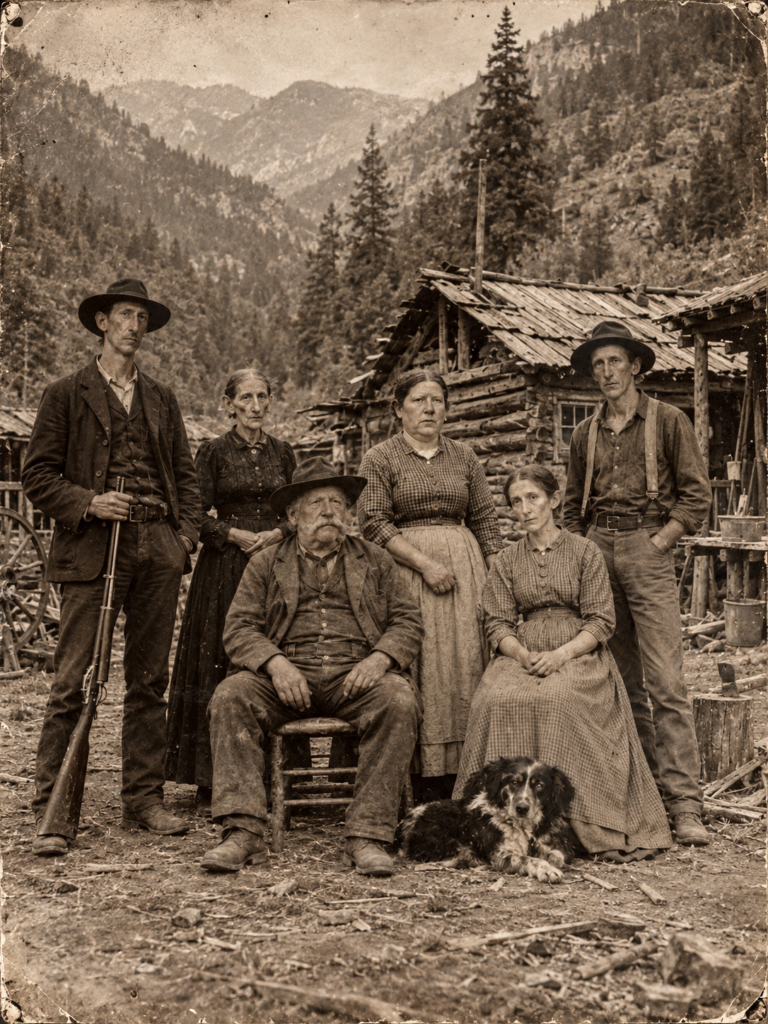
For nearly 30 years, anyone entering the Narrows encountered the same thing at its mouth: a low stone house pressed against the northern wall of the canyon and a member of the Yont family waiting beside the trail.
There were somewhere between 19 and 24 Yonts at the height of the household.
No one ever established the number with confidence.
The Yonts did not behave like the criminal families later frontier papers made them out to be. They did not rob stagecoaches. They did not hold up payroll wagons. They did not wait behind rocks with rifles.
They charged a toll.
A traveler arriving alone with 1 animal usually paid $2 for the right to pass up through the canyon and return again.
The price was high enough to be irritating but not so high that a miner or freighter would turn around after riding miles to reach the entrance.
The Yont collecting it was invariably polite.
That courtesy appeared repeatedly in the few surviving accounts.
He might be a young man sitting on a flat stone near the path, his hat on one knee. He would ask where a traveler had come from, where he was going, how long he expected to remain in the high country, and whether anyone was waiting for him beyond the mountains.
The questions sounded ordinary.
The frontier encouraged such conversation. Roads were uncertain, weather killed without warning, and a stranger who disappeared might owe his survival to someone remembering where he had meant to go.
Once the questions were answered, the Yont stated the toll.
Sometimes he accepted money.
Sometimes goods.
Sometimes a day of labor.
Occasionally, however, a traveler would reach for his purse and be told that no payment was necessary.
His passage, the Yont would say, had already been covered.
Those were the travelers whose names later became impossible to trace.
After the toll came the rules.
Stay on the trail.
Water animals only at marked places.
Camp only inside the stone rings beside the trail.
Travel in daylight.
If darkness came before reaching the next destination, remain inside the nearest ring until full morning.
Do not investigate sounds beyond the trail.
Do not leave the ring after dark, regardless of what you hear.
When your business in the high meadow is finished, return by the same route.
And before leaving Coyle’s Draw, stop again at the stone house.
Tell the Yonts you have come down.
The final rule was the one travelers remembered because the family enforced it with an urgency absent from everything else.
A man who rode past the house without reporting himself down would sometimes find a Yont pursuing him into open country.
Not threatening him.
Begging him to stop.
Only long enough to be marked down.
The family needed to close his account.
At the time, most travelers assumed this was some private superstition attached to the toll business.
Those who obeyed the rules went through the Narrows, reached the meadow or the mountain passes beyond it, returned, reported themselves down, and continued their journeys.
Most never thought about the Yonts again.
That was the unsettling part.
The arrangement worked.
A traveler who did what he was told usually survived Coyle’s Draw.
The first person to understand that the toll house was not merely collecting money was a county surveyor named Wilford Annis.
By then the Yonts had occupied the canyon for decades.
Annis entered the district in 1888 to establish property boundaries. He spent portions of 3 summers working around the Narrows and kept 2 kinds of records.
The first were official.
Distances. Bearings. Claims. Creeks. Elevations.
The second were private.
Those he kept in a notebook he apparently never intended to surrender to a government office.
Annis became interested in the Yonts almost by accident.
The stone house itself bothered him.
From the trail it looked like a poor frontier dwelling: low walls, rough roof, plank door, a chimney blackened from years of smoke.
But the visible house was only the front.
Behind it, chambers continued into the mountain.
The family had built domestic rooms against the entrance to something much older.
Annis examined the interior as far as the Yonts permitted. The passage behind the house had not been hacked crudely from granite by settlers. The walls carried tool marks he could not reconcile with the family’s tools, and deeper sections involved a dark material unlike the surrounding rock.
The Yonts had not excavated the place.
They had moved into it.
Then Annis learned about the tally book.
The book was plain, practical, and meticulously kept.
For nearly 30 years someone in the family had recorded the traffic through Coyle’s Draw.
One column counted people going up.
Another counted people coming down.
Most entries contained no names.
Only marks.
Annis added them.
Then he added them again.
The columns differed by roughly 400.
About 400 people had entered the Narrows and never been marked as returning.
At first the explanation seemed obvious.
The Yonts were murderers.
A family controlling a narrow mountain passage had discovered that travelers could vanish there without witnesses. They charged legitimate travelers a toll and selected vulnerable men for robbery.
It fit the frontier.
It fit human nature.
It fit every ugly rumor that had grown around the family.
Then Annis searched for the property of the dead.
There was none.
Four hundred missing travelers should have enriched a family beyond measure.
Even poor men carried equipment. Saddles. Rifles. Picks. Blankets. Cooking tins. Watches. Harness. Boots. Mules. Horses. Coin.
Yet the Yonts remained poor.
Their house contained no accumulation of stolen goods. No hidden stable held hundreds of animals. No storeroom contained decades of abandoned tools. No cache of weapons or clothing suggested a long-running murder enterprise.
The missing travelers had gone up carrying their possessions.
Neither the travelers nor their possessions had returned.
Annis eventually wrote a sentence in his notebook that changed his investigation.
The Yonts were not robbing them.
They were delivering them.
He did not yet know what that meant.
But he began reading the toll arrangement differently.
The $2 was not payment for the right to enter the canyon.
It was payment for the right to leave it.
The traveler who paid became a customer.
The traveler told that his passage had already been paid belonged to another category.
Payment.
The family’s questions at the trail suddenly acquired another meaning.
Where are you going?
Who is waiting?
Does anyone know you are here?
Do you have family?
When are you expected?
The Yonts were not making conversation.
They were determining how loudly the world would react if a man failed to arrive.
A merchant traveling with partners was a poor choice.
A prospector expected back in town within 2 days was dangerous.
A husband with a wife waiting over the pass might bring a search party into the Narrows.
But a solitary man drifting toward the goldfields, with no fixed destination and no people expecting him, could vanish into the mountains without producing more than a delayed question somewhere far away.
Those were the men whose toll was sometimes waived.
The conclusion disgusted Annis.
Yet something still failed to fit.
If the Yonts were deliberately selecting victims, why keep an accurate count?
Criminals hid numbers.
The Yonts preserved them.
Every missing traveler widened the difference between the 2 columns.
They were not concealing that difference from themselves.
They were measuring it.
That suggested the tally was not a confession.
It was an account.
And accounts were kept for someone.
Annis found another piece of the problem in Denver.
Between 1867 and 1871, members of the Yont family had submitted several mineral samples to an assay office.
They were not gold samples.
They were not silver.
The reports described a dense, dark, fine-grained material capable of taking a high polish. The assayers could not comfortably match it to the known geology of the district. Trace metals appeared in combinations strange enough to be noted, though not valuable enough to explain continued testing.
One report from 1869 contained a peculiar observation.
When struck, the material produced a tone.
The note persisted far longer than expected.
The assayer wrote that it seemed less as though the stone itself were ringing than as though the sound were coming from somewhere within it.
He declined an offer to examine a larger piece.
Annis eventually found the same material inside Coyle’s Draw.
A seam appeared beside the trail.
More of it lay behind the Yont house.
And in the high meadow above the Narrows was the feature that changed his understanding of the entire landscape.
The meadow should have attracted settlement.
Its grass was excellent. It had timber, game, shelter, and a spring that apparently never failed even in dry years.
No permanent ranch survived there.
No mining camp lasted.
Near its center stood a low circular rise about 80 feet across and perhaps 6 feet high.
At first Annis assumed it was a natural hummock.
He opened a small test pit.
At roughly 18 inches his shovel struck something hard.
The blade rang.
Below the turf was dark stone.
Not loose rock.
A surface.
The meadow rise was the top of something buried.
Annis traced what he could without opening more ground than necessary. The dimensions made little sense. The structure extended beyond the pit in every direction.
He returned to the passage behind the Yont house.
Gradually he began entertaining a possibility he disliked even writing down.
The underground chambers at the mouth of the Narrows and the buried structure beneath the high meadow might be connected.
If so, the connection ran beneath much of the canyon.
The Narrows might not simply be a gorge through which some structure passed.
The structure and the gorge might occupy the same line.
The trail above could be following the exposed edge of something buried beneath the mountain.
That conclusion was far beyond anything Annis could prove.
He knew it.
His notebook distinguished measurement from speculation carefully.
But the speculation explained details that otherwise remained separate.
The dark stone.
The chambers.
The mound.
The strange placement of the camps.
There were exactly 7 marked camping places through the 3-mile constriction.
Each consisted of an old ring of stones set slightly aside from the trail.
Travelers assumed the Yonts had built them as convenient stopping places.
Annis measured the intervals.
They were regular.
Too regular.
Not spaced according to the pace of a man or mule but according to geometry.
When he examined the ground more carefully, another relationship appeared.
Each ring stood above a place where the dark material came nearest the surface.
The rings were not casual camps.
They were stations.
And if the accounts of travelers were believed, they were safe stations.
People who remained within them at night usually survived.
People who wandered away sometimes did not.
For Annis, that was the point at which frontier superstition began resembling engineering.
Nature produced dangerous places.
It did not usually place 7 of them at equal intervals and surround each one with an ancient ring indicating where a traveler should stand.
The Yont rules suddenly resembled instructions inherited from people who had understood the system more completely.
Stay on the trail.
Move in daylight.
Stop inside the rings.
Do not step outside after dark.
Report yourself down.
What had sounded like the habits of an isolated mountain family now looked like an operating procedure.
The family themselves were equally difficult to understand.
Their history in Colorado began around 1858 with a man Annis identified as Absalom Yont.
Absalom arrived with a wife, several grown children, and considerably more ready money than a man without an obvious occupation should have possessed.
He did not prospect.
He filed no mining claim.
He did not seek farmland.
He went directly to Coyle’s Draw, apparently already knowing the canyon and the house existed.
He moved his household into the low stone structure.
Then he began keeping the count.
Annis tried to discover where Absalom came from.
He found fragments.
The Yonts spoke with an accent containing something Appalachian. Their family practices reminded him of isolated communities in the southern hill country where certain lineages had intermarried and preserved customs that local churches had condemned for generations.
Annis developed a theory.
The Yonts had not come west to begin their work.
They had come west to continue it.
The canyon was not dangerous because the Yonts lived there.
The Yonts lived there because the canyon was dangerous.
Their occupation was not toll collecting.
It was keeping.
Whatever their ancestors had done elsewhere, they had brought the practice to Colorado.
They were clerks at the mouth of something.
Operators.
Custodians.
Their poverty was part of the evidence.
They were not becoming rich.
The work itself was the inheritance.
Annis tried to conduct a household census during his second summer.
He failed.
Not because the Yonts refused.
They answered him with their usual calm courtesy.
The problem was that the family did not remain numerically stable.
A child Annis remembered from one season might be absent the next.
When he asked, relatives sometimes seemed genuinely unable to understand whom he meant.
There was no mourning.
No claim that the child had died.
No attempt to hide a death.
The child simply appeared to have ceased being part of their memory.
The reverse also occurred.
An adult whom Annis was certain he had never seen would appear at the house and be treated as though he had belonged to the family for years.
He would use the Yont name.
He would perform household work.
He would know routines.
No one introduced him.
No one explained where he came from.
Annis recorded the possibility only once.
Some travelers taken by the canyon, he suspected, did not disappear completely.
Some returned.
Changed.
Folded into the household.
Made Yont.
That would explain why the size of the family could not be fixed.
The Yonts were less a bloodline than a population moving through an office.
Some were born there.
Some disappeared.
Some arrived from the trail.
Some remained.
The family changed while the tally book continued.
Annis wrote that the book appeared to contain the memory the people themselves lacked.
The people forgot.
The book remembered.
Only the elder remained continuous.
The elder was not necessarily the oldest biological descendant.
The title seemed to belong to whichever member of the household had remained himself longest.
Absalom Yont had occupied that position when the family arrived.
Later someone else may have carried his name or office.
The elder remembered the rules, the old language used over the tally book, the meaning of the columns, and the procedures no other member seemed to hold completely.
He was the human continuity of the keeping.
That interpretation remained only Annis’s theory until the autumn of 1891.
Then Josiah Kell entered Coyle’s Draw.
He stayed 11 days.
He went in with 3 men.
He came out alone.
And for the first time, someone who had passed beyond the edges of the Yont system returned able to describe what the rules were protecting travelers from.
Part 2
Josiah Kell was 34 years old in September 1891, an educated mining engineer employed by a company considering construction of a stamp mill in the high meadow beyond the Narrows.
He did not believe in mountain folklore.
That mattered.
Kell later wrote that if he had been a more credulous man, 3 other men might have lived.
His party consisted of 4 people: Kell, Bell, Curado, and a young rodman named Tims.
At the Yont house they paid $8.
The young man beside the trail recorded them and recited the rules.
Kell listened.
He remembered every rule later.
At the time he considered most of them the inherited superstitions of an ignorant family that had lived too long beyond ordinary society.
The first day passed quietly.
The men stayed on the path.
They reached a marked camp before dark.
They remained inside its stone boundary, more from convenience than obedience.
Nothing happened.
That confirmed Kell’s opinion.
On the second day he saw an exposed seam of dark material several yards from the trail.
Professional curiosity overcame the warning.
He stepped away to examine it.
The material did not resemble the granite surrounding it.
Kell touched the surface.
It was warm.
Not sun-warmed.
The outcrop lay in shade.
The warmth seemed internal.
Then he felt something through his palm.
Years later, when giving his sealed testimony, he devoted nearly a page to finding words for the sensation.
He settled on counting.
Something beneath his hand seemed to be counting.
Slowly.
Patiently.
On a scale so large that the sensation felt less like thought than geological pressure.
He withdrew his hand.
The feeling stopped.
Kell told himself heat had accumulated in the stone earlier in the day.
He returned to the trail.
That night, while lying inside the second marked ring, he experienced something stranger.
He heard voices.
Then, in his testimony, he corrected himself.
They were not voices.
Exactness mattered to him.
There had been no sound moving through the air.
Instead, he remembered sounds he had never heard.
Words arrived in his mind already possessing the quality of memory.
They seemed old.
They came from below.
Not merely from beneath his bedroll, but from a direction he could not place within ordinary space.
The closest description he found was down.
Always down.
The remembered voices were not calling to Kell.
They seemed to be calling through him.
Calling into the canyon.
Like animals calling home at dusk.
By morning Kell knew he should leave.
He admitted that without qualification.
Every useful instinct told him to turn the party around, return to the Yont house, report themselves down, and abandon the commission.
He remained.
The reason was not supernatural.
That was what disturbed him afterward.
His work was unfinished.
A company expected measurements.
Men in his profession were judged by reliability.
He would have to explain that he abandoned a valuable survey because a rock felt warm and he had suffered unusual dreams.
He imagined the laughter.
He imagined damage to his reputation.
He stayed.
Years later Kell wrote that the canyon did not need extraordinary power to keep a man inside it.
It only needed a man to continue being himself.
Work ethic was enough.
Pride was enough.
Curiosity was enough.
The party reached the high meadow on the fourth day.
Kell’s description matched Annis’s independent notes almost exactly.
Good grass.
Cold spring.
Timber around the margins.
Peaks enclosing the basin.
And near the center, the low circular mound.
Bell climbed onto it while they established camp.
He stamped his heel.
The ground rang.
The men laughed.
Bell stamped again.
Curado joined him.
Then Tims.
The 3 stood on top of the rise like boys testing a hollow floor, striking it with their boots and listening to the deep note rise beneath them.
Kell remained below.
He had heard the quality of that ringing already.
He knew, without knowing how he knew, that the sound was not simply resonance.
They were knocking.
Something underneath was receiving the knock.
That night Kell remained awake.
Sometime near midnight the grass on the mound moved.
There was no wind.
The crown settled downward.
Not quickly.
Gradually.
Then it rose again.
Kell compared it to a chest taking breath.
He woke the others.
All 4 watched.
The grass lowered.
Paused.
Lifted.
No one laughed.
For the first time, all of them wanted to leave.
But it was night.
The Yont rules returned to Kell with sudden authority.
Do not leave the marked camp after dark.
No matter what you hear.
They stayed inside the ring.
Nothing crossed the stones.
Nothing appeared from the mound.
Morning came.
Sunlight changed the character of everything.
The rise was only grass.
The basin was beautiful.
Curado walked around the mound and declared that exhaustion had affected them.
Perhaps underground water had shifted soil.
Perhaps they had seen grass moving and frightened one another.
He was not returning to his employer with a report that 4 trained men abandoned a survey because a hill appeared to breathe.
Kell agreed.
He would spend the rest of his life hating himself for how reasonable the decision felt.
They worked through the fifth day.
Nothing happened.
They worked through the sixth.
Still nothing.
The ordinary daylight allowed each uneventful hour to argue against the terror of the fourth night.
By the seventh day the impossible memory had already begun softening.
Tims carried a survey marker onto the mound.
It was midday.
The sun was high.
Kell watched him climb the shallow slope.
The rodman reached the crown.
He knelt.
He placed the marker.
He raised his mallet.
Kell looked away.
He could never explain why.
He heard no shout.
No movement.
No warning.
His attention simply moved elsewhere for what he estimated was no longer than a breath.
When he looked back, Tims was gone.
The mallet remained on the grass.
The marker was gone with him.
There was no hole.
No disturbed soil.
No flattened trail leading away.
No cry echoed from the trees.
One moment Tims had been kneeling on the mound.
The next the meadow contained only 3 men.
That ended the survey.
Kell, Bell, and Curado abandoned their instruments and ran.
The Yont house lay several miles below.
Under ordinary conditions they could have covered the distance without difficulty.
These were not ordinary conditions.
Their pace became erratic.
Curado injured his ankle.
The light dropped behind the canyon walls earlier than it would have on open ground.
By the time they entered the deepest section of the Narrows, darkness had caught them.
They had not reached a marked ring.
The trail lay between walls of stone rising hundreds of feet on either side.
Above them, the sky was only a narrow strip.
Kell remembered the instruction.
Do not move in darkness.
But another rule told them to stay inside a marked camp.
There was no camp.
Only the path.
He faced a choice none of the Yont warnings had prepared him to make.
Continue in darkness toward the house.
Or stop in an unprotected section of the canyon and wait 9 hours for dawn.
Kell stopped.
He ordered the others against the wall.
They sat with their backs against the stone.
Then the canyon began working on them.
Kell refused in his testimony to describe every detail.
The magistrate who later sealed the document wrote that portions were unfit for public circulation.
What Kell did explain was the mechanism.
Nothing physical came down the trail.
No animal approached.
No human figure appeared.
The darkness remained darkness.
The canyon reached them through memory and thought.
It did not force.
It suggested.
Each suggestion arrived already dressed as the most natural decision the person receiving it could make.
Curado was the first.
He had argued repeatedly that they should finish their work.
The canyon used that.
Hours into the night, Curado became calm.
His fear disappeared.
He stood.
He told Kell that they had made a foolish mistake abandoning the instruments.
They were professionals.
They would return to the meadow.
Finish the survey.
Recover their equipment.
Walk out properly in the morning.
The argument was absurd.
Yet Curado delivered it with complete certainty.
Kell grabbed for him.
Curado stepped beyond reach.
He walked north along the trail.
No voice called him.
Nothing dragged him.
He went voluntarily into the dark because the desire to complete his work felt entirely his own.
Kell heard his footsteps diminish.
Curado never returned.
Bell survived almost until dawn.
The canyon found a different opening in him.
Fear.
Kell would not describe much of what happened.
He wrote only that Bell became increasingly terrified of remaining on the trail.
The walls seemed to concern him.
He said something was moving inside them.
Kell told him not to look.
Bell looked.
Near the first gray suggestion of morning, Kell saw him press himself against the dark seam exposed in the canyon wall.
Then Bell appeared to sink into it.
There was no violent struggle.
The stone received him the way still water receives a thrown object.
Its surface seemed to yield.
Bell went inward.
The material closed again.
A single note sounded through the canyon.
Low.
Sustained.
Far too long.
Then silence.
Kell was alone.
He later asked himself repeatedly why the canyon had not taken him.
His answer was not that he was stronger than the others.
He believed it had tried.
Its first method was the same one used on Curado.
Kell felt the need to finish the survey rise inside him.
The idea seemed perfectly rational.
He should stand.
Walk back to the meadow.
Recover the notes.
Complete the measurements.
A competent man did not leave work undone.
He began to rise.
Then, in the movement itself, something became clear.
The thought was not his.
Yet it sounded exactly like him.
That distinction saved his life.
He understood what Curado had experienced.
The canyon did not replace a man’s nature with something foreign.
It used the truest part of him.
A proud man experienced pride.
A curious man experienced curiosity.
A frightened man experienced fear.
The decision to surrender therefore felt like self-expression.
There was nothing alien to resist.
Kell realized he could not argue with the thought.
Arguments would be produced by the same mind already being used against him.
Instead he obeyed the rule in its simplest form.
He held his line.
He remained against the wall.
He counted his breaths aloud.
The impulse told him to stand.
He kept counting.
The certainty grew stronger.
There was work to finish.
Men were depending on him.
His reputation mattered.
He had wasted enough time.
He did not move.
Kell later described his counting as a small human arithmetic set against something enormous beneath the canyon.
The ground counted.
He counted back.
Dawn reached the Narrows.
The pressure stopped.
Kell remained alive.
That was when he finally understood the Yont rules.
They were not religious taboos.
They were survival procedures.
Stay on the trail because the trail was the controlled route.
Do not touch what lay beyond it.
Move in daylight because whatever reached through the canyon was weaker then.
Camp inside the stone rings because a boundary chosen in advance gave the traveler a decision already made before darkness began influencing him.
A man inside a ring did not need to decide where to go.
He had already committed himself to staying.
The Yonts called that holding the line.
The final rule, reporting yourself down, now seemed equally important.
A traveler entered the tally book when he went up.
Until a second mark closed that entry, the account remained open.
And an open account represented something the canyon could still claim.
Kell remained sitting against the wall throughout the seventh day.
He was free to walk.
He could not make himself begin.
Every direction felt like another choice, and after the night he had survived, he no longer trusted decisions arising inside his own mind.
That afternoon 2 Yonts came up the trail.
An older woman.
A young man.
They approached without touching him.
The woman crouched several feet away.
“You held your line,” she told him.
Kell stared at her.
“We felt you holding it. Most do not.”
She waited.
“You can come down now. But you have to come down right.”
Kell asked what that meant.
Her answer remained with him for the rest of his life.
“If you come down wrong, you will be coming down for the rest of your life.”
They guided him toward the mouth.
Slowly.
At dusk they stopped inside one of the marked rings.
The older woman stayed awake with Kell.
During the night she explained the open accounts.
Four men had gone up.
Only Kell was returning.
Tims, Curado, and Bell remained unclosed.
The debt of their disappearance, she told him, had attached itself partly to the surviving member of their party.
The canyon knew connection.
It knew association.
If the accounts remained open, the reaching would follow Kell beyond Coyle’s Draw.
He asked what was required.
Did 3 more men have to be brought up?
Was that how the Yonts maintained the balance?
The woman said no.
For the first time, Kell understood how badly outsiders had misunderstood the family.
The Yonts did not lure people into the Narrows.
They spent their lives doing the opposite.
They warned.
They sorted.
They slowed the traffic.
They diverted people when they could.
They taught rules without explaining enough to attract curiosity.
The canyon took people regardless.
The family’s work was to reduce the number.
The roughly 400 missing over 30 years were not proof that the Yonts had been efficient killers.
They were evidence, the woman claimed, that the Yonts had been effective wardens.
Without them, she said, the canyon could take 400 in a year.
The statement forced Kell into a moral world he never fully escaped.
The Yonts still selected some travelers.
They still allowed certain solitary men to go upward without payment.
They knew some would disappear.
By any ordinary standard, that made them participants.
But if the woman spoke truthfully, complete refusal to participate would not save those lives.
It would remove the only restraint operating on the canyon.
The Yonts had inherited the task of deciding how many would be lost so that many more would survive.
No clean moral language existed for such work.
They were neither murderers nor innocent.
Neither servants nor masters.
They were wardens of a thing they could not destroy.
The canyon demanded.
The Yonts rationed.
And the price of rationing was being hated for the number they could not save.
The following morning Kell reached the stone house.
The elder came out.
By then the man called Absalom in some accounts was very old, though Kell could not be certain whether he was the original Absalom who arrived in 1858 or another keeper who had inherited the name.
The elder carried the tally book.
He opened it.
Found the 4 marks made when Kell’s party entered.
Then he performed something Kell had not expected.
Beside Tims, Curado, and Bell, he made marks in the down column.
Kell protested.
They had not come down.
The elder ignored him.
Over each mark he spoke several words in a language Kell did not recognize.
Then he closed the book.
The reaching stopped.
Kell felt it physically.
A pressure he had carried since the night in the Narrows lifted.
The elder had not substituted 3 new victims.
He had closed the debt through the account itself.
The tally book was not merely recording the canyon.
It limited it.
The elder possessed authority to declare an account complete.
Whatever the origin of that authority, the canyon appeared to accept it.
For Kell, this changed everything.
The book was not a murderer’s ledger.
It was a boundary expressed as arithmetic.
The Yonts recorded the taken because what was not recorded remained open.
The count had to be known.
The count had to be closed.
Someone had to be able to say: this debt ends here.
Kell should have left that day.
Instead he remained 3 more.
The elder asked him to.
The old man had a problem.
He was dying.
And the family had no clear successor.
The revolving household had failed to produce someone who had remained sufficiently continuous—sufficiently himself—to inherit the full office of keeper.
Children disappeared into the canyon’s influence.
Adults changed.
Travelers occasionally became family.
Memories thinned.
Identities shifted.
The canyon consumed its wardens slowly.
The elder feared that when he died, no one would remain who understood how to use the book.
Then he had seen Josiah Kell hold his line.
Kell had resisted the canyon from inside its strongest reach.
He had recognized a thought wearing his own voice.
He had remained himself.
That made him a candidate.
For 3 days, without threat or coercion, the elder asked Kell to stay.
Become Yont.
Take the book.
Learn the old speech.
Sit beside the trail.
Ask strangers where they were going and who expected them.
Tell them the rules.
Keep the count.
Make the terrible decisions.
Close the accounts of the dead.
Maintain the line between the canyon and everyone beyond it.
Kell understood the offer.
He also understood the cost.
The family had paid with itself.
Generation after generation, the canyon had worn them down. Children vanished. Identities blurred. Travelers entered the household. Human beings became roles.
Keeper.
Counter.
Watcher.
Elder.
The longer a person remained, the less ordinary life seemed to survive inside him.
Kell said no.
He never defended the decision proudly.
In his sealed statement he admitted that he did not know whether refusing had been courage or cowardice.
By leaving, he preserved himself.
He may also have abandoned thousands of future travelers to a canyon whose existing wardens were failing.
By staying, he might have saved them.
He also would have become a participant in an arrangement that accepted some human lives as necessary losses.
There was no clean choice.
On the 11th day, Josiah Kell walked out of Coyle’s Draw.
He never returned west.
In 1892 he gave his statement to a magistrate.
At his own request, the testimony was sealed.
The magistrate agreed, writing that its contents were not suitable for entry into a public record.
Kell lived the rest of his life cautiously.
He obeyed rules.
He avoided unfinished accounts.
He seemed unable to dismiss boundaries simply because he did not understand why they existed.
His statement remained sealed until 1968.
But long before anyone read it, the thing Kell feared had already happened.
The Yont family failed.
Part 3
The decline was visible first in the tally book.
The elder died around 1894.
No successor inherited the entire office.
Someone continued making marks, but the handwriting changed.
The lines lost their precision.
Entries became irregular.
The 2 columns, once maintained with extraordinary care, began drifting.
Whatever discipline had governed the Yonts for generations was breaking down on paper.
By the winter of 1898, the entries nearly ceased.
The last mark in the book was made in the up column.
No date.
No corresponding mark down.
Then blank pages.
In the spring of 1899, after months passed without anyone seeing a Yont in the nearest settlement, Deputy Harlon Puit joined a small party entering Coyle’s Draw.
No toll collector waited beside the flat stone.
The house stood open.
Cold.
The chimney was dead.
Inside, there was no evidence of a struggle.
No broken furniture.
No blood.
No hurried packing.
The Yonts were gone.
All of them.
Whether there had been 19 at the end, or 24, or some number in between, no one could say.
The search party found only 1 body.
An old woman sat upright against the deepest wall of the built portion of the house.
She had died from cold.
Her body faced the passage leading into the mountain.
The tally book rested closed across her lap.
Her hands lay folded on top of it.
The image affected Puit deeply.
It did not look as if she had tried to escape.
It looked as if she had stayed at her post after everyone else was gone.
Puit took the book.
That decision preserved almost everything later researchers would know about the Yont count.
The party then entered the passage.
The chambers behind the house were real.
The workmanship did not resemble the crude frontier structure outside.
The men went deeper.
They encountered the dark material.
Someone struck it accidentally.
It rang.
The party continued until the lead man stopped.
There was no visible obstacle.
He simply refused to advance.
The others began feeling the same reluctance.
Not fear in the ordinary sense.
A suggestion.
A certainty.
The same mechanism Kell would later describe when his sealed statement became available.
Going deeper felt like the next reasonable thing.
And because it felt so reasonable, every man suddenly distrusted it.
They turned around.
No one entered again.
The house was closed as well as possible.
The official report said little.
Coyle’s Draw returned to obscurity.
Puit kept the tally book rather than surrendering it to authorities who seemed uninterested in preserving anything connected to the canyon.
After his death the book passed to his daughter.
In the 1950s it entered a county historical collection.
There it sat in a box.
Unremarkable.
A ledger with columns of marks.
In 1961 a researcher named Delavos examined it.
Only then did the scattered evidence begin to connect.
The tally book.
The Denver assay reports.
Wilford Annis’s private notebook.
Later, Josiah Kell’s sealed statement.
Taken separately, each source suggested a different story.
Together they formed something far stranger.
Annis’s later investigation into the Yonts’ origins expanded the problem beyond Colorado.
During his third summer near the Narrows, he contacted an associate in the East and asked him to search for Yont families in the southern Appalachian region.
The answer described a remote hill county where a family of that name had once been known as keepers of a particular hollow.
The hollow was a deep cleft locals avoided.
The Yonts had lived near its entrance beyond living memory.
Church records from as early as the 1790s mentioned unusual practices within the family and among 2 or 3 related lineages with whom they intermarried.
The descriptions were fragmentary.
Rules.
Isolation.
Warnings against entering the hollow.
Then, sometime in the 1850s, the Yonts left.
Not a few young people.
The whole connection.
They packed and moved west.
Shortly afterward the abandoned hollow experienced a period of disappearances.
Travelers vanished.
Herders failed to return.
The incidents stopped only when local residents blocked the entrance and effectively abandoned the route.
For Annis, the implication was difficult to avoid.
Coyle’s Draw had not been the family’s first keeping.
The Yonts had managed another dangerous place in the Appalachians.
When they left, that place became worse.
Then they appeared in Colorado and immediately occupied a stone house attached to another unexplained site.
They brought with them an old speech.
Rules.
A keeper.
A count.
The family did not belong to 1 canyon.
They belonged to a type of place.
Annis wrote a short observation in his notebook.
If a family had moved once, it could have moved before.
And if keepers moved between sites, then abandoned sites did not cease existing when the keepers left.
They became unkept.
For Annis, that possibility was worse.
The Yonts might not have been evidence of a unique horror in Colorado.
They might have been evidence of a system.
A series of hollows, draws, canyons, and buried structures scattered across a landscape whose official maps did not record them.
That interpretation eventually merged with Annis’s most speculative theory.
He no longer believed the dark structure beneath the Narrows was a cave.
He thought it was infrastructure.
Something built.
The passage behind the Yont house formed 1 end.
The buried mound in the meadow formed another.
The 7 stone rings were stations along the exposed route.
The dark material was structural rather than geological.
The Yonts had inherited operational knowledge without inheriting a complete explanation.
Whoever built the system was gone.
The procedures remained.
That was why the family could recite instructions but could not explain the origin of the structure.
They were caretakers of technology so old that its operating manual had decayed into tradition.
The tally book, under that interpretation, became something more than a family record.
It was a maintenance log.
A report.
Perhaps intended for no living reader.
Perhaps intended for the people who had built the system.
That was the most speculative part of the theory, and Annis knew it.
Nothing proved that unknown builders would ever return.
Nothing proved the old language belonged to such builders.
Nothing established that the canyon was literally a machine requiring human beings.
Yet the idea explained the family’s behavior with disturbing efficiency.
They gained no wealth.
They sought no recognition.
They preserved the account.
The elder spoke formulaic words when closing a debt.
The rules corresponded to physical features.
The family moved between sites.
And beneath it all stood a structure none of them claimed to have made.
Annis came to think of the Yonts as hereditary clerks whose employer had vanished.
The job remained.
No one remembered who had issued it.
Still the account had to be ready.
Still the numbers had to balance.
Still the rules had to be followed.
Among the names appearing in the early tally book, 1 case particularly troubled Delavos.
Silas Ward entered Coyle’s Draw in the summer of 1868.
He traveled alone.
He was bound west.
No family was waiting for him.
No employer expected him on a specific date.
He matched the kind of traveler the Yonts often classified as vulnerable.
At the stone house he was told he owed no toll.
His passage had already been paid.
But Ward did something unusual.
He asked why.
The young Yont at the entrance tried to dismiss the question.
Ward persisted.
What happened, he asked, if someone ignored the rules?
The Yont finally told him enough of the truth to frighten him.
Ward understood that being excused from the toll was not generosity.
He had been selected.
According to the note in the tally book, Ward turned his animal around.
He abandoned the entire westward journey.
He left the canyon without going beyond the house.
The elder nevertheless entered a mark beside Ward’s name.
Later he added another note in different ink.
“The canyon does not forget a promised one.”
The family continued watching the road for him.
Delavos spent years attempting to discover what became of Silas Ward.
She found nothing.
No clear death record.
No western claim.
No later household.
No grave.
No reliable trace.
Perhaps Ward simply disappeared into the vast anonymity of 19th-century migration.
Thousands of people did.
Or perhaps an account opened at Coyle’s Draw followed him farther than anyone understood.
The book did not answer.
That refusal to answer characterized nearly everything associated with the Yonts.
There was enough evidence to create a shape.
Never enough to close it.
The documented core remained smaller than the legend.
A family lived at the mouth of a Colorado canyon.
They charged travelers a toll.
They kept an unusual tally book.
The columns did not balance.
Hundreds of people apparently entered without being marked down again.
Assay reports connected the family to strange dark mineral samples.
Annis described chambers and a buried structure.
Kell described losing 3 men during an 11-day expedition and gave details of the canyon’s layout consistent with information Annis had recorded independently.
The rest was interpretation.
The idea of a buried machine.
The concept of feeding.
The builders.
The hereditary maintenance contract.
The claim that the Yonts rationed disappearances to prevent something worse.
The possibility that their tally book was written for absent masters.
None of that could be demonstrated with the certainty of ordinary history.
The distinction mattered.
Without it, the story became too easy.
Every missing document could be called evidence of conspiracy.
Every geological anomaly could be declared artificial.
Every unexplained death could be attached to the canyon.
A theory that explained everything risked proving nothing.
And yet the ordinary explanation also left uncomfortable questions.
If the Yonts were simple murderers, where was the accumulated property?
Why record every victim?
Why did the family remain poor?
Why did independent visitors describe the same geography?
Why were the marked rings regularly spaced?
Why had Absalom Yont gone directly to the house when he arrived from the East?
Why did the family appear to inherit procedures older than its residence in Colorado?
Why did Josiah Kell, an educated engineer who regarded the rules as superstition, spend the remainder of his life obeying them?
And why did the Yonts disappear?
By 1899 their keeping had failed.
After that, Coyle’s Draw no longer had anyone sitting on the flat stone.
No one asked travelers who expected them.
No one explained where to camp.
No elder waited to close an account.
No one maintained the book.
If the Yonts had been predators, their disappearance should have made the canyon safer.
If they had been wardens, it accomplished the opposite.
The canyon became unkept.
Unbooked.
Uncounted.
Later maps were of little help because the place had already been treated strangely by survey crews decades earlier.
There was no famous massacre to attract historians.
No spectacular treasure.
No courthouse trial.
No outlaw whose photograph could be sold on postcards.
Only a canyon few people visited, a family that had vanished, and a box containing a ledger.
Then Delavos noticed the last detail.
She began her 1961 work by transcribing the tally book carefully.
Every visible mark in the up column.
Every mark in the down column.
The work was tedious enough that she checked the counts repeatedly.
The book then remained in archival storage while she studied associated records.
Near the end of the project, Delavos returned to verify the totals.
They did not match her transcription.
The difference was 1.
She assumed she had made an error.
She counted again.
Then compared sections line by line.
Somewhere among decades of marks was an additional entry in the up column.
A single vertical mark.
No answering mark down.
Delavos could not distinguish its handwriting from the marks surrounding it.
She could not confidently date the ink.
She had no way to prove the mark had not been present during her first transcription.
The rational explanation was obvious.
She had missed it.
Old ledgers were difficult to read.
A researcher could count hundreds of nearly identical marks and overlook 1.
Delavos accepted that explanation publicly.
Privately, she did not.
The problem was that she had checked the original count more than once.
And the book had been closed for decades.
No Yont had touched it since 1899.
Harlon Puit had kept it.
Then his daughter.
Then the historical society.
It had sat in a box behind a locked door.
Dead ink on old paper.
Nothing in it should change.
Delavos excluded the discrepancy from her published study.
Years later, after her death, a private letter surfaced.
In it she mentioned the additional mark.
She had checked her original transcription 3 times.
She no longer believed she had simply miscounted.
The line she wrote afterward became the last sentence generally associated with the Yont story.
“The book is not finished. Someone is still keeping it.”
There was no way to test what she meant.
Perhaps fatigue had turned an ordinary archival mistake into something larger.
Perhaps another researcher had marked the ledger carelessly.
Perhaps the extra stroke had always been there.
Those explanations remained more reasonable than a tally book writing by itself.
But the unexplained mark reopened the oldest question.
Who was the account for?
The Yonts had treated the book as though accuracy mattered beyond memory.
An unclosed entry disturbed them.
A traveler coming back down had to report himself.
An elder could declare the dead account settled.
A promised traveler such as Silas Ward remained marked even after turning around.
Kell carried the pressure of his companions’ open accounts until the elder entered closing marks.
The entire family lived inside a system of arithmetic.
Up.
Down.
Owed.
Closed.
Kept.
The word that appeared again and again was not sacrifice.
Not worship.
Keeping.
They kept the canyon.
Kept the book.
Kept the count.
Kept travelers on the trail.
Kept them inside the rings after dark.
Kept the feeding, if Kell’s older Yont guide spoke truthfully, as slow as possible.
And finally they failed to keep themselves.
That was the mercy Kell could never resolve.
The Yonts had allowed people to die.
There was no escaping that.
If their own explanation was true, they had also spent generations preventing far more deaths.
Their moral condition was therefore almost impossible to judge from outside.
A person who knew nothing of the canyon could call them monsters.
A person who believed their account might call them guardians.
Kell, who had lost 3 men and had every reason to hate them, called them neither.
He understood too much.
The older woman who found him against the canyon wall had not behaved like a murderer.
She had climbed into the Narrows to save him.
She taught him how to return.
The elder closed his companions’ accounts instead of demanding replacements.
Then the old man offered Kell the burden that was killing his own family.
Not because he wanted another victim.
Because he believed somebody had to remain at the controls.
Kell refused.
That refusal haunted him.
Perhaps he saved his soul.
Perhaps he left a road unguarded.
Both possibilities could be true.
The Yonts themselves had lived inside that contradiction for generations.
They accepted damnation in the eyes of anyone who might someday discover what they did because the alternative, in their understanding, was worse.
They let the count rise slowly rather than all at once.
They made themselves the visible horror so that whatever lay beneath Coyle’s Draw remained invisible.
Then they disappeared.
The last old woman died with the book in her lap.
The passage was closed.
The official record thinned.
The canyon remained.
That is where the story becomes less about a family and more about inheritance.
Human beings often preserve rules longer than reasons.
A child is told not to cross a boundary.
Years later the explanation is forgotten.
The boundary remains.
Another generation calls it superstition.
The next removes it.
Most of the time nothing happens.
Sometimes the forgotten reason mattered.
The Yont rules were simple enough to survive because they required no theory.
Stay on the trail.
Move in daylight.
Sleep inside the rings.
Do not follow what calls from beyond them.
Report yourself down.
Hold your line.
The rules did not require a traveler to believe in dark stone, vanished builders, buried machinery, or hereditary keepers.
He only had to obey.
Josiah Kell learned that too late for Tims, Curado, and Bell.
He learned it in darkness with his back against the wall while a thought wearing his own voice told him to stand.
That may be the most disturbing detail in the entire account.
Not a monster.
Not claws.
Not a shape moving through the trees.
A perfectly sensible decision.
A thought indistinguishable from one’s own.
Go finish what you started.
Investigate.
Take 1 step outside the boundary.
Do not look foolish.
Do not turn back.
The canyon needed no force if a person could be persuaded that surrender was simply the natural continuation of his own character.
That made every strength potentially dangerous.
Curiosity.
Ambition.
Duty.
Pride.
Fear.
Even courage.
The Yonts did not teach travelers how to defeat the canyon.
They taught them how to reduce the number of decisions they would have to make while inside it.
The trail made the direction predetermined.
The daylight limited exposure.
The rings predetermined where a man would remain after dark.
The tally book predetermined whether his passage was complete.
The rules converted choice into procedure.
Hold the line.
That was the technology the Yonts understood best.
Perhaps it was the only technology they truly understood.
If Annis was correct, the buried structure beneath the Narrows belonged to another age, another people, or simply another chapter of history that no surviving document could explain.
But the family did not need to know who built it.
They needed to know how not to be taken by it.
They had reduced that knowledge to rules simple enough for a boy sitting beside a trail to recite.
Then, after generations, even that line of transmission failed.
The teller vanished.
The listeners disappeared.
The book entered an archive.
The canyon dropped from ordinary knowledge.
Only the procedures remained scattered among forgotten documents.
And somewhere in Colorado, if Coyle’s Draw still exists in the form described by the surviving accounts, the 7 rings remain beneath weather and grass.
The dark stone lies close to the trail.
The high meadow still receives snow.
The mound rises only a few feet above the good grass.
The passage behind the old stone house either collapsed long ago or continues into the mountain.
There is no Yont at the entrance now.
No one asks where you are going.
No one asks who will notice if you fail to return.
No one tells you why you should not leave the trail.
A modern traveler might find the old rules insulting.
The land is public.
A canyon is a canyon.
A stone ring is a fire ring.
A mound is a mound.
A warm rock has been heated by the sun.
A sound beneath the ground is water.
A strange thought is fatigue.
A missing hour is distraction.
An urge to continue is perseverance.
There is always an ordinary explanation.
There should be.
The history of Coyle’s Draw never supplied evidence strong enough to require another one.
But that was not how Wilford Annis ended his private notes.
He ended with the problem of the unattended system.
A kept place, however terrible, had limits.
Someone counted.
Someone closed the accounts.
Someone warned travelers.
An unkept place had no such restraint.
The Yonts, he believed, were the reason roughly 400 people vanished across 30 years instead of thousands.
Once the family was gone, no one knew the safe route.
No one knew when the reaching was strongest.
No one knew how to discharge a debt.
No one knew whether the old authority of the tally book still applied.
Except, perhaps, the book itself.
That final extra mark may have been nothing.
A researcher’s error.
A faded stroke seen differently under another light.
A human mistake elevated into legend.
It should be understood that way unless better evidence appears.
Yet Delavos had spent years with the object.
She knew every page.
And in private, where reputation no longer required caution, she admitted what she believed.
The account remained active.
Someone—or something—was still keeping it.
If so, the last Yont had not truly abandoned her post when she died against the wall in 1899.
She had simply become unnecessary.
Perhaps the family had always misunderstood one part of its inheritance.
Perhaps they believed the book needed a keeper because there had always been a hand holding it.
Perhaps the elder’s office did not give power to the ledger.
Perhaps it only taught a human being how to participate in a system that never depended on humans in the first place.
That possibility would explain why the last account could open decades after the house emptied.
It would also make the disappearance of the Yonts less important to the canyon than the Yonts themselves believed.
They may have been wardens.
They may have been servants.
Or they may have been temporary instruments of a mechanism that could continue once they were gone.
The distinction cannot be settled.
The records end.
The book does not explain itself.
No verified expedition has produced an answer from beneath the meadow.
No one can say whether Josiah Kell described a physical phenomenon, psychological collapse, collective terror, or something for which his language had no category.
The best that survives is his warning.
He did not tell people to be fearless.
Fear had taken Bell.
He did not tell them to be rational.
Reason had kept Kell in the canyon after the second day.
He did not tell them to be strong.
Strength without preparation merely gave the canyon a stronger part of the self to use.
He reduced everything to the lesson the Yonts had given him before he was willing to listen.
Choose the boundary before the darkness.
Then do not renegotiate with yourself.
Stay on the trail.
When the light fades, enter the ring.
Whatever you remember hearing outside it, remain where you are.
If the ground seems to count beneath you, count your own breath.
If a thought arrives telling you there is one reasonable thing left to do, distrust it.
If you come down, close the account.
And above everything else, hold your line.
The Yonts did that for almost 30 years in Colorado and, if Annis’s eastern research was correct, for far longer elsewhere.
They paid for it with their identities, their children, their reputation, and finally their existence.
History remembered them as killers because that was easier.
A murderous canyon family belonged to the frontier.
Everyone knew where to place such people.
The possibility that they had stood between ordinary travelers and something older was harder.
It offered no satisfying category.
It meant the men collecting tolls were allowing deaths and preventing them at the same time.
It meant the most terrible thing about the Yonts was also the thing closest to mercy.
They knew what happened when the line was not held.
And knowing it, they remained.
Until there was no one left.
The house went cold.
The elder died.
The count failed.
The last woman sat with the book across her knees and faced the dark passage until winter killed her.
Then strangers carried the ledger into daylight.
Years passed.
The canyon fell silent.
And in a locked archive far from the Narrows, among dead ink and paper that should have contained nothing new, another mark appeared in the column for those who had gone up.
No one entered a mark beside it to say that traveler had come down.

